
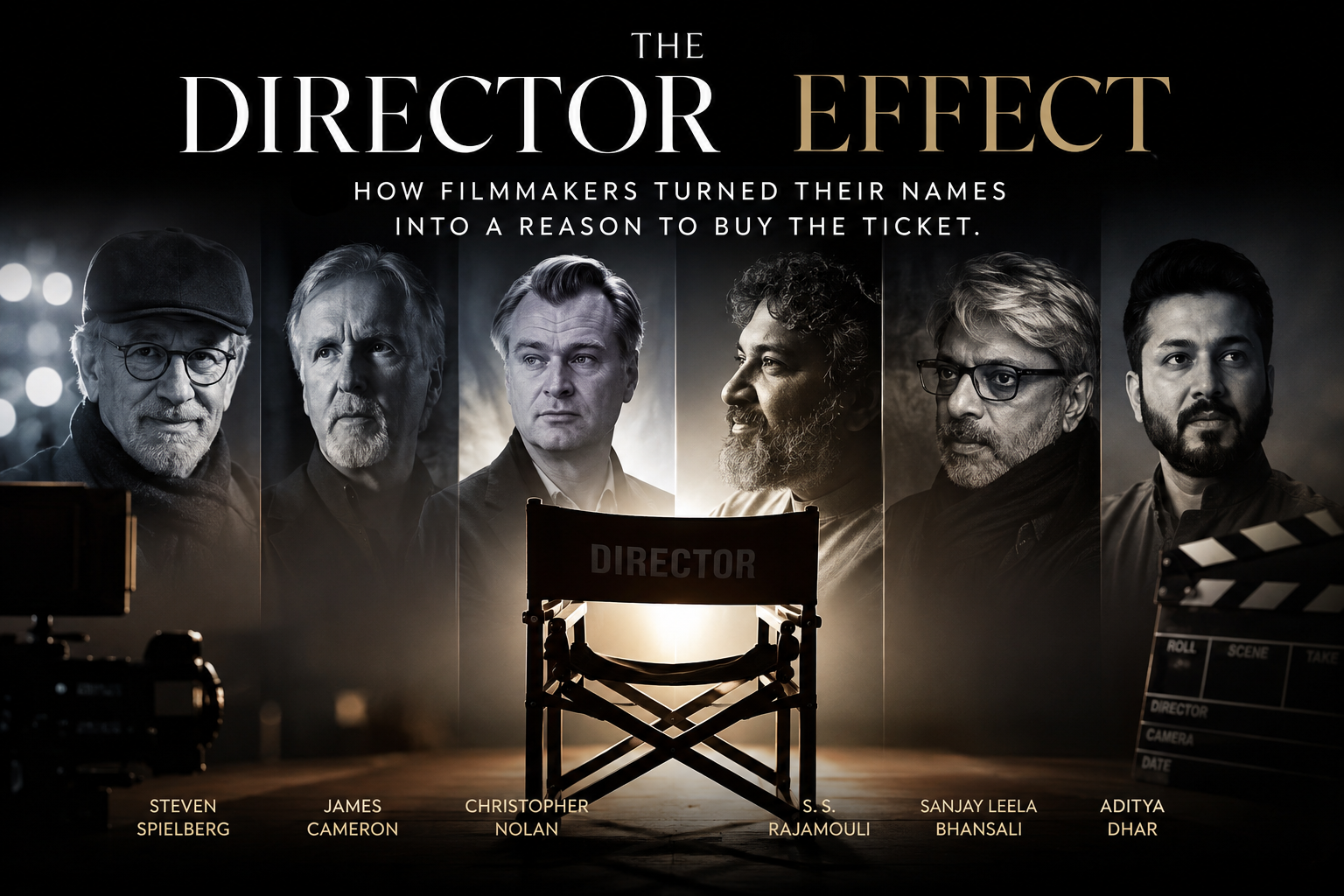
How cinema’s most successful filmmakers turned their names into a reason to buy the ticket.
There was a time when the name above a film’s title usually belonged to the star.
The actor was the attraction. The face was the campaign. The opening weekend belonged to the celebrity whose name appeared largest on the poster.
The director was often the person behind the curtain.
That relationship has changed.
Today, a select group of filmmakers have developed something remarkably powerful: a name that carries its own promise.
A Nolan film suggests one kind of experience. A Spielberg film another. A Cameron film another. In India, Rajamouli, Bhansali and, increasingly, Aditya Dhar have begun building similarly recognisable creative identities.
The audience may not know every detail of the story.
They may not even need to.
The filmmaker’s name already tells them something about what they are about to experience.
Scale.
Craftsmanship.
Aesthetic.
Ambition.
Emotion.
Spectacle.
That is when a director stops being simply the person who made the film.
The director becomes part of the reason to see it.
When the Name Becomes the Attraction
The interesting shift isn’t that directors have become famous.
Great directors have always been famous.
The shift is that their names increasingly influence the audience’s decision to watch the film itself.
Christopher Nolan offers perhaps the clearest contemporary example.
The Odyssey arrived in 2026 with an extraordinary cast including Matt Damon, Tom Holland, Anne Hathaway, Lupita Nyong’o and Zendaya. Yet the conversation surrounding the film was never simply about its cast.
It was about a Christopher Nolan film.
The film opened to $264.1 million worldwide and went on to cross $1.4 billion globally, demonstrating the extraordinary theatrical power that can now surround a filmmaker’s name.
The significance goes beyond the numbers.
Nolan has reached a point where audiences can recognise the experience before they know the story.
That is brand recognition.
Christopher Nolan — The Event Maker
Nolan’s greatest achievement may not be any individual film.
It may be that he has transformed the act of going to the cinema into part of his identity as a filmmaker.
IMAX.
Large-format film.
Practical effects.
Immersive sound.
Complex narratives.
Scale.
Mystery.
His films arrive with a sense of occasion.
His relationship with IMAX has become particularly important to that identity. The Odyssey generated an extraordinary opening for the format, reinforcing the idea that Nolan’s films are designed not merely to be watched but to be experienced theatrically.
Nolan therefore sells something more than a story.
He sells the experience of cinema itself.
That is why audiences can become interested in a Nolan film before they know exactly what happens in it.
The name tells them enough.
Steven Spielberg — The Pioneer
Long before directors were discussed as personal brands, Steven Spielberg had already established the model.
Jaws didn’t simply become a hit.
It helped define the modern blockbuster.
Spielberg’s name eventually came to represent something unusually broad:
Adventure.
Emotion.
Spectacle.
Humanity.
Family.
History.
Science fiction.
The remarkable part is the range.
A Spielberg film doesn’t have to belong to one genre to feel like a Spielberg film.
That is one of the defining characteristics of a mature creative brand.
The identity survives the category.
His name became associated with a particular standard of mainstream cinematic storytelling, helping establish the idea that the filmmaker could become part of the commercial identity of a movie.
Decades later, the name still carries that accumulated trust.
And that is perhaps the purest form of brand equity:
recognition built over time.
James Cameron — The Spectacle
If Spielberg helped build the modern blockbuster, James Cameron pushed the idea of spectacle into technological territory.
Titanic, Avatar and Avatar: The Way of Water place Cameron in an extraordinarily rare commercial category.
But the more interesting part isn’t simply their box-office performance.
It is the way Cameron approaches technology.
He doesn’t merely use new tools.
He frequently pushes the industry to develop them.
For Avatar, his production team developed new approaches to performance capture, virtual environments and 3D filmmaking to realise the world he had imagined.
The technology became part of the storytelling.
That has become part of the Cameron promise.
When a Cameron film arrives, audiences expect something that stretches the boundaries of what cinema can physically display.
The technology becomes part of the spectacle.
And the director becomes the guarantee.
India’s Director-Brand Era
The phenomenon isn’t uniquely American.
In fact, some of the most interesting examples are emerging from India.
Indian cinema has always had powerful stars, but a new generation of filmmakers has demonstrated that a director’s name can carry an increasingly independent form of commercial and cultural value.
The difference is subtle.
The audience isn’t simply asking who is acting in the film.
It is beginning to ask:
Who is creating this world?
S. S. Rajamouli — The Global Phenomenon
S. S. Rajamouli may be the clearest contemporary example of an Indian filmmaker whose name has become associated with a global theatrical proposition.
Baahubali established the scale.
RRR expanded the international audience.
His cinema carries a recognisable promise:
Mythology.
Emotion.
Heroism.
Music.
Large-scale action.
World-building.
Spectacle.
But Rajamouli’s influence has increasingly travelled beyond the traditional boundaries of Indian cinema.
His international reception and the global ambitions surrounding his upcoming projects demonstrate how far that directorial identity has travelled.
The important shift is that Rajamouli is no longer simply exporting individual films.
He is exporting a cinematic language.
Audiences increasingly understand what a Rajamouli experience promises before the opening frame.
That is a powerful form of authorship.
Sanjay Leela Bhansali — The Aesthetic
If Rajamouli’s name promises spectacle, Sanjay Leela Bhansali’s promises something more intimate:
a world.
Mention Bhansali and an audience can almost imagine the frame before seeing it.
Architecture.
Jewellery.
Textiles.
Music.
Choreography.
Romance.
Colour.
Light.
Grandeur.
His films have developed such a distinctive visual vocabulary that the director’s name itself functions almost like an aesthetic category.
That is a particularly sophisticated form of brand recognition.
A luxury house can communicate through a silhouette.
An architect can communicate through proportion.
A watchmaker can communicate through a movement.
Bhansali communicates through the frame.
His films feel authored down to the smallest detail.
The sets, costumes, musical sequences and compositions all belong to the same universe.
And that consistency creates expectation.
The audience knows what kind of world it is entering.
The question isn’t whether it will be beautiful.
The question is how Bhansali will make beauty feel this time.
Aditya Dhar — The New Force
Aditya Dhar represents a different stage of director-brand power.
His career is considerably younger than those of Spielberg, Cameron, Nolan, Rajamouli or Bhansali, but that is precisely what makes his rise interesting.
Uri: The Surgical Strike established his directorial identity through political tension, action and a grounded sense of scale.
The Dhurandhar films expanded that identity dramatically.
The commercial response has demonstrated that Dhar is increasingly associated with a particular cinematic proposition: political narratives, high-stakes action, technical ambition and large-scale world-building.
That matters because a director does not necessarily need decades to build a recognisable identity anymore.
In an environment where audiences are exposed to more content than ever, a distinctive creative voice can become recognisable remarkably quickly.
Dhar represents the newer model of the director as a commercial force.
His story is still being written.
But the audience is beginning to recognise the promise.
The Director as a Luxury Brand
This is where cinema begins to resemble luxury.
A luxury house doesn’t simply sell an object.
It sells an expectation.
You don’t choose a watch only because it tells time.
You choose its history, craftsmanship, design language and reputation.
You don’t choose a fashion house merely because it produces clothing.
You choose its interpretation of clothing.
The same principle increasingly applies to filmmakers.
A Nolan film promises one kind of experience.
A Cameron film another.
A Rajamouli film another.
A Bhansali film another.
The audience is not simply purchasing a ticket.
It is purchasing an expectation of authorship.
That is the real shift.
From Star Power to Auteur Power
For decades, cinema was built around the star system.
The actor was the brand.
The actor’s face sold the poster.
The actor’s name drove the opening.
That power hasn’t disappeared.
But audiences now have another way of choosing.
Franchises have multiplied.
Streaming has expanded the amount of content available.
The number of films competing for attention has become enormous.
In that environment, a recognisable creative voice becomes valuable.
A filmmaker with a distinct identity provides something a new concept otherwise lacks:
trust.
The audience may not know the entire story.
But they know the person telling it.
And sometimes that is enough.
The New Currency Is Expectation
Perhaps the most valuable thing a filmmaker can build is not fame.
It is expectation.
When a director reaches that level, a new project becomes news before the trailer arrives.
A new Nolan project becomes an event.
A new Cameron project becomes an event.
A new Rajamouli project becomes an event.
A new Bhansali project becomes an event.
The filmmaker’s previous work has already performed part of the marketing.
The reputation precedes the film.
That is exactly how powerful luxury brands operate.
The name creates anticipation before the object is experienced.
The Risk of Becoming a Brand
There is, however, a paradox.
A brand creates expectations.
And expectations can become a prison.
The more recognisable a filmmaker becomes, the more audiences expect the next film to resemble the last.
Nolan must remain Nolan.
Bhansali must remain Bhansali.
Rajamouli must remain Rajamouli.
But if a signature becomes too predictable, it can become formula.
The strongest creative brands therefore face the same challenge as the strongest luxury houses:
How do you remain recognisable without becoming predictable?
The answer is evolution.
Preserve the philosophy.
Change the expression.
A signature should be a foundation, not a cage.
The Future Belongs to the Signature
The future of theatrical cinema will not belong entirely to actors.
Nor will it belong exclusively to franchises.
Both will remain powerful.
But as audiences become more selective about which films deserve their time, money and attention, authorship becomes increasingly valuable.
A filmmaker with a recognisable voice offers something a generic production cannot.
A reason to anticipate.
A reason to care.
A reason to believe the experience will be different.
That may explain why the modern director is becoming something more than the person who makes the film.
The director is becoming part of the reason the film exists in the audience’s imagination before it arrives.
The Director Is the Brand
The most interesting evolution in cinema may therefore be happening above the title.
Not in the cast list.
Not in the franchise logo.
But in the name of the person who imagined the world.
Spielberg built the modern blockbuster.
Cameron turned technology into spectacle.
Nolan turned theatrical cinema into an event.
Rajamouli transformed scale into a global Indian cinematic language.
Bhansali turned visual beauty into authorship.
Dhar is demonstrating how quickly a contemporary filmmaker can build a commercial identity around a distinct worldview.
Six directors.
Six different forms of influence.
But one underlying shift.
The audience isn’t always asking:
“What is this film about?”
Increasingly, it is asking:
“Who made it?”
And when the answer itself is enough to make someone buy a ticket, the filmmaker has crossed an important line.
They are no longer simply making the brand.
They have become the brand.
INSYDE — Beyond the Spotlight.