
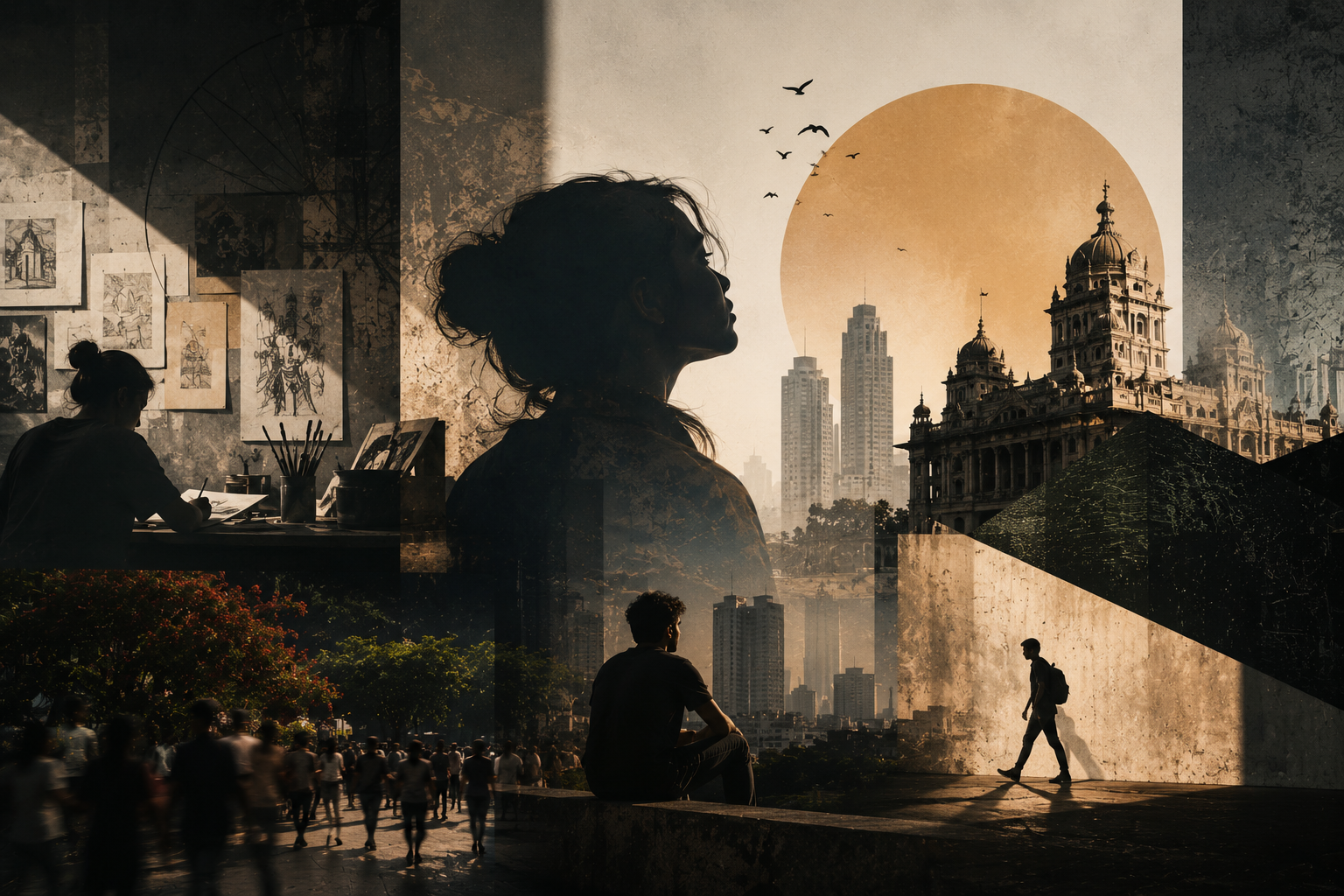
Bengaluru has always been a city of ideas. But something is changing.
For decades, the city has been defined by technology.
Startups. Software. Engineers. Global companies. Venture capital. The familiar image of Bengaluru as India’s technology capital has become so powerful that it can sometimes feel like the entire city has been reduced to one identity.
But spend enough time here and another Bengaluru begins to appear.
It exists in small studios and independent cafés. In rehearsal rooms, galleries, design offices, music venues and photography collectives. It exists in the people building brands from their bedrooms, artists experimenting with new mediums, musicians creating without waiting for a record label, designers turning ideas into businesses and young people trying to build careers that don’t fit neatly into traditional job titles.
This is the Bengaluru we want to look at.
This is INSYDE.
A city built on what comes next
Bengaluru has a long relationship with experimentation.
Its reputation as India’s technology and startup capital didn’t happen overnight. The city developed an ecosystem where engineers, entrepreneurs, researchers and investors could collide and create something new. More recently, that appetite for experimentation has extended well beyond technology.
The city’s cultural ecosystem has grown alongside its economic one. Museums, independent cultural spaces, festivals, theatres, music communities and creative institutions have created more places for ideas to meet. The World Cities Culture Forum describes Bengaluru as a city with a varied cultural offering, a growing nightlife scene, a large reading community and a diverse population.
Recent cultural initiatives have also attempted to position Bengaluru not only as a technology capital, but as a cultural force. UnboxingBLR, for example, has focused on understanding and strengthening the city’s cultural identity through data, events and citywide initiatives.
And perhaps that’s the interesting part.
Bengaluru doesn’t have to choose between technology and culture.
It can be both.
The people behind the city
Cities aren’t really defined by their buildings.
They’re defined by the people who give those buildings a reason to exist.
The founder working from a tiny office.
The illustrator taking commissions between two jobs.
The designer launching a label with five pieces.
The musician playing a small venue before anyone knows their name.
The filmmaker making something with a handful of friends.
The photographer documenting a neighbourhood before it becomes fashionable.
The chef experimenting with what Indian food can become.
The architect thinking about what an Indian city should look like.
The creator turning a phone, an idea and an internet connection into a career.
These people may not have millions of followers.
They may not appear on magazine covers.
They may not have investors, publicists or blue ticks.
But they are often the people who make a city interesting.
And that’s where we think the story begins.
Beyond the startup narrative
There is nothing wrong with Bengaluru being India’s technology capital.
In fact, it’s an extraordinary part of the city’s story.
But the technology narrative can sometimes overshadow everything else.
Ask someone about Bengaluru and you’ll probably hear about startups, traffic, weather, cafés, IT parks and the tech industry.
Ask someone who actually spends time inside the city’s creative communities, however, and you’ll hear a much longer story.
You’ll hear about independent artists.
About theatre.
About fashion.
About music.
About food.
About design.
About photography.
About architecture.
About books.
About communities.
About people building things simply because they believe they should exist.
That is a different version of Bengaluru.
And perhaps it deserves more attention.
The new ambition
There is also something changing about ambition itself.
For an earlier generation, success could be easier to define.
Get a good degree.
Get a good job.
Build a career.
Buy a house.
Move up.
Today, the definition is messier.
A young person might work in technology during the day and make music at night.
Someone might have a full-time job while building a fashion label.
An artist might sell work through Instagram.
A creator might build a business without ever having an office.
A designer might become an entrepreneur.
An entrepreneur might become a content creator.
The boundaries between professions are disappearing.
And Bengaluru is a particularly interesting place to watch this happen because technology, entrepreneurship and creative culture already exist side by side.
The British Council’s research into arts and technology in India highlights Bengaluru as one of the places where practitioners are exploring how technology can become a creative medium, while artists use their work to question and reinterpret technology itself.
The interesting question isn’t simply:
“What job do you have?”
It’s becoming:
“What are you building?”
A city that keeps reinventing itself
Bengaluru has changed dramatically over the years.
The city of today is not the city of twenty years ago.
And the city that exists ten years from now probably won’t resemble today’s Bengaluru either.
That’s what makes it worth documenting.
Every generation leaves something behind.
New businesses.
New music.
New aesthetics.
New neighbourhoods.
New communities.
New ideas.
New problems.
New solutions.
New definitions of what it means to belong to the city.
Technology may have helped Bengaluru become globally important.
But culture is what helps a city develop a personality.
And Bengaluru has plenty of personality.
So, what is INSYDE?
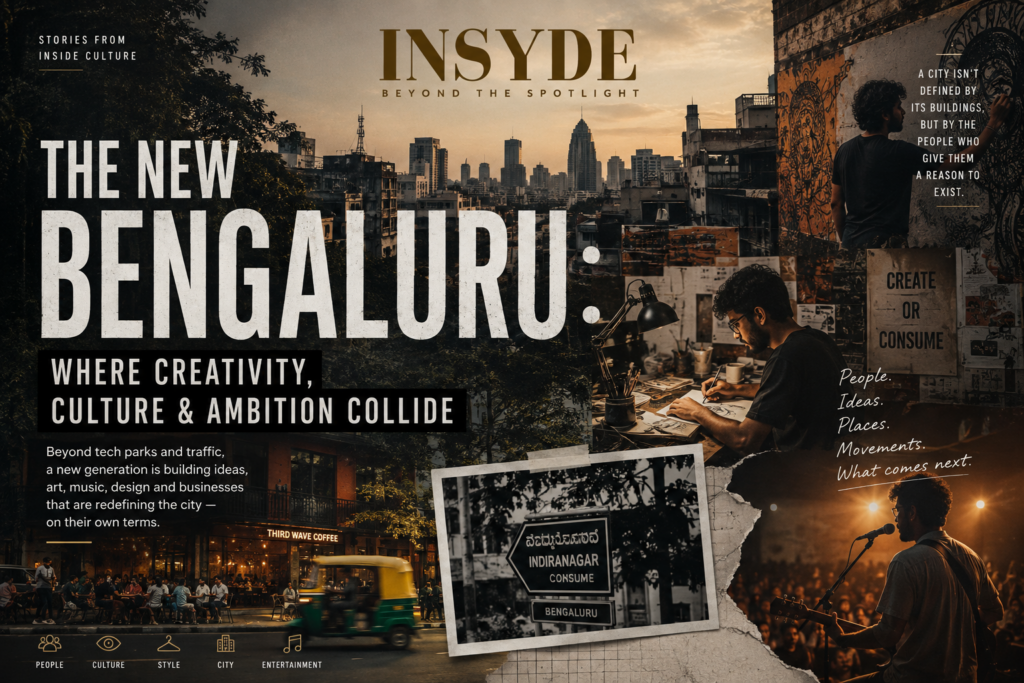
INSYDE is an independent media platform starting in Bengaluru.
We’re interested in the people, ideas, places and movements shaping what comes next.
Not only the famous.
Not only the successful.
Not only the people who already have an audience.
We’re interested in the ones building quietly.
The ones experimenting.
The ones taking risks.
The ones creating something from nothing.
The ones who might be unknown today and impossible to ignore tomorrow.
We’ll talk to artists, designers, founders, musicians, filmmakers, architects, creators, chefs, photographers and anyone else who is pushing culture forward.
We’ll look at the places where new ideas are emerging.
We’ll explore the city’s changing relationship with fashion, technology, art, music, food and identity.
And we’ll try to ask better questions along the way.
Because we don’t want INSYDE to simply tell you who is already important.
We want to help you discover who might become important next.
Bengaluru is only the beginning
We’re starting here because this city gives us something special.
A collision of technology and tradition.
Ambition and creativity.
Local culture and global influence.
Old neighbourhoods and new ideas.
People from across India and around the world.
Bengaluru is complicated.
It’s exciting.
It’s frustrating.
It’s constantly changing.
And sometimes it feels like five different cities occupying the same space.
That’s exactly why we’re interested.
Because somewhere between the traffic, the startups, the cafés, the apartments, the studios, the stages and the streets is a generation quietly creating a new version of the city.
We want to meet them.
We want to understand them.
And we want to tell their stories.
This is the beginning.
Welcome to INSYDE.