Inside the films pushing Indian cinema into a new era of scale, technology and global ambition
By INSYDE Editorial Desk
Data & Research: INSYDE Editorial Desk | Ormax Media
Research updated: 29 September 2026
Indian cinema has entered a different kind of arms race.
The biggest films are no longer competing only on star power, opening-day collections or the number of languages in which they release. They are competing on scale — the size of their worlds, the sophistication of their visual effects, the reach of their international campaigns and, increasingly, the amount of capital required to put them on screen.
A new generation of Indian productions is now being mounted at extraordinary financial scale.
Ramayana has been associated with a ₹4,000-crore project figure. Varanasi has been reported at approximately ₹1,300–1,400 crore. Raaka has been reported at more than ₹1,000 crore, while Kalki 2898 AD: Part 2 and Fauzi are being discussed in the ₹600–700-crore range.
But there is an important distinction.
These numbers are not directly comparable production budgets.
Some are industry estimates. Some include marketing and release expenditure. Ramayana’s ₹4,000-crore figure covers two films rather than one. Several producers have not publicly disclosed audited production costs.
So the more useful question is not simply which movie costs the most?
It is:
Why is Indian cinema willing to spend at this scale — and what does that tell us about the future of the business?
THE FIVE MEGA-PRODUCTIONS TO WATCH
| Film | Reported / Estimated Scale | Current Status | Expected Release |
|---|---|---|---|
| Ramayana: Part 1 & Part 2 | ~₹4,000 Cr* | Part 1 completed / global rollout underway | Part 1: 6 Nov 2026; Part 2: 2027 |
| Varanasi | ~₹1,300–1,400 Cr** | In production | 7 Apr 2027 |
| Raaka | ₹1,000 Cr+** | In production | 2027 |
| Kalki 2898 AD: Part 2 | ~₹700 Cr*** | Regular shoot begins Oct 2026 | TBA |
| Fauzi | ~₹600–700 Cr** | In production / postponed | TBA |
* The ₹4,000-crore figure covers both Ramayana films, including release and promotional costs, according to Yash. (India Today)
** Reported industry estimate; not an audited producer-disclosed budget. (NDTV)
*** Reported estimate rather than an officially confirmed production budget. (DPIFF)
01 — RAMAYANA
The ₹4,000-Crore Global Project
Few Indian films have generated as much conversation about scale as Ramayana.
Directed by Nitesh Tiwari and led by Ranbir Kapoor as Rama, Sai Pallavi as Sita and Yash as Ravana, the two-part epic is being developed as an international-scale cinematic adaptation of one of India’s most enduring stories.
The headline number, however, needs context.
The much-discussed ₹4,000 crore is not the production cost of Part One alone. In August 2026, Yash, who is also a co-producer, clarified that the figure covers both films along with release and promotional expenditure. (India Today)
That makes Ramayana less useful as a conventional single-film budget comparison and more interesting as a large-scale entertainment project.
Part One is scheduled to release internationally on 6 November 2026, ahead of the Diwali weekend, with the second instalment planned for 2027. (India Today)
The production also has an unusually international creative infrastructure. Its official promotional material identifies DNEG as the VFX partner, with the film being designed for IMAX presentation and featuring music by Hans Zimmer and A.R. Rahman. (YouTube)
THE BUSINESS OF MYTHOLOGY
The commercial proposition behind Ramayana is bigger than a familiar story.
It is the attempt to turn Indian mythology into globally marketable cinematic intellectual property.
The source material already possesses enormous cultural recognition. The investment is therefore being directed toward translating that recognition into a modern theatrical spectacle — one that can travel beyond India’s linguistic and geographical markets.
That requires world-building, visual effects, international distribution, marketing and premium theatrical presentation.
In other words, the investment is not simply in actors.
It is in building an entertainment property at global scale.
02 — VARANASI
Rajamouli’s Global Gamble
S. S. Rajamouli has spent the past decade demonstrating that the commercial ceiling of Indian cinema can be much higher than its traditional regional boundaries.
Varanasi may be his most ambitious experiment yet.
Starring Mahesh Babu, Priyanka Chopra Jonas and Prithviraj Sukumaran, the action-adventure is being mounted on a reported budget of approximately ₹1,300–1,400 crore. Different reports have cited figures in this range, and the exact audited production cost has not been publicly established. (Bollywood Hungama)
The film has an officially announced theatrical release date of 7 April 2027. (India Today)
Its production ambitions extend well beyond conventional Indian locations. Reporting around the film has highlighted international locations including Africa and Antarctica, while the project is being designed around large-scale action and IMAX presentation. (NDTV)
THE PAN-INDIA MODEL HAS EVOLVED
The first generation of pan-India cinema was largely about taking a successful regional film into other Indian markets.
The next generation is being designed differently.
The film itself is being conceived for multiple markets from the beginning.
That means:
Indian theatrical markets
International Indian audiences
Premium formats
Overseas distribution
Streaming
Global publicity
Varanasi therefore represents a bigger commercial experiment than simply making an expensive Telugu film.
It asks whether an Indian director can build a blockbuster whose production language and commercial ambition are genuinely global.
03 — RAAKA
Allu Arjun’s ₹1,000-Crore Franchise Bet
Raaka may offer the clearest example of Indian cinema moving toward the franchise economy.
Directed by Atlee and starring Allu Arjun, the project has been reported by India Today as being mounted at more than ₹1,000 crore and planned as a two-part franchise. (India Today)
The reported narrative spans two worlds and timelines, including a Puranic/Vedic-era setting and a contemporary world.
That structure is significant.
Instead of investing heavily in one contained story, the production is reportedly building a larger mythology capable of supporting multiple films.
And the project is still evolving. As of September 2026, Allu Arjun has acknowledged that production is taking time, while current reporting places the film in the 2027 release window without a firmly announced date. (Hindustan Times)
The film has also recently attracted attention for its use of large-scale motion-capture technology, underlining how much of the production’s ambition lies beyond conventional live-action filmmaking. (The Indian Express)
FROM MOVIE TO UNIVERSE
The economics of a franchise are fundamentally different from those of a standalone film.
A successful movie can create:
Characters → audience loyalty → sequels → merchandise → streaming value → music → licensing → future theatrical events
That is the model global entertainment companies have spent decades developing.
Indian cinema is increasingly moving in the same direction.
And Raaka is particularly interesting because its reported budget is being paired with a multi-part structure and multiple cinematic worlds.
The investment is therefore not only in making one movie.
It is in creating something that could potentially become an entertainment universe.
04 — KALKI 2898 AD: PART 2
When the Franchise Becomes the Product
Kalki 2898 AD demonstrated that Indian cinema could combine mythology, science fiction and large-scale visual effects into a commercially ambitious theatrical property.
Now, the sequel is preparing to expand that universe.
Industry estimates have placed Kalki 2898 AD: Part 2 at around ₹700 crore, although the figure has not been officially confirmed by the producers. (DPIFF)
Director Nag Ashwin has now confirmed that regular filming is scheduled to begin in October 2026, with the team hoping to complete the shoot by the middle of 2027 before moving into post-production. He has also indicated that the film could arrive in 2028, although no final release date has been announced. (The Times of India)
Prabhas, Amitabh Bachchan and Kamal Haasan remain central to the project.
But the most valuable asset may not be the cast.
It is the Kalki world itself.
The first film established the mythology, characters, visual language and futuristic environment. The sequel therefore doesn’t have to spend its entire narrative introducing audiences to a new universe.
It can expand it.
THE VALUE OF EXISTING IP
This is one of the most important economic shifts in contemporary Indian cinema.
A successful franchise can reduce one of the most difficult problems facing expensive films:
building audience familiarity from zero.
The audience already knows the world.
That gives the sequel a foundation on which to build bigger action, deeper mythology and more ambitious visual effects.
But it also raises the stakes.
A ₹700-crore film cannot simply look expensive.
It has to feel like an event.
05 — FAUZI
The ₹600–700-Crore Historical Bet
Not every mega-budget Indian film is built around mythology or futuristic worlds.
Fauzi is taking the historical route.
Directed by Hanu Raghavapudi and starring Prabhas, the period action drama is set against the backdrop of pre-Independence India and has been reported at an estimated ₹600–700 crore. (@theweek)
The film was originally scheduled for 3 December 2026, but producer Y. Ravi Shankar confirmed in September that the release has been postponed. A new date has not yet been announced, with the film now expected to move into 2027. (India Today)
The delay itself illustrates the economics of large-scale filmmaking.
Period films require extensive physical reconstruction:
Sets.
Costumes.
Vehicles.
Crowds.
Weapons.
Locations.
Action choreography.
Visual effects.
And when the production is designed as a pan-India theatrical event, the post-production burden grows further.
SCALE AS IMMERSION
The objective of a historical epic is not simply to show the past.
It is to reconstruct it convincingly enough for an audience to enter it.
That makes production design and post-production central to the business.
And Fauzi demonstrates an important reality of mega-budget cinema:
sometimes the most expensive part of a film is not what the camera captures — but everything required to make the world outside the camera believable.
THE ₹1,000-CRORE QUESTION
The real story behind these films isn’t simply that Indian cinema is spending more.
It is that the market underneath those investments is changing.
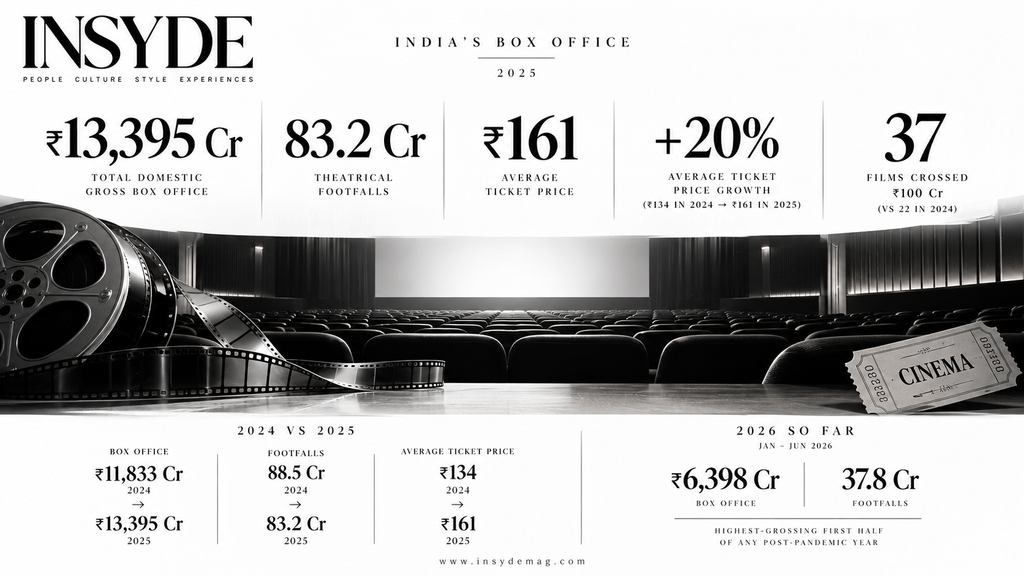
India’s domestic box office reached a record ₹13,395 crore in 2025, making it the first year to cross the ₹13,000-crore mark. But the same year also saw theatrical footfalls decline 6% to 83.2 crore, while average ticket price rose 20%, from ₹134 to ₹161. (Ormax Media Pvt. Ltd.)
That combination is revealing.
The theatrical market is generating more money without requiring proportionally more admissions.
In other words, premiumisation matters.
Higher ticket prices, premium formats and event-driven releases are becoming increasingly important to the economics of theatrical cinema.
And 2026 has continued that momentum.
By the end of August, Indian domestic box office collections for films released during the year had reached ₹9,868 crore, 18% higher than the corresponding period in 2025. August alone generated ₹1,768 crore, making it the strongest month of 2026 so far and the third-highest-grossing month ever recorded in India’s domestic market. (Ormax Media Pvt. Ltd.)
The market is therefore providing a stronger foundation for large theatrical events.
But a stronger market does not make a ₹1,000-crore production automatically safe.
THE NEW BLOCKBUSTER ECONOMY
A film’s production budget and its box-office gross are not the same thing.
This distinction becomes critical at the top end of the market.
A major Indian film can generate revenue from multiple sources:
Theatrical rights
Overseas distribution
Streaming rights
Satellite rights
Music rights
Brand partnerships
Merchandising and licensing
At the same time, costs can extend far beyond principal photography:
Production
Star remuneration
Sets and locations
Visual effects
Post-production
Marketing
Distribution and release
This is why a ₹700-crore budget does not mean a film simply needs to collect ₹700 crore at the box office to recover its investment.
Theatrical gross is distributed across the exhibition and distribution ecosystem, while non-theatrical rights can contribute substantially to the overall financial model.
For mega-budget cinema, the question is therefore not:
“How much did the movie collect?”
It is:
“How much value did the entire property generate across its life cycle?”
That is a much more sophisticated way of looking at the modern Indian film business.
WHY INDIAN CINEMA IS GOING BIGGER
01 — PAN-INDIA IS NOW AN ECONOMIC STRATEGY
The success of films travelling across language markets has fundamentally changed the way major productions are conceived.
A large-scale film can now be designed for Hindi, Telugu, Tamil, Kannada and Malayalam audiences from the outset, rather than being created for one market and expanded later.
The addressable audience becomes larger.
So does the investment required to reach it.
02 — THE GLOBAL INDIAN AUDIENCE MATTERS
Indian cinema’s commercial opportunity is no longer restricted to India.
Large diaspora markets across North America, the Gulf, the UK, Australia and elsewhere provide additional theatrical and streaming audiences.
For a production carrying hundreds of crores in costs, international distribution can therefore become part of the core business strategy rather than an afterthought.
Ramayana is perhaps the clearest current example of this approach, with its makers explicitly framing the project around a global audience and global release and promotional economics. (India Today)
03 — VFX IS NO LONGER A FINISHING TOUCH
Visual effects have moved from being a supporting element to becoming a fundamental part of Indian blockbuster production.
In films such as Ramayana, Varanasi and Kalki, entire environments, creatures, action sequences and worlds depend on digital production.
That requires:
Longer post-production schedules.
Specialised international teams.
Advanced motion capture.
Virtual environments.
Digital set extensions.
High-end compositing.
The technology makes bigger films possible.
It also makes them considerably more expensive.
04 — THE STAR HAS BECOME A GLOBAL ASSET
Ranbir Kapoor.
Yash.
Mahesh Babu.
Allu Arjun.
Prabhas.
These names represent more than casting.
For a mega-budget production, a major star can influence:
Opening demand.
Language-market penetration.
Overseas awareness.
Brand partnerships.
Distribution leverage.
The Indian superstar is increasingly becoming part of the film’s international commercial architecture.
05 — CINEMA NEEDS TO FEEL LIKE AN EVENT
Streaming has made entertainment more accessible than ever.
That creates a difficult question for theatrical cinema:
Why should audiences leave home?
The answer increasingly appears to be spectacle.
IMAX.
Premium screens.
Large-format sound.
Massive action sequences.
Mythology.
Science fiction.
Historical worlds.
International locations.
Major stars.
The modern blockbuster is being designed to offer something that a phone, laptop or ordinary television cannot easily replicate.
An experience.
THE RISK OF SCALE
There is another side to the mega-budget revolution.
Scale increases both opportunity and exposure.
A ₹200-crore film and a ₹1,000-crore project do not carry the same financial risk.
The larger the investment, the more sensitive the production becomes to:
- release timing
- production delays
- visual-effects delivery
- marketing efficiency
- distribution
- audience demand
- premium-screen availability
- international performance
A delay can increase costs.
A crowded release calendar can affect screen availability.
A production overrun can materially change the financial equation.
And if audiences decide that a spectacle is not worth the price of admission, the size of the investment can become its greatest vulnerability.
This is why India’s mega-budget era should not simply be described as Indian cinema becoming richer.
It is more accurately understood as the industry moving toward higher-stakes entertainment assets.
THE NEW POWER MAP OF INDIAN CINEMA
There is another story hiding inside these five productions.
A significant share of India’s current mega-budget pipeline is connected to the Telugu film industry and its wider production ecosystem.
Varanasi.
Raaka.
Kalki 2898 AD: Part 2.
Fauzi.
This reflects a broader transformation in Indian cinema.
Over the past decade, Telugu filmmaking has developed a commercially powerful model combining:
large-scale spectacle + star power + multilingual distribution + visual effects + international ambition.
Rajamouli’s Baahubali and RRR were important milestones in that evolution.
The current generation is taking the model further.
At the same time, Ramayana demonstrates that the Hindi industry is also moving toward the same global-scale production philosophy.
The old Bollywood-versus-South framework is becoming increasingly inadequate at the highest end of the market.
The next generation of Indian blockbusters may be better understood as Indian entertainment properties, rather than films belonging neatly to one regional industry.
THE FINAL FRAME
India’s next generation of blockbuster films is not simply getting more expensive.
It is becoming more global, more technological and more franchise-driven.
Ramayana is attempting to transform mythology into a global cinematic property.
Varanasi is pushing Rajamouli’s spectacle into an increasingly international production model.
Raaka is being built around the economics of multiple worlds and a potential franchise.
Kalki 2898 AD: Part 2 is expanding an established science-fiction universe.
Fauzi is investing hundreds of crores in historical spectacle and theatrical immersion.
Together, these films represent something larger than a list of expensive productions.
They represent a fundamental question for the next phase of Indian cinema:
CAN INDIA BUILD BLOCKBUSTERS AT GLOBAL SCALE — AND BUILD A BUSINESS THAT CAN SUSTAIN THE COST?
The answer will not be found in budget announcements alone.
It will be measured across theatrical admissions, ticket prices, premium formats, overseas markets, streaming rights, distribution deals and the long-term value of the intellectual properties these films create.
Because the next era of Indian cinema may not be defined by who can make the most expensive film.
It may be defined by who can turn extraordinary production scale into an extraordinary entertainment business.
And that is where the real ₹1,000-crore story begins.
EDITORIAL RESEARCH NOTE
Budget figures in this feature are presented as reported or estimated figures, not as uniformly audited production budgets. The figures are particularly difficult to compare because they can include different combinations of production, visual effects, marketing, release and multi-film expenditure.
The ₹4,000-crore Ramayana figure specifically covers both parts of the project along with release and promotional expenditure, as clarified by co-producer Yash. (India Today)
Varanasi‘s reported budget ranges around ₹1,300–1,400 crore, while Raaka has been reported at ₹1,000 crore-plus. Kalki 2898 AD: Part 2 has been widely estimated at around ₹700 crore, and Fauzi at approximately ₹600–700 crore. These latter figures remain estimates rather than producer-confirmed audited budgets. (NDTV)
Toxic has deliberately not been included in this upcoming-film list because it released theatrically on 26 August 2026. (India Today)
Primary market-data source: Ormax Media, The Ormax Box Office Report 2025 and The India Box Office Report: August 2026. (Ormax Media Pvt. Ltd.)
INSYDE | PEOPLE · CULTURE · STYLE · EXPERIENCES