

The ₹13,395 Crore Business of Indian Cinema
India’s film economy is no longer a one-industry story. Hindi cinema has reclaimed the top spot at record scale, while Telugu, Tamil, Malayalam and Kannada cinema continue to build powerful theatrical markets of their own.
For decades, the global shorthand for Indian cinema was simple: Bollywood.
But the economics of the country’s theatrical market tell a far more complex story.
India is home to several large film industries, each with its own stars, studios, audiences, distribution networks and cultural identity. Hindi cinema remains the country’s largest theatrical language market, but Telugu and Tamil cinema operate at enormous commercial scale, Malayalam cinema has established itself as a major force, and Kannada cinema delivered one of the market’s sharpest recoveries in 2025.
The numbers underline just how large the business has become.
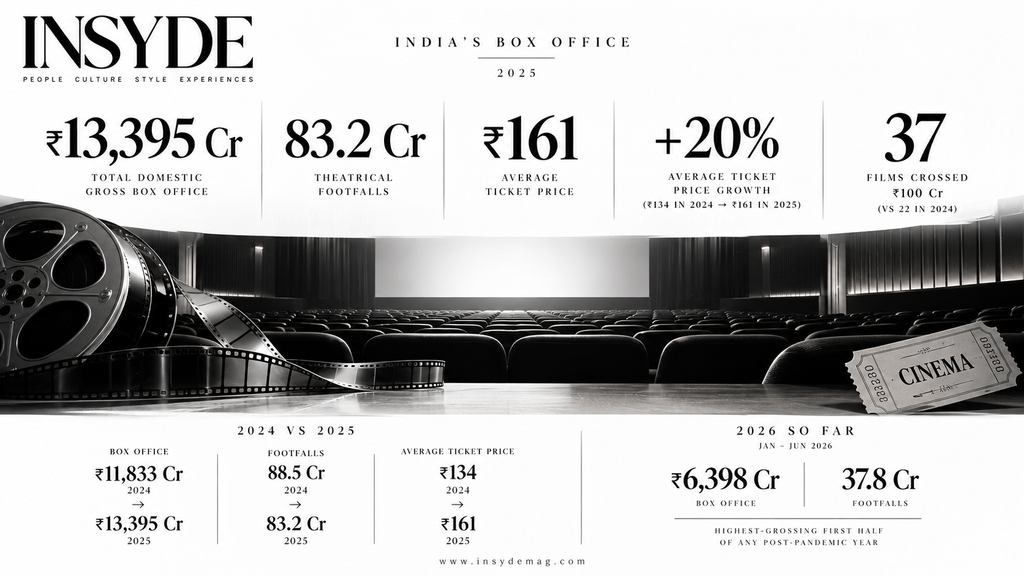
In 2025, India’s domestic theatrical box office reached ₹13,395 crore — the highest annual gross in the history of the Indian market and the first time the country crossed the ₹13,000 crore mark. The previous record was ₹12,226 crore in 2023.
But the headline number comes with an important qualification.
India recorded 83.2 crore theatrical footfalls in 2025, down 6% from 2024, while the average ticket price rose 20%, from ₹134 to ₹161. The record box office was therefore driven not simply by larger audiences, but also by audiences paying more for cinema.
And within that record market, five Indian language industries stood out.

THE FIVE BIGGEST
| Rank | Industry | 2025 Gross Box Office | Share of India |
|---|---|---|---|
| 01 | Hindi | ₹5,504 Cr | 41% |
| 02 | Telugu | ₹2,377 Cr | 18% |
| 03 | Tamil | ₹1,805 Cr | 13% |
| 04 | Malayalam | ₹1,164 Cr | 9% |
| 05 | Kannada | ₹528 Cr | 4% |
Source: Ormax Media, The Ormax Box Office Report 2025. Figures represent domestic gross box office and are rounded.
Together, these five language markets generated approximately ₹11,378 crore, or about 85% of India’s total 2025 theatrical box office.
But the real story isn’t simply who collected the most.
It is how each industry is evolving.
01 — HINDI CINEMA
₹5,504 CRORE
The giant returns to record territory.
Hindi cinema remained India’s largest theatrical market in 2025 — and reached a new high.
The Hindi-language market generated ₹5,504 crore in domestic gross box office, making 2025 its best year ever. Hindi accounted for approximately 41% of India’s total theatrical market.
But the more revealing statistic lies beneath the headline.
93% of Hindi cinema’s 2025 box office came from original Hindi-language films.
That represents a significant change from 2024, when dubbed South Indian films accounted for approximately 31% of Hindi cinema’s collections. In 2025, that dependence fell to just 7%.
The market was therefore not merely growing; its composition was changing.
At the centre of that resurgence was Dhurandhar, which generated approximately ₹950 crore in India and became the highest-grossing Hindi-language film in Ormax’s 2025 data, surpassing Stree 2 at ₹698 crore.
Chhaava was another major contributor, while Saiyaara became one of the year’s other major Hindi successes.
Across the entire Indian market, only three films crossed the ₹500 crore mark in 2025: Dhurandhar, Kantara: A Legend – Chapter 1 and Chhaava.
Hindi cinema’s 2025 performance therefore represented more than a single blockbuster year.
It demonstrated the continued commercial power of original Hindi-language theatrical content.
THE NUMBER TO KNOW
₹5,504 Cr — Hindi cinema’s 2025 domestic gross.
WHAT IT TELLS US
Hindi cinema remains the single largest theatrical language market in India, but its 2025 resurgence was increasingly powered by original Hindi films rather than dubbed South Indian releases.
02 — TELUGU CINEMA
₹2,377 CRORE
A ₹2,000-crore market with staying power.
Telugu cinema finished 2025 as India’s second-largest language market, with ₹2,377 crore in domestic gross box office.
The significance of Telugu cinema lies not only in the size of the number, but in its consistency.
The industry has remained above the ₹2,000 crore mark for multiple consecutive years, establishing a scale that few other regional markets have matched.
The Telugu market has also become an important part of India’s wider pan-Indian theatrical ecosystem.
Films originating in Telugu increasingly travel beyond Andhra Pradesh and Telangana, while stars, directors and production houses have become recognisable across India.
That cross-market ambition has been one of the defining characteristics of the modern Telugu film business.
Yet the industry’s commercial strength does not mean every year produces a new record.
In 2025, Telugu cinema’s overall box office remained broadly stable compared with the previous year. That stability itself is notable: the industry maintained a ₹2,000-crore-plus market even without depending on one year’s singular mega-blockbuster to redefine its scale.
The first half of 2026 reinforced Telugu cinema’s importance. During January 2026, Telugu releases accounted for 39% of that month’s box office alongside Hindi releases, with the Sankranthi period alone producing more than ₹500 crore from five major Telugu releases.
THE NUMBER TO KNOW
₹2,377 Cr — Telugu cinema’s 2025 domestic gross.
WHAT IT TELLS US
Telugu cinema has evolved from a strong regional industry into one of India’s most commercially significant theatrical ecosystems, with the ability to generate large-scale business both within its home markets and beyond them.
03 — TAMIL CINEMA
₹1,805 CRORE
A heavyweight in a quieter year.
Tamil cinema generated ₹1,805 crore in domestic gross box office in 2025, placing it third among India’s major language markets.
The number is substantial, but 2025 was not a peak year for the industry.
Tamil cinema’s share of India’s annual box office was approximately 13%, and its theatrical performance was softer than in some recent record years.
That is an important distinction when looking at industry rankings.
A market can remain enormous while experiencing a weaker cycle of releases.
Tamil cinema has one of India’s deepest filmmaking ecosystems, with a large domestic audience, an established star system, major production houses and a long history of films travelling internationally.
The industry’s influence also extends far beyond the size of its annual domestic gross.
However, theatrical markets are ultimately measured by what audiences spend at the box office — and 2025 demonstrated how much annual rankings can be affected by the presence or absence of a handful of event films.
The 2026 numbers show that volatility continuing. In the first half of 2026, Tamil cinema’s share of India’s box office fell from 17% in H1 2025 to 12% in H1 2026.
That should not be interpreted as a permanent change in the industry’s position. It is a snapshot of a particular release cycle.
THE NUMBER TO KNOW
₹1,805 Cr — Tamil cinema’s 2025 domestic gross.
WHAT IT TELLS US
Tamil cinema remains one of India’s largest film markets, but its annual box-office performance can move considerably depending on the strength and timing of major releases.
04 — MALAYALAM CINEMA
₹1,164 CRORE
From regional strength to national relevance.
If one Indian film industry has dramatically changed its commercial profile in recent years, it is Malayalam cinema.
In 2025, Malayalam films generated ₹1,164 crore in domestic gross box office, keeping the industry above the ₹1,000-crore threshold for a second consecutive year.
That achievement is particularly notable because Malayalam cinema had already undergone a dramatic expansion in 2024.
In 2024, its box office more than doubled and crossed ₹1,000 crore for the first time, rising from ₹572 crore in 2023 to ₹1,165 crore.
Maintaining almost exactly that level in 2025 makes the development more significant.
It suggests that the ₹1,000-crore year was not simply an isolated spike.
Malayalam cinema has increasingly demonstrated that commercially successful films do not necessarily require the scale traditionally associated with the largest Indian industries.
Its ecosystem has been built around a combination of strong storytelling, distinctive filmmakers, established actors, genre experimentation and an audience willing to support a wide variety of films.
That model has also helped Malayalam films travel.
Streaming has expanded their national visibility, while successful theatrical titles increasingly attract audiences outside Kerala through dubbed versions and cross-language releases.
The commercial result is a market that now sits comfortably among India’s five largest theatrical language industries.
THE NUMBER TO KNOW
₹1,164 Cr — Malayalam cinema’s 2025 domestic gross.
WHAT IT TELLS US
Malayalam cinema’s rise is not simply about one successful year. Its ability to sustain a ₹1,000-crore-plus theatrical market has made it one of the most significant developments in India’s modern film economy.
05 — KANNADA CINEMA
₹528 CRORE
The comeback market.
Kannada cinema enters the top five with ₹528 crore in 2025 domestic gross box office.
But the number that makes the industry stand out is not ₹528 crore.
It is 73%.
Kannada cinema recorded approximately 73% growth over 2024, making it the only one of the four major South Indian language markets highlighted by Ormax to show significant growth in 2025.
The recovery was driven heavily by Kantara: A Legend – Chapter 1, which became one of the year’s biggest Indian films.
The film was one of only three releases to cross ₹500 crore across India in 2025, alongside Dhurandhar and Chhaava.
That puts Kannada cinema’s year into perspective.
Its overall market remains considerably smaller than Hindi, Telugu, Tamil or Malayalam cinema. But its 2025 performance demonstrated the ability of a major Kannada-language event film to operate at national scale.
The challenge now is sustainability.
A single blockbuster can dramatically change an industry’s annual numbers. Building a deeper pipeline of commercially successful films is what ultimately determines whether a recovery becomes a lasting expansion.
For Kannada cinema, 2025 was therefore both a commercial achievement and a reminder of the power of event filmmaking.
THE NUMBER TO KNOW
₹528 Cr — Kannada cinema’s 2025 domestic gross.
WHAT IT TELLS US
Kannada cinema’s 2025 performance showed how quickly a smaller theatrical market can expand when a major homegrown film becomes a national event.
THE ₹13,395-CRORE QUESTION
What is really driving India’s box office?
The most interesting part of India’s record 2025 box office is that audience volume did not grow alongside revenue.
India recorded 83.2 crore theatrical footfalls, a 6% decline from 2024.
At the same time, the average ticket price increased by 20%, from ₹134 to ₹161.
This tells us something important about the modern theatrical business.
The industry’s growth is increasingly influenced by:
Higher ticket prices.
Premium formats.
Event films.
Large-scale releases.
Audience concentration around films perceived as theatrical experiences.
The market is not simply selling more tickets.
It is extracting more value from the audiences who do go.
That distinction will matter enormously as the Indian theatrical industry competes with streaming platforms for consumers’ time and entertainment spending.
THE BLOCKBUSTER ECONOMY
Another major change appeared in the number of films crossing the ₹100-crore threshold.
In 2025, 37 films crossed ₹100 crore at the Indian box office, compared with 22 films in 2024.
At the very top of the market, six films crossed ₹300 crore, while three crossed ₹500 crore.
That tells us two things simultaneously.
First, India’s theatrical market has developed a much larger pool of films capable of generating significant revenue.
Second, the blockbuster remains enormously important.
This became even more visible in the first half of 2026.
From January to June 2026, the Indian box office generated ₹6,398 crore, approximately 10% higher than the same period in 2025. Footfalls also increased by 5%, reaching 37.8 crore.
But box-office concentration increased.
Six films crossed ₹200 crore in the first half of 2026, while the top 15 films accounted for 58% of total box office, compared with 49% during the comparable 2025 period. Dhurandhar: The Revenge alone contributed nearly 20% of the first-half total.
The message is clear:
India’s theatrical market can be broad, but its biggest numbers are still increasingly concentrated around event films.
THE LANGUAGE SHIFT
Perhaps the most important change in Indian cinema is not occurring inside any individual industry.
It is happening between them.
The old model treated Hindi cinema and regional cinema as separate commercial worlds.
That distinction is increasingly difficult to maintain.
Actors cross industries.
Directors work across languages.
Films release simultaneously in multiple markets.
Stories are dubbed and remade.
Audiences move between languages.
And theatrical success can now travel far beyond the market in which a film was originally produced.
At the same time, the 2025 numbers show that this does not mean every industry is growing at the same rate.
Hindi cinema’s share reached 41% of India’s 2025 box office, while the combined share of Telugu, Tamil, Malayalam and Kannada cinema fell from 48% in 2024 to 44% in 2025.
That change was driven in part by Hindi cinema’s strong recovery and the increased contribution of international films.
It is therefore better understood as a shift in annual market share, rather than evidence that India’s regional industries are becoming commercially irrelevant.
In fact, the opposite may be happening.
India is becoming a market in which multiple film industries can achieve national-scale success.
2026: THE MARKET IS STILL MOVING
The story did not stop with 2025.
The first six months of 2026 generated ₹6,398 crore, the strongest first half of any post-pandemic year. Footfalls rose 5% year-on-year, reversing a three-year period of decline and stagnation.
Hindi cinema strengthened its position, accounting for 44% of the first-half 2026 box office, compared with 39% in the corresponding period of 2025. Tamil cinema’s share moved in the opposite direction, falling from 17% to 12%.
And the market continued to produce exceptionally strong monthly results.
By August 2026, the Indian box office had already recorded its strongest month of the year, with ₹1,768 crore in gross collections during August.
The annual picture will ultimately depend on the performance of the remaining 2026 releases, but the mid-year data confirms one thing:
India’s theatrical economy is still expanding — and the balance between its major language markets continues to shift.
THE NEW POWER MAP OF INDIAN CINEMA
The idea of Indian cinema as simply “Bollywood” no longer captures the economics of the market.
Hindi cinema is still the largest.
Telugu cinema has established a ₹2,000-crore-plus theatrical scale.
Tamil cinema remains one of India’s deepest and most established film ecosystems.
Malayalam cinema has transformed itself into a ₹1,000-crore-plus market.
Kannada cinema has shown how quickly a regional industry can rebound when a film becomes a national cultural event.
And beyond these five, industries such as Marathi, Gujarati, Bengali and others continue to contribute to India’s increasingly diverse theatrical economy.
The result is a film market that is becoming simultaneously larger, more multilingual and more interconnected.
For audiences, that means more films crossing traditional language boundaries.
For studios, it means the potential audience for a successful film is no longer limited to the language in which it was produced.
For stars, it means regional fame can increasingly become national recognition.
And for the business itself, it means the next blockbuster could come from almost anywhere.
THE FINAL FRAME
India’s film industry did not become a ₹13,395-crore business because one industry suddenly conquered the others.
It happened because several powerful film ecosystems are operating simultaneously — sometimes competing, sometimes collaborating and increasingly sharing audiences.
The five largest language markets accounted for roughly 85% of India’s 2025 theatrical gross, but their individual stories could hardly be more different.
One returned to record territory.
One maintained a ₹2,000-crore-plus scale.
One navigated a softer release cycle.
One consolidated a remarkable breakthrough.
And one delivered a dramatic comeback.
That may be the most important story in Indian cinema today.
The future of Indian film is not necessarily about one industry replacing another.
It is about more industries becoming big enough to matter.
And in a market this large, the next major cinematic phenomenon could come from Mumbai, Hyderabad, Chennai, Kochi, Bengaluru — or somewhere audiences haven’t started looking yet.
**India’s box office is no longer one story. It is an ecosystem.**
By INSYDE Editorial Desk
Research & Data: Ormax Media
Additional 2026 market data: Ormax Media — Jan–Jun 2026