Category: Indian Cinema

The films, filmmakers and movements shaping Indian cinema.

  • THE FILMS INDIA CAN’T AFFORD TO FAIL

    THE FILMS INDIA CAN’T AFFORD TO FAIL

    Inside the films pushing Indian cinema into a new era of scale, technology and global ambition

    By INSYDE Editorial Desk
    Data & Research: INSYDE Editorial Desk | Ormax Media
    Research updated: 29 September 2026

    Indian cinema has entered a different kind of arms race.

    The biggest films are no longer competing only on star power, opening-day collections or the number of languages in which they release. They are competing on scale — the size of their worlds, the sophistication of their visual effects, the reach of their international campaigns and, increasingly, the amount of capital required to put them on screen.

    A new generation of Indian productions is now being mounted at extraordinary financial scale.

    Ramayana has been associated with a ₹4,000-crore project figure. Varanasi has been reported at approximately ₹1,300–1,400 crore. Raaka has been reported at more than ₹1,000 crore, while Kalki 2898 AD: Part 2 and Fauzi are being discussed in the ₹600–700-crore range.

    But there is an important distinction.

    These numbers are not directly comparable production budgets.

    Some are industry estimates. Some include marketing and release expenditure. Ramayana’s ₹4,000-crore figure covers two films rather than one. Several producers have not publicly disclosed audited production costs.

    So the more useful question is not simply which movie costs the most?

    It is:

    Why is Indian cinema willing to spend at this scale — and what does that tell us about the future of the business?


    THE FIVE MEGA-PRODUCTIONS TO WATCH

    FilmReported / Estimated ScaleCurrent StatusExpected Release
    Ramayana: Part 1 & Part 2~₹4,000 Cr*Part 1 completed / global rollout underwayPart 1: 6 Nov 2026; Part 2: 2027
    Varanasi~₹1,300–1,400 Cr**In production7 Apr 2027
    Raaka₹1,000 Cr+**In production2027
    Kalki 2898 AD: Part 2~₹700 Cr***Regular shoot begins Oct 2026TBA
    Fauzi~₹600–700 Cr**In production / postponedTBA

    * The ₹4,000-crore figure covers both Ramayana films, including release and promotional costs, according to Yash. (India Today)

    ** Reported industry estimate; not an audited producer-disclosed budget. (NDTV)

    *** Reported estimate rather than an officially confirmed production budget. (DPIFF)


    01 — RAMAYANA

    The ₹4,000-Crore Global Project

    Few Indian films have generated as much conversation about scale as Ramayana.

    Directed by Nitesh Tiwari and led by Ranbir Kapoor as Rama, Sai Pallavi as Sita and Yash as Ravana, the two-part epic is being developed as an international-scale cinematic adaptation of one of India’s most enduring stories.

    The headline number, however, needs context.

    The much-discussed ₹4,000 crore is not the production cost of Part One alone. In August 2026, Yash, who is also a co-producer, clarified that the figure covers both films along with release and promotional expenditure. (India Today)

    That makes Ramayana less useful as a conventional single-film budget comparison and more interesting as a large-scale entertainment project.

    Part One is scheduled to release internationally on 6 November 2026, ahead of the Diwali weekend, with the second instalment planned for 2027. (India Today)

    The production also has an unusually international creative infrastructure. Its official promotional material identifies DNEG as the VFX partner, with the film being designed for IMAX presentation and featuring music by Hans Zimmer and A.R. Rahman. (YouTube)

    THE BUSINESS OF MYTHOLOGY

    The commercial proposition behind Ramayana is bigger than a familiar story.

    It is the attempt to turn Indian mythology into globally marketable cinematic intellectual property.

    The source material already possesses enormous cultural recognition. The investment is therefore being directed toward translating that recognition into a modern theatrical spectacle — one that can travel beyond India’s linguistic and geographical markets.

    That requires world-building, visual effects, international distribution, marketing and premium theatrical presentation.

    In other words, the investment is not simply in actors.

    It is in building an entertainment property at global scale.


    02 — VARANASI

    Rajamouli’s Global Gamble

    S. S. Rajamouli has spent the past decade demonstrating that the commercial ceiling of Indian cinema can be much higher than its traditional regional boundaries.

    Varanasi may be his most ambitious experiment yet.

    Starring Mahesh Babu, Priyanka Chopra Jonas and Prithviraj Sukumaran, the action-adventure is being mounted on a reported budget of approximately ₹1,300–1,400 crore. Different reports have cited figures in this range, and the exact audited production cost has not been publicly established. (Bollywood Hungama)

    The film has an officially announced theatrical release date of 7 April 2027. (India Today)

    Its production ambitions extend well beyond conventional Indian locations. Reporting around the film has highlighted international locations including Africa and Antarctica, while the project is being designed around large-scale action and IMAX presentation. (NDTV)

    THE PAN-INDIA MODEL HAS EVOLVED

    The first generation of pan-India cinema was largely about taking a successful regional film into other Indian markets.

    The next generation is being designed differently.

    The film itself is being conceived for multiple markets from the beginning.

    That means:

    Indian theatrical markets
    International Indian audiences
    Premium formats
    Overseas distribution
    Streaming
    Global publicity

    Varanasi therefore represents a bigger commercial experiment than simply making an expensive Telugu film.

    It asks whether an Indian director can build a blockbuster whose production language and commercial ambition are genuinely global.


    03 — RAAKA

    Allu Arjun’s ₹1,000-Crore Franchise Bet

    Raaka may offer the clearest example of Indian cinema moving toward the franchise economy.

    Directed by Atlee and starring Allu Arjun, the project has been reported by India Today as being mounted at more than ₹1,000 crore and planned as a two-part franchise. (India Today)

    The reported narrative spans two worlds and timelines, including a Puranic/Vedic-era setting and a contemporary world.

    That structure is significant.

    Instead of investing heavily in one contained story, the production is reportedly building a larger mythology capable of supporting multiple films.

    And the project is still evolving. As of September 2026, Allu Arjun has acknowledged that production is taking time, while current reporting places the film in the 2027 release window without a firmly announced date. (Hindustan Times)

    The film has also recently attracted attention for its use of large-scale motion-capture technology, underlining how much of the production’s ambition lies beyond conventional live-action filmmaking. (The Indian Express)

    FROM MOVIE TO UNIVERSE

    The economics of a franchise are fundamentally different from those of a standalone film.

    A successful movie can create:

    Characters → audience loyalty → sequels → merchandise → streaming value → music → licensing → future theatrical events

    That is the model global entertainment companies have spent decades developing.

    Indian cinema is increasingly moving in the same direction.

    And Raaka is particularly interesting because its reported budget is being paired with a multi-part structure and multiple cinematic worlds.

    The investment is therefore not only in making one movie.

    It is in creating something that could potentially become an entertainment universe.


    04 — KALKI 2898 AD: PART 2

    When the Franchise Becomes the Product

    Kalki 2898 AD demonstrated that Indian cinema could combine mythology, science fiction and large-scale visual effects into a commercially ambitious theatrical property.

    Now, the sequel is preparing to expand that universe.

    Industry estimates have placed Kalki 2898 AD: Part 2 at around ₹700 crore, although the figure has not been officially confirmed by the producers. (DPIFF)

    Director Nag Ashwin has now confirmed that regular filming is scheduled to begin in October 2026, with the team hoping to complete the shoot by the middle of 2027 before moving into post-production. He has also indicated that the film could arrive in 2028, although no final release date has been announced. (The Times of India)

    Prabhas, Amitabh Bachchan and Kamal Haasan remain central to the project.

    But the most valuable asset may not be the cast.

    It is the Kalki world itself.

    The first film established the mythology, characters, visual language and futuristic environment. The sequel therefore doesn’t have to spend its entire narrative introducing audiences to a new universe.

    It can expand it.

    THE VALUE OF EXISTING IP

    This is one of the most important economic shifts in contemporary Indian cinema.

    A successful franchise can reduce one of the most difficult problems facing expensive films:

    building audience familiarity from zero.

    The audience already knows the world.

    That gives the sequel a foundation on which to build bigger action, deeper mythology and more ambitious visual effects.

    But it also raises the stakes.

    A ₹700-crore film cannot simply look expensive.

    It has to feel like an event.


    05 — FAUZI

    The ₹600–700-Crore Historical Bet

    Not every mega-budget Indian film is built around mythology or futuristic worlds.

    Fauzi is taking the historical route.

    Directed by Hanu Raghavapudi and starring Prabhas, the period action drama is set against the backdrop of pre-Independence India and has been reported at an estimated ₹600–700 crore. (@theweek)

    The film was originally scheduled for 3 December 2026, but producer Y. Ravi Shankar confirmed in September that the release has been postponed. A new date has not yet been announced, with the film now expected to move into 2027. (India Today)

    The delay itself illustrates the economics of large-scale filmmaking.

    Period films require extensive physical reconstruction:

    Sets.
    Costumes.
    Vehicles.
    Crowds.
    Weapons.
    Locations.
    Action choreography.
    Visual effects.

    And when the production is designed as a pan-India theatrical event, the post-production burden grows further.

    SCALE AS IMMERSION

    The objective of a historical epic is not simply to show the past.

    It is to reconstruct it convincingly enough for an audience to enter it.

    That makes production design and post-production central to the business.

    And Fauzi demonstrates an important reality of mega-budget cinema:

    sometimes the most expensive part of a film is not what the camera captures — but everything required to make the world outside the camera believable.


    THE ₹1,000-CRORE QUESTION

    The real story behind these films isn’t simply that Indian cinema is spending more.

    It is that the market underneath those investments is changing.

    India’s domestic box office reached a record ₹13,395 crore in 2025, making it the first year to cross the ₹13,000-crore mark. But the same year also saw theatrical footfalls decline 6% to 83.2 crore, while average ticket price rose 20%, from ₹134 to ₹161. (Ormax Media Pvt. Ltd.)

    That combination is revealing.

    The theatrical market is generating more money without requiring proportionally more admissions.

    In other words, premiumisation matters.

    Higher ticket prices, premium formats and event-driven releases are becoming increasingly important to the economics of theatrical cinema.

    And 2026 has continued that momentum.

    By the end of August, Indian domestic box office collections for films released during the year had reached ₹9,868 crore, 18% higher than the corresponding period in 2025. August alone generated ₹1,768 crore, making it the strongest month of 2026 so far and the third-highest-grossing month ever recorded in India’s domestic market. (Ormax Media Pvt. Ltd.)

    The market is therefore providing a stronger foundation for large theatrical events.

    But a stronger market does not make a ₹1,000-crore production automatically safe.


    THE NEW BLOCKBUSTER ECONOMY

    A film’s production budget and its box-office gross are not the same thing.

    This distinction becomes critical at the top end of the market.

    A major Indian film can generate revenue from multiple sources:

    Theatrical rights
    Overseas distribution
    Streaming rights
    Satellite rights
    Music rights
    Brand partnerships
    Merchandising and licensing

    At the same time, costs can extend far beyond principal photography:

    Production
    Star remuneration
    Sets and locations
    Visual effects
    Post-production
    Marketing
    Distribution and release

    This is why a ₹700-crore budget does not mean a film simply needs to collect ₹700 crore at the box office to recover its investment.

    Theatrical gross is distributed across the exhibition and distribution ecosystem, while non-theatrical rights can contribute substantially to the overall financial model.

    For mega-budget cinema, the question is therefore not:

    “How much did the movie collect?”

    It is:

    “How much value did the entire property generate across its life cycle?”

    That is a much more sophisticated way of looking at the modern Indian film business.


    WHY INDIAN CINEMA IS GOING BIGGER

    01 — PAN-INDIA IS NOW AN ECONOMIC STRATEGY

    The success of films travelling across language markets has fundamentally changed the way major productions are conceived.

    A large-scale film can now be designed for Hindi, Telugu, Tamil, Kannada and Malayalam audiences from the outset, rather than being created for one market and expanded later.

    The addressable audience becomes larger.

    So does the investment required to reach it.


    02 — THE GLOBAL INDIAN AUDIENCE MATTERS

    Indian cinema’s commercial opportunity is no longer restricted to India.

    Large diaspora markets across North America, the Gulf, the UK, Australia and elsewhere provide additional theatrical and streaming audiences.

    For a production carrying hundreds of crores in costs, international distribution can therefore become part of the core business strategy rather than an afterthought.

    Ramayana is perhaps the clearest current example of this approach, with its makers explicitly framing the project around a global audience and global release and promotional economics. (India Today)


    03 — VFX IS NO LONGER A FINISHING TOUCH

    Visual effects have moved from being a supporting element to becoming a fundamental part of Indian blockbuster production.

    In films such as Ramayana, Varanasi and Kalki, entire environments, creatures, action sequences and worlds depend on digital production.

    That requires:

    Longer post-production schedules.
    Specialised international teams.
    Advanced motion capture.
    Virtual environments.
    Digital set extensions.
    High-end compositing.

    The technology makes bigger films possible.

    It also makes them considerably more expensive.


    04 — THE STAR HAS BECOME A GLOBAL ASSET

    Ranbir Kapoor.

    Yash.

    Mahesh Babu.

    Allu Arjun.

    Prabhas.

    These names represent more than casting.

    For a mega-budget production, a major star can influence:

    Opening demand.
    Language-market penetration.
    Overseas awareness.
    Brand partnerships.
    Distribution leverage.

    The Indian superstar is increasingly becoming part of the film’s international commercial architecture.


    05 — CINEMA NEEDS TO FEEL LIKE AN EVENT

    Streaming has made entertainment more accessible than ever.

    That creates a difficult question for theatrical cinema:

    Why should audiences leave home?

    The answer increasingly appears to be spectacle.

    IMAX.

    Premium screens.

    Large-format sound.

    Massive action sequences.

    Mythology.

    Science fiction.

    Historical worlds.

    International locations.

    Major stars.

    The modern blockbuster is being designed to offer something that a phone, laptop or ordinary television cannot easily replicate.

    An experience.


    THE RISK OF SCALE

    There is another side to the mega-budget revolution.

    Scale increases both opportunity and exposure.

    A ₹200-crore film and a ₹1,000-crore project do not carry the same financial risk.

    The larger the investment, the more sensitive the production becomes to:

    • release timing
    • production delays
    • visual-effects delivery
    • marketing efficiency
    • distribution
    • audience demand
    • premium-screen availability
    • international performance

    A delay can increase costs.

    A crowded release calendar can affect screen availability.

    A production overrun can materially change the financial equation.

    And if audiences decide that a spectacle is not worth the price of admission, the size of the investment can become its greatest vulnerability.

    This is why India’s mega-budget era should not simply be described as Indian cinema becoming richer.

    It is more accurately understood as the industry moving toward higher-stakes entertainment assets.


    THE NEW POWER MAP OF INDIAN CINEMA

    There is another story hiding inside these five productions.

    A significant share of India’s current mega-budget pipeline is connected to the Telugu film industry and its wider production ecosystem.

    Varanasi.
    Raaka.
    Kalki 2898 AD: Part 2.
    Fauzi.

    This reflects a broader transformation in Indian cinema.

    Over the past decade, Telugu filmmaking has developed a commercially powerful model combining:

    large-scale spectacle + star power + multilingual distribution + visual effects + international ambition.

    Rajamouli’s Baahubali and RRR were important milestones in that evolution.

    The current generation is taking the model further.

    At the same time, Ramayana demonstrates that the Hindi industry is also moving toward the same global-scale production philosophy.

    The old Bollywood-versus-South framework is becoming increasingly inadequate at the highest end of the market.

    The next generation of Indian blockbusters may be better understood as Indian entertainment properties, rather than films belonging neatly to one regional industry.


    THE FINAL FRAME

    India’s next generation of blockbuster films is not simply getting more expensive.

    It is becoming more global, more technological and more franchise-driven.

    Ramayana is attempting to transform mythology into a global cinematic property.

    Varanasi is pushing Rajamouli’s spectacle into an increasingly international production model.

    Raaka is being built around the economics of multiple worlds and a potential franchise.

    Kalki 2898 AD: Part 2 is expanding an established science-fiction universe.

    Fauzi is investing hundreds of crores in historical spectacle and theatrical immersion.

    Together, these films represent something larger than a list of expensive productions.

    They represent a fundamental question for the next phase of Indian cinema:

    CAN INDIA BUILD BLOCKBUSTERS AT GLOBAL SCALE — AND BUILD A BUSINESS THAT CAN SUSTAIN THE COST?

    The answer will not be found in budget announcements alone.

    It will be measured across theatrical admissions, ticket prices, premium formats, overseas markets, streaming rights, distribution deals and the long-term value of the intellectual properties these films create.

    Because the next era of Indian cinema may not be defined by who can make the most expensive film.

    It may be defined by who can turn extraordinary production scale into an extraordinary entertainment business.

    And that is where the real ₹1,000-crore story begins.


    EDITORIAL RESEARCH NOTE

    Budget figures in this feature are presented as reported or estimated figures, not as uniformly audited production budgets. The figures are particularly difficult to compare because they can include different combinations of production, visual effects, marketing, release and multi-film expenditure.

    The ₹4,000-crore Ramayana figure specifically covers both parts of the project along with release and promotional expenditure, as clarified by co-producer Yash. (India Today)

    Varanasi‘s reported budget ranges around ₹1,300–1,400 crore, while Raaka has been reported at ₹1,000 crore-plus. Kalki 2898 AD: Part 2 has been widely estimated at around ₹700 crore, and Fauzi at approximately ₹600–700 crore. These latter figures remain estimates rather than producer-confirmed audited budgets. (NDTV)

    Toxic has deliberately not been included in this upcoming-film list because it released theatrically on 26 August 2026. (India Today)

    Primary market-data source: Ormax Media, The Ormax Box Office Report 2025 and The India Box Office Report: August 2026. (Ormax Media Pvt. Ltd.)

    INSYDE | PEOPLE · CULTURE · STYLE · EXPERIENCES
  • INDIA’S 5 BIGGEST FILM INDUSTRIES

    INDIA’S 5 BIGGEST FILM INDUSTRIES

    The ₹13,395 Crore Business of Indian Cinema

    India’s film economy is no longer a one-industry story. Hindi cinema has reclaimed the top spot at record scale, while Telugu, Tamil, Malayalam and Kannada cinema continue to build powerful theatrical markets of their own.

    For decades, the global shorthand for Indian cinema was simple: Bollywood.

    But the economics of the country’s theatrical market tell a far more complex story.

    India is home to several large film industries, each with its own stars, studios, audiences, distribution networks and cultural identity. Hindi cinema remains the country’s largest theatrical language market, but Telugu and Tamil cinema operate at enormous commercial scale, Malayalam cinema has established itself as a major force, and Kannada cinema delivered one of the market’s sharpest recoveries in 2025.

    The numbers underline just how large the business has become.

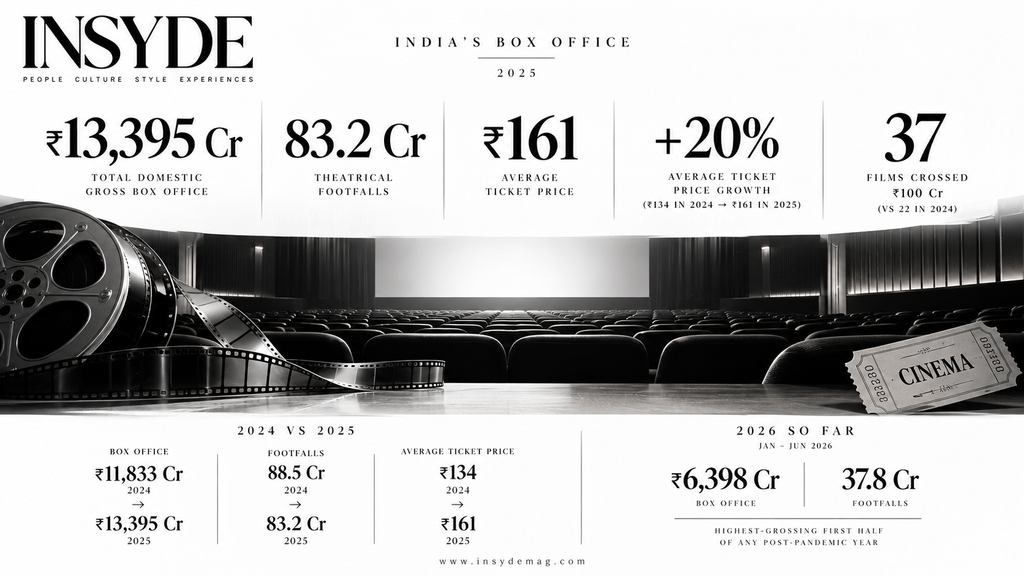
    In 2025, India’s domestic theatrical box office reached ₹13,395 crore — the highest annual gross in the history of the Indian market and the first time the country crossed the ₹13,000 crore mark. The previous record was ₹12,226 crore in 2023.

    But the headline number comes with an important qualification.

    India recorded 83.2 crore theatrical footfalls in 2025, down 6% from 2024, while the average ticket price rose 20%, from ₹134 to ₹161. The record box office was therefore driven not simply by larger audiences, but also by audiences paying more for cinema.

    And within that record market, five Indian language industries stood out.

    THE FIVE BIGGEST

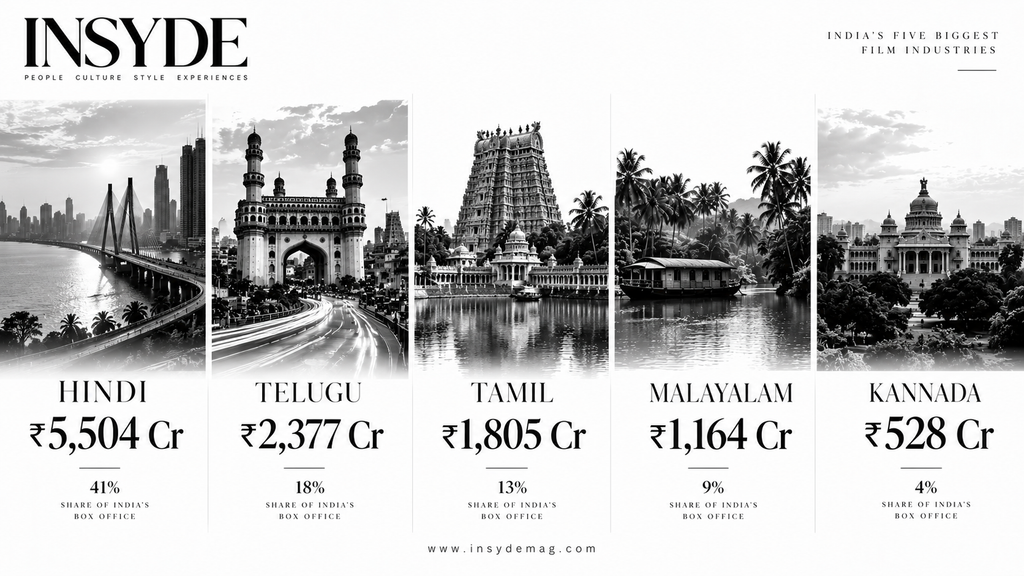
    RankIndustry2025 Gross Box OfficeShare of India
    01Hindi₹5,504 Cr41%
    02Telugu₹2,377 Cr18%
    03Tamil₹1,805 Cr13%
    04Malayalam₹1,164 Cr9%
    05Kannada₹528 Cr4%

    Source: Ormax Media, The Ormax Box Office Report 2025. Figures represent domestic gross box office and are rounded.

    Together, these five language markets generated approximately ₹11,378 crore, or about 85% of India’s total 2025 theatrical box office.

    But the real story isn’t simply who collected the most.

    It is how each industry is evolving.


    01 — HINDI CINEMA

    ₹5,504 CRORE

    The giant returns to record territory.

    Hindi cinema remained India’s largest theatrical market in 2025 — and reached a new high.

    The Hindi-language market generated ₹5,504 crore in domestic gross box office, making 2025 its best year ever. Hindi accounted for approximately 41% of India’s total theatrical market.

    But the more revealing statistic lies beneath the headline.

    93% of Hindi cinema’s 2025 box office came from original Hindi-language films.

    That represents a significant change from 2024, when dubbed South Indian films accounted for approximately 31% of Hindi cinema’s collections. In 2025, that dependence fell to just 7%.

    The market was therefore not merely growing; its composition was changing.

    At the centre of that resurgence was Dhurandhar, which generated approximately ₹950 crore in India and became the highest-grossing Hindi-language film in Ormax’s 2025 data, surpassing Stree 2 at ₹698 crore.

    Chhaava was another major contributor, while Saiyaara became one of the year’s other major Hindi successes.

    Across the entire Indian market, only three films crossed the ₹500 crore mark in 2025: Dhurandhar, Kantara: A Legend – Chapter 1 and Chhaava.

    Hindi cinema’s 2025 performance therefore represented more than a single blockbuster year.

    It demonstrated the continued commercial power of original Hindi-language theatrical content.

    THE NUMBER TO KNOW

    ₹5,504 Cr — Hindi cinema’s 2025 domestic gross.

    WHAT IT TELLS US

    Hindi cinema remains the single largest theatrical language market in India, but its 2025 resurgence was increasingly powered by original Hindi films rather than dubbed South Indian releases.


    02 — TELUGU CINEMA

    ₹2,377 CRORE

    A ₹2,000-crore market with staying power.

    Telugu cinema finished 2025 as India’s second-largest language market, with ₹2,377 crore in domestic gross box office.

    The significance of Telugu cinema lies not only in the size of the number, but in its consistency.

    The industry has remained above the ₹2,000 crore mark for multiple consecutive years, establishing a scale that few other regional markets have matched.

    The Telugu market has also become an important part of India’s wider pan-Indian theatrical ecosystem.

    Films originating in Telugu increasingly travel beyond Andhra Pradesh and Telangana, while stars, directors and production houses have become recognisable across India.

    That cross-market ambition has been one of the defining characteristics of the modern Telugu film business.

    Yet the industry’s commercial strength does not mean every year produces a new record.

    In 2025, Telugu cinema’s overall box office remained broadly stable compared with the previous year. That stability itself is notable: the industry maintained a ₹2,000-crore-plus market even without depending on one year’s singular mega-blockbuster to redefine its scale.

    The first half of 2026 reinforced Telugu cinema’s importance. During January 2026, Telugu releases accounted for 39% of that month’s box office alongside Hindi releases, with the Sankranthi period alone producing more than ₹500 crore from five major Telugu releases.

    THE NUMBER TO KNOW

    ₹2,377 Cr — Telugu cinema’s 2025 domestic gross.

    WHAT IT TELLS US

    Telugu cinema has evolved from a strong regional industry into one of India’s most commercially significant theatrical ecosystems, with the ability to generate large-scale business both within its home markets and beyond them.


    03 — TAMIL CINEMA

    ₹1,805 CRORE

    A heavyweight in a quieter year.

    Tamil cinema generated ₹1,805 crore in domestic gross box office in 2025, placing it third among India’s major language markets.

    The number is substantial, but 2025 was not a peak year for the industry.

    Tamil cinema’s share of India’s annual box office was approximately 13%, and its theatrical performance was softer than in some recent record years.

    That is an important distinction when looking at industry rankings.

    A market can remain enormous while experiencing a weaker cycle of releases.

    Tamil cinema has one of India’s deepest filmmaking ecosystems, with a large domestic audience, an established star system, major production houses and a long history of films travelling internationally.

    The industry’s influence also extends far beyond the size of its annual domestic gross.

    However, theatrical markets are ultimately measured by what audiences spend at the box office — and 2025 demonstrated how much annual rankings can be affected by the presence or absence of a handful of event films.

    The 2026 numbers show that volatility continuing. In the first half of 2026, Tamil cinema’s share of India’s box office fell from 17% in H1 2025 to 12% in H1 2026.

    That should not be interpreted as a permanent change in the industry’s position. It is a snapshot of a particular release cycle.

    THE NUMBER TO KNOW

    ₹1,805 Cr — Tamil cinema’s 2025 domestic gross.

    WHAT IT TELLS US

    Tamil cinema remains one of India’s largest film markets, but its annual box-office performance can move considerably depending on the strength and timing of major releases.


    04 — MALAYALAM CINEMA

    ₹1,164 CRORE

    From regional strength to national relevance.

    If one Indian film industry has dramatically changed its commercial profile in recent years, it is Malayalam cinema.

    In 2025, Malayalam films generated ₹1,164 crore in domestic gross box office, keeping the industry above the ₹1,000-crore threshold for a second consecutive year.

    That achievement is particularly notable because Malayalam cinema had already undergone a dramatic expansion in 2024.

    In 2024, its box office more than doubled and crossed ₹1,000 crore for the first time, rising from ₹572 crore in 2023 to ₹1,165 crore.

    Maintaining almost exactly that level in 2025 makes the development more significant.

    It suggests that the ₹1,000-crore year was not simply an isolated spike.

    Malayalam cinema has increasingly demonstrated that commercially successful films do not necessarily require the scale traditionally associated with the largest Indian industries.

    Its ecosystem has been built around a combination of strong storytelling, distinctive filmmakers, established actors, genre experimentation and an audience willing to support a wide variety of films.

    That model has also helped Malayalam films travel.

    Streaming has expanded their national visibility, while successful theatrical titles increasingly attract audiences outside Kerala through dubbed versions and cross-language releases.

    The commercial result is a market that now sits comfortably among India’s five largest theatrical language industries.

    THE NUMBER TO KNOW

    ₹1,164 Cr — Malayalam cinema’s 2025 domestic gross.

    WHAT IT TELLS US

    Malayalam cinema’s rise is not simply about one successful year. Its ability to sustain a ₹1,000-crore-plus theatrical market has made it one of the most significant developments in India’s modern film economy.


    05 — KANNADA CINEMA

    ₹528 CRORE

    The comeback market.

    Kannada cinema enters the top five with ₹528 crore in 2025 domestic gross box office.

    But the number that makes the industry stand out is not ₹528 crore.

    It is 73%.

    Kannada cinema recorded approximately 73% growth over 2024, making it the only one of the four major South Indian language markets highlighted by Ormax to show significant growth in 2025.

    The recovery was driven heavily by Kantara: A Legend – Chapter 1, which became one of the year’s biggest Indian films.

    The film was one of only three releases to cross ₹500 crore across India in 2025, alongside Dhurandhar and Chhaava.

    That puts Kannada cinema’s year into perspective.

    Its overall market remains considerably smaller than Hindi, Telugu, Tamil or Malayalam cinema. But its 2025 performance demonstrated the ability of a major Kannada-language event film to operate at national scale.

    The challenge now is sustainability.

    A single blockbuster can dramatically change an industry’s annual numbers. Building a deeper pipeline of commercially successful films is what ultimately determines whether a recovery becomes a lasting expansion.

    For Kannada cinema, 2025 was therefore both a commercial achievement and a reminder of the power of event filmmaking.

    THE NUMBER TO KNOW

    ₹528 Cr — Kannada cinema’s 2025 domestic gross.

    WHAT IT TELLS US

    Kannada cinema’s 2025 performance showed how quickly a smaller theatrical market can expand when a major homegrown film becomes a national event.


    THE ₹13,395-CRORE QUESTION

    What is really driving India’s box office?

    The most interesting part of India’s record 2025 box office is that audience volume did not grow alongside revenue.

    India recorded 83.2 crore theatrical footfalls, a 6% decline from 2024.

    At the same time, the average ticket price increased by 20%, from ₹134 to ₹161.

    This tells us something important about the modern theatrical business.

    The industry’s growth is increasingly influenced by:

    Higher ticket prices.

    Premium formats.

    Event films.

    Large-scale releases.

    Audience concentration around films perceived as theatrical experiences.

    The market is not simply selling more tickets.

    It is extracting more value from the audiences who do go.

    That distinction will matter enormously as the Indian theatrical industry competes with streaming platforms for consumers’ time and entertainment spending.


    THE BLOCKBUSTER ECONOMY

    Another major change appeared in the number of films crossing the ₹100-crore threshold.

    In 2025, 37 films crossed ₹100 crore at the Indian box office, compared with 22 films in 2024.

    At the very top of the market, six films crossed ₹300 crore, while three crossed ₹500 crore.

    That tells us two things simultaneously.

    First, India’s theatrical market has developed a much larger pool of films capable of generating significant revenue.

    Second, the blockbuster remains enormously important.

    This became even more visible in the first half of 2026.

    From January to June 2026, the Indian box office generated ₹6,398 crore, approximately 10% higher than the same period in 2025. Footfalls also increased by 5%, reaching 37.8 crore.

    But box-office concentration increased.

    Six films crossed ₹200 crore in the first half of 2026, while the top 15 films accounted for 58% of total box office, compared with 49% during the comparable 2025 period. Dhurandhar: The Revenge alone contributed nearly 20% of the first-half total.

    The message is clear:

    India’s theatrical market can be broad, but its biggest numbers are still increasingly concentrated around event films.


    THE LANGUAGE SHIFT

    Perhaps the most important change in Indian cinema is not occurring inside any individual industry.

    It is happening between them.

    The old model treated Hindi cinema and regional cinema as separate commercial worlds.

    That distinction is increasingly difficult to maintain.

    Actors cross industries.

    Directors work across languages.

    Films release simultaneously in multiple markets.

    Stories are dubbed and remade.

    Audiences move between languages.

    And theatrical success can now travel far beyond the market in which a film was originally produced.

    At the same time, the 2025 numbers show that this does not mean every industry is growing at the same rate.

    Hindi cinema’s share reached 41% of India’s 2025 box office, while the combined share of Telugu, Tamil, Malayalam and Kannada cinema fell from 48% in 2024 to 44% in 2025.

    That change was driven in part by Hindi cinema’s strong recovery and the increased contribution of international films.

    It is therefore better understood as a shift in annual market share, rather than evidence that India’s regional industries are becoming commercially irrelevant.

    In fact, the opposite may be happening.

    India is becoming a market in which multiple film industries can achieve national-scale success.


    2026: THE MARKET IS STILL MOVING

    The story did not stop with 2025.

    The first six months of 2026 generated ₹6,398 crore, the strongest first half of any post-pandemic year. Footfalls rose 5% year-on-year, reversing a three-year period of decline and stagnation.

    Hindi cinema strengthened its position, accounting for 44% of the first-half 2026 box office, compared with 39% in the corresponding period of 2025. Tamil cinema’s share moved in the opposite direction, falling from 17% to 12%.

    And the market continued to produce exceptionally strong monthly results.

    By August 2026, the Indian box office had already recorded its strongest month of the year, with ₹1,768 crore in gross collections during August.

    The annual picture will ultimately depend on the performance of the remaining 2026 releases, but the mid-year data confirms one thing:

    India’s theatrical economy is still expanding — and the balance between its major language markets continues to shift.


    THE NEW POWER MAP OF INDIAN CINEMA

    The idea of Indian cinema as simply “Bollywood” no longer captures the economics of the market.

    Hindi cinema is still the largest.

    Telugu cinema has established a ₹2,000-crore-plus theatrical scale.

    Tamil cinema remains one of India’s deepest and most established film ecosystems.

    Malayalam cinema has transformed itself into a ₹1,000-crore-plus market.

    Kannada cinema has shown how quickly a regional industry can rebound when a film becomes a national cultural event.

    And beyond these five, industries such as Marathi, Gujarati, Bengali and others continue to contribute to India’s increasingly diverse theatrical economy.

    The result is a film market that is becoming simultaneously larger, more multilingual and more interconnected.

    For audiences, that means more films crossing traditional language boundaries.

    For studios, it means the potential audience for a successful film is no longer limited to the language in which it was produced.

    For stars, it means regional fame can increasingly become national recognition.

    And for the business itself, it means the next blockbuster could come from almost anywhere.


    THE FINAL FRAME

    India’s film industry did not become a ₹13,395-crore business because one industry suddenly conquered the others.

    It happened because several powerful film ecosystems are operating simultaneously — sometimes competing, sometimes collaborating and increasingly sharing audiences.

    The five largest language markets accounted for roughly 85% of India’s 2025 theatrical gross, but their individual stories could hardly be more different.

    One returned to record territory.

    One maintained a ₹2,000-crore-plus scale.

    One navigated a softer release cycle.

    One consolidated a remarkable breakthrough.

    And one delivered a dramatic comeback.

    That may be the most important story in Indian cinema today.

    The future of Indian film is not necessarily about one industry replacing another.

    It is about more industries becoming big enough to matter.

    And in a market this large, the next major cinematic phenomenon could come from Mumbai, Hyderabad, Chennai, Kochi, Bengaluru — or somewhere audiences haven’t started looking yet.

    **India’s box office is no longer one story. It is an ecosystem.**

    By INSYDE Editorial Desk
    Research & Data: Ormax Media
    Additional 2026 market data: Ormax Media — Jan–Jun 2026

  • The Bhansali Aesthetic

    The Bhansali Aesthetic

    How Sanjay Leela Bhansali turned Indian cinema into a language of beauty, craftsmanship and desire.

    Some filmmakers tell stories.

    Sanjay Leela Bhansali builds worlds.

    Before a character speaks, there may already be a chandelier glowing above her, silk moving through the frame, jewellery catching the light, music rising somewhere beyond the room.

    In his cinema, beauty is rarely background.

    Beauty is part of the narrative.

    That is what makes Bhansali particularly interesting to INSYDE.

    His work sits at an intersection of cinema, fashion, architecture, music, craftsmanship and desire — a place where visual richness becomes storytelling and detail becomes identity.

    Over more than three decades, he has developed an aesthetic so recognisable that a frame can sometimes feel like a Bhansali frame before the audience consciously understands why.

    And perhaps that is the real achievement.

    He didn’t simply create films with a distinctive look. He created a visual language.

    When Cinema Becomes a World

    There is a difference between designing a beautiful frame and constructing an entire universe.

    Bhansali has consistently pursued the latter.

    His films are populated by elaborate interiors, dramatic architecture, intricate costumes, jewellery, carefully choreographed movement and compositions in which even the smallest visual element can feel deliberate.

    Those details do not exist independently.

    They speak to one another.

    Architecture establishes scale.

    Costume establishes character.

    Lighting establishes mood.

    Music establishes emotion.

    Movement establishes rhythm.

    Together, they create something closer to an immersive environment than a conventional film set.

    That precision has become part of the Bhansali method. On Heeramandi, Architectural Digest India documented his insistence on repeatedly adjusting elements of the set — from furniture and wall textures to seemingly minor decorative details — and quoted Bhansali explaining that architecture plays an important role in how he constructs a frame. (Architectural Digest)

    The point is not simply to make a set look expensive.

    The environment has to belong to the story.

    The Luxury of Detail

    Luxury has always depended on detail.

    The difference between something expensive and something exceptional is often invisible from a distance.

    A stitch.

    A setting.

    A finish.

    A proportion.

    A material chosen because of how it responds to light.

    Bhansali approaches cinema with a similar sensitivity.

    A costume isn’t simply clothing.

    A room isn’t simply a set.

    A chandelier isn’t simply decoration.

    A colour isn’t simply a colour.

    Everything contributes to the emotional architecture of the scene.

    The result is a cinema that can feel almost tactile.

    You sense the weight of the fabric.

    The warmth of the light.

    The scale of the room.

    The movement of jewellery.

    The silence before the music begins.

    The effect is extravagant, but the underlying principle is surprisingly disciplined:

    nothing is there without intention.

    Where the Obsession With Beauty Began

    The grandeur of Bhansali’s cinema has a deeply personal origin.

    He has spoken about growing up in a chawl in Mumbai and about the lack of space and visual beauty around him during his childhood. His mother, a dancer, performed in a small space, while Bhansali imagined larger, more ordered environments. He has connected those experiences directly to the expansive sets, central framing and visual symmetry that later became signatures of his filmmaking. (Indian Express)

    It is an important detail because it changes the way his aesthetic can be understood.

    The grandeur is not simply extravagance for its own sake.

    It is a response to limitation.

    Small spaces became expansive ones.

    Plain walls became elaborate environments.

    Disorder became symmetry.

    Limited movement became choreography.

    The absence of beauty became an obsession with creating it.

    And perhaps that is why his sets rarely feel merely expensive.

    They feel imagined.

    The Architecture of Desire

    Bhansali understands something that luxury brands have understood for generations:

    objects become more powerful when placed inside a world.

    A necklace is one thing.

    A necklace worn with a particular fabric, under a particular light, inside a particular room, accompanied by music and movement, becomes something else.

    The object acquires context.

    That is one of the reasons his cinema has such a strong relationship with fashion and jewellery.

    The visual elements do not sit around the characters.

    They help construct them.

    Jewellery as Storytelling

    There may be no better example than jewellery.

    In Bhansali’s worlds, jewellery rarely feels incidental.

    It can establish hierarchy.

    It can indicate wealth.

    It can communicate tradition.

    It can transform the silhouette of a character.

    And, importantly, it interacts with light.

    A necklace catching the light during a close-up is doing more than displaying craftsmanship.

    It is participating in the image.

    This is where Bhansali’s cinema naturally intersects with the language of luxury.

    The finest luxury objects are designed to reward attention.

    So are his frames.

    The closer you look, the more there is to discover.

    Fashion Without the Fashion Show

    Bhansali’s relationship with fashion is more sophisticated than simply dressing actors beautifully.

    His costumes establish an entire visual vocabulary.

    Silhouette, fabric, colour, ornamentation and movement work together.

    The clothes have to survive choreography.

    They have to respond to lighting.

    They have to communicate period and cultural context.

    And they have to remain emotionally connected to the character.

    That requires something closer to design than conventional styling.

    The result is fashion that belongs to the world of the film rather than being placed on top of it.

    The costume doesn’t interrupt the story. It becomes part of the story.

    The Women at the Centre

    Bhansali’s cinema has repeatedly placed women at the centre of its visual and emotional worlds.

    From Devdas and Black to Ram-Leela, Bajirao Mastani, Padmaavat, Gangubai Kathiawadi and Heeramandi, his women are rarely treated as background figures.

    Their clothes, jewellery, movement and environments often become extensions of their emotional and social position.

    The scale of the world around them can communicate power.

    A crowded room can become a stage.

    A palace can become a prison.

    A costume can become armour.

    A jewel can become status.

    A dance can become defiance.

    That visual treatment has become one of the recognisable elements of his cinema. Actors from Heeramandi have also described his approach to presenting women as central to his filmmaking language. (Indian Express)

    The important point is not simply that Bhansali makes beautiful images of women.

    It is that he uses beauty as part of the language through which their stories are told.

    Music Is Architecture

    There is another defining element of the Bhansali aesthetic: music.

    For Bhansali, music has long been central to the construction of his films rather than something added after the visual world is complete.

    A song can become a room.

    A room can become choreography.

    Choreography can become emotion.

    Emotion becomes narrative.

    This is why some of his most memorable sequences can communicate enormous amounts without conventional dialogue.

    The music carries the architecture of the scene.

    The performers move through it.

    The camera becomes part of the choreography.

    The result is closer to a fully composed theatrical experience than a conventional musical interlude.

    The Discipline Beneath the Spectacle

    The word “grand” is often used to describe Bhansali.

    It is accurate, but incomplete.

    What is more interesting is the discipline underneath it.

    He has spoken about his fascination with central framing and the desire to create order from the disorder he experienced growing up. (Indian Express)

    Architectural Digest India has similarly documented his attention to the smallest details of his sets, including furniture placement, textures, colours and architectural elements. (Architectural Digest)

    That reveals the secret beneath the spectacle.

    The image may be extravagant.

    The composition is controlled.

    That is why his frames can feel so immediately recognisable.

    Grandeur With a Purpose

    Bhansali’s films are often described using words such as lavish, opulent and larger-than-life.

    But spectacle alone would not explain their longevity.

    The real fascination lies in what the grandeur communicates.

    A palace can represent power.

    A crowded courtyard can represent society.

    A vast stage can make an individual appear small.

    An empty room can make an emotion feel enormous.

    A chandelier can suggest wealth, desire or decay.

    A costume can tell you where a character belongs before the dialogue does.

    The visual scale is therefore not simply decoration.

    It is emotional scale.

    India Through a More Cinematic Lens

    There is also something distinctly Indian about Bhansali’s understanding of grandeur.

    India has never treated beauty as purely architectural.

    It exists in textiles.

    Jewellery.

    Music.

    Dance.

    Wedding traditions.

    Craftsmanship.

    Palaces.

    Festivals.

    Theatre.

    Ceremony.

    Bhansali understands that instinctively.

    His cinema draws from a cultural memory in which colour, ornamentation, music and movement can coexist without apology.

    The result is not simply an expensive-looking version of Indian cinema.

    It is an attempt to transform elements of Indian visual culture into a cinematic language of their own.

    And that distinction matters.

    He doesn’t simply decorate Indian stories. He builds worlds around them.

    From Cinema to a Wider Cultural Language

    With Heeramandi: The Diamond Bazaar, Bhansali extended this visual vocabulary into streaming.

    The series brought together his familiar concerns — music, performance, elaborate environments, costumes, historical atmosphere and female characters — for a global streaming audience. Netflix describes the series as a story of love, power, betrayal and freedom centred on the courtesans of pre-independence Lahore. (Indian Express)

    The significance goes beyond the move from cinema to television.

    It demonstrated that the Bhansali aesthetic could exist as a broader cultural world.

    The sets became part of the conversation.

    The costumes became part of the conversation.

    The jewellery became part of the conversation.

    The music became part of the conversation.

    The visual identity became almost as recognisable as the title itself.

    That is a powerful position for any filmmaker to reach.

    The Influence of the Past

    Bhansali’s visual references are not limited to cinema.

    Architectural Digest India has documented how his reference library has drawn from places and objects he encountered growing up, as well as artists, photographers and musicians including S. H. Raza, V. S. Gaitonde, Raghu Rai and Kishori Amonkar. (Architectural Digest)

    That is revealing.

    His aesthetic isn’t built from one source.

    It is accumulated.

    Painting.

    Photography.

    Music.

    Architecture.

    Theatre.

    Textiles.

    Indian history.

    Street life.

    Memory.

    The resulting world may look fantastical, but its ingredients are deeply rooted in observation.

    When Excess Becomes Restraint

    There is an irony in Bhansali’s work.

    The images can be enormous.

    The sets can be enormous.

    The costumes can be elaborate.

    The music can be overwhelming.

    Yet the composition is often highly controlled.

    Symmetry.

    Central framing.

    Colour relationships.

    Movement.

    Light.

    Negative space.

    Everything is competing for attention, yet everything is carefully placed.

    That tension is part of what makes the aesthetic work.

    The spectacle is large. The intention is precise.

    A Filmmaker With a Signature

    The ultimate achievement for an auteur is recognisability.

    Not fame.

    Not scale.

    Not even box-office success.

    A signature.

    Something that makes an audience recognise the creator before seeing the name.

    Bhansali has achieved that.

    The grand interiors.

    The controlled colour.

    The elaborate costumes.

    The music.

    The choreography.

    The central compositions.

    The emotional intensity.

    The women framed against enormous spaces.

    The sense that every object has been placed with intention.

    Together, they form a vocabulary.

    And once a filmmaker develops a vocabulary of that strength, individual films become chapters inside a much larger artistic language.

    What Comes Next

    Bhansali’s next chapter is already taking shape.

    His much-anticipated Love & War, starring Ranbir Kapoor, Alia Bhatt and Vicky Kaushal, is nearing completion, with reports now pointing toward his next major project, a Madhubala biopic. (The Times of India)

    For a filmmaker whose aesthetic is already so established, the interesting question is not whether the next project will be visually ambitious.

    We know the answer.

    The more compelling question is:

    What will he do with that language next?

    Can grandeur evolve without becoming repetition?

    Can spectacle remain emotionally intimate?

    Can a recognisable aesthetic continue to surprise?

    Those are the questions that matter when an artist has spent decades refining a signature.

    The Bhansali Aesthetic

    Perhaps the easiest way to misunderstand Sanjay Leela Bhansali is to think his cinema is simply about luxury.

    It isn’t.

    Luxury is the surface.

    The deeper obsession is craft.

    The craft of composition.

    The craft of music.

    The craft of costume.

    The craft of movement.

    The craft of light.

    The craft of architecture.

    The craft of creating an environment that feels larger than reality.

    That is why his images remain so persistent.

    Long after a film’s plot has been discussed, individual frames remain.

    A room.

    A colour.

    A piece of jewellery.

    A costume.

    A song.

    A gesture beneath a chandelier.

    A character standing alone in an enormous space.

    These are not simply beautiful moments.

    They are fragments of a language.

    And perhaps that is Bhansali’s most enduring contribution to Indian cinema.

    He has shown that grandeur, when treated with enough discipline and imagination, can become more than spectacle.

    It can become storytelling.

    In a culture increasingly consumed through fleeting images, there is something almost radical about a filmmaker who still believes a frame deserves to be constructed, considered and remembered.

    That may be the real Bhansali aesthetic.

    Not simply the luxury of seeing more — but the discipline of making every detail matter.

    INSYDE — Beyond the Spotlight.

  • FROM KGF TO TOXIC

    FROM KGF TO TOXIC

    HOW KANNADA CINEMA CHANGED THE GAME

    The story of how Karnataka’s film industry stopped asking for a national audience — and started building one.

    For years, Indian cinema had an unspoken hierarchy.

    There was Bollywood.

    There were the major South Indian industries.

    And then there was Kannada cinema — an industry with its own stars, filmmakers, audiences and extraordinary creative history, but one that rarely received the same national attention.

    Then something changed.

    Not overnight.

    Not because one film suddenly transformed an entire industry.

    But because a generation of Kannada filmmakers began asking a different question:

    What if Kannada cinema didn’t have to look like anyone else’s cinema to be seen by everyone else?

    What if the language stayed?

    What if the stories stayed rooted?

    What if Karnataka itself became part of the spectacle?

    And what if the rest of India came to watch?

    That question helped create a new chapter.

    KGF changed the scale.

    Kantara changed the conversation.

    And now, with Toxic: A Fairy Tale for Grown-Ups, Kannada cinema is entering another fascinating phase — one where the ambition is no longer simply to make a successful Kannada film, but to create films capable of travelling across languages, markets and cultures.

    But the real story isn’t Toxic.

    It is the industry that made a film like Toxic possible.


    BEFORE THE PAN-INDIA ERA

    Kannada cinema did not suddenly arrive when KGF did.

    Long before Rocky entered the Kolar Gold Fields, Karnataka had a film culture with its own stars, writers, musicians, filmmakers and fiercely loyal audiences.

    The problem wasn’t a lack of cinema.

    It was the scale of visibility.

    A successful Kannada film could dominate Karnataka without necessarily becoming a national cultural event.

    That distinction matters.

    An industry can be commercially healthy within its home market and still remain relatively invisible outside it.

    For years, Kannada cinema operated within that contradiction.

    It had the talent.

    It had the audience.

    It had the stories.

    But the national conversation was often happening somewhere else.

    Then the economics of Indian cinema began changing.

    Streaming made regional films easier to discover.

    Social media allowed films and stars to travel before audiences ever entered theatres.

    Digital distribution reduced some of the barriers created by language.

    And filmmakers began realising that the word “regional” did not necessarily have to mean “limited.”


    THEN CAME KGF

    When KGF: Chapter 1 arrived in 2018, it did not feel like a conventional regional release.

    It felt bigger.

    Darker.

    More aggressive.

    More theatrical.

    More deliberately designed as an event.

    Yash wasn’t presented merely as another Kannada star.

    He was introduced to a much wider audience as a larger-than-life cinematic figure.

    The filmmaking was unapologetically grand.

    The world was stylised.

    The music was designed to travel.

    And the marketing understood something crucial:

    People don’t need to understand every cultural reference to understand ambition.

    KGF demonstrated that a Kannada-language production could be conceived, marketed and distributed as a major Indian theatrical product without abandoning its regional identity.

    Its sequel expanded that commercial scale dramatically.

    But the most important number wasn’t the box office.

    It was the number of people who suddenly began looking at Kannada cinema differently.

    The industry had demonstrated that its commercial ceiling did not necessarily end at Karnataka’s borders.

    And that changed expectations.

    For producers.

    For distributors.

    For actors.

    For filmmakers.

    And, perhaps most importantly, for audiences.


    THE REAL CHANGE WASN’T LANGUAGE

    This is where the phrase “pan-India” can become misleading.

    A film doesn’t become pan-India simply because it is dubbed into several languages.

    Distribution can put a movie in front of millions of people.

    It cannot make those people care.

    That requires something else.

    A character they connect with.

    A world they want to enter.

    A story that feels emotionally accessible.

    A visual language powerful enough to cross linguistic boundaries.

    That distinction has become particularly relevant to Kannada cinema’s current conversation.

    The industry’s own filmmakers and actors have increasingly emphasised that simply labelling a film “pan-India” isn’t enough. Connection, relatability and strong storytelling matter more than the label itself.

    That may be one of the most important lessons from Kannada cinema’s recent rise.

    Pan-India isn’t a language strategy.

    It’s a connection strategy.


    THEN KANTARA CHANGED THE CONVERSATION

    If KGF demonstrated that Kannada cinema could compete at scale, Kantara demonstrated something even more interesting.

    You didn’t necessarily have to make Karnataka less visible to make a film nationally successful.

    You could make the story more local.

    More rooted.

    More specific.

    And somehow, that specificity could make it more universal.

    That is an important shift in the psychology of Indian cinema.

    For years, there was an assumption that a film seeking national attention needed to become more accessible by becoming more generic.

    Kantara offered another possibility:

    What if authenticity itself was the attraction?

    Rishab Shetty’s film drew deeply from the cultural landscape of coastal Karnataka and turned local traditions, folklore and questions of land and identity into a cinematic language that travelled far beyond the state.

    The lesson wasn’t simply that regional stories could succeed.

    It was more powerful:

    Regional identity could become a competitive advantage.


    KARNATAKA STOPPED BEING THE BACKGROUND

    And this is where the transformation becomes bigger than movies.

    Look at what successful Kannada cinema has begun exporting.

    Not only actors.

    Not only films.

    But Karnataka itself.

    Its landscapes.

    Its mythology.

    Its music.

    Its language.

    Its architecture.

    Its visual identity.

    Its people.

    Cinema is one of the world’s most powerful cultural export machines because audiences don’t simply watch stories.

    They absorb worlds.

    A successful film can make someone curious about a place they’ve never visited.

    It can make an unfamiliar language sound interesting.

    It can turn an actor into a national face.

    It can make a local aesthetic aspirational.

    And that is where entertainment begins becoming culture.


    THE RISE OF THE KANNADA STAR

    The new generation of Kannada stars is operating in a very different environment.

    An actor is no longer defined only by the films they make.

    Their identity exists across:

    Cinema.

    Social media.

    Fashion.

    Brand partnerships.

    Interviews.

    Premieres.

    Music.

    Advertising.

    Fan communities.

    The star is now a media ecosystem.

    Yash is perhaps the clearest example of this transformation.

    After KGF, his identity expanded beyond Karnataka’s traditional star system.

    He became one of the faces through which audiences outside the state encountered Kannada cinema.

    And Toxic represents an interesting next step because its ambition is visibly larger in scale while remaining rooted in a Kannada production ecosystem.

    Its multilingual release and national marketing demonstrate how dramatically the commercial ambitions surrounding major Kannada productions have expanded.

    That would have been much harder to imagine in the same way a generation ago.


    BUT BIGGER DOESN’T ALWAYS MEAN BETTER

    This is where the conversation gets uncomfortable.

    The moment a regional industry becomes successful nationally, a new pressure appears.

    Scale.

    Bigger stars.

    Bigger budgets.

    Bigger sets.

    More languages.

    More screens.

    More expectations.

    More comparisons.

    Suddenly, every film risks being judged against the biggest success that came before it.

    And that can become dangerous.

    Because one of the things that made Kannada cinema interesting was its willingness to tell stories that didn’t feel manufactured for everyone.

    The industry now has to balance two competing ambitions:

    How do you become bigger without becoming less yourself?

    That may be Kannada cinema’s most important question over the next decade.


    TOXIC IS THE NEXT TEST

    Toxic arrives at exactly that intersection.

    It follows Yash’s KGF era and comes from director Geetu Mohandas, with an ensemble that includes major names from different parts of Indian cinema.

    Its scale, multilingual release strategy and expectations around Yash make it an important moment for the industry’s evolving business model.

    But its importance goes beyond whether it becomes a blockbuster.

    It represents a question.

    Can Kannada cinema continue expanding its ambition without losing the creative identity that made the industry worth watching in the first place?

    That is a much harder challenge than simply making a bigger movie.


    THE BUSINESS OF GOING PAN-INDIA

    There is another side to this transformation that audiences rarely see.

    Making a film for multiple markets changes the economics.

    Distribution becomes more complicated.

    Marketing becomes more expensive.

    Dubbing and localisation matter.

    Release strategies become more sophisticated.

    Star power becomes a financial asset.

    And suddenly, a film is no longer being designed only for the audience sitting in Bengaluru on Friday night.

    It is being designed for multiple markets simultaneously.

    That changes risk.

    It also changes opportunity.

    A successful Kannada film can potentially earn from audiences far beyond Karnataka.

    But a film designed for a much larger market also carries much larger expectations.

    Recent industry discussions have highlighted this tension: the success of KGF and Kantara has encouraged bigger pan-India ambitions, but there are also concerns that chasing the scale of past blockbusters can lead to excessive budgets and formulaic filmmaking.

    Pan-India is not just an artistic ambition.

    It’s a business model.

    And Kannada cinema is still learning how to operate inside it.


    THE FASHION OF A NEW INDUSTRY

    There is another element of this transformation that is easy to overlook:

    fashion.

    As Kannada stars become nationally visible, their public image becomes increasingly important.

    Film promotions aren’t simply about posters anymore.

    They are fashion moments.

    Red carpets become editorial moments.

    Press tours become visual campaigns.

    Celebrity styling becomes part of the marketing.

    And the actor’s appearance becomes another way of selling the world around the film.

    This matters because entertainment and luxury increasingly overlap.

    A successful film can create demand for a look.

    A celebrity can influence fashion.

    A designer can become part of a film’s cultural conversation.

    A star can become a brand ambassador.

    The movie becomes content.

    The actor becomes a personality.

    And the personality becomes a commercial ecosystem.

    That is modern entertainment.


    FROM BENGALURU TO THE WORLD

    There is something particularly fascinating about Karnataka’s cultural transformation.

    For decades, Bengaluru’s global identity was dominated by technology.

    Software.

    Startups.

    Engineering.

    Global companies.

    Innovation.

    Now another part of Karnataka is travelling with it:

    culture.

    And the two ecosystems are not necessarily as separate as they appear.

    A city that produces global technology companies also produces audiences with global cultural exposure.

    It produces entrepreneurs.

    Designers.

    Musicians.

    Creators.

    Filmmakers.

    And a new generation of consumers who move comfortably between international culture and local identity.

    That creates an unusually interesting environment for entertainment.

    The technology capital and the film industry are increasingly part of the same broader cultural economy.


    THE INDUSTRY IS GETTING BIGGER. BUT WHAT WILL IT BECOME?

    This is where the story stops being about KGF.

    And Kantara.

    And Toxic.

    Because individual films come and go.

    The bigger question is what kind of industry Kannada cinema wants to build.

    Does it want to compete purely on scale?

    Does it want to become another large commercial film industry?

    Does it want to preserve a stronger regional identity?

    Can it do both?

    Can a Kannada film become global without becoming culturally diluted?

    Can a filmmaker make an intensely local story and still find an audience in Tokyo, London, Dubai or Los Angeles?

    And perhaps most importantly:

    Can Kannada cinema build a global reputation that belongs to the industry itself, rather than being dependent on a handful of superstar films?

    That is the next frontier.


    KANNADA CINEMA DOESN’T NEED TO BECOME BOLLYWOOD

    This may be the biggest lesson of the last decade.

    Kannada cinema doesn’t need to imitate Bollywood.

    It doesn’t need to imitate Tamil cinema.

    It doesn’t need to imitate Telugu cinema.

    And it certainly doesn’t need to imitate Hollywood.

    Its greatest opportunity may be to become more unmistakably Kannada.

    Because the global audience doesn’t need another version of something it already knows.

    It needs something it hasn’t seen.

    That is the advantage of cultural specificity.

    The more confident an industry becomes in its own identity, the more interesting it can become to everyone else.


    FROM REGIONAL INDUSTRY TO CULTURAL EXPORT

    The transformation can now be seen in a simple sequence.

    KGF changed the scale.

    Kantara changed the conversation.

    A new generation of actors changed the faces.

    Streaming changed discovery.

    Social media changed fandom.

    Pan-India distribution changed the business.

    And now films like Toxic are testing the next stage.

    Not:

    Can Kannada cinema become successful outside Karnataka?

    That question has already been answered.

    The new question is:

    How far can it go without losing itself?

    Because the most exciting thing about Kannada cinema right now isn’t simply that the rest of India has started watching.

    It’s that Karnataka has started to understand the power of what it has been creating all along.

    Stories.

    Stars.

    Music.

    Style.

    Identity.

    Culture.

    And eventually, influence.


    KARNATAKA’S NEXT EXPORT

    For years, when the world thought about Karnataka, it often thought about technology.

    The code.

    The companies.

    The startups.

    The engineers.

    Now another export is gaining momentum.

    Culture.

    Kannada cinema doesn’t need permission to enter the national conversation anymore.

    It has already entered.

    The challenge now is far more ambitious.

    To build a cinematic identity strong enough that audiences don’t simply recognise a successful Kannada film when they see one.

    They recognise where it came from.

    They recognise the language.

    The visual language.

    The people.

    The stories.

    The feeling.

    And perhaps that is the real change.

    KGF didn’t just make Kannada cinema bigger.

    Kantara didn’t just make Karnataka visible.

    And Toxic isn’t simply another attempt to go bigger.

    Together, they represent an industry learning how to turn regional identity into cultural power.

    For years, Karnataka’s greatest global export may have been technology.

    But cinema is beginning to export something technology cannot:

    a way of seeing the world.

    And the next chapter of Kannada cinema may not be about proving that Karnataka belongs on the global stage.

    It may be about deciding what Karnataka wants the world to see when it gets there.

    INSYDE — Beyond the Spotlight.

  • The Director Effect

    The Director Effect

    How cinema’s most successful filmmakers turned their names into a reason to buy the ticket.

    There was a time when the name above a film’s title usually belonged to the star.

    The actor was the attraction. The face was the campaign. The opening weekend belonged to the celebrity whose name appeared largest on the poster.

    The director was often the person behind the curtain.

    That relationship has changed.

    Today, a select group of filmmakers have developed something remarkably powerful: a name that carries its own promise.

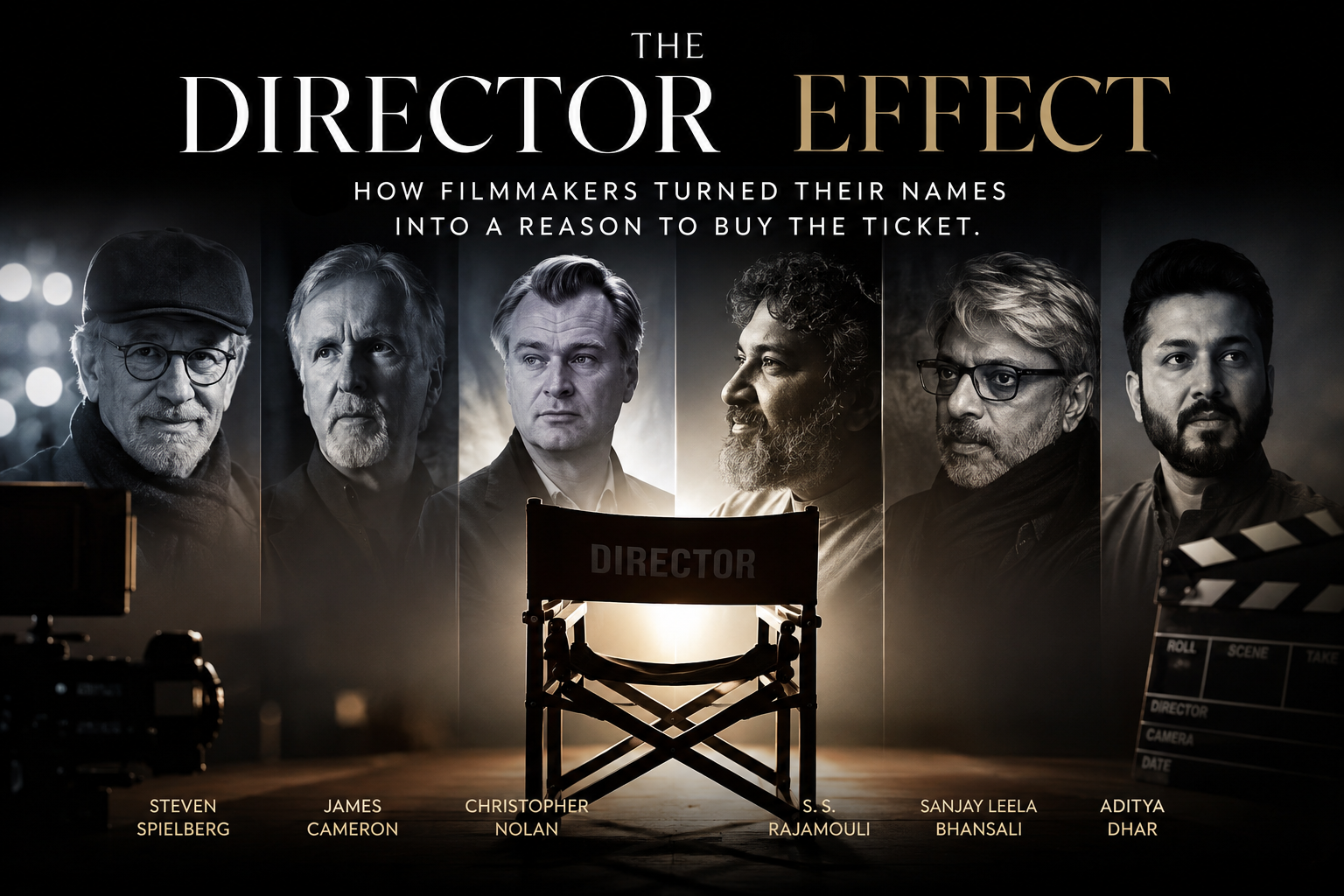
    A Nolan film suggests one kind of experience. A Spielberg film another. A Cameron film another. In India, Rajamouli, Bhansali and, increasingly, Aditya Dhar have begun building similarly recognisable creative identities.

    The audience may not know every detail of the story.

    They may not even need to.

    The filmmaker’s name already tells them something about what they are about to experience.

    Scale.

    Craftsmanship.

    Aesthetic.

    Ambition.

    Emotion.

    Spectacle.

    That is when a director stops being simply the person who made the film.

    The director becomes part of the reason to see it.


    When the Name Becomes the Attraction

    The interesting shift isn’t that directors have become famous.

    Great directors have always been famous.

    The shift is that their names increasingly influence the audience’s decision to watch the film itself.

    Christopher Nolan offers perhaps the clearest contemporary example.

    The Odyssey arrived in 2026 with an extraordinary cast including Matt Damon, Tom Holland, Anne Hathaway, Lupita Nyong’o and Zendaya. Yet the conversation surrounding the film was never simply about its cast.

    It was about a Christopher Nolan film.

    The film opened to $264.1 million worldwide and went on to cross $1.4 billion globally, demonstrating the extraordinary theatrical power that can now surround a filmmaker’s name.

    The significance goes beyond the numbers.

    Nolan has reached a point where audiences can recognise the experience before they know the story.

    That is brand recognition.


    Christopher Nolan — The Event Maker

    Nolan’s greatest achievement may not be any individual film.

    It may be that he has transformed the act of going to the cinema into part of his identity as a filmmaker.

    IMAX.

    Large-format film.

    Practical effects.

    Immersive sound.

    Complex narratives.

    Scale.

    Mystery.

    His films arrive with a sense of occasion.

    His relationship with IMAX has become particularly important to that identity. The Odyssey generated an extraordinary opening for the format, reinforcing the idea that Nolan’s films are designed not merely to be watched but to be experienced theatrically.

    Nolan therefore sells something more than a story.

    He sells the experience of cinema itself.

    That is why audiences can become interested in a Nolan film before they know exactly what happens in it.

    The name tells them enough.


    Steven Spielberg — The Pioneer

    Long before directors were discussed as personal brands, Steven Spielberg had already established the model.

    Jaws didn’t simply become a hit.

    It helped define the modern blockbuster.

    Spielberg’s name eventually came to represent something unusually broad:

    Adventure.

    Emotion.

    Spectacle.

    Humanity.

    Family.

    History.

    Science fiction.

    The remarkable part is the range.

    A Spielberg film doesn’t have to belong to one genre to feel like a Spielberg film.

    That is one of the defining characteristics of a mature creative brand.

    The identity survives the category.

    His name became associated with a particular standard of mainstream cinematic storytelling, helping establish the idea that the filmmaker could become part of the commercial identity of a movie.

    Decades later, the name still carries that accumulated trust.

    And that is perhaps the purest form of brand equity:

    recognition built over time.


    James Cameron — The Spectacle

    If Spielberg helped build the modern blockbuster, James Cameron pushed the idea of spectacle into technological territory.

    Titanic, Avatar and Avatar: The Way of Water place Cameron in an extraordinarily rare commercial category.

    But the more interesting part isn’t simply their box-office performance.

    It is the way Cameron approaches technology.

    He doesn’t merely use new tools.

    He frequently pushes the industry to develop them.

    For Avatar, his production team developed new approaches to performance capture, virtual environments and 3D filmmaking to realise the world he had imagined.

    The technology became part of the storytelling.

    That has become part of the Cameron promise.

    When a Cameron film arrives, audiences expect something that stretches the boundaries of what cinema can physically display.

    The technology becomes part of the spectacle.

    And the director becomes the guarantee.


    India’s Director-Brand Era

    The phenomenon isn’t uniquely American.

    In fact, some of the most interesting examples are emerging from India.

    Indian cinema has always had powerful stars, but a new generation of filmmakers has demonstrated that a director’s name can carry an increasingly independent form of commercial and cultural value.

    The difference is subtle.

    The audience isn’t simply asking who is acting in the film.

    It is beginning to ask:

    Who is creating this world?


    S. S. Rajamouli — The Global Phenomenon

    S. S. Rajamouli may be the clearest contemporary example of an Indian filmmaker whose name has become associated with a global theatrical proposition.

    Baahubali established the scale.

    RRR expanded the international audience.

    His cinema carries a recognisable promise:

    Mythology.

    Emotion.

    Heroism.

    Music.

    Large-scale action.

    World-building.

    Spectacle.

    But Rajamouli’s influence has increasingly travelled beyond the traditional boundaries of Indian cinema.

    His international reception and the global ambitions surrounding his upcoming projects demonstrate how far that directorial identity has travelled.

    The important shift is that Rajamouli is no longer simply exporting individual films.

    He is exporting a cinematic language.

    Audiences increasingly understand what a Rajamouli experience promises before the opening frame.

    That is a powerful form of authorship.


    Sanjay Leela Bhansali — The Aesthetic

    If Rajamouli’s name promises spectacle, Sanjay Leela Bhansali’s promises something more intimate:

    a world.

    Mention Bhansali and an audience can almost imagine the frame before seeing it.

    Architecture.

    Jewellery.

    Textiles.

    Music.

    Choreography.

    Romance.

    Colour.

    Light.

    Grandeur.

    His films have developed such a distinctive visual vocabulary that the director’s name itself functions almost like an aesthetic category.

    That is a particularly sophisticated form of brand recognition.

    A luxury house can communicate through a silhouette.

    An architect can communicate through proportion.

    A watchmaker can communicate through a movement.

    Bhansali communicates through the frame.

    His films feel authored down to the smallest detail.

    The sets, costumes, musical sequences and compositions all belong to the same universe.

    And that consistency creates expectation.

    The audience knows what kind of world it is entering.

    The question isn’t whether it will be beautiful.

    The question is how Bhansali will make beauty feel this time.


    Aditya Dhar — The New Force

    Aditya Dhar represents a different stage of director-brand power.

    His career is considerably younger than those of Spielberg, Cameron, Nolan, Rajamouli or Bhansali, but that is precisely what makes his rise interesting.

    Uri: The Surgical Strike established his directorial identity through political tension, action and a grounded sense of scale.

    The Dhurandhar films expanded that identity dramatically.

    The commercial response has demonstrated that Dhar is increasingly associated with a particular cinematic proposition: political narratives, high-stakes action, technical ambition and large-scale world-building.

    That matters because a director does not necessarily need decades to build a recognisable identity anymore.

    In an environment where audiences are exposed to more content than ever, a distinctive creative voice can become recognisable remarkably quickly.

    Dhar represents the newer model of the director as a commercial force.

    His story is still being written.

    But the audience is beginning to recognise the promise.


    The Director as a Luxury Brand

    This is where cinema begins to resemble luxury.

    A luxury house doesn’t simply sell an object.

    It sells an expectation.

    You don’t choose a watch only because it tells time.

    You choose its history, craftsmanship, design language and reputation.

    You don’t choose a fashion house merely because it produces clothing.

    You choose its interpretation of clothing.

    The same principle increasingly applies to filmmakers.

    A Nolan film promises one kind of experience.

    A Cameron film another.

    A Rajamouli film another.

    A Bhansali film another.

    The audience is not simply purchasing a ticket.

    It is purchasing an expectation of authorship.

    That is the real shift.


    From Star Power to Auteur Power

    For decades, cinema was built around the star system.

    The actor was the brand.

    The actor’s face sold the poster.

    The actor’s name drove the opening.

    That power hasn’t disappeared.

    But audiences now have another way of choosing.

    Franchises have multiplied.

    Streaming has expanded the amount of content available.

    The number of films competing for attention has become enormous.

    In that environment, a recognisable creative voice becomes valuable.

    A filmmaker with a distinct identity provides something a new concept otherwise lacks:

    trust.

    The audience may not know the entire story.

    But they know the person telling it.

    And sometimes that is enough.


    The New Currency Is Expectation

    Perhaps the most valuable thing a filmmaker can build is not fame.

    It is expectation.

    When a director reaches that level, a new project becomes news before the trailer arrives.

    A new Nolan project becomes an event.

    A new Cameron project becomes an event.

    A new Rajamouli project becomes an event.

    A new Bhansali project becomes an event.

    The filmmaker’s previous work has already performed part of the marketing.

    The reputation precedes the film.

    That is exactly how powerful luxury brands operate.

    The name creates anticipation before the object is experienced.


    The Risk of Becoming a Brand

    There is, however, a paradox.

    A brand creates expectations.

    And expectations can become a prison.

    The more recognisable a filmmaker becomes, the more audiences expect the next film to resemble the last.

    Nolan must remain Nolan.

    Bhansali must remain Bhansali.

    Rajamouli must remain Rajamouli.

    But if a signature becomes too predictable, it can become formula.

    The strongest creative brands therefore face the same challenge as the strongest luxury houses:

    How do you remain recognisable without becoming predictable?

    The answer is evolution.

    Preserve the philosophy.

    Change the expression.

    A signature should be a foundation, not a cage.


    The Future Belongs to the Signature

    The future of theatrical cinema will not belong entirely to actors.

    Nor will it belong exclusively to franchises.

    Both will remain powerful.

    But as audiences become more selective about which films deserve their time, money and attention, authorship becomes increasingly valuable.

    A filmmaker with a recognisable voice offers something a generic production cannot.

    A reason to anticipate.

    A reason to care.

    A reason to believe the experience will be different.

    That may explain why the modern director is becoming something more than the person who makes the film.

    The director is becoming part of the reason the film exists in the audience’s imagination before it arrives.


    The Director Is the Brand

    The most interesting evolution in cinema may therefore be happening above the title.

    Not in the cast list.

    Not in the franchise logo.

    But in the name of the person who imagined the world.

    Spielberg built the modern blockbuster.

    Cameron turned technology into spectacle.

    Nolan turned theatrical cinema into an event.

    Rajamouli transformed scale into a global Indian cinematic language.

    Bhansali turned visual beauty into authorship.

    Dhar is demonstrating how quickly a contemporary filmmaker can build a commercial identity around a distinct worldview.

    Six directors.

    Six different forms of influence.

    But one underlying shift.

    The audience isn’t always asking:

    “What is this film about?”

    Increasingly, it is asking:

    “Who made it?”

    And when the answer itself is enough to make someone buy a ticket, the filmmaker has crossed an important line.

    They are no longer simply making the brand.

    They have become the brand.

    INSYDE — Beyond the Spotlight.