Category: Ideas

Thoughtful perspectives on the trends, questions and ideas influencing fashion, luxury, culture and modern life.

  • THE BLOODLINES OF BENGALURU

    THE BLOODLINES OF BENGALURU

    Five Families. Generational Wealth. The Empires Shaping a City.

    From technology fortunes and real-estate empires to a jewellery house spanning six generations, INSYDE explores the family legacies behind Bengaluru’s changing relationship with wealth, ambition and influence.

    Bengaluru has become a city of extraordinary contrasts. Glass towers rise beside century-old neighbourhoods. Technology entrepreneurs build global businesses while property developers reshape the skyline. Luxury residences, commercial districts and established family enterprises coexist with a new generation determined to create fortunes of its own.

    Yet behind the city’s familiar corporate names lies another story: the families whose decisions, businesses and legacies have helped shape its economic identity.

    Some built their fortunes by transforming traditional enterprises into global businesses. Others recognised the value of land, commercial infrastructure or the growing appetite for luxury. A few created something more enduring than a company: an institution that continued to evolve long after its founders established it.

    But family wealth is rarely as straightforward as it appears. A founder’s fortune is not necessarily the same as a family’s collective wealth. A prominent surname does not automatically confer control over a publicly listed company. And a business that has survived for generations must continually prove its relevance to a changing market.

    To understand Bengaluru’s business dynasties, then, we must look beyond net-worth lists. We must examine what these families built, how their businesses operate today and what their stories reveal about the future of wealth in one of India’s most ambitious cities.

    This is not a ranking of Bengaluru’s richest families, nor a claim that five families own the city. It is a closer look at five distinct legacies: technology, real estate, commercial infrastructure, industrial enterprise and luxury craftsmanship.
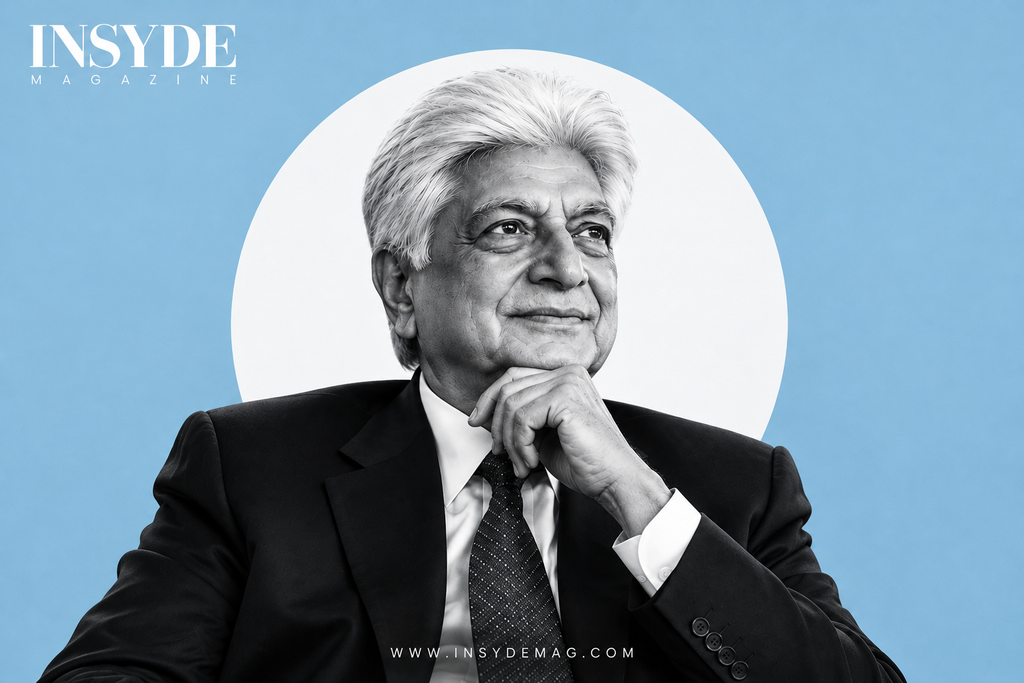
    01. THE PREMJI FAMILY

    From an established enterprise to a global technology fortune

    Few business legacies illustrate the transformation of Indian industry as clearly as that of Azim Premji and Wipro.

    The company began in 1945 as Western India Vegetable Products, operating in the vegetable-oil business. Under Premji’s leadership, it diversified and eventually developed into one of India’s most recognisable information technology services companies.

    The transformation was significant. Wipro became part of a wider shift that positioned Indian technology professionals as essential participants in the global digital economy. Bengaluru, with its growing concentration of engineering talent and technology businesses, became central to that story.

    But the Premji legacy is not simply a story of an entrepreneur recognising an opportunity. It is also a story of ownership, succession and the distinction between family influence and professional management.

    Wipro’s FY2025–26 corporate disclosures identify Azim Premji as a non-executive director and Rishad Premji as executive chairman. The company’s annual reporting also documents the substantial shareholding associated with Azim Premji and the structures through which some of those shares are held.

    The figures illustrate the scale of the family’s connection to the business. They should not, however, be confused with a complete estimate of the family’s net worth: company shares, private businesses, philanthropic trusts and other assets are different categories of wealth.

    The next chapter is equally important. Rishad Premji joined Wipro in 2007, worked across several roles and became executive chairman in 2019. His progression reflects a model of succession in which a family member develops experience within a large organisation before assuming its most senior leadership responsibilities.

    Beyond business, Azim Premji has become one of India’s most prominent philanthropists through his work in education and social development, including the Azim Premji Foundation.

    That philanthropic dimension complicates the usual image of a business dynasty. Wealth can preserve influence, but it can also be directed towards institutions and causes that extend beyond the original enterprise.

    The legacy: The Premji story is about transforming a traditional business into a global technology enterprise — and about the responsibilities that accompany wealth at that scale.

    Sources: Wipro Integrated Annual Report 2025–26; Wipro’s FY2025–26 filing with the US Securities and Exchange Commission.
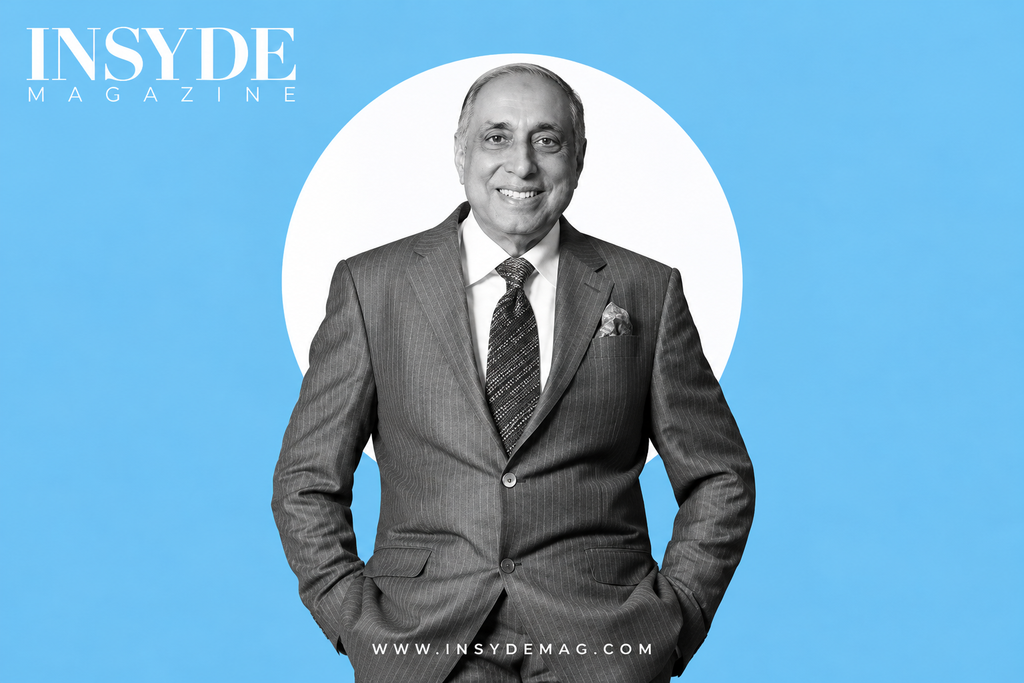
    02. THE RAZACK FAMILY

    The business of building aspiration

    In Bengaluru, real estate is more than a market for apartments and office buildings. It is one of the most visible ways in which economic growth becomes physical: a new address, a commercial district, a residential community or a skyline that changes the character of an entire neighbourhood.

    The Razack family, associated with Prestige Group, has played a prominent role in this transformation.

    The company’s growth under Irfan Razack and his brothers, Noaman and Rezwan, reflects the expansion of Indian real estate from a largely residential business into a broader industry encompassing commercial offices, retail, hospitality and other property assets.

    As Bengaluru attracted technology companies and a growing professional workforce, demand for housing and commercial space changed. Developers responded to new expectations around location, design, amenities and lifestyle. Prestige became one of the major businesses operating within that evolution.

    Its continuing family connection is visible in its shareholding structure. The Razack Family Trust held 52.24% of Prestige Estates Projects in the June 2026 shareholding data reported by Value Research. The three brothers were also individually listed among the company’s promoter shareholders.

    That is a more meaningful indicator of family influence than simply attaching a speculative fortune to the family name. It establishes a documented ownership relationship with a publicly listed business.

    The group is also looking beyond the traditional economics of property sales.

    In an interview published by Financial Express in October 2026, Irfan Razack said Prestige was targeting annual rental income of more than ₹4,000 crore by FY2030, compared with approximately ₹860 crore at the time of the interview. He also cited 35 million square feet of commercial space under development.

    These are forward-looking company targets and pipeline figures, not achieved results. Nevertheless, they reveal an important strategic ambition: building a business in which recurring rental income becomes increasingly significant alongside residential sales.

    The distinction matters. Selling an apartment generates revenue from a transaction. Owning and leasing commercial property can create recurring income over a much longer period. The two models involve different capital requirements, risks and measures of success.

    For Bengaluru, this is part of the larger story of how property businesses evolve alongside the city itself.

    The legacy: The Razack family represents the relationship between private enterprise and urban transformation — and the ambition to turn property development into a more enduring portfolio of assets.

    Sources: Prestige Estates Projects shareholding data; Financial Express, October 2026.
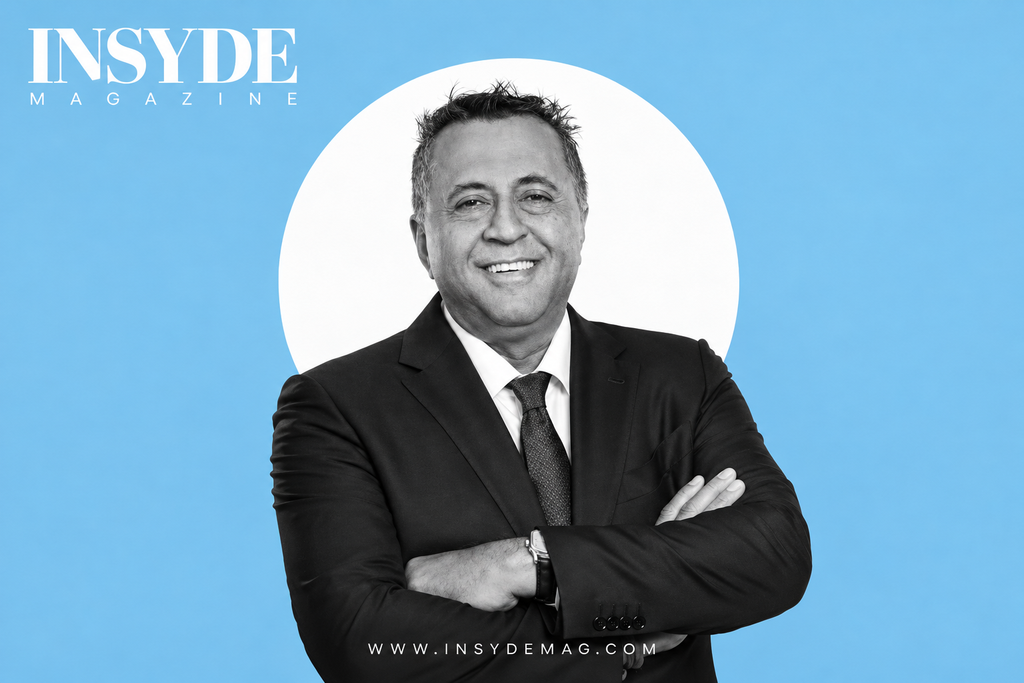
    03. THE VIRWANI FAMILY

    The infrastructure behind business power

    The most visible part of Bengaluru’s business economy is often the company occupying a glass office tower. Less visible, but equally important, is the infrastructure that allows the company to operate.

    Commercial real estate sits at that intersection. It connects businesses with physical space, creates long-term property assets and provides the workplaces around which employment districts develop.

    The Virwani family, associated with Embassy Group, offers a perspective on this side of Bengaluru’s growth.

    Under Jitu Virwani’s leadership, Embassy developed a substantial presence in commercial real estate and expanded into other property-related businesses. The group became closely associated with the development of large office campuses and business parks, reflecting the growing demand for organised commercial space as Bengaluru attracted domestic and international companies.

    The family’s next-generation story is also relevant. Embassy’s published leadership information identifies Jitu Virwani as chairman and Aditya Virwani as managing director. Aditya’s executive role demonstrates how leadership responsibilities can pass to a new generation within an established business.

    But the larger story is not simply one of inheritance.

    Commercial property is a capital-intensive business. Its performance depends on factors such as location, construction costs, financing, occupancy, rental agreements, tenant demand and the wider economic cycle. A large office portfolio may generate recurring income, but it is also exposed to changes in how companies use workplaces and how investors value property.

    The rise of real-estate investment trusts has added another dimension to the sector. These structures can allow investors to participate in income-producing property assets through a listed investment vehicle, bringing institutional capital and public-market scrutiny into a business that was historically associated with private ownership.

    That evolution helps explain why commercial real estate has become more than a story about who builds the tallest tower. It is also about who owns the assets, how they are financed and how they generate returns over time.

    For Bengaluru, a city whose growth has been closely linked to technology and professional services, commercial infrastructure remains a crucial part of the economic landscape.

    The legacy: The Virwani family illustrates a less visible form of business influence — creating and managing the physical environments in which other businesses grow.

    Source: Embassy Group — official website and leadership information.

    04. THE KHODAY FAMILY

    An industrial legacy in a changing city

    Bengaluru’s reputation as a technology capital can sometimes overshadow its older business history.

    Long before software companies became central to the city’s identity, Bengaluru had established commercial and industrial enterprises in areas such as textiles, manufacturing and trade. These businesses contributed to the economic foundations on which later generations built.

    The Khoday name is associated with that earlier industrial landscape.

    The group’s history has been linked to silk and other traditional businesses, followed by expansion into distilling and related activities. Khoday India Limited’s own corporate documentation records its incorporation as Khoday Distilleries Private Limited in 1965, its conversion to a public limited company in 1986 and its subsequent renaming in 1992.

    The distinction between the family’s broader history and the legal history of an individual company is important. A business group may contain multiple entities, and its ownership, operations and financial position can change over time. Historical prominence alone cannot establish the current value of a family’s holdings or the extent of its present-day influence.

    That is why the Khoday story is most useful as an exploration of industrial continuity rather than a claim about current wealth.

    Traditional enterprises face a particular challenge when the economy changes around them. They must preserve the strengths that made them successful while adapting to new competition, changing consumer preferences, regulation and evolving business models.

    For a family business, those pressures are compounded by succession. The next generation may inherit a recognised name and established assets, but it must still decide what the enterprise should become.

    In that sense, the Khoday history represents an essential part of Bengaluru’s economic story: the businesses that existed before the city’s technology boom and the continuing question of what it takes for an industrial legacy to survive.

    The legacy: The Khoday story reminds us that a city’s economic identity is built in layers. The newest industries may dominate the headlines, but older enterprises remain part of the history that made the city what it is.

    Source: Khoday India Limited — corporate documentation.
    05. THE C. KRISHNIAH CHETTY FAMILY

    Six generations of luxury craftsmanship

    Not every business dynasty builds its legacy through technology, property or industrial scale. Some build it through something more intimate: trust, craftsmanship and a reputation carried from one generation to the next.

    The C. Krishniah Chetty Group offers a distinctly Bengaluru example.

    The jewellery business traces its origins to 1869, when Cotha Krishniah Chetty began selling coloured beads in Bengaluru. More than 150 years later, the business has passed through six generations, according to a Moneycontrol profile published on 4 October 2026.

    Its longevity places it in a different category from the city’s technology and real-estate businesses. Jewellery is a product, but a luxury jewellery house sells more than materials and design. It also sells workmanship, service, trust and the accumulated reputation of its name.

    Those qualities are especially significant in a category where purchases can carry emotional, cultural and financial importance. A piece of jewellery may mark a wedding, an anniversary, a family milestone or an inheritance. The relationship between the customer and the house can therefore extend well beyond a single transaction.

    Yet heritage alone is not enough to guarantee survival.

    A business that has operated across six generations has had to navigate changes in customers, purchasing behaviour, technology and retail. The challenge is to modernise the experience without losing the qualities that made the business worth returning to in the first place.

    That tension is familiar across luxury. Established houses must remain relevant to younger consumers while preserving the craftsmanship, service and identity that distinguish them from mass-market competitors.

    For INSYDE, the Chetty family adds an important dimension to the idea of wealth. Its story is not primarily about corporate scale or a published billionaire ranking. It is about the endurance of a local luxury business and the work required to keep a family name commercially relevant over generations.

    The legacy: The C. Krishniah Chetty story demonstrates that generational wealth can be built not only by scaling an empire, but also by preserving a specialised craft and a relationship with customers over time.

    Source: Moneycontrol, 4 October 2026 — “From selling coloured beads on a bicycle to serving 21 royal families: How C. Krishniah Chetty survived 155 years”.

    WHAT THESE BLOODLINES REVEAL ABOUT BENGALURU

    Look across these five stories and a broader pattern emerges.

    The Premji family represents the transformation of a traditional enterprise into a global technology business. The Razacks illustrate how real estate can capture and respond to the ambitions of a growing city. The Virwanis show how commercial infrastructure supports the businesses that drive economic activity. The Khoday history connects Bengaluru’s present to its older industrial roots. And the C. Krishniah Chetty family demonstrates how a local luxury house can preserve its identity across generations.

    These are different forms of legacy, built under different circumstances. They should not be treated as interchangeable fortunes or placed on a single scale of wealth.

    A company’s market capitalisation is not the same as a family’s net worth. Promoter shareholding is not the same as complete ownership. A property pipeline is not the same as completed assets, and a revenue target is not an achieved financial result.

    Those distinctions matter because the public image of family wealth often compresses complicated business realities into a single surname and a headline figure.

    The more revealing question is how these enterprises continue to operate.

    Family ownership can offer continuity, long-term thinking and a strong sense of identity. It can also introduce challenges around succession, governance and the separation of family interests from corporate responsibilities. Publicly listed companies must answer to shareholders and regulators; private businesses face their own pressures to professionalise and adapt.

    Nor does inheritance guarantee success. A family may inherit capital, relationships and a recognised name, but maintaining a business requires decisions that respond to changing markets.

    Bengaluru’s next generation of wealth may emerge from industries that look very different from those that built the fortunes of the past. Artificial intelligence, healthcare, advanced manufacturing, climate technology and consumer businesses could all produce new entrepreneurial legacies.

    The city’s business story is therefore unfinished.

    Its established families operate alongside first-generation founders, venture-backed companies, global corporations and independent entrepreneurs. The next influential business name may come from a family with a century of history — or from a founder who has only just begun.

    INSYDE TAKE

    The real luxury is legacy

    Wealth attracts attention. Legacy demands something more.

    A company valuation can rise and fall. A building can change hands. A founder can step away. What remains is the question of whether the enterprise created something that continues to matter: a global business, lasting infrastructure, a durable institution or a craft that survives the generation that established it.

    That is the more compelling story behind Bengaluru’s business families.

    Not a claim that five surnames own a city. Not a list of fortunes stripped of context. But an exploration of the businesses, decisions and relationships that have helped shape Bengaluru’s economic identity.

    In a city that continues to reinvent itself, the meaning of wealth is changing too. The old measures of inheritance and ownership now sit alongside innovation, institutional strength, cultural relevance and the ability to adapt.

    The most successful business families will not necessarily be those that preserve everything exactly as it was. They will be the ones that understand what must endure — and what must change.

    Because the ultimate measure of a dynasty is not simply what one generation accumulates.

    It is what the next generation can build from it.

    And in Bengaluru, the next chapter of wealth is already being written.

    INSYDE MAGAZINE
    The definitive voice of modern luxury.

    Bengaluru’s No. 1 Luxury Magazine.

    www.insydemag.com

  • THE GEN Z LUXURY PARADOX

    THE GEN Z LUXURY PARADOX

    They want luxury. They just don’t want to want it the way previous generations did.

    Luxury has always been built on desire.

    Not simply the desire to own something expensive, but the desire to believe that something is worth wanting.

    For decades, the formula was relatively clear: heritage, craftsmanship, scarcity, a famous name and a price high enough to create distance.

    Then came Gen Z.

    They grew up with luxury everywhere.

    The campaign appears on Instagram before the collection reaches a boutique. A celebrity can make a new bag culturally relevant overnight. The history of a watch can be researched in minutes. A vintage piece can be found online. A resale price can be checked before the original box is even opened.

    Luxury has never been more visible.

    And that may be precisely why being desirable has become harder.

    Because the question this generation asks is not simply:

    “How much does it cost?”

    It is:

    “Why is it worth it?”

    That question may become one of the defining forces of luxury’s next decade.


    THE GENERATION LUXURY CAN’T IGNORE

    The numbers make one thing clear: Gen Z is not standing outside luxury looking in.

    It is already becoming one of the industry’s most important consumer groups.

    In India, Ipsos reports that 70% of new e-luxury shoppers are under 35, while 76% of Indian Gen Z consumers are open to trying new brands, including luxury brands. Ipsos also describes younger Indian luxury consumers as more value-conscious yet indulgent, with purchases increasingly expected to feel personal and “story-worthy.” Ipsos

    That changes the conversation.

    Gen Z isn’t asking whether luxury belongs in its world.

    It is deciding what kind of luxury deserves a place in it.

    Globally, the trajectory is equally significant. BCG’s True-Luxury research estimates that Gen Z represented around 12% of total luxury spending in 2024, with that share projected to reach 25% by 2030. BCG Web Assets

    McKinsey goes further: Gen Z spending is growing roughly twice as fast as that of previous generations and is expected to surpass Baby Boomer spending by 2029, helped by the long-term transfer of wealth from older generations to younger ones. McKinsey & Company

    The implication is difficult for luxury brands to ignore.

    The next generation isn’t approaching the luxury market. It is becoming the luxury market.


    THEY DON’T HATE EXPENSIVE THINGS

    There is an easy story about Gen Z that the luxury industry should probably stop telling itself.

    That young consumers are rejecting expensive products.

    The reality is considerably more complicated.

    Gen Z can be highly value-conscious and highly indulgent at the same time.

    They can buy secondhand and still dream about a new watch.

    They can care about sustainability and still desire exceptional craftsmanship.

    They can search for a more affordable alternative and still spend heavily on something that feels deeply personal.

    That isn’t necessarily contradiction.

    It is selectivity.

    McKinsey’s State of Fashion 2026 research found that Gen Z and Millennials place greater emphasis on luxury as a marker of identity and status than older cohorts, while being less likely to connect luxury primarily with wealth. McKinsey & Company

    That distinction matters.

    The older luxury equation could be:

    I can afford this, therefore it says something about me.

    The emerging equation is closer to:

    This says something about me, therefore I’m willing to pay for it.

    The object hasn’t necessarily become less valuable.

    The reason for buying it has changed.


    THE LOGO IS NO LONGER THE WHOLE STORY

    For much of modern luxury, the logo did enormous cultural work.

    It told people what you owned.

    It told people where it came from.

    It could communicate wealth without requiring conversation.

    But Gen Z grew up surrounded by logos.

    Luxury became part of the visual background of the internet.

    That changes its power.

    McKinsey’s research shows that younger consumers increasingly associate luxury with personal status and identity, while also placing strong emphasis on quality, craftsmanship, uniqueness and exclusivity. The same research finds that Gen Z and Millennials cite exclusivity as a driver of increased luxury spending 11 percentage points above the average. McKinsey & Company

    But exclusivity itself is changing.

    The product doesn’t necessarily need to be impossible to buy.

    It needs to feel meaningful enough to choose.

    A young consumer may care less about whether everyone recognises an object and more about whether they understand why it matters.

    The movement inside a watch.

    The atelier behind a garment.

    The provenance of a stone.

    The technique behind a piece of furniture.

    The designer nobody has discovered yet.

    The archival handbag that requires knowledge to identify.

    Suddenly, knowledge becomes a form of luxury.


    EXCLUSIVITY DIDN’T DIE. IT GOT SMARTER.

    Gen Z did not kill exclusivity.

    In many ways, it made exclusivity more interesting.

    For the traditional luxury model, exclusivity often meant:

    Not everyone can buy this.

    For the new consumer, it can also mean:

    Not everyone knows about this.

    That is a significant shift.

    An invitation-only event.

    An emerging designer.

    A limited archival release.

    A watch with an unusual complication.

    A small atelier.

    A piece discovered before it becomes culturally obvious.

    A restaurant known more through relationships than advertising.

    Luxury becomes less about simply being expensive and more about being specific.

    And specificity is difficult to mass-produce.


    WHY VINTAGE MATTERS

    Perhaps nowhere is this transformation more visible than in resale.

    At first glance, secondhand luxury appears contradictory.

    Luxury traditionally sells the dream of the new.

    Resale sells something that has already lived a life.

    But for younger consumers, that history can increase desirability.

    BCG and Vestiaire Collective’s 2025 research found that secondhand fashion and luxury were growing about three times faster than the firsthand market, with the global resale market estimated at $210–$220 billion at the time and projected to reach as much as $360 billion by 2030. BCG Global

    Gen Z is particularly important.

    BCG found that secondhand pieces can account for up to 32% of Gen Z wardrobes, rising to 45% for handbags and 36% for clothing among the surveyed population. Affordability was the leading motivation at 74%, but discovery, experimentation and personal style also mattered. Around 80% of Gen Z respondents said they had bought or discovered a new brand through secondhand, compared with 66% overall. BCG Global

    That changes the meaning of resale.

    It isn’t simply a cheaper entrance into luxury.

    It can be a discovery engine.

    It creates access to archives.

    It encourages experimentation.

    It gives consumers a way to develop taste outside the current-season marketing cycle.

    The luxury consumer no longer has to ask:

    “What is the brand selling me this season?”

    They can ask:

    “What has this brand made that I want to find?”

    That is a much more powerful position for the consumer.


    THE SECONDHAND PARADOX

    There is another reason resale matters.

    It can actually make luxury more exclusive, not less.

    A current-season handbag may be everywhere.

    An obscure piece from fifteen years ago may be almost impossible to find.

    The second object could carry less obvious status and more cultural capital.

    And that distinction matters in an era when luxury brands are wrestling with overexposure.

    The industry itself is adapting.

    Deloitte’s 2026 Global Powers of Luxury research found that 68.3% of surveyed luxury companies offer repair or refurbishment, 53.8% operate certified pre-owned or trade-in programmes, and 44.5% partner with resale platforms. Deloitte United Kingdom

    Luxury is beginning to understand something important:

    A product’s life does not have to end when the first owner stops wearing it.

    Its story can continue.

    And that may become increasingly valuable to a generation that thinks about products in terms of longevity, identity and discovery.


    INDIA MAKES THE PARADOX EVEN MORE INTERESTING

    India may be one of the most revealing markets in which to watch this transformation.

    The Indian luxury consumer is not simply importing a European definition of luxury.

    Global brands now meet a consumer shaped simultaneously by Indian culture, global fashion, social media, digital commerce, traditional craftsmanship and a rapidly expanding luxury ecosystem.

    Ipsos identifies India’s younger luxury consumers as particularly open to new brands, while highlighting the growing importance of cultural fit and unique experiences alongside traditional status signals. Ipsos

    And there is another important point.

    India’s Gen Z is not a small niche waiting for luxury to arrive.

    Ipsos identifies Gen Z as India’s largest generational cohort and reports that it contributes 43% of overall consumer spending. Ipsos

    That gives India a unique position.

    The next generation of Indian luxury consumers can want a Swiss watch and Indian jewellery.

    A global fashion house and an independent Indian designer.

    A European supercar and a locally created luxury experience.

    Heritage and experimentation.

    Global and deeply Indian.

    The boundaries are becoming less rigid.


    THE INDIAN GEN Z CONSUMER DOESN’T WANT TO BE SOLD A DREAM

    Not in the traditional sense.

    They have already seen the dream.

    They have watched the campaigns.

    They have followed the celebrities.

    They know the boutiques.

    They know the language.

    What they increasingly want is a reason to believe.

    Show me the craftsmanship.

    Show me the story.

    Show me what makes it different.

    Show me why the price makes sense.

    Show me something I haven’t already seen everywhere.

    That is a much harder brief for a luxury brand.

    But it may also be a better one.

    Because it forces luxury back toward the thing that made it powerful in the first place:

    meaning.


    THE CELEBRITY ISN’T ENOUGH ANYMORE

    Celebrity still matters.

    Of course it does.

    A major campaign can create enormous attention overnight.

    But attention and desire are not the same thing.

    Gen Z lives inside an economy of constant cultural visibility.

    Actors, musicians, athletes, creators, designers and influencers are all competing for attention at the same time.

    A famous face can introduce a product.

    It cannot automatically make the product meaningful.

    The more interesting luxury campaigns increasingly understand this.

    The person becomes a doorway into a larger story about identity, culture or creativity.

    The product has to survive after the celebrity leaves the frame.

    Because the next generation doesn’t simply want to know:

    “Who is wearing it?”

    It increasingly wants to know:

    “Why should I care?”


    THE BIGGEST PROBLEM FOR LUXURY ISN’T GEN Z

    It may be overexposure.

    Luxury spent decades expanding.

    More stores.

    More categories.

    More products.

    More consumers.

    More collaborations.

    More visibility.

    That expansion created enormous commercial opportunity.

    But it also created a contradiction.

    The more visible luxury becomes, the harder it can be to make it feel genuinely rare.

    McKinsey’s recent luxury research has highlighted the pressure created by rising prices and the weakening of exclusivity and desirability when brands become overexposed. McKinsey & Company

    The answer isn’t necessarily to make everything more expensive.

    It may be to make fewer things more meaningful.

    That distinction is crucial.

    Because Gen Z isn’t necessarily asking luxury to become cheaper.

    It may be asking luxury to become better at proving its value.


    LUXURY’S STRANGEST NEW COMPETITOR

    The biggest competitor to a luxury product may not be another luxury product.

    It may be an alternative.

    A vintage piece.

    A young designer.

    A secondhand watch.

    A niche fragrance.

    A beautifully made Indian brand.

    A product discovered through social media.

    Something that costs less but feels culturally more interesting.

    Ipsos’ finding that 76% of Indian Gen Z consumers are open to trying new brands, including luxury, is therefore more than a positive statistic for emerging labels. It is a warning to established houses. Ipsos

    Heritage is valuable.

    But heritage is not immunity.

    A famous name can earn the first look.

    It cannot assume it gets the next purchase.


    BUT GEN Z STILL WANTS THE DREAM

    And this is where the paradox becomes interesting.

    For all the conversation around resale, value, sustainability and authenticity, Gen Z has not stopped dreaming.

    It still wants the extraordinary.

    The watch.

    The car.

    The handbag.

    The jewellery.

    The couture.

    The hotel.

    The journey.

    The impossible object.

    What is changing is the relationship between the consumer and the dream.

    Luxury is becoming more personal.

    And the industry is beginning to respond.

    Deloitte’s 2026 research identifies customer experience and loyalty as the strongest growth opportunity cited by luxury executives, while its findings show luxury companies investing more heavily in repair, pre-owned programmes, resale partnerships, technology and relationship-driven experiences. Deloitte United Kingdom

    The message from the industry is increasingly clear:

    The relationship matters.


    THE NEW LUXURY EQUATION

    Perhaps the old equation looked like this:

    PRICE + HERITAGE + SCARCITY = DESIRE

    The emerging equation is closer to:

    CRAFT + IDENTITY + CULTURE + EXPERIENCE + DISCOVERY = DESIRE

    Price hasn’t disappeared.

    Scarcity hasn’t disappeared.

    Heritage certainly hasn’t disappeared.

    But they no longer work alone.

    A luxury brand now has to give the consumer something to believe in.

    Something to discover.

    Something to identify with.

    Something worth talking about.

    Something worth keeping.

    And increasingly, something worth passing on.


    SO, DOES GEN Z LOVE LUXURY?

    Yes.

    Just not necessarily luxury for luxury’s sake.

    They want the object when the object means something.

    They want the brand when the brand has a point of view.

    They want exclusivity when exclusivity feels earned.

    They want heritage when heritage is alive rather than simply repeated.

    They want craftsmanship when craftsmanship can be felt.

    They want experiences that cannot be reduced to a product page.

    And they are willing to look somewhere else when luxury stops giving them a reason to care.

    That isn’t the death of luxury.

    It may actually be luxury becoming more interesting.


    THE FUTURE OF LUXURY ISN’T ABOUT BEING RICHER

    It is about being more discerning.

    The next generation of luxury consumers will not necessarily be the people with the biggest wardrobes.

    They may be the people who know exactly why one thing deserves a place in theirs.

    That changes the role of the luxury brand.

    It is no longer enough to say:

    “This is expensive.”

    The better question is:

    “Is this worth wanting?”

    And that question will shape everything from fashion and watches to beauty, cars, jewellery, hospitality and design.

    Gen Z hasn’t killed luxury.

    It has made luxury work harder.

    Harder to impress.

    Harder to convince.

    Harder to imitate.

    Harder to make culturally relevant.

    But perhaps also harder to forget.


    INSYDE TAKE

    Luxury has spent decades teaching consumers what to desire.

    Gen Z is becoming the generation that asks why.

    That doesn’t make them the enemy of luxury.

    It makes them one of its most important tests.

    The brands that win the next era won’t necessarily be the loudest, oldest or most visible.

    They will be the ones capable of making a young consumer stop scrolling, look closer and think:

    I understand why this matters.

    And perhaps that is the most valuable luxury of all.

    Not being told what is desirable.

    Discovering it for yourself.


    INSYDE MAGAZINE
    Luxury, Through a Different Lens.
    Beyond the Spotlight.

  • THE LUXURY BRANDS THE RICH DON’T TELL YOU ABOUT

    THE LUXURY BRANDS THE RICH DON’T TELL YOU ABOUT

    Beyond Gucci, Hermès and Chanel: the discreet names shaping the world of insider luxury.

    By INSYDE


    Everyone knows the names.

    Gucci. Louis Vuitton. Chanel. Hermès. Dior. Prada.

    Their logos are everywhere — on red carpets, in airports, on social media, in music videos and across the wardrobes of celebrities.

    But there is another side to luxury.

    A quieter one.

    One where the logo matters less, the history matters more and recognising the name can sometimes be less important than understanding why the name matters.

    This is the world of Kiton, Delvaux, Moynat, Charvet and Stefano Ricci.

    They aren’t secret brands in the literal sense. Serious fashion collectors, luxury insiders, menswear enthusiasts and wealthy clients know them well. But compared with the global visibility of the industry’s biggest houses, these names occupy a more specialised corner of luxury.

    And that difference is precisely what makes them fascinating.

    Because once you’ve seen every logo, visited every flagship and bought every obvious symbol of status, a different question begins to emerge:

    What comes next?


    WHEN LUXURY STOPS SHOUTING

    For years, luxury was built around recognition.

    The monogram was the message.

    A handbag could tell a story before its owner said a word. A belt buckle could announce a price bracket. A watch could communicate status across a room.

    But the luxury conversation has become more complicated.

    Today’s most sophisticated luxury consumer doesn’t necessarily want less luxury.

    They may simply want more meaning behind it.

    Craftsmanship.

    Provenance.

    Fabric.

    Construction.

    Heritage.

    Personalisation.

    Scarcity.

    And perhaps most importantly — knowledge.

    There is a difference between recognising luxury and understanding luxury.

    Almost everyone recognises a Louis Vuitton monogram.

    Far fewer people can explain why a hand-built Neapolitan jacket from Kiton commands its price.

    Everyone knows Hermès.

    Far fewer have encountered Delvaux’s nearly two-century-old leather-goods history.

    And while many people have heard of bespoke tailoring, considerably fewer know why a house like Charvet has maintained such an unusual position at Paris’s Place Vendôme for almost two centuries.

    This is where the deeper luxury market becomes interesting.


    01

    KITON

    When the suit becomes a craft.

    Naples has always had a particular relationship with tailoring.

    It is relaxed rather than rigid. Soft rather than architectural. Personal rather than formulaic.

    Kiton was founded in 1968 by Ciro Paone in Arzano, near Naples, with a mission centred on handcrafted clothing and Neapolitan sartorial tradition. The house still describes its philosophy through the fundamental tools of tailoring: needle, thread and scissors.

    That philosophy remains visible in Kiton’s current 2026–27 offering.

    The house’s Fall/Winter 2026–27 collection includes highly priced cashmere tailoring, with a medium-grey checked pure-cashmere jacket listed at €10,930 on its current website. Kiton also continues to operate a School of Haute Couture aimed at passing tailoring knowledge to future generations.

    Its fabric programme is equally central to the proposition, with the house highlighting fibres including vicuña, cashmere, silk and fine micron wool, alongside its emphasis on limited production and artisanal processing.

    But the real attraction isn’t simply the price.

    It is the construction.

    A Kiton jacket isn’t intended to scream that it cost thousands.

    Its appeal is supposed to be discovered through the way it sits, moves and feels.

    That is an entirely different approach to status.

    The garment doesn’t introduce itself.

    You have to know what you’re looking at.

    And perhaps that is the point.

    Kiton has continued to expand globally — including a new Hangzhou boutique announced in September 2026 — while maintaining the craftsmanship narrative that made its name.

    In a world obsessed with speed, Kiton is selling something increasingly rare:

    time.


    02

    DELVAUX

    The handbag you don’t need everyone to recognise.

    If you’re talking about luxury handbags, the usual conversation begins with Hermès, Chanel and Louis Vuitton.

    But go deeper and you’ll eventually encounter Delvaux.

    Founded in Brussels in 1829, Delvaux describes itself as the world’s oldest fine leather-goods house. The maison’s archives contain more than 3,000 designs catalogued since 1908, and the house has served as an official purveyor to the Belgian Royal Court since 1883.

    That’s not a recent luxury story.

    That’s nearly two centuries of one.

    Today, Delvaux continues to build around its distinctive leather-goods universe, with collections including the Brillant, Tempête, Pin, Léonce, Cool and Lingot families. The brand also operates more than 50 boutiques globally.

    The important distinction is visibility.

    A Delvaux bag doesn’t necessarily announce its price from across a room.

    Its identity is more subtle.

    The person carrying it may know exactly what it is.

    The person standing beside them may not.

    And that creates an intriguing kind of luxury.

    Recognition becomes optional.

    The object can exist as something personal rather than performative.

    Delvaux’s continued investment in craftsmanship and its historical archives gives it another advantage: it isn’t trying to manufacture heritage after the fact.

    It has almost two centuries of it.


    03

    MOYNAT

    Before the handbag, there was the trunk.

    There was a time when luxury was not primarily about handbags.

    It was about travel.

    Trunks were status objects. They carried wardrobes, possessions and entire lifestyles across oceans and continents.

    Moynat entered that world in 1849, founded by Pauline Moynat as a specialist trunk-making house. In 1873, Moynat introduced its English Trunk, incorporating waterproofing technology using gutta-percha-coated canvas.

    That history still informs the house today.

    Moynat continues to make leather goods, travel pieces and contemporary trunks while maintaining techniques such as leather marquetry, hand-painted personalisation and specialised trunk construction. The house says a Gabrielle handbag can require around 20 hours of work in the atelier.

    Its leather marquetry is particularly remarkable.

    Individual pieces of leather are cut and assembled by hand so precisely that the finished composition can appear to be one continuous piece.

    And Moynat isn’t simply living in its archive.

    In 2026, the maison continued its collaboration with artist Kasing Lung, launching a second capsule collection in selected boutiques from February 6. The project brought Lung’s characters onto Moynat’s signature M Canvas.

    The house currently has a presence in 12 countries with 28 boutiques, according to Moynat, while continuing to offer personalised and special-order services.

    That combination is what makes Moynat interesting in 2026:

    heritage without becoming a museum.

    The past is being used as material for the future.


    04

    CHARVET

    The shirtmaker that luxury’s biggest names eventually came looking for.

    There is something almost cinematic about Charvet.

    A historic Parisian shirtmaker.

    A Place Vendôme address.

    Bespoke shirts.

    Thousands of fabrics.

    And a reputation built largely without shouting about itself.

    Founded in 1838, Charvet has operated from 28 Place Vendôme and has long been associated with bespoke craftsmanship and highly personalised service. A 2026 Vanity Fair profile described it as a rare bastion of discreet luxury, noting its resistance to mass expansion and conventional luxury marketing.

    But 2026 brought a major twist to the Charvet story.

    Chanel acquired the house.

    The acquisition ended 188 years of independent ownership and gave Chanel control of Charvet’s Place Vendôme headquarters and store. The deal followed collaboration between Charvet and Chanel creative director Matthieu Blazy and was presented as part of Chanel’s effort to deepen its connection with menswear and specialist craftsmanship.

    Yet the fascinating part is what isn’t supposed to change.

    Charvet’s identity is built around discretion, craftsmanship and personalised service — the exact qualities that made it interesting in the first place.

    The acquisition therefore raises a much larger question:

    What happens when the world’s biggest luxury houses start acquiring the small houses that already understand exclusivity?

    Because the future of luxury may not simply belong to the biggest brands.

    It may belong to the brands that know how to make luxury feel personal again.


    05

    STEFANO RICCI

    Where luxury becomes almost impossibly specific.

    Florence has always understood luxury.

    Art.

    Architecture.

    Leather.

    Tailoring.

    Stefano Ricci emerged from that tradition in 1972, building an Italian menswear house focused on tailoring, exceptional materials and an unmistakably Florentine identity.

    Today, the brand’s current collections demonstrate just how far into the high end that proposition goes.

    Its current menswear offering includes a cashmere two-button deconstructed suit at $10,650, an Alpha Yarn cashmere suit at $13,350, and an Alpha Yarn cashmere-and-mink blouson at $44,750 on its US website.

    Its Fall/Winter 2026 collection also includes pieces such as vicuña, silk and crocodile leather outerwear listed at £17,850, alongside an Alpha Yarn cashmere-and-mink blouson at £27,900.

    These numbers are eye-catching.

    But price alone isn’t the story.

    Stefano Ricci positions its menswear around luxurious fabrics and 100% Made in Italy craftsmanship, spanning formal tailoring, leisurewear and specialist materials.

    The brand’s Alpha Yarn collection, for example, is built around particularly fine cashmere, while its tailoring includes high-grade wool and cashmere constructions.

    This is luxury operating at a level where the difference between two seemingly similar jackets can become a conversation about fibre, weave, construction, finishing and provenance.

    The consumer isn’t simply buying the jacket.

    They’re buying the knowledge embedded inside it.


    THE REAL LUXURY FLEX IS KNOWING WHY

    This is where the conversation around these brands becomes more interesting than a simple list of expensive names.

    Because wealth and luxury are not the same thing.

    You can buy an expensive product without understanding it.

    And you can understand a remarkable product without needing everyone else to recognise it.

    That distinction is increasingly important in a luxury market saturated with visibility.

    The biggest brands have enormous cultural power.

    But cultural power comes with familiarity.

    The more people recognise something, the less exclusive recognition itself becomes.

    That doesn’t make famous luxury brands less valuable.

    It simply creates another market around them.

    A market where the selling point is not:

    “Everyone knows this.”

    It is:

    “You know what this is.”


    FROM LOGO TO LITERACY

    For a younger generation discovering luxury through Instagram, TikTok, celebrities and street style, the first stage of luxury is often recognition.

    You learn the logos.

    Then the silhouettes.

    Then the iconic bags.

    Then the watches.

    But eventually, if your interest goes deeper, you start asking different questions.

    Who made it?

    Where?

    How?

    From what?

    How long did it take?

    Why is this fabric different?

    Why does this jacket cost more than another one that looks almost identical?

    Why does one handbag have a waiting list?

    Why would someone choose a brand that fewer people recognise?

    That is where luxury literacy begins.

    And it may be the most interesting form of status in fashion today.

    Not simply possessing the object.

    Understanding the object.


    THE NEW STATUS SYMBOL

    The luxury industry has spent decades teaching consumers to look.

    Look at the logo.

    Look at the bag.

    Look at the car.

    Look at the watch.

    Look at the celebrity wearing it.

    But the deeper luxury market asks you to look closer.

    At the stitching.

    The fabric.

    The leather.

    The construction.

    The history.

    The atelier.

    The person who made it.

    And that creates an entirely different form of desire.

    It is quieter.

    More intimate.

    More difficult to manufacture.

    And much harder to fake.

    Because you can’t create decades of heritage overnight.

    You can’t manufacture a tailoring tradition with a marketing campaign.

    You can’t invent 180 years of leather craftsmanship.

    And you can’t simply print a logo and call it savoir-faire.


    SO, ARE THESE REALLY “THE BRANDS ONLY THE RICH KNOW”?

    Not literally.

    That would be too easy — and not quite true.

    These houses are known to fashion editors, collectors, menswear specialists, luxury professionals and dedicated enthusiasts around the world.

    But compared with the global recognition of Gucci, Chanel, Louis Vuitton, Dior or Hermès, their visibility is much more specialised.

    And that is the real story.

    The luxury world has layers.

    There is the luxury everyone recognises.

    Then there is the luxury people who are deeply interested in the subject recognise.

    And beneath that sits a world where the product itself becomes the credential.

    That’s where these names become interesting.


    THE LUXURY AFTER LUXURY

    Perhaps the biggest misconception about wealth is that once someone has enough money, they simply buy more expensive versions of the same things.

    The reality of specialist luxury is more nuanced.

    At the highest end, scarcity can matter.

    Craft can matter.

    Personalisation can matter.

    Heritage can matter.

    And sometimes, anonymity itself can become desirable.

    That is why a person might choose a jacket that very few people can identify.

    A handbag without an obvious monogram.

    A shirt made specifically for them.

    A trunk built around a personal request.

    A suit constructed from an extraordinary fabric that only another menswear obsessive would recognise.

    The flex isn’t always:

    “Look what I can afford.”

    Sometimes it is:

    “I know what this is.”


    THE LAST WORD

    Luxury doesn’t disappear when the logo does.

    It becomes harder to read.

    And perhaps that’s what makes it fascinating.

    Kiton turns tailoring into an almost obsessive pursuit of craft.

    Delvaux turns nearly two centuries of leather history into objects that don’t need to announce themselves.

    Moynat transforms the heritage of the travelling trunk into contemporary leather, travel and art.

    Charvet has made the humble shirt an exercise in personalisation — and in 2026, even Chanel came looking for that expertise.

    Stefano Ricci pushes Italian menswear into a realm where extraordinary materials and craftsmanship can command extraordinary prices.

    None of these houses needs to be completely unknown.

    They simply need to remain less obvious.

    Because once you’ve seen every logo, the real luxury may be discovering what lies behind them.

    The deeper you go into luxury, the less it needs to prove.


    INSYDE

    Luxury isn’t just about what you own.

    It’s about what you know.


  • THE COMEBACK OF ADANI

    THE COMEBACK OF ADANI

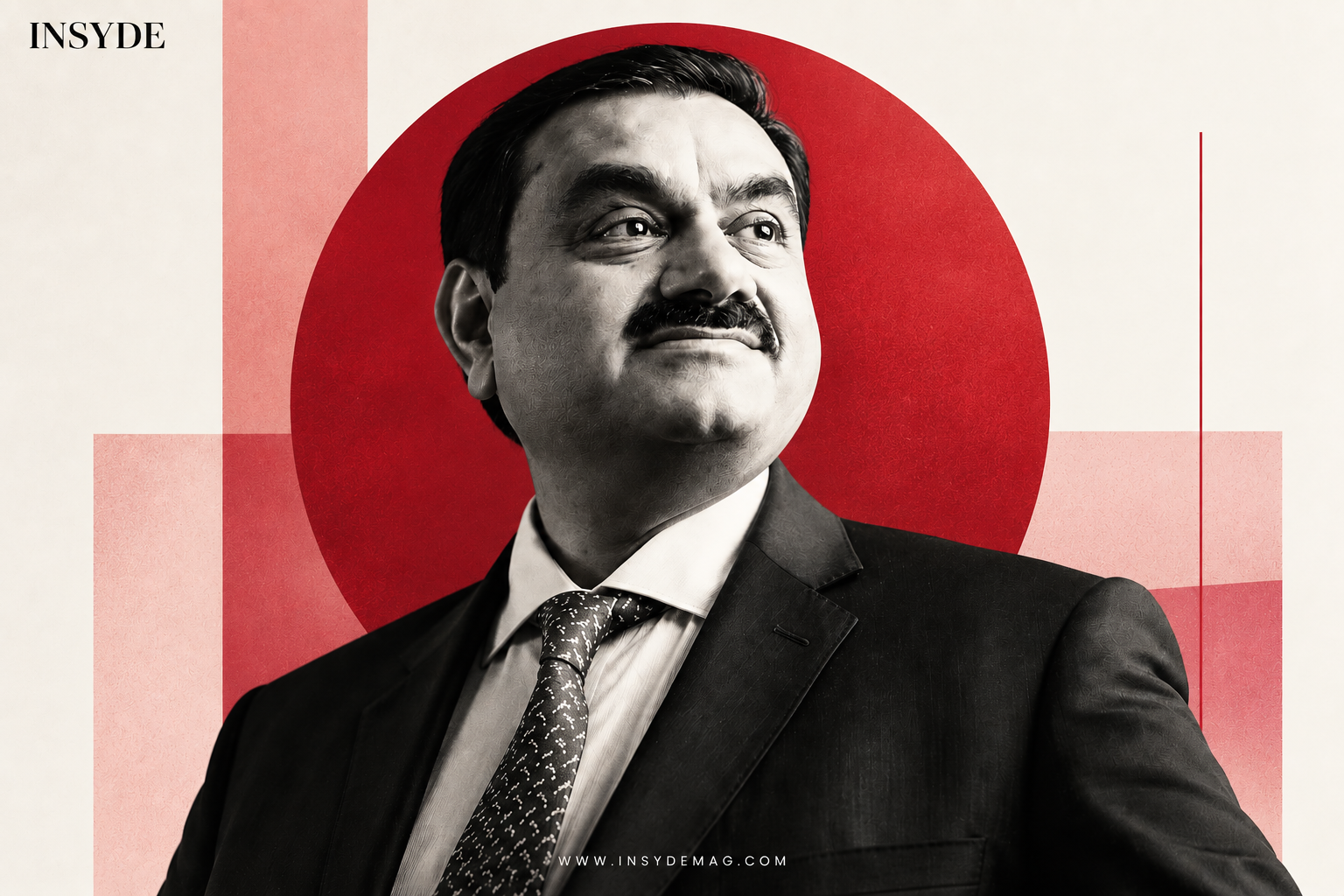
    How Gautam Adani returned to the top of India’s wealth rankings — and why the bigger story is the infrastructure empire being built for what comes next.

    BY INSYDE | BUSINESS & POWER


    There are different ways to become extraordinarily wealthy.

    You can build something people desperately want.

    You can create a brand people dream about owning.

    Or you can build the infrastructure that an entire economy depends on.

    Gautam Adani belongs largely to the third category.

    In September 2026, Forbes’ latest India’s 100 Richest list placed Adani at No. 1 with an estimated $112.7 billion fortune, marking his return to the top after three years at No. 2. Forbes said his wealth had increased by $20.7 billion over the previous year.

    The M3M Hurun India Rich List 2026 also placed Adani and his family first, valuing their wealth at approximately ₹9.23 lakh crore. Hurun’s wealth calculations, however, were a snapshot as of August 24, 2026, illustrating why billionaire rankings can produce different numbers at different points in time.

    That distinction matters.

    Because the most interesting part of the Adani story isn’t simply who occupies the first line of a rich list.

    It is what kind of empire can create wealth on this scale.

    Ports.

    Airports.

    Power.

    Renewables.

    Logistics.

    Infrastructure.

    And increasingly:

    Artificial intelligence.

    The Adani comeback is therefore about more than a number.

    It is about the changing architecture of Indian wealth.


    01 — THE RETURN

    The headline is irresistible:

    Adani is back on top.

    Forbes’ 2026 India rich list estimates Gautam Adani’s fortune at $112.7 billion, making him India’s richest person on that ranking. The publication says he has reclaimed the position after three years at No. 2.

    Hurun tells a similar story. Its 2026 list puts Adani and his family at approximately ₹9.23 lakh crore, ahead of Mukesh Ambani and family at ₹8.63 lakh crore.

    But billionaire rankings are snapshots, not permanent titles.

    Their numbers change with listed-company valuations, exchange rates, ownership stakes and the date on which wealth is measured. Forbes and Hurun themselves use different methodologies and valuation dates, which explains why their figures are not identical.

    The ranking is therefore the hook.

    The empire is the story.


    02 — BEFORE THE BILLIONS, THERE WAS TRADE

    The Adani Group did not begin as an airport empire.

    It began in 1988 as a commodities trading business.

    Over the following decades, Gautam Adani expanded into ports, logistics, energy, transmission, airports, renewables and other infrastructure businesses.

    That history explains something fundamental about the Adani model.

    The group has generally built around large physical systems rather than a single consumer-facing product.

    A luxury brand might sell a handbag.

    A technology company might sell software.

    Adani’s businesses operate closer to the foundations underneath those economies.

    They move goods.

    They move people.

    They generate electricity.

    They transmit power.

    They connect supply chains.

    And increasingly, they are positioning themselves around the infrastructure required for computing.

    The result is a very different kind of business empire.

    Less visible.

    More physical.

    And built around assets designed to operate at enormous scale.

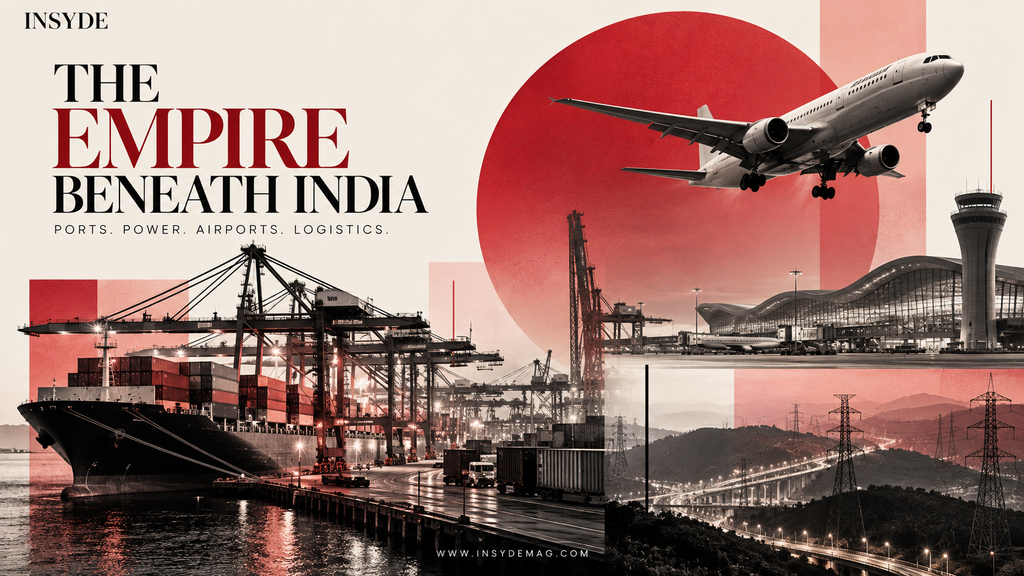
    Container port and logistics infrastructure representing Adani's ports and infrastructure empire

    03 — THE EMPIRE BENEATH INDIA

    Look at the port business and the scale becomes clearer.

    Adani Ports and Special Economic Zone, or APSEZ, reported 500.8 million tonnes of cargo handled in FY26, an 11% increase from the previous year. The company reported a 27.1% share of India’s total port cargo and a 45.5% share of India’s container market.

    Mundra is particularly significant.

    The port handles nearly 35% of India’s container trade, according to APSEZ.

    This isn’t simply a story about owning a port.

    It is about occupying a critical position inside India’s relationship with global trade.

    Then there is aviation.

    Adani Airport Holdings reported 94.44 million passengers across its seven operational airports in FY2024–25, according to the company’s reporting.

    The network now stretches across major Indian aviation markets, while Navi Mumbai International Airport began international operations in July 2026, adding another significant asset to the group’s aviation portfolio.

    These aren’t abstract assets.

    They are places through which millions of people and enormous volumes of goods physically move.

    And that is the defining characteristic of the Adani empire:

    scale becomes tangible.


    04 — THE ₹1.53-LAKH-CRORE STATEMENT

    Perhaps the clearest indication of where the group is heading isn’t Adani’s personal net worth.

    It is how aggressively the businesses are investing.

    The Adani portfolio reported ₹1,52,967 crore in capital expenditure during FY26, describing it as the highest annual capex in its history. Its gross asset base reached ₹7,85,098 crore, while EBITDA reached an all-time high of ₹94,834 crore, up 5.6% year on year. The group said core infrastructure contributed 87% of EBITDA.

    The numbers reveal something important.

    Adani’s wealth story isn’t simply about assets becoming more valuable.

    It is also about continually building more assets.

    During FY26, the group reported commissioning major projects including 5.1 GW of renewable capacity, 3.37 GWh of battery-energy storage, the Ganga Expressway and Navi Mumbai International Airport.

    Infrastructure requires enormous amounts of capital.

    But it also requires something else:

    time.

    A port is not a five-year trend.

    An airport is not a seasonal fashion cycle.

    A transmission network is not a consumer fad.

    These are assets designed to operate for decades.

    Futuristic data centre infrastructure representing the growing role of AI in India's infrastructure economy

    05 — THEN CAME AI

    This is where the Adani story becomes considerably more interesting.

    In February 2026, the Adani Group announced a proposed $100 billion direct investment through 2035 to develop renewable-energy-powered, hyperscale, AI-ready data centres.

    The plan targets 5 GW of integrated data-centre capacity and is expected by the group to catalyse an additional $150 billion across areas including server manufacturing, advanced electrical infrastructure and sovereign cloud services — creating what Adani describes as a potential $250 billion AI infrastructure ecosystem in India.

    The significance isn’t simply the size of the headline number.

    It is the logic behind it.

    AI may look like a software revolution.

    But software needs hardware.

    Hardware needs data centres.

    Data centres need electricity.

    Electricity requires generation and transmission.

    And all of that requires land, construction, cooling, logistics, networks and capital.

    Suddenly, the traditional Adani portfolio — energy, infrastructure, logistics and utilities — has a direct relationship with one of the defining technological shifts of the decade.

    The group isn’t simply betting on AI applications.

    It is betting on the physical infrastructure underneath AI.


    06 — FROM PORTS TO COMPUTE

    This may ultimately be one of the most interesting evolutions in the Adani story.

    The first version of the empire was built around commodities.

    The next expanded into infrastructure and energy.

    The emerging version is positioning itself around the infrastructure required by a more digital economy.

    It is an evolution from moving physical goods to supporting the systems that move information and computation.

    In April 2026, Google broke ground on a gigawatt-scale AI hub in Visakhapatnam in partnership with AdaniConneX and Nxtra by Airtel, adding another major development to India’s emerging AI infrastructure ecosystem.

    Then, in June, Adani Enterprises and Jabil announced plans for a strategic alliance aimed at building a vertically integrated AI and data-centre infrastructure manufacturing platform in India, including high-density AI racks, servers, storage, networking systems, power-distribution equipment and thermal-management infrastructure.

    The glamour of AI tends to belong to the companies building models, applications and consumer products.

    But underneath the interface is an industrial ecosystem:

    Power.
    Cooling.
    Data centres.
    Servers.
    Transmission.
    Connectivity.
    Land.
    Construction.
    Logistics.

    That is the infrastructure opportunity Adani is pursuing.


    07 — TWO MODELS OF INDIAN SCALE

    For years, India’s billionaire story has been framed around a single question:

    Ambani or Adani?

    But the more revealing comparison isn’t personal.

    It is structural.

    Reliance under Mukesh Ambani has evolved from its traditional energy and petrochemicals base into a broader ecosystem spanning telecommunications, digital services, retail, financial services and energy.

    Adani’s centre of gravity is different.

    Its portfolio remains heavily concentrated around infrastructure, transport, logistics, energy, utilities and industrial development, while newer ambitions extend into areas such as AI infrastructure and advanced manufacturing.

    The distinction tells us something about India’s economic transformation.

    The country’s largest business empires are increasingly not built around one product.

    They are built around ecosystems.

    One can be closer to the consumer.

    Another can be closer to the infrastructure underneath the consumer economy.

    Both reflect the increasing scale and complexity of Indian capital.


    08 — THE COMEBACK HAS A HISTORY

    No serious account of Adani’s rise can ignore the scrutiny surrounding the group in recent years.

    In January 2023, Hindenburg Research published allegations concerning the Adani Group, including claims involving stock manipulation and financial wrongdoing. The Adani Group denied the allegations. The episode was followed by substantial market scrutiny and a sharp decline in the group’s listed-company valuations.

    The story has since moved through multiple regulatory and legal developments.

    Most recently, on September 28, 2026, India’s market regulator SEBI allowed Gautam Adani and four Adani Group companies to settle proceedings concerning alleged minimum-public-shareholding violations.

    Reuters reported that the settlement involved a payment of ₹1.482 crore ($154,403) without admission or denial of SEBI’s findings. Proceedings against the Adani entities were disposed of without penalties, while two individuals were separately fined ₹20 lakh each for incomplete or incorrect disclosures.

    For INSYDE, this isn’t a footnote.

    It is part of understanding what happens when a private business empire becomes large enough to attract sustained regulatory, market and public scrutiny.

    Scale creates opportunity.
    Scale also creates scrutiny.


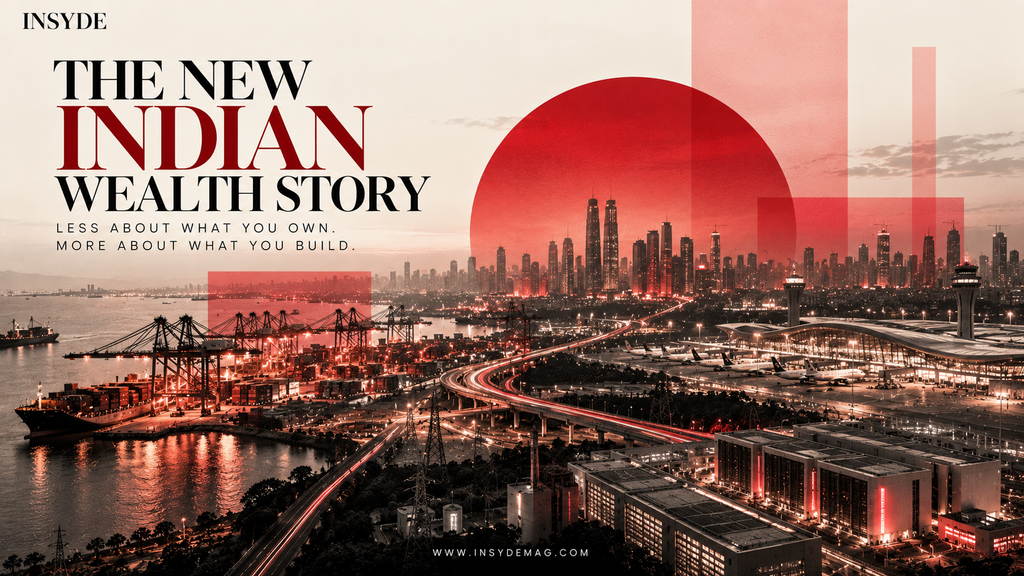
    Indian city, airport, port and infrastructure landscape representing the new scale of Indian wealth

    09 — THE NEW INDIAN BILLIONAIRE

    There was a time when India’s wealth hierarchy was dominated by industrial categories that were relatively easy to define.

    Steel.

    Cement.

    Textiles.

    Pharmaceuticals.

    Petrochemicals.

    Today’s landscape is more complicated.

    Technology.

    Telecom.

    Digital platforms.

    Renewable energy.

    Infrastructure.

    Healthcare.

    Financial services.

    Data centres.

    AI.

    Logistics.

    The latest Hurun list puts that transformation into perspective: 1,810 individuals with wealth of at least ₹1,000 crore made its 2026 list, with their combined wealth reaching approximately ₹187.5 lakh crore, or $1.96 trillion. Hurun also counted a record 391 dollar billionaires.

    The modern billionaire is increasingly not simply a person with an enormous collection of assets.

    It is an individual whose ownership can span networks of businesses that interact with one another.

    A port connects to logistics.

    Logistics connects to manufacturing.

    Energy connects to data centres.

    Data centres connect to AI.

    Airports connect to retail, hospitality and urban development.

    The empire becomes the ecosystem.


    10 — THE LUXURY OF SCALE

    Luxury is usually presented through objects.

    A watch.

    A car.

    A yacht.

    A private jet.

    A penthouse.

    But there is another form of luxury that rarely appears in glossy advertising:

    scale.

    The ability to commit billions of dollars to an industry before its full potential becomes obvious.

    The ability to build assets that may take years to mature.

    The ability to think in decades rather than seasons.

    Infrastructure requires exactly that kind of patience.

    It is capital-intensive, operationally complex and dependent on long-term demand.

    That makes the Adani story relevant to INSYDE for a different reason.

    It expands the definition of what extreme wealth looks like.

    Sometimes luxury is owning the object everyone recognizes.

    Sometimes it is having the resources to build the system nobody notices until it stops working.


    11 — WHAT INDIA NEEDS NEXT

    The real test of an infrastructure empire is not how impressive its balance sheet looks today.

    It is whether the assets being built remain relevant tomorrow.

    India’s next phase of growth will require enormous amounts of:

    Energy.
    Transportation.
    Logistics.
    Urban infrastructure.
    Digital connectivity.
    Computing capacity.
    Manufacturing.

    Adani’s recent capital deployment reflects that ambition.

    During FY26, the group reported commissioning major assets across renewable energy, battery storage, airports, roads and other infrastructure platforms. Adani Green Energy separately reported adding more than 5 GW of renewable capacity in FY26, taking its operational renewable portfolio to 19.3 GW.

    The strategy is therefore not simply about becoming larger.

    It is about positioning the portfolio around the physical requirements of India’s next economic phase.

    Whether every investment ultimately delivers the returns projected is a question that only time and markets can answer.

    But the direction of capital is clear.


    12 — THE SECOND ACT

    The easiest way to describe this moment is as a comeback.

    And there is truth in that.

    Adani has returned to the top of Forbes’ 2026 Indian wealth ranking after three years at No. 2.

    But the second act is more interesting than the first.

    Because this isn’t simply about rebuilding what existed before.

    The group is simultaneously expanding its infrastructure portfolio while placing major new bets on renewable energy, energy storage, data centres and AI infrastructure.

    That makes the current moment less about reclaiming a title and more about what happens after the title is reclaimed.

    The next decade will determine whether the group’s enormous capital cycle translates into equally significant long-term value.

    For now, the direction is unmistakable.

    The empire is building.


    THE INSYDE TAKE

    The most interesting thing about Gautam Adani’s return to the top isn’t the number beside his name.

    It is what that number represents.

    A fortune built largely around the physical architecture of a rapidly changing economy.

    Ports.

    Airports.

    Power.

    Energy.

    Logistics.

    Renewables.

    And now, increasingly, artificial intelligence.

    Forbes and Hurun currently place Adani at the top of their respective 2026 Indian wealth rankings, while their figures differ because their methodologies and valuation dates differ.

    But beyond the ranking, the larger story is difficult to miss.

    India is building.

    It is building airports.

    Ports.

    Energy systems.

    Digital infrastructure.

    Manufacturing capacity.

    And increasingly, the physical foundations of artificial intelligence.

    The fortunes being created at the highest levels of Indian wealth are therefore becoming increasingly connected not simply to what India buys, but to what India will need next.

    That may be the real Adani comeback.

    Not simply returning to No. 1.

    But building for what comes after it.


    THE ADANI COMEBACK

    The billionaire is back at the top.
    The empire is building for what comes next.

    Ports. Power. Airports. AI.

    The new Indian wealth story may be less about what you own — and more about what you build.

    INSYDE

  • WHERE THE ULTRA-RICH LIVE

    WHERE THE ULTRA-RICH LIVE

    Bengaluru’s 5 Most Exclusive Residential Addresses in 2026

    By INSYDE Magazine

    Bengaluru has spent decades building wealth. Now, that wealth is reshaping the city’s residential map.

    India’s technology capital has become one of the country’s most important luxury-property markets, driven by technology entrepreneurs, business families, senior executives, investors and a growing population of high-net-worth individuals.

    The numbers tell part of the story.

    In FY2026, Bengaluru recorded 128 residential transactions valued at ₹10 crore or more, worth a combined ₹1,957 crore. The number of ultra-luxury transactions increased 52% year-on-year, making Bengaluru the fastest-growing of the three southern markets tracked in the CRE Matrix–India Sotheby’s International Realty Southern India High-End Luxury Housing Report. (CRE Matrix)

    The broader market has remained equally active. Cushman & Wakefield recorded 12,442 residential launches in Bengaluru in Q3 2026, taking year-to-date launches to approximately 37,650 units. High-end and luxury housing continued to dominate new supply. Earlier in 2026, the segment accounted for 68% of launches in Q1, compared with 53% in the previous quarter. (Cushman & Wakefield)

    At the prime end of the market, the story becomes even more interesting.

    Knight Frank’s 2026 Prime International Residential Index found global prime residential prices rose 3.2% during 2025, while Bengaluru recorded 9.4% growth, placing the city among the strongest-performing prime residential markets tracked globally. (Global)

    But where does Bengaluru’s wealth actually live?

    Not necessarily in the newest skyscraper. And not always in the largest gated villa development.

    Some of the city’s most valuable residential real estate remains concentrated in established neighbourhoods where land is scarce, privacy is difficult to replicate and the address itself carries decades of prestige.

    After examining current 2026 pricing, luxury inventory, documented transactions, land scarcity and the character of wealth concentrated in each market, these are the five addresses that stand out.


    01

    LAVELLE ROAD & VITTAL MALLYA ROAD

    THE TROPHY ADDRESS

    If Bengaluru has a residential equivalent of a trophy asset, it is the Lavelle Road–Vittal Mallya Road corridor.

    This is the city’s most concentrated ultra-prime residential pocket: central, land-constrained and surrounded by some of Bengaluru’s most established commercial, cultural and hospitality destinations.

    Current 2026 data shows just how expensive the market has become.

    MagicBricks recorded an average apartment price of approximately ₹23,904 per sq ft on Lavelle Road in Q2 2026, with the locality’s quoted high reaching around ₹28,476 per sq ft. (MagicBricks)

    But averages only tell part of the story.

    At the trophy end of the market, a 25,824-sq-ft ancestral bungalow on Lavelle Road reportedly transacted at approximately ₹64,000 per sq ft, putting the transaction value at roughly ₹165.6 crore. This was a landed property transaction, not an apartment sale, and therefore should not be compared directly with apartment averages. It does, however, demonstrate the extraordinary value attached to scarce land in this micro-market. (Sadhwani Real Estate Holdings)

    Vittal Mallya Road operates at an equally rarefied level.

    The road is home to Kingfisher Towers, one of Bengaluru’s best-known ultra-luxury residential developments. A previously recorded 8,400-sq-ft apartment transaction at ₹50 crore translated to approximately ₹59,500 per sq ft. Another resale transaction was reported at approximately ₹42,090 per sq ft. (Sadhwani Real Estate Holdings)

    These transactions should not be mistaken for locality-wide averages. They are trophy benchmarks.

    And that distinction is important.

    At this level of the market, buyers are not simply paying for built-up area. They are paying for scarcity, centrality, privacy and provenance.

    Government guidance values underline the same land-scarcity story. For FY2026–27, Lavelle Road carries a residential guidance value of ₹15,000 per sq ft, the highest residential guidance value among the localities listed in the DeedSure index. Guidance value, however, is a registration benchmark — not the market price. (DeedSure)

    What makes it exclusive: trophy transactions, scarce central land, established luxury developments and an address that has become synonymous with Bengaluru’s uppermost residential market.


    02

    SADASHIVANAGAR

    WHERE LEGACY LIVES

    If Lavelle Road represents trophy real estate, Sadashivanagar represents legacy wealth.

    The neighbourhood’s character is fundamentally different from Bengaluru’s newer luxury corridors.

    Here, the ultimate asset is often not a high-rise apartment but land.

    Large plots, mature trees, established residences and limited opportunities for comparable development have created a market where privacy and location carry enormous value.

    MagicBricks recorded an average apartment price of approximately ₹24,063 per sq ft in Q2 2026, with the quoted locality range running from roughly ₹20,128 to ₹27,998 per sq ft. (MagicBricks)

    Another MagicBricks listing dataset puts the average rate around ₹24,062 per sq ft for the same period, reinforcing the locality’s position among Bengaluru’s most expensive established apartment markets. (MagicBricks)

    But again, apartment prices do not fully capture the economics of Sadashivanagar.

    The neighbourhood contains a significant stock of independent homes and large plots, meaning that the value of a property can be heavily influenced by the land beneath it.

    That is why comparing Sadashivanagar purely with apartment-heavy neighbourhoods can be misleading.

    It is a market where the address, the plot and the privacy are part of the product.

    The government’s FY2026–27 guidance value also places Sadashivanagar among Karnataka’s highest-value residential localities, at ₹12,000 per sq ft. (DeedSure)

    Luxury-market research continues to identify Sadashivanagar as one of Bengaluru’s traditional prime residential addresses, alongside the Lavelle Road and Vittal Mallya Road corridor. (GHAR.TV)

    What makes it exclusive: legacy housing stock, large land parcels, low-supply conditions, privacy and an established association with Bengaluru’s wealthiest residential circles.


    03

    CUNNINGHAM ROAD

    QUIET, CENTRAL, ULTRA-PRIME

    Cunningham Road is not necessarily Bengaluru’s loudest luxury address.

    That is part of its appeal.

    Located in central Bengaluru, close to the CBD and some of the city’s most established institutions and neighbourhoods, Cunningham Road occupies a particularly scarce segment of the residential market.

    MagicBricks recorded an average apartment price of approximately ₹18,530 per sq ft in Q2 2026, with the locality’s quoted high at approximately ₹22,821 per sq ft. (MagicBricks)

    But premium developments can command considerably more.

    Current 2026 luxury-market research places advertised rates on Cunningham Road at roughly ₹21,550–₹31,750 per sq ft, with some of the most exclusive central branded projects quoting approximately ₹33,000–₹35,000 per sq ft. (GHAR.TV)

    The difference between these numbers is not necessarily contradictory.

    MagicBricks is reporting a broader locality-level apartment market, while the higher figures relate to selected premium developments.

    That distinction is crucial when analysing Bengaluru’s luxury property market.

    Cunningham Road also benefits from one of the characteristics that matters most at the top end of real estate: limited supply in a central location.

    The wider Cushman & Wakefield market classification places Cunningham Road within Bengaluru’s high-end Central submarket alongside locations such as Lavelle Road, Palace Cross Road, Richmond Road and Sankey Road. (Cushman & Wakefield)

    This is not a neighbourhood built around spectacle.

    It is built around location.

    What makes it exclusive: centrality, limited high-quality residential supply, premium apartment developments and proximity to Bengaluru’s CBD.


    04

    RICHMOND TOWN

    OLD BENGALURU, NEW LUXURY

    Richmond Town represents another version of central Bengaluru luxury.

    Its appeal comes from its combination of heritage character, central location and increasingly expensive residential stock.

    MagicBricks recorded an average apartment price of approximately ₹18,079 per sq ft in Q2 2026, with a quoted locality high of around ₹21,419 per sq ft. (MagicBricks)

    Other datasets show an even higher premium at the project level.

    DOSL, using Karnataka RERA project data rather than property-portal listings, reports a median builder quote of ₹23,158 per sq ft across projects with published pricing in Richmond Town. Because this is a project-level median rather than a locality-wide transaction average, it should be interpreted separately from the MagicBricks figure. (DOSL)

    Housing.com, meanwhile, reports a 2026 locality average of approximately ₹21,269 per sq ft, with listed properties extending considerably higher depending on the asset. (Housing)

    The differences illustrate something fundamental about central Bengaluru.

    There is no single number that perfectly describes an entire neighbourhood.

    A newly built luxury apartment, a resale residence, an independent house and a redevelopment parcel can have radically different economics even when they share the same postcode.

    Richmond Town benefits from precisely that mix.

    It sits close to Bengaluru’s established commercial and hospitality districts while retaining the character of an older residential neighbourhood.

    For wealthy buyers who want centrality without the trophy-apartment identity of Vittal Mallya Road, that combination can be particularly attractive.

    What makes it exclusive: central location, established residential character, limited new supply and a growing premium for high-quality redevelopment.


    05

    INDIRANAGAR

    WHERE NEW WEALTH MEETS CULTURE

    Indiranagar tells a different story.

    If Sadashivanagar represents established wealth, Indiranagar represents the evolution of Bengaluru’s new affluent lifestyle.

    The neighbourhood has become one of the city’s most recognisable destinations for restaurants, nightlife, fashion, hospitality, design and premium retail.

    Its residential market reflects the same transformation.

    MagicBricks recorded an average apartment price of approximately ₹18,749 per sq ft in Q2 2026. But independent houses were considerably more expensive, averaging approximately ₹34,529 per sq ft, with the highest quoted house price reaching around ₹43,361 per sq ft. (MagicBricks)

    That difference is revealing.

    Indiranagar’s most valuable properties are not necessarily the apartments.

    In many cases, the underlying land is the real asset.

    The government’s FY2026–27 residential guidance value for Indiranagar is ₹11,000 per sq ft, placing it among Karnataka’s highest-value residential localities. Again, this is a statutory guidance benchmark rather than an open-market selling price. (DeedSure)

    Indiranagar also demonstrates how the meaning of luxury is changing in Bengaluru.

    For a newer generation of affluent residents, luxury can mean being close to the city’s best restaurants, social spaces, boutiques, cafés and entertainment — rather than being completely removed from urban life.

    That makes Indiranagar different from the quieter legacy neighbourhoods.

    Its luxury proposition is not only privacy.

    It is access.

    What makes it exclusive: premium landed property, strong lifestyle infrastructure, central connectivity and a deep connection to Bengaluru’s contemporary affluent culture.


    THE FIVE ADDRESSES, AT A GLANCE

    RankAddress2026 Market IndicatorLuxury Character
    01Lavelle Road & Vittal Mallya RoadLavelle Road apartments ~₹23,904/sq ft; trophy transactions substantially higherTrophy real estate
    02SadashivanagarApartments ~₹24,063/sq ftLegacy wealth & privacy
    03Cunningham RoadApartments ~₹18,530/sq ft; premium projects can exceed ₹30,000/sq ftCentral ultra-luxury
    04Richmond TownApartments ~₹18,079/sq ft; project-level quotes can exceed ₹23,000/sq ftHeritage central luxury
    05IndiranagarApartments ~₹18,749/sq ft; independent houses ~₹34,529/sq ftNew wealth & lifestyle

    Locality averages and premium-project figures are not directly interchangeable. They represent different market samples and methodologies.


    SO, WHERE DOES BENGALURU’S ULTRA-WEALTHY LIVE?

    The answer is not as simple as identifying the five neighbourhoods with the highest average price per square foot.

    Bengaluru’s luxury market is divided into several different forms of wealth.

    Lavelle Road and Vittal Mallya Road represent the city’s trophy residential core.

    Sadashivanagar represents legacy wealth and scarce landed property.

    Cunningham Road represents quiet, central ultra-luxury.

    Richmond Town combines heritage character with central-city premiumisation.

    Indiranagar represents the city’s newer affluent lifestyle economy.

    There is also an important reason why Koramangala does not appear in this final five despite being one of Bengaluru’s most important wealth neighbourhoods.

    Koramangala is unquestionably a major luxury market and a significant centre of technology-driven wealth. Its Q2 2026 average apartment price was approximately ₹15,738 per sq ft, while independent houses averaged around ₹32,767 per sq ft, with the highest quoted house level around ₹40,901 per sq ft. (MagicBricks)

    But when the ranking is constructed around the combination of current residential price intensity, ultra-prime scarcity and established luxury positioning, the central addresses above provide a stronger overall fit for this particular editorial.

    That does not mean Koramangala is less important to Bengaluru’s wealth story.

    It means expensive real estate and wealth concentration are two related — but different — measures.


    THE BIGGER STORY

    The most interesting part of Bengaluru’s luxury-property market isn’t a single ₹50 crore apartment or a ₹100 crore-plus bungalow.

    It is the structural change taking place underneath the market.

    The city is producing more high-value housing, more high-net-worth buyers and more sophisticated forms of residential luxury.

    The FY2026 data from CRE Matrix and India Sotheby’s International Realty is particularly revealing: Bengaluru recorded 128 homes sold at ₹10 crore or above, worth ₹1,957 crore, with unit sales up 52% from FY2025. (CRE Matrix)

    At the same time, new luxury supply is expanding beyond Bengaluru’s traditional centre.

    Cushman & Wakefield’s 2026 research shows strong launch activity in East and North Bengaluru, including Whitefield, Gunjur, Budigere Cross, Hoskote, Devanahalli and Hebbal. The latest Q3 data recorded 12,442 new residential launches, while year-to-date launches reached approximately 37,650 units. (Cushman & Wakefield)

    That creates two very different definitions of luxury.

    There is new luxury:

    Branded residences.
    Large-format apartments.
    Gated villas.
    Airport-corridor developments.
    Private amenities.
    New infrastructure.

    And then there is scarcity luxury:

    Old plots.
    Large gardens.
    Established streets.
    Low-density neighbourhoods.
    Trophy buildings.
    Addresses that cannot easily be recreated.

    The second category remains particularly powerful in central Bengaluru.

    Because once a neighbourhood reaches a certain level of scarcity, the value is no longer simply in what can be built there.

    It is in what cannot be built again.


    THE INSYDE TAKE

    Bengaluru’s wealth map is changing, but its most exclusive addresses continue to be shaped by an old principle of luxury real estate:

    scarcity creates status.

    Lavelle Road and Vittal Mallya Road have the trophy transactions.

    Sadashivanagar has the land and legacy.

    Cunningham Road has central scarcity.

    Richmond Town has heritage and location.

    Indiranagar has the lifestyle and the new affluent economy.

    Together, they reveal a city where old wealth and new wealth increasingly overlap — while the most valuable pieces of real estate remain remarkably difficult to reproduce.

    The future of Bengaluru luxury property may be being built in new corridors.

    But some of the city’s most coveted addresses are already decades old.

    And perhaps that is the ultimate luxury.

    Not owning the newest home in Bengaluru.

    Owning a piece of the city that cannot be made again.


    DATA & METHODOLOGY

    This editorial uses the latest publicly available 2026 data reviewed by INSYDE as of 28 September 2026. Locality-level figures primarily use Q2 2026 property-market data where Q3 locality data was not yet available in a comparable format. City-wide market analysis incorporates the latest available Q3 2026 Cushman & Wakefield data, FY2026 luxury transaction data from CRE Matrix and India Sotheby’s International Realty, and Knight Frank’s 2026 prime residential index. (Cushman & Wakefield)

    Price figures from property portals, RERA-based project databases, market reports and transaction records measure different things. Asking prices, builder quotes, registered transaction prices, locality averages and government guidance values should not be treated as interchangeable. Where trophy transactions are cited, they are presented as individual benchmarks rather than locality-wide averages.

    Government guidance values are statutory registration benchmarks and do not represent current market prices. (DeedSure)

    The five-address selection is an INSYDE editorial analysis, based on a combination of price intensity, ultra-prime inventory, documented transaction benchmarks, land scarcity, centrality and the character of wealth associated with each residential market. It is not an official government or industry ranking.

    SOURCES & MARKET DATA

    Primary market and industry research

    Locality pricing — 2026

    Karnataka property valuation

    Ultra-luxury Bengaluru market research

    Market data reviewed through: 28 September 2026.

    INSYDE Magazine
    People. Culture. Style. What’s Next.

  • THE RICHEST SPORT ON EARTH?

    THE RICHEST SPORT ON EARTH?

    Inside the NFL’s $300 Billion Empire

    The NFL has transformed American football into one of the most valuable entertainment businesses on the planet. But is it really the richest sport in the world?

    There are sports leagues.

    And then there is the NFL.

    With just 32 franchises, the National Football League has built a commercial machine that generates more than $23 billion in annual revenue, commands nearly $110 billion in long-term media rights agreements, and has pushed the average value of an NFL franchise to approximately $9.5 billion in 2026.

    The Dallas Cowboys alone are now valued at $17 billion.

    The league’s financial scale has become so extraordinary that the least valuable NFL franchise is now worth around $8 billion.

    But there is a catch.

    The NFL is not the world’s biggest sport by global audience. Football — or soccer — has a vastly broader international footprint, with the FIFA World Cup continuing to demonstrate its enormous global reach.

    So what exactly has the NFL built?

    The answer is perhaps more interesting than the question.

    The NFL has created one of the most powerful sports-business ecosystems in the world — a combination of media rights, advertising, sponsorship, franchise scarcity, stadium economics, merchandising, celebrity and live entertainment that has turned American football into a financial powerhouse.

    And the numbers tell the story.


    $300 BILLION AND COUNTING

    In September 2026, Forbes valued the average NFL franchise at approximately $9.5 billion, up 34% from the previous year.

    Collectively, the 32 franchises are therefore worth more than $300 billion.

    Every team in the league is now valued at at least $8 billion.

    That is an extraordinary change from just a few years ago.

    The Dallas Cowboys sit at the top of the market with a valuation of $17 billion, according to Forbes. The Los Angeles Rams follow at $13.5 billion, the New York Giants at $12 billion, the New England Patriots at $10.6 billion and the San Francisco 49ers at $10.5 billion.

    The Cowboys have held the position as the NFL’s most valuable franchise for 20 consecutive years.

    The striking part isn’t simply that the Cowboys are worth $17 billion.

    It is how quickly the entire league has moved upward.

    The Seattle Seahawks, for example, were sold in 2026 at a reported $9.6 billion valuation — a price that would have represented an extraordinary franchise value only a few years ago.

    Today, it places the club around the middle of the NFL’s valuation hierarchy.

    This is what happens when a scarce asset class meets rapidly growing media economics.


    THE NFL DOESN’T NEED 100 TEAMS

    There are only 32 NFL franchises.

    That scarcity is fundamental to the economics.

    An investor cannot simply create another NFL franchise and begin competing with the existing clubs.

    Ownership opportunities are exceptionally rare, while the number of ultra-high-net-worth individuals and investment groups capable of participating in major sports ownership has expanded.

    At the same time, NFL media rights have continued to grow.

    The result is a remarkably powerful equation:

    limited supply + growing demand + predictable media revenue = rising franchise valuations.

    S&P Global’s 2026 analysis points to several forces behind the rise in NFL valuations, including expanding television rights, the influx of private equity and higher revenue multiples.

    The value of an NFL franchise is therefore not determined simply by how well its team performs on the field.

    The business surrounding the team can be just as important.


    THE $23 BILLION MACHINE

    The NFL’s scale becomes even clearer when looking at revenue.

    NFL teams generated an estimated $23.5 billion in revenue in 2025, according to recent industry reporting, while total NFL revenue surpassed $23 billion.

    That places the NFL substantially ahead of several other major individual sports leagues on commonly reported revenue measures.

    The NBA’s teams generated an estimated $12.25 billion during the 2024–25 season.

    The Premier League’s clubs generated approximately £6.8 billion during 2024–25, equivalent to roughly $9 billion depending on exchange rates.

    These comparisons need some caution because leagues report their finances differently and operate under different structures.

    But the broad picture is clear:

    The NFL is an extraordinary revenue-generating machine.

    And much of that machine is powered by something increasingly valuable in modern media:

    live attention.


    THE $14.5 BILLION DISTRIBUTION

    One of the NFL’s most important structural advantages is its centralized revenue model.

    In 2025, NFL teams received approximately $14.5 billion in shared league revenue, according to S&P Global.

    That works out to more than $450 million per team before considering many locally generated revenue streams.

    The shared revenue pool includes national media rights, sponsorships, licensing and other leaguewide commercial income.

    This structure creates an unusually strong financial floor for individual franchises.

    The NFL isn’t simply a collection of 32 independent businesses.

    It functions as a connected commercial ecosystem.

    The league sells its most valuable national inventory collectively.

    The teams share substantial portions of that income.

    And the result is greater financial stability across the franchise base.


    TELEVISION IS THE REAL MVP

    The NFL’s greatest commercial asset may not be the stadium.

    It may not even be the Super Bowl.

    It is the league’s control over premium live media.

    The NFL’s current media agreements with CBS, NBC, FOX, ESPN/ABC and Amazon run through the 2033 season and are worth nearly $110 billion over 11 years, according to S&P Global.

    The agreements cover television and digital distribution, including major regular-season packages and Super Bowl rights.

    The significance goes beyond the size of the cheque.

    Live sport is one of the few forms of entertainment that people still have a powerful reason to watch immediately.

    A film can wait.

    A series can wait.

    A YouTube video can wait.

    A game cannot.

    The outcome exists only once.

    That makes live sport incredibly valuable to broadcasters and advertisers.

    And the NFL has an enormous amount of it.


    83 OF AMERICA’S TOP 100

    The league’s dominance of U.S. television illustrates the strength of the model.

    NFL games accounted for 83 of the 100 most-watched television broadcasts in the United States during 2025, according to recent industry reporting.

    The NFL also averaged approximately 18.7 million viewers per game during the 2025 season, according to S&P Global, making it one of the most powerful recurring television properties in the United States.

    That concentration of attention is commercially rare.

    And advertisers know it.


    THE SUPER BOWL EFFECT

    Then there is the Super Bowl.

    Super Bowl LX, played in February 2026, averaged 125.6 million viewers across NBC, Peacock, Telemundo, NBC Sports Digital and NFL+, according to Nielsen figures reported by NBC Sports.

    The broadcast peaked at 137.8 million viewers, setting a U.S. television viewership record for a single moment of programming.

    Those numbers explain why the Super Bowl exists in a category of its own.

    It is simultaneously a championship game, television spectacle, advertising platform, celebrity event and entertainment property.

    For brands, it is not simply a media buy.

    It is access to one of the largest concentrated audiences available in American entertainment.

    The Super Bowl has therefore become something larger than the game itself.

    It is a cultural event built around a sporting event.


    THE PRICE OF 30 SECONDS

    The economics of Super Bowl advertising make that point even clearer.

    A 30-second commercial during the 2026 Super Bowl cost advertisers roughly $8 million on average, with some placements reaching higher levels.

    But the real cost of participating in the Super Bowl ecosystem can be substantially greater.

    Brands don’t just purchase airtime.

    They produce campaigns.

    Hire celebrities.

    Create social content.

    Launch teasers.

    Build activations.

    Extend the campaign across digital platforms.

    And then compete for attention around the advertisement itself.

    The commercial becomes part of the entertainment.

    That is one of the NFL’s greatest commercial advantages.

    It doesn’t simply sell advertising space.

    It sells participation in a cultural moment.


    THE COWBOYS: A BUSINESS BEYOND FOOTBALL

    Nothing illustrates the NFL’s economics better than the Dallas Cowboys.

    Forbes estimates the Cowboys generated nearly $1.28 billion in revenue during the 2025 season and approximately $677 million in operating income.

    Their franchise valuation reached $17 billion in 2026.

    The Cowboys are therefore not simply monetizing football games.

    Their business encompasses sponsorships, premium seating, merchandise, media exposure, stadium activity, hospitality and the enormous commercial value of the Cowboys brand.

    AT&T Stadium itself functions as an entertainment destination.

    The franchise has effectively turned team ownership into a large-scale entertainment and commercial platform.

    And that model increasingly defines modern sports ownership.


    THE STADIUM HAS BECOME A LUXURY PRODUCT

    The modern sports stadium is no longer simply a place to watch a game.

    Premium suites.

    Private clubs.

    Corporate hospitality.

    Restaurants.

    Luxury seating.

    Concerts.

    Naming rights.

    Merchandise.

    Non-sporting events.

    The stadium has become a destination where sport meets hospitality, entertainment and business.

    This matters because the highest-value fan isn’t necessarily the person buying the cheapest seat.

    The premium customer may be paying thousands for access, privacy, hospitality and networking.

    The experience becomes the product.

    And that is increasingly where sports begins to overlap with luxury.


    THE ATHLETE IS A BUSINESS, TOO

    The commercial ecosystem doesn’t end with the franchise.

    Players themselves have become brands.

    The modern NFL star can generate value through:

    Endorsements.

    Merchandise.

    Social media.

    Fashion.

    Collectibles.

    Media appearances.

    Personal businesses.

    The NFL Players Association reported more than $1.9 billion in retail sales of officially licensed player merchandise during the March 2025–February 2026 period.

    A jersey isn’t simply merchandise.

    It is identity.

    Fans don’t only consume the sport.

    They participate in it through the athletes and teams they choose to represent.

    That creates another layer of commercial value.


    THE SALARY CAP AND THE ECONOMIC ENGINE

    The players are also directly connected to the league’s financial growth.

    The NFL’s salary cap reached approximately $301.2 million per team in 2026, crossing the $300 million threshold for the first time.

    That is a dramatic increase from the approximately $208.2 million cap in 2022.

    The growth reflects the increasing size of the league’s revenue pool.

    More media money means more league revenue.

    More league revenue means a larger pool available under the league’s labor agreement.

    The result is a cycle in which media growth, player compensation and franchise economics are closely connected.


    BUT IS THE NFL REALLY THE BIGGEST SPORT ON EARTH?

    This is where the story gets complicated.

    If “biggest” means financial power as an individual sports league, the NFL has a compelling claim.

    If “biggest” means global audience and worldwide cultural reach, the answer is different.

    Football — soccer — is played and followed across far more countries and markets.

    The 2026 FIFA World Cup once again demonstrated that reach.

    FIFA reported record-breaking audiences across multiple countries during the tournament’s opening stages and described the World Cup as the world’s biggest and most-watched global sporting event.

    That distinction is crucial.

    The NFL is one centralized league with 32 franchises.

    Global football is a massive ecosystem made up of domestic leagues, continental competitions, national teams and international tournaments.

    Comparing the two directly is therefore imperfect.

    But the contrast is revealing.

    Soccer has the world’s broader global footprint.

    The NFL has one of the world’s most powerful individual league businesses.

    Those are not the same achievement.


    THE GLOBAL EXPANSION

    The NFL understands the difference.

    And it is increasingly looking outside the United States.

    The league is scheduled to play a record nine international games during the 2026 season, expanding its presence across markets including the United Kingdom, Germany, Brazil, Spain, Ireland, Australia and other international destinations.

    All 32 NFL teams are also involved in the league’s Global Markets Program, which gives franchises commercial rights in selected international markets.

    The strategy is straightforward:

    The NFL already has enormous commercial power in the United States.

    Now it wants more of the world’s attention.

    That means international games.

    Streaming.

    Merchandise.

    Sponsorships.

    Local partnerships.

    Player marketing.

    And eventually, deeper grassroots development.

    The opportunity is enormous.

    So is the challenge.


    THE GLOBAL GAP

    American football does not yet have the worldwide cultural penetration of soccer.

    In many countries, football is not simply another sport.

    It is part of everyday culture.

    The NFL therefore faces a different problem from many global sports organizations.

    It does not need to prove that its business works.

    It needs to prove that its business model can travel.

    That is a much harder question.

    The United States provides the NFL with an enormous and highly monetized domestic market.

    The rest of the world offers something different:

    scale.

    If the NFL can convert even a fraction of international curiosity into long-term fandom, merchandise sales, media audiences and commercial partnerships, the league’s economic ceiling could move significantly higher.


    WHY THE NFL BUSINESS MODEL WORKS

    The league’s extraordinary economics come down to several structural advantages.

    SCARCITY

    Only 32 franchises exist.

    MEDIA POWER

    The league controls some of the most valuable live sports content in the world.

    CENTRALIZED REVENUE

    Large portions of national commercial revenue are shared among franchises.

    LIVE ATTENTION

    The outcome of a game cannot be replicated after the fact.

    ADVERTISING

    The Super Bowl provides one of the world’s most concentrated advertising audiences.

    BRAND VALUE

    NFL franchises have become powerful entertainment brands in their own right.

    PREMIUM HOSPITALITY

    Luxury suites, clubs and premium experiences create additional high-value revenue.

    GLOBAL EXPANSION

    The league still has significant international markets to develop.

    Put together, these factors create something unusually powerful:

    a scarce asset with recurring media demand and growing global commercial potential.


    THE NEXT BILLION-DOLLAR QUESTION

    The NFL’s next phase is not simply about increasing ticket sales.

    It is about increasing the value of attention.

    Streaming will become increasingly important.

    International markets will become increasingly important.

    Sports betting and fantasy will remain part of the broader engagement ecosystem.

    Premium hospitality will continue to evolve.

    Digital content will extend the life of games beyond the broadcast.

    And future media negotiations could become even more valuable.

    The league’s current media agreements already approach $110 billion over 11 years.

    Several agreements contain opt-out provisions that could allow the NFL to renegotiate before the contracts fully expire. S&P Global reports that most of the current agreements can be opted out of after the 2029 season.

    That creates another potential inflection point.

    The next major NFL media cycle could become one of the most closely watched transactions in global sports entertainment.


    SO, IS THE NFL THE RICHEST SPORT IN THE WORLD?

    There is no single answer because the question itself mixes different measurements.

    BY INDIVIDUAL LEAGUE REVENUE

    The NFL is the clear financial heavyweight among major individual sports leagues on commonly reported figures, with team revenue estimated at $23.5 billion in 2025 and total league revenue above $23 billion.

    BY FRANCHISE VALUE

    The NFL is extraordinary.

    Its 32 franchises have an average value of approximately $9.5 billion, while the league’s combined franchise value exceeds $300 billion.

    BY GLOBAL SPORTING REACH

    Soccer remains the larger worldwide phenomenon.

    The FIFA World Cup continues to generate enormous audiences across continents and FIFA describes it as the world’s biggest and most-watched global sporting event.

    BY SINGLE-EVENT COMMERCIAL POWER

    The Super Bowl occupies an unusually powerful position.

    Its 125.6 million average U.S. viewers in 2026 demonstrate the scale of the event, while its advertising market turns the championship into a major commercial spectacle.

    So the most defensible conclusion is not that the NFL is simply “the biggest sport on Earth.”

    It is this:

    The NFL is arguably the world’s most powerful individual sports-league business.

    And that distinction matters.


    THE REAL PRODUCT IS ATTENTION

    Football is what happens on the field.

    The real business happens everywhere else.

    In television studios.

    Inside advertising agencies.

    In luxury suites.

    At sponsorship meetings.

    Across streaming platforms.

    Inside stadiums.

    On social media.

    In merchandise stores.

    And increasingly, in markets outside the United States.

    The NFL has created an ecosystem where broadcasters pay billions for access to games, advertisers pay millions for access to viewers, investors pay billions for access to franchises, fans pay for access to experiences, and brands pay for access to the cultural conversation.

    Everyone is buying the same thing.

    Attention.

    The NFL has simply become exceptionally good at converting that attention into economic value.


    THE FINAL WHISTLE

    The NFL may not be the world’s most globally popular sport.

    That distinction belongs to a much broader football ecosystem.

    But measuring the NFL only by audience would miss the extraordinary business it has created.

    Thirty-two franchises.

    More than $23 billion in annual revenue.

    More than $300 billion in combined franchise value.

    A $17 billion flagship franchise.

    Nearly $110 billion in current media agreements.

    A Super Bowl attracting 125.6 million viewers in the United States.

    And a league now aggressively expanding into international markets.

    The NFL is no longer simply selling football.

    It is selling media.

    It is selling access.

    It is selling identity.

    It is selling entertainment.

    It is selling scarcity.

    And above all, it is selling attention.

    The game lasts a few hours.

    The business never stops.


    INSYDE VERDICT

    The NFL isn’t necessarily the biggest sport on Earth.

    But it may be the clearest example of how sport can be transformed into a global-scale entertainment and financial business.

    And as franchise valuations climb, media rights expand and the league pushes further beyond America, the most interesting question may no longer be whether the NFL is the richest sports league.

    It may be:

    How much is the NFL still worth if the rest of the world starts watching?

  • The Places Money Can’t Find

    The Places Money Can’t Find

    Why the rarest luxury destinations are becoming the hardest to reach.

    There was a time when luxury travel was about knowing where to go.

    Then it became about knowing where to stay.

    The right hotel. The right suite. The right table. The right beach.

    But for the traveller who has already experienced the familiar vocabulary of luxury, the more interesting question is beginning to emerge:

    Where can you go that still feels discovered?

    Not necessarily unknown.

    Not necessarily untouched.

    But difficult to reach, difficult to replicate and impossible to experience in quite the same way twice.

    That distinction is becoming increasingly important.

    Because when almost any destination can be researched, photographed, reviewed and booked within minutes, exclusivity can no longer depend entirely on a room number or a five-star rating.

    The new language of luxury travel is increasingly about access, privacy, time and discovery.

    And sometimes, the greatest luxury is simply being somewhere that doesn’t feel designed for everyone.

    When Luxury Becomes Too Accessible

    The luxury travel industry has become exceptionally good at creating beautiful places.

    There are extraordinary resorts on private islands, architectural villas overlooking the sea, mountain retreats surrounded by wilderness and hotels where every detail has been considered.

    And there is nothing wrong with any of it.

    But familiarity changes perception.

    Once a destination becomes part of the established luxury circuit, its exclusivity begins to evolve.

    The property may remain exceptional.

    The service may remain impeccable.

    The view may still be extraordinary.

    But the feeling of discovery becomes harder to preserve.

    For the sophisticated traveller, that can create a different desire.

    Not necessarily for something more expensive.

    For something less obvious.

    The New Luxury Is Distance

    Distance has become a luxury of its own.

    Not because travelling farther is inherently better, but because distance creates natural scarcity.

    A remote island cannot accommodate everyone.

    A private estate cannot simply add another thousand rooms.

    An expedition vessel cannot reproduce the infrastructure of a major resort.

    A destination requiring a yacht, private aircraft, helicopter or long overland journey naturally limits who can reach it.

    That limitation changes the experience.

    The journey itself becomes part of the privilege.

    The destination is no longer simply where you arrive.

    It is what you had to leave behind to get there.

    Privacy Is the New Amenity

    A private pool is beautiful.

    A private beach is better.

    But privacy itself may be becoming the more valuable amenity.

    For people whose lives involve constant communication, visibility and tightly managed schedules, the ability to disappear for several days without interruption can be worth more than another spectacular suite.

    No lobby.

    No crowds.

    No unnecessary meetings.

    No expectation to be anywhere.

    Just time.

    This is one reason private villas, secluded estates, yacht-based journeys and remote retreats have become such compelling forms of luxury.

    They don’t simply offer comfort.

    They create distance from everything else.

    Beyond the Suite

    The luxury industry spent years refining the hotel room.

    Better beds.

    Better bathrooms.

    Better views.

    Larger terraces.

    Private pools.

    Personal service.

    But the next evolution of luxury travel may be less concerned with what happens inside the room.

    The more interesting question is:

    What can the destination allow you to experience?

    A private cultural visit before the crowds arrive.

    A remote dive site reached by boat.

    Dinner prepared in a place where no restaurant exists.

    A conservation experience guided by specialists.

    A private estate normally closed to the public.

    A journey planned around a particular interest rather than a standard itinerary.

    These experiences are valuable because they are not simply amenities.

    They are access.

    And access is becoming one of the most sophisticated currencies in modern luxury.

    When the Journey Becomes the Experience

    The traditional idea of travel separates the journey from the destination.

    You fly there.

    Then the holiday begins.

    Luxury increasingly removes that boundary.

    A private aircraft can make the departure itself part of the experience.

    A yacht can turn the route into the destination.

    An expedition vessel can make the journey through remote waters the reason for travelling.

    A helicopter can transform a difficult landscape into an accessible one.

    The affluent traveller is therefore increasingly choosing not simply a destination, but a sequence of moments that could not easily be reproduced.

    The journey becomes part of the story.

    And the story becomes part of the luxury.

    The End of the Checklist

    There is another change taking place quietly.

    Luxury travel is moving away from the checklist.

    The old formula was familiar:

    See the landmark.

    Visit the famous restaurant.

    Stay at the iconic hotel.

    Take the photograph.

    Move to the next destination.

    But for someone who has travelled extensively, another itinerary can begin to feel strangely repetitive.

    The more interesting journey may have no checklist at all.

    It might revolve around a particular passion.

    Architecture.

    Wine.

    Art.

    Marine life.

    History.

    Photography.

    Cuisine.

    Wellness.

    Wildlife.

    Or simply the desire to spend a week somewhere extraordinarily quiet.

    This is where personalisation becomes more important than extravagance.

    The best itinerary may be the one that could not have been designed for anyone else.

    The Rise of Private Discovery

    There is a difference between exclusivity and discovery.

    Exclusivity says:

    Not everyone can enter.

    Discovery says:

    Not everyone knows to look.

    The second is more powerful.

    A private guide who has spent decades studying a region.

    A conservationist who can take you somewhere visitors rarely see.

    A local family opening a place that has never been part of mainstream tourism.

    A chef preparing a meal around ingredients sourced from a particular landscape.

    An architect introducing you to buildings unavailable through conventional tours.

    These experiences don’t necessarily require extraordinary spectacle.

    Their value comes from knowledge and access.

    And knowledge is one of the few luxuries that cannot simply be purchased by the hour.

    The Luxury of Knowing Someone

    At the highest level of travel, the concierge is no longer simply arranging a reservation.

    They are connecting you to a world.

    The difference is enormous.

    A reservation can be made online.

    A relationship cannot.

    The most sophisticated travel experiences often depend on people who know the region intimately — who understand which door to knock on, who to call, when to arrive and, just as importantly, when not to.

    That invisible network can transform an ordinary destination into an extraordinary one.

    The traveller may never know how difficult the arrangement was.

    They simply experience the result.

    Again, the finest luxury often works quietly.

    The Destination Without the Audience

    There is something increasingly attractive about experiencing a beautiful place without immediately turning it into content.

    No photograph required.

    No location tag.

    No audience.

    No obligation to document the moment.

    Just the experience itself.

    That may sound almost old-fashioned in a world where travel is constantly photographed and shared.

    But perhaps that is precisely why it feels luxurious.

    When every extraordinary moment can become public within seconds, keeping one private can become its own form of exclusivity.

    Not everything beautiful needs to be witnessed.

    Some experiences become more valuable precisely because they belong only to the people who were there.

    Beyond the Familiar

    This does not mean the world’s great luxury destinations are becoming irrelevant.

    Paris will remain Paris.

    The Mediterranean will remain the Mediterranean.

    The world’s great cities, hotels and resorts will continue to attract sophisticated travellers.

    But the definition of luxury is expanding.

    The experienced traveller may stay at the celebrated hotel.

    And then leave it.

    They may charter a yacht instead of spending the entire week at the resort.

    They may fly somewhere remote for three days.

    They may spend part of the journey in a private villa and part of it in an expedition camp.

    The point is not to reject conventional luxury.

    It is to move beyond it.

    The New Status Symbol Is the Story

    Luxury has always had a relationship with status.

    But status is changing.

    A recognisable hotel once communicated that you had arrived.

    A recognisable destination communicated taste.

    A recognisable experience communicated access.

    Today, the most interesting status may be more personal.

    It is the story you can tell because you were there.

    Not:

    “I stayed at the most expensive resort.”

    But:

    “We were taken somewhere almost nobody visits.”

    Not:

    “We went to the famous restaurant.”

    But:

    “We had dinner somewhere that doesn’t normally serve the public.”

    Not:

    “We visited the destination.”

    But:

    “We saw a side of it that most people never encounter.”

    The difference is subtle.

    But it represents a profound change in how sophisticated luxury is experienced.

    When Money Stops Being Enough

    There is a misconception that enough money can buy anything.

    In travel, that isn’t always true.

    Money can buy a private aircraft.

    It can buy a suite.

    It can charter a yacht.

    It can secure extraordinary service.

    But it cannot automatically create authenticity.

    It cannot manufacture a genuine relationship with a place.

    It cannot reproduce a moment that happened only because the circumstances aligned.

    And it cannot guarantee discovery.

    Some experiences depend on weather.

    Some on season.

    Some on local relationships.

    Some on conservation restrictions.

    Some on simply being in the right place at the right moment.

    That uncertainty is part of what makes them valuable.

    The rarest luxury is not always what money can buy.

    Sometimes it is what money can only help you reach.

    What the Next Luxury Traveller Wants

    The next generation of luxury travel is likely to be increasingly personal.

    Less concerned with showing where you have been.

    More interested in how deeply you experienced it.

    Less focused on excess.

    More focused on access.

    Less interested in a standard itinerary.

    More interested in something designed around an individual.

    The priorities become remarkably simple:

    Privacy.

    Time.

    Access.

    Discovery.

    Personalisation.

    Meaning.

    And perhaps most importantly:

    the feeling that the experience could not have been copied and given to someone else.

    The Places Money Can’t Find

    Perhaps that is where luxury travel is heading.

    Not necessarily toward the most expensive destination.

    Not toward the biggest suite.

    Not toward the most photographed beach.

    But toward places where luxury becomes almost invisible.

    A remote coastline.

    A private estate.

    A quiet island.

    A journey without an itinerary.

    A table prepared somewhere it shouldn’t be.

    A landscape seen before anyone else arrives.

    A place that doesn’t need a name everyone recognises.

    Because when almost anywhere can be discovered online, reviewed instantly and booked with a few clicks, the rarest destinations are no longer necessarily the ones nobody knows about.

    They are the ones that cannot be reduced to a booking.

    The ones that require a relationship.

    A journey.

    A little patience.

    A certain amount of luck.

    And the willingness to go further.

    Perhaps that is the real evolution of luxury travel.

    The world is not running out of beautiful places.

    It is simply becoming harder to experience them privately, personally and unexpectedly.

    And for the traveller who has already seen much of what the world has to offer, that may be the ultimate luxury.

    Not going somewhere everyone dreams of visiting.

    Going somewhere that still feels like you discovered it yourself.

    INSYDE — Beyond the Spotlight.

  • THE BUILDERS

    THE BUILDERS

    5 Entrepreneurs Who Helped Build Modern India

    India was not built by one industry. It was built by people willing to imagine a different one.

    Long before India became one of the world’s largest startup ecosystems, before Bengaluru became synonymous with technology, before smartphones became essential infrastructure and before biotechnology became one of the country’s most promising frontiers, there were entrepreneurs building companies in a very different India.

    They operated in an economy defined by scarcity, regulation and limited access to capital.

    Yet they built.

    They built factories, software companies, computers, telecommunications networks and biotechnology laboratories. More importantly, they built institutions that changed what Indian businesses could aspire to become.

    Today, India has more than 200,000 startups recognised by the government, millions of jobs created by the startup ecosystem and a technology sector projected to cross $315 billion in FY2026.

    The country is no longer simply asking whether something can be built in India.

    It is asking whether it can be built in India and for the world.

    That shift did not happen overnight.

    It was shaped by generations of entrepreneurs who expanded the boundaries of Indian business — sometimes through industrial scale, sometimes through technology, sometimes through connectivity, and sometimes through scientific ambition.

    There is no definitive list of the people who “built India.” The country is far too large, and its economic transformation far too complex, for that.

    But these five entrepreneurs offer five compelling lenses through which to understand the making of modern Indian enterprise.

    Dhirubhai Ambani.
    N. R. Narayana Murthy.
    Sunil Bharti Mittal.
    Kiran Mazumdar-Shaw.
    Shiv Nadar.

    Five entrepreneurs.

    Five industries.

    Five different ideas of what India could become.


    01

    THE BUILDER OF SCALE

    Dhirubhai Ambani

    Reliance Industries

    There is a particular word that follows Dhirubhai Ambani through the history of Indian business:

    Scale.

    In 1957, after returning to India, Dhirubhai began a yarn-trading business in Mumbai. Two decades later, Reliance Textile Industries went public.

    The 1977 IPO became a defining moment. The issue was oversubscribed seven times, and Reliance credits it with helping usher in what became known as the “equity cult” in India.

    But the significance of Dhirubhai’s story goes beyond the size of Reliance.

    He understood something that would become central to modern Indian capitalism: scale could itself be a competitive advantage.

    Reliance moved from textiles into petrochemicals and progressively deeper into the industrial value chain. The objective was not simply to operate a successful business in one category, but to build an integrated industrial enterprise capable of competing at a much larger level.

    That ambition eventually became part of the foundation on which Reliance expanded into energy, retail, telecommunications and digital services.

    The transformation is striking when viewed against the India in which Dhirubhai began.

    Capital was scarce.

    Markets were less developed.

    Indian companies were rarely discussed in the same global terms as their Western counterparts.

    Dhirubhai’s answer was not to think smaller because the environment was difficult.

    It was to think bigger.

    His public-market strategy also brought a new generation of individual investors into the story of corporate growth. Reliance’s 1977 public issue became an important moment in the widening participation of ordinary Indian investors in equity markets.

    That legacy is complicated, as the history of any enormous business empire inevitably is.

    But there is little ambiguity about the ambition.

    Dhirubhai helped establish a model of Indian entrepreneurship built around scale, vertical integration, capital and mass participation.

    The company that emerged from that philosophy would eventually become one of the world’s largest diversified business groups.

    THE IDEA

    India could build companies at industrial scale — and Indian capital could participate in that growth.


    02

    THE EXPORTER OF INDIAN TALENT

    N. R. Narayana Murthy

    Infosys

    In 1981, seven engineers founded Infosys in Pune with initial capital of just US$250.

    Four decades later, the company reported FY2026 revenue of roughly US$20.3 billion on a trailing basis, with more than 328,000 employees.

    The distance between those two numbers tells part of the story.

    The more important story is what happened in between.

    Infosys emerged during a period when India’s greatest economic asset was increasingly recognised not as raw material or manufacturing capacity, but as human capital.

    Engineers.

    Programmers.

    Mathematicians.

    Problem-solvers.

    Infosys helped turn that talent into a global business model.

    The company pioneered the Global Delivery Model, allowing technology work to be delivered across borders and time zones. In 1999, Infosys became the first Indian IT company to be listed on NASDAQ.

    Suddenly, the world was not simply outsourcing work to India.

    It was increasingly recognising India as a source of sophisticated technology talent.

    That distinction matters.

    The growth of India’s IT services industry would go on to create an enormous ecosystem of engineers, entrepreneurs, technology professionals and new companies.

    Bengaluru became one of the most important centres of that transformation.

    Infosys was not responsible for India’s entire technology revolution. No single company was.

    But it became one of the institutions through which the world began to see Indian technology capability differently.

    Its employee stock-option programme also became an important part of the early Indian technology story, creating a pathway through which professional employees could participate directly in the value created by a rapidly growing company.

    The broader result was a change in perception.

    Indian talent was no longer simply a cost advantage.

    It could become a global competitive advantage.

    THE IDEA

    India’s most valuable export did not always need to be a physical product. Sometimes it was knowledge.


    03

    THE CONNECTOR

    Sunil Bharti Mittal

    Bharti Airtel

    There was a time when a mobile phone in India was a luxury.

    Today, telecommunications is infrastructure.

    As of March 2026, India had more than 1.26 billion wireless subscribers, more than 1.06 billion broadband subscribers and more than 1.09 billion internet subscribers.

    That transformation was not created by one company.

    But Sunil Bharti Mittal and Bharti Airtel became major participants in it.

    Mittal began Bharti Enterprises in 1976, initially building businesses including bicycle components. Telecommunications became the defining chapter.

    Airtel launched its Delhi mobile service in 1995.

    The idea was deceptively simple:

    Make telecommunications a mass-market business.

    The implications were enormous.

    As mobile connectivity spread, the telephone evolved into something much larger.

    It became a gateway to banking, commerce, entertainment, education, navigation, work and social life.

    By 2026, Bharti Airtel had crossed the 650 million customer milestone globally, making it the world’s second-largest telecom operator by customer base, according to Bharti.

    The number is almost difficult to visualise.

    But the real significance is not the number itself.

    It is what that number represents.

    Connectivity became democratised at extraordinary scale.

    The Indian consumer moved from waiting for access to a fixed telephone line to carrying a connected computer in their pocket.

    And that infrastructure became one of the foundations of India’s digital economy.

    Mittal’s story therefore belongs in this conversation not simply because he built a large telecommunications company.

    It belongs here because he helped participate in a transformation in which connectivity stopped being a privilege and became part of everyday life.

    THE IDEA

    Sometimes the most powerful businesses don’t sell a product. They build the infrastructure through which an entire economy operates.


    04

    THE SCIENTIST

    Kiran Mazumdar-Shaw

    Biocon

    In 1978, Kiran Mazumdar-Shaw began Biocon in Bengaluru with three employees in a rented shed.

    The company started by manufacturing and exporting enzymes.

    It was an unlikely beginning for what would become one of India’s best-known biotechnology enterprises.

    But the importance of Biocon lies precisely in that leap.

    India’s economic transformation is often told through the stories of manufacturing, information technology and telecommunications.

    Biotechnology offers another chapter.

    It is the story of a country attempting to turn scientific capability into globally relevant businesses.

    Biocon’s early history was built around enzymes. Its ambitions expanded into research, biopharmaceuticals, biosimilars and healthcare.

    In FY2026, Biocon reported consolidated total income of approximately ₹17,270 crore, with operating revenue of around ₹16,927 crore, demonstrating the scale of the institution that grew from that original Bengaluru operation.

    But financial scale only tells part of the story.

    Mazumdar-Shaw was building in a field where the barriers were fundamentally different from those faced by consumer or software businesses.

    Biotechnology demands scientific infrastructure.

    Research.

    Regulatory expertise.

    Patient capital.

    Global partnerships.

    And an ability to remain committed to a problem for years rather than quarters.

    That makes Biocon an important part of India’s larger entrepreneurial story.

    The company did not simply demonstrate that an Indian company could manufacture biological products.

    It demonstrated that Indian scientific capability could become the foundation of a global business.

    And the sector is becoming increasingly important.

    India’s bioeconomy reached approximately $195.3 billion in 2025, according to the India BioEconomy Report 2026.

    The industry Mazumdar-Shaw entered in 1978 is no longer a niche experiment.

    It is becoming a major part of India’s future economic architecture.

    THE IDEA

    India’s next great industries can be built in laboratories as well as factories.


    05

    THE TECHNOLOGY PIONEER

    Shiv Nadar

    HCL

    Before India became known as the world’s technology-services powerhouse, it was already trying to build computers.

    In 1976, Shiv Nadar and his co-founders established HCL.

    The company began as one of India’s early technology ventures and moved into computer hardware at a time when the country’s computing ecosystem was still in its infancy.

    HCL’s history includes a series of technological firsts, including the development of indigenous computing systems and early work in areas such as Unix-based computing and relational database technology.

    The larger significance is easy to miss from today’s perspective.

    India now has hundreds of millions of people working and studying around digital technologies.

    In the 1970s, the country was still building much of the technological capability needed to participate in the coming information age.

    Nadar’s bet was that India should not simply consume technology.

    India should build it.

    HCL began with hardware and eventually evolved into a global technology enterprise spanning engineering, software and services.

    That evolution mirrors India’s own technological journey.

    Hardware.

    Computing.

    Software.

    IT services.

    Engineering.

    Digital transformation.

    Artificial intelligence.

    The industry kept changing.

    HCL kept changing with it.

    Nadar’s story also illustrates an important characteristic of India’s technology sector: it was not created entirely by the companies that later became household names.

    It was built by an earlier generation that took risks when the market was smaller, the technology was expensive and the outcome was far from certain.

    Today, HCLTech describes itself as a global technology company with more than 220,000 professionals operating across 60 countries.

    But its origins were much smaller.

    A handful of entrepreneurs.

    A Delhi startup.

    A belief in the microprocessor.

    And a conviction that India could participate in the information age on its own terms.

    THE IDEA

    Before India could become a technology superpower, someone had to believe India could build technology.


    THE FIVE BUILDERS

    Dhirubhai Ambani built around scale.

    Narayana Murthy helped turn Indian talent into a global technology export.

    Sunil Bharti Mittal helped make connectivity mass infrastructure.

    Kiran Mazumdar-Shaw demonstrated the potential of Indian biotechnology and scientific entrepreneurship.

    Shiv Nadar helped establish an early foundation for Indian computing and technology.

    Their businesses were different.

    Their generations were different.

    Their strategies were different.

    But each expanded the boundaries of what Indian enterprise could attempt.

    And that may be the most interesting way to understand their legacy.

    Not through their net worth.

    Not through a ranking.

    Not through the size of their personal fortunes.

    But through the possibilities their companies created for the people who came after them.


    FROM BUILDING COMPANIES TO BUILDING POSSIBILITIES

    The India these entrepreneurs entered was not the India we know today.

    The economy was smaller.

    Capital was harder to access.

    Technology was expensive.

    Global markets were further away.

    The infrastructure required to build a world-class company was often missing.

    Yet businesses were built anyway.

    Then those businesses created talent.

    Talent created new businesses.

    Those businesses created capital.

    Capital created more ambition.

    And ambition created an ecosystem.

    That compounding effect is perhaps the most important part of the story.

    Today’s India has more than 2.07 lakh startups recognised by DPIIT, with nearly 2.8 million jobs attributed to the startup ecosystem.

    The country’s technology industry is projected to cross $315 billion in FY2026.

    Its telecommunications infrastructure now reaches more than a billion internet subscribers.

    Its bioeconomy has crossed $195 billion.

    These numbers belong to today’s India.

    But the foundations were laid over decades.


    THE NEXT BUILDERS

    The question facing the next generation is therefore different.

    The first generation had to ask:

    Can India build?

    The next generation asks:

    Can India lead?

    That distinction is already visible.

    Artificial intelligence.

    Semiconductors.

    Space technology.

    Electric mobility.

    Biotechnology.

    Defence technology.

    Climate technology.

    Consumer brands.

    Financial technology.

    Deep-tech.

    India’s entrepreneurial story is moving into industries where the opportunity is not simply to build large companies, but to build globally consequential ones.

    The builders of the previous era created institutions.

    The builders of the next era will inherit those institutions — along with a vastly larger market, deeper pools of talent, greater access to capital and a generation of consumers who are increasingly connected to the world.

    That does not make the next chapter inevitable.

    Building anything consequential remains difficult.

    Markets change.

    Technology changes.

    Capital disappears.

    Competition intensifies.

    And institutions must continually reinvent themselves.

    But the ambition has changed.

    India is no longer only a market waiting to be served.

    It is increasingly a place from which products, technologies, companies and ideas can emerge for the rest of the world.


    THE REAL LEGACY

    Perhaps the phrase “builders of India” is too large for any five names.

    It is.

    A country of 1.4 billion people cannot be reduced to five entrepreneurs.

    India was built by farmers and engineers, workers and scientists, entrepreneurs and educators, designers and factory workers, investors and consumers, public institutions and private enterprise.

    The five people in this story represent only a handful of those forces.

    But their stories reveal something important.

    Countries change when their citizens begin to believe that the future can be built rather than simply inherited.

    Dhirubhai Ambani showed what scale could look like.

    Narayana Murthy showed what Indian talent could export.

    Sunil Bharti Mittal showed what connectivity could unlock.

    Kiran Mazumdar-Shaw showed what science could become.

    Shiv Nadar showed that India could build technology rather than merely consume it.

    Their greatest legacy may therefore not be the companies they left behind.

    It may be the entrepreneurs who looked at those companies and thought:

    Why not us?


    THE BUILDERS

    Five entrepreneurs.

    Five industries.

    One evolving India.

    And the story is nowhere near finished.

  • The Luxury of Disappearing

    The Luxury of Disappearing

    Why the world’s most private escapes are moving further offshore.

    There is a particular moment when a yacht leaves the harbour.

    The shoreline begins to disappear.

    The marina becomes smaller.

    The noise fades.

    And eventually, there is almost nothing left but open water.

    No lobby.

    No check-in desk.

    No crowded beach.

    No neighbouring suite.

    No one asking where you are going next.

    Just the horizon.

    For most people, that sounds like an extraordinary holiday.

    For someone who has access to almost everything, it represents something considerably rarer:

    privacy.

    That may be the most interesting thing happening in modern yachting.

    The superyacht has long been associated with excess — spectacular interiors, enormous decks, swimming pools, tenders, toys and seemingly limitless space.

    But the meaning of the yacht is changing.

    At the highest end of luxury, the conversation is becoming less about having more and more about having control over time, space and access.

    The yacht is no longer simply a symbol of wealth.

    It is becoming something more personal.

    A private world.

    One that happens to move.

    When Everything Is Available

    Luxury has traditionally been about access.

    A better hotel.

    A better table.

    A better seat.

    A better destination.

    A private car waiting outside.

    A flight that leaves when you want it to.

    But wealth changes the meaning of access.

    When almost everything is available, access itself becomes less rare.

    The more valuable commodities become time, privacy and control.

    That shift is increasingly visible across the luxury world. Knight Frank’s 2026 Wealth Report describes a broader movement toward more intentional, experience-led luxury, while its reporting on superyachts highlights continued demand among wealthy individuals for mobility and multi-location lifestyles.

    The yacht fits naturally into that world.

    It doesn’t simply take you somewhere.

    It allows you to decide where your world exists.

    The Yacht Isn’t the Luxury

    This is the distinction that matters.

    The yacht itself is not necessarily the luxury.

    The luxury is what it makes possible.

    You decide where to wake up.

    You decide who joins you.

    You decide when you leave.

    You decide where dinner happens.

    You decide how long you stay.

    You decide when the world disappears.

    A hotel can give you an extraordinary room.

    A private villa can give you privacy.

    A private jet can give you speed.

    But a yacht can combine all three while giving you something neither a hotel nor a jet can completely provide:

    the ability to take your private world with you.

    That is a fundamentally different proposition.

    The vessel becomes the architecture of freedom.

    The New Currency Is Privacy

    There was a time when luxury was most powerful when it was visible.

    The car needed to be recognisable.

    The watch needed to be distinctive.

    The hotel needed to be famous.

    The destination needed to be photographed.

    But the more visible the world becomes, the more valuable invisibility can become.

    For people whose lives are already highly exposed — through business, wealth, public profile or simply constant digital connectivity — privacy can become more valuable than spectacle.

    That is helping reshape luxury travel.

    Burgess reported in July 2026 that yacht-charter demand had risen sharply, with privacy, flexibility, personalised itineraries and experiential travel among the factors driving demand.

    The implication is subtle but important.

    The ultimate luxury may no longer be being seen in the right place.

    It may be being somewhere nobody else can reach.

    From Status Symbol to Private World

    A yacht has always carried symbolism.

    It says something about its owner.

    But symbolism is only the beginning.

    At the highest level, the yacht becomes something closer to a private residence.

    A dining room becomes a restaurant without another table in sight.

    A bedroom becomes a hotel suite with the horizon as its view.

    A pool becomes a private beach.

    A cinema becomes a room for a handful of people rather than hundreds.

    A deck becomes an office, a dining room, a gym, a lounge or simply somewhere to sit in silence.

    Modern yacht design is increasingly moving in this direction. Recent 2026 launches and deliveries show owners placing greater emphasis on natural materials, residential interiors, outdoor living, integrated wellness and spaces designed around individual lifestyles.

    The yacht is becoming less like a trophy.

    It is becoming a private ecosystem.

    A Home Without an Address

    There is something deeply appealing about a home that refuses to stay in one place.

    A traditional luxury residence is defined by its location.

    A yacht is defined by its ability to leave.

    One week, it can be anchored off the Mediterranean.

    Another, it can be crossing an ocean.

    And for owners interested in exploration, the destination doesn’t have to be the familiar circuit of luxury marinas.

    Explorer yachts are increasingly being designed around longer-range cruising, autonomy and access to remote destinations. Current yacht projects show owners prioritising expedition capability alongside comfort, wellness and highly personalised interiors.

    This represents a subtle change in the meaning of luxury.

    Luxury once meant reaching the world’s best-known places.

    Increasingly, it can mean reaching somewhere almost nobody else has.

    The Yacht Built Around You

    There is no single definition of the perfect yacht.

    That is precisely the point.

    One owner might want a floating family residence.

    Another might want an extraordinary platform for entertaining.

    Another may want a wellness retreat.

    Another may want a serious expedition vessel.

    Another may care about art.

    Another may care about diving, sailing, fishing or exploration.

    The yacht can be designed around the owner’s life rather than forcing the owner to adapt to the vessel.

    That is perhaps the purest expression of modern luxury.

    The product changes around you.

    Recent custom-yacht projects demonstrate just how far this philosophy can go, with owners influencing layouts, accommodation, beach clubs, technical spaces and operational capabilities throughout the construction process.

    The best luxury no longer asks:

    Which option do you want?

    It asks:

    What do you want to create?

    The Invisible Luxury of Service

    There is another reason exceptional yachts feel different.

    The people behind them.

    The captain.

    The chef.

    The engineers.

    The hospitality team.

    The specialists.

    The people who understand how the owner likes to live.

    The yacht appears effortless because an enormous amount of expertise exists behind the scenes.

    The guest sees the sunset.

    Someone else has already handled everything else.

    That is one of the great paradoxes of luxury.

    The more sophisticated the service, the less visible the machinery behind it.

    The experience should never feel like an operation.

    It should feel natural.

    Almost inevitable.

    When the Yacht Becomes Architecture

    The most compelling yachts increasingly deserve to be discussed alongside contemporary homes.

    Materials matter.

    Light matters.

    Proportion matters.

    Silence matters.

    The relationship between indoor and outdoor space matters.

    Natural materials, restrained palettes and residential interiors are becoming increasingly prominent across contemporary yacht design, replacing some of the decorative excess historically associated with superyachts.

    That doesn’t mean luxury has become less impressive.

    It has simply become more considered.

    A marble staircase can be beautiful.

    But so can a quiet room lined in natural wood with nothing competing for attention.

    The new question is not:

    How much can you put inside the yacht?

    It is:

    How does the space make you feel?

    Wellness at Sea

    Luxury is increasingly being measured by how you feel rather than simply what you possess.

    That idea is now moving deeper into yacht design.

    Wellness is no longer an afterthought.

    Recent 2026 yacht deliveries show dedicated spas, hydrotherapy, fitness areas, outdoor exercise spaces and wellness facilities being integrated into the architecture from the beginning rather than added as secondary amenities.

    The possibilities are becoming more sophisticated:

    A spa at sea level.

    A gym opening directly onto the water.

    A cold plunge after a morning swim.

    A private treatment room.

    A quiet space for meditation.

    A kitchen designed around a particular nutritional philosophy.

    Or simply enough room to slow down.

    The direction is revealing.

    Luxury is moving from stimulation to restoration.

    From entertainment to wellbeing.

    From having more to feeling better.

    The Quiet Yacht

    Perhaps the most interesting luxury trend of all is one that is almost invisible.

    Silence.

    Modern propulsion systems and engineering are giving designers more opportunities to reduce noise and vibration, while hybrid technologies are being incorporated into increasingly sophisticated vessels.

    But the goal isn’t simply to add more technology.

    It is to make technology disappear.

    The climate should be comfortable without demanding attention.

    The connectivity should work without dominating the interior.

    The lighting should feel natural.

    The propulsion should feel effortless.

    Automation should remove friction rather than announce itself.

    The ideal experience is one where you stop thinking about the machinery entirely.

    You simply experience the calm.

    And that may be one of the defining characteristics of modern luxury:

    the sophistication of what you don’t notice.

    Bigger Is Not Always Better

    The traditional yacht arms race is easy to understand.

    More length.

    More decks.

    More rooms.

    More toys.

    More spectacle.

    And there will always be owners who want exactly that.

    But another idea is emerging.

    The most desirable yacht may not necessarily be the largest one in the harbour.

    It may be the one that travels further.

    The one that feels more private.

    The one designed around a particular family.

    The one capable of reaching places others cannot.

    The one whose interior feels like a home rather than a showroom.

    The one that reflects its owner’s interests so precisely that another person’s version would make no sense.

    The next generation of yacht luxury may be measured less by scale and more by specificity.

    The Explorer Mentality

    This is why explorer yachts are so fascinating.

    They represent a different philosophy of wealth.

    Not:

    How impressive is the object?

    But:

    What can the object allow me to experience?

    Remote islands.

    Longer voyages.

    Less familiar coastlines.

    Polar waters.

    Places beyond the conventional luxury circuit.

    Explorer yachts are gaining attention because they offer something that established luxury destinations increasingly struggle to provide:

    discovery.

    And discovery is difficult to commoditise.

    A five-star hotel can be replicated.

    A private beach can be booked.

    A famous restaurant can become crowded.

    But reaching somewhere almost nobody else has experienced is a different kind of privilege.

    The Yacht as Freedom

    This may ultimately be why people choose yachts.

    Not because they need another luxury asset.

    Not because the world needs another floating palace.

    But because ownership — or even the most private forms of charter — creates a type of freedom that is difficult to reproduce elsewhere.

    Freedom from schedules.

    Freedom from crowded spaces.

    Freedom from other people’s itineraries.

    Freedom to stay longer.

    Freedom to leave earlier.

    Freedom to change your mind.

    And for someone who has spent years building a life around decisions, that last one may be particularly valuable.

    The ability to decide differently.

    What Comes Next

    The future of yachting will not simply be about making vessels larger.

    It will be about making them more personal, more capable and more intelligently designed.

    The direction is already visible:

    exploration

    wellness

    privacy

    personalisation

    quiet technology

    alternative propulsion

    natural materials

    long-range capability

    and deeper connections with the sea itself.

    Recent 2026 yacht developments point toward exactly this combination, with owner-led design, wellness, explorer capability and lower-impact propulsion becoming increasingly important parts of the conversation.

    The yacht of the future may therefore be less interested in proving how much its owner can afford.

    It may be more interested in proving how completely it can serve the owner’s way of living.

    That is a very different kind of luxury.

    The Luxury of Disappearing

    Perhaps the greatest misconception about the yacht is that it is a symbol of wealth.

    At the highest level, wealth doesn’t need another symbol.

    It needs somewhere to go.

    Somewhere private.

    Somewhere quiet.

    Somewhere the calendar can disappear and the horizon can take over.

    Because when almost everything in the world is available, the rarest luxury is no longer simply access.

    It is escape.

    The yacht offers something a hotel cannot.

    Something a private jet cannot.

    Something even the most extraordinary residence cannot completely provide.

    The ability to take your world with you — and leave the rest behind.

    Perhaps that is what the modern yacht has really become.

    Not a vessel for showing the world what you own.

    But a private world of your own.

    And perhaps, in an age where almost everything can be seen, shared and documented, the greatest luxury is not being seen at all.

    It is disappearing — on your own terms.

    INSYDE — Beyond the Spotlight.

  • THE CREDIT CARDS ONLY THE RICH HAVE ACCESS TO

    THE CREDIT CARDS ONLY THE RICH HAVE ACCESS TO

    Inside the invitation-only cards, private-bank relationships and ultra-premium financial products where the real luxury isn’t spending power — it’s access.

    There are credit cards designed to earn cashback.

    There are cards designed to collect airline miles.

    And then there are cards that belong to an entirely different financial ecosystem.

    Some are invitation-only. Some are available exclusively to private-banking clients. Others require significant income or an established relationship with a financial institution. Their benefits can extend far beyond rewards: dedicated relationship managers, private concierge services, luxury travel, priority airport experiences, members-only facilities and access to experiences that aren’t available through an ordinary application.

    At this level, the card is no longer simply a way to pay.

    It becomes an extension of the relationship between a financial institution and its wealthiest clients.

    And that relationship is where the real luxury begins.


    THE CARD IS ONLY THE BEGINNING

    The premium-card market has spent decades competing on numbers.

    More points.

    More miles.

    More airport lounges.

    Higher limits.

    Bigger sign-up bonuses.

    But the very top end of the market operates differently.

    A wealthy client doesn’t necessarily need another 2% in rewards.

    What becomes valuable is time.

    Someone to arrange the difficult reservation.

    Someone to coordinate an itinerary.

    Someone to resolve a problem while travelling.

    Someone who already knows the client and understands what they need.

    This is why the world’s most exclusive cards increasingly resemble private lifestyle platforms attached to financial relationships.

    The card is simply the object you can see.

    The infrastructure behind it is the part you can’t.


    01 — AMERICAN EXPRESS CENTURION

    THE BLACK CARD

    Few payment cards have achieved the cultural recognition of the American Express Centurion.

    Better known as the Black Card, Centurion helped transform the payment card from a financial tool into a luxury symbol.

    But the mythology surrounding it can sometimes obscure the actual product.

    In India, American Express’s current publicly available Centurion terms list a ₹7 lakh joining fee and an annual membership fee of ₹2.75 lakh, before applicable GST and other taxes. The published terms were updated on 11 August 2025. (American Express)

    That is an extraordinary price for a card.

    But the fee isn’t really the interesting part.

    The Centurion sits inside American Express’s wider premium travel, dining and lifestyle ecosystem. In the United States, eligible Centurion members have access to Fine Hotels + Resorts, which currently covers more than 1,900 luxury properties worldwide, with benefits including daily breakfast for two, a property credit, potential room upgrades and guaranteed 4 p.m. checkout, subject to programme terms. (American Express)

    The larger idea is that the card is designed around experience rather than simply expenditure.

    And there is an important distinction for Indian readers.

    American Express’s Indian Centurion terms are current, but the company’s Indian charge-card application process has also been undergoing technology-related changes. The product should therefore not be presented as a conventional open-application card available to anyone willing to pay the fee.

    That ambiguity is part of what has always surrounded Centurion.

    The card became famous partly because access itself became part of the product.

    THE INSYDE VIEW

    The Centurion’s most valuable feature may not be what sits inside the wallet.

    It may be the world built around it.


    02 — DBS INSIGNIA VISA INFINITE

    THE CARD YOU DON’T SIMPLY APPLY FOR

    Singapore’s DBS Insignia takes exclusivity a step further.

    DBS states explicitly that the Insignia Visa Infinite is available by invitation only and directs interested clients to their DBS Private Banking or relationship manager. (DBS Bank)

    The published proposition is striking.

    DBS advertises up to S$1 million in credit, a dedicated 24/7 concierge team known as Insignia Service Ambassadors, VIP airport-lounge access, fast-track immigration at selected Asian airports and complimentary stays at selected luxury hotels and resorts. (DBS Bank)

    The card also offers dining privileges through The Culinaire’s List and a published annual reward of 100,000 bonus miles for each annual-fee-paying year, subject to the applicable terms. (DBS Bank)

    But the defining word is not million.

    It is invitation.

    The card is embedded within a private-banking relationship rather than positioned as a mass-market premium product.

    That distinction changes the psychology completely.

    A conventional card asks a prospective customer to prove eligibility.

    An invitation-only card begins from a different premise:

    the institution has already decided that you belong in the room.

    THE INSYDE VIEW

    At this level, the question isn’t only:

    How much can you spend?

    It becomes:

    What can your relationship unlock?


    03 — FAB ROYALE WORLD LEGEND EXCLUSIVE

    THE NEW LANGUAGE OF FINANCIAL LUXURY

    The ultra-premium card market is still evolving, particularly in the Middle East.

    On 10 September 2026, First Abu Dhabi Bank and Mastercard launched the FAB Royale World Legend Exclusive, described by Mastercard as the UAE’s first World Legend Exclusive Mastercard credit card.

    It is explicitly invitation-only and intended for a select circle of FAB clients. (Mastercard)

    The proposition is less about a single spectacular perk and more about an entire service architecture.

    Cardholders receive dedicated relationship management through Royale Lifestyle Concierge, access to Mastercard’s Premium Lifestyle Program and international meet-and-greet services across 60 destinations. The programme also includes access to selected global economic forums in partnership with Bloomberg. (Mastercard)

    Then there is the Mastercard Collection, which brings priority restaurant reservations, premium tickets and fast-track airport services into the proposition. (Mastercard)

    This is revealing.

    The traditional premium-card model was essentially:

    Spend → earn → redeem.

    The new ultra-premium model increasingly looks like:

    Relationship → access → experience.

    The card isn’t necessarily trying to make spending more rewarding.

    It is trying to make living more frictionless.

    THE INSYDE VIEW

    For today’s wealthy consumer, convenience can be its own form of luxury.


    04 — COUTTS SILK

    WHEN THE CARD COMES AFTER THE BANKER

    British private bank Coutts offers another interpretation of exclusivity.

    Its Silk Credit Card and Silk Charge Card are available to Coutts private clients aged 18 and over. Both currently carry no annual card fee, while the cards form part of the wider Coutts private-banking relationship. (Coutts)

    That detail is more important than it initially appears.

    Because it demonstrates that exclusivity doesn’t necessarily have to come with an enormous card fee.

    Sometimes, the exclusivity exists before the card is issued.

    Coutts says its Silk cards provide access to more than 1,100 executive airport lounges across more than 300 airports through LoungeKey, alongside rewards, experiences and event invitations. (Coutts)

    The card also offers no non-sterling transaction fees when spending in foreign currencies, according to Coutts. (Coutts)

    But the most revealing part is the relationship itself.

    Coutts describes its cards as bringing “the power of your private bank to your pocket.” (Coutts)

    That is perhaps the cleanest explanation of the entire ultra-premium-card category.

    The card isn’t the relationship.

    The card is the physical expression of it.

    THE INSYDE VIEW

    Sometimes the most exclusive thing in your wallet isn’t the card.

    It’s the banker behind it.


    05 — EMIRATES NBD DARNA VISA INFINITE PRIVILEGE

    WHEN A CREDIT CARD BECOMES A LIFESTYLE MEMBERSHIP

    Not every elite-facing card is invitation-only.

    The Emirates NBD Darna Visa Infinite Privilege demonstrates another model: high financial thresholds combined with a tightly integrated lifestyle ecosystem.

    Emirates NBD currently lists a minimum monthly salary requirement of AED 50,000 and an annual fee of AED 2,625 for the Darna Visa Infinite Privilege card. (Emirates NBD)

    That makes it fundamentally different from an invitation-only product such as DBS Insignia or FAB Royale.

    But its proposition is equally revealing.

    Cardholders receive Darna Invite Only membership, which connects the financial product to benefits across Aldar’s lifestyle ecosystem. The broader offering includes travel, dining, golf, hotel and entertainment privileges, alongside premium airport access. (Emirates NBD)

    The important shift is from card benefit to ecosystem.

    The consumer isn’t simply being rewarded for using the card.

    The card is connecting financial activity to an entire network of experiences.

    That is where banking begins to resemble luxury hospitality.

    THE INSYDE VIEW

    The next generation of premium cards may not simply reward wealth.

    They may increasingly organise the world around it.


    WHAT MAKES A CARD “ELITE”?

    There is no universal financial category called an elite credit card.

    That distinction matters.

    A product can be exclusive for very different reasons.

    Centurion is associated with extraordinary fees and a highly selective premium ecosystem.

    DBS Insignia is explicitly invitation-only.

    FAB Royale World Legend Exclusive is invitation-only and tied to a select client base.

    Coutts Silk is restricted to Coutts private clients.

    Darna Visa Infinite Privilege uses a substantial published income threshold and a premium lifestyle ecosystem.

    They are not interchangeable.

    They operate in different markets, have different eligibility structures and offer different benefits.

    What connects them is their position at the upper end of premium financial services.

    And, increasingly, their emphasis on what exists beyond the transaction.


    THE DEATH OF THE CREDIT-CARD FLEX

    For years, premium-card culture was about visible numbers.

    A higher limit.

    More miles.

    More points.

    More airport lounges.

    But luxury itself has been changing.

    The new luxury consumer increasingly values things that are difficult to quantify:

    Time.

    Privacy.

    Convenience.

    Personalisation.

    Access.

    That is why concierge services matter.

    A concierge doesn’t make a restaurant more expensive.

    It makes the reservation easier.

    A relationship manager doesn’t necessarily make an asset more valuable.

    They make the financial relationship more personal.

    An airport fast-track service doesn’t change the flight.

    It changes the experience of getting there.

    The underlying product is therefore not simply money.

    It is friction reduction.

    And for people who have already accumulated significant wealth, removing friction can be more meaningful than accumulating another reward.


    WHEN MONEY STOPS BEING THE STORY

    This is where luxury banking begins to intersect with the broader luxury industry.

    Traditional luxury has historically been built around objects.

    A watch.

    A car.

    A handbag.

    A piece of jewellery.

    But contemporary luxury increasingly includes things that cannot simply be placed in a shopping bag.

    A private table.

    A sold-out event.

    A last-minute suite.

    A trusted introduction.

    A relationship.

    An experience that isn’t available to everyone.

    The ultra-premium card sits directly inside that transition.

    It is a physical object representing something increasingly intangible.

    Access.


    THE PRIVILEGE YOU CAN’T SEE

    There is a peculiar irony to elite financial products.

    The most visible part is the card.

    The most valuable part may be invisible.

    Someone receives a call from a dedicated relationship manager.

    Someone’s travel problem is solved without navigating a customer-service queue.

    Someone gains access to a restaurant, event or experience through a private programme.

    Someone has a financial institution coordinating around their needs rather than simply processing their transactions.

    None of that necessarily looks extravagant from the outside.

    And perhaps that is the point.

    Luxury has always evolved as its most obvious symbols become more accessible.

    The next expression tends to become quieter.

    More personal.

    More difficult to replicate.


    THE NEW STATUS SYMBOL IS ACCESS

    The premium card of the future may therefore look very different from the premium card of the past.

    It doesn’t necessarily need to be heavier.

    It doesn’t necessarily need to be black.

    It doesn’t necessarily need a higher credit limit.

    What matters is the ecosystem surrounding it.

    A card can be reproduced.

    A points programme can be matched.

    A metal finish can be copied.

    But a deeply integrated relationship between a client, a private bank, concierge teams, luxury brands and global experiences is much harder to replicate.

    That is where the real value lies.

    Not in the object.

    But in the network behind the object.


    THE CARD YOU NEVER SEE

    Perhaps that is the most fascinating part of the ultra-premium card.

    You can see the card.

    You can’t see the relationship behind it.

    You can see the metal.

    You can’t see the concierge.

    You can see the payment.

    You can’t see the access.

    And increasingly, that is where the definition of luxury is moving.

    Away from what you own.

    Toward what becomes possible because of who you are and who you bank with.

    The black card was once the ultimate symbol.

    Today, the black card is simply the beginning of a much larger conversation about wealth, privacy, access and personalised service.


    INSYDE TAKE

    The world’s most exclusive cards are not necessarily the ones with the highest fees or the most extravagant designs.

    Their significance lies in what happens around the card.

    A private-banking relationship.

    A dedicated concierge.

    An invitation.

    A network.

    A level of service designed around an individual rather than a demographic.

    That is the real evolution of luxury finance.

    Because when purchasing power is already high, the next luxury isn’t necessarily being able to buy more.

    It is being able to move through the world with less friction.

    And perhaps the ultimate privilege isn’t a card that lets you spend without thinking.

    It’s a relationship that makes the extraordinary feel effortless.


    INSYDE
    Luxury, Through a Different Lens.
    Beyond the Spotlight.