
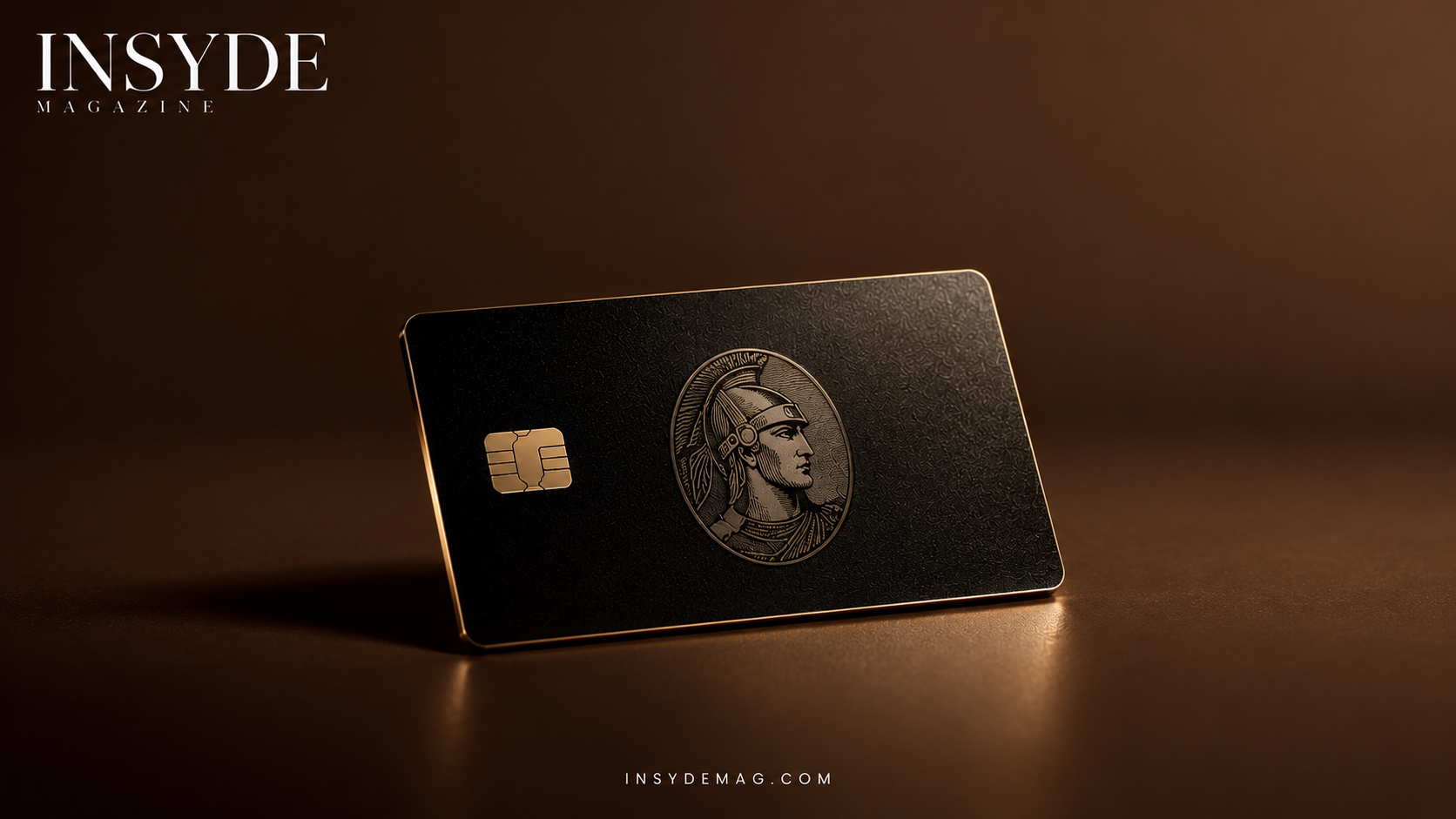
Inside the invitation-only cards, private-bank relationships and ultra-premium financial products where the real luxury isn’t spending power — it’s access.
There are credit cards designed to earn cashback.
There are cards designed to collect airline miles.
And then there are cards that belong to an entirely different financial ecosystem.
Some are invitation-only. Some are available exclusively to private-banking clients. Others require significant income or an established relationship with a financial institution. Their benefits can extend far beyond rewards: dedicated relationship managers, private concierge services, luxury travel, priority airport experiences, members-only facilities and access to experiences that aren’t available through an ordinary application.
At this level, the card is no longer simply a way to pay.
It becomes an extension of the relationship between a financial institution and its wealthiest clients.
And that relationship is where the real luxury begins.
THE CARD IS ONLY THE BEGINNING
The premium-card market has spent decades competing on numbers.
More points.
More miles.
More airport lounges.
Higher limits.
Bigger sign-up bonuses.
But the very top end of the market operates differently.
A wealthy client doesn’t necessarily need another 2% in rewards.
What becomes valuable is time.
Someone to arrange the difficult reservation.
Someone to coordinate an itinerary.
Someone to resolve a problem while travelling.
Someone who already knows the client and understands what they need.
This is why the world’s most exclusive cards increasingly resemble private lifestyle platforms attached to financial relationships.
The card is simply the object you can see.
The infrastructure behind it is the part you can’t.
01 — AMERICAN EXPRESS CENTURION
THE BLACK CARD
Few payment cards have achieved the cultural recognition of the American Express Centurion.
Better known as the Black Card, Centurion helped transform the payment card from a financial tool into a luxury symbol.
But the mythology surrounding it can sometimes obscure the actual product.
In India, American Express’s current publicly available Centurion terms list a ₹7 lakh joining fee and an annual membership fee of ₹2.75 lakh, before applicable GST and other taxes. The published terms were updated on 11 August 2025. (American Express)
That is an extraordinary price for a card.
But the fee isn’t really the interesting part.
The Centurion sits inside American Express’s wider premium travel, dining and lifestyle ecosystem. In the United States, eligible Centurion members have access to Fine Hotels + Resorts, which currently covers more than 1,900 luxury properties worldwide, with benefits including daily breakfast for two, a property credit, potential room upgrades and guaranteed 4 p.m. checkout, subject to programme terms. (American Express)
The larger idea is that the card is designed around experience rather than simply expenditure.
And there is an important distinction for Indian readers.
American Express’s Indian Centurion terms are current, but the company’s Indian charge-card application process has also been undergoing technology-related changes. The product should therefore not be presented as a conventional open-application card available to anyone willing to pay the fee.
That ambiguity is part of what has always surrounded Centurion.
The card became famous partly because access itself became part of the product.
THE INSYDE VIEW
The Centurion’s most valuable feature may not be what sits inside the wallet.
It may be the world built around it.
02 — DBS INSIGNIA VISA INFINITE
THE CARD YOU DON’T SIMPLY APPLY FOR
Singapore’s DBS Insignia takes exclusivity a step further.
DBS states explicitly that the Insignia Visa Infinite is available by invitation only and directs interested clients to their DBS Private Banking or relationship manager. (DBS Bank)
The published proposition is striking.
DBS advertises up to S$1 million in credit, a dedicated 24/7 concierge team known as Insignia Service Ambassadors, VIP airport-lounge access, fast-track immigration at selected Asian airports and complimentary stays at selected luxury hotels and resorts. (DBS Bank)
The card also offers dining privileges through The Culinaire’s List and a published annual reward of 100,000 bonus miles for each annual-fee-paying year, subject to the applicable terms. (DBS Bank)
But the defining word is not million.
It is invitation.
The card is embedded within a private-banking relationship rather than positioned as a mass-market premium product.
That distinction changes the psychology completely.
A conventional card asks a prospective customer to prove eligibility.
An invitation-only card begins from a different premise:
the institution has already decided that you belong in the room.
THE INSYDE VIEW
At this level, the question isn’t only:
How much can you spend?
It becomes:
What can your relationship unlock?
03 — FAB ROYALE WORLD LEGEND EXCLUSIVE
THE NEW LANGUAGE OF FINANCIAL LUXURY
The ultra-premium card market is still evolving, particularly in the Middle East.
On 10 September 2026, First Abu Dhabi Bank and Mastercard launched the FAB Royale World Legend Exclusive, described by Mastercard as the UAE’s first World Legend Exclusive Mastercard credit card.
It is explicitly invitation-only and intended for a select circle of FAB clients. (Mastercard)
The proposition is less about a single spectacular perk and more about an entire service architecture.
Cardholders receive dedicated relationship management through Royale Lifestyle Concierge, access to Mastercard’s Premium Lifestyle Program and international meet-and-greet services across 60 destinations. The programme also includes access to selected global economic forums in partnership with Bloomberg. (Mastercard)
Then there is the Mastercard Collection, which brings priority restaurant reservations, premium tickets and fast-track airport services into the proposition. (Mastercard)
This is revealing.
The traditional premium-card model was essentially:
Spend → earn → redeem.
The new ultra-premium model increasingly looks like:
Relationship → access → experience.
The card isn’t necessarily trying to make spending more rewarding.
It is trying to make living more frictionless.
THE INSYDE VIEW
For today’s wealthy consumer, convenience can be its own form of luxury.
04 — COUTTS SILK
WHEN THE CARD COMES AFTER THE BANKER
British private bank Coutts offers another interpretation of exclusivity.
Its Silk Credit Card and Silk Charge Card are available to Coutts private clients aged 18 and over. Both currently carry no annual card fee, while the cards form part of the wider Coutts private-banking relationship. (Coutts)
That detail is more important than it initially appears.
Because it demonstrates that exclusivity doesn’t necessarily have to come with an enormous card fee.
Sometimes, the exclusivity exists before the card is issued.
Coutts says its Silk cards provide access to more than 1,100 executive airport lounges across more than 300 airports through LoungeKey, alongside rewards, experiences and event invitations. (Coutts)
The card also offers no non-sterling transaction fees when spending in foreign currencies, according to Coutts. (Coutts)
But the most revealing part is the relationship itself.
Coutts describes its cards as bringing “the power of your private bank to your pocket.” (Coutts)
That is perhaps the cleanest explanation of the entire ultra-premium-card category.
The card isn’t the relationship.
The card is the physical expression of it.
THE INSYDE VIEW
Sometimes the most exclusive thing in your wallet isn’t the card.
It’s the banker behind it.
05 — EMIRATES NBD DARNA VISA INFINITE PRIVILEGE
WHEN A CREDIT CARD BECOMES A LIFESTYLE MEMBERSHIP
Not every elite-facing card is invitation-only.
The Emirates NBD Darna Visa Infinite Privilege demonstrates another model: high financial thresholds combined with a tightly integrated lifestyle ecosystem.
Emirates NBD currently lists a minimum monthly salary requirement of AED 50,000 and an annual fee of AED 2,625 for the Darna Visa Infinite Privilege card. (Emirates NBD)
That makes it fundamentally different from an invitation-only product such as DBS Insignia or FAB Royale.
But its proposition is equally revealing.
Cardholders receive Darna Invite Only membership, which connects the financial product to benefits across Aldar’s lifestyle ecosystem. The broader offering includes travel, dining, golf, hotel and entertainment privileges, alongside premium airport access. (Emirates NBD)
The important shift is from card benefit to ecosystem.
The consumer isn’t simply being rewarded for using the card.
The card is connecting financial activity to an entire network of experiences.
That is where banking begins to resemble luxury hospitality.
THE INSYDE VIEW
The next generation of premium cards may not simply reward wealth.
They may increasingly organise the world around it.
WHAT MAKES A CARD “ELITE”?
There is no universal financial category called an elite credit card.
That distinction matters.
A product can be exclusive for very different reasons.
Centurion is associated with extraordinary fees and a highly selective premium ecosystem.
DBS Insignia is explicitly invitation-only.
FAB Royale World Legend Exclusive is invitation-only and tied to a select client base.
Coutts Silk is restricted to Coutts private clients.
Darna Visa Infinite Privilege uses a substantial published income threshold and a premium lifestyle ecosystem.
They are not interchangeable.
They operate in different markets, have different eligibility structures and offer different benefits.
What connects them is their position at the upper end of premium financial services.
And, increasingly, their emphasis on what exists beyond the transaction.
THE DEATH OF THE CREDIT-CARD FLEX
For years, premium-card culture was about visible numbers.
A higher limit.
More miles.
More points.
More airport lounges.
But luxury itself has been changing.
The new luxury consumer increasingly values things that are difficult to quantify:
Time.
Privacy.
Convenience.
Personalisation.
Access.
That is why concierge services matter.
A concierge doesn’t make a restaurant more expensive.
It makes the reservation easier.
A relationship manager doesn’t necessarily make an asset more valuable.
They make the financial relationship more personal.
An airport fast-track service doesn’t change the flight.
It changes the experience of getting there.
The underlying product is therefore not simply money.
It is friction reduction.
And for people who have already accumulated significant wealth, removing friction can be more meaningful than accumulating another reward.
WHEN MONEY STOPS BEING THE STORY
This is where luxury banking begins to intersect with the broader luxury industry.
Traditional luxury has historically been built around objects.
A watch.
A car.
A handbag.
A piece of jewellery.
But contemporary luxury increasingly includes things that cannot simply be placed in a shopping bag.
A private table.
A sold-out event.
A last-minute suite.
A trusted introduction.
A relationship.
An experience that isn’t available to everyone.
The ultra-premium card sits directly inside that transition.
It is a physical object representing something increasingly intangible.
Access.
THE PRIVILEGE YOU CAN’T SEE
There is a peculiar irony to elite financial products.
The most visible part is the card.
The most valuable part may be invisible.
Someone receives a call from a dedicated relationship manager.
Someone’s travel problem is solved without navigating a customer-service queue.
Someone gains access to a restaurant, event or experience through a private programme.
Someone has a financial institution coordinating around their needs rather than simply processing their transactions.
None of that necessarily looks extravagant from the outside.
And perhaps that is the point.
Luxury has always evolved as its most obvious symbols become more accessible.
The next expression tends to become quieter.
More personal.
More difficult to replicate.
THE NEW STATUS SYMBOL IS ACCESS
The premium card of the future may therefore look very different from the premium card of the past.
It doesn’t necessarily need to be heavier.
It doesn’t necessarily need to be black.
It doesn’t necessarily need a higher credit limit.
What matters is the ecosystem surrounding it.
A card can be reproduced.
A points programme can be matched.
A metal finish can be copied.
But a deeply integrated relationship between a client, a private bank, concierge teams, luxury brands and global experiences is much harder to replicate.
That is where the real value lies.
Not in the object.
But in the network behind the object.
THE CARD YOU NEVER SEE
Perhaps that is the most fascinating part of the ultra-premium card.
You can see the card.
You can’t see the relationship behind it.
You can see the metal.
You can’t see the concierge.
You can see the payment.
You can’t see the access.
And increasingly, that is where the definition of luxury is moving.
Away from what you own.
Toward what becomes possible because of who you are and who you bank with.
The black card was once the ultimate symbol.
Today, the black card is simply the beginning of a much larger conversation about wealth, privacy, access and personalised service.
INSYDE TAKE
The world’s most exclusive cards are not necessarily the ones with the highest fees or the most extravagant designs.
Their significance lies in what happens around the card.
A private-banking relationship.
A dedicated concierge.
An invitation.
A network.
A level of service designed around an individual rather than a demographic.
That is the real evolution of luxury finance.
Because when purchasing power is already high, the next luxury isn’t necessarily being able to buy more.
It is being able to move through the world with less friction.
And perhaps the ultimate privilege isn’t a card that lets you spend without thinking.
It’s a relationship that makes the extraordinary feel effortless.
INSYDE
Luxury, Through a Different Lens.
Beyond the Spotlight.