
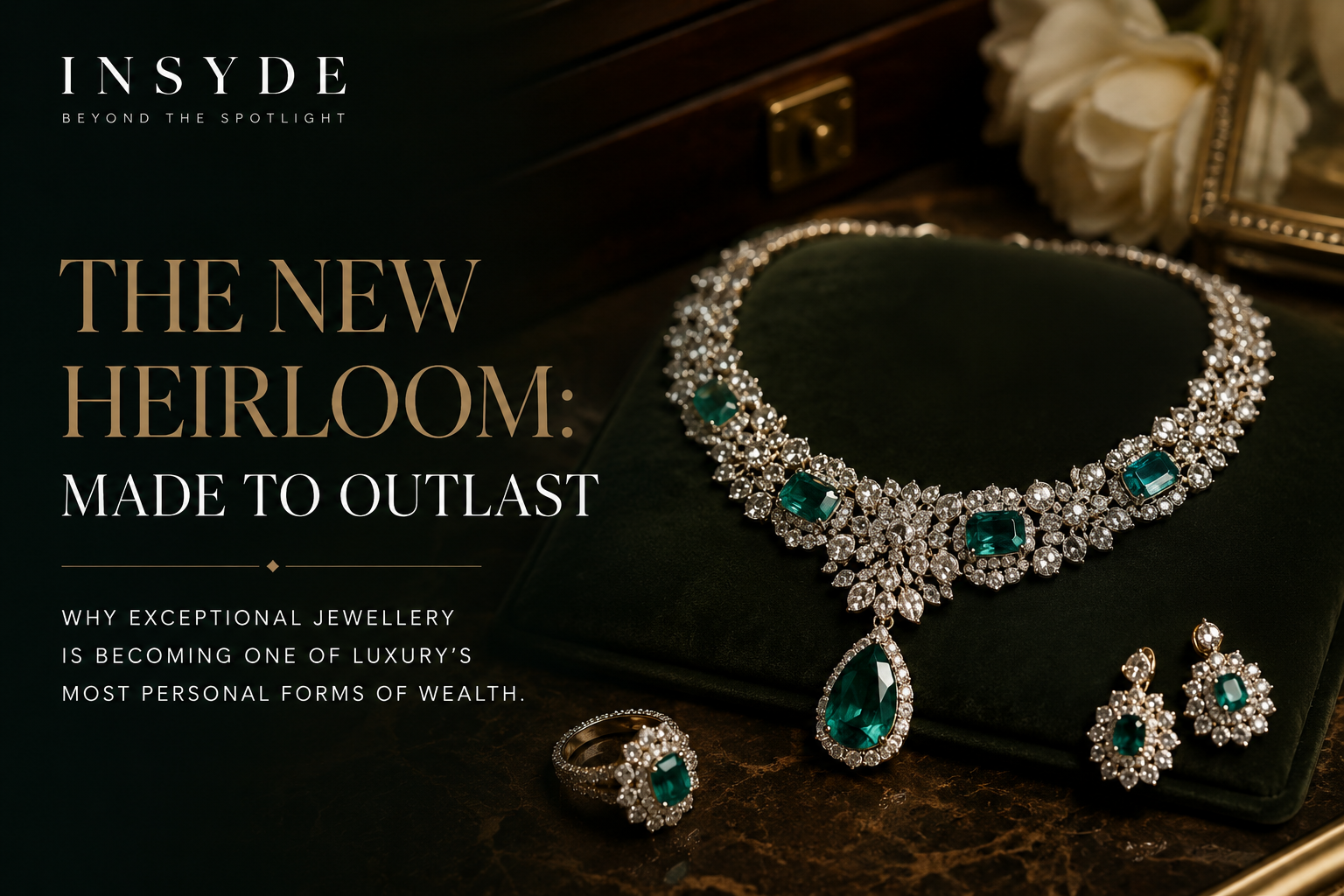
Why exceptional jewellery is becoming one of luxury’s most personal forms of wealth.
There is a difference between owning something valuable and owning something that matters.
The distinction becomes clearer at the highest levels of luxury.
When access is no longer the challenge, another question begins to matter: what is actually worth keeping?
A remarkable piece of jewellery can answer that question rather elegantly.
It does not need to occupy a room.
It does not need a chauffeur.
It does not need a marina or a private hangar.
It can sit quietly in a private collection, emerge for one evening, and carry more meaning than an object ten times its size.
That is the peculiar power of exceptional jewellery.
It is wealth made intimate.
Not necessarily wealth designed to be seen by everyone, but wealth expressed through rarity, provenance, craftsmanship and personal significance.
And increasingly, that is where luxury is heading.
When Price Stops Being the Point
For a certain kind of buyer, price is an important consideration.
For the truly affluent, it is often a secondary one.
The question is no longer whether something is expensive enough to justify its place in a collection.
It is whether it is exceptional enough to deserve one.
That distinction changes the entire conversation.
A rare Colombian emerald.
An extraordinary Burmese ruby with compelling provenance.
A historic diamond.
A one-of-one commission.
A piece created by an exceptional atelier.
A jewel whose craftsmanship reveals itself only when examined closely.
These are not interchangeable luxury goods.
They are objects with characteristics that cannot simply be reproduced by increasing a budget.
That is where jewellery becomes particularly interesting.
Money can secure access. It cannot manufacture rarity.
The Value of Knowing What You Are Looking At
There is a sophistication to jewellery that rewards knowledge.
Two stones can appear similar to an untrained eye and possess radically different histories, qualities and desirability.
Two pieces can carry similar materials and have completely different levels of craftsmanship.
The difference may be in the cut.
The setting.
The proportions.
The origin.
The stone selection.
The construction.
The hand behind it.
Or simply the judgement of the person who commissioned it.
This is why the most sophisticated jewellery culture is not necessarily loud.
It is informed.
A collector does not need a room to recognise a remarkable stone.
Sometimes a glance across a dinner table is enough.
That is a very different kind of status.
Recognition becomes selective.
Jewellery Is Wealth You Can Wear
A residence remains at its address.
A yacht remains at sea.
A private aircraft moves according to a flight plan.
Jewellery has a different kind of freedom.
It travels with its owner.
A necklace can move between continents.
A ring can pass from a boardroom to a private dinner.
A pair of earrings can become part of an evening’s entire visual language.
The object is not simply stored wealth.
It becomes portable identity.
And because it is worn directly against the body, jewellery occupies an unusually intimate position within a luxury collection.
You don’t simply own it.
You live with it.
The Quiet Power of Exceptional Craftsmanship
At the top end of jewellery, craftsmanship is rarely there for spectacle.
It is there for perfection.
The setting has to hold the stone without overpowering it.
The proportions have to feel inevitable.
The metal has to respond to light correctly.
The construction has to survive years of wear without losing its character.
The smallest detail can determine whether a piece feels merely expensive or genuinely exceptional.
This is where the great ateliers distinguish themselves.
The finished piece may appear effortless.
That is precisely the point.
Exceptional craftsmanship hides its own difficulty.
The more refined the object, the less it needs to explain itself.
The Stone Is Only the Beginning
A remarkable gemstone carries its own identity.
Its colour.
Its character.
Its origin.
Its rarity.
Its history.
Its imperfections can sometimes become part of what makes it desirable.
The sophisticated collector therefore isn’t necessarily searching for the largest stone.
They may be searching for the stone that cannot easily be replaced.
That distinction matters.
Size can be measured.
Rarity has to be understood.
And in the highest echelons of collecting, uniqueness tends to outlast spectacle.
India’s Jewellery Legacy Is an Extraordinary Advantage
India enters this conversation with something many emerging luxury markets would struggle to create from scratch:
centuries of jewellery culture.
Kundan.
Jadau.
Polki.
Meenakari.
Temple jewellery.
Goldsmithing traditions.
Gem-setting techniques.
Regional craftsmanship passed between generations.
These aren’t simply decorative traditions.
They are sophisticated systems of making.
The opportunity for contemporary Indian luxury is therefore not to reproduce the European model of jewellery.
It is to take India’s enormous craft heritage and give it a new vocabulary.
The most compelling future Indian jewellery may not look traditionally Indian at first glance.
It may be architectural.
Minimal.
Sculptural.
Unexpected.
But the intelligence of the craft can remain underneath.
That is where heritage becomes contemporary.
The Indian Jewel of Tomorrow
Imagine a contemporary necklace constructed using a centuries-old technique.
A sculptural ring inspired by Indian architecture.
A modern interpretation of Jadau without ceremonial excess.
A rare gemstone framed with the restraint of contemporary design.
A private commission that combines an inherited stone with a completely new setting.
That is far more interesting than simply placing an Indian motif on a luxury product.
The real opportunity is reinvention without losing provenance.
If Indian jewellery houses can achieve that balance, the result could become globally significant.
Not because it is Indian.
But because it is exceptional.
When Jewellery Becomes a Private Language
There is a particular pleasure in owning something that does not need to announce itself.
A necklace without a visible logo.
A ring whose significance is understood only by a handful of collectors.
A stone selected because of its provenance rather than its recognisability.
A private commission that exists nowhere else.
This is where jewellery enters the territory of discreet luxury.
The object does not ask for attention.
It rewards attention.
And that distinction is increasingly important.
The old luxury language often said:
Look at what I own.
The newer language can say:
Look closely.
The Heirloom Is Changing
Historically, an heirloom was something that survived long enough to be inherited.
Today, the most thoughtful collectors can design for inheritance from the beginning.
A piece commissioned for a milestone.
A gemstone selected with a future daughter or son in mind.
An existing family jewel redesigned without losing its original stone.
A new piece created specifically to become part of a family’s visual history.
The object becomes more than an acquisition.
It becomes a decision about the future.
And that may be one of the most sophisticated reasons to buy exceptional jewellery.
You are not necessarily buying for yourself alone.
You are deciding what deserves to survive you.
From Jewellery to Family Archive
This is where jewellery becomes almost impossible to price.
A necklace can carry the memory of a wedding.
A ring can carry the history of a marriage.
A stone can be reset across generations.
A brooch can return decades later at another family celebration.
The financial value may remain measurable.
The emotional value does not.
And over time, the two can become inseparable.
A remarkable jewel is therefore capable of becoming something unusual:
a physical archive of a family.
That is a form of wealth no balance sheet can properly capture.
The Collector’s Eye
Serious collecting is rarely about accumulation for its own sake.
The most interesting private collections tend to have a point of view.
They may focus on exceptional stones.
A particular period.
A house.
A designer.
A technique.
A geographical tradition.
Or simply pieces that tell compelling stories.
The collector begins to develop an eye.
They notice things.
The quality of a setting.
The way a stone is cut.
The originality of a design.
The difference between an important piece and merely an expensive one.
At that point, buying becomes less about consumption and more about curation.
And curation is one of the defining characteristics of sophisticated luxury.
When a Jewel Becomes Art
There is a moment when jewellery stops functioning as an accessory.
It becomes an artwork.
A one-of-one commission.
An extraordinary stone.
An experimental setting.
A collaboration between an artist and a master jeweller.
A piece whose proportions are so deliberate that it could belong in a gallery as naturally as it belongs on the body.
At that level, the question is no longer whether the piece matches an outfit.
It is whether the object itself deserves to exist.
That is a much higher standard.
And it is where jewellery enters the world of collecting.
The Investment Question Is Almost the Wrong Question
Luxury jewellery is frequently discussed as an investment.
That conversation has its place.
Certain exceptional pieces can command significant prices in the secondary market, particularly when rarity, provenance, craftsmanship and collector demand converge.
But reducing exceptional jewellery to financial performance misses its more enduring value.
The serious collector isn’t necessarily asking whether a jewel will outperform an investment portfolio.
They are asking whether it possesses lasting desirability.
Will the stone still be remarkable?
Will the craftsmanship still be respected?
Will the design still feel relevant?
Will the provenance still matter?
Will someone want it decades from now?
That is a different definition of value.
Financial value can fluctuate. Cultural value can compound.
The New Luxury Is Personal
The next generation of high jewellery is unlikely to be defined simply by larger stones or heavier pieces.
It will be defined by individuality.
Private commissions.
Unusual gemstones.
Exceptional provenance.
Artist collaborations.
Heritage techniques.
Contemporary Indian craftsmanship.
One-of-one designs.
And pieces that could never have been created for anyone else.
This is where luxury becomes most interesting.
The object is no longer simply selected.
It is authored.
The collector becomes part of the creative process.
The final piece carries something of both sides: the skill of the maker and the identity of the person who commissioned it.
That is difficult to mass-produce.
And therefore, increasingly valuable.
Beyond the Logo
The future of jewellery may belong to pieces that do not immediately reveal their price, their house or even their significance.
A rare stone.
An exceptional setting.
A technique recognised by a specialist.
A piece with a story known only to the owner and a small circle of people who understand its importance.
This is not the disappearance of the luxury brand.
It is the evolution of luxury beyond the brand.
The logo tells you who made something.
The craftsmanship tells you why it matters.
The provenance tells you where it has been.
But the story tells you why it should be kept.
The Things We Choose to Keep
Perhaps that is why jewellery has survived every change in fashion.
Trends disappear.
Designers change.
Houses rise and fall.
But a remarkable jewel can remain.
It can cross generations.
It can carry a story long after its original owner is gone.
It can be worn again decades later and somehow feel completely right.
Because the most valuable thing about jewellery has never been simply what it is made from.
It is what it remembers.
And perhaps that is the ultimate luxury.
Not owning the largest stone.
Not wearing the most recognisable name.
Not proving how much something cost.
But possessing something rare enough, beautiful enough and meaningful enough to become part of someone else’s future.
The finest jewellery doesn’t simply belong to a person.
For a while, a person becomes part of its story.
INSYDE — Beyond the Spotlight.