Category: Couture

The artistry, craftsmanship and evolving language of couture in India and around the world.

  • The New Heirloom: The Luxury of Legacy

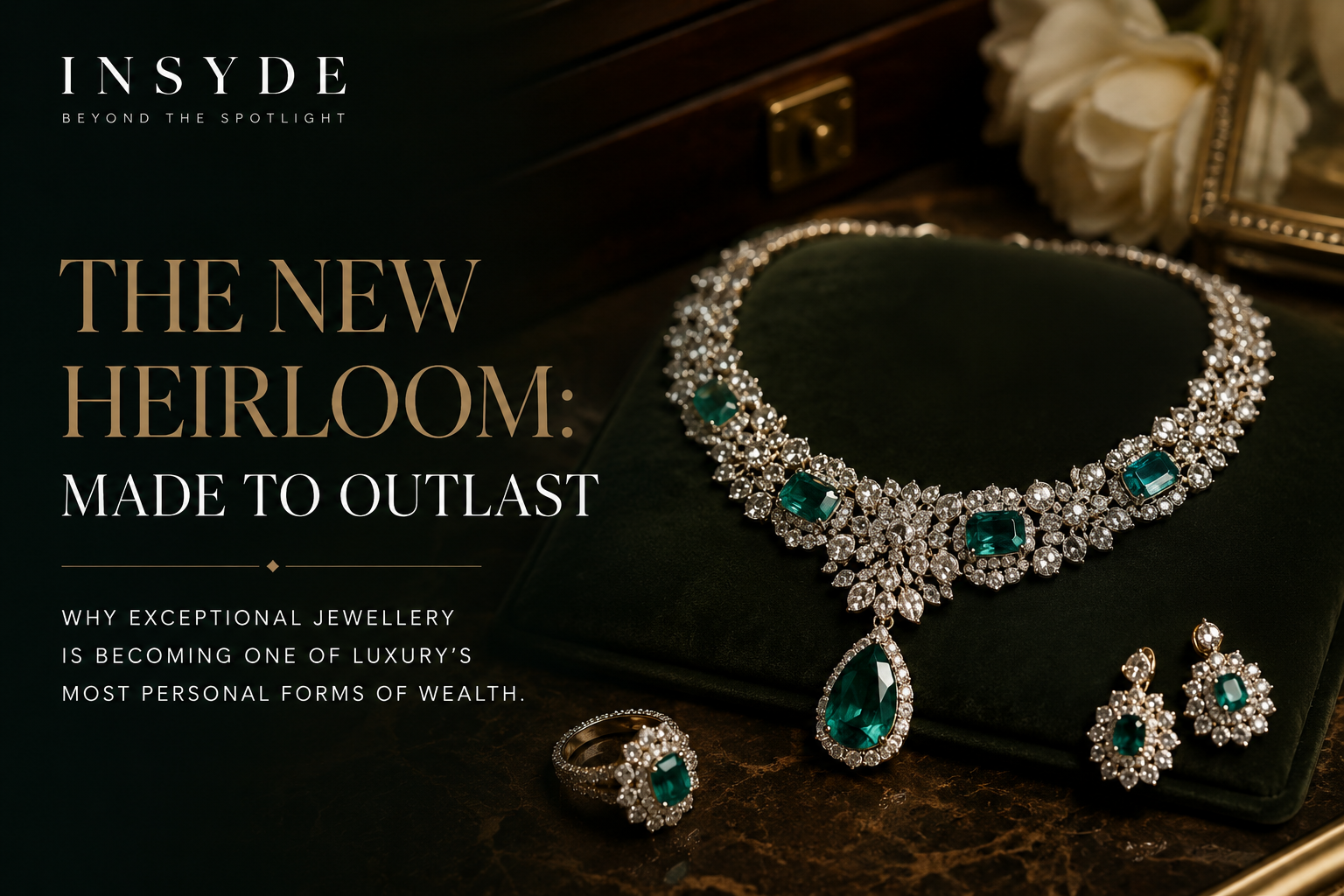
    The New Heirloom: The Luxury of Legacy

    Why exceptional jewellery is becoming one of luxury’s most personal forms of wealth.

    There is a difference between owning something valuable and owning something that matters.

    The distinction becomes clearer at the highest levels of luxury.

    When access is no longer the challenge, another question begins to matter: what is actually worth keeping?

    A remarkable piece of jewellery can answer that question rather elegantly.

    It does not need to occupy a room.

    It does not need a chauffeur.

    It does not need a marina or a private hangar.

    It can sit quietly in a private collection, emerge for one evening, and carry more meaning than an object ten times its size.

    That is the peculiar power of exceptional jewellery.

    It is wealth made intimate.

    Not necessarily wealth designed to be seen by everyone, but wealth expressed through rarity, provenance, craftsmanship and personal significance.

    And increasingly, that is where luxury is heading.

    When Price Stops Being the Point

    For a certain kind of buyer, price is an important consideration.

    For the truly affluent, it is often a secondary one.

    The question is no longer whether something is expensive enough to justify its place in a collection.

    It is whether it is exceptional enough to deserve one.

    That distinction changes the entire conversation.

    A rare Colombian emerald.

    An extraordinary Burmese ruby with compelling provenance.

    A historic diamond.

    A one-of-one commission.

    A piece created by an exceptional atelier.

    A jewel whose craftsmanship reveals itself only when examined closely.

    These are not interchangeable luxury goods.

    They are objects with characteristics that cannot simply be reproduced by increasing a budget.

    That is where jewellery becomes particularly interesting.

    Money can secure access. It cannot manufacture rarity.

    The Value of Knowing What You Are Looking At

    There is a sophistication to jewellery that rewards knowledge.

    Two stones can appear similar to an untrained eye and possess radically different histories, qualities and desirability.

    Two pieces can carry similar materials and have completely different levels of craftsmanship.

    The difference may be in the cut.

    The setting.

    The proportions.

    The origin.

    The stone selection.

    The construction.

    The hand behind it.

    Or simply the judgement of the person who commissioned it.

    This is why the most sophisticated jewellery culture is not necessarily loud.

    It is informed.

    A collector does not need a room to recognise a remarkable stone.

    Sometimes a glance across a dinner table is enough.

    That is a very different kind of status.

    Recognition becomes selective.

    Jewellery Is Wealth You Can Wear

    A residence remains at its address.

    A yacht remains at sea.

    A private aircraft moves according to a flight plan.

    Jewellery has a different kind of freedom.

    It travels with its owner.

    A necklace can move between continents.

    A ring can pass from a boardroom to a private dinner.

    A pair of earrings can become part of an evening’s entire visual language.

    The object is not simply stored wealth.

    It becomes portable identity.

    And because it is worn directly against the body, jewellery occupies an unusually intimate position within a luxury collection.

    You don’t simply own it.

    You live with it.

    The Quiet Power of Exceptional Craftsmanship

    At the top end of jewellery, craftsmanship is rarely there for spectacle.

    It is there for perfection.

    The setting has to hold the stone without overpowering it.

    The proportions have to feel inevitable.

    The metal has to respond to light correctly.

    The construction has to survive years of wear without losing its character.

    The smallest detail can determine whether a piece feels merely expensive or genuinely exceptional.

    This is where the great ateliers distinguish themselves.

    The finished piece may appear effortless.

    That is precisely the point.

    Exceptional craftsmanship hides its own difficulty.

    The more refined the object, the less it needs to explain itself.

    The Stone Is Only the Beginning

    A remarkable gemstone carries its own identity.

    Its colour.

    Its character.

    Its origin.

    Its rarity.

    Its history.

    Its imperfections can sometimes become part of what makes it desirable.

    The sophisticated collector therefore isn’t necessarily searching for the largest stone.

    They may be searching for the stone that cannot easily be replaced.

    That distinction matters.

    Size can be measured.

    Rarity has to be understood.

    And in the highest echelons of collecting, uniqueness tends to outlast spectacle.

    India’s Jewellery Legacy Is an Extraordinary Advantage

    India enters this conversation with something many emerging luxury markets would struggle to create from scratch:

    centuries of jewellery culture.

    Kundan.

    Jadau.

    Polki.

    Meenakari.

    Temple jewellery.

    Goldsmithing traditions.

    Gem-setting techniques.

    Regional craftsmanship passed between generations.

    These aren’t simply decorative traditions.

    They are sophisticated systems of making.

    The opportunity for contemporary Indian luxury is therefore not to reproduce the European model of jewellery.

    It is to take India’s enormous craft heritage and give it a new vocabulary.

    The most compelling future Indian jewellery may not look traditionally Indian at first glance.

    It may be architectural.

    Minimal.

    Sculptural.

    Unexpected.

    But the intelligence of the craft can remain underneath.

    That is where heritage becomes contemporary.

    The Indian Jewel of Tomorrow

    Imagine a contemporary necklace constructed using a centuries-old technique.

    A sculptural ring inspired by Indian architecture.

    A modern interpretation of Jadau without ceremonial excess.

    A rare gemstone framed with the restraint of contemporary design.

    A private commission that combines an inherited stone with a completely new setting.

    That is far more interesting than simply placing an Indian motif on a luxury product.

    The real opportunity is reinvention without losing provenance.

    If Indian jewellery houses can achieve that balance, the result could become globally significant.

    Not because it is Indian.

    But because it is exceptional.

    When Jewellery Becomes a Private Language

    There is a particular pleasure in owning something that does not need to announce itself.

    A necklace without a visible logo.

    A ring whose significance is understood only by a handful of collectors.

    A stone selected because of its provenance rather than its recognisability.

    A private commission that exists nowhere else.

    This is where jewellery enters the territory of discreet luxury.

    The object does not ask for attention.

    It rewards attention.

    And that distinction is increasingly important.

    The old luxury language often said:

    Look at what I own.

    The newer language can say:

    Look closely.

    The Heirloom Is Changing

    Historically, an heirloom was something that survived long enough to be inherited.

    Today, the most thoughtful collectors can design for inheritance from the beginning.

    A piece commissioned for a milestone.

    A gemstone selected with a future daughter or son in mind.

    An existing family jewel redesigned without losing its original stone.

    A new piece created specifically to become part of a family’s visual history.

    The object becomes more than an acquisition.

    It becomes a decision about the future.

    And that may be one of the most sophisticated reasons to buy exceptional jewellery.

    You are not necessarily buying for yourself alone.

    You are deciding what deserves to survive you.

    From Jewellery to Family Archive

    This is where jewellery becomes almost impossible to price.

    A necklace can carry the memory of a wedding.

    A ring can carry the history of a marriage.

    A stone can be reset across generations.

    A brooch can return decades later at another family celebration.

    The financial value may remain measurable.

    The emotional value does not.

    And over time, the two can become inseparable.

    A remarkable jewel is therefore capable of becoming something unusual:

    a physical archive of a family.

    That is a form of wealth no balance sheet can properly capture.

    The Collector’s Eye

    Serious collecting is rarely about accumulation for its own sake.

    The most interesting private collections tend to have a point of view.

    They may focus on exceptional stones.

    A particular period.

    A house.

    A designer.

    A technique.

    A geographical tradition.

    Or simply pieces that tell compelling stories.

    The collector begins to develop an eye.

    They notice things.

    The quality of a setting.

    The way a stone is cut.

    The originality of a design.

    The difference between an important piece and merely an expensive one.

    At that point, buying becomes less about consumption and more about curation.

    And curation is one of the defining characteristics of sophisticated luxury.

    When a Jewel Becomes Art

    There is a moment when jewellery stops functioning as an accessory.

    It becomes an artwork.

    A one-of-one commission.

    An extraordinary stone.

    An experimental setting.

    A collaboration between an artist and a master jeweller.

    A piece whose proportions are so deliberate that it could belong in a gallery as naturally as it belongs on the body.

    At that level, the question is no longer whether the piece matches an outfit.

    It is whether the object itself deserves to exist.

    That is a much higher standard.

    And it is where jewellery enters the world of collecting.

    The Investment Question Is Almost the Wrong Question

    Luxury jewellery is frequently discussed as an investment.

    That conversation has its place.

    Certain exceptional pieces can command significant prices in the secondary market, particularly when rarity, provenance, craftsmanship and collector demand converge.

    But reducing exceptional jewellery to financial performance misses its more enduring value.

    The serious collector isn’t necessarily asking whether a jewel will outperform an investment portfolio.

    They are asking whether it possesses lasting desirability.

    Will the stone still be remarkable?

    Will the craftsmanship still be respected?

    Will the design still feel relevant?

    Will the provenance still matter?

    Will someone want it decades from now?

    That is a different definition of value.

    Financial value can fluctuate. Cultural value can compound.

    The New Luxury Is Personal

    The next generation of high jewellery is unlikely to be defined simply by larger stones or heavier pieces.

    It will be defined by individuality.

    Private commissions.

    Unusual gemstones.

    Exceptional provenance.

    Artist collaborations.

    Heritage techniques.

    Contemporary Indian craftsmanship.

    One-of-one designs.

    And pieces that could never have been created for anyone else.

    This is where luxury becomes most interesting.

    The object is no longer simply selected.

    It is authored.

    The collector becomes part of the creative process.

    The final piece carries something of both sides: the skill of the maker and the identity of the person who commissioned it.

    That is difficult to mass-produce.

    And therefore, increasingly valuable.

    Beyond the Logo

    The future of jewellery may belong to pieces that do not immediately reveal their price, their house or even their significance.

    A rare stone.

    An exceptional setting.

    A technique recognised by a specialist.

    A piece with a story known only to the owner and a small circle of people who understand its importance.

    This is not the disappearance of the luxury brand.

    It is the evolution of luxury beyond the brand.

    The logo tells you who made something.

    The craftsmanship tells you why it matters.

    The provenance tells you where it has been.

    But the story tells you why it should be kept.

    The Things We Choose to Keep

    Perhaps that is why jewellery has survived every change in fashion.

    Trends disappear.

    Designers change.

    Houses rise and fall.

    But a remarkable jewel can remain.

    It can cross generations.

    It can carry a story long after its original owner is gone.

    It can be worn again decades later and somehow feel completely right.

    Because the most valuable thing about jewellery has never been simply what it is made from.

    It is what it remembers.

    And perhaps that is the ultimate luxury.

    Not owning the largest stone.

    Not wearing the most recognisable name.

    Not proving how much something cost.

    But possessing something rare enough, beautiful enough and meaningful enough to become part of someone else’s future.

    The finest jewellery doesn’t simply belong to a person.

    For a while, a person becomes part of its story.

    INSYDE — Beyond the Spotlight.
  • How Manish Malhotra Turned Bollywood Glamour Into a Global Luxury House

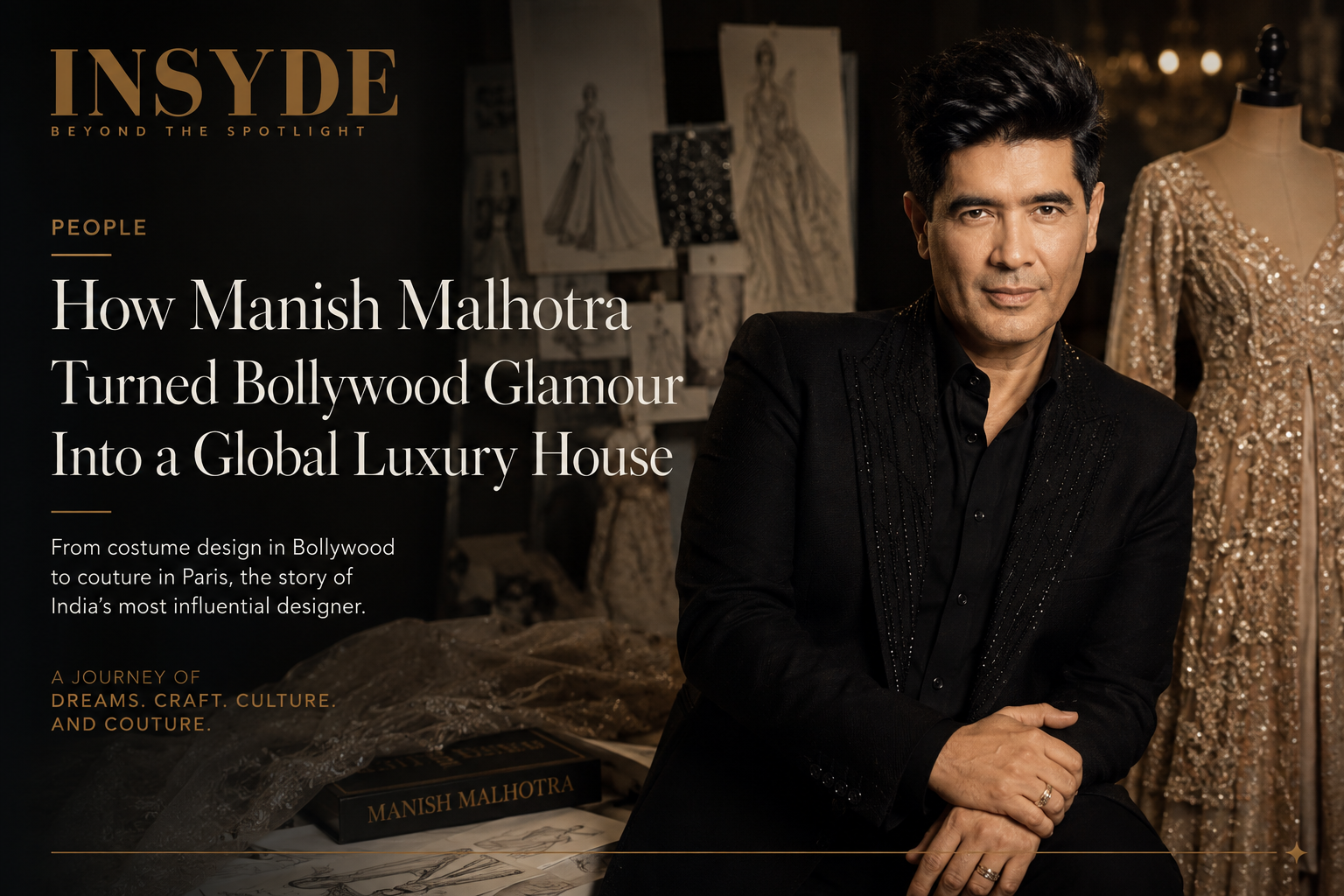
    How Manish Malhotra Turned Bollywood Glamour Into a Global Luxury House

    From costume design in Bollywood to couture in Paris, Manish Malhotra has spent more than three decades turning fashion into storytelling — and storytelling into one of India’s most recognisable luxury worlds.

    There are designers whose clothes are admired.

    And then there are designers whose clothes become part of memory.

    A lehenga from a wedding. A saree from a film. A heroine walking through a song sequence. A particular shade of shimmer beneath the lights. Clothes that become so closely associated with a character, a celebrity or a moment that it becomes difficult to remember one without the other.

    Manish Malhotra belongs to that second category.

    For more than three decades, he has operated at the intersection of fashion, cinema, celebrity and Indian culture. He began not with a luxury boutique or a couture atelier, but inside the world of films, where clothes had to do something more than look beautiful.

    They had to tell a story.

    And that may be the most important thread running through his career.

    Before Manish Malhotra became a fashion house, he became a storyteller.

    Before the Name Became the Brand

    Malhotra’s entry into fashion was unconventional.

    He began his career as a model before moving into costume design, eventually making his cinematic debut in 1990 with Swarg. By 1993, his work on Gumrah was already establishing a different approach to costume design — one in which the complete look of a character could become part of the storytelling.

    Then came Rangeela.

    In 1995, his work on the film earned him the first-ever Filmfare Award for Best Costume Design. It was more than a career milestone. It was an indication that the way Indian cinema dressed its characters was changing.

    Malhotra understood something that would become central to his career:

    People don’t simply watch films.

    They absorb them.

    They remember the characters, the colours, the music — and increasingly, the clothes.

    Fashion could influence how an audience understood a character before that character had even spoken.

    That idea would become one of his greatest strengths.

    When Bollywood Became a Fashion Classroom

    Malhotra’s relationship with cinema gave him an education that could not be contained inside a traditional fashion curriculum.

    He learned through actors.

    Through scripts.

    Through movement.

    Through lighting.

    Through the personalities of the people wearing his clothes.

    And most importantly, through the audience.

    His costumes helped make the wardrobe of a film star feel aspirational in a new way. The clothes weren’t simply part of the production design. They could become part of the cultural conversation surrounding the film.

    That was particularly powerful in the Bollywood of the 1990s and early 2000s.

    Cinema was becoming increasingly fashion-conscious, and Malhotra was one of the designers helping define what that looked like.

    His work became associated with the visual language of contemporary Bollywood: glamour, colour, romance, youth and spectacle.

    By 2002, his work on Kuch Kuch Hota Hai had earned seven costume-design awards, according to the House’s official timeline.

    The numbers matter.

    But the cultural effect matters more.

    A generation began looking at film stars differently.

    And, in turn, began looking at fashion differently.

    The Moment the Costume Designer Became a Designer

    There comes a point in many creative careers when influence has to become something more permanent.

    For Malhotra, that transition happened through fashion itself.

    In 1999, he presented his first runway show in Mumbai. In 2004, the Manish Malhotra label launched and his first international flagship boutique opened in Dubai. A year later, he founded the House of Manish Malhotra.

    The distinction is important.

    He was no longer simply designing clothes for someone else’s story.

    He was building his own.

    That is a much harder proposition.

    Cinema had given Malhotra an enormous platform, but a fashion house requires something different: an identity that can survive beyond any single film, actor or season.

    The House had to become the story.

    And slowly, it did.

    Building a World, Not Just a Label

    Today, the House of Manish Malhotra describes itself as a multidisciplinary luxury house spanning couture, bridal, menswear, ready-to-wear, high jewellery, beauty and film production.

    That expansion says something about how Malhotra understood luxury.

    Luxury is rarely just the object.

    It is the world surrounding the object.

    The setting.

    The craftsmanship.

    The celebrity.

    The experience.

    The sense that the customer isn’t simply buying a garment but entering a particular visual universe.

    Malhotra’s universe has always been recognisable.

    It is dramatic without being anonymous.

    Indian without being trapped in nostalgia.

    Luxurious without pretending that Indian craftsmanship needs to be disguised as something European.

    That balance has become one of the defining characteristics of the brand.

    The Business Behind the Glamour

    It is easy to look at Manish Malhotra through photographs.

    A celebrity wearing couture.

    A bride walking down an aisle.

    A red carpet.

    A runway.

    A glittering lehenga.

    But behind those images sits a much larger operation.

    Vogue reported around his 2026 Paris debut that the Mumbai-based business had grown into an empire spanning fashion, Bollywood, hospitality, beauty, fragrance and high jewellery, with a 40,000-square-foot atelier and headquarters and around 300 in-house embroiderers. The fashion business also has backing from Reliance Brands Limited.

    That scale changes the conversation.

    Because a designer can create beautiful clothes.

    A luxury house has to create beautiful clothes repeatedly, consistently and at scale, while maintaining the identity that made people desire them in the first place.

    That requires artisans.

    Operations.

    Retail.

    Marketing.

    Celebrity relationships.

    Client management.

    Digital storytelling.

    And, above all, a clear point of view.

    The glamour may be what people see.

    The system underneath it is what makes the glamour possible.

    The Indian Craftsmanship at the Centre

    Malhotra’s international story is also an Indian craftsmanship story.

    The House says its work is built around embroidery, weaving and handcraft traditions passed down through generations, reinterpreted through a contemporary luxury lens.

    That matters because Indian craftsmanship has long played a significant role in global luxury.

    For decades, the techniques and handwork associated with Indian artisans have appeared within international fashion while the people and traditions behind them have often remained invisible to the final consumer.

    The conversation is changing.

    Vogue noted in 2026 that more Indian designers are appearing on the official Paris couture calendar, reflecting a broader movement in which Indian craftsmanship is increasingly being presented not simply as a source of embellishment, but as part of a wider luxury and design conversation.

    Malhotra’s approach fits into that shift.

    His objective isn’t to make Indian craft look less Indian.

    It is to make the world look at Indian craft differently.

    The embroidery becomes architecture.

    The textile becomes emotion.

    The sari becomes memory.

    The lehenga becomes spectacle.

    Craft becomes luxury.

    The Celebrity Effect

    Then there is Bollywood.

    It would be impossible to tell the Manish Malhotra story without acknowledging how closely the designer and celebrity cultures have grown together.

    But this relationship is more interesting than simple endorsement.

    The designer needs the star.

    The star needs the designer.

    One creates the image.

    The other amplifies it.

    That relationship helped Malhotra develop something that many luxury houses spend decades trying to manufacture: cultural visibility.

    A Manish Malhotra outfit could appear on a runway, then on a film star, then in a magazine, then at a wedding.

    The garment travelled.

    And with it, the brand travelled.

    This is where his cinema background became a business advantage.

    He already understood how people fall in love with an image.

    He simply transferred that understanding from the screen to the fashion house.

    Why Bridalwear Became So Powerful

    For millions of Indians, the name Manish Malhotra is almost inseparable from weddings.

    The reason isn’t difficult to understand.

    Indian weddings are already theatrical.

    There is music.

    There is colour.

    There is ceremony.

    There is photography.

    There is family.

    There is performance.

    Malhotra’s aesthetic naturally belongs in that environment.

    But bridalwear also gave the brand something else: a powerful emotional purchase.

    A wedding outfit isn’t simply clothing.

    It becomes part of a memory.

    That is precisely the kind of emotional relationship luxury brands want to create.

    The House’s expansion into bridal, jewellery, beauty and other categories has allowed that relationship to grow beyond the original garment.

    A client can enter the Manish Malhotra world through a bridal lehenga.

    Another through jewellery.

    Another through beauty.

    Another through menswear.

    Another through couture.

    Different products.

    One universe.

    The House Keeps Expanding

    The evolution has continued.

    The House launched Manish Malhotra Beauty in 2018, expanded further into high jewellery, introduced Ready-to-Wear in 2025 and has continued developing international showcases and retail presence. Its official timeline also records the launch of Stage5 Productions and other extensions beyond traditional fashion.

    This is no longer simply the story of a designer selling clothes.

    It is the story of a creative brand expanding its cultural territory.

    Fashion becomes jewellery.

    Jewellery becomes beauty.

    Beauty becomes lifestyle.

    Cinema becomes production.

    And the designer becomes the centre of a much larger ecosystem.

    That is the difference between a successful designer and a modern luxury house.

    Paris Changes the Scale

    For years, Paris represented one of fashion’s ultimate stages.

    In July 2026, Manish Malhotra entered it.

    He presented his Fall/Winter 2026 couture collection in Paris as a guest house on the official Haute Couture Week schedule, becoming the fourth Indian designer to appear on that official calendar.

    But the significance of the moment wasn’t simply that an Indian designer had reached Paris.

    It was what he carried with him.

    The collection was called “Maa.”

    It was dedicated to his mother, Sudarshan Malhotra, who died earlier in 2026.

    The show opened with a deep red runway, red lighting and the sound of a heartbeat. The collection explored memories of motherhood and childhood through sculptural silhouettes, intricate embroidery and references to his mother’s jewellery and saris.

    One of the most striking ideas was the transformation of her bangles into the circular structure of a gown.

    It was fashion, but it was also memory.

    After decades spent dressing other people’s characters, Malhotra arrived in Paris telling a story that belonged entirely to him.

    That gave the debut an emotional weight that a simple international expansion could never have carried.

    A New Kind of Indian Luxury

    The Paris debut also arrives at an interesting moment for Indian fashion.

    For years, the world understood India largely through its craftsmanship.

    The embroidery.

    The textiles.

    The artisans.

    The colour.

    But craftsmanship alone does not create a global luxury house.

    A house also needs authorship.

    A point of view.

    A recognisable identity.

    A business capable of sustaining that identity.

    And a story people around the world can understand.

    Indian designers are increasingly bringing those elements together.

    Malhotra’s Paris debut is part of that larger movement. Vogue described the growing presence of Indian designers on the official couture calendar as evidence of a shift in how Indian fashion is participating in the global luxury conversation.

    The conversation is no longer simply:

    “Look at the craftsmanship India can provide.”

    It is becoming:

    “Look at the luxury worlds Indian designers can create.”

    That is a much bigger proposition.

    The Manish Malhotra Formula

    There is no single formula behind Manish Malhotra’s career.

    But there is a pattern.

    He observes culture.

    He understands aspiration.

    He understands celebrity.

    He understands spectacle.

    And he understands that people don’t simply buy clothes.

    They buy the feeling surrounding them.

    That may be the real lesson of his career.

    The clothes matter.

    The craftsmanship matters.

    The business matters.

    But the story connecting everything together matters just as much.

    He has spent more than three decades building that story.

    First through cinema.

    Then through couture.

    Then through celebrity.

    Then through weddings.

    Then through jewellery and beauty.

    And now, increasingly, through the global language of luxury.

    From Mumbai to Paris

    The distance between Mumbai and Paris is measured in thousands of kilometres.

    But creatively, Manish Malhotra’s journey between them has been built one image at a time.

    A character in a film.

    A costume that people remember.

    A celebrity who becomes an icon.

    A runway.

    A boutique.

    A bride.

    A jewellery collection.

    A beauty line.

    A luxury house.

    And finally, Paris.

    The interesting thing is that he did not arrive there overnight.

    Paris was simply the newest stage for a story that had been developing for more than three decades.

    That is what makes Manish Malhotra’s career worth looking at beyond fashion.

    It is a story about reinvention.

    About understanding what people desire — and then building a world around that desire.

    It is about taking an opportunity that was never supposed to be the final destination and turning it into something larger.

    Manish Malhotra didn’t just dress Bollywood.

    He helped change the way Bollywood imagined glamour.

    And in doing so, he discovered something even bigger:

    that the person designing the clothes could eventually build the entire world around them.

    From cinema to couture, from Mumbai to Paris, Manish Malhotra’s story is ultimately a story about scale — and the ambition to keep building.

  • How Sabyasachi Built a Global Indian Luxury House | INSYDE

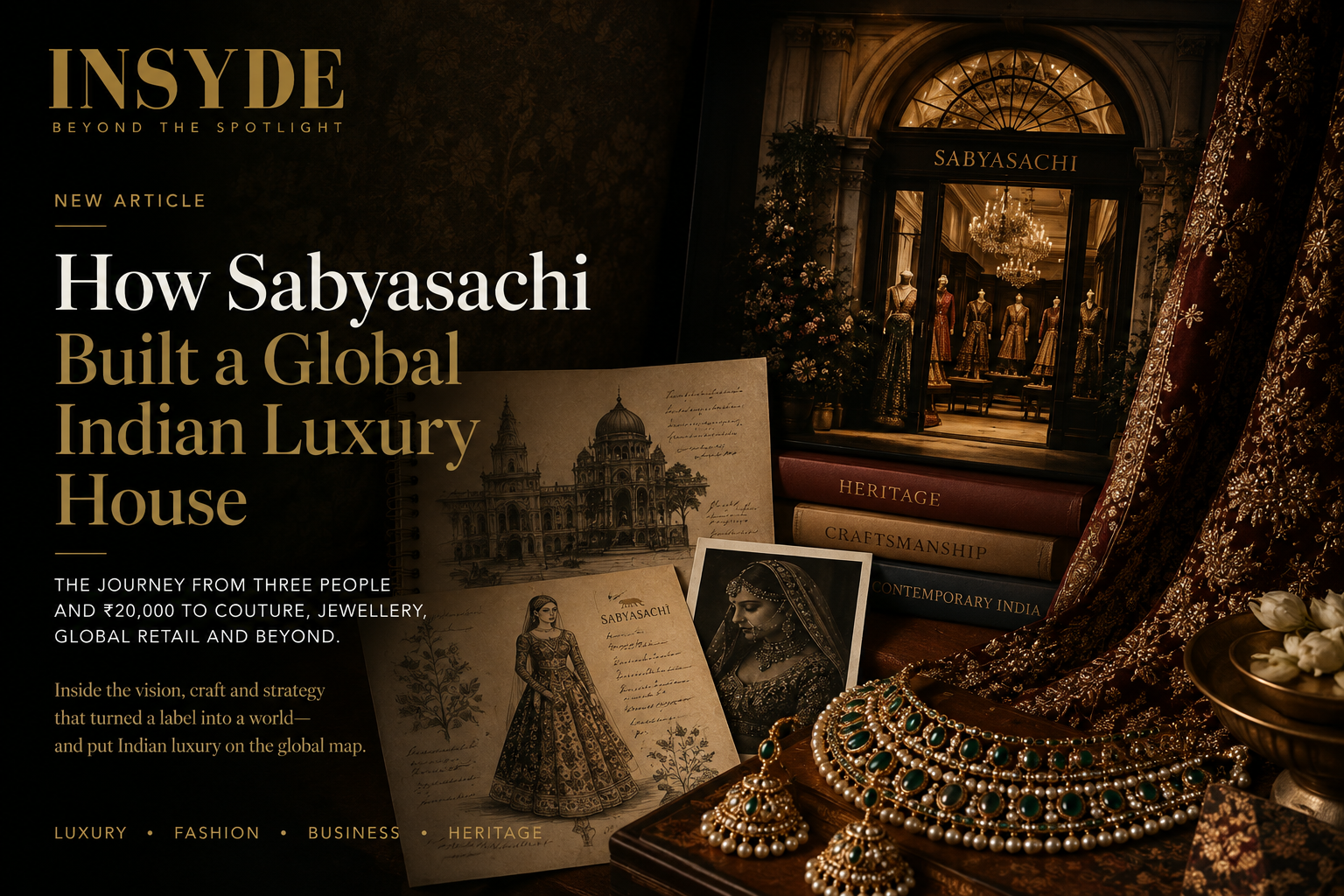
    How Sabyasachi Built a Global Indian Luxury House | INSYDE

    The Sabyasachi label began with three people and ₹20,000. Today, it spans couture, jewellery, retail, beauty, art and international markets. The real story is how a designer turned an aesthetic into an entire luxury ecosystem.

    A fashion label sells clothes.

    A luxury house sells something much harder to manufacture:

    a world.

    Sabyasachi has spent more than two decades building one.

    The clothes came first.

    Then came bridalwear.

    Then jewellery.

    Then accessories.

    Then stores that looked more like museums.

    Then international expansion.

    Then beauty.

    Then art.

    Then collaborations with global companies.

    At some point, calling Sabyasachi simply a fashion label stopped being enough.

    The more interesting question became:

    How did one designer turn a very specific idea of India into a global luxury business?

    The original ambition was never small

    The Sabyasachi story starts with an unusually clear ambition.

    After graduating from NIFT Kolkata in 1999, Sabyasachi rejected job offers from established designers and started his own label. His official history says he borrowed ₹20,000 from his family and began with a workforce of three.

    The ambition, according to the brand, was to create India’s biggest luxury house.

    That is important because it changes how we read everything that followed.

    The jewellery wasn’t a random extension.

    The stores weren’t simply retail expansion.

    The beauty collaboration wasn’t just another licensing opportunity.

    They were pieces of a larger plan.

    The goal was never only to design clothes.

    It was to build a house.

    The luxury proposition was craft

    The foundation of the business is not celebrity.

    It is craftsmanship.

    Sabyasachi’s official history describes work with weavers, block printers, embroiderers, dyers, goldsmiths, furniture artisans and other craftspeople across India. It currently says the house employs around 1,000 craftspeople and works regularly with more than 3,000 craftspeople and master weavers.

    That network gives the brand something modern luxury increasingly values:

    provenance.

    Where was it made?

    Who made it?

    How long did it take?

    What technique was used?

    What region does it come from?

    These questions turn an object into a story.

    And luxury has always been very good at selling stories.

    Sabyasachi’s innovation was to argue that India’s enormous craft tradition could be the foundation of a luxury proposition rather than simply a source of inspiration.

    The house explicitly describes the future of artisanal crafts and handwoven textiles as lying in luxury.

    That is not just a design philosophy.

    It is a business philosophy.

    The bridal business created the ecosystem

    Couture created prestige.

    Bridalwear created demand.

    Jewellery expanded the relationship.

    The wedding became the perfect environment for a luxury house because the customer often needs multiple categories at once.

    Clothing.

    Jewellery.

    Accessories.

    Beauty.

    Sometimes even décor and hospitality.

    Sabyasachi’s first bridal collection, Chand Bibi, marked a major turning point in the brand’s growth and helped establish what became known as the “Sabyasachi bride.”

    But the important business insight was broader.

    A bride doesn’t necessarily want a single product.

    She wants a world around the occasion.

    Sabyasachi was well positioned to provide it.

    Then jewellery became its own business

    The launch of Sabyasachi Jewellery was a significant step because jewellery is not simply another category of fashion.

    It changes the economics and lifespan of the relationship with the customer.

    A couture garment may be purchased for an occasion.

    Jewellery can become an heirloom.

    The house developed its jewellery language around Indian heritage, North Calcutta references and Byzantine influences. It also introduced a branded mangalsutra, presenting the traditional wedding necklace through a contemporary luxury lens.

    The jewellery business expanded internationally, including retail at Bergdorf Goodman and dedicated spaces in the brand’s New York and Mumbai stores.

    This was an important evolution.

    The customer no longer had to leave the Sabyasachi universe to complete the look.

    The house could increasingly provide the look itself.

    The store became the advertisement

    Then came retail.

    But Sabyasachi did not treat the store as somewhere to put clothes.

    The brand describes its retail spaces as “living museums.”

    The Mumbai flagship, opened in the city’s heritage district in 2023, expanded the idea dramatically. The brand describes the 25,862-square-foot space as its largest flagship, bringing together bridal and couture, ready-to-wear, jewellery, archival pieces and other elements of the Sabyasachi world.

    The New York flagship had already opened in 2022.

    The current official store network includes Kolkata, Mumbai, Delhi, Hyderabad, Bengaluru and New York.

    This is more than expansion.

    It is brand theatre.

    A luxury customer isn’t simply entering a shop.

    They are entering the story.

    And once the physical environment becomes distinctive enough, the store itself becomes marketing.

    People photograph it.

    Publications cover it.

    Visitors remember it.

    The building becomes part of the brand.

    New York wasn’t just another store

    The New York expansion carried a specific ambition.

    The brand described the goal as changing perceptions of Indian luxury—from “made in India” to “designed and made in India.”

    That distinction goes to the heart of Sabyasachi’s global strategy.

    The brand did not want India to be viewed simply as a production location.

    It wanted India to be understood as a source of design authority.

    That is a much bigger proposition.

    It changes the relationship between Indian luxury and the rest of the world.

    India is no longer merely where the artisan sits.

    India is where the luxury story begins.

    Collaboration without losing the identity

    Sabyasachi has also used collaborations as a way of extending the brand without abandoning its visual language.

    The house has worked with names including Christian Louboutin, H&M, Pottery Barn, Starbucks and Estée Lauder.

    The H&M collaboration is particularly interesting.

    It brought Sabyasachi into a mass global retail environment and included the retailer’s first sari. The collection was made available across approximately 50 countries, and the brand’s own history says the Indian online launch saw Myntra crash shortly after release, with the collection selling out rapidly.

    That kind of collaboration can easily dilute a luxury brand.

    Instead, it demonstrated something useful:

    recognition can travel across price points.

    People who could not access couture could still encounter the Sabyasachi universe.

    The brand remained aspirational.

    Then came beauty

    Beauty was a more significant move than it might initially appear.

    In its 25th year, Sabyasachi became the first Indian brand to collaborate with Estée Lauder on a global collection, launched across more than 20 countries.

    Why beauty?

    Because luxury houses don’t only sell what people wear.

    They sell codes.

    Colours.

    Textures.

    Packaging.

    Objects.

    Rituals.

    Beauty allowed Sabyasachi to take its visual identity into a category with a different price structure and a much wider global audience.

    The product changed.

    The world did not.

    That’s the real power of a luxury house.

    The corporate engine

    Behind the romance is another reality.

    Scaling a luxury business requires capital and infrastructure.

    In 2021, Aditya Birla Fashion and Retail acquired a 51% stake in Sabyasachi Calcutta LLP. ABFRL continues to include Sabyasachi within its designer-led ethnic portfolio.

    This relationship matters because it gives the house access to a larger corporate platform while the Sabyasachi identity remains the creative centre.

    And there is a larger lesson here.

    A designer can create desire.

    But a business has to deliver it.

    Supply chains.

    Retail.

    Inventory.

    International distribution.

    People.

    Technology.

    Capital.

    A global luxury house needs all of them.

    The glamour is the visible part.

    The infrastructure is the reason the glamour can exist at scale.

    The art foundation changes the definition again

    Another recent development pushes Sabyasachi beyond conventional fashion.

    The Sabyasachi Art Foundation opened its first gallery at Nilaya Anthology, with an inaugural exhibition by artist Atish Mukherjee. The brand describes the initiative as part of its commitment to cultural stewardship and to creating a permanent home where art can be nurtured and exhibited.

    This is strategically interesting.

    Because once a fashion brand begins collecting, exhibiting and supporting art, its cultural authority starts to change.

    It is no longer only making products.

    It is participating in cultural preservation.

    That is a much more ambitious position.

    Twenty-five years later, the house looks back

    The 25th-anniversary show in Mumbai in 2025 made the evolution visible.

    More than 150 looks revisited the Sabyasachi vocabulary while mixing traditional Indian craft with international references. Vogue described the show as a return to Calcutta and to the designer’s foundational aesthetic.

    The timing was significant.

    The house had spent years expanding outward.

    Now it was looking backward.

    But not nostalgically for nostalgia’s sake.

    The past had become an asset.

    The archive had become a resource.

    The signature had become a business advantage.

    And now the house is going back to New York

    The next chapter is already taking shape.

    The CFDA’s official preliminary September 2026 schedule lists Sabyasachi by Sabyasachi Mukherjee for New York Fashion Week on September 15, 2026.

    The return matters because the house is no longer arriving in New York as an ambitious young Indian label.

    It arrives with:

    A mature couture business.

    A global jewellery operation.

    International retail.

    A recognised visual identity.

    A craft ecosystem.

    Corporate backing.

    And a much larger understanding of what an Indian luxury house can be.

    The runway is almost the least interesting part.

    The interesting part is everything that had to be built before the runway could matter.

    So, what actually makes Sabyasachi a luxury house?

    It isn’t the price.

    It isn’t the celebrity list.

    It isn’t even the craftsmanship on its own.

    It is consistency.

    The same world appears across clothing.

    Jewellery.

    Stores.

    Beauty.

    Art.

    Packaging.

    Photography.

    Collaborations.

    The customer knows what Sabyasachi means before seeing the product.

    That is one of the hardest things to build in luxury.

    A recognisable world.

    The real Sabyasachi business

    There is a reason Sabyasachi has become such an interesting case study for Indian luxury.

    He didn’t build the business by abandoning India.

    He built it by making India itself part of the brand proposition.

    The craft is Indian.

    The references are Indian.

    The nostalgia is Indian.

    The jewellery is Indian.

    The wedding is Indian.

    But the ambition is global.

    That combination is what makes the house interesting.

    Because the real product isn’t a lehenga.

    It isn’t a necklace.

    It isn’t a store in New York.

    The product is the belief that all of these things belong together.

    That they can form one coherent world.

    And perhaps that is what separates a successful designer from a luxury house.

    A designer creates beautiful things.

    A luxury house creates meaning around those things.

    Sabyasachi has spent twenty-five years building that meaning.

    Now the question is no longer whether Indian luxury can travel.

    It already has.

    The question is how far the Sabyasachi idea of India can travel with it.

    — INSYDE