
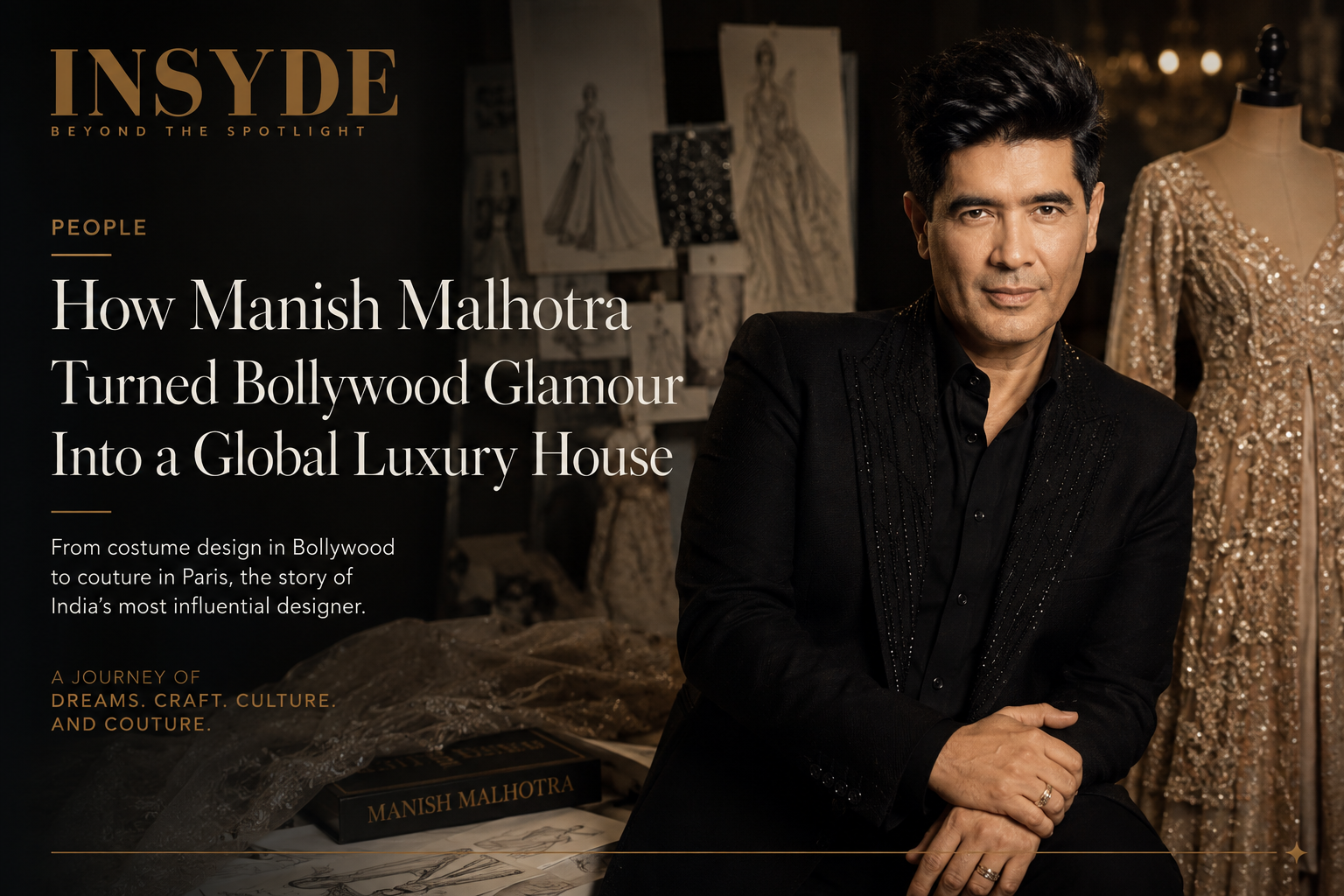
From costume design in Bollywood to couture in Paris, Manish Malhotra has spent more than three decades turning fashion into storytelling — and storytelling into one of India’s most recognisable luxury worlds.
There are designers whose clothes are admired.
And then there are designers whose clothes become part of memory.
A lehenga from a wedding. A saree from a film. A heroine walking through a song sequence. A particular shade of shimmer beneath the lights. Clothes that become so closely associated with a character, a celebrity or a moment that it becomes difficult to remember one without the other.
Manish Malhotra belongs to that second category.
For more than three decades, he has operated at the intersection of fashion, cinema, celebrity and Indian culture. He began not with a luxury boutique or a couture atelier, but inside the world of films, where clothes had to do something more than look beautiful.
They had to tell a story.
And that may be the most important thread running through his career.
Before Manish Malhotra became a fashion house, he became a storyteller.
Before the Name Became the Brand
Malhotra’s entry into fashion was unconventional.
He began his career as a model before moving into costume design, eventually making his cinematic debut in 1990 with Swarg. By 1993, his work on Gumrah was already establishing a different approach to costume design — one in which the complete look of a character could become part of the storytelling.
Then came Rangeela.
In 1995, his work on the film earned him the first-ever Filmfare Award for Best Costume Design. It was more than a career milestone. It was an indication that the way Indian cinema dressed its characters was changing.
Malhotra understood something that would become central to his career:
People don’t simply watch films.
They absorb them.
They remember the characters, the colours, the music — and increasingly, the clothes.
Fashion could influence how an audience understood a character before that character had even spoken.
That idea would become one of his greatest strengths.
When Bollywood Became a Fashion Classroom
Malhotra’s relationship with cinema gave him an education that could not be contained inside a traditional fashion curriculum.
He learned through actors.
Through scripts.
Through movement.
Through lighting.
Through the personalities of the people wearing his clothes.
And most importantly, through the audience.
His costumes helped make the wardrobe of a film star feel aspirational in a new way. The clothes weren’t simply part of the production design. They could become part of the cultural conversation surrounding the film.
That was particularly powerful in the Bollywood of the 1990s and early 2000s.
Cinema was becoming increasingly fashion-conscious, and Malhotra was one of the designers helping define what that looked like.
His work became associated with the visual language of contemporary Bollywood: glamour, colour, romance, youth and spectacle.
By 2002, his work on Kuch Kuch Hota Hai had earned seven costume-design awards, according to the House’s official timeline.
The numbers matter.
But the cultural effect matters more.
A generation began looking at film stars differently.
And, in turn, began looking at fashion differently.
The Moment the Costume Designer Became a Designer
There comes a point in many creative careers when influence has to become something more permanent.
For Malhotra, that transition happened through fashion itself.
In 1999, he presented his first runway show in Mumbai. In 2004, the Manish Malhotra label launched and his first international flagship boutique opened in Dubai. A year later, he founded the House of Manish Malhotra.
The distinction is important.
He was no longer simply designing clothes for someone else’s story.
He was building his own.
That is a much harder proposition.
Cinema had given Malhotra an enormous platform, but a fashion house requires something different: an identity that can survive beyond any single film, actor or season.
The House had to become the story.
And slowly, it did.
Building a World, Not Just a Label
Today, the House of Manish Malhotra describes itself as a multidisciplinary luxury house spanning couture, bridal, menswear, ready-to-wear, high jewellery, beauty and film production.
That expansion says something about how Malhotra understood luxury.
Luxury is rarely just the object.
It is the world surrounding the object.
The setting.
The craftsmanship.
The celebrity.
The experience.
The sense that the customer isn’t simply buying a garment but entering a particular visual universe.
Malhotra’s universe has always been recognisable.
It is dramatic without being anonymous.
Indian without being trapped in nostalgia.
Luxurious without pretending that Indian craftsmanship needs to be disguised as something European.
That balance has become one of the defining characteristics of the brand.
The Business Behind the Glamour
It is easy to look at Manish Malhotra through photographs.
A celebrity wearing couture.
A bride walking down an aisle.
A red carpet.
A runway.
A glittering lehenga.
But behind those images sits a much larger operation.
Vogue reported around his 2026 Paris debut that the Mumbai-based business had grown into an empire spanning fashion, Bollywood, hospitality, beauty, fragrance and high jewellery, with a 40,000-square-foot atelier and headquarters and around 300 in-house embroiderers. The fashion business also has backing from Reliance Brands Limited.
That scale changes the conversation.
Because a designer can create beautiful clothes.
A luxury house has to create beautiful clothes repeatedly, consistently and at scale, while maintaining the identity that made people desire them in the first place.
That requires artisans.
Operations.
Retail.
Marketing.
Celebrity relationships.
Client management.
Digital storytelling.
And, above all, a clear point of view.
The glamour may be what people see.
The system underneath it is what makes the glamour possible.
The Indian Craftsmanship at the Centre
Malhotra’s international story is also an Indian craftsmanship story.
The House says its work is built around embroidery, weaving and handcraft traditions passed down through generations, reinterpreted through a contemporary luxury lens.
That matters because Indian craftsmanship has long played a significant role in global luxury.
For decades, the techniques and handwork associated with Indian artisans have appeared within international fashion while the people and traditions behind them have often remained invisible to the final consumer.
The conversation is changing.
Vogue noted in 2026 that more Indian designers are appearing on the official Paris couture calendar, reflecting a broader movement in which Indian craftsmanship is increasingly being presented not simply as a source of embellishment, but as part of a wider luxury and design conversation.
Malhotra’s approach fits into that shift.
His objective isn’t to make Indian craft look less Indian.
It is to make the world look at Indian craft differently.
The embroidery becomes architecture.
The textile becomes emotion.
The sari becomes memory.
The lehenga becomes spectacle.
Craft becomes luxury.
The Celebrity Effect
Then there is Bollywood.
It would be impossible to tell the Manish Malhotra story without acknowledging how closely the designer and celebrity cultures have grown together.
But this relationship is more interesting than simple endorsement.
The designer needs the star.
The star needs the designer.
One creates the image.
The other amplifies it.
That relationship helped Malhotra develop something that many luxury houses spend decades trying to manufacture: cultural visibility.
A Manish Malhotra outfit could appear on a runway, then on a film star, then in a magazine, then at a wedding.
The garment travelled.
And with it, the brand travelled.
This is where his cinema background became a business advantage.
He already understood how people fall in love with an image.
He simply transferred that understanding from the screen to the fashion house.
Why Bridalwear Became So Powerful
For millions of Indians, the name Manish Malhotra is almost inseparable from weddings.
The reason isn’t difficult to understand.
Indian weddings are already theatrical.
There is music.
There is colour.
There is ceremony.
There is photography.
There is family.
There is performance.
Malhotra’s aesthetic naturally belongs in that environment.
But bridalwear also gave the brand something else: a powerful emotional purchase.
A wedding outfit isn’t simply clothing.
It becomes part of a memory.
That is precisely the kind of emotional relationship luxury brands want to create.
The House’s expansion into bridal, jewellery, beauty and other categories has allowed that relationship to grow beyond the original garment.
A client can enter the Manish Malhotra world through a bridal lehenga.
Another through jewellery.
Another through beauty.
Another through menswear.
Another through couture.
Different products.
One universe.
The House Keeps Expanding
The evolution has continued.
The House launched Manish Malhotra Beauty in 2018, expanded further into high jewellery, introduced Ready-to-Wear in 2025 and has continued developing international showcases and retail presence. Its official timeline also records the launch of Stage5 Productions and other extensions beyond traditional fashion.
This is no longer simply the story of a designer selling clothes.
It is the story of a creative brand expanding its cultural territory.
Fashion becomes jewellery.
Jewellery becomes beauty.
Beauty becomes lifestyle.
Cinema becomes production.
And the designer becomes the centre of a much larger ecosystem.
That is the difference between a successful designer and a modern luxury house.
Paris Changes the Scale
For years, Paris represented one of fashion’s ultimate stages.
In July 2026, Manish Malhotra entered it.
He presented his Fall/Winter 2026 couture collection in Paris as a guest house on the official Haute Couture Week schedule, becoming the fourth Indian designer to appear on that official calendar.
But the significance of the moment wasn’t simply that an Indian designer had reached Paris.
It was what he carried with him.
The collection was called “Maa.”
It was dedicated to his mother, Sudarshan Malhotra, who died earlier in 2026.
The show opened with a deep red runway, red lighting and the sound of a heartbeat. The collection explored memories of motherhood and childhood through sculptural silhouettes, intricate embroidery and references to his mother’s jewellery and saris.
One of the most striking ideas was the transformation of her bangles into the circular structure of a gown.
It was fashion, but it was also memory.
After decades spent dressing other people’s characters, Malhotra arrived in Paris telling a story that belonged entirely to him.
That gave the debut an emotional weight that a simple international expansion could never have carried.
A New Kind of Indian Luxury
The Paris debut also arrives at an interesting moment for Indian fashion.
For years, the world understood India largely through its craftsmanship.
The embroidery.
The textiles.
The artisans.
The colour.
But craftsmanship alone does not create a global luxury house.
A house also needs authorship.
A point of view.
A recognisable identity.
A business capable of sustaining that identity.
And a story people around the world can understand.
Indian designers are increasingly bringing those elements together.
Malhotra’s Paris debut is part of that larger movement. Vogue described the growing presence of Indian designers on the official couture calendar as evidence of a shift in how Indian fashion is participating in the global luxury conversation.
The conversation is no longer simply:
“Look at the craftsmanship India can provide.”
It is becoming:
“Look at the luxury worlds Indian designers can create.”
That is a much bigger proposition.
The Manish Malhotra Formula
There is no single formula behind Manish Malhotra’s career.
But there is a pattern.
He observes culture.
He understands aspiration.
He understands celebrity.
He understands spectacle.
And he understands that people don’t simply buy clothes.
They buy the feeling surrounding them.
That may be the real lesson of his career.
The clothes matter.
The craftsmanship matters.
The business matters.
But the story connecting everything together matters just as much.
He has spent more than three decades building that story.
First through cinema.
Then through couture.
Then through celebrity.
Then through weddings.
Then through jewellery and beauty.
And now, increasingly, through the global language of luxury.
From Mumbai to Paris
The distance between Mumbai and Paris is measured in thousands of kilometres.
But creatively, Manish Malhotra’s journey between them has been built one image at a time.
A character in a film.
A costume that people remember.
A celebrity who becomes an icon.
A runway.
A boutique.
A bride.
A jewellery collection.
A beauty line.
A luxury house.
And finally, Paris.
The interesting thing is that he did not arrive there overnight.
Paris was simply the newest stage for a story that had been developing for more than three decades.
That is what makes Manish Malhotra’s career worth looking at beyond fashion.
It is a story about reinvention.
About understanding what people desire — and then building a world around that desire.
It is about taking an opportunity that was never supposed to be the final destination and turning it into something larger.
Manish Malhotra didn’t just dress Bollywood.
He helped change the way Bollywood imagined glamour.
And in doing so, he discovered something even bigger:
that the person designing the clothes could eventually build the entire world around them.
From cinema to couture, from Mumbai to Paris, Manish Malhotra’s story is ultimately a story about scale — and the ambition to keep building.