
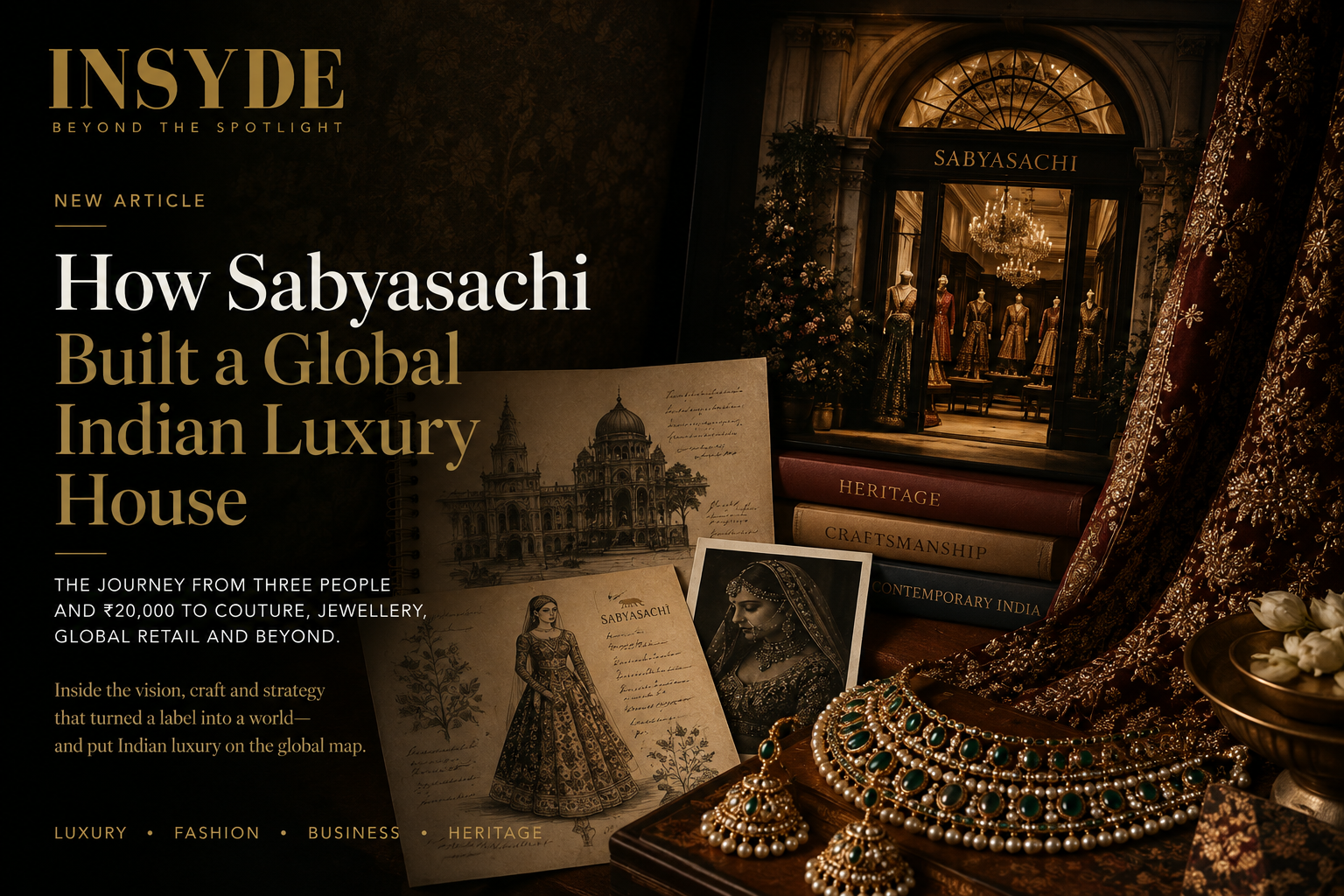
The Sabyasachi label began with three people and ₹20,000. Today, it spans couture, jewellery, retail, beauty, art and international markets. The real story is how a designer turned an aesthetic into an entire luxury ecosystem.
A fashion label sells clothes.
A luxury house sells something much harder to manufacture:
a world.
Sabyasachi has spent more than two decades building one.
The clothes came first.
Then came bridalwear.
Then jewellery.
Then accessories.
Then stores that looked more like museums.
Then international expansion.
Then beauty.
Then art.
Then collaborations with global companies.
At some point, calling Sabyasachi simply a fashion label stopped being enough.
The more interesting question became:
How did one designer turn a very specific idea of India into a global luxury business?
The original ambition was never small
The Sabyasachi story starts with an unusually clear ambition.
After graduating from NIFT Kolkata in 1999, Sabyasachi rejected job offers from established designers and started his own label. His official history says he borrowed ₹20,000 from his family and began with a workforce of three.
The ambition, according to the brand, was to create India’s biggest luxury house.
That is important because it changes how we read everything that followed.
The jewellery wasn’t a random extension.
The stores weren’t simply retail expansion.
The beauty collaboration wasn’t just another licensing opportunity.
They were pieces of a larger plan.
The goal was never only to design clothes.
It was to build a house.
The luxury proposition was craft
The foundation of the business is not celebrity.
It is craftsmanship.
Sabyasachi’s official history describes work with weavers, block printers, embroiderers, dyers, goldsmiths, furniture artisans and other craftspeople across India. It currently says the house employs around 1,000 craftspeople and works regularly with more than 3,000 craftspeople and master weavers.
That network gives the brand something modern luxury increasingly values:
provenance.
Where was it made?
Who made it?
How long did it take?
What technique was used?
What region does it come from?
These questions turn an object into a story.
And luxury has always been very good at selling stories.
Sabyasachi’s innovation was to argue that India’s enormous craft tradition could be the foundation of a luxury proposition rather than simply a source of inspiration.
The house explicitly describes the future of artisanal crafts and handwoven textiles as lying in luxury.
That is not just a design philosophy.
It is a business philosophy.
The bridal business created the ecosystem
Couture created prestige.
Bridalwear created demand.
Jewellery expanded the relationship.
The wedding became the perfect environment for a luxury house because the customer often needs multiple categories at once.
Clothing.
Jewellery.
Accessories.
Beauty.
Sometimes even décor and hospitality.
Sabyasachi’s first bridal collection, Chand Bibi, marked a major turning point in the brand’s growth and helped establish what became known as the “Sabyasachi bride.”
But the important business insight was broader.
A bride doesn’t necessarily want a single product.
She wants a world around the occasion.
Sabyasachi was well positioned to provide it.
Then jewellery became its own business
The launch of Sabyasachi Jewellery was a significant step because jewellery is not simply another category of fashion.
It changes the economics and lifespan of the relationship with the customer.
A couture garment may be purchased for an occasion.
Jewellery can become an heirloom.
The house developed its jewellery language around Indian heritage, North Calcutta references and Byzantine influences. It also introduced a branded mangalsutra, presenting the traditional wedding necklace through a contemporary luxury lens.
The jewellery business expanded internationally, including retail at Bergdorf Goodman and dedicated spaces in the brand’s New York and Mumbai stores.
This was an important evolution.
The customer no longer had to leave the Sabyasachi universe to complete the look.
The house could increasingly provide the look itself.
The store became the advertisement
Then came retail.
But Sabyasachi did not treat the store as somewhere to put clothes.
The brand describes its retail spaces as “living museums.”
The Mumbai flagship, opened in the city’s heritage district in 2023, expanded the idea dramatically. The brand describes the 25,862-square-foot space as its largest flagship, bringing together bridal and couture, ready-to-wear, jewellery, archival pieces and other elements of the Sabyasachi world.
The New York flagship had already opened in 2022.
The current official store network includes Kolkata, Mumbai, Delhi, Hyderabad, Bengaluru and New York.
This is more than expansion.
It is brand theatre.
A luxury customer isn’t simply entering a shop.
They are entering the story.
And once the physical environment becomes distinctive enough, the store itself becomes marketing.
People photograph it.
Publications cover it.
Visitors remember it.
The building becomes part of the brand.
New York wasn’t just another store
The New York expansion carried a specific ambition.
The brand described the goal as changing perceptions of Indian luxury—from “made in India” to “designed and made in India.”
That distinction goes to the heart of Sabyasachi’s global strategy.
The brand did not want India to be viewed simply as a production location.
It wanted India to be understood as a source of design authority.
That is a much bigger proposition.
It changes the relationship between Indian luxury and the rest of the world.
India is no longer merely where the artisan sits.
India is where the luxury story begins.
Collaboration without losing the identity
Sabyasachi has also used collaborations as a way of extending the brand without abandoning its visual language.
The house has worked with names including Christian Louboutin, H&M, Pottery Barn, Starbucks and Estée Lauder.
The H&M collaboration is particularly interesting.
It brought Sabyasachi into a mass global retail environment and included the retailer’s first sari. The collection was made available across approximately 50 countries, and the brand’s own history says the Indian online launch saw Myntra crash shortly after release, with the collection selling out rapidly.
That kind of collaboration can easily dilute a luxury brand.
Instead, it demonstrated something useful:
recognition can travel across price points.
People who could not access couture could still encounter the Sabyasachi universe.
The brand remained aspirational.
Then came beauty
Beauty was a more significant move than it might initially appear.
In its 25th year, Sabyasachi became the first Indian brand to collaborate with Estée Lauder on a global collection, launched across more than 20 countries.
Why beauty?
Because luxury houses don’t only sell what people wear.
They sell codes.
Colours.
Textures.
Packaging.
Objects.
Rituals.
Beauty allowed Sabyasachi to take its visual identity into a category with a different price structure and a much wider global audience.
The product changed.
The world did not.
That’s the real power of a luxury house.
The corporate engine
Behind the romance is another reality.
Scaling a luxury business requires capital and infrastructure.
In 2021, Aditya Birla Fashion and Retail acquired a 51% stake in Sabyasachi Calcutta LLP. ABFRL continues to include Sabyasachi within its designer-led ethnic portfolio.
This relationship matters because it gives the house access to a larger corporate platform while the Sabyasachi identity remains the creative centre.
And there is a larger lesson here.
A designer can create desire.
But a business has to deliver it.
Supply chains.
Retail.
Inventory.
International distribution.
People.
Technology.
Capital.
A global luxury house needs all of them.
The glamour is the visible part.
The infrastructure is the reason the glamour can exist at scale.
The art foundation changes the definition again
Another recent development pushes Sabyasachi beyond conventional fashion.
The Sabyasachi Art Foundation opened its first gallery at Nilaya Anthology, with an inaugural exhibition by artist Atish Mukherjee. The brand describes the initiative as part of its commitment to cultural stewardship and to creating a permanent home where art can be nurtured and exhibited.
This is strategically interesting.
Because once a fashion brand begins collecting, exhibiting and supporting art, its cultural authority starts to change.
It is no longer only making products.
It is participating in cultural preservation.
That is a much more ambitious position.
Twenty-five years later, the house looks back
The 25th-anniversary show in Mumbai in 2025 made the evolution visible.
More than 150 looks revisited the Sabyasachi vocabulary while mixing traditional Indian craft with international references. Vogue described the show as a return to Calcutta and to the designer’s foundational aesthetic.
The timing was significant.
The house had spent years expanding outward.
Now it was looking backward.
But not nostalgically for nostalgia’s sake.
The past had become an asset.
The archive had become a resource.
The signature had become a business advantage.
And now the house is going back to New York
The next chapter is already taking shape.
The CFDA’s official preliminary September 2026 schedule lists Sabyasachi by Sabyasachi Mukherjee for New York Fashion Week on September 15, 2026.
The return matters because the house is no longer arriving in New York as an ambitious young Indian label.
It arrives with:
A mature couture business.
A global jewellery operation.
International retail.
A recognised visual identity.
A craft ecosystem.
Corporate backing.
And a much larger understanding of what an Indian luxury house can be.
The runway is almost the least interesting part.
The interesting part is everything that had to be built before the runway could matter.
So, what actually makes Sabyasachi a luxury house?
It isn’t the price.
It isn’t the celebrity list.
It isn’t even the craftsmanship on its own.
It is consistency.
The same world appears across clothing.
Jewellery.
Stores.
Beauty.
Art.
Packaging.
Photography.
Collaborations.
The customer knows what Sabyasachi means before seeing the product.
That is one of the hardest things to build in luxury.
A recognisable world.
The real Sabyasachi business
There is a reason Sabyasachi has become such an interesting case study for Indian luxury.
He didn’t build the business by abandoning India.
He built it by making India itself part of the brand proposition.
The craft is Indian.
The references are Indian.
The nostalgia is Indian.
The jewellery is Indian.
The wedding is Indian.
But the ambition is global.
That combination is what makes the house interesting.
Because the real product isn’t a lehenga.
It isn’t a necklace.
It isn’t a store in New York.
The product is the belief that all of these things belong together.
That they can form one coherent world.
And perhaps that is what separates a successful designer from a luxury house.
A designer creates beautiful things.
A luxury house creates meaning around those things.
Sabyasachi has spent twenty-five years building that meaning.
Now the question is no longer whether Indian luxury can travel.
It already has.
The question is how far the Sabyasachi idea of India can travel with it.
— INSYDE