Category: Bridal

The designers, traditions, trends and changing ideas shaping modern bridal fashion.

  • The New Heirloom: The Luxury of Legacy

    The New Heirloom: The Luxury of Legacy

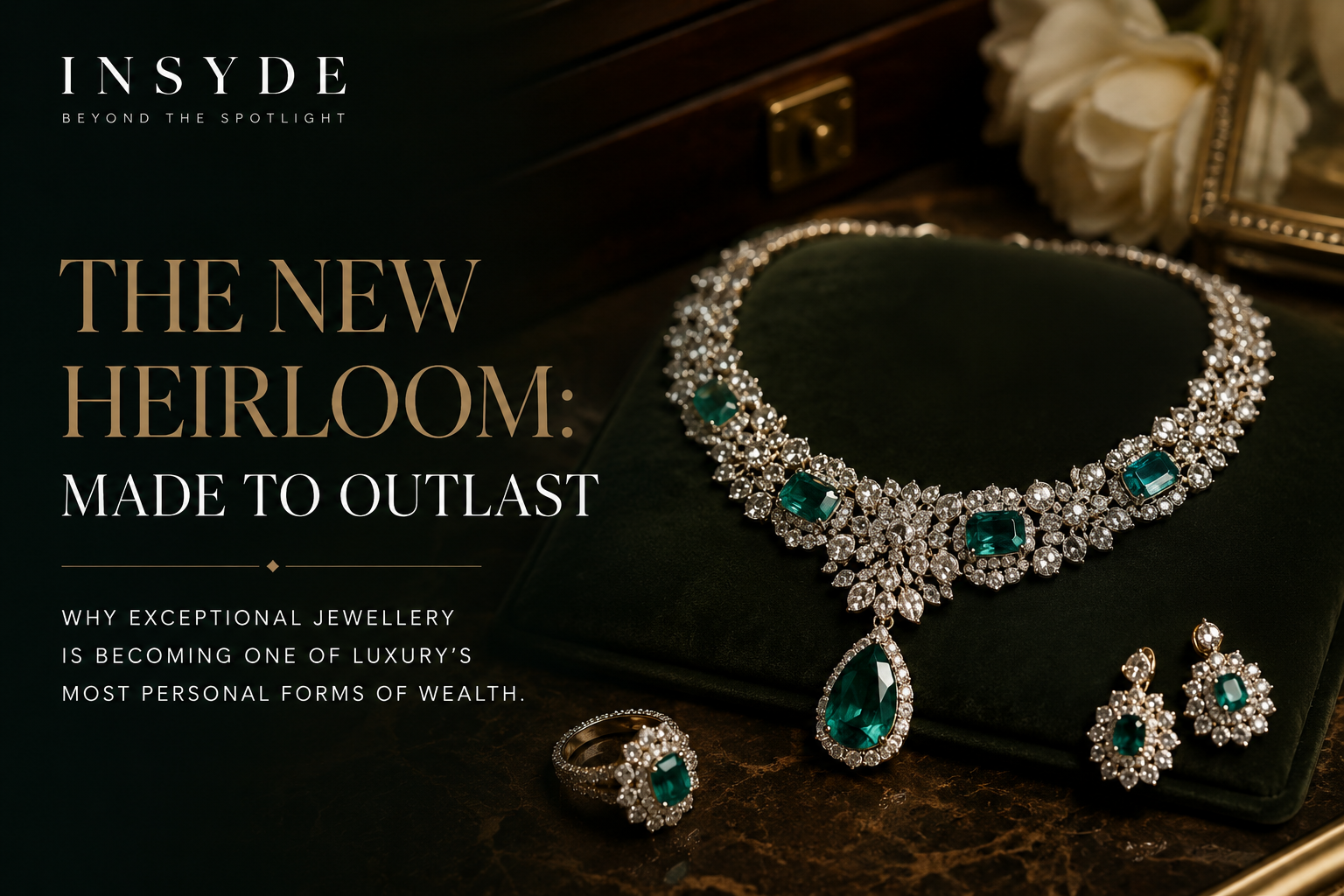
    Why exceptional jewellery is becoming one of luxury’s most personal forms of wealth.

    There is a difference between owning something valuable and owning something that matters.

    The distinction becomes clearer at the highest levels of luxury.

    When access is no longer the challenge, another question begins to matter: what is actually worth keeping?

    A remarkable piece of jewellery can answer that question rather elegantly.

    It does not need to occupy a room.

    It does not need a chauffeur.

    It does not need a marina or a private hangar.

    It can sit quietly in a private collection, emerge for one evening, and carry more meaning than an object ten times its size.

    That is the peculiar power of exceptional jewellery.

    It is wealth made intimate.

    Not necessarily wealth designed to be seen by everyone, but wealth expressed through rarity, provenance, craftsmanship and personal significance.

    And increasingly, that is where luxury is heading.

    When Price Stops Being the Point

    For a certain kind of buyer, price is an important consideration.

    For the truly affluent, it is often a secondary one.

    The question is no longer whether something is expensive enough to justify its place in a collection.

    It is whether it is exceptional enough to deserve one.

    That distinction changes the entire conversation.

    A rare Colombian emerald.

    An extraordinary Burmese ruby with compelling provenance.

    A historic diamond.

    A one-of-one commission.

    A piece created by an exceptional atelier.

    A jewel whose craftsmanship reveals itself only when examined closely.

    These are not interchangeable luxury goods.

    They are objects with characteristics that cannot simply be reproduced by increasing a budget.

    That is where jewellery becomes particularly interesting.

    Money can secure access. It cannot manufacture rarity.

    The Value of Knowing What You Are Looking At

    There is a sophistication to jewellery that rewards knowledge.

    Two stones can appear similar to an untrained eye and possess radically different histories, qualities and desirability.

    Two pieces can carry similar materials and have completely different levels of craftsmanship.

    The difference may be in the cut.

    The setting.

    The proportions.

    The origin.

    The stone selection.

    The construction.

    The hand behind it.

    Or simply the judgement of the person who commissioned it.

    This is why the most sophisticated jewellery culture is not necessarily loud.

    It is informed.

    A collector does not need a room to recognise a remarkable stone.

    Sometimes a glance across a dinner table is enough.

    That is a very different kind of status.

    Recognition becomes selective.

    Jewellery Is Wealth You Can Wear

    A residence remains at its address.

    A yacht remains at sea.

    A private aircraft moves according to a flight plan.

    Jewellery has a different kind of freedom.

    It travels with its owner.

    A necklace can move between continents.

    A ring can pass from a boardroom to a private dinner.

    A pair of earrings can become part of an evening’s entire visual language.

    The object is not simply stored wealth.

    It becomes portable identity.

    And because it is worn directly against the body, jewellery occupies an unusually intimate position within a luxury collection.

    You don’t simply own it.

    You live with it.

    The Quiet Power of Exceptional Craftsmanship

    At the top end of jewellery, craftsmanship is rarely there for spectacle.

    It is there for perfection.

    The setting has to hold the stone without overpowering it.

    The proportions have to feel inevitable.

    The metal has to respond to light correctly.

    The construction has to survive years of wear without losing its character.

    The smallest detail can determine whether a piece feels merely expensive or genuinely exceptional.

    This is where the great ateliers distinguish themselves.

    The finished piece may appear effortless.

    That is precisely the point.

    Exceptional craftsmanship hides its own difficulty.

    The more refined the object, the less it needs to explain itself.

    The Stone Is Only the Beginning

    A remarkable gemstone carries its own identity.

    Its colour.

    Its character.

    Its origin.

    Its rarity.

    Its history.

    Its imperfections can sometimes become part of what makes it desirable.

    The sophisticated collector therefore isn’t necessarily searching for the largest stone.

    They may be searching for the stone that cannot easily be replaced.

    That distinction matters.

    Size can be measured.

    Rarity has to be understood.

    And in the highest echelons of collecting, uniqueness tends to outlast spectacle.

    India’s Jewellery Legacy Is an Extraordinary Advantage

    India enters this conversation with something many emerging luxury markets would struggle to create from scratch:

    centuries of jewellery culture.

    Kundan.

    Jadau.

    Polki.

    Meenakari.

    Temple jewellery.

    Goldsmithing traditions.

    Gem-setting techniques.

    Regional craftsmanship passed between generations.

    These aren’t simply decorative traditions.

    They are sophisticated systems of making.

    The opportunity for contemporary Indian luxury is therefore not to reproduce the European model of jewellery.

    It is to take India’s enormous craft heritage and give it a new vocabulary.

    The most compelling future Indian jewellery may not look traditionally Indian at first glance.

    It may be architectural.

    Minimal.

    Sculptural.

    Unexpected.

    But the intelligence of the craft can remain underneath.

    That is where heritage becomes contemporary.

    The Indian Jewel of Tomorrow

    Imagine a contemporary necklace constructed using a centuries-old technique.

    A sculptural ring inspired by Indian architecture.

    A modern interpretation of Jadau without ceremonial excess.

    A rare gemstone framed with the restraint of contemporary design.

    A private commission that combines an inherited stone with a completely new setting.

    That is far more interesting than simply placing an Indian motif on a luxury product.

    The real opportunity is reinvention without losing provenance.

    If Indian jewellery houses can achieve that balance, the result could become globally significant.

    Not because it is Indian.

    But because it is exceptional.

    When Jewellery Becomes a Private Language

    There is a particular pleasure in owning something that does not need to announce itself.

    A necklace without a visible logo.

    A ring whose significance is understood only by a handful of collectors.

    A stone selected because of its provenance rather than its recognisability.

    A private commission that exists nowhere else.

    This is where jewellery enters the territory of discreet luxury.

    The object does not ask for attention.

    It rewards attention.

    And that distinction is increasingly important.

    The old luxury language often said:

    Look at what I own.

    The newer language can say:

    Look closely.

    The Heirloom Is Changing

    Historically, an heirloom was something that survived long enough to be inherited.

    Today, the most thoughtful collectors can design for inheritance from the beginning.

    A piece commissioned for a milestone.

    A gemstone selected with a future daughter or son in mind.

    An existing family jewel redesigned without losing its original stone.

    A new piece created specifically to become part of a family’s visual history.

    The object becomes more than an acquisition.

    It becomes a decision about the future.

    And that may be one of the most sophisticated reasons to buy exceptional jewellery.

    You are not necessarily buying for yourself alone.

    You are deciding what deserves to survive you.

    From Jewellery to Family Archive

    This is where jewellery becomes almost impossible to price.

    A necklace can carry the memory of a wedding.

    A ring can carry the history of a marriage.

    A stone can be reset across generations.

    A brooch can return decades later at another family celebration.

    The financial value may remain measurable.

    The emotional value does not.

    And over time, the two can become inseparable.

    A remarkable jewel is therefore capable of becoming something unusual:

    a physical archive of a family.

    That is a form of wealth no balance sheet can properly capture.

    The Collector’s Eye

    Serious collecting is rarely about accumulation for its own sake.

    The most interesting private collections tend to have a point of view.

    They may focus on exceptional stones.

    A particular period.

    A house.

    A designer.

    A technique.

    A geographical tradition.

    Or simply pieces that tell compelling stories.

    The collector begins to develop an eye.

    They notice things.

    The quality of a setting.

    The way a stone is cut.

    The originality of a design.

    The difference between an important piece and merely an expensive one.

    At that point, buying becomes less about consumption and more about curation.

    And curation is one of the defining characteristics of sophisticated luxury.

    When a Jewel Becomes Art

    There is a moment when jewellery stops functioning as an accessory.

    It becomes an artwork.

    A one-of-one commission.

    An extraordinary stone.

    An experimental setting.

    A collaboration between an artist and a master jeweller.

    A piece whose proportions are so deliberate that it could belong in a gallery as naturally as it belongs on the body.

    At that level, the question is no longer whether the piece matches an outfit.

    It is whether the object itself deserves to exist.

    That is a much higher standard.

    And it is where jewellery enters the world of collecting.

    The Investment Question Is Almost the Wrong Question

    Luxury jewellery is frequently discussed as an investment.

    That conversation has its place.

    Certain exceptional pieces can command significant prices in the secondary market, particularly when rarity, provenance, craftsmanship and collector demand converge.

    But reducing exceptional jewellery to financial performance misses its more enduring value.

    The serious collector isn’t necessarily asking whether a jewel will outperform an investment portfolio.

    They are asking whether it possesses lasting desirability.

    Will the stone still be remarkable?

    Will the craftsmanship still be respected?

    Will the design still feel relevant?

    Will the provenance still matter?

    Will someone want it decades from now?

    That is a different definition of value.

    Financial value can fluctuate. Cultural value can compound.

    The New Luxury Is Personal

    The next generation of high jewellery is unlikely to be defined simply by larger stones or heavier pieces.

    It will be defined by individuality.

    Private commissions.

    Unusual gemstones.

    Exceptional provenance.

    Artist collaborations.

    Heritage techniques.

    Contemporary Indian craftsmanship.

    One-of-one designs.

    And pieces that could never have been created for anyone else.

    This is where luxury becomes most interesting.

    The object is no longer simply selected.

    It is authored.

    The collector becomes part of the creative process.

    The final piece carries something of both sides: the skill of the maker and the identity of the person who commissioned it.

    That is difficult to mass-produce.

    And therefore, increasingly valuable.

    Beyond the Logo

    The future of jewellery may belong to pieces that do not immediately reveal their price, their house or even their significance.

    A rare stone.

    An exceptional setting.

    A technique recognised by a specialist.

    A piece with a story known only to the owner and a small circle of people who understand its importance.

    This is not the disappearance of the luxury brand.

    It is the evolution of luxury beyond the brand.

    The logo tells you who made something.

    The craftsmanship tells you why it matters.

    The provenance tells you where it has been.

    But the story tells you why it should be kept.

    The Things We Choose to Keep

    Perhaps that is why jewellery has survived every change in fashion.

    Trends disappear.

    Designers change.

    Houses rise and fall.

    But a remarkable jewel can remain.

    It can cross generations.

    It can carry a story long after its original owner is gone.

    It can be worn again decades later and somehow feel completely right.

    Because the most valuable thing about jewellery has never been simply what it is made from.

    It is what it remembers.

    And perhaps that is the ultimate luxury.

    Not owning the largest stone.

    Not wearing the most recognisable name.

    Not proving how much something cost.

    But possessing something rare enough, beautiful enough and meaningful enough to become part of someone else’s future.

    The finest jewellery doesn’t simply belong to a person.

    For a while, a person becomes part of its story.

    INSYDE — Beyond the Spotlight.
  • The New Indian Wedding: When Luxury Becomes Personal

    The New Indian Wedding: When Luxury Becomes Personal

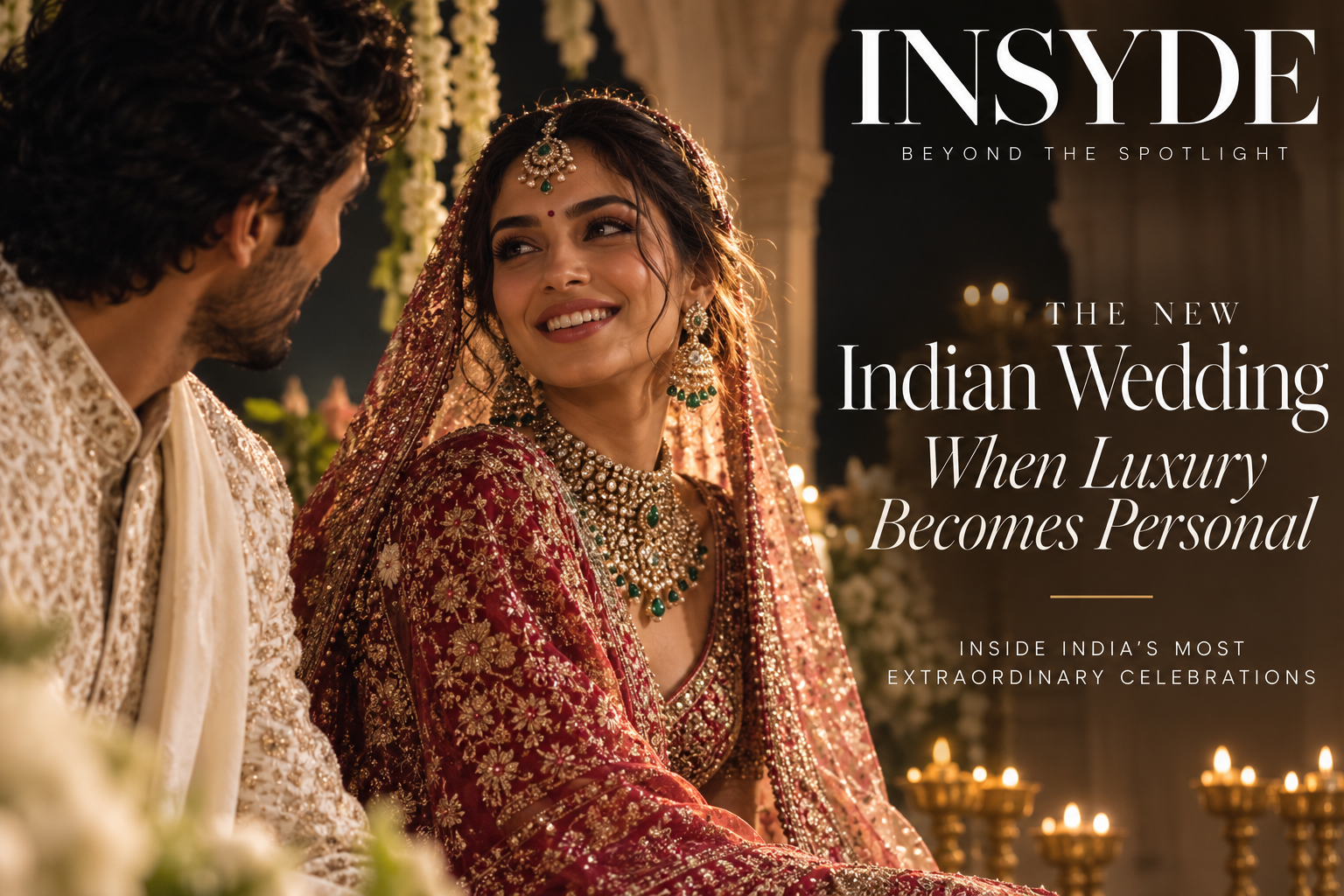
    India has never been short of spectacular weddings. But a new generation is changing what makes a celebration truly luxurious — moving beyond scale and spectacle towards personalisation, experience, craftsmanship and the art of making people feel part of something extraordinary.

    A luxury Indian wedding is no longer simply a celebration.

    For a few days, it can become an entire world.

    A palace becomes a private residence. A garden becomes a dining room. A designer creates clothing that exists for one person. A chef builds a menu around a family’s memories. An artist transforms a space overnight. Guests arrive not simply for a ceremony, but for an experience designed to stay with them long after the final event.

    India has always known how to celebrate.

    What is changing is what the celebration is trying to say.

    For generations, wedding luxury was often measured through scale: larger venues, longer guest lists, bigger décor and increasingly elaborate entertainment.

    Those things still have their place.

    But the most interesting luxury weddings are beginning to ask a different question:

    Does this wedding feel like us?

    That question is changing the Indian wedding — and turning it into one of the country’s most fascinating expressions of modern luxury.

    From Grand to Personal

    The idea that luxury has to mean more is beginning to feel outdated.

    More flowers.

    More guests.

    More entertainment.

    More spectacle.

    More everything.

    But a wedding can be extraordinarily expensive and still feel strangely impersonal.

    The new luxury is increasingly found in the details that could not have been copied from another celebration.

    A menu built around a couple’s favourite dishes.

    A wedding wardrobe designed around a personal story.

    A handwritten note waiting in every guest’s room.

    A piece of jewellery incorporating a family heirloom.

    A song that means something to the couple rather than simply being popular.

    A ceremony designed around heritage without becoming theatrical.

    Recent industry reporting reflects this shift, with Indian wedding professionals describing personalisation, experience and emotional relevance as increasingly important to younger couples. (Eventfaqs)

    The difference is subtle, but important.

    Luxury is becoming less about how much is added and more about how much thought goes into what is chosen.

    The Destination Becomes Part of the Story

    The venue used to be the backdrop.

    Now, increasingly, it is part of the experience.

    A destination wedding can turn a single ceremony into several days of shared life.

    Guests arrive early.

    They stay together.

    They eat together.

    They explore the destination.

    They attend smaller celebrations.

    They have time to actually talk.

    That helps explain the continuing appeal of India’s palaces, heritage properties, resorts and quieter destinations. Recent reporting suggests that couples are increasingly looking beyond conventional wedding destinations for locations that offer privacy, atmosphere and a more distinctive experience. (The Economic Times)

    The venue is no longer simply where the wedding happens.

    The venue becomes part of the story.

    A palace communicates history.

    A coastal property creates a different rhythm.

    A private villa creates intimacy.

    A heritage estate creates a connection to place.

    A quieter destination can give a celebration something increasingly valuable: space.

    And the location can influence everything that follows — from the wardrobe and flowers to the food, photography and guest experience.

    The Wedding Becomes a Multi-Day World

    The modern luxury wedding is increasingly less like a single event and more like an editorial unfolding over several days.

    Welcome dinner.

    Mehendi.

    Haldi.

    Sangeet.

    Cocktail evening.

    Wedding ceremony.

    Reception.

    After-party.

    But the interesting change isn’t simply the number of events.

    It is how differently each event can feel.

    A daytime ceremony might be quiet and architectural.

    An evening celebration might become theatrical.

    A private dinner might feel intimate and almost residential.

    A final brunch might be deliberately relaxed.

    Each moment becomes its own chapter.

    The result is less of a wedding programme and more of a curated journey.

    That distinction matters.

    Luxury is increasingly being measured by the quality of the experience between the major moments, not simply by what happens on the main stage. Business Standard recently reported that Indian couples are increasingly trimming guest lists while investing more in destinations and multi-day experiences that allow families and friends to stay, explore and create memories together. (Business Standard)

    When Fashion Shapes the Entire Wedding

    Few things reveal the changing Indian wedding better than fashion.

    The wedding wardrobe has always been important.

    But today, couture can influence the entire visual language of the celebration.

    A bridal lehenga can inspire the colour palette.

    A groom’s sherwani can influence the décor.

    Jewellery can influence the lighting.

    Textiles can influence table settings.

    The invitation can become an extension of the couture.

    Fashion moves beyond the wardrobe.

    It becomes architecture.

    This is particularly interesting in India because the country already possesses an extraordinary vocabulary of textile and craft traditions.

    Embroidery.

    Weaving.

    Zardozi.

    Hand-painted textiles.

    Metalwork.

    Jewellery.

    Regional techniques passed between generations.

    The modern luxury wedding can give those traditions a new stage.

    The objective doesn’t have to be recreating the past.

    It can be reinterpretation.

    A traditional technique can become contemporary.

    A historic motif can become graphic.

    An old textile can be paired with modern tailoring.

    Heritage can become something that moves forward rather than something preserved behind glass.

    Craftsmanship Becomes Part of the Celebration

    The most memorable luxury is often the kind that takes time.

    A hand-embroidered garment.

    A custom piece of jewellery.

    A hand-painted invitation.

    A specially commissioned installation.

    A table setting created by craftspeople.

    A menu developed around regional ingredients.

    These things have something in common.

    They cannot be produced instantly.

    And that makes them valuable in a culture increasingly dominated by speed.

    The Indian wedding has always been a major platform for craftsmanship.

    But the opportunity now is to move beyond simply using craft as decoration.

    Craft can become the story itself.

    Imagine a wedding where guests are introduced to the artisans who created the textiles.

    Where the menu explains the origins of ingredients.

    Where the jewellery tells the story of a family.

    Where the architecture of the venue becomes part of the celebration.

    Suddenly, luxury becomes educational as well as beautiful.

    The Guest Is No Longer Just a Guest

    This may be one of the biggest changes in modern luxury weddings.

    The guest experience has become part of the design.

    A wedding can have the most beautiful stage in the country and still fail if the people attending it feel forgotten.

    Luxury hospitality works differently.

    Guests know where they are staying.

    They know what is happening.

    They have thoughtful welcome experiences.

    They receive things that feel selected rather than generic.

    They are given time to enjoy the destination.

    They are introduced to the culture of the place.

    They are not simply spectators.

    They become participants.

    That is why hospitality is becoming one of the most important dimensions of luxury weddings.

    The question isn’t only:

    How impressive can the wedding look?

    It is:

    How does everyone feel while they are there?

    That is a much harder question to answer.

    And perhaps a much more meaningful one.

    Food Becomes Storytelling

    Indian weddings have always taken food seriously.

    The modern luxury wedding is taking it further.

    Private dining.

    Regional menus.

    Chef collaborations.

    Curated tasting experiences.

    Family recipes.

    Local ingredients.

    Fine-dining techniques.

    Food can become another way of telling the couple’s story.

    A dish from the bride’s childhood.

    A recipe from the groom’s family.

    A regional ingredient from a place that matters to them.

    A menu inspired by their first trip together.

    The most luxurious meal may not be the one with the greatest number of dishes.

    It may be the one where every dish has a reason for being there.

    From Spectacle to Storytelling

    This doesn’t mean Indian weddings are becoming minimal.

    That would be too simple.

    Grand celebrations are not disappearing.

    Instead, grandeur is becoming more intentional.

    A spectacular performance can still be extraordinary.

    A dramatic floral installation can still be beautiful.

    Fireworks can still create a moment.

    A palace can still be magnificent.

    The difference is that spectacle increasingly works best when it belongs to a larger story.

    The question becomes:

    Why this?

    Why this location?

    Why this music?

    Why this designer?

    Why this colour?

    Why this performance?

    Why this particular piece of jewellery?

    When every element has an answer, extravagance begins to feel like curation rather than excess.

    India’s Heritage Meets a Global Outlook

    Indian weddings have always been deeply rooted in tradition.

    But today’s couples are also growing up in a global cultural environment.

    They travel.

    They study abroad.

    They consume international fashion.

    They follow global design.

    They discover restaurants, hotels and artists from around the world.

    That creates an interesting tension.

    The modern Indian wedding doesn’t necessarily have to choose between Indian and international.

    It can be both.

    A traditional ceremony can take place inside contemporary architecture.

    Indian textiles can be styled with modern silhouettes.

    A regional menu can be presented with contemporary fine-dining techniques.

    A palace wedding can have a distinctly modern visual identity.

    A destination wedding abroad can still remain deeply Indian.

    The future of Indian wedding luxury may therefore be less about choosing between heritage and modernity.

    It may be about making the two belong together.

    The Ultimate Luxury May Be Privacy

    There is another shift worth watching.

    For years, luxury weddings were designed to be seen.

    The bigger the spectacle, the more photographs.

    The more famous the guests, the more attention.

    The more elaborate the production, the more social media content.

    But for some of today’s most high-profile celebrations, the direction is changing.

    Privacy itself is becoming desirable.

    Smaller guest lists.

    Private properties.

    Controlled access.

    Discreet photography.

    Personalised hospitality.

    Carefully managed guest information.

    In July 2026, industry coverage of several high-profile Indian weddings highlighted privacy, intimate guest lists and personalised hospitality as increasingly important markers of luxury. (Eventfaqs)

    This doesn’t necessarily mean spending less.

    In fact, a smaller celebration can allow couples to spend considerably more on the people and details that matter.

    The wedding stops being a performance for everyone.

    It becomes an experience for the people who are actually there.

    And perhaps that is a more sophisticated form of luxury.

    The ability to decide who gets to see it.

    Technology Has a Place — But It Isn’t the Luxury

    Technology is now woven into almost every part of wedding planning and production.

    Digital invitations.

    Online RSVPs.

    Virtual venue tours.

    AI-assisted planning.

    Drone photography.

    Live streaming.

    Immersive installations.

    Technology can make a wedding more efficient and, sometimes, more spectacular.

    But technology itself isn’t necessarily what makes the experience luxurious.

    The best use of technology is often the use you barely notice.

    It removes friction.

    It makes the experience smoother.

    It helps personalise the celebration.

    The luxury remains human.

    A thoughtful welcome.

    A beautifully prepared room.

    A meal that arrives at exactly the right moment.

    A piece of clothing made specifically for you.

    A conversation that lasts longer than expected.

    Technology can support those moments.

    It cannot replace them.

    The Wedding as a Luxury Ecosystem

    Perhaps this is why weddings are becoming so important to the wider luxury industry.

    A single celebration can bring together fashion, jewellery, hospitality, travel, automobiles, beauty, food, art, architecture and entertainment.

    A wedding doesn’t exist inside one luxury category.

    It connects them all.

    A bride may work with a couture house, a jewellery designer, a beauty team and a photographer.

    The family may book a heritage property, private transport, a chef and a production company.

    Guests may travel internationally, stay at luxury hotels and shop for new wardrobes.

    The wedding becomes an ecosystem of luxury.

    But the commercial value is only one part of the story.

    The more interesting question is cultural:

    Why has the Indian wedding become such a powerful expression of aspiration?

    Because it combines almost everything India values about celebration — family, identity, tradition, craftsmanship, food, fashion, hospitality and storytelling — into one extraordinary moment.

    What Will the Next Indian Luxury Wedding Look Like?

    It may still be enormous.

    Or it may have 80 guests.

    It may take place in a palace.

    Or on a private beach.

    It may involve couture from Paris.

    Or a young Indian designer nobody outside the fashion world has discovered yet.

    It may feature a famous performer.

    Or simply a musician who means something to the family.

    There is no single formula.

    And that is precisely the point.

    The future of luxury weddings is not one aesthetic.

    It is personalisation at scale.

    The ability to create an experience that feels extraordinarily considered, even when the production itself is enormous.

    That requires more than money.

    It requires taste.

    It requires restraint.

    It requires storytelling.

    And above all, it requires knowing what matters.

    The Most Luxurious Wedding May Be the Most Personal One

    India doesn’t need to make its weddings less spectacular.

    It simply has the opportunity to make them more meaningful.

    The most memorable celebration may not be the one with the largest guest list or the tallest floral installation.

    It may be the one where every detail feels connected.

    The clothes.

    The jewellery.

    The food.

    The architecture.

    The music.

    The destination.

    The people.

    The memories.

    The things that could only have belonged to that particular couple.

    Because the ultimate luxury may not be having the wedding everyone remembers.

    It may be creating the wedding that could belong to no one else.

    And perhaps that is where the new Indian wedding begins.

    INSYDE — Inside modern luxury.

  • How Sabyasachi Changed the Indian Bridal Wardrobe

    How Sabyasachi Changed the Indian Bridal Wardrobe

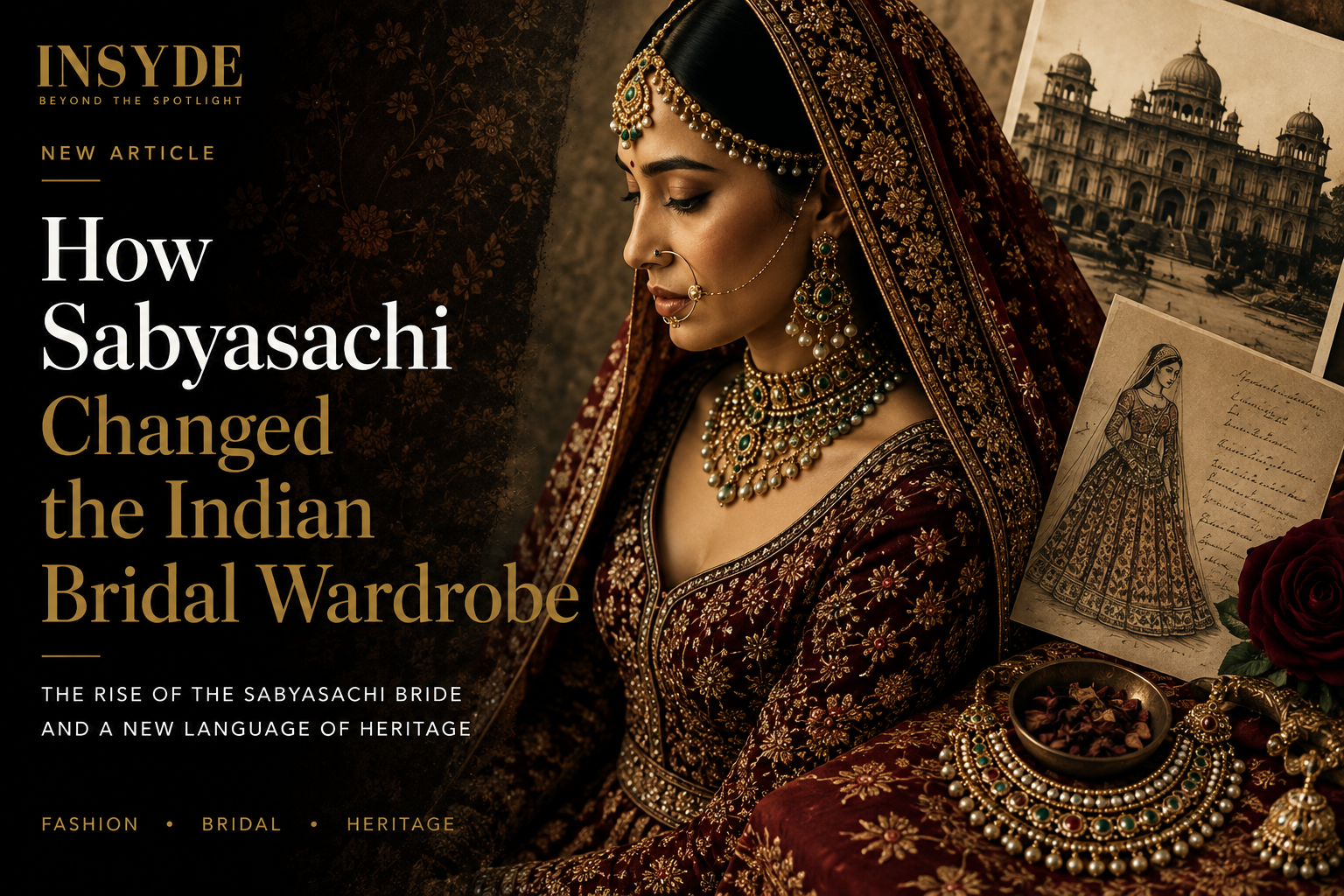
    The Sabyasachi bride became more than a customer. She became a template—and eventually, one of the most recognisable visual identities in Indian fashion.

    There was a time when an Indian bride could be described by a checklist.

    A sari in one region. A lehenga in another. Gold jewellery. Red somewhere in the picture. Family traditions deciding much of the rest.

    Then the Indian wedding became something else.

    More photographed. More televised. More consumed online. More aspirational.

    And somewhere in that transformation, the bride acquired a new visual vocabulary.

    Deep colour.

    Hand embroidery.

    Old-world jewellery.

    Long-sleeved blouses.

    High-waisted lehengas.

    A certain kind of sepia-toned grandeur.

    The Sabyasachi bride had arrived.

    The designer did not invent Indian bridal fashion. Far from it. India had centuries of wedding traditions before Sabyasachi existed.

    What he did was more commercially powerful:

    He turned a collection of regional traditions, crafts and memories into a recognisable contemporary luxury aesthetic.

    The bride came after the world

    Sabyasachi’s bridal story did not begin with a wedding obsession.

    It came after years of looking outward.

    After graduating from NIFT Kolkata in 1999, the designer won the Femina British Council Most Outstanding Young Designer Award and travelled to London for an internship and research assignment at the Victoria & Albert Museum. His own account of the experience describes returning to India with a deeper understanding of India’s largely overlooked history of luxury.

    That perspective became important.

    Sabyasachi’s early collections were built around Indian craft and heritage, but they weren’t designed as historical costumes.

    They were contemporary clothes carrying old references.

    That distinction would eventually become the foundation of his bridal business.

    Chand Bibi changes the equation

    Sabyasachi launched his first bridal collection, Chand Bibi, at Lakmé Fashion Week.

    The designer describes the collection as a turning point: after spending years taking Indian fashion to international audiences, he wanted to bring what he considered the best of Indian craft and couture back into the great Indian wedding.

    The idea was deceptively simple.

    Don’t make the Indian bride choose between heritage and modernity.

    Give her both.

    The result was a bridal aesthetic that felt rooted in India’s past while still belonging to the contemporary luxury market.

    That distinction became crucial.

    Because the Sabyasachi bride didn’t look as though she had borrowed her grandmother’s wardrobe.

    She looked as though she had inherited it—and then had it remade for herself.

    Why the Sabyasachi look became so recognisable

    The Sabyasachi silhouette was never just about one garment.

    It was a combination of codes.

    The lehenga.

    The sari.

    The blouse.

    The jewellery.

    The hair.

    The colour palette.

    The embroidery.

    The setting.

    Even the photography.

    Over time, these elements became recognisable enough that the phrase “Sabyasachi bride” could describe an entire visual world.

    Vogue India has noted the designer’s influence on bridal dressing, including the high-waisted lehenga, long-sleeved blouse, conservative neckline and old-world embroidery associated with his aesthetic.

    The important word here is associated.

    A designer becomes influential when people begin recognising the design language even before they see the label.

    That is what happened.

    The colour of memory

    Sabyasachi’s bridal palette also helped distinguish him.

    Instead of relying exclusively on the predictable bright bridal red, his world expanded into deep maroons, greens, browns, pinks, muted golds and jewel tones.

    The colours felt less like a seasonal fashion palette and more like something discovered in an old photograph.

    That was part of the appeal. The bride wasn’t simply buying a beautiful outfit.

    She was buying an atmosphere.

    And atmosphere is powerful in luxury. Because clothes eventually leave the wedding.

    The photograph stays.

    The jewellery was never an afterthought

    Another reason the Sabyasachi bride became so complete was the relationship between clothing and jewellery.

    The house eventually built its own jewellery business, developing a language that combines Indian heritage with influences including North Calcutta and Byzantine art. Sabyasachi also introduced a branded mangalsutra, reinterpreting the traditional wedding necklace for a contemporary luxury audience.

    This mattered because the designer was no longer dressing only the body.

    He was shaping the entire frame.

    The blouse.

    The sari.

    The necklace.

    The earrings.

    The hair.

    The photographs.

    The wedding.

    Everything could belong to one visual universe.

    Luxury brands have long understood the power of this kind of total look.

    Sabyasachi applied it to the Indian wedding.

    Then celebrity weddings changed everything

    The Indian wedding was already important.

    Celebrity weddings made it culturally explosive.

    When a prominent bride chooses one designer across multiple wedding events, the designer is no longer simply supplying clothing.

    The designer is helping define the visual identity of the wedding itself.

    Vogue India has written about the emergence of this phenomenon in India, where celebrity couples increasingly wear the same designer across wedding events, giving the designer an opportunity to dictate the season’s bridal mood board.

    That is an extraordinary amount of cultural influence.

    One wedding can generate hundreds—or thousands—of photographs.

    Those photographs circulate through Instagram, newspapers, fashion magazines, wedding platforms and WhatsApp groups.

    The bride becomes the campaign.

    And the campaign becomes inspiration for the next bride.

    That is how an aesthetic spreads.

    The copy market is part of the story

    There is an uncomfortable compliment embedded in Sabyasachi’s success.

    His bridal designs became widely copied.

    The designer himself has spoken about the replication of his work and the enormous copy market surrounding it.

    From a business perspective, imitation is a problem.

    From a cultural perspective, it is evidence of influence.

    When a design vocabulary becomes so familiar that customers want versions of it at different price points, the designer has moved beyond fashion.

    The aesthetic has entered popular culture.

    You no longer need to buy the original to recognise the original.

    The bride became the brand

    This is where Sabyasachi’s bridal story becomes particularly interesting.

    Most fashion brands sell garments.

    Sabyasachi increasingly sold a version of the bride.

    She was romantic, but not delicate.

    Traditional, but not conservative.

    Luxurious, but not necessarily minimalist.

    Indian, without needing to explain herself.

    And importantly, she looked good in photographs.

    That last point cannot be underestimated.

    The modern Indian wedding is also a media event.

    The clothes have to work in person, under cameras, on Instagram, in videos, in family albums and in the imagination of everyone watching from outside.

    Sabyasachi’s clothes were built for that ecosystem.

    The wedding became a luxury platform

    The modern Indian wedding is increasingly an ecosystem of luxury industries.

    Fashion.

    Jewellery.

    Beauty.

    Hospitality.

    Décor.

    Photography.

    Travel.

    Food.

    Entertainment.

    Sabyasachi sits at the intersection of several of them.

    That is why his bridal business became larger than bridalwear.

    A bride buying a Sabyasachi lehenga enters a world that can include jewellery, accessories and eventually other expressions of the brand.

    The house itself has expanded into couture, ready-to-wear, jewellery, accessories and other categories.

    The wedding became an entry point.

    The house became the destination.

    But has the Sabyasachi bride changed?

    Yes.

    And this may be the most interesting part.

    The contemporary Indian bride is not necessarily looking for one rigid definition of tradition.

    Vogue India’s reporting on a newer generation of brides points toward a desire for balance: tradition and individuality, family and personal identity, the past and the present.

    That creates an interesting challenge for Sabyasachi.

    The aesthetic that once felt rebellious because it rejected generic modernity has itself become recognisable.

    The Sabyasachi bride is now a tradition.

    So what happens when the rebellion becomes the template?

    The answer may already be visible in the house’s recent work.

    At its 25th-anniversary show in Mumbai in 2025, Sabyasachi moved beyond a straightforward celebration of bridal codes. The collection mixed saris with trousers, sequins with tailoring, Japanese cotton with pashmina, and traditional craft with references ranging from Frida Kahlo to Madonna.

    The house was reminding its audience that Sabyasachi was never supposed to mean only weddings.

    The next Sabyasachi bride

    The future of the Sabyasachi bride may therefore be less about a specific lehenga.

    It may be about ownership of heritage.

    A sari worn again.

    A necklace passed down.

    A blouse separated from the lehenga and worn with something else.

    A wedding outfit treated as an heirloom rather than a one-night costume.

    That philosophy fits neatly with the house’s broader emphasis on craftsmanship, longevity and what it calls modern heirlooms.

    And it changes the meaning of luxury.

    The most luxurious garment isn’t necessarily the one that looks newest.

    It may be the one that still matters twenty years later.

    The Sabyasachi bride was never really about the bride

    That may be the secret.

    The designer didn’t simply change what Indian brides wore.

    He changed what a bridal outfit could mean.

    It could be memory.

    It could be status.

    It could be heritage.

    It could be fashion.

    It could be a family object.

    It could be a photograph.

    And it could be luxury.

    The Sabyasachi bride became powerful because she represented all of those things at once.

    The question now is whether the next generation will continue to want the same image—or whether it will take the Sabyasachi vocabulary and make it its own.

    Because fashion has a strange habit.

    First, someone creates the look.

    Then everyone wants the look.

    And finally, someone has to reinvent it.

    — INSYDE