
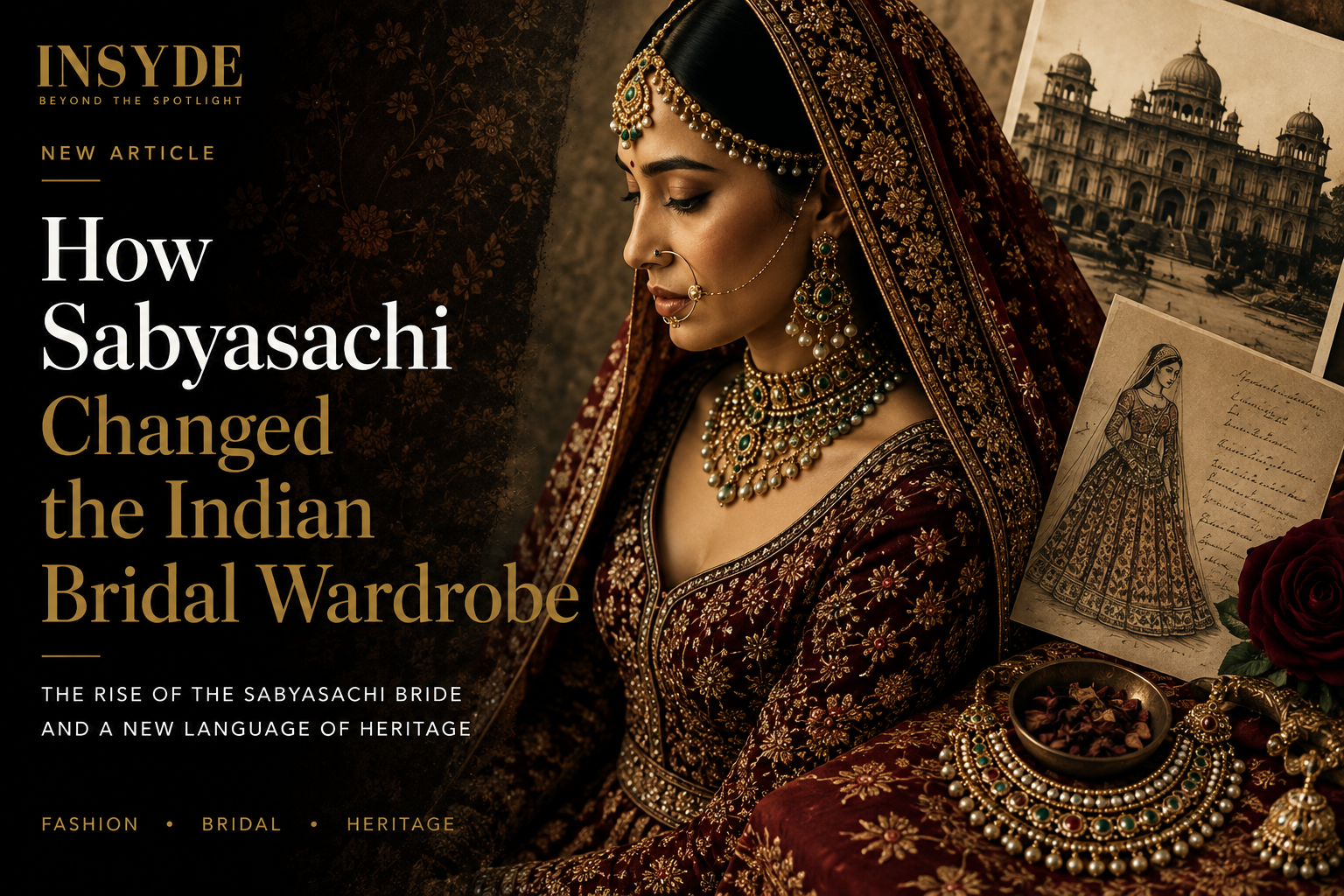
The Sabyasachi bride became more than a customer. She became a template—and eventually, one of the most recognisable visual identities in Indian fashion.
There was a time when an Indian bride could be described by a checklist.
A sari in one region. A lehenga in another. Gold jewellery. Red somewhere in the picture. Family traditions deciding much of the rest.
Then the Indian wedding became something else.
More photographed. More televised. More consumed online. More aspirational.
And somewhere in that transformation, the bride acquired a new visual vocabulary.
Deep colour.
Hand embroidery.
Old-world jewellery.
Long-sleeved blouses.
High-waisted lehengas.
A certain kind of sepia-toned grandeur.
The Sabyasachi bride had arrived.
The designer did not invent Indian bridal fashion. Far from it. India had centuries of wedding traditions before Sabyasachi existed.
What he did was more commercially powerful:
He turned a collection of regional traditions, crafts and memories into a recognisable contemporary luxury aesthetic.
The bride came after the world
Sabyasachi’s bridal story did not begin with a wedding obsession.
It came after years of looking outward.
After graduating from NIFT Kolkata in 1999, the designer won the Femina British Council Most Outstanding Young Designer Award and travelled to London for an internship and research assignment at the Victoria & Albert Museum. His own account of the experience describes returning to India with a deeper understanding of India’s largely overlooked history of luxury.
That perspective became important.
Sabyasachi’s early collections were built around Indian craft and heritage, but they weren’t designed as historical costumes.
They were contemporary clothes carrying old references.
That distinction would eventually become the foundation of his bridal business.
Chand Bibi changes the equation
Sabyasachi launched his first bridal collection, Chand Bibi, at Lakmé Fashion Week.
The designer describes the collection as a turning point: after spending years taking Indian fashion to international audiences, he wanted to bring what he considered the best of Indian craft and couture back into the great Indian wedding.
The idea was deceptively simple.
Don’t make the Indian bride choose between heritage and modernity.
Give her both.
The result was a bridal aesthetic that felt rooted in India’s past while still belonging to the contemporary luxury market.
That distinction became crucial.
Because the Sabyasachi bride didn’t look as though she had borrowed her grandmother’s wardrobe.
She looked as though she had inherited it—and then had it remade for herself.
Why the Sabyasachi look became so recognisable
The Sabyasachi silhouette was never just about one garment.
It was a combination of codes.
The lehenga.
The sari.
The blouse.
The jewellery.
The hair.
The colour palette.
The embroidery.
The setting.
Even the photography.
Over time, these elements became recognisable enough that the phrase “Sabyasachi bride” could describe an entire visual world.
Vogue India has noted the designer’s influence on bridal dressing, including the high-waisted lehenga, long-sleeved blouse, conservative neckline and old-world embroidery associated with his aesthetic.
The important word here is associated.
A designer becomes influential when people begin recognising the design language even before they see the label.
That is what happened.
The colour of memory
Sabyasachi’s bridal palette also helped distinguish him.
Instead of relying exclusively on the predictable bright bridal red, his world expanded into deep maroons, greens, browns, pinks, muted golds and jewel tones.
The colours felt less like a seasonal fashion palette and more like something discovered in an old photograph.
That was part of the appeal. The bride wasn’t simply buying a beautiful outfit.
She was buying an atmosphere.
And atmosphere is powerful in luxury. Because clothes eventually leave the wedding.
The photograph stays.
The jewellery was never an afterthought
Another reason the Sabyasachi bride became so complete was the relationship between clothing and jewellery.
The house eventually built its own jewellery business, developing a language that combines Indian heritage with influences including North Calcutta and Byzantine art. Sabyasachi also introduced a branded mangalsutra, reinterpreting the traditional wedding necklace for a contemporary luxury audience.
This mattered because the designer was no longer dressing only the body.
He was shaping the entire frame.
The blouse.
The sari.
The necklace.
The earrings.
The hair.
The photographs.
The wedding.
Everything could belong to one visual universe.
Luxury brands have long understood the power of this kind of total look.
Sabyasachi applied it to the Indian wedding.
Then celebrity weddings changed everything
The Indian wedding was already important.
Celebrity weddings made it culturally explosive.
When a prominent bride chooses one designer across multiple wedding events, the designer is no longer simply supplying clothing.
The designer is helping define the visual identity of the wedding itself.
Vogue India has written about the emergence of this phenomenon in India, where celebrity couples increasingly wear the same designer across wedding events, giving the designer an opportunity to dictate the season’s bridal mood board.
That is an extraordinary amount of cultural influence.
One wedding can generate hundreds—or thousands—of photographs.
Those photographs circulate through Instagram, newspapers, fashion magazines, wedding platforms and WhatsApp groups.
The bride becomes the campaign.
And the campaign becomes inspiration for the next bride.
That is how an aesthetic spreads.
The copy market is part of the story
There is an uncomfortable compliment embedded in Sabyasachi’s success.
His bridal designs became widely copied.
The designer himself has spoken about the replication of his work and the enormous copy market surrounding it.
From a business perspective, imitation is a problem.
From a cultural perspective, it is evidence of influence.
When a design vocabulary becomes so familiar that customers want versions of it at different price points, the designer has moved beyond fashion.
The aesthetic has entered popular culture.
You no longer need to buy the original to recognise the original.
The bride became the brand
This is where Sabyasachi’s bridal story becomes particularly interesting.
Most fashion brands sell garments.
Sabyasachi increasingly sold a version of the bride.
She was romantic, but not delicate.
Traditional, but not conservative.
Luxurious, but not necessarily minimalist.
Indian, without needing to explain herself.
And importantly, she looked good in photographs.
That last point cannot be underestimated.
The modern Indian wedding is also a media event.
The clothes have to work in person, under cameras, on Instagram, in videos, in family albums and in the imagination of everyone watching from outside.
Sabyasachi’s clothes were built for that ecosystem.
The wedding became a luxury platform
The modern Indian wedding is increasingly an ecosystem of luxury industries.
Fashion.
Jewellery.
Beauty.
Hospitality.
Décor.
Photography.
Travel.
Food.
Entertainment.
Sabyasachi sits at the intersection of several of them.
That is why his bridal business became larger than bridalwear.
A bride buying a Sabyasachi lehenga enters a world that can include jewellery, accessories and eventually other expressions of the brand.
The house itself has expanded into couture, ready-to-wear, jewellery, accessories and other categories.
The wedding became an entry point.
The house became the destination.
But has the Sabyasachi bride changed?
Yes.
And this may be the most interesting part.
The contemporary Indian bride is not necessarily looking for one rigid definition of tradition.
Vogue India’s reporting on a newer generation of brides points toward a desire for balance: tradition and individuality, family and personal identity, the past and the present.
That creates an interesting challenge for Sabyasachi.
The aesthetic that once felt rebellious because it rejected generic modernity has itself become recognisable.
The Sabyasachi bride is now a tradition.
So what happens when the rebellion becomes the template?
The answer may already be visible in the house’s recent work.
At its 25th-anniversary show in Mumbai in 2025, Sabyasachi moved beyond a straightforward celebration of bridal codes. The collection mixed saris with trousers, sequins with tailoring, Japanese cotton with pashmina, and traditional craft with references ranging from Frida Kahlo to Madonna.
The house was reminding its audience that Sabyasachi was never supposed to mean only weddings.
The next Sabyasachi bride
The future of the Sabyasachi bride may therefore be less about a specific lehenga.
It may be about ownership of heritage.
A sari worn again.
A necklace passed down.
A blouse separated from the lehenga and worn with something else.
A wedding outfit treated as an heirloom rather than a one-night costume.
That philosophy fits neatly with the house’s broader emphasis on craftsmanship, longevity and what it calls modern heirlooms.
And it changes the meaning of luxury.
The most luxurious garment isn’t necessarily the one that looks newest.
It may be the one that still matters twenty years later.
The Sabyasachi bride was never really about the bride
That may be the secret.
The designer didn’t simply change what Indian brides wore.
He changed what a bridal outfit could mean.
It could be memory.
It could be status.
It could be heritage.
It could be fashion.
It could be a family object.
It could be a photograph.
And it could be luxury.
The Sabyasachi bride became powerful because she represented all of those things at once.
The question now is whether the next generation will continue to want the same image—or whether it will take the Sabyasachi vocabulary and make it its own.
Because fashion has a strange habit.
First, someone creates the look.
Then everyone wants the look.
And finally, someone has to reinvent it.
— INSYDE