
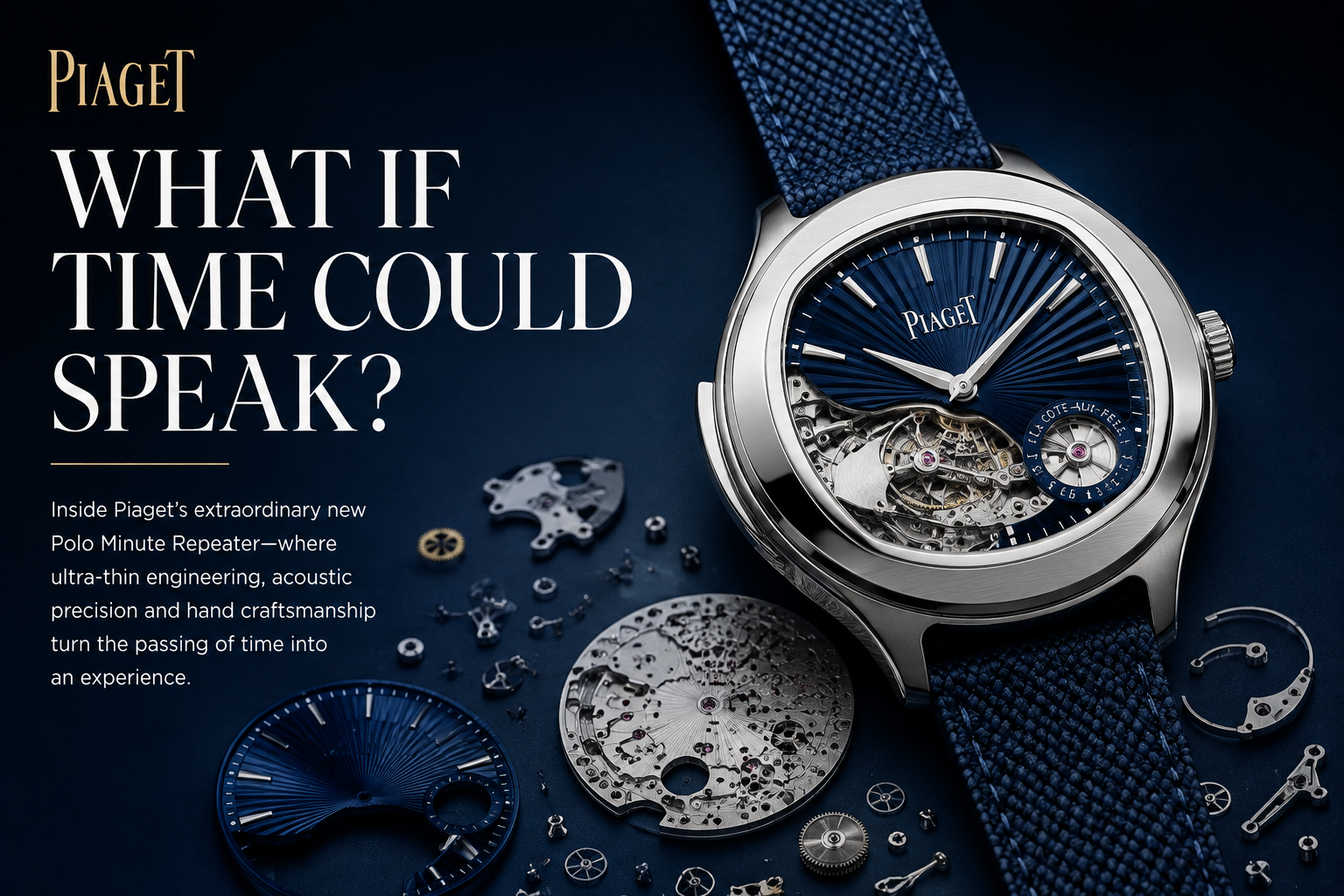
Inside Piaget’s extraordinary new Polo Minute Repeater — where ultra-thin engineering, acoustic precision and hand craftsmanship turn the passing of time into an experience.
We live in a world where time has become almost impossible to ignore.
It appears on our phones, our laptops, our cars, our walls and the screens we glance at without thinking.
And yet, somewhere in Switzerland, Piaget has spent years perfecting a very different idea:
What if you could hear it?
The new Piaget Polo Minute Repeater doesn’t need to exist.
That is exactly what makes it fascinating.
It takes one of the most demanding complications in mechanical watchmaking and places it inside Piaget’s unmistakably modern Polo — a large 18-karat white-gold watch measuring 48mm across and just 9.30mm thick. Inside sits the self-winding Calibre 1290P, an ultra-thin movement developed, finished and assembled at Piaget’s Manufacture in La Côte-aux-Fées.
This isn’t simply another complicated luxury watch.
It is Piaget making an argument about what luxury can still mean when technology has already made everything easier.
THE MOST UNNECESSARY COMPLICATION MAY BE THE MOST BEAUTIFUL
A minute repeater is an almost wonderfully irrational piece of engineering.
Activate it, and the mechanism chimes the time.
Hours.
Quarter hours.
Minutes.
That’s it.
Your phone can tell you the same thing instantly.
But a phone doesn’t need hundreds of mechanical components moving in sequence, carefully tuned hammers, resonating structures and years of accumulated watchmaking knowledge to do it.
A minute repeater does.
And that is where the fascination begins.
Luxury has always been at its most interesting when it moves beyond necessity.
A private jet isn’t necessary.
A hand-finished grand complication isn’t necessary.
A bespoke suit isn’t necessary.
The point is not efficiency.
The point is experience.
The Polo Minute Repeater takes that idea to its most literal conclusion.
It doesn’t simply show you the time.
It gives time a voice.
WHEN A WATCH BECOMES AN INSTRUMENT
The real achievement isn’t merely making the mechanism chime.
It is making it sound right.
Piaget says the 1290P produces 64 decibels of acoustic intensity, with three harmonic partials and a damping factor of 2,600. The hours are struck at G sharp and the minutes at A sharp, both in the fifth octave. The activation slide sits at nine o’clock.
For someone who doesn’t spend weekends discussing calibres, those specifications may sound unnecessarily technical.
They are.
But beautifully so.
Because they are ultimately about something remarkably simple:
sound.
The movement and the case have to work together to create an acoustic experience.
And suddenly, this isn’t just watchmaking anymore.
It is a form of mechanical acoustics.
The watch has to keep time.
It has to fit inside an extraordinarily thin architecture.
And then, when asked, it has to perform.
PIAGET DIDN’T HIDE THE MAGIC
This is perhaps the most INSYDE-worthy part of the watch.
Piaget could have hidden the mechanism.
Instead, it opened the door.
The Polo Minute Repeater uses a partially openworked dial to reveal parts of the 1290P beneath it. At four o’clock, a smoked-blue sapphire ring sits over the inertia wheel — the dedicated regulator of the minute repeater — while a gold fillet travels across the dial and reveals sections of the mechanism.
The effect is subtle.
And that’s important.
This isn’t skeletonisation for the sake of showing off every gear.
The mechanism becomes part of the composition.
The engineering becomes decoration.
The decoration becomes engineering.
You aren’t simply looking at the finished object. You’re being invited to understand why it is extraordinary.
That is a very different kind of luxury.
THE REAL COST ISN’T GOLD
The case is made from 18-karat white gold.
The strap is blue textured calfskin.
The dial is gold, hand-guilloché and finished with a radiant sunray pattern, with an opaline outer track adding contrast.
All of that sounds luxurious.
But none of it is the most valuable material inside this watch.
That would be time itself.
Piaget says more than 150 hours went into developing the dial, followed by another 50 hours of hand finishing for each individual piece. The calibre’s bridges are hand-beveled, its mainplate carries guilloché decoration, and its minute-repeater hammers receive a mirror polish.
Think about that.
In an era where almost everything is optimised to be faster, Piaget is deliberately creating something that takes longer.
Much longer.
And that may be the real luxury story here.
THE PIAGET PARADOX
Piaget has been chasing thinness for generations.
Georges-Édouard Piaget founded the Maison in the Swiss Jura in 1874, with a principle that would become central to its identity: “always do better than necessary.” Ultra-thin watchmaking eventually became one of the defining expressions of that philosophy.
In 2013, Piaget introduced a minute repeater in the Polo Emperador case that the Maison presented as the world’s thinnest minute repeater at the time. The new Polo Minute Repeater carries that legacy into the contemporary Polo collection.
And this is where Piaget’s philosophy becomes interesting.
The goal isn’t simply:
Can we make a complicated watch?
The better question is:
Can we make a complicated watch thinner, more wearable and more beautiful than it has any practical reason to be?
The 1290P is just 4.8mm thick.
The complete watch is 9.30mm thick.
And yet inside that relatively restrained vertical space is an automatic minute-repeating mechanism with roughly 430 components, developed entirely at La Côte-aux-Fées.
That contradiction is quintessentially Piaget.
More complexity. Less thickness.
WHY PUT IT IN A POLO?
This is where the watch becomes more than a technical exercise.
The minute repeater is one of traditional watchmaking’s most classical complications.
The Polo is not.
Since its arrival in 1979, the collection has represented a more contemporary side of Piaget — defined by its distinctive “shape-in-shape” architecture and its sport-chic identity.
Putting the two together creates an interesting collision.
Haute Horlogerie meets modern sports luxury.
The result is not trying to look like a 19th-century pocket watch transferred onto a wrist.
It is deliberately contemporary.
Large.
Architectural.
Blue.
Open.
And technically serious.
At 48mm, it is certainly not a watch designed to disappear beneath a shirt cuff.
It wants to be noticed.
But the thing worth noticing isn’t simply the size.
It’s the contradiction:
A sports watch carrying one of traditional watchmaking’s most demanding complications — while remaining only 9.3mm thick.
FIVE WATCHES. NOT BECAUSE THEY HAD TO BE LIMITED.
Only five numbered pieces of the Polo Minute Repeater are being crafted this year.
But Piaget makes an interesting distinction.
It isn’t presenting the watch as a conventional limited edition.
The number is a consequence of the work required to make each piece.
That difference matters.
Luxury brands have become extremely good at creating scarcity.
Five pieces can be a marketing strategy.
But when five pieces are the natural result of hundreds of hours of specialist work, scarcity becomes something else.
It becomes a by-product of craftsmanship.
And perhaps that is a more convincing form of exclusivity.
You aren’t being told that only five exist because five sounds exclusive.
You’re being told that only five can realistically emerge from this level of human involvement.
THEN PIAGET MAKES IT EVEN MORE EXTREME
There is also a High Jewellery version.
The bezel is set with baguette-cut blue sapphires, while the case combines baguette-cut and brilliant-cut diamonds. The dial is fully openworked, putting more than 70 hours of handcraft directly on display.
It is almost excessive.
And that’s the point.
Piaget has never been particularly interested in choosing between watchmaking and jewellery.
The Maison has historically operated comfortably in both worlds.
Here, the two are fused into a single object:
mechanical complexity beneath jewellery-level finishing, with sound as the final element.
It doesn’t just ask to be seen.
It asks to be heard.
IN A WORLD OF SMARTWATCHES, PIAGET CHOSE SOUND
There is an amusing irony to all of this.
The smartwatch era has made watches smarter than ever.
They track health.
Messages.
Calls.
Maps.
Markets.
Flights.
Sleep.
The weather.
The mechanical watch has responded by becoming something else entirely.
An object of emotion.
Craft.
History.
Identity.
And now, with the Polo Minute Repeater, perhaps even theatre.
Because the experience isn’t about information.
You already know the time.
The experience is the moment you activate the slide and the watch begins to speak.
For a few seconds, you are not checking the time.
You are experiencing it.
That distinction is becoming increasingly important in luxury.
THE REAL LUXURY IS TIME SPENT
The most interesting thing about the Piaget Polo Minute Repeater isn’t the 48mm case.
It isn’t the white gold.
It isn’t even the complication.
It is the philosophy behind the object.
Someone decided that it was worth spending weeks finishing hundreds of components by hand so that a watch could perform something a phone can do instantly.
Someone decided that the mechanism should be thin.
Someone decided that parts of it should be visible.
Someone decided that the sound itself had to be engineered.
And someone decided that five watches a year was enough.
None of those decisions were necessary.
That is precisely why they matter.
Modern luxury increasingly revolves around access — who can enter, who can own, who can experience, who can get there first.
But there is another kind of exclusivity.
The exclusivity of time.
The time required to learn a craft.
The time required to make something by hand.
The time required to wait for something that cannot be rushed.
And eventually, the time required to stop what you’re doing and simply listen.
The Piaget Polo Minute Repeater doesn’t make time more useful.
It makes it more memorable.
And perhaps that is the point.
In a world where technology has taught us to save every second, Piaget has created a watch that asks us to spend a few of them differently.
Listening.
INSYDE – Beyond the Spotlight