
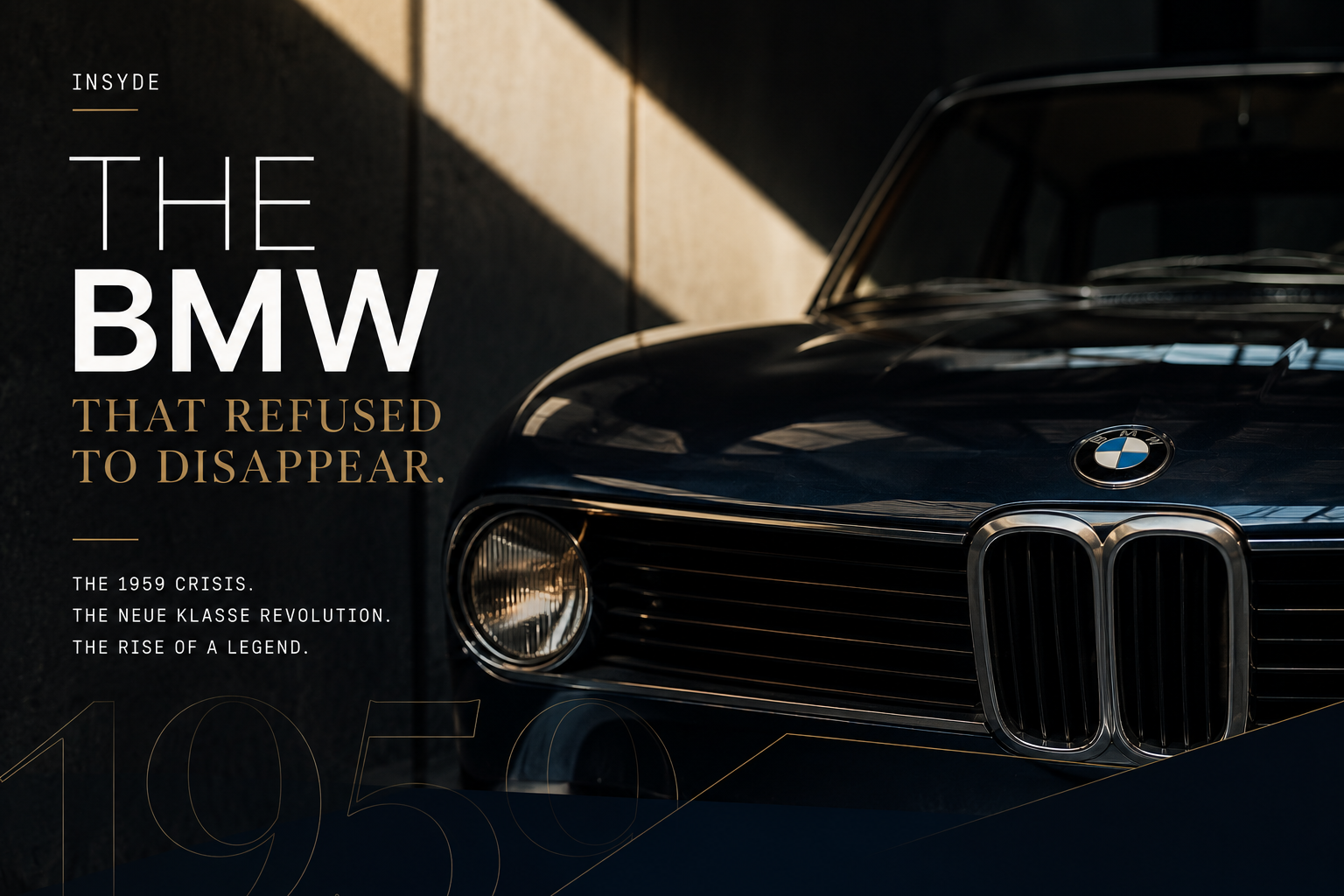
How a company that nearly fell into Daimler-Benz’s hands reinvented itself — and became one of the world’s defining premium automotive brands.
Today, the BMW badge carries a certain expectation.
Performance.
Precision.
Design.
Status.
For millions of drivers, it represents something more specific than simply owning an expensive car: the idea that luxury should still be felt from behind the wheel.
But in 1959, BMW was fighting for something much more basic.
Survival.
The company was in serious financial difficulty. Its automobile and motorcycle businesses were struggling, and its future independence was in question. Daimler-Benz — the company behind Mercedes-Benz — submitted a time-limited restructuring offer that could have brought BMW under its control.
At BMW’s Annual General Meeting on 9 December 1959, the proposed takeover was rejected after determined opposition from small shareholders and employees. The offer subsequently expired. BMW remained independent, but its financial crisis was far from over. (BMW Group)
What happened next would become one of the most remarkable transformations in automotive history.
BMW didn’t simply survive the crisis.
It discovered what it could become.
THE BMW THAT ALMOST BECAME MERCEDES
The BMW of the late 1950s was a very different company from the one the world knows today.
It had built beautiful and technically ambitious automobiles, including the 503 and 507, but its larger cars were expensive to produce and difficult to sell profitably. The company was caught between expensive luxury automobiles at one end and smaller, lower-margin products at the other.
The result was a dangerous financial position.
By the end of the decade, the possibility of BMW losing its independence was no longer theoretical.
Daimler-Benz had presented a restructuring proposal.
The situation reached a dramatic point at the December 1959 shareholders’ meeting. Small shareholders challenged the proposed restructuring, including the valuation assigned to BMW’s brand and workforce. The meeting was adjourned, and the time-limited Daimler-Benz offer expired. (BMW Group Press)
BMW had escaped.
But escaping Mercedes was not the same as saving BMW.
The company still needed a future.
THEN CAME HERBERT QUANDT
That future was closely tied to industrialist Herbert Quandt.
Impressed by the determination of BMW’s shareholders and employees, Quandt increased his investment in the company and backed a restructuring built around keeping BMW independent. Temporary government assistance also helped give the company room to reorganise. (BMW Group)
The strategy was simple in principle and enormous in consequence:
BMW would not survive by standing still.
It needed new products.
The BMW 700 helped put the company back on a path toward recovery.
But the decisive breakthrough was still ahead.
It would arrive in 1961.
And it would wear a name that would eventually become one of the most important phrases in BMW’s history:
Neue Klasse.
THE CAR THAT CHANGED EVERYTHING
At the 1961 Frankfurt Motor Show, BMW unveiled the BMW 1500.
It was compact by the standards of the time. Sporty. Modern. Four-door. Engineered around a new approach to performance and everyday usability.
And people noticed.
BMW says the car filled a gap in the market and became the breakthrough that established the company as a successful, contemporary automaker. Demand was so strong that initial orders exceeded production capacity. (BMW Group)
The 1500 was more than a successful model.
It gave BMW a direction.
It showed that the company didn’t need to compete by simply building larger, softer or more traditionally prestigious cars.
It could build something different.
A premium automobile designed around the person driving it.
The philosophy was beginning to take shape.
BMW DIDN’T TRY TO BECOME MERCEDES
This is where the story becomes more interesting.
BMW’s great strategic victory wasn’t beating Mercedes at Mercedes’ own game.
It was refusing to play the same game.
Mercedes-Benz already had extraordinary heritage, engineering credibility and a powerful association with prestige.
BMW needed its own territory.
The Neue Klasse gave it one.
The company increasingly built its identity around agility, performance, design and the relationship between driver and machine.
Mercedes could represent arrival.
BMW could represent the journey.
That distinction would become incredibly valuable.
Because BMW wasn’t simply selling another interpretation of luxury.
It was creating a different one.
WHEN PERFORMANCE BECAME LUXURY
Traditional luxury had always been associated with refinement.
Leather.
Wood.
Comfort.
Silence.
Status.
BMW added something else.
Emotion.
The driving experience itself became part of the luxury proposition.
The steering.
The balance.
The response of the engine.
The position of the driver.
The way the car behaved through a corner.
These weren’t merely engineering specifications.
They became part of the emotional value of owning a BMW.
The brand’s promise of “Sheer Driving Pleasure” eventually gave that philosophy a simple expression — and the roots of that promise can be traced directly back to the Neue Klasse era. (BMW Group)
BMW had discovered a powerful idea:
Luxury doesn’t have to separate you from the machine. It can bring you closer to it.
THE 02 SERIES MADE THE IDEA SCALABLE
The Neue Klasse created the foundation.
The 02 Series helped turn that foundation into a brand identity.
Introduced in the 1960s, the compact two-door models brought BMW’s sporting character to a wider audience. BMW describes the 02 Series as a benchmark for the brand’s approach to combining everyday usability with driving pleasure. (BMW Group)
This mattered enormously.
BMW wasn’t creating one successful car.
It was developing a repeatable philosophy.
Compact could still be premium.
Practical could still be exciting.
Everyday transportation could still have character.
And that gave BMW something luxury brands desperately want:
a recognisable point of view.
THE 3 SERIES CHANGED THE GAME AGAIN
Then came the car that would turn BMW’s philosophy into a global phenomenon.
The BMW 3 Series arrived in 1975.
Compact dimensions.
Rear-wheel drive.
Driver-focused ergonomics.
Sporty proportions.
Premium quality.
Everyday practicality.
BMW describes the 3 Series as the world’s bestselling premium car and says the model has attracted more than 20 million customers worldwide across seven generations. (BMW Group)
Its importance goes beyond sales.
The 3 Series made the BMW formula understandable.
You didn’t have to be a racing driver.
You didn’t have to own a chauffeur-driven limousine.
You simply had to enjoy driving.
That was the genius.
BMW had taken something traditionally associated with sports cars and integrated it into a practical premium sedan.
Luxury became something you could experience every morning on the way to work.
THE MERCEDES RIVALRY BECAME A CULTURAL ONE
By this point, the relationship between BMW and Mercedes had changed.
BMW was no longer the company that had nearly been absorbed.
It was becoming one of Mercedes-Benz’s defining competitors.
But the rivalry wasn’t simply about price or horsepower.
It was about identity.
Mercedes could represent authority, heritage and formal prestige.
BMW increasingly represented performance, independence and the pleasure of driving.
Neither interpretation needed to destroy the other.
In fact, their differences made both brands stronger.
The competition created a question that would shape the premium automotive market for decades:
What should a luxury car make you feel?
BMW had its answer.
THEN BMW TURNED PERFORMANCE INTO MYTH
BMW’s relationship with motorsport added another layer to the brand.
Performance was no longer merely something engineers claimed.
It could be demonstrated on a track.
That credibility eventually became central to BMW M.
Motorsport technology, performance engineering and road-car development began reinforcing one another.
The M badge became more than a specification.
It became a symbol.
That matters in luxury.
Because luxury consumers don’t only buy features.
They buy provenance.
A reason to believe.
A story that existed before the product arrived.
BMW had one.
THE BRAND BECAME PART OF THE PRODUCT
Eventually, BMW reached a point that every luxury company dreams of reaching.
The product no longer had to explain the brand.
The brand explained the product.
You could recognise a BMW from its proportions.
Its design language.
Its cockpit.
Its grille.
Its stance.
And, increasingly, the way it behaved on the road.
The badge itself had accumulated meaning.
This is when a manufacturer becomes more than a manufacturer.
It becomes a brand with a worldview.
BMW wasn’t simply selling cars anymore.
It was selling a particular relationship between the driver and the machine.
BMW DIDN’T BEAT MERCEDES BY COPYING IT
This is the part of the story that matters most.
BMW’s eventual success was not built on becoming a cheaper Mercedes.
It wasn’t built on becoming a louder Mercedes.
And it wasn’t built on simply offering more luxury features.
BMW found a different route to desirability.
It made performance aspirational.
It made driving part of luxury.
It turned engineering into emotion.
And it created a customer who didn’t simply want to be transported.
They wanted to be involved.
That distinction became BMW’s competitive advantage.
FROM SURVIVAL TO GLOBAL POWER
The transformation took decades.
The Neue Klasse established the direction.
The 02 Series broadened the philosophy.
The 3 Series turned it into a global formula.
BMW M gave performance a halo.
The 5 Series and 7 Series expanded the brand into higher segments.
The X family opened another enormous market.
And BMW continued evolving as luxury itself changed.
Today, BMW operates at enormous global scale. In financial year 2025, BMW Group delivered 2.46 million premium vehicles, while BMW M reached a record 213,449 deliveries. (BMW Group Press)
That doesn’t mean BMW literally “defeated” Mercedes-Benz.
Mercedes remains one of the world’s most important luxury automotive brands.
The more significant achievement is that BMW became powerful enough to challenge Mercedes from a completely different position.
It didn’t need to become Mercedes.
It built an identity Mercedes couldn’t own.
THE REAL BMW LUXURY
That is why BMW’s story is ultimately not about cars.
It is about positioning.
A company that was nearly absorbed had to decide what made it worth saving.
The answer wasn’t simply its factory.
It wasn’t simply its engineering.
It wasn’t simply its history.
It was the possibility of creating something distinctive.
BMW realised that it could make luxury emotional.
That it could make engineering desirable.
That it could make performance aspirational.
And, most importantly, that independence could itself become part of the brand.
THE BMW THAT REFUSED TO DISAPPEAR
In 1959, BMW was fighting to remain independent.
One year later, Herbert Quandt backed a restructuring that kept the company on its own path.
In 1961, the BMW 1500 gave that path a product.
The Neue Klasse gave it a philosophy.
The 02 Series gave it momentum.
The 3 Series gave it scale.
BMW M gave it mythology.
And the decades that followed turned that philosophy into one of the world’s most recognisable premium automotive brands. (BMW Group)
That is the extraordinary part of the story.
BMW didn’t inherit its position at the top.
It engineered its way there.
And perhaps the most important lesson is not about automobiles at all.
When a company is pushed to the edge, the instinct is often to become more like the competitor that appears to be winning.
BMW did something more difficult.
It discovered what it could become that its competitor couldn’t.
It didn’t survive by becoming Mercedes.
It survived by becoming BMW.
And that may be the most valuable luxury of all:
having an identity nobody else can own.
INSYDE — Beyond the Spotlight.