Category: watches

  • INSYDE the GRAND PRIX DE GENÈVE AWARD 2026

    INSYDE the GRAND PRIX DE GENÈVE AWARD 2026

    Rexhep Rexhepi takes horology’s highest honour as the 26th edition of the Grand Prix d’Horlogerie de Genève celebrates independent watchmaking, technical ingenuity and the evolving language of haute horlogerie.

    LUXURY | WATCHMAKING | INDUSTRY

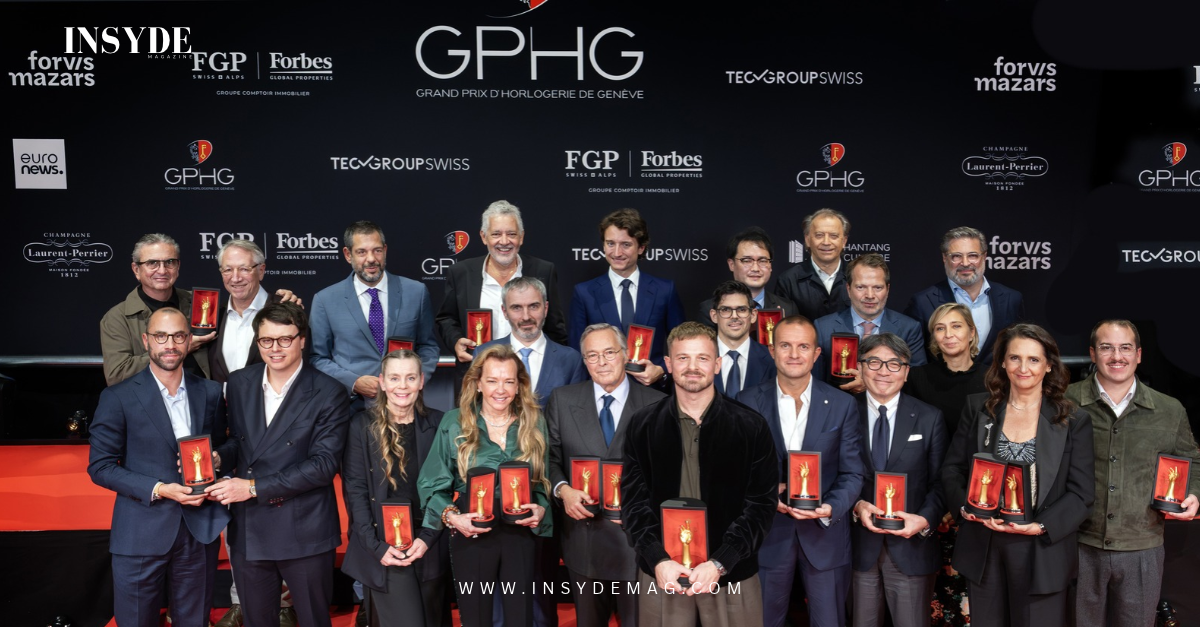
    On 7 November 2026, Geneva once again became the centre of the international watchmaking conversation. The 26th edition of the Grand Prix d’Horlogerie de Genève (GPHG) brought together established maisons, independent watchmakers, collectors and industry figures for an evening recognising some of the year’s most notable achievements in horology.

    The evening’s highest distinction, the Aiguille d’Or Grand Prix, went to independent watchmaker Rexhep Rexhepi for his Chronograph Flyback. The result placed an independent creator at the summit of an awards programme that continues to bring together the full breadth of contemporary watchmaking — from technically ambitious complications and traditional craftsmanship to jewellery watches and accessible mechanical design.

    Across 20 prizes, the 2026 winners reflected an industry that is not defined by a single aesthetic or commercial model. Heritage maisons and independent ateliers shared the spotlight, while the revised award categories brought a different structure to the competition. The result was a particularly revealing snapshot of where fine watchmaking stands today.


    GPHG / grand prix de l’horlogerie de Genève / 7 novembre 2026 / BFM / Genève /photo: nicolas.lieber@nicolaslieber.ch

    THE AIGUILLE D’OR: REXHEP REXHEPI’S DEFINING MOMENT

    The defining moment of the 2026 ceremony belonged to Rexhep Rexhepi, whose Chronograph Flyback received the Aiguille d’Or — the competition’s highest award.

    Rexhepi has built his reputation through a commitment to traditional watchmaking and an independent approach to design and mechanical construction. Through his Geneva-based atelier, Akrivia, he has become one of the prominent figures in a generation of independent watchmakers attracting international attention for their highly considered, technically focused work.

    The award is significant not simply because of the recognition it gives one watch. It also reflects the growing cultural and institutional standing of independent watchmaking. While the industry’s largest maisons benefit from extensive manufacturing capabilities, global distribution and established heritage, independent creators often operate with smaller teams and more concentrated production. Their influence, however, increasingly extends well beyond their production numbers.

    Rexhepi’s win reinforces the idea that the highest levels of horology are not exclusively the domain of the largest luxury groups. Technical discipline, an identifiable creative vision and the ability to execute a movement to exceptional standards can command recognition on their own terms.

    The Chronograph Flyback therefore becomes more than the winning timepiece of the year. It is a statement about the continuing relevance of independent craftsmanship in a market where scale and visibility do not necessarily determine artistic or horological importance.

    Explore the watch and the watchmaker through the official Rexhep Rexhepi website.
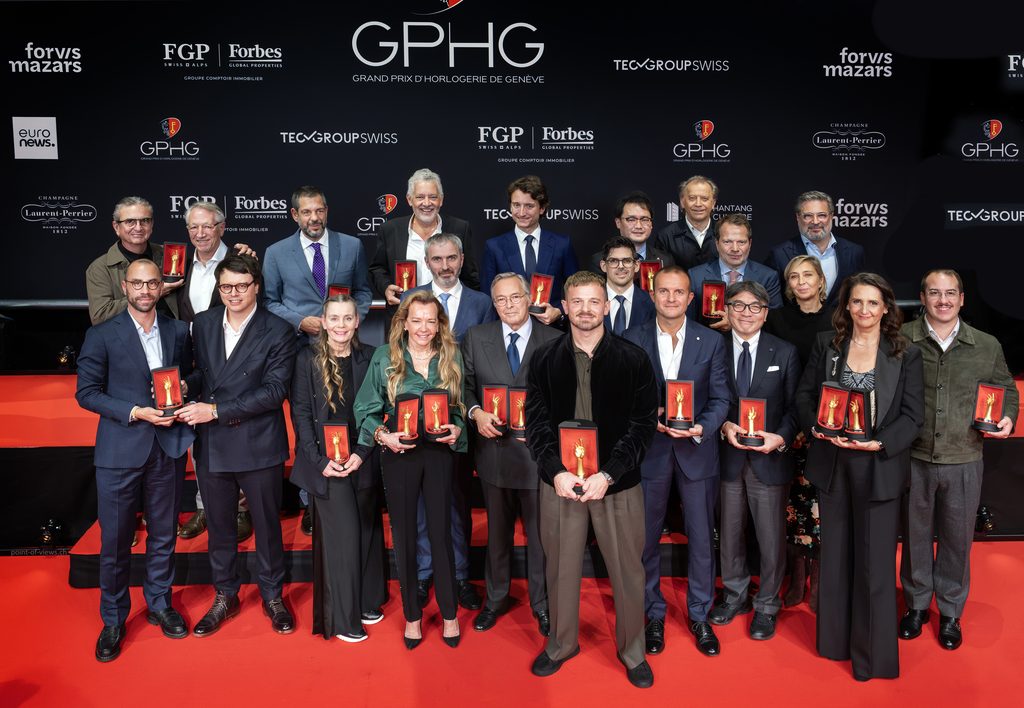
    THE 2026 WINNERS: ALL 20 PRIZES

    The 2026 GPHG recognised 20 winners across a broad range of disciplines. The complete prize list demonstrates the diversity of contemporary horology, with awards spanning precision, complications, sports watches, artistic crafts, jewellery and mechanical clocks.

    Award2026 winnerWinning creation
    Aiguille d’Or Grand PrixRexhep RexhepiChronograph Flyback
    Iconic Watch PrizeAudemars PiguetRoyal Oak “Jumbo” Extra-thin Selfwinding Flying Tourbillon Chronograph RD#5 “150th Anniversary”
    Special Jury PrizePatek PhilippeWatch Art Grand Exhibition
    Audacity PrizeKonstantin ChaykinThinKing Mystery
    Chronometry PrizeFerdinand BerthoudNaissance d’une Montre 3
    Horological Revelation PrizeDominique RenaudPulse60 Titanium Black
    Mechanical Exception Watch PrizeBlancpainGrande Double Sonnerie
    Complication Watch PrizeCleguerInspiration One
    Chronograph Watch PrizeParmigiani FleurierTonda PF Chronographe Mystérieux
    Tourbillon Watch PrizeFerdinand BerthoudChronomètre FB 2TV
    Sports Watch PrizeGrand SeikoSpring Drive U.F.A. Ushio 300 Diver
    Calendar and Astronomy Watch PrizeAudemars Piguet150 Heritage
    Essential Watch PrizeDaniel RothExtra Plat Rose Gold Skeleton
    Time Only Watch PrizeChopardL.U.C 1860
    Jewellery Watch PrizeChopardMystery Nut
    Artistic Crafts Watch PrizeLouis VuittonTambour Taiko Arty Automata
    Gemset Watch PrizePiagetSwinging Pebble
    Petite Aiguille Watch PrizeOtsuka LotecNo.8
    Challenge Watch PrizeSpaceOne × BalticSeconde Majeure
    Mechanical Clock PrizeLa ValléeCosmo

    The full results are available through the official GPHG 2026 prize list.

    AUDemars PIGUET AND THE POWER OF AN ICON

    Among the evening’s most closely watched recognitions was the Iconic Watch Prize, awarded to Audemars Piguet for its Royal Oak “Jumbo” Extra-thin Selfwinding Flying Tourbillon Chronograph RD#5 “150th Anniversary”.

    The Royal Oak is one of the defining designs of modern luxury watchmaking. Since its introduction in 1972, the collection has challenged conventional distinctions between sports watches and high-end horology. Its recognisable architecture and integrated-bracelet design have helped establish it as one of the most influential watch families in the luxury sector.

    The RD#5 takes that established identity into a more technically ambitious territory, combining the Royal Oak’s familiar design language with an elaborate complication. Its recognition is particularly notable in the context of the maison’s 150th anniversary, connecting a landmark moment in the brand’s history with contemporary mechanical development.

    Audemars Piguet also received the Calendar and Astronomy Watch Prize for its 150 Heritage. The double recognition illustrates the maison’s ability to work across two different dimensions of watchmaking: the cultural significance of an enduring design and the technical ambition of complex horological mechanisms.

    For a maison whose identity is so closely associated with one of watchmaking’s most recognisable silhouettes, the awards demonstrate how heritage can remain relevant when it is supported by continued innovation.

    Discover the maison’s collections and anniversary creations at Audemars Piguet.

    THE ART OF MECHANICAL EXCELLENCE

    Technical achievement remained central to the 2026 awards, with several prizes recognising the complexity and precision that continue to distinguish haute horlogerie.

    Blancpain received the Mechanical Exception Watch Prize for the Grande Double Sonnerie. Grande sonnerie mechanisms are among the most demanding complications in traditional watchmaking. They are designed to strike the hours and quarters automatically, requiring intricate coordination between the movement’s components. The category recognises work that pushes the boundaries of mechanical construction.

    Ferdinand Berthoud was another prominent name, receiving two awards. Its Naissance d’une Montre 3 won the Chronometry Prize, while the Chronomètre FB 2TV received the Tourbillon Watch Prize. Together, the awards highlight the maison’s emphasis on precision, traditional construction and the preservation of demanding horological techniques.

    The Chronograph Watch Prize went to Parmigiani Fleurier for the Tonda PF Chronographe Mystérieux, while Cleguer received the Complication Watch Prize for Inspiration One. These results underline the range of approaches being taken to mechanical complications, from established manufacture expertise to more individual interpretations.

    The awards also recognised Dominique Renaud, whose Pulse60 Titanium Black received the Horological Revelation Prize. Renaud’s recognition adds another independent voice to a year in which individual watchmakers and specialist ateliers made a particularly strong impression.

    WHEN WATCHMAKING BECOMES ART

    Fine watchmaking has always existed at the intersection of engineering and artistic expression. The 2026 winners offered several examples of how far that relationship can extend.

    Louis Vuitton received the Artistic Crafts Watch Prize for its Tambour Taiko Arty Automata. The recognition reflects the importance of decorative techniques and artistic execution in luxury watchmaking, where the dial, case and mechanical display can become a canvas for specialist craftsmanship.

    Chopard won two awards. Its L.U.C 1860 received the Time Only Watch Prize, while the Mystery Nut was recognised in the Jewellery Watch category. The two creations represent different expressions of the maison’s expertise: one focused on the refinement of traditional time display, the other on the relationship between jewellery and horological construction.

    Piaget received the Gemset Watch Prize for the Swinging Pebble, bringing attention to the role of gemsetting and jewellery techniques in contemporary watch design.

    These awards are a reminder that the value of a high-end watch is not measured by mechanical complexity alone. The quality of finishing, material selection, decorative skill and visual imagination remain essential elements of the discipline.
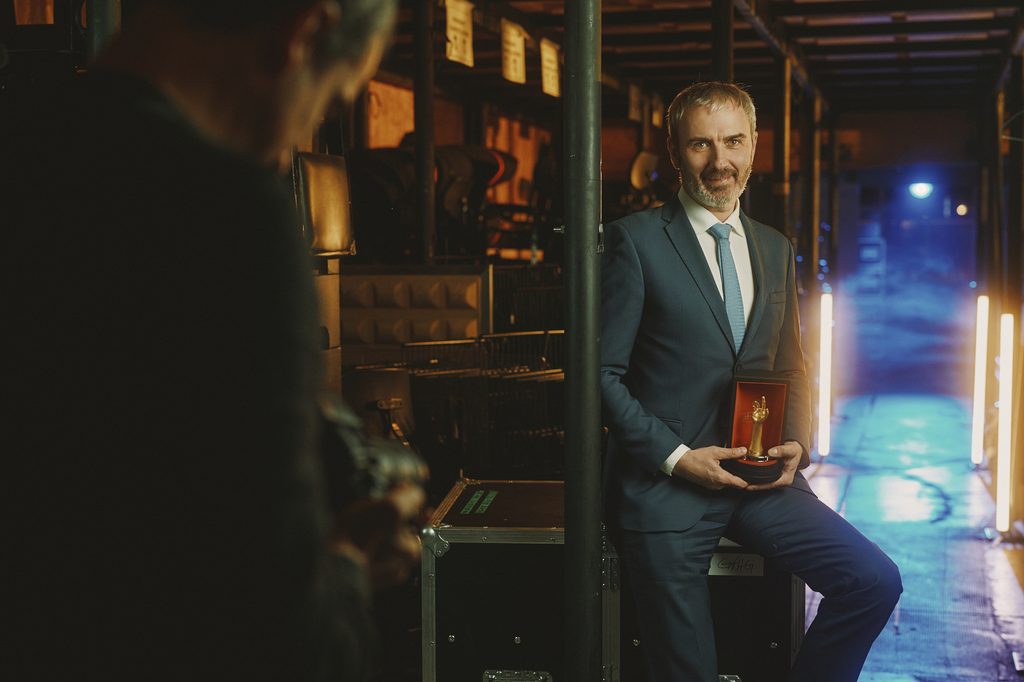
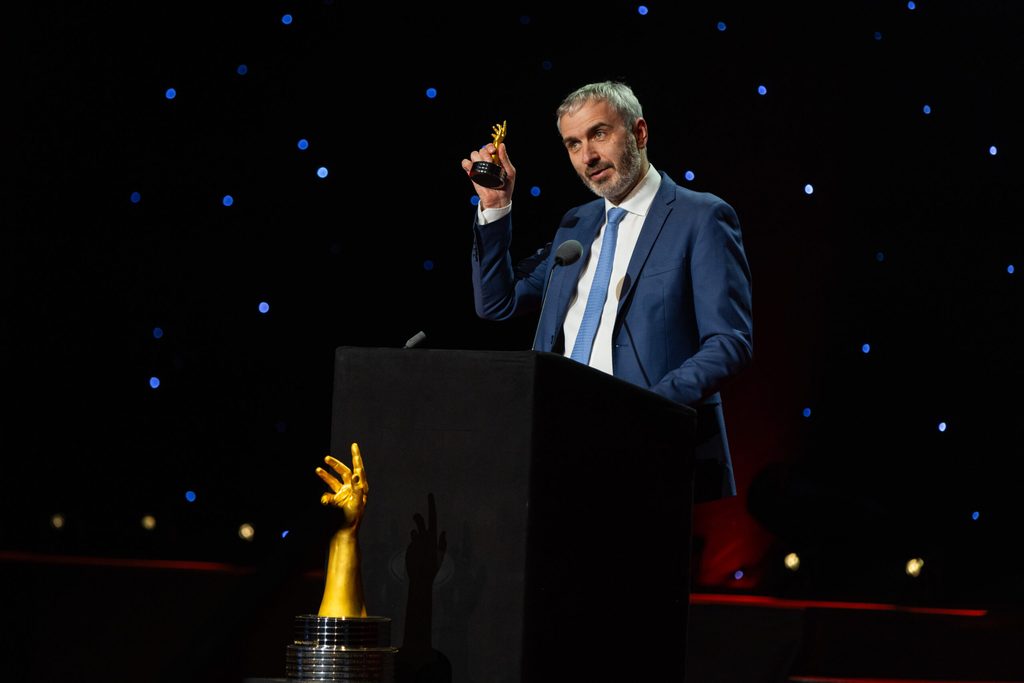
    GPHG / grand prix de l’horlogerie de Genève / 7 novembre 2026 / BFM / Genève /photo: nicolas.lieber@nicolaslieber.ch

    THE INDEPENDENT WATCHMAKERS CHANGING THE CONVERSATION

    One of the most interesting themes emerging from the 2026 results was the visibility of independent watchmaking.

    Alongside Rexhep Rexhepi’s Aiguille d’Or victory, Konstantin Chaykin received the Audacity Prize for ThinKing Mystery. Chaykin has become known for an inventive approach to mechanical displays and unconventional watch design. His recognition reflects the importance of creative experimentation within an industry often associated with tradition.

    Otsuka Lotec, a Japanese independent watchmaking name, received the Petite Aiguille Watch Prize for No.8. The award brought attention to a creator operating outside the conventional Swiss luxury-house structure.

    The Challenge Watch Prize went to SpaceOne × Baltic for Seconde Majeure, another collaboration demonstrating how smaller watchmaking businesses can develop distinctive mechanical propositions.

    These results matter because independent watchmakers contribute something that larger organisations may find harder to institutionalise: a highly individual creative point of view. Their production may be limited, but their influence can be considerable among collectors who value originality, specialist knowledge and a direct connection with the maker.

    The GPHG does not measure the commercial scale of each participant. Its value lies in creating a shared platform where established manufacturers and smaller independent creators can be considered within the same broader conversation about horological achievement.

    A NEW STRUCTURE FOR THE AWARDS

    The 2026 edition also introduced a notable change to the competition’s category structure.

    The traditional Men’s and Ladies’ Watch categories were replaced by a revised framework that included Essential Watch, Complication Watch and Gemset Watch categories. This shift moves the competition towards classifications based more directly on a watch’s functions, construction and defining characteristics rather than the gender-based divisions used in previous editions.

    The change reflects a wider conversation across luxury watchmaking. Product design, marketing and consumer preferences are increasingly moving beyond conventional assumptions about who a particular watch is designed for. A watch’s complication, dimensions, materials and visual identity can be more meaningful points of distinction than the gender category under which it is marketed.

    The revised structure also gives the awards a broader framework for recognising different forms of horological achievement. It is a meaningful evolution for an event that must balance the preservation of watchmaking tradition with the changing expectations of a global audience.

    HOW THE GPHG SELECTS ITS WINNERS

    The Grand Prix d’Horlogerie de Genève is more than a ceremony. It is the culmination of a selection process involving the GPHG Academy and an international jury.

    For 2026, the Academy comprised more than 1,000 members drawn from the international watchmaking ecosystem. The nominated timepieces were assessed through a process involving the Academy and a specialist jury chaired by Wei Koh, founder of Revolution.

    The 2026 selection brought 84 nominated timepieces to the competition, with 20 prizes awarded at the ceremony. The process is designed to bring together different forms of expertise, including watchmaking knowledge, industry experience, collecting perspectives and editorial understanding.

    The awards are therefore not a simple popularity contest. They provide a structured assessment of the year’s creations, although, as with any juried award, the final results represent the judgement of the participating experts rather than an objective ranking of every watch produced during the year.

    Further details about the competition, its jury and its selection process are available through the official GPHG website.

    THE INDUSTRY BEHIND THE AWARDS: A MARKET IN MOTION

    The importance of the GPHG becomes clearer when considered against the wider performance of the Swiss watch industry.

    According to the Federation of the Swiss Watch Industry (FH), Swiss watch exports rose by 11.7% in September 2026, marking a fourth consecutive month of growth. Across the first nine months of the year, cumulative export value reached approximately CHF 19.5 billion, an increase of 2.7% compared with the same period in 2025.

    The September figures offer a positive signal after a more uneven period for the industry. They also underline the importance of international demand to Swiss watchmaking, with the United States, France, Japan, the United Kingdom, Hong Kong, China and Singapore among the leading export destinations in the first nine months of 2026.

    These figures need to be read carefully. Swiss export statistics are recorded at declared export prices; they are not equivalent to final retail sales, brand revenues or the total value of the global luxury watch market. They nevertheless provide one of the most useful official indicators of the industry’s international trade performance.

    The broader picture is one of a sector navigating changing consumer demand, geopolitical uncertainty, pricing pressures and the growing importance of brand desirability. In that environment, the GPHG offers more than an annual celebration. It helps draw attention to the creative and technical achievements that sustain the industry’s cultural relevance.

    The latest statistics can be followed through the Federation of the Swiss Watch Industry’s official export data.

    INDIA’S PLACE IN THE GLOBAL WATCHMAKING CONVERSATION

    The 2026 GPHG also had a meaningful connection with India. Before arriving in Geneva, the exhibition of nominated watches travelled to Mumbai from 28 September to 1 October 2026, bringing a selection of the year’s creations to an important luxury market.

    The Mumbai presentation placed Indian collectors and watch enthusiasts within the international GPHG exhibition calendar. It also reflected the growing relevance of India to global luxury businesses, as international maisons continue to engage with a market shaped by rising wealth, expanding luxury retail and a younger generation of affluent consumers.

    India’s luxury watch opportunity should not be reduced to sales volume alone. The market’s development also depends on collector education, access to authorised retail, after-sales service, brand storytelling and the growth of specialist communities. Events and exhibitions can help build that ecosystem by giving audiences the opportunity to encounter exceptional timepieces beyond digital campaigns and retail displays.

    For Indian collectors, the GPHG provides a useful reference point for understanding the different dimensions of fine watchmaking — from traditional Swiss manufacture to independent creators and contemporary design.

    FROM GENEVA TO LONDON: THE WINNING WATCHES ON DISPLAY

    The GPHG is not confined to the ceremony itself. Its exhibition programme gives the nominated timepieces an opportunity to reach audiences in different markets.

    Following earlier presentations in Mumbai and Bangkok, the exhibition featuring all 84 nominated timepieces remains at Geneva’s Musée d’Art et d’Histoire until 15 November 2026.

    The winning watches are then scheduled to be presented in London at Watches of Switzerland, Knightsbridge, from 18 to 23 November 2026.

    This travelling exhibition is an important part of the event’s identity. It allows collectors, enthusiasts and members of the public to experience the watches in person, compare different approaches to design and mechanics, and engage with the work of both established maisons and independent watchmakers.

    For those unable to attend the Geneva ceremony, the exhibition programme extends the life of the awards beyond a single evening and brings the results into direct contact with international audiences.

    The full programme is available through the GPHG 2026 exhibition schedule.

    WHAT THE 2026 RESULTS TELL US ABOUT THE FUTURE OF LUXURY WATCHES

    The 2026 GPHG results reveal an industry that continues to draw strength from its contrasts.

    The established maisons remain central to the luxury watch landscape, with Audemars Piguet, Patek Philippe, Blancpain, Chopard, Louis Vuitton, Piaget and Grand Seiko among the recognised names. At the same time, the highest award went to an independent watchmaker, while other smaller creators received recognition for technical ambition and original design.

    That balance is important. The future of luxury watchmaking is unlikely to be shaped by one dominant aesthetic or a single business model. It will depend on the ability of manufacturers to protect the knowledge and skills that define traditional horology while finding new ways to interpret them.

    For established brands, heritage remains a powerful asset, but heritage alone is not enough. Collectors increasingly expect meaningful innovation, strong design identities, technical credibility and a clear reason for a watch to exist beyond its name.

    For independent watchmakers, the opportunity lies in originality and specialist expertise. Their challenge is to maintain the quality and identity of their work while managing the realities of production, distribution and long-term business sustainability.

    For the industry as a whole, the GPHG offers an annual reminder that mechanical watchmaking remains a living discipline — one capable of evolving without abandoning the traditions that made it valuable in the first place.

    THE FINAL WORD

    The 26th Grand Prix d’Horlogerie de Genève was not simply a celebration of the year’s most remarkable timepieces. It was a reflection of an industry negotiating the relationship between heritage and innovation, established maisons and independent creators, mechanical precision and artistic expression.

    Rexhep Rexhepi’s Aiguille d’Or victory gave the evening a compelling centrepiece. The wider list of winners, however, revealed a more expansive story: one in which technical mastery, creative risk-taking and the preservation of specialist craftsmanship continue to define the highest ambitions of watchmaking.

    In a luxury market increasingly shaped by visibility, scale and commercial performance, the GPHG places the focus back on the object itself — the movement, the materials, the finishing and the human expertise required to bring a remarkable timepiece to life.

    And that may be its most important contribution. The future of fine watchmaking will not be decided by heritage alone, nor by innovation for its own sake. It will belong to the makers capable of bringing the two together.

    For INSYDE, the 2026 GPHG is a reminder that the most compelling luxury creations are not simply products of prestige. They are expressions of knowledge, imagination and an enduring commitment to craft.

    INSYDE MAGAZINE – No.1 Luxury Magazine In Bengaluru
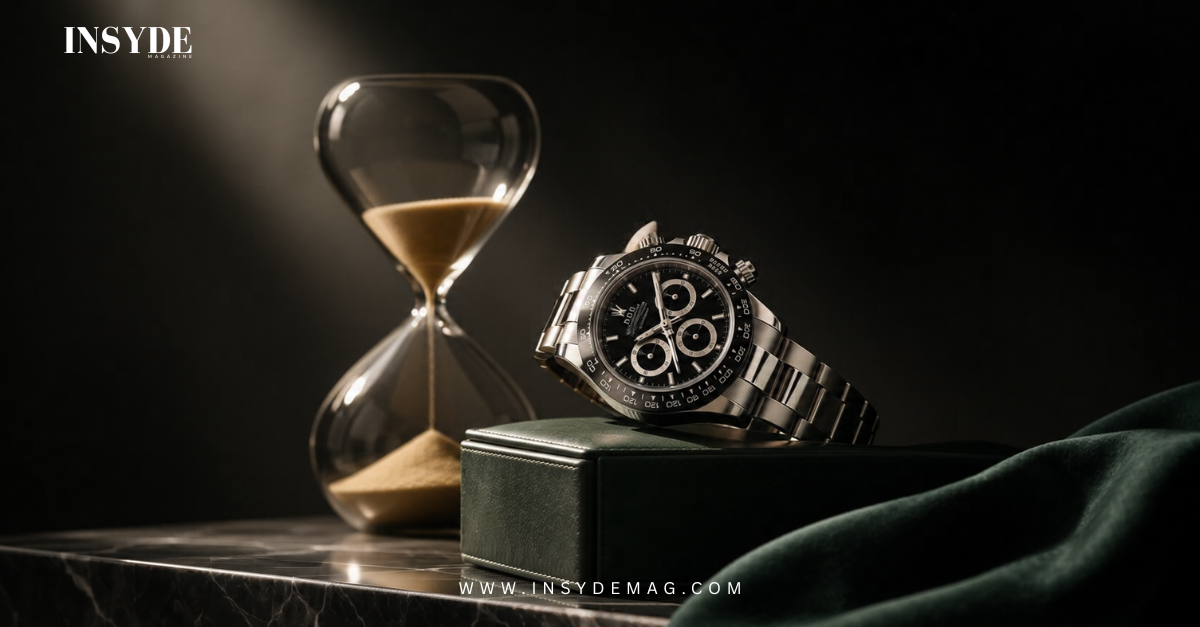
  • THE BILLION-DOLLAR BUSINESS OF PRE-OWNED LUXURY WATCHES

    THE BILLION-DOLLAR BUSINESS OF PRE-OWNED LUXURY WATCHES

    Why Rolex, Audemars Piguet and the world’s most prestigious watchmakers are moving into the lucrative business of luxury resale.

    LUXURY | BUSINESS & INDUSTRY

    A luxury watch is rarely just a watch. It is a marker of taste, a symbol of status, an expression of craftsmanship and, for some collectors, an object whose desirability can outlast its original owner. But behind the polished steel, precious metals and meticulously engineered movements lies another story—one about a market that continues to generate value long after a timepiece leaves the boutique.

    For decades, much of that business belonged to independent dealers, specialist retailers, auction houses and online marketplaces. A watchmaker might create the object, establish its reputation and sell it through an authorised retailer, only to have little involvement when the same watch changed hands again. That arrangement is now evolving.

    In October 2026, Audemars Piguet introduced The Watch Keepers, a digital experience designed to facilitate the buying and selling of certified pre-owned Audemars Piguet watches. The move follows the expansion of Rolex’s Certified Pre-Owned programme and reflects a wider shift in luxury watchmaking: manufacturers increasingly want a role in the commercial life of their products after the first sale.

    The opportunity is substantial. According to Grand View Research’s July 2026 market report, the global pre-owned luxury watch market was valued at an estimated US$32.3 billion in 2025. The firm projects a market value of US$35.7 billion in 2026, rising to US$85.4 billion by 2033, at a forecast compound annual growth rate of 13.3%.

    These are market-research estimates, rather than audited totals of every transaction worldwide. Yet the direction is clear: pre-owned luxury watches have become a major commercial category, attracting the attention of manufacturers that once left much of the resale business to others.

    The question is no longer simply who will buy the next luxury watch. It is who will profit when that watch is sold again.

    A SECONDARY MARKET WORTH WATCHING

    The scale of the opportunity becomes clearer when looking beyond long-term market forecasts to recorded transactions.

    According to EveryWatch’s H1 2026 Secondary Market Report, the secondary watch market recorded US$10.5 billion in sold value between January and June 2026, representing a 37.2% increase year on year. Approximately 795,000 watches were sold, up 18.7% compared with the first half of 2025. The median sale price rose 19.3% to US$5,900.

    EveryWatch aggregates transaction information from 650 dealers and 472 auction houses. Its figures therefore provide a view of recorded activity across its coverage, rather than a complete census of every private and commercial watch transaction.

    The data also reveals how concentrated demand remains. Rolex accounted for approximately 41% of secondary-market value in the report, followed by Patek Philippe at 14.4% and Audemars Piguet at 9.4%.

    These figures do not mean that every model from these brands appreciates, or that every watch can be resold profitably. They show that a significant share of observed market value is concentrated in a handful of highly recognisable names.

    The distinction between a broad market estimate and recorded transaction data matters. Grand View Research estimates the size of the pre-owned luxury watch market using its own research methodology; EveryWatch measures transactions within its data coverage. The figures should not be combined as though they measure precisely the same market.

    Taken together, however, they illustrate why pre-owned watches are becoming strategically important. The secondary market is not merely a place where unwanted watches end up. It is a substantial commercial ecosystem in which brand reputation, scarcity, condition, provenance and collector demand influence the value of products already in circulation.

    WHEN WATCHMAKERS ENTER THE RESALE BUSINESS

    Rolex: turning certification into a business

    Rolex provides one of the clearest examples of a manufacturer establishing a formal presence in pre-owned retail.

    Launched in 2022, the Rolex Certified Pre-Owned programme enables participating official Rolex retailers to sell eligible second-hand watches that have been authenticated and certified through the brand’s processes.

    To qualify, a watch must be at least two years old. Each timepiece returns to Rolex workshops, where its components and original configuration are examined. Certified watches are sold with a dedicated seal, a guarantee card and a new two-year international guarantee.

    The programme does more than reassure buyers. It creates an official channel through which customers can purchase a previously owned Rolex while remaining within the brand’s authorised retail network.

    The commercial momentum is notable. EveryWatch reported that Rolex Certified Pre-Owned sales reached US$385.4 million in the first half of 2026, an increase of 101.3% year on year. Within EveryWatch’s coverage, the programme accounted for approximately 9% of Rolex secondary-market sales by value.

    The figures suggest that certification is becoming a meaningful retail proposition in its own right. Instead of competing exclusively to sell new watches, authorised retailers can also participate in the resale of watches that already have a place in the market.

    For Rolex, the model aligns the brand’s reputation for quality with a more structured approach to second-hand transactions. For consumers, it offers an alternative to purchasing through an independent seller whose standards and guarantees may differ.

    Audemars Piguet: bringing resale closer to the brand

    Audemars Piguet’s October 2026 introduction of The Watch Keepers marks another important development.

    The platform facilitates the buying and selling of certified pre-owned Audemars Piguet watches, with the aim of providing greater clarity and confidence during the transaction. It brings the manufacturer closer to a market in which authenticity, originality and condition can have a substantial influence on a watch’s desirability and price.

    This is particularly relevant for a brand whose most coveted references can attract intense collector interest. A pre-owned watch may have been polished, modified, serviced outside the authorised network or fitted with components that do not match its original configuration. Such details can materially affect what a knowledgeable buyer is prepared to pay.

    A manufacturer-backed process can help reduce uncertainty by establishing clearer standards around the watch being offered.

    The strategic significance extends beyond authentication. By facilitating resale, Audemars Piguet gains a more direct connection to customers who may be acquiring a watch years after it was originally sold. It also positions the brand to participate in a transaction that might otherwise take place entirely through an independent dealer or marketplace.

    That does not mean Audemars Piguet controls every resale of its watches. Rather, it is building an official channel for buyers and sellers who value the reassurance associated with the manufacturer.

    A wider industry movement

    The shift extends beyond Rolex and Audemars Piguet.

    Richard Mille has operated a pre-owned programme through its approved retail network, combining the brand’s technical expertise with inspection, restoration and warranty support.

    Vacheron Constantin has developed a Certified Pre-Owned offering through authorised partners, with inspection and warranty provisions designed to support confidence in previously owned watches.

    IWC’s Curated collection takes a related but distinct approach by focusing on selected historical watches restored and certified by the manufacturer.

    These programmes are not interchangeable. Some focus on certifying eligible pre-owned watches; others place greater emphasis on historical references or selected retail partnerships. Their common objective is to bring the manufacturer’s expertise into a market where trust and product knowledge are essential.

    The direction is significant. Luxury watchmakers are increasingly treating the secondary market not simply as an external resale channel, but as another point of contact between their products and their customers.

    WHY THE INDUSTRY WANTS A SECOND SALE

    The commercial logic behind pre-owned watches goes beyond the immediate resale margin. It touches on customer acquisition, after-sales services, brand reputation and the long-term economics of luxury.

    1. Capturing value beyond the first transaction

    When a manufacturer sells a new watch, it participates in the original sale through its established retail and distribution structure. When that watch is resold, however, the next transaction may generate revenue for an independent dealer, an online marketplace or an auction house.

    A manufacturer-backed resale programme offers another route to participate in that activity. Depending on its structure, the business may generate revenue through resale, authorised retail, servicing, authentication and related services.

    The opportunity should not be overstated: brands do not automatically receive a share of every subsequent sale, and certification programmes have their own operating costs. But they can create a more direct commercial relationship with a market that already exists.

    A desirable watch can pass through several owners over its lifetime. Each transaction represents a potential point of contact with a new customer—and an opportunity for the brand to demonstrate its expertise.

    2. Trust is part of the luxury proposition

    The purchase of a high-value watch involves more than selecting a design. Buyers must consider authenticity, condition, service history, original components and the credibility of the seller.

    For a first-time buyer, uncertainty can be a barrier. For an experienced collector, small differences in condition or originality can materially affect desirability and value.

    Manufacturer-backed certification seeks to address those concerns through defined inspection procedures, authentication and, where offered, warranties.

    Rolex’s programme, for example, includes examination of the watch’s components and original configuration. Other manufacturers and specialist retailers use their own inspection and certification processes.

    This is where established watchmakers possess a structural advantage: they understand the products they manufacture and maintain. Their technical expertise can become a meaningful part of the resale proposition.

    Certification does not remove every risk, and buyers should still examine the terms, warranty coverage and condition report associated with a specific watch. Nevertheless, credible authentication can make the category more accessible to consumers who would otherwise be reluctant to purchase second-hand luxury.

    3. A new entry point for younger buyers

    The secondary market can also introduce prestigious brands to customers who may not be ready—or able—to purchase a new watch at full retail price.

    In its Swiss Watch Industry Study 2025, Deloitte found that 40% of surveyed millennials and Generation Z consumers were likely to purchase a pre-owned watch in the coming year. Across respondents, affordability was cited by 53% as a motivation, while 36% valued access to unique or discontinued models.

    The appeal is not exclusively financial. A pre-owned watch may offer access to a reference that is no longer manufactured, a particular design era or a model that is difficult to obtain through current retail channels.

    For younger consumers, resale can provide an entry point into a brand’s world. For experienced collectors, it can offer the opportunity to acquire a historically significant reference or complete a collection.

    For manufacturers, this creates the possibility of building relationships with customers earlier in their luxury journey. A pre-owned purchase can lead to servicing, additional collecting and, eventually, purchases from the current catalogue.

    The secondary market is therefore not necessarily a substitute for new-watch sales. In some cases, it may complement them.

    4. Monetising heritage and discontinued models

    Luxury watchmakers invest heavily in design, engineering, craftsmanship and the stories associated with their collections. Those assets can retain their appeal long after a particular reference leaves the catalogue.

    Historical models may become desirable because of their design, technical significance, production history or association with a particular period in a brand’s development.

    IWC’s Curated offering illustrates how a manufacturer can apply its knowledge to selected historical timepieces, restoring and certifying them for a new generation of buyers.

    This approach gives the brand a role in the presentation and preservation of its own history. Rather than leaving every vintage or discontinued reference to the interpretation of the resale market, the manufacturer can contribute expertise about the product’s origins and condition.

    Heritage, in this sense, becomes more than a marketing narrative. It can support a distinct commercial offering.

    5. Keeping the customer relationship alive

    The original sale is only one moment in a watch’s lifecycle. Servicing, repairs, authentication, trade-ins and subsequent purchases can create relationships that last for decades.

    Pre-owned programmes provide another opportunity to maintain those relationships, especially when a watch moves from one owner to another.

    A buyer entering the brand through a certified pre-owned model may later require servicing or choose to purchase a new reference. An existing customer selling a watch may return to the retailer to acquire another.

    These outcomes are not guaranteed, but the strategic value is clear: manufacturers and authorised retailers can remain involved in more stages of ownership rather than concentrating exclusively on the first purchase.

    THE RESALE PRICE QUESTION

    For luxury watchmakers, the secondary market also acts as a visible measure of consumer demand.

    Retail prices are set through the brand’s commercial strategy, but resale prices emerge from a wider set of forces: supply, demand, condition, availability, collector sentiment and the price buyers are willing to pay.

    Some references trade above their original retail prices. Others sell below them. A brand’s performance in the secondary market can vary considerably from one model to another, even within the same collection.

    EveryWatch’s H1 2026 data highlights the concentration of value in leading brands, but market share should not be confused with guaranteed appreciation. Nor should a watch that sells above retail be automatically treated as a reliable investment.

    The price a buyer ultimately realises depends on the actual transaction, not merely the asking price. Dealer margins, servicing costs, taxes, insurance and other expenses can reduce any apparent gain. Market conditions can also change, and demand for particular references may weaken.

    For manufacturers, however, resale values remain important because they influence how consumers perceive desirability and ownership costs.

    A strong secondary market can reinforce a brand’s reputation. If a sought-after reference remains desirable after its first sale, that demand may strengthen its appeal to future buyers. Conversely, a significant gap between retail prices and resale prices can create questions about pricing, availability and perceived value.

    Certified pre-owned programmes place manufacturers closer to this conversation. They may improve trust and offer buyers a clearer route into the market, but they also expose the brand to more direct comparisons with independent sellers.

    The challenge is to create a programme that justifies its proposition through authenticity, service and customer experience—not simply through the prestige of the name on the dial.

    INDIA: THE NEXT FRONTIER FOR ORGANised RESALE

    India offers a compelling example of how the pre-owned luxury watch market could develop.

    A growing base of affluent consumers, rising interest in luxury products and an expanding organised retail sector are creating opportunities beyond the sale of new watches. As more timepieces enter circulation, a larger pool of potential pre-owned inventory can emerge.

    In a September 2026 report, Moneycontrol highlighted the expansion of India’s pre-owned luxury watch market and the growth of Ethos’s certified pre-owned business through Second Movement. The report cited an estimated annual growth rate of approximately 11%, attributed to Ethos’s latest annual report. That figure is a reported industry estimate, not a definitive measurement of every transaction in India.

    Second Movement offers pre-owned luxury watches through an organised retail model, with inspection, authenticity assurance and a stated one-year warranty. Its business illustrates how established retailers can use infrastructure and after-sales capabilities to address one of the category’s central barriers: consumer confidence.

    Deloitte’s 2024 Spotlight on India found that more than half of surveyed Indian consumers were very or somewhat likely to purchase a pre-owned watch in the following 12 months, compared with 38% globally. The survey identified affordability, sustainability and immediate availability among the motivations.

    These findings should be read in their original context: they reflect consumer intentions reported in 2024, not confirmed purchases or a current 2026 market share.

    Even so, they point to several factors that could support the category’s development. Pre-owned watches may offer access to brands and references that sit beyond a buyer’s immediate budget for new products. They can also provide access to discontinued models that are no longer available through standard retail channels.

    For the Indian market, the next phase of growth will depend not only on demand, but on the quality of the ecosystem serving it. Transparent pricing, reliable authentication, documented condition, credible warranties and dependable after-sales service will be important in converting consumer interest into long-term confidence.

    Organised retailers are positioned to play a significant role. As the market matures, they can help connect first-time buyers, established collectors and owners seeking to trade or sell their watches.

    CAN LUXURY BRANDS OWN THE AFTERMARKET?

    The expansion of manufacturer-backed programmes does not mean independent dealers and marketplaces are about to disappear.

    Platforms such as Chrono24, specialist retailers and auction houses continue to serve important parts of the secondary market. They offer broad inventories, international reach, price discovery and access to watches that may not be available through official brand channels.

    For collectors seeking rare or historically important pieces, auction houses can provide expertise and access to specialised markets. Independent dealers may offer a wider selection across brands, price points and conditions than any single manufacturer’s programme.

    Brand-backed resale has its own limitations. Availability may be narrower, and the price of a certified watch may be higher than comparable alternatives offered independently. That premium may reflect inspection, servicing, warranty coverage and the confidence attached to the programme—but buyers must assess whether the specific offer justifies the difference.

    There is also a broader strategic tension. Luxury brands rely on exclusivity and carefully managed positioning, while the secondary market makes prices and availability more visible. Greater transparency can reinforce confidence in a product, but it can also reveal differences between official retail pricing and what the market is willing to pay.

    Nor does pre-owned automatically mean sustainable. Extending the useful life of a product can support more prolonged use, but the environmental benefit depends on factors such as refurbishment, transportation and whether a pre-owned purchase replaces a new purchase or simply adds another one.

    The brands that succeed will need to offer a credible reason for customers to choose their official resale channels. Authentication, technical expertise, warranty terms, service quality and a carefully managed customer experience are likely to matter more than the label alone.

    The aftermarket will remain diverse. The contest is over how much of that market manufacturers can attract—and how effectively they can compete without undermining the independent ecosystem that helped build it.

    THE BUSINESS AFTER THE FIRST SALE

    The rise of pre-owned luxury watches signals a broader change in how the industry thinks about ownership.

    For years, the traditional model placed the greatest emphasis on the new watch: the boutique experience, the launch, the waiting list and the first purchase. The secondary market challenges that narrow view by showing that a desirable timepiece can remain commercially relevant long after it leaves the original owner’s wrist.

    Rolex has built a formal channel around certification and guarantees. Richard Mille, Vacheron Constantin and IWC have developed their own approaches to pre-owned or curated watches. Audemars Piguet’s Watch Keepers adds fresh momentum to a shift that is becoming increasingly difficult for the industry to ignore.

    The opportunity is significant, but it is not without challenges. Manufacturers must compete with established resale specialists, maintain the credibility of their certification processes and operate in a market where prices are shaped by supply, demand and collector sentiment—not simply by official retail strategy.

    The prize, however, extends beyond the revenue generated by an individual transaction. It is the opportunity to remain connected to a watch throughout its life, from its first owner to the collectors who may acquire it decades later.

    The future of luxury watchmaking may therefore depend not only on the watches brands create, but on how they manage the value, trust and desirability those watches carry after the original sale.

    Because in the business of luxury, the first sale may begin the relationship. It does not have to end it.

    INSYDE MAGAZINE – number one luxury magazine in Bangalore

  • WHY ARE SWISS WATCHES CONSIDERED LUXURY?

    WHY ARE SWISS WATCHES CONSIDERED LUXURY?

    Inside the craftsmanship, heritage and global prestige that transformed Swiss watchmaking into one of the world’s most influential luxury industries.

    INSYDE | LUXURY

    A watch can tell the time. A luxury watch can tell a story about the person wearing it, the hands that made it and the history behind its name.

    For centuries, Switzerland has cultivated a reputation for precision, craftsmanship and technical excellence. Today, its watchmakers occupy an extraordinary position in the global luxury market, producing timepieces that can cost hundreds, thousands or even millions of Swiss francs.

    But what makes a Swiss watch a luxury object? Is it the movement inside the case, the materials on the wrist, the name printed on the dial—or the reputation of an entire country?

    The answer lies in the intersection of engineering, heritage, commercial strategy and human desire.

    THE MAKING OF A WATCHMAKING NATION

    Switzerland’s position in watchmaking was not inevitable. It emerged through centuries of specialised craftsmanship, economic development and the concentration of expertise in a relatively small geographical area.

    Geneva became an important centre of watchmaking during the sixteenth century, when Protestant refugees, including skilled artisans, brought their knowledge to the city. Goldsmiths and other craftsmen gradually directed their expertise towards watches and clocks, helping establish a tradition that would eventually extend across the country.

    Over time, watchmaking developed throughout the Jura region and neighbouring areas. Workshops specialised in individual components and processes, creating networks of suppliers, engineers, finishers and assemblers. This concentration of skills helped Swiss manufacturers develop technical expertise that could be refined and passed between generations.

    Geneva’s contribution to fine watchmaking remains particularly significant. Established in 1886, the Poinçon de Genève, or Geneva Seal, became a mark associated with demanding standards of craftsmanship and finishing.

    Yet Switzerland’s success was not built on tradition alone. The industry also adapted to industrialisation, changing consumer tastes and technological disruption.

    During the quartz crisis of the 1970s and 1980s, affordable electronic watches—particularly from Japanese manufacturers—challenged the economics of traditional mechanical watchmaking. Swiss manufacturers faced intense competition, restructuring and the possibility that centuries of expertise might lose their commercial relevance.

    The industry’s recovery demonstrated a crucial principle: heritage is valuable only when it remains relevant. Swiss watchmakers had to combine their traditional strengths with new production methods, contemporary design and more clearly defined brand identities.

    That ability to evolve helped transform Swiss watchmaking from a manufacturing specialism into a globally recognised luxury category.

    For further reading: Switzerland’s official overview of its watchmaking industry.

    PRECISION, ENGINEERING AND THE HUMAN HAND

    At the heart of traditional Swiss watchmaking lies a remarkable engineering challenge: creating a compact mechanism capable of measuring time reliably through the coordinated movement of tiny components.

    A mechanical watch typically draws energy from a mainspring. A gear train transmits that energy, while an escapement and regulating system control its release. In an automatic watch, a rotor uses the movement of the wearer’s wrist to wind the mainspring.

    The principle is deceptively simple. The execution can be extraordinarily complex.

    Components must be manufactured to precise tolerances, assembled correctly and adjusted to work together. Depending on the movement, a watch may incorporate additional mechanisms for chronographs, calendars, multiple time zones or tourbillons.

    At the upper end of watchmaking, the distinction often lies in the details: carefully finished bridges, polished edges, decorated surfaces, precise adjustments and the integration of complicated mechanisms into a reliable instrument.

    These elements require technical knowledge, specialised equipment and, in many cases, highly trained human skill.

    However, an important distinction should be made. Not every Swiss watch is handmade, and not every luxury watch contains a complicated mechanical movement. Modern watchmaking combines automated manufacturing with skilled assembly and finishing in different proportions.

    The presence of a mechanical movement alone does not establish superior quality. Design, materials, reliability, finishing and execution all matter.

    Nor is mechanical watchmaking necessarily the most accurate way to tell time. Quartz watches can offer excellent accuracy at substantially lower prices.

    The appeal of a fine mechanical watch is different. It is the achievement of engineering a miniature mechanical system, the beauty of its construction and the opportunity to wear an object whose operation can be appreciated long after its original purchase.

    In an increasingly digital world, that physical connection to engineering has become part of its attraction.

    WHAT DOES “SWISS MADE” ACTUALLY MEAN?

    Few country-of-origin designations carry the same recognition in watchmaking as the words Swiss Made. But their significance extends beyond marketing.

    Switzerland regulates the use of the designation through specific legal requirements. Under the rules strengthened in 2017, a qualifying watch must meet requirements covering Swiss technical development, its movement, casing-up, final inspection and manufacturing costs.

    At least 60 per cent of the manufacturing costs of the complete watch must be incurred in Switzerland. The movement must also satisfy separate Swiss-origin requirements, including assembly and inspection in Switzerland, qualifying manufacturing costs and a minimum Swiss share of component value.

    These rules are designed to protect the credibility of the designation and ensure that a substantial part of the watch’s qualifying development and manufacture takes place in Switzerland.

    The distinction is important because modern manufacturing is international. Materials, components and specialist services may come from different countries, even when a watch is developed and manufactured under Swiss rules.

    But Swiss Made should not be mistaken for a universal luxury certification.

    Swiss Made establishes a regulated standard of origin. It does not guarantee that every qualifying watch is expensive, exceptionally finished or superior to every watch made elsewhere.

    A relatively affordable Swiss watch can satisfy the legal requirements. A watch manufactured in another country can also demonstrate outstanding craftsmanship and technical sophistication.

    The designation gives consumers meaningful information about provenance. Its commercial power, however, comes from the reputation Switzerland has built around that provenance over generations.

    Official reference: Swiss Ordinance on the Use of “Switzerland” or “Swiss” for Watches.

    WHY SOME WATCHES COST SO MUCH

    The price of a luxury watch is rarely explained by its manufacturing cost alone.

    Materials, movement development, specialist labour, finishing, testing, quality control and after-sales service all contribute to the economics of a timepiece. Precious metals, complex mechanisms and labour-intensive finishing can add substantial costs.

    But the final retail price also reflects factors that are less tangible.

    A watchmaker may spend decades establishing a reputation for reliability, distinctive design or technical achievement. A brand’s history, visual identity and relationship with collectors can influence how consumers perceive its products. Retail networks, distribution strategies and the cost of maintaining a luxury business also contribute to the price.

    Brand equity—the commercial value associated with a name and its reputation—can therefore become a significant part of what a buyer pays for.

    Consider two watches that perform the same basic function. One may be designed primarily as a reliable everyday timepiece. The other may combine a distinctive movement, exceptional finishing, precious materials, decades of brand heritage and a highly recognisable design.

    Both tell the time. Their prices may be dramatically different because their products, production methods, positioning and perceived value are different.

    Scarcity can add another dimension. Restricted production and strong demand may make certain watches difficult to obtain. But scarcity alone does not establish superior craftsmanship, and limited availability does not guarantee that a watch will appreciate in value.

    A luxury watch is not automatically a good investment. Its resale price depends on the specific model, condition, provenance, market demand and other factors that can change over time.

    The strongest luxury brands combine tangible product quality with an identity that consumers recognise and value. The physical watch matters, but so does the meaning attached to it.

    FROM ROLEX TO PATEK PHILIPPE: THE MANY FACES OF SWISS LUXURY

    Swiss watchmaking is not a single, uniform category. Its leading houses demonstrate different ways of building prestige.

    Rolex has established a powerful international identity through recognisable designs, technical development and consistency across its collections. Its watches often function as both personal accessories and widely understood status symbols.

    Patek Philippe places particular emphasis on traditional watchmaking, complex movements, heritage and long-term continuity. Its positioning appeals to collectors who value technical artistry and the idea of a timepiece being passed between generations.

    Audemars Piguet illustrates the power of design in defining luxury. The Royal Oak, introduced in 1972, helped establish the luxury sports watch as a major category, combining a distinctive case and integrated bracelet with high-end watchmaking.

    Omega has built its identity around technical heritage, precision, professional timing and cultural associations, including space exploration and its longstanding connection with the James Bond film franchise.

    These brands are not interchangeable. Their products differ in design, technical character, price, production and availability.

    Their shared lesson is that Swiss origin provides a foundation, but individual brands must give consumers a reason to desire their particular watches.

    A country can establish a reputation for quality. A brand must turn that reputation into a distinctive identity.

    THE PSYCHOLOGY OF OWNING A LUXURY WATCH

    Why spend thousands—or, in certain cases, hundreds of thousands—on a watch when a much less expensive device can display the time?

    The answer depends on the buyer.

    For some, the attraction is technical: the movement, the finishing, the materials or the challenge of understanding how a complex mechanism works. For others, the appeal is aesthetic, rooted in the proportions of a case, the design of a dial or the way a watch complements personal style.

    There is also an emotional dimension. A watch may mark a graduation, a wedding, a professional milestone or a personal achievement. Over time, it can become associated with memories and relationships that extend beyond its original purpose.

    Luxury watches also occupy a social space. Certain designs communicate status, taste or familiarity with a particular cultural world. Other watches appeal to collectors precisely because their craftsmanship is less immediately visible to a casual observer.

    Heritage can deepen that relationship. A well-maintained watch may be passed from one generation to another, acquiring meaning through the people who own and wear it.

    This is one reason a traditional watch can remain desirable in an age of smartwatches and connected devices. Its value is not limited to the information displayed on its dial. It can be an expression of personal taste, an appreciation of craftsmanship or an object associated with a significant moment in life.

    None of this means that a luxury watch makes its owner more successful, or that a higher price guarantees greater satisfaction.

    Instead, luxury watchmaking succeeds because it brings together technical achievement and the meanings consumers attach to the objects they choose to own.

    THE MARKET IN 2026: PRESTIGE MEETS REALITY

    Switzerland’s watchmaking reputation remains formidable, but the industry’s recent performance shows why prestige should not be confused with immunity to economic pressure.

    According to the Federation of the Swiss Watch Industry (FH), Swiss watch exports totalled approximately CHF 25.6 billion in 2025, a decline of 1.7 per cent from 2024. The number of watches exported also fell, declining 4.8 per cent to approximately 14.6 million units.

    The federation cited difficult market conditions, uncertainty surrounding US trade policy, continued weakness in mainland China and Hong Kong, and elevated gold prices and Swiss-franc strength as factors affecting the industry.

    The pressure continued into the first half of 2026. Swiss watch exports reached CHF 12.8 billion, down 0.7 per cent year on year, according to the federation’s half-year report published on 21 July 2026.

    Yet the results were not uniform across markets. Swiss watch exports to India grew 31.5 per cent during the first half of 2026, moving India into fifth place among destination markets in the federation’s reported ranking. This is a notable development for a country where luxury consumption and interest in premium products offer watchmakers opportunities for future growth.

    The latest monthly report available as of 18 October adds another layer to the picture. In August 2026, Swiss watch exports increased 9.1 per cent year on year, according to the federation’s monthly statistics. However, August had one more working day than the same month in 2025, and export performance varied substantially between markets. Shipments to the United States, for example, declined 19.4 per cent.

    These figures require careful interpretation. Export values represent shipments declared by exporting companies; they are not the same as final consumer retail sales. Monthly comparisons can also be affected by working days, exchange rates, trade policy and the timing of shipments.

    Nevertheless, the data makes one point clear: Swiss watchmaking remains a major international industry, but its performance depends on changing economic conditions and consumer demand.

    The market does not reward reputation indefinitely without question. Brands must continue to justify their prices, maintain their desirability and adapt to the expectations of new generations of buyers.

    For India, the recent export growth offers a compelling reason to pay closer attention to Swiss watchmaking—not simply as a symbol of European luxury, but as part of a global industry responding to changing patterns of demand.

    DOES SWISS MADE STILL MATTER?

    In an age of smartwatches, connected devices and advanced manufacturing across the world, the Swiss watch industry faces a question that goes beyond precision: what makes a traditional timepiece worth wanting?

    The answer cannot be found in accuracy alone. Nor can it be reduced to the words printed on a dial.

    Swiss watchmaking remains compelling because it brings together several forms of value: technical expertise, manufacturing traditions, regulated provenance, recognisable design and the cultural meaning attached to established brands.

    These elements reinforce one another. Craftsmanship gives heritage substance. Heritage helps build trust. A strong brand transforms that trust into desire. Consumer demand, in turn, helps sustain the specialist skills on which the industry depends.

    But Swiss origin is not the whole story. Outstanding watchmaking exists beyond Switzerland, and Swiss manufacturers themselves span a wide range of prices, technologies and ambitions. A discerning buyer must still evaluate the individual watch, its quality, its design and the value it offers.

    Ultimately, the enduring strength of Swiss watchmaking lies in its ability to make time tangible—not merely as a measurement, but as an expression of human skill, engineering, design and memory.

    A watch may be purchased for its craftsmanship, worn as a personal statement or treasured as an heirloom. Its significance depends on the person who owns it.

    And perhaps that is the most revealing distinction between a watch that simply tells time and one that becomes a luxury object: the latter carries a story that extends far beyond the movement inside its case.

    Because in luxury, the object matters. But so does everything that gives it meaning.

    INSYDE — The world of luxury, culture and the people shaping what comes next.

    No.1 Luxury Magazine In Bengaluru
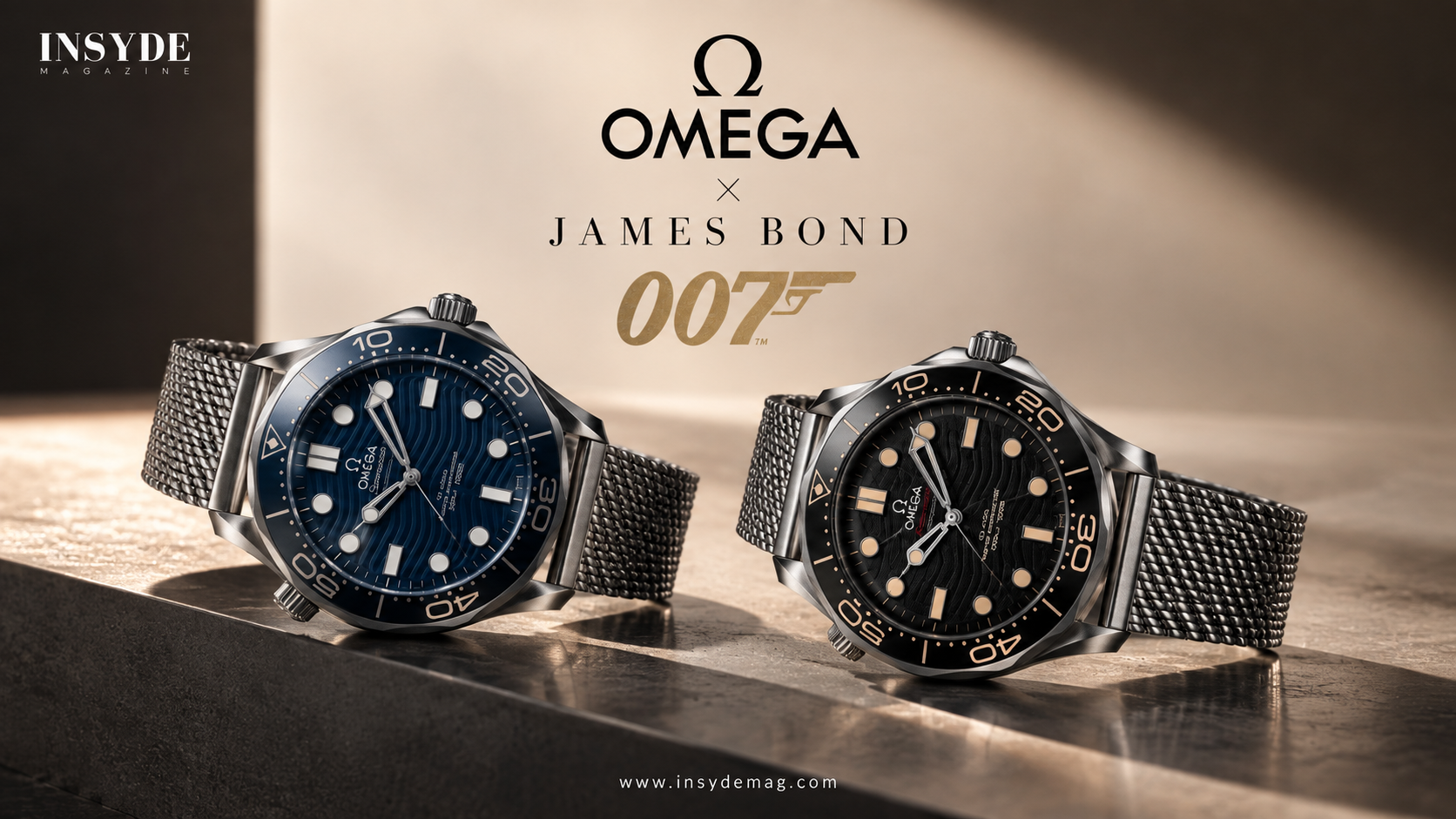
  • JAMES BOND x OMEGA: GOOD, EVIL & VERY EXPENSIVE

    JAMES BOND x OMEGA: GOOD, EVIL & VERY EXPENSIVE

    Inside OMEGA’s new Seamaster collection, where 007 meets SPECTRE — and luxury turns a battle of identities into a collector’s game.

    By INSYDE

    There are watches that tell time.

    And then there are watches that tell a story about the person wearing them.

    For more than three decades, OMEGA has understood the difference.

    James Bond first wore an OMEGA in GoldenEye in 1995. Since then, the Seamaster has become one of the most recognisable objects in the 007 universe — moving through the Pierce Brosnan and Daniel Craig eras and becoming part of the character’s visual language. OMEGA’s relationship with Bond has now lasted more than 30 years. OMEGA Press Room

    But in October 2026, OMEGA changed the formula.

    For the first time, SPECTRE has entered the picture.

    The new Seamaster Diver 300M James Bond and SPECTRE Collection, released October 5, brings six watches into the same universe: three carrying the James Bond identity and three carrying the SPECTRE identity. OMEGA Press Room

    And suddenly, this isn’t simply another Bond watch.

    It’s a choice.

    Good or evil.

    Blue or black.

    Bond or SPECTRE.

    And, depending on how far you want to take the fantasy, $8,600 or $89,800.


    THE BOND WATCH HAS BECOME SOMETHING BIGGER

    OMEGA’s Bond relationship is one of luxury’s most successful examples of entertainment becoming brand identity.

    The Seamaster wasn’t invented for James Bond. The Diver 300M dates back to 1993, two years before it appeared on Pierce Brosnan’s wrist in GoldenEye. But cinema transformed the watch from a professional dive instrument into something much more culturally charged. OMEGA Press Room

    Over time, the watch became part of Bond’s uniform.

    The tuxedo.

    The Aston Martin.

    The gadgets.

    The Seamaster.

    That distinction matters because OMEGA isn’t borrowing Bond’s cultural relevance for a single campaign. It has spent three decades building a relationship in which the watch itself has become part of the mythology.

    And now the brand is expanding that mythology from one character to two.


    ENTER: SPECTRE

    The cleverness of the 2026 collection is its simplicity.

    Bond and SPECTRE share the same technical foundation, but represent opposing personalities.

    OMEGA describes Bond through duty, discipline and loyalty. SPECTRE represents independence, self-interest and operating beyond the same constraints. The brand’s own concept is built around this duality — the idea that different instincts can exist within the same person. OMEGA Press Room

    That gives the watches something more interesting than a franchise logo.

    It gives them personality.

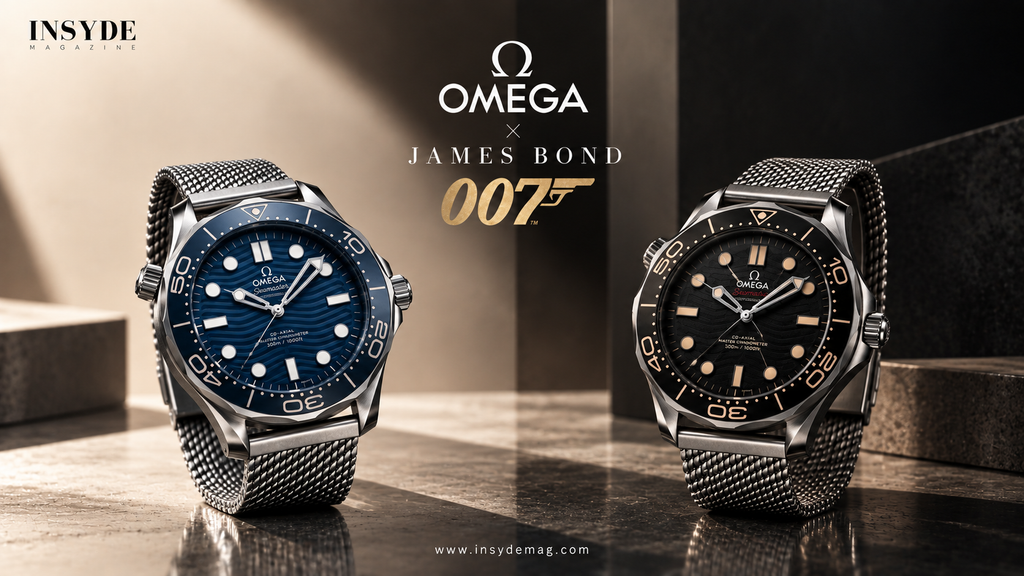
    The Bond watch is blue.

    The SPECTRE watch is black.

    One feels familiar.

    The other feels forbidden.

    And that is precisely where luxury starts to become psychological.


    THE WATCH FOR 007

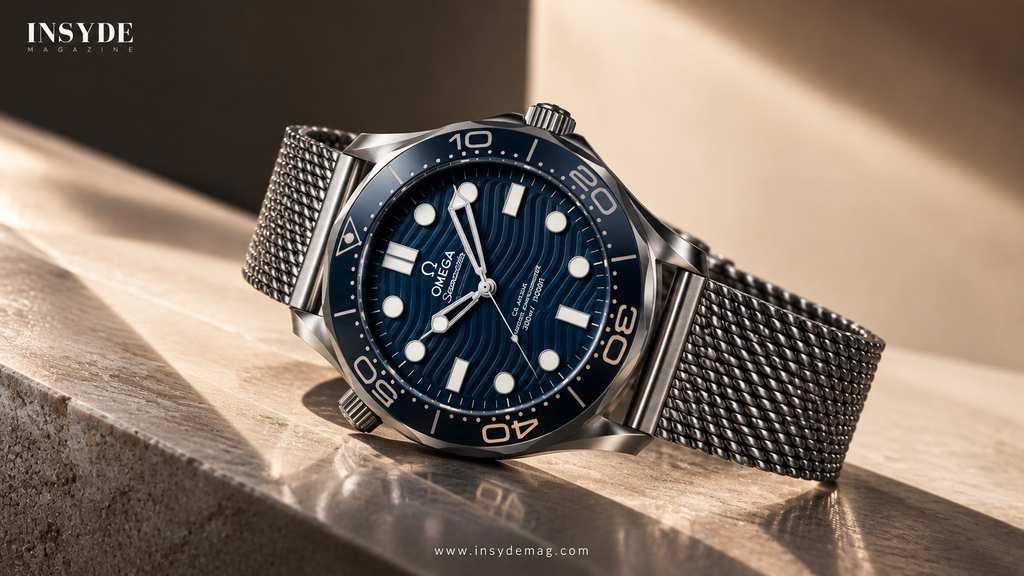
    The standard James Bond edition, reference 210.30.42.20.03.004, measures 42mm and is crafted in stainless steel.

    It features a Grade 5 titanium bezel ring and a blue aluminium dial with the laser-engraved wave pattern associated with the Seamaster Diver 300M. The watch comes on a brushed mesh bracelet. OMEGA Press Room

    Turn it over and the Bond mythology becomes more discreet.

    The movement’s rotor carries a gun-barrel decoration — an unmistakable reference to 007 without turning the dial into a piece of obvious merchandise. OMEGA Press Room

    That restraint is important.

    Because the modern luxury consumer doesn’t necessarily want to announce:

    “I am wearing the James Bond watch.”

    They may prefer something subtler:

    “If you know, you know.”


    THE WATCH FOR THE DARK SIDE

    Then comes the SPECTRE edition.

    Reference 210.30.42.20.01.023 keeps the same 42mm stainless-steel architecture but changes the mood completely.

    The bezel becomes black ceramic.

    The dial takes on a blackened, grained finish.

    The bracelet remains brushed mesh.

    The result is darker, quieter and more severe. OMEGA Press Room

    And beneath the sapphire caseback sits perhaps the best detail of all: a rotor shaped around SPECTRE’s octopus insignia. Monochrome Watches

    It is the kind of detail that rewards attention.

    The Bond watch wants to be recognised.

    The SPECTRE watch almost feels like it wants to be discovered.


    TWO WATCHES. ONE QUESTION.

    Whose side are you on?

    OMEGA has effectively turned product selection into identity selection.

    Bond or SPECTRE.

    Classic or dark.

    Duty or independence.

    The appeal isn’t purely technical.

    It’s emotional.

    And that is increasingly important in luxury.

    A watch at this level is no longer competing solely on accuracy, materials or movement architecture. It is competing for meaning.

    Why this watch?

    Why this brand?

    Why this particular story?

    The answer can be as important as the specification sheet.


    THE TECHNICAL CREDENTIALS STILL MATTER

    For all the cinematic theatre, OMEGA hasn’t turned the Seamaster into a costume accessory.

    The new watches are powered by the OMEGA Co-Axial Master Chronometer Calibre 8806, an automatic movement certified as a Master Chronometer by the Swiss Federal Institute of Metrology (METAS).

    The movement provides approximately 55 hours of power reserve, while the Seamaster Diver 300M retains 300 metres of water resistance. The watches measure 42mm in diameter and approximately 14.23mm thick. Monochrome Watches

    This is important to the credibility of the collection.

    The Bond connection creates the desire.

    The watchmaking has to justify the object.


    THEN OMEGA MAKES IT VERY EXPENSIVE

    The standard stainless-steel Bond and SPECTRE watches are priced at $8,600 each in the United States, with both models positioned as non-limited editions. Hodinkee

    But OMEGA has also created something considerably more exclusive.

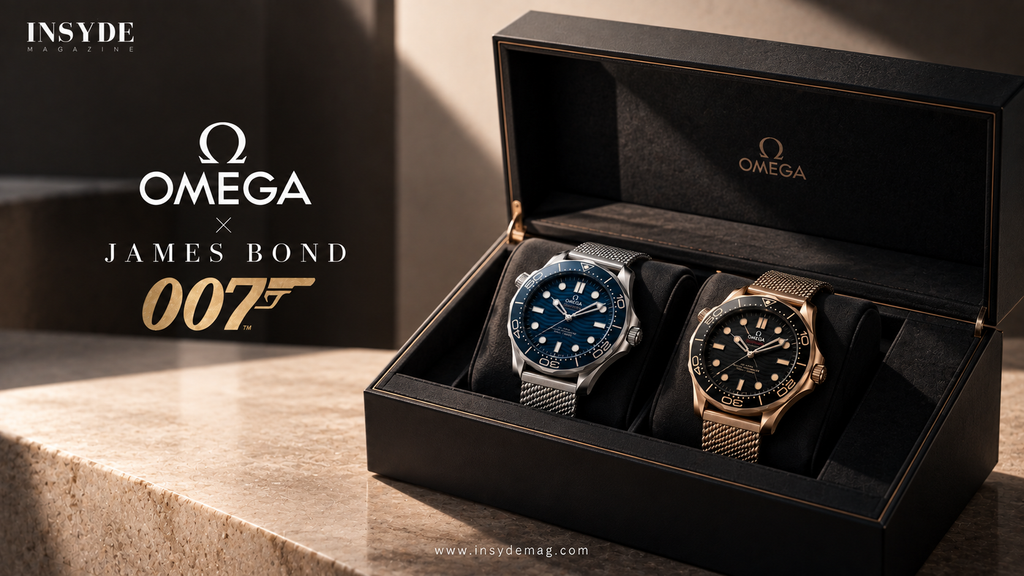
    Two limited-edition sets sit at the top of the collection:

    One for James Bond.

    One for SPECTRE.

    Each is limited to 77 numbered sets.

    Each costs $89,800 in the United States. Hodinkee

    And neither watch within those sets is sold separately.

    That changes the proposition completely.


    THE $89,800 SIDE OF THE STORY

    Each limited set combines a stainless-steel watch with a platinum-gold model.

    The platinum-gold versions feature polished ceramic bezels, platinum diving scales and 18K white-gold dials with character-specific designs.

    The Bond version carries a blue gradient and gun-barrel motif.

    The SPECTRE version goes dark grey, with an octopus design.

    Both use 18K Moonshine™ Gold for the rotor emblem. OMEGA Press Room

    But OMEGA hasn’t stopped at the watches.

    The presentation box includes an additional NATO strap and changing tool, cufflinks, a cord bracelet, loupe, leather travel pouch, card holder and certificate of authenticity.

    Even the accessories are divided by allegiance.

    Bond receives a blue travel pouch and 007 details.

    SPECTRE receives black treatment and its own insignia. OMEGA Press Room

    This is no longer simply watchmaking.

    It’s world-building.


    WHY 77 MATTERS

    Seventy-seven.

    A number that immediately speaks to 007.

    OMEGA hasn’t positioned the limited editions as merely “rare.” It has created a numerical connection to the franchise itself.

    And that’s how collectible luxury works at its most effective.

    Scarcity creates urgency.

    Story creates emotion.

    Craft creates credibility.

    When those three meet, a product can move beyond being something you wear and become something you collect.

    At $89,800, that is clearly the territory OMEGA is entering.


    FROM WATCH TO COLLECTIBLE

    There is a larger shift happening across luxury.

    The strongest products increasingly aren’t just objects.

    They are objects with cultural context.

    A handbag can carry a fashion-house history.

    A sneaker can represent a cultural movement.

    A watch can carry an entire cinematic mythology.

    OMEGA’s Bond relationship gives it something that most watch brands cannot manufacture overnight: recognition built over decades.

    And the new SPECTRE chapter adds another dimension.

    For 30 years, OMEGA told the story from Bond’s side.

    Now it is deliberately giving the other side equal space.

    That isn’t just product design.

    It’s narrative strategy.


    BOND DOESN’T NEED A NEW FILM

    This may be the most interesting part of the timing.

    The new collection arrives without a new James Bond film driving the launch.

    Instead, OMEGA has been expanding the 007 universe beyond cinema.

    In May 2026, the brand introduced the Seamaster Diver 300M Chronograph 007 First Light, a watch created in collaboration with IO Interactive and Amazon MGM Studios for the 007 First Light video game. The game presents a new story around a 26-year-old James Bond, giving the franchise a new interactive entry point. OMEGA Press Room

    That is significant.

    OMEGA isn’t simply waiting for the next movie.

    It is keeping 007 culturally active through different forms of entertainment.

    And now, rather than simply following Bond into another film, the brand has expanded the universe to include his most recognisable enemy.


    THE TIMING COULD HARDLY BE MORE INTERESTING

    The broader Swiss watch industry is operating in a complicated environment.

    According to the Federation of the Swiss Watch Industry, Swiss watch exports totalled CHF 12.8 billion in the first half of 2026, down 0.7% year-on-year. The industry has been dealing with currency pressure, tariffs, geopolitical uncertainty and weaker conditions in some major markets. FHS

    But the picture isn’t simply negative.

    The same data shows that India’s Swiss watch imports grew 31.5% in the first half of 2026, making India one of the industry’s strongest growth markets and moving it into fifth place among Swiss watch export destinations. FHS

    That matters for a publication like INSYDE.

    Luxury watch culture is no longer something Indian consumers merely observe from a distance.

    India is becoming a more important market for Swiss watchmakers, and younger affluent consumers are increasingly engaging with watches as part of fashion, lifestyle and personal identity.

    For OMEGA, a globally recognised cultural property like James Bond gives the mechanical watch an immediate point of entry.


    THE WATCH INDUSTRY’S REAL BATTLE IS EMOTIONAL

    The mechanical watch has an unusual problem.

    It isn’t necessary.

    Your phone tells the time more accurately.

    Your smartwatch tells you much more.

    And yet mechanical watches remain objects of desire.

    Why?

    Because luxury has never really been about necessity.

    It’s about meaning.

    A mechanical watch can represent craftsmanship, heritage, achievement, taste or personal milestones.

    James Bond adds another layer:

    fantasy.

    The fantasy of competence.

    The fantasy of elegance under pressure.

    The fantasy of walking into a room and already knowing what to do.

    That is something a smartwatch cannot manufacture.


    WHY THIS MATTERS TO A YOUNGER LUXURY AUDIENCE

    For younger consumers, luxury increasingly works through cultural literacy.

    Knowing the obvious logo isn’t enough.

    Understanding the reference can be the real flex.

    That’s why the SPECTRE watch is particularly interesting.

    Someone unfamiliar with the franchise may simply see a black luxury dive watch.

    Someone who knows the mythology sees something else.

    They see the octopus.

    They understand the reference.

    They know why the watch exists.

    The product becomes a conversation between people who recognise the same cultural code.

    That is powerful territory for luxury.


    THE DANGER OF MAKING A “BOND WATCH”

    There is, however, a fine line.

    Too much Bond and a luxury watch can become merchandise.

    Too little Bond and the collaboration becomes meaningless.

    OMEGA’s new collection largely avoids that trap by retaining the identity of the Seamaster Diver 300M.

    The Bond and SPECTRE references are layered into the design rather than overwhelming it.

    That distinction is important.

    You’re not buying a movie prop.

    You’re buying an OMEGA Seamaster with a particularly rich story attached to it.

    And that gives the collection relevance beyond the franchise’s most dedicated fans.


    THE SPECTRE WATCH MAY BE THE MORE INTERESTING ONE

    The Bond model is the obvious choice.

    But the SPECTRE model is where things become more intriguing.

    It is darker.

    More discreet.

    Less immediately conventional.

    And perhaps more aligned with the current luxury consumer’s fascination with understatement.

    The watch doesn’t need to scream villain.

    The black ceramic bezel and grained dial already create the mood.

    The octopus waits on the other side.

    That is exactly how insider luxury works.

    The detail is there for the person who knows.


    IS $89,800 REALLY ABOUT THE WATCH?

    Not entirely.

    And that’s okay.

    At this level, you’re buying a combination of:

    Watchmaking.

    Materials.

    Scarcity.

    Provenance.

    Story.

    Collectibility.

    The 77-piece limitation, platinum-gold construction and dual-watch presentation deliberately move the product into collector territory.

    Whether that makes the price “worth it” is subjective.

    But it does make the strategy understandable.

    OMEGA isn’t asking the buyer to pay $89,800 simply to tell time.

    It’s asking them to own a highly limited physical piece of the 007 universe.

    That’s a very different proposition.


    OMEGA HAS TURNED LUXURY INTO A CHOICE

    And perhaps that is why this collection works.

    The brand hasn’t simply added another Bond logo to another Seamaster.

    It has created a confrontation.

    James Bond vs. SPECTRE.

    Blue vs. black.

    Hero vs. villain.

    Duty vs. freedom.

    And underneath all of it is the same mechanical foundation.

    That is smart luxury storytelling.

    Because the consumer doesn’t just choose a watch.

    They choose the version of the story they want to wear.


    THE VERDICT

    Is this OMEGA’s most technically revolutionary Bond watch?

    No.

    And that isn’t really the point.

    The movement is proven.

    The Seamaster platform is established.

    The design language is familiar.

    The innovation is happening somewhere else.

    In the story.

    OMEGA has taken one of luxury’s most recognisable entertainment partnerships and expanded it into a two-sided universe.

    It has made the hero share the spotlight.

    It has given the villain equal wrist space.

    And it has turned the collector into the final decision-maker.

    For $8,600, you can choose your side.

    For $89,800, you can collect both worlds within a limited set.

    And for everyone else, you can simply enjoy watching one of luxury’s most enduring partnerships become a little more dangerous.


    GOOD. EVIL. AND VERY EXPENSIVE.

    James Bond has always had a watch.

    Now, for the first time, his enemy has one too.

    OMEGA’s new collection is therefore more than another chapter in the brand’s Bond relationship.

    It is a statement about where luxury is going.

    The watch no longer has to sell itself purely through mechanics.

    It can sell through memory, identity, entertainment and culture.

    That is increasingly how modern luxury wins attention.

    And perhaps the smartest detail is that OMEGA doesn’t tell you which side is better.

    It simply asks:

    Which side are you on?

    Because after 30 years of making James Bond synonymous with OMEGA, the Swiss watchmaker has found a new way to keep the fantasy alive.

    Give the villain a watch.

    And let the collector decide who wins.


    INSYDE’S TAKE

    OMEGA has made a watch launch feel like a choice of identity.

    That’s what makes the 2026 Bond and SPECTRE collection more interesting than another franchise collaboration.

    The watches aren’t revolutionary because they don’t need to be.

    The Seamaster already has the credibility.

    Bond already has the mythology.

    SPECTRE already has the intrigue.

    OMEGA has simply brought the two together — and turned the space between them into luxury.

    Good. Evil. Very expensive.

    And, for once, the dark side has a very good case.


    EDITORIAL FACT BOX

    Collection: OMEGA Seamaster Diver 300M James Bond & SPECTRE
    Launch: October 5, 2026
    Total watches: Six
    Standard editions: Two stainless-steel models
    Case size: 42mm
    Movement: OMEGA Co-Axial Master Chronometer Calibre 8806
    Power reserve: 55 hours
    Water resistance: 300 metres
    Standard U.S. price: $8,600 each
    Limited sets: Two — one James Bond, one SPECTRE
    Limited quantity: 77 numbered sets of each
    Limited-set U.S. price: $89,800
    Availability: OMEGA boutiques and OMEGA’s online store OMEGA Press Room

    INSYDE INDUSTRY NOTE

    The Swiss watch market remains resilient but uneven in 2026. First-half Swiss watch exports fell 0.7% to CHF 12.8 billion, while India grew 31.5%, making it one of the strongest-performing markets. At the same time, Swatch Group reported strong sales acceleration in May and June, continuing into July, across price segments and regions. The evidence therefore does not support framing OMEGA’s Bond strategy as a response to a simple sales crisis. A stronger interpretation is that the brand is using a highly recognizable cultural property to deepen emotional relevance and maintain momentum in a competitive luxury-watch environment. FHS.


  • EVERYTHING YOU NEED TO KNOW ABOUT THE ROLEX PERPETUAL PADELLONE

    EVERYTHING YOU NEED TO KNOW ABOUT THE ROLEX PERPETUAL PADELLONE

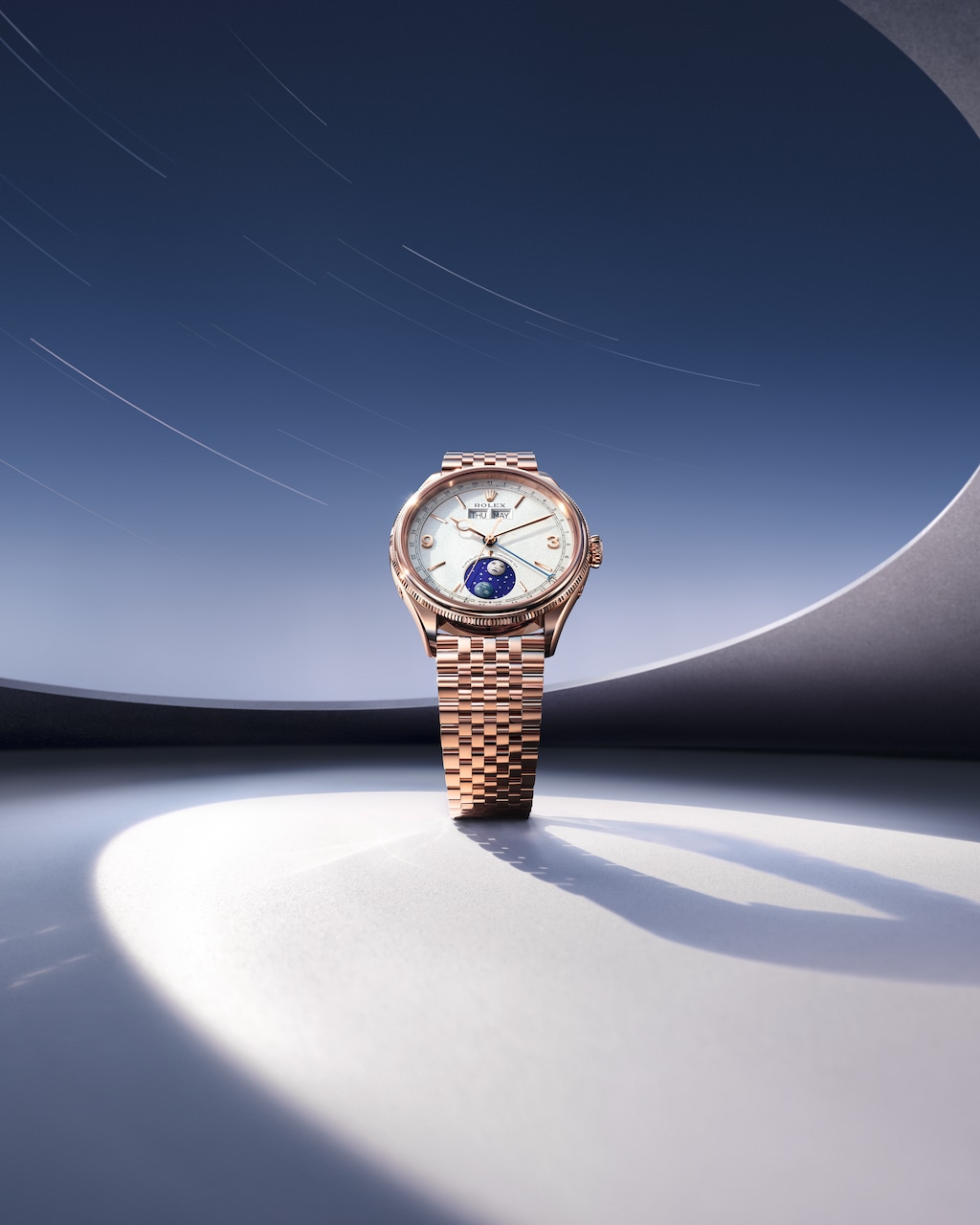
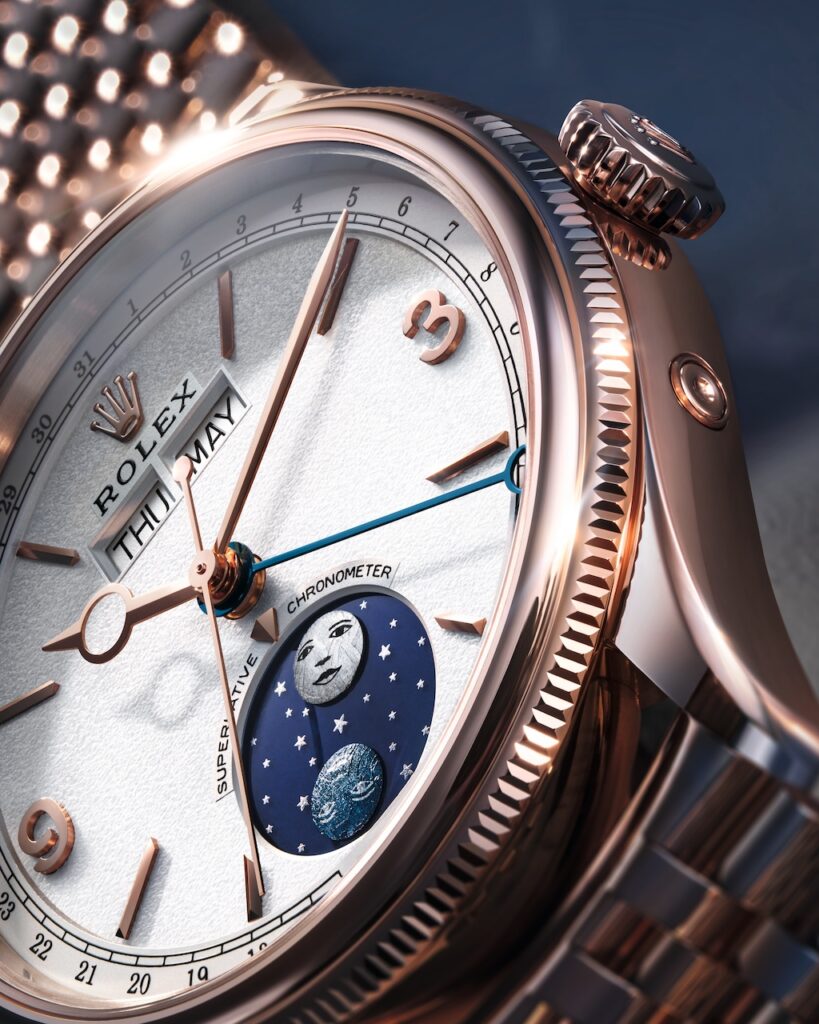
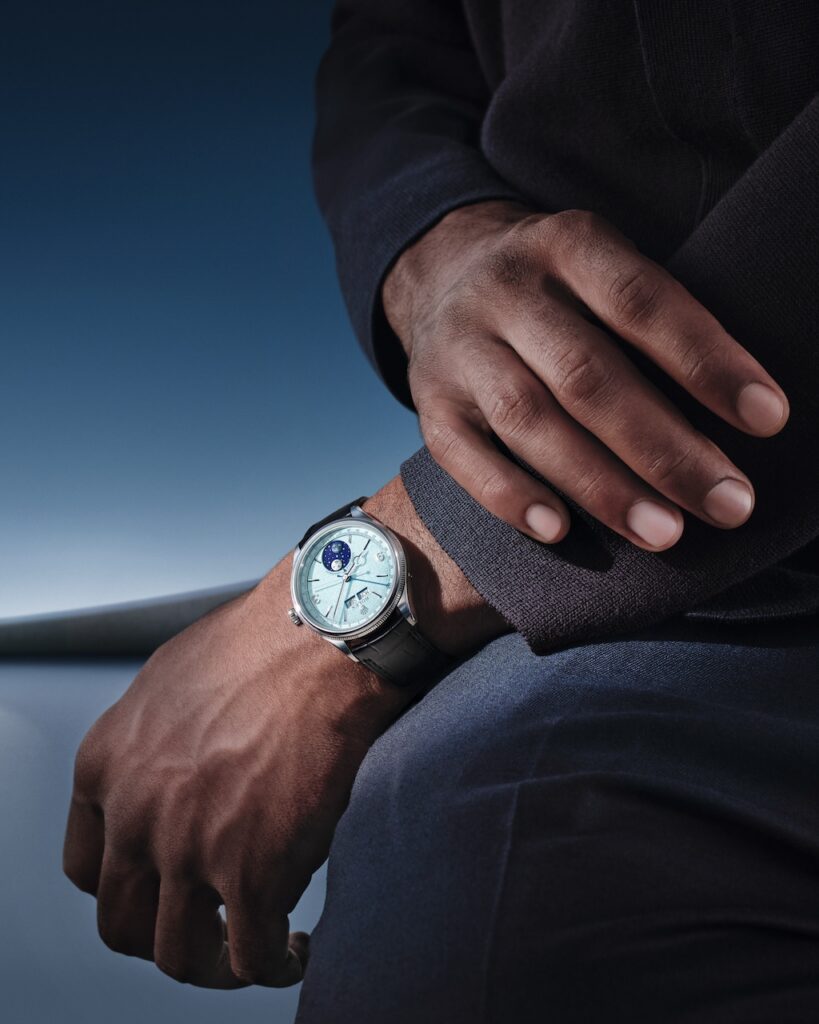
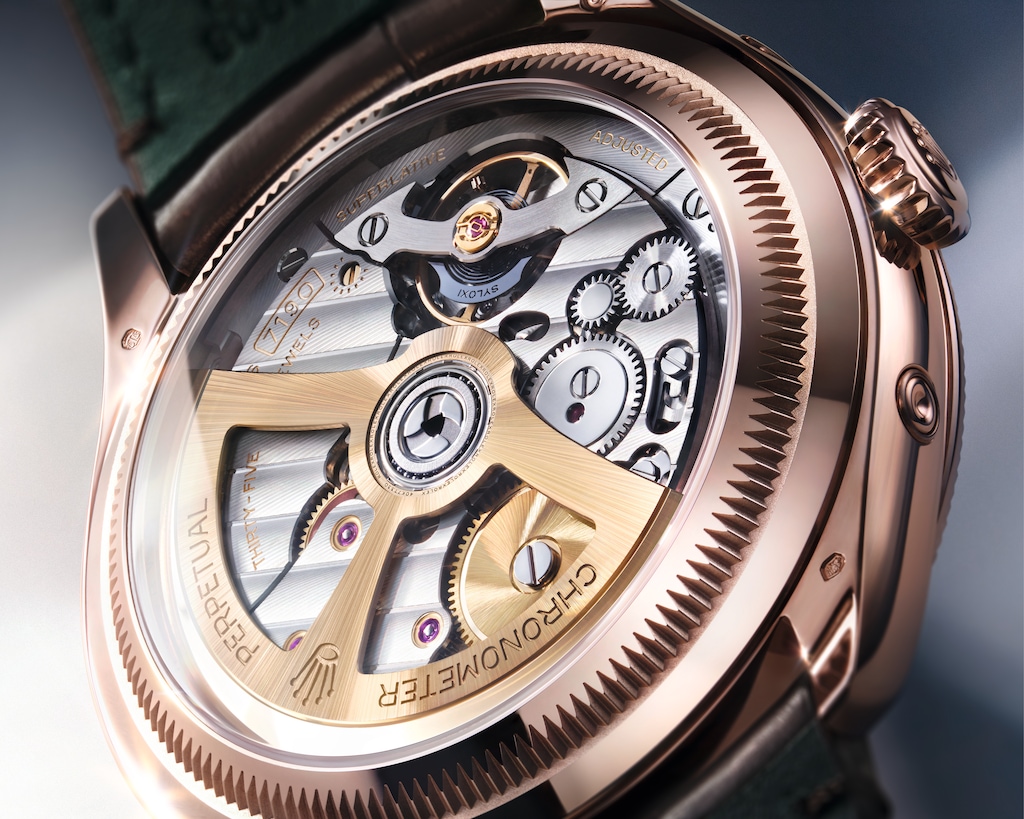
    A historic Rolex name returns in a 39mm creation that brings together an instantaneous complete annual calendar, a meteorite moonphase and a new movement built around some of the brand’s latest technical developments.

    A smartphone knows the date.

    It knows the day, the month and, with a quick glance, the phase of the moon.

    So why would anyone still build a mechanical watch that does all of this through gears, levers, springs and a movement beating five times every second?

    Because mechanical watchmaking has never really been about necessity.

    It is about turning something as ordinary as the passage of time into an object worth looking at.

    That idea sits at the heart of the Rolex Perpetual Padellone, the latest addition to Rolex’s Perpetual collection. Introduced in September 2026, the watch brings together an instantaneous complete annual calendar, a moonphase display and a new self-winding movement, combining traditional watchmaking ideas with contemporary Rolex engineering.

    Its name, however, comes from much further back.

    The Padellone takes its identity from Rolex reference 8171, an earlier Rolex timepiece with a complete calendar that became known to collectors as the “Padellone.” Rolex describes the new watch as a natural continuation of that heritage.

    But this is not simply an exercise in recreating the past.

    The historical name provides the starting point.

    The engineering is entirely of its time.

    Perpetual Padellone, 18 ct Everose gold

    THE RETURN OF THE PADELLONE

    There is something fascinating about the way Rolex uses its history.

    Reference 8171 established the Padellone name within the brand’s story of complete-calendar watches. Decades later, Rolex has taken that name and attached it to a watch built around an entirely new movement and a considerably more sophisticated calendar mechanism.

    The connection is therefore not about reproducing an old design piece by piece.

    It is about continuing an idea.

    The calendar remains central.

    But now it sits alongside a moonphase display, an instantaneous calendar change and calibre 7190, a movement developed specifically for the new watch.

    The result is a conversation between two eras of Rolex watchmaking.

    One provides the name.

    The other provides the mechanics.


    WHAT EXACTLY IS THE PERPETUAL PADELLONE?

    At its most basic, the Perpetual Padellone displays:

    Hours. Minutes. Seconds. Date. Day. Month. Moonphase.

    But the way it handles the calendar is what makes the watch particularly interesting.

    Rolex calls it an instantaneous complete annual calendar.

    The first important word is annual.

    Through Rolex’s patented Haplos system, the mechanism differentiates between months containing 30 days and those containing 31 days.

    That means the wearer only needs to make one calendar adjustment each year: when February turns to March.

    Then comes instantaneous.

    At midnight, the day, date and month change simultaneously in a fraction of a second.

    Rather than having the three indications transition independently, Rolex has engineered them to jump together, maintaining their alignment. A patent application has also been filed for this mechanism.

    On the dial, the day and month appear in two apertures at 12 o’clock, while a blue central hand with a crescent moon at its tip points towards the date around the circumference.

    It is an impressive amount of information presented with remarkably little visual noise.


    Perpetual Padellone, 950 platinum

    THE HAPLOS SYSTEM

    The mechanism behind the annual calendar is called Haplos.

    Rolex says the system consists of only two components coupled to the date mechanism: an additional carrier finger and an annual lever.

    The programming of the annual calendar is incorporated into the reverse side of the month disc.

    That information tells the annual lever which month is currently being displayed, allowing the mechanism to distinguish between 30-day and 31-day months.

    The result is remarkably simple from the wearer’s perspective.

    The watch understands the difference between the months.

    The wearer doesn’t have to.

    Only February requires intervention.

    And when the calendar reaches midnight, the three indications change together.

    The sophistication is hidden exactly where it should be: inside the movement.


    THEN THERE IS THE MOON

    At six o’clock, the Padellone introduces another rhythm entirely.

    A blue enamelled moonphase disc completes one rotation every 29.53 days, corresponding to the lunar month.

    But the moonphase isn’t simply a decorative complication.

    The full moon and new moon displayed on the disc are made from meteorite.

    The new moon is treated with a dark-blue PVD coating, while the silver stars are pad printed onto the disc.

    It gives the watch an unusual relationship with the natural world.

    The calendar follows the structure of the year.

    The moonphase follows the lunar cycle.

    And both are being translated into mechanical motion on the wrist.

    Rolex itself describes the moonphase as a link between the rhythm of the Moon and that of the Earth—a small window onto the night sky.


    A DIAL BUILT AROUND RESTRAINT

    The dial of the Perpetual Padellone is finished with a grained texture across most of its surface, while the outer edge receives a fine satin finish.

    The date scale is inscribed in black around the periphery.

    A blue central hand, finished with its crescent-moon tip, indicates the date.

    At 12 o’clock, the day and month appear through two apertures, both displayed in English.

    At six, the blue moonphase disc provides the visual counterpoint.

    There is a lot happening here.

    But the dial doesn’t look crowded.

    That is perhaps one of the watch’s more understated achievements.

    The complication is visible without becoming the aesthetic.


    Calibre 7190, Perpetual Padellone, 18 ct Everose gold

    THE 39MM CASE

    The Perpetual Padellone measures 39mm in diameter.

    Its case combines graceful lines with a bezel that is both domed and subtly fluted. The middle case incorporates correctors on its sides for the calendar functions, while the upper edges of the lugs receive gentle chamfering.

    The domed sapphire crystal and transparent sapphire caseback both receive anti-reflective coating.

    The watch is waterproof to 50 metres / 165 feet.

    The case is offered in 18 ct Everose gold or 950 platinum.

    The transparent caseback is particularly important to the character of the watch.

    It allows the movement to become part of the visual experience rather than remaining entirely hidden.

    Through it, Rolex’s finishing can be seen, including bridges decorated with Rolex Côtes de Genève and a cut-out oscillating weight in yellow gold.


    THREE EXPRESSIONS OF THE PADELLONE

    Rolex presents the Perpetual Padellone in three configurations.

    EVEROSE GOLD WITH SETTIMO BRACELET

    The first combines an 18 ct Everose gold case with a grained-finish intense white dial and a Settimo bracelet fitted with a concealed Crownclasp.

    PLATINUM WITH ICE-BLUE DIAL

    The second features a 950 platinum case, a grained-finish ice-blue dial and a matt black alligator leather strap with a Dualclasp.

    EVEROSE GOLD WITH BROWN ALLIGATOR

    The third returns to 18 ct Everose gold and an intense white grained-finish dial, this time paired with a matt brown alligator leather strap and Dualclasp.

    The mechanical foundation remains the same.

    The material and strap combinations simply give the watch different expressions.


    THE SETTIMO BRACELET

    The Everose gold version with the bracelet introduces Rolex’s Settimo bracelet.

    Its links are made from seven very small, slightly contoured elements, polished on every surface. Rolex says this construction allows the bracelet to follow the shape of the wrist while remaining particularly lightweight.

    The bracelet uses a special attachment system to the middle case for which a patent application has been filed.

    A concealed folding Crownclasp completes the design, maintaining the visual continuity of the bracelet.

    The leather versions take a different approach.

    The matt brown and matt black alligator straps feature green calfskin lining, tone-on-tone stitching and a Dualclasp, a double folding clasp designed to sit centred on the wrist.

    The details are subtle.

    That is exactly the point.


    CALIBRE 7190: THE ENGINE INSIDE

    If the dial is where the Padellone tells its story, calibre 7190 is where that story becomes mechanical.

    The movement is entirely developed and manufactured by Rolex and is exclusive to the Perpetual Padellone.

    It is a self-winding mechanical movement operating at 5 hertz and delivering an approximately 66-hour power reserve. Rolex places it within the 71XX family and notes that it is thinner than the majority of its movements.

    The movement is protected by 30 patent applications, two of which are exclusive to the watch.

    Calibre 7190 is based on the design of calibre 7135, unveiled with the Land-Dweller in 2025, and incorporates the same regulating system built around the Dynapulse escapement and advanced oscillator.

    But the movement has been developed around the Padellone’s annual-calendar architecture.

    This is where the watch’s various ideas converge.

    Calendar.

    Moonphase.

    Precision.

    Energy.

    All of them have to work together inside a single movement.


    DYNAPULSE

    The Dynapulse escapement is a sequential-distribution escapement made from silicon.

    Rolex says it combines excellent energy efficiency with dependability and resistance to strong magnetic fields.

    The technology is the subject of seven patent applications. It was inaugurated with calibre 7135 in the Land-Dweller in 2025.

    For calibre 7190, Dynapulse becomes part of a movement that has to manage the additional demands of an instantaneous annual calendar.

    It is another example of how the Padellone combines a traditional complication with more recent Rolex movement technology.


    THE SYLOXI HAIRSPRING

    Calibre 7190 also uses a Syloxi hairspring made from silicon.

    Rolex highlights its resistance to strong magnetic fields, thermal stability and high shock resistance.

    The geometry of the hairspring is patented and designed to help maintain the calibre’s regularity in different positions.

    For calibre 7190, the Syloxi coils are particularly thick, providing greater rigidity. Rolex identifies this as an essential factor in allowing the movement to beat at 5 hertz.

    The specification therefore isn’t just a number on a technical sheet.

    The movement has been engineered around it.


    THE OSCILLATOR

    The oscillator of calibre 7190 contains a balance staff made from high-technology ceramic, a material Rolex describes as patented and exclusive to the brand.

    It is paired with a balance wheel made from optimized brass.

    The oscillator is mounted on Paraflex shock absorbers, which further enhance the movement’s resistance to shocks and help reposition the balance staff after impact. Rolex also says the system allows the balance to pivot smoothly and regularly in different positions.

    Once again, the philosophy is cumulative.

    Precision is not one component.

    It is the result of many components behaving correctly together.


    APPROXIMATELY 66 HOURS OF POWER

    The movement uses a self-winding system through a Perpetual rotor.

    Rolex attributes the approximately 66-hour power reserve to the architecture of the barrel and the efficiency of the escapement.

    For the wearer, that means the watch can continue running for almost three days when fully wound and left off the wrist.

    For Rolex, the more interesting story is how that autonomy is achieved while maintaining the performance expected from a movement operating at 5 hertz and carrying a sophisticated calendar mechanism.


    THE SUPERLATIVE CHRONOMETER

    The Perpetual Padellone carries Rolex’s Superlative Chronometer certification.

    Since 2026, the certification includes three additional testing criteria:

    Resistance to magnetism.

    Reliability.

    Sustainability.

    These supplement the existing criteria governing precision, waterproofness, self-winding and autonomy.

    Rolex’s precision requirement for the finished watch is particularly stringent.

    After the movement has been cased, the watch must achieve an accuracy of between −2 and +2 seconds per day.

    The distinction matters.

    Rolex is not talking only about the movement before it becomes a watch.

    The test applies to the finished object.

    The certification is represented by the Rolex green seal and is accompanied by an international five-year guarantee.


    HERITAGE WITHOUT REPRODUCTION

    This may be the most interesting thing about the Padellone.

    Rolex could have simply recreated the visual identity of reference 8171.

    Instead, the brand has taken the historical idea behind the Padellone and placed it inside an entirely contemporary technical framework.

    The name comes from the past.

    The annual-calendar concept connects it to traditional watchmaking.

    The moonphase gives the watch an astronomical dimension.

    Calibre 7190 brings in the latest generation of Rolex movement technology used in the watch.

    And Haplos introduces a new approach to the annual-calendar mechanism itself.

    The result is not a vintage watch wearing modern clothes.

    It is a modern watch carrying a historical name.

    That is a very different proposition.


    WHY DOES A MECHANICAL WATCH NEED TO KNOW THE MOON?

    This is perhaps the question that sits underneath the entire Padellone.

    We no longer need a mechanical watch to tell us what day it is.

    Our phones do it.

    Our computers do it.

    Our cars do it.

    Our calendars correct themselves.

    The moonphase is available with a search.

    Information has become almost frictionless.

    Mechanical watchmaking moves in the opposite direction.

    It takes something simple and makes it physical.

    A date becomes a system of wheels and levers.

    A change of month becomes an instantaneous mechanical event.

    The moon becomes a disc completing one revolution every 29.53 days.

    A movement becomes something that can be seen through sapphire.

    That is the paradox at the heart of modern mechanical luxury.

    Technology has made time easier to access.

    Watchmaking makes time more tangible.

    And perhaps that is why complications still matter.

    Not because we need them.

    Because we want to understand them.


    THE PADELLONE, RECONSIDERED

    The Perpetual Padellone is ultimately less about adding more information to a watch than about making information meaningful again.

    The calendar tells us where we are in the year.

    The moonphase reminds us that time does not move according to a single rhythm.

    The movement turns those rhythms into something physical.

    And the case brings the entire system into an object designed to be worn, handled and looked at.

    That is where the Padellone becomes particularly interesting within Rolex’s broader approach to watchmaking.

    It does not abandon tradition in favour of technology.

    Nor does it rely on tradition alone.

    Instead, the two are made to work together.

    The historical Padellone provides the name.

    Haplos provides a new approach to the calendar.

    Calibre 7190 provides the mechanical architecture.

    The moonphase gives the watch its poetry.

    And the transparent caseback lets the wearer see some of the work behind the result.


    WHEN TIMES ALIGN

    The Perpetual Padellone is an unusual kind of Rolex.

    It is not trying to make time louder.

    It is making time more interesting.

    At 39mm, it remains relatively restrained in proportion. Its dial is carefully balanced. Its calendar information is integrated rather than shouted. Its moonphase introduces a quiet sense of astronomy.

    And underneath it all is a movement designed specifically for the watch, operating at 5 hertz, with approximately 66 hours of power reserve and protected by 30 patent applications.

    The name may belong to Rolex’s past.

    The engineering does not.

    That is ultimately what makes the Perpetual Padellone worth paying attention to.

    It is not simply a return.

    It is a continuation.

    A historical idea has been taken apart, reconsidered and rebuilt with the tools of contemporary watchmaking.

    And perhaps the most beautiful irony is that Rolex has created such a complicated way to remind us of something incredibly simple:

    Time passes.

    We can measure it.

    We can display it.

    We can engineer it.

    But we can also make something beautiful enough to make us stop and look at it.

    That is the Perpetual Padellone.

    And that is when times align.

    INSYDE MAGAZINE
    Luxury, Through a Different Lens.

  • WHEN DIAMONDS START TO MOVE

    WHEN DIAMONDS START TO MOVE

    Jacob & Co.’s Brilliant Flying Tourbillon Baguette Pastel Arlequino turns a technically sensitive component of a mechanical movement into a moving expression of high jewellery.

    There are watches that use diamonds to catch the light. And then there are watches that make the light move.

    With the Brilliant Flying Tourbillon Baguette Pastel Arlequino, Jacob & Co. has placed 54 brilliant-cut white diamonds directly onto the balance wheel—one of the most technically sensitive components inside a mechanical watch. As the balance oscillates, the stones move with it, transforming a regulating organ normally appreciated by watchmakers into part of the visual performance.

    It is an unusual place to put jewellery. More importantly, it is an unusual place to put additional weight.

    That distinction is what makes this particular Jacob & Co. creation worth looking beyond the obvious spectacle.

    The watch is a one-of-a-kind piece within the brand’s Brilliant Flying Tourbillon collection, combining an 18K white-gold case, an intricate arrangement of pastel sapphires and diamonds, a flying tourbillon and the self-winding JCFA02 calibre. But its most interesting idea is not simply how much has been set onto the watch. It is where the decoration has been allowed to enter the mechanics.

    THE DIAMOND THAT MOVES

    A balance wheel is fundamental to the operation of a mechanical watch.

    Working with the hairspring, it forms part of the regulating system that governs the movement’s rate. It oscillates back and forth at a precise frequency, controlling the release of energy through the escapement and, ultimately, the measurement of time.

    Its mass and weight distribution therefore matter enormously.

    Adding gemstones to a component whose behaviour depends on precise mass distribution is not comparable to setting diamonds into a case or dial. Every additional element has the potential to influence the balance’s characteristics.

    Jacob & Co.’s approach was to engineer the balance wheel specifically to accommodate the 54 diamonds while retaining the characteristics required for the movement’s operation. The result is a regulating component that is simultaneously mechanical architecture and moving jewellery.

    The effect becomes particularly striking when the watch is running.

    The diamond-set balance wheel oscillates at 21,600 vibrations per hour, or 3Hz, while the flying tourbillon completes one rotation every 60 seconds. Their independent movement continually changes the relationship between the diamonds and the surrounding light.

    The sparkle is therefore not static.

    It travels.

    That is a subtle but important distinction in a category where gemstone setting has traditionally been about controlling how light interacts with a fixed surface.

    WHERE JEWELLERY MEETS MECHANICS

    The idea itself has historical echoes.

    Attempts to place diamonds directly onto balance wheels can be traced to experiments by watchmakers in the 19th century. As mechanical watchmaking became increasingly focused on precision, however, the regulating organ became a particularly unforgiving place for additional weight and decoration.

    Jacob & Co. is revisiting that territory with contemporary engineering.

    It is a fitting direction for a brand whose watchmaking has consistently treated mechanical complication as something to be seen rather than hidden. From its highly architectural creations to its flying tourbillons, the company has repeatedly placed movement and spectacle in the same conversation.

    The Pastel Arlequino takes that philosophy one step further.

    Instead of merely exposing the mechanism, it makes one of its most delicate components part of the jewellery language.

    A PALETTE BUILT LIKE A MOSAIC

    The movement may provide the watch’s technical argument, but the exterior provides its immediate identity.

    The 42mm 18K white-gold case is set with 194 baguette-cut pastel sapphires, totalling approximately 11.03 carats, alongside 32 white diamonds. The crown carries another 12 baguette-cut sapphires and one white diamond.

    The dial continues the composition with 139 baguette-cut pastel sapphires and 23 white diamonds.

    Across the watch, the stones are arranged in contrasting shades of green, blue, lavender and pink. Rather than creating a conventional colour gradient, the arrangement keeps the individual colours distinct, producing a geometric, almost mosaic-like effect.

    The name Arlequino points to the visual reference behind that arrangement: Arlecchino, the colourful character of the Italian commedia dell’arte, whose costume is traditionally associated with contrasting geometric patches.

    Here, that idea is translated into high jewellery.

    The pastel palette is particularly effective because it avoids the obvious route of simply making the watch louder. The colours introduce playfulness without abandoning the precision demanded by baguette-cut stones and invisible setting.

    And invisible setting matters.

    With the stones secured from beneath, the visible surfaces avoid the interruption of conventional prongs or exposed metal between individual gemstones. The result is a continuous field of colour across the case and dial.

    THE ART OF MAKING THE MECHANICAL VISIBLE

    There is an interesting tension at the centre of the Pastel Arlequino.

    A traditional high-jewellery watch can be understood primarily through its materials: precious metal, diamonds, coloured gemstones and craftsmanship.

    A high-complication watch is understood differently. Its value is tied to what happens beneath the surface—the architecture, engineering and precision of the movement.

    Jacob & Co. does not appear particularly interested in choosing between the two.

    The JCFA02 calibre combines a micro-rotor and flying tourbillon, operates at 3Hz and offers a 72-hour power reserve. The movement measures 30.4mm in diameter by 6.9mm thick and comprises 184 components.

    Even the movement bridges receive the jewellery treatment, with 234 brilliant-cut white diamonds totalling approximately 0.69 carats.

    But the balance wheel is different.

    The bridges are decorative surfaces.

    The balance wheel is in motion.

    That makes the 54 diamonds set onto it more than another gemstone count. They become part of the watch’s kinetic identity.

    WHEN DECORATION BECOMES PERFORMANCE

    This is where the Pastel Arlequino becomes more interesting than its specifications initially suggest.

    High watchmaking has spent decades finding new ways to expose movement. Sapphire dials, skeletonisation, openworked bridges and visible tourbillons have all made the mechanics of a watch increasingly central to its visual language.

    Jacob & Co.’s answer is to make the mechanics themselves decorative.

    The diamond-set balance wheel is not simply something to admire through an opening in the dial. It is constantly changing position. Every oscillation changes the angle at which its diamonds meet the light.

    At the same time, the flying tourbillon turns once per minute.

    Two different mechanical rhythms therefore operate within the same visual field.

    One oscillates.

    One rotates.

    Both catch the light.

    The result is almost closer to kinetic jewellery than conventional watch decoration.

    A WATCH BUILT AROUND CONTRAST

    The Arlequino concept also depends on contrast.

    Pastel sapphires meet brilliant-cut diamonds. Fixed gemstone surfaces surround moving mechanical elements. A playful colour palette is placed over a movement whose purpose remains intensely precise.

    Even the strap deliberately steps back.

    The watch is paired with an alligator strap and an 18K white-gold tang buckle set with 21 baguette-cut pastel Arlequino sapphires, approximately 1.52 carats.

    Across the complete piece, Jacob & Co. uses 366 sapphires distributed across the case, dial, crown and buckle.

    The numbers are impressive, but they are not really the story.

    The story is what happens when those stones are integrated into an object whose fundamental purpose is to measure time.

    THE IMPOSSIBLE, MADE VISIBLE

    Jacob & Co. has long occupied an unusual position in contemporary high watchmaking.

    The brand’s most recognisable creations rarely attempt to disappear beneath the cuff. They embrace theatricality, mechanical animation and jewellery as part of the same vocabulary.

    The Brilliant Flying Tourbillon Baguette Pastel Arlequino is very much part of that tradition.

    But the diamond-set balance wheel gives it a more technical proposition.

    It asks a question that is surprisingly simple:

    What happens when a component designed for precision becomes part of the spectacle?

    The answer is not another static display of precious stones.

    It is movement.

    And movement changes the way jewellery is perceived.

    A diamond on a bezel reflects light.

    A diamond on a moving balance wheel appears to participate in time itself.

    THE NEW LANGUAGE OF HIGH-JEWELLERY WATCHMAKING

    There is a broader shift visible here.

    High-jewellery watches have increasingly moved away from treating gemstone setting and mechanical watchmaking as separate disciplines. The most compelling contemporary pieces often ask how the two can interact—how a material can influence the movement, how a complication can become visual theatre, or how a mechanical component can become part of the aesthetic experience.

    The Pastel Arlequino sits squarely within that territory.

    Its sapphires create the first impression.

    Its tourbillon provides the familiar horological spectacle.

    But the balance wheel creates the surprise.

    That is ultimately why the watch feels more considered than its exuberant appearance might suggest. Beneath the colour and brilliance is an attempt to integrate jewellery into the functioning architecture of the movement rather than simply placing it around the movement.

    For a one-of-a-kind creation, that is a more compelling proposition than simply being extravagant.

    INSYDE PERSPECTIVE

    The most interesting luxury objects are rarely interesting because they contain the most expensive materials.

    They become interesting when those materials are made to do something unexpected.

    Jacob & Co.’s 54-diamond balance wheel is precisely that kind of idea. The diamonds are not simply there to increase the visual value of the watch. They have been incorporated into a component whose behaviour depends on precise engineering, turning a regulating organ into part of the watch’s visual performance.

    The Pastel Arlequino consequently sits somewhere between haute horlogerie and high jewellery without needing to choose one over the other.

    It is a watch where precision creates spectacle, and spectacle reveals precision.

    And when the diamonds begin to move, the distinction between decoration and mechanics becomes considerably harder to draw.

  • Why Watches Are No Longer Just About Time

    Why Watches Are No Longer Just About Time

    In an age when a smartphone can tell the time with extraordinary precision, the mechanical watch has survived by becoming something else entirely — an object of craftsmanship, identity, history and desire.

    There is something almost irrational about wanting a mechanical watch in 2026.

    Your phone tells the time more accurately.

    Your smartwatch can track your heart rate, count your steps, read your messages and remind you about your next meeting.

    A digital clock costs almost nothing.

    And yet people continue to spend lakhs — sometimes far more — on objects whose most obvious function can be performed by something already sitting in their pocket.

    That contradiction is precisely what makes the luxury watch so fascinating.

    A great watch was never really just about telling time.

    It is about what you choose to wear when you don’t need to.

    And in India, that choice is becoming increasingly interesting.

    India’s Watch Moment Is Getting Bigger

    For years, India’s luxury-watch culture was relatively contained.

    There were established collectors, traditional luxury buyers, wedding purchases and a handful of names that dominated the conversation.

    That world still exists.

    But it is expanding.

    In the first half of 2026, India imported around 200,000 Swiss watches, up nearly 37% from the same period a year earlier. The value of those imports rose by more than 31% to approximately 168.7 million Swiss francs.

    The numbers are significant.

    But the more interesting story is what they suggest about the Indian consumer.

    India is becoming increasingly important to international watchmakers at a time when the global Swiss watch industry is facing a more complicated environment.

    Brands are responding.

    The opportunity is no longer simply about selling watches.

    It is about understanding a new generation of Indian buyers who are becoming more curious about what they wear, why they wear it and what exists beyond the obvious names.

    The Watch as a Personal Signature

    Luxury has always been partly about recognition.

    A famous name can tell people what you own.

    A watch can reveal something more subtle:

    why you chose it.

    One person might choose a restrained dress watch because they appreciate proportion and simplicity.

    Another might choose an unusual independent watch because the obvious answer doesn’t interest them.

    Someone else might collect vintage pieces because history matters more than novelty.

    Another collector might be fascinated by movements, complications and the engineering hidden beneath the dial.

    Two people can spend the same amount of money and end up with completely different watches.

    That is where collecting becomes personal.

    The watch stops being merely an accessory.

    It becomes a signature.

    And unlike many luxury objects, it sits unusually close to the body.

    You don’t simply own it.

    You live with it.

    Why Mechanical Watches Still Matter

    The mechanical watch is an extraordinary piece of technology precisely because it is unnecessary.

    Inside a traditional mechanical movement, hundreds of components work together to measure something humans can now measure more cheaply and accurately in countless other ways.

    There is no screen.

    No notification.

    No app.

    No charging cable.

    Just gears, springs, wheels and precision.

    The complexity is no longer necessary.

    It is chosen.

    That may be one of the most fundamental ideas behind luxury itself.

    Luxury often begins where necessity ends.

    A mechanical watch takes an ordinary function and turns it into an object of craftsmanship.

    The movement becomes part of the story.

    The finishing becomes part of the story.

    The sound becomes part of the story.

    Even the ritual of winding or setting the watch can become part of the experience.

    The technology may be centuries old.

    The fascination is not.

    The Indian Buyer Is Becoming More Informed

    Perhaps the most important change in India’s watch market is not simply that more people are buying luxury watches.

    It is that buyers are becoming more curious about what they are buying.

    The Indian market is attracting a younger customer base, while interest in premiumisation, design and the emotional value of mechanical watches continues to grow.

    The first luxury watch might still be about recognition.

    The second might be about design.

    The third might be about the movement.

    The fourth might be about finding something nobody around you is wearing.

    That is how collecting becomes interesting.

    Not necessarily with wealth.

    With curiosity.

    Beyond the Obvious Names

    There is nothing wrong with choosing one of the world’s most recognisable watchmakers.

    Heritage matters.

    Craftsmanship matters.

    Consistency matters.

    Generations of watchmaking expertise do not disappear simply because consumers become more experimental.

    But luxury has always had another side.

    The world of independent watchmaking can be wonderfully strange.

    Smaller workshops.

    Unusual complications.

    Experimental materials.

    Unexpected dial designs.

    Limited production.

    Designs that reward attention rather than immediate recognition.

    For someone who already knows the obvious names, discovery becomes part of the pleasure.

    The question changes from:

    “How famous is the brand?”

    to:

    “How interesting is the watch?”

    That is where the watch begins to move closer to art.

    Quiet Luxury Has Reached the Wrist

    For years, bigger often meant more luxurious.

    Large cases.

    Gold.

    Diamonds.

    Complicated dials.

    Visual presence.

    But the mood is becoming more nuanced.

    Indian luxury-watch retailers and brands have been reporting stronger interest in smaller, more understated watches, reflecting a broader movement towards quieter expressions of luxury.

    A 39mm watch can communicate confidence without demanding attention.

    A simple dial can require more appreciation than a complicated one.

    A watch without diamonds can sometimes be more difficult to understand — and therefore more interesting.

    This is where the phrase quiet luxury becomes useful.

    Not because understated automatically means better.

    But because sophistication increasingly depends on recognising quality without needing it to announce itself.

    The most interesting watch in the room may not be the one everyone notices first.

    It might be the one only another collector recognises.

    A Watch Can Become a Memory

    There is another reason watches occupy such a unique place in luxury.

    They age with you.

    A smartphone becomes obsolete.

    A car eventually changes hands.

    Fashion moves on.

    A watch can remain.

    It might be purchased to mark a promotion.

    A wedding.

    A birthday.

    A first business success.

    A significant journey.

    Or simply the moment someone decides that they want to own something beautiful.

    Years later, the object carries the memory.

    The scratches become part of it.

    The worn strap becomes part of it.

    The person who originally wore it may no longer be the person wearing it.

    That is why watches can become heirlooms.

    Not simply because they are valuable.

    Because they are portable pieces of memory.

    The Indian Heirloom Instinct

    India already understands the emotional value of objects that move through generations.

    Jewellery is inherited.

    Saris become family archives.

    Furniture survives marriages, houses and cities.

    Objects accumulate stories.

    The mechanical watch fits naturally into that tradition.

    A watch bought today can eventually become something else entirely.

    It can become the watch your child remembers seeing on your wrist.

    Then the watch your child wears years later.

    Its monetary value may matter.

    But its emotional value can become greater.

    The modern luxury watch is, in that sense, not entirely foreign to India.

    It simply gives an old idea a new form.

    Watches Are Becoming Part of a Larger Luxury Culture

    The modern watch does not exist in isolation.

    It sits inside a much larger cultural ecosystem.

    Fashion.

    Automobiles.

    Sport.

    Art.

    Travel.

    Architecture.

    Technology.

    Formula 1 has become deeply connected to luxury watchmaking.

    Tennis has long provided another meeting point between watches, sport and fashion.

    Automobile enthusiasts often move naturally between collecting cars and collecting watches.

    Fashion houses collaborate with watchmakers.

    Artists reinterpret watch design.

    Luxury hotels create experiences around collectors and horology.

    The watch has become part of a larger conversation about how people express taste.

    And this is where watches become particularly relevant to INSYDE.

    We aren’t interested only in what is on the wrist.

    We’re interested in what the wrist tells us about the person wearing it — and the culture around them.

    The New Luxury Collector Doesn’t Always Want the Obvious

    There is a difference between being able to buy a luxury watch and becoming genuinely interested in watches.

    The first is financial.

    The second is cultural.

    A collector starts noticing details.

    The movement beneath the dial.

    The finishing on a bridge.

    The proportions of a case.

    The history of a reference.

    The difference between a manufacture movement and an outsourced calibre.

    The story behind an independent watchmaker.

    The way a watch changes on the wrist.

    This knowledge creates another form of luxury.

    Knowing what you’re looking at.

    And perhaps that is where the next generation of Indian watch culture becomes particularly interesting.

    The consumer is no longer dependent entirely on a salesperson to explain why something matters.

    Information is everywhere.

    Collectors can study movements, follow independent makers, compare references and discover watches from almost anywhere in the world.

    The result is a more informed buyer.

    And a more demanding one.

    India’s Watch Market Is Becoming More Sophisticated

    India’s growth is happening at an interesting moment for the global industry.

    Swiss watch exports declined in 2025, while India continued to show strong momentum.

    That contrast has made India increasingly difficult for global watchmakers to ignore.

    Retail networks are expanding.

    New boutiques are opening.

    Brands are investing in local teams and customer experiences.

    And younger buyers are entering categories that were once associated primarily with older collectors.

    The opportunity is not simply to sell more watches.

    It is to build a deeper watch culture.

    That means better retail experiences.

    More education.

    More access to interesting independent makers.

    More collecting communities.

    More conversations around craftsmanship.

    And eventually, perhaps, a stronger Indian voice within global horology.

    The Watch Doesn’t Need to Compete With Your Phone

    Perhaps the easiest mistake is to ask whether a mechanical watch can compete with technology.

    It can’t.

    It shouldn’t.

    Your phone tells you the time.

    Your watch tells you why you chose to wear it.

    One provides information.

    The other provides expression.

    One is designed around constant updates.

    The other can remain largely unchanged for decades.

    One is expected to be replaced.

    The other can be designed to survive you.

    That is why the mechanical watch continues to matter.

    It offers something technology has made increasingly rare:

    a reason to keep something simply because it is beautifully made.

    So, Why Do We Still Want Watches?

    Because we don’t really buy them for the time.

    We buy them for the engineering.

    The craft.

    The history.

    The design.

    The ritual.

    The memory.

    The weight on the wrist.

    The quiet movement beneath the dial.

    And sometimes, simply because we love the way they look.

    There is nothing irrational about that.

    Luxury has never been entirely rational.

    It exists in the space between need and desire.

    Few objects occupy that space as elegantly as the mechanical watch.

    India’s Time Is Changing

    India’s watch story is no longer simply about importing more Swiss watches.

    It is about a new generation learning to appreciate what makes a watch worth wearing.

    The buyer is becoming younger.

    The market is becoming deeper.

    The choices are becoming wider.

    And the conversation is moving beyond logos.

    For the next generation of Indian collectors, the most interesting watch may not necessarily be the most recognisable one.

    It may be the one with the most compelling story.

    The most beautiful movement.

    The most unusual design.

    The strongest connection to its maker.

    Or simply the one that means something to the person wearing it.

    Because when everyone can check the time on a phone, a mechanical watch has to offer something else.

    It has to give you a reason to keep looking at it.

    And increasingly, in India, people are learning exactly where to look.

    INSYDE — Inside modern luxury.

  • THE SOUND OF LUXURY

    THE SOUND OF LUXURY

    Inside Piaget’s extraordinary new Polo Minute Repeater — where ultra-thin engineering, acoustic precision and hand craftsmanship turn the passing of time into an experience.

    We live in a world where time has become almost impossible to ignore.

    It appears on our phones, our laptops, our cars, our walls and the screens we glance at without thinking.

    And yet, somewhere in Switzerland, Piaget has spent years perfecting a very different idea:

    What if you could hear it?

    The new Piaget Polo Minute Repeater doesn’t need to exist.

    That is exactly what makes it fascinating.

    It takes one of the most demanding complications in mechanical watchmaking and places it inside Piaget’s unmistakably modern Polo — a large 18-karat white-gold watch measuring 48mm across and just 9.30mm thick. Inside sits the self-winding Calibre 1290P, an ultra-thin movement developed, finished and assembled at Piaget’s Manufacture in La Côte-aux-Fées.

    This isn’t simply another complicated luxury watch.

    It is Piaget making an argument about what luxury can still mean when technology has already made everything easier.

    THE MOST UNNECESSARY COMPLICATION MAY BE THE MOST BEAUTIFUL

    A minute repeater is an almost wonderfully irrational piece of engineering.

    Activate it, and the mechanism chimes the time.

    Hours.

    Quarter hours.

    Minutes.

    That’s it.

    Your phone can tell you the same thing instantly.

    But a phone doesn’t need hundreds of mechanical components moving in sequence, carefully tuned hammers, resonating structures and years of accumulated watchmaking knowledge to do it.

    A minute repeater does.

    And that is where the fascination begins.

    Luxury has always been at its most interesting when it moves beyond necessity.

    A private jet isn’t necessary.

    A hand-finished grand complication isn’t necessary.

    A bespoke suit isn’t necessary.

    The point is not efficiency.

    The point is experience.

    The Polo Minute Repeater takes that idea to its most literal conclusion.

    It doesn’t simply show you the time.

    It gives time a voice.

    WHEN A WATCH BECOMES AN INSTRUMENT

    The real achievement isn’t merely making the mechanism chime.

    It is making it sound right.

    Piaget says the 1290P produces 64 decibels of acoustic intensity, with three harmonic partials and a damping factor of 2,600. The hours are struck at G sharp and the minutes at A sharp, both in the fifth octave. The activation slide sits at nine o’clock.

    For someone who doesn’t spend weekends discussing calibres, those specifications may sound unnecessarily technical.

    They are.

    But beautifully so.

    Because they are ultimately about something remarkably simple:

    sound.

    The movement and the case have to work together to create an acoustic experience.

    And suddenly, this isn’t just watchmaking anymore.

    It is a form of mechanical acoustics.

    The watch has to keep time.

    It has to fit inside an extraordinarily thin architecture.

    And then, when asked, it has to perform.

    PIAGET DIDN’T HIDE THE MAGIC

    This is perhaps the most INSYDE-worthy part of the watch.

    Piaget could have hidden the mechanism.

    Instead, it opened the door.

    The Polo Minute Repeater uses a partially openworked dial to reveal parts of the 1290P beneath it. At four o’clock, a smoked-blue sapphire ring sits over the inertia wheel — the dedicated regulator of the minute repeater — while a gold fillet travels across the dial and reveals sections of the mechanism.

    The effect is subtle.

    And that’s important.

    This isn’t skeletonisation for the sake of showing off every gear.

    The mechanism becomes part of the composition.

    The engineering becomes decoration.

    The decoration becomes engineering.

    You aren’t simply looking at the finished object. You’re being invited to understand why it is extraordinary.

    That is a very different kind of luxury.

    THE REAL COST ISN’T GOLD

    The case is made from 18-karat white gold.

    The strap is blue textured calfskin.

    The dial is gold, hand-guilloché and finished with a radiant sunray pattern, with an opaline outer track adding contrast.

    All of that sounds luxurious.

    But none of it is the most valuable material inside this watch.

    That would be time itself.

    Piaget says more than 150 hours went into developing the dial, followed by another 50 hours of hand finishing for each individual piece. The calibre’s bridges are hand-beveled, its mainplate carries guilloché decoration, and its minute-repeater hammers receive a mirror polish.

    Think about that.

    In an era where almost everything is optimised to be faster, Piaget is deliberately creating something that takes longer.

    Much longer.

    And that may be the real luxury story here.

    THE PIAGET PARADOX

    Piaget has been chasing thinness for generations.

    Georges-Édouard Piaget founded the Maison in the Swiss Jura in 1874, with a principle that would become central to its identity: “always do better than necessary.” Ultra-thin watchmaking eventually became one of the defining expressions of that philosophy.

    In 2013, Piaget introduced a minute repeater in the Polo Emperador case that the Maison presented as the world’s thinnest minute repeater at the time. The new Polo Minute Repeater carries that legacy into the contemporary Polo collection.

    And this is where Piaget’s philosophy becomes interesting.

    The goal isn’t simply:

    Can we make a complicated watch?

    The better question is:

    Can we make a complicated watch thinner, more wearable and more beautiful than it has any practical reason to be?

    The 1290P is just 4.8mm thick.

    The complete watch is 9.30mm thick.

    And yet inside that relatively restrained vertical space is an automatic minute-repeating mechanism with roughly 430 components, developed entirely at La Côte-aux-Fées.

    That contradiction is quintessentially Piaget.

    More complexity. Less thickness.

    WHY PUT IT IN A POLO?

    This is where the watch becomes more than a technical exercise.

    The minute repeater is one of traditional watchmaking’s most classical complications.

    The Polo is not.

    Since its arrival in 1979, the collection has represented a more contemporary side of Piaget — defined by its distinctive “shape-in-shape” architecture and its sport-chic identity.

    Putting the two together creates an interesting collision.

    Haute Horlogerie meets modern sports luxury.

    The result is not trying to look like a 19th-century pocket watch transferred onto a wrist.

    It is deliberately contemporary.

    Large.

    Architectural.

    Blue.

    Open.

    And technically serious.

    At 48mm, it is certainly not a watch designed to disappear beneath a shirt cuff.

    It wants to be noticed.

    But the thing worth noticing isn’t simply the size.

    It’s the contradiction:

    A sports watch carrying one of traditional watchmaking’s most demanding complications — while remaining only 9.3mm thick.

    FIVE WATCHES. NOT BECAUSE THEY HAD TO BE LIMITED.

    Only five numbered pieces of the Polo Minute Repeater are being crafted this year.

    But Piaget makes an interesting distinction.

    It isn’t presenting the watch as a conventional limited edition.

    The number is a consequence of the work required to make each piece.

    That difference matters.

    Luxury brands have become extremely good at creating scarcity.

    Five pieces can be a marketing strategy.

    But when five pieces are the natural result of hundreds of hours of specialist work, scarcity becomes something else.

    It becomes a by-product of craftsmanship.

    And perhaps that is a more convincing form of exclusivity.

    You aren’t being told that only five exist because five sounds exclusive.

    You’re being told that only five can realistically emerge from this level of human involvement.

    THEN PIAGET MAKES IT EVEN MORE EXTREME

    There is also a High Jewellery version.

    The bezel is set with baguette-cut blue sapphires, while the case combines baguette-cut and brilliant-cut diamonds. The dial is fully openworked, putting more than 70 hours of handcraft directly on display.

    It is almost excessive.

    And that’s the point.

    Piaget has never been particularly interested in choosing between watchmaking and jewellery.

    The Maison has historically operated comfortably in both worlds.

    Here, the two are fused into a single object:

    mechanical complexity beneath jewellery-level finishing, with sound as the final element.

    It doesn’t just ask to be seen.

    It asks to be heard.

    IN A WORLD OF SMARTWATCHES, PIAGET CHOSE SOUND

    There is an amusing irony to all of this.

    The smartwatch era has made watches smarter than ever.

    They track health.

    Messages.

    Calls.

    Maps.

    Markets.

    Flights.

    Sleep.

    The weather.

    The mechanical watch has responded by becoming something else entirely.

    An object of emotion.

    Craft.

    History.

    Identity.

    And now, with the Polo Minute Repeater, perhaps even theatre.

    Because the experience isn’t about information.

    You already know the time.

    The experience is the moment you activate the slide and the watch begins to speak.

    For a few seconds, you are not checking the time.

    You are experiencing it.

    That distinction is becoming increasingly important in luxury.

    THE REAL LUXURY IS TIME SPENT

    The most interesting thing about the Piaget Polo Minute Repeater isn’t the 48mm case.

    It isn’t the white gold.

    It isn’t even the complication.

    It is the philosophy behind the object.

    Someone decided that it was worth spending weeks finishing hundreds of components by hand so that a watch could perform something a phone can do instantly.

    Someone decided that the mechanism should be thin.

    Someone decided that parts of it should be visible.

    Someone decided that the sound itself had to be engineered.

    And someone decided that five watches a year was enough.

    None of those decisions were necessary.

    That is precisely why they matter.

    Modern luxury increasingly revolves around access — who can enter, who can own, who can experience, who can get there first.

    But there is another kind of exclusivity.

    The exclusivity of time.

    The time required to learn a craft.

    The time required to make something by hand.

    The time required to wait for something that cannot be rushed.

    And eventually, the time required to stop what you’re doing and simply listen.

    The Piaget Polo Minute Repeater doesn’t make time more useful.

    It makes it more memorable.

    And perhaps that is the point.

    In a world where technology has taught us to save every second, Piaget has created a watch that asks us to spend a few of them differently.

    Listening.
    INSYDE – Beyond the Spotlight

  • THE RICH BUY ROLEX. THE POWERFUL BUY PATEK.

    THE RICH BUY ROLEX. THE POWERFUL BUY PATEK.

    Two watches. Two worlds. And a question luxury has been asking for generations: what does the watch on your wrist say about you?

    There is a saying in the world of luxury watches:

    The rich buy Rolex. The powerful buy Patek.

    It is provocative. It is memorable. And, taken literally, it is wrong.

    There are billionaires who wear Rolex. Collectors who own both. Watch enthusiasts who choose neither. And a Patek Philippe on a wrist does not make its wearer powerful any more than a Rolex makes someone rich.

    But the saying survives because it captures something far more interesting than a simple comparison.

    It captures the psychology of luxury.

    Because at a certain level of wealth, a watch stops being about telling time.

    It becomes about what you want the world to know — and what you no longer need it to know.

    Rolex and Patek Philippe sit at the summit of Swiss watchmaking, yet they communicate remarkably different ideas of success.

    One mastered global recognition.

    The other mastered the power of discretion.

    One became a symbol of achievement.

    The other became a symbol of legacy.

    And somewhere between the two lies a fascinating question:

    When you can afford almost anything, why does the thing you choose to wear still matter so much?


    ROLEX: THE SYMBOL OF ARRIVAL

    Few luxury brands are as instantly recognisable as Rolex.

    You don’t have to be a watch collector to know the crown.

    You don’t need to understand mechanical movements.

    You don’t need to know the reference number.

    You simply see it.

    And you understand.

    That is one of the greatest achievements in luxury branding.

    Rolex began with Hans Wilsdorf, who believed the wristwatch could become both technically dependable and commercially desirable. The company’s history was built around precision, water resistance, reliability and performance in demanding environments.

    But Rolex eventually became much more than a technical watchmaker.

    It became a cultural symbol.

    Explorers wore it.

    Athletes wore it.

    Leaders wore it.

    Entrepreneurs wore it.

    Actors wore it.

    People who had achieved something wore it.

    Over generations, the association became almost automatic.

    Rolex became a shorthand for having made it.


    THE POWER OF BEING RECOGNISED

    This is where Rolex is extraordinary.

    Patek Philippe may be revered by serious collectors, but Rolex possesses something almost impossible to manufacture:

    mass cultural recognition without losing luxury status.

    A Rolex can be appreciated by a lifelong horologist and recognised by someone who has never opened a watch case.

    That duality is extraordinarily powerful.

    It means the watch can operate on two levels simultaneously.

    For the enthusiast, it can be about engineering, history and design.

    For the wider world, it can simply mean:

    success.

    That is not superficial.

    It is branding at its highest level.

    Rolex didn’t merely create watches people wanted.

    It created a symbol people wanted to be associated with.


    THEN THERE IS PATEK PHILIPPE

    If Rolex is the language of recognition, Patek Philippe is closer to the language of connoisseurship.

    Founded in Geneva in 1839, Patek Philippe has spent generations developing complicated mechanical watches and preserving an unusually independent identity. The Stern family acquired the company in 1932, and Patek Philippe remains family-owned today.

    That independence is significant.

    Patek Philippe does not need to become everything to everyone.

    Its appeal has always been rooted in high watchmaking, craftsmanship, technical expertise and continuity.

    Its watches can be extraordinarily complicated.

    Its production remains deliberately limited.

    And the company itself emphasises the rarity and time involved in creating its pieces.

    This creates a different kind of desirability.

    You don’t necessarily buy Patek Philippe so everyone notices.

    You buy it because you understand what you’re looking at.


    WHEN STATUS BECOMES A SECRET LANGUAGE

    Imagine two people entering the same room.

    One is wearing a Rolex.

    Almost everyone recognises it.

    Another is wearing a complicated Patek Philippe.

    Most people don’t notice.

    Then someone across the room looks at the wrist.

    They pause.

    They understand.

    That tiny moment captures one of the most fascinating changes in modern luxury.

    Status doesn’t always become more powerful by becoming more visible.

    Sometimes it becomes more powerful by becoming selective.

    The person wearing the watch isn’t necessarily asking:

    Do you know how much this costs?

    They may be asking something much quieter:

    Do you know what this is?

    And if the answer is yes, nothing else needs to be said.


    TWO BRANDS. TWO DEFINITIONS OF SUCCESS.

    This is where the famous saying begins to make sense.

    Not literally.

    Culturally.

    Rolex has become associated with achievement.

    Patek Philippe has become associated with legacy.

    Rolex can communicate:

    I made it.

    Patek Philippe can communicate:

    I understand why this matters.

    The difference is subtle.

    But in luxury, subtlety is often where the interesting stories begin.


    THE OWNERSHIP STORY IS EVEN MORE INTERESTING

    There is another reason these two brands deserve attention.

    Neither is simply another luxury label sitting inside a massive publicly traded conglomerate.

    Rolex is owned by the Hans Wilsdorf Foundation, established by its founder. The structure allows Rolex to remain independently controlled.

    Patek Philippe remains controlled by the Stern family, which has owned the company since 1932.

    Think about that.

    Two of the world’s most powerful names in luxury watchmaking have retained extraordinary independence while building global influence.

    In an industry where brands can become pieces of enormous luxury portfolios, that independence is part of the story.

    They aren’t simply selling products.

    They are protecting legacies.


    THE BUSINESS OF SAYING NO

    Luxury has always depended on an interesting contradiction.

    A brand needs people to want its products.

    But if everyone can have them immediately, desire changes.

    Too much availability weakens scarcity.

    Too much visibility can weaken mystery.

    Too much production can weaken exclusivity.

    Rolex and Patek Philippe approach this challenge differently, but both understand the fundamental principle:

    Desire needs distance.

    Rolex has achieved enormous global recognition while maintaining a powerful perception of exclusivity.

    Patek Philippe operates at a different scale, with a stronger emphasis on complicated watchmaking, limited production and craftsmanship.

    Neither needs to convince consumers that the product is luxurious.

    The reputation arrived long before the customer.


    PATEK AND THE IDEA OF TIME BEYOND YOURSELF

    Perhaps the most powerful distinction comes from Patek Philippe’s philosophy.

    The brand’s famous campaign tells the owner:

    “You never actually own a Patek Philippe. You merely look after it for the next generation.”

    It is one of the most effective ideas in luxury advertising because it changes the meaning of ownership.

    You are not the final owner.

    You are a temporary custodian.

    The watch existed before you.

    Someone may inherit it after you.

    Suddenly, the product isn’t simply about wealth.

    It is about continuity.

    That is an extraordinarily sophisticated proposition.


    BUT ROLEX HAS ITS OWN KIND OF POWER

    It would be easy — and wrong — to turn this into a story where Patek Philippe is the sophisticated choice and Rolex is simply the more recognisable one.

    Rolex’s achievement may actually be more difficult.

    How do you become one of the world’s most recognised luxury brands without becoming ordinary?

    How do you reach millions of people while preserving the perception of exclusivity?

    How do you become recognisable across continents, generations and cultures?

    Rolex answered those questions better than almost anyone.

    Its strength is not secrecy.

    Its strength is universal recognition.

    That is a different form of power.

    And it is enormous.


    THE WATCH IS NO LONGER ABOUT TIME

    This is where luxury becomes fascinating.

    A watch costing thousands, tens of thousands or hundreds of thousands of dollars does not provide proportionally more accurate time.

    That isn’t why people buy it.

    They buy craftsmanship.

    History.

    Design.

    Scarcity.

    Identity.

    Emotion.

    And sometimes, status.

    The watch becomes a piece of personal storytelling.

    A Rolex might tell the story of ambition.

    A Patek might tell the story of appreciation.

    A vintage piece might tell the story of heritage.

    A rare complication might tell the story of obsession.

    The object becomes a reflection of the person.

    Time is merely the mechanism.


    SO, WHICH ONE IS FOR THE POWERFUL?

    Perhaps the question itself is flawed.

    Power isn’t measured by the logo on someone’s wrist.

    And wealth certainly isn’t.

    The real distinction is what the wearer wants from the object.

    If recognition matters, Rolex possesses extraordinary power.

    If craftsmanship, rarity and horological depth matter, Patek Philippe occupies a remarkable position.

    If legacy matters, Patek’s philosophy becomes particularly compelling.

    If achievement matters, Rolex’s cultural history speaks loudly.

    And if none of those things matter?

    Then perhaps the most luxurious choice is simply wearing what you genuinely love.


    WHEN YOU NO LONGER NEED TO PROVE IT

    There is a point in the journey of luxury where the conversation changes.

    At first, luxury can be about being seen.

    Then it can become about being recognised.

    Eventually, it can become about being understood.

    That is where Patek Philippe’s world becomes especially fascinating.

    Not because Patek is inherently “better” than Rolex.

    But because it represents a different relationship with status.

    A Rolex can enter a room and announce achievement.

    A Patek can sit beneath a cuff and wait.

    Someone who understands will notice.

    Everyone else doesn’t need to.

    That is perhaps the purest form of discreet luxury.


    THE RICH BUY ROLEX. THE POWERFUL BUY PATEK.

    So, is the statement true?

    Not literally.

    It is far too simple for a world as complicated as luxury.

    But as a cultural observation, it reveals something important.

    Rolex mastered recognition.

    Patek Philippe mastered discretion.

    Rolex became one of the world’s most powerful symbols of achievement.

    Patek Philippe became one of the world’s most powerful symbols of horological legacy.

    One tells the world:

    I made it.

    The other can quietly suggest:

    I don’t need to explain it.

    And perhaps the difference between the two isn’t actually about wealth.

    It is about what you want your wealth to say.

    Because at the highest level of luxury, the most expensive thing you can own isn’t necessarily the object.

    It is the confidence to let the object speak for itself.

    INSYDE — Beyond the Spotlight.