
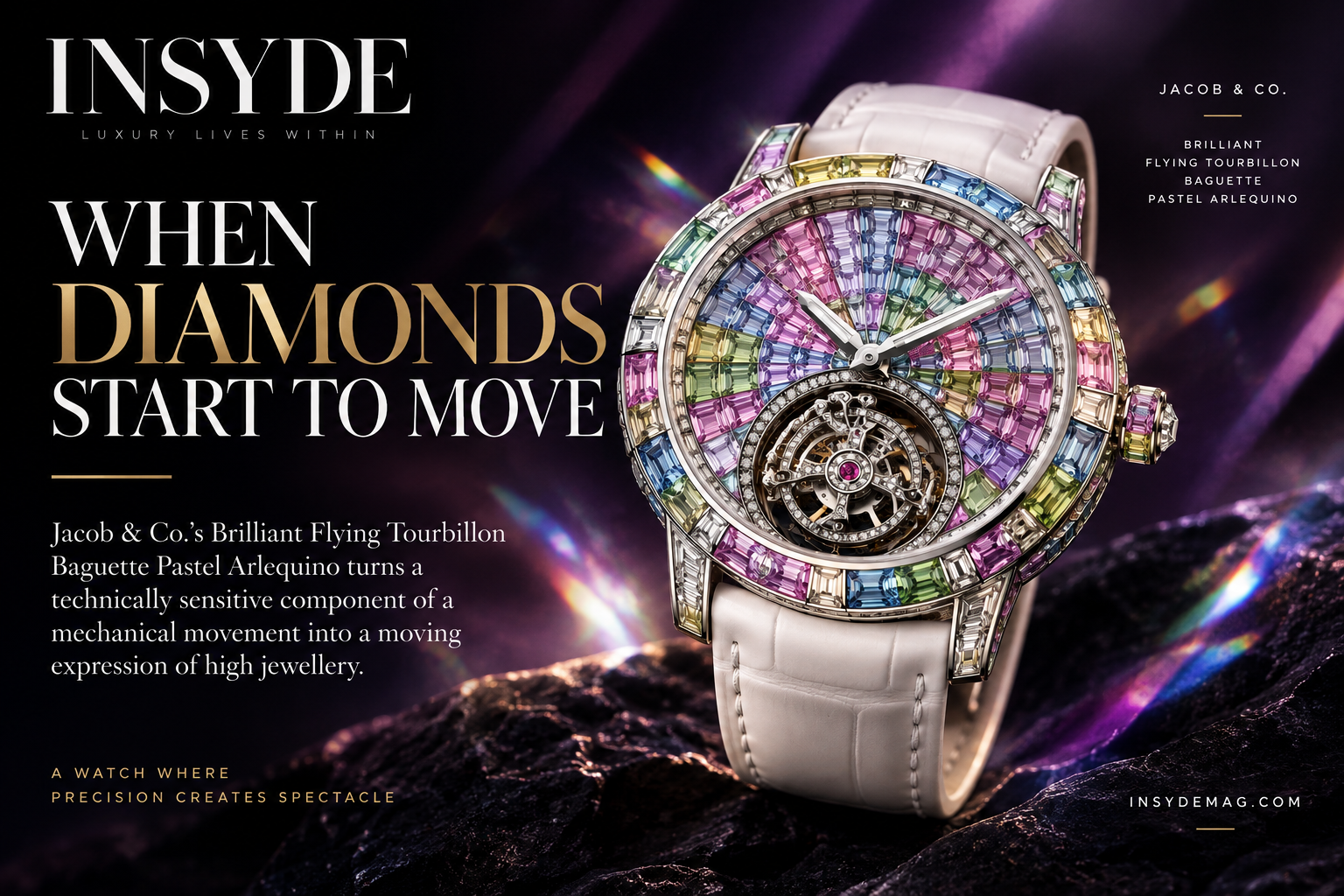
Jacob & Co.’s Brilliant Flying Tourbillon Baguette Pastel Arlequino turns a technically sensitive component of a mechanical movement into a moving expression of high jewellery.
There are watches that use diamonds to catch the light. And then there are watches that make the light move.
With the Brilliant Flying Tourbillon Baguette Pastel Arlequino, Jacob & Co. has placed 54 brilliant-cut white diamonds directly onto the balance wheel—one of the most technically sensitive components inside a mechanical watch. As the balance oscillates, the stones move with it, transforming a regulating organ normally appreciated by watchmakers into part of the visual performance.
It is an unusual place to put jewellery. More importantly, it is an unusual place to put additional weight.
That distinction is what makes this particular Jacob & Co. creation worth looking beyond the obvious spectacle.
The watch is a one-of-a-kind piece within the brand’s Brilliant Flying Tourbillon collection, combining an 18K white-gold case, an intricate arrangement of pastel sapphires and diamonds, a flying tourbillon and the self-winding JCFA02 calibre. But its most interesting idea is not simply how much has been set onto the watch. It is where the decoration has been allowed to enter the mechanics.
THE DIAMOND THAT MOVES
A balance wheel is fundamental to the operation of a mechanical watch.
Working with the hairspring, it forms part of the regulating system that governs the movement’s rate. It oscillates back and forth at a precise frequency, controlling the release of energy through the escapement and, ultimately, the measurement of time.
Its mass and weight distribution therefore matter enormously.
Adding gemstones to a component whose behaviour depends on precise mass distribution is not comparable to setting diamonds into a case or dial. Every additional element has the potential to influence the balance’s characteristics.
Jacob & Co.’s approach was to engineer the balance wheel specifically to accommodate the 54 diamonds while retaining the characteristics required for the movement’s operation. The result is a regulating component that is simultaneously mechanical architecture and moving jewellery.
The effect becomes particularly striking when the watch is running.
The diamond-set balance wheel oscillates at 21,600 vibrations per hour, or 3Hz, while the flying tourbillon completes one rotation every 60 seconds. Their independent movement continually changes the relationship between the diamonds and the surrounding light.
The sparkle is therefore not static.
It travels.
That is a subtle but important distinction in a category where gemstone setting has traditionally been about controlling how light interacts with a fixed surface.
WHERE JEWELLERY MEETS MECHANICS
The idea itself has historical echoes.
Attempts to place diamonds directly onto balance wheels can be traced to experiments by watchmakers in the 19th century. As mechanical watchmaking became increasingly focused on precision, however, the regulating organ became a particularly unforgiving place for additional weight and decoration.
Jacob & Co. is revisiting that territory with contemporary engineering.
It is a fitting direction for a brand whose watchmaking has consistently treated mechanical complication as something to be seen rather than hidden. From its highly architectural creations to its flying tourbillons, the company has repeatedly placed movement and spectacle in the same conversation.
The Pastel Arlequino takes that philosophy one step further.
Instead of merely exposing the mechanism, it makes one of its most delicate components part of the jewellery language.
A PALETTE BUILT LIKE A MOSAIC
The movement may provide the watch’s technical argument, but the exterior provides its immediate identity.
The 42mm 18K white-gold case is set with 194 baguette-cut pastel sapphires, totalling approximately 11.03 carats, alongside 32 white diamonds. The crown carries another 12 baguette-cut sapphires and one white diamond.
The dial continues the composition with 139 baguette-cut pastel sapphires and 23 white diamonds.
Across the watch, the stones are arranged in contrasting shades of green, blue, lavender and pink. Rather than creating a conventional colour gradient, the arrangement keeps the individual colours distinct, producing a geometric, almost mosaic-like effect.
The name Arlequino points to the visual reference behind that arrangement: Arlecchino, the colourful character of the Italian commedia dell’arte, whose costume is traditionally associated with contrasting geometric patches.
Here, that idea is translated into high jewellery.
The pastel palette is particularly effective because it avoids the obvious route of simply making the watch louder. The colours introduce playfulness without abandoning the precision demanded by baguette-cut stones and invisible setting.
And invisible setting matters.
With the stones secured from beneath, the visible surfaces avoid the interruption of conventional prongs or exposed metal between individual gemstones. The result is a continuous field of colour across the case and dial.
THE ART OF MAKING THE MECHANICAL VISIBLE
There is an interesting tension at the centre of the Pastel Arlequino.
A traditional high-jewellery watch can be understood primarily through its materials: precious metal, diamonds, coloured gemstones and craftsmanship.
A high-complication watch is understood differently. Its value is tied to what happens beneath the surface—the architecture, engineering and precision of the movement.
Jacob & Co. does not appear particularly interested in choosing between the two.
The JCFA02 calibre combines a micro-rotor and flying tourbillon, operates at 3Hz and offers a 72-hour power reserve. The movement measures 30.4mm in diameter by 6.9mm thick and comprises 184 components.
Even the movement bridges receive the jewellery treatment, with 234 brilliant-cut white diamonds totalling approximately 0.69 carats.
But the balance wheel is different.
The bridges are decorative surfaces.
The balance wheel is in motion.
That makes the 54 diamonds set onto it more than another gemstone count. They become part of the watch’s kinetic identity.
WHEN DECORATION BECOMES PERFORMANCE
This is where the Pastel Arlequino becomes more interesting than its specifications initially suggest.
High watchmaking has spent decades finding new ways to expose movement. Sapphire dials, skeletonisation, openworked bridges and visible tourbillons have all made the mechanics of a watch increasingly central to its visual language.
Jacob & Co.’s answer is to make the mechanics themselves decorative.
The diamond-set balance wheel is not simply something to admire through an opening in the dial. It is constantly changing position. Every oscillation changes the angle at which its diamonds meet the light.
At the same time, the flying tourbillon turns once per minute.
Two different mechanical rhythms therefore operate within the same visual field.
One oscillates.
One rotates.
Both catch the light.
The result is almost closer to kinetic jewellery than conventional watch decoration.
A WATCH BUILT AROUND CONTRAST
The Arlequino concept also depends on contrast.
Pastel sapphires meet brilliant-cut diamonds. Fixed gemstone surfaces surround moving mechanical elements. A playful colour palette is placed over a movement whose purpose remains intensely precise.
Even the strap deliberately steps back.
The watch is paired with an alligator strap and an 18K white-gold tang buckle set with 21 baguette-cut pastel Arlequino sapphires, approximately 1.52 carats.
Across the complete piece, Jacob & Co. uses 366 sapphires distributed across the case, dial, crown and buckle.
The numbers are impressive, but they are not really the story.
The story is what happens when those stones are integrated into an object whose fundamental purpose is to measure time.
THE IMPOSSIBLE, MADE VISIBLE
Jacob & Co. has long occupied an unusual position in contemporary high watchmaking.
The brand’s most recognisable creations rarely attempt to disappear beneath the cuff. They embrace theatricality, mechanical animation and jewellery as part of the same vocabulary.
The Brilliant Flying Tourbillon Baguette Pastel Arlequino is very much part of that tradition.
But the diamond-set balance wheel gives it a more technical proposition.
It asks a question that is surprisingly simple:
What happens when a component designed for precision becomes part of the spectacle?
The answer is not another static display of precious stones.
It is movement.
And movement changes the way jewellery is perceived.
A diamond on a bezel reflects light.
A diamond on a moving balance wheel appears to participate in time itself.
THE NEW LANGUAGE OF HIGH-JEWELLERY WATCHMAKING
There is a broader shift visible here.
High-jewellery watches have increasingly moved away from treating gemstone setting and mechanical watchmaking as separate disciplines. The most compelling contemporary pieces often ask how the two can interact—how a material can influence the movement, how a complication can become visual theatre, or how a mechanical component can become part of the aesthetic experience.
The Pastel Arlequino sits squarely within that territory.
Its sapphires create the first impression.
Its tourbillon provides the familiar horological spectacle.
But the balance wheel creates the surprise.
That is ultimately why the watch feels more considered than its exuberant appearance might suggest. Beneath the colour and brilliance is an attempt to integrate jewellery into the functioning architecture of the movement rather than simply placing it around the movement.
For a one-of-a-kind creation, that is a more compelling proposition than simply being extravagant.
INSYDE PERSPECTIVE
The most interesting luxury objects are rarely interesting because they contain the most expensive materials.
They become interesting when those materials are made to do something unexpected.
Jacob & Co.’s 54-diamond balance wheel is precisely that kind of idea. The diamonds are not simply there to increase the visual value of the watch. They have been incorporated into a component whose behaviour depends on precise engineering, turning a regulating organ into part of the watch’s visual performance.
The Pastel Arlequino consequently sits somewhere between haute horlogerie and high jewellery without needing to choose one over the other.
It is a watch where precision creates spectacle, and spectacle reveals precision.
And when the diamonds begin to move, the distinction between decoration and mechanics becomes considerably harder to draw.