
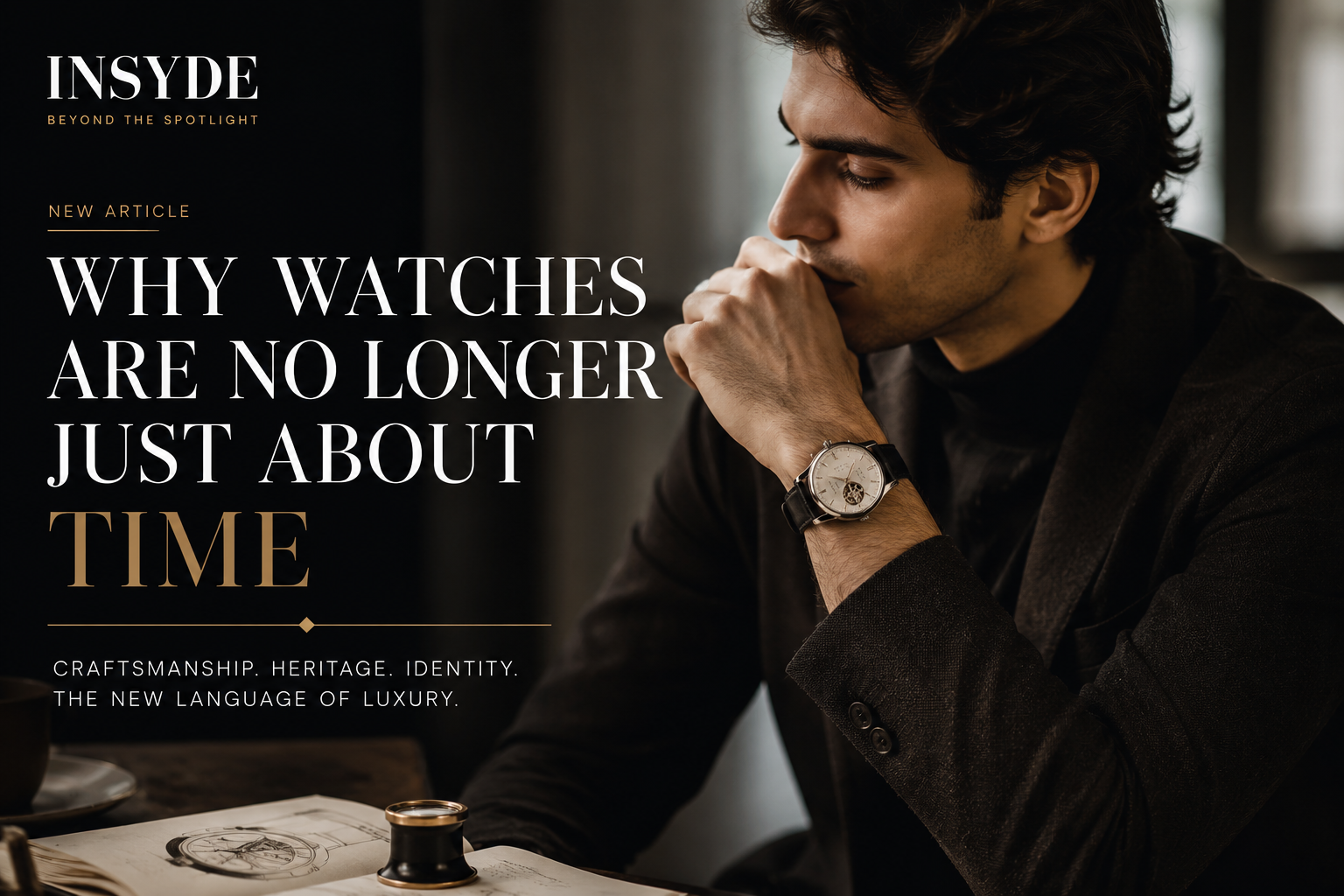
In an age when a smartphone can tell the time with extraordinary precision, the mechanical watch has survived by becoming something else entirely — an object of craftsmanship, identity, history and desire.
There is something almost irrational about wanting a mechanical watch in 2026.
Your phone tells the time more accurately.
Your smartwatch can track your heart rate, count your steps, read your messages and remind you about your next meeting.
A digital clock costs almost nothing.
And yet people continue to spend lakhs — sometimes far more — on objects whose most obvious function can be performed by something already sitting in their pocket.
That contradiction is precisely what makes the luxury watch so fascinating.
A great watch was never really just about telling time.
It is about what you choose to wear when you don’t need to.
And in India, that choice is becoming increasingly interesting.
India’s Watch Moment Is Getting Bigger
For years, India’s luxury-watch culture was relatively contained.
There were established collectors, traditional luxury buyers, wedding purchases and a handful of names that dominated the conversation.
That world still exists.
But it is expanding.
In the first half of 2026, India imported around 200,000 Swiss watches, up nearly 37% from the same period a year earlier. The value of those imports rose by more than 31% to approximately 168.7 million Swiss francs.
The numbers are significant.
But the more interesting story is what they suggest about the Indian consumer.
India is becoming increasingly important to international watchmakers at a time when the global Swiss watch industry is facing a more complicated environment.
Brands are responding.
The opportunity is no longer simply about selling watches.
It is about understanding a new generation of Indian buyers who are becoming more curious about what they wear, why they wear it and what exists beyond the obvious names.
The Watch as a Personal Signature
Luxury has always been partly about recognition.
A famous name can tell people what you own.
A watch can reveal something more subtle:
why you chose it.
One person might choose a restrained dress watch because they appreciate proportion and simplicity.
Another might choose an unusual independent watch because the obvious answer doesn’t interest them.
Someone else might collect vintage pieces because history matters more than novelty.
Another collector might be fascinated by movements, complications and the engineering hidden beneath the dial.
Two people can spend the same amount of money and end up with completely different watches.
That is where collecting becomes personal.
The watch stops being merely an accessory.
It becomes a signature.
And unlike many luxury objects, it sits unusually close to the body.
You don’t simply own it.
You live with it.
Why Mechanical Watches Still Matter
The mechanical watch is an extraordinary piece of technology precisely because it is unnecessary.
Inside a traditional mechanical movement, hundreds of components work together to measure something humans can now measure more cheaply and accurately in countless other ways.
There is no screen.
No notification.
No app.
No charging cable.
Just gears, springs, wheels and precision.
The complexity is no longer necessary.
It is chosen.
That may be one of the most fundamental ideas behind luxury itself.
Luxury often begins where necessity ends.
A mechanical watch takes an ordinary function and turns it into an object of craftsmanship.
The movement becomes part of the story.
The finishing becomes part of the story.
The sound becomes part of the story.
Even the ritual of winding or setting the watch can become part of the experience.
The technology may be centuries old.
The fascination is not.
The Indian Buyer Is Becoming More Informed
Perhaps the most important change in India’s watch market is not simply that more people are buying luxury watches.
It is that buyers are becoming more curious about what they are buying.
The Indian market is attracting a younger customer base, while interest in premiumisation, design and the emotional value of mechanical watches continues to grow.
The first luxury watch might still be about recognition.
The second might be about design.
The third might be about the movement.
The fourth might be about finding something nobody around you is wearing.
That is how collecting becomes interesting.
Not necessarily with wealth.
With curiosity.
Beyond the Obvious Names
There is nothing wrong with choosing one of the world’s most recognisable watchmakers.
Heritage matters.
Craftsmanship matters.
Consistency matters.
Generations of watchmaking expertise do not disappear simply because consumers become more experimental.
But luxury has always had another side.
The world of independent watchmaking can be wonderfully strange.
Smaller workshops.
Unusual complications.
Experimental materials.
Unexpected dial designs.
Limited production.
Designs that reward attention rather than immediate recognition.
For someone who already knows the obvious names, discovery becomes part of the pleasure.
The question changes from:
“How famous is the brand?”
to:
“How interesting is the watch?”
That is where the watch begins to move closer to art.
Quiet Luxury Has Reached the Wrist
For years, bigger often meant more luxurious.
Large cases.
Gold.
Diamonds.
Complicated dials.
Visual presence.
But the mood is becoming more nuanced.
Indian luxury-watch retailers and brands have been reporting stronger interest in smaller, more understated watches, reflecting a broader movement towards quieter expressions of luxury.
A 39mm watch can communicate confidence without demanding attention.
A simple dial can require more appreciation than a complicated one.
A watch without diamonds can sometimes be more difficult to understand — and therefore more interesting.
This is where the phrase quiet luxury becomes useful.
Not because understated automatically means better.
But because sophistication increasingly depends on recognising quality without needing it to announce itself.
The most interesting watch in the room may not be the one everyone notices first.
It might be the one only another collector recognises.
A Watch Can Become a Memory
There is another reason watches occupy such a unique place in luxury.
They age with you.
A smartphone becomes obsolete.
A car eventually changes hands.
Fashion moves on.
A watch can remain.
It might be purchased to mark a promotion.
A wedding.
A birthday.
A first business success.
A significant journey.
Or simply the moment someone decides that they want to own something beautiful.
Years later, the object carries the memory.
The scratches become part of it.
The worn strap becomes part of it.
The person who originally wore it may no longer be the person wearing it.
That is why watches can become heirlooms.
Not simply because they are valuable.
Because they are portable pieces of memory.
The Indian Heirloom Instinct
India already understands the emotional value of objects that move through generations.
Jewellery is inherited.
Saris become family archives.
Furniture survives marriages, houses and cities.
Objects accumulate stories.
The mechanical watch fits naturally into that tradition.
A watch bought today can eventually become something else entirely.
It can become the watch your child remembers seeing on your wrist.
Then the watch your child wears years later.
Its monetary value may matter.
But its emotional value can become greater.
The modern luxury watch is, in that sense, not entirely foreign to India.
It simply gives an old idea a new form.
Watches Are Becoming Part of a Larger Luxury Culture
The modern watch does not exist in isolation.
It sits inside a much larger cultural ecosystem.
Fashion.
Automobiles.
Sport.
Art.
Travel.
Architecture.
Technology.
Formula 1 has become deeply connected to luxury watchmaking.
Tennis has long provided another meeting point between watches, sport and fashion.
Automobile enthusiasts often move naturally between collecting cars and collecting watches.
Fashion houses collaborate with watchmakers.
Artists reinterpret watch design.
Luxury hotels create experiences around collectors and horology.
The watch has become part of a larger conversation about how people express taste.
And this is where watches become particularly relevant to INSYDE.
We aren’t interested only in what is on the wrist.
We’re interested in what the wrist tells us about the person wearing it — and the culture around them.
The New Luxury Collector Doesn’t Always Want the Obvious
There is a difference between being able to buy a luxury watch and becoming genuinely interested in watches.
The first is financial.
The second is cultural.
A collector starts noticing details.
The movement beneath the dial.
The finishing on a bridge.
The proportions of a case.
The history of a reference.
The difference between a manufacture movement and an outsourced calibre.
The story behind an independent watchmaker.
The way a watch changes on the wrist.
This knowledge creates another form of luxury.
Knowing what you’re looking at.
And perhaps that is where the next generation of Indian watch culture becomes particularly interesting.
The consumer is no longer dependent entirely on a salesperson to explain why something matters.
Information is everywhere.
Collectors can study movements, follow independent makers, compare references and discover watches from almost anywhere in the world.
The result is a more informed buyer.
And a more demanding one.
India’s Watch Market Is Becoming More Sophisticated
India’s growth is happening at an interesting moment for the global industry.
Swiss watch exports declined in 2025, while India continued to show strong momentum.
That contrast has made India increasingly difficult for global watchmakers to ignore.
Retail networks are expanding.
New boutiques are opening.
Brands are investing in local teams and customer experiences.
And younger buyers are entering categories that were once associated primarily with older collectors.
The opportunity is not simply to sell more watches.
It is to build a deeper watch culture.
That means better retail experiences.
More education.
More access to interesting independent makers.
More collecting communities.
More conversations around craftsmanship.
And eventually, perhaps, a stronger Indian voice within global horology.
The Watch Doesn’t Need to Compete With Your Phone
Perhaps the easiest mistake is to ask whether a mechanical watch can compete with technology.
It can’t.
It shouldn’t.
Your phone tells you the time.
Your watch tells you why you chose to wear it.
One provides information.
The other provides expression.
One is designed around constant updates.
The other can remain largely unchanged for decades.
One is expected to be replaced.
The other can be designed to survive you.
That is why the mechanical watch continues to matter.
It offers something technology has made increasingly rare:
a reason to keep something simply because it is beautifully made.
So, Why Do We Still Want Watches?
Because we don’t really buy them for the time.
We buy them for the engineering.
The craft.
The history.
The design.
The ritual.
The memory.
The weight on the wrist.
The quiet movement beneath the dial.
And sometimes, simply because we love the way they look.
There is nothing irrational about that.
Luxury has never been entirely rational.
It exists in the space between need and desire.
Few objects occupy that space as elegantly as the mechanical watch.
India’s Time Is Changing
India’s watch story is no longer simply about importing more Swiss watches.
It is about a new generation learning to appreciate what makes a watch worth wearing.
The buyer is becoming younger.
The market is becoming deeper.
The choices are becoming wider.
And the conversation is moving beyond logos.
For the next generation of Indian collectors, the most interesting watch may not necessarily be the most recognisable one.
It may be the one with the most compelling story.
The most beautiful movement.
The most unusual design.
The strongest connection to its maker.
Or simply the one that means something to the person wearing it.
Because when everyone can check the time on a phone, a mechanical watch has to offer something else.
It has to give you a reason to keep looking at it.
And increasingly, in India, people are learning exactly where to look.
INSYDE — Inside modern luxury.