Category: Jewellery

The designers, makers, stones, craftsmanship and stories behind exceptional jewellery.

  • BEYOND BEAUTY: HOW CAPUCINE HUGUET TURNS SCIENCE INTO JEWELLERY

    BEYOND BEAUTY: HOW CAPUCINE HUGUET TURNS SCIENCE INTO JEWELLERY

    From Arctic glaciers to microscopic marine life, the Paris-based jewellery artist transforms scientific discovery into sculptural creations that challenge conventional ideas of beauty, craftsmanship and the meaning of luxury.

    INSYDE EXCLUSIVE | PEOPLE · LUXURY · DESIGN

    By INSYDE Magazine


    A jewel can mark a moment, express an identity or become an heirloom that carries a family’s history across generations. Yet for Paris-based jewellery artist Capucine Huguet, its possibilities extend beyond personal adornment. A jewel can also communicate an idea, reveal an overlooked natural phenomenon and invite its wearer to see the world differently.

    Her work begins with questions rather than gemstones. What makes a natural structure extraordinary? How can a scientific discovery be translated into a form that can be worn? And what happens when the language of fine jewellery meets the complexity of the natural world?

    These questions shape a practice that brings scientific research into conversation with sculptural design and traditional craftsmanship. From the vast landscapes of the Arctic to the intricate structures of microscopic marine life, Huguet investigates subjects that are often difficult to comprehend through observation alone, translating their essential qualities into jewellery with a distinct visual and conceptual language.

    Her approach is deliberately considered. Scientific literature, conversations with specialists and, at times, first-hand experiences in natural environments inform the earliest stages of a collection. Sketches and prototypes follow only after a sustained period of research and reflection.

    The finished pieces may be precious objects, but their value lies in more than the materials from which they are made. Each begins with a subject Huguet wants to understand and a story she wants to communicate.

    For her, beauty is not the end of the conversation. It is the means through which the conversation begins.
    A Childhood Curiosity, A Creative Language

    Huguet’s interest in science predates her professional practice. She recalls being fascinated by the ways scientific knowledge explains phenomena that can otherwise appear almost magical: rainbows, lightning, snowflakes and magnetism.

    At the same time, she knew from an early age that she wanted to become a jewellery designer. What she sought was a way to combine that ambition with a broader purpose.

    “I wanted my work to go beyond aesthetics and convey ideas that matter to me,” she explains.

    Science and the natural world offered that possibility. They allowed her to bring together her interest in jewellery and her curiosity about how the world works, giving her designs a narrative foundation beyond their immediate visual appeal.

    This distinction is important in a discipline where nature has long served as a source of inspiration. Floral motifs, animal forms and references to the sea are familiar elements of jewellery design. Huguet’s approach, however, begins with understanding the subject rather than simply reproducing its appearance.

    She wants to identify what makes a phenomenon significant, which characteristics deserve attention and what an interpretation of it might communicate.

    Research is therefore the starting point for every new collection. She studies books, scientific papers, articles and documentaries before narrowing her focus and contacting specialists who can deepen her understanding. Depending on the subject, these conversations may involve biologists, glaciologists or other scientists.

    For some projects, reading and consultation are not enough. Huguet seeks direct encounters with the environments she is studying, allowing observation to become part of the creative process.

    Her practice reflects a belief that meaningful design begins with curiosity—and that the more thoroughly a subject is understood, the more possibilities emerge for interpreting it.

    The Value of Going Beyond the Studio

    Huguet’s research has taken her to Svalbard in the Arctic, where she observed melting glaciers and met glaciologists, and to Costa Rica, where she volunteered in a nature reserve in the rainforest to explore its biodiversity.

    These experiences offered a different relationship with her subjects. A landscape encountered in person carries dimensions that photographs and written descriptions cannot fully convey: its sounds, its scale, its atmosphere and the physical sensation of being present.

    “There is an enormous difference between studying these subjects through books and images and experiencing them firsthand,” she says.

    The experiences become part of an accumulating body of impressions and memories. Huguet takes time to analyse what she has encountered before beginning to develop visual references and sketches. The process can take months.

    This extended period of observation gives her work a particular rhythm. Rather than beginning with a predetermined aesthetic and searching for a reference to justify it, she allows the subject to shape the direction of the design.

    It is an approach that places research at the centre of creative production. The environment is not simply a backdrop or a source of attractive forms; it is something to investigate, interpret and understand.

    The distinction becomes especially clear when an unexpected encounter changes the course of a project.
    Serendipity as a Design Principle

    For Huguet, research is not a process of confirming what she already expects to find. It is an opportunity to discover something she had not considered.

    “I strongly believe in serendipity,” she says.

    Before entering a field or immersing herself in a subject, she rarely knows which detail will ultimately capture her attention. Sometimes she is drawn to a phenomenon because of its significance or because she believes it deserves greater attention. At other times, the inspiration is more personal: a moment of fascination, an emotional response or an encounter that stays with her.

    Her experience in Costa Rica offers an example. Among the rainforest’s extraordinary biodiversity, leafcutter ants became an unexpected source of inspiration. She was fascinated by the thousands of ants moving through the environment, carrying pieces of leaves and creating extensive trails across the forest.

    Their organisation and collective movement captured her imagination. It was not a subject she had planned to explore before encountering it directly.

    That discovery became an opportunity to translate a natural system into a new visual language.

    The significance of serendipity in Huguet’s practice is not that research becomes less rigorous, but that it remains open-ended. Observation provides the foundation; curiosity determines where it leads.

    In this sense, her jewellery emerges from a dialogue between knowledge and instinct. Scientific understanding gives her a framework, while personal encounters help determine which aspects of a subject are worth transforming into form.

    From Natural Phenomenon to Wearable Sculpture

    Translating a complex natural structure into jewellery requires more than technical precision. It demands interpretation.

    A scientific reference may be intricate, irregular or difficult to reproduce at the scale of a wearable object. The designer must decide what to preserve, what to simplify and what to transform so that the finished piece remains connected to its source without becoming a literal copy.

    Huguet begins by identifying the characteristics and associations that make a subject compelling. These become keywords that guide the exploration of shapes and forms.

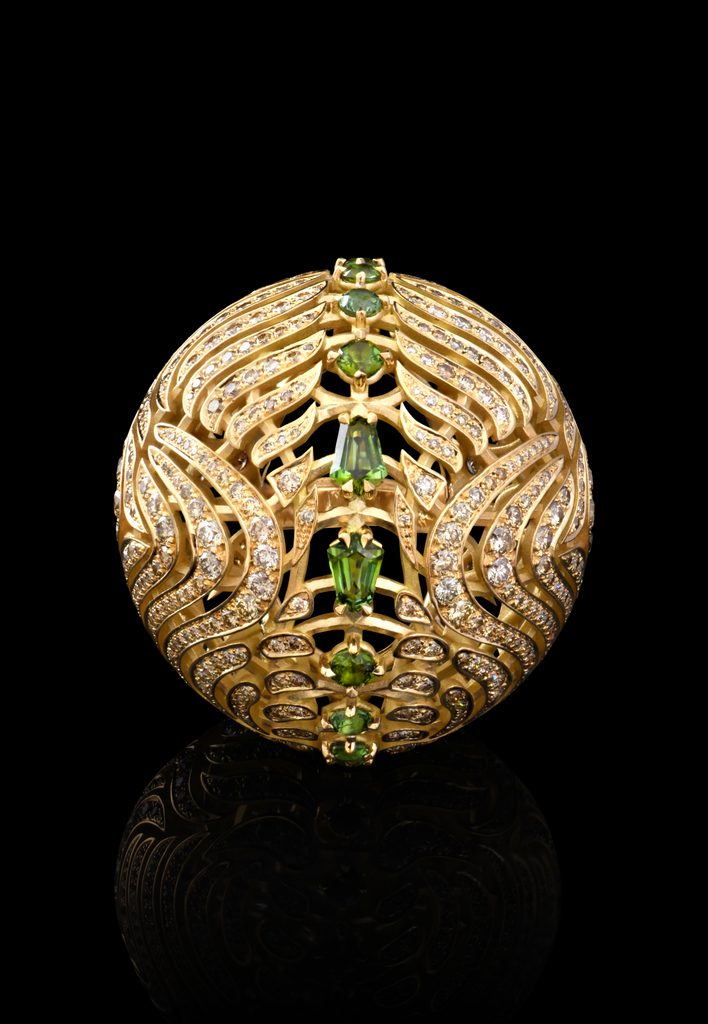
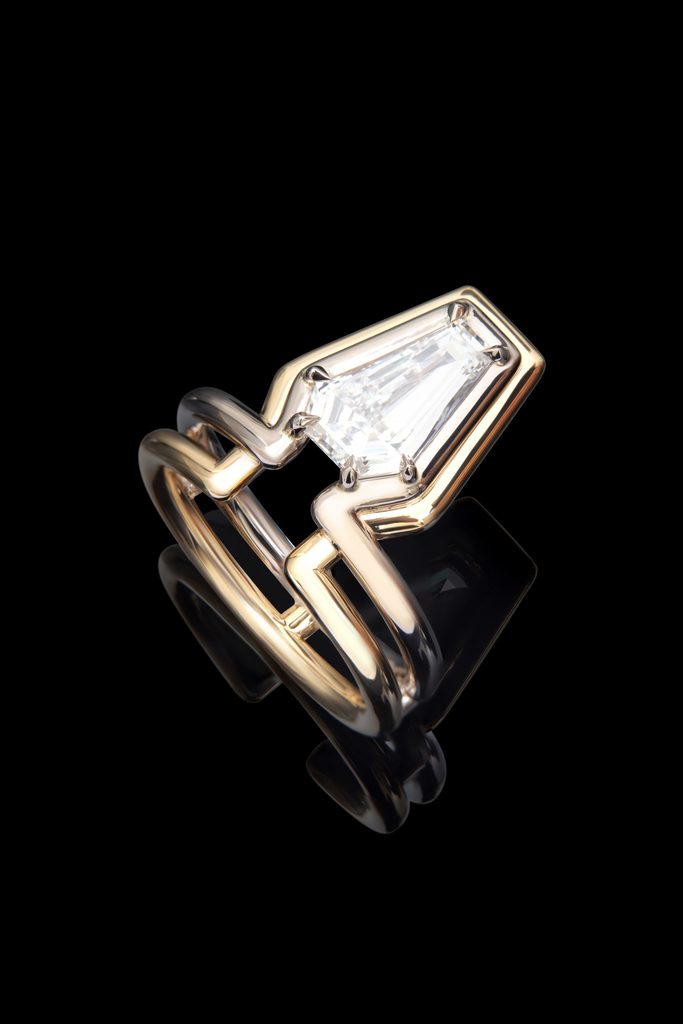
    She approaches jewellery as a form of miniature sculpture, paying close attention to its three-dimensional qualities. Each angle should reveal something interesting; the piece should not depend entirely on a single viewpoint.

    Texture is equally important. Surfaces can communicate a subject’s character while introducing a tactile dimension to the experience of wearing a jewel. The object becomes something to examine from different angles and, where appropriate, to discover through touch as well as sight.

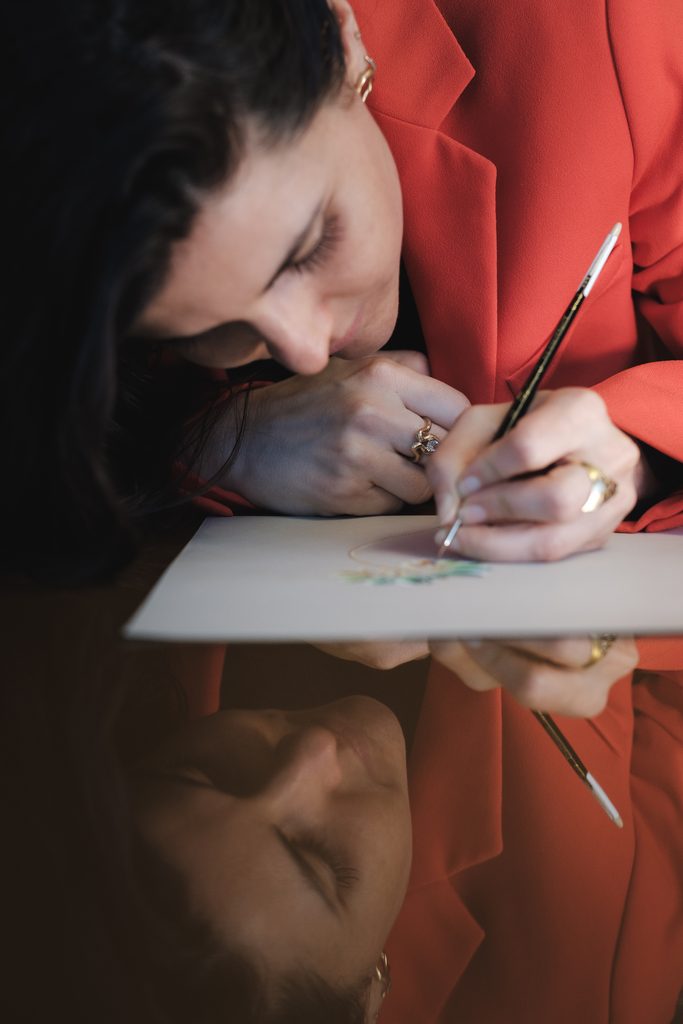
    Her own technical knowledge plays an important role in bringing these ideas to life. Huguet develops her prototypes personally, using wax carving or computer-aided design (CAD) to translate imagined volumes, curves and structures into tangible forms.

    The prototype provides a foundation for discussion with the artisans who help realise the final piece. It makes the intended design more precise and creates a shared point of reference for addressing technical challenges.

    Huguet describes herself as fortunate to have learned almost every aspect of jewellery-making. This allows her to collaborate with craftspeople as a peer, sharing a technical vocabulary and an understanding of the difficulties involved in producing complex forms.

    She also values the small scale of her team, which allows different perspectives to come together before work begins. Anticipating challenges and finding solutions collaboratively can help preserve the original concept without ignoring the realities of making.

    The result is a practice in which the artistic idea and the production process are closely connected. Craftsmanship is not merely the final stage of the work; it is part of the means through which the idea becomes possible.
    The Cristellaria Echinata Brooch: Making the Invisible Visible

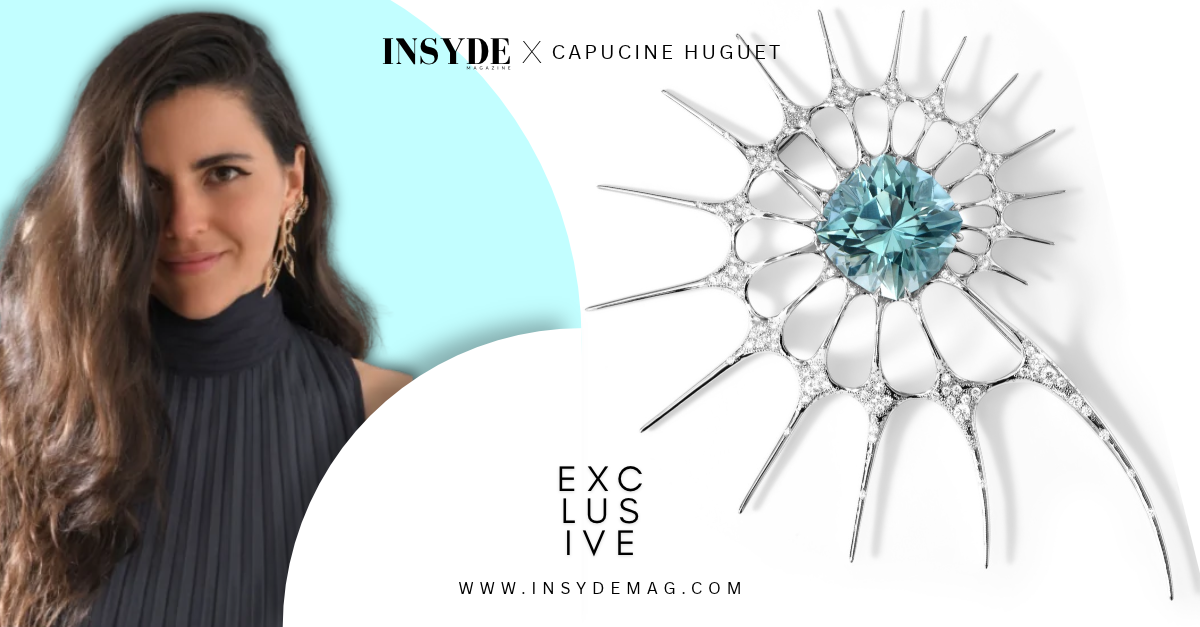
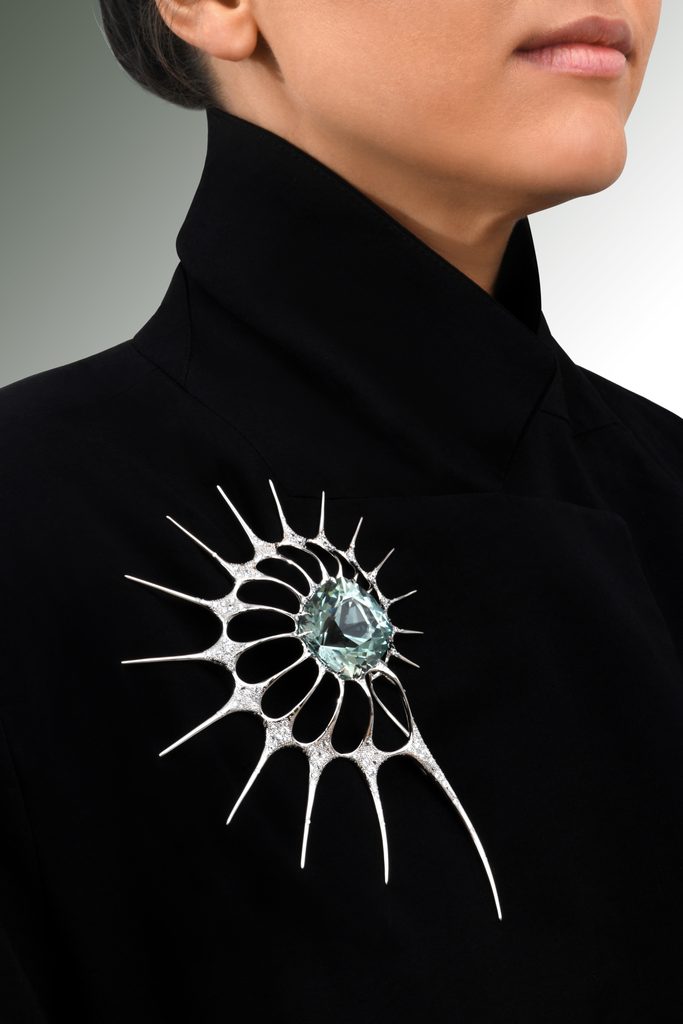
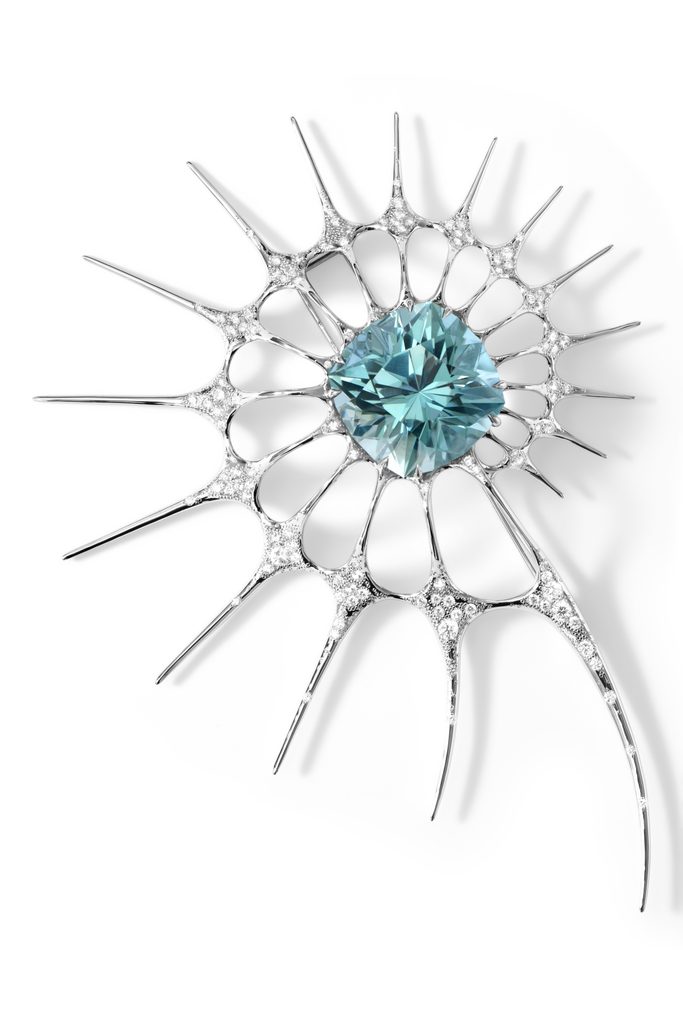
    One of the most revealing examples of Huguet’s approach is the Cristellaria Echinata brooch from her Téthys collection, which explores phytoplankton.

    These microscopic organisms occupy a significant place in marine ecosystems. Through photosynthesis, phytoplankton contributes to the production of oxygen and the absorption of carbon dioxide. Despite its scale, it plays a role in the larger environmental systems on which life depends.

    Huguet wanted to create a piece that would communicate the importance of this often-overlooked marine life.

    The brooch draws inspiration from the shell of Cristellaria Echinata, a form that also recalls the spiral structure of a nautilus shell. Her interpretation is delicate and intricately constructed, with an airy framework intended to evoke the movement of plankton through the ocean.

    At its centre sits a 100-carat topaz in a glacial-blue hue. The pavé setting introduces further complexity, with the structure and setting designed to evoke photosynthesis and the ecological significance of phytoplankton.

    The contrast is striking: a substantial precious stone sits within a form inspired by microscopic life. The result is an object with visual presence that also carries a story extending beyond its materials.

    For Huguet, the piece is compelling precisely because it combines these dimensions. It is bold and immediately eye-catching, yet its underlying subject asks the viewer to consider a natural system that is usually invisible.

    The making process presented its own challenges. Huguet hand-carved the entire structure in wax, creating a form that was exceptionally fragile. Achieving a successful casting required considerable experimentation and perseverance in collaboration with the caster.

    The technical challenge was to preserve the delicacy of the design while producing a finished jewel capable of holding its form.

    The brooch demonstrates how scientific research, sculptural thinking and specialist craftsmanship can converge in a single object. It also illustrates a broader ambition within Huguet’s work: to use the attraction of jewellery as a way of directing attention towards subjects that might otherwise remain outside the viewer’s awareness.

    The story behind the piece is as integral to its identity as its silhouette, stone and setting.

    Materials That Carry Meaning

    In Huguet’s practice, materials are not simply selected to complete a design. They help communicate its story.

    Colour, she explains, can fundamentally change how a piece is perceived. Yellow gold may evoke warmth, generosity and sunlight, while white gold can suggest cooler, glacial atmospheres, architecture or the stillness of night. Gemstones carry their own visual associations, and a particular design may feel incomplete if its colours do not support the intended idea.

    Texture also shapes perception. A mirror-polished surface, a brushed finish and an intricately engraved one each create a different visual impression and tactile experience.

    These decisions influence the direction of a design as it develops. Material choice is therefore neither a purely technical consideration nor an afterthought; it is part of the narrative itself.

    That principle extends to sourcing. Huguet states that she works exclusively with recycled 18-carat gold or recycled platinum. She uses recycled diamonds whenever possible, alongside vintage or responsibly sourced gemstones, including stones from Moyo Gems.

    Finding trustworthy gemstone dealers requires research, time and collaboration with reliable partners. For Huguet, these choices are integral to the way she wants to develop her practice rather than optional additions to a finished product.

    Her production model reflects a similar preference for considered making. All her pieces are made in Paris, and most are produced to order. This allows her to avoid unnecessary overproduction and focus on the quality of individual objects.

    She is also realistic about the challenges of maintaining these standards as a business grows. Scaling production, reaching a broader market or focusing more heavily on retail can make sourcing constraints, production capacity and cost management increasingly difficult to balance.

    Independence brings its own limitations, but it also creates room to make different decisions. Huguet sees the ability to prioritise quality, traceability and the integrity of the creative process over volume as a meaningful advantage.

    It is a position that places responsibility within the actual decisions involved in making jewellery—from the selection of materials to the relationships that sustain production.

    Between Fine Jewellery and High Jewellery

    Jewellery occupies a distinctive space between an artwork and an object intended to be worn. It can be conceived as sculpture, yet it must also respond to the physical realities of everyday life.

    Huguet approaches fine jewellery and high jewellery differently.

    With fine jewellery, she considers how a piece will evolve through regular wear. Comfort, durability and the way the owner makes the jewel their own are central to the design.

    There is something personal about imagining an object accompanying someone for years, becoming part of their life and accumulating memories along the way.

    High jewellery allows a different degree of conceptual freedom. When a piece is approached as an artwork in its own right, Huguet can push further in terms of scale, weight, technique and mechanisms. She can explore more ambitious forms, provided they retain the sculptural and conceptual qualities that define her work.

    The distinction is not simply a question of size or extravagance. It concerns the intended relationship between the object and the person encountering it.

    A jewel intended for everyday wear must function comfortably within its owner’s life. A more ambitious high-jewellery creation can challenge conventional expectations of wearability and explore the possibilities of jewellery as a sculptural medium.

    Both approaches, however, depend on a clear relationship between concept, material and execution.

    A Different Measure of Luxury

    For Huguet, luxury is not defined by the value of precious materials alone. It lies in creating something distinctive and meaningful, realised through exceptional craftsmanship and carrying a significance that resonates with its owner.

    Her clients are often looking for jewellery that reflects who they are, expresses something personal or represents a story they want to preserve. The desire is not simply to own a valuable object, but to possess something that feels individual.

    This is particularly evident in bespoke commissions. Huguet maintains a close relationship with clients throughout the process, meeting them several times to discuss ideas and refine the design.

    The collaboration becomes part of the experience, giving the finished jewel a context that extends beyond its physical characteristics.

    It is a view of luxury rooted in personal connection and continuity. A piece may become associated with love, faith, family, a memorable journey or a personal belief. Over time, it can carry memories that extend beyond the person who originally commissioned or created it.

    For Huguet, jewellery has an extraordinary ability to hold these meanings and pass them forward.

    The idea of an heirloom, in this context, is not simply about an object surviving physically. It is about the story attached to it remaining relevant as it moves between people and generations.

    This also clarifies why craftsmanship matters so deeply to her. Technical excellence gives an object its form and durability, but meaning gives it a reason to be kept.

    Luxury becomes less about the immediate impression an object creates and more about the relationship that develops around it: the thought invested in its creation, the experience of acquiring it and the significance it eventually comes to hold.

    What Comes Next

    Huguet has a long list of subjects she hopes to explore, although she prefers to keep the details of future projects private until they develop further. For now, she is particularly interested in physics and curious about where that interest might lead her work.

    The direction remains open, but her underlying ambition is consistent. She wants people to recognise jewellery as more than a beautiful adornment: a small work of art that can carry meaning for both its maker and its owner.

    Design, in her view, is a way of communicating ideas and telling stories. A jewel can represent love, faith, family, a journey or a personal conviction. Through her own practice, she chooses to tell stories about science and the natural world, encouraging people to look at familiar subjects from a different perspective.

    She also hopes that this engagement can foster a greater appreciation of the natural world and its fragility. Understanding something, she believes, can be the first step towards wanting to protect it.

    There is a compelling relationship between the precision of her process and the openness of its outcomes. Research provides structure, craftsmanship provides discipline, and curiosity leaves room for discovery. The finished piece brings these elements together without reducing the original subject to a simple visual motif.

    In a luxury landscape where objects are often judged by recognisability, rarity and immediate appeal, Huguet offers another way of thinking about what makes a jewel valuable. Her work asks the viewer to consider not only what an object is made of, but what it communicates, what it reveals and what it might mean over time.

    The result is jewellery that rewards attention. Its forms invite a closer look; its stories encourage further thought.

    Ultimately, Huguet’s practice suggests that the most meaningful objects do more than decorate the world around us. They change the way we engage with it.

    A jewel, in her hands, becomes a meeting point between the natural world and human imagination—an object through which scientific discovery can be felt, craftsmanship can be experienced and beauty can become a way of seeing differently.


    Explore more: Capucine H — Official Website · The Designer · Téthys Collection Journal · Commitment to Craft and Responsible Sourcing

    INSYDE MAGAZINE – No.1 Luxury Magazine in Bengaluru
    Luxury, Through a Different Lens.
    www.insydemag.com
  • ISHA DEB: THE ART OF JEWELLERY, THE INSTINCT OF AN ARTIST

    ISHA DEB: THE ART OF JEWELLERY, THE INSTINCT OF AN ARTIST

    INSYDE EXCLUSIVE | ISHA DEB

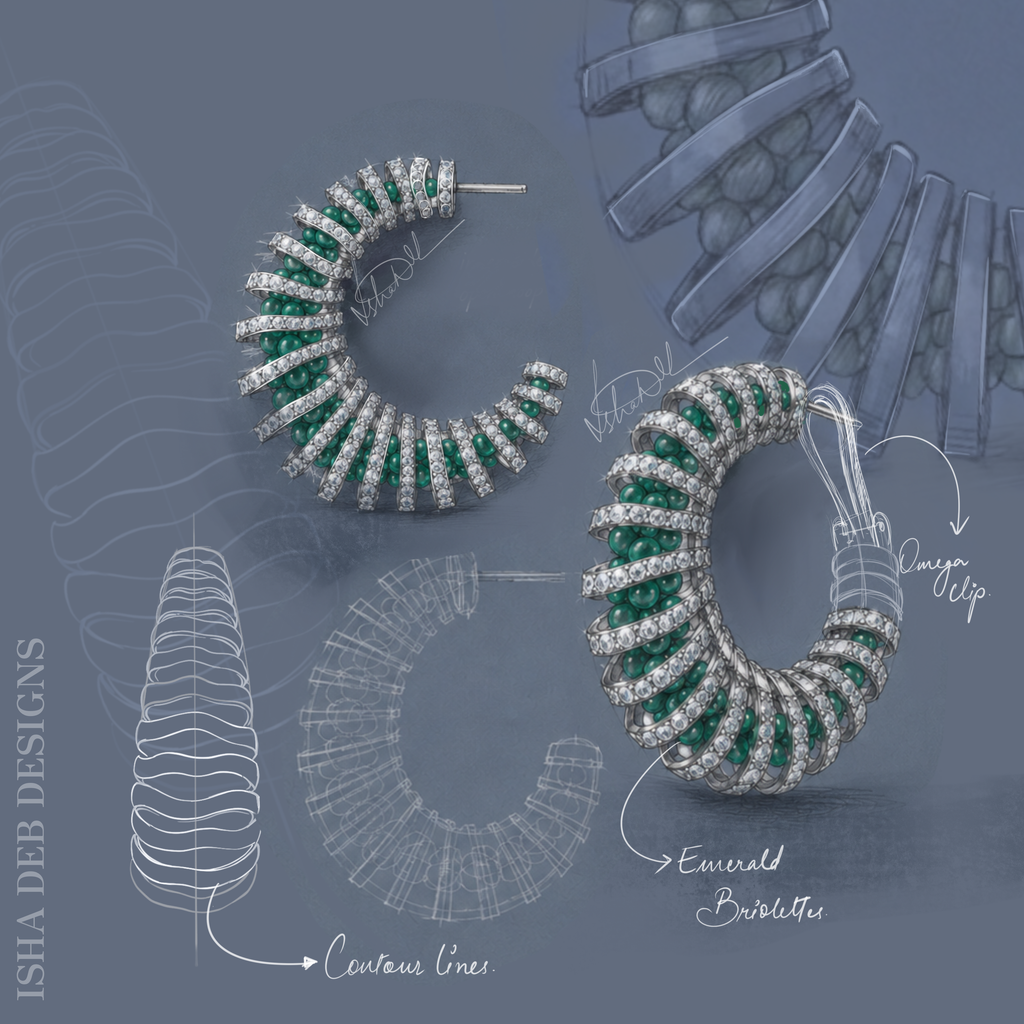
    From the first sketch to the finished piece, jewellery designer Isha Deb explores the intuition, imagination and technical precision behind jewellery that is as personal as it is beautiful.

    Artificial intelligence can generate intricate jewellery concepts in seconds. Digital tools can explore silhouettes, experiment with proportions and turn an abstract idea into a compelling visual long before a gemstone is set or a piece reaches the workbench. For an industry built around precision, aesthetics and material expertise, these capabilities present exciting possibilities.

    But a convincing image is not the same as a finished piece of jewellery. Between the first idea and the object a person eventually wears lies a series of decisions that demand creative judgement, technical understanding and an awareness of how design meets the human body.

    It is within this space between possibility and execution that jewellery designer Isha Deb sees the continuing importance of the designer.

    “I use them myself, but for me, they remain a medium through which I express a design. My own thought process and judgement still guide the work,” she says of artificial intelligence and digital tools.

    For Deb, technology is neither something to resist nor a substitute for creative authorship. It is an extension of the design process, capable of making certain tasks faster and expanding the range of ideas a designer can explore. What it cannot automatically supply is the personal perspective that determines which ideas are worth pursuing.

    As AI becomes increasingly capable of producing sophisticated visual concepts, that distinction raises a question extending beyond jewellery: when the image becomes easier to generate, what gives the final object its identity?

    THE HUMAN ELEMENT BEHIND THE IMAGE

    A jewellery designer’s point of view develops over time. It is shaped by experiences, observations, travel, culture and the details that hold an individual’s attention. These influences may find their way into a design consciously or emerge through instinct, informing everything from the selection of a gemstone to the decision to pursue a sharp architectural line or a softer, more fluid form.

    For Deb, this accumulated experience is central to creative identity.

    “AI can produce a beautiful image, but I don’t believe a designer’s soul can be cloned, at least not yet.”

    Her distinction is between generating possibilities and giving those possibilities direction. AI can offer a starting point, but a designer must still assess the result, question its relevance and determine whether it reflects a considered creative intention.

    That judgement is particularly significant in jewellery, where visual appeal is only one part of the equation. A design must also account for materials, construction, proportion and wearability. A form that looks impressive on a screen may require substantial refinement before it becomes a viable object.

    The challenge, therefore, is not simply to use the most advanced tools available. It is to retain the ability to make independent creative decisions while using those tools.

    WHY SKETCHING STILL MATTERS

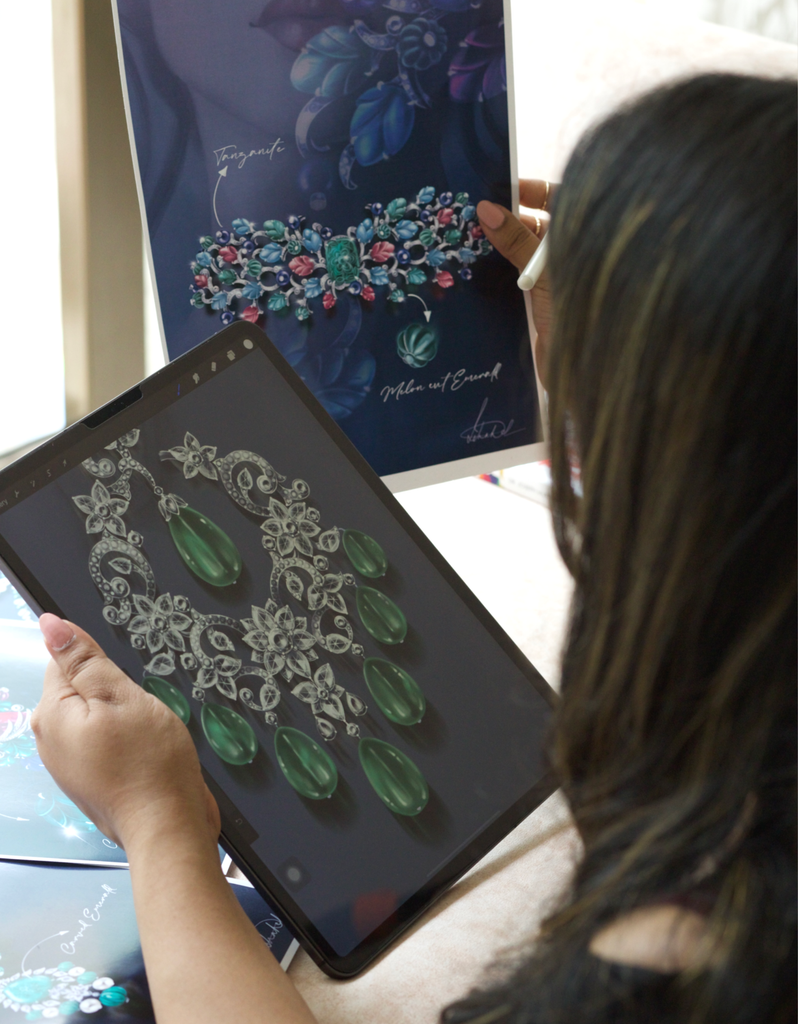
    For Deb, the creative process often begins with drawing. A sketch is not merely a record of an idea that has already been resolved; it can be the means through which the idea becomes clear in the first place.

    “Often, an idea only starts to become clear when you begin drawing it,” she explains.

    A rough line on paper, a quick doodle or an unfinished drawing can help a designer discover proportions, test a form and recognise possibilities that were not immediately apparent. The act of drawing becomes part of the thinking itself.

    Digital devices have made this process more flexible. Deb carries an iPad, allowing her to sketch when an idea occurs rather than waiting until she is at her workspace. The medium has evolved, but she sees the underlying relationship between thought and drawing as largely unchanged.

    “I still work through rough lines, make changes and let the idea evolve as I draw. For me, it is simply an upgraded tool.”

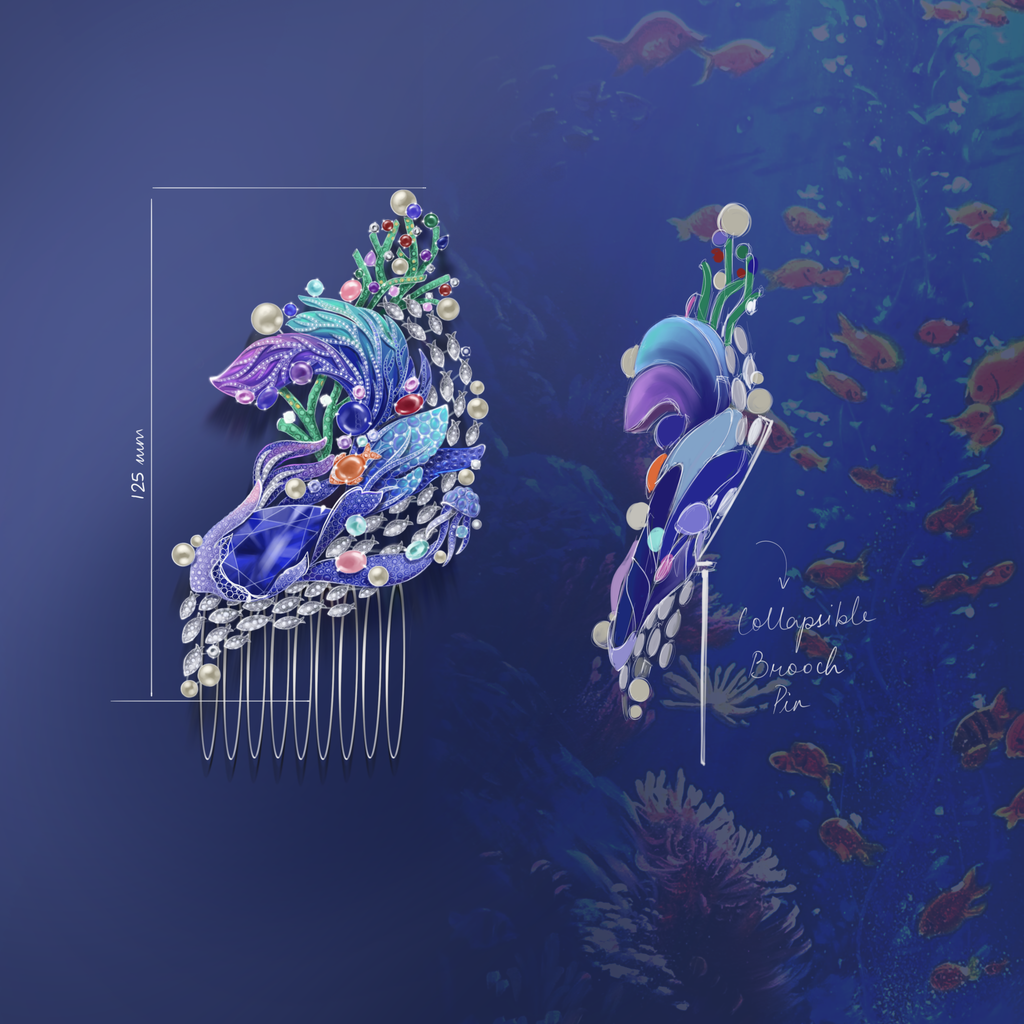
    This distinction matters in a conversation often framed as a choice between traditional methods and digital innovation. In practice, the two can coexist. A designer can begin with a spontaneous sketch, develop it digitally, refine it through three-dimensional modelling and ultimately translate it into a physical object.

    What matters is the continuity of thought throughout that process. The tools may change, but the designer remains responsible for deciding what the design should become.

    WHEN TECHNOLOGY BECOMES A CREATIVE RISK

    The risk of generic design does not begin and end with artificial intelligence. Jewellery designers have long navigated the tension between personal expression and commercial realities.

    Budgets, customer preferences, material costs and the need to build a sustainable business can influence the final form of a piece. A detail may need to be simplified, a design adjusted or the choice of diamonds and gemstones reconsidered to meet a particular price point.

    Deb acknowledges that these pressures are part of the profession. She believes the greater challenge is recognising which compromises are necessary without losing the qualities that distinguish a designer’s work.

    “I think technology works well as a creative tool as long as a designer’s own expression and style remain intact. It should help us develop an idea without making it feel more generic.”

    AI may make it easier to generate alternatives, but a greater number of options does not necessarily produce a more original outcome. If designers accept convenient results without questioning whether they reflect their own aesthetic, the process risks becoming an exercise in selecting images rather than developing ideas.

    For Deb, the responsibility lies in knowing when to adapt and when to preserve the character of a design. Commercial viability is essential, but it need not come at the expense of every distinctive detail.

    The question is not whether a designer should compromise. It is whether the compromise serves the design or gradually erodes its identity.

    FROM DIGITAL CONCEPT TO PHYSICAL REALITY

    The difference between an attractive visual and a workable piece becomes especially apparent during computer-aided design, or CAD.

    While a sketch establishes the initial direction, CAD translates the idea into a three-dimensional structure that can be manufactured and worn. This stage requires the designer to preserve the character of the original concept while resolving the technical demands of construction.

    For Deb, getting the CAD right is one of the most challenging parts of the process.

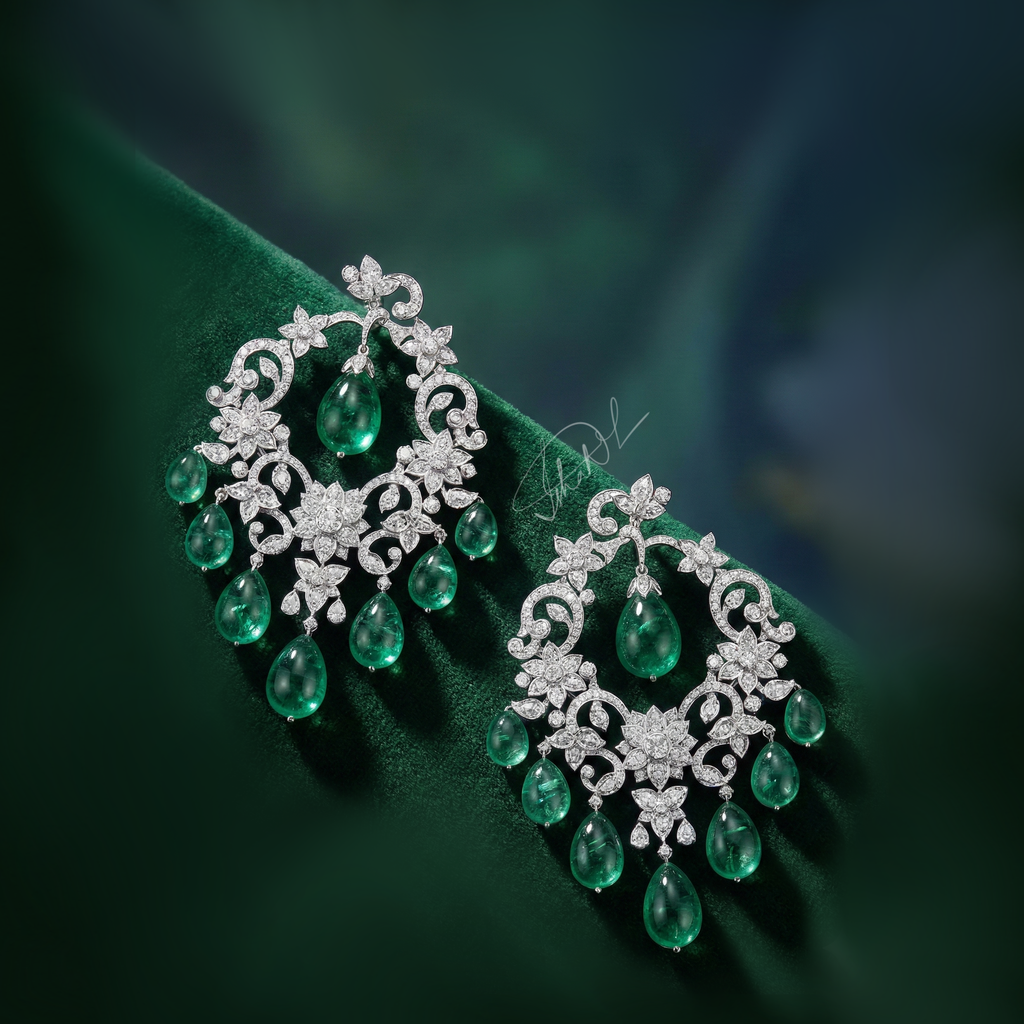
    Consider a necklace. Its links must provide sufficient flexibility to sit comfortably around the neck, while the height and angles of its elements influence how it rests against the body. An earring presents a different set of demands: its weight, balance and support must work together so that it sits correctly on the ear.

    These details may not be immediately apparent in a rendering, yet they can determine whether a piece succeeds in practice. The designer must understand how a form behaves in three dimensions, how its components interact and how its construction affects the wearer.

    “Getting the CAD right means preserving the character of the design while resolving all the practical details that make it work as jewellery.”

    The process also depends on technical knowledge and collaboration with manufacturers. A design must move beyond visual intention without losing what made it compelling in the first place.

    This is where the debate around AI becomes more nuanced. Digital tools already play an important role in jewellery development, and AI may help streamline aspects of the process further. But generating a concept and resolving the details required to manufacture it are different tasks.

    A finished jewel must function as an object, not merely as an image.

    DESIGNING FOR CONNECTION, NOT JUST APPEARANCE

    The value of jewellery has traditionally been associated with materials, rarity, craftsmanship and monetary worth. These remain important considerations, but Deb believes the contemporary luxury customer is also looking for a more personal relationship with what they buy.

    “I believe today’s luxury customer is looking for a more personal connection with what they buy.”

    For her, individuality can emerge from a distinctive design, an unusual gemstone colour, a rare diamond cut or a stone with a compelling history. The appeal extends beyond the material’s price to the character that makes a particular piece feel different.

    She also sees wearability as an increasingly important consideration. Customers may value exceptional jewellery that can be enjoyed across different occasions, rather than pieces that remain reserved for a single event. A distinctive design does not necessarily need to be elaborate to make a statement.

    This places a different emphasis on the relationship between design and ownership. Jewellery can be an expression of personal style, but it can also become part of everyday life—something selected because it feels relevant to the wearer rather than simply because it signals status.

    For a designer, creating that connection requires more than visual impact. It means considering how a piece will feel, how it will be worn and whether its character will continue to resonate beyond the moment of purchase.

    HERITAGE AS A STARTING POINT

    Indian jewellery offers a vast vocabulary of craftsmanship, ornamentation, architectural references and cultural forms. For contemporary designers, the challenge is to engage with this heritage without simply reproducing familiar aesthetics.

    Deb approaches inspiration by looking beyond the obvious form. She considers the structure, rhythm or detail that attracts her, then explores how it might be reinterpreted through changes in proportion, pattern, shape or the use of gemstones.

    The original reference remains part of the creative process, but it does not have to dictate the final result.

    “I feel working with heritage and cultural references is more about understanding it deeply enough to express it in a fresh and more personalised way.”

    This approach places interpretation at the centre of design. A historical or cultural reference can be a starting point for exploration rather than a template to reproduce. Through drawing, experimentation and the considered use of materials, a familiar form can develop a new identity.

    The same principle applies to technology. Whether an idea begins with a cultural reference, a hand-drawn sketch or a digital concept, its originality depends on the decisions that shape its development.

    Innovation does not necessarily require abandoning the past. It can emerge from understanding a reference deeply enough to discover what else it might become.

    WHAT THE NEXT GENERATION OF JEWELLERY MIGHT LOOK LIKE

    Deb expects jewellery design to continue responding to changing lifestyles, customer preferences and the practical realities of materials and pricing.

    She sees wearability and versatility as important considerations, alongside the enduring appeal of classic pieces and exceptional one-of-a-kind high jewellery. With gold becoming more expensive, she believes lighter designs are becoming more attractive to some customers. Layering necklaces and combining different pieces can also offer more personal ways of wearing jewellery.

    She points to lab-grown diamonds as making solitaire jewellery more accessible and identifies materials such as titanium as offering possibilities for colour, volume and playful designs that remain comfortable to wear.

    These observations reflect her perspective on the direction of the market rather than a universal shift in consumer behaviour. Jewellery continues to serve different preferences, from everyday fine jewellery to highly individualised and exceptional pieces.

    For designers, the challenge is to respond to these changes without allowing every new preference or technology to dictate the direction of their work.

    Deb sees considerable potential in AI and other digital tools to improve visualisation, streamline aspects of CAD development and support manufacturing processes. By allowing designers and customers to explore ideas earlier, such tools may also help identify changes before significant time and resources are committed to production.

    But she draws a clear distinction between technological capability and creative originality.

    “Having the ability to generate more options does not necessarily mean those options carry an original thought.”

    The designer’s role will continue to involve understanding the customer, exploring materials and deciding which ideas deserve to be developed. The tools may expand the possibilities, but the creative direction must still come from somewhere.

    WHEN A BEAUTIFUL OBJECT BECOMES GOOD DESIGN

    For Deb, a design’s success is not complete when the piece has been manufactured. Its meaning is ultimately tested through the experience of the person who chooses to wear it.

    “I will be honest- according to me, the success of a design is not complete when the piece is made. It is when someone chooses to buy it, wears it and loves it.”

    The statement brings the discussion back to the physical realities of jewellery. A piece must balance its creative idea with comfort, construction, price and value. It should move as required, sit properly on the body and allow its wearer to enjoy it without constant adjustment or discomfort.

    Commercial success also matters. A designer must understand the intended customer and work within practical limits without losing the character or quality of the design. When those elements come together, the result becomes more than a visually appealing object.

    It becomes a piece of jewellery that someone wants to make part of their life.

    Artificial intelligence will continue to change how designers imagine, visualise and develop their work. It may reduce the time required for certain tasks, open up new technical possibilities and make experimentation more accessible. Its influence on jewellery design is likely to grow as the tools evolve.

    But the central questions remain grounded in the object itself. Does the design work? Does the gemstone belong? Has the original idea survived the process of making? Does the finished piece offer something meaningful to the person who wears it?

    For Isha Deb, the future is not about choosing between human creativity and technological progress. It is about understanding what each can contribute—and ensuring that efficiency never becomes a substitute for judgement.

    A machine may help generate the image. The designer must still decide what is worth bringing into the world.


    INSYDE EXCLUSIVE
    Isha Deb on AI, creative authorship and the future of jewellery design.

    INSYDE Magazine | Luxury. Culture. Perspective.

    No.1 Luxury Magazine In Bengaluru

  • THE INDIAN ROYAL WHO REWROTE BOUCHERON’S STORY

    THE INDIAN ROYAL WHO REWROTE BOUCHERON’S STORY

    How Maharaja Bhupinder Singh of Patiala brought a treasure of gemstones to Paris—and inspired one of French high jewellery’s most extraordinary chapters.

    By INSYDE

    There are jewels that announce wealth.

    And then there are jewels that become history.

    On 2 August 1928, an Indian Maharaja arrived at one of Paris’s most prestigious jewellery houses carrying a treasure of diamonds, emeralds, rubies and pearls. He had not come to browse a boutique or select a finished necklace. He had brought his own gemstones, and he wanted them transformed into something extraordinary.

    His name was Maharaja Bhupinder Singh of Patiala.

    The jeweller was Boucheron.

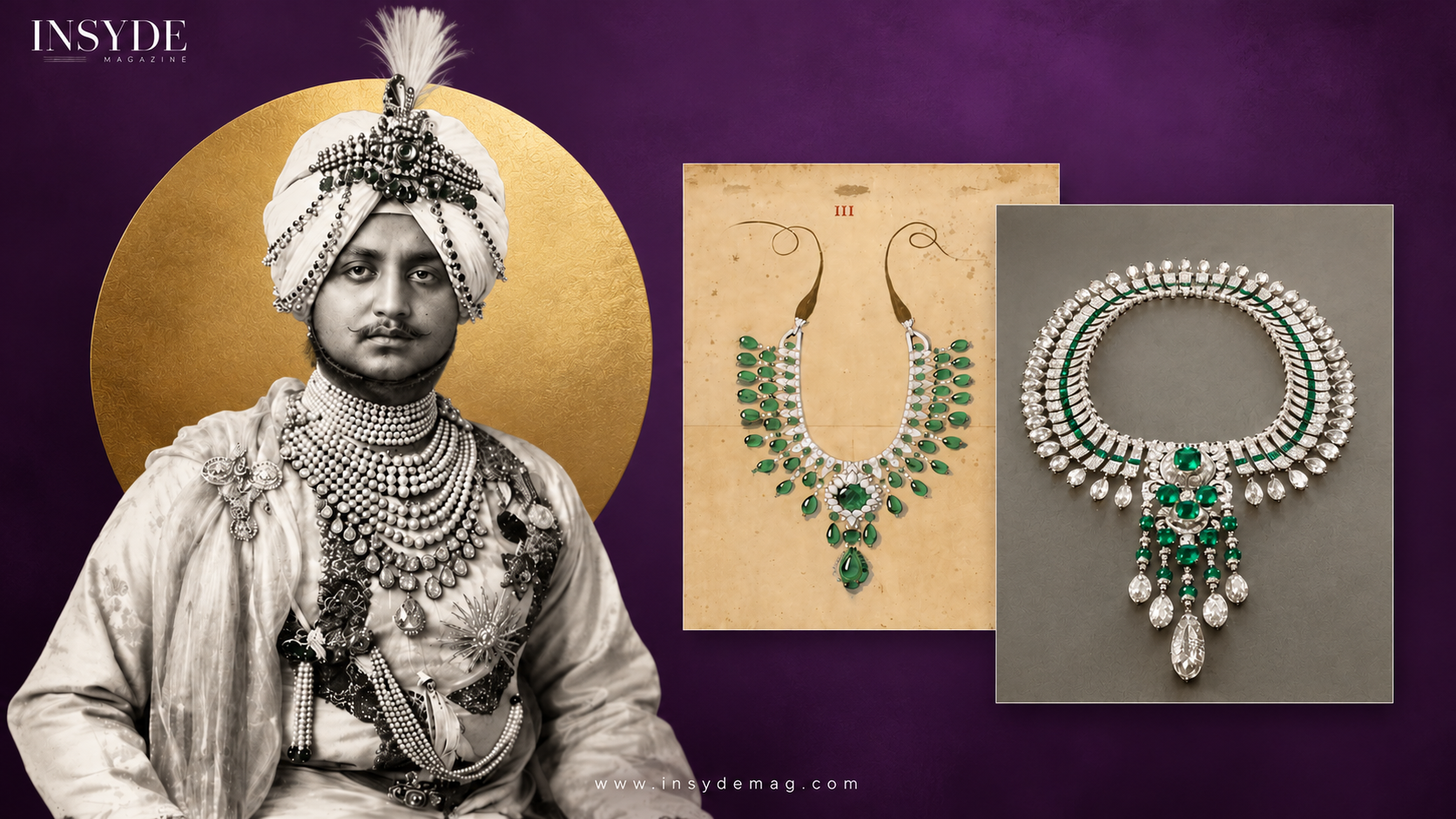
    What followed was an exceptional commission: 7,571 diamonds, 1,432 emeralds and 149 original jewellery designs, according to Boucheron’s historical account and contemporary coverage.

    It was a meeting between Indian royal patronage and French high jewellery, between a ruler with an extraordinary collection of gemstones and a maison with the craftsmanship to give them new form.

    Nearly a century later, those original designs would inspire a contemporary collection, bringing the story back into the spotlight.

    The Maharaja’s jewels had become more than an expression of royal extravagance. They had entered the creative history of one of France’s most enduring jewellery houses.

    And the most remarkable part?

    The story was still being written long after the original commission.

    BEFORE THE MAHARAJA, THERE WAS BOUCHERON

    Founded in Paris in 1858 by Frédéric Boucheron, the maison established its reputation through fine craftsmanship, precious gemstones and an approach to jewellery that challenged convention.

    In 1893, Frédéric Boucheron became the first of the great contemporary jewellers to open a boutique on Place Vendôme, the Parisian address that would become synonymous with high jewellery.

    The location was a statement in itself. Place Vendôme represented a world where exceptional materials, technical mastery and individual commissions came together to serve an international clientele.

    By the early twentieth century, Indian princely rulers were among the wealthy patrons commissioning jewellery from European maisons. Their collections contained gemstones inherited across generations, and their commissions could demand a level of customisation far beyond conventional retail.

    But the relationship was not simply about Indian wealth purchasing European craftsmanship.

    Indian royal jewellery had its own visual language and cultural significance. Precious stones, elaborate necklaces, ceremonial ornaments and turban jewels could communicate rank, authority and identity. Their forms were shaped by regional traditions, courtly customs and the preferences of individual rulers.

    For European jewellers, commissions of this kind presented an opportunity to work with extraordinary materials while interpreting them through their own design traditions.

    Boucheron’s encounter with Bhupinder Singh would become one of the most remarkable examples of that relationship.

    ENTER THE MAHARAJA OF PATIALA

    Bhupinder Singh was born in 1891 and became Maharaja of Patiala in 1900. The ruler of the princely state in present-day Punjab was known for his extravagant lifestyle, interest in sport and passion for luxury.

    His world encompassed grand travel, automobiles, fine clothing and exceptional jewellery. He understood the public language of royal presentation: the way a carefully chosen object could communicate authority, taste and status.

    Yet the significance of his relationship with Boucheron lies in something more specific than his reputation for extravagance.

    He brought the maison a commission built around his own gemstones.

    On 2 August 1928, the Maharaja arrived at Boucheron’s boutique at 26 Place Vendôme in Paris. Accounts of the visit describe an extensive royal entourage and guards carrying secure containers filled with precious stones.

    The jewellery house was led by the legacy of its founder, Frédéric Boucheron. The commission was handled by his son, Louis Boucheron, who received the Maharaja’s treasure and undertook the task of translating it into jewellery designs.

    The scene has all the ingredients of a cinematic encounter: a royal patron arriving in the heart of Paris with a private treasure, a historic jewellery house opening its doors, and gemstones whose potential would be realised through an extraordinary bespoke commission.

    Inside were diamonds, emeralds, rubies, pearls and other precious stones.

    The question was what Boucheron could make of them.

    7,571 DIAMONDS. 1,432 EMERALDS. 149 DESIGNS.

    The numbers remain extraordinary.

    According to Boucheron’s historical account, the 1928 commission involved 7,571 diamonds and 1,432 emeralds, alongside other gemstones, which were selected for an exceptional collection of jewellery.

    Louis Boucheron created 149 original designs for the commission.

    The proposed creations included elaborate diamond-and-emerald collars, multi-strand pearl necklaces, gemstone-set belts and other pieces intended for the Maharaja and his family.

    These were not ordinary retail purchases. The gemstones came from the Maharaja’s own collection, while Boucheron’s role was to interpret those materials through design and jewellery-making expertise.

    That distinction matters.

    In contemporary luxury, the value of a jewel is often communicated through its brand, rarity, materials or retail price. In this commission, the story began with a royal collection of gemstones and the decision to entrust them to a particular maison.

    Boucheron had to do more than produce expensive objects. It had to create jewellery capable of carrying the Maharaja’s identity and the visual grandeur expected of a royal commission.

    The designs brought together elements of Indian jewellery traditions and the design sensibilities of the period, including Art Deco influences. The resulting aesthetic was not simply a reproduction of European fashion or Indian court jewellery. It emerged from the meeting of the patron’s requirements, the gemstones themselves and Boucheron’s creative interpretation.

    The scale of the commission was exceptional. Boucheron describes it as the largest order ever placed at Place Vendôme.

    One royal commission had given the maison a remarkable chapter in its history.

    WHEN WEALTH BECOMES A CREATIVE BRIEF

    There is a difference between commissioning jewellery and giving a jeweller the freedom to create something extraordinary.

    Bhupinder Singh’s commission began with an exceptional resource: his own collection of precious stones. Rather than selecting finished pieces from a display, he brought the materials and entrusted Boucheron with the task of transforming them.

    The gemstones were not simply materials to be acquired. They were part of the creative brief.

    Their colours, sizes and individual characteristics helped determine what could be made. The jeweller’s challenge was to bring them into a coherent collection while respecting their qualities and the intended forms of the jewellery.

    The result was a collaboration between a royal patron and a jewellery house, each contributing something essential.

    The Maharaja brought the treasure and the commission.

    Boucheron brought the design expertise, craftsmanship and creative interpretation.

    This is an enduring principle of high jewellery: exceptional creations often emerge when rare materials meet a clear vision and the technical ability to realise it.

    In this case, the outcome was not simply one celebrated necklace, but a body of 149 original designs.

    It was a reminder that the most interesting luxury commissions are not always defined by the amount spent. They are defined by what a patron and a creative house can make possible together.

    THE ARCHIVE THAT KEPT THE STORY ALIVE

    Time is not always kind to extraordinary objects.

    Jewellery can be inherited, dismantled, reset, sold or dispersed across private collections. A piece that once defined a royal occasion may eventually become difficult to trace.

    The Boucheron commission illustrates an important distinction: the history of a jewel is not necessarily the same as the history of its design.

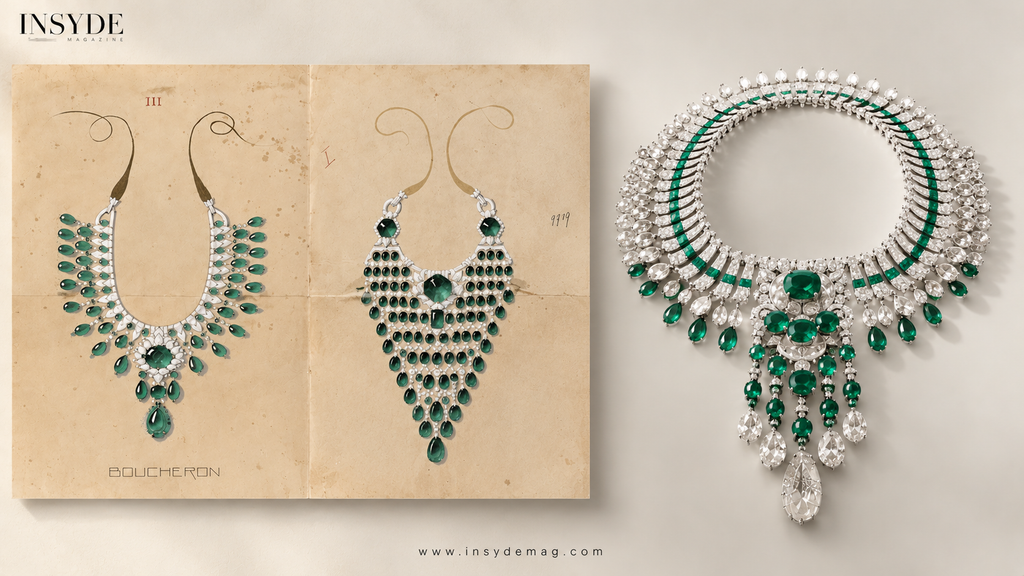
    Boucheron retained the original designs in its archives. These drawings recorded the creative response to the Maharaja’s commission and preserved a connection to the work undertaken in 1928.

    The subsequent whereabouts of the entire original collection are not clearly established in the public record. It would therefore be inaccurate to claim that all 149 finished pieces remain together, or that the entire collection was definitively lost.

    What survives is significant in its own right: the original designs and the documented history of the commission.

    Those records eventually became a bridge between the royal patron of 1928 and a new generation of designers.

    Nearly a century later, the archive would lead to another collection.

    NEW MAHARAJAHS: A ROYAL VISION REIMAGINED

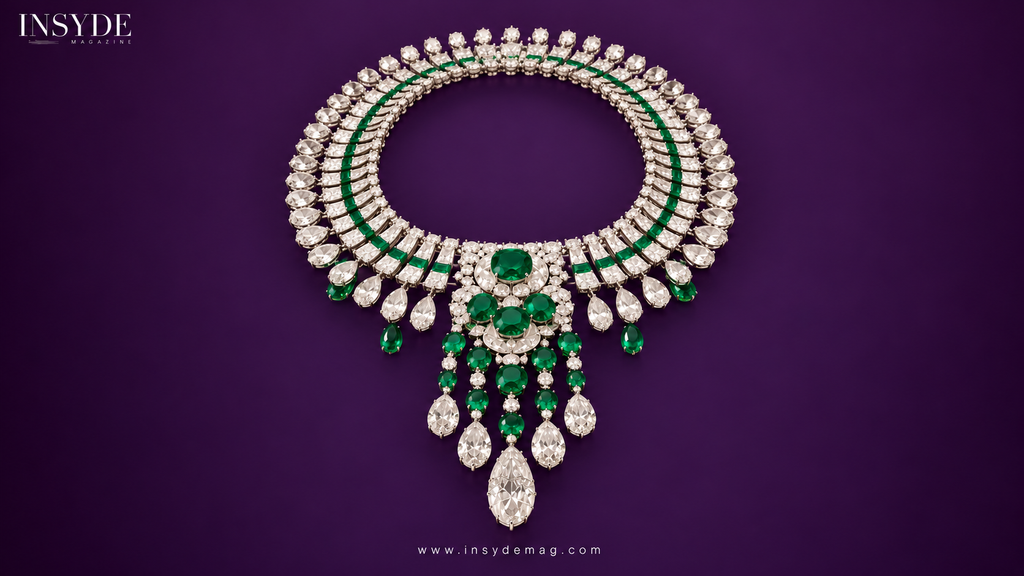
    In January 2022, Boucheron unveiled Histoire de Style: New Maharajahs, a high-jewellery collection inspired by the historic Patiala commission.

    Conceived by the maison’s creative director, Claire Choisne, the collection revisited the original designs and explored how their spirit could be translated into contemporary jewellery.

    The objective was not to reproduce the past piece by piece.

    Instead, Choisne used the archive as a starting point for a new creative interpretation. The collection retained references to Indian royal adornment while exploring contemporary proportions, materials and ways of wearing jewellery.

    The resulting collection comprised 14 pieces across five sets.

    Diamonds, emeralds, pearls, rock crystal, mother-of-pearl, platinum and white gold contributed to its visual language. The designs also drew on references associated with Indian adornment, including the lotus flower and the traditional sarpech, a jewelled ornament worn on a turban.

    One of the collection’s defining creations was the New Maharajah necklace, featuring nine cushion-cut Colombian emeralds weighing nearly 40 carats in total. Its central motif could be detached and worn as a brooch, allowing the piece to be transformed rather than confined to a single form.

    That transformability reflected a broader approach within the collection: jewellery was not treated solely as ceremonial display, but as something that could adapt to the wearer.

    Choisne also made a striking aesthetic decision. Rather than recreating the original commission’s full visual intensity, the contemporary collection explored a palette of white and transparency, using materials such as rock crystal and diamonds to create a different sense of lightness.

    The result was a conversation between historical inspiration and modern design.

    The Maharaja’s commission supplied the creative foundation. Boucheron’s contemporary studio supplied a new interpretation.

    The past was not simply reproduced. It was reimagined.

    WHY BOUCHERON RETURNED TO THE MAHARAJA

    Luxury houses frequently speak of heritage. But heritage becomes meaningful when it can do more than decorate a campaign.

    It must give the present something to work with.

    The Patiala commission offered Boucheron several layers of meaning: an extraordinary historical client, a remarkable collection of gemstones, a documented body of designs and a connection between Indian royal culture and French high jewellery.

    The New Maharajahs collection brought these elements together again, demonstrating how an archive can inform contemporary creation.

    A historic design is not automatically relevant to a modern audience. Its relevance emerges when a creative house finds something in it that can be reconsidered, adapted or challenged.

    In Boucheron’s case, the original drawings offered more than a record of what had once been commissioned. They provided a foundation for new work.

    That is the difference between heritage as nostalgia and heritage as a creative resource.

    The 2022 collection did not need the original jewels to be presented as a complete surviving set. The designs themselves offered a way to reconnect with the commission and reinterpret its ideas for a new generation.

    The Maharaja’s legacy continued through the creative possibilities his commission had left behind.

    THE INDIAN CONNECTION TO FRENCH LUXURY

    There is a tendency to tell the history of European luxury houses as a story of European creativity expanding outwards into the world.

    The relationship between Boucheron and Bhupinder Singh offers another perspective.

    The Maharaja was not simply a consumer of French luxury. He was a patron whose gemstones and commission helped shape a significant body of work within the maison’s history.

    The original commission emerged from a specific encounter between Indian royal wealth, traditions of Indian adornment and the capabilities of a Parisian jewellery house.

    Its later revival made that encounter relevant to a contemporary audience.

    This does not mean that one commission alone transformed Boucheron into the maison it is today. Its history stretches back to 1858 and includes many clients, designers and creative chapters.

    But the Patiala commission demonstrates that the history of a luxury house is often shaped by the people who commission its work as much as by the people who create it.

    The relationship was not simply transactional. It became part of the maison’s cultural and creative heritage.

    For Indian readers, that connection is especially compelling. It places an Indian royal at the centre of a major chapter in the history of a French jewellery house—not as a passing reference, but as the patron behind an exceptional commission whose designs later inspired a contemporary collection.

    It is a reminder that the history of global luxury has never belonged to one country alone.

    THE OTHER PATIALA JEWELLERY STORY

    The Maharaja’s name is also associated with another celebrated creation: the Patiala Necklace by Cartier.

    The two stories are connected by the same royal patron, but they are separate commissions.

    Boucheron’s 1928 order involved 149 original jewellery designs using gemstones from Bhupinder Singh’s collection. Cartier’s Patiala Necklace was a different creation, renowned for its extraordinary diamonds and its central 234.65-carat yellow De Beers diamond.

    The Cartier necklace later became the subject of a separate story involving the disappearance of much of the original piece and the eventual recovery and restoration of some components by Cartier using replacement stones.

    That history should not be confused with the uncertain whereabouts of the complete Boucheron commission.

    Both stories reveal the scale of Indian royal patronage during the period and the relationships between princely wealth and the leading jewellery houses of Europe.

    But Boucheron’s story deserves to be understood on its own terms: a vast bespoke commission, 149 archival designs and a modern high-jewellery collection inspired by the original work.

    WHAT THE MAHARAJA’S LEGACY REVEALS ABOUT LUXURY

    Today, luxury is frequently discussed in terms of scarcity, status, price and brand recognition. These elements matter, but they do not fully explain why certain objects endure in cultural memory.

    The Boucheron–Patiala story offers another perspective.

    The original commission possessed scale and material extravagance. Yet its continuing significance comes from more than the number of gemstones involved.

    It has a protagonist, a documented creative relationship, an archive and a contemporary reinterpretation.

    It connects a specific historical moment to a modern collection, allowing the past to inform the present without requiring the original pieces to remain together.

    That is the power of meaningful luxury heritage.

    A jewel can be valuable because of its materials. It can be desirable because of its craftsmanship. But a documented story can give it another dimension: a place within a wider history of people, taste and creative exchange.

    For Boucheron, the Maharaja’s commission remains a striking example of that principle.

    The stones were extraordinary. The order was exceptional. But the legacy endured because the creative work was preserved—and because a later generation found something worth creating from it.

    THE VERDICT

    The Indian royal who rewrote Boucheron’s story did not build the maison, and he did not define its entire future.

    What he did was leave behind an extraordinary chapter.

    In 1928, Bhupinder Singh of Patiala brought his collection of precious stones to Paris and commissioned Boucheron to create 149 jewellery designs. The maison describes the order as the largest ever placed at Place Vendôme.

    The original designs remained in the archives. In 2022, Claire Choisne returned to them with Histoire de Style: New Maharajahs, translating a historic royal commission into a contemporary high-jewellery collection.

    The distance between those two moments is what makes the story remarkable.

    A treasure arrived in Paris. A jewellery house gave it form. An archive preserved the creative record. And a new generation found inspiration in the designs.

    Nearly a century later, the Maharaja’s story still has something to say about luxury—not simply as the possession of rare things, but as the meeting of material, imagination, patronage and memory.

    Because the most enduring luxury stories are rarely about the price of an object alone.

    They are about the people who make it possible, the ideas that shape it and the legacy it leaves behind.

    One Indian Maharaja. One extraordinary commission. And a French jewellery house whose archives ensured the story would not end in 1928.

    INSYDE — Culture, people and the stories shaping luxury.

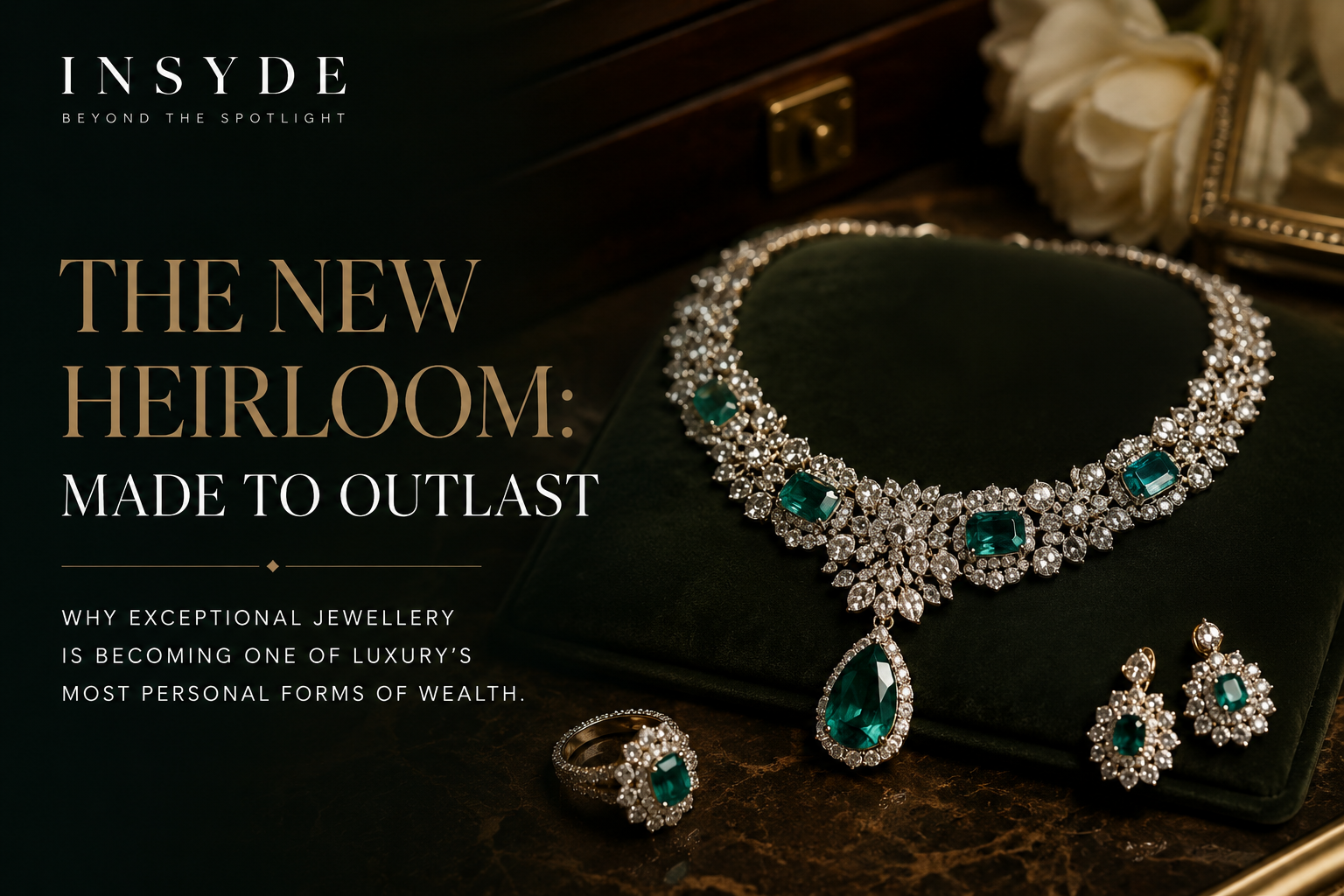
  • The New Heirloom: The Luxury of Legacy

    The New Heirloom: The Luxury of Legacy

    Why exceptional jewellery is becoming one of luxury’s most personal forms of wealth.

    There is a difference between owning something valuable and owning something that matters.

    The distinction becomes clearer at the highest levels of luxury.

    When access is no longer the challenge, another question begins to matter: what is actually worth keeping?

    A remarkable piece of jewellery can answer that question rather elegantly.

    It does not need to occupy a room.

    It does not need a chauffeur.

    It does not need a marina or a private hangar.

    It can sit quietly in a private collection, emerge for one evening, and carry more meaning than an object ten times its size.

    That is the peculiar power of exceptional jewellery.

    It is wealth made intimate.

    Not necessarily wealth designed to be seen by everyone, but wealth expressed through rarity, provenance, craftsmanship and personal significance.

    And increasingly, that is where luxury is heading.

    When Price Stops Being the Point

    For a certain kind of buyer, price is an important consideration.

    For the truly affluent, it is often a secondary one.

    The question is no longer whether something is expensive enough to justify its place in a collection.

    It is whether it is exceptional enough to deserve one.

    That distinction changes the entire conversation.

    A rare Colombian emerald.

    An extraordinary Burmese ruby with compelling provenance.

    A historic diamond.

    A one-of-one commission.

    A piece created by an exceptional atelier.

    A jewel whose craftsmanship reveals itself only when examined closely.

    These are not interchangeable luxury goods.

    They are objects with characteristics that cannot simply be reproduced by increasing a budget.

    That is where jewellery becomes particularly interesting.

    Money can secure access. It cannot manufacture rarity.

    The Value of Knowing What You Are Looking At

    There is a sophistication to jewellery that rewards knowledge.

    Two stones can appear similar to an untrained eye and possess radically different histories, qualities and desirability.

    Two pieces can carry similar materials and have completely different levels of craftsmanship.

    The difference may be in the cut.

    The setting.

    The proportions.

    The origin.

    The stone selection.

    The construction.

    The hand behind it.

    Or simply the judgement of the person who commissioned it.

    This is why the most sophisticated jewellery culture is not necessarily loud.

    It is informed.

    A collector does not need a room to recognise a remarkable stone.

    Sometimes a glance across a dinner table is enough.

    That is a very different kind of status.

    Recognition becomes selective.

    Jewellery Is Wealth You Can Wear

    A residence remains at its address.

    A yacht remains at sea.

    A private aircraft moves according to a flight plan.

    Jewellery has a different kind of freedom.

    It travels with its owner.

    A necklace can move between continents.

    A ring can pass from a boardroom to a private dinner.

    A pair of earrings can become part of an evening’s entire visual language.

    The object is not simply stored wealth.

    It becomes portable identity.

    And because it is worn directly against the body, jewellery occupies an unusually intimate position within a luxury collection.

    You don’t simply own it.

    You live with it.

    The Quiet Power of Exceptional Craftsmanship

    At the top end of jewellery, craftsmanship is rarely there for spectacle.

    It is there for perfection.

    The setting has to hold the stone without overpowering it.

    The proportions have to feel inevitable.

    The metal has to respond to light correctly.

    The construction has to survive years of wear without losing its character.

    The smallest detail can determine whether a piece feels merely expensive or genuinely exceptional.

    This is where the great ateliers distinguish themselves.

    The finished piece may appear effortless.

    That is precisely the point.

    Exceptional craftsmanship hides its own difficulty.

    The more refined the object, the less it needs to explain itself.

    The Stone Is Only the Beginning

    A remarkable gemstone carries its own identity.

    Its colour.

    Its character.

    Its origin.

    Its rarity.

    Its history.

    Its imperfections can sometimes become part of what makes it desirable.

    The sophisticated collector therefore isn’t necessarily searching for the largest stone.

    They may be searching for the stone that cannot easily be replaced.

    That distinction matters.

    Size can be measured.

    Rarity has to be understood.

    And in the highest echelons of collecting, uniqueness tends to outlast spectacle.

    India’s Jewellery Legacy Is an Extraordinary Advantage

    India enters this conversation with something many emerging luxury markets would struggle to create from scratch:

    centuries of jewellery culture.

    Kundan.

    Jadau.

    Polki.

    Meenakari.

    Temple jewellery.

    Goldsmithing traditions.

    Gem-setting techniques.

    Regional craftsmanship passed between generations.

    These aren’t simply decorative traditions.

    They are sophisticated systems of making.

    The opportunity for contemporary Indian luxury is therefore not to reproduce the European model of jewellery.

    It is to take India’s enormous craft heritage and give it a new vocabulary.

    The most compelling future Indian jewellery may not look traditionally Indian at first glance.

    It may be architectural.

    Minimal.

    Sculptural.

    Unexpected.

    But the intelligence of the craft can remain underneath.

    That is where heritage becomes contemporary.

    The Indian Jewel of Tomorrow

    Imagine a contemporary necklace constructed using a centuries-old technique.

    A sculptural ring inspired by Indian architecture.

    A modern interpretation of Jadau without ceremonial excess.

    A rare gemstone framed with the restraint of contemporary design.

    A private commission that combines an inherited stone with a completely new setting.

    That is far more interesting than simply placing an Indian motif on a luxury product.

    The real opportunity is reinvention without losing provenance.

    If Indian jewellery houses can achieve that balance, the result could become globally significant.

    Not because it is Indian.

    But because it is exceptional.

    When Jewellery Becomes a Private Language

    There is a particular pleasure in owning something that does not need to announce itself.

    A necklace without a visible logo.

    A ring whose significance is understood only by a handful of collectors.

    A stone selected because of its provenance rather than its recognisability.

    A private commission that exists nowhere else.

    This is where jewellery enters the territory of discreet luxury.

    The object does not ask for attention.

    It rewards attention.

    And that distinction is increasingly important.

    The old luxury language often said:

    Look at what I own.

    The newer language can say:

    Look closely.

    The Heirloom Is Changing

    Historically, an heirloom was something that survived long enough to be inherited.

    Today, the most thoughtful collectors can design for inheritance from the beginning.

    A piece commissioned for a milestone.

    A gemstone selected with a future daughter or son in mind.

    An existing family jewel redesigned without losing its original stone.

    A new piece created specifically to become part of a family’s visual history.

    The object becomes more than an acquisition.

    It becomes a decision about the future.

    And that may be one of the most sophisticated reasons to buy exceptional jewellery.

    You are not necessarily buying for yourself alone.

    You are deciding what deserves to survive you.

    From Jewellery to Family Archive

    This is where jewellery becomes almost impossible to price.

    A necklace can carry the memory of a wedding.

    A ring can carry the history of a marriage.

    A stone can be reset across generations.

    A brooch can return decades later at another family celebration.

    The financial value may remain measurable.

    The emotional value does not.

    And over time, the two can become inseparable.

    A remarkable jewel is therefore capable of becoming something unusual:

    a physical archive of a family.

    That is a form of wealth no balance sheet can properly capture.

    The Collector’s Eye

    Serious collecting is rarely about accumulation for its own sake.

    The most interesting private collections tend to have a point of view.

    They may focus on exceptional stones.

    A particular period.

    A house.

    A designer.

    A technique.

    A geographical tradition.

    Or simply pieces that tell compelling stories.

    The collector begins to develop an eye.

    They notice things.

    The quality of a setting.

    The way a stone is cut.

    The originality of a design.

    The difference between an important piece and merely an expensive one.

    At that point, buying becomes less about consumption and more about curation.

    And curation is one of the defining characteristics of sophisticated luxury.

    When a Jewel Becomes Art

    There is a moment when jewellery stops functioning as an accessory.

    It becomes an artwork.

    A one-of-one commission.

    An extraordinary stone.

    An experimental setting.

    A collaboration between an artist and a master jeweller.

    A piece whose proportions are so deliberate that it could belong in a gallery as naturally as it belongs on the body.

    At that level, the question is no longer whether the piece matches an outfit.

    It is whether the object itself deserves to exist.

    That is a much higher standard.

    And it is where jewellery enters the world of collecting.

    The Investment Question Is Almost the Wrong Question

    Luxury jewellery is frequently discussed as an investment.

    That conversation has its place.

    Certain exceptional pieces can command significant prices in the secondary market, particularly when rarity, provenance, craftsmanship and collector demand converge.

    But reducing exceptional jewellery to financial performance misses its more enduring value.

    The serious collector isn’t necessarily asking whether a jewel will outperform an investment portfolio.

    They are asking whether it possesses lasting desirability.

    Will the stone still be remarkable?

    Will the craftsmanship still be respected?

    Will the design still feel relevant?

    Will the provenance still matter?

    Will someone want it decades from now?

    That is a different definition of value.

    Financial value can fluctuate. Cultural value can compound.

    The New Luxury Is Personal

    The next generation of high jewellery is unlikely to be defined simply by larger stones or heavier pieces.

    It will be defined by individuality.

    Private commissions.

    Unusual gemstones.

    Exceptional provenance.

    Artist collaborations.

    Heritage techniques.

    Contemporary Indian craftsmanship.

    One-of-one designs.

    And pieces that could never have been created for anyone else.

    This is where luxury becomes most interesting.

    The object is no longer simply selected.

    It is authored.

    The collector becomes part of the creative process.

    The final piece carries something of both sides: the skill of the maker and the identity of the person who commissioned it.

    That is difficult to mass-produce.

    And therefore, increasingly valuable.

    Beyond the Logo

    The future of jewellery may belong to pieces that do not immediately reveal their price, their house or even their significance.

    A rare stone.

    An exceptional setting.

    A technique recognised by a specialist.

    A piece with a story known only to the owner and a small circle of people who understand its importance.

    This is not the disappearance of the luxury brand.

    It is the evolution of luxury beyond the brand.

    The logo tells you who made something.

    The craftsmanship tells you why it matters.

    The provenance tells you where it has been.

    But the story tells you why it should be kept.

    The Things We Choose to Keep

    Perhaps that is why jewellery has survived every change in fashion.

    Trends disappear.

    Designers change.

    Houses rise and fall.

    But a remarkable jewel can remain.

    It can cross generations.

    It can carry a story long after its original owner is gone.

    It can be worn again decades later and somehow feel completely right.

    Because the most valuable thing about jewellery has never been simply what it is made from.

    It is what it remembers.

    And perhaps that is the ultimate luxury.

    Not owning the largest stone.

    Not wearing the most recognisable name.

    Not proving how much something cost.

    But possessing something rare enough, beautiful enough and meaningful enough to become part of someone else’s future.

    The finest jewellery doesn’t simply belong to a person.

    For a while, a person becomes part of its story.

    INSYDE — Beyond the Spotlight.

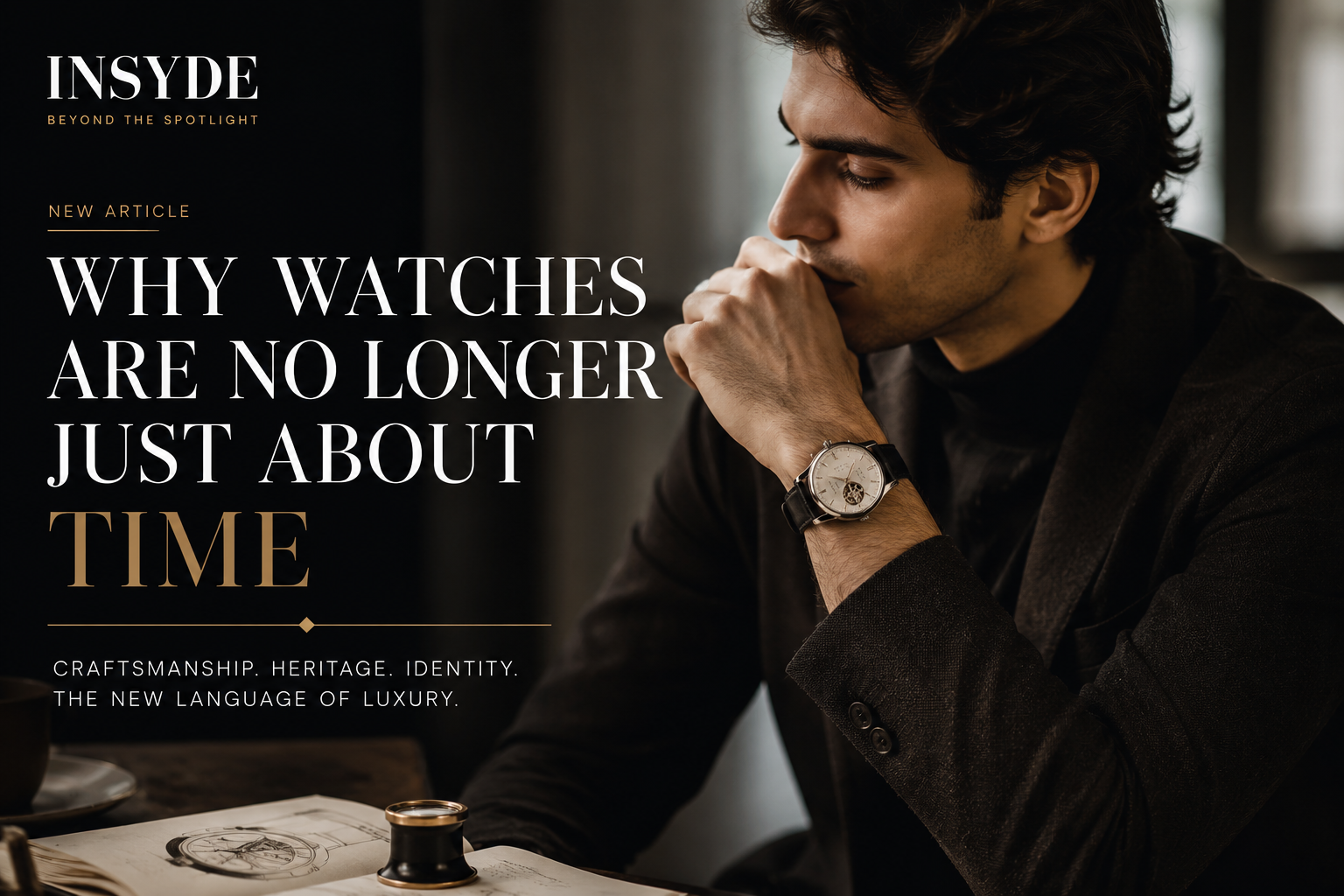
  • Why Watches Are No Longer Just About Time

    Why Watches Are No Longer Just About Time

    In an age when a smartphone can tell the time with extraordinary precision, the mechanical watch has survived by becoming something else entirely — an object of craftsmanship, identity, history and desire.

    There is something almost irrational about wanting a mechanical watch in 2026.

    Your phone tells the time more accurately.

    Your smartwatch can track your heart rate, count your steps, read your messages and remind you about your next meeting.

    A digital clock costs almost nothing.

    And yet people continue to spend lakhs — sometimes far more — on objects whose most obvious function can be performed by something already sitting in their pocket.

    That contradiction is precisely what makes the luxury watch so fascinating.

    A great watch was never really just about telling time.

    It is about what you choose to wear when you don’t need to.

    And in India, that choice is becoming increasingly interesting.

    India’s Watch Moment Is Getting Bigger

    For years, India’s luxury-watch culture was relatively contained.

    There were established collectors, traditional luxury buyers, wedding purchases and a handful of names that dominated the conversation.

    That world still exists.

    But it is expanding.

    In the first half of 2026, India imported around 200,000 Swiss watches, up nearly 37% from the same period a year earlier. The value of those imports rose by more than 31% to approximately 168.7 million Swiss francs.

    The numbers are significant.

    But the more interesting story is what they suggest about the Indian consumer.

    India is becoming increasingly important to international watchmakers at a time when the global Swiss watch industry is facing a more complicated environment.

    Brands are responding.

    The opportunity is no longer simply about selling watches.

    It is about understanding a new generation of Indian buyers who are becoming more curious about what they wear, why they wear it and what exists beyond the obvious names.

    The Watch as a Personal Signature

    Luxury has always been partly about recognition.

    A famous name can tell people what you own.

    A watch can reveal something more subtle:

    why you chose it.

    One person might choose a restrained dress watch because they appreciate proportion and simplicity.

    Another might choose an unusual independent watch because the obvious answer doesn’t interest them.

    Someone else might collect vintage pieces because history matters more than novelty.

    Another collector might be fascinated by movements, complications and the engineering hidden beneath the dial.

    Two people can spend the same amount of money and end up with completely different watches.

    That is where collecting becomes personal.

    The watch stops being merely an accessory.

    It becomes a signature.

    And unlike many luxury objects, it sits unusually close to the body.

    You don’t simply own it.

    You live with it.

    Why Mechanical Watches Still Matter

    The mechanical watch is an extraordinary piece of technology precisely because it is unnecessary.

    Inside a traditional mechanical movement, hundreds of components work together to measure something humans can now measure more cheaply and accurately in countless other ways.

    There is no screen.

    No notification.

    No app.

    No charging cable.

    Just gears, springs, wheels and precision.

    The complexity is no longer necessary.

    It is chosen.

    That may be one of the most fundamental ideas behind luxury itself.

    Luxury often begins where necessity ends.

    A mechanical watch takes an ordinary function and turns it into an object of craftsmanship.

    The movement becomes part of the story.

    The finishing becomes part of the story.

    The sound becomes part of the story.

    Even the ritual of winding or setting the watch can become part of the experience.

    The technology may be centuries old.

    The fascination is not.

    The Indian Buyer Is Becoming More Informed

    Perhaps the most important change in India’s watch market is not simply that more people are buying luxury watches.

    It is that buyers are becoming more curious about what they are buying.

    The Indian market is attracting a younger customer base, while interest in premiumisation, design and the emotional value of mechanical watches continues to grow.

    The first luxury watch might still be about recognition.

    The second might be about design.

    The third might be about the movement.

    The fourth might be about finding something nobody around you is wearing.

    That is how collecting becomes interesting.

    Not necessarily with wealth.

    With curiosity.

    Beyond the Obvious Names

    There is nothing wrong with choosing one of the world’s most recognisable watchmakers.

    Heritage matters.

    Craftsmanship matters.

    Consistency matters.

    Generations of watchmaking expertise do not disappear simply because consumers become more experimental.

    But luxury has always had another side.

    The world of independent watchmaking can be wonderfully strange.

    Smaller workshops.

    Unusual complications.

    Experimental materials.

    Unexpected dial designs.

    Limited production.

    Designs that reward attention rather than immediate recognition.

    For someone who already knows the obvious names, discovery becomes part of the pleasure.

    The question changes from:

    “How famous is the brand?”

    to:

    “How interesting is the watch?”

    That is where the watch begins to move closer to art.

    Quiet Luxury Has Reached the Wrist

    For years, bigger often meant more luxurious.

    Large cases.

    Gold.

    Diamonds.

    Complicated dials.

    Visual presence.

    But the mood is becoming more nuanced.

    Indian luxury-watch retailers and brands have been reporting stronger interest in smaller, more understated watches, reflecting a broader movement towards quieter expressions of luxury.

    A 39mm watch can communicate confidence without demanding attention.

    A simple dial can require more appreciation than a complicated one.

    A watch without diamonds can sometimes be more difficult to understand — and therefore more interesting.

    This is where the phrase quiet luxury becomes useful.

    Not because understated automatically means better.

    But because sophistication increasingly depends on recognising quality without needing it to announce itself.

    The most interesting watch in the room may not be the one everyone notices first.

    It might be the one only another collector recognises.

    A Watch Can Become a Memory

    There is another reason watches occupy such a unique place in luxury.

    They age with you.

    A smartphone becomes obsolete.

    A car eventually changes hands.

    Fashion moves on.

    A watch can remain.

    It might be purchased to mark a promotion.

    A wedding.

    A birthday.

    A first business success.

    A significant journey.

    Or simply the moment someone decides that they want to own something beautiful.

    Years later, the object carries the memory.

    The scratches become part of it.

    The worn strap becomes part of it.

    The person who originally wore it may no longer be the person wearing it.

    That is why watches can become heirlooms.

    Not simply because they are valuable.

    Because they are portable pieces of memory.

    The Indian Heirloom Instinct

    India already understands the emotional value of objects that move through generations.

    Jewellery is inherited.

    Saris become family archives.

    Furniture survives marriages, houses and cities.

    Objects accumulate stories.

    The mechanical watch fits naturally into that tradition.

    A watch bought today can eventually become something else entirely.

    It can become the watch your child remembers seeing on your wrist.

    Then the watch your child wears years later.

    Its monetary value may matter.

    But its emotional value can become greater.

    The modern luxury watch is, in that sense, not entirely foreign to India.

    It simply gives an old idea a new form.

    Watches Are Becoming Part of a Larger Luxury Culture

    The modern watch does not exist in isolation.

    It sits inside a much larger cultural ecosystem.

    Fashion.

    Automobiles.

    Sport.

    Art.

    Travel.

    Architecture.

    Technology.

    Formula 1 has become deeply connected to luxury watchmaking.

    Tennis has long provided another meeting point between watches, sport and fashion.

    Automobile enthusiasts often move naturally between collecting cars and collecting watches.

    Fashion houses collaborate with watchmakers.

    Artists reinterpret watch design.

    Luxury hotels create experiences around collectors and horology.

    The watch has become part of a larger conversation about how people express taste.

    And this is where watches become particularly relevant to INSYDE.

    We aren’t interested only in what is on the wrist.

    We’re interested in what the wrist tells us about the person wearing it — and the culture around them.

    The New Luxury Collector Doesn’t Always Want the Obvious

    There is a difference between being able to buy a luxury watch and becoming genuinely interested in watches.

    The first is financial.

    The second is cultural.

    A collector starts noticing details.

    The movement beneath the dial.

    The finishing on a bridge.

    The proportions of a case.

    The history of a reference.

    The difference between a manufacture movement and an outsourced calibre.

    The story behind an independent watchmaker.

    The way a watch changes on the wrist.

    This knowledge creates another form of luxury.

    Knowing what you’re looking at.

    And perhaps that is where the next generation of Indian watch culture becomes particularly interesting.

    The consumer is no longer dependent entirely on a salesperson to explain why something matters.

    Information is everywhere.

    Collectors can study movements, follow independent makers, compare references and discover watches from almost anywhere in the world.

    The result is a more informed buyer.

    And a more demanding one.

    India’s Watch Market Is Becoming More Sophisticated

    India’s growth is happening at an interesting moment for the global industry.

    Swiss watch exports declined in 2025, while India continued to show strong momentum.

    That contrast has made India increasingly difficult for global watchmakers to ignore.

    Retail networks are expanding.

    New boutiques are opening.

    Brands are investing in local teams and customer experiences.

    And younger buyers are entering categories that were once associated primarily with older collectors.

    The opportunity is not simply to sell more watches.

    It is to build a deeper watch culture.

    That means better retail experiences.

    More education.

    More access to interesting independent makers.

    More collecting communities.

    More conversations around craftsmanship.

    And eventually, perhaps, a stronger Indian voice within global horology.

    The Watch Doesn’t Need to Compete With Your Phone

    Perhaps the easiest mistake is to ask whether a mechanical watch can compete with technology.

    It can’t.

    It shouldn’t.

    Your phone tells you the time.

    Your watch tells you why you chose to wear it.

    One provides information.

    The other provides expression.

    One is designed around constant updates.

    The other can remain largely unchanged for decades.

    One is expected to be replaced.

    The other can be designed to survive you.

    That is why the mechanical watch continues to matter.

    It offers something technology has made increasingly rare:

    a reason to keep something simply because it is beautifully made.

    So, Why Do We Still Want Watches?

    Because we don’t really buy them for the time.

    We buy them for the engineering.

    The craft.

    The history.

    The design.

    The ritual.

    The memory.

    The weight on the wrist.

    The quiet movement beneath the dial.

    And sometimes, simply because we love the way they look.

    There is nothing irrational about that.

    Luxury has never been entirely rational.

    It exists in the space between need and desire.

    Few objects occupy that space as elegantly as the mechanical watch.

    India’s Time Is Changing

    India’s watch story is no longer simply about importing more Swiss watches.

    It is about a new generation learning to appreciate what makes a watch worth wearing.

    The buyer is becoming younger.

    The market is becoming deeper.

    The choices are becoming wider.

    And the conversation is moving beyond logos.

    For the next generation of Indian collectors, the most interesting watch may not necessarily be the most recognisable one.

    It may be the one with the most compelling story.

    The most beautiful movement.

    The most unusual design.

    The strongest connection to its maker.

    Or simply the one that means something to the person wearing it.

    Because when everyone can check the time on a phone, a mechanical watch has to offer something else.

    It has to give you a reason to keep looking at it.

    And increasingly, in India, people are learning exactly where to look.

    INSYDE — Inside modern luxury.

  • The Bhansali Aesthetic

    The Bhansali Aesthetic

    How Sanjay Leela Bhansali turned Indian cinema into a language of beauty, craftsmanship and desire.

    Some filmmakers tell stories.

    Sanjay Leela Bhansali builds worlds.

    Before a character speaks, there may already be a chandelier glowing above her, silk moving through the frame, jewellery catching the light, music rising somewhere beyond the room.

    In his cinema, beauty is rarely background.

    Beauty is part of the narrative.

    That is what makes Bhansali particularly interesting to INSYDE.

    His work sits at an intersection of cinema, fashion, architecture, music, craftsmanship and desire — a place where visual richness becomes storytelling and detail becomes identity.

    Over more than three decades, he has developed an aesthetic so recognisable that a frame can sometimes feel like a Bhansali frame before the audience consciously understands why.

    And perhaps that is the real achievement.

    He didn’t simply create films with a distinctive look. He created a visual language.

    When Cinema Becomes a World

    There is a difference between designing a beautiful frame and constructing an entire universe.

    Bhansali has consistently pursued the latter.

    His films are populated by elaborate interiors, dramatic architecture, intricate costumes, jewellery, carefully choreographed movement and compositions in which even the smallest visual element can feel deliberate.

    Those details do not exist independently.

    They speak to one another.

    Architecture establishes scale.

    Costume establishes character.

    Lighting establishes mood.

    Music establishes emotion.

    Movement establishes rhythm.

    Together, they create something closer to an immersive environment than a conventional film set.

    That precision has become part of the Bhansali method. On Heeramandi, Architectural Digest India documented his insistence on repeatedly adjusting elements of the set — from furniture and wall textures to seemingly minor decorative details — and quoted Bhansali explaining that architecture plays an important role in how he constructs a frame. (Architectural Digest)

    The point is not simply to make a set look expensive.

    The environment has to belong to the story.

    The Luxury of Detail

    Luxury has always depended on detail.

    The difference between something expensive and something exceptional is often invisible from a distance.

    A stitch.

    A setting.

    A finish.

    A proportion.

    A material chosen because of how it responds to light.

    Bhansali approaches cinema with a similar sensitivity.

    A costume isn’t simply clothing.

    A room isn’t simply a set.

    A chandelier isn’t simply decoration.

    A colour isn’t simply a colour.

    Everything contributes to the emotional architecture of the scene.

    The result is a cinema that can feel almost tactile.

    You sense the weight of the fabric.

    The warmth of the light.

    The scale of the room.

    The movement of jewellery.

    The silence before the music begins.

    The effect is extravagant, but the underlying principle is surprisingly disciplined:

    nothing is there without intention.

    Where the Obsession With Beauty Began

    The grandeur of Bhansali’s cinema has a deeply personal origin.

    He has spoken about growing up in a chawl in Mumbai and about the lack of space and visual beauty around him during his childhood. His mother, a dancer, performed in a small space, while Bhansali imagined larger, more ordered environments. He has connected those experiences directly to the expansive sets, central framing and visual symmetry that later became signatures of his filmmaking. (Indian Express)

    It is an important detail because it changes the way his aesthetic can be understood.

    The grandeur is not simply extravagance for its own sake.

    It is a response to limitation.

    Small spaces became expansive ones.

    Plain walls became elaborate environments.

    Disorder became symmetry.

    Limited movement became choreography.

    The absence of beauty became an obsession with creating it.

    And perhaps that is why his sets rarely feel merely expensive.

    They feel imagined.

    The Architecture of Desire

    Bhansali understands something that luxury brands have understood for generations:

    objects become more powerful when placed inside a world.

    A necklace is one thing.

    A necklace worn with a particular fabric, under a particular light, inside a particular room, accompanied by music and movement, becomes something else.

    The object acquires context.

    That is one of the reasons his cinema has such a strong relationship with fashion and jewellery.

    The visual elements do not sit around the characters.

    They help construct them.

    Jewellery as Storytelling

    There may be no better example than jewellery.

    In Bhansali’s worlds, jewellery rarely feels incidental.

    It can establish hierarchy.

    It can indicate wealth.

    It can communicate tradition.

    It can transform the silhouette of a character.

    And, importantly, it interacts with light.

    A necklace catching the light during a close-up is doing more than displaying craftsmanship.

    It is participating in the image.

    This is where Bhansali’s cinema naturally intersects with the language of luxury.

    The finest luxury objects are designed to reward attention.

    So are his frames.

    The closer you look, the more there is to discover.

    Fashion Without the Fashion Show

    Bhansali’s relationship with fashion is more sophisticated than simply dressing actors beautifully.

    His costumes establish an entire visual vocabulary.

    Silhouette, fabric, colour, ornamentation and movement work together.

    The clothes have to survive choreography.

    They have to respond to lighting.

    They have to communicate period and cultural context.

    And they have to remain emotionally connected to the character.

    That requires something closer to design than conventional styling.

    The result is fashion that belongs to the world of the film rather than being placed on top of it.

    The costume doesn’t interrupt the story. It becomes part of the story.

    The Women at the Centre

    Bhansali’s cinema has repeatedly placed women at the centre of its visual and emotional worlds.

    From Devdas and Black to Ram-Leela, Bajirao Mastani, Padmaavat, Gangubai Kathiawadi and Heeramandi, his women are rarely treated as background figures.

    Their clothes, jewellery, movement and environments often become extensions of their emotional and social position.

    The scale of the world around them can communicate power.

    A crowded room can become a stage.

    A palace can become a prison.

    A costume can become armour.

    A jewel can become status.

    A dance can become defiance.

    That visual treatment has become one of the recognisable elements of his cinema. Actors from Heeramandi have also described his approach to presenting women as central to his filmmaking language. (Indian Express)

    The important point is not simply that Bhansali makes beautiful images of women.

    It is that he uses beauty as part of the language through which their stories are told.

    Music Is Architecture

    There is another defining element of the Bhansali aesthetic: music.

    For Bhansali, music has long been central to the construction of his films rather than something added after the visual world is complete.

    A song can become a room.

    A room can become choreography.

    Choreography can become emotion.

    Emotion becomes narrative.

    This is why some of his most memorable sequences can communicate enormous amounts without conventional dialogue.

    The music carries the architecture of the scene.

    The performers move through it.

    The camera becomes part of the choreography.

    The result is closer to a fully composed theatrical experience than a conventional musical interlude.

    The Discipline Beneath the Spectacle

    The word “grand” is often used to describe Bhansali.

    It is accurate, but incomplete.

    What is more interesting is the discipline underneath it.

    He has spoken about his fascination with central framing and the desire to create order from the disorder he experienced growing up. (Indian Express)

    Architectural Digest India has similarly documented his attention to the smallest details of his sets, including furniture placement, textures, colours and architectural elements. (Architectural Digest)

    That reveals the secret beneath the spectacle.

    The image may be extravagant.

    The composition is controlled.

    That is why his frames can feel so immediately recognisable.

    Grandeur With a Purpose

    Bhansali’s films are often described using words such as lavish, opulent and larger-than-life.

    But spectacle alone would not explain their longevity.

    The real fascination lies in what the grandeur communicates.

    A palace can represent power.

    A crowded courtyard can represent society.

    A vast stage can make an individual appear small.

    An empty room can make an emotion feel enormous.

    A chandelier can suggest wealth, desire or decay.

    A costume can tell you where a character belongs before the dialogue does.

    The visual scale is therefore not simply decoration.

    It is emotional scale.

    India Through a More Cinematic Lens

    There is also something distinctly Indian about Bhansali’s understanding of grandeur.

    India has never treated beauty as purely architectural.

    It exists in textiles.

    Jewellery.

    Music.

    Dance.

    Wedding traditions.

    Craftsmanship.

    Palaces.

    Festivals.

    Theatre.

    Ceremony.

    Bhansali understands that instinctively.

    His cinema draws from a cultural memory in which colour, ornamentation, music and movement can coexist without apology.

    The result is not simply an expensive-looking version of Indian cinema.

    It is an attempt to transform elements of Indian visual culture into a cinematic language of their own.

    And that distinction matters.

    He doesn’t simply decorate Indian stories. He builds worlds around them.

    From Cinema to a Wider Cultural Language

    With Heeramandi: The Diamond Bazaar, Bhansali extended this visual vocabulary into streaming.

    The series brought together his familiar concerns — music, performance, elaborate environments, costumes, historical atmosphere and female characters — for a global streaming audience. Netflix describes the series as a story of love, power, betrayal and freedom centred on the courtesans of pre-independence Lahore. (Indian Express)

    The significance goes beyond the move from cinema to television.

    It demonstrated that the Bhansali aesthetic could exist as a broader cultural world.

    The sets became part of the conversation.

    The costumes became part of the conversation.

    The jewellery became part of the conversation.

    The music became part of the conversation.

    The visual identity became almost as recognisable as the title itself.

    That is a powerful position for any filmmaker to reach.

    The Influence of the Past

    Bhansali’s visual references are not limited to cinema.

    Architectural Digest India has documented how his reference library has drawn from places and objects he encountered growing up, as well as artists, photographers and musicians including S. H. Raza, V. S. Gaitonde, Raghu Rai and Kishori Amonkar. (Architectural Digest)

    That is revealing.

    His aesthetic isn’t built from one source.

    It is accumulated.

    Painting.

    Photography.

    Music.

    Architecture.

    Theatre.

    Textiles.

    Indian history.

    Street life.

    Memory.

    The resulting world may look fantastical, but its ingredients are deeply rooted in observation.

    When Excess Becomes Restraint

    There is an irony in Bhansali’s work.

    The images can be enormous.

    The sets can be enormous.

    The costumes can be elaborate.

    The music can be overwhelming.

    Yet the composition is often highly controlled.

    Symmetry.

    Central framing.

    Colour relationships.

    Movement.

    Light.

    Negative space.

    Everything is competing for attention, yet everything is carefully placed.

    That tension is part of what makes the aesthetic work.

    The spectacle is large. The intention is precise.

    A Filmmaker With a Signature

    The ultimate achievement for an auteur is recognisability.

    Not fame.

    Not scale.

    Not even box-office success.

    A signature.

    Something that makes an audience recognise the creator before seeing the name.

    Bhansali has achieved that.

    The grand interiors.

    The controlled colour.

    The elaborate costumes.

    The music.

    The choreography.

    The central compositions.

    The emotional intensity.

    The women framed against enormous spaces.

    The sense that every object has been placed with intention.

    Together, they form a vocabulary.

    And once a filmmaker develops a vocabulary of that strength, individual films become chapters inside a much larger artistic language.

    What Comes Next

    Bhansali’s next chapter is already taking shape.

    His much-anticipated Love & War, starring Ranbir Kapoor, Alia Bhatt and Vicky Kaushal, is nearing completion, with reports now pointing toward his next major project, a Madhubala biopic. (The Times of India)

    For a filmmaker whose aesthetic is already so established, the interesting question is not whether the next project will be visually ambitious.

    We know the answer.

    The more compelling question is:

    What will he do with that language next?

    Can grandeur evolve without becoming repetition?

    Can spectacle remain emotionally intimate?

    Can a recognisable aesthetic continue to surprise?

    Those are the questions that matter when an artist has spent decades refining a signature.

    The Bhansali Aesthetic

    Perhaps the easiest way to misunderstand Sanjay Leela Bhansali is to think his cinema is simply about luxury.

    It isn’t.

    Luxury is the surface.

    The deeper obsession is craft.

    The craft of composition.

    The craft of music.

    The craft of costume.

    The craft of movement.

    The craft of light.

    The craft of architecture.

    The craft of creating an environment that feels larger than reality.

    That is why his images remain so persistent.

    Long after a film’s plot has been discussed, individual frames remain.

    A room.

    A colour.

    A piece of jewellery.

    A costume.

    A song.

    A gesture beneath a chandelier.

    A character standing alone in an enormous space.

    These are not simply beautiful moments.

    They are fragments of a language.

    And perhaps that is Bhansali’s most enduring contribution to Indian cinema.

    He has shown that grandeur, when treated with enough discipline and imagination, can become more than spectacle.

    It can become storytelling.

    In a culture increasingly consumed through fleeting images, there is something almost radical about a filmmaker who still believes a frame deserves to be constructed, considered and remembered.

    That may be the real Bhansali aesthetic.

    Not simply the luxury of seeing more — but the discipline of making every detail matter.

    INSYDE — Beyond the Spotlight.

  • THE BAG THAT MONEY CAN’T BUY

    THE BAG THAT MONEY CAN’T BUY

    How Hermès turned scarcity, craftsmanship and desire into one of luxury’s most powerful status symbols.

    There are handbags that cost hundreds.

    There are handbags that cost thousands.

    And then there is the Hermès Birkin — a handbag so deeply embedded in the language of luxury that its price is no longer the most interesting thing about it.

    The real question is much simpler:

    What happens when having the money still doesn’t guarantee that you can have the thing you want?

    That is where Hermès becomes fascinating.

    Because luxury has traditionally followed a straightforward formula:

    More money. Better things.

    Hermès built something more complicated:

    More money gives you access to luxury. But it doesn’t necessarily give you access to everything.

    And that distinction transformed a handbag into something far bigger than a fashion accessory.

    The Birkin became a symbol of wealth, yes.

    But also of taste.

    Scarcity.

    Craftsmanship.

    Access.

    And, perhaps most importantly, desire.

    Because when something is difficult to obtain, the price is only the beginning of the story.


    THE BAG WAS NEVER DESIGNED TO BECOME A STATUS SYMBOL

    The origin of the Birkin is almost too ordinary for the mythology that eventually surrounded it.

    In 1984, British actress and singer Jane Birkin found herself seated next to Jean-Louis Dumas, then chairman and chief executive of Hermès, on a flight from Paris to London.

    Birkin explained that she couldn’t find a leather bag that worked for her as an everyday carryall.

    Dumas listened.

    The idea evolved into a new handbag.

    The Birkin was born.

    There was no grand plan to create one of the world’s most recognisable symbols of extreme wealth.

    It began with functionality.

    Make it practical.

    Make it beautiful.

    Make it exceptionally well.

    The mythology came later.

    And that may be one of the most important details in the entire story.

    Because Hermès didn’t begin by manufacturing status.

    It manufactured quality.

    Status followed.


    HERMÈS WAS BUILDING LUXURY LONG BEFORE THE BIRKIN

    To understand why the Birkin became so powerful, you have to go back much further.

    Hermès was founded in Paris in 1837 by Thierry Hermès, originally as a workshop producing harnesses and other equestrian equipment.

    Its early clientele included members of Europe’s wealthy and aristocratic society.

    As transportation changed, Hermès changed with it.

    The company moved into bags, luggage, silk, fashion, jewellery and other categories while maintaining a central commitment to craftsmanship.

    That history matters.

    Because the Birkin didn’t create Hermès’ luxury reputation.

    Hermès’ reputation created the environment in which the Birkin could become legendary.

    The bag arrived with decades of credibility already behind the name.


    THE REAL LUXURY IS IN THE MAKING

    A Birkin is not valuable simply because it carries the Hermès name.

    The construction itself is part of the story.

    Hermès leather goods are made by highly trained artisans, with the house emphasising manual craftsmanship and individual attention throughout the production process. The company says leather artisans undergo extensive training before becoming fully qualified.

    The leather is selected carefully.

    Pieces are cut and prepared.

    Edges are finished.

    Hardware is fitted.

    Stitching is performed by hand.

    And the artisan’s work becomes part of the character of the finished bag.

    This is important because modern luxury often creates the illusion of infinite choice.

    Hermès does something different.

    It reminds the customer that human time is finite.

    A skilled artisan can only make so many pieces.

    A particular material can only exist in a certain quantity.

    A particular finish requires a certain amount of attention.

    And suddenly, scarcity isn’t just a marketing strategy.

    It is built into the production process.


    THE DIFFERENCE BETWEEN EXPENSIVE AND EXCLUSIVE

    This is where the Birkin story becomes particularly interesting.

    An expensive product asks:

    Can you afford it?

    An exclusive product asks:

    Can you get it?

    Those are completely different questions.

    A wealthy customer can have the financial means to purchase a Birkin and still not be able to walk into a boutique and simply select any model, colour or leather they want.

    Availability varies.

    Relationships matter.

    Specific pieces are limited.

    And the exact bag someone wants may not be waiting behind the counter.

    That creates a psychological effect that money cannot completely eliminate:

    anticipation.

    You want it.

    You search for it.

    You wait.

    And the longer the desire survives, the more emotionally valuable the eventual acquisition can become.


    WHEN “NO” BECOMES PART OF THE LUXURY

    Modern commerce has been built around convenience.

    See it.

    Click it.

    Buy it.

    Tomorrow, it’s at your door.

    Luxury operates differently.

    At its highest level, friction can become part of the experience.

    The wait.

    The discovery.

    The relationship.

    The invitation.

    The moment when the right piece finally appears.

    That is a radical idea in a world obsessed with instant gratification.

    Hermès doesn’t need to make the Birkin feel like something everyone can have immediately.

    In fact, the opposite can make the product more desirable.

    The less ordinary the acquisition feels, the less ordinary the object can feel.

    The purchase becomes an event.


    THE BOUTIQUE ISN’T JUST A STORE

    This is another important distinction.

    For most consumer products, the store exists to facilitate the transaction.

    In luxury, the environment is part of the product.

    The boutique.

    The service.

    The packaging.

    The conversation.

    The anticipation.

    The feeling of discovering something rather than simply ordering it.

    These details matter because luxury is fundamentally emotional.

    A customer isn’t only purchasing leather and hardware.

    They’re purchasing an experience around the object.

    And Hermès has spent generations protecting that experience.


    THEN THE BIRKIN BECAME A CULTURAL SYMBOL

    The bag’s transformation accelerated as it became associated with celebrities, socialites, entrepreneurs and some of the world’s wealthiest consumers.

    Its shape became recognisable.

    Its hardware became recognisable.

    Its name became recognisable.

    The Birkin became something you could identify without seeing the logo.

    That is powerful branding.

    Hermès didn’t need to cover the bag in enormous symbols.

    The silhouette did much of the work.

    And this created an interesting form of status:

    the people who knew, knew.

    The bag could be visible without being loud.

    It could communicate wealth without announcing a price.

    It could sit quietly on an arm while carrying an enormous amount of cultural meaning.


    WHY THE BIRKIN DOESN’T NEED A GIANT LOGO

    Modern luxury has spent decades teaching consumers to recognise logos.

    Hermès took a different route.

    The Birkin’s identity comes from its proportions, construction, hardware, craftsmanship and association with the house.

    That makes the bag part of a more sophisticated form of luxury communication.

    A large logo says:

    Look at the brand.

    A recognisable object can say:

    If you know, you know.

    And that distinction has become increasingly relevant as luxury consumers become more interested in subtlety, provenance and craftsmanship.

    The most sophisticated status signal isn’t necessarily the loudest one.

    Sometimes it is the thing only a certain audience recognises.


    THEN THE SECONDARY MARKET CHANGED THE GAME

    The Birkin became even more fascinating when it entered the world of resale and collecting.

    Certain colours.

    Certain leathers.

    Certain sizes.

    Certain years.

    Exceptional condition.

    Rare examples.

    All can influence desirability in the secondary market.

    Some Birkins have sold for extraordinary sums at auction, particularly rare or historically significant examples.

    But there is an important distinction:

    A Birkin is not automatically an investment.

    The resale market is influenced by condition, provenance, rarity, demand and market conditions.

    The existence of a strong secondary market doesn’t guarantee appreciation.

    But it does demonstrate something important.

    The Birkin can exist simultaneously as:

    a handbag,

    a collectible,

    a status symbol,

    and a cultural asset.

    That is an extraordinary amount of meaning for an object originally designed to carry personal belongings.


    THE PSYCHOLOGY OF SCARCITY

    Why does scarcity work?

    Because humans don’t always value things according to their practical usefulness.

    When something is limited, difficult to obtain or perceived as disappearing, its psychological value can increase.

    Luxury brands have understood this for generations.

    But scarcity only works when the underlying product deserves desire.

    Make something rare without making it desirable and you have nothing.

    Hermès combined the two.

    Exceptional craftsmanship created the desire.

    Limited availability intensified it.

    And the result became a self-reinforcing cycle.

    Desire creates demand.

    Demand reinforces scarcity.

    Scarcity increases desirability.

    And the cycle continues.


    THE MOST POWERFUL WORD IN LUXURY

    No.

    No mass-market production.

    No constant discounting.

    No desperate promotions.

    No need to make every product available to everyone immediately.

    That ability to say no is one of the most powerful tools a luxury brand can possess.

    Because the moment a luxury product becomes permanently available at a discount, something changes.

    The consumer stops asking:

    “Can I get it?”

    and starts asking:

    “Should I buy it?”

    Hermès has spent decades making the first question more important.

    And that is incredibly powerful.


    WHEN THE BAG BECAME CULTURAL CURRENCY

    Eventually, owning a Birkin stopped being solely about owning an exceptional handbag.

    It became a form of cultural knowledge.

    You could recognise the bag.

    Understand the leather.

    Understand the construction.

    Understand why one version might attract more attention than another.

    Understand why rarity matters.

    That knowledge becomes part of the luxury experience.

    And suddenly, the Birkin communicates something beyond financial capability.

    It can communicate:

    I know this world.

    That’s cultural capital.

    And cultural capital is one of the most powerful currencies in luxury.


    HERMÈS DOESN’T NEED TO CHASE THE MOMENT

    Fashion is built around change.

    New season.

    New collection.

    New trend.

    New colour.

    New obsession.

    Luxury operates on a different clock.

    Hermès has the advantage of being able to build on heritage rather than constantly replacing it.

    The Birkin doesn’t need to become radically different every season.

    Its enduring appeal comes partly from consistency.

    The design can evolve.

    Materials can vary.

    Colours can change.

    But the underlying identity remains recognisable.

    That gives the brand something most fashion businesses desperately want:

    timelessness.


    THE BAG MONEY ALONE CAN’T GUARANTEE

    This is where the title becomes meaningful.

    The Bag That Money Can’t Buy.

    Of course money matters.

    A Birkin is a luxury purchase, and financial ability is an obvious part of accessing the category.

    But money isn’t the entire equation.

    There is availability.

    There is demand.

    There is craftsmanship.

    There is scarcity.

    There is knowledge.

    There is patience.

    There is the relationship with the house.

    And there is something even more important:

    desire.

    Because a luxury brand’s greatest achievement isn’t convincing you that you need its product.

    It’s convincing you that you want this particular product.

    Even when you could buy something else.


    WHEN THE WAIT BECOMES PART OF THE PRODUCT

    Think about the psychology.

    If something arrives tomorrow, you enjoy it tomorrow.

    If you’ve spent months wanting something, searching for it and imagining owning it, the moment you finally receive it carries something else:

    a story.

    The acquisition has emotional history.

    You remember the search.

    You remember the anticipation.

    You remember finally finding it.

    And that story becomes part of the object.

    This is one of luxury’s greatest tricks:

    the journey can become part of the value.


    THE BIRKIN ISN’T REALLY ABOUT THE BAG

    This is the point where the story becomes bigger than Hermès.

    The Birkin reveals something fundamental about modern luxury.

    People don’t simply buy objects.

    They buy:

    identity.

    belonging.

    recognition.

    craftsmanship.

    scarcity.

    emotion.

    And sometimes, they buy the feeling of possessing something that most people cannot simply obtain.

    That is why luxury cannot be measured purely by material cost.

    A handbag doesn’t become extraordinary because leather suddenly became priceless.

    It becomes extraordinary because people collectively decided that it means something.

    Hermès understood that better than most.


    WHAT HERMÈS REALLY SELLS

    It would be easy to say Hermès sells handbags.

    It doesn’t.

    Not entirely.

    Hermès sells craftsmanship.

    It sells heritage.

    It sells patience.

    It sells scarcity.

    It sells access.

    And, above everything else, it sells desire.

    The Birkin is simply one of the most successful containers for all of those ideas.

    And that’s why copying the shape isn’t enough.

    Another company can make a beautiful leather bag.

    Another company can use expensive hardware.

    Another company can create limited editions.

    But it cannot instantly manufacture decades of heritage.

    It cannot manufacture the artisans.

    It cannot manufacture the cultural mythology.

    And it cannot simply manufacture desire.

    That has to be earned.


    THE BAG THAT MONEY CAN’T BUY

    The Birkin became one of the world’s most powerful luxury symbols because Hermès understood a principle that many brands eventually forget:

    Luxury isn’t created by making something expensive.

    It’s created by making something desirable, distinctive and difficult to replace.

    The craftsmanship matters.

    The leather matters.

    The history matters.

    The scarcity matters.

    But the real magic happens when all of those things meet.

    Then a handbag becomes something else.

    A statement.

    A collectible.

    A cultural signal.

    A piece of personal identity.

    And perhaps that is the ultimate lesson of the Birkin.

    In a world where almost anything can be bought instantly, luxury has discovered a new form of power:

    making you wait for what you already have the money to buy.

    Because when money stops being the only barrier between you and the thing you want—

    desire becomes the real currency.

    And Hermès has spent generations becoming one of the world’s greatest masters of it.

    INSYDE — Beyond the Spotlight.