
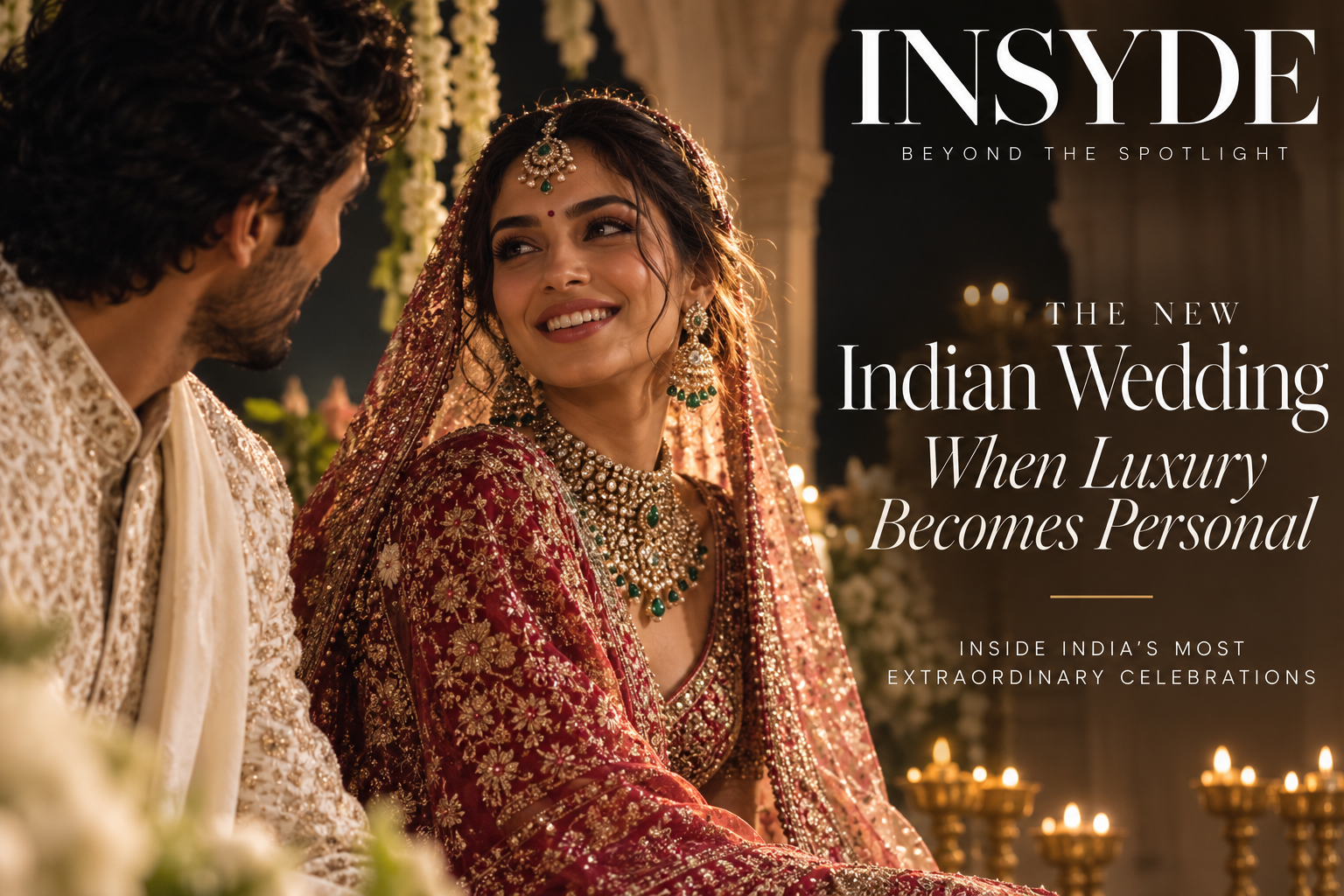
India has never been short of spectacular weddings. But a new generation is changing what makes a celebration truly luxurious — moving beyond scale and spectacle towards personalisation, experience, craftsmanship and the art of making people feel part of something extraordinary.
A luxury Indian wedding is no longer simply a celebration.
For a few days, it can become an entire world.
A palace becomes a private residence. A garden becomes a dining room. A designer creates clothing that exists for one person. A chef builds a menu around a family’s memories. An artist transforms a space overnight. Guests arrive not simply for a ceremony, but for an experience designed to stay with them long after the final event.
India has always known how to celebrate.
What is changing is what the celebration is trying to say.
For generations, wedding luxury was often measured through scale: larger venues, longer guest lists, bigger décor and increasingly elaborate entertainment.
Those things still have their place.
But the most interesting luxury weddings are beginning to ask a different question:
Does this wedding feel like us?
That question is changing the Indian wedding — and turning it into one of the country’s most fascinating expressions of modern luxury.
From Grand to Personal
The idea that luxury has to mean more is beginning to feel outdated.
More flowers.
More guests.
More entertainment.
More spectacle.
More everything.
But a wedding can be extraordinarily expensive and still feel strangely impersonal.
The new luxury is increasingly found in the details that could not have been copied from another celebration.
A menu built around a couple’s favourite dishes.
A wedding wardrobe designed around a personal story.
A handwritten note waiting in every guest’s room.
A piece of jewellery incorporating a family heirloom.
A song that means something to the couple rather than simply being popular.
A ceremony designed around heritage without becoming theatrical.
Recent industry reporting reflects this shift, with Indian wedding professionals describing personalisation, experience and emotional relevance as increasingly important to younger couples. (Eventfaqs)
The difference is subtle, but important.
Luxury is becoming less about how much is added and more about how much thought goes into what is chosen.
The Destination Becomes Part of the Story
The venue used to be the backdrop.
Now, increasingly, it is part of the experience.
A destination wedding can turn a single ceremony into several days of shared life.
Guests arrive early.
They stay together.
They eat together.
They explore the destination.
They attend smaller celebrations.
They have time to actually talk.
That helps explain the continuing appeal of India’s palaces, heritage properties, resorts and quieter destinations. Recent reporting suggests that couples are increasingly looking beyond conventional wedding destinations for locations that offer privacy, atmosphere and a more distinctive experience. (The Economic Times)
The venue is no longer simply where the wedding happens.
The venue becomes part of the story.
A palace communicates history.
A coastal property creates a different rhythm.
A private villa creates intimacy.
A heritage estate creates a connection to place.
A quieter destination can give a celebration something increasingly valuable: space.
And the location can influence everything that follows — from the wardrobe and flowers to the food, photography and guest experience.
The Wedding Becomes a Multi-Day World
The modern luxury wedding is increasingly less like a single event and more like an editorial unfolding over several days.
Welcome dinner.
Mehendi.
Haldi.
Sangeet.
Cocktail evening.
Wedding ceremony.
Reception.
After-party.
But the interesting change isn’t simply the number of events.
It is how differently each event can feel.
A daytime ceremony might be quiet and architectural.
An evening celebration might become theatrical.
A private dinner might feel intimate and almost residential.
A final brunch might be deliberately relaxed.
Each moment becomes its own chapter.
The result is less of a wedding programme and more of a curated journey.
That distinction matters.
Luxury is increasingly being measured by the quality of the experience between the major moments, not simply by what happens on the main stage. Business Standard recently reported that Indian couples are increasingly trimming guest lists while investing more in destinations and multi-day experiences that allow families and friends to stay, explore and create memories together. (Business Standard)
When Fashion Shapes the Entire Wedding
Few things reveal the changing Indian wedding better than fashion.
The wedding wardrobe has always been important.
But today, couture can influence the entire visual language of the celebration.
A bridal lehenga can inspire the colour palette.
A groom’s sherwani can influence the décor.
Jewellery can influence the lighting.
Textiles can influence table settings.
The invitation can become an extension of the couture.
Fashion moves beyond the wardrobe.
It becomes architecture.
This is particularly interesting in India because the country already possesses an extraordinary vocabulary of textile and craft traditions.
Embroidery.
Weaving.
Zardozi.
Hand-painted textiles.
Metalwork.
Jewellery.
Regional techniques passed between generations.
The modern luxury wedding can give those traditions a new stage.
The objective doesn’t have to be recreating the past.
It can be reinterpretation.
A traditional technique can become contemporary.
A historic motif can become graphic.
An old textile can be paired with modern tailoring.
Heritage can become something that moves forward rather than something preserved behind glass.
Craftsmanship Becomes Part of the Celebration
The most memorable luxury is often the kind that takes time.
A hand-embroidered garment.
A custom piece of jewellery.
A hand-painted invitation.
A specially commissioned installation.
A table setting created by craftspeople.
A menu developed around regional ingredients.
These things have something in common.
They cannot be produced instantly.
And that makes them valuable in a culture increasingly dominated by speed.
The Indian wedding has always been a major platform for craftsmanship.
But the opportunity now is to move beyond simply using craft as decoration.
Craft can become the story itself.
Imagine a wedding where guests are introduced to the artisans who created the textiles.
Where the menu explains the origins of ingredients.
Where the jewellery tells the story of a family.
Where the architecture of the venue becomes part of the celebration.
Suddenly, luxury becomes educational as well as beautiful.
The Guest Is No Longer Just a Guest
This may be one of the biggest changes in modern luxury weddings.
The guest experience has become part of the design.
A wedding can have the most beautiful stage in the country and still fail if the people attending it feel forgotten.
Luxury hospitality works differently.
Guests know where they are staying.
They know what is happening.
They have thoughtful welcome experiences.
They receive things that feel selected rather than generic.
They are given time to enjoy the destination.
They are introduced to the culture of the place.
They are not simply spectators.
They become participants.
That is why hospitality is becoming one of the most important dimensions of luxury weddings.
The question isn’t only:
How impressive can the wedding look?
It is:
How does everyone feel while they are there?
That is a much harder question to answer.
And perhaps a much more meaningful one.
Food Becomes Storytelling
Indian weddings have always taken food seriously.
The modern luxury wedding is taking it further.
Private dining.
Regional menus.
Chef collaborations.
Curated tasting experiences.
Family recipes.
Local ingredients.
Fine-dining techniques.
Food can become another way of telling the couple’s story.
A dish from the bride’s childhood.
A recipe from the groom’s family.
A regional ingredient from a place that matters to them.
A menu inspired by their first trip together.
The most luxurious meal may not be the one with the greatest number of dishes.
It may be the one where every dish has a reason for being there.
From Spectacle to Storytelling
This doesn’t mean Indian weddings are becoming minimal.
That would be too simple.
Grand celebrations are not disappearing.
Instead, grandeur is becoming more intentional.
A spectacular performance can still be extraordinary.
A dramatic floral installation can still be beautiful.
Fireworks can still create a moment.
A palace can still be magnificent.
The difference is that spectacle increasingly works best when it belongs to a larger story.
The question becomes:
Why this?
Why this location?
Why this music?
Why this designer?
Why this colour?
Why this performance?
Why this particular piece of jewellery?
When every element has an answer, extravagance begins to feel like curation rather than excess.
India’s Heritage Meets a Global Outlook
Indian weddings have always been deeply rooted in tradition.
But today’s couples are also growing up in a global cultural environment.
They travel.
They study abroad.
They consume international fashion.
They follow global design.
They discover restaurants, hotels and artists from around the world.
That creates an interesting tension.
The modern Indian wedding doesn’t necessarily have to choose between Indian and international.
It can be both.
A traditional ceremony can take place inside contemporary architecture.
Indian textiles can be styled with modern silhouettes.
A regional menu can be presented with contemporary fine-dining techniques.
A palace wedding can have a distinctly modern visual identity.
A destination wedding abroad can still remain deeply Indian.
The future of Indian wedding luxury may therefore be less about choosing between heritage and modernity.
It may be about making the two belong together.
The Ultimate Luxury May Be Privacy
There is another shift worth watching.
For years, luxury weddings were designed to be seen.
The bigger the spectacle, the more photographs.
The more famous the guests, the more attention.
The more elaborate the production, the more social media content.
But for some of today’s most high-profile celebrations, the direction is changing.
Privacy itself is becoming desirable.
Smaller guest lists.
Private properties.
Controlled access.
Discreet photography.
Personalised hospitality.
Carefully managed guest information.
In July 2026, industry coverage of several high-profile Indian weddings highlighted privacy, intimate guest lists and personalised hospitality as increasingly important markers of luxury. (Eventfaqs)
This doesn’t necessarily mean spending less.
In fact, a smaller celebration can allow couples to spend considerably more on the people and details that matter.
The wedding stops being a performance for everyone.
It becomes an experience for the people who are actually there.
And perhaps that is a more sophisticated form of luxury.
The ability to decide who gets to see it.
Technology Has a Place — But It Isn’t the Luxury
Technology is now woven into almost every part of wedding planning and production.
Digital invitations.
Online RSVPs.
Virtual venue tours.
AI-assisted planning.
Drone photography.
Live streaming.
Immersive installations.
Technology can make a wedding more efficient and, sometimes, more spectacular.
But technology itself isn’t necessarily what makes the experience luxurious.
The best use of technology is often the use you barely notice.
It removes friction.
It makes the experience smoother.
It helps personalise the celebration.
The luxury remains human.
A thoughtful welcome.
A beautifully prepared room.
A meal that arrives at exactly the right moment.
A piece of clothing made specifically for you.
A conversation that lasts longer than expected.
Technology can support those moments.
It cannot replace them.
The Wedding as a Luxury Ecosystem
Perhaps this is why weddings are becoming so important to the wider luxury industry.
A single celebration can bring together fashion, jewellery, hospitality, travel, automobiles, beauty, food, art, architecture and entertainment.
A wedding doesn’t exist inside one luxury category.
It connects them all.
A bride may work with a couture house, a jewellery designer, a beauty team and a photographer.
The family may book a heritage property, private transport, a chef and a production company.
Guests may travel internationally, stay at luxury hotels and shop for new wardrobes.
The wedding becomes an ecosystem of luxury.
But the commercial value is only one part of the story.
The more interesting question is cultural:
Why has the Indian wedding become such a powerful expression of aspiration?
Because it combines almost everything India values about celebration — family, identity, tradition, craftsmanship, food, fashion, hospitality and storytelling — into one extraordinary moment.
What Will the Next Indian Luxury Wedding Look Like?
It may still be enormous.
Or it may have 80 guests.
It may take place in a palace.
Or on a private beach.
It may involve couture from Paris.
Or a young Indian designer nobody outside the fashion world has discovered yet.
It may feature a famous performer.
Or simply a musician who means something to the family.
There is no single formula.
And that is precisely the point.
The future of luxury weddings is not one aesthetic.
It is personalisation at scale.
The ability to create an experience that feels extraordinarily considered, even when the production itself is enormous.
That requires more than money.
It requires taste.
It requires restraint.
It requires storytelling.
And above all, it requires knowing what matters.
The Most Luxurious Wedding May Be the Most Personal One
India doesn’t need to make its weddings less spectacular.
It simply has the opportunity to make them more meaningful.
The most memorable celebration may not be the one with the largest guest list or the tallest floral installation.
It may be the one where every detail feels connected.
The clothes.
The jewellery.
The food.
The architecture.
The music.
The destination.
The people.
The memories.
The things that could only have belonged to that particular couple.
Because the ultimate luxury may not be having the wedding everyone remembers.
It may be creating the wedding that could belong to no one else.
And perhaps that is where the new Indian wedding begins.
INSYDE — Inside modern luxury.