
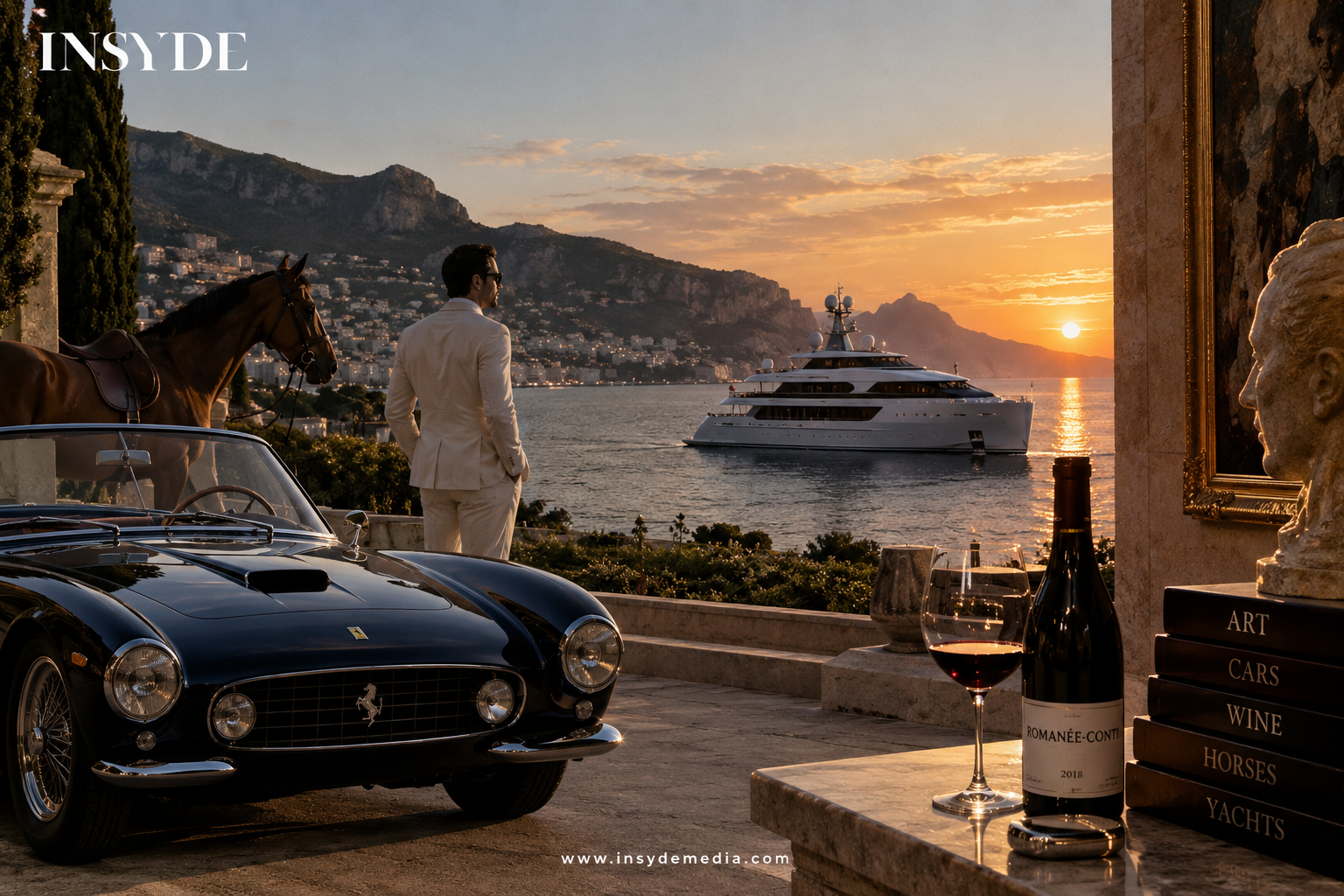
When passion stops being a pastime — and becomes a private universe.
By INSYDE | LUXURY
For most people, a hobby begins when the working day ends.
A few hours on the golf course. A weekend drive. A bottle opened for a special occasion. A watch admired through a glass counter.
Then there is another kind of hobby.
The kind that requires a captain.
Or a stable.
Or a climate-controlled cellar.
Or a specialist who has spent decades learning how to restore an engine that hasn’t been produced in years.
At the highest levels of wealth, hobbies can become something much larger than leisure. They become collections, communities, rituals, businesses — sometimes entire worlds.
A yacht becomes a racing programme.
A love of horses becomes a bloodline.
A car becomes a piece of history.
A painting becomes part of a cultural archive.
A vineyard becomes a legacy.
The interesting question isn’t simply how much these pursuits cost.
It is why people become obsessed with them in the first place.
Because when money stops being the primary limitation, something else becomes valuable:
passion.
01 — YACHTING
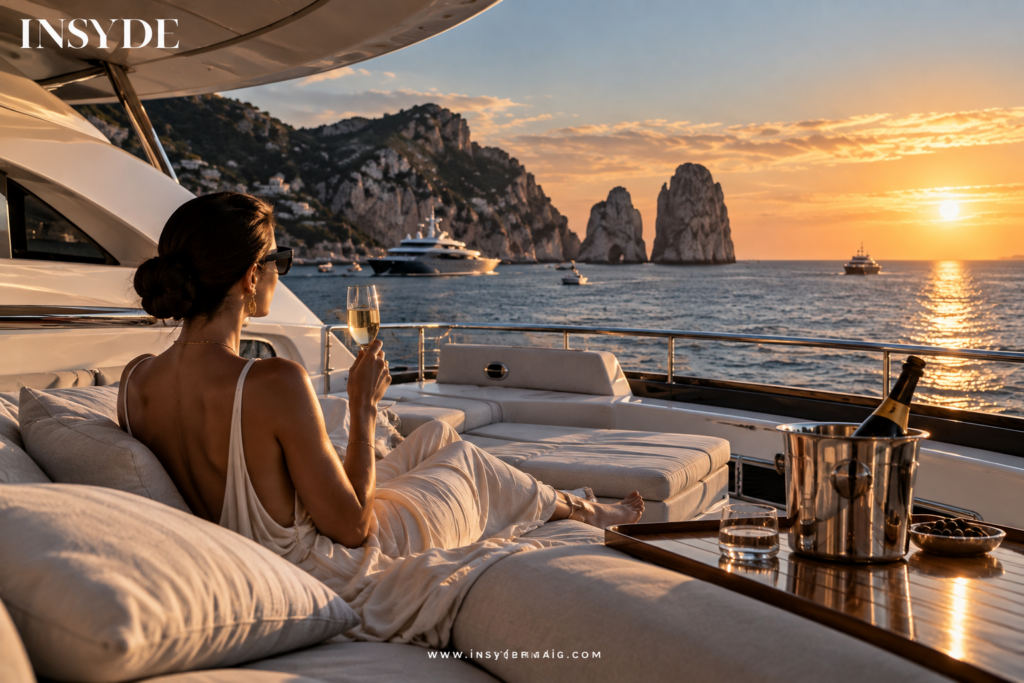
WHEN A BOAT BECOMES A WORLD
There are boats.
And then there are yachts that require a captain, a crew, engineers, designers, shipyards and an itinerary that can stretch months ahead.
The distinction isn’t simply size.
It’s what happens around the object.
At the top end, a yacht can become an ecosystem of its own — bespoke interiors, tenders, watercraft, hospitality, navigation and a permanent team keeping the entire experience moving.
And then there is the ocean.
The Mediterranean in summer.
The Caribbean in winter.
A secluded cove that never appears on a conventional holiday itinerary.
A dinner served somewhere accessible only by water.
In 2025, the superyacht market rebounded strongly. Knight Frank reported a 70% year-on-year increase in total sales value, while sales of yachts over 70 metres rose 60%. The average asking price of a yacht sold during the year reached approximately US$16.6 million. (Global)
But the most interesting part of yachting isn’t necessarily ownership.
It’s what ownership enables.
Racing.
Exploration.
Entertaining.
Privacy.
Time away from the itinerary of everyone else.
For those who race, the romance becomes competition. Engineering matters. Crew matters. Strategy matters. Small decisions can determine what happens once the sails go up.
Suddenly, the ultimate luxury isn’t simply sitting on the deck.
It’s having something to race.
02 — HORSES & POLO
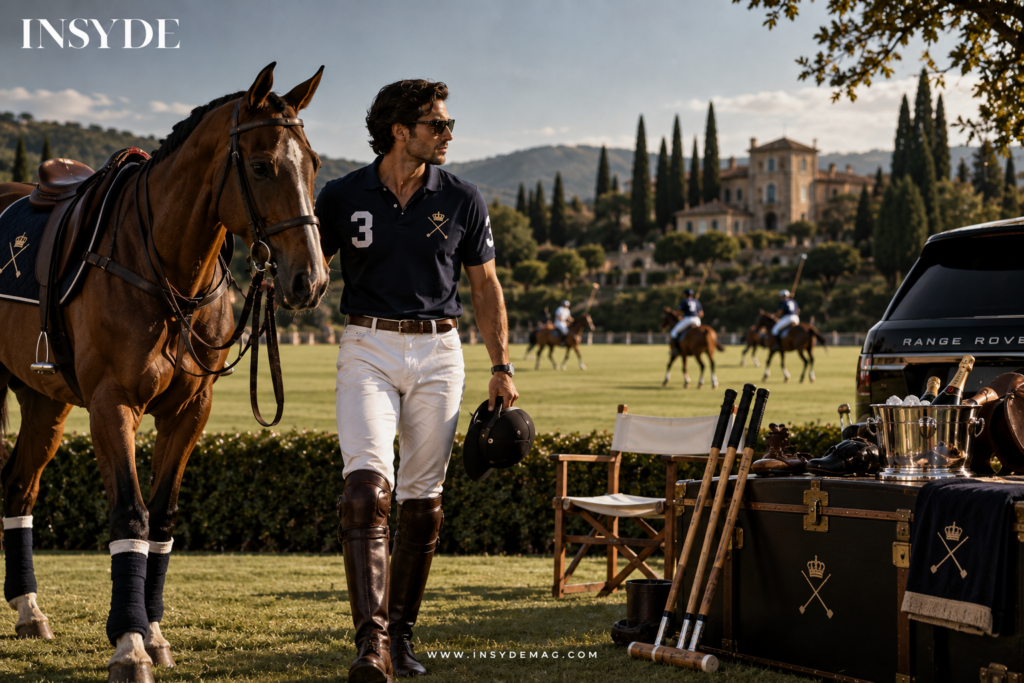
THE LUXURY OF BLOODLINES
Few luxury pursuits have a more complicated relationship with time than horses.
You can order a watch.
Commission a car.
Build a yacht.
But a bloodline cannot be rushed.
At the highest levels of equestrian culture, horses exist within a world of breeding, training, competition, land and expertise.
Polo adds another dimension.
The sport becomes a social environment as much as an athletic one — clubs, tournaments, travelling teams, private estates and a network of people who understand the culture from inside.
The aesthetic is undeniably seductive.
Leather.
Boots.
Grass.
Horsehair.
But beneath the imagery is something far more enduring:
patience.
A great horse cannot simply be manufactured.
Neither can its lineage.
And that makes equestrian luxury fundamentally different from buying something off a shelf.
The object is alive.
It requires care.
It requires knowledge.
It demands time.
Perhaps that is why horses occupy such a distinctive place in the world of serious wealth: they offer something increasingly difficult to purchase in an instant.
Continuity.
03 — CLASSIC CARS
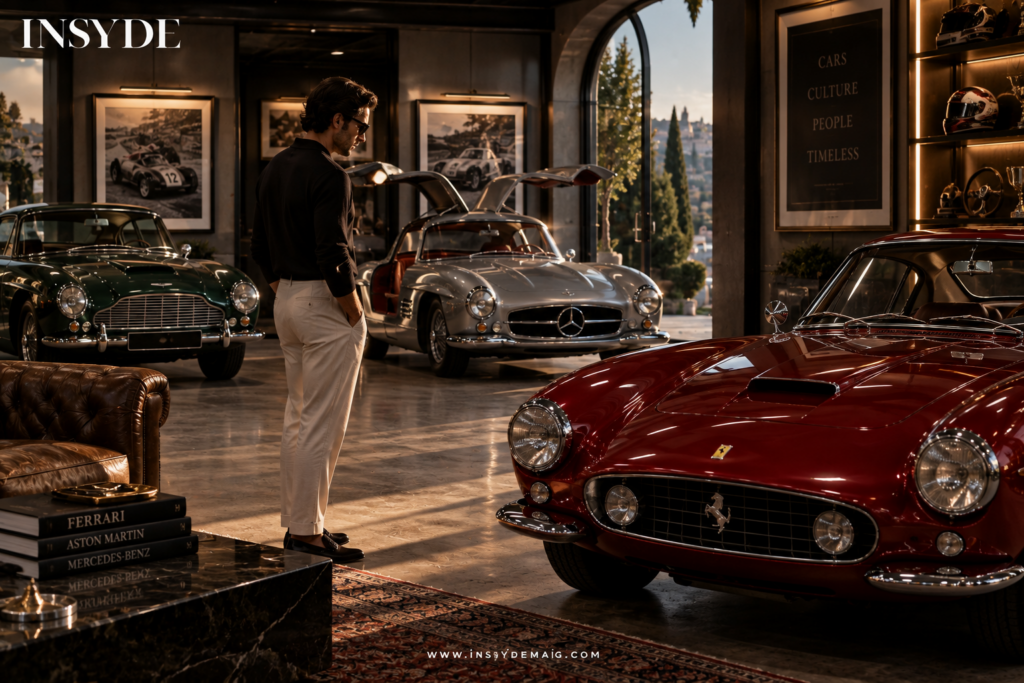
WHEN COLLECTING BECOMES OBSESSION
The obvious luxury-car purchase is the newest supercar.
The more interesting one may be a Ferrari built decades ago.
Because serious car collecting isn’t necessarily about horsepower.
It’s about provenance.
The right chassis.
The right specification.
The right history.
The right previous owner.
The right story.
Knight Frank’s 2026 Luxury Investment Index notes that classic cars remain an important collecting category, with renewed interest in vehicles from the late 1980s through the early 2000s. A 1995 Ferrari F50 sold for US$9.2 million at Monterey Car Week, while a 1956 Mercedes-Benz 300 SL Gullwing reached US$5 million in Paris. (Global)
But the numbers are almost secondary.
Imagine finding a car that has spent decades in the hands of collectors.
Then finding the specialist capable of restoring it correctly.
Then discovering that one original component — something almost invisible — is worth more than an entire modern car.
That is when collecting becomes obsession.
The collector isn’t simply buying transportation.
They’re preserving a moment that cannot be recreated.
The newest car represents the future.
The right classic represents a past that will never happen again.
And increasingly, rarity is becoming part of the attraction. Knight Frank reports that buyers in the luxury collectibles market are becoming more disciplined, favouring rarity and value as the market becomes more selective. (Global)
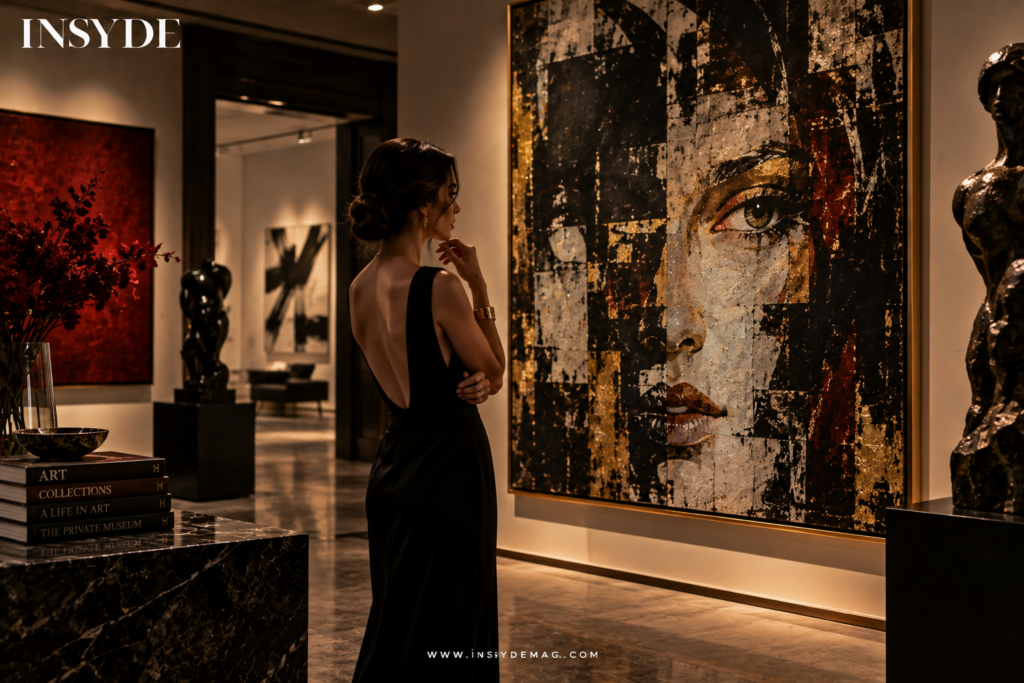
04 — ART & RARE COLLECTING
WHEN YOUR HOBBY BECOMES A CULTURAL LEGACY
Perhaps nothing reveals a collector’s personality quite like art.
Because unlike a car or a watch, art has no practical purpose.
You don’t need it.
You choose it.
And that makes the choice strangely intimate.
What do you hang on your wall?
Which artist do you believe in?
Which period matters to you?
What do you want future generations to see?
The serious collector increasingly looks beyond the obvious trophy.
Knight Frank’s 2026 research describes a broader evolution in luxury collecting, with greater emphasis on personal meaning, knowledge, rarity and taste. Its research frames collecting as something increasingly connected to personal growth and identity rather than simply conspicuous consumption. (Global)
The market itself remains selective.
Major auction-house fine-art sales rose 11% in 2025, according to Knight Frank, while Impressionist sales increased 80.4%. The US$10 million-plus segment also grew 19.4%. Gustav Klimt’s Portrait of Elisabeth Lederer sold for US$236.4 million. (Global)
But serious collecting isn’t simply about spending more.
It’s about knowing why something matters.
That’s the difference between accumulating and collecting.
One fills a room.
The other builds a point of view.
And perhaps the ultimate collector isn’t the person with the most objects.
It’s the person with the most interesting reasons for owning them.

05 — WINE & VINEYARDS
THE LUXURY OF OWNING TIME
There are few luxury pursuits more romantic than wine.
A cellar beneath an old house.
Rows of bottles resting in darkness.
Labels that have survived decades.
A vineyard stretching across a landscape.
A harvest that happens once a year.
And perhaps that’s what makes wine different.
It refuses to be rushed.
You can buy the vineyard.
You can buy the cellar.
You can buy the bottle.
But you cannot buy the years that created it.
The financial reality, however, is considerably less romantic than the fantasy.
Knight Frank’s 2026 Luxury Investment Index reports that the Liv-ex Fine Wine 100 declined 2.5% during 2025, with total losses of almost 25% from its 2022 peak. The research also notes that quality and value are increasingly shaping demand. (Global)
Which is precisely why wine is more interesting as a luxury pursuit than as a simplistic investment story.
The attraction can be somewhere else.
Terroir.
History.
Craft.
Hospitality.
The pleasure of opening something that has been waiting years for that particular evening.
A great wine doesn’t simply tell you what it costs.
It tells you how long you’ve been willing to wait.
WHEN A HOBBY BECOMES A WORLD
A yacht.
A stable.
A Ferrari.
A painting.
A vineyard.
From the outside, they can look like extravagant possessions.
Look closer, however, and something else appears.
Time.
Knowledge.
Craftsmanship.
Patience.
Obsession.
That is what separates a luxury hobby from an expensive purchase.
The object is only the entrance.
Behind it is an entire ecosystem of people, expertise, history and culture.
A serious collector doesn’t simply own a car.
They learn its history.
They find its specialists.
They understand its provenance.
A serious wine enthusiast doesn’t simply own bottles.
They learn the regions, producers and vintages.
A serious art collector doesn’t simply buy paintings.
They develop a point of view.
And perhaps that is why collecting remains so powerful in an increasingly digital world.
Some things cannot be endlessly replicated.
A historic Ferrari cannot be produced again.
A vineyard cannot be moved.
An original painting cannot become an edition of one hundred million.
A bloodline cannot be accelerated.
Scarcity still has a pulse.
THE REAL LUXURY
There is an interesting contradiction at the heart of extreme wealth.
The more money someone has, the less interesting money itself can become.
What becomes interesting is what money allows them to pursue.
Not necessarily more.
Something deeper.
A craft.
A collection.
A competition.
A landscape.
A piece of history.
A world that requires years to understand.
Knight Frank’s 2026 research describes luxury consumption as evolving beyond conspicuous consumption toward more personal forms of indulgence, with experience, personal growth and taste playing a greater role. (Global)
That changes the meaning of an expensive hobby.
The luxury isn’t simply that you can afford it.
It’s that you can devote yourself to it.
THE INSYDE TAKE
Perhaps the ultimate luxury isn’t owning something everyone else wants.
It’s discovering something you genuinely care about — and having the freedom to pursue it without practical limits.
The yacht becomes a passion.
The horse becomes a bloodline.
The car becomes history.
The painting becomes a cultural legacy.
The vineyard becomes time itself.
At that level, the price tag is almost beside the point.
Because the real indulgence isn’t simply being able to afford the hobby.
It’s having the freedom to turn a fascination into a world.
And perhaps that is what the world’s most expensive hobbies ultimately reveal.
When money removes the obvious limits, the rarest luxury isn’t necessarily another possession.
It is having something worth becoming obsessed with.
THE WORLD’S MOST EXPENSIVE HOBBIES
When passion stops being a pastime — and becomes a private universe.
INSYDE | LUXURY