Category: Luxury

An inside look at the world of luxury — fashion houses, jewellery, craftsmanship, hospitality, interiors, experiences and the evolving meaning of luxury in India.

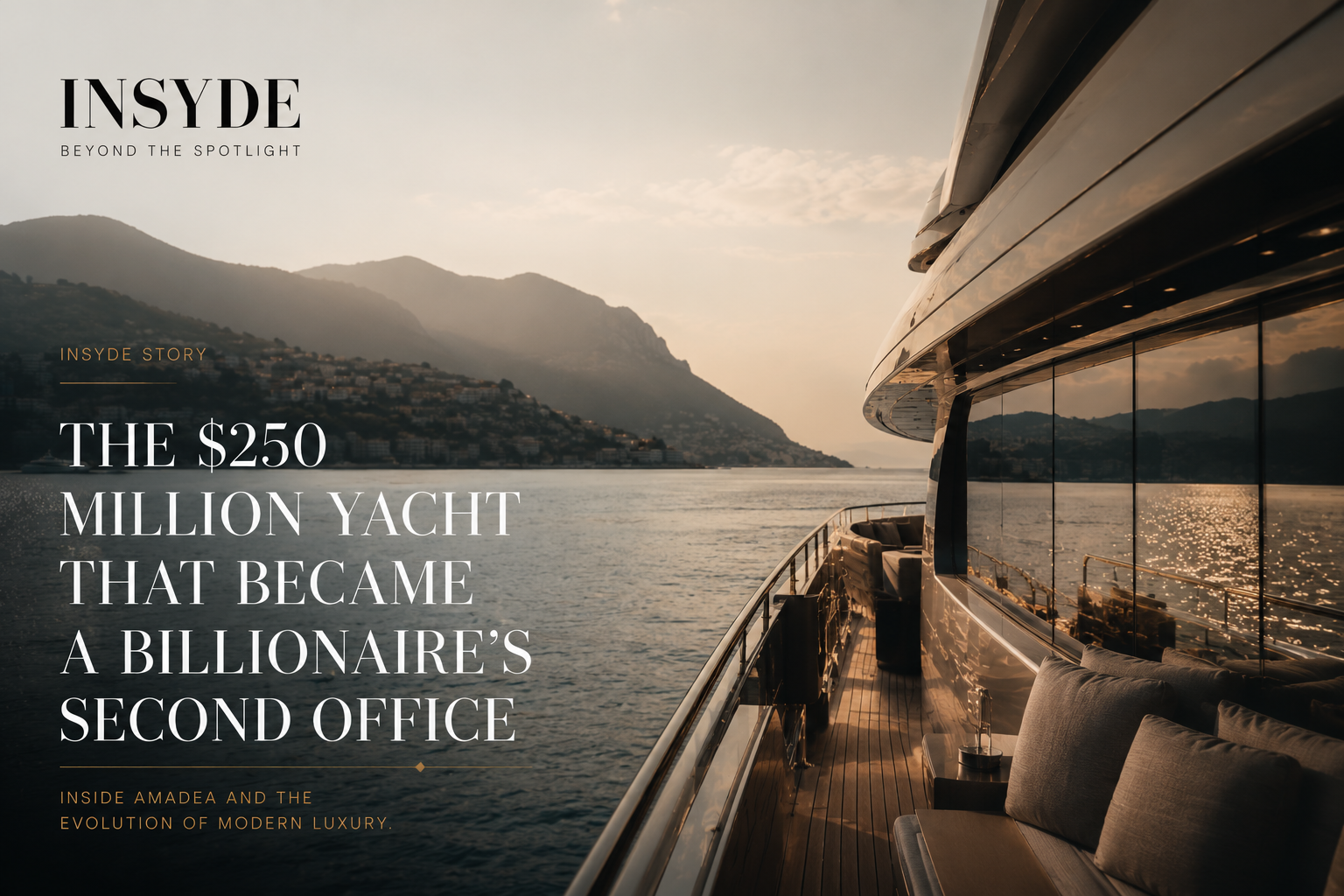
  • The $250 Million Yacht That Became a Billionaire’s Second Office

    The $250 Million Yacht That Became a Billionaire’s Second Office

    At 27, Dubai real-estate billionaire Abbas Sajwani isn’t using his 348-foot superyacht simply as an escape. He works from it, entertains from it and moves between continents aboard it. Inside Amadea — and the changing meaning of ultra-luxury.

    There was a time when a yacht meant escape.

    You left the city behind. You disappeared from the calendar. The sea became the destination.

    For Abbas Sajwani, the idea is different.

    His 348-foot superyacht, Amadea, is a floating residence, an entertainment space and, increasingly, a workplace from which he continues to run his Dubai real-estate business.

    At 27, Sajwani has built his fortune in Dubai’s luxury property market. Forbes currently lists him as a billionaire with an estimated net worth of $1.9 billion.

    But the most interesting thing about Amadea isn’t simply its scale.

    It is what the yacht says about the new language of luxury.

    Because when a yacht becomes a home, an office, a private retreat and a way of moving through the world, ownership starts to mean something very different.

    A Yacht With a History

    Built by the German shipyard Lürssen and delivered in 2017, Amadea stretches 348 feet across six decks.

    It is less conventional yacht than private floating estate.

    There is a 10-metre infinity pool with a swim-up bar, a cinema lounge with an adjoining firepit, a spa, beauty salon, gym and helipad. During Forbes’ visit, the helipad had even been converted into a pickleball court. A glass-enclosed winter garden evokes an orangerie, complete with an outdoor hot tub.

    But some of the most striking details are smaller.

    Intricately inlaid teak.

    Marble from the Greek island of Thassos.

    A hand-painted Pleyel baby grand piano.

    A gold elevator connecting the decks.

    The interior carries an Art Deco influence without feeling like a replica of another era.

    It is extravagant.

    But it is also considered.

    And that distinction matters.

    Because modern luxury is increasingly being defined not simply by how much is spent, but by how deliberately something is made.

    The Billionaire Who Didn’t Want to Start Over

    Sajwani had actually seen Amadea before he owned it.

    He toured the yacht when it was briefly on the market in 2020 and remembered it years later. When the opportunity to acquire it eventually appeared, the attraction was not simply its size.

    It was the design.

    The layout.

    The quality of the build.

    The condition.

    The details.

    Sajwani has said that around 90% of the interior was already to his liking when he bought it, and he has no plans for a major refit.

    That may sound like a small detail.

    It isn’t.

    In a world where extreme wealth can make almost anything customisable, knowing when not to change something can itself be a form of taste.

    Instead of stripping the yacht back and rebuilding it around his identity, Sajwani chose to preserve much of what made Amadea distinctive.

    The result is less like a blank canvas and more like acquiring a finished piece of floating architecture.

    From Trophy to Territory

    The yacht’s history is unusual.

    Amadea was seized by U.S. and Fijian authorities in 2022 after American authorities identified it as belonging to sanctioned Russian billionaire Suleiman Kerimov. The U.S. Department of Justice subsequently pursued civil forfeiture proceedings, and the vessel was eventually sold at a U.S. government auction in 2025. Sajwani emerged as the winning bidder.

    The winning bid was not publicly disclosed.

    That distinction matters because Amadea is now estimated to be worth around $250 million — but that is not the amount Sajwani paid for it.

    His winning bid was reportedly only $1 million higher than the next-highest bid.

    For INSYDE, the more interesting part of the story isn’t the auction.

    It is what happened afterwards.

    Sajwani didn’t simply acquire a trophy.

    He began using it.

    The Office That Moves

    In summer, Amadea moves through the Mediterranean.

    In winter, it heads towards St. Barts.

    But Sajwani’s work doesn’t stop when the yacht leaves Dubai.

    He continues to run his real-estate business from the vessel.

    Meetings happen.

    Zoom calls happen.

    Business decisions happen.

    Then the working week ends.

    The pool opens.

    The spa becomes the destination.

    Guests arrive.

    The sea becomes the backdrop.

    That changes the traditional idea of the yacht.

    It isn’t necessarily an escape from work anymore.

    It is a way of changing the environment in which work happens.

    Sajwani has described life aboard Amadea as being closer to living in a home than taking a holiday, with weekdays structured around meetings and calls and weekends devoted more to enjoying the yacht.

    The distinction is revealing.

    For the ultra-wealthy, luxury is increasingly about controlling where life happens.

    When a Yacht Becomes Real Estate

    Sajwani’s background makes Amadea even more interesting.

    His business is built around luxury real estate.

    AHS Properties has developed and acquired high-end properties across Dubai, with a focus on luxury residential projects and major hospitality and real-estate assets.

    The connection between his business and his yacht is almost philosophical.

    Real estate is about location.

    A yacht is about taking location with you.

    A luxury residence gives you privacy, design and control over your environment.

    A superyacht does the same thing — except the environment can change.

    The address moves.

    The architecture doesn’t.

    That may be one of the most fascinating ideas in modern luxury.

    A yacht is private real estate that refuses to stay in one place.

    The Architecture of Privacy

    Luxury has always had a relationship with privacy.

    The gated estate.

    The private dining room.

    The members’ club.

    The secluded resort.

    But a superyacht takes the idea further.

    It creates a private environment that can physically leave the places where everyone else is.

    There is no hotel lobby.

    No neighbouring apartment.

    No shared pool.

    No public restaurant.

    The world remains outside.

    That makes privacy itself part of the experience.

    And perhaps this is one reason yachts continue to occupy such a unique position within the luxury world.

    The yacht doesn’t merely give you somewhere beautiful to stay.

    It gives you control over access to you.

    The New Luxury Is About Time

    This brings us back to a theme running through the modern luxury conversation.

    Time.

    Not the time displayed on a watch.

    Time itself.

    The ability to decide where you wake up.

    Where you work.

    Who you see.

    When you leave.

    How long you stay.

    For someone with sufficient resources, the ultimate luxury may no longer be owning more things.

    It may be having fewer constraints.

    A yacht like Amadea turns geography into something almost flexible.

    The South of France in summer.

    The Caribbean in winter.

    The office travels with you.

    The home travels with you.

    The view changes without the address changing.

    That is an extraordinary expression of wealth.

    But it is also an expression of something increasingly important in luxury:

    freedom.

    Why the Details Matter

    It would be easy to reduce Amadea to its headline numbers.

    348 feet.

    Six decks.

    A 10-metre infinity pool.

    Spa.

    Cinema.

    Helipad.

    Gold elevator.

    Estimated value of $250 million.

    But that isn’t where the yacht becomes interesting.

    The real story is in the details.

    The hand-painted piano.

    The Greek marble.

    The intricate teak.

    The Art Deco-inspired design.

    The glass winter garden.

    The fact that Sajwani has chosen not to radically alter an interior he already considers highly successful.

    This is where luxury becomes craftsmanship.

    Anyone can understand expensive.

    Not everyone understands why something is beautifully made.

    And that difference is becoming increasingly important.

    Dubai’s New Luxury Generation

    There is also something distinctly Dubai about this story.

    The city has built its modern identity around ambition, architecture, hospitality, real estate and an almost obsessive relationship with scale.

    But the next generation of Dubai luxury is becoming more sophisticated.

    The conversation is moving from:

    How big can it be?

    towards:

    How precisely can it be designed?

    Sajwani’s own world of luxury real estate reflects that shift — waterfront locations, architecture, premium materials and highly controlled residential experiences.

    The yacht therefore feels less like an isolated indulgence and more like an extension of the same worldview.

    Architecture.

    Scarcity.

    Privacy.

    Experience.

    Location.

    All compressed into one moving object.

    The Yacht as a World of Its Own

    Perhaps this is what separates a superyacht from almost every other luxury purchase.

    A watch travels with you.

    A car moves with you.

    A private jet takes you somewhere.

    A yacht can become somewhere.

    It can contain bedrooms, dining spaces, entertainment areas, wellness facilities, offices and outdoor spaces.

    It can host a dinner.

    A meeting.

    A weekend.

    A holiday.

    A celebration.

    Or simply a quiet morning looking at the sea.

    It isn’t merely transportation.

    It is an environment.

    And Amadea is an extreme expression of that idea.

    What Happens When Luxury Stops Being About Possession?

    There is a temptation to look at a $250 million yacht and see only excess.

    That reaction is understandable.

    But luxury becomes more interesting when we look beyond the price.

    What does someone actually buy when they acquire something like Amadea?

    Not just a yacht.

    They buy space.

    Privacy.

    Mobility.

    Time.

    Control.

    Experience.

    And perhaps, most importantly, the ability to decide what their surroundings look like.

    That is a very different definition of luxury from simply owning the most expensive object in the room.

    It is closer to designing your own world.

    The New Floating Luxury

    The superyacht has always been a symbol of wealth.

    But Amadea suggests that its role is changing.

    For a new generation of ultra-high-net-worth owners, the yacht can be a residence, a workplace, a social space and a private retreat at once.

    The object becomes an ecosystem.

    And that may be where luxury is heading more broadly.

    Away from simply owning impressive things.

    Towards creating impressive ways of living.

    The watch tells time.

    The car moves you.

    The home gives you a place to live.

    The private jet moves you between cities.

    But the yacht combines many of those ideas into one floating environment.

    Perhaps that is why the most interesting luxury objects are no longer objects at all.

    They are worlds.

    And aboard Amadea, one billionaire has quite literally built one that moves.

    INSYDE — Inside modern luxury.
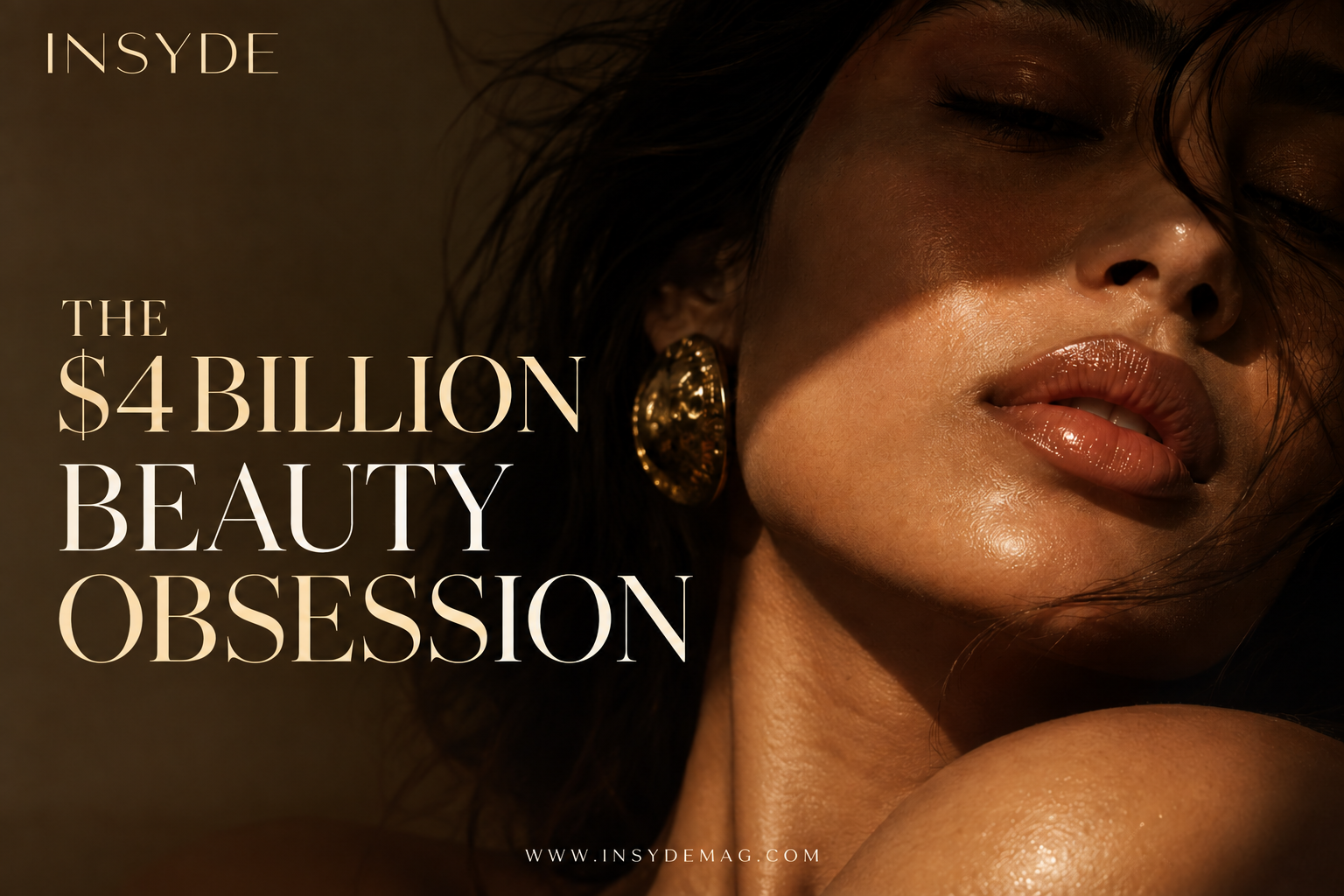
  • THE $4 BILLION BEAUTY OBSESSION

    THE $4 BILLION BEAUTY OBSESSION

    India is falling for luxury beauty. But as global houses chase the country’s next generation of consumers, the real question is whether they know what India actually wants.

    India can now discover a Dior lipstick almost as quickly as Paris.

    A new foundation can appear on an Indian beauty feed within hours of its global launch. A celebrity can turn a shade into a sell-out before the product has even reached every store. A consumer in Bengaluru can compare formulas, finishes and undertones with someone in London without ever leaving her phone.

    Luxury beauty has never been this accessible in India.

    But access is no longer the interesting part.

    The more seductive question is whether luxury beauty actually understands the person buying it.

    Because India’s beauty consumer is changing faster than the industry built to serve them.

    And somewhere between the luxury counter, the Instagram Reel, the quick-commerce delivery and the bathroom mirror, a new beauty market is taking shape.


    INDIA IS NO LONGER WAITING FOR LUXURY

    For years, India’s luxury beauty story was fundamentally about availability.

    Could you find the brand?

    Could you find the right shade?

    Could you buy it without travelling abroad?

    Could you get the latest global launch before the next one arrived?

    Those questions are becoming less important.

    India’s luxury beauty market was already around $800 million in 2023, according to Reuters’ reporting on research from Kearney and LUXASIA, and the Kearney-LUXASIA study projects the market to reach $4 billion by 2035.

    But there is an important distinction.

    That $4 billion figure refers to luxury beauty as a whole, not makeup alone.

    Within the category, color cosmetics represented 28% of luxury beauty in 2023 and are projected to reach 32% by 2028, with color cosmetics forecast to grow at a 24% CAGR between 2023 and 2028.

    That makes makeup particularly interesting.

    Because India isn’t simply buying more beauty.

    It is becoming more deliberate about what beauty means.

    And makeup sits directly at the intersection of beauty, fashion, identity and desire.


    THE BEAUTY OF BEING SEEN

    Luxury used to tell consumers what was desirable.

    Today, consumers increasingly tell brands what matters.

    The shift is particularly visible among younger Indian shoppers.

    According to Ipsos’ Luxury Reimagined research, 70% of new e-luxury shoppers in India are under 35, while 76% of Indian Gen Z consumers are open to trying new brands, even in luxury.

    That is a very different consumer from the traditional luxury buyer.

    For younger shoppers, luxury makeup is not necessarily about possessing a status symbol.

    It can be about identity.

    A lipstick can complete an outfit.

    A fragrance can become associated with a relationship.

    A blush can define the look of an entire generation on Instagram.

    A compact can become an object of desire before anyone has even used it.

    Beauty is no longer sitting neatly inside the beauty category.

    It is crossing into fashion, entertainment, culture and self-expression.

    And that is exactly why India is becoming such an important luxury market.


    BUT INDIA IS NOT ONE SHADE

    Here is where the fantasy of a single global luxury consumer begins to fall apart.

    India is not one complexion.

    Not one undertone.

    Not one climate.

    Not one beauty ritual.

    Not even one definition of what a beautiful finish looks like.

    A foundation developed around one market’s expectations can behave differently in India’s humidity. A complexion range created without enough brown, neutral or warm undertones can leave consumers searching for a match that simply isn’t there.

    The Kearney-LUXASIA research identifies India’s geographical and ethnic diversity as a significant consideration for beauty brands, recommending region- and city-specific strategies and greater adaptation to India’s complexions, climate and consumer preferences.

    That is the difference between selling in India and designing for India.

    The first requires distribution.

    The second requires understanding.

    And luxury has always claimed that understanding the customer is part of the experience.


    THE INDIAN FACE HAS BECOME A GLOBAL IMAGE

    There is another shift happening quietly.

    Indian beauty is no longer simply consuming global aesthetics.

    It is increasingly influencing them.

    Indian celebrities, creators, makeup artists and fashion personalities are appearing inside global campaigns and conversations. Indian weddings generate enormous beauty demand. Indian skin tones are becoming more visible in global beauty imagery. And social platforms have removed much of the distance between an international launch and an Indian consumer.

    But representation is only the beginning.

    There is a temptation for global brands to treat localisation as casting.

    Put an Indian model in the campaign.

    Launch the same product.

    Change the creative.

    Call it local.

    Consumers are becoming sophisticated enough to see through that.

    Representation can make a brand visible in India. Relevance makes it stay.


    THE STRANGEST NUMBER IN INDIAN LUXURY BEAUTY

    Perhaps the most revealing statistic isn’t the size of the opportunity.

    It is who currently owns it.

    Kearney-LUXASIA estimates that international brands account for roughly 93% of India’s luxury beauty market, leaving local brands with approximately 7%. The same research contrasts this with mature Asian markets such as Japan and South Korea, where local brands can represent a significantly larger share of luxury beauty.

    That raises a much more interesting question than How big can India’s luxury beauty market become?

    Why hasn’t India built more global luxury beauty brands of its own?

    India has centuries of beauty rituals.

    Ayurveda.

    Fragrance.

    Natural ingredients.

    Jewellery.

    Colour.

    Craft.

    Ceremony.

    And an extraordinary cultural relationship with appearance.

    Yet when consumers think of luxury makeup, the most recognisable names are still largely European or American.

    That isn’t necessarily a failure.

    It could be the biggest opportunity sitting inside the market.


    THE NEXT LUXURY BEAUTY HOUSE COULD COME FROM INDIA

    Imagine an Indian beauty house that doesn’t attempt to make itself look European.

    A brand that understands Indian skin without turning “Indian skin” into a marketing gimmick.

    A house built around India’s relationship with colour.

    Its climates.

    Its rituals.

    Its weddings.

    Its nightlife.

    Its cinema.

    Its jewellery.

    Its architecture.

    Its contradictions.

    A brand that could sell a product in Mumbai and Paris without having to explain why it came from India.

    That would be a different kind of luxury.

    Not Indian luxury for Indians.

    Indian luxury for the world.

    And that distinction matters.

    Because the greatest luxury brands don’t simply sell products from their home countries.

    They export a worldview.


    THE METRO IS NO LONGER THE WHOLE STORY

    The next consumer isn’t necessarily standing in a luxury mall in Mumbai.

    India’s beauty growth is spreading outward.

    The Nykaa Beauty Trends Report 2024 found that approximately 55% of sales from the top nine prestige beauty brands on Nykaa came from non-metro markets.

    That changes the geography of luxury.

    The consumer in Jaipur doesn’t necessarily need to become a consumer in Mumbai.

    The consumer in Chandigarh doesn’t need to behave like someone in Delhi.

    The consumer in Kochi doesn’t need to have the same beauty routine as someone in Bengaluru.

    Digital access is allowing these markets to develop their own relationship with beauty.

    And luxury brands will have to learn how to listen to them individually.


    THE COUNTER IS DEAD. LONG LIVE THE COUNTER.

    Not literally.

    But the role of the luxury beauty counter is changing.

    For decades, the counter was where discovery happened.

    Today discovery can happen anywhere.

    Instagram.

    YouTube.

    TikTok.

    A creator’s GRWM.

    A celebrity interview.

    A beauty community.

    A search bar.

    A friend sending a screenshot.

    The physical store now has to offer something digital cannot.

    Confidence.

    The ability to touch the product.

    Test the shade.

    Understand the texture.

    Ask someone who actually knows the difference.

    Experience the fragrance.

    Feel the weight of the packaging.

    And perhaps most importantly, feel that the brand has made an effort to understand you.

    Kearney-LUXASIA estimates that approximately 70% of India’s luxury beauty market remains offline, with online accounting for around 30%. E-commerce, however, is projected to be one of the category’s fastest-growing channels.

    The future therefore isn’t online versus offline.

    It is online into offline and back again.

    A Reel creates desire.

    A store creates confidence.

    A purchase creates data.

    The next Reel creates another desire.

    Luxury beauty is becoming an ecosystem.


    AND THEN INDIA MADE LUXURY FAST

    There is something almost contradictory about luxury beauty in India right now.

    Luxury traditionally asks you to wait.

    India increasingly expects everything immediately.

    Quick commerce has trained consumers to think in minutes rather than days. Premium beauty is increasingly participating in that ecosystem.

    That doesn’t necessarily make luxury less luxurious.

    It may actually reveal something important about what modern luxury means.

    Luxury used to mean having more.

    Now it increasingly means having control.

    Control over your time.

    Your access.

    Your experience.

    Your choices.

    If a consumer discovers a product at 10:00 a.m. and wants it at 10:30, the ability to fulfil that desire can itself become part of the luxury proposition.

    The contradiction is beautiful:

    The future of luxury beauty may be both slower and faster.

    Slower in the experience.

    Faster in the access.


    WHAT BRANDS STILL GET WRONG

    The biggest mistake would be to look at India’s growth numbers and assume the job is done.

    It isn’t.

    A bigger market does not automatically create a stronger luxury proposition.

    The brands that want to win here will have to think beyond campaigns.

    They will need better shade architecture.

    Better climate understanding.

    Better inventory planning.

    Better replenishment.

    Better beauty advisors.

    Better city-specific strategies.

    Better digital discovery.

    And perhaps most importantly, better cultural intelligence.

    The Kearney-LUXASIA report identifies product, marketing, and partnership/distribution as three central pillars for brands seeking to unlock India’s luxury beauty opportunity.

    But beneath all three is the same requirement:

    Listen before you localise.


    INDIA DOESN’T NEED ANOTHER LUXURY LOGO

    This is perhaps the most exciting part of the story.

    India’s luxury beauty opportunity isn’t interesting because another European beauty house is opening another counter.

    It is interesting because the entire relationship between luxury and the Indian consumer is being rewritten.

    The consumer is younger.

    The access is wider.

    The discovery is digital.

    The cities are multiplying.

    The appetite is growing.

    And the definition of luxury itself is becoming more personal.

    The question is no longer:

    Will Indians buy luxury beauty?

    They already are.

    The question is:

    What will they demand from it next?

    Perhaps better representation.

    Perhaps better products.

    Perhaps more meaningful experiences.

    Perhaps brands that understand the difference between adapting to India and simply entering India.

    And perhaps, eventually, an Indian beauty house capable of making the rest of the world look East for its next idea.

    Because India’s luxury beauty story is no longer about catching up with Paris, Milan, London or New York.

    It may be about giving the world something those cities don’t have.

    A different way of seeing beauty.

    A different way of experiencing luxury.

    A different face of desire.

    And that face is increasingly Indian.


    INSYDE TAKE

    The first phase of India’s luxury beauty boom was about access.

    The second is about relevance.

    The third could be about creation.

    Global beauty houses are arriving because the opportunity is impossible to ignore. But the real winners won’t be defined by how quickly they can put a luxury logo in front of an Indian consumer.

    They will be defined by how deeply they understand the person behind the purchase.

    And somewhere in that gap between global luxury and Indian identity, there is room for an entirely new beauty story.

    The next great luxury beauty house might not be discovering India.

    It might be coming from it.

    Beyond the Spotlight.

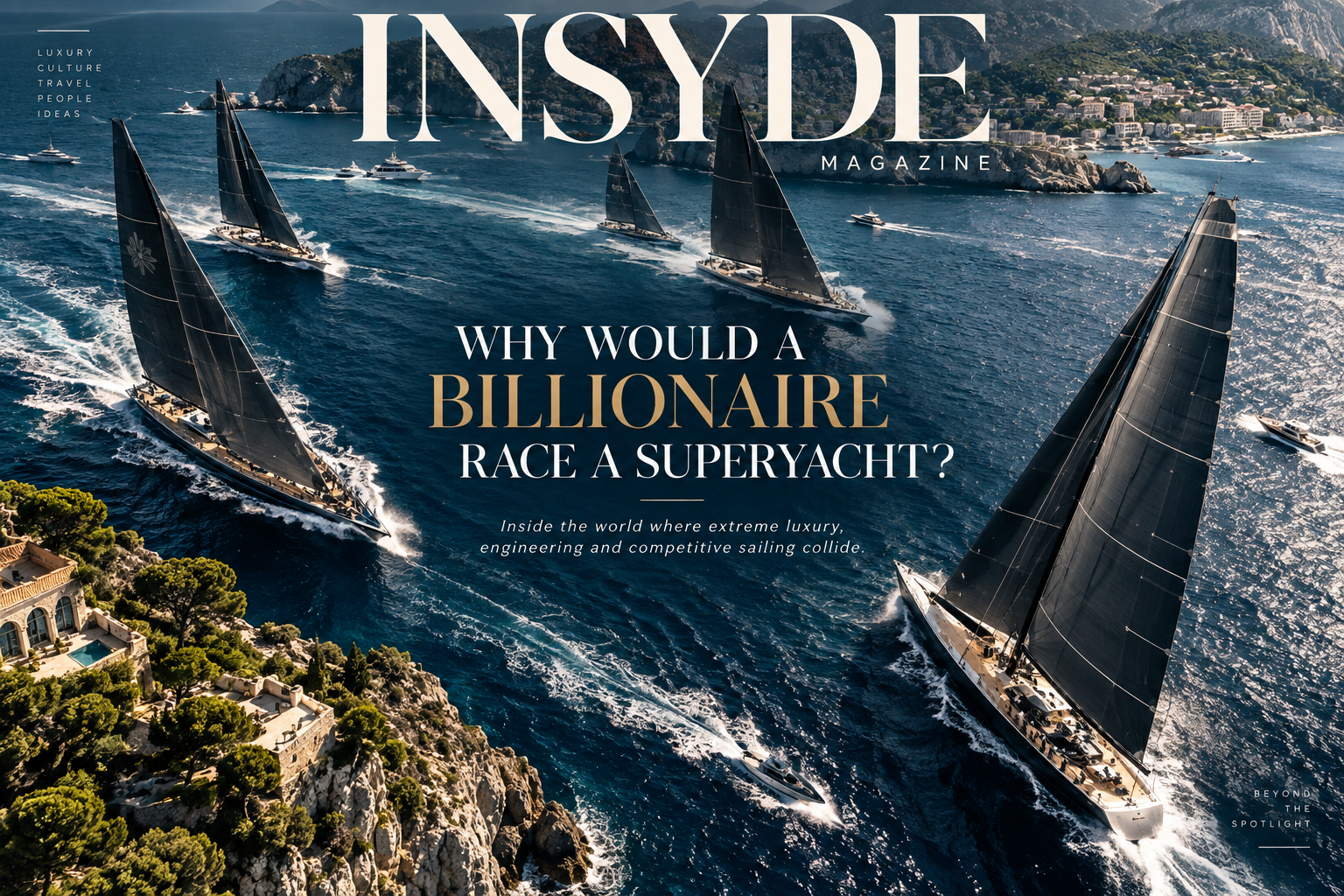
  • WHY WOULD A BILLIONAIRE RACE A SUPERYACHT?

    WHY WOULD A BILLIONAIRE RACE A SUPERYACHT?

    Why are the world’s most luxurious yachts being built to race?

    There is a particular contradiction at the heart of contemporary luxury.

    A superyacht can take years to design and build, contain craftsmanship more commonly associated with fine watchmaking or haute couture, and serve as a private world at sea. It can offer its owner almost complete control over time, space and movement.

    And then, sometimes, that same yacht is taken to the starting line and pushed against others at full speed.

    It is an unusual idea: spending millions on creating something extraordinary, only to test it in an environment where performance matters more than possession.

    Yet that is precisely what makes superyacht racing so compelling.

    In 2026, the world’s elite sailing calendar has once again demonstrated the scale of the phenomenon. The St. Barths Bucket brought together 33 superyacht teams across nine classes, with yachts ranging from 28 to 78 metres and spanning an extraordinary range of designs and performance characteristics. In Mallorca, the 30th anniversary edition of The Superyacht Cup Palma Richard Mille brought 20 yachts to the start line, after the event had sold out its racing places earlier in the year. (Bucket Regatta)

    These are not simply gatherings of expensive boats.

    They are where craftsmanship meets competition, engineering meets aesthetics, and luxury meets performance.

    And increasingly, they offer a glimpse into what luxury itself is becoming.


    WHEN LUXURY HAS TO PERFORM

    A yacht does not need to race to be impressive.

    Its architecture can be extraordinary. Its interiors can be entirely bespoke. Its materials can be selected with the same obsessive attention given to a complicated timepiece. Its itinerary can be dictated entirely by its owner.

    But the moment it enters a regatta, the rules change.

    Weight matters. Aerodynamics matter. Hull design matters. Sail configuration matters. Weather matters. The crew matters. A tactical decision made seconds too late can cost a race.

    At the 2026 St. Barths Bucket, the fleet included everything from 90-foot yachts to Maxi 100 racing boats, as well as large cruising yachts and three-masted schooners. The event’s classes are designed to create competitive racing between yachts with very different characteristics. (Bucket Regatta)

    The result is a fascinating reversal of the conventional luxury equation.

    At the marina, the yacht is an object of desire.

    On the racecourse, it becomes a machine.

    And machines have to perform.


    THE RISE OF THE LUXURY REGATTA

    Superyacht racing occupies a rare space between elite sport and private luxury.

    The competition is serious, but the world surrounding it is equally important.

    The 30th Superyacht Cup Palma Richard Mille is a perfect example. The event combines competitive racing with an owner-focused social programme, bringing together yacht owners, professional crews, designers, builders and an ecosystem of specialist marine companies. Its 2026 edition ultimately saw Win Win, a 33-metre Baltic yacht, claim the overall title for a third time. (The Superyacht Cup)

    That combination is part of the attraction.

    The race provides the adrenaline.

    The setting provides the lifestyle.

    And the community provides something increasingly valuable in the luxury economy: access.

    This is not luxury experienced from a distance. It is participation in a highly specialised world where the people designing, building, sailing and owning these yachts occupy the same physical environment.

    The yacht becomes the entry point.

    The culture around it becomes the experience.


    WHERE WATCHMAKING MEETS THE SEA

    The involvement of luxury brands makes the relationship even more revealing.

    In 2026, Richard Mille became title partner of The Superyacht Cup Palma in a three-year partnership. The relationship is built around a vocabulary familiar to both watchmaking and elite sailing: precision, engineering, performance and innovation. (The Superyacht Cup)

    It makes sense.

    A high-performance yacht and an advanced mechanical watch may belong to different industries, but they share a philosophy.

    Both hide extraordinary technical complexity beneath refined exteriors.

    Both depend on precision.

    Both demand specialised craftsmanship.

    And both appeal to a consumer who increasingly wants to understand how something works, rather than simply recognise what it costs.

    That distinction matters.

    Luxury is becoming less dependent on the obvious signal of price and more interested in the invisible details that justify it.

    The movement inside the watch.

    The engineering inside the yacht.

    The hours behind the finish.

    The expertise behind the performance.

    The story is no longer simply the object.

    It is everything that makes the object exceptional.


    THE SEA AS A TECHNOLOGY LABORATORY

    Perhaps the most fascinating part of modern sailing is what happens beneath the surface of the spectacle.

    Elite racing has become an extraordinary testing ground for materials, aerodynamics, hydrodynamics, data and control systems.

    The pursuit of speed has transformed sailing technology.

    SailGP offers perhaps the clearest demonstration. During the 2026 season, six teams had already crossed the 100 km/h threshold, with ROCKWOOL Racing reaching 103.73 km/h at the halfway point of the season. (ussailgp)

    At those speeds, the traditional image of sailing begins to disappear.

    This is no longer simply wind, sails and water.

    It is carbon fibre, foils, sensors, data, aerodynamic efficiency and human reaction working together at extraordinary speed.

    Superyacht racing does not necessarily replicate the technology of a SailGP F50, nor should it. The yachts have different objectives, designs and operating philosophies.

    But they belong to the same broader ecosystem.

    And that ecosystem is changing what a yacht can be.

    The yacht is no longer only a vessel for enjoying the sea.

    It can also be a laboratory for engineering, design and performance.


    THE FASHION OF THE SEA

    There is another reason the sailing world feels increasingly relevant to luxury brands: it possesses a visual language that does not need to be manufactured.

    A yacht cutting through Mediterranean water.

    A sculptural sail catching the wind.

    Carbon fibre against polished surfaces.

    Technical clothing alongside tailored silhouettes.

    Historic yacht designs sharing a harbour with radically modern forms.

    It is an environment where sport, fashion, architecture and luxury naturally overlap.

    The Giorgio Armani Superyacht Regatta in Porto Cervo is perhaps one of the clearest expressions of that relationship. Held from 26 to 30 May 2026, the event placed a major fashion house directly within the world of elite sailing. (Yacht Club Costa Smeralda)

    The significance goes beyond branding.

    For luxury houses, these environments provide something increasingly difficult to manufacture: context.

    A watch becomes part of a culture of precision.

    A fashion house becomes part of a culture of design.

    A yacht builder becomes part of a culture of craftsmanship.

    The setting does some of the storytelling itself.

    And perhaps that is why sailing remains so attractive to luxury.

    It communicates exclusivity without having to shout about it.


    THE QUESTION OF EXPERIENCE

    So why race something that could simply be enjoyed?

    Because the definition of luxury is changing.

    For decades, luxury was largely communicated through ownership.

    The car.

    The watch.

    The house.

    The yacht.

    But the contemporary luxury consumer increasingly values what sits behind ownership: access, time, privacy, expertise and experience.

    A yacht is valuable because it exists.

    But it becomes something else when it gives its owner the ability to cross an ocean, explore remote places, gather people together or compete at sea.

    Racing adds another dimension.

    Participation.

    You are no longer simply looking at an extraordinary object.

    You are testing it.

    Learning it.

    Working with it.

    Trying to make it perform better.

    That is a very different relationship with luxury.


    THE YACHT AS IDENTITY

    There is also something deeply personal about racing.

    Two yachts can sit beside each other in the same harbour and represent completely different ideas of luxury.

    One may be designed around speed.

    Another may celebrate traditional craftsmanship.

    Another may be built around cutting-edge technology.

    Another may be a modern interpretation of a classic sailing yacht.

    The yacht becomes an extension of its owner’s taste.

    Not merely through the colour of the interiors or the materials used, but through the philosophy behind the vessel and the way it is used.

    That is particularly relevant to the next generation of luxury consumers.

    Individuality is becoming more important than uniform status.

    The question is no longer simply:

    How much did it cost?

    It is:

    Why this one?

    Why this designer?

    Why this material?

    Why this technology?

    Why this experience?

    Racing gives those questions somewhere to go.


    BEYOND THE STATUS SYMBOL

    The superyacht has long been one of the world’s clearest symbols of extreme wealth.

    But reducing it to a status symbol misses what is actually happening around the category.

    The most compelling yachts increasingly represent an intersection of disciplines.

    Naval architecture.

    Industrial design.

    Engineering.

    Hospitality.

    Art.

    Technology.

    Craftsmanship.

    And now, increasingly, sport.

    The 2026 St. Barths Bucket illustrated the diversity of this world particularly well. Its fleet included large sailing yachts displacing hundreds of tonnes alongside smaller, faster racing designs, all competing within a carefully structured handicap system. The event’s final race was ultimately cancelled because of high winds, with the previous day’s scores becoming the final results. (Bucket Regatta)

    That detail is revealing.

    For all the technology and wealth involved, the sea still gets the final word.

    Weather cannot be bought.

    Wind cannot be commanded.

    And the most sophisticated yacht in the fleet still has to work with nature.

    That tension is part of the romance.


    THE NEW LUXURY IS PERFORMANCE

    Perhaps that is why superyacht racing feels so relevant now.

    Luxury is no longer only about accumulation.

    It is increasingly about meaningful experience.

    The most interesting objects are not necessarily the largest or most expensive. They are the ones with a reason to exist beyond their price.

    A watch that demonstrates extraordinary mechanical expertise.

    A car engineered around performance.

    A fashion piece built around exceptional craftsmanship.

    A yacht designed not only to entertain, but to sail.

    In that sense, racing gives the superyacht something money alone cannot provide:

    a test.

    When the sails rise and the starting sequence begins, ownership becomes secondary.

    The crew has to perform.

    The design has to work.

    The strategy has to hold.

    The machine has to respond.

    And eventually, someone has to cross the finish line first.

    That is where luxury becomes interesting.

    Not when it simply announces what someone can afford, but when it demonstrates what something has been made capable of doing.


    THE ART OF RACING

    The future of luxury may not be about going bigger.

    It may be about going deeper.

    Deeper into craftsmanship.

    Deeper into technology.

    Deeper into experience.

    Deeper into the story behind the object.

    Superyacht racing brings all of these ideas together on the same starting line.

    It is a world where a yacht can be a private sanctuary one day and a high-performance machine the next; where centuries-old sailing traditions meet advanced engineering; where fashion houses and watchmakers find natural cultural territory; and where extraordinary wealth still has to confront something it cannot control.

    The sea.

    Perhaps that is the real appeal.

    A superyacht can represent freedom.

    A regatta gives that freedom a purpose.

    And when the starting gun goes, the most important question is no longer how much the yacht is worth.

    It is what it can do.

    Beyond ownership.
    Beyond appearance.
    Beyond the obvious.

    This is the art of racing.

    Beyond the Spotlight.

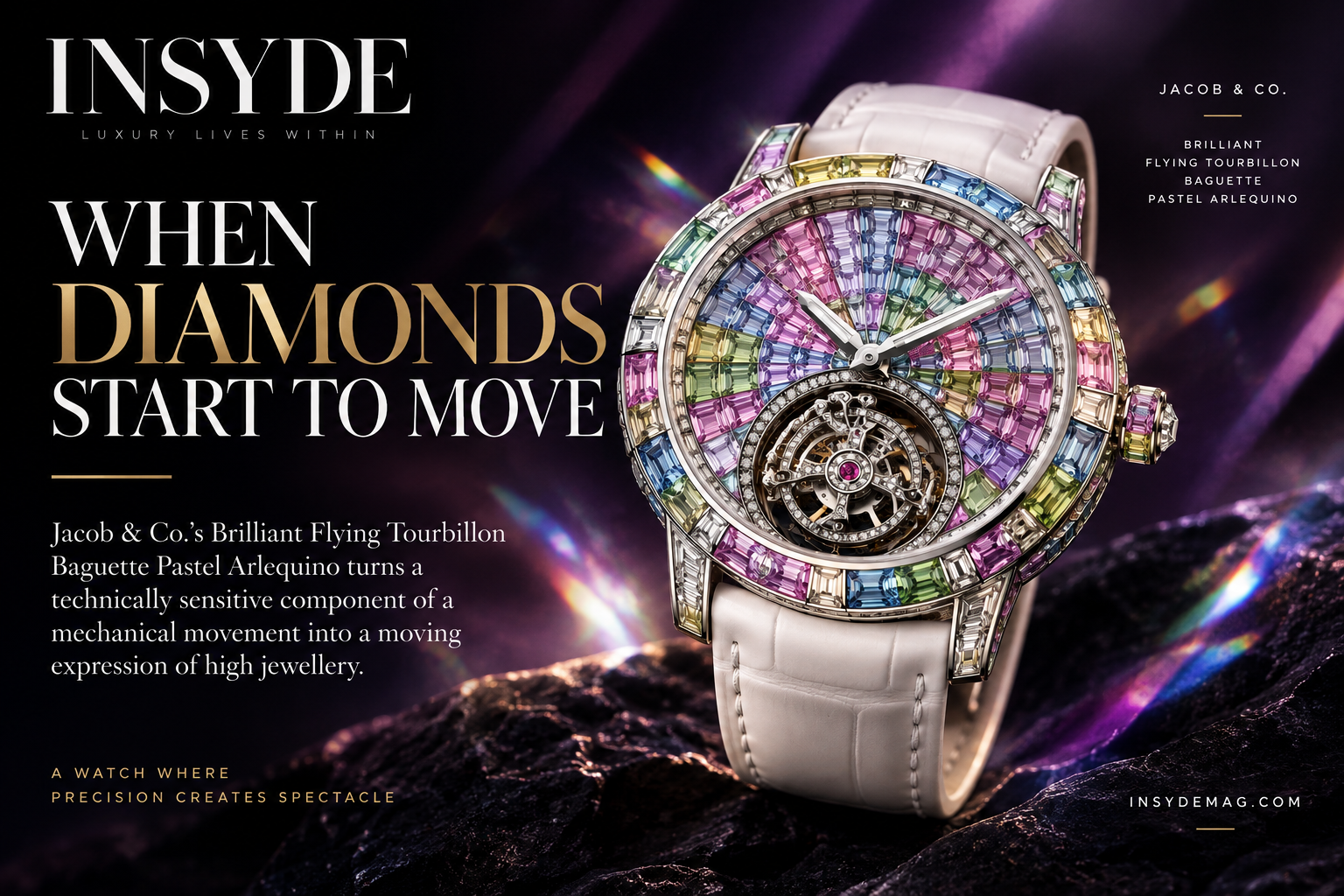
  • WHEN DIAMONDS START TO MOVE

    WHEN DIAMONDS START TO MOVE

    Jacob & Co.’s Brilliant Flying Tourbillon Baguette Pastel Arlequino turns a technically sensitive component of a mechanical movement into a moving expression of high jewellery.

    There are watches that use diamonds to catch the light. And then there are watches that make the light move.

    With the Brilliant Flying Tourbillon Baguette Pastel Arlequino, Jacob & Co. has placed 54 brilliant-cut white diamonds directly onto the balance wheel—one of the most technically sensitive components inside a mechanical watch. As the balance oscillates, the stones move with it, transforming a regulating organ normally appreciated by watchmakers into part of the visual performance.

    It is an unusual place to put jewellery. More importantly, it is an unusual place to put additional weight.

    That distinction is what makes this particular Jacob & Co. creation worth looking beyond the obvious spectacle.

    The watch is a one-of-a-kind piece within the brand’s Brilliant Flying Tourbillon collection, combining an 18K white-gold case, an intricate arrangement of pastel sapphires and diamonds, a flying tourbillon and the self-winding JCFA02 calibre. But its most interesting idea is not simply how much has been set onto the watch. It is where the decoration has been allowed to enter the mechanics.

    THE DIAMOND THAT MOVES

    A balance wheel is fundamental to the operation of a mechanical watch.

    Working with the hairspring, it forms part of the regulating system that governs the movement’s rate. It oscillates back and forth at a precise frequency, controlling the release of energy through the escapement and, ultimately, the measurement of time.

    Its mass and weight distribution therefore matter enormously.

    Adding gemstones to a component whose behaviour depends on precise mass distribution is not comparable to setting diamonds into a case or dial. Every additional element has the potential to influence the balance’s characteristics.

    Jacob & Co.’s approach was to engineer the balance wheel specifically to accommodate the 54 diamonds while retaining the characteristics required for the movement’s operation. The result is a regulating component that is simultaneously mechanical architecture and moving jewellery.

    The effect becomes particularly striking when the watch is running.

    The diamond-set balance wheel oscillates at 21,600 vibrations per hour, or 3Hz, while the flying tourbillon completes one rotation every 60 seconds. Their independent movement continually changes the relationship between the diamonds and the surrounding light.

    The sparkle is therefore not static.

    It travels.

    That is a subtle but important distinction in a category where gemstone setting has traditionally been about controlling how light interacts with a fixed surface.

    WHERE JEWELLERY MEETS MECHANICS

    The idea itself has historical echoes.

    Attempts to place diamonds directly onto balance wheels can be traced to experiments by watchmakers in the 19th century. As mechanical watchmaking became increasingly focused on precision, however, the regulating organ became a particularly unforgiving place for additional weight and decoration.

    Jacob & Co. is revisiting that territory with contemporary engineering.

    It is a fitting direction for a brand whose watchmaking has consistently treated mechanical complication as something to be seen rather than hidden. From its highly architectural creations to its flying tourbillons, the company has repeatedly placed movement and spectacle in the same conversation.

    The Pastel Arlequino takes that philosophy one step further.

    Instead of merely exposing the mechanism, it makes one of its most delicate components part of the jewellery language.

    A PALETTE BUILT LIKE A MOSAIC

    The movement may provide the watch’s technical argument, but the exterior provides its immediate identity.

    The 42mm 18K white-gold case is set with 194 baguette-cut pastel sapphires, totalling approximately 11.03 carats, alongside 32 white diamonds. The crown carries another 12 baguette-cut sapphires and one white diamond.

    The dial continues the composition with 139 baguette-cut pastel sapphires and 23 white diamonds.

    Across the watch, the stones are arranged in contrasting shades of green, blue, lavender and pink. Rather than creating a conventional colour gradient, the arrangement keeps the individual colours distinct, producing a geometric, almost mosaic-like effect.

    The name Arlequino points to the visual reference behind that arrangement: Arlecchino, the colourful character of the Italian commedia dell’arte, whose costume is traditionally associated with contrasting geometric patches.

    Here, that idea is translated into high jewellery.

    The pastel palette is particularly effective because it avoids the obvious route of simply making the watch louder. The colours introduce playfulness without abandoning the precision demanded by baguette-cut stones and invisible setting.

    And invisible setting matters.

    With the stones secured from beneath, the visible surfaces avoid the interruption of conventional prongs or exposed metal between individual gemstones. The result is a continuous field of colour across the case and dial.

    THE ART OF MAKING THE MECHANICAL VISIBLE

    There is an interesting tension at the centre of the Pastel Arlequino.

    A traditional high-jewellery watch can be understood primarily through its materials: precious metal, diamonds, coloured gemstones and craftsmanship.

    A high-complication watch is understood differently. Its value is tied to what happens beneath the surface—the architecture, engineering and precision of the movement.

    Jacob & Co. does not appear particularly interested in choosing between the two.

    The JCFA02 calibre combines a micro-rotor and flying tourbillon, operates at 3Hz and offers a 72-hour power reserve. The movement measures 30.4mm in diameter by 6.9mm thick and comprises 184 components.

    Even the movement bridges receive the jewellery treatment, with 234 brilliant-cut white diamonds totalling approximately 0.69 carats.

    But the balance wheel is different.

    The bridges are decorative surfaces.

    The balance wheel is in motion.

    That makes the 54 diamonds set onto it more than another gemstone count. They become part of the watch’s kinetic identity.

    WHEN DECORATION BECOMES PERFORMANCE

    This is where the Pastel Arlequino becomes more interesting than its specifications initially suggest.

    High watchmaking has spent decades finding new ways to expose movement. Sapphire dials, skeletonisation, openworked bridges and visible tourbillons have all made the mechanics of a watch increasingly central to its visual language.

    Jacob & Co.’s answer is to make the mechanics themselves decorative.

    The diamond-set balance wheel is not simply something to admire through an opening in the dial. It is constantly changing position. Every oscillation changes the angle at which its diamonds meet the light.

    At the same time, the flying tourbillon turns once per minute.

    Two different mechanical rhythms therefore operate within the same visual field.

    One oscillates.

    One rotates.

    Both catch the light.

    The result is almost closer to kinetic jewellery than conventional watch decoration.

    A WATCH BUILT AROUND CONTRAST

    The Arlequino concept also depends on contrast.

    Pastel sapphires meet brilliant-cut diamonds. Fixed gemstone surfaces surround moving mechanical elements. A playful colour palette is placed over a movement whose purpose remains intensely precise.

    Even the strap deliberately steps back.

    The watch is paired with an alligator strap and an 18K white-gold tang buckle set with 21 baguette-cut pastel Arlequino sapphires, approximately 1.52 carats.

    Across the complete piece, Jacob & Co. uses 366 sapphires distributed across the case, dial, crown and buckle.

    The numbers are impressive, but they are not really the story.

    The story is what happens when those stones are integrated into an object whose fundamental purpose is to measure time.

    THE IMPOSSIBLE, MADE VISIBLE

    Jacob & Co. has long occupied an unusual position in contemporary high watchmaking.

    The brand’s most recognisable creations rarely attempt to disappear beneath the cuff. They embrace theatricality, mechanical animation and jewellery as part of the same vocabulary.

    The Brilliant Flying Tourbillon Baguette Pastel Arlequino is very much part of that tradition.

    But the diamond-set balance wheel gives it a more technical proposition.

    It asks a question that is surprisingly simple:

    What happens when a component designed for precision becomes part of the spectacle?

    The answer is not another static display of precious stones.

    It is movement.

    And movement changes the way jewellery is perceived.

    A diamond on a bezel reflects light.

    A diamond on a moving balance wheel appears to participate in time itself.

    THE NEW LANGUAGE OF HIGH-JEWELLERY WATCHMAKING

    There is a broader shift visible here.

    High-jewellery watches have increasingly moved away from treating gemstone setting and mechanical watchmaking as separate disciplines. The most compelling contemporary pieces often ask how the two can interact—how a material can influence the movement, how a complication can become visual theatre, or how a mechanical component can become part of the aesthetic experience.

    The Pastel Arlequino sits squarely within that territory.

    Its sapphires create the first impression.

    Its tourbillon provides the familiar horological spectacle.

    But the balance wheel creates the surprise.

    That is ultimately why the watch feels more considered than its exuberant appearance might suggest. Beneath the colour and brilliance is an attempt to integrate jewellery into the functioning architecture of the movement rather than simply placing it around the movement.

    For a one-of-a-kind creation, that is a more compelling proposition than simply being extravagant.

    INSYDE PERSPECTIVE

    The most interesting luxury objects are rarely interesting because they contain the most expensive materials.

    They become interesting when those materials are made to do something unexpected.

    Jacob & Co.’s 54-diamond balance wheel is precisely that kind of idea. The diamonds are not simply there to increase the visual value of the watch. They have been incorporated into a component whose behaviour depends on precise engineering, turning a regulating organ into part of the watch’s visual performance.

    The Pastel Arlequino consequently sits somewhere between haute horlogerie and high jewellery without needing to choose one over the other.

    It is a watch where precision creates spectacle, and spectacle reveals precision.

    And when the diamonds begin to move, the distinction between decoration and mechanics becomes considerably harder to draw.

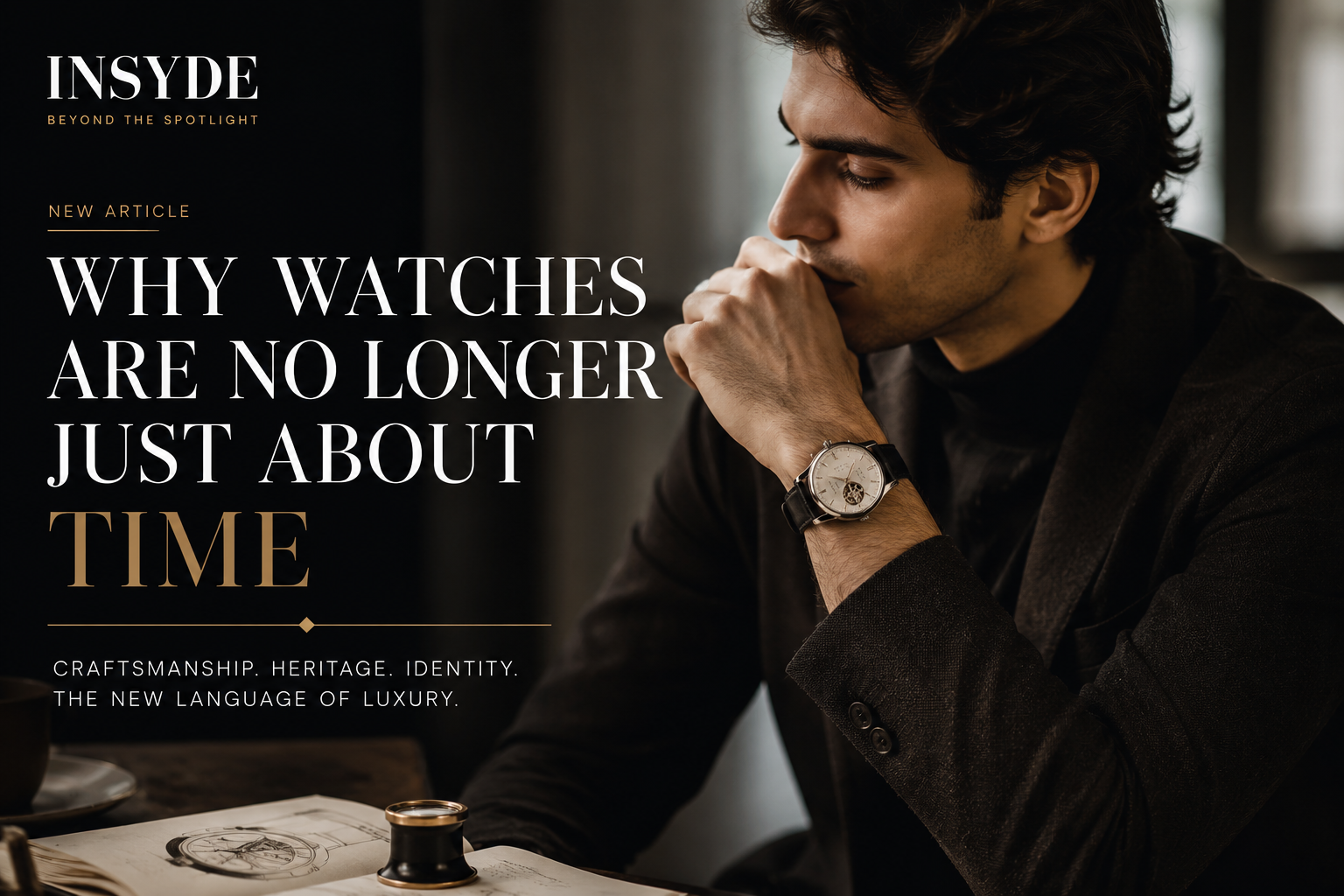
  • Why Watches Are No Longer Just About Time

    Why Watches Are No Longer Just About Time

    In an age when a smartphone can tell the time with extraordinary precision, the mechanical watch has survived by becoming something else entirely — an object of craftsmanship, identity, history and desire.

    There is something almost irrational about wanting a mechanical watch in 2026.

    Your phone tells the time more accurately.

    Your smartwatch can track your heart rate, count your steps, read your messages and remind you about your next meeting.

    A digital clock costs almost nothing.

    And yet people continue to spend lakhs — sometimes far more — on objects whose most obvious function can be performed by something already sitting in their pocket.

    That contradiction is precisely what makes the luxury watch so fascinating.

    A great watch was never really just about telling time.

    It is about what you choose to wear when you don’t need to.

    And in India, that choice is becoming increasingly interesting.

    India’s Watch Moment Is Getting Bigger

    For years, India’s luxury-watch culture was relatively contained.

    There were established collectors, traditional luxury buyers, wedding purchases and a handful of names that dominated the conversation.

    That world still exists.

    But it is expanding.

    In the first half of 2026, India imported around 200,000 Swiss watches, up nearly 37% from the same period a year earlier. The value of those imports rose by more than 31% to approximately 168.7 million Swiss francs.

    The numbers are significant.

    But the more interesting story is what they suggest about the Indian consumer.

    India is becoming increasingly important to international watchmakers at a time when the global Swiss watch industry is facing a more complicated environment.

    Brands are responding.

    The opportunity is no longer simply about selling watches.

    It is about understanding a new generation of Indian buyers who are becoming more curious about what they wear, why they wear it and what exists beyond the obvious names.

    The Watch as a Personal Signature

    Luxury has always been partly about recognition.

    A famous name can tell people what you own.

    A watch can reveal something more subtle:

    why you chose it.

    One person might choose a restrained dress watch because they appreciate proportion and simplicity.

    Another might choose an unusual independent watch because the obvious answer doesn’t interest them.

    Someone else might collect vintage pieces because history matters more than novelty.

    Another collector might be fascinated by movements, complications and the engineering hidden beneath the dial.

    Two people can spend the same amount of money and end up with completely different watches.

    That is where collecting becomes personal.

    The watch stops being merely an accessory.

    It becomes a signature.

    And unlike many luxury objects, it sits unusually close to the body.

    You don’t simply own it.

    You live with it.

    Why Mechanical Watches Still Matter

    The mechanical watch is an extraordinary piece of technology precisely because it is unnecessary.

    Inside a traditional mechanical movement, hundreds of components work together to measure something humans can now measure more cheaply and accurately in countless other ways.

    There is no screen.

    No notification.

    No app.

    No charging cable.

    Just gears, springs, wheels and precision.

    The complexity is no longer necessary.

    It is chosen.

    That may be one of the most fundamental ideas behind luxury itself.

    Luxury often begins where necessity ends.

    A mechanical watch takes an ordinary function and turns it into an object of craftsmanship.

    The movement becomes part of the story.

    The finishing becomes part of the story.

    The sound becomes part of the story.

    Even the ritual of winding or setting the watch can become part of the experience.

    The technology may be centuries old.

    The fascination is not.

    The Indian Buyer Is Becoming More Informed

    Perhaps the most important change in India’s watch market is not simply that more people are buying luxury watches.

    It is that buyers are becoming more curious about what they are buying.

    The Indian market is attracting a younger customer base, while interest in premiumisation, design and the emotional value of mechanical watches continues to grow.

    The first luxury watch might still be about recognition.

    The second might be about design.

    The third might be about the movement.

    The fourth might be about finding something nobody around you is wearing.

    That is how collecting becomes interesting.

    Not necessarily with wealth.

    With curiosity.

    Beyond the Obvious Names

    There is nothing wrong with choosing one of the world’s most recognisable watchmakers.

    Heritage matters.

    Craftsmanship matters.

    Consistency matters.

    Generations of watchmaking expertise do not disappear simply because consumers become more experimental.

    But luxury has always had another side.

    The world of independent watchmaking can be wonderfully strange.

    Smaller workshops.

    Unusual complications.

    Experimental materials.

    Unexpected dial designs.

    Limited production.

    Designs that reward attention rather than immediate recognition.

    For someone who already knows the obvious names, discovery becomes part of the pleasure.

    The question changes from:

    “How famous is the brand?”

    to:

    “How interesting is the watch?”

    That is where the watch begins to move closer to art.

    Quiet Luxury Has Reached the Wrist

    For years, bigger often meant more luxurious.

    Large cases.

    Gold.

    Diamonds.

    Complicated dials.

    Visual presence.

    But the mood is becoming more nuanced.

    Indian luxury-watch retailers and brands have been reporting stronger interest in smaller, more understated watches, reflecting a broader movement towards quieter expressions of luxury.

    A 39mm watch can communicate confidence without demanding attention.

    A simple dial can require more appreciation than a complicated one.

    A watch without diamonds can sometimes be more difficult to understand — and therefore more interesting.

    This is where the phrase quiet luxury becomes useful.

    Not because understated automatically means better.

    But because sophistication increasingly depends on recognising quality without needing it to announce itself.

    The most interesting watch in the room may not be the one everyone notices first.

    It might be the one only another collector recognises.

    A Watch Can Become a Memory

    There is another reason watches occupy such a unique place in luxury.

    They age with you.

    A smartphone becomes obsolete.

    A car eventually changes hands.

    Fashion moves on.

    A watch can remain.

    It might be purchased to mark a promotion.

    A wedding.

    A birthday.

    A first business success.

    A significant journey.

    Or simply the moment someone decides that they want to own something beautiful.

    Years later, the object carries the memory.

    The scratches become part of it.

    The worn strap becomes part of it.

    The person who originally wore it may no longer be the person wearing it.

    That is why watches can become heirlooms.

    Not simply because they are valuable.

    Because they are portable pieces of memory.

    The Indian Heirloom Instinct

    India already understands the emotional value of objects that move through generations.

    Jewellery is inherited.

    Saris become family archives.

    Furniture survives marriages, houses and cities.

    Objects accumulate stories.

    The mechanical watch fits naturally into that tradition.

    A watch bought today can eventually become something else entirely.

    It can become the watch your child remembers seeing on your wrist.

    Then the watch your child wears years later.

    Its monetary value may matter.

    But its emotional value can become greater.

    The modern luxury watch is, in that sense, not entirely foreign to India.

    It simply gives an old idea a new form.

    Watches Are Becoming Part of a Larger Luxury Culture

    The modern watch does not exist in isolation.

    It sits inside a much larger cultural ecosystem.

    Fashion.

    Automobiles.

    Sport.

    Art.

    Travel.

    Architecture.

    Technology.

    Formula 1 has become deeply connected to luxury watchmaking.

    Tennis has long provided another meeting point between watches, sport and fashion.

    Automobile enthusiasts often move naturally between collecting cars and collecting watches.

    Fashion houses collaborate with watchmakers.

    Artists reinterpret watch design.

    Luxury hotels create experiences around collectors and horology.

    The watch has become part of a larger conversation about how people express taste.

    And this is where watches become particularly relevant to INSYDE.

    We aren’t interested only in what is on the wrist.

    We’re interested in what the wrist tells us about the person wearing it — and the culture around them.

    The New Luxury Collector Doesn’t Always Want the Obvious

    There is a difference between being able to buy a luxury watch and becoming genuinely interested in watches.

    The first is financial.

    The second is cultural.

    A collector starts noticing details.

    The movement beneath the dial.

    The finishing on a bridge.

    The proportions of a case.

    The history of a reference.

    The difference between a manufacture movement and an outsourced calibre.

    The story behind an independent watchmaker.

    The way a watch changes on the wrist.

    This knowledge creates another form of luxury.

    Knowing what you’re looking at.

    And perhaps that is where the next generation of Indian watch culture becomes particularly interesting.

    The consumer is no longer dependent entirely on a salesperson to explain why something matters.

    Information is everywhere.

    Collectors can study movements, follow independent makers, compare references and discover watches from almost anywhere in the world.

    The result is a more informed buyer.

    And a more demanding one.

    India’s Watch Market Is Becoming More Sophisticated

    India’s growth is happening at an interesting moment for the global industry.

    Swiss watch exports declined in 2025, while India continued to show strong momentum.

    That contrast has made India increasingly difficult for global watchmakers to ignore.

    Retail networks are expanding.

    New boutiques are opening.

    Brands are investing in local teams and customer experiences.

    And younger buyers are entering categories that were once associated primarily with older collectors.

    The opportunity is not simply to sell more watches.

    It is to build a deeper watch culture.

    That means better retail experiences.

    More education.

    More access to interesting independent makers.

    More collecting communities.

    More conversations around craftsmanship.

    And eventually, perhaps, a stronger Indian voice within global horology.

    The Watch Doesn’t Need to Compete With Your Phone

    Perhaps the easiest mistake is to ask whether a mechanical watch can compete with technology.

    It can’t.

    It shouldn’t.

    Your phone tells you the time.

    Your watch tells you why you chose to wear it.

    One provides information.

    The other provides expression.

    One is designed around constant updates.

    The other can remain largely unchanged for decades.

    One is expected to be replaced.

    The other can be designed to survive you.

    That is why the mechanical watch continues to matter.

    It offers something technology has made increasingly rare:

    a reason to keep something simply because it is beautifully made.

    So, Why Do We Still Want Watches?

    Because we don’t really buy them for the time.

    We buy them for the engineering.

    The craft.

    The history.

    The design.

    The ritual.

    The memory.

    The weight on the wrist.

    The quiet movement beneath the dial.

    And sometimes, simply because we love the way they look.

    There is nothing irrational about that.

    Luxury has never been entirely rational.

    It exists in the space between need and desire.

    Few objects occupy that space as elegantly as the mechanical watch.

    India’s Time Is Changing

    India’s watch story is no longer simply about importing more Swiss watches.

    It is about a new generation learning to appreciate what makes a watch worth wearing.

    The buyer is becoming younger.

    The market is becoming deeper.

    The choices are becoming wider.

    And the conversation is moving beyond logos.

    For the next generation of Indian collectors, the most interesting watch may not necessarily be the most recognisable one.

    It may be the one with the most compelling story.

    The most beautiful movement.

    The most unusual design.

    The strongest connection to its maker.

    Or simply the one that means something to the person wearing it.

    Because when everyone can check the time on a phone, a mechanical watch has to offer something else.

    It has to give you a reason to keep looking at it.

    And increasingly, in India, people are learning exactly where to look.

    INSYDE — Inside modern luxury.

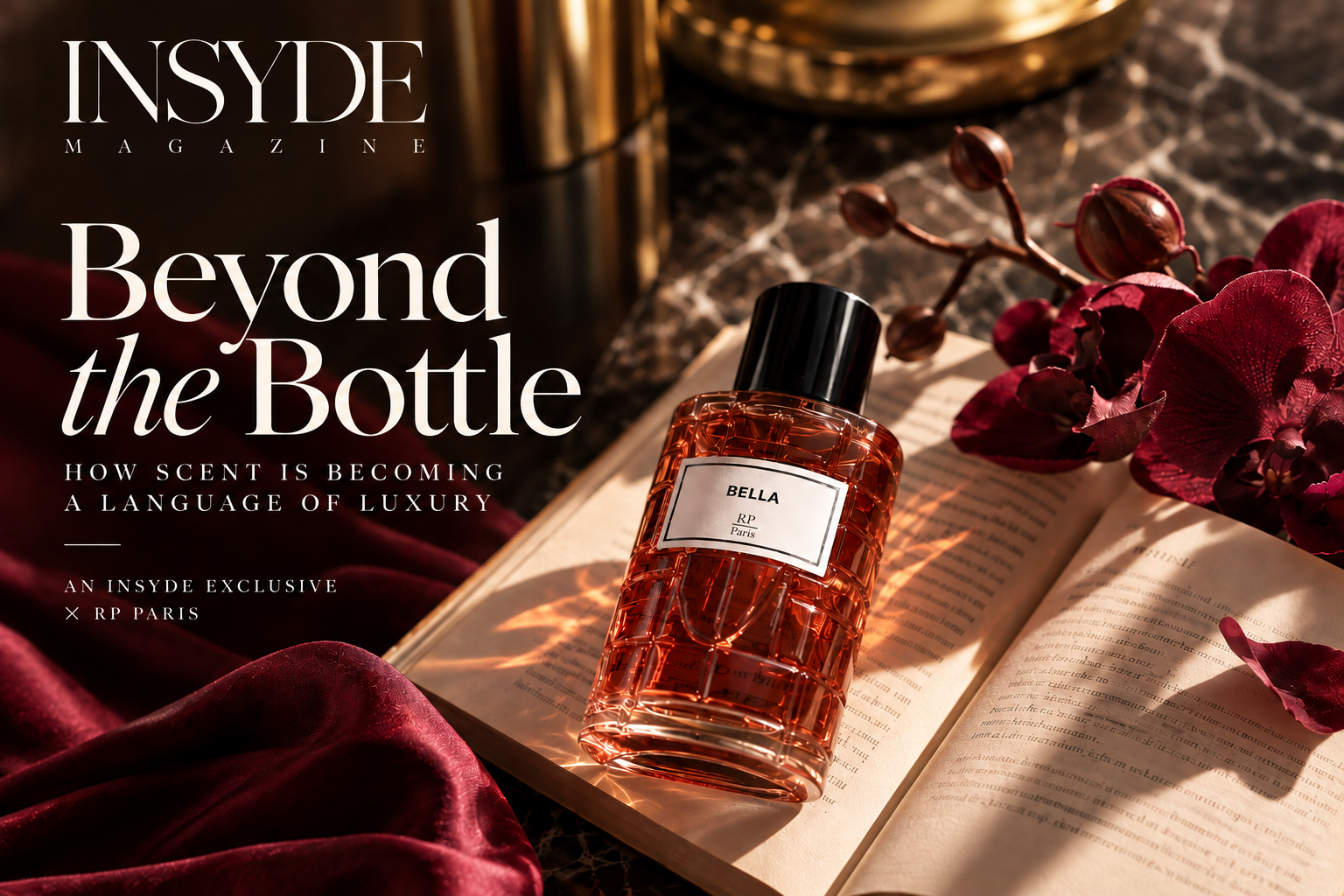
  • Beyond the Bottle: How Scent Is Becoming a Language of Luxury

    Beyond the Bottle: How Scent Is Becoming a Language of Luxury

    From signature fragrances to scented interiors, textiles and everyday rituals, scent is moving beyond the body — becoming an increasingly intimate way to shape identity, atmosphere and experience.

    Luxury has traditionally been something we can see.

    It is found in the cut of a garment, the construction of a watch, the setting of a jewel or the architecture of a carefully considered space. Even the quietest forms of luxury tend to reveal themselves through material, proportion, finish or craftsmanship.

    Scent asks us to experience luxury differently.

    It cannot be held in the same way as an object. It has no permanent form, no fixed visual language and no single interpretation. Yet it can alter the character of a room, transform an ordinary ritual or bring an entire memory back with remarkable precision.

    That invisible quality is becoming increasingly relevant to the way contemporary luxury is experienced.

    Fragrance was once largely defined by the bottle and the person wearing it. Today, its territory is expanding into homes, textiles, cars, hospitality and the rituals of everyday life. Scent is becoming less confined to a moment of application and more closely connected to the environments we create around ourselves.

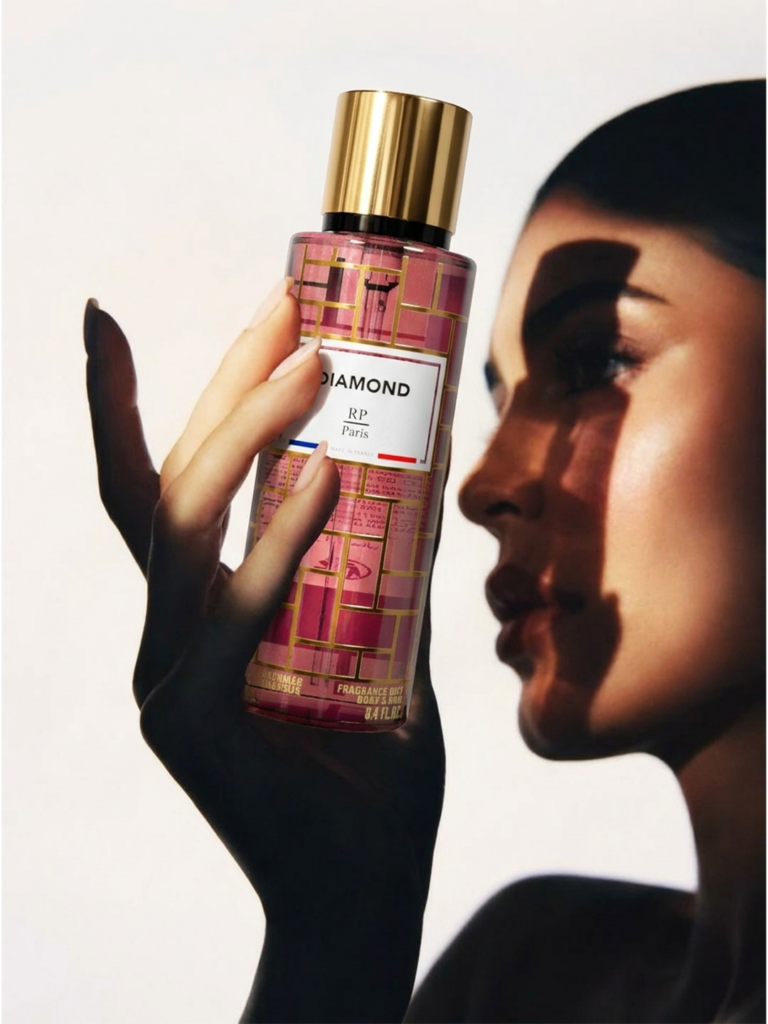
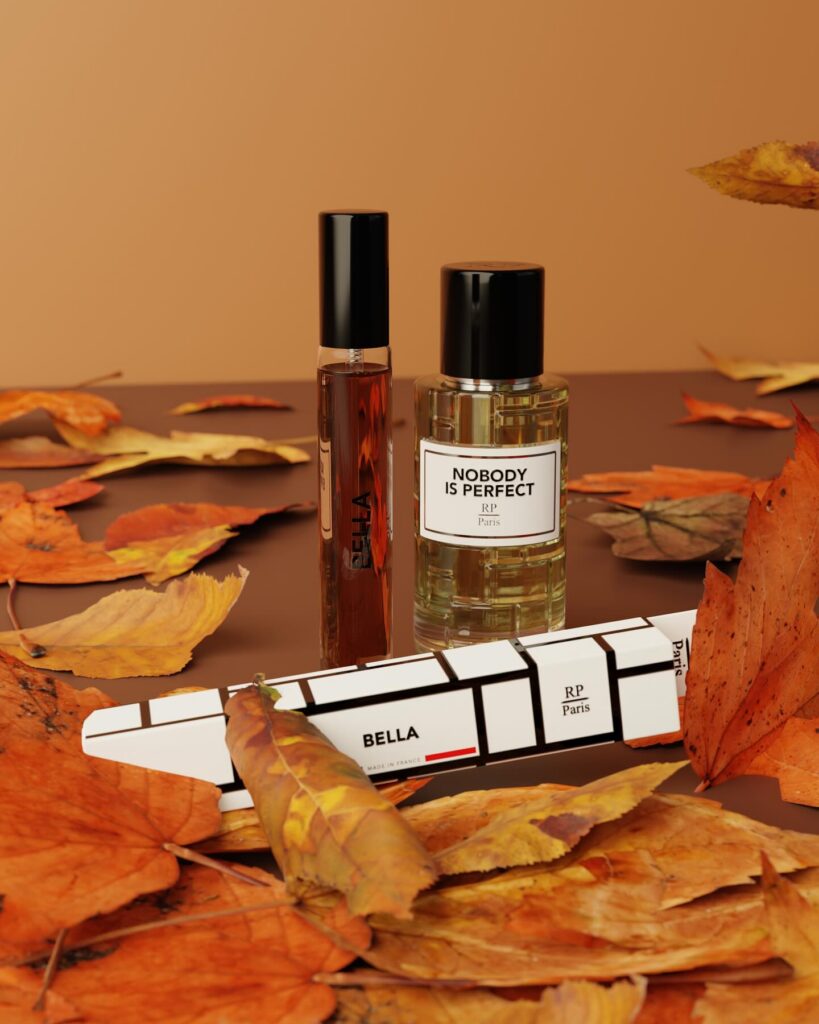
    For RP Paris, a French perfume house founded in 2015, that evolution reflects a broader change in how people understand fragrance and personal expression. The house describes its creative universe through emotion and has developed an offering that extends from perfumes and mists to textile sprays, home diffusers, car fragrances and other scent-led products.

    The shift raises a more interesting question than simply where fragrance is being used next.

    What happens when luxury becomes something we experience rather than something we see?


    Beyond the Signature Scent

    For generations, the idea of a signature scent carried a particular kind of intimacy.

    One fragrance could become synonymous with a person — something recognisable, personal and almost invisible to everyone except those who encountered it.

    But the idea of one scent defining an entire identity is becoming less rigid.

    RP Paris sees consumers becoming more comfortable with different fragrances for different parts of their lives. The scent chosen for the skin does not necessarily have to be the scent chosen for a bedroom, a textile or a car.

    The comparison with fashion is revealing.

    We don’t dress the same way for every occasion. Our wardrobes change with our mood, surroundings and intentions. Why should our relationship with scent be any different?

    A fragrance can accompany getting ready in the morning. Another can create a calmer atmosphere at night. A familiar scent can become associated with travelling, returning home or simply making an ordinary moment feel more considered.

    The result is a more fluid understanding of olfactory identity.

    Rather than asking which single fragrance represents us, we can begin to ask which scent belongs to this particular moment.

    For RP Paris –

    “the expansion of fragrance is therefore not simply about creating more products or more occasions for application. It reflects a desire to make more parts of everyday life feel personal.”

    That distinction matters.

    The modern luxury consumer is increasingly interested in experiences that feel individual rather than prescribed.

    And scent, perhaps more than any other luxury category, allows for that freedom.


    Image Courtesy: RP Paris

    The Luxury You Cannot See

    There is a particular intimacy in something that does not need to announce itself.

    A watch can reveal its craftsmanship through its movement. A jewel communicates through metal and stone. A garment speaks through cut, construction and material.

    Scent operates on a different level.

    “With scent, there is nothing to look at. You have to experience it.” — RP Paris

    That experience is inherently subjective.

    The same fragrance can evoke confidence in one person, comfort in another and a completely different memory in someone else. A scent may remind someone of a particular place or period of their life without that association ever having been part of the creator’s original intention.

    This makes fragrance particularly interesting within today’s luxury landscape.

    Luxury has increasingly moved away from the need to demonstrate status through visibility. Experiences, personal rituals and emotional associations have become just as significant as the objects themselves.

    Scent fits naturally into that evolution.

    It does not need to be seen by anyone else to have value.

    In fact, its most meaningful effect may happen when nobody else notices it at all.


    Image Courtesy: RP Paris

    When a Space Has an Identity

    The most significant change in fragrance may be taking place beyond the body.

    Think about the way a room is designed.

    Lighting, furniture, colour, texture and materials are selected not only for their individual qualities but for the atmosphere they create together. Scent can increasingly become part of that same conversation.

    A bedroom can have a different olfactory character from a living room. A boutique can develop an atmosphere that complements its visual identity. A hotel can create an association that remains with its guests long after they have left.

    RP Paris describes scent as:

    “the invisible finishing layer of a space.”

    It is a compelling way of thinking about fragrance because it moves scent from the category of accessory into the language of design.

    We already talk about the visual identity of a space.

    Increasingly, we may begin talking about its olfactory identity.

    For hospitality, retail and residential interiors, that possibility is particularly intriguing. A recognisable scent can become part of how a place is remembered, just as much as its architecture, materials or visual details.

    And this does not necessarily require extravagance.

    Sometimes luxury is simply the ability to shape an environment so precisely that it feels unmistakably yours.


    Image Courtesy: RP Paris

    From Owning Luxury to Curating Experience

    The broader luxury industry has been moving steadily toward experience.

    A hotel is no longer judged only by the room itself. A boutique is increasingly designed as an environment rather than simply a place to transact. Residential design has become as concerned with atmosphere and wellbeing as it is with materials and objects.

    Scent belongs naturally within this shift.

    It can change how an environment is perceived without changing its physical structure.

    A room does not need to be redesigned.

    A car does not need to be transformed.

    A home does not need another object.

    The sensory experience can change through something almost invisible.

    For RP Paris –

    this is where contemporary indulgence becomes particularly interesting: in the ability to take an ordinary moment and make it feel more deliberate.

    The fragrance in a room before guests arrive. The scent of textiles at the end of the day. A familiar atmosphere inside a car. A particular fragrance associated with coming home.

    These are small details, but they can create lasting associations.

    Luxury, in this context, becomes less about accumulating things and more about curating how life is experienced.


    Image Courtesy: RP Paris

    The Challenge of a Visual World

    Fragrance exists in an unusual position within contemporary culture.

    We live through images. Fashion is photographed. Jewellery is displayed. Interiors are captured and shared. Luxury brands construct elaborate visual worlds around their products.

    But scent itself cannot be photographed.

    A bottle can be beautiful. Packaging can establish a visual identity. A campaign can suggest a particular mood. None of them, however, can reproduce the fragrance itself.

    Eventually, the consumer has to experience it.

    For RP Paris, this makes storytelling essential — but it also means leaving room for interpretation.

    “The visual identity creates the first invitation, but the scent creates the real connection.” — RP Paris

    That relationship between image and experience is increasingly important.

    The visual world can invite someone in, but it cannot dictate what the fragrance will mean to them.

    A scent may become associated with a childhood memory, a city, a relationship or an entirely unexpected moment.

    In that sense, the consumer completes the story.

    And perhaps that is one of fragrance’s greatest strengths in an age where almost everything is immediately visible and explainable.

    There is still something left to discover.


    French Tradition, Without Standing Still

    The expansion of fragrance does not mean abandoning the traditions from which the category emerged.

    RP Paris positions French perfumery as a foundation of its identity while also looking toward changing tastes, contemporary lifestyles and new ways of experiencing scent. The house describes its approach through collaboration, technical expertise, craftsmanship and innovation, while its product universe continues to expand beyond conventional personal fragrance.

    But the relationship between heritage and modernity is not presented as a choice between two opposing directions.

    RP Paris puts it simply:

    “French perfumery is a starting point, not a boundary.”

    That distinction becomes increasingly relevant as the category evolves.

    Tradition has value because of the knowledge and craftsmanship it carries. But for that knowledge to remain relevant, it must be capable of responding to the way people live now.

    Consumers discover fragrance differently. They experiment more. They move between beauty, fashion, interiors and lifestyle with fewer rigid boundaries.

    For a contemporary perfume house, the challenge is therefore to preserve the character and quality associated with its foundations while allowing the experience of fragrance to evolve.

    Heritage does not have to remain still in order to remain meaningful.


    A Sensory Wardrobe

    Perhaps the easiest way to understand the future of fragrance is to think of it as a wardrobe.

    Not one scent, but several.

    Different moods. Different spaces. Different occasions.

    The same person can want something expressive on the skin, something softer in a bedroom, something fresh in a car or something entirely different during travel.

    This mirrors the way personal style has already evolved.

    We no longer expect a single outfit to represent every version of ourselves. Our wardrobes accommodate different identities and circumstances.

    Fragrance can do the same.

    This is why the expansion into textile sprays, home fragrance and car scent feels more significant than a simple multiplication of product categories. It reflects a broader shift in where scent belongs.

    It belongs wherever experience happens.

    Beauty.

    Fashion.

    Interiors.

    Travel.

    Hospitality.

    Home.

    The boundaries between these worlds are increasingly fluid, and fragrance is uniquely capable of moving between them.


    Image Courtesy: RP Paris

    Designing the Invisible

    The next stage of fragrance may therefore have less to do with where another perfume product can be placed and more to do with recognising scent as a form of design.

    Imagine a home where fragrance is considered alongside lighting, fabrics and materials.

    A hotel where the olfactory character of the space is developed as deliberately as its architecture.

    A boutique whose scent becomes as recognisable as its visual identity.

    A car where fragrance completes the experience of its interior.

    These possibilities are already beginning to emerge, but their significance lies in what they suggest about the future of design.

    RP Paris believes designers and brands may increasingly think about scent earlier in the creative process rather than treating it as an element added at the end.

    That would represent a subtle but meaningful shift.

    Scent would no longer simply finish an environment.

    It would help define it.

    And once that happens, the idea of an “olfactory identity” may become as natural as talking about a visual one.


    What Comes After the Bottle?

    The future of fragrance may not require us to leave the bottle behind.

    It may simply require us to understand that the bottle was never the entire experience.

    What follows is more interesting.

    A memory.

    A mood.

    A room.

    A journey.

    A ritual.

    The feeling of arriving somewhere, or returning home.

    RP Paris expects personalisation to remain central to the evolution of fragrance, with consumers increasingly choosing scents according to different moods, spaces and occasions while continuing to value quality, craftsmanship and authenticity.

    That balance may define the category’s next chapter.

    Because as scent becomes more integrated into everyday life, its value may lie less in its ability to signal status and more in its ability to create meaning.

    It can make a familiar space feel different.

    It can turn a routine into a ritual.

    It can connect a present moment with a memory that may have been forgotten.

    And it can do all of this without demanding to be seen.

    “Scent becoming less of a single product and more of an everyday sensory language.” — RP Paris

    That may ultimately be the most interesting evolution of all.

    Luxury has spent centuries perfecting the art of what can be seen, touched and owned.

    Scent suggests another possibility:

    luxury as something felt.

    And beyond the bottle, fragrance may be becoming one of the most intimate ways we shape the world around us.


    RP Paris

    French perfumery, contemporary olfactory experiences.

    An INSYDE Exclusive editorial conversation with RP Paris.

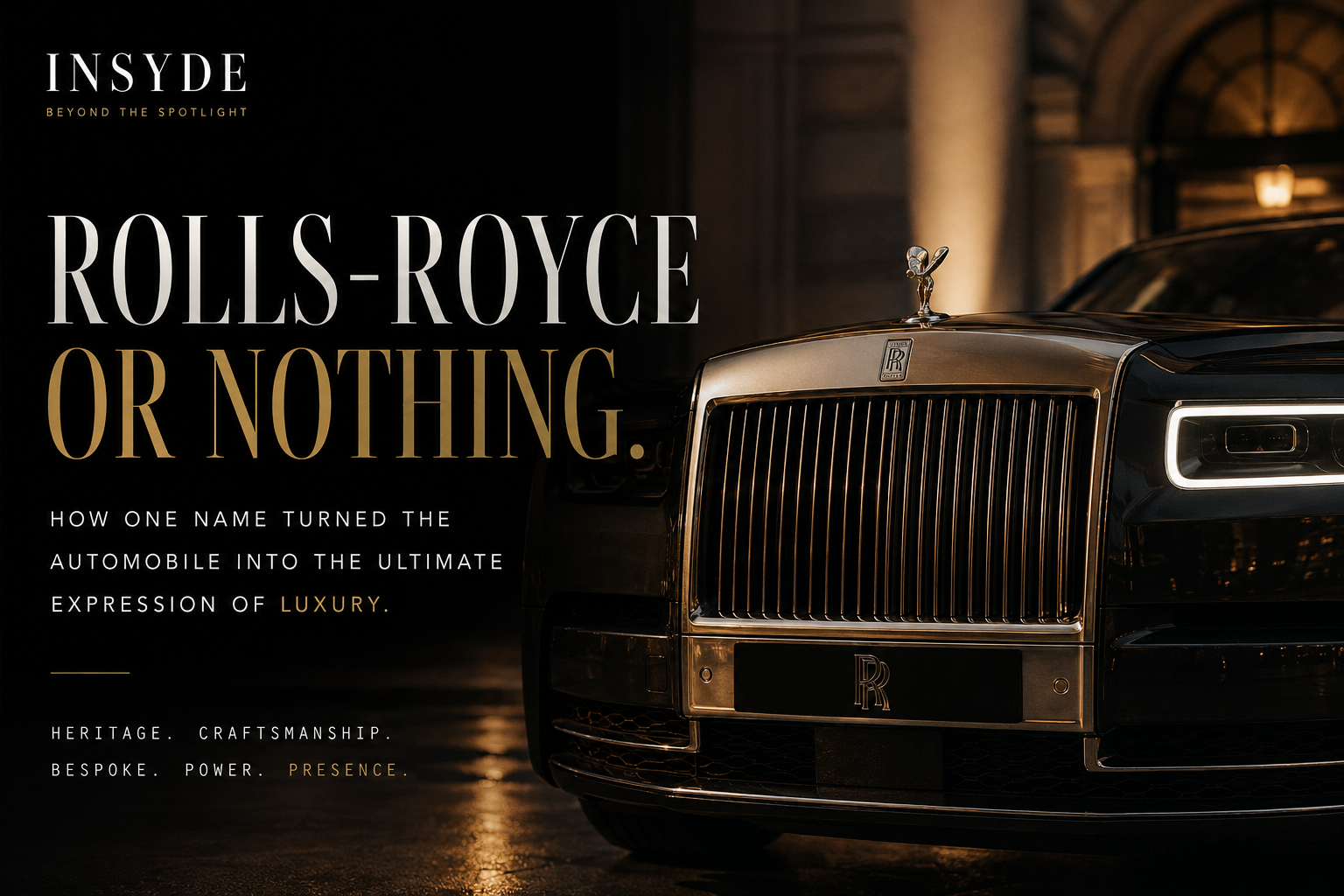
  • ROLLS-ROYCE OR NOTHING ?

    ROLLS-ROYCE OR NOTHING ?

    How one name turned the automobile into the ultimate expression of luxury.

    There are expensive cars.

    There are performance cars.

    There are luxury cars.

    And then there is Rolls-Royce.

    For more than a century, the name has occupied a peculiar position at the very top of the automotive world. Not because it makes the fastest cars. Not because it produces the most cars. And certainly not because everyone needs one.

    Rolls-Royce represents something far more difficult to manufacture:

    the feeling that nothing else will do.

    A Ferrari is about the thrill of driving.

    A Bentley is about grand touring and craftsmanship.

    A Mercedes-Benz can deliver extraordinary technology and comfort.

    Rolls-Royce plays a different game.

    It asks a much more luxurious question:

    What if the journey itself became the destination?

    That question sits at the heart of the marque.

    Because the closer you look at Rolls-Royce, the less it resembles a conventional car company.

    It begins to look like something else entirely:

    a luxury house that happens to build automobiles.


    THE IDEA THAT STARTED IT ALL

    The story began in 1904.

    Charles Rolls and Henry Royce met in Manchester and discovered a partnership built on two very different strengths: Rolls brought entrepreneurial ambition and a passion for motoring, while Royce brought an obsessive engineering mind and an uncompromising pursuit of quality.

    Their ambition was audacious:

    to build the best car they could.

    The result would eventually become one of the most powerful names in luxury.

    But the important part wasn’t simply engineering excellence.

    It was the philosophy behind it.

    Rolls-Royce was never interested in making an ordinary automobile and decorating it with expensive materials.

    The ambition was to make the entire experience feel exceptional.

    That distinction has survived for more than 120 years.

    Technology changed.

    Design changed.

    Customers changed.

    The world changed.

    But the central idea remained:

    nothing ordinary.


    WHEN A CAR STOPPED BEING JUST A CAR

    The earliest Rolls-Royce automobiles reveal something important about the company’s DNA.

    Until 1949, Rolls-Royce supplied its cars as rolling chassis, with specialist coachbuilders creating the bodywork according to the customer’s wishes. In other words, the customer’s vision was part of the product from the beginning.

    That tradition matters enormously when understanding modern Rolls-Royce.

    Because today’s obsession with Bespoke isn’t some fashionable marketing invention.

    It is a continuation of the brand’s original philosophy.

    The idea was never simply:

    “Here is our car.”

    It was closer to:

    “Here is the foundation. What would you like us to create?”

    That is a very different relationship between manufacturer and customer.

    And it is one of the reasons Rolls-Royce has always occupied such unusual territory.


    LUXURY ISN’T THE PRICE

    Anyone can make something expensive.

    Luxury is harder.

    A car can have beautiful leather, exotic wood, a powerful engine and an enormous price tag and still feel like an expensive product.

    True luxury requires something more elusive:

    intentionality.

    Every surface needs to feel considered.

    Every movement needs to feel effortless.

    Every detail needs to feel like it belongs.

    And most importantly, the experience needs to feel different from what came before.

    That is where Rolls-Royce has built its reputation.

    At Goodwood, where Rolls-Royce Motor Cars has made its home since the beginning of the modern era, craftsmanship and personalisation sit at the centre of the production philosophy. The company describes its motor cars as meticulously crafted and its Bespoke operation as a way for clients to realise highly individual visions.

    The result is not simply a luxury specification.

    It is a personal object.


    THE ART OF BESPOKE

    There is a moment when customisation becomes something more.

    You choose a colour.

    Then a material.

    Then a finish.

    Then an interior.

    Then a detail nobody else has.

    Eventually, you stop selecting options from a catalogue.

    You start commissioning an idea.

    That is the world Rolls-Royce has built around Bespoke.

    Clients can work with designers, engineers and craftspeople to develop cars around highly personal ideas, from materials and colours to intricate artistic details.

    And at the very top sits Coachbuild.

    Rolls-Royce describes Coachbuild as the pinnacle of its Bespoke offering and the automotive equivalent of haute couture. It is an invitation-only process in which clients collaborate with designers, engineers and craftspeople to create entirely original motor cars.

    The process can take years.

    That is the point.

    Luxury isn’t always about getting something quickly.

    Sometimes luxury is having the freedom to say:

    “Take your time. Make it mine.”


    WHEN THE CUSTOMER BECOMES THE DESIGNER

    This is where Rolls-Royce separates itself from the traditional idea of a luxury car.

    Most manufacturers sell you a finished product.

    Rolls-Royce increasingly sells you the opportunity to participate in its creation.

    The client can bring a memory.

    A place.

    A piece of art.

    A passion.

    A family story.

    An obsession.

    The designers translate it.

    The craftspeople execute it.

    And eventually, something exists that did not exist before.

    That changes the psychology of ownership.

    You are no longer simply buying something rare.

    You are helping create something rare.

    And there is a profound difference.

    Anyone can own an expensive object.

    Far fewer people can say:

    “This was made because I imagined it.”


    THE SPIRIT OF ECSTASY

    Then there is the figure above the grille.

    The Spirit of Ecstasy.

    Since 1911, Charles Sykes’ creation has served as one of the world’s most recognisable automotive emblems. Rolls-Royce describes the figure as a continuing symbol of ambition, achievement, excellence and freedom from conformity.

    But her importance goes beyond recognition.

    She gives the marque a visual philosophy.

    She leans forward.

    She moves into the wind.

    She isn’t looking backward.

    And for more than a century, she has become the tiny figure that tells the world exactly what is approaching.

    There is something almost theatrical about that.

    A Rolls-Royce doesn’t need to shout.

    The emblem already speaks.


    THE PHANTOM EFFECT

    Few names in luxury carry the weight of Phantom.

    The first Phantom arrived in 1925.

    A century later, the name remains the pinnacle of the Rolls-Royce range. The company marked Phantom’s centenary in 2025 by reflecting on how generations of owners used Bespoke details to make their cars expressions of their own tastes, values and eras.

    That history reveals something fascinating.

    Phantom wasn’t merely a luxury car that survived for 100 years.

    It became a canvas.

    Different generations changed the way they wanted luxury to look.

    Phantom changed with them.

    But the underlying promise remained remarkably stable:

    make it extraordinary, then make it personal.


    SILENCE IS A LUXURY

    There is another quality that defines the Rolls-Royce experience.

    Silence.

    Not the silence of emptiness.

    The silence of distance from the outside world.

    Traffic is still there.

    The city is still moving.

    People are still rushing.

    But inside the cabin, the urgency feels further away.

    And that represents something increasingly valuable in modern luxury.

    For centuries, wealth was often expressed through accumulation:

    More land.

    More houses.

    More possessions.

    More staff.

    More visibility.

    Modern luxury can mean something very different.

    More control.

    Control over your surroundings.

    Control over your time.

    Control over your privacy.

    Control over the experience.

    A Rolls-Royce turns the cabin into something approaching a private room that happens to move.

    And that may be more luxurious than another 100 horsepower ever could be.


    THE CAR YOU DON’T HAVE TO DRIVE

    There is a beautiful contradiction at the heart of Rolls-Royce.

    The automobile was born from the desire for personal mobility.

    Rolls-Royce perfected a version of luxury where the owner doesn’t necessarily need to care about driving at all.

    The rear cabin becomes the destination.

    The road becomes background.

    The driver handles the journey.

    The passenger gets the experience.

    That is not an accident.

    It is a different interpretation of automotive luxury.

    Sports cars celebrate the person behind the wheel.

    Rolls-Royce celebrates the person who has somewhere to be — and doesn’t need to concern themselves with how they get there.

    Power isn’t always about controlling everything yourself.

    Sometimes it is about having the freedom not to.


    WHEN HERITAGE LEARNED TO BECOME REBELLIOUS

    For decades, Rolls-Royce carried a very traditional image of wealth.

    Formal.

    Elegant.

    Aristocratic.

    Almost untouchable.

    But the modern luxury customer changed.

    A new generation wanted individuality.

    More attitude.

    More performance.

    Less ceremony.

    Rolls-Royce responded with Black Badge.

    Introduced in 2016, Black Badge became a darker, more assertive expression of the marque’s character. Rolls-Royce itself describes it as a more rebellious and uncompromising interpretation of its products.

    This was strategically important.

    Because heritage is only valuable if you can make it feel relevant.

    Rolls-Royce didn’t abandon its past.

    It found another way to express it.


    THE MOST EXCLUSIVE ROLLS-ROYCE MAY NOT EXIST YET

    This is the idea that makes Coachbuild so fascinating.

    The most extraordinary Rolls-Royce isn’t necessarily the one with the longest list of options.

    It could be the one that didn’t exist until its owner imagined it.

    Rolls-Royce’s modern Coachbuild commissions — including creations such as Boat Tail and Droptail — demonstrate just how far the brand can move beyond conventional automotive design when a client commissions something truly individual.

    At that point, calling it a “car” begins to feel almost inadequate.

    It becomes closer to a commissioned work of art.

    And the customer becomes something closer to a patron.

    That is an old idea.

    But Rolls-Royce has managed to make it feel remarkably modern.


    ROLLS-ROYCE DOESN’T PLAY THE SAME GAME

    This may be the most important thing to understand about the brand.

    Rolls-Royce isn’t simply trying to build a better luxury car than its competitors.

    It isn’t defined by being faster than a Ferrari.

    It isn’t defined by being sportier than a Bentley.

    It isn’t defined by having more technology than a Mercedes-Benz.

    Its competition is different.

    Its competition is the customer’s imagination.

    Once a buyer can ask for something that has never existed before, a specification sheet becomes almost irrelevant.

    The question changes from:

    “Which car has more?”

    to:

    “How far can we take this?”

    That is where Rolls-Royce has created one of the strongest positions in luxury.

    It doesn’t simply sell exclusivity.

    It sells individuality at scale.

    And that is an extraordinarily difficult thing to replicate.


    THE NEW DEFINITION OF WEALTH

    There was a time when luxury was easy to recognise.

    The bigger house.

    The faster car.

    The larger yacht.

    The more obvious diamond.

    More expensive meant more luxurious.

    But today’s most sophisticated luxury is increasingly about something else:

    choice.

    Choice over your time.

    Choice over your environment.

    Choice over your privacy.

    Choice over your possessions.

    And ultimately, choice over how those possessions are created.

    That is the deeper appeal of Rolls-Royce.

    Its greatest luxury isn’t the leather.

    It isn’t the wood.

    It isn’t the engine.

    It isn’t even the badge.

    It is the ability to make the object feel like yours.


    ROLLS-ROYCE OR NOTHING.

    So why does someone who can afford almost any car choose a Rolls-Royce?

    Because eventually, the question stops being:

    “What is the best car?”

    It becomes:

    “What represents me?”

    A Rolls-Royce answers with craftsmanship.

    With history.

    With presence.

    With privacy.

    With individuality.

    And with the extraordinary possibility of creating something that nobody else owns in quite the same way.

    That is why the marque has survived changing technologies, generations and definitions of wealth.

    It never needed to become the car for everyone.

    It needed to remain the car for someone who had decided that ordinary was no longer enough.


    THE ULTIMATE LUXURY ISN’T ATTENTION

    Perhaps this is the most important lesson hidden inside the Rolls-Royce story.

    Luxury can begin with attention.

    Then it becomes recognition.

    But at its highest level, luxury can become something much quieter:

    indifference to recognition.

    The colour nobody else has.

    The material chosen for a reason only you understand.

    The detail inspired by a private memory.

    The rear seat where the outside world disappears.

    The silence.

    The time.

    The privacy.

    The freedom.

    And suddenly, the most luxurious thing about a Rolls-Royce isn’t that everyone knows what it is.

    It is that you don’t need everyone to understand why you chose it.


    ROLLS-ROYCE OR NOTHING.

    Rolls-Royce began with two men who wanted to build something exceptional.

    More than a century later, the company has turned that ambition into something far larger than an automobile.

    It has built a philosophy of luxury around a deceptively simple idea:

    the world should not dictate what luxury means to you.

    You decide.

    The designers interpret it.

    The craftspeople build it.

    And the finished object becomes something personal enough to outlive the moment in which it was created.

    That is why Rolls-Royce remains different.

    Not because it is simply expensive.

    Not because it is simply prestigious.

    But because, at its most extraordinary, it refuses to feel mass-produced in a world built around mass production.

    And perhaps that is the real meaning behind:

    Rolls-Royce or nothing.

    Not nothing else is expensive enough.

    Not nothing else is impressive enough.

    Something more interesting:

    Nothing else feels quite like mine.

    INSYDE — Beyond the Spotlight.

  • The New Indian Luxury: Why Young Indians Are Redefining What “Luxury” Means

    The New Indian Luxury: Why Young Indians Are Redefining What “Luxury” Means

    Luxury in India is entering a new chapter. For a generation raised on global access, digital discovery and changing ideas of success, the most desirable things are increasingly defined not by price alone, but by craftsmanship, identity, experience and meaning.

    For a long time, luxury in India had a recognisable vocabulary.

    Couture. Diamonds. Swiss watches. Imported automobiles. Grand homes. European fashion houses.

    Luxury was visible. It announced itself.

    But something is changing.

    Walk through the creative districts of Bengaluru. Spend an evening in Mumbai. Look at the new design spaces emerging across Delhi. Follow the independent designers, architects, artists, watch collectors, restaurateurs and entrepreneurs shaping India’s cultural landscape.

    The new luxury doesn’t always announce itself.

    Sometimes, it whispers.

    It might be a handwoven textile chosen for the story behind it. A vintage watch bought for its movement rather than its logo. A contemporary home where the architect, materials and light matter more than sheer size. A beautifully designed hotel. A dinner that takes three hours because nobody is in a hurry.

    For a new generation of Indian consumers, the question is becoming less:

    “How expensive is it?”

    and more:

    “Why does it matter?”

    That shift is beginning to reshape what luxury means in India — and potentially, what India itself contributes to the global luxury conversation.

    From Showing Wealth to Expressing Taste

    Luxury has always been connected to status.

    A recognisable name could communicate wealth without explanation. A particular handbag, watch, car or couture house carried a social language of its own.

    That language still exists.

    But younger consumers have grown up in a world where almost everything is visible.

    A runway collection can be watched from anywhere. A new watch can be discovered on Instagram before it reaches a local boutique. A young designer can build an audience without belonging to an established fashion house. A restaurant can become a destination because of a single photograph.

    When access to information becomes almost unlimited, simply knowing about something is no longer enough.

    Taste becomes the differentiator.

    Recent Deloitte research on India’s fashion market points to the same broader shift: consumers are becoming more deliberate about what they buy, with quality, craftsmanship, authenticity and experience playing a greater role alongside price. Deloitte found that close to 40% of surveyed consumers had tried new fashion brands in the previous year, while around 30% cited sensory and in-store experience as an influence on purchase decisions.

    That doesn’t mean young Indians have stopped caring about established luxury houses.

    They haven’t.

    It means they are increasingly comfortable building their own definition of what belongs in a luxury wardrobe, home or lifestyle.

    A global fashion house might sit beside an independent Indian label.

    A vintage watch might sit beside a new smartwatch.

    A handwoven textile might be paired with contemporary jewellery.

    The choices don’t always follow one brand universe.

    They follow a personal one.

    Luxury is becoming less about displaying wealth and more about expressing taste.

    India Is Starting to Write Its Own Luxury Language

    For decades, much of the global vocabulary of luxury came from Europe.

    Paris had couture.

    Milan had fashion and design.

    London had tailoring.

    Switzerland became synonymous with watchmaking.

    India possessed something different: extraordinary craft traditions that existed long before modern luxury marketing had a name for them.

    Embroidery. Weaving. Jewellery. Metalwork. Leather. Wood. Stone. Textiles.

    The question was never whether India had craftsmanship.

    The question was how the world would value it.

    That conversation is changing.

    Indian designers are increasingly placing traditional techniques inside contemporary visual languages. Architects are reinterpreting local materials. Jewellery designers are bringing regional references into modern forms. Independent studios are turning craft into objects that feel current rather than nostalgic.

    The important shift is not simply that Indian craft is becoming more expensive.

    It is that Indian craft is increasingly being treated as contemporary design.

    That distinction matters.

    A handwoven textile doesn’t have to look traditional.

    An ancient technique doesn’t have to remain frozen in time.

    A material associated with heritage can become architectural.

    And an Indian object doesn’t need to resemble something from Paris, Milan or London to communicate sophistication.

    Indian luxury is becoming more comfortable looking Indian.

    That is not a rejection of global luxury.

    It is a sign of confidence within it.

    The Independent Brand Becomes Desirable

    There is a particular pleasure in discovering something before everyone else does.

    That feeling has become increasingly valuable.

    Across fashion, jewellery, furniture, fragrance, food and hospitality, independent brands can offer something that scale often struggles to reproduce: a visible point of view.

    You can see the thinking behind the product.

    You can understand the material.

    You can discover the person who designed it.

    You can trace the inspiration.

    The product begins to feel less like a commodity and more like an object with authorship.

    That matters in a world of mass production and algorithmically recommended products.

    When millions of people can be shown the same thing, specificity becomes valuable.

    The independent brand can say:

    This is where we come from.

    This is why we make it.

    This is what we believe.

    And when a consumer connects with that story, the relationship becomes more powerful than a transaction.

    This is one reason premiumisation in India is becoming more nuanced. Consumers are not simply buying more; they are increasingly looking for reasons to justify paying more — whether through quality, durability, craftsmanship, authenticity or experience.

    The future of premium consumption may therefore belong not only to the biggest names, but also to the brands with something distinctive to say.

    The New Luxury Is Not the Same Everywhere

    India doesn’t have one luxury consumer.

    It has many.

    Mumbai, Delhi and Bengaluru already demonstrate how differently aspiration can look within the same country.

    Mumbai understands spectacle.

    Fashion, cinema, hospitality, nightlife and celebrity culture have created an ecosystem where glamour remains a powerful cultural currency.

    Delhi carries another kind of luxury language — one shaped by couture, jewellery, architecture, heritage and institutions with deep histories.

    Then there is Bengaluru.

    Its luxury language can feel quieter.

    Technology, entrepreneurship, design, food, art and architecture overlap in ways that create a different kind of aspiration.

    A beautifully designed home can matter more than a larger one.

    The architect can matter as much as the address.

    A restaurant can be valued for its atmosphere and design as much as its menu.

    A fashion label can be interesting because of its philosophy rather than its fame.

    This isn’t necessarily a rejection of traditional luxury.

    It is another interpretation of it.

    And that is important for INSYDE’s larger view of luxury: India is not one market with one taste. It is a collection of evolving cultures of aspiration.

    When the Experience Becomes the Luxury

    Perhaps the most significant shift is happening outside traditional luxury categories.

    Luxury is moving into experience.

    Travel.

    Hospitality.

    Food.

    Art.

    Architecture.

    Wellness.

    Sport.

    Music.

    Recent global luxury research reflects this broader movement. Deloitte’s 2026 Global Powers of Luxury report identifies customer experience and loyalty as major growth opportunities for luxury businesses, while travel and hospitality are among the categories executives see as having particularly strong potential.

    The reason is simple.

    A beautiful hotel isn’t simply a room.

    A restaurant isn’t simply a meal.

    A journey isn’t simply transportation.

    The architecture, service, atmosphere, food, landscape, people and story become part of the value.

    The luxury isn’t entirely contained within an object anymore.

    It exists in the experience surrounding it.

    For a generation that spends so much of its life online, physical experiences can feel particularly valuable because they cannot be fully reproduced on a screen.

    You can look at a photograph of a hotel.

    Being there is different.

    Time Might Be the Ultimate Luxury

    There is a contradiction at the centre of modern luxury.

    Technology has made almost everything faster.

    Shopping is instant.

    Entertainment is immediate.

    Communication is constant.

    Trends move across continents in hours.

    Yet many of the things we increasingly consider luxurious require the opposite.

    Time.

    A hand-embroidered garment takes time.

    A mechanical watch demands extraordinary precision.

    A piece of furniture made by a skilled craftsperson requires patience.

    A painting takes time.

    A carefully prepared meal takes time.

    A building designed to last decades takes time.

    Perhaps that is why craftsmanship feels so relevant in a digital age.

    In a culture obsessed with speed, time has become a luxury material.

    India has an extraordinary advantage here.

    Its craft traditions aren’t inventions created for today’s luxury market. They are living systems of knowledge developed across generations.

    The challenge is not simply to preserve them.

    It is to let them evolve.

    To give craft a future rather than turning it into a museum piece.

    The Instagram Problem

    Luxury has never been more visible.

    A designer can be discovered through a single photograph.

    A hotel can become desirable before someone has visited.

    A restaurant can become famous because of its interiors.

    A watch can become a collector’s obsession through a short video.

    Social media has democratised discovery.

    But it has also created a paradox.

    If everyone can see it, can it still feel exclusive?

    A hidden restaurant becomes a destination.

    A niche designer becomes a trend.

    A distinctive aesthetic becomes a template.

    The luxury industry therefore faces a different question from the one it faced a generation ago:

    How do you create desire in a world where almost nothing stays hidden?

    The answer may not be greater secrecy.

    It may be greater meaning.

    Consumers can now research brands, compare products, discover makers and learn about materials before making a purchase. Deloitte’s recent work on Indian consumers also points to the growing influence of digital discovery, peer recommendations and creator-led commerce.

    Visibility creates attention.

    Meaning creates attachment.

    The Luxury of Knowing

    There is another form of luxury that rarely appears in advertising.

    Knowledge.

    Knowing why one textile is different from another.

    Recognising the work of a particular watchmaker.

    Understanding the craft behind a piece of jewellery.

    Knowing why a chair is beautifully proportioned.

    Being able to identify an artist before their work becomes widely known.

    Luxury and culture begin to overlap here.

    Taste is no longer simply about consumption.

    It is about curiosity.

    And India’s creative industries are becoming increasingly interconnected because of it.

    Fashion speaks to art.

    Art speaks to architecture.

    Architecture speaks to hospitality.

    Hospitality speaks to food.

    Food speaks to design.

    Design speaks to technology.

    Sport speaks to fashion.

    The boundaries are becoming softer.

    The hotel becomes a gallery.

    The chef works with a ceramicist.

    The architect collaborates with a fashion designer.

    The watchmaker becomes part of a wider cultural conversation.

    Luxury becomes an ecosystem rather than a collection of products.

    The New Consumer Wants a Reason

    India’s premium and luxury opportunity is expanding, but that does not mean consumers are becoming careless about spending.

    Deloitte’s 2026 consumer research describes Indian consumers as increasingly selective: discretionary spending is concentrating on quality and experiences while larger purchases are being approached more cautiously.

    That distinction is important.

    The next Indian luxury consumer may not simply ask:

    “Can I afford it?”

    They may also ask:

    “Is it worth it?”

    Worth can mean craftsmanship.

    It can mean rarity.

    It can mean heritage.

    It can mean design.

    It can mean sustainability.

    It can mean emotional connection.

    It can mean longevity.

    It can even mean that the object becomes more interesting with age.

    Luxury, then, begins to move from excess towards discernment.

    And discernment is something that cannot be purchased instantly.

    It has to be developed.

    So, What Does Luxury Mean Now?

    There is no universal answer.

    For one person, it might still be couture.

    For another, a vintage watch.

    For someone else, a quiet home filled with objects they genuinely love.

    It might be a private dinner.

    A long journey.

    A piece of jewellery made by hand.

    A painting purchased directly from an artist.

    A beautifully designed hotel.

    A classic car driven on an empty road.

    A tennis match watched from the right seat.

    Or simply an afternoon without notifications.

    That is what makes India’s luxury landscape so compelling.

    It isn’t rejecting traditional luxury.

    It is expanding the definition.

    The logo still matters.

    Price still matters.

    Exclusivity still matters.

    But increasingly, so do craftsmanship, culture, experience, identity and meaning.

    India’s Luxury Story Is Only Beginning

    India is no longer simply a market waiting for global luxury brands to arrive.

    It is increasingly becoming one of the places where the future of luxury will be shaped.

    Deloitte’s 2026 global luxury research places India among the markets executives identify as important engines of luxury growth, alongside China, Japan and the Middle East. At the same time, Deloitte’s India research points to a consumer base becoming more selective, digitally connected and interested in quality and experience.

    But India’s opportunity is bigger than becoming another large market for international brands.

    It is the opportunity to contribute something of its own.

    A luxury object can carry Indian materials.

    A modern home can reinterpret Indian architecture.

    A fashion collection can use centuries-old craft without looking backwards.

    A hotel can combine contemporary design with a powerful sense of place.

    A watch collector can appreciate Swiss precision while developing an unmistakably Indian point of view.

    The future of Indian luxury may therefore not be louder.

    It may be more thoughtful.

    More personal.

    More rooted.

    More difficult to copy.

    Because the most valuable thing about luxury has never really been the price.

    It has always been the feeling that what you have chosen means something.

    And in the India emerging now, that meaning may become the ultimate luxury.

    INSYDE — Inside modern luxury.

  • Beyond the Supercar

    Beyond the Supercar

    The new language of automotive luxury — where performance gives way to design, rarity, craftsmanship and identity.

    There was a time when the most desirable car was simply the fastest one in the room.

    More horsepower.
    More cylinders.
    A lower 0–100 time.
    A higher top speed.

    The numbers were easy to understand and even easier to compare.

    But automotive luxury has become more sophisticated.

    At the highest end of the market, speed is no longer the entire conversation. When extraordinary performance has become almost expected, the question changes.

    What makes one extraordinary machine more desirable than another?

    The answer increasingly lies beyond the stopwatch.

    Design.

    Provenance.

    Craftsmanship.

    Rarity.

    Engineering.

    Personalisation.

    And, perhaps most importantly, the feeling that the car could not have been made for anyone else.

    This is the territory beyond the supercar.

    When Speed Stops Being Enough

    The supercar was built around a beautifully simple proposition:

    Go faster.

    For decades, that proposition defined automotive desire.

    Ferrari, Lamborghini, Porsche, McLaren, Aston Martin and others built their reputations around increasingly sophisticated interpretations of performance. Horsepower became mythology. Acceleration became conversation. Top speed became status.

    But performance eventually reaches a curious point.

    When a road car already produces astonishing power and acceleration, another fraction of a second becomes less meaningful to the person who actually owns it.

    The conversation begins to move elsewhere.

    Who designed it?

    How was it engineered?

    How rare is it?

    What is its history?

    What makes this particular example different?

    Can it be made personal?

    Those are collector’s questions.

    And collector’s questions lead somewhere beyond performance.

    The Automobile as a Cultural Object

    The most desirable cars have never been valuable simply because they move quickly.

    They represent something.

    An era.

    A designer.

    A technological breakthrough.

    A racing legacy.

    A particular interpretation of beauty.

    The cars that remain culturally important decades after their introduction are rarely remembered for horsepower alone.

    They are remembered for proportion, engineering, character and story.

    A great automobile can become a cultural object in the same way a great watch, piece of furniture or work of art can.

    It becomes something to preserve.

    To study.

    To discuss.

    To pass down.

    Eventually, perhaps, to inherit.

    That is when a car stops being merely a vehicle.

    It becomes part of a collection of ideas.

    The Collector’s Eye

    The serious collector sees an automobile differently from the casual buyer.

    The casual buyer asks whether a car is impressive.

    The collector asks why it matters.

    How many were made?

    Who designed it?

    What engine does it carry?

    Where was it built?

    Who owned it?

    What competition history does it have?

    Has it been preserved?

    Has it been altered?

    What makes this example different from the next?

    These questions turn an automobile into an object of provenance.

    And provenance is one of the most sophisticated currencies in luxury collecting.

    A car with a meaningful history can become more desirable than a newer machine with superior technical specifications.

    Because technology changes.

    Story endures.

    Bespoke Is the New Luxury

    Perhaps the clearest sign of where automotive luxury is heading is the rise of personalisation.

    At the ordinary end of the market, choosing a car means selecting from a catalogue.

    At the highest end, the catalogue becomes a starting point.

    Paint can be developed.

    Materials can be selected.

    Interiors can be commissioned.

    Details can be altered.

    The owner can become part of the design process itself.

    This is automotive luxury approaching the philosophy of haute couture.

    The objective is no longer simply to own something expensive.

    It is to own something specific.

    Something that reflects an individual taste rather than a market consensus.

    That distinction is important.

    A beautifully configured luxury car is impressive.

    A bespoke automobile carries something more intimate:

    authorship.

    When the Garage Becomes a Gallery

    As collections become more sophisticated, the garage itself changes.

    It stops being somewhere cars are parked.

    It becomes part of the architecture.

    Private garages can be designed around lighting, proportions, materials, display and even the relationship between individual cars.

    The automobile becomes an object within the room.

    The room becomes part of the collection.

    For a serious collector, this is not excessive.

    It is logical.

    If a car is appreciated as an object of design, why shouldn’t the space around it be designed with the same level of consideration?

    The private garage becomes a gallery where the exhibits happen to have engines.

    The New Obsession With Rarity

    Scarcity has always been central to luxury.

    But the most sophisticated form of rarity is not simply producing fewer examples.

    It is creating something with a reason to be rare.

    A limited production run means one thing.

    A historically significant automobile means another.

    A coachbuilt commission created around an individual owner means something else entirely.

    The difference is between numerical scarcity and cultural significance.

    The first can be manufactured.

    The second has to be earned.

    And that is why serious collectors often become less interested in price as their knowledge increases.

    The more they understand, the more they look beyond the badge.

    The Hypercar Changes the Conversation

    The hypercar pushed the automobile into another territory.

    These machines are not simply faster versions of supercars.

    They bring together advanced materials, aerodynamics, computational engineering, motorsport technology and extraordinary design.

    At their most ambitious, they begin to resemble engineering laboratories that happen to be road legal.

    But even here, speed is only part of the fascination.

    The engineering itself becomes desirable.

    Carbon fibre.

    Aerodynamic surfaces.

    Powertrain architecture.

    Weight reduction.

    Thermal management.

    The relationship between form and function.

    For the sophisticated observer, understanding how a machine achieves what it does can be as fascinating as its performance.

    The car becomes an engineering object.

    The Beauty of the Machine

    There is also something deeply emotional about automotive design.

    A great car can communicate before its engine is started.

    A silhouette.

    A stance.

    A proportion.

    The relationship between its wheels and body.

    A particular curve across a fender.

    A cabin that feels more like a private room than a cockpit.

    Design speaks first.

    This is why certain cars remain desirable long after their performance figures become obsolete.

    Technology has a release date.

    Good design doesn’t.

    A beautifully resolved automobile can outlive the technology that created it.

    That is why some classics remain objects of fascination decades after their production ended.

    The Electric Question

    The automobile is now entering another defining transition.

    Electrification is changing the relationship between driver and machine.

    Instant torque can make acceleration effortless.

    Power delivery can become almost silent.

    Mechanical complexity can change dramatically.

    But another question emerges.

    What happens to the emotional theatre of the automobile?

    For generations, part of driving’s appeal has been mechanical sensation.

    Engine noise.

    Gear changes.

    Vibration.

    Heat.

    The feeling of machinery working beneath you.

    As technology evolves, manufacturers face a difficult challenge:

    How do you preserve emotion when the machine itself is changing?

    The answer may increasingly come through design, materials, interaction and personalisation.

    If the powertrain becomes quieter, the cabin can become more immersive.

    If performance becomes easier to access, character becomes more important.

    If mechanical theatre diminishes, craftsmanship and design may have to carry more of the emotional weight.

    The future of automotive luxury may therefore depend less on making cars louder or faster and more on making them meaningful.

    The Return of the Coachbuilder

    One of the most fascinating developments at the highest end of automotive culture is the renewed appreciation for coachbuilding and ultra-low-volume commissions.

    The concept is wonderfully old-fashioned.

    Instead of choosing an automobile from a catalogue, an owner works with designers and craftsmen to create something highly individual.

    It is the automotive equivalent of commissioning a bespoke suit, a piece of jewellery or a work of art.

    And it represents something modern luxury increasingly values:

    time.

    A bespoke automobile requires consultation.

    Design.

    Materials.

    Engineering.

    Craftsmanship.

    Iteration.

    The process becomes part of the value.

    The waiting becomes part of the experience.

    And when the finished automobile finally arrives, it carries a story that belongs to its owner.

    Beyond the Badge

    Luxury cars have always carried powerful badges.

    The horse.

    The bull.

    The shield.

    The wing.

    The names alone can communicate status.

    But sophisticated automotive culture increasingly goes beyond the emblem.

    Two cars from the same manufacturer can have completely different cultural significance.

    One may simply be expensive.

    Another may be historically important.

    One may be fashionable.

    Another may be genuinely rare.

    One may be extremely fast.

    Another may represent a defining moment in automotive design.

    This is why serious collectors become more knowledgeable over time.

    The more they learn, the less impressed they become by price alone.

    Value becomes more interesting than cost.

    The Car as Personal Language

    At a certain point, an automobile becomes a form of personal language.

    A restrained grand tourer communicates something different from an aggressive track-focused machine.

    A collector of historic European sports cars communicates something different from someone commissioning a futuristic hypercar.

    Neither is inherently superior.

    The choice simply reveals something.

    That is one of the oldest relationships between luxury and identity.

    The object becomes a reflection of its owner.

    Not because it is expensive.

    Because it is chosen.

    The New Definition of Automotive Luxury

    Perhaps the biggest change is that automotive luxury is becoming less about what the car can do and more about what the car means.

    Performance still matters.

    Engineering still matters.

    Speed still matters.

    But they are no longer sufficient.

    The modern luxury automobile increasingly needs something harder to quantify.

    Character.

    Rarity.

    Craftsmanship.

    History.

    Beauty.

    Personal meaning.

    A sense of occasion.

    And ideally, a story.

    Because at the highest level, the question is no longer:

    “How much does it cost?”

    It becomes:

    “Why does this particular car matter?”

    That is a much harder question.

    And a much more interesting one.

    The Future Is Personal

    The future of automotive luxury may not belong exclusively to the fastest machines.

    It may belong to the most personal ones.

    Cars commissioned around individual owners.

    Collections built around particular eras.

    Restorations that preserve history while introducing modern engineering.

    Electric automobiles redefining what performance feels like.

    Coachbuilt machines created almost as works of art.

    Vehicles designed not simply to transport their owners, but to express them.

    The industry will continue to chase numbers.

    It will continue to pursue performance.

    It will continue to find new ways to make cars faster, lighter and more technologically sophisticated.

    But beyond those numbers lies another pursuit.

    Meaning.

    Beyond the Supercar

    The supercar changed the automobile by making extraordinary performance desirable.

    The hypercar pushed engineering further.

    But what comes next may be less about going faster and more about going deeper.

    Deeper into design.

    Deeper into craftsmanship.

    Deeper into history.

    Deeper into personalisation.

    Deeper into the relationship between an owner and a machine.

    Because when speed becomes increasingly accessible, technology increasingly sophisticated and performance increasingly difficult to distinguish, the things that remain genuinely difficult to reproduce become more valuable.

    A story.

    A feeling.

    A design.

    A relationship with the machine.

    A car made for one person rather than thousands.

    That is the territory beyond the supercar.

    Not simply the pursuit of more performance — but the pursuit of something worth remembering.

    And perhaps that is where the automobile becomes something more than a machine.

    It becomes a statement of taste.

    INSYDE — Beyond the Spotlight.

  • Jaya Misra: The Making of a  Modern Indian Fashion Language

    Jaya Misra: The Making of a Modern Indian Fashion Language

    Jaya Misra at the Cannes Film Festival,

    As Jaya Misra marks 20 years in fashion, the designer reflects on Indian identity, global ambition, craftsmanship, personal style and why the future of fashion may depend on knowing when to say less.

    Indian fashion is having a global moment.

    But the conversation around it is changing.

    For decades, international perceptions of Indian fashion were often reduced to a familiar vocabulary: elaborate embroidery, vivid colour, weddings, traditional silhouettes and the extraordinary work of its artisans.

    Those elements remain important. But they were never the whole story.

    India possesses one of the world’s richest design languages — shaped by textiles, regional craftsmanship, architecture, jewellery, history and generations of accumulated knowledge. Increasingly, Indian designers are taking those foundations into contemporary territory, creating work that can speak to an international audience without surrendering its identity.

    For Jaya Misra, that distinction is fundamental.

    “I have always believed that we do not need to become Western to be international. We can take something deeply Indian and give it a modern expression.”

    It is an idea that has accompanied her through two decades in fashion.

    In 2026, Jaya Misra India marks 20 years since its establishment. A graduate of NIFT, Jaya founded the house in 2006 and has since presented her work across national and international fashion platforms, with showcases spanning cities including Milan, New York, London, Dubai, Tokyo, Toronto and Vancouver. Her career has also included serving as an official designer for Femina Miss India and working across multiple international couture and fashion showcases.

    But after twenty years, the more interesting question is not simply where Indian fashion has travelled.

    It is what Indian fashion is becoming.

    Indian, Without Explanation

    For a long time, Indian fashion was introduced to the world through its most recognisable elements.

    Colour. Embroidery. Weddings. Ornamentation.

    Jaya believes that perception is becoming more nuanced.

    “Indian fashion is so much more than that,” she says, pointing to the country’s textiles, craftsmanship and techniques passed down through generations.

    The shift, she believes, is happening as designers begin presenting those traditions through a contemporary language that feels relevant around the world.

    There is still a tendency, she acknowledges, to measure luxury against Western standards. But that is gradually changing as Indian fashion becomes more confident in defining its own value.

    That distinction matters.

    Global relevance does not have to mean cultural translation.

    Indian fashion does not need to become Western in order to become international.

    Its challenge may instead be to become more confident about what is already uniquely its own — and to find new ways of expressing it.

    The goal is not simply to make Indian fashion visible.

    It is to make it understood on its own terms.

    When Heritage Is Allowed to Move

    Fashion has always had a complicated relationship with tradition.

    Preserve it too rigidly and it can become something admired rather than lived. Change it too completely and the knowledge behind it can disappear.

    For Jaya, evolution is part of preservation.

    “For me, preservation does not mean freezing something in time.”

    A traditional craft, she believes, needs room to move.

    A historic weave can become a contemporary jacket, corset or gown. An established technique can enter an unexpected silhouette without losing the heritage from which it came.

    The form can change.

    The essence should remain.

    But there is one boundary she considers essential: respect for the maker.

    “Evolution should never erase the artisan or the story behind the craft.”

    That places craftsmanship somewhere beyond decoration. The artisan is not simply part of a production process; the knowledge, patience and human skill behind the technique are part of the value of the final piece.

    For Indian fashion, keeping craft alive may therefore depend not on protecting it from change, but on giving it enough relevance to continue being worn, interpreted and desired.

    Tradition survives not only when it is preserved.

    Sometimes, it survives because it is allowed to evolve.

    The Luxury of Time

    Luxury has accumulated plenty of definitions.

    Price. Exclusivity. Rarity. Status.

    Jaya’s understanding is quieter.

    “For me, luxury is not defined by a price tag.”

    Instead, she associates it with time, craftsmanship, individuality and intention.

    That perspective feels particularly relevant in an industry increasingly shaped by immediacy.

    Fashion moves quickly. Trends appear and disappear almost overnight. Digital platforms encourage constant consumption, constant visibility and constant newness.

    Against that speed, something made slowly begins to feel almost radical.

    “Something handmade, created especially for you or marked by the subtle imperfections of the human hand has a unique soul.”

    But there is another form of luxury that cannot be measured through material value.

    Memory.

    “If a garment makes you feel powerful, beautiful or connected to a memory, its value goes far beyond its price,” she says.

    A couture garment can therefore become more than an object of consumption. It can become part of an experience, a milestone or a personal history.

    Perhaps that is why craftsmanship continues to matter.

    It gives an object something mass production struggles to replicate:

    a sense of having been made for a person rather than simply made for a market.

    The Problem With Seeing Everything

    Social media has changed fashion more radically than almost any runway could.

    A designer can now be discovered by someone thousands of kilometres away without passing through the traditional gatekeepers of the industry. Emerging talent can build an audience independently, while consumers have access to more fashion than ever before.

    Jaya sees that democratisation as a positive development.

    But accessibility has created its own contradiction.

    When everyone is looking at the same images, references can begin to converge.

    “The same silhouette, styling and trend can appear everywhere almost overnight.”

    The result is an industry with more access but, sometimes, less distinction.

    In that environment, personal style becomes less about knowing what is trending and more about knowing what feels authentic.

    “Personal style begins when you stop asking, ‘What is everyone wearing?’ and start asking, ‘What feels authentic to me?’”

    It is a question that extends beyond clothing.

    When algorithms can constantly tell us what to see, buy and desire, individuality requires a degree of resistance.

    Fashion can inspire you.

    It should not have to define you.

    Indian by Instinct

    Should an Indian designer have a responsibility to represent Indian culture?

    Jaya does not believe creativity should come with a compulsory assignment.

    An Indian designer should be free to create something minimal, futuristic, Western, traditional or experimental.

    “Creativity needs freedom.”

    Yet freedom from obligation does not mean freedom from influence.

    India’s textiles, embroideries, colours, architecture, jewellery, history and crafts inevitably form part of the visual memory of someone who grows up within that environment.

    “So even when I create something highly international, my Indian sensibility often comes through,” she says.

    “I do not have to force it; it is already an intrinsic part of who I am.”

    There is something significant in that idea.

    Identity does not always need to be announced to be present.

    For a designer working between Indian heritage and contemporary global silhouettes, being Indian does not necessarily mean reproducing recognisable symbols of India.

    Sometimes it is simply part of the way one sees.

    The Case for Editing

    Indian fashion has never struggled to make an entrance.

    Drama, colour, surface, craftsmanship and occasion are among its natural strengths. On a red carpet or international platform, that visual confidence can be extraordinarily powerful.

    But Jaya believes the next stage of India’s global fashion story may require a different skill.

    Editing.

    “Sometimes, we assume that showcasing craftsmanship means showing everything at once.”

    Her counterargument is particularly relevant to contemporary luxury: restraint can communicate just as much as abundance.

    “A single extraordinary detail can sometimes say more than twenty.”

    It is a deceptively simple observation in an industry where more is often mistaken for more luxurious.

    India already possesses extraordinary craftsmanship. The challenge now is not proving that it exists.

    The challenge is how it is presented.

    Jaya argues that Indian fashion needs stronger global business structures, presentation, communication and consistency.

    “Talent is not our challenge; we have an abundance of it.”

    That may be one of the most important questions facing Indian fashion today.

    The next chapter may be less about proving what India can create and more about deciding how that creativity is edited, positioned and communicated to the world.

    Jaya Misra at the House of Lords, London

    Dream First. Then Find the Woman.

    Every designer eventually confronts the tension between creativity and commercial reality.

    Focus too heavily on commerce and creative identity can disappear. Create only for yourself and the relationship with the person wearing the garment can become distant.

    Jaya sees the two as a dialogue.

    “I like to create a dream first. Then I ask myself: how can a real woman enter that dream?”

    The runway can remain dramatic and imaginative while its essence is translated into something that can exist beyond the show — a jacket, saree, dress or another silhouette.

    The idea begins as fantasy.

    The wearer gives it a life.

    That balance is particularly important in couture, where the distance between spectacle and reality can be enormous.

    The most successful design does not necessarily force the customer into the designer’s imagination.

    It gives the customer a way into it.

    A Generation in a Hurry

    Looking toward the future, Jaya is optimistic about the fearlessness of younger designers.

    Today’s generation has access to global references almost instantly. They experiment with gender, technology, sustainability, textiles, silhouettes and storytelling, while rediscovering Indian crafts through increasingly unconventional approaches.

    But that access also comes with pressure.

    Everything is expected to happen faster.

    Collections. Trends. Content. Recognition.

    “There can be enormous pressure to succeed before you have had the chance to discover who you are as a designer.”

    For Jaya, identity cannot be rushed.

    “A strong identity takes time.”

    After two decades in fashion, she says she is still learning, evolving and discovering new possibilities.

    That process, she believes, never really ends.

    Perhaps that is the most revealing lesson in her twenty years of fashion.

    Longevity is not simply about remaining relevant.

    It is about continuing to evolve without losing the thread that makes the work recognisably yours.

    Her advice to the next generation is therefore less about visibility than substance:

    “Do not be so eager to be seen that you forget to develop something worth remembering.”

    It is a thought that feels particularly relevant in an industry where visibility can arrive instantly and disappear just as quickly.

    Because ultimately, Jaya’s understanding of fashion is not about creating a moment.

    It is about creating a language.

    An identity.

    A body of work.

    Something that can travel across borders without losing its origin, evolve without abandoning its memory, and remain unmistakably its own.

    For Jaya Misra, Global Vision and Indian Couture are not opposing ideas.

    They are part of the same conversation.

    And after twenty years, that conversation is still evolving.


    JAYA MISRA INDIA

    Jaya Misra — Founder & Creative Director

    20 Years of Fashion Excellence · 2006–2026

    Design Signature: Modern Indian Couture · Heritage Textiles & Indian Craftsmanship · Contemporary Draping & Global Silhouettes · Luxury with Individuality · Tradition Reimagined for the Modern Woman

    Brand Philosophy: Global Vision. Indian Couture.

    INSYDE Exclusive