
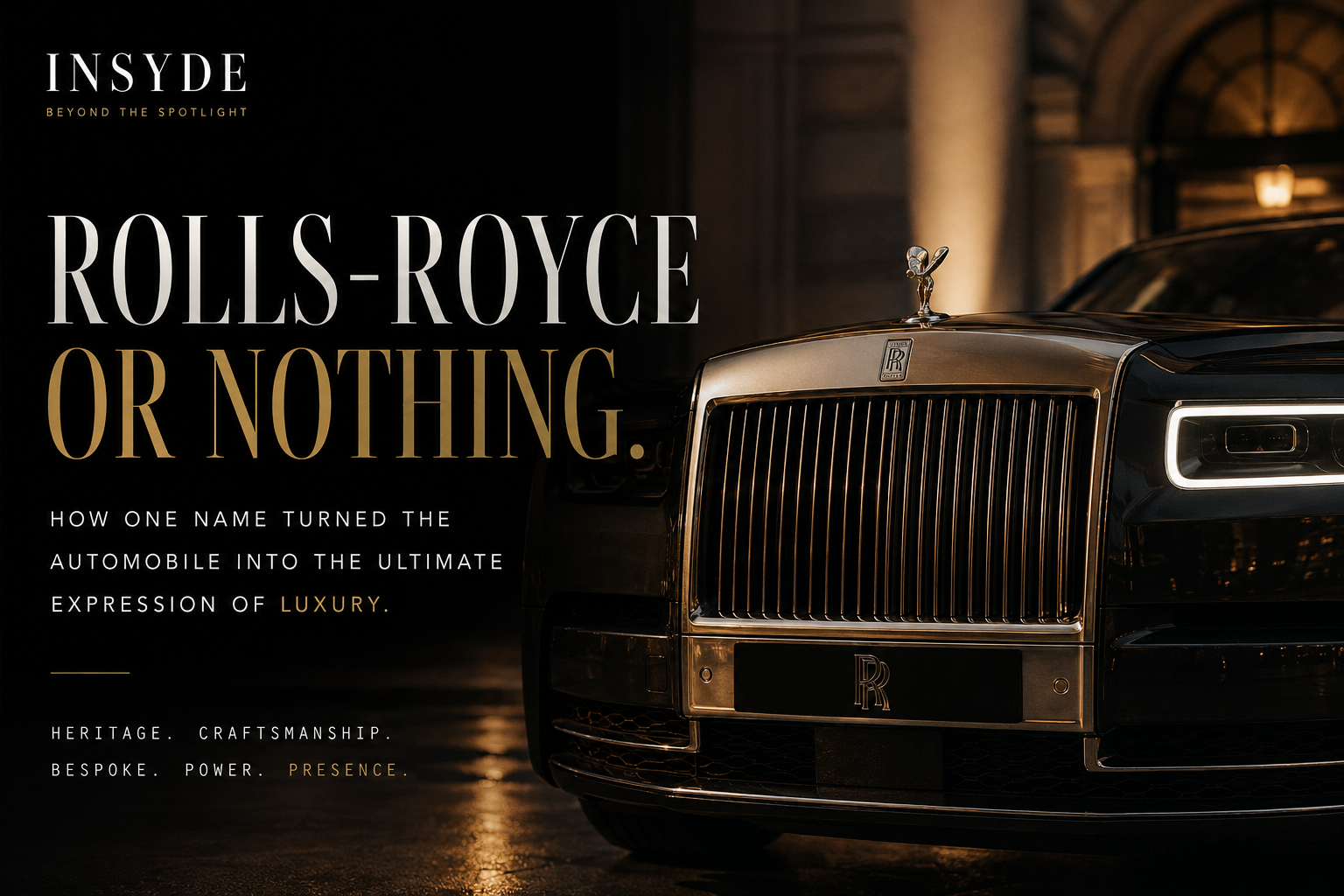
How one name turned the automobile into the ultimate expression of luxury.
There are expensive cars.
There are performance cars.
There are luxury cars.
And then there is Rolls-Royce.
For more than a century, the name has occupied a peculiar position at the very top of the automotive world. Not because it makes the fastest cars. Not because it produces the most cars. And certainly not because everyone needs one.
Rolls-Royce represents something far more difficult to manufacture:
the feeling that nothing else will do.
A Ferrari is about the thrill of driving.
A Bentley is about grand touring and craftsmanship.
A Mercedes-Benz can deliver extraordinary technology and comfort.
Rolls-Royce plays a different game.
It asks a much more luxurious question:
What if the journey itself became the destination?
That question sits at the heart of the marque.
Because the closer you look at Rolls-Royce, the less it resembles a conventional car company.
It begins to look like something else entirely:
a luxury house that happens to build automobiles.
THE IDEA THAT STARTED IT ALL
The story began in 1904.
Charles Rolls and Henry Royce met in Manchester and discovered a partnership built on two very different strengths: Rolls brought entrepreneurial ambition and a passion for motoring, while Royce brought an obsessive engineering mind and an uncompromising pursuit of quality.
Their ambition was audacious:
to build the best car they could.
The result would eventually become one of the most powerful names in luxury.
But the important part wasn’t simply engineering excellence.
It was the philosophy behind it.
Rolls-Royce was never interested in making an ordinary automobile and decorating it with expensive materials.
The ambition was to make the entire experience feel exceptional.
That distinction has survived for more than 120 years.
Technology changed.
Design changed.
Customers changed.
The world changed.
But the central idea remained:
nothing ordinary.
WHEN A CAR STOPPED BEING JUST A CAR
The earliest Rolls-Royce automobiles reveal something important about the company’s DNA.
Until 1949, Rolls-Royce supplied its cars as rolling chassis, with specialist coachbuilders creating the bodywork according to the customer’s wishes. In other words, the customer’s vision was part of the product from the beginning.
That tradition matters enormously when understanding modern Rolls-Royce.
Because today’s obsession with Bespoke isn’t some fashionable marketing invention.
It is a continuation of the brand’s original philosophy.
The idea was never simply:
“Here is our car.”
It was closer to:
“Here is the foundation. What would you like us to create?”
That is a very different relationship between manufacturer and customer.
And it is one of the reasons Rolls-Royce has always occupied such unusual territory.
LUXURY ISN’T THE PRICE
Anyone can make something expensive.
Luxury is harder.
A car can have beautiful leather, exotic wood, a powerful engine and an enormous price tag and still feel like an expensive product.
True luxury requires something more elusive:
intentionality.
Every surface needs to feel considered.
Every movement needs to feel effortless.
Every detail needs to feel like it belongs.
And most importantly, the experience needs to feel different from what came before.
That is where Rolls-Royce has built its reputation.
At Goodwood, where Rolls-Royce Motor Cars has made its home since the beginning of the modern era, craftsmanship and personalisation sit at the centre of the production philosophy. The company describes its motor cars as meticulously crafted and its Bespoke operation as a way for clients to realise highly individual visions.
The result is not simply a luxury specification.
It is a personal object.
THE ART OF BESPOKE
There is a moment when customisation becomes something more.
You choose a colour.
Then a material.
Then a finish.
Then an interior.
Then a detail nobody else has.
Eventually, you stop selecting options from a catalogue.
You start commissioning an idea.
That is the world Rolls-Royce has built around Bespoke.
Clients can work with designers, engineers and craftspeople to develop cars around highly personal ideas, from materials and colours to intricate artistic details.
And at the very top sits Coachbuild.
Rolls-Royce describes Coachbuild as the pinnacle of its Bespoke offering and the automotive equivalent of haute couture. It is an invitation-only process in which clients collaborate with designers, engineers and craftspeople to create entirely original motor cars.
The process can take years.
That is the point.
Luxury isn’t always about getting something quickly.
Sometimes luxury is having the freedom to say:
“Take your time. Make it mine.”
WHEN THE CUSTOMER BECOMES THE DESIGNER
This is where Rolls-Royce separates itself from the traditional idea of a luxury car.
Most manufacturers sell you a finished product.
Rolls-Royce increasingly sells you the opportunity to participate in its creation.
The client can bring a memory.
A place.
A piece of art.
A passion.
A family story.
An obsession.
The designers translate it.
The craftspeople execute it.
And eventually, something exists that did not exist before.
That changes the psychology of ownership.
You are no longer simply buying something rare.
You are helping create something rare.
And there is a profound difference.
Anyone can own an expensive object.
Far fewer people can say:
“This was made because I imagined it.”
THE SPIRIT OF ECSTASY
Then there is the figure above the grille.
The Spirit of Ecstasy.
Since 1911, Charles Sykes’ creation has served as one of the world’s most recognisable automotive emblems. Rolls-Royce describes the figure as a continuing symbol of ambition, achievement, excellence and freedom from conformity.
But her importance goes beyond recognition.
She gives the marque a visual philosophy.
She leans forward.
She moves into the wind.
She isn’t looking backward.
And for more than a century, she has become the tiny figure that tells the world exactly what is approaching.
There is something almost theatrical about that.
A Rolls-Royce doesn’t need to shout.
The emblem already speaks.
THE PHANTOM EFFECT
Few names in luxury carry the weight of Phantom.
The first Phantom arrived in 1925.
A century later, the name remains the pinnacle of the Rolls-Royce range. The company marked Phantom’s centenary in 2025 by reflecting on how generations of owners used Bespoke details to make their cars expressions of their own tastes, values and eras.
That history reveals something fascinating.
Phantom wasn’t merely a luxury car that survived for 100 years.
It became a canvas.
Different generations changed the way they wanted luxury to look.
Phantom changed with them.
But the underlying promise remained remarkably stable:
make it extraordinary, then make it personal.
SILENCE IS A LUXURY
There is another quality that defines the Rolls-Royce experience.
Silence.
Not the silence of emptiness.
The silence of distance from the outside world.
Traffic is still there.
The city is still moving.
People are still rushing.
But inside the cabin, the urgency feels further away.
And that represents something increasingly valuable in modern luxury.
For centuries, wealth was often expressed through accumulation:
More land.
More houses.
More possessions.
More staff.
More visibility.
Modern luxury can mean something very different.
More control.
Control over your surroundings.
Control over your time.
Control over your privacy.
Control over the experience.
A Rolls-Royce turns the cabin into something approaching a private room that happens to move.
And that may be more luxurious than another 100 horsepower ever could be.
THE CAR YOU DON’T HAVE TO DRIVE
There is a beautiful contradiction at the heart of Rolls-Royce.
The automobile was born from the desire for personal mobility.
Rolls-Royce perfected a version of luxury where the owner doesn’t necessarily need to care about driving at all.
The rear cabin becomes the destination.
The road becomes background.
The driver handles the journey.
The passenger gets the experience.
That is not an accident.
It is a different interpretation of automotive luxury.
Sports cars celebrate the person behind the wheel.
Rolls-Royce celebrates the person who has somewhere to be — and doesn’t need to concern themselves with how they get there.
Power isn’t always about controlling everything yourself.
Sometimes it is about having the freedom not to.
WHEN HERITAGE LEARNED TO BECOME REBELLIOUS
For decades, Rolls-Royce carried a very traditional image of wealth.
Formal.
Elegant.
Aristocratic.
Almost untouchable.
But the modern luxury customer changed.
A new generation wanted individuality.
More attitude.
More performance.
Less ceremony.
Rolls-Royce responded with Black Badge.
Introduced in 2016, Black Badge became a darker, more assertive expression of the marque’s character. Rolls-Royce itself describes it as a more rebellious and uncompromising interpretation of its products.
This was strategically important.
Because heritage is only valuable if you can make it feel relevant.
Rolls-Royce didn’t abandon its past.
It found another way to express it.
THE MOST EXCLUSIVE ROLLS-ROYCE MAY NOT EXIST YET
This is the idea that makes Coachbuild so fascinating.
The most extraordinary Rolls-Royce isn’t necessarily the one with the longest list of options.
It could be the one that didn’t exist until its owner imagined it.
Rolls-Royce’s modern Coachbuild commissions — including creations such as Boat Tail and Droptail — demonstrate just how far the brand can move beyond conventional automotive design when a client commissions something truly individual.
At that point, calling it a “car” begins to feel almost inadequate.
It becomes closer to a commissioned work of art.
And the customer becomes something closer to a patron.
That is an old idea.
But Rolls-Royce has managed to make it feel remarkably modern.
ROLLS-ROYCE DOESN’T PLAY THE SAME GAME
This may be the most important thing to understand about the brand.
Rolls-Royce isn’t simply trying to build a better luxury car than its competitors.
It isn’t defined by being faster than a Ferrari.
It isn’t defined by being sportier than a Bentley.
It isn’t defined by having more technology than a Mercedes-Benz.
Its competition is different.
Its competition is the customer’s imagination.
Once a buyer can ask for something that has never existed before, a specification sheet becomes almost irrelevant.
The question changes from:
“Which car has more?”
to:
“How far can we take this?”
That is where Rolls-Royce has created one of the strongest positions in luxury.
It doesn’t simply sell exclusivity.
It sells individuality at scale.
And that is an extraordinarily difficult thing to replicate.
THE NEW DEFINITION OF WEALTH
There was a time when luxury was easy to recognise.
The bigger house.
The faster car.
The larger yacht.
The more obvious diamond.
More expensive meant more luxurious.
But today’s most sophisticated luxury is increasingly about something else:
choice.
Choice over your time.
Choice over your environment.
Choice over your privacy.
Choice over your possessions.
And ultimately, choice over how those possessions are created.
That is the deeper appeal of Rolls-Royce.
Its greatest luxury isn’t the leather.
It isn’t the wood.
It isn’t the engine.
It isn’t even the badge.
It is the ability to make the object feel like yours.
ROLLS-ROYCE OR NOTHING.
So why does someone who can afford almost any car choose a Rolls-Royce?
Because eventually, the question stops being:
“What is the best car?”
It becomes:
“What represents me?”
A Rolls-Royce answers with craftsmanship.
With history.
With presence.
With privacy.
With individuality.
And with the extraordinary possibility of creating something that nobody else owns in quite the same way.
That is why the marque has survived changing technologies, generations and definitions of wealth.
It never needed to become the car for everyone.
It needed to remain the car for someone who had decided that ordinary was no longer enough.
THE ULTIMATE LUXURY ISN’T ATTENTION
Perhaps this is the most important lesson hidden inside the Rolls-Royce story.
Luxury can begin with attention.
Then it becomes recognition.
But at its highest level, luxury can become something much quieter:
indifference to recognition.
The colour nobody else has.
The material chosen for a reason only you understand.
The detail inspired by a private memory.
The rear seat where the outside world disappears.
The silence.
The time.
The privacy.
The freedom.
And suddenly, the most luxurious thing about a Rolls-Royce isn’t that everyone knows what it is.
It is that you don’t need everyone to understand why you chose it.
ROLLS-ROYCE OR NOTHING.
Rolls-Royce began with two men who wanted to build something exceptional.
More than a century later, the company has turned that ambition into something far larger than an automobile.
It has built a philosophy of luxury around a deceptively simple idea:
the world should not dictate what luxury means to you.
You decide.
The designers interpret it.
The craftspeople build it.
And the finished object becomes something personal enough to outlive the moment in which it was created.
That is why Rolls-Royce remains different.
Not because it is simply expensive.
Not because it is simply prestigious.
But because, at its most extraordinary, it refuses to feel mass-produced in a world built around mass production.
And perhaps that is the real meaning behind:
Rolls-Royce or nothing.
Not nothing else is expensive enough.
Not nothing else is impressive enough.
Something more interesting:
Nothing else feels quite like mine.
INSYDE — Beyond the Spotlight.