
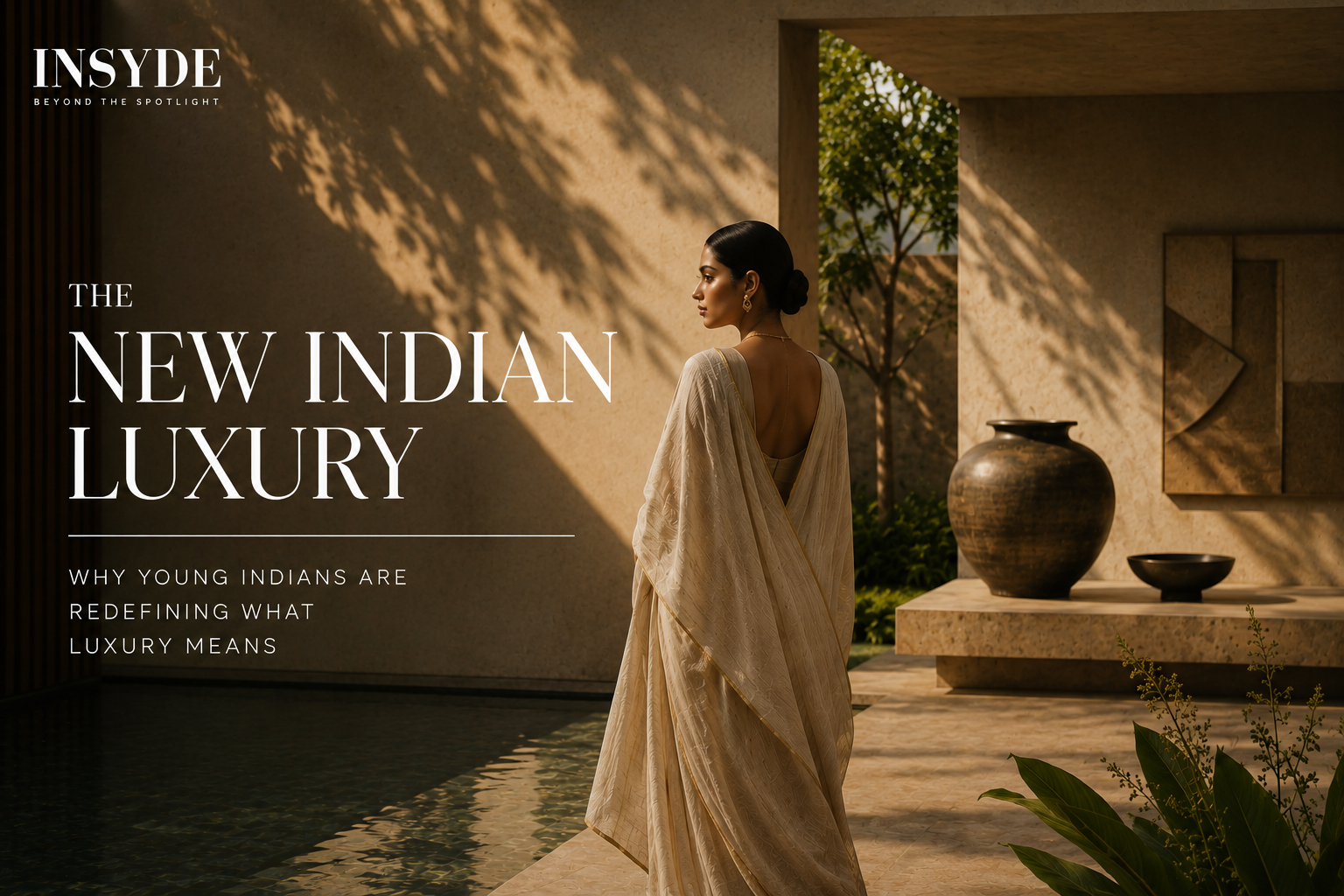
Luxury in India is entering a new chapter. For a generation raised on global access, digital discovery and changing ideas of success, the most desirable things are increasingly defined not by price alone, but by craftsmanship, identity, experience and meaning.
For a long time, luxury in India had a recognisable vocabulary.
Couture. Diamonds. Swiss watches. Imported automobiles. Grand homes. European fashion houses.
Luxury was visible. It announced itself.
But something is changing.
Walk through the creative districts of Bengaluru. Spend an evening in Mumbai. Look at the new design spaces emerging across Delhi. Follow the independent designers, architects, artists, watch collectors, restaurateurs and entrepreneurs shaping India’s cultural landscape.
The new luxury doesn’t always announce itself.
Sometimes, it whispers.
It might be a handwoven textile chosen for the story behind it. A vintage watch bought for its movement rather than its logo. A contemporary home where the architect, materials and light matter more than sheer size. A beautifully designed hotel. A dinner that takes three hours because nobody is in a hurry.
For a new generation of Indian consumers, the question is becoming less:
“How expensive is it?”
and more:
“Why does it matter?”
That shift is beginning to reshape what luxury means in India — and potentially, what India itself contributes to the global luxury conversation.
From Showing Wealth to Expressing Taste
Luxury has always been connected to status.
A recognisable name could communicate wealth without explanation. A particular handbag, watch, car or couture house carried a social language of its own.
That language still exists.
But younger consumers have grown up in a world where almost everything is visible.
A runway collection can be watched from anywhere. A new watch can be discovered on Instagram before it reaches a local boutique. A young designer can build an audience without belonging to an established fashion house. A restaurant can become a destination because of a single photograph.
When access to information becomes almost unlimited, simply knowing about something is no longer enough.
Taste becomes the differentiator.
Recent Deloitte research on India’s fashion market points to the same broader shift: consumers are becoming more deliberate about what they buy, with quality, craftsmanship, authenticity and experience playing a greater role alongside price. Deloitte found that close to 40% of surveyed consumers had tried new fashion brands in the previous year, while around 30% cited sensory and in-store experience as an influence on purchase decisions.
That doesn’t mean young Indians have stopped caring about established luxury houses.
They haven’t.
It means they are increasingly comfortable building their own definition of what belongs in a luxury wardrobe, home or lifestyle.
A global fashion house might sit beside an independent Indian label.
A vintage watch might sit beside a new smartwatch.
A handwoven textile might be paired with contemporary jewellery.
The choices don’t always follow one brand universe.
They follow a personal one.
Luxury is becoming less about displaying wealth and more about expressing taste.
India Is Starting to Write Its Own Luxury Language
For decades, much of the global vocabulary of luxury came from Europe.
Paris had couture.
Milan had fashion and design.
London had tailoring.
Switzerland became synonymous with watchmaking.
India possessed something different: extraordinary craft traditions that existed long before modern luxury marketing had a name for them.
Embroidery. Weaving. Jewellery. Metalwork. Leather. Wood. Stone. Textiles.
The question was never whether India had craftsmanship.
The question was how the world would value it.
That conversation is changing.
Indian designers are increasingly placing traditional techniques inside contemporary visual languages. Architects are reinterpreting local materials. Jewellery designers are bringing regional references into modern forms. Independent studios are turning craft into objects that feel current rather than nostalgic.
The important shift is not simply that Indian craft is becoming more expensive.
It is that Indian craft is increasingly being treated as contemporary design.
That distinction matters.
A handwoven textile doesn’t have to look traditional.
An ancient technique doesn’t have to remain frozen in time.
A material associated with heritage can become architectural.
And an Indian object doesn’t need to resemble something from Paris, Milan or London to communicate sophistication.
Indian luxury is becoming more comfortable looking Indian.
That is not a rejection of global luxury.
It is a sign of confidence within it.
The Independent Brand Becomes Desirable
There is a particular pleasure in discovering something before everyone else does.
That feeling has become increasingly valuable.
Across fashion, jewellery, furniture, fragrance, food and hospitality, independent brands can offer something that scale often struggles to reproduce: a visible point of view.
You can see the thinking behind the product.
You can understand the material.
You can discover the person who designed it.
You can trace the inspiration.
The product begins to feel less like a commodity and more like an object with authorship.
That matters in a world of mass production and algorithmically recommended products.
When millions of people can be shown the same thing, specificity becomes valuable.
The independent brand can say:
This is where we come from.
This is why we make it.
This is what we believe.
And when a consumer connects with that story, the relationship becomes more powerful than a transaction.
This is one reason premiumisation in India is becoming more nuanced. Consumers are not simply buying more; they are increasingly looking for reasons to justify paying more — whether through quality, durability, craftsmanship, authenticity or experience.
The future of premium consumption may therefore belong not only to the biggest names, but also to the brands with something distinctive to say.
The New Luxury Is Not the Same Everywhere
India doesn’t have one luxury consumer.
It has many.
Mumbai, Delhi and Bengaluru already demonstrate how differently aspiration can look within the same country.
Mumbai understands spectacle.
Fashion, cinema, hospitality, nightlife and celebrity culture have created an ecosystem where glamour remains a powerful cultural currency.
Delhi carries another kind of luxury language — one shaped by couture, jewellery, architecture, heritage and institutions with deep histories.
Then there is Bengaluru.
Its luxury language can feel quieter.
Technology, entrepreneurship, design, food, art and architecture overlap in ways that create a different kind of aspiration.
A beautifully designed home can matter more than a larger one.
The architect can matter as much as the address.
A restaurant can be valued for its atmosphere and design as much as its menu.
A fashion label can be interesting because of its philosophy rather than its fame.
This isn’t necessarily a rejection of traditional luxury.
It is another interpretation of it.
And that is important for INSYDE’s larger view of luxury: India is not one market with one taste. It is a collection of evolving cultures of aspiration.
When the Experience Becomes the Luxury
Perhaps the most significant shift is happening outside traditional luxury categories.
Luxury is moving into experience.
Travel.
Hospitality.
Food.
Art.
Architecture.
Wellness.
Sport.
Music.
Recent global luxury research reflects this broader movement. Deloitte’s 2026 Global Powers of Luxury report identifies customer experience and loyalty as major growth opportunities for luxury businesses, while travel and hospitality are among the categories executives see as having particularly strong potential.
The reason is simple.
A beautiful hotel isn’t simply a room.
A restaurant isn’t simply a meal.
A journey isn’t simply transportation.
The architecture, service, atmosphere, food, landscape, people and story become part of the value.
The luxury isn’t entirely contained within an object anymore.
It exists in the experience surrounding it.
For a generation that spends so much of its life online, physical experiences can feel particularly valuable because they cannot be fully reproduced on a screen.
You can look at a photograph of a hotel.
Being there is different.
Time Might Be the Ultimate Luxury
There is a contradiction at the centre of modern luxury.
Technology has made almost everything faster.
Shopping is instant.
Entertainment is immediate.
Communication is constant.
Trends move across continents in hours.
Yet many of the things we increasingly consider luxurious require the opposite.
Time.
A hand-embroidered garment takes time.
A mechanical watch demands extraordinary precision.
A piece of furniture made by a skilled craftsperson requires patience.
A painting takes time.
A carefully prepared meal takes time.
A building designed to last decades takes time.
Perhaps that is why craftsmanship feels so relevant in a digital age.
In a culture obsessed with speed, time has become a luxury material.
India has an extraordinary advantage here.
Its craft traditions aren’t inventions created for today’s luxury market. They are living systems of knowledge developed across generations.
The challenge is not simply to preserve them.
It is to let them evolve.
To give craft a future rather than turning it into a museum piece.
The Instagram Problem
Luxury has never been more visible.
A designer can be discovered through a single photograph.
A hotel can become desirable before someone has visited.
A restaurant can become famous because of its interiors.
A watch can become a collector’s obsession through a short video.
Social media has democratised discovery.
But it has also created a paradox.
If everyone can see it, can it still feel exclusive?
A hidden restaurant becomes a destination.
A niche designer becomes a trend.
A distinctive aesthetic becomes a template.
The luxury industry therefore faces a different question from the one it faced a generation ago:
How do you create desire in a world where almost nothing stays hidden?
The answer may not be greater secrecy.
It may be greater meaning.
Consumers can now research brands, compare products, discover makers and learn about materials before making a purchase. Deloitte’s recent work on Indian consumers also points to the growing influence of digital discovery, peer recommendations and creator-led commerce.
Visibility creates attention.
Meaning creates attachment.
The Luxury of Knowing
There is another form of luxury that rarely appears in advertising.
Knowledge.
Knowing why one textile is different from another.
Recognising the work of a particular watchmaker.
Understanding the craft behind a piece of jewellery.
Knowing why a chair is beautifully proportioned.
Being able to identify an artist before their work becomes widely known.
Luxury and culture begin to overlap here.
Taste is no longer simply about consumption.
It is about curiosity.
And India’s creative industries are becoming increasingly interconnected because of it.
Fashion speaks to art.
Art speaks to architecture.
Architecture speaks to hospitality.
Hospitality speaks to food.
Food speaks to design.
Design speaks to technology.
Sport speaks to fashion.
The boundaries are becoming softer.
The hotel becomes a gallery.
The chef works with a ceramicist.
The architect collaborates with a fashion designer.
The watchmaker becomes part of a wider cultural conversation.
Luxury becomes an ecosystem rather than a collection of products.
The New Consumer Wants a Reason
India’s premium and luxury opportunity is expanding, but that does not mean consumers are becoming careless about spending.
Deloitte’s 2026 consumer research describes Indian consumers as increasingly selective: discretionary spending is concentrating on quality and experiences while larger purchases are being approached more cautiously.
That distinction is important.
The next Indian luxury consumer may not simply ask:
“Can I afford it?”
They may also ask:
“Is it worth it?”
Worth can mean craftsmanship.
It can mean rarity.
It can mean heritage.
It can mean design.
It can mean sustainability.
It can mean emotional connection.
It can mean longevity.
It can even mean that the object becomes more interesting with age.
Luxury, then, begins to move from excess towards discernment.
And discernment is something that cannot be purchased instantly.
It has to be developed.
So, What Does Luxury Mean Now?
There is no universal answer.
For one person, it might still be couture.
For another, a vintage watch.
For someone else, a quiet home filled with objects they genuinely love.
It might be a private dinner.
A long journey.
A piece of jewellery made by hand.
A painting purchased directly from an artist.
A beautifully designed hotel.
A classic car driven on an empty road.
A tennis match watched from the right seat.
Or simply an afternoon without notifications.
That is what makes India’s luxury landscape so compelling.
It isn’t rejecting traditional luxury.
It is expanding the definition.
The logo still matters.
Price still matters.
Exclusivity still matters.
But increasingly, so do craftsmanship, culture, experience, identity and meaning.
India’s Luxury Story Is Only Beginning
India is no longer simply a market waiting for global luxury brands to arrive.
It is increasingly becoming one of the places where the future of luxury will be shaped.
Deloitte’s 2026 global luxury research places India among the markets executives identify as important engines of luxury growth, alongside China, Japan and the Middle East. At the same time, Deloitte’s India research points to a consumer base becoming more selective, digitally connected and interested in quality and experience.
But India’s opportunity is bigger than becoming another large market for international brands.
It is the opportunity to contribute something of its own.
A luxury object can carry Indian materials.
A modern home can reinterpret Indian architecture.
A fashion collection can use centuries-old craft without looking backwards.
A hotel can combine contemporary design with a powerful sense of place.
A watch collector can appreciate Swiss precision while developing an unmistakably Indian point of view.
The future of Indian luxury may therefore not be louder.
It may be more thoughtful.
More personal.
More rooted.
More difficult to copy.
Because the most valuable thing about luxury has never really been the price.
It has always been the feeling that what you have chosen means something.
And in the India emerging now, that meaning may become the ultimate luxury.
INSYDE — Inside modern luxury.