
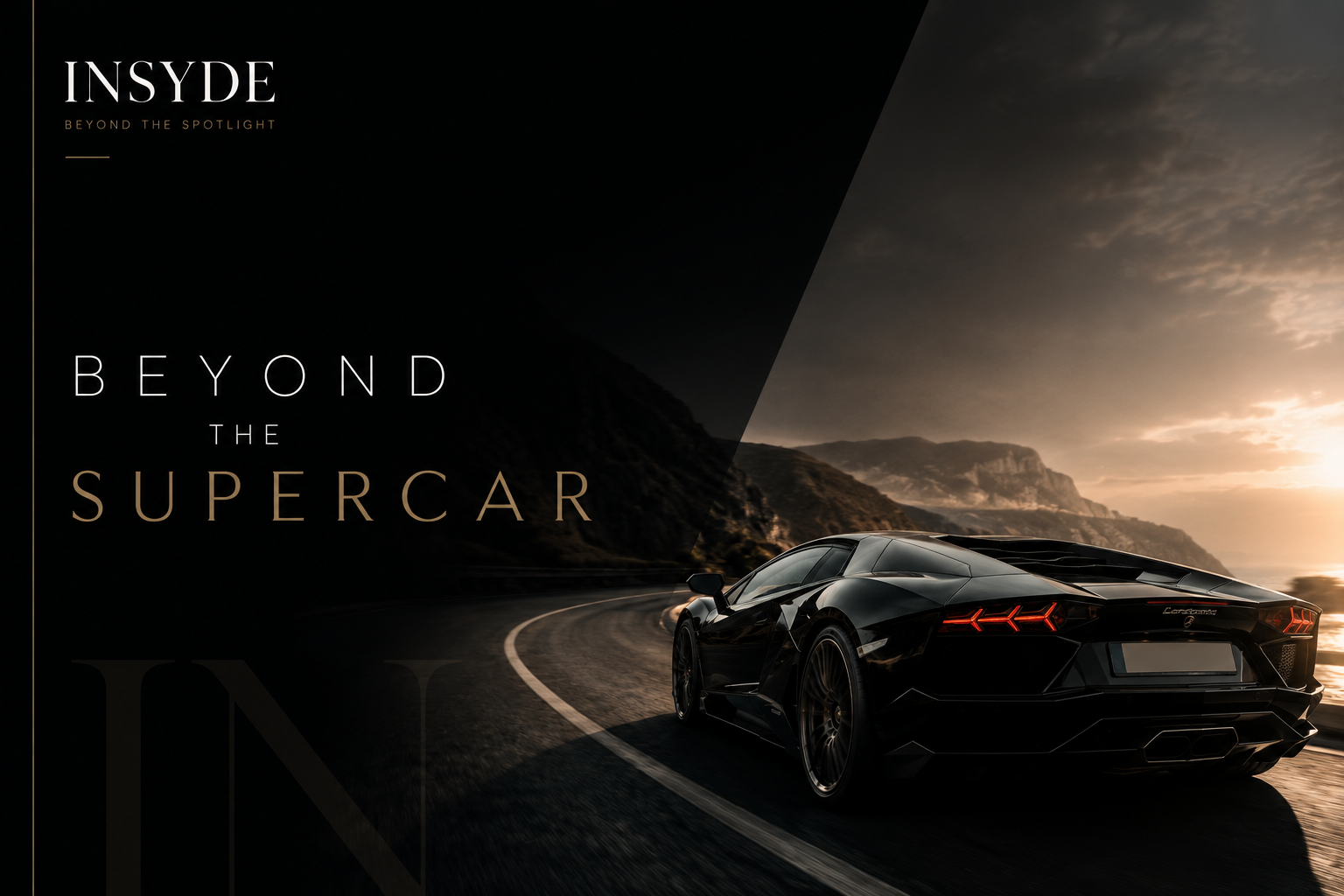
The new language of automotive luxury — where performance gives way to design, rarity, craftsmanship and identity.
There was a time when the most desirable car was simply the fastest one in the room.
More horsepower.
More cylinders.
A lower 0–100 time.
A higher top speed.
The numbers were easy to understand and even easier to compare.
But automotive luxury has become more sophisticated.
At the highest end of the market, speed is no longer the entire conversation. When extraordinary performance has become almost expected, the question changes.
What makes one extraordinary machine more desirable than another?
The answer increasingly lies beyond the stopwatch.
Design.
Provenance.
Craftsmanship.
Rarity.
Engineering.
Personalisation.
And, perhaps most importantly, the feeling that the car could not have been made for anyone else.
This is the territory beyond the supercar.
When Speed Stops Being Enough
The supercar was built around a beautifully simple proposition:
Go faster.
For decades, that proposition defined automotive desire.
Ferrari, Lamborghini, Porsche, McLaren, Aston Martin and others built their reputations around increasingly sophisticated interpretations of performance. Horsepower became mythology. Acceleration became conversation. Top speed became status.
But performance eventually reaches a curious point.
When a road car already produces astonishing power and acceleration, another fraction of a second becomes less meaningful to the person who actually owns it.
The conversation begins to move elsewhere.
Who designed it?
How was it engineered?
How rare is it?
What is its history?
What makes this particular example different?
Can it be made personal?
Those are collector’s questions.
And collector’s questions lead somewhere beyond performance.
The Automobile as a Cultural Object
The most desirable cars have never been valuable simply because they move quickly.
They represent something.
An era.
A designer.
A technological breakthrough.
A racing legacy.
A particular interpretation of beauty.
The cars that remain culturally important decades after their introduction are rarely remembered for horsepower alone.
They are remembered for proportion, engineering, character and story.
A great automobile can become a cultural object in the same way a great watch, piece of furniture or work of art can.
It becomes something to preserve.
To study.
To discuss.
To pass down.
Eventually, perhaps, to inherit.
That is when a car stops being merely a vehicle.
It becomes part of a collection of ideas.
The Collector’s Eye
The serious collector sees an automobile differently from the casual buyer.
The casual buyer asks whether a car is impressive.
The collector asks why it matters.
How many were made?
Who designed it?
What engine does it carry?
Where was it built?
Who owned it?
What competition history does it have?
Has it been preserved?
Has it been altered?
What makes this example different from the next?
These questions turn an automobile into an object of provenance.
And provenance is one of the most sophisticated currencies in luxury collecting.
A car with a meaningful history can become more desirable than a newer machine with superior technical specifications.
Because technology changes.
Story endures.
Bespoke Is the New Luxury
Perhaps the clearest sign of where automotive luxury is heading is the rise of personalisation.
At the ordinary end of the market, choosing a car means selecting from a catalogue.
At the highest end, the catalogue becomes a starting point.
Paint can be developed.
Materials can be selected.
Interiors can be commissioned.
Details can be altered.
The owner can become part of the design process itself.
This is automotive luxury approaching the philosophy of haute couture.
The objective is no longer simply to own something expensive.
It is to own something specific.
Something that reflects an individual taste rather than a market consensus.
That distinction is important.
A beautifully configured luxury car is impressive.
A bespoke automobile carries something more intimate:
authorship.
When the Garage Becomes a Gallery
As collections become more sophisticated, the garage itself changes.
It stops being somewhere cars are parked.
It becomes part of the architecture.
Private garages can be designed around lighting, proportions, materials, display and even the relationship between individual cars.
The automobile becomes an object within the room.
The room becomes part of the collection.
For a serious collector, this is not excessive.
It is logical.
If a car is appreciated as an object of design, why shouldn’t the space around it be designed with the same level of consideration?
The private garage becomes a gallery where the exhibits happen to have engines.
The New Obsession With Rarity
Scarcity has always been central to luxury.
But the most sophisticated form of rarity is not simply producing fewer examples.
It is creating something with a reason to be rare.
A limited production run means one thing.
A historically significant automobile means another.
A coachbuilt commission created around an individual owner means something else entirely.
The difference is between numerical scarcity and cultural significance.
The first can be manufactured.
The second has to be earned.
And that is why serious collectors often become less interested in price as their knowledge increases.
The more they understand, the more they look beyond the badge.
The Hypercar Changes the Conversation
The hypercar pushed the automobile into another territory.
These machines are not simply faster versions of supercars.
They bring together advanced materials, aerodynamics, computational engineering, motorsport technology and extraordinary design.
At their most ambitious, they begin to resemble engineering laboratories that happen to be road legal.
But even here, speed is only part of the fascination.
The engineering itself becomes desirable.
Carbon fibre.
Aerodynamic surfaces.
Powertrain architecture.
Weight reduction.
Thermal management.
The relationship between form and function.
For the sophisticated observer, understanding how a machine achieves what it does can be as fascinating as its performance.
The car becomes an engineering object.
The Beauty of the Machine
There is also something deeply emotional about automotive design.
A great car can communicate before its engine is started.
A silhouette.
A stance.
A proportion.
The relationship between its wheels and body.
A particular curve across a fender.
A cabin that feels more like a private room than a cockpit.
Design speaks first.
This is why certain cars remain desirable long after their performance figures become obsolete.
Technology has a release date.
Good design doesn’t.
A beautifully resolved automobile can outlive the technology that created it.
That is why some classics remain objects of fascination decades after their production ended.
The Electric Question
The automobile is now entering another defining transition.
Electrification is changing the relationship between driver and machine.
Instant torque can make acceleration effortless.
Power delivery can become almost silent.
Mechanical complexity can change dramatically.
But another question emerges.
What happens to the emotional theatre of the automobile?
For generations, part of driving’s appeal has been mechanical sensation.
Engine noise.
Gear changes.
Vibration.
Heat.
The feeling of machinery working beneath you.
As technology evolves, manufacturers face a difficult challenge:
How do you preserve emotion when the machine itself is changing?
The answer may increasingly come through design, materials, interaction and personalisation.
If the powertrain becomes quieter, the cabin can become more immersive.
If performance becomes easier to access, character becomes more important.
If mechanical theatre diminishes, craftsmanship and design may have to carry more of the emotional weight.
The future of automotive luxury may therefore depend less on making cars louder or faster and more on making them meaningful.
The Return of the Coachbuilder
One of the most fascinating developments at the highest end of automotive culture is the renewed appreciation for coachbuilding and ultra-low-volume commissions.
The concept is wonderfully old-fashioned.
Instead of choosing an automobile from a catalogue, an owner works with designers and craftsmen to create something highly individual.
It is the automotive equivalent of commissioning a bespoke suit, a piece of jewellery or a work of art.
And it represents something modern luxury increasingly values:
time.
A bespoke automobile requires consultation.
Design.
Materials.
Engineering.
Craftsmanship.
Iteration.
The process becomes part of the value.
The waiting becomes part of the experience.
And when the finished automobile finally arrives, it carries a story that belongs to its owner.
Beyond the Badge
Luxury cars have always carried powerful badges.
The horse.
The bull.
The shield.
The wing.
The names alone can communicate status.
But sophisticated automotive culture increasingly goes beyond the emblem.
Two cars from the same manufacturer can have completely different cultural significance.
One may simply be expensive.
Another may be historically important.
One may be fashionable.
Another may be genuinely rare.
One may be extremely fast.
Another may represent a defining moment in automotive design.
This is why serious collectors become more knowledgeable over time.
The more they learn, the less impressed they become by price alone.
Value becomes more interesting than cost.
The Car as Personal Language
At a certain point, an automobile becomes a form of personal language.
A restrained grand tourer communicates something different from an aggressive track-focused machine.
A collector of historic European sports cars communicates something different from someone commissioning a futuristic hypercar.
Neither is inherently superior.
The choice simply reveals something.
That is one of the oldest relationships between luxury and identity.
The object becomes a reflection of its owner.
Not because it is expensive.
Because it is chosen.
The New Definition of Automotive Luxury
Perhaps the biggest change is that automotive luxury is becoming less about what the car can do and more about what the car means.
Performance still matters.
Engineering still matters.
Speed still matters.
But they are no longer sufficient.
The modern luxury automobile increasingly needs something harder to quantify.
Character.
Rarity.
Craftsmanship.
History.
Beauty.
Personal meaning.
A sense of occasion.
And ideally, a story.
Because at the highest level, the question is no longer:
“How much does it cost?”
It becomes:
“Why does this particular car matter?”
That is a much harder question.
And a much more interesting one.
The Future Is Personal
The future of automotive luxury may not belong exclusively to the fastest machines.
It may belong to the most personal ones.
Cars commissioned around individual owners.
Collections built around particular eras.
Restorations that preserve history while introducing modern engineering.
Electric automobiles redefining what performance feels like.
Coachbuilt machines created almost as works of art.
Vehicles designed not simply to transport their owners, but to express them.
The industry will continue to chase numbers.
It will continue to pursue performance.
It will continue to find new ways to make cars faster, lighter and more technologically sophisticated.
But beyond those numbers lies another pursuit.
Meaning.
Beyond the Supercar
The supercar changed the automobile by making extraordinary performance desirable.
The hypercar pushed engineering further.
But what comes next may be less about going faster and more about going deeper.
Deeper into design.
Deeper into craftsmanship.
Deeper into history.
Deeper into personalisation.
Deeper into the relationship between an owner and a machine.
Because when speed becomes increasingly accessible, technology increasingly sophisticated and performance increasingly difficult to distinguish, the things that remain genuinely difficult to reproduce become more valuable.
A story.
A feeling.
A design.
A relationship with the machine.
A car made for one person rather than thousands.
That is the territory beyond the supercar.
Not simply the pursuit of more performance — but the pursuit of something worth remembering.
And perhaps that is where the automobile becomes something more than a machine.
It becomes a statement of taste.
INSYDE — Beyond the Spotlight.