
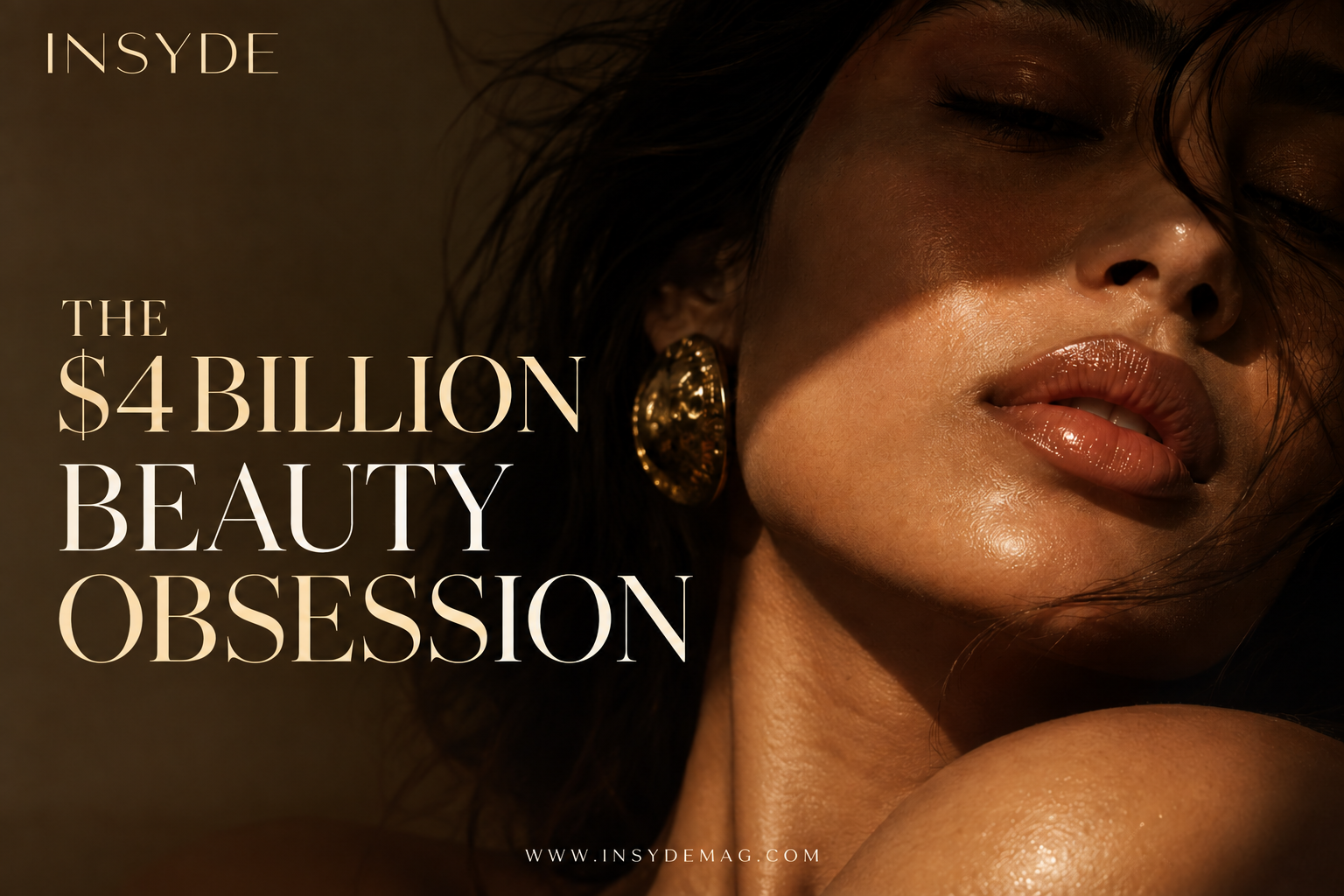
India is falling for luxury beauty. But as global houses chase the country’s next generation of consumers, the real question is whether they know what India actually wants.
India can now discover a Dior lipstick almost as quickly as Paris.
A new foundation can appear on an Indian beauty feed within hours of its global launch. A celebrity can turn a shade into a sell-out before the product has even reached every store. A consumer in Bengaluru can compare formulas, finishes and undertones with someone in London without ever leaving her phone.
Luxury beauty has never been this accessible in India.
But access is no longer the interesting part.
The more seductive question is whether luxury beauty actually understands the person buying it.
Because India’s beauty consumer is changing faster than the industry built to serve them.
And somewhere between the luxury counter, the Instagram Reel, the quick-commerce delivery and the bathroom mirror, a new beauty market is taking shape.
INDIA IS NO LONGER WAITING FOR LUXURY
For years, India’s luxury beauty story was fundamentally about availability.
Could you find the brand?
Could you find the right shade?
Could you buy it without travelling abroad?
Could you get the latest global launch before the next one arrived?
Those questions are becoming less important.
India’s luxury beauty market was already around $800 million in 2023, according to Reuters’ reporting on research from Kearney and LUXASIA, and the Kearney-LUXASIA study projects the market to reach $4 billion by 2035.
But there is an important distinction.
That $4 billion figure refers to luxury beauty as a whole, not makeup alone.
Within the category, color cosmetics represented 28% of luxury beauty in 2023 and are projected to reach 32% by 2028, with color cosmetics forecast to grow at a 24% CAGR between 2023 and 2028.
That makes makeup particularly interesting.
Because India isn’t simply buying more beauty.
It is becoming more deliberate about what beauty means.
And makeup sits directly at the intersection of beauty, fashion, identity and desire.
THE BEAUTY OF BEING SEEN
Luxury used to tell consumers what was desirable.
Today, consumers increasingly tell brands what matters.
The shift is particularly visible among younger Indian shoppers.
According to Ipsos’ Luxury Reimagined research, 70% of new e-luxury shoppers in India are under 35, while 76% of Indian Gen Z consumers are open to trying new brands, even in luxury.
That is a very different consumer from the traditional luxury buyer.
For younger shoppers, luxury makeup is not necessarily about possessing a status symbol.
It can be about identity.
A lipstick can complete an outfit.
A fragrance can become associated with a relationship.
A blush can define the look of an entire generation on Instagram.
A compact can become an object of desire before anyone has even used it.
Beauty is no longer sitting neatly inside the beauty category.
It is crossing into fashion, entertainment, culture and self-expression.
And that is exactly why India is becoming such an important luxury market.
BUT INDIA IS NOT ONE SHADE
Here is where the fantasy of a single global luxury consumer begins to fall apart.
India is not one complexion.
Not one undertone.
Not one climate.
Not one beauty ritual.
Not even one definition of what a beautiful finish looks like.
A foundation developed around one market’s expectations can behave differently in India’s humidity. A complexion range created without enough brown, neutral or warm undertones can leave consumers searching for a match that simply isn’t there.
The Kearney-LUXASIA research identifies India’s geographical and ethnic diversity as a significant consideration for beauty brands, recommending region- and city-specific strategies and greater adaptation to India’s complexions, climate and consumer preferences.
That is the difference between selling in India and designing for India.
The first requires distribution.
The second requires understanding.
And luxury has always claimed that understanding the customer is part of the experience.
THE INDIAN FACE HAS BECOME A GLOBAL IMAGE
There is another shift happening quietly.
Indian beauty is no longer simply consuming global aesthetics.
It is increasingly influencing them.
Indian celebrities, creators, makeup artists and fashion personalities are appearing inside global campaigns and conversations. Indian weddings generate enormous beauty demand. Indian skin tones are becoming more visible in global beauty imagery. And social platforms have removed much of the distance between an international launch and an Indian consumer.
But representation is only the beginning.
There is a temptation for global brands to treat localisation as casting.
Put an Indian model in the campaign.
Launch the same product.
Change the creative.
Call it local.
Consumers are becoming sophisticated enough to see through that.
Representation can make a brand visible in India. Relevance makes it stay.
THE STRANGEST NUMBER IN INDIAN LUXURY BEAUTY
Perhaps the most revealing statistic isn’t the size of the opportunity.
It is who currently owns it.
Kearney-LUXASIA estimates that international brands account for roughly 93% of India’s luxury beauty market, leaving local brands with approximately 7%. The same research contrasts this with mature Asian markets such as Japan and South Korea, where local brands can represent a significantly larger share of luxury beauty.
That raises a much more interesting question than How big can India’s luxury beauty market become?
Why hasn’t India built more global luxury beauty brands of its own?
India has centuries of beauty rituals.
Ayurveda.
Fragrance.
Natural ingredients.
Jewellery.
Colour.
Craft.
Ceremony.
And an extraordinary cultural relationship with appearance.
Yet when consumers think of luxury makeup, the most recognisable names are still largely European or American.
That isn’t necessarily a failure.
It could be the biggest opportunity sitting inside the market.
THE NEXT LUXURY BEAUTY HOUSE COULD COME FROM INDIA
Imagine an Indian beauty house that doesn’t attempt to make itself look European.
A brand that understands Indian skin without turning “Indian skin” into a marketing gimmick.
A house built around India’s relationship with colour.
Its climates.
Its rituals.
Its weddings.
Its nightlife.
Its cinema.
Its jewellery.
Its architecture.
Its contradictions.
A brand that could sell a product in Mumbai and Paris without having to explain why it came from India.
That would be a different kind of luxury.
Not Indian luxury for Indians.
Indian luxury for the world.
And that distinction matters.
Because the greatest luxury brands don’t simply sell products from their home countries.
They export a worldview.
THE METRO IS NO LONGER THE WHOLE STORY
The next consumer isn’t necessarily standing in a luxury mall in Mumbai.
India’s beauty growth is spreading outward.
The Nykaa Beauty Trends Report 2024 found that approximately 55% of sales from the top nine prestige beauty brands on Nykaa came from non-metro markets.
That changes the geography of luxury.
The consumer in Jaipur doesn’t necessarily need to become a consumer in Mumbai.
The consumer in Chandigarh doesn’t need to behave like someone in Delhi.
The consumer in Kochi doesn’t need to have the same beauty routine as someone in Bengaluru.
Digital access is allowing these markets to develop their own relationship with beauty.
And luxury brands will have to learn how to listen to them individually.
THE COUNTER IS DEAD. LONG LIVE THE COUNTER.
Not literally.
But the role of the luxury beauty counter is changing.
For decades, the counter was where discovery happened.
Today discovery can happen anywhere.
Instagram.
YouTube.
TikTok.
A creator’s GRWM.
A celebrity interview.
A beauty community.
A search bar.
A friend sending a screenshot.
The physical store now has to offer something digital cannot.
Confidence.
The ability to touch the product.
Test the shade.
Understand the texture.
Ask someone who actually knows the difference.
Experience the fragrance.
Feel the weight of the packaging.
And perhaps most importantly, feel that the brand has made an effort to understand you.
Kearney-LUXASIA estimates that approximately 70% of India’s luxury beauty market remains offline, with online accounting for around 30%. E-commerce, however, is projected to be one of the category’s fastest-growing channels.
The future therefore isn’t online versus offline.
It is online into offline and back again.
A Reel creates desire.
A store creates confidence.
A purchase creates data.
The next Reel creates another desire.
Luxury beauty is becoming an ecosystem.
AND THEN INDIA MADE LUXURY FAST
There is something almost contradictory about luxury beauty in India right now.
Luxury traditionally asks you to wait.
India increasingly expects everything immediately.
Quick commerce has trained consumers to think in minutes rather than days. Premium beauty is increasingly participating in that ecosystem.
That doesn’t necessarily make luxury less luxurious.
It may actually reveal something important about what modern luxury means.
Luxury used to mean having more.
Now it increasingly means having control.
Control over your time.
Your access.
Your experience.
Your choices.
If a consumer discovers a product at 10:00 a.m. and wants it at 10:30, the ability to fulfil that desire can itself become part of the luxury proposition.
The contradiction is beautiful:
The future of luxury beauty may be both slower and faster.
Slower in the experience.
Faster in the access.
WHAT BRANDS STILL GET WRONG
The biggest mistake would be to look at India’s growth numbers and assume the job is done.
It isn’t.
A bigger market does not automatically create a stronger luxury proposition.
The brands that want to win here will have to think beyond campaigns.
They will need better shade architecture.
Better climate understanding.
Better inventory planning.
Better replenishment.
Better beauty advisors.
Better city-specific strategies.
Better digital discovery.
And perhaps most importantly, better cultural intelligence.
The Kearney-LUXASIA report identifies product, marketing, and partnership/distribution as three central pillars for brands seeking to unlock India’s luxury beauty opportunity.
But beneath all three is the same requirement:
Listen before you localise.
INDIA DOESN’T NEED ANOTHER LUXURY LOGO
This is perhaps the most exciting part of the story.
India’s luxury beauty opportunity isn’t interesting because another European beauty house is opening another counter.
It is interesting because the entire relationship between luxury and the Indian consumer is being rewritten.
The consumer is younger.
The access is wider.
The discovery is digital.
The cities are multiplying.
The appetite is growing.
And the definition of luxury itself is becoming more personal.
The question is no longer:
Will Indians buy luxury beauty?
They already are.
The question is:
What will they demand from it next?
Perhaps better representation.
Perhaps better products.
Perhaps more meaningful experiences.
Perhaps brands that understand the difference between adapting to India and simply entering India.
And perhaps, eventually, an Indian beauty house capable of making the rest of the world look East for its next idea.
Because India’s luxury beauty story is no longer about catching up with Paris, Milan, London or New York.
It may be about giving the world something those cities don’t have.
A different way of seeing beauty.
A different way of experiencing luxury.
A different face of desire.
And that face is increasingly Indian.
INSYDE TAKE
The first phase of India’s luxury beauty boom was about access.
The second is about relevance.
The third could be about creation.
Global beauty houses are arriving because the opportunity is impossible to ignore. But the real winners won’t be defined by how quickly they can put a luxury logo in front of an Indian consumer.
They will be defined by how deeply they understand the person behind the purchase.
And somewhere in that gap between global luxury and Indian identity, there is room for an entirely new beauty story.
The next great luxury beauty house might not be discovering India.
It might be coming from it.
Beyond the Spotlight.