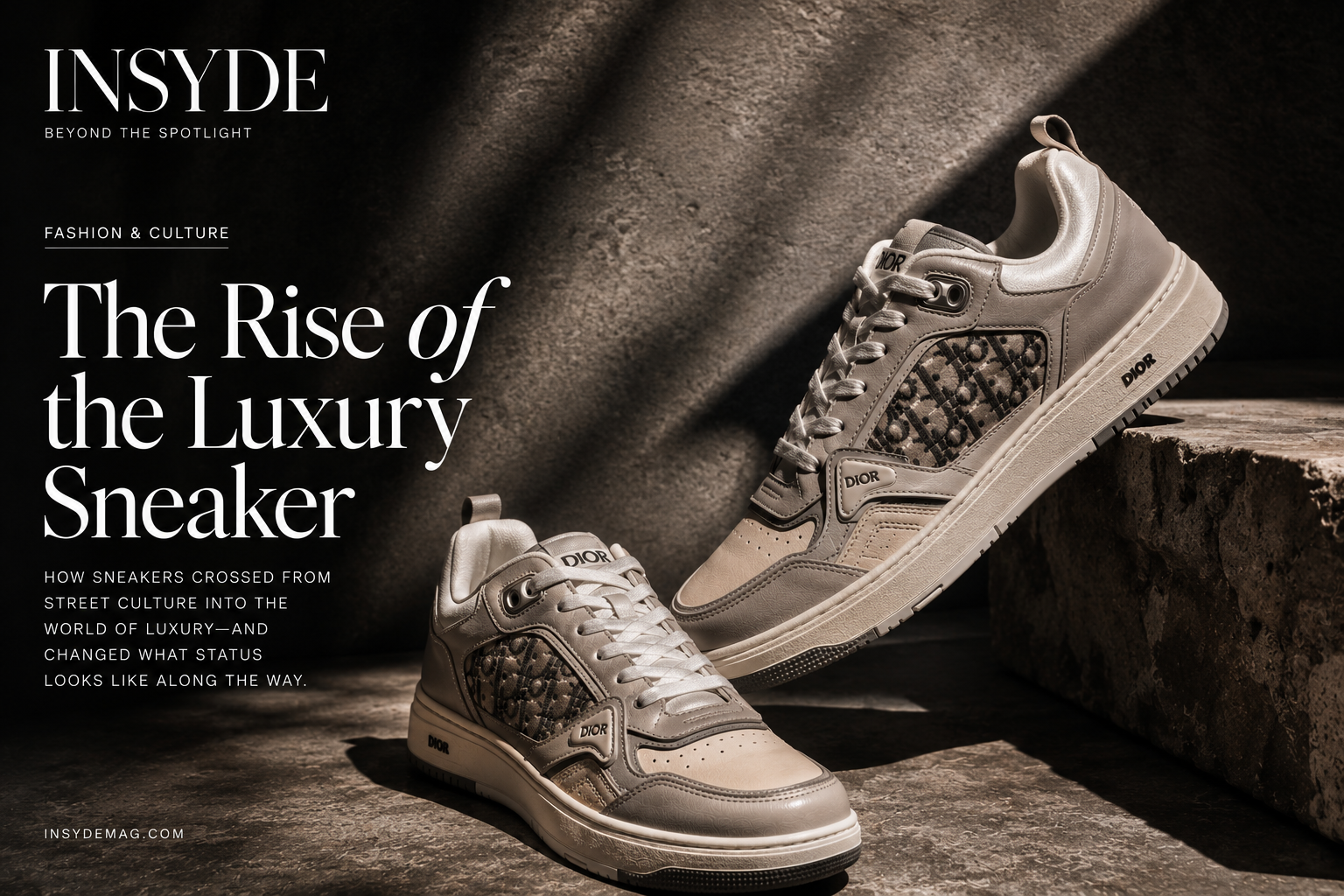
How sneakers crossed from street culture into the world of luxury — and changed what status looks like along the way.
There was a time when luxury had a dress code.
A tailored jacket. A fine watch. Polished leather. A recognisable handbag. Objects whose value was understood almost immediately.
Then came the sneaker.
Casual. Familiar. Democratic. Designed for movement rather than ceremony.
And somehow, it became one of fashion’s most powerful expressions of status.
That transformation is more interesting than the sneaker’s price tag.
Because the luxury sneaker did not become important simply because fashion houses decided to make expensive shoes. It became important because culture changed what people wanted luxury to mean.
The sneaker brought together sport, music, youth culture, fashion and design. Luxury gave it craftsmanship, scarcity and prestige.
The result was something neither world could have created alone.
A new language of luxury.
The Object That Wasn’t Supposed to Be Luxury
The sneaker was never designed to communicate wealth.
Its original purpose was practical: movement, comfort and performance.
But practicality gave it something luxury could not manufacture.
Cultural credibility.
Sneakers were worn on basketball courts, running tracks, city streets and stages. They became intertwined with music, particularly hip-hop, and with the rise of streetwear.
The sneaker began appearing everywhere culture was being created.
And that changed its meaning.
It was no longer simply footwear.
A particular pair could communicate what music you listened to, which athletes you admired, what subculture you belonged to or how closely you followed fashion.
The sneaker became an identity marker.
Luxury eventually noticed.
When the Street Met the Maison
For decades, high fashion and street culture occupied very different territories.
One represented heritage, craftsmanship and exclusivity.
The other represented youth, rebellion and cultural immediacy.
Then the boundary began to disappear.
Luxury houses started incorporating sneakers into their collections, while streetwear gained increasing influence over the wider fashion industry.
The meeting was inevitable.
But it wasn’t simply luxury moving downward.
It was luxury learning from the street.
The sneaker offered fashion something extremely valuable: relevance.
It was already connected to communities, music, sport and youth culture.
Luxury could provide materials and craftsmanship.
The street provided cultural energy.
Together, they created a new category.
The Collaboration Changed the Rules
Few developments accelerated the sneaker’s transformation more than the collaboration.
When a sneaker became the meeting point between an athlete, musician, artist, designer or fashion house, it became more than a product.
It became a cultural event.
Suddenly, the story surrounding the shoe could matter as much as the shoe itself.
Who designed it?
Who wore it?
Why was it created?
How many were produced?
When was it released?
And, perhaps most importantly:
Could everyone get one?
Scarcity introduced a new kind of desire.
The sneaker began behaving less like ordinary footwear and more like a collectible.
That was a significant moment.
Because luxury has always understood that desire grows when access becomes selective.
Scarcity Became a Status Symbol
Luxury has never been purely about price.
It is about access.
The rare watch.
The difficult-to-book restaurant.
The limited edition automobile.
The handbag that isn’t simply waiting on a shelf.
Sneakers adopted the same psychology.
Limited releases created urgency.
Exclusive collaborations created communities.
Rare editions developed their own markets.
But there is an important distinction.
Scarcity alone does not create value.
There must be a reason to care.
The most desirable sneakers usually combine rarity with cultural significance.
They represent an athlete.
A designer.
A collaboration.
A particular era.
A moment that mattered.
The shoe becomes valuable because it carries a story.
When the Sneaker Became Collectible
This is where sneaker culture began moving closer to traditional luxury collecting.
Collectors stopped looking only at whether a shoe looked good.
They began considering provenance.
Condition.
Originality.
Production history.
Collaboration.
Cultural relevance.
A rare sneaker can become interesting in much the same way as a vintage watch or classic automobile.
Not because it is necessary.
Precisely because it isn’t.
The object exists beyond function.
It becomes something to preserve, study and appreciate.
That is one of luxury’s oldest ideas.
And sneakers have adopted it remarkably well.
The Luxury of Craft
There is another reason luxury sneakers command attention: craftsmanship.
Once high fashion began taking the category seriously, the sneaker became a canvas for experimentation.
Leather.
Suede.
Technical textiles.
Metal hardware.
Specialised construction.
Unexpected proportions.
Complex soles.
Hand-finishing.
Details that might once have been invisible became part of the conversation.
The sneaker could now be examined rather than simply worn.
And that changed the perception of the object.
It didn’t have to stop being comfortable to become luxurious.
It could be both.
Function and craftsmanship could coexist.
That combination is central to modern luxury.
The End of the Formal Luxury Uniform
Perhaps the sneaker’s greatest cultural victory is that it helped make luxury less formal.
The modern luxury wardrobe doesn’t necessarily require a polished leather shoe.
A tailored trouser can meet a minimalist sneaker.
A fine watch can sit above a relaxed silhouette.
A luxury jacket can be paired with something deliberately casual.
The contrast isn’t accidental.
It is part of the language.
Today’s sophisticated consumer often has less interest in proving that something is expensive.
They are more interested in demonstrating that they know what works.
That is a profound change.
Luxury becomes less about dressing according to a rulebook and more about knowing when to break one.
The New Status Symbol Doesn’t Always Shout
For decades, luxury was designed to be recognised.
Logos were visible.
Signatures were obvious.
The product announced itself.
The sneaker introduced another possibility.
Recognition could become selective.
Someone who doesn’t follow fashion might see an ordinary pair of shoes.
Someone who does might immediately recognise the silhouette, collaboration or material.
That creates a subtle form of status.
Not:
“Everyone should know what I’m wearing.”
But:
“The people who understand it will know.”
That distinction has become increasingly important in contemporary luxury.
The audience for the signal has become smaller.
The meaning of the signal has become deeper.
From Logo to Language
The most interesting luxury sneakers aren’t necessarily the loudest.
They can be minimal.
Almost anonymous.
Their luxury might exist in the leather, construction, proportion or silhouette rather than a giant logo.
That reflects a broader evolution in fashion.
The conversation is moving from visibility to discernment.
The question isn’t simply whether something looks expensive.
It is whether it looks considered.
A sneaker can now communicate taste without demanding attention.
And that may be one of the reasons the category has become so powerful.
It fits the psychology of a consumer who already knows what luxury looks like.
They don’t need to announce it.
The New Luxury Consumer
The rise of the luxury sneaker also reflects a generational change.
Younger consumers have never experienced fashion as a series of isolated categories.
Music influences fashion.
Sport influences fashion.
Streetwear influences luxury.
Luxury influences streetwear.
Film, gaming, art and social media all participate in the same cultural conversation.
For this audience, a sneaker does not need permission to belong in a luxury wardrobe.
It already belongs.
The old hierarchy has weakened.
A rare sneaker can sit beside a mechanical watch.
A vintage piece can sit beside a new luxury garment.
A streetwear collaboration can become as culturally significant as a traditional fashion collection.
Luxury is no longer a closed room.
It has become a conversation.
What Makes a Sneaker Luxury?
The obvious answer is price.
But price is only one ingredient.
True luxury requires something more difficult to manufacture.
Desire.
A sneaker becomes luxurious when people want it for reasons beyond its practical purpose.
Craftsmanship can create desire.
Scarcity can create desire.
Design can create desire.
History can create desire.
Cultural relevance can create desire.
And the strongest products combine several of them.
That is why a very expensive sneaker can feel completely unremarkable, while a much simpler pair can become iconic.
Luxury is not the number on the receipt.
It is the meaning attached to the object.
The Sneaker and the Collector’s Mind
The luxury world has always been fascinated by objects that don’t need to exist.
Collectors buy watches even when their phones tell time more accurately.
They collect automobiles they cannot drive every day.
They acquire art they may rarely display.
The value lies somewhere beyond utility.
Sneakers now occupy that same territory.
A collector can own dozens of pairs without needing another pair of shoes.
The purchase is no longer about necessity.
It is about appreciation.
Memory.
Identity.
Curation.
The collection becomes a portrait of the collector.
And perhaps that is the final transformation of the sneaker:
from something you wear to something that represents what you value.
The Luxury Sneaker Is Here to Stay
The sneaker’s rise tells us something larger about luxury.
The definition of status has changed.
For one generation, luxury meant formality.
For another, it meant recognisable logos.
Today, luxury increasingly means choice.
Knowing what to buy.
Knowing what not to buy.
Understanding craftsmanship.
Recognising cultural significance.
Being able to move between worlds without looking as though you’re trying too hard.
The sneaker fits perfectly into that new definition.
It can be casual without being careless.
Expensive without being obvious.
Rare without being theatrical.
Cultural without losing craftsmanship.
That is an extraordinary amount of territory for one object to occupy.
The Rise of the Luxury Sneaker
The sneaker didn’t become luxurious simply because luxury fashion decided to put its name on it.
Its transformation happened much earlier.
Culture made it desirable.
Sport made it iconic.
Music gave it attitude.
Streetwear gave it identity.
Fashion gave it craftsmanship.
Scarcity gave it collectability.
And consumers gave it something even more powerful:
meaning.
That is why the luxury sneaker represents more than another category for fashion houses.
It represents the changing definition of status itself.
The old luxury question was:
“How much does it cost?”
The newer question is:
“Why does it matter?”
And perhaps that is the most modern luxury of all.
To own something not because everyone wants it—
but because you understand why you do.
INSYDE — Beyond the Spotlight.