Category: Luxury

An inside look at the world of luxury — fashion houses, jewellery, craftsmanship, hospitality, interiors, experiences and the evolving meaning of luxury in India.

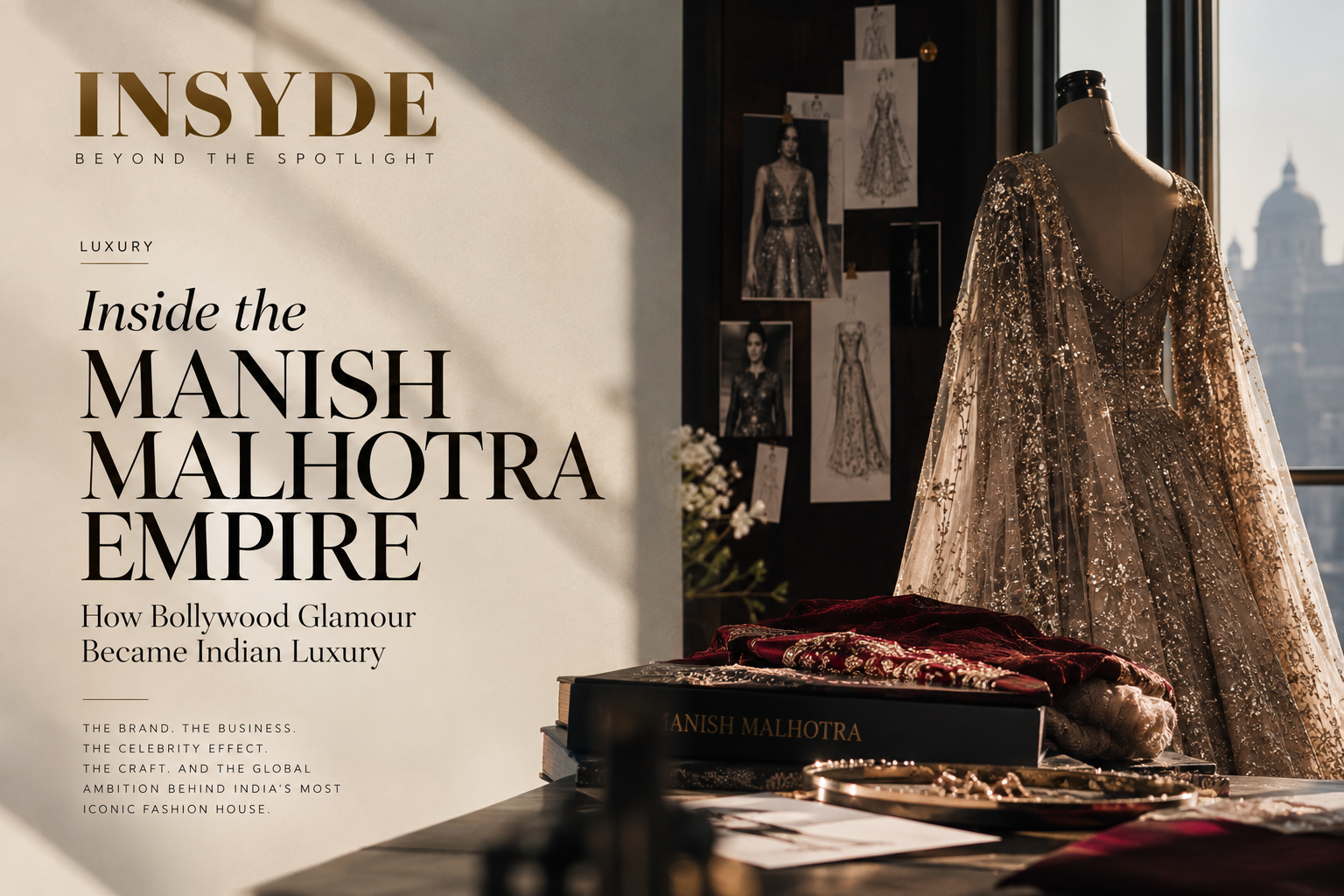
  • Insyde the Manish Malhotra Empire: How Bollywood Glamour Became Indian Luxury

    Insyde the Manish Malhotra Empire: How Bollywood Glamour Became Indian Luxury

    What began with costumes for Bollywood became something much larger: a luxury house built around celebrity, craftsmanship, aspiration and the idea that Indian fashion can belong on the world’s biggest stages.

    Luxury has always been about more than what you wear.

    It is about what a name makes you feel.

    For some houses, that feeling has been built through centuries of European heritage. For others, it comes from a particular designer, a particular silhouette or a particular way of seeing the world.

    In India, few names have created that feeling as consistently as Manish Malhotra.

    For decades, his name has been attached to Bollywood glamour: sequins under studio lights, elaborate wedding lehengas, celebrities on red carpets and couture that seems designed for moments larger than everyday life.

    But there is another Manish Malhotra story hiding underneath the glamour.

    It is a business story.

    The story of how a costume designer became a fashion label, how a label became a luxury house, and how that house is now trying to move from being India’s most recognisable designer name to becoming a global Indian luxury brand.

    That distinction matters.

    Because designing beautiful clothes is one thing.

    Building a luxury house is something else entirely.

    The House Behind the Name

    The House of Manish Malhotra was founded in 2005, after the designer had already spent more than a decade transforming costume design in Indian cinema. Today, the House spans couture, bridal, menswear, ready-to-wear, high jewellery, beauty and film production.

    That expansion didn’t happen because fashion suddenly became a business opportunity.

    It happened because Malhotra had already built something extraordinarily valuable before the fashion house fully existed:

    recognition.

    People knew the name.

    They knew the aesthetic.

    They knew the celebrities.

    They knew the glamour.

    And they knew what it meant when a star stepped out in Manish Malhotra.

    That kind of cultural recognition cannot simply be bought.

    It has to be accumulated.

    Year after year.

    Film after film.

    Collection after collection.

    Wedding after wedding.

    The House was therefore not starting from zero.

    It was turning cultural influence into commercial architecture.

    Bollywood Was the Original Luxury Engine

    Before social media, before influencer marketing, before celebrity collaborations became standard fashion strategy, Bollywood was already doing something remarkably powerful.

    It was selling aspiration.

    Millions of people watched actors on screen and wanted pieces of that world: the clothes, the jewellery, the homes, the parties, the romance, the glamour.

    Malhotra understood this unusually well because he was working inside the machine creating those images.

    His costume designs didn’t simply dress characters.

    They helped define them.

    That gave him an advantage that a conventional fashion label could never easily replicate.

    He understood how clothes behave on camera.

    How colour works under lighting.

    How a silhouette changes the perception of a character.

    How one outfit can become associated with an entire film.

    And eventually, how a designer’s name can become part of the fantasy.

    That is one reason his move into fashion was so powerful.

    He wasn’t introducing a new name to Bollywood.

    He was taking a name Bollywood had already helped make famous and turning it into a brand.

    When Visibility Became Value

    Luxury traditionally depends on scarcity.

    But Malhotra built his brand through something that might appear contradictory:

    visibility.

    His clothes were everywhere.

    On movie stars.

    At weddings.

    At award ceremonies.

    In magazines.

    On runways.

    On social media.

    That visibility did not necessarily make the brand less luxurious.

    Instead, it created desire.

    The public could see the world.

    But only a small number of people could actually enter it.

    That is the basic psychology of aspiration.

    And Malhotra understood it long before the language of personal branding and influencer culture became part of fashion strategy.

    The celebrity was not simply wearing the product.

    The celebrity was helping create the product’s meaning.

    A Manish Malhotra lehenga became more than fabric and embroidery.

    It became a piece of the world associated with the people wearing it.

    The Power of the Indian Wedding

    There may be no better environment for luxury than an Indian wedding.

    Weddings are emotional.

    They are highly visual.

    They involve multiple generations.

    They bring together fashion, jewellery, beauty, photography, music and ceremony.

    And they often represent one of the largest discretionary fashion purchases a family will make.

    Malhotra’s aesthetic fits naturally into this world.

    His couture is dramatic enough for the occasion, detailed enough to reward close attention and recognisable enough to photograph beautifully.

    But there is something deeper happening here.

    A wedding outfit is not simply a fashion purchase.

    It becomes part of memory.

    The lehenga becomes the photograph.

    The photograph becomes the family archive.

    The garment becomes part of the story.

    For a luxury house, that emotional connection is enormously valuable.

    It means the brand isn’t simply selling clothing.

    It is participating in people’s most important moments.

    Craftsmanship as the Luxury Proposition

    There is another foundation underneath the glamour:

    craft.

    The House describes Indian craftsmanship as central to its identity, with embroidery, weaving and handcraft traditions continuously reinterpreted through a contemporary luxury vocabulary.

    This is important because Indian craftsmanship has historically occupied an unusual position in global fashion.

    The world has wanted the embroidery.

    It has wanted the textiles.

    It has wanted the handwork.

    But the names of the designers and houses presenting that craft have often mattered more than the names of the artisans producing it.

    The luxury conversation is beginning to change.

    Indian designers are increasingly presenting craftsmanship as part of an authored luxury proposition rather than simply as a source of decorative technique.

    Malhotra’s model is built around that idea.

    The embroidery isn’t background.

    It is part of the identity.

    The handwork isn’t simply an embellishment.

    It is part of the value.

    The Indian-ness isn’t something to hide.

    It is part of the luxury proposition.

    From Couture to an Ecosystem

    A fashion label can survive on clothing.

    A luxury house needs more.

    The Manish Malhotra universe has steadily expanded into categories that allow the customer to interact with the brand in different ways.

    Beauty arrived in 2018.

    High jewellery expanded from 2019 and formally launched as Manish Malhotra High Jewellery in 2023.

    Ready-to-wear launched in 2025.

    The House has also moved into film production through Stage5 Productions.

    This is not random diversification.

    It follows a familiar luxury-house logic.

    If the customer loves the aesthetic, give them more ways to live inside it.

    Couture creates the fantasy.

    Ready-to-wear makes it more accessible.

    Jewellery adds permanence.

    Beauty extends the identity to everyday life.

    Film creates another storytelling platform.

    The products change.

    The world remains recognisable.

    That is how a designer becomes a brand ecosystem.

    The Reliance Chapter

    Then came a significant change in the business story.

    In 2021, Reliance Brands acquired a 40% stake in Manish Malhotra’s brand company, MM Styles. The partnership was positioned around expanding the brand in India and internationally, including retail and digital growth.

    This matters because scale is one of the hardest problems facing Indian luxury.

    A designer can have extraordinary creative talent and enormous cultural influence.

    But global luxury requires infrastructure.

    Retail.

    Capital.

    Technology.

    Supply chains.

    International distribution.

    Marketing.

    And the ability to build a consistent customer experience across markets.

    Strategic corporate backing can provide some of that infrastructure.

    Malhotra himself has been open about the ambition.

    In a 2025 interview with The Week, he said he wanted the business to reach ₹1,000 crore, adding that he did not believe the company was very far from that goal. He also said the business had grown by 35% over the previous two years.

    That changes the way we should look at the House.

    This isn’t simply a designer protecting a creative legacy.

    It is a company trying to scale.

    The Global Customer

    The international opportunity is not theoretical.

    Malhotra opened his first international flagship in Dubai in 2004 — before opening his first Indian flagship in Mumbai in 2006. His relationship with Dubai has continued to deepen, including the opening of a large Dubai Mall boutique in 2023.

    And the potential customer isn’t necessarily Indian.

    In his 2025 interview with The Week, Malhotra described his Dubai clientele as including NRIs alongside Arab, Russian and Chinese customers.

    That is an important distinction.

    An Indian luxury brand becomes genuinely global when people who do not need to buy Indian fashion begin wanting it.

    The diaspora can be the bridge.

    But it cannot be the entire destination.

    The bigger ambition is to make Indian luxury desirable because it is Indian, not merely because Indians abroad want a connection to home.

    That is a much harder challenge.

    And a much bigger opportunity.

    Why Paris Matters

    In July 2026, the House reached one of the most important stages in its history.

    Manish Malhotra presented his Fall/Winter 2026 couture collection in Paris as a guest house on the official Haute Couture Week schedule, becoming the fourth Indian designer to appear on the official calendar.

    It would be easy to treat that as a glamorous milestone.

    But Paris means more than a runway.

    It is a signal.

    For years, Indian craftsmanship has quietly supported global luxury. Vogue noted in 2026 that Indian artisans have long produced embroidery, embellishment and handwoven textiles used by major international fashion houses. The growing presence of Indian designers on the Paris couture calendar represents a shift in who gets to tell that story.

    Malhotra’s arrival therefore carries a larger question:

    Can an Indian house move from supplying craftsmanship and inspiration to owning the global luxury narrative?

    That is the real significance of Paris.

    The House Has Something Europe Cannot Manufacture

    There is an interesting advantage to the Manish Malhotra proposition.

    European luxury houses have heritage.

    Malhotra has something different.

    He has cultural immediacy.

    He has Bollywood.

    He has Indian weddings.

    He has celebrity relationships.

    He has contemporary Indian glamour.

    He has access to an enormous cultural ecosystem that already understands the emotional language of his clothes.

    That is difficult for a new luxury brand to manufacture.

    You cannot launch a campaign and suddenly create thirty years of cultural memory.

    Malhotra already has it.

    The challenge is translating that memory for someone who didn’t grow up watching Bollywood.

    That is where the next stage of the brand becomes interesting.

    Can the glamour travel without losing its meaning?

    Can the craftsmanship feel contemporary rather than simply traditional?

    Can the name become aspirational in Paris, Dubai, London or New York for someone who has no personal connection to Hindi cinema?

    Those are the questions that will define the next chapter.

    The Risk of Being Too Much Manish Malhotra

    Every powerful designer brand eventually faces the same problem.

    The designer becomes the brand.

    That creates enormous recognition.

    But it can also create dependence.

    When people hear Manish Malhotra, they immediately know what kind of world they are entering.

    That is an asset.

    But a global luxury house has to become bigger than the person who created it.

    It needs institutional identity.

    It needs younger customers.

    It needs new categories.

    It needs designers, artisans and creative teams who can evolve the language without destroying it.

    The House’s expansion into ready-to-wear, beauty, jewellery and film suggests that this process is already underway.

    The question is whether the brand can evolve while remaining unmistakably Manish Malhotra.

    That is the difficult part of building a maison.

    You have to change without looking like you changed.

    The Indian Luxury Moment

    There is a broader story here too.

    India’s luxury market is entering a different phase.

    For a long time, Indian consumers who wanted global luxury looked outward.

    European fashion houses represented prestige.

    International logos represented status.

    Indian designers were often associated with weddings, occasionwear and celebrity culture.

    That hierarchy is becoming less simple.

    Indian designers are building stronger businesses.

    Indian craftsmanship is receiving greater attention.

    Indian consumers are becoming more confident in local luxury.

    And global audiences are increasingly interested in the culture and aesthetics emerging from India.

    Malhotra sits directly inside that transition.

    He represents an older India that discovered glamour through cinema.

    But he is also building for a newer India that wants to participate in global luxury on its own terms.

    That tension is part of what makes the House interesting.

    Beyond the Logo

    The most valuable thing Manish Malhotra has built may not be a logo.

    It is recognition.

    You can often identify the world before you identify the garment.

    The shimmer.

    The embroidery.

    The colour.

    The drama.

    The collision of contemporary silhouettes with Indian craft.

    That consistency is one of the foundations of luxury.

    A great house creates a visual language that customers recognise almost instinctively.

    Malhotra has been refining that language for decades.

    The business is simply giving it more places to exist.

    So, Can Manish Malhotra Become a Global Luxury House?

    The answer is more complicated than yes or no.

    The ingredients are already there.

    A recognisable creative identity.

    Decades of cultural relevance.

    A strong celebrity network.

    Deep relationships with Indian craftsmanship.

    A growing multi-category business.

    International retail.

    Corporate backing.

    And now, an official Paris couture presence.

    The harder part is what comes next.

    Global luxury cannot be built entirely on celebrity.

    It cannot depend only on Indian weddings.

    It cannot survive on nostalgia.

    And it cannot simply export the same product to every market.

    It has to evolve.

    It has to create desire beyond its original audience.

    It has to become culturally relevant without losing its origin.

    That is the real test.

    From Bollywood Glamour to Indian Luxury

    Manish Malhotra’s greatest achievement may not be that he became India’s most famous fashion designer.

    It may be that he understood how to turn attention into aspiration, aspiration into desire, and desire into a business.

    The movies gave him visibility.

    Celebrity gave him cultural power.

    Couture gave him authority.

    Craftsmanship gave him depth.

    Business partnerships gave him scale.

    And Paris has given the House a new stage.

    But the story isn’t finished.

    If the next decade goes the way Malhotra hopes, the question may eventually stop being:

    “Can an Indian designer build a global luxury house?”

    It may become:

    “Why did we ever assume Indian luxury had to look anywhere else for permission?”

    That is the opportunity sitting in front of Manish Malhotra.

    Not simply to take Indian glamour to the world.

    But to convince the world that Indian glamour was already luxury.

    The next chapter isn’t about becoming global.

    It is about deciding what Indian luxury looks like when the world is watching.
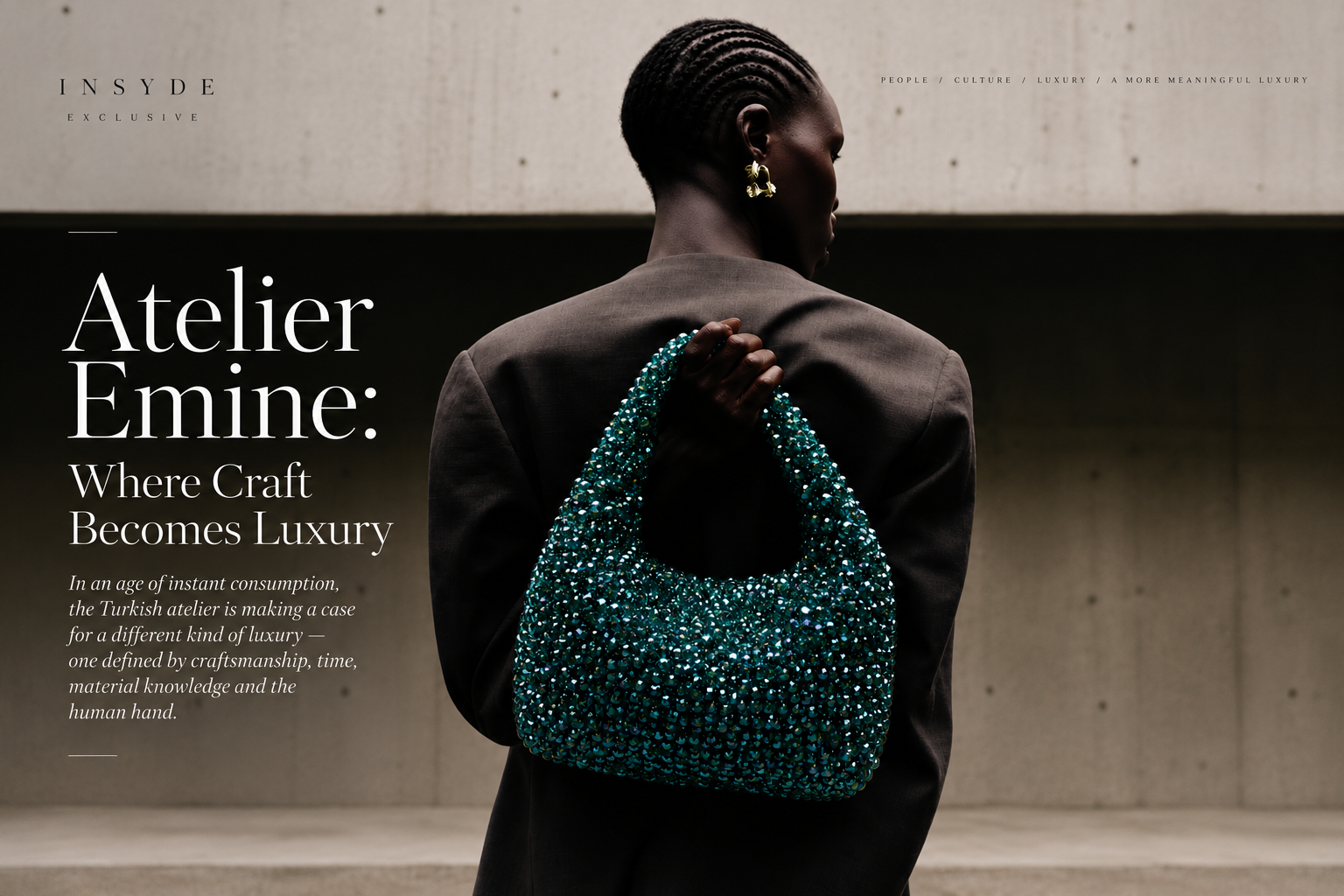
  • Atelier Emine: Where Craft Becomes Luxury

    Atelier Emine: Where Craft Becomes Luxury

    In an age of instant consumption, the Turkish atelier is making a case for a different kind of luxury — one defined by craftsmanship, time, material knowledge and the human hand.

    Luxury has always had its codes.

    Precious materials. Recognisable silhouettes. Objects whose value is often understood before they are even touched.

    But there is another way to think about luxury — one that is less concerned with what an object announces and more interested in what it contains.

    The time behind it. The technique. The knowledge required to make it. The hands that shaped it.

    This is where Atelier Emine becomes particularly intriguing.

    The Türkiye-based atelier creates handcrafted handbags using an unconventional combination of materials including crystal, mother-of-pearl, pearls, wood and velvet. At the foundation of these pieces is monofilament, worked together with the materials through specialised weaving and knotting techniques.

    The result is visually striking, but the most interesting part of the construction is not necessarily the part the eye notices first.

    The monofilament remains visually subtle, allowing the materials themselves to become the language of each piece. Yet beneath those surfaces is a method of making that is central to the identity of the object.

    For Atelier Emine, the construction is not simply functional. It is part of the design.

    And that opens up a larger question: what exactly makes a luxury object luxurious?

    When Craftsmanship Creates Rarity

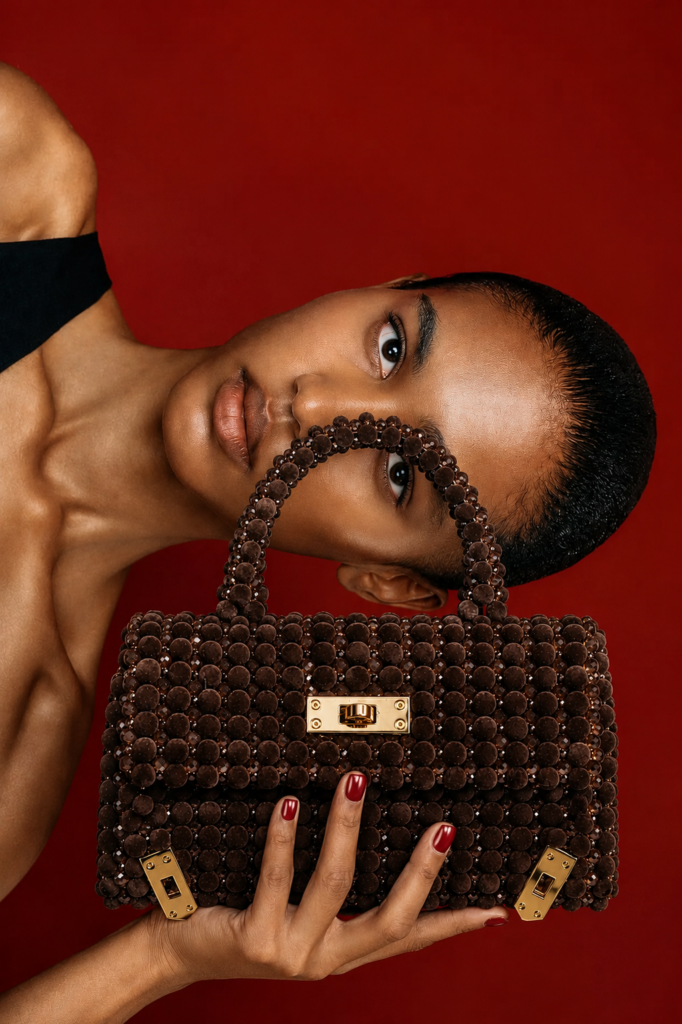
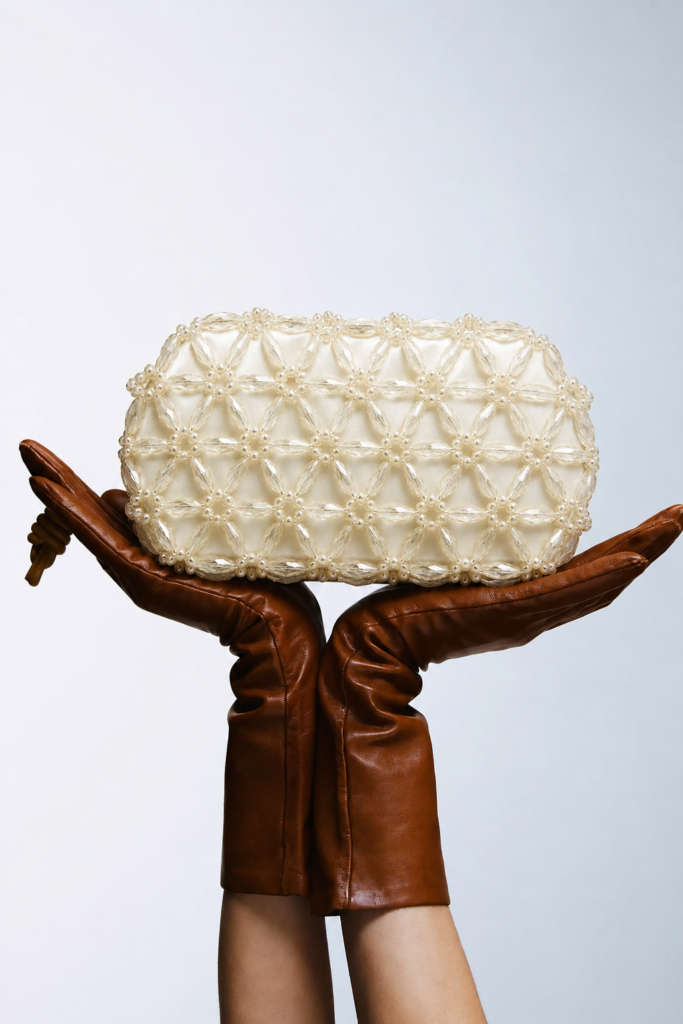
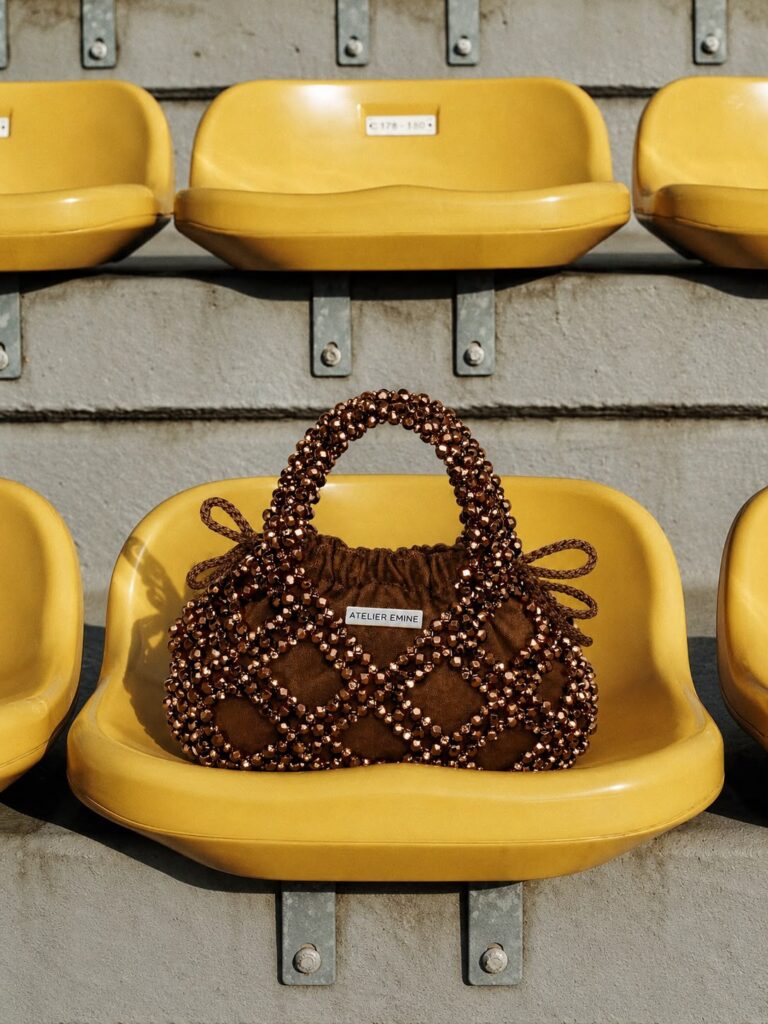
    A study in material and craftsmanship, where individually worked elements become part of the bag’s visual language. Images Courtesy: Atelier Emine

    Luxury has traditionally placed considerable emphasis on the value of materials.

    Gold, precious stones, fine leather and rare textiles have long served as shorthand for exclusivity.

    Atelier Emine approaches rarity from another direction.

    “We believe craftsmanship itself can create rarity,” the atelier tells INSYDE.

    Its pieces are produced in limited quantities and handmade in a private workshop in Türkiye, where individual materials are carefully worked and brought together through specialised techniques.

    The distinction is important.

    A material can possess inherent value, but craftsmanship can transform that material into something far more personal. The technique, the time involved and the knowledge required to execute it become part of the finished object’s value.

    The handbag is no longer simply the result of a production process.

    The process becomes part of the luxury.

    It is an idea that feels increasingly relevant at a time when so many objects can be reproduced with remarkable speed and consistency.

    Where Material Meets Form

    Behind the finished object: meticulous handwork and specialised weaving techniques shape every Atelier Emine piece. Images Courtesy: Atelier Emine

    There is no fixed starting point when Atelier Emine develops a piece.

    Material, form and idea are allowed to influence one another.

    Crystal, velvet, mother-of-pearl, wood and pearls each possess different textures, weights and visual qualities. Rather than treating these materials as decorative elements added after the design is established, Atelier Emine allows them to participate in the construction itself.

    “The material influences what the form can become, while the intended form also influences how we work with the material,”

    – the atelier explains.

    That relationship gives the making process a certain fluidity.

    The material is not simply being asked to conform to a predetermined shape. The shape evolves alongside the material and the technique.

    It is a subtle shift, but an important one.

    Craftsmanship here is not merely about executing a design perfectly. It becomes part of the creative thinking behind the design.

    The Beauty of Imperfection

    Delicate materials, intricate construction and the precision of handmade work meet in Atelier Emine’s contemporary designs. Images Courtesy: Atelier Emine

    Handmade luxury carries an inherent contradiction.

    The human hand is part of its appeal, yet luxury also demands precision.

    Atelier Emine sees no need to choose between the two.

    Its pieces are entirely handmade, but production is accompanied by careful quality control. Slight variations in tone, texture, form or the arrangement of materials can naturally occur during the process.

    Rather than automatically treating these differences as flaws, the atelier sees them as part of the individual character of a handmade piece.

    That does not mean precision is abandoned.

    Construction, finishing and quality remain essential.

    The balance lies in allowing the object to retain its human character without compromising the discipline expected of a luxury piece.

    Perhaps that is one of the most compelling qualities of handmade objects today.

    In a world increasingly capable of producing perfect uniformity, individuality can become its own form of rarity.

    Heritage Without Nostalgia

    Designed to exist beyond the display case, Atelier Emine’s pieces bring handcrafted detail into contemporary dressing. Images Courtesy: Atelier Emine

    Behind Atelier Emine’s contemporary aesthetic lies a 65-year craft heritage passed down through generations.

    But the atelier does not believe heritage needs to look historical.

    Instead, it sees heritage in the practices that have survived: specialised techniques, patience, handwork and attention to detail.

    “We do not see heritage as something that has to be reproduced as a historical aesthetic,We see it more fundamentally through the practice of craftsmanship.”

    – the atelier explains

    That distinction allows tradition to move forward.

    Heritage can easily become a visual formula — familiar motifs reproduced season after season, or the past transformed into a marketable aesthetic.

    Atelier Emine approaches it differently.

    The heritage remains in how the object is made, allowing the object itself to remain contemporary.

    “Contemporary design is not a departure from craftsmanship,” the atelier says. “It is a way of carrying craftsmanship forward.”

    It is a particularly relevant idea in contemporary luxury, where the challenge is no longer simply preserving tradition but finding ways for traditional knowledge to remain meaningful in the present.

    The Luxury of Waiting

    Luxury at a slower pace — a reminder that some of the most meaningful objects are made to be experienced, not rushed. Images Courtesy: Atelier Emine

    There is another element of luxury that has become increasingly rare: time.

    The culture surrounding fashion and consumer goods has become faster than ever. Trends appear and disappear almost instantly. Digital platforms have made discovery and purchasing almost frictionless.

    Handmade objects exist according to another rhythm.

    Atelier Emine’s pieces are made to order, with individual models requiring time to complete. The waiting is not positioned as an inconvenience. It is part of the nature of the object.

    And perhaps that is where patience begins to take on a new meaning.

    When an object takes time to make, that time does not simply disappear once the piece is finished. It becomes part of its story.

    The willingness to wait for something carefully made can itself become meaningful in a culture increasingly built around immediacy.

    Luxury, in this sense, is not simply about possessing something rare.

    It can also be about allowing something to take its time.

    Beyond the Traditional Codes of Luxury

    A distinctive expression of Atelier Emine’s material language, balancing sculptural design with artisanal craftsmanship. Images Courtesy: Atelier Emine

    Atelier Emine ultimately challenges a familiar assumption: that luxury has to look a certain way.

    Its approach does not reject precious materials or established luxury entirely. Instead, it suggests that they are not the only things capable of creating value.

    Craftsmanship can create rarity.

    Technique can create distinction.

    Limited production can create individuality.

    Time can become part of an object’s worth.

    And unconventional materials can acquire an entirely different significance when transformed through knowledge and handwork.

    Look closely at an Atelier Emine piece and the first thing that may capture the eye is the surface — the crystals, colour, texture or form.

    Look closer, and another story begins to appear.

    The monofilament.

    The weaving.

    The knotting.

    The arrangement of materials.

    The subtle variations created by the human hand.

    The time.

    And the people behind it.

    That is perhaps the most compelling idea at the heart of Atelier Emine’s philosophy.

    The value of a luxury object does not always have to announce itself.

    Sometimes, it asks you to look closer.

    Because when everything around us is becoming faster, louder and more immediately recognisable, there is something powerful about an object whose value reveals itself slowly.

    Atelier Emine is not simply creating handbags.

    It is offering a different way of understanding what luxury can be — one where the material is only the beginning, and where craftsmanship, patience and human knowledge become part of the object itself.

    Perhaps the future of luxury is not necessarily about objects that demand attention.

    Perhaps it is about objects that reward it.

    Made by Hand, Made to Be Remembered.

  • The Bhansali Aesthetic

    The Bhansali Aesthetic

    How Sanjay Leela Bhansali turned Indian cinema into a language of beauty, craftsmanship and desire.

    Some filmmakers tell stories.

    Sanjay Leela Bhansali builds worlds.

    Before a character speaks, there may already be a chandelier glowing above her, silk moving through the frame, jewellery catching the light, music rising somewhere beyond the room.

    In his cinema, beauty is rarely background.

    Beauty is part of the narrative.

    That is what makes Bhansali particularly interesting to INSYDE.

    His work sits at an intersection of cinema, fashion, architecture, music, craftsmanship and desire — a place where visual richness becomes storytelling and detail becomes identity.

    Over more than three decades, he has developed an aesthetic so recognisable that a frame can sometimes feel like a Bhansali frame before the audience consciously understands why.

    And perhaps that is the real achievement.

    He didn’t simply create films with a distinctive look. He created a visual language.

    When Cinema Becomes a World

    There is a difference between designing a beautiful frame and constructing an entire universe.

    Bhansali has consistently pursued the latter.

    His films are populated by elaborate interiors, dramatic architecture, intricate costumes, jewellery, carefully choreographed movement and compositions in which even the smallest visual element can feel deliberate.

    Those details do not exist independently.

    They speak to one another.

    Architecture establishes scale.

    Costume establishes character.

    Lighting establishes mood.

    Music establishes emotion.

    Movement establishes rhythm.

    Together, they create something closer to an immersive environment than a conventional film set.

    That precision has become part of the Bhansali method. On Heeramandi, Architectural Digest India documented his insistence on repeatedly adjusting elements of the set — from furniture and wall textures to seemingly minor decorative details — and quoted Bhansali explaining that architecture plays an important role in how he constructs a frame. (Architectural Digest)

    The point is not simply to make a set look expensive.

    The environment has to belong to the story.

    The Luxury of Detail

    Luxury has always depended on detail.

    The difference between something expensive and something exceptional is often invisible from a distance.

    A stitch.

    A setting.

    A finish.

    A proportion.

    A material chosen because of how it responds to light.

    Bhansali approaches cinema with a similar sensitivity.

    A costume isn’t simply clothing.

    A room isn’t simply a set.

    A chandelier isn’t simply decoration.

    A colour isn’t simply a colour.

    Everything contributes to the emotional architecture of the scene.

    The result is a cinema that can feel almost tactile.

    You sense the weight of the fabric.

    The warmth of the light.

    The scale of the room.

    The movement of jewellery.

    The silence before the music begins.

    The effect is extravagant, but the underlying principle is surprisingly disciplined:

    nothing is there without intention.

    Where the Obsession With Beauty Began

    The grandeur of Bhansali’s cinema has a deeply personal origin.

    He has spoken about growing up in a chawl in Mumbai and about the lack of space and visual beauty around him during his childhood. His mother, a dancer, performed in a small space, while Bhansali imagined larger, more ordered environments. He has connected those experiences directly to the expansive sets, central framing and visual symmetry that later became signatures of his filmmaking. (Indian Express)

    It is an important detail because it changes the way his aesthetic can be understood.

    The grandeur is not simply extravagance for its own sake.

    It is a response to limitation.

    Small spaces became expansive ones.

    Plain walls became elaborate environments.

    Disorder became symmetry.

    Limited movement became choreography.

    The absence of beauty became an obsession with creating it.

    And perhaps that is why his sets rarely feel merely expensive.

    They feel imagined.

    The Architecture of Desire

    Bhansali understands something that luxury brands have understood for generations:

    objects become more powerful when placed inside a world.

    A necklace is one thing.

    A necklace worn with a particular fabric, under a particular light, inside a particular room, accompanied by music and movement, becomes something else.

    The object acquires context.

    That is one of the reasons his cinema has such a strong relationship with fashion and jewellery.

    The visual elements do not sit around the characters.

    They help construct them.

    Jewellery as Storytelling

    There may be no better example than jewellery.

    In Bhansali’s worlds, jewellery rarely feels incidental.

    It can establish hierarchy.

    It can indicate wealth.

    It can communicate tradition.

    It can transform the silhouette of a character.

    And, importantly, it interacts with light.

    A necklace catching the light during a close-up is doing more than displaying craftsmanship.

    It is participating in the image.

    This is where Bhansali’s cinema naturally intersects with the language of luxury.

    The finest luxury objects are designed to reward attention.

    So are his frames.

    The closer you look, the more there is to discover.

    Fashion Without the Fashion Show

    Bhansali’s relationship with fashion is more sophisticated than simply dressing actors beautifully.

    His costumes establish an entire visual vocabulary.

    Silhouette, fabric, colour, ornamentation and movement work together.

    The clothes have to survive choreography.

    They have to respond to lighting.

    They have to communicate period and cultural context.

    And they have to remain emotionally connected to the character.

    That requires something closer to design than conventional styling.

    The result is fashion that belongs to the world of the film rather than being placed on top of it.

    The costume doesn’t interrupt the story. It becomes part of the story.

    The Women at the Centre

    Bhansali’s cinema has repeatedly placed women at the centre of its visual and emotional worlds.

    From Devdas and Black to Ram-Leela, Bajirao Mastani, Padmaavat, Gangubai Kathiawadi and Heeramandi, his women are rarely treated as background figures.

    Their clothes, jewellery, movement and environments often become extensions of their emotional and social position.

    The scale of the world around them can communicate power.

    A crowded room can become a stage.

    A palace can become a prison.

    A costume can become armour.

    A jewel can become status.

    A dance can become defiance.

    That visual treatment has become one of the recognisable elements of his cinema. Actors from Heeramandi have also described his approach to presenting women as central to his filmmaking language. (Indian Express)

    The important point is not simply that Bhansali makes beautiful images of women.

    It is that he uses beauty as part of the language through which their stories are told.

    Music Is Architecture

    There is another defining element of the Bhansali aesthetic: music.

    For Bhansali, music has long been central to the construction of his films rather than something added after the visual world is complete.

    A song can become a room.

    A room can become choreography.

    Choreography can become emotion.

    Emotion becomes narrative.

    This is why some of his most memorable sequences can communicate enormous amounts without conventional dialogue.

    The music carries the architecture of the scene.

    The performers move through it.

    The camera becomes part of the choreography.

    The result is closer to a fully composed theatrical experience than a conventional musical interlude.

    The Discipline Beneath the Spectacle

    The word “grand” is often used to describe Bhansali.

    It is accurate, but incomplete.

    What is more interesting is the discipline underneath it.

    He has spoken about his fascination with central framing and the desire to create order from the disorder he experienced growing up. (Indian Express)

    Architectural Digest India has similarly documented his attention to the smallest details of his sets, including furniture placement, textures, colours and architectural elements. (Architectural Digest)

    That reveals the secret beneath the spectacle.

    The image may be extravagant.

    The composition is controlled.

    That is why his frames can feel so immediately recognisable.

    Grandeur With a Purpose

    Bhansali’s films are often described using words such as lavish, opulent and larger-than-life.

    But spectacle alone would not explain their longevity.

    The real fascination lies in what the grandeur communicates.

    A palace can represent power.

    A crowded courtyard can represent society.

    A vast stage can make an individual appear small.

    An empty room can make an emotion feel enormous.

    A chandelier can suggest wealth, desire or decay.

    A costume can tell you where a character belongs before the dialogue does.

    The visual scale is therefore not simply decoration.

    It is emotional scale.

    India Through a More Cinematic Lens

    There is also something distinctly Indian about Bhansali’s understanding of grandeur.

    India has never treated beauty as purely architectural.

    It exists in textiles.

    Jewellery.

    Music.

    Dance.

    Wedding traditions.

    Craftsmanship.

    Palaces.

    Festivals.

    Theatre.

    Ceremony.

    Bhansali understands that instinctively.

    His cinema draws from a cultural memory in which colour, ornamentation, music and movement can coexist without apology.

    The result is not simply an expensive-looking version of Indian cinema.

    It is an attempt to transform elements of Indian visual culture into a cinematic language of their own.

    And that distinction matters.

    He doesn’t simply decorate Indian stories. He builds worlds around them.

    From Cinema to a Wider Cultural Language

    With Heeramandi: The Diamond Bazaar, Bhansali extended this visual vocabulary into streaming.

    The series brought together his familiar concerns — music, performance, elaborate environments, costumes, historical atmosphere and female characters — for a global streaming audience. Netflix describes the series as a story of love, power, betrayal and freedom centred on the courtesans of pre-independence Lahore. (Indian Express)

    The significance goes beyond the move from cinema to television.

    It demonstrated that the Bhansali aesthetic could exist as a broader cultural world.

    The sets became part of the conversation.

    The costumes became part of the conversation.

    The jewellery became part of the conversation.

    The music became part of the conversation.

    The visual identity became almost as recognisable as the title itself.

    That is a powerful position for any filmmaker to reach.

    The Influence of the Past

    Bhansali’s visual references are not limited to cinema.

    Architectural Digest India has documented how his reference library has drawn from places and objects he encountered growing up, as well as artists, photographers and musicians including S. H. Raza, V. S. Gaitonde, Raghu Rai and Kishori Amonkar. (Architectural Digest)

    That is revealing.

    His aesthetic isn’t built from one source.

    It is accumulated.

    Painting.

    Photography.

    Music.

    Architecture.

    Theatre.

    Textiles.

    Indian history.

    Street life.

    Memory.

    The resulting world may look fantastical, but its ingredients are deeply rooted in observation.

    When Excess Becomes Restraint

    There is an irony in Bhansali’s work.

    The images can be enormous.

    The sets can be enormous.

    The costumes can be elaborate.

    The music can be overwhelming.

    Yet the composition is often highly controlled.

    Symmetry.

    Central framing.

    Colour relationships.

    Movement.

    Light.

    Negative space.

    Everything is competing for attention, yet everything is carefully placed.

    That tension is part of what makes the aesthetic work.

    The spectacle is large. The intention is precise.

    A Filmmaker With a Signature

    The ultimate achievement for an auteur is recognisability.

    Not fame.

    Not scale.

    Not even box-office success.

    A signature.

    Something that makes an audience recognise the creator before seeing the name.

    Bhansali has achieved that.

    The grand interiors.

    The controlled colour.

    The elaborate costumes.

    The music.

    The choreography.

    The central compositions.

    The emotional intensity.

    The women framed against enormous spaces.

    The sense that every object has been placed with intention.

    Together, they form a vocabulary.

    And once a filmmaker develops a vocabulary of that strength, individual films become chapters inside a much larger artistic language.

    What Comes Next

    Bhansali’s next chapter is already taking shape.

    His much-anticipated Love & War, starring Ranbir Kapoor, Alia Bhatt and Vicky Kaushal, is nearing completion, with reports now pointing toward his next major project, a Madhubala biopic. (The Times of India)

    For a filmmaker whose aesthetic is already so established, the interesting question is not whether the next project will be visually ambitious.

    We know the answer.

    The more compelling question is:

    What will he do with that language next?

    Can grandeur evolve without becoming repetition?

    Can spectacle remain emotionally intimate?

    Can a recognisable aesthetic continue to surprise?

    Those are the questions that matter when an artist has spent decades refining a signature.

    The Bhansali Aesthetic

    Perhaps the easiest way to misunderstand Sanjay Leela Bhansali is to think his cinema is simply about luxury.

    It isn’t.

    Luxury is the surface.

    The deeper obsession is craft.

    The craft of composition.

    The craft of music.

    The craft of costume.

    The craft of movement.

    The craft of light.

    The craft of architecture.

    The craft of creating an environment that feels larger than reality.

    That is why his images remain so persistent.

    Long after a film’s plot has been discussed, individual frames remain.

    A room.

    A colour.

    A piece of jewellery.

    A costume.

    A song.

    A gesture beneath a chandelier.

    A character standing alone in an enormous space.

    These are not simply beautiful moments.

    They are fragments of a language.

    And perhaps that is Bhansali’s most enduring contribution to Indian cinema.

    He has shown that grandeur, when treated with enough discipline and imagination, can become more than spectacle.

    It can become storytelling.

    In a culture increasingly consumed through fleeting images, there is something almost radical about a filmmaker who still believes a frame deserves to be constructed, considered and remembered.

    That may be the real Bhansali aesthetic.

    Not simply the luxury of seeing more — but the discipline of making every detail matter.

    INSYDE — Beyond the Spotlight.

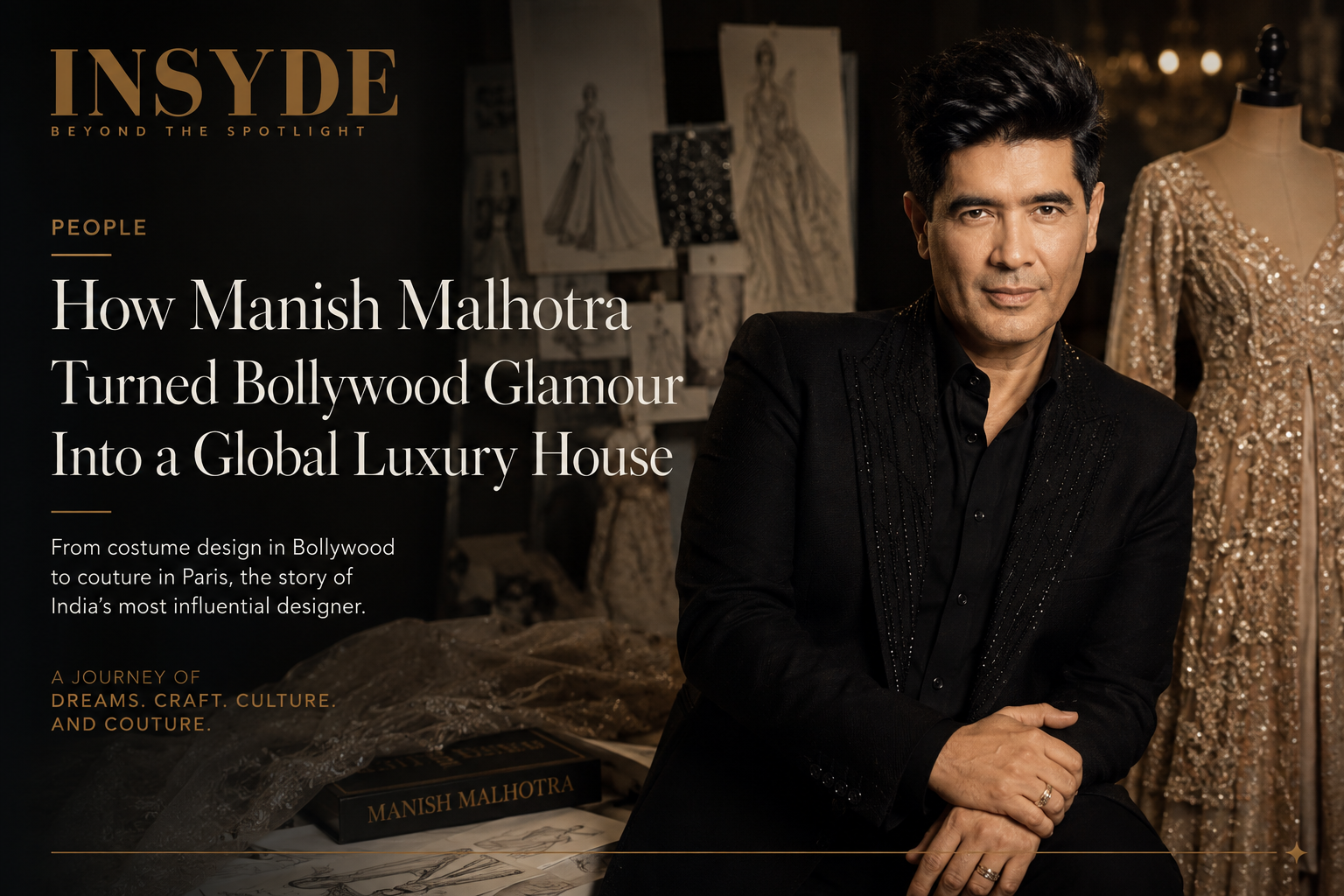
  • How Manish Malhotra Turned Bollywood Glamour Into a Global Luxury House

    How Manish Malhotra Turned Bollywood Glamour Into a Global Luxury House

    From costume design in Bollywood to couture in Paris, Manish Malhotra has spent more than three decades turning fashion into storytelling — and storytelling into one of India’s most recognisable luxury worlds.

    There are designers whose clothes are admired.

    And then there are designers whose clothes become part of memory.

    A lehenga from a wedding. A saree from a film. A heroine walking through a song sequence. A particular shade of shimmer beneath the lights. Clothes that become so closely associated with a character, a celebrity or a moment that it becomes difficult to remember one without the other.

    Manish Malhotra belongs to that second category.

    For more than three decades, he has operated at the intersection of fashion, cinema, celebrity and Indian culture. He began not with a luxury boutique or a couture atelier, but inside the world of films, where clothes had to do something more than look beautiful.

    They had to tell a story.

    And that may be the most important thread running through his career.

    Before Manish Malhotra became a fashion house, he became a storyteller.

    Before the Name Became the Brand

    Malhotra’s entry into fashion was unconventional.

    He began his career as a model before moving into costume design, eventually making his cinematic debut in 1990 with Swarg. By 1993, his work on Gumrah was already establishing a different approach to costume design — one in which the complete look of a character could become part of the storytelling.

    Then came Rangeela.

    In 1995, his work on the film earned him the first-ever Filmfare Award for Best Costume Design. It was more than a career milestone. It was an indication that the way Indian cinema dressed its characters was changing.

    Malhotra understood something that would become central to his career:

    People don’t simply watch films.

    They absorb them.

    They remember the characters, the colours, the music — and increasingly, the clothes.

    Fashion could influence how an audience understood a character before that character had even spoken.

    That idea would become one of his greatest strengths.

    When Bollywood Became a Fashion Classroom

    Malhotra’s relationship with cinema gave him an education that could not be contained inside a traditional fashion curriculum.

    He learned through actors.

    Through scripts.

    Through movement.

    Through lighting.

    Through the personalities of the people wearing his clothes.

    And most importantly, through the audience.

    His costumes helped make the wardrobe of a film star feel aspirational in a new way. The clothes weren’t simply part of the production design. They could become part of the cultural conversation surrounding the film.

    That was particularly powerful in the Bollywood of the 1990s and early 2000s.

    Cinema was becoming increasingly fashion-conscious, and Malhotra was one of the designers helping define what that looked like.

    His work became associated with the visual language of contemporary Bollywood: glamour, colour, romance, youth and spectacle.

    By 2002, his work on Kuch Kuch Hota Hai had earned seven costume-design awards, according to the House’s official timeline.

    The numbers matter.

    But the cultural effect matters more.

    A generation began looking at film stars differently.

    And, in turn, began looking at fashion differently.

    The Moment the Costume Designer Became a Designer

    There comes a point in many creative careers when influence has to become something more permanent.

    For Malhotra, that transition happened through fashion itself.

    In 1999, he presented his first runway show in Mumbai. In 2004, the Manish Malhotra label launched and his first international flagship boutique opened in Dubai. A year later, he founded the House of Manish Malhotra.

    The distinction is important.

    He was no longer simply designing clothes for someone else’s story.

    He was building his own.

    That is a much harder proposition.

    Cinema had given Malhotra an enormous platform, but a fashion house requires something different: an identity that can survive beyond any single film, actor or season.

    The House had to become the story.

    And slowly, it did.

    Building a World, Not Just a Label

    Today, the House of Manish Malhotra describes itself as a multidisciplinary luxury house spanning couture, bridal, menswear, ready-to-wear, high jewellery, beauty and film production.

    That expansion says something about how Malhotra understood luxury.

    Luxury is rarely just the object.

    It is the world surrounding the object.

    The setting.

    The craftsmanship.

    The celebrity.

    The experience.

    The sense that the customer isn’t simply buying a garment but entering a particular visual universe.

    Malhotra’s universe has always been recognisable.

    It is dramatic without being anonymous.

    Indian without being trapped in nostalgia.

    Luxurious without pretending that Indian craftsmanship needs to be disguised as something European.

    That balance has become one of the defining characteristics of the brand.

    The Business Behind the Glamour

    It is easy to look at Manish Malhotra through photographs.

    A celebrity wearing couture.

    A bride walking down an aisle.

    A red carpet.

    A runway.

    A glittering lehenga.

    But behind those images sits a much larger operation.

    Vogue reported around his 2026 Paris debut that the Mumbai-based business had grown into an empire spanning fashion, Bollywood, hospitality, beauty, fragrance and high jewellery, with a 40,000-square-foot atelier and headquarters and around 300 in-house embroiderers. The fashion business also has backing from Reliance Brands Limited.

    That scale changes the conversation.

    Because a designer can create beautiful clothes.

    A luxury house has to create beautiful clothes repeatedly, consistently and at scale, while maintaining the identity that made people desire them in the first place.

    That requires artisans.

    Operations.

    Retail.

    Marketing.

    Celebrity relationships.

    Client management.

    Digital storytelling.

    And, above all, a clear point of view.

    The glamour may be what people see.

    The system underneath it is what makes the glamour possible.

    The Indian Craftsmanship at the Centre

    Malhotra’s international story is also an Indian craftsmanship story.

    The House says its work is built around embroidery, weaving and handcraft traditions passed down through generations, reinterpreted through a contemporary luxury lens.

    That matters because Indian craftsmanship has long played a significant role in global luxury.

    For decades, the techniques and handwork associated with Indian artisans have appeared within international fashion while the people and traditions behind them have often remained invisible to the final consumer.

    The conversation is changing.

    Vogue noted in 2026 that more Indian designers are appearing on the official Paris couture calendar, reflecting a broader movement in which Indian craftsmanship is increasingly being presented not simply as a source of embellishment, but as part of a wider luxury and design conversation.

    Malhotra’s approach fits into that shift.

    His objective isn’t to make Indian craft look less Indian.

    It is to make the world look at Indian craft differently.

    The embroidery becomes architecture.

    The textile becomes emotion.

    The sari becomes memory.

    The lehenga becomes spectacle.

    Craft becomes luxury.

    The Celebrity Effect

    Then there is Bollywood.

    It would be impossible to tell the Manish Malhotra story without acknowledging how closely the designer and celebrity cultures have grown together.

    But this relationship is more interesting than simple endorsement.

    The designer needs the star.

    The star needs the designer.

    One creates the image.

    The other amplifies it.

    That relationship helped Malhotra develop something that many luxury houses spend decades trying to manufacture: cultural visibility.

    A Manish Malhotra outfit could appear on a runway, then on a film star, then in a magazine, then at a wedding.

    The garment travelled.

    And with it, the brand travelled.

    This is where his cinema background became a business advantage.

    He already understood how people fall in love with an image.

    He simply transferred that understanding from the screen to the fashion house.

    Why Bridalwear Became So Powerful

    For millions of Indians, the name Manish Malhotra is almost inseparable from weddings.

    The reason isn’t difficult to understand.

    Indian weddings are already theatrical.

    There is music.

    There is colour.

    There is ceremony.

    There is photography.

    There is family.

    There is performance.

    Malhotra’s aesthetic naturally belongs in that environment.

    But bridalwear also gave the brand something else: a powerful emotional purchase.

    A wedding outfit isn’t simply clothing.

    It becomes part of a memory.

    That is precisely the kind of emotional relationship luxury brands want to create.

    The House’s expansion into bridal, jewellery, beauty and other categories has allowed that relationship to grow beyond the original garment.

    A client can enter the Manish Malhotra world through a bridal lehenga.

    Another through jewellery.

    Another through beauty.

    Another through menswear.

    Another through couture.

    Different products.

    One universe.

    The House Keeps Expanding

    The evolution has continued.

    The House launched Manish Malhotra Beauty in 2018, expanded further into high jewellery, introduced Ready-to-Wear in 2025 and has continued developing international showcases and retail presence. Its official timeline also records the launch of Stage5 Productions and other extensions beyond traditional fashion.

    This is no longer simply the story of a designer selling clothes.

    It is the story of a creative brand expanding its cultural territory.

    Fashion becomes jewellery.

    Jewellery becomes beauty.

    Beauty becomes lifestyle.

    Cinema becomes production.

    And the designer becomes the centre of a much larger ecosystem.

    That is the difference between a successful designer and a modern luxury house.

    Paris Changes the Scale

    For years, Paris represented one of fashion’s ultimate stages.

    In July 2026, Manish Malhotra entered it.

    He presented his Fall/Winter 2026 couture collection in Paris as a guest house on the official Haute Couture Week schedule, becoming the fourth Indian designer to appear on that official calendar.

    But the significance of the moment wasn’t simply that an Indian designer had reached Paris.

    It was what he carried with him.

    The collection was called “Maa.”

    It was dedicated to his mother, Sudarshan Malhotra, who died earlier in 2026.

    The show opened with a deep red runway, red lighting and the sound of a heartbeat. The collection explored memories of motherhood and childhood through sculptural silhouettes, intricate embroidery and references to his mother’s jewellery and saris.

    One of the most striking ideas was the transformation of her bangles into the circular structure of a gown.

    It was fashion, but it was also memory.

    After decades spent dressing other people’s characters, Malhotra arrived in Paris telling a story that belonged entirely to him.

    That gave the debut an emotional weight that a simple international expansion could never have carried.

    A New Kind of Indian Luxury

    The Paris debut also arrives at an interesting moment for Indian fashion.

    For years, the world understood India largely through its craftsmanship.

    The embroidery.

    The textiles.

    The artisans.

    The colour.

    But craftsmanship alone does not create a global luxury house.

    A house also needs authorship.

    A point of view.

    A recognisable identity.

    A business capable of sustaining that identity.

    And a story people around the world can understand.

    Indian designers are increasingly bringing those elements together.

    Malhotra’s Paris debut is part of that larger movement. Vogue described the growing presence of Indian designers on the official couture calendar as evidence of a shift in how Indian fashion is participating in the global luxury conversation.

    The conversation is no longer simply:

    “Look at the craftsmanship India can provide.”

    It is becoming:

    “Look at the luxury worlds Indian designers can create.”

    That is a much bigger proposition.

    The Manish Malhotra Formula

    There is no single formula behind Manish Malhotra’s career.

    But there is a pattern.

    He observes culture.

    He understands aspiration.

    He understands celebrity.

    He understands spectacle.

    And he understands that people don’t simply buy clothes.

    They buy the feeling surrounding them.

    That may be the real lesson of his career.

    The clothes matter.

    The craftsmanship matters.

    The business matters.

    But the story connecting everything together matters just as much.

    He has spent more than three decades building that story.

    First through cinema.

    Then through couture.

    Then through celebrity.

    Then through weddings.

    Then through jewellery and beauty.

    And now, increasingly, through the global language of luxury.

    From Mumbai to Paris

    The distance between Mumbai and Paris is measured in thousands of kilometres.

    But creatively, Manish Malhotra’s journey between them has been built one image at a time.

    A character in a film.

    A costume that people remember.

    A celebrity who becomes an icon.

    A runway.

    A boutique.

    A bride.

    A jewellery collection.

    A beauty line.

    A luxury house.

    And finally, Paris.

    The interesting thing is that he did not arrive there overnight.

    Paris was simply the newest stage for a story that had been developing for more than three decades.

    That is what makes Manish Malhotra’s career worth looking at beyond fashion.

    It is a story about reinvention.

    About understanding what people desire — and then building a world around that desire.

    It is about taking an opportunity that was never supposed to be the final destination and turning it into something larger.

    Manish Malhotra didn’t just dress Bollywood.

    He helped change the way Bollywood imagined glamour.

    And in doing so, he discovered something even bigger:

    that the person designing the clothes could eventually build the entire world around them.

    From cinema to couture, from Mumbai to Paris, Manish Malhotra’s story is ultimately a story about scale — and the ambition to keep building.

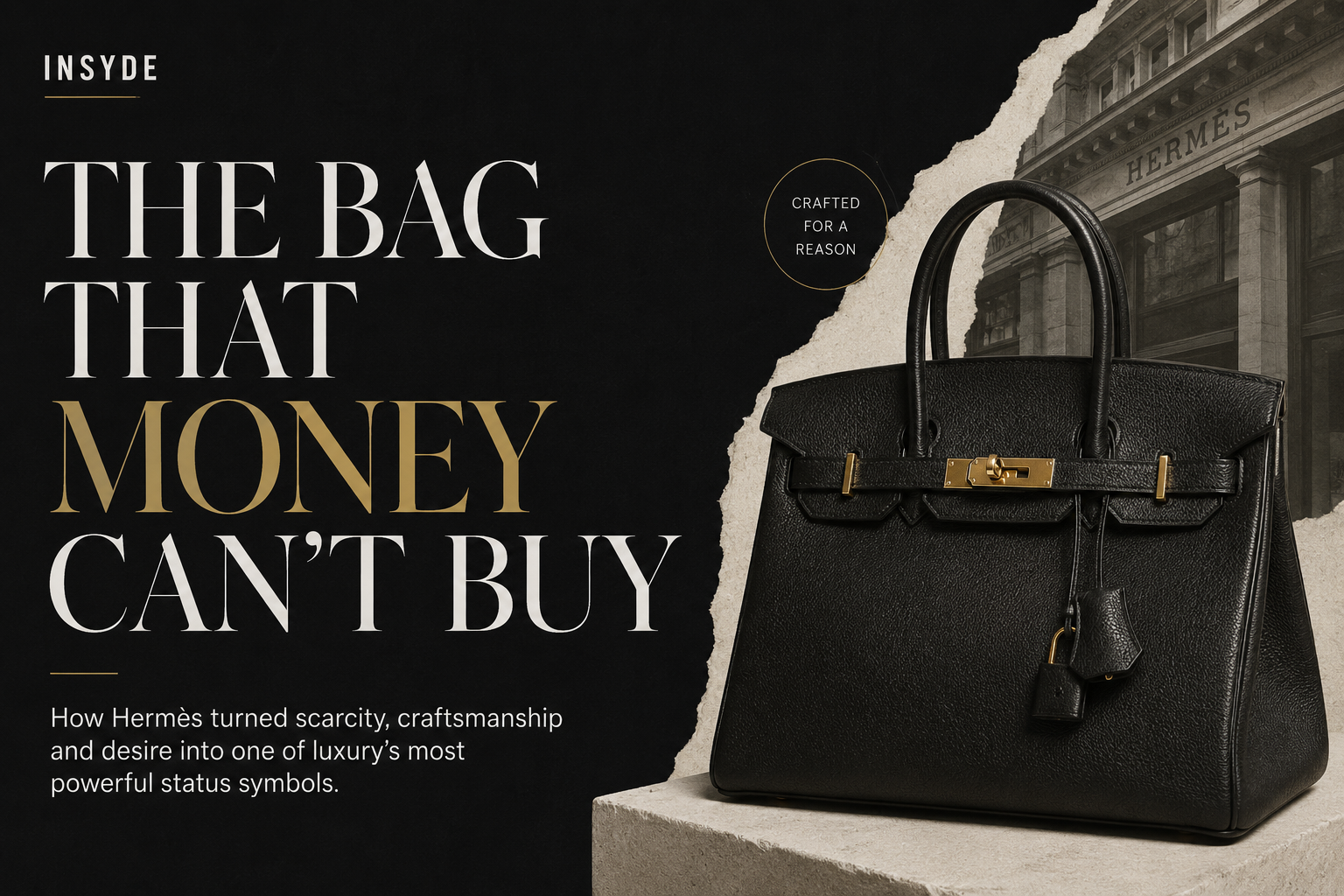
  • THE BAG THAT MONEY CAN’T BUY

    THE BAG THAT MONEY CAN’T BUY

    How Hermès turned scarcity, craftsmanship and desire into one of luxury’s most powerful status symbols.

    There are handbags that cost hundreds.

    There are handbags that cost thousands.

    And then there is the Hermès Birkin — a handbag so deeply embedded in the language of luxury that its price is no longer the most interesting thing about it.

    The real question is much simpler:

    What happens when having the money still doesn’t guarantee that you can have the thing you want?

    That is where Hermès becomes fascinating.

    Because luxury has traditionally followed a straightforward formula:

    More money. Better things.

    Hermès built something more complicated:

    More money gives you access to luxury. But it doesn’t necessarily give you access to everything.

    And that distinction transformed a handbag into something far bigger than a fashion accessory.

    The Birkin became a symbol of wealth, yes.

    But also of taste.

    Scarcity.

    Craftsmanship.

    Access.

    And, perhaps most importantly, desire.

    Because when something is difficult to obtain, the price is only the beginning of the story.


    THE BAG WAS NEVER DESIGNED TO BECOME A STATUS SYMBOL

    The origin of the Birkin is almost too ordinary for the mythology that eventually surrounded it.

    In 1984, British actress and singer Jane Birkin found herself seated next to Jean-Louis Dumas, then chairman and chief executive of Hermès, on a flight from Paris to London.

    Birkin explained that she couldn’t find a leather bag that worked for her as an everyday carryall.

    Dumas listened.

    The idea evolved into a new handbag.

    The Birkin was born.

    There was no grand plan to create one of the world’s most recognisable symbols of extreme wealth.

    It began with functionality.

    Make it practical.

    Make it beautiful.

    Make it exceptionally well.

    The mythology came later.

    And that may be one of the most important details in the entire story.

    Because Hermès didn’t begin by manufacturing status.

    It manufactured quality.

    Status followed.


    HERMÈS WAS BUILDING LUXURY LONG BEFORE THE BIRKIN

    To understand why the Birkin became so powerful, you have to go back much further.

    Hermès was founded in Paris in 1837 by Thierry Hermès, originally as a workshop producing harnesses and other equestrian equipment.

    Its early clientele included members of Europe’s wealthy and aristocratic society.

    As transportation changed, Hermès changed with it.

    The company moved into bags, luggage, silk, fashion, jewellery and other categories while maintaining a central commitment to craftsmanship.

    That history matters.

    Because the Birkin didn’t create Hermès’ luxury reputation.

    Hermès’ reputation created the environment in which the Birkin could become legendary.

    The bag arrived with decades of credibility already behind the name.


    THE REAL LUXURY IS IN THE MAKING

    A Birkin is not valuable simply because it carries the Hermès name.

    The construction itself is part of the story.

    Hermès leather goods are made by highly trained artisans, with the house emphasising manual craftsmanship and individual attention throughout the production process. The company says leather artisans undergo extensive training before becoming fully qualified.

    The leather is selected carefully.

    Pieces are cut and prepared.

    Edges are finished.

    Hardware is fitted.

    Stitching is performed by hand.

    And the artisan’s work becomes part of the character of the finished bag.

    This is important because modern luxury often creates the illusion of infinite choice.

    Hermès does something different.

    It reminds the customer that human time is finite.

    A skilled artisan can only make so many pieces.

    A particular material can only exist in a certain quantity.

    A particular finish requires a certain amount of attention.

    And suddenly, scarcity isn’t just a marketing strategy.

    It is built into the production process.


    THE DIFFERENCE BETWEEN EXPENSIVE AND EXCLUSIVE

    This is where the Birkin story becomes particularly interesting.

    An expensive product asks:

    Can you afford it?

    An exclusive product asks:

    Can you get it?

    Those are completely different questions.

    A wealthy customer can have the financial means to purchase a Birkin and still not be able to walk into a boutique and simply select any model, colour or leather they want.

    Availability varies.

    Relationships matter.

    Specific pieces are limited.

    And the exact bag someone wants may not be waiting behind the counter.

    That creates a psychological effect that money cannot completely eliminate:

    anticipation.

    You want it.

    You search for it.

    You wait.

    And the longer the desire survives, the more emotionally valuable the eventual acquisition can become.


    WHEN “NO” BECOMES PART OF THE LUXURY

    Modern commerce has been built around convenience.

    See it.

    Click it.

    Buy it.

    Tomorrow, it’s at your door.

    Luxury operates differently.

    At its highest level, friction can become part of the experience.

    The wait.

    The discovery.

    The relationship.

    The invitation.

    The moment when the right piece finally appears.

    That is a radical idea in a world obsessed with instant gratification.

    Hermès doesn’t need to make the Birkin feel like something everyone can have immediately.

    In fact, the opposite can make the product more desirable.

    The less ordinary the acquisition feels, the less ordinary the object can feel.

    The purchase becomes an event.


    THE BOUTIQUE ISN’T JUST A STORE

    This is another important distinction.

    For most consumer products, the store exists to facilitate the transaction.

    In luxury, the environment is part of the product.

    The boutique.

    The service.

    The packaging.

    The conversation.

    The anticipation.

    The feeling of discovering something rather than simply ordering it.

    These details matter because luxury is fundamentally emotional.

    A customer isn’t only purchasing leather and hardware.

    They’re purchasing an experience around the object.

    And Hermès has spent generations protecting that experience.


    THEN THE BIRKIN BECAME A CULTURAL SYMBOL

    The bag’s transformation accelerated as it became associated with celebrities, socialites, entrepreneurs and some of the world’s wealthiest consumers.

    Its shape became recognisable.

    Its hardware became recognisable.

    Its name became recognisable.

    The Birkin became something you could identify without seeing the logo.

    That is powerful branding.

    Hermès didn’t need to cover the bag in enormous symbols.

    The silhouette did much of the work.

    And this created an interesting form of status:

    the people who knew, knew.

    The bag could be visible without being loud.

    It could communicate wealth without announcing a price.

    It could sit quietly on an arm while carrying an enormous amount of cultural meaning.


    WHY THE BIRKIN DOESN’T NEED A GIANT LOGO

    Modern luxury has spent decades teaching consumers to recognise logos.

    Hermès took a different route.

    The Birkin’s identity comes from its proportions, construction, hardware, craftsmanship and association with the house.

    That makes the bag part of a more sophisticated form of luxury communication.

    A large logo says:

    Look at the brand.

    A recognisable object can say:

    If you know, you know.

    And that distinction has become increasingly relevant as luxury consumers become more interested in subtlety, provenance and craftsmanship.

    The most sophisticated status signal isn’t necessarily the loudest one.

    Sometimes it is the thing only a certain audience recognises.


    THEN THE SECONDARY MARKET CHANGED THE GAME

    The Birkin became even more fascinating when it entered the world of resale and collecting.

    Certain colours.

    Certain leathers.

    Certain sizes.

    Certain years.

    Exceptional condition.

    Rare examples.

    All can influence desirability in the secondary market.

    Some Birkins have sold for extraordinary sums at auction, particularly rare or historically significant examples.

    But there is an important distinction:

    A Birkin is not automatically an investment.

    The resale market is influenced by condition, provenance, rarity, demand and market conditions.

    The existence of a strong secondary market doesn’t guarantee appreciation.

    But it does demonstrate something important.

    The Birkin can exist simultaneously as:

    a handbag,

    a collectible,

    a status symbol,

    and a cultural asset.

    That is an extraordinary amount of meaning for an object originally designed to carry personal belongings.


    THE PSYCHOLOGY OF SCARCITY

    Why does scarcity work?

    Because humans don’t always value things according to their practical usefulness.

    When something is limited, difficult to obtain or perceived as disappearing, its psychological value can increase.

    Luxury brands have understood this for generations.

    But scarcity only works when the underlying product deserves desire.

    Make something rare without making it desirable and you have nothing.

    Hermès combined the two.

    Exceptional craftsmanship created the desire.

    Limited availability intensified it.

    And the result became a self-reinforcing cycle.

    Desire creates demand.

    Demand reinforces scarcity.

    Scarcity increases desirability.

    And the cycle continues.


    THE MOST POWERFUL WORD IN LUXURY

    No.

    No mass-market production.

    No constant discounting.

    No desperate promotions.

    No need to make every product available to everyone immediately.

    That ability to say no is one of the most powerful tools a luxury brand can possess.

    Because the moment a luxury product becomes permanently available at a discount, something changes.

    The consumer stops asking:

    “Can I get it?”

    and starts asking:

    “Should I buy it?”

    Hermès has spent decades making the first question more important.

    And that is incredibly powerful.


    WHEN THE BAG BECAME CULTURAL CURRENCY

    Eventually, owning a Birkin stopped being solely about owning an exceptional handbag.

    It became a form of cultural knowledge.

    You could recognise the bag.

    Understand the leather.

    Understand the construction.

    Understand why one version might attract more attention than another.

    Understand why rarity matters.

    That knowledge becomes part of the luxury experience.

    And suddenly, the Birkin communicates something beyond financial capability.

    It can communicate:

    I know this world.

    That’s cultural capital.

    And cultural capital is one of the most powerful currencies in luxury.


    HERMÈS DOESN’T NEED TO CHASE THE MOMENT

    Fashion is built around change.

    New season.

    New collection.

    New trend.

    New colour.

    New obsession.

    Luxury operates on a different clock.

    Hermès has the advantage of being able to build on heritage rather than constantly replacing it.

    The Birkin doesn’t need to become radically different every season.

    Its enduring appeal comes partly from consistency.

    The design can evolve.

    Materials can vary.

    Colours can change.

    But the underlying identity remains recognisable.

    That gives the brand something most fashion businesses desperately want:

    timelessness.


    THE BAG MONEY ALONE CAN’T GUARANTEE

    This is where the title becomes meaningful.

    The Bag That Money Can’t Buy.

    Of course money matters.

    A Birkin is a luxury purchase, and financial ability is an obvious part of accessing the category.

    But money isn’t the entire equation.

    There is availability.

    There is demand.

    There is craftsmanship.

    There is scarcity.

    There is knowledge.

    There is patience.

    There is the relationship with the house.

    And there is something even more important:

    desire.

    Because a luxury brand’s greatest achievement isn’t convincing you that you need its product.

    It’s convincing you that you want this particular product.

    Even when you could buy something else.


    WHEN THE WAIT BECOMES PART OF THE PRODUCT

    Think about the psychology.

    If something arrives tomorrow, you enjoy it tomorrow.

    If you’ve spent months wanting something, searching for it and imagining owning it, the moment you finally receive it carries something else:

    a story.

    The acquisition has emotional history.

    You remember the search.

    You remember the anticipation.

    You remember finally finding it.

    And that story becomes part of the object.

    This is one of luxury’s greatest tricks:

    the journey can become part of the value.


    THE BIRKIN ISN’T REALLY ABOUT THE BAG

    This is the point where the story becomes bigger than Hermès.

    The Birkin reveals something fundamental about modern luxury.

    People don’t simply buy objects.

    They buy:

    identity.

    belonging.

    recognition.

    craftsmanship.

    scarcity.

    emotion.

    And sometimes, they buy the feeling of possessing something that most people cannot simply obtain.

    That is why luxury cannot be measured purely by material cost.

    A handbag doesn’t become extraordinary because leather suddenly became priceless.

    It becomes extraordinary because people collectively decided that it means something.

    Hermès understood that better than most.


    WHAT HERMÈS REALLY SELLS

    It would be easy to say Hermès sells handbags.

    It doesn’t.

    Not entirely.

    Hermès sells craftsmanship.

    It sells heritage.

    It sells patience.

    It sells scarcity.

    It sells access.

    And, above everything else, it sells desire.

    The Birkin is simply one of the most successful containers for all of those ideas.

    And that’s why copying the shape isn’t enough.

    Another company can make a beautiful leather bag.

    Another company can use expensive hardware.

    Another company can create limited editions.

    But it cannot instantly manufacture decades of heritage.

    It cannot manufacture the artisans.

    It cannot manufacture the cultural mythology.

    And it cannot simply manufacture desire.

    That has to be earned.


    THE BAG THAT MONEY CAN’T BUY

    The Birkin became one of the world’s most powerful luxury symbols because Hermès understood a principle that many brands eventually forget:

    Luxury isn’t created by making something expensive.

    It’s created by making something desirable, distinctive and difficult to replace.

    The craftsmanship matters.

    The leather matters.

    The history matters.

    The scarcity matters.

    But the real magic happens when all of those things meet.

    Then a handbag becomes something else.

    A statement.

    A collectible.

    A cultural signal.

    A piece of personal identity.

    And perhaps that is the ultimate lesson of the Birkin.

    In a world where almost anything can be bought instantly, luxury has discovered a new form of power:

    making you wait for what you already have the money to buy.

    Because when money stops being the only barrier between you and the thing you want—

    desire becomes the real currency.

    And Hermès has spent generations becoming one of the world’s greatest masters of it.

    INSYDE — Beyond the Spotlight.

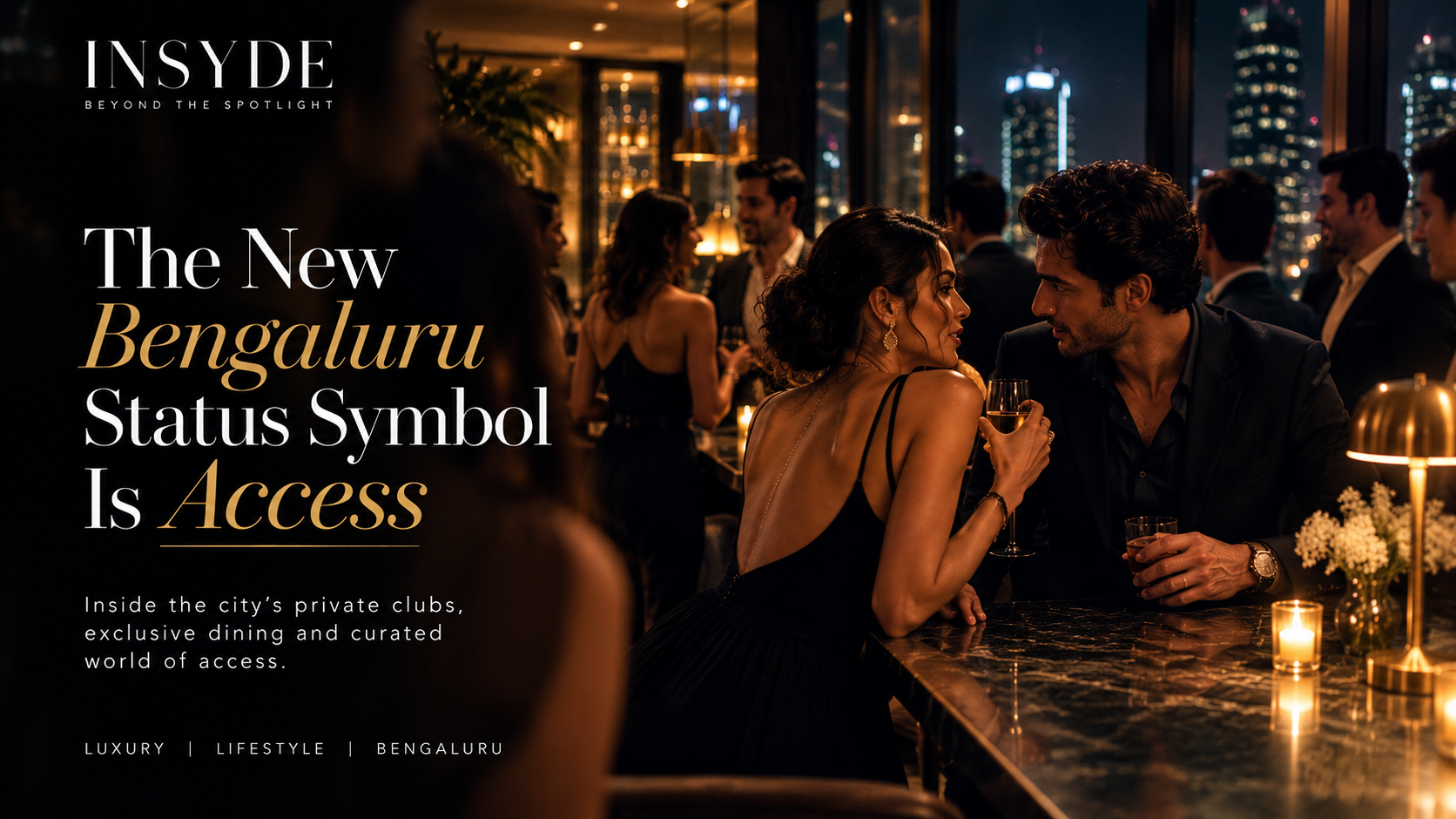
  • The New Bengaluru Status Symbol Is Access

    The New Bengaluru Status Symbol Is Access

    In a city built on networks, wealth is beginning to buy something more elusive than ownership: entry. Private clubs, curated communities, exclusive dining and invitation-only experiences are redefining what luxury means in Bengaluru.

    For a long time, luxury had a fairly recognisable vocabulary.

    A larger home. A more expensive car. A watch that could be recognised across a room. A restaurant reservation that was difficult to secure.

    The symbols were visible.

    But Bengaluru is developing a different relationship with status.

    Increasingly, some of the city’s most desirable experiences are defined not by what they cost, but by who can enter.

    A private room. A members-only club. A dining experience with limited seats. A wellness space built around a carefully selected community. An invitation that does not arrive simply because you can afford it.

    The product is no longer only the place.

    It is access to the people, atmosphere and experience inside it.

    And in Bengaluru—a city whose modern economy has been built on networks, founders, investors and professional connections—that distinction is becoming particularly significant.

    From Ownership to Access

    Luxury has always involved scarcity.

    What is difficult to obtain tends to become more desirable.

    But modern luxury is increasingly moving beyond physical scarcity towards social scarcity.

    There may be thousands of luxury apartments in a city. There may be hundreds of premium restaurants. But there are far fewer rooms where entry is controlled, the community is curated and the experience changes depending on who is sitting around the table.

    That is the appeal of the modern members’ club.

    The idea itself is not new. Bengaluru has long had established clubs with histories, traditions and membership structures of their own. What is changing is the proposition being built for a newer generation.

    The new club is less likely to be defined solely by sport or tradition and more likely to combine hospitality, dining, wellness, work, culture and social life.

    In other words, it is selling a way of belonging.

    The Room Is the Product

    This is where the economics of access become interesting.

    A beautiful building can be replicated.

    A restaurant can be copied.

    A spa can be recreated.

    But a community is considerably harder to reproduce.

    That is why the most sophisticated membership concepts increasingly place the member at the centre of the proposition.

    Bengaluru has begun to see luxury hospitality groups and independent operators experiment with members-only environments that combine dining, meetings, social occasions, wellness and curated experiences.

    The distinction is subtle but important.

    The club is no longer simply the building.

    The room is the product.

    The people in it determine its energy.

    The conversations determine its value.

    The relationships determine whether members return.

    And the exclusivity determines whether the experience remains desirable.

    Why Bengaluru?

    Bengaluru may be uniquely suited to this model.

    The city has produced an enormous amount of first-generation wealth through technology, entrepreneurship, venture capital and the startup ecosystem.

    But wealth does not automatically create community.

    A founder can build a company from a laptop.

    An executive can work with teams across five time zones.

    An investor can conduct an entire business relationship without leaving a screen.

    The more digitally connected professional life becomes, the more valuable physical spaces for meaningful interaction can become.

    This is one reason the new generation of private clubs is less interested in simply offering a place to sit.

    It wants to create a reason to stay.

    To meet.

    To return.

    To know the people around you.

    To become part of something that exists beyond the transaction.

    The Evolution of the Private Club

    Traditional clubs were often built around institutions: golf, sport, professional associations, family connections and long-established social networks.

    The newer generation is being built around interests and identity.

    Entrepreneurship.

    Design.

    Food.

    Wellness.

    Art.

    Technology.

    Culture.

    Or simply a particular understanding of how people want to spend their time.

    That distinction matters in Bengaluru.

    The city is full of people who arrived without inherited networks and built their own.

    Now, a new generation of businesses is attempting to build physical spaces around those networks.

    The result is a different kind of exclusivity.

    Less about lineage.

    More about relevance.

    Luxury Without the Logo

    The rise of access-based luxury also reflects a broader change in how affluent consumers think about status.

    A logo can demonstrate what you own.

    Access demonstrates where you belong.

    That difference matters.

    The most interesting luxury experiences increasingly do not need to announce themselves.

    A discreet entrance.

    A familiar face at reception.

    A reservation that never appears on a public booking platform.

    A room where the atmosphere depends as much on the people inside it as the interiors around them.

    This is luxury stripped of some of its traditional theatre.

    It is quieter.

    More personal.

    And often considerably more difficult to replicate.

    When Going Out Becomes an Experience

    The same logic extends beyond private clubs.

    Bengaluru’s premium hospitality scene is increasingly built around experiences rather than simple consumption.

    Consider the growing appeal of chef-led dinners, limited-seat culinary events, private tastings and highly curated hospitality experiences. The meal remains important, but it is no longer the entire proposition.

    The chef matters.

    The room matters.

    The guest list matters.

    The rarity matters.

    The memory matters.

    Luxury dining is increasingly operating in the same territory as fashion, entertainment and culture: people are paying for participation in a moment.

    That moment might last two hours.

    Its perceived value can last much longer.

    Wellness Becomes Social

    Perhaps the most revealing evolution is happening in wellness.

    Traditionally, wellness was private.

    A gym membership. A spa appointment. A personal trainer.

    The newer model turns wellness into a social environment.

    Across Bengaluru, emerging premium wellness concepts are beginning to combine health, recovery, social interaction and curated membership rather than treating wellness as a purely individual pursuit.

    The proposition is telling.

    Wellness is no longer being sold only as something you do for yourself.

    It is becoming something you belong to.

    That is a distinctly modern version of luxury.

    Access as a Business Model

    For businesses, this shift is significant.

    Membership creates something ordinary hospitality often struggles to build: a recurring relationship.

    A restaurant has a customer.

    A hotel has a guest.

    A club has a member.

    That difference changes the economics.

    A member can generate recurring revenue, attend events, dine repeatedly, bring guests, participate in programming and become part of the community that attracts the next member.

    The physical space becomes the stage.

    The membership becomes the business.

    And the community becomes the moat.

    That is why the most valuable question for a new private club may not be:

    How beautiful is the building?

    It may be:

    Who will be in the room?

    The New Currency of Bengaluru

    There is an irony to all of this.

    Bengaluru built its modern economy around connectivity.

    Now, some of its most premium experiences are being designed around controlled connectivity.

    Not everyone.

    Not everywhere.

    Not all the time.

    Just the right people, in the right room, at the right moment.

    That is the new appeal of exclusivity.

    And perhaps that is why access is becoming more valuable than another object sitting on a shelf.

    You can buy a watch.

    You can buy a house.

    You can buy a car.

    But you cannot simply buy a community with chemistry.

    You have to be admitted into one.

    Beyond Ownership

    Bengaluru’s luxury story is entering another chapter.

    The first was about accumulation.

    Then came the desire for better design, better homes and better experiences.

    Now comes something more intangible.

    Belonging.

    The next generation of luxury businesses will not necessarily compete by offering more.

    They will compete by offering something fewer people can have.

    A room.

    A relationship.

    A conversation.

    A moment.

    An invitation.

    Because in a city where almost everything is connected, the ultimate luxury may be deciding who gets access.

    — INSYDE Editorial

  • Your Next Escape

    Your Next Escape

    10 exceptional destinations to experience from September to December.

    There is a difference between having the freedom to travel and knowing when to go.

    The most discerning travellers understand it.

    A destination in the wrong season can feel crowded, overheated or strangely ordinary. The same place at precisely the right moment can become something else entirely — quieter, more intimate, more beautiful.

    That is the idea behind The Luxury Season.

    September through December is one of the most interesting periods on the global travel calendar. The Mediterranean begins to exhale after summer. East Africa enters one of its great safari periods. Japan moves into autumn. The Southern Hemisphere welcomes spring. And by December, the world divides between alpine winter and tropical escape.

    For the modern luxury traveller, the question is no longer simply where to go.

    It is when the destination becomes worth going to.

    Here are ten places where timing can transform the experience.


    01 — MALLORCA, SPAIN

    The Mediterranean, after the crowds.

    Mallorca is often associated with the height of summer.

    But September reveals a more refined version of the island.

    The sea remains warm, the days are still generous, and the intensity of peak-season travel begins to soften. Recent luxury-travel advisers have specifically highlighted September and October as an attractive period for Mallorca, when summer crowds ease while the island retains its Mediterranean appeal. (Forbes)

    This is the moment to explore the Serra de Tramuntana, disappear into the villages around Deià, take a long lunch overlooking the coast and spend an afternoon in a quiet cove rather than a crowded beach club.

    Mallorca’s luxury is not necessarily found in extravagance.

    It is found in knowing where the island becomes quiet.

    Best for: Mediterranean design, gastronomy, coastal escapes and slow travel.

    Ideal window: September to early October.


    02 — TANZANIA

    Luxury at the edge of civilisation.

    There are luxury hotels where the experience begins at the door.

    Then there are places where luxury means being somewhere that feels completely removed from ordinary life.

    Tanzania belongs to the second category.

    The country’s official tourism authority places the Great Migration among its defining experiences and highlights its national parks and wildlife safaris as central to the destination. (Tanzania Tourism)

    September sits within the dry season and remains a particularly compelling period for northern Tanzania, when wildlife viewing can be excellent and the migration continues to shape the landscape.

    But the real attraction is not simply the animals.

    It is the silence.

    The enormous horizon.

    The early-morning light.

    The feeling that civilisation is temporarily very far away.

    A private safari vehicle. A remote lodge. Dinner beneath an open sky.

    This is luxury without excess.

    Nature becomes the architecture.

    Best for: Safari, wildlife, wilderness and complete disconnection.

    Ideal window: September.


    OCTOBER

    03 — KYOTO, JAPAN

    Where luxury is found in detail.

    Kyoto doesn’t need to announce itself.

    Its appeal lies in restraint: gardens composed over centuries, traditional architecture, craftsmanship, cuisine, temples and the quiet precision of Japanese hospitality.

    Autumn makes that character even more pronounced.

    Kyoto’s official tourism guide identifies September through November as its autumn season, with October remaining relatively warm before temperatures fall in November. The city’s autumn colours generally begin appearing toward the end of October and often reach their peak around mid-November, although timing varies by year and location. (Kyoto Travel)

    For the luxury traveller, Kyoto offers something increasingly rare:

    refinement without excess.

    A private cultural experience.

    A traditional ryokan.

    An intimate kaiseki dinner.

    A garden before the crowds arrive.

    The luxury is not necessarily in what you can purchase.

    It is in how closely you are allowed to experience a place.

    Best for: Art, architecture, craftsmanship, cuisine and cultural immersion.

    Ideal window: Late October through November.


    04 — PATAGONIA, CHILE

    The luxury of having nowhere else to be.

    Patagonia doesn’t compete for attention.

    It simply occupies an extraordinary amount of space.

    October marks the beginning of spring in the Southern Hemisphere, making it an appealing period for travellers drawn to dramatic landscapes, wilderness and outdoor exploration. Luxury travel specialists also identify Patagonia as a key October destination in the Southern Hemisphere. (Lightfoot Travel)

    Here, luxury is not about having more.

    It is about needing less.

    Less noise.

    Less traffic.

    Less obligation.

    A remote lodge overlooking the mountains. A long walk through wilderness. Dinner beside enormous windows as the landscape disappears into evening.

    Patagonia offers a rare commodity:

    space without interruption.

    Best for: Wilderness, adventure, photography and remote luxury.

    Ideal window: October to November.


    05 — AMALFI COAST, ITALY

    Italy, after the spotlight fades.

    The Amalfi Coast is one of the world’s most recognisable luxury destinations.

    That recognition, however, comes with a seasonal price.

    In the height of summer, Positano, Amalfi and Ravello can become intensely busy. By October, the rhythm begins to change.

    The coast becomes slower.

    The light becomes softer.

    The experience becomes less about seeing everything and more about staying somewhere long enough to appreciate it.

    This is the moment for coastal drives, long lunches, Ravello gardens, quiet evenings and — when conditions allow — seeing the cliffs from the water rather than from the crowded roads.

    The Amalfi Coast does not need more glamour.

    It needs space to reveal it.

    Best for: Gastronomy, architecture, coastal drives and Mediterranean living.

    Ideal window: October.


    NOVEMBER

    06 — BHUTAN

    When less becomes the ultimate luxury.

    Bhutan offers a completely different definition of luxury.

    It is not a destination built around excess.

    It is built around perspective.

    The Himalayas provide the setting, but the deeper attraction is the relationship between landscape, culture, spirituality and architecture.

    A monastery at first light.

    A mountain trail without a crowd.

    A traditional meal.

    A lodge where the landscape remains the most important feature in the room.

    Bhutan represents an idea that is becoming increasingly important in modern luxury:

    the value of restraint.

    The greatest experience may not be something you purchase.

    It may be the feeling of having temporarily stepped outside the pace of contemporary life.

    Best for: Culture, mountains, spirituality and meaningful slow travel.

    Ideal window: November.


    07 — THE SEYCHELLES

    Privacy, perfected by nature.

    Some destinations are built around entertainment.

    The Seychelles is built around escape.

    Granite formations rise from clear water. Forest meets coastline. Islands disappear into the horizon.

    And the most luxurious experience can be remarkably simple.

    A private villa.

    A boat heading toward an empty stretch of coast.

    An afternoon in the water.

    Dinner outside.

    No schedule.

    No obligation.

    The Seychelles represents a version of luxury that is becoming increasingly valuable: the freedom to remove everything unnecessary.

    It is not about collecting experiences.

    It is about having enough time to experience one properly.

    Best for: Privacy, sailing, beaches, wellness and complete escape.

    Ideal window: November into the drier-season transition.


    08 — BUENOS AIRES, ARGENTINA

    For the traveller who prefers a city to a resort.

    Luxury travel does not always require a private island.

    Sometimes it requires a great city.

    November brings spring to Buenos Aires, filling parks and avenues with new colour and giving the city an energetic atmosphere.

    The city rewards curiosity.

    Recoleta.

    Palermo.

    Grand architecture.

    Contemporary design.

    Art.

    Wine.

    Late dinners.

    And the unmistakable energy of a city that refuses to go quietly into the night.

    Buenos Aires is luxury without isolation.

    It is about being close to culture rather than protected from it.

    Because sometimes the most sophisticated way to travel is not to escape the world.

    It is to understand it better.

    Best for: Architecture, art, gastronomy, design and urban culture.

    Ideal window: November.


    DECEMBER

    09 — ST. MORITZ, SWITZERLAND

    Where winter becomes an art form.

    By December, the mood changes completely.

    The Mediterranean fades into the background.

    The Alps take over.

    St. Moritz represents one of Europe’s enduring versions of winter luxury: snow-covered landscapes, private chalets, exceptional hospitality, fine dining and a culture built around the season.

    But the attraction isn’t simply skiing.

    It is the ritual.

    Morning light across the mountains.

    A long lunch after the slopes.

    Tailored winter layers.

    A fireplace at the end of the day.

    Dinner long after the sun has disappeared.

    Alpine luxury has survived because it never needed to chase every new trend.

    It simply refined the experience.

    Best for: Skiing, alpine architecture, gastronomy and winter glamour.

    Ideal window: December through the winter season.


    10 — THE MALDIVES

    The art of disappearing.

    After months of movement, there is something deeply appealing about going nowhere.

    The Maldives offers the ultimate luxury-travel contradiction:

    the destination is extraordinary because there is almost nothing else around you.

    An overwater villa.

    A private stretch of ocean.

    A horizon without a skyline.

    Morning swims.

    Long lunches.

    Sunset without city lights.

    And the rare opportunity to spend several days without needing to know what is happening elsewhere.

    December is already a major travel period for the Maldives; official tourism data recorded a record 224,455 arrivals in December 2025, underscoring the strength of year-end demand. (Visit Maldives Corporation)

    For the traveller who has spent the year moving between cities, meetings and obligations, the Maldives offers something more valuable than entertainment.

    Silence.

    Best for: Privacy, ocean escapes, wellness and complete disconnection.

    Ideal window: December onward.


    THE LUXURY OF TIMING

    The most interesting thing about these destinations isn’t that they are luxurious.

    We already know that.

    The real question is when they become most themselves.

    Mallorca becomes quieter.

    Tanzania becomes wild.

    Kyoto turns into a study in colour.

    Patagonia opens into spring.

    Amalfi slows down.

    Bhutan becomes contemplative.

    The Seychelles becomes an exercise in privacy.

    Buenos Aires comes alive.

    St. Moritz becomes winter theatre.

    The Maldives becomes an escape from everything.

    This is why seasonal travel matters.

    The destination isn’t the entire experience.

    Timing is part of the luxury.


    THE NEW LUXURY OF TRAVEL

    Luxury travel was once largely measured by distance, price and exclusivity.

    How far could you go?

    How much could you spend?

    How exclusive was the resort?

    The modern definition is becoming more personal.

    Luxury can mean having a private guide who understands exactly what interests you.

    It can mean staying somewhere with ten rooms instead of two hundred.

    It can mean arriving before everyone else.

    Or staying after everyone has left.

    It can mean choosing a destination because of its architecture, food, landscape or silence.

    And increasingly, it means having enough time to experience it.

    Time may be the rarest travel luxury of all.


    THE SEASON AHEAD

    The smartest luxury traveller doesn’t simply ask:

    “Where should I go?”

    They ask:

    “When should I go?”

    That distinction changes the entire journey.

    Because the world’s most desirable destinations do not have one identity.

    They change with the light.

    The weather.

    The landscape.

    The crowds.

    The season.

    And the people who arrive — and leave.

    September through December offers some of the year’s most compelling transitions.

    And perhaps that is the real luxury:

    Not simply having the means to go anywhere.

    But having the freedom to choose the right place, at the right time, for the right reason.

    INSYDE — Beyond the Spotlight.

  • THE BMW THAT REFUSED TO DISAPPEAR

    THE BMW THAT REFUSED TO DISAPPEAR

    How a company that nearly fell into Daimler-Benz’s hands reinvented itself — and became one of the world’s defining premium automotive brands.

    Today, the BMW badge carries a certain expectation.

    Performance.
    Precision.
    Design.
    Status.

    For millions of drivers, it represents something more specific than simply owning an expensive car: the idea that luxury should still be felt from behind the wheel.

    But in 1959, BMW was fighting for something much more basic.

    Survival.

    The company was in serious financial difficulty. Its automobile and motorcycle businesses were struggling, and its future independence was in question. Daimler-Benz — the company behind Mercedes-Benz — submitted a time-limited restructuring offer that could have brought BMW under its control.

    At BMW’s Annual General Meeting on 9 December 1959, the proposed takeover was rejected after determined opposition from small shareholders and employees. The offer subsequently expired. BMW remained independent, but its financial crisis was far from over. (BMW Group)

    What happened next would become one of the most remarkable transformations in automotive history.

    BMW didn’t simply survive the crisis.

    It discovered what it could become.


    THE BMW THAT ALMOST BECAME MERCEDES

    The BMW of the late 1950s was a very different company from the one the world knows today.

    It had built beautiful and technically ambitious automobiles, including the 503 and 507, but its larger cars were expensive to produce and difficult to sell profitably. The company was caught between expensive luxury automobiles at one end and smaller, lower-margin products at the other.

    The result was a dangerous financial position.

    By the end of the decade, the possibility of BMW losing its independence was no longer theoretical.

    Daimler-Benz had presented a restructuring proposal.

    The situation reached a dramatic point at the December 1959 shareholders’ meeting. Small shareholders challenged the proposed restructuring, including the valuation assigned to BMW’s brand and workforce. The meeting was adjourned, and the time-limited Daimler-Benz offer expired. (BMW Group Press)

    BMW had escaped.

    But escaping Mercedes was not the same as saving BMW.

    The company still needed a future.


    THEN CAME HERBERT QUANDT

    That future was closely tied to industrialist Herbert Quandt.

    Impressed by the determination of BMW’s shareholders and employees, Quandt increased his investment in the company and backed a restructuring built around keeping BMW independent. Temporary government assistance also helped give the company room to reorganise. (BMW Group)

    The strategy was simple in principle and enormous in consequence:

    BMW would not survive by standing still.

    It needed new products.

    The BMW 700 helped put the company back on a path toward recovery.

    But the decisive breakthrough was still ahead.

    It would arrive in 1961.

    And it would wear a name that would eventually become one of the most important phrases in BMW’s history:

    Neue Klasse.


    THE CAR THAT CHANGED EVERYTHING

    At the 1961 Frankfurt Motor Show, BMW unveiled the BMW 1500.

    It was compact by the standards of the time. Sporty. Modern. Four-door. Engineered around a new approach to performance and everyday usability.

    And people noticed.

    BMW says the car filled a gap in the market and became the breakthrough that established the company as a successful, contemporary automaker. Demand was so strong that initial orders exceeded production capacity. (BMW Group)

    The 1500 was more than a successful model.

    It gave BMW a direction.

    It showed that the company didn’t need to compete by simply building larger, softer or more traditionally prestigious cars.

    It could build something different.

    A premium automobile designed around the person driving it.

    The philosophy was beginning to take shape.


    BMW DIDN’T TRY TO BECOME MERCEDES

    This is where the story becomes more interesting.

    BMW’s great strategic victory wasn’t beating Mercedes at Mercedes’ own game.

    It was refusing to play the same game.

    Mercedes-Benz already had extraordinary heritage, engineering credibility and a powerful association with prestige.

    BMW needed its own territory.

    The Neue Klasse gave it one.

    The company increasingly built its identity around agility, performance, design and the relationship between driver and machine.

    Mercedes could represent arrival.

    BMW could represent the journey.

    That distinction would become incredibly valuable.

    Because BMW wasn’t simply selling another interpretation of luxury.

    It was creating a different one.


    WHEN PERFORMANCE BECAME LUXURY

    Traditional luxury had always been associated with refinement.

    Leather.

    Wood.

    Comfort.

    Silence.

    Status.

    BMW added something else.

    Emotion.

    The driving experience itself became part of the luxury proposition.

    The steering.

    The balance.

    The response of the engine.

    The position of the driver.

    The way the car behaved through a corner.

    These weren’t merely engineering specifications.

    They became part of the emotional value of owning a BMW.

    The brand’s promise of “Sheer Driving Pleasure” eventually gave that philosophy a simple expression — and the roots of that promise can be traced directly back to the Neue Klasse era. (BMW Group)

    BMW had discovered a powerful idea:

    Luxury doesn’t have to separate you from the machine. It can bring you closer to it.


    THE 02 SERIES MADE THE IDEA SCALABLE

    The Neue Klasse created the foundation.

    The 02 Series helped turn that foundation into a brand identity.

    Introduced in the 1960s, the compact two-door models brought BMW’s sporting character to a wider audience. BMW describes the 02 Series as a benchmark for the brand’s approach to combining everyday usability with driving pleasure. (BMW Group)

    This mattered enormously.

    BMW wasn’t creating one successful car.

    It was developing a repeatable philosophy.

    Compact could still be premium.

    Practical could still be exciting.

    Everyday transportation could still have character.

    And that gave BMW something luxury brands desperately want:

    a recognisable point of view.


    THE 3 SERIES CHANGED THE GAME AGAIN

    Then came the car that would turn BMW’s philosophy into a global phenomenon.

    The BMW 3 Series arrived in 1975.

    Compact dimensions.

    Rear-wheel drive.

    Driver-focused ergonomics.

    Sporty proportions.

    Premium quality.

    Everyday practicality.

    BMW describes the 3 Series as the world’s bestselling premium car and says the model has attracted more than 20 million customers worldwide across seven generations. (BMW Group)

    Its importance goes beyond sales.

    The 3 Series made the BMW formula understandable.

    You didn’t have to be a racing driver.

    You didn’t have to own a chauffeur-driven limousine.

    You simply had to enjoy driving.

    That was the genius.

    BMW had taken something traditionally associated with sports cars and integrated it into a practical premium sedan.

    Luxury became something you could experience every morning on the way to work.


    THE MERCEDES RIVALRY BECAME A CULTURAL ONE

    By this point, the relationship between BMW and Mercedes had changed.

    BMW was no longer the company that had nearly been absorbed.

    It was becoming one of Mercedes-Benz’s defining competitors.

    But the rivalry wasn’t simply about price or horsepower.

    It was about identity.

    Mercedes could represent authority, heritage and formal prestige.

    BMW increasingly represented performance, independence and the pleasure of driving.

    Neither interpretation needed to destroy the other.

    In fact, their differences made both brands stronger.

    The competition created a question that would shape the premium automotive market for decades:

    What should a luxury car make you feel?

    BMW had its answer.


    THEN BMW TURNED PERFORMANCE INTO MYTH

    BMW’s relationship with motorsport added another layer to the brand.

    Performance was no longer merely something engineers claimed.

    It could be demonstrated on a track.

    That credibility eventually became central to BMW M.

    Motorsport technology, performance engineering and road-car development began reinforcing one another.

    The M badge became more than a specification.

    It became a symbol.

    That matters in luxury.

    Because luxury consumers don’t only buy features.

    They buy provenance.

    A reason to believe.

    A story that existed before the product arrived.

    BMW had one.


    THE BRAND BECAME PART OF THE PRODUCT

    Eventually, BMW reached a point that every luxury company dreams of reaching.

    The product no longer had to explain the brand.

    The brand explained the product.

    You could recognise a BMW from its proportions.

    Its design language.

    Its cockpit.

    Its grille.

    Its stance.

    And, increasingly, the way it behaved on the road.

    The badge itself had accumulated meaning.

    This is when a manufacturer becomes more than a manufacturer.

    It becomes a brand with a worldview.

    BMW wasn’t simply selling cars anymore.

    It was selling a particular relationship between the driver and the machine.


    BMW DIDN’T BEAT MERCEDES BY COPYING IT

    This is the part of the story that matters most.

    BMW’s eventual success was not built on becoming a cheaper Mercedes.

    It wasn’t built on becoming a louder Mercedes.

    And it wasn’t built on simply offering more luxury features.

    BMW found a different route to desirability.

    It made performance aspirational.

    It made driving part of luxury.

    It turned engineering into emotion.

    And it created a customer who didn’t simply want to be transported.

    They wanted to be involved.

    That distinction became BMW’s competitive advantage.


    FROM SURVIVAL TO GLOBAL POWER

    The transformation took decades.

    The Neue Klasse established the direction.

    The 02 Series broadened the philosophy.

    The 3 Series turned it into a global formula.

    BMW M gave performance a halo.

    The 5 Series and 7 Series expanded the brand into higher segments.

    The X family opened another enormous market.

    And BMW continued evolving as luxury itself changed.

    Today, BMW operates at enormous global scale. In financial year 2025, BMW Group delivered 2.46 million premium vehicles, while BMW M reached a record 213,449 deliveries. (BMW Group Press)

    That doesn’t mean BMW literally “defeated” Mercedes-Benz.

    Mercedes remains one of the world’s most important luxury automotive brands.

    The more significant achievement is that BMW became powerful enough to challenge Mercedes from a completely different position.

    It didn’t need to become Mercedes.

    It built an identity Mercedes couldn’t own.


    THE REAL BMW LUXURY

    That is why BMW’s story is ultimately not about cars.

    It is about positioning.

    A company that was nearly absorbed had to decide what made it worth saving.

    The answer wasn’t simply its factory.

    It wasn’t simply its engineering.

    It wasn’t simply its history.

    It was the possibility of creating something distinctive.

    BMW realised that it could make luxury emotional.

    That it could make engineering desirable.

    That it could make performance aspirational.

    And, most importantly, that independence could itself become part of the brand.


    THE BMW THAT REFUSED TO DISAPPEAR

    In 1959, BMW was fighting to remain independent.

    One year later, Herbert Quandt backed a restructuring that kept the company on its own path.

    In 1961, the BMW 1500 gave that path a product.

    The Neue Klasse gave it a philosophy.

    The 02 Series gave it momentum.

    The 3 Series gave it scale.

    BMW M gave it mythology.

    And the decades that followed turned that philosophy into one of the world’s most recognisable premium automotive brands. (BMW Group)

    That is the extraordinary part of the story.

    BMW didn’t inherit its position at the top.

    It engineered its way there.

    And perhaps the most important lesson is not about automobiles at all.

    When a company is pushed to the edge, the instinct is often to become more like the competitor that appears to be winning.

    BMW did something more difficult.

    It discovered what it could become that its competitor couldn’t.

    It didn’t survive by becoming Mercedes.

    It survived by becoming BMW.

    And that may be the most valuable luxury of all:

    having an identity nobody else can own.

    INSYDE — Beyond the Spotlight.

  • THE SOUND OF LUXURY

    THE SOUND OF LUXURY

    Inside Piaget’s extraordinary new Polo Minute Repeater — where ultra-thin engineering, acoustic precision and hand craftsmanship turn the passing of time into an experience.

    We live in a world where time has become almost impossible to ignore.

    It appears on our phones, our laptops, our cars, our walls and the screens we glance at without thinking.

    And yet, somewhere in Switzerland, Piaget has spent years perfecting a very different idea:

    What if you could hear it?

    The new Piaget Polo Minute Repeater doesn’t need to exist.

    That is exactly what makes it fascinating.

    It takes one of the most demanding complications in mechanical watchmaking and places it inside Piaget’s unmistakably modern Polo — a large 18-karat white-gold watch measuring 48mm across and just 9.30mm thick. Inside sits the self-winding Calibre 1290P, an ultra-thin movement developed, finished and assembled at Piaget’s Manufacture in La Côte-aux-Fées.

    This isn’t simply another complicated luxury watch.

    It is Piaget making an argument about what luxury can still mean when technology has already made everything easier.

    THE MOST UNNECESSARY COMPLICATION MAY BE THE MOST BEAUTIFUL

    A minute repeater is an almost wonderfully irrational piece of engineering.

    Activate it, and the mechanism chimes the time.

    Hours.

    Quarter hours.

    Minutes.

    That’s it.

    Your phone can tell you the same thing instantly.

    But a phone doesn’t need hundreds of mechanical components moving in sequence, carefully tuned hammers, resonating structures and years of accumulated watchmaking knowledge to do it.

    A minute repeater does.

    And that is where the fascination begins.

    Luxury has always been at its most interesting when it moves beyond necessity.

    A private jet isn’t necessary.

    A hand-finished grand complication isn’t necessary.

    A bespoke suit isn’t necessary.

    The point is not efficiency.

    The point is experience.

    The Polo Minute Repeater takes that idea to its most literal conclusion.

    It doesn’t simply show you the time.

    It gives time a voice.

    WHEN A WATCH BECOMES AN INSTRUMENT

    The real achievement isn’t merely making the mechanism chime.

    It is making it sound right.

    Piaget says the 1290P produces 64 decibels of acoustic intensity, with three harmonic partials and a damping factor of 2,600. The hours are struck at G sharp and the minutes at A sharp, both in the fifth octave. The activation slide sits at nine o’clock.

    For someone who doesn’t spend weekends discussing calibres, those specifications may sound unnecessarily technical.

    They are.

    But beautifully so.

    Because they are ultimately about something remarkably simple:

    sound.

    The movement and the case have to work together to create an acoustic experience.

    And suddenly, this isn’t just watchmaking anymore.

    It is a form of mechanical acoustics.

    The watch has to keep time.

    It has to fit inside an extraordinarily thin architecture.

    And then, when asked, it has to perform.

    PIAGET DIDN’T HIDE THE MAGIC

    This is perhaps the most INSYDE-worthy part of the watch.

    Piaget could have hidden the mechanism.

    Instead, it opened the door.

    The Polo Minute Repeater uses a partially openworked dial to reveal parts of the 1290P beneath it. At four o’clock, a smoked-blue sapphire ring sits over the inertia wheel — the dedicated regulator of the minute repeater — while a gold fillet travels across the dial and reveals sections of the mechanism.

    The effect is subtle.

    And that’s important.

    This isn’t skeletonisation for the sake of showing off every gear.

    The mechanism becomes part of the composition.

    The engineering becomes decoration.

    The decoration becomes engineering.

    You aren’t simply looking at the finished object. You’re being invited to understand why it is extraordinary.

    That is a very different kind of luxury.

    THE REAL COST ISN’T GOLD

    The case is made from 18-karat white gold.

    The strap is blue textured calfskin.

    The dial is gold, hand-guilloché and finished with a radiant sunray pattern, with an opaline outer track adding contrast.

    All of that sounds luxurious.

    But none of it is the most valuable material inside this watch.

    That would be time itself.

    Piaget says more than 150 hours went into developing the dial, followed by another 50 hours of hand finishing for each individual piece. The calibre’s bridges are hand-beveled, its mainplate carries guilloché decoration, and its minute-repeater hammers receive a mirror polish.

    Think about that.

    In an era where almost everything is optimised to be faster, Piaget is deliberately creating something that takes longer.

    Much longer.

    And that may be the real luxury story here.

    THE PIAGET PARADOX

    Piaget has been chasing thinness for generations.

    Georges-Édouard Piaget founded the Maison in the Swiss Jura in 1874, with a principle that would become central to its identity: “always do better than necessary.” Ultra-thin watchmaking eventually became one of the defining expressions of that philosophy.

    In 2013, Piaget introduced a minute repeater in the Polo Emperador case that the Maison presented as the world’s thinnest minute repeater at the time. The new Polo Minute Repeater carries that legacy into the contemporary Polo collection.

    And this is where Piaget’s philosophy becomes interesting.

    The goal isn’t simply:

    Can we make a complicated watch?

    The better question is:

    Can we make a complicated watch thinner, more wearable and more beautiful than it has any practical reason to be?

    The 1290P is just 4.8mm thick.

    The complete watch is 9.30mm thick.

    And yet inside that relatively restrained vertical space is an automatic minute-repeating mechanism with roughly 430 components, developed entirely at La Côte-aux-Fées.

    That contradiction is quintessentially Piaget.

    More complexity. Less thickness.

    WHY PUT IT IN A POLO?

    This is where the watch becomes more than a technical exercise.

    The minute repeater is one of traditional watchmaking’s most classical complications.

    The Polo is not.

    Since its arrival in 1979, the collection has represented a more contemporary side of Piaget — defined by its distinctive “shape-in-shape” architecture and its sport-chic identity.

    Putting the two together creates an interesting collision.

    Haute Horlogerie meets modern sports luxury.

    The result is not trying to look like a 19th-century pocket watch transferred onto a wrist.

    It is deliberately contemporary.

    Large.

    Architectural.

    Blue.

    Open.

    And technically serious.

    At 48mm, it is certainly not a watch designed to disappear beneath a shirt cuff.

    It wants to be noticed.

    But the thing worth noticing isn’t simply the size.

    It’s the contradiction:

    A sports watch carrying one of traditional watchmaking’s most demanding complications — while remaining only 9.3mm thick.

    FIVE WATCHES. NOT BECAUSE THEY HAD TO BE LIMITED.

    Only five numbered pieces of the Polo Minute Repeater are being crafted this year.

    But Piaget makes an interesting distinction.

    It isn’t presenting the watch as a conventional limited edition.

    The number is a consequence of the work required to make each piece.

    That difference matters.

    Luxury brands have become extremely good at creating scarcity.

    Five pieces can be a marketing strategy.

    But when five pieces are the natural result of hundreds of hours of specialist work, scarcity becomes something else.

    It becomes a by-product of craftsmanship.

    And perhaps that is a more convincing form of exclusivity.

    You aren’t being told that only five exist because five sounds exclusive.

    You’re being told that only five can realistically emerge from this level of human involvement.

    THEN PIAGET MAKES IT EVEN MORE EXTREME

    There is also a High Jewellery version.

    The bezel is set with baguette-cut blue sapphires, while the case combines baguette-cut and brilliant-cut diamonds. The dial is fully openworked, putting more than 70 hours of handcraft directly on display.

    It is almost excessive.

    And that’s the point.

    Piaget has never been particularly interested in choosing between watchmaking and jewellery.

    The Maison has historically operated comfortably in both worlds.

    Here, the two are fused into a single object:

    mechanical complexity beneath jewellery-level finishing, with sound as the final element.

    It doesn’t just ask to be seen.

    It asks to be heard.

    IN A WORLD OF SMARTWATCHES, PIAGET CHOSE SOUND

    There is an amusing irony to all of this.

    The smartwatch era has made watches smarter than ever.

    They track health.

    Messages.

    Calls.

    Maps.

    Markets.

    Flights.

    Sleep.

    The weather.

    The mechanical watch has responded by becoming something else entirely.

    An object of emotion.

    Craft.

    History.

    Identity.

    And now, with the Polo Minute Repeater, perhaps even theatre.

    Because the experience isn’t about information.

    You already know the time.

    The experience is the moment you activate the slide and the watch begins to speak.

    For a few seconds, you are not checking the time.

    You are experiencing it.

    That distinction is becoming increasingly important in luxury.

    THE REAL LUXURY IS TIME SPENT

    The most interesting thing about the Piaget Polo Minute Repeater isn’t the 48mm case.

    It isn’t the white gold.

    It isn’t even the complication.

    It is the philosophy behind the object.

    Someone decided that it was worth spending weeks finishing hundreds of components by hand so that a watch could perform something a phone can do instantly.

    Someone decided that the mechanism should be thin.

    Someone decided that parts of it should be visible.

    Someone decided that the sound itself had to be engineered.

    And someone decided that five watches a year was enough.

    None of those decisions were necessary.

    That is precisely why they matter.

    Modern luxury increasingly revolves around access — who can enter, who can own, who can experience, who can get there first.

    But there is another kind of exclusivity.

    The exclusivity of time.

    The time required to learn a craft.

    The time required to make something by hand.

    The time required to wait for something that cannot be rushed.

    And eventually, the time required to stop what you’re doing and simply listen.

    The Piaget Polo Minute Repeater doesn’t make time more useful.

    It makes it more memorable.

    And perhaps that is the point.

    In a world where technology has taught us to save every second, Piaget has created a watch that asks us to spend a few of them differently.

    Listening.
    INSYDE – Beyond the Spotlight

  • How Sabyasachi Changed the Indian Bridal Wardrobe

    How Sabyasachi Changed the Indian Bridal Wardrobe

    The Sabyasachi bride became more than a customer. She became a template—and eventually, one of the most recognisable visual identities in Indian fashion.

    There was a time when an Indian bride could be described by a checklist.

    A sari in one region. A lehenga in another. Gold jewellery. Red somewhere in the picture. Family traditions deciding much of the rest.

    Then the Indian wedding became something else.

    More photographed. More televised. More consumed online. More aspirational.

    And somewhere in that transformation, the bride acquired a new visual vocabulary.

    Deep colour.

    Hand embroidery.

    Old-world jewellery.

    Long-sleeved blouses.

    High-waisted lehengas.

    A certain kind of sepia-toned grandeur.

    The Sabyasachi bride had arrived.

    The designer did not invent Indian bridal fashion. Far from it. India had centuries of wedding traditions before Sabyasachi existed.

    What he did was more commercially powerful:

    He turned a collection of regional traditions, crafts and memories into a recognisable contemporary luxury aesthetic.

    The bride came after the world

    Sabyasachi’s bridal story did not begin with a wedding obsession.

    It came after years of looking outward.

    After graduating from NIFT Kolkata in 1999, the designer won the Femina British Council Most Outstanding Young Designer Award and travelled to London for an internship and research assignment at the Victoria & Albert Museum. His own account of the experience describes returning to India with a deeper understanding of India’s largely overlooked history of luxury.

    That perspective became important.

    Sabyasachi’s early collections were built around Indian craft and heritage, but they weren’t designed as historical costumes.

    They were contemporary clothes carrying old references.

    That distinction would eventually become the foundation of his bridal business.

    Chand Bibi changes the equation

    Sabyasachi launched his first bridal collection, Chand Bibi, at Lakmé Fashion Week.

    The designer describes the collection as a turning point: after spending years taking Indian fashion to international audiences, he wanted to bring what he considered the best of Indian craft and couture back into the great Indian wedding.

    The idea was deceptively simple.

    Don’t make the Indian bride choose between heritage and modernity.

    Give her both.

    The result was a bridal aesthetic that felt rooted in India’s past while still belonging to the contemporary luxury market.

    That distinction became crucial.

    Because the Sabyasachi bride didn’t look as though she had borrowed her grandmother’s wardrobe.

    She looked as though she had inherited it—and then had it remade for herself.

    Why the Sabyasachi look became so recognisable

    The Sabyasachi silhouette was never just about one garment.

    It was a combination of codes.

    The lehenga.

    The sari.

    The blouse.

    The jewellery.

    The hair.

    The colour palette.

    The embroidery.

    The setting.

    Even the photography.

    Over time, these elements became recognisable enough that the phrase “Sabyasachi bride” could describe an entire visual world.

    Vogue India has noted the designer’s influence on bridal dressing, including the high-waisted lehenga, long-sleeved blouse, conservative neckline and old-world embroidery associated with his aesthetic.

    The important word here is associated.

    A designer becomes influential when people begin recognising the design language even before they see the label.

    That is what happened.

    The colour of memory

    Sabyasachi’s bridal palette also helped distinguish him.

    Instead of relying exclusively on the predictable bright bridal red, his world expanded into deep maroons, greens, browns, pinks, muted golds and jewel tones.

    The colours felt less like a seasonal fashion palette and more like something discovered in an old photograph.

    That was part of the appeal. The bride wasn’t simply buying a beautiful outfit.

    She was buying an atmosphere.

    And atmosphere is powerful in luxury. Because clothes eventually leave the wedding.

    The photograph stays.

    The jewellery was never an afterthought

    Another reason the Sabyasachi bride became so complete was the relationship between clothing and jewellery.

    The house eventually built its own jewellery business, developing a language that combines Indian heritage with influences including North Calcutta and Byzantine art. Sabyasachi also introduced a branded mangalsutra, reinterpreting the traditional wedding necklace for a contemporary luxury audience.

    This mattered because the designer was no longer dressing only the body.

    He was shaping the entire frame.

    The blouse.

    The sari.

    The necklace.

    The earrings.

    The hair.

    The photographs.

    The wedding.

    Everything could belong to one visual universe.

    Luxury brands have long understood the power of this kind of total look.

    Sabyasachi applied it to the Indian wedding.

    Then celebrity weddings changed everything

    The Indian wedding was already important.

    Celebrity weddings made it culturally explosive.

    When a prominent bride chooses one designer across multiple wedding events, the designer is no longer simply supplying clothing.

    The designer is helping define the visual identity of the wedding itself.

    Vogue India has written about the emergence of this phenomenon in India, where celebrity couples increasingly wear the same designer across wedding events, giving the designer an opportunity to dictate the season’s bridal mood board.

    That is an extraordinary amount of cultural influence.

    One wedding can generate hundreds—or thousands—of photographs.

    Those photographs circulate through Instagram, newspapers, fashion magazines, wedding platforms and WhatsApp groups.

    The bride becomes the campaign.

    And the campaign becomes inspiration for the next bride.

    That is how an aesthetic spreads.

    The copy market is part of the story

    There is an uncomfortable compliment embedded in Sabyasachi’s success.

    His bridal designs became widely copied.

    The designer himself has spoken about the replication of his work and the enormous copy market surrounding it.

    From a business perspective, imitation is a problem.

    From a cultural perspective, it is evidence of influence.

    When a design vocabulary becomes so familiar that customers want versions of it at different price points, the designer has moved beyond fashion.

    The aesthetic has entered popular culture.

    You no longer need to buy the original to recognise the original.

    The bride became the brand

    This is where Sabyasachi’s bridal story becomes particularly interesting.

    Most fashion brands sell garments.

    Sabyasachi increasingly sold a version of the bride.

    She was romantic, but not delicate.

    Traditional, but not conservative.

    Luxurious, but not necessarily minimalist.

    Indian, without needing to explain herself.

    And importantly, she looked good in photographs.

    That last point cannot be underestimated.

    The modern Indian wedding is also a media event.

    The clothes have to work in person, under cameras, on Instagram, in videos, in family albums and in the imagination of everyone watching from outside.

    Sabyasachi’s clothes were built for that ecosystem.

    The wedding became a luxury platform

    The modern Indian wedding is increasingly an ecosystem of luxury industries.

    Fashion.

    Jewellery.

    Beauty.

    Hospitality.

    Décor.

    Photography.

    Travel.

    Food.

    Entertainment.

    Sabyasachi sits at the intersection of several of them.

    That is why his bridal business became larger than bridalwear.

    A bride buying a Sabyasachi lehenga enters a world that can include jewellery, accessories and eventually other expressions of the brand.

    The house itself has expanded into couture, ready-to-wear, jewellery, accessories and other categories.

    The wedding became an entry point.

    The house became the destination.

    But has the Sabyasachi bride changed?

    Yes.

    And this may be the most interesting part.

    The contemporary Indian bride is not necessarily looking for one rigid definition of tradition.

    Vogue India’s reporting on a newer generation of brides points toward a desire for balance: tradition and individuality, family and personal identity, the past and the present.

    That creates an interesting challenge for Sabyasachi.

    The aesthetic that once felt rebellious because it rejected generic modernity has itself become recognisable.

    The Sabyasachi bride is now a tradition.

    So what happens when the rebellion becomes the template?

    The answer may already be visible in the house’s recent work.

    At its 25th-anniversary show in Mumbai in 2025, Sabyasachi moved beyond a straightforward celebration of bridal codes. The collection mixed saris with trousers, sequins with tailoring, Japanese cotton with pashmina, and traditional craft with references ranging from Frida Kahlo to Madonna.

    The house was reminding its audience that Sabyasachi was never supposed to mean only weddings.

    The next Sabyasachi bride

    The future of the Sabyasachi bride may therefore be less about a specific lehenga.

    It may be about ownership of heritage.

    A sari worn again.

    A necklace passed down.

    A blouse separated from the lehenga and worn with something else.

    A wedding outfit treated as an heirloom rather than a one-night costume.

    That philosophy fits neatly with the house’s broader emphasis on craftsmanship, longevity and what it calls modern heirlooms.

    And it changes the meaning of luxury.

    The most luxurious garment isn’t necessarily the one that looks newest.

    It may be the one that still matters twenty years later.

    The Sabyasachi bride was never really about the bride

    That may be the secret.

    The designer didn’t simply change what Indian brides wore.

    He changed what a bridal outfit could mean.

    It could be memory.

    It could be status.

    It could be heritage.

    It could be fashion.

    It could be a family object.

    It could be a photograph.

    And it could be luxury.

    The Sabyasachi bride became powerful because she represented all of those things at once.

    The question now is whether the next generation will continue to want the same image—or whether it will take the Sabyasachi vocabulary and make it its own.

    Because fashion has a strange habit.

    First, someone creates the look.

    Then everyone wants the look.

    And finally, someone has to reinvent it.

    — INSYDE