
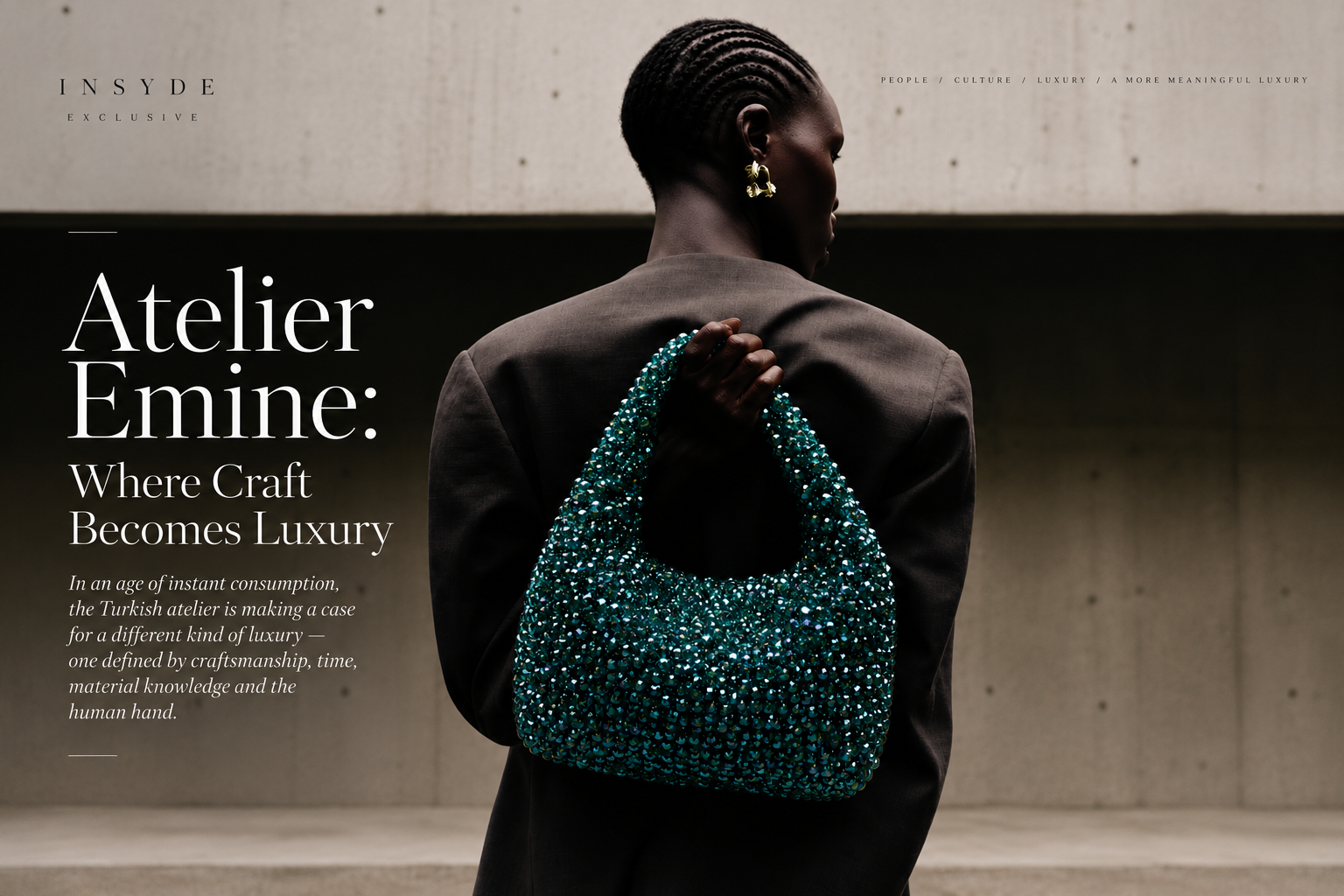
In an age of instant consumption, the Turkish atelier is making a case for a different kind of luxury — one defined by craftsmanship, time, material knowledge and the human hand.
Luxury has always had its codes.
Precious materials. Recognisable silhouettes. Objects whose value is often understood before they are even touched.
But there is another way to think about luxury — one that is less concerned with what an object announces and more interested in what it contains.
The time behind it. The technique. The knowledge required to make it. The hands that shaped it.
This is where Atelier Emine becomes particularly intriguing.
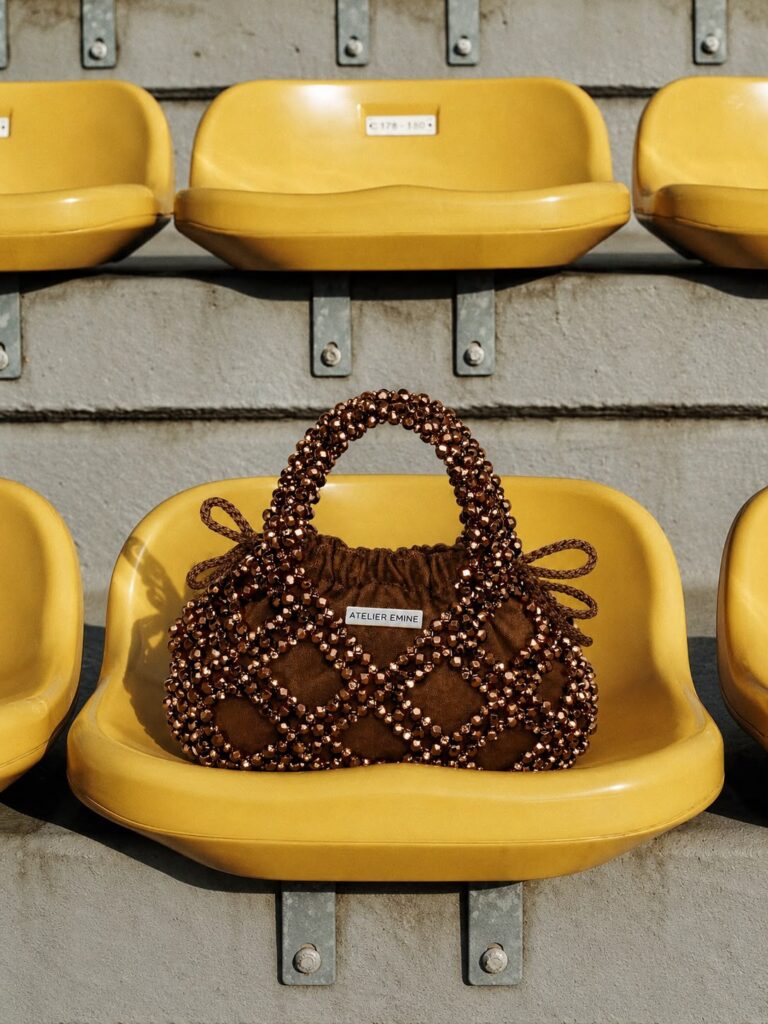
The Türkiye-based atelier creates handcrafted handbags using an unconventional combination of materials including crystal, mother-of-pearl, pearls, wood and velvet. At the foundation of these pieces is monofilament, worked together with the materials through specialised weaving and knotting techniques.
The result is visually striking, but the most interesting part of the construction is not necessarily the part the eye notices first.
The monofilament remains visually subtle, allowing the materials themselves to become the language of each piece. Yet beneath those surfaces is a method of making that is central to the identity of the object.
For Atelier Emine, the construction is not simply functional. It is part of the design.
And that opens up a larger question: what exactly makes a luxury object luxurious?
When Craftsmanship Creates Rarity
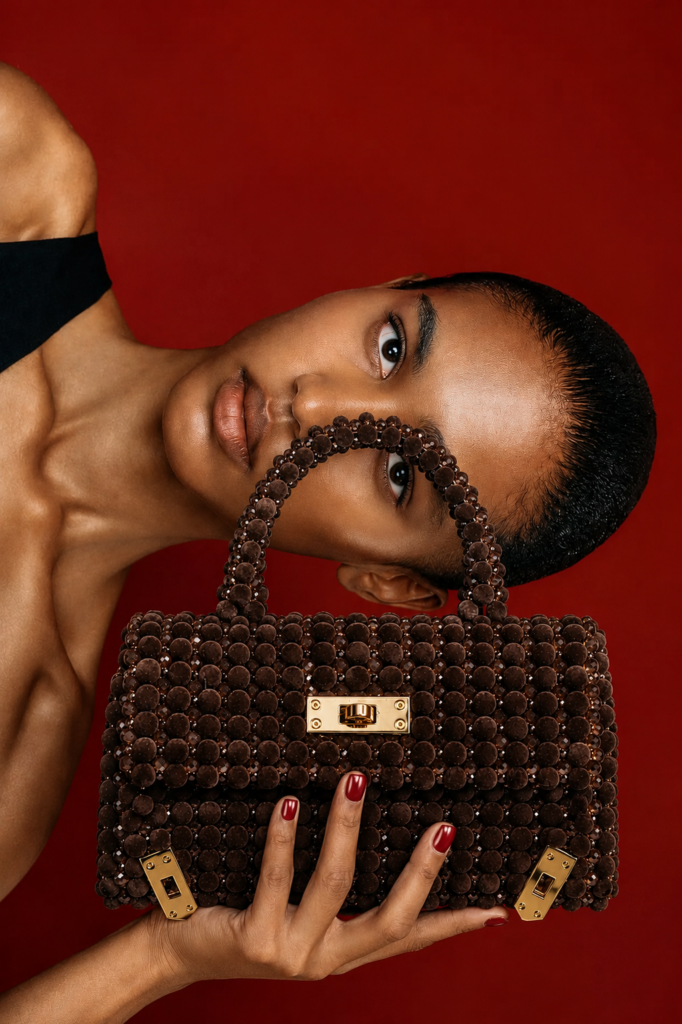
Luxury has traditionally placed considerable emphasis on the value of materials.
Gold, precious stones, fine leather and rare textiles have long served as shorthand for exclusivity.
Atelier Emine approaches rarity from another direction.
“We believe craftsmanship itself can create rarity,” the atelier tells INSYDE.
Its pieces are produced in limited quantities and handmade in a private workshop in Türkiye, where individual materials are carefully worked and brought together through specialised techniques.
The distinction is important.
A material can possess inherent value, but craftsmanship can transform that material into something far more personal. The technique, the time involved and the knowledge required to execute it become part of the finished object’s value.
The handbag is no longer simply the result of a production process.
The process becomes part of the luxury.
It is an idea that feels increasingly relevant at a time when so many objects can be reproduced with remarkable speed and consistency.
Where Material Meets Form
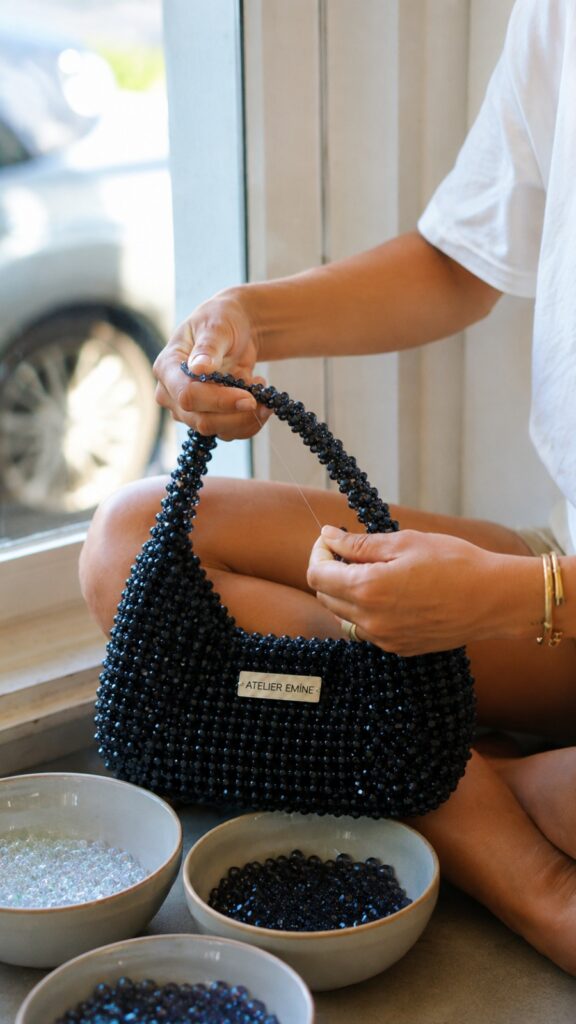
There is no fixed starting point when Atelier Emine develops a piece.
Material, form and idea are allowed to influence one another.
Crystal, velvet, mother-of-pearl, wood and pearls each possess different textures, weights and visual qualities. Rather than treating these materials as decorative elements added after the design is established, Atelier Emine allows them to participate in the construction itself.
“The material influences what the form can become, while the intended form also influences how we work with the material,”
– the atelier explains.
That relationship gives the making process a certain fluidity.
The material is not simply being asked to conform to a predetermined shape. The shape evolves alongside the material and the technique.
It is a subtle shift, but an important one.
Craftsmanship here is not merely about executing a design perfectly. It becomes part of the creative thinking behind the design.
The Beauty of Imperfection
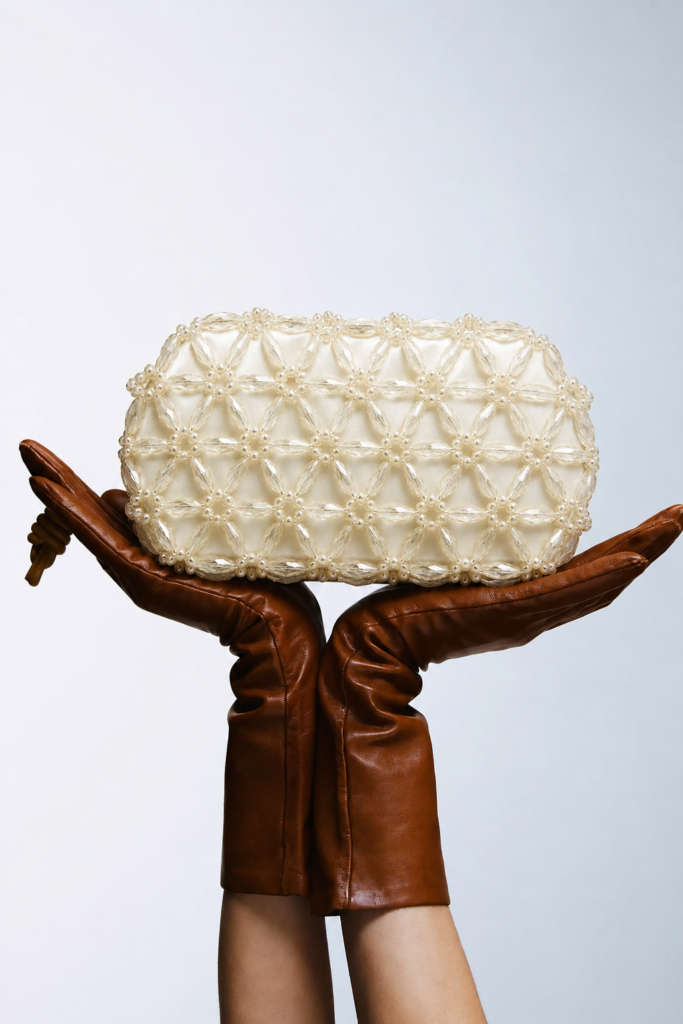
Handmade luxury carries an inherent contradiction.
The human hand is part of its appeal, yet luxury also demands precision.
Atelier Emine sees no need to choose between the two.
Its pieces are entirely handmade, but production is accompanied by careful quality control. Slight variations in tone, texture, form or the arrangement of materials can naturally occur during the process.
Rather than automatically treating these differences as flaws, the atelier sees them as part of the individual character of a handmade piece.
That does not mean precision is abandoned.
Construction, finishing and quality remain essential.
The balance lies in allowing the object to retain its human character without compromising the discipline expected of a luxury piece.
Perhaps that is one of the most compelling qualities of handmade objects today.
In a world increasingly capable of producing perfect uniformity, individuality can become its own form of rarity.
Heritage Without Nostalgia
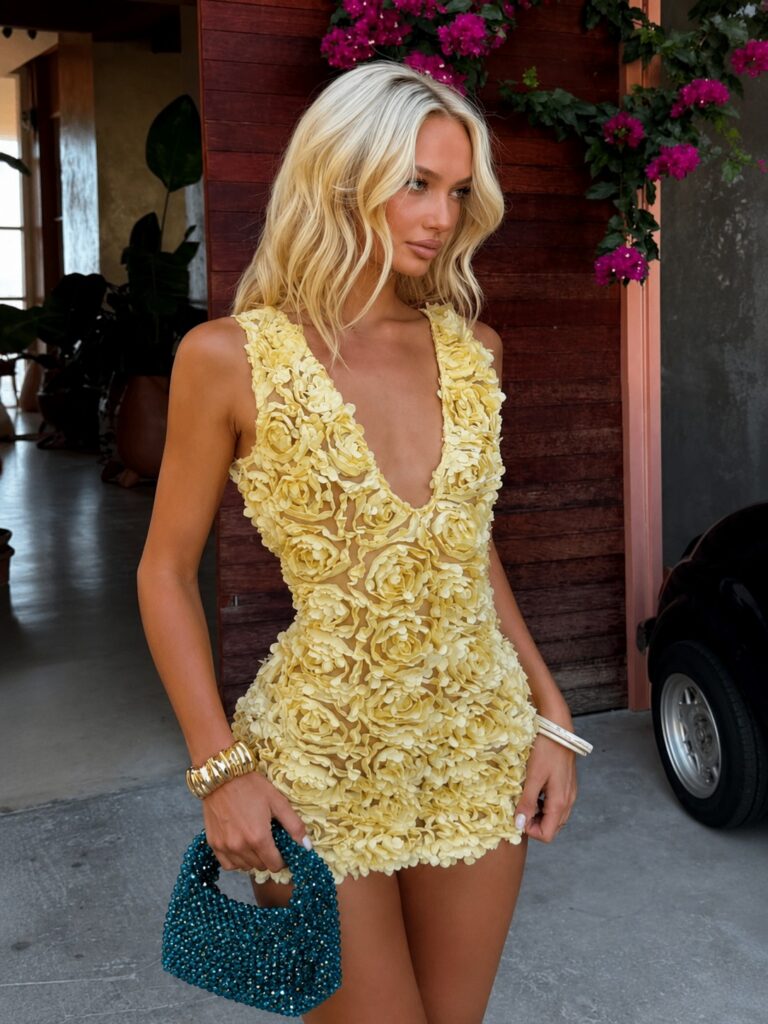
Behind Atelier Emine’s contemporary aesthetic lies a 65-year craft heritage passed down through generations.
But the atelier does not believe heritage needs to look historical.
Instead, it sees heritage in the practices that have survived: specialised techniques, patience, handwork and attention to detail.
“We do not see heritage as something that has to be reproduced as a historical aesthetic,We see it more fundamentally through the practice of craftsmanship.”
– the atelier explains
That distinction allows tradition to move forward.
Heritage can easily become a visual formula — familiar motifs reproduced season after season, or the past transformed into a marketable aesthetic.
Atelier Emine approaches it differently.
The heritage remains in how the object is made, allowing the object itself to remain contemporary.
“Contemporary design is not a departure from craftsmanship,” the atelier says. “It is a way of carrying craftsmanship forward.”
It is a particularly relevant idea in contemporary luxury, where the challenge is no longer simply preserving tradition but finding ways for traditional knowledge to remain meaningful in the present.
The Luxury of Waiting

There is another element of luxury that has become increasingly rare: time.
The culture surrounding fashion and consumer goods has become faster than ever. Trends appear and disappear almost instantly. Digital platforms have made discovery and purchasing almost frictionless.
Handmade objects exist according to another rhythm.
Atelier Emine’s pieces are made to order, with individual models requiring time to complete. The waiting is not positioned as an inconvenience. It is part of the nature of the object.
And perhaps that is where patience begins to take on a new meaning.
When an object takes time to make, that time does not simply disappear once the piece is finished. It becomes part of its story.
The willingness to wait for something carefully made can itself become meaningful in a culture increasingly built around immediacy.
Luxury, in this sense, is not simply about possessing something rare.
It can also be about allowing something to take its time.
Beyond the Traditional Codes of Luxury
Atelier Emine ultimately challenges a familiar assumption: that luxury has to look a certain way.
Its approach does not reject precious materials or established luxury entirely. Instead, it suggests that they are not the only things capable of creating value.
Craftsmanship can create rarity.
Technique can create distinction.
Limited production can create individuality.
Time can become part of an object’s worth.
And unconventional materials can acquire an entirely different significance when transformed through knowledge and handwork.
Look closely at an Atelier Emine piece and the first thing that may capture the eye is the surface — the crystals, colour, texture or form.
Look closer, and another story begins to appear.
The monofilament.
The weaving.
The knotting.
The arrangement of materials.
The subtle variations created by the human hand.
The time.
And the people behind it.
That is perhaps the most compelling idea at the heart of Atelier Emine’s philosophy.
The value of a luxury object does not always have to announce itself.
Sometimes, it asks you to look closer.
Because when everything around us is becoming faster, louder and more immediately recognisable, there is something powerful about an object whose value reveals itself slowly.
Atelier Emine is not simply creating handbags.
It is offering a different way of understanding what luxury can be — one where the material is only the beginning, and where craftsmanship, patience and human knowledge become part of the object itself.
Perhaps the future of luxury is not necessarily about objects that demand attention.
Perhaps it is about objects that reward it.
Made by Hand, Made to Be Remembered.