
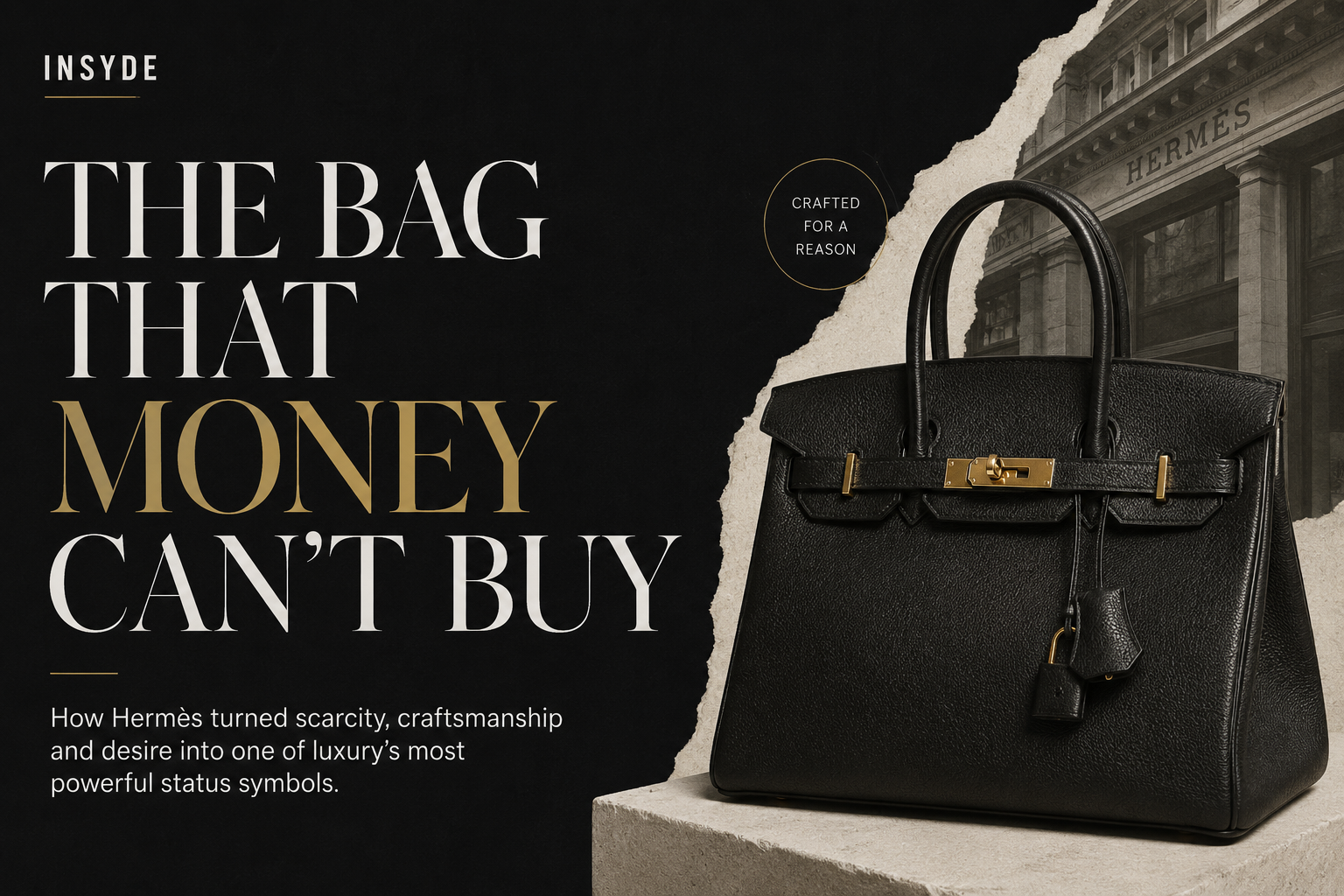
How Hermès turned scarcity, craftsmanship and desire into one of luxury’s most powerful status symbols.
There are handbags that cost hundreds.
There are handbags that cost thousands.
And then there is the Hermès Birkin — a handbag so deeply embedded in the language of luxury that its price is no longer the most interesting thing about it.
The real question is much simpler:
What happens when having the money still doesn’t guarantee that you can have the thing you want?
That is where Hermès becomes fascinating.
Because luxury has traditionally followed a straightforward formula:
More money. Better things.
Hermès built something more complicated:
More money gives you access to luxury. But it doesn’t necessarily give you access to everything.
And that distinction transformed a handbag into something far bigger than a fashion accessory.
The Birkin became a symbol of wealth, yes.
But also of taste.
Scarcity.
Craftsmanship.
Access.
And, perhaps most importantly, desire.
Because when something is difficult to obtain, the price is only the beginning of the story.
THE BAG WAS NEVER DESIGNED TO BECOME A STATUS SYMBOL
The origin of the Birkin is almost too ordinary for the mythology that eventually surrounded it.
In 1984, British actress and singer Jane Birkin found herself seated next to Jean-Louis Dumas, then chairman and chief executive of Hermès, on a flight from Paris to London.
Birkin explained that she couldn’t find a leather bag that worked for her as an everyday carryall.
Dumas listened.
The idea evolved into a new handbag.
The Birkin was born.
There was no grand plan to create one of the world’s most recognisable symbols of extreme wealth.
It began with functionality.
Make it practical.
Make it beautiful.
Make it exceptionally well.
The mythology came later.
And that may be one of the most important details in the entire story.
Because Hermès didn’t begin by manufacturing status.
It manufactured quality.
Status followed.
HERMÈS WAS BUILDING LUXURY LONG BEFORE THE BIRKIN
To understand why the Birkin became so powerful, you have to go back much further.
Hermès was founded in Paris in 1837 by Thierry Hermès, originally as a workshop producing harnesses and other equestrian equipment.
Its early clientele included members of Europe’s wealthy and aristocratic society.
As transportation changed, Hermès changed with it.
The company moved into bags, luggage, silk, fashion, jewellery and other categories while maintaining a central commitment to craftsmanship.
That history matters.
Because the Birkin didn’t create Hermès’ luxury reputation.
Hermès’ reputation created the environment in which the Birkin could become legendary.
The bag arrived with decades of credibility already behind the name.
THE REAL LUXURY IS IN THE MAKING
A Birkin is not valuable simply because it carries the Hermès name.
The construction itself is part of the story.
Hermès leather goods are made by highly trained artisans, with the house emphasising manual craftsmanship and individual attention throughout the production process. The company says leather artisans undergo extensive training before becoming fully qualified.
The leather is selected carefully.
Pieces are cut and prepared.
Edges are finished.
Hardware is fitted.
Stitching is performed by hand.
And the artisan’s work becomes part of the character of the finished bag.
This is important because modern luxury often creates the illusion of infinite choice.
Hermès does something different.
It reminds the customer that human time is finite.
A skilled artisan can only make so many pieces.
A particular material can only exist in a certain quantity.
A particular finish requires a certain amount of attention.
And suddenly, scarcity isn’t just a marketing strategy.
It is built into the production process.
THE DIFFERENCE BETWEEN EXPENSIVE AND EXCLUSIVE
This is where the Birkin story becomes particularly interesting.
An expensive product asks:
Can you afford it?
An exclusive product asks:
Can you get it?
Those are completely different questions.
A wealthy customer can have the financial means to purchase a Birkin and still not be able to walk into a boutique and simply select any model, colour or leather they want.
Availability varies.
Relationships matter.
Specific pieces are limited.
And the exact bag someone wants may not be waiting behind the counter.
That creates a psychological effect that money cannot completely eliminate:
anticipation.
You want it.
You search for it.
You wait.
And the longer the desire survives, the more emotionally valuable the eventual acquisition can become.
WHEN “NO” BECOMES PART OF THE LUXURY
Modern commerce has been built around convenience.
See it.
Click it.
Buy it.
Tomorrow, it’s at your door.
Luxury operates differently.
At its highest level, friction can become part of the experience.
The wait.
The discovery.
The relationship.
The invitation.
The moment when the right piece finally appears.
That is a radical idea in a world obsessed with instant gratification.
Hermès doesn’t need to make the Birkin feel like something everyone can have immediately.
In fact, the opposite can make the product more desirable.
The less ordinary the acquisition feels, the less ordinary the object can feel.
The purchase becomes an event.
THE BOUTIQUE ISN’T JUST A STORE
This is another important distinction.
For most consumer products, the store exists to facilitate the transaction.
In luxury, the environment is part of the product.
The boutique.
The service.
The packaging.
The conversation.
The anticipation.
The feeling of discovering something rather than simply ordering it.
These details matter because luxury is fundamentally emotional.
A customer isn’t only purchasing leather and hardware.
They’re purchasing an experience around the object.
And Hermès has spent generations protecting that experience.
THEN THE BIRKIN BECAME A CULTURAL SYMBOL
The bag’s transformation accelerated as it became associated with celebrities, socialites, entrepreneurs and some of the world’s wealthiest consumers.
Its shape became recognisable.
Its hardware became recognisable.
Its name became recognisable.
The Birkin became something you could identify without seeing the logo.
That is powerful branding.
Hermès didn’t need to cover the bag in enormous symbols.
The silhouette did much of the work.
And this created an interesting form of status:
the people who knew, knew.
The bag could be visible without being loud.
It could communicate wealth without announcing a price.
It could sit quietly on an arm while carrying an enormous amount of cultural meaning.
WHY THE BIRKIN DOESN’T NEED A GIANT LOGO
Modern luxury has spent decades teaching consumers to recognise logos.
Hermès took a different route.
The Birkin’s identity comes from its proportions, construction, hardware, craftsmanship and association with the house.
That makes the bag part of a more sophisticated form of luxury communication.
A large logo says:
Look at the brand.
A recognisable object can say:
If you know, you know.
And that distinction has become increasingly relevant as luxury consumers become more interested in subtlety, provenance and craftsmanship.
The most sophisticated status signal isn’t necessarily the loudest one.
Sometimes it is the thing only a certain audience recognises.
THEN THE SECONDARY MARKET CHANGED THE GAME
The Birkin became even more fascinating when it entered the world of resale and collecting.
Certain colours.
Certain leathers.
Certain sizes.
Certain years.
Exceptional condition.
Rare examples.
All can influence desirability in the secondary market.
Some Birkins have sold for extraordinary sums at auction, particularly rare or historically significant examples.
But there is an important distinction:
A Birkin is not automatically an investment.
The resale market is influenced by condition, provenance, rarity, demand and market conditions.
The existence of a strong secondary market doesn’t guarantee appreciation.
But it does demonstrate something important.
The Birkin can exist simultaneously as:
a handbag,
a collectible,
a status symbol,
and a cultural asset.
That is an extraordinary amount of meaning for an object originally designed to carry personal belongings.
THE PSYCHOLOGY OF SCARCITY
Why does scarcity work?
Because humans don’t always value things according to their practical usefulness.
When something is limited, difficult to obtain or perceived as disappearing, its psychological value can increase.
Luxury brands have understood this for generations.
But scarcity only works when the underlying product deserves desire.
Make something rare without making it desirable and you have nothing.
Hermès combined the two.
Exceptional craftsmanship created the desire.
Limited availability intensified it.
And the result became a self-reinforcing cycle.
Desire creates demand.
Demand reinforces scarcity.
Scarcity increases desirability.
And the cycle continues.
THE MOST POWERFUL WORD IN LUXURY
No.
No mass-market production.
No constant discounting.
No desperate promotions.
No need to make every product available to everyone immediately.
That ability to say no is one of the most powerful tools a luxury brand can possess.
Because the moment a luxury product becomes permanently available at a discount, something changes.
The consumer stops asking:
“Can I get it?”
and starts asking:
“Should I buy it?”
Hermès has spent decades making the first question more important.
And that is incredibly powerful.
WHEN THE BAG BECAME CULTURAL CURRENCY
Eventually, owning a Birkin stopped being solely about owning an exceptional handbag.
It became a form of cultural knowledge.
You could recognise the bag.
Understand the leather.
Understand the construction.
Understand why one version might attract more attention than another.
Understand why rarity matters.
That knowledge becomes part of the luxury experience.
And suddenly, the Birkin communicates something beyond financial capability.
It can communicate:
I know this world.
That’s cultural capital.
And cultural capital is one of the most powerful currencies in luxury.
HERMÈS DOESN’T NEED TO CHASE THE MOMENT
Fashion is built around change.
New season.
New collection.
New trend.
New colour.
New obsession.
Luxury operates on a different clock.
Hermès has the advantage of being able to build on heritage rather than constantly replacing it.
The Birkin doesn’t need to become radically different every season.
Its enduring appeal comes partly from consistency.
The design can evolve.
Materials can vary.
Colours can change.
But the underlying identity remains recognisable.
That gives the brand something most fashion businesses desperately want:
timelessness.
THE BAG MONEY ALONE CAN’T GUARANTEE
This is where the title becomes meaningful.
The Bag That Money Can’t Buy.
Of course money matters.
A Birkin is a luxury purchase, and financial ability is an obvious part of accessing the category.
But money isn’t the entire equation.
There is availability.
There is demand.
There is craftsmanship.
There is scarcity.
There is knowledge.
There is patience.
There is the relationship with the house.
And there is something even more important:
desire.
Because a luxury brand’s greatest achievement isn’t convincing you that you need its product.
It’s convincing you that you want this particular product.
Even when you could buy something else.
WHEN THE WAIT BECOMES PART OF THE PRODUCT
Think about the psychology.
If something arrives tomorrow, you enjoy it tomorrow.
If you’ve spent months wanting something, searching for it and imagining owning it, the moment you finally receive it carries something else:
a story.
The acquisition has emotional history.
You remember the search.
You remember the anticipation.
You remember finally finding it.
And that story becomes part of the object.
This is one of luxury’s greatest tricks:
the journey can become part of the value.
THE BIRKIN ISN’T REALLY ABOUT THE BAG
This is the point where the story becomes bigger than Hermès.
The Birkin reveals something fundamental about modern luxury.
People don’t simply buy objects.
They buy:
identity.
belonging.
recognition.
craftsmanship.
scarcity.
emotion.
And sometimes, they buy the feeling of possessing something that most people cannot simply obtain.
That is why luxury cannot be measured purely by material cost.
A handbag doesn’t become extraordinary because leather suddenly became priceless.
It becomes extraordinary because people collectively decided that it means something.
Hermès understood that better than most.
WHAT HERMÈS REALLY SELLS
It would be easy to say Hermès sells handbags.
It doesn’t.
Not entirely.
Hermès sells craftsmanship.
It sells heritage.
It sells patience.
It sells scarcity.
It sells access.
And, above everything else, it sells desire.
The Birkin is simply one of the most successful containers for all of those ideas.
And that’s why copying the shape isn’t enough.
Another company can make a beautiful leather bag.
Another company can use expensive hardware.
Another company can create limited editions.
But it cannot instantly manufacture decades of heritage.
It cannot manufacture the artisans.
It cannot manufacture the cultural mythology.
And it cannot simply manufacture desire.
That has to be earned.
THE BAG THAT MONEY CAN’T BUY
The Birkin became one of the world’s most powerful luxury symbols because Hermès understood a principle that many brands eventually forget:
Luxury isn’t created by making something expensive.
It’s created by making something desirable, distinctive and difficult to replace.
The craftsmanship matters.
The leather matters.
The history matters.
The scarcity matters.
But the real magic happens when all of those things meet.
Then a handbag becomes something else.
A statement.
A collectible.
A cultural signal.
A piece of personal identity.
And perhaps that is the ultimate lesson of the Birkin.
In a world where almost anything can be bought instantly, luxury has discovered a new form of power:
making you wait for what you already have the money to buy.
Because when money stops being the only barrier between you and the thing you want—
desire becomes the real currency.
And Hermès has spent generations becoming one of the world’s greatest masters of it.
INSYDE — Beyond the Spotlight.