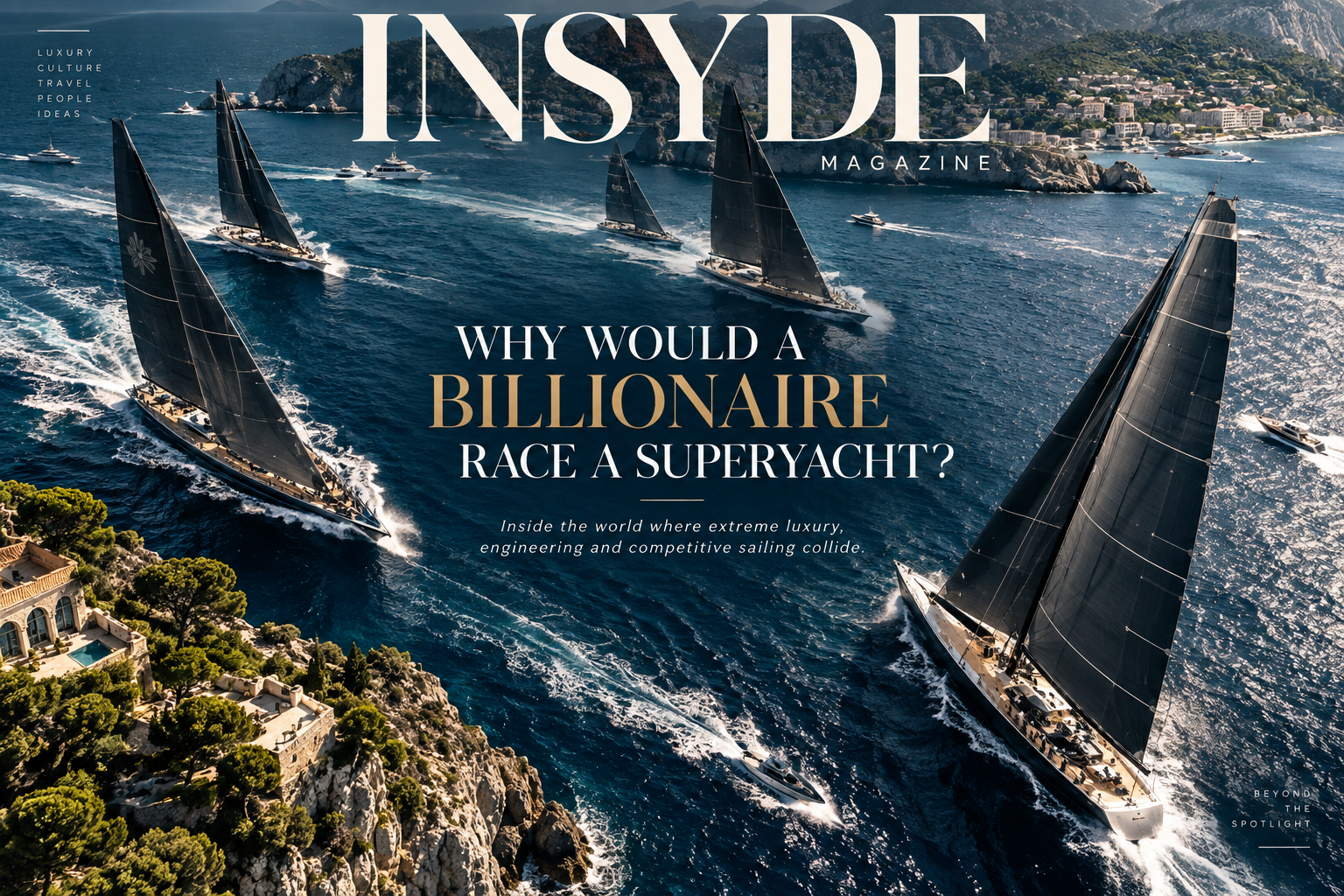
Why are the world’s most luxurious yachts being built to race?
There is a particular contradiction at the heart of contemporary luxury.
A superyacht can take years to design and build, contain craftsmanship more commonly associated with fine watchmaking or haute couture, and serve as a private world at sea. It can offer its owner almost complete control over time, space and movement.
And then, sometimes, that same yacht is taken to the starting line and pushed against others at full speed.
It is an unusual idea: spending millions on creating something extraordinary, only to test it in an environment where performance matters more than possession.
Yet that is precisely what makes superyacht racing so compelling.
In 2026, the world’s elite sailing calendar has once again demonstrated the scale of the phenomenon. The St. Barths Bucket brought together 33 superyacht teams across nine classes, with yachts ranging from 28 to 78 metres and spanning an extraordinary range of designs and performance characteristics. In Mallorca, the 30th anniversary edition of The Superyacht Cup Palma Richard Mille brought 20 yachts to the start line, after the event had sold out its racing places earlier in the year. (Bucket Regatta)
These are not simply gatherings of expensive boats.
They are where craftsmanship meets competition, engineering meets aesthetics, and luxury meets performance.
And increasingly, they offer a glimpse into what luxury itself is becoming.
WHEN LUXURY HAS TO PERFORM
A yacht does not need to race to be impressive.
Its architecture can be extraordinary. Its interiors can be entirely bespoke. Its materials can be selected with the same obsessive attention given to a complicated timepiece. Its itinerary can be dictated entirely by its owner.
But the moment it enters a regatta, the rules change.
Weight matters. Aerodynamics matter. Hull design matters. Sail configuration matters. Weather matters. The crew matters. A tactical decision made seconds too late can cost a race.
At the 2026 St. Barths Bucket, the fleet included everything from 90-foot yachts to Maxi 100 racing boats, as well as large cruising yachts and three-masted schooners. The event’s classes are designed to create competitive racing between yachts with very different characteristics. (Bucket Regatta)
The result is a fascinating reversal of the conventional luxury equation.
At the marina, the yacht is an object of desire.
On the racecourse, it becomes a machine.
And machines have to perform.
THE RISE OF THE LUXURY REGATTA
Superyacht racing occupies a rare space between elite sport and private luxury.
The competition is serious, but the world surrounding it is equally important.
The 30th Superyacht Cup Palma Richard Mille is a perfect example. The event combines competitive racing with an owner-focused social programme, bringing together yacht owners, professional crews, designers, builders and an ecosystem of specialist marine companies. Its 2026 edition ultimately saw Win Win, a 33-metre Baltic yacht, claim the overall title for a third time. (The Superyacht Cup)
That combination is part of the attraction.
The race provides the adrenaline.
The setting provides the lifestyle.
And the community provides something increasingly valuable in the luxury economy: access.
This is not luxury experienced from a distance. It is participation in a highly specialised world where the people designing, building, sailing and owning these yachts occupy the same physical environment.
The yacht becomes the entry point.
The culture around it becomes the experience.
WHERE WATCHMAKING MEETS THE SEA
The involvement of luxury brands makes the relationship even more revealing.
In 2026, Richard Mille became title partner of The Superyacht Cup Palma in a three-year partnership. The relationship is built around a vocabulary familiar to both watchmaking and elite sailing: precision, engineering, performance and innovation. (The Superyacht Cup)
It makes sense.
A high-performance yacht and an advanced mechanical watch may belong to different industries, but they share a philosophy.
Both hide extraordinary technical complexity beneath refined exteriors.
Both depend on precision.
Both demand specialised craftsmanship.
And both appeal to a consumer who increasingly wants to understand how something works, rather than simply recognise what it costs.
That distinction matters.
Luxury is becoming less dependent on the obvious signal of price and more interested in the invisible details that justify it.
The movement inside the watch.
The engineering inside the yacht.
The hours behind the finish.
The expertise behind the performance.
The story is no longer simply the object.
It is everything that makes the object exceptional.
THE SEA AS A TECHNOLOGY LABORATORY
Perhaps the most fascinating part of modern sailing is what happens beneath the surface of the spectacle.
Elite racing has become an extraordinary testing ground for materials, aerodynamics, hydrodynamics, data and control systems.
The pursuit of speed has transformed sailing technology.
SailGP offers perhaps the clearest demonstration. During the 2026 season, six teams had already crossed the 100 km/h threshold, with ROCKWOOL Racing reaching 103.73 km/h at the halfway point of the season. (ussailgp)
At those speeds, the traditional image of sailing begins to disappear.
This is no longer simply wind, sails and water.
It is carbon fibre, foils, sensors, data, aerodynamic efficiency and human reaction working together at extraordinary speed.
Superyacht racing does not necessarily replicate the technology of a SailGP F50, nor should it. The yachts have different objectives, designs and operating philosophies.
But they belong to the same broader ecosystem.
And that ecosystem is changing what a yacht can be.
The yacht is no longer only a vessel for enjoying the sea.
It can also be a laboratory for engineering, design and performance.
THE FASHION OF THE SEA
There is another reason the sailing world feels increasingly relevant to luxury brands: it possesses a visual language that does not need to be manufactured.
A yacht cutting through Mediterranean water.
A sculptural sail catching the wind.
Carbon fibre against polished surfaces.
Technical clothing alongside tailored silhouettes.
Historic yacht designs sharing a harbour with radically modern forms.
It is an environment where sport, fashion, architecture and luxury naturally overlap.
The Giorgio Armani Superyacht Regatta in Porto Cervo is perhaps one of the clearest expressions of that relationship. Held from 26 to 30 May 2026, the event placed a major fashion house directly within the world of elite sailing. (Yacht Club Costa Smeralda)
The significance goes beyond branding.
For luxury houses, these environments provide something increasingly difficult to manufacture: context.
A watch becomes part of a culture of precision.
A fashion house becomes part of a culture of design.
A yacht builder becomes part of a culture of craftsmanship.
The setting does some of the storytelling itself.
And perhaps that is why sailing remains so attractive to luxury.
It communicates exclusivity without having to shout about it.
THE QUESTION OF EXPERIENCE
So why race something that could simply be enjoyed?
Because the definition of luxury is changing.
For decades, luxury was largely communicated through ownership.
The car.
The watch.
The house.
The yacht.
But the contemporary luxury consumer increasingly values what sits behind ownership: access, time, privacy, expertise and experience.
A yacht is valuable because it exists.
But it becomes something else when it gives its owner the ability to cross an ocean, explore remote places, gather people together or compete at sea.
Racing adds another dimension.
Participation.
You are no longer simply looking at an extraordinary object.
You are testing it.
Learning it.
Working with it.
Trying to make it perform better.
That is a very different relationship with luxury.
THE YACHT AS IDENTITY
There is also something deeply personal about racing.
Two yachts can sit beside each other in the same harbour and represent completely different ideas of luxury.
One may be designed around speed.
Another may celebrate traditional craftsmanship.
Another may be built around cutting-edge technology.
Another may be a modern interpretation of a classic sailing yacht.
The yacht becomes an extension of its owner’s taste.
Not merely through the colour of the interiors or the materials used, but through the philosophy behind the vessel and the way it is used.
That is particularly relevant to the next generation of luxury consumers.
Individuality is becoming more important than uniform status.
The question is no longer simply:
How much did it cost?
It is:
Why this one?
Why this designer?
Why this material?
Why this technology?
Why this experience?
Racing gives those questions somewhere to go.
BEYOND THE STATUS SYMBOL
The superyacht has long been one of the world’s clearest symbols of extreme wealth.
But reducing it to a status symbol misses what is actually happening around the category.
The most compelling yachts increasingly represent an intersection of disciplines.
Naval architecture.
Industrial design.
Engineering.
Hospitality.
Art.
Technology.
Craftsmanship.
And now, increasingly, sport.
The 2026 St. Barths Bucket illustrated the diversity of this world particularly well. Its fleet included large sailing yachts displacing hundreds of tonnes alongside smaller, faster racing designs, all competing within a carefully structured handicap system. The event’s final race was ultimately cancelled because of high winds, with the previous day’s scores becoming the final results. (Bucket Regatta)
That detail is revealing.
For all the technology and wealth involved, the sea still gets the final word.
Weather cannot be bought.
Wind cannot be commanded.
And the most sophisticated yacht in the fleet still has to work with nature.
That tension is part of the romance.
THE NEW LUXURY IS PERFORMANCE
Perhaps that is why superyacht racing feels so relevant now.
Luxury is no longer only about accumulation.
It is increasingly about meaningful experience.
The most interesting objects are not necessarily the largest or most expensive. They are the ones with a reason to exist beyond their price.
A watch that demonstrates extraordinary mechanical expertise.
A car engineered around performance.
A fashion piece built around exceptional craftsmanship.
A yacht designed not only to entertain, but to sail.
In that sense, racing gives the superyacht something money alone cannot provide:
a test.
When the sails rise and the starting sequence begins, ownership becomes secondary.
The crew has to perform.
The design has to work.
The strategy has to hold.
The machine has to respond.
And eventually, someone has to cross the finish line first.
That is where luxury becomes interesting.
Not when it simply announces what someone can afford, but when it demonstrates what something has been made capable of doing.
THE ART OF RACING
The future of luxury may not be about going bigger.
It may be about going deeper.
Deeper into craftsmanship.
Deeper into technology.
Deeper into experience.
Deeper into the story behind the object.
Superyacht racing brings all of these ideas together on the same starting line.
It is a world where a yacht can be a private sanctuary one day and a high-performance machine the next; where centuries-old sailing traditions meet advanced engineering; where fashion houses and watchmakers find natural cultural territory; and where extraordinary wealth still has to confront something it cannot control.
The sea.
Perhaps that is the real appeal.
A superyacht can represent freedom.
A regatta gives that freedom a purpose.
And when the starting gun goes, the most important question is no longer how much the yacht is worth.
It is what it can do.
Beyond ownership.
Beyond appearance.
Beyond the obvious.
This is the art of racing.
Beyond the Spotlight.