Category: Luxury

An inside look at the world of luxury — fashion houses, jewellery, craftsmanship, hospitality, interiors, experiences and the evolving meaning of luxury in India.

  • THE PRIVATE ISLAND AFFAIR: INSIDE THE WORLD OF EXTREME LUXURY

    THE PRIVATE ISLAND AFFAIR: INSIDE THE WORLD OF EXTREME LUXURY

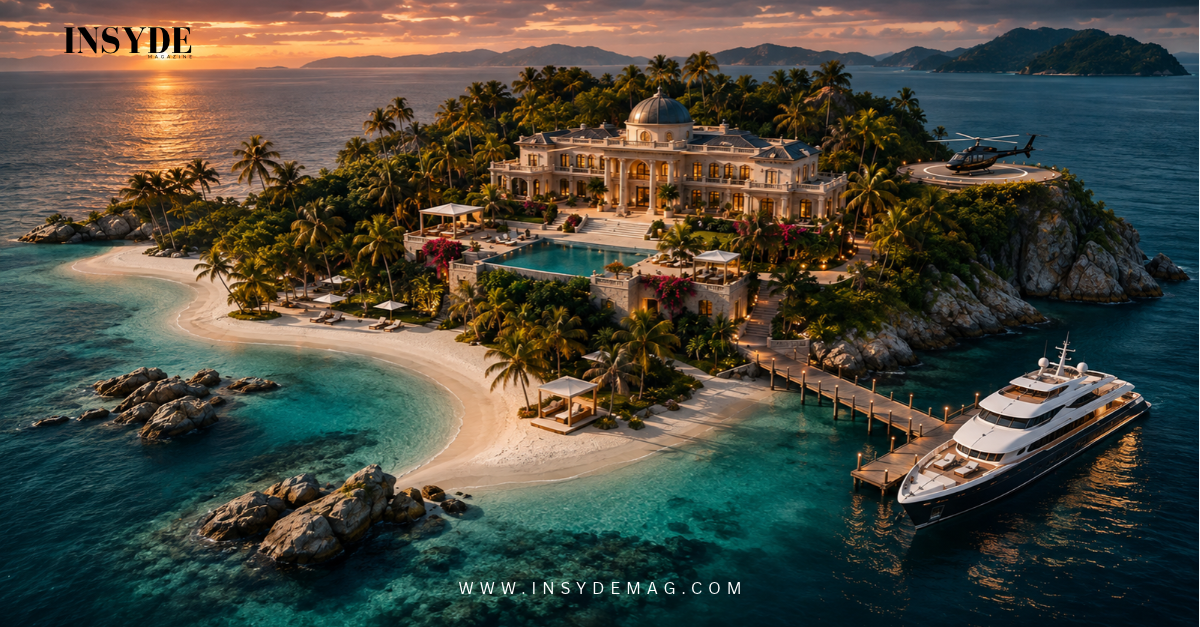
    Beyond turquoise waters and secluded shores lies a world of extraordinary wealth, private ownership and the pursuit of absolute exclusivity. From billionaire retreats and multimillion-dollar estates to institutional investments in island destinations, private islands are becoming one of the most fascinating intersections of luxury real estate and global hospitality.

    INSYDE MAGAZINE | PRIVATE ISLAND


    There is a particular kind of luxury that cannot be found in a penthouse overlooking Manhattan, a private members’ club in London or even the presidential suite of the world’s most celebrated hotel. It is the luxury of an entire island — a private stretch of coastline, an uninterrupted horizon and the freedom to decide who enters your world.

    For centuries, islands have represented power, escape and privilege. Today, they occupy an increasingly intriguing position within the global luxury economy. Some are extraordinary private residences belonging to wealthy individuals and families. Others have become sophisticated hospitality destinations, attracting international hotel groups, institutional investors and travellers willing to pay a premium for experiences that conventional luxury properties cannot easily replicate.

    Yet beneath the romance of palm-lined beaches and secluded villas lies a far more complicated proposition. Acquiring an island involves navigating property rights, infrastructure, environmental regulations and substantial operating costs. Developing one into a commercially successful destination requires an entirely different level of capital and expertise.

    The private island is no longer simply a symbol of having made it. In the right circumstances, it can be a real estate holding, a hospitality business and an exceptionally scarce destination.

    The question is no longer just who can afford paradise. It is who can own it, develop it and make it last.

    THE NEW CURRENCY OF EXCLUSIVITY

    Luxury has always been associated with access. But as the world’s affluent consumers become increasingly experienced in high-end travel, the definition of exclusivity is evolving.

    The traditional markers of luxury — five-star accommodation, first-class travel and prestigious destinations — are increasingly complemented by something considerably harder to obtain: privacy, personalisation and control over the experience.

    The 2026 Virtuoso Luxe Report, based on insights from more than 2,400 travel advisers across over 50 countries, offers an indication of this changing landscape. Nearly half of the advisers surveyed anticipated a slight increase in luxury travel demand for 2026, while 18 per cent expected a significant increase. Furthermore, 55 per cent anticipated modest growth in spending per trip.

    The report identifies beach resort stays, multigenerational travel, cultural immersion and expedition experiences among the leading luxury travel trends.

    These findings point towards a consumer who increasingly values the quality and individuality of an experience rather than accommodation alone.

    An exceptional hotel suite can offer comfort. A private villa can provide discretion. An entire island, however, presents a different proposition altogether: the ability to determine the surroundings, the company, the pace and, to a significant extent, the boundaries of the experience.

    For ultra-high-net-worth individuals, families and discerning travellers, this is where the appeal of private island living becomes particularly compelling.

    Privacy is not simply an amenity. It is part of the product.

    THE PRICE OF PARADISE

    Owning an island sounds like the ultimate expression of financial freedom. The reality is considerably more complex.

    The international private island property market is fragmented, with opportunities varying significantly by geography, ownership structure, infrastructure and development potential. There is no sufficiently comprehensive, independently audited global database that establishes the total value or annual transaction volume of privately owned islands.

    Nevertheless, property listings offer a glimpse into the extraordinary range of opportunities available.

    Consider Little Norman’s Cay in the Bahamas. Marketed through Bahamas Sotheby’s International Realty at an asking price of US$75 million, the 35-acre private island features a substantial residential estate comprising 15 bedrooms and 16 bathrooms.

    At the other end of the market, Sotheby’s International Realty’s Bahamas private-island listings have featured properties advertised for considerably lower amounts, including Swain’s Cay at US$1.5 million.

    These figures are asking prices, not verified completed transactions. They also represent properties with very different levels of development, accessibility and infrastructure.

    The difference between purchasing an undeveloped island and acquiring an established private estate can be substantial.

    There is another distinction that prospective buyers must understand: ownership does not necessarily mean unrestricted freehold title. Depending on the jurisdiction, an acquisition may involve freehold property, leasehold interests, government concessions or other forms of land-use rights. Foreign ownership restrictions, planning permissions and environmental approvals can fundamentally change what is being acquired.

    And then there is the cost of making the island functional.

    Electricity generation, freshwater production, desalination, wastewater treatment, telecommunications, marine transportation, staff accommodation and emergency facilities are essential components of a developed island property.

    The financial commitment extends beyond construction. Staffing, maintenance, insurance, security, logistics and environmental management create recurring expenditure that can be considerable, particularly in remote locations.

    A relatively inexpensive undeveloped island may ultimately require a larger capital commitment than a more expensive property with established infrastructure.

    The true price of paradise, therefore, is not determined by its coastline alone. It is determined by what it takes to sustain life and luxury there.

    WHEN AN ISLAND BECOMES AN INVESTMENT

    The growing intersection between luxury real estate and hospitality investment is perhaps the most interesting development in the modern island economy.

    An island with established hotels, restaurants, transportation infrastructure, a marina and commercial operations is fundamentally different from an undeveloped private property. It represents an operating destination with multiple revenue streams and the potential for long-term value creation.

    This is where institutional capital enters the picture.

    According to JLL’s 2026 Global Hotel Investment Outlook, global hotel direct investment volumes in 2025 increased by 22 per cent compared with the 2023 trough. Hotels accounted for approximately eight per cent of global commercial real estate investment volumes in 2025, exceeding their long-term average share.

    JLL also identifies luxury resorts and trophy hospitality assets as increasingly attractive investment targets, supported by investor appetite for exceptional properties and the availability of institutional capital.

    The regional picture, however, is not uniform. While hotel transaction volumes increased across the Americas and Europe, Asia-Pacific experienced a 20 per cent decline in 2025. JLL nevertheless identifies improving conditions and renewed investment opportunities in the region for 2026.

    These figures describe the broader hospitality investment market, not private island transactions specifically. Their relevance lies in the investment environment surrounding extraordinary destinations.

    One of the clearest illustrations is Hamilton Island in Australia’s Whitsunday Islands.
    THE HAMILTON ISLAND DEAL: WHEN PRIVATE PARADISE ATTRACTS INSTITUTIONAL CAPITAL

    In December 2025, global alternative asset manager Blackstone announced an agreement to acquire Hamilton Island from the Oatley family through its real estate funds.

    The scale of the destination makes the transaction particularly significant.

    According to Blackstone’s official acquisition announcement, Hamilton Island spans more than 2,800 acres across two islands, approximately 70 per cent of which remains undeveloped.

    Its existing infrastructure includes five hotels, more than 20 restaurants and bars, 20 retail outlets, an 18-hole championship golf course on neighbouring Dent Island, a marina and a commercial airport.

    Located within the World Heritage-listed Great Barrier Reef region, the destination combines natural assets with an established hospitality and tourism operation.

    The importance of the transaction extends beyond its geographical scale.

    For an institutional investor such as Blackstone, an integrated island destination offers the possibility of combining real estate ownership interests, hospitality operations, destination management and long-term development opportunities within a single investment.

    The transaction also demonstrates why an established island destination can attract a very different category of buyer from an individual purchasing a secluded residential island.

    The latter may be seeking privacy and personal enjoyment. The former is evaluating operating performance, capital expenditure, tourism demand, infrastructure, development potential and long-term returns.

    Hamilton Island is therefore an important case study in how exceptional island destinations can become institutional-scale hospitality assets.

    It also illustrates an important distinction: the acquisition announced by Blackstone concerns an integrated resort destination and its associated interests, not necessarily unrestricted freehold ownership of every parcel of land across both islands.
    THE INDIAN OCEAN: WHERE ISLAND LUXURY MEETS GLOBAL DEMAND

    Few destinations embody the modern private island experience quite like the Maldives.

    Its combination of secluded resorts, private villas, marine experiences and high-end hospitality has established the country as one of the world’s most recognisable luxury island destinations.

    Yet beyond its international reputation lies an important economic story.

    According to the Maldives Monetary Authority’s 2025 Annual Report, the country welcomed 2,246,516 international visitors in 2025, representing growth of approximately 9.8 per cent over the previous year.

    Tourism receipts reached an estimated US$5.57 billion, compared with approximately US$4.79 billion in 2024.

    The figures underline the economic importance of tourism to the Maldivian economy and the commercial potential of its hospitality sector.

    However, the latest available 2026 figures reveal a more nuanced picture.

    Data from the Maldives Monetary Authority’s tourism statistics database, covering January to September 2026, records approximately 1.572 million tourist arrivals, compared with 1.636 million over the corresponding period in 2025 — a decline of around 3.9 per cent.

    Over the same period, the average occupancy rate was approximately 55.2 per cent, compared with 58.2 per cent a year earlier.

    The figures suggest that the strong annual growth recorded in 2025 has not translated into uninterrupted growth throughout 2026.

    For hospitality operators, this creates a more demanding commercial environment. Expanding accommodation capacity alone does not guarantee stronger performance. Pricing, occupancy, average length of stay, source markets and operational efficiency become increasingly important.

    The Maldives offers an instructive example of this challenge. Its luxury positioning is globally established, but the next stage of growth will depend on how effectively the industry balances additional supply with sustainable demand.

    For private island resorts, the lesson is particularly relevant: exclusivity may command a premium, but the economics behind delivering it must remain viable.

    THE BUSINESS MODEL BEHIND AN EXCLUSIVE ISLAND

    The commercial appeal of a private island can extend far beyond selling accommodation.

    Depending on its ownership structure, location and operating model, an island destination can generate income through multiple channels.

    Luxury accommodation remains central, but private dining, wellness programmes, yacht services, marine excursions, events, destination weddings, private aviation transfers and exclusive-use bookings can contribute to the wider hospitality proposition.

    Some properties operate as privately owned estates, while others function as commercially managed resorts. There are also destinations that combine private residential ownership with hotel operations and shared amenities.

    This diversity is important because the economics of each model are fundamentally different.

    A private estate may prioritise personal enjoyment and long-term wealth preservation rather than operating profitability. A resort, by contrast, must generate sufficient revenue to support staff, maintenance, utilities, marketing, distribution and capital investment.

    The distinction also affects how an island should be valued.

    An established hospitality destination with operating infrastructure and an established customer base cannot be evaluated in the same way as undeveloped land. Its value may depend on operating income, future development potential, brand positioning, management capability and the legal rights attached to the property.

    For investors, the opportunity is therefore not simply to acquire an island. It is to acquire or create a destination that can sustain its exclusivity commercially.

    THE ENVIRONMENTAL COST OF PARADISE

    There is an uncomfortable contradiction at the heart of private island luxury.

    The natural environment that makes these destinations desirable is also one of their greatest long-term vulnerabilities.

    Rising sea levels, coastal erosion, coral degradation, freshwater stress and extreme weather events present significant challenges for low-lying island economies.

    The Asian Development Bank’s October 2026 Asia-Pacific Climate Report highlights the growing economic risks facing coastal communities and island nations across the region.

    Across 30 ADB developing member countries with coastlines, more than 400 million people live within ten kilometres of the coast. The report estimates that, without adaptation, annual coastal flood damages across the region could rise from approximately US$27 billion today to US$172–199 billion by 2050.

    The implications for small island economies are particularly serious.

    For the Maldives, the report estimates that climate-related ocean damages could produce an equivalent permanent reduction in living standards of 3.8 per cent under a moderate-emissions scenario and 7.6 per cent under a high-emissions scenario by 2100.

    These are economy-wide modelled estimates, not forecasts of individual property losses. Nevertheless, they illustrate the scale of the environmental and economic challenges facing vulnerable island destinations.

    For private island owners and hospitality operators, environmental resilience is increasingly inseparable from long-term asset management.

    Responsible development requires careful consideration of coastal protection, freshwater availability, energy systems, marine ecosystems, waste management and construction practices.

    An island resort that damages the very environment on which its appeal depends risks undermining its own long-term commercial proposition.

    Sustainability, in this context, is not simply an aesthetic or marketing consideration. It is a fundamental question of whether paradise can remain viable.

    THE FUTURE OF PRIVATE ISLAND LUXURY

    The future of private island ownership is unlikely to be defined by a single type of buyer or investment strategy.

    Some will continue to acquire islands as secluded family estates, prioritising privacy, security and personal freedom. Others will approach them as hospitality opportunities, seeking to create destinations that combine exceptional accommodation with carefully curated experiences.

    Institutional investors are also likely to remain interested in distinctive hospitality assets where location, infrastructure and operational potential offer compelling long-term propositions.

    Yet the industry faces a more demanding set of considerations than the traditional image of billionaire island living might suggest.

    Legal ownership structures, capital requirements, infrastructure limitations, tourism cycles and climate exposure all influence the attractiveness of an island investment.

    The most successful destinations will likely be those that understand the relationship between exclusivity and operational discipline — properties capable of delivering exceptional experiences while protecting the natural assets that make them valuable.

    Ultimately, the private island represents something more complex than a luxury purchase.

    It is a rare intersection of geography, wealth, architecture, hospitality and power. For some, it is the ultimate expression of personal freedom. For others, it is a strategic investment in an extraordinary destination.

    And perhaps that is what makes the private island affair so compelling.

    Because in a world where almost everything can be accessed, booked or experienced, the ability to possess a place that feels entirely one’s own remains one of luxury’s most enduring ambitions.

    Paradise may be priceless. But owning it is a business.


    INSYDE MAGAZINE– No. 1 Luxury Magazine In Bangalore

    Discover the people, culture, style and experiences shaping what comes next.

  • THE REAL COST OF OWNING A PRIVATE JET

    THE REAL COST OF OWNING A PRIVATE JET

    The purchase price is only the beginning. From multimillion-dollar acquisition costs and annual operating budgets to maintenance, depreciation and the economics of flying privately, we examine what it really takes to own a private jet.

    For most people, owning a private jet is the ultimate expression of wealth. It represents freedom from commercial schedules, access to destinations beyond conventional airline networks and the ability to turn travel into a more controlled, private experience.

    But the aircraft itself is only the beginning of the financial commitment.

    Behind the polished cabins, bespoke interiors and long-range capabilities lies an expensive operating structure involving fuel, pilots, maintenance programmes, hangar space, insurance, airport fees and depreciation. Even when an aircraft is sitting on the ground, its owner may still be paying to keep it ready to fly.

    The difference between being able to purchase a private jet and being able to operate one comfortably is considerable. For an ultra-long-range aircraft, annual operating expenses alone can reach several million dollars.

    So, what does private jet ownership actually cost in 2026? And at what point does owning an aircraft become more practical than chartering one?

    THE PRICE OF OWNING THE SKY

    Private aircraft are not a single category of luxury purchase. The market stretches from relatively compact light jets to large-cabin, ultra-long-range aircraft designed for intercontinental travel.

    The price depends on the aircraft’s size, age, range, performance, cabin configuration, maintenance history and equipment. A pre-owned aircraft can offer a considerably lower entry price than a new delivery, although its maintenance condition and future upgrade requirements can change the financial equation.

    As a broad 2026 market reference, JetAtlas’s private aircraft pricing overview places new aircraft across a wide spectrum: very light and light jets in the lower single-digit to low double-digit millions, midsize and super-midsize aircraft in the tens of millions, and ultra-long-range jets commonly in the US$60 million to US$80 million range.

    At the upper end, the published aircraft price indications compiled by WAPE Jets list the Gulfstream G700 at approximately US$79 million and the Bombardier Global 7500 at approximately US$78 million. The Embraer Praetor 600 is listed at approximately US$25.8 million.

    These are indicative list-price references, not guaranteed transaction prices. Final acquisition costs can vary with specification, delivery position, equipment, negotiation and market conditions. Bespoke cabin completions and additional options can also push the price higher.

    For buyers considering a pre-owned aircraft, the purchase price is only one part of the assessment. A thorough pre-purchase inspection, maintenance records, engine programme status, upcoming inspections and component life limits can materially affect the aircraft’s true cost.

    The most expensive aircraft is not necessarily the most expensive one to own. The condition of the individual aircraft, how often it flies and how it is managed can matter just as much as its original price.

    WHAT DOES IT COST TO OPERATE A PRIVATE JET?

    The real financial commitment begins after the aircraft has been acquired.

    Private jet operating expenses are generally divided into two categories: fixed costs and variable costs.

    Fixed costs are expenses incurred to keep the aircraft and its operating infrastructure available, regardless of how frequently it flies. These can include crew salaries, training, insurance, hangar rental, management fees and certain administrative expenses.

    Variable costs increase with aircraft utilisation. Fuel, maintenance reserves, engine programmes, landing and handling charges, navigation fees and other trip-related expenses contribute to this category.

    The balance between these costs varies significantly across aircraft types. A larger aircraft generally requires more fuel and a more substantial operating structure, although the precise figures depend on its engines, maintenance arrangements, route profile and operating environment.

    To understand the scale, consider the October 2026 operating-cost estimates published by GlobalAir. The figures below provide a useful comparison across different aircraft categories.

    AircraftAnnual flight-hour assumptionEstimated annual operating budgetReported hourly cost
    Cessna Citation CJ3250 hoursUS$964,179US$3,857
    Embraer Praetor 600375 hoursUS$1,644,319US$4,385
    Bombardier Global 7500450 hoursUS$3,517,649US$7,817
    Gulfstream G700450 hoursUS$3,920,087US$8,711
    Gulfstream G650ER450 hoursUS$4,970,648US$11,046

    Source: GlobalAir operating-cost reports dated October 2026. The estimates use different annual utilisation assumptions and should not be interpreted as a perfectly controlled comparison. They are modelled budgets, not quotations or guaranteed costs.

    The difference is striking. The estimated annual operating budget for a Citation CJ3 is below US$1 million, while the G650ER estimate approaches US$5 million.

    The figures also demonstrate why an aircraft’s purchase price alone provides an incomplete picture of ownership. A buyer acquiring an ultra-long-range jet must be prepared for a substantial recurring financial commitment long after the initial transaction.

    INSIDE THE ANNUAL OPERATING BUDGET

    What exactly makes operating a private aircraft so expensive?

    1. Fuel: The cost of every journey

    Fuel is one of the largest variable expenses in private aviation.

    A jet’s fuel consumption depends on its aircraft type, engine performance, flight distance, payload, altitude, weather and operating conditions. Larger, heavier aircraft generally consume considerably more fuel than smaller jets.

    The financial effect becomes especially significant for owners who fly frequently. A long-haul itinerary can involve substantial fuel expenditure before landing, handling, crew and other trip-related charges are considered.

    Fuel prices also fluctuate across markets and airports. Owners may have access to fuel contracts or negotiated arrangements, but the actual cost will depend on where and how the aircraft operates.

    2. Crew: The people behind the aircraft

    A private jet requires qualified professionals to operate it safely and reliably.

    Depending on the aircraft and its operating requirements, this typically includes pilots, cabin crew and additional operational support. Owners must account for salaries, recurrent training, qualifications, accommodation, travel and other employment-related expenses.

    Large-cabin and long-range aircraft can require more complex crew arrangements, particularly when operating long-distance routes or maintaining availability across multiple destinations.

    Crew expenses are not simply a matter of paying salaries. Maintaining a trained, qualified and appropriately rested team is an ongoing operational responsibility.

    3. Maintenance: Protecting a multimillion-dollar asset

    Aircraft maintenance is one of the most important and potentially unpredictable areas of ownership.

    Scheduled inspections, unscheduled repairs, replacement components, avionics upgrades and engine maintenance all contribute to the cost of keeping an aircraft airworthy.

    Engine programmes and maintenance reserves are particularly important. Owners may pay into programmes that help make future maintenance expenses more predictable, but these arrangements do not eliminate the underlying cost.

    A pre-owned jet can appear attractive at acquisition, yet an approaching engine overhaul or major inspection can materially change the economics of the purchase.

    This is why experienced buyers look beyond the aircraft’s age and appearance. Maintenance records, component status and programme coverage can be central to determining its actual value.

    4. Hangar, insurance and airport charges

    An aircraft needs a place to be stored and protected when it is not flying.

    Hangar rental varies according to aircraft size, airport location and availability. At major business aviation airports, suitable hangar space can be a significant recurring expense.

    Insurance premiums depend on factors including aircraft value, pilot experience, operating history, coverage and intended use.

    Owners must also account for landing charges, parking, ground handling, navigation and airport-related services. These expenses can vary considerably between destinations and can become substantial for aircraft operating internationally.

    THE GULFSTREAM G700: A CLOSER LOOK AT THE NUMBERS

    The Gulfstream G700 provides a useful example of the financial scale associated with modern ultra-long-range private aviation.

    With a reported annual operating budget of US$3,920,087, GlobalAir’s October 8, 2026 estimate divides the expenditure into two principal categories:

    Cost categoryAnnual estimate
    Fixed costsUS$1,137,800
    Variable costsUS$2,782,287
    Total annual operating budgetUS$3,920,087

    The estimate is based on 450 annual flight hours, equivalent to an average of approximately 37.5 hours per month.

    At that utilisation level, the reported budget works out to approximately US$8,711 per flight hour.

    This is an operating-cost estimate, not the aircraft’s complete cost of ownership. It does not represent the purchase price, financing, depreciation, applicable taxes or every extraordinary expense that may arise during the aircraft’s service life.

    The distinction is important. An owner purchasing an aircraft for approximately US$79 million and spending close to US$4 million annually on its estimated operation is managing two very different financial commitments.

    Over five years, simply multiplying the published annual operating budget by five produces approximately US$19.6 million in operating expenditure.

    That calculation assumes the same annual budget and utilisation throughout the period. It is an illustration, not a five-year forecast: actual fuel prices, maintenance events, crew costs and operating conditions will change. It also excludes acquisition, financing, depreciation, taxes and exceptional expenses.

    The point is not that every G700 owner will spend precisely this amount. It is that operating a flagship private aircraft requires a financial structure that extends far beyond the initial purchase.

    THE HIDDEN COST: DEPRECIATION

    Among the most easily overlooked aspects of private jet ownership is depreciation.

    An aircraft is a capital asset, but it is not immune to changes in market value. Its resale price can be affected by age, engine hours, maintenance history, cabin condition, technological developments, market demand and the availability of newer models.

    A new aircraft may lose value as it moves from delivery into the pre-owned market. However, depreciation is not necessarily a straight line. Aircraft values can rise or fall depending on supply, demand and wider economic conditions.

    The market itself offers a useful illustration.

    In its September 2026 market barometer, JETNET reported that worldwide business jet departures had increased 4.5% over the preceding 12 months. The report also highlighted a combined US$61.6 billion backlog among major aircraft manufacturers.

    However, the pre-owned market showed a more nuanced picture. Transaction growth had slowed from more than 15% year-on-year in December to low single digits, while large-cabin aircraft values had normalised towards levels seen in 2019.

    This matters to prospective owners. A strong business aviation market does not guarantee that every aircraft will retain its value. The resale market can behave differently across aircraft categories, age groups and individual models.

    Depreciation should therefore be considered when assessing the total economic cost of ownership, even though it is not included in the annual operating budgets discussed earlier.

    NEW OR PRE-OWNED: WHICH MAKES MORE FINANCIAL SENSE?

    Buying a new private jet offers advantages: the latest technology, a factory-fresh cabin, a known maintenance history and the ability to configure the aircraft to the owner’s requirements.

    But new aircraft can involve a substantial capital commitment, and buyers may face delivery timelines depending on the manufacturer and model.

    Pre-owned aircraft offer a different proposition. They can provide access to larger or more capable aircraft at a lower acquisition price, sometimes with immediate availability.

    However, a lower purchase price does not automatically translate into lower ownership costs.

    An older aircraft may require expensive inspections, cabin refurbishment, avionics upgrades or engine work. Buyers must also consider whether the aircraft is enrolled in suitable maintenance programmes and whether its records support the asking price.

    The JETNET market data suggests that the pre-owned market has been moving towards more normal transaction conditions, even as flight activity and manufacturer backlogs remain elevated.

    For buyers, this creates an important distinction: acquisition opportunities should be evaluated aircraft by aircraft rather than through broad assumptions about the market.

    OWNERSHIP, CHARTER OR FRACTIONAL: THE ALTERNATIVES

    Full ownership is not the only way to access private aviation.

    For individuals and businesses that value flexibility but do not require an aircraft under their exclusive control, charter and fractional programmes can offer alternative financial structures.

    Private jet charter

    Chartering allows customers to pay for individual journeys without purchasing an aircraft or taking responsibility for its long-term operating infrastructure.

    It can be attractive for occasional travellers, companies with irregular travel schedules and individuals who use different aircraft categories depending on the journey.

    The trade-off is that availability, aircraft positioning, route requirements and pricing can vary. Chartering also does not provide the same level of guaranteed access and control as dedicated ownership.

    Fractional ownership

    Fractional ownership gives customers access to a share of an aircraft or a managed fleet, generally through a programme with defined usage rights and associated fees.

    It reduces the upfront capital commitment compared with purchasing an entire aircraft, while providing a more structured access arrangement than booking individual charter flights.

    The model has become increasingly significant in business aviation.

    According to Honeywell’s 2025 Global Business Aviation Outlook, the global fractional fleet had grown by more than 65% since 2019 to approximately 1,300 aircraft. Honeywell also reported that 91% of surveyed operators expected to fly the same amount or more in 2026 compared with 2025.

    These figures underline a wider industry shift: demand for private aviation does not necessarily translate into demand for full aircraft ownership.

    For many users, access can be more valuable than owning the asset outright.

    THE INDIA PERSPECTIVE: OWNERSHIP IN A DIFFERENT OPERATING ENVIRONMENT

    India’s growing concentration of private wealth, international business activity and demand for premium travel makes it an important market to watch.

    However, owning and operating an aircraft in India involves considerations beyond the aircraft’s purchase price and the operating estimates published for other markets.

    Aircraft registration, import arrangements, applicable taxes, operating permissions, maintenance support, crew availability, airport infrastructure and international operating requirements all need to be assessed within the relevant regulatory framework.

    These factors can materially change the economics of ownership. A US-dollar operating-cost estimate should not be treated as an India-specific ownership quotation, and the financial treatment of an aircraft can vary according to its ownership structure and intended use.

    For prospective Indian buyers, a specialist aviation adviser, tax professional and legal team should be involved before an acquisition is structured. The aircraft’s intended routes, home base, annual utilisation and operating model should be established before comparing ownership with charter or fractional access.

    The opportunity is significant, but the financial decision requires local expertise rather than a simple conversion of international cost estimates into rupees.

    WHEN DOES OWNING A PRIVATE JET MAKE SENSE?

    There is no universal number of flight hours at which ownership becomes the better financial decision.

    The answer depends on how frequently the aircraft is used, the routes it serves, the number of passengers travelling, the importance of schedule control and the cost of alternative arrangements.

    For a business that flies frequently between multiple cities, the value of having an aircraft available can extend beyond the ticket price. Time saved, schedule flexibility, access to airports and the ability to coordinate complex itineraries can all contribute to the decision.

    For an individual who flies privately only a handful of times each year, full ownership may be difficult to justify financially. Chartering or fractional access may provide a more efficient way to enjoy the benefits without carrying the entire cost of an aircraft.

    Ownership becomes more compelling when utilisation is consistent, the aircraft is appropriately matched to the routes being flown and the owner can support the ongoing financial and operational responsibilities.

    But even at high utilisation, the decision should be evaluated against the alternatives. A private jet is not automatically a better investment simply because its owner can afford to buy one.

    THE FINAL EQUATION

    Private jet ownership is often presented as the ultimate luxury purchase. In reality, it is closer to operating a highly specialised business asset.

    The acquisition price is only the first financial decision. Fuel, crew, maintenance, insurance, hangar space, airport charges and depreciation continue to shape the economics for as long as the aircraft remains in service.

    The numbers are substantial. A smaller business jet can carry an annual operating budget approaching US$1 million, while a flagship ultra-long-range aircraft can require several million dollars every year simply to remain operational at a given utilisation level.

    And that is before the cost of acquiring the aircraft is fully considered.

    For the ultra-wealthy, the appeal of private aviation is rarely just about luxury. It is about control over time, privacy, access and the ability to move according to their own schedules.

    But the most important distinction in private aviation is not between those who can afford to buy a jet and those who cannot.

    It is between those who can afford to own one and those for whom ownership actually makes sense.

    Because the real cost of owning a private jet is not measured by the price on the aircraft’s specification sheet. It is measured by everything that happens after the keys are handed over.


    Editorial research and methodology: Operating-cost figures in this article are based on dated GlobalAir model estimates published in October 2026, with each aircraft’s stated annual utilisation assumption retained. Acquisition prices are indicative public market/list-price references and are not confirmed transaction prices. Market context draws on JETNET, GAMA and Honeywell publications. Costs vary by aircraft condition, configuration, utilisation, geography, operator and contractual arrangements. All financial figures are in US dollars unless otherwise stated. This article is editorial analysis, not financial, tax, legal or aviation-operational advice.


    INSYDE MAGAZINE– No.1 Luxury Magazine In Bengalore

  • BEYOND BEAUTY: HOW CAPUCINE HUGUET TURNS SCIENCE INTO JEWELLERY

    BEYOND BEAUTY: HOW CAPUCINE HUGUET TURNS SCIENCE INTO JEWELLERY

    From Arctic glaciers to microscopic marine life, the Paris-based jewellery artist transforms scientific discovery into sculptural creations that challenge conventional ideas of beauty, craftsmanship and the meaning of luxury.

    INSYDE EXCLUSIVE | PEOPLE · LUXURY · DESIGN

    By INSYDE Magazine


    A jewel can mark a moment, express an identity or become an heirloom that carries a family’s history across generations. Yet for Paris-based jewellery artist Capucine Huguet, its possibilities extend beyond personal adornment. A jewel can also communicate an idea, reveal an overlooked natural phenomenon and invite its wearer to see the world differently.

    Her work begins with questions rather than gemstones. What makes a natural structure extraordinary? How can a scientific discovery be translated into a form that can be worn? And what happens when the language of fine jewellery meets the complexity of the natural world?

    These questions shape a practice that brings scientific research into conversation with sculptural design and traditional craftsmanship. From the vast landscapes of the Arctic to the intricate structures of microscopic marine life, Huguet investigates subjects that are often difficult to comprehend through observation alone, translating their essential qualities into jewellery with a distinct visual and conceptual language.

    Her approach is deliberately considered. Scientific literature, conversations with specialists and, at times, first-hand experiences in natural environments inform the earliest stages of a collection. Sketches and prototypes follow only after a sustained period of research and reflection.

    The finished pieces may be precious objects, but their value lies in more than the materials from which they are made. Each begins with a subject Huguet wants to understand and a story she wants to communicate.

    For her, beauty is not the end of the conversation. It is the means through which the conversation begins.

    A Childhood Curiosity, A Creative Language

    Huguet’s interest in science predates her professional practice. She recalls being fascinated by the ways scientific knowledge explains phenomena that can otherwise appear almost magical: rainbows, lightning, snowflakes and magnetism.

    At the same time, she knew from an early age that she wanted to become a jewellery designer. What she sought was a way to combine that ambition with a broader purpose.

    “I wanted my work to go beyond aesthetics and convey ideas that matter to me,” she explains.

    Science and the natural world offered that possibility. They allowed her to bring together her interest in jewellery and her curiosity about how the world works, giving her designs a narrative foundation beyond their immediate visual appeal.

    This distinction is important in a discipline where nature has long served as a source of inspiration. Floral motifs, animal forms and references to the sea are familiar elements of jewellery design. Huguet’s approach, however, begins with understanding the subject rather than simply reproducing its appearance.

    She wants to identify what makes a phenomenon significant, which characteristics deserve attention and what an interpretation of it might communicate.

    Research is therefore the starting point for every new collection. She studies books, scientific papers, articles and documentaries before narrowing her focus and contacting specialists who can deepen her understanding. Depending on the subject, these conversations may involve biologists, glaciologists or other scientists.

    For some projects, reading and consultation are not enough. Huguet seeks direct encounters with the environments she is studying, allowing observation to become part of the creative process.

    Her practice reflects a belief that meaningful design begins with curiosity—and that the more thoroughly a subject is understood, the more possibilities emerge for interpreting it.

    The Value of Going Beyond the Studio

    Huguet’s research has taken her to Svalbard in the Arctic, where she observed melting glaciers and met glaciologists, and to Costa Rica, where she volunteered in a nature reserve in the rainforest to explore its biodiversity.

    These experiences offered a different relationship with her subjects. A landscape encountered in person carries dimensions that photographs and written descriptions cannot fully convey: its sounds, its scale, its atmosphere and the physical sensation of being present.

    “There is an enormous difference between studying these subjects through books and images and experiencing them firsthand,” she says.

    The experiences become part of an accumulating body of impressions and memories. Huguet takes time to analyse what she has encountered before beginning to develop visual references and sketches. The process can take months.

    This extended period of observation gives her work a particular rhythm. Rather than beginning with a predetermined aesthetic and searching for a reference to justify it, she allows the subject to shape the direction of the design.

    It is an approach that places research at the centre of creative production. The environment is not simply a backdrop or a source of attractive forms; it is something to investigate, interpret and understand.

    The distinction becomes especially clear when an unexpected encounter changes the course of a project.

    Serendipity as a Design Principle

    For Huguet, research is not a process of confirming what she already expects to find. It is an opportunity to discover something she had not considered.

    “I strongly believe in serendipity,” she says.

    Before entering a field or immersing herself in a subject, she rarely knows which detail will ultimately capture her attention. Sometimes she is drawn to a phenomenon because of its significance or because she believes it deserves greater attention. At other times, the inspiration is more personal: a moment of fascination, an emotional response or an encounter that stays with her.

    Her experience in Costa Rica offers an example. Among the rainforest’s extraordinary biodiversity, leafcutter ants became an unexpected source of inspiration. She was fascinated by the thousands of ants moving through the environment, carrying pieces of leaves and creating extensive trails across the forest.

    Their organisation and collective movement captured her imagination. It was not a subject she had planned to explore before encountering it directly.

    That discovery became an opportunity to translate a natural system into a new visual language.

    The significance of serendipity in Huguet’s practice is not that research becomes less rigorous, but that it remains open-ended. Observation provides the foundation; curiosity determines where it leads.

    In this sense, her jewellery emerges from a dialogue between knowledge and instinct. Scientific understanding gives her a framework, while personal encounters help determine which aspects of a subject are worth transforming into form.

    From Natural Phenomenon to Wearable Sculpture

    Translating a complex natural structure into jewellery requires more than technical precision. It demands interpretation.

    A scientific reference may be intricate, irregular or difficult to reproduce at the scale of a wearable object. The designer must decide what to preserve, what to simplify and what to transform so that the finished piece remains connected to its source without becoming a literal copy.

    Huguet begins by identifying the characteristics and associations that make a subject compelling. These become keywords that guide the exploration of shapes and forms.

    She approaches jewellery as a form of miniature sculpture, paying close attention to its three-dimensional qualities. Each angle should reveal something interesting; the piece should not depend entirely on a single viewpoint.

    Texture is equally important. Surfaces can communicate a subject’s character while introducing a tactile dimension to the experience of wearing a jewel. The object becomes something to examine from different angles and, where appropriate, to discover through touch as well as sight.

    Her own technical knowledge plays an important role in bringing these ideas to life. Huguet develops her prototypes personally, using wax carving or computer-aided design (CAD) to translate imagined volumes, curves and structures into tangible forms.

    The prototype provides a foundation for discussion with the artisans who help realise the final piece. It makes the intended design more precise and creates a shared point of reference for addressing technical challenges.

    Huguet describes herself as fortunate to have learned almost every aspect of jewellery-making. This allows her to collaborate with craftspeople as a peer, sharing a technical vocabulary and an understanding of the difficulties involved in producing complex forms.

    She also values the small scale of her team, which allows different perspectives to come together before work begins. Anticipating challenges and finding solutions collaboratively can help preserve the original concept without ignoring the realities of making.

    The result is a practice in which the artistic idea and the production process are closely connected. Craftsmanship is not merely the final stage of the work; it is part of the means through which the idea becomes possible.

    The Cristellaria Echinata Brooch: Making the Invisible Visible

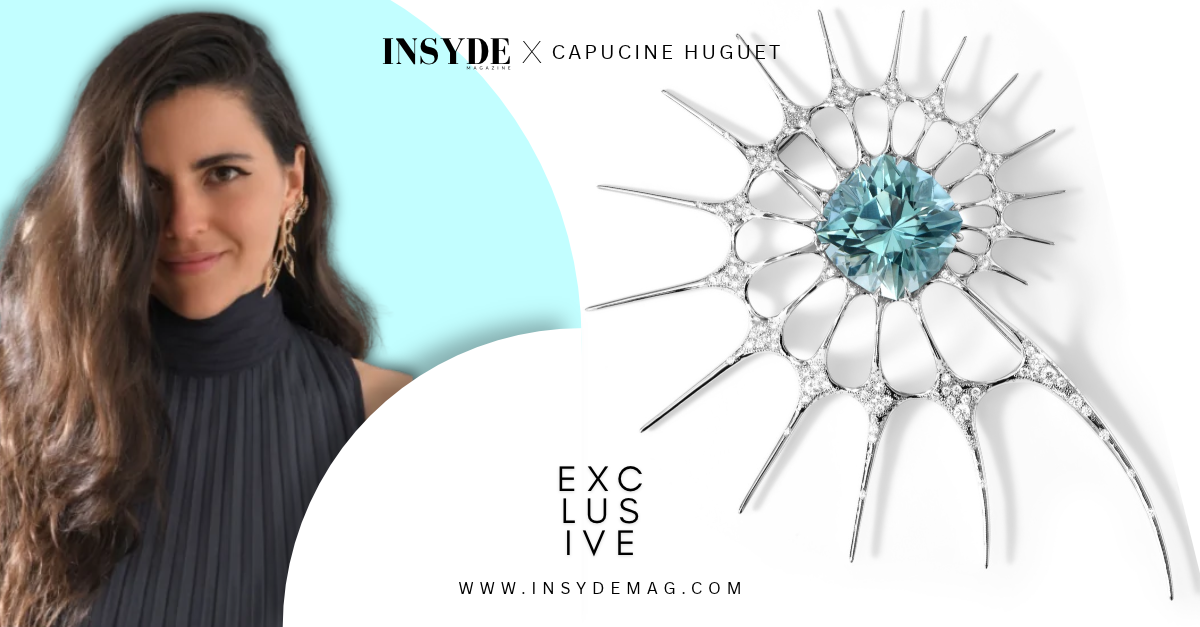
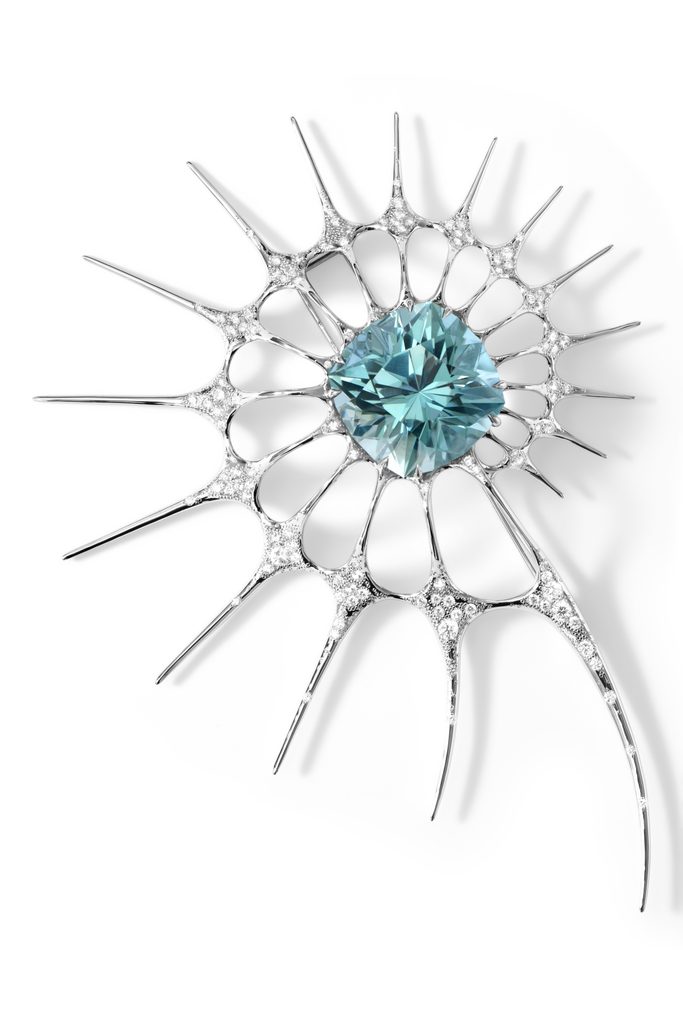
    One of the most revealing examples of Huguet’s approach is the Cristellaria Echinata brooch from her Téthys collection, which explores phytoplankton.

    These microscopic organisms occupy a significant place in marine ecosystems. Through photosynthesis, phytoplankton contributes to the production of oxygen and the absorption of carbon dioxide. Despite its scale, it plays a role in the larger environmental systems on which life depends.

    Huguet wanted to create a piece that would communicate the importance of this often-overlooked marine life.

    The brooch draws inspiration from the shell of Cristellaria Echinata, a form that also recalls the spiral structure of a nautilus shell. Her interpretation is delicate and intricately constructed, with an airy framework intended to evoke the movement of plankton through the ocean.

    At its centre sits a 100-carat topaz in a glacial-blue hue. The pavé setting introduces further complexity, with the structure and setting designed to evoke photosynthesis and the ecological significance of phytoplankton.

    The contrast is striking: a substantial precious stone sits within a form inspired by microscopic life. The result is an object with visual presence that also carries a story extending beyond its materials.

    For Huguet, the piece is compelling precisely because it combines these dimensions. It is bold and immediately eye-catching, yet its underlying subject asks the viewer to consider a natural system that is usually invisible.

    The making process presented its own challenges. Huguet hand-carved the entire structure in wax, creating a form that was exceptionally fragile. Achieving a successful casting required considerable experimentation and perseverance in collaboration with the caster.

    The technical challenge was to preserve the delicacy of the design while producing a finished jewel capable of holding its form.

    The brooch demonstrates how scientific research, sculptural thinking and specialist craftsmanship can converge in a single object. It also illustrates a broader ambition within Huguet’s work: to use the attraction of jewellery as a way of directing attention towards subjects that might otherwise remain outside the viewer’s awareness.

    The story behind the piece is as integral to its identity as its silhouette, stone and setting.

    Materials That Carry Meaning

    In Huguet’s practice, materials are not simply selected to complete a design. They help communicate its story.

    Colour, she explains, can fundamentally change how a piece is perceived. Yellow gold may evoke warmth, generosity and sunlight, while white gold can suggest cooler, glacial atmospheres, architecture or the stillness of night. Gemstones carry their own visual associations, and a particular design may feel incomplete if its colours do not support the intended idea.

    Texture also shapes perception. A mirror-polished surface, a brushed finish and an intricately engraved one each create a different visual impression and tactile experience.

    These decisions influence the direction of a design as it develops. Material choice is therefore neither a purely technical consideration nor an afterthought; it is part of the narrative itself.

    That principle extends to sourcing. Huguet states that she works exclusively with recycled 18-carat gold or recycled platinum. She uses recycled diamonds whenever possible, alongside vintage or responsibly sourced gemstones, including stones from Moyo Gems.

    Finding trustworthy gemstone dealers requires research, time and collaboration with reliable partners. For Huguet, these choices are integral to the way she wants to develop her practice rather than optional additions to a finished product.

    Her production model reflects a similar preference for considered making. All her pieces are made in Paris, and most are produced to order. This allows her to avoid unnecessary overproduction and focus on the quality of individual objects.

    She is also realistic about the challenges of maintaining these standards as a business grows. Scaling production, reaching a broader market or focusing more heavily on retail can make sourcing constraints, production capacity and cost management increasingly difficult to balance.

    Independence brings its own limitations, but it also creates room to make different decisions. Huguet sees the ability to prioritise quality, traceability and the integrity of the creative process over volume as a meaningful advantage.

    It is a position that places responsibility within the actual decisions involved in making jewellery—from the selection of materials to the relationships that sustain production.

    Between Fine Jewellery and High Jewellery

    Jewellery occupies a distinctive space between an artwork and an object intended to be worn. It can be conceived as sculpture, yet it must also respond to the physical realities of everyday life.

    Huguet approaches fine jewellery and high jewellery differently.

    With fine jewellery, she considers how a piece will evolve through regular wear. Comfort, durability and the way the owner makes the jewel their own are central to the design.

    There is something personal about imagining an object accompanying someone for years, becoming part of their life and accumulating memories along the way.

    High jewellery allows a different degree of conceptual freedom. When a piece is approached as an artwork in its own right, Huguet can push further in terms of scale, weight, technique and mechanisms. She can explore more ambitious forms, provided they retain the sculptural and conceptual qualities that define her work.

    The distinction is not simply a question of size or extravagance. It concerns the intended relationship between the object and the person encountering it.

    A jewel intended for everyday wear must function comfortably within its owner’s life. A more ambitious high-jewellery creation can challenge conventional expectations of wearability and explore the possibilities of jewellery as a sculptural medium.

    Both approaches, however, depend on a clear relationship between concept, material and execution.

    A Different Measure of Luxury

    For Huguet, luxury is not defined by the value of precious materials alone. It lies in creating something distinctive and meaningful, realised through exceptional craftsmanship and carrying a significance that resonates with its owner.

    Her clients are often looking for jewellery that reflects who they are, expresses something personal or represents a story they want to preserve. The desire is not simply to own a valuable object, but to possess something that feels individual.

    This is particularly evident in bespoke commissions. Huguet maintains a close relationship with clients throughout the process, meeting them several times to discuss ideas and refine the design.

    The collaboration becomes part of the experience, giving the finished jewel a context that extends beyond its physical characteristics.

    It is a view of luxury rooted in personal connection and continuity. A piece may become associated with love, faith, family, a memorable journey or a personal belief. Over time, it can carry memories that extend beyond the person who originally commissioned or created it.

    For Huguet, jewellery has an extraordinary ability to hold these meanings and pass them forward.

    The idea of an heirloom, in this context, is not simply about an object surviving physically. It is about the story attached to it remaining relevant as it moves between people and generations.

    This also clarifies why craftsmanship matters so deeply to her. Technical excellence gives an object its form and durability, but meaning gives it a reason to be kept.

    Luxury becomes less about the immediate impression an object creates and more about the relationship that develops around it: the thought invested in its creation, the experience of acquiring it and the significance it eventually comes to hold.

    What Comes Next

    Huguet has a long list of subjects she hopes to explore, although she prefers to keep the details of future projects private until they develop further. For now, she is particularly interested in physics and curious about where that interest might lead her work.

    The direction remains open, but her underlying ambition is consistent. She wants people to recognise jewellery as more than a beautiful adornment: a small work of art that can carry meaning for both its maker and its owner.

    Design, in her view, is a way of communicating ideas and telling stories. A jewel can represent love, faith, family, a journey or a personal conviction. Through her own practice, she chooses to tell stories about science and the natural world, encouraging people to look at familiar subjects from a different perspective.

    She also hopes that this engagement can foster a greater appreciation of the natural world and its fragility. Understanding something, she believes, can be the first step towards wanting to protect it.

    There is a compelling relationship between the precision of her process and the openness of its outcomes. Research provides structure, craftsmanship provides discipline, and curiosity leaves room for discovery. The finished piece brings these elements together without reducing the original subject to a simple visual motif.

    In a luxury landscape where objects are often judged by recognisability, rarity and immediate appeal, Huguet offers another way of thinking about what makes a jewel valuable. Her work asks the viewer to consider not only what an object is made of, but what it communicates, what it reveals and what it might mean over time.

    The result is jewellery that rewards attention. Its forms invite a closer look; its stories encourage further thought.

    Ultimately, Huguet’s practice suggests that the most meaningful objects do more than decorate the world around us. They change the way we engage with it.

    A jewel, in her hands, becomes a meeting point between the natural world and human imagination—an object through which scientific discovery can be felt, craftsmanship can be experienced and beauty can become a way of seeing differently.


    Explore more: Capucine H — Official Website · The Designer · Téthys Collection Journal · Commitment to Craft and Responsible Sourcing

    INSYDE MAGAZINE – No.1 Luxury Magazine in Bengaluru
    Luxury, Through a Different Lens.
    www.insydemag.com

  • INSIDE THE F1 EMPIRE – THE BILLION-DOLLAR RACE

    INSIDE THE F1 EMPIRE – THE BILLION-DOLLAR RACE

    Inside the billions, billionaires and global spectacle powering Formula 1

    Formula 1 has become far more than a motorsport championship. With billions in annual revenue, a reported global fanbase of 827 million and a growing presence in luxury, entertainment and premium experiences, F1 is building one of the most commercially powerful brands in world sport.

    INSYDE Magazine | Business, Luxury & Culture


    The Billion-Dollar Race

    Every Formula 1 race is decided by fractions of a second. The business behind it, however, is built over years of contracts, commercial partnerships, technological investment and global audience development.

    A car crosses the finish line. A championship is decided. But behind the spectacle sits a much larger operation—one that sells broadcasting rights, secures sponsorship agreements, licenses races to host cities and turns a sporting calendar into a global entertainment property.

    The financial scale is substantial. In its 2025 financial results, Liberty Media reported that Formula 1 generated US$3.873 billion in revenue in 2025, up from US$3.411 billion in 2024. Operating income rose to US$632 million, while adjusted operating income before depreciation and amortisation—known as adjusted OIBDA—reached US$946 million.

    That represents revenue growth of approximately 13.5 per cent year on year, alongside a 28 per cent increase in operating income.

    These are not small numbers for a sport built around a limited number of live events each year. They reflect the strength of a business model in which the same championship can generate income from broadcasters, sponsors, race promoters, digital services and premium experiences across multiple markets.

    And the momentum has continued into 2026. Formula 1’s mid-season review, published in July 2026, reported nearly 3.7 million race-weekend attendances across the first 11 events, approximately 6 per cent above the same events in 2025. All 11 events had sold out at the time of the review.

    The financial results for the full 2026 season are not yet available. But the mid-season numbers provide a current indication of demand.

    The bigger question is what makes this business so valuable—and how much of the global economy surrounding Formula 1 is actually captured by its headline revenue.

    First, Understand What the $3.87 Billion Actually Means

    Formula 1’s US$3.873 billion figure represents revenue reported by the championship’s commercial business. It is not the combined turnover of every team, sponsor, circuit, broadcaster, hospitality provider and supplier connected to the sport.

    That distinction is essential.

    The wider F1 ecosystem includes independently operated teams, manufacturers, race promoters, television networks, sponsors, travel companies, hospitality businesses and numerous suppliers. Their revenues overlap in different ways, and there is no single, comprehensive figure that captures the entire ecosystem without risking double-counting.

    Formula 1’s own financial disclosures provide the clearest starting point.

    According to Liberty Media’s 2025 annual report, the championship generated US$3.086 billion in primary revenue and US$787 million in other revenue during 2025.

    Primary revenue grew from US$2.757 billion in 2024, while other revenue increased from US$654 million. Together, they brought total reported revenue to US$3.873 billion.

    The difference between revenue and profit also matters. Formula 1 reported US$632 million in operating income, not US$3.873 billion in profit. Its reported operating expenses, administrative costs, depreciation and other items sit between the revenue figure and the operating result.

    For investors and business analysts, the distinction is fundamental: revenue measures the money a business earns from its operations, while operating income reflects what remains after relevant operating costs and expenses.

    Formula 1 is not simply large. It is a rights-based business with a substantial cost structure and a globally distributed commercial model.

    Where Does Formula 1 Make Its Money?

    Formula 1’s commercial structure is built around three principal revenue engines: race promotion, media rights and sponsorship. Its additional revenue streams include hospitality, logistics, support championships, digital activities and licensing.

    The categories are described in detail in Liberty Media’s annual filing.

    1. Media Rights: Selling the Race to the World

    Formula 1 does not need every fan to attend a Grand Prix to monetise their interest in the championship.

    Through media-rights agreements, broadcasters and streaming platforms pay for the right to show races and associated programming in their respective markets. These agreements allow Formula 1 to reach audiences across countries while creating recurring commercial relationships.

    For broadcasters, the attraction is live sport, dramatic competition, recognisable personalities and programming that can draw viewers throughout a season. For Formula 1, media distribution expands the audience beyond the physical limits of a circuit.

    The business is particularly powerful because a single season produces a continuing schedule of events. Each race creates fresh content, new narratives and further opportunities for advertisers and partners.

    Formula 1 also operates its own digital subscription service, F1 TV, and earns revenue from licensing footage and other media-related activities.

    The financial importance of media rights is not just the size of an individual contract. It is the ability to build a portfolio of agreements across markets, with contract terms that can extend across multiple years.

    That gives the business a degree of commercial continuity even as individual races, teams and championship outcomes change.

    2. Race Hosting: Why Cities Pay to Join the Calendar

    A Grand Prix can deliver a city something that conventional advertising rarely offers: several days of international attention tied to a live event.

    Formula 1 earns race-promotion revenue by granting promoters the rights to host, stage and promote events. These arrangements are generally governed by contracts, and the fees differ according to the event, market and commercial terms.

    In its 2025 annual report, Liberty Media disclosed that race-promotion revenue accounted for 26.7 per cent of Formula 1’s total revenue in 2025.

    Applying that reported share to total revenue puts race-promotion revenue at approximately US$1.03 billion for the year. This is an arithmetic estimate based on the disclosed percentage, rather than a separately quoted exact revenue figure.

    That makes hosting agreements a major pillar of the business.

    For a host destination, the attraction may include tourism, hotel occupancy, international media exposure, corporate networking and the chance to position the city as a centre for business and entertainment.

    But a Grand Prix is not automatically profitable for its host. Staging costs can be high, and the economic benefits depend on factors such as ticket sales, sponsorship, visitor spending, public investment and the terms of the hosting agreement.

    A race can create enormous visibility without necessarily delivering the same financial return to every stakeholder.

    The commercial question is whether the event’s long-term benefits justify its cost.

    3. Sponsorship: The Value of Being Associated With F1

    Formula 1 is an attractive platform for brands because it combines global reach with associations that are difficult to manufacture through traditional advertising alone.

    Performance. Precision. Engineering. Speed. Innovation. Exclusivity.

    Sponsors can integrate themselves into the championship through team partnerships, car liveries, driver apparel, trackside advertising, branded content, digital campaigns and hospitality experiences.

    The relationship can be especially valuable when a partnership goes beyond logo placement. A technology company may use Formula 1 to demonstrate engineering expertise. A financial institution may connect the sport with performance and international business. A luxury brand may use the paddock to communicate craftsmanship, prestige and access.

    Formula 1’s 2025 results included a new multi-year sponsorship agreement with Standard Chartered, alongside continuing commercial partnerships and broadcast arrangements. The announcement is documented in Liberty Media’s year-end results.

    For sponsors, the commercial opportunity extends across the season. A brand can appear in race coverage, social content, driver interviews, event activations and premium hospitality environments.

    For Formula 1, those relationships help monetise its audience and brand beyond the ticket-buying spectator.

    827 Million Fans: The Audience Behind the Business

    A global sports business becomes more valuable when its audience expands. In Formula 1’s case, the audience is also changing.

    According to Formula 1’s official 2025 season review, the sport’s reported global fanbase reached 827 million people in 2025—up 12 per cent year on year and 63 per cent compared with 2018.

    Formula 1 also reported that 43 per cent of its global fanbase was under 35, while women accounted for 42 per cent. The proportion of female fans had risen from 37 per cent in 2018.

    These are Formula 1’s own published fanbase estimates, not a census of unique people who watched every race. Even with that qualification, the figures point to a championship expanding its reach beyond its traditional audience.

    This matters because younger and more diverse audiences can open doors to new categories of advertisers, sponsors and entertainment partners.

    A fan might first discover Formula 1 through a driver on social media, a documentary, a video game, a fashion collaboration or a clip from a dramatic race. The route into the sport no longer begins and ends with watching a full Grand Prix broadcast.

    That creates more opportunities for Formula 1 to convert attention into participation—and, ultimately, commercial value.

    India: A Market Worth Watching

    For an Indian publication, the global fanbase figures are particularly relevant.

    Formula 1’s published 2025 season review put its Indian fanbase at 78.8 million. The same report listed China at 221.1 million, demonstrating the scale of the sport’s Asian audience.

    These are estimates published by Formula 1 and should be attributed accordingly. They do not mean that every person counted watches every race or represents an active paying customer.

    Nevertheless, the scale is significant for brands seeking to reach Indian audiences interested in technology, cars, fashion, entertainment and premium experiences.

    India has a large digital audience and a growing market for international entertainment and premium consumer brands. Formula 1’s commercial opportunity lies in connecting that audience with accessible digital content, broadcast distribution, sponsorships and experiences that are relevant to the market.

    The challenge is converting interest into sustained engagement and spending. A large fanbase is an asset, but it is not the same as a large paying customer base.

    The Digital Economy: Formula 1 Never Really Leaves the Track

    The business of Formula 1 continues between race weekends.

    Its drivers and teams produce a steady stream of interviews, behind-the-scenes footage, technical explanations, short-form videos and social media moments. That content gives the championship a presence long after the cars return to the garages.

    Formula 1’s 2025 season review reported more than 2.3 billion social media engagements across its platforms during the year.

    Engagement is not the same as unique viewers, and it should not be treated as direct revenue. But it demonstrates how the sport can extend a live event into a much wider digital conversation.

    A dramatic overtake may become a short video. A driver’s radio message may turn into a meme. A team launch may generate weeks of discussion before the first race. Each moment gives the championship another opportunity to reach fans and commercial partners.

    This is particularly important for a sport whose events take place across different time zones. Social media allows fans to follow the championship even when they cannot watch a race live.

    The business implication is clear: Formula 1 is selling more than the broadcast of a sporting event. It is building a year-round entertainment ecosystem around the event.

    That ecosystem creates additional inventory for sponsors, new ways to engage fans and a stronger relationship between the championship and its audience.

    Luxury, Monaco and the Business of Access

    Formula 1’s relationship with luxury is not incidental. The sport brings together high-performance engineering, international travel, premium hospitality and a clientele that includes business leaders, celebrities, investors and brand executives.

    Monaco is the clearest illustration. The Grand Prix unfolds in a destination already associated with superyachts, luxury hotels, high-end retail and international wealth. The race becomes a sporting event and a social setting at the same time.

    Yet the luxury economy around Formula 1 extends beyond one location.

    Premium hospitality offerings can include trackside suites, curated dining, exclusive viewing areas and access to parts of the race-weekend environment that are not available to ordinary ticket holders. Formula 1’s own Paddock Club offering sits within this broader market for premium race experiences.

    The appeal is not simply watching cars go by. It is proximity—to the teams, the drivers, the engineering and the atmosphere surrounding the championship.

    For businesses, hospitality can also be a relationship-building tool. Corporate guests can meet clients, entertain partners and participate in an environment that communicates status and exclusivity.

    For luxury brands, Formula 1 provides a stage where performance and prestige can coexist. Watchmakers, fashion houses, automotive brands and premium consumer businesses can use partnerships and event activations to connect with an audience already immersed in those values.

    The commercial opportunity is to sell not just a seat, but an experience.

    The Real Cost of Going to a Grand Prix

    The premium nature of Formula 1 creates opportunities, but it also introduces a clear divide between different ways of experiencing the sport.

    At one end, fans watch through television, streaming and social media. At the other, spectators can pay for premium grandstand locations, hospitality packages, travel and accommodation in some of the world’s most expensive destinations.

    The total cost of attending varies considerably by race, ticket category, travel arrangements and accommodation. There is no single price that accurately represents a Formula 1 weekend.

    For a destination such as Monaco, hotel and travel costs can be a major part of the overall expenditure. Other races may offer different price points, although flights, accommodation and local transport can still make attendance expensive.

    This tiered model is commercially useful. Formula 1 can reach millions of fans digitally while also selling premium experiences to customers willing to spend significantly more for access.

    The business must, however, balance exclusivity with accessibility. If attending a race becomes prohibitively expensive for too many fans, the championship risks limiting one of the most important ways audiences develop a deeper connection with the sport.

    The strongest model is one in which mass reach and premium experiences reinforce each other rather than compete.

    The Teams: A Different Financial Race

    Formula 1’s commercial revenue is only one part of the financial picture. The ten teams operate their own businesses, with separate sponsorships, technical programmes, personnel costs and commercial arrangements.

    Their economics are shaped by the expense of designing, developing and operating competitive cars. Teams must invest in engineering, research, manufacturing, logistics and specialist staff, all while competing under the sport’s technical and financial regulations.

    The cost cap constrains specified categories of team expenditure, but it should not be mistaken for a universal limit on every cost associated with running a Formula 1 operation. The applicable rules contain defined exclusions and adjustments.

    The financial position of one team can also differ substantially from another, depending on sponsorship, ownership, manufacturer support, commercial success and performance.

    This is why the championship’s US$3.873 billion revenue should not be presented as the combined revenue of all teams, nor should it be used to infer that every team is equally profitable.

    Formula 1’s central commercial business and its competitors have related but distinct economics. One sells the championship’s commercial rights; the others compete within the series while building their own commercial operations.

    That distinction is critical to understanding where the money flows—and who ultimately benefits.

    2026: A New Era, a New Commercial Test

    The 2026 season represents a major technical transition for Formula 1, with new power-unit and chassis regulations changing the engineering challenge for teams and manufacturers.

    The regulatory framework has been developed by the FIA, with details available through its official Formula 1 regulations announcements. For manufacturers, regulatory changes can create new opportunities to demonstrate engineering capability. For teams, they introduce technical uncertainty and the need to adapt.

    For the commercial business, a new era offers an opportunity to renew audience interest, attract partners and tell a fresh story around the championship. But it also creates risks: fans may react differently to the racing, teams may experience changing competitive fortunes, and manufacturers must judge the value of continued investment.

    The latest published 2026 attendance data provides a positive early signal. In its July 2026 mid-season review, Formula 1 reported nearly 3.7 million attendees across the first 11 race weekends, compared with 3.4 million across the corresponding events in 2025. All 11 events had sold out.

    That is approximately 6 per cent growth in attendance across the comparable events.

    It is a meaningful indicator of live demand, but it is not a complete measure of financial performance. Attendance alone cannot establish whether revenue, operating income or profitability has increased at the same rate.

    The full-year financial results will provide a more complete picture once published.

    For now, the central test is whether Formula 1 can preserve its audience momentum while continuing to make the championship commercially attractive to broadcasters, sponsors, teams and host destinations.

    Is Formula 1 One of the World’s Most Powerful Sports Businesses?

    The evidence points to a championship with substantial commercial scale and a diversified revenue model.

    Its 2025 financial results show US$3.873 billion in revenue and US$632 million in operating income. Its reported global fanbase reached 827 million, while its season attracted 6.7 million race attendances and generated more than 2.3 billion social media engagements.

    The figures measure different things. Revenue captures the commercial income reported by Formula 1’s business. Operating income reflects the result after relevant operating costs. Fanbase estimates describe the championship’s claimed global reach, while attendance and social engagement measure activity in physical and digital environments.

    Together, they show how Formula 1 has built a commercial platform that extends far beyond the circuit.

    Its model combines recurring media-rights agreements, race-hosting fees, sponsorships, licensing, hospitality and digital distribution. Around that core sits a wider ecosystem of teams, manufacturers, broadcasters, tourism businesses and premium brands.

    But the size of the business should not obscure its risks. High operating costs, expensive event infrastructure, dependence on audience demand and the challenge of sustaining interest all matter. Nor should Formula 1’s revenue be confused with the total economic impact of the sport or the profits earned by its individual participants.

    The next phase of growth will depend on more than adding fans. It will require the championship to keep those fans engaged, demonstrate value to commercial partners and maintain a compelling sporting product through technical and competitive change.

    The Final Lap

    Formula 1 may be decided on Sunday, but its business is built all year.

    The championship sells broadcasters access to live competition, gives sponsors a global stage, offers cities a high-profile event and provides fans with experiences ranging from a mobile screen to a premium hospitality suite.

    Its cars are the most visible part of the product. The real commercial engine is the world built around them: the rivalries, the technology, the drivers, the destinations and the audience that returns for every race.

    For INSYDE, Formula 1 is a revealing case study in the convergence of business, luxury and culture. It shows how a sport can turn performance into a brand, attention into commercial opportunity and a calendar of races into a global entertainment property.

    The fastest car may win the race. The bigger business is the one that keeps the world watching.


    INSYDE | Luxury, Through a Different Lens

    Sources & Reporting

    Data note: Full-year financial figures in this article refer to the 2025 reporting year. 2026 attendance figures are from Formula 1’s July 2026 mid-season review and should not be interpreted as full-season totals. Fanbase and engagement figures are attributed to Formula 1’s own published reporting. The estimated race-promotion revenue is calculated from the share disclosed in Liberty Media’s annual filing.

    INSYDE MAGAZINE
    Bengaluru’s No. 1 Luxury Magazine

    Luxury, Through a Different Lens
    www.insydemag.com

  • SPEED IS SEXY, WEALTH IS SEXIER

    SPEED IS SEXY, WEALTH IS SEXIER

    The 5 Richest Formula 1 Drivers in the World in 2026

    Inside the fortunes, contracts and commercial power of Formula 1’s wealthiest active drivers.

    By INSYDE Magazine | Luxury, Culture & People

    In Formula 1, speed earns the headlines. Wealth tells a longer story.

    Behind the carbon fibre, champagne celebrations and immaculate paddock appearances lies a business built on extraordinary contracts, performance bonuses, global sponsorships and the commercial value of sporting fame. For the drivers at the top, success is no longer measured exclusively in championship points. It is also reflected in the fortunes they accumulate throughout their careers.

    Formula 1 has become a global entertainment powerhouse, attracting luxury houses, technology companies, financial institutions and international consumer brands. According to Liberty Media’s 2025 annual financial results, Formula 1 generated US$3.873 billion in revenue in 2025, up from US$3.411 billion in 2024. Operating income increased from US$492 million to US$632 million over the same period.

    Those figures describe the sport’s commercial business, not the personal income of its drivers. But they help explain why the people competing at its highest level have become valuable sporting and commercial assets in their own right.

    A driver’s financial position can be shaped by years of team contracts, championship bonuses, sponsorship agreements, business interests and investments. Yet one distinction matters: the highest-paid driver in a season is not necessarily the wealthiest driver overall. Annual earnings measure income over a period; net worth estimates the value of a person’s assets minus liabilities.

    So, who sits at the top of Formula 1’s financial grid in 2026?

    Using a single published set of 2026 net-worth estimates for consistency, INSYDE examines five of the sport’s wealthiest active drivers — and the different paths behind their fortunes.

    A note on the ranking: There is no public, audited register of Formula 1 drivers’ personal wealth. The figures in this feature are third-party estimates, not confirmed personal balance sheets. Other publishers use different assumptions and report different valuations. The ranking below should therefore be read as an estimate-based snapshot, not a definitive statement of each driver’s actual wealth.


    01. LEWIS HAMILTON

    Estimated net worth: US$580 million

    The champion who turned sporting excellence into global influence.

    Few Formula 1 careers have combined longevity, achievement and cultural visibility quite like Lewis Hamilton’s. A seven-time world champion, Hamilton has spent nearly two decades at the centre of the sport, building a reputation that reaches beyond the circuit into fashion, entertainment and global brand culture.

    According to F1 Salaries’ 2026 driver net-worth estimates, Hamilton’s estimated net worth is US$580 million, placing him first among active drivers in that publication’s ranking. The same source estimates his cumulative Formula 1 career earnings at approximately US$720.94 million. These are separate measurements: career earnings represent estimated pay accumulated over time, while net worth attempts to estimate the value of what an individual owns after financial obligations and spending.

    His annual compensation provides another perspective. In Forbes’ ranking of the highest-paid Formula 1 drivers for 2025, Hamilton’s on-track earnings were estimated at US$70.5 million, comprising approximately US$70 million in salary and US$500,000 in bonuses. This is a 2025 estimate, not a verified statement of his 2026 salary.

    Hamilton’s commercial appeal extends beyond race results. His involvement in fashion and wider cultural conversations has helped make him recognisable to audiences who may not follow every Grand Prix. That reach can be valuable to brands seeking an association with performance, individuality and international influence.

    However, visibility alone does not establish the value of a private investment or endorsement contract. The complete details of Hamilton’s assets, liabilities and business holdings are not publicly available in an audited personal financial statement.

    His position at the top of this estimate-based ranking reflects the cumulative earning potential of a long, successful career combined with a public profile that reaches well beyond motorsport.

    INSYDE perspective: Hamilton represents the modern sporting icon as a global personal brand — an athlete whose influence crosses the boundaries between racing, luxury and culture.


    02. MAX VERSTAPPEN

    Estimated net worth: US$305 million

    Precision, dominance and the economics of winning.

    Max Verstappen has built his reputation on uncompromising racecraft and sustained competitiveness. His success has also strengthened his position in Formula 1’s financial landscape, where elite performance can translate into larger contracts, bonuses and commercial opportunities.

    F1 Salaries’ 2026 estimates place Verstappen’s estimated net worth at US$305 million, with cumulative Formula 1 career earnings of approximately US$471.61 million. These figures are the publication’s estimates rather than independently audited disclosures.

    Verstappen’s annual earnings illustrate why the distinction between income and wealth matters. Forbes’ 2025 driver earnings ranking placed him first for on-track compensation, estimating US$76 million in salary and bonuses: approximately US$65 million in salary and US$11 million in bonuses.

    That figure describes estimated compensation for one year, not his total personal fortune. Nor should it be presented as his confirmed 2026 income.

    In Formula 1, a driver capable of consistently competing at the front occupies a scarce position. Teams invest in performance, experience and the possibility of championship success. A driver’s negotiating power can reflect that scarcity, although contract terms and bonus arrangements are not always fully disclosed.

    Verstappen’s financial story is therefore closely linked to his competitive standing. His results have helped establish him as one of the sport’s defining figures, while his earning potential illustrates how success at the highest level can command extraordinary annual compensation.

    The exact value of his private investments, property and individual commercial agreements remains uncertain. Those unknowns are one reason net-worth estimates should never be mistaken for a complete financial audit.

    INSYDE perspective: Verstappen embodies the direct relationship between elite performance and financial leverage — a reminder that in Formula 1, a driver’s competitive value can be worth tens of millions in a single season.


    03. FERNANDO ALONSO

    Estimated net worth: US$260 million

    The long game can be worth a fortune.

    Fernando Alonso’s career has spanned multiple generations of Formula 1. His longevity offers a different perspective on wealth in elite sport: a fortune can be built not only through championship-winning seasons, but also through sustained earning power over many years.

    According to F1 Salaries’ 2026 estimates, Alonso’s estimated net worth stands at US$260 million. The same source places his cumulative Formula 1 career earnings at approximately US$594.79 million.

    The contrast between those two figures is particularly revealing. Estimated career earnings measure income received over a professional career; estimated net worth attempts to measure current wealth. Taxes, fees, expenditure, investment outcomes and other financial obligations affect how much of that income translates into assets.

    Alonso’s long tenure in the sport has given him opportunities to negotiate contracts across different competitive eras and maintain a high international profile. His experience also has value within a racing team, where technical feedback, racecraft and knowledge accumulated over thousands of competitive laps can be important assets.

    Yet the public record does not reveal a complete picture of Alonso’s private investments, liabilities or property portfolio. His estimated net worth is consequently a useful indicator of his financial standing, not a definitive calculation of everything he owns.

    His place on this list also illustrates why a single-season earnings table cannot tell the whole story. A driver may earn less than a younger rival in one year while having accumulated greater wealth across a longer career.

    INSYDE perspective: Alonso is a case study in financial longevity — a career in which experience, sustained relevance and years of professional earning power have helped build a substantial estimated fortune.


    04. CHARLES LECLERC

    Estimated net worth: US$100 million

    The Ferrari factor — and the value of a global stage.

    Charles Leclerc competes for Ferrari, one of the most recognisable names in automotive and motorsport culture. That association places him within a brand environment where racing, engineering, design and luxury meet on a global stage.

    F1 Salaries’ 2026 net-worth estimates place Leclerc’s estimated fortune at US$100 million, with cumulative Formula 1 career earnings of approximately US$171.15 million. Both numbers are third-party estimates and should be treated accordingly.

    Leclerc’s financial position demonstrates that substantial wealth in Formula 1 is not restricted to the sport’s most decorated champions. Drivers can accumulate significant earnings through team contracts, performance incentives and commercial opportunities during their careers.

    His Ferrari association also gives him international visibility beyond race weekends. For brands, a driver can represent speed, precision, ambition and a recognisable sporting identity. Those qualities can make a partnership commercially attractive, although the precise value of individual endorsement agreements is not always public.

    It is important not to confuse the value of Ferrari as a brand with Leclerc’s personal wealth. The company’s commercial value belongs to the business and its shareholders; it is not a measure of the fortune of an individual driver.

    Leclerc’s estimated net worth is also a snapshot rather than a projection. Future contracts, sporting results and investment decisions may change his financial position, but those outcomes cannot be reliably quantified in advance.

    INSYDE perspective: Leclerc represents a newer generation of motorsport wealth — one built through elite competition and amplified by the visibility of one of the most powerful names in automotive culture.


    05. LANDO NORRIS

    Estimated net worth: US$80 million

    When performance bonuses change the numbers.

    Lando Norris’s rise with McLaren has made him one of Formula 1’s most recognisable contemporary drivers. His first world championship, won in 2025, marked a defining moment in his sporting career and highlighted the financial importance that performance can carry in modern motorsport.

    According to F1 Salaries’ 2026 estimates, Norris’s estimated net worth is US$80 million, while his cumulative Formula 1 career earnings are estimated at approximately US$200 million. These figures are not audited personal financial disclosures.

    The difference between his estimated net worth and annual compensation is especially striking. Forbes’ 2025 highest-paid driver ranking estimated Norris’s on-track earnings at US$57.5 million for that year, comprising US$18 million in salary and US$39.5 million in performance bonuses.

    Those estimates show how significantly bonuses can influence annual income. They do not mean that Norris added US$57.5 million to his personal wealth: taxes, expenses and other financial commitments affect how income translates into net worth.

    Norris also belongs to a generation of drivers whose public identities are shaped by digital media, direct fan engagement and personality-led content as well as traditional sporting coverage. That visibility can increase commercial appeal, but the revenue generated by specific digital channels or endorsements should not be assumed without reliable evidence.

    His financial position remains a developing story. A championship can strengthen negotiating power and create commercial opportunities, but future salaries, sponsorship income and investment returns cannot be treated as guaranteed.

    INSYDE perspective: Norris illustrates how sporting success and performance-linked compensation can accelerate a driver’s earning power — even when accumulated wealth remains below that of more established veterans.


    BEYOND THE PODIUM: THE BUSINESS OF BEING AN F1 DRIVER

    The fortunes behind Formula 1’s biggest names reveal several different routes to wealth. Hamilton’s estimated fortune reflects an unusually long career and global cultural profile. Verstappen’s annual compensation demonstrates the financial value attached to elite performance. Alonso illustrates the power of longevity, while Leclerc and Norris show how fortunes can grow as newer generations establish themselves at the front of the sport.

    The distinction between personal wealth and annual earnings is not a technicality. It changes the story.

    In its 2025 highest-paid driver ranking, Forbes estimated Verstappen’s on-track compensation at US$76 million, ahead of Hamilton at US$70.5 million and Norris at US$57.5 million. Yet the 2026 net-worth estimates from F1 Salaries place Hamilton first, followed by Verstappen and Alonso.

    There is no contradiction. The first list estimates compensation over one year; the second estimates accumulated wealth. Each answers a different question.

    The broader commercial environment is also important. Liberty Media’s 2025 financial filing records Formula 1 revenue of US$3.873 billion. That scale helps explain the sport’s ability to attract major commercial partners and sustain a global audience, but it should not be confused with the amount paid to drivers.

    Nor does a driver’s wealth represent the value of the team they race for. Team valuations, sponsor commitments and the commercial worth of Formula 1 are separate measures from an athlete’s private net worth.

    Ultimately, a driver’s fortune reflects a combination of income and financial decisions made over time. Public estimates can indicate the broad scale of that wealth, but they cannot reveal every private asset, liability or investment. The most responsible ranking is therefore one that makes its assumptions visible rather than presenting estimates as unquestionable fact.

    SPEED IS SEXY. WEALTH IS SEXIER.

    In Formula 1, the stopwatch measures speed. The championship table measures performance. Neither tells the whole story of a driver’s financial life.

    Fortunes accumulate through years of contracts, bonuses, sponsorships, business opportunities and decisions made far from the circuit. For some drivers, sporting success becomes a global personal brand. For others, longevity and consistency provide the foundation of their wealth. For all of them, the relationship between fame and money is more complex than a single headline figure.

    The numbers in this ranking are estimates, but the wider lesson is clear: Formula 1 is a sport where extraordinary performance can create extraordinary commercial value.

    Speed may earn the applause.

    Wealth tells a longer story.


    SOURCES & METHODOLOGY

    Net-worth estimates: F1 Salaries — F1 Driver Net Worth 2026, updated 22 October 2026. The five net-worth figures and cumulative career-earnings estimates in this ranking come from this source for consistency.

    Annual earnings: Forbes — Formula 1’s Highest-Paid Drivers 2025, published 9 December 2025 and updated 8 January 2026. The earnings figures cited in this article are Forbes estimates of 2025 salary and bonuses.

    Formula 1’s official 2026 driver lineup: Formula1.com — 2026 Drivers.

    Formula 1 financial results: Liberty Media Corporation — 2025 Annual Financial Filing.

    Ranking methodology: This feature ranks active 2026 Formula 1 drivers using one published set of third-party net-worth estimates. Net worth and career earnings are distinct measures. All figures are in US dollars. Personal net worth is not publicly audited on a standardised basis, and other publishers may report materially different estimates. These figures should not be interpreted as verified personal financial statements.

    Research cut-off: 24 October 2026. Net-worth figures reflect the cited provider’s latest available 2026 estimates at the research cut-off. Annual earnings figures refer specifically to 2025 and are not presented as confirmed 2026 salaries.

    INSYDE MAGAZINE – The Number one Luxury Magazine in Bengaluru.

    Luxury. Culture. People. What comes next.

    WWW.INSYDEMAG.COM

  • CHARLES LECLERC: FIVE CARS, ONE OBSESSION

    CHARLES LECLERC: FIVE CARS, ONE OBSESSION

    From a road-legal machine inspired by Ferrari’s experimental racing programme to a classic V12 grand tourer, Charles Leclerc’s reported collection offers a closer look at the engineering, heritage and exclusivity behind the Prancing Horse.

    INSYDE | PEOPLE · AUTOMOBILES · LUXURY


    For Charles Leclerc, Ferrari is more than the name stitched across a racing suit. It is the marque at the centre of his professional life—and, judging by the cars he has been reported to own, a significant part of his personal automotive world.

    The Monégasque driver has been associated with some of Maranello’s most compelling road cars: the SF90 XX Stradale, the Daytona SP3, the 488 Pista Spider, the 812 Competizione A and a classic Ferrari 275 GTB. They span different generations of engineering and represent very different ideas of what makes a car extraordinary.

    Some are defined by advanced aerodynamics and hybrid power. Others celebrate naturally aspirated engines, sculptural design or a connection to Ferrari’s racing past. Their common thread is not simply speed or scarcity, but the way each car expresses a particular side of the Ferrari identity.

    That makes Leclerc’s collection worth examining beyond the usual supercar spectacle. These are not interchangeable symbols of wealth. Each represents a distinct chapter in the evolution of one of the world’s most recognisable automotive names.

    01. Ferrari SF90 XX Stradale — The Road Car That Thinks Like a Race Car

    Few modern Ferraris illustrate the company’s pursuit of performance as clearly as the SF90 XX Stradale.

    Unveiled in 2023, the model brought Ferrari’s XX philosophy into a road-legal production car for the first time. The XX programme had traditionally been associated with highly specialised machines developed for selected clients to explore extreme performance on the circuit. The SF90 XX Stradale translates that thinking into a car that can also be driven on public roads.

    Its powertrain combines a 4.0-litre twin-turbocharged V8 with three electric motors. Ferrari quotes a combined output of 1,030 cv, a claimed 0–100 km/h time of 2.3 seconds and a top speed of 320 km/h.

    The engineering story, however, extends beyond the power figure. A fixed rear wing—an unusual feature for a modern road-going Ferrari—works with the car’s wider aerodynamic package to generate up to 530 kg of downforce at 250 km/h. The result is a machine designed to produce substantial aerodynamic grip while retaining the systems required for road use.

    Production is limited to 799 coupés, alongside 599 examples of the open-top SF90 XX Spider. That scarcity places the car within Ferrari’s most exclusive contemporary offerings, although limited production should not automatically be interpreted as a guarantee of future investment returns.

    Leclerc’s personalised example has been widely reported in a satin-black finish with red details, accents inspired by Monaco’s flag and his racing number, 16. The specification gives the car an individual identity while retaining the unmistakable visual language of Ferrari.

    What makes the SF90 XX Stradale especially compelling is the contrast between its technological complexity and its underlying purpose. Electrification is not simply an efficiency measure here; it forms part of a performance system designed to make the car faster and more capable.

    For a driver whose professional life is spent extracting performance from a Formula 1 car, the SF90 XX offers a road-going interpretation of the same pursuit: precision, control and speed shaped by engineering.

    02. Ferrari Daytona SP3 — A Modern Tribute to Racing History

    The Daytona SP3 approaches performance from a different direction.

    Part of Ferrari’s Icona series, it takes inspiration from the company’s endurance-racing heritage and reinterprets that history through a contemporary design. Its sculpted surfaces, low profile and dramatic proportions give it a presence that feels closer to a moving piece of automotive design than a conventional modern supercar.

    Beneath the bodywork sits a naturally aspirated 6.5-litre V12. Ferrari quotes 840 cv at 9,250 rpm, a maximum engine speed of 9,500 rpm and a claimed 0–100 km/h time of 2.85 seconds. The company lists a top speed exceeding 340 km/h.

    Those numbers are impressive, but the Daytona SP3’s character is about more than acceleration. Its V12 delivers a different kind of experience from the hybrid-assisted powertrain of the SF90 XX Stradale. Rather than combining combustion and electric power, it places the sound, response and high-revving character of a naturally aspirated engine at the centre of the experience.

    The Daytona SP3 is limited to 599 examples. Its place in Ferrari’s Icona family also gives it a distinct role: these cars draw from the marque’s history without simply reproducing an old design.

    Leclerc has been reported with a personalised Daytona SP3 finished in matte black, with red and white details associated with Monaco and his racing number. The car’s specification echoes the individual identity of his SF90 XX, despite the two models having very different engineering philosophies.

    The Daytona SP3 represents Ferrari looking backwards to move forwards. Its design recalls the company’s racing past, while its powertrain and construction belong firmly to the modern era.

    For collectors, that combination of heritage, rarity and contemporary engineering is central to its appeal. For Leclerc, it provides another expression of the marque that defines his professional career.

    03. Ferrari 488 Pista Spider — Performance Without a Roof

    Not every exceptional Ferrari needs hybrid technology or a limited-edition design programme to make its case.

    The 488 Pista Spider is a more direct expression of performance, built around the 488 platform and developed with a sharper focus on weight, aerodynamics and driver involvement.

    Its 3.9-litre twin-turbocharged V8 produces 720 cv at 8,000 rpm, according to Ferrari’s published specifications. The company quotes a 0–100 km/h time of 2.85 seconds and a top speed of 340 km/h.

    The Pista’s development drew on Ferrari’s experience in motorsport, including the aerodynamic and engine work associated with its Challenge racing programme. Changes to the intake layout, lightweight components and other technical details were intended to improve the car’s performance beyond that of the standard 488 Spider.

    The Spider configuration adds another dimension. With the roof removed, the relationship between the driver and the engine becomes more immediate. Sound, airflow and the surrounding environment become part of the experience, giving the car a character distinct from that of a closed-cockpit track-focused machine.

    Leclerc’s personalised Pista Spider has been reported in a dark finish with red accents, consistent with the visual theme seen on several of his other Ferraris.

    Within the collection, it occupies an interesting middle ground. It is less technologically complex than the SF90 XX Stradale and less explicitly heritage-focused than the Daytona SP3. Its appeal lies in the connection between a powerful combustion engine, an open roof and a chassis developed around performance.

    It is a reminder that the appeal of a sports car cannot always be reduced to a headline power figure. The way a car communicates with its driver is part of what makes it memorable.

    04. Ferrari 812 Competizione A — The V12 at the Centre of the Experience

    The Ferrari 812 Competizione A represents one of the most distinctive traditions in Maranello’s road-car history: the high-performance, front-engined V12.

    Developed from the 812 Superfast, the Competizione is a more focused interpretation of Ferrari’s large-engined grand touring formula. The Competizione A is its open-top targa counterpart, combining the same performance-led character with the option of open-air driving.

    Its naturally aspirated 6.5-litre V12 produces 830 cv at 9,250 rpm and can reach 9,500 rpm. Ferrari quotes a 0–100 km/h time of 2.85 seconds and a maximum speed exceeding 340 km/h for the Competizione family.

    The engine is central to the car’s identity. Rather than using turbocharging or hybrid assistance, Ferrari developed the V12 through revisions to components including the con-rods, pistons, crankshaft and intake system. The objective was to improve performance and responsiveness across the rev range while preserving the character of a high-revving naturally aspirated engine.

    The Competizione A is limited to 599 examples. Leclerc has been reported with a personalised example in matte white, with exposed carbon-fibre details and his number, 16.

    That specification gives the car a more understated appearance than some of the darker machines in his collection, while still connecting it to his personal visual identity.

    The Competizione A also captures a particular moment in performance-car development. As electrification becomes increasingly important to the industry, naturally aspirated V12 models remain significant expressions of an engineering philosophy built around engine response, sound and mechanical character.

    Its appeal is not simply that it is powerful or rare. It represents an increasingly specialised interpretation of the grand touring Ferrari: a car in which the engine itself remains the main event.

    05. Ferrari 275 GTB — When History Becomes Part of the Drive

    The classic Ferrari 275 GTB brings the collection into a different era.

    Introduced in the 1960s, the 275 GTB belongs to a period when Ferrari was developing increasingly sophisticated road cars while maintaining a close relationship with competition engineering. Its long bonnet, sculptural bodywork and restrained proportions stand in sharp contrast to the complex aerodynamic surfaces of a modern supercar.

    The model was powered by a 3.3-litre Colombo V12. Its engineering included a rear transaxle layout, helping with weight distribution, and independent suspension on all four wheels—features that contributed to the evolution of Ferrari’s road cars.

    The 275 GTB was produced in multiple configurations, so production numbers and market values depend on the exact version. Certain examples, particularly those with desirable specifications, documented provenance and original components, have achieved multimillion-dollar prices at specialist auctions.

    Leclerc’s connection with the model has attracted attention because of his own comments about driving a restored 275 GTB at Ferrari’s Fiorano test circuit. In comments reported by Motorsport.com, he described the experience as pure driving pleasure and reflected on how much automotive engineering has changed since the car’s era.

    That observation is particularly revealing coming from a modern Formula 1 driver.

    Today’s performance cars rely on sophisticated electronic controls, advanced materials and complex powertrains. A classic Ferrari communicates differently. The engine, steering, brakes and mechanical responses create a more direct relationship between the driver and the machine.

    The 275 GTB therefore offers something that a modern performance figure cannot fully capture: the experience of encountering a different period of automotive history from behind the wheel.

    Its desirability also illustrates why collector-car values are shaped by more than age or rarity. Originality, condition, provenance, specification and the quality of restoration can all influence a car’s position in the market.

    For Leclerc, the appeal of a classic Ferrari sits alongside the technology of his modern machines. It suggests an interest in the evolution of the automobile, not simply its latest performance benchmark.

    The Ferrari Connection: Five Cars, Different Philosophies

    Viewed together, these five Ferraris reveal the breadth of the marque’s appeal.

    The SF90 XX Stradale represents the convergence of hybrid technology, aerodynamics and track-focused engineering. The Daytona SP3 reinterprets racing heritage through a limited-production modern design. The 488 Pista Spider focuses on performance and open-air engagement. The 812 Competizione A celebrates the naturally aspirated V12, while the 275 GTB offers a connection to an earlier generation of automotive engineering.

    Their differences are as important as their shared badge.

    Ferrari’s identity has been built across decades of racing, road-car development, design and brand storytelling. Its most exclusive cars do not all pursue the same goal. Some are technical showcases; others are celebrations of heritage, engine character or a particular design philosophy.

    Leclerc’s reported collection brings those ideas into a single personal context. His relationship with Ferrari begins on the Formula 1 circuit, but the road cars associated with him reveal the many ways the company translates its identity into machines designed for private ownership.

    That is what makes the collection interesting beyond its price tags. It provides a way to understand Ferrari not as a single idea of speed or luxury, but as a family of distinct automotive experiences.

    Beyond the Price Tag

    The luxury-car market often reduces extraordinary vehicles to three numbers: horsepower, production volume and price. Those figures matter, but they do not tell the whole story.

    A limited production run does not guarantee appreciation. Auction estimates are not the same as completed transactions, and a car’s eventual value can depend heavily on condition, provenance, originality, maintenance history and wider market demand. Ownership also brings substantial costs that extend beyond the purchase price.

    The more meaningful question is what makes a particular machine desirable in the first place.

    In Leclerc’s case, the answer appears to lie in the variety of Ferrari’s engineering and design philosophies. These cars offer different ways to experience performance, from the digital precision of a hybrid supercar to the analogue character of a classic V12.

    They also illustrate why automotive collecting is not simply about acquiring the most expensive object available. For many enthusiasts, the connection to engineering, history and the experience of driving is what gives a car its lasting significance.

    The Final Word

    Charles Leclerc’s reported Ferrari collection offers a portrait of a driver whose professional world and personal automotive interests meet under the same emblem.

    The SF90 XX Stradale looks towards the future of performance engineering. The Daytona SP3 brings Ferrari’s racing history into a modern form. The 488 Pista Spider and 812 Competizione A explore two different expressions of high-performance combustion power, while the 275 GTB reminds us that the emotional appeal of a car can endure long after its technology has been surpassed.

    Together, they show why Ferrari’s position in the luxury world cannot be explained by speed alone. Its appeal rests on the relationship between engineering, design, heritage and the individual character of each machine.

    For Leclerc, the Prancing Horse is the symbol on his racing suit. In the cars associated with his private collection, it becomes something more personal: a continuing connection to the machines and ideas that make Ferrari what it is.

    INSYDE explores the people, machines and ideas shaping contemporary luxury.
    INSYDE – the number one luxury magazine in Bangalore


    Editorial sourcing note: Technical specifications in this article are based on Ferrari’s published materials. Details about Leclerc’s personal vehicles are based on public automotive reporting and should be understood as reported ownership, not an independently audited inventory. No total collection valuation is asserted.

  • WHY ARE SWISS WATCHES CONSIDERED LUXURY?

    WHY ARE SWISS WATCHES CONSIDERED LUXURY?

    Inside the craftsmanship, heritage and global prestige that transformed Swiss watchmaking into one of the world’s most influential luxury industries.

    INSYDE | LUXURY

    A watch can tell the time. A luxury watch can tell a story about the person wearing it, the hands that made it and the history behind its name.

    For centuries, Switzerland has cultivated a reputation for precision, craftsmanship and technical excellence. Today, its watchmakers occupy an extraordinary position in the global luxury market, producing timepieces that can cost hundreds, thousands or even millions of Swiss francs.

    But what makes a Swiss watch a luxury object? Is it the movement inside the case, the materials on the wrist, the name printed on the dial—or the reputation of an entire country?

    The answer lies in the intersection of engineering, heritage, commercial strategy and human desire.

    THE MAKING OF A WATCHMAKING NATION

    Switzerland’s position in watchmaking was not inevitable. It emerged through centuries of specialised craftsmanship, economic development and the concentration of expertise in a relatively small geographical area.

    Geneva became an important centre of watchmaking during the sixteenth century, when Protestant refugees, including skilled artisans, brought their knowledge to the city. Goldsmiths and other craftsmen gradually directed their expertise towards watches and clocks, helping establish a tradition that would eventually extend across the country.

    Over time, watchmaking developed throughout the Jura region and neighbouring areas. Workshops specialised in individual components and processes, creating networks of suppliers, engineers, finishers and assemblers. This concentration of skills helped Swiss manufacturers develop technical expertise that could be refined and passed between generations.

    Geneva’s contribution to fine watchmaking remains particularly significant. Established in 1886, the Poinçon de Genève, or Geneva Seal, became a mark associated with demanding standards of craftsmanship and finishing.

    Yet Switzerland’s success was not built on tradition alone. The industry also adapted to industrialisation, changing consumer tastes and technological disruption.

    During the quartz crisis of the 1970s and 1980s, affordable electronic watches—particularly from Japanese manufacturers—challenged the economics of traditional mechanical watchmaking. Swiss manufacturers faced intense competition, restructuring and the possibility that centuries of expertise might lose their commercial relevance.

    The industry’s recovery demonstrated a crucial principle: heritage is valuable only when it remains relevant. Swiss watchmakers had to combine their traditional strengths with new production methods, contemporary design and more clearly defined brand identities.

    That ability to evolve helped transform Swiss watchmaking from a manufacturing specialism into a globally recognised luxury category.

    For further reading: Switzerland’s official overview of its watchmaking industry.

    PRECISION, ENGINEERING AND THE HUMAN HAND

    At the heart of traditional Swiss watchmaking lies a remarkable engineering challenge: creating a compact mechanism capable of measuring time reliably through the coordinated movement of tiny components.

    A mechanical watch typically draws energy from a mainspring. A gear train transmits that energy, while an escapement and regulating system control its release. In an automatic watch, a rotor uses the movement of the wearer’s wrist to wind the mainspring.

    The principle is deceptively simple. The execution can be extraordinarily complex.

    Components must be manufactured to precise tolerances, assembled correctly and adjusted to work together. Depending on the movement, a watch may incorporate additional mechanisms for chronographs, calendars, multiple time zones or tourbillons.

    At the upper end of watchmaking, the distinction often lies in the details: carefully finished bridges, polished edges, decorated surfaces, precise adjustments and the integration of complicated mechanisms into a reliable instrument.

    These elements require technical knowledge, specialised equipment and, in many cases, highly trained human skill.

    However, an important distinction should be made. Not every Swiss watch is handmade, and not every luxury watch contains a complicated mechanical movement. Modern watchmaking combines automated manufacturing with skilled assembly and finishing in different proportions.

    The presence of a mechanical movement alone does not establish superior quality. Design, materials, reliability, finishing and execution all matter.

    Nor is mechanical watchmaking necessarily the most accurate way to tell time. Quartz watches can offer excellent accuracy at substantially lower prices.

    The appeal of a fine mechanical watch is different. It is the achievement of engineering a miniature mechanical system, the beauty of its construction and the opportunity to wear an object whose operation can be appreciated long after its original purchase.

    In an increasingly digital world, that physical connection to engineering has become part of its attraction.

    WHAT DOES “SWISS MADE” ACTUALLY MEAN?

    Few country-of-origin designations carry the same recognition in watchmaking as the words Swiss Made. But their significance extends beyond marketing.

    Switzerland regulates the use of the designation through specific legal requirements. Under the rules strengthened in 2017, a qualifying watch must meet requirements covering Swiss technical development, its movement, casing-up, final inspection and manufacturing costs.

    At least 60 per cent of the manufacturing costs of the complete watch must be incurred in Switzerland. The movement must also satisfy separate Swiss-origin requirements, including assembly and inspection in Switzerland, qualifying manufacturing costs and a minimum Swiss share of component value.

    These rules are designed to protect the credibility of the designation and ensure that a substantial part of the watch’s qualifying development and manufacture takes place in Switzerland.

    The distinction is important because modern manufacturing is international. Materials, components and specialist services may come from different countries, even when a watch is developed and manufactured under Swiss rules.

    But Swiss Made should not be mistaken for a universal luxury certification.

    Swiss Made establishes a regulated standard of origin. It does not guarantee that every qualifying watch is expensive, exceptionally finished or superior to every watch made elsewhere.

    A relatively affordable Swiss watch can satisfy the legal requirements. A watch manufactured in another country can also demonstrate outstanding craftsmanship and technical sophistication.

    The designation gives consumers meaningful information about provenance. Its commercial power, however, comes from the reputation Switzerland has built around that provenance over generations.

    Official reference: Swiss Ordinance on the Use of “Switzerland” or “Swiss” for Watches.

    WHY SOME WATCHES COST SO MUCH

    The price of a luxury watch is rarely explained by its manufacturing cost alone.

    Materials, movement development, specialist labour, finishing, testing, quality control and after-sales service all contribute to the economics of a timepiece. Precious metals, complex mechanisms and labour-intensive finishing can add substantial costs.

    But the final retail price also reflects factors that are less tangible.

    A watchmaker may spend decades establishing a reputation for reliability, distinctive design or technical achievement. A brand’s history, visual identity and relationship with collectors can influence how consumers perceive its products. Retail networks, distribution strategies and the cost of maintaining a luxury business also contribute to the price.

    Brand equity—the commercial value associated with a name and its reputation—can therefore become a significant part of what a buyer pays for.

    Consider two watches that perform the same basic function. One may be designed primarily as a reliable everyday timepiece. The other may combine a distinctive movement, exceptional finishing, precious materials, decades of brand heritage and a highly recognisable design.

    Both tell the time. Their prices may be dramatically different because their products, production methods, positioning and perceived value are different.

    Scarcity can add another dimension. Restricted production and strong demand may make certain watches difficult to obtain. But scarcity alone does not establish superior craftsmanship, and limited availability does not guarantee that a watch will appreciate in value.

    A luxury watch is not automatically a good investment. Its resale price depends on the specific model, condition, provenance, market demand and other factors that can change over time.

    The strongest luxury brands combine tangible product quality with an identity that consumers recognise and value. The physical watch matters, but so does the meaning attached to it.

    FROM ROLEX TO PATEK PHILIPPE: THE MANY FACES OF SWISS LUXURY

    Swiss watchmaking is not a single, uniform category. Its leading houses demonstrate different ways of building prestige.

    Rolex has established a powerful international identity through recognisable designs, technical development and consistency across its collections. Its watches often function as both personal accessories and widely understood status symbols.

    Patek Philippe places particular emphasis on traditional watchmaking, complex movements, heritage and long-term continuity. Its positioning appeals to collectors who value technical artistry and the idea of a timepiece being passed between generations.

    Audemars Piguet illustrates the power of design in defining luxury. The Royal Oak, introduced in 1972, helped establish the luxury sports watch as a major category, combining a distinctive case and integrated bracelet with high-end watchmaking.

    Omega has built its identity around technical heritage, precision, professional timing and cultural associations, including space exploration and its longstanding connection with the James Bond film franchise.

    These brands are not interchangeable. Their products differ in design, technical character, price, production and availability.

    Their shared lesson is that Swiss origin provides a foundation, but individual brands must give consumers a reason to desire their particular watches.

    A country can establish a reputation for quality. A brand must turn that reputation into a distinctive identity.

    THE PSYCHOLOGY OF OWNING A LUXURY WATCH

    Why spend thousands—or, in certain cases, hundreds of thousands—on a watch when a much less expensive device can display the time?

    The answer depends on the buyer.

    For some, the attraction is technical: the movement, the finishing, the materials or the challenge of understanding how a complex mechanism works. For others, the appeal is aesthetic, rooted in the proportions of a case, the design of a dial or the way a watch complements personal style.

    There is also an emotional dimension. A watch may mark a graduation, a wedding, a professional milestone or a personal achievement. Over time, it can become associated with memories and relationships that extend beyond its original purpose.

    Luxury watches also occupy a social space. Certain designs communicate status, taste or familiarity with a particular cultural world. Other watches appeal to collectors precisely because their craftsmanship is less immediately visible to a casual observer.

    Heritage can deepen that relationship. A well-maintained watch may be passed from one generation to another, acquiring meaning through the people who own and wear it.

    This is one reason a traditional watch can remain desirable in an age of smartwatches and connected devices. Its value is not limited to the information displayed on its dial. It can be an expression of personal taste, an appreciation of craftsmanship or an object associated with a significant moment in life.

    None of this means that a luxury watch makes its owner more successful, or that a higher price guarantees greater satisfaction.

    Instead, luxury watchmaking succeeds because it brings together technical achievement and the meanings consumers attach to the objects they choose to own.

    THE MARKET IN 2026: PRESTIGE MEETS REALITY

    Switzerland’s watchmaking reputation remains formidable, but the industry’s recent performance shows why prestige should not be confused with immunity to economic pressure.

    According to the Federation of the Swiss Watch Industry (FH), Swiss watch exports totalled approximately CHF 25.6 billion in 2025, a decline of 1.7 per cent from 2024. The number of watches exported also fell, declining 4.8 per cent to approximately 14.6 million units.

    The federation cited difficult market conditions, uncertainty surrounding US trade policy, continued weakness in mainland China and Hong Kong, and elevated gold prices and Swiss-franc strength as factors affecting the industry.

    The pressure continued into the first half of 2026. Swiss watch exports reached CHF 12.8 billion, down 0.7 per cent year on year, according to the federation’s half-year report published on 21 July 2026.

    Yet the results were not uniform across markets. Swiss watch exports to India grew 31.5 per cent during the first half of 2026, moving India into fifth place among destination markets in the federation’s reported ranking. This is a notable development for a country where luxury consumption and interest in premium products offer watchmakers opportunities for future growth.

    The latest monthly report available as of 18 October adds another layer to the picture. In August 2026, Swiss watch exports increased 9.1 per cent year on year, according to the federation’s monthly statistics. However, August had one more working day than the same month in 2025, and export performance varied substantially between markets. Shipments to the United States, for example, declined 19.4 per cent.

    These figures require careful interpretation. Export values represent shipments declared by exporting companies; they are not the same as final consumer retail sales. Monthly comparisons can also be affected by working days, exchange rates, trade policy and the timing of shipments.

    Nevertheless, the data makes one point clear: Swiss watchmaking remains a major international industry, but its performance depends on changing economic conditions and consumer demand.

    The market does not reward reputation indefinitely without question. Brands must continue to justify their prices, maintain their desirability and adapt to the expectations of new generations of buyers.

    For India, the recent export growth offers a compelling reason to pay closer attention to Swiss watchmaking—not simply as a symbol of European luxury, but as part of a global industry responding to changing patterns of demand.

    DOES SWISS MADE STILL MATTER?

    In an age of smartwatches, connected devices and advanced manufacturing across the world, the Swiss watch industry faces a question that goes beyond precision: what makes a traditional timepiece worth wanting?

    The answer cannot be found in accuracy alone. Nor can it be reduced to the words printed on a dial.

    Swiss watchmaking remains compelling because it brings together several forms of value: technical expertise, manufacturing traditions, regulated provenance, recognisable design and the cultural meaning attached to established brands.

    These elements reinforce one another. Craftsmanship gives heritage substance. Heritage helps build trust. A strong brand transforms that trust into desire. Consumer demand, in turn, helps sustain the specialist skills on which the industry depends.

    But Swiss origin is not the whole story. Outstanding watchmaking exists beyond Switzerland, and Swiss manufacturers themselves span a wide range of prices, technologies and ambitions. A discerning buyer must still evaluate the individual watch, its quality, its design and the value it offers.

    Ultimately, the enduring strength of Swiss watchmaking lies in its ability to make time tangible—not merely as a measurement, but as an expression of human skill, engineering, design and memory.

    A watch may be purchased for its craftsmanship, worn as a personal statement or treasured as an heirloom. Its significance depends on the person who owns it.

    And perhaps that is the most revealing distinction between a watch that simply tells time and one that becomes a luxury object: the latter carries a story that extends far beyond the movement inside its case.

    Because in luxury, the object matters. But so does everything that gives it meaning.

    INSYDE — The world of luxury, culture and the people shaping what comes next.
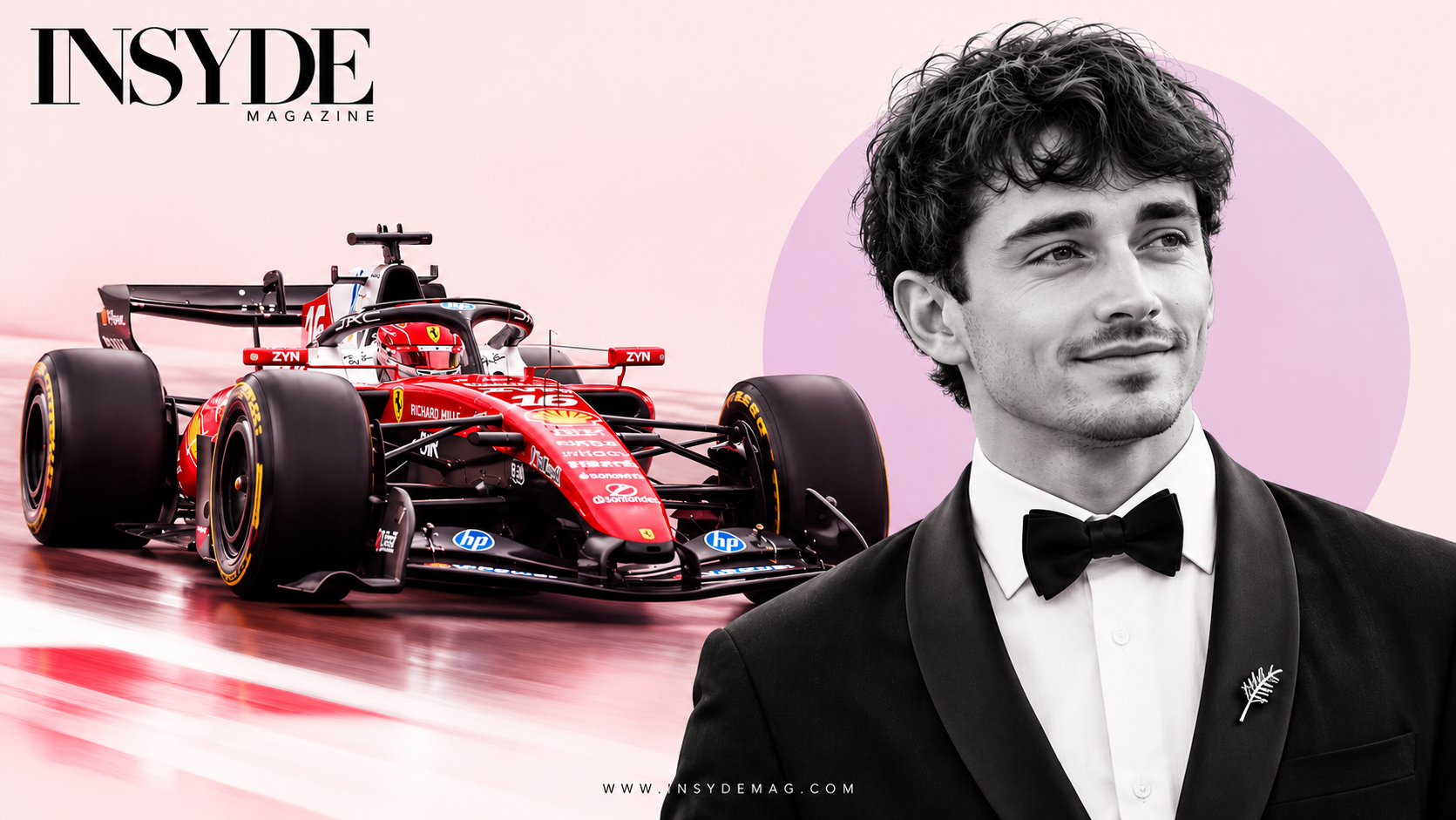
    No.1 Luxury Magazine In Bengaluru

  • PEN BRANDS OF THE ULTRA-RICH

    PEN BRANDS OF THE ULTRA-RICH

    Five luxury pen houses where heritage, artistry and precision turn an everyday object into a statement of taste.

    A signature can close a billion-dollar deal. It can authenticate a masterpiece, formalize an acquisition or mark the beginning of a legacy. Yet the object behind that signature is often overlooked.

    In an age when messages disappear into screens and contracts are completed with a click, the luxury pen occupies a different kind of space. It is tactile, personal and deliberately old-fashioned. It asks you to slow down.

    For the discerning collector, a pen can be far more than a writing instrument. It can represent a century of craftsmanship, a rare artistic tradition or a fascination with the smallest details. And at the highest end of the market, the difference between an ordinary pen and an extraordinary one can be measured in hours of handwork, intricate finishing and the scarcity of a particular edition.

    The appeal is not simply about spending more. It is about knowing what you are paying for.

    A BILLION-DOLLAR MARKET, BUILT ON THE DETAILS

    The luxury pen industry is larger than its niche reputation might suggest. According to Grand View Research’s August 2026 market report, the global luxury-pen market was valued at an estimated US$3.6 billion in 2025. The firm projects it will reach US$3.7 billion in 2026 and US$5 billion by 2033, representing a forecast compound annual growth rate of 4.4% between 2026 and 2033.

    The report estimates that fountain pens accounted for 41.5% of market revenue in 2025, making them the largest product segment. The mid-luxury category represented 45.2%, while offline retail accounted for 72.4% of sales. Europe held the largest regional share, at 32.6%.

    These figures are commercial research estimates, not audited industry-wide sales disclosures. They nevertheless point to an important distinction: luxury writing instruments are not sustained by ultra-expensive collector pieces alone. The market also depends on everyday premium products, personalization, gifting and the experience of examining an instrument before buying it.

    The most interesting end of the market, however, is where a pen becomes something closer to an object of art.

    01. MONTBLANC — THE POWER OF AN ICON

    Few writing-instrument names have achieved the cultural recognition of Montblanc.

    The German luxury house introduced its Meisterstück in 1924. Over the following century, its distinctive silhouette and enduring design helped turn it into one of the most recognizable names in fine writing. The collection marked its centenary in 2024.

    Montblanc’s strength is the balance between familiarity and aspiration. Its writing instruments are associated with professional achievement, milestone gifting and the rituals of business, but the brand’s collectible editions offer a different proposition.

    The Great Characters collection draws inspiration from influential figures and cultural icons. Its Homage to The Great Gatsby Limited Edition 1925 fountain pen, for example, is listed at US$5,300 on Montblanc’s US website. The edition connects the writing instrument to the visual language of the Jazz Age and F. Scott Fitzgerald’s celebrated novel.

    That price is for a specific limited edition, not a representative price for all Montblanc pens. The brand’s wider collection spans considerably different price points.

    What makes Montblanc compelling is its ability to turn a recognisable design into a personal object. For one owner, it may be a daily writing companion. For another, a particular edition may represent a favourite author, an important achievement or a carefully chosen collectible.

    The luxury proposition: An enduring design icon with a bridge between professional life, cultural references and collecting.

    02. NAMIKI — THE ART OF JAPANESE LACQUER

    Some luxury objects announce their value immediately. Others reward a closer look.

    Namiki belongs firmly in the second category.

    The Japanese brand’s history of maki-e fountain pens dates to 1925. Maki-e is a traditional decorative technique that involves building intricate designs through layers of lacquer and the application of materials such as metallic powders. The process demands specialist knowledge, patience and careful execution.

    According to Namiki’s official history, the company explored lacquer as a durable and beautiful material for fountain-pen bodies before developing decorated designs that brought Japanese artistic traditions to writing instruments.

    The result is a different expression of luxury. Rather than relying solely on a familiar logo or precious-metal finish, Namiki places the decorative work at the centre of the object. Nature, mythology and traditional Japanese motifs can become elaborate compositions across a pen’s surface.

    The craftsmanship is not incidental decoration. It is the reason the object exists in that particular form.

    For collectors, this creates a more intimate relationship with ownership. The attraction may lie in the visual complexity of a design, the skill required to produce it or the connection to a tradition passed between generations of artisans.

    Namiki also challenges the assumption that luxury must always be loud. A pen can be extraordinary without relying on conspicuous branding. Its value can be found in the work that only becomes apparent when someone takes the time to look.

    The luxury proposition: Traditional Japanese artistry, intricate lacquerwork and craftsmanship that transforms a writing instrument into a miniature canvas.

    03. S.T. DUPONT — FRENCH REFINEMENT IN EVERY DETAIL

    S.T. Dupont approaches luxury through precision, finish and the relationship between an object and its owner.

    The French house’s Classique pen has an origin story that captures this philosophy. According to S.T. Dupont’s official account, Jacqueline Kennedy Onassis requested a writing instrument to match her S.T. Dupont lighter. The company, which had not previously manufactured pens, took on the challenge and adapted the lighter’s design language to create its first writing instrument.

    The resulting Classique design drew on the lighter’s metalwork and vertical guilloché detailing. It was an exercise in translating the character of one luxury object into another.

    That attention to detail remains central to the appeal of the house’s writing instruments. Surface patterns, lacquer, polished metal and the proportions of the body all contribute to the experience. The pen is not merely a vessel for ink; it is an object designed to feel considered in the hand and distinctive on a desk.

    There is a certain intimacy to this kind of luxury. A writing instrument is handled repeatedly, often during moments that matter: a personal letter, a formal agreement, a handwritten note or a significant gift. The quality of its design becomes part of the ritual.

    S.T. Dupont’s appeal is therefore less about size or spectacle than about refinement. The details are the point.

    The luxury proposition: French design heritage, refined metalwork and an understated approach to personal luxury.

    04. CARAN D’ACHE — SWISS PRECISION AT ITS MOST EXTRAVAGANT

    Caran d’Ache brings Switzerland’s tradition of precision and technical design into the world of writing instruments.

    Founded in Geneva in 1915, the company produces its writing and drawing instruments in Switzerland. Its range extends from accessible premium stationery to limited editions that explore elaborate materials, intricate finishing and ambitious design concepts.

    One example is the 1010 Timekeeper Fountain Pen Limited Edition. On its US website, Caran d’Ache lists the model at US$14,325.

    The design draws inspiration from the world of fine watchmaking, including the visual language of watch dials and crowns. The company highlights techniques including guilloché, engraving, manual polishing, lacquering and PVD treatment.

    This is where the relationship between watches and pens becomes particularly interesting. Both objects combine engineering with personal taste. Both can be judged on their practical performance, yet their most collectible versions are often appreciated for the design decisions and technical work that go into them.

    The price of the 1010 Timekeeper is a useful illustration of how far a luxury writing instrument can extend beyond everyday utility. It is not a typical Caran d’Ache price, nor should it be taken as representative of the brand’s broader collection. It is a specific limited edition at the upper end of its range.

    At this level, the appeal lies in the convergence of design, specialist finishing and scarcity.

    The luxury proposition: Swiss manufacturing and technical precision, expressed through highly elaborate limited editions.

    05. MONTEGRAPPA — ITALIAN CHARACTER, COLLECTOR APPEAL

    Montegrappa offers a more expressive interpretation of luxury writing.

    Its history began in 1912, when a group of industrialists established Italy’s first nib factory in Bassano Veneto, now Bassano del Grappa. The company subsequently developed its own fountain pens and built a reputation around Italian manufacturing and design.

    The house’s official history describes a tradition shaped by the artisanal culture of the Veneto region. That heritage continues to inform its identity, alongside an appetite for distinctive designs and themed collections.

    Montegrappa is particularly interesting for collectors who want an object to communicate something about their interests. Its writing instruments have explored subjects from cultural figures and literature to entertainment and history. This can make the choice of pen feel more personal than simply selecting a familiar luxury name.

    A collector might be drawn to a particular edition because of its visual language, the story behind it or the subject it commemorates. Another buyer may prefer a more restrained design from the brand’s wider range.

    That breadth is important. Luxury collecting is not a single aesthetic, and a high price does not automatically make an object desirable. For many enthusiasts, the strongest connection comes from finding a design that feels individual.

    Montegrappa’s character-driven approach gives it a distinct place among established writing houses: it treats the pen as a canvas for identity as well as a tool for writing.

    The luxury proposition: Italian heritage, expressive design and collectible instruments that appeal to personal interests.

    WHAT ACTUALLY MAKES A LUXURY PEN EXPENSIVE?

    The price of a luxury pen is rarely explained by a single material or manufacturing decision. Several factors can combine to create a substantial premium.

    Craftsmanship and finishing. Specialist nib work, engraving, lacquer application, polishing and assembly can require considerable skill. Techniques such as Namiki’s maki-e are particularly labour-intensive because the decorative surface is built through a series of carefully controlled processes.

    Materials and construction. Precious metals, specialist finishes and complex components can affect manufacturing costs. Their influence varies by model, and a premium material alone does not establish a pen’s overall quality.

    Design and heritage. Established houses carry histories, recognisable design languages and reputations built over decades. For some buyers, that continuity is part of the appeal.

    Limited production. A restricted edition can attract interest when it combines a distinctive concept, desirable execution and genuine collector demand. However, limited availability does not guarantee that a pen will appreciate in value.

    Personalisation and meaning. Engraving, bespoke details and the circumstances in which a pen is purchased can make it deeply personal. A writing instrument given to mark a career milestone may be valued for reasons that have little to do with its resale price.

    It is also worth separating luxury from investment. Some pens become sought-after collectibles, but future value is uncertain. Condition, authenticity, provenance, rarity and market demand all matter. A buyer should not assume that an expensive pen will generate a financial return.

    WHY THE PEN STILL MATTERS IN A DIGITAL WORLD

    The continued appeal of fine writing instruments is not simply a nostalgic rejection of technology. It is a reminder that convenience and experience are not always the same thing.

    Digital tools are faster for most routine communication. A luxury pen offers something different: the physical sensation of writing, the rhythm of forming words by hand and the pleasure of using an object made with care.

    That distinction is relevant to the wider luxury market. Consumers can buy functional objects at almost every price point. The products that inspire deeper attachment often offer something beyond basic utility: a story, a craft tradition, an individual aesthetic or a connection to a meaningful moment.

    Fine writing instruments sit comfortably within that world. They can be used every day, displayed as part of a collection or kept for occasions when the act of writing deserves attention.

    They also occupy an unusual position between personal luxury and gifting. A pen can be chosen for its design, presented to mark an achievement or retained as a reminder of a relationship. Unlike a digital signature, the physical object can remain long after the moment has passed.

    THE FINAL WORD

    Montblanc represents the power of an icon. Namiki turns traditional Japanese craftsmanship into a form of wearable-scale art. S.T. Dupont brings French refinement to the smallest details. Caran d’Ache explores the possibilities of Swiss precision, while Montegrappa gives collectors a more expressive design language.

    These five houses demonstrate that luxury writing is not defined by one price bracket or a single idea of status. Their collections span different budgets, and not every instrument is intended for the wealthiest buyer.

    What connects them is the belief that an everyday object can become something worth keeping.

    The finest luxury pens do more than put ink on paper. They bring together design, craft, heritage and personal meaning in a form that can be held in the hand.

    In a world that rarely asks us to slow down, perhaps that is the ultimate luxury: not simply owning something expensive, but owning something worth taking the time to appreciate.

    INSYDE MAGAZINE– NO.1 LUXURY MAGAZINE IN BENGALURU

  • THE $50 MILLION FANTASY BRA

    THE $50 MILLION FANTASY BRA

    Jacob & Co. × Victoria’s Secret: Where Diamonds, Desire and Fashion Spectacle Collide

    INSYDE Magazine | Fashion, Luxury & Culture

    More than 4,400 diamonds, a 75.54-carat yellow diamond and over 1,000 hours of craftsmanship. As Victoria’s Secret revives its most extravagant runway tradition with Jacob & Co., the Fantasy Bra reveals how luxury transforms exceptional materials into global spectacle.

    On 18 October 2026, Victoria’s Secret brought one of fashion’s most recognisable spectacles back to the runway. At its Los Angeles fashion show, Kylie Jenner made her Victoria’s Secret runway debut wearing the brand’s latest Fantasy Bra—a creation developed in collaboration with New York-based high-jewellery house Jacob & Co. and assigned a reported value of US$50 million.

    The number is extraordinary. So is the object behind it.

    Set in 18-karat white and yellow gold, the creation features more than 4,400 natural diamonds, anchored by a 75.54-carat radiant-cut Fancy Vivid yellow diamond. Fifteen artisans spent more than 1,000 hours bringing the piece to life, assembling approximately 3,218 individually designed components into a structure intended to move with the body.

    According to Jacob & Co.’s official product description and reporting by Forbes, the design combines elaborate gemstone setting with engineering techniques more commonly associated with intricate mechanical objects than conventional lingerie.

    It is a creation designed to be seen, photographed and remembered. Yet the most interesting story is not simply how much it is worth. It is how two brands have turned the intersection of jewellery, fashion and celebrity into an object capable of commanding global attention.

    A DIAMOND AT THE CENTRE OF THE FANTASY

    The Fantasy Bra’s visual impact begins with its centrepiece: a 75.54-carat natural Fancy Vivid yellow diamond, graded VS2 by the Gemological Institute of America, or GIA, according to Jacob & Co.’s published specifications.

    The radiant cut combines the rectangular outline of an emerald-style cut with faceting designed to produce considerable brilliance. In a stone of this colour and scale, the effect is particularly striking. Rather than serving as a small accent, the yellow diamond becomes the focal point around which the entire composition is organised.

    Two round brilliant white diamonds, together weighing 11.85 carats, flank the centre stone. Beyond them, the design incorporates 91 large natural white diamonds, with individual stones ranging from 5.01 to 18.59 carats. Jacob & Co. identifies these stones as E–F in colour and VVS2–VS1 in clarity. The remaining diamond work fills the structure with additional brilliance and detail.

    The house’s published specifications list a combined diamond weight of approximately 1,373.39 carats. The stones are set in 18-karat white and yellow gold, with multiple diamond shapes and setting techniques used throughout the design.

    These details matter because exceptional jewellery is not defined by carat weight alone. Colour, clarity, cut, proportions, setting and the relationship between individual stones all influence the final effect. The challenge is to make thousands of elements read as one coherent design rather than a collection of unrelated gemstones.

    In the Fantasy Bra, the yellow centre stone establishes the visual hierarchy. The surrounding white diamonds intensify its contrast, while the gold framework gives the composition its structure.

    The result is less a conventional garment embellished with precious stones than a piece of high jewellery conceived around the form of lingerie.

    Source: Jacob & Co. — The Angel Fantasy Bra.

    3,218 COMPONENTS. MORE THAN 1,000 HOURS OF CRAFTSMANSHIP.

    The most revealing aspect of the Fantasy Bra may be the work that cannot be understood from a photograph.

    Jacob & Co. describes the creation as a structure comprising approximately 3,218 individually designed components. Fifteen artisans spent more than 1,000 hours assembling and setting the piece by hand, combining traditional jewellery-making methods with computer-aided design.

    The process began with an initial sketch, followed by a full-scale model made from chipboard. The team then developed a detailed digital model to refine the proportions, map the individual components and plan the construction.

    Each gold component was cast using the lost-wax method, a traditional process in which a wax model is encased in investment material and heated until the wax melts away, leaving a mould for molten metal. The resulting pieces were cleaned, refined and pre-polished before being assembled and set with diamonds.

    The engineering challenge was substantial. A centre stone weighing more than 75 carats requires a supporting structure capable of handling its mass. At the same time, the design could not behave like a rigid jewellery plate. It needed to follow the contours of the body and allow movement.

    The team therefore used different setting approaches for different parts of the piece. Prong settings expose more of a diamond to light, while bezel settings secure stones in areas subject to greater movement. Pavé settings fill the spaces between larger stones, creating a more continuous field of brilliance. Articulated sections allow parts of the gold structure to move in relation to one another.

    These are not merely decorative decisions. Every setting, connection and supporting element must balance the security of the gemstones with the overall appearance and wearability of the piece.

    The challenge becomes even more significant when the object is intended for a live runway presentation. It must photograph beautifully, withstand movement and sit correctly on the wearer, all while preserving the visual integrity of the design.

    As Forbes reported on 19 October 2026, the construction combined computer-aided design with traditional hand-finishing and assembly.

    The craftsmanship is what separates this object from a simple exercise in extravagance. The diamonds establish its visual impact; the engineering makes the design possible.

    WHEN PRECIOUS METAL BEHAVES LIKE FABRIC

    The Fantasy Bra draws inspiration from Jacob & Co.’s Rare Touch jewellery collection, which explores how precious metal can be shaped into articulated structures that move with the body.

    That idea is pushed further here. Instead of creating a conventional necklace, bracelet or rigid ornament, the house has developed a piece made entirely from precious metal and gemstones that is intended to function as lingerie.

    The distinction is important. Jewellery is usually designed to sit on the body, while clothing is designed to follow it. The Fantasy Bra must do both.

    Its gold framework has to support a substantial quantity of diamonds without becoming visually cumbersome. Its cups must follow the contours of the wearer. Its articulated elements must permit movement, while the settings must keep the stones secure.

    The design also had to be fitted to Jenner’s measurements, with adjustments made to ensure that the structure sat correctly on her body.

    In the official behind-the-scenes feature, Jacob Arabo, founder of Jacob & Co., emphasised that value alone was not enough. The creative priorities, he explained, were the diamonds, the light and the movement. Victoria’s Secret chief creative officer Adam Selman similarly stressed the importance of designing for the person wearing the piece.

    Their comments point to the central design tension: the Fantasy Bra must be spectacular without becoming a static display object.

    The finished creation weighs just under four pounds, according to Vogue. That is a remarkable weight for something intended to be worn on a moving body, and it underlines the unusual demands of the project.

    For Jacob & Co., the collaboration offers an opportunity to apply its high-jewellery expertise to a format where the technical challenges are immediately visible. For Victoria’s Secret, it transforms a familiar piece of lingerie into a showpiece built around exceptional materials and specialist craftsmanship.

    Sources: Victoria’s Secret — The Making of the Fantasy Bra and Vogue.

    THE RETURN OF A RUNWAY ICON

    The 2026 creation is also a revival of a tradition that has been part of Victoria’s Secret’s visual identity for three decades.

    The first Fantasy Bra appeared in 1996, when Claudia Schiffer wore the original design in a magazine advertisement. Over the following years, the concept became a signature expression of the brand’s extravagant runway aesthetic, with each edition built around precious stones, elaborate craftsmanship and a high-profile wearer.

    The tradition reached a new level of visibility in 2000, when Gisele Bündchen wore the Red Hot Fantasy Bra, valued at US$15 million. Other editions followed, each adding to the mythology surrounding the garment.

    The last Fantasy Bra before the current revival was worn by Elsa Hosk in 2018. That edition, created with Atelier Swarovski, was valued at approximately US$1 million.

    The return in 2026 therefore marks an eight-year gap between editions. It also arrives at a time when fashion shows are increasingly understood as entertainment properties as much as presentations of clothing.

    The Victoria’s Secret Fashion Show on 18 October 2026 returned to Los Angeles, with a seasonal concept spanning spring, summer, autumn and two winter segments, alongside a dedicated PINK presentation. The production brought together runway fashion, celebrity appearances and live musical performances.

    Within that wider production, the Fantasy Bra served as a focal point: a single creation with a long history, a recognisable name and a headline-making valuation.

    Its return is not simply a nostalgic gesture. It reintroduces an established brand signature in a format suited to contemporary fashion coverage, where a single image can become the defining visual of an entire event.

    The Fantasy Bra gives the show a clear centre of gravity. It is an object audiences can identify immediately, even if they know little about the rest of the collection.

    Source: Vogue — The history and return of the Fantasy Bra.

    WHY KYLIE JENNER WAS THE RIGHT CHOICE

    The selection of Kylie Jenner was central to the story.

    Jenner’s public profile extends across entertainment, fashion, beauty and social media. As a beauty entrepreneur with a substantial international audience, she reaches consumers who may not ordinarily follow fine-jewellery craftsmanship or the history of lingerie runway shows.

    Her appearance therefore connected two different kinds of visibility: the specialist world of high jewellery and the broader culture of celebrity-led fashion.

    In its coverage of the show, Vogue reported that Selman described Jenner as a “cultural powerhouse”, emphasising her influence beyond any single industry. The choice was consistent with the show’s positioning as entertainment as well as fashion.

    That distinction matters in an era when the reach of a runway moment is not limited to the people in the room. Photographs, short-form video, backstage content, interviews and social commentary extend the life of a show long after the final model leaves the catwalk.

    A recognisable celebrity can help translate a highly specialised object into a story with wider appeal. Audiences may initially encounter the Fantasy Bra because of Jenner, then become curious about the diamonds, the designer, the construction or the reported price.

    The wearer is therefore more than a model displaying a garment. She becomes the link between the craftsmanship and the culture surrounding it.

    This does not mean celebrity alone creates luxury. The object still needs a compelling design, credible craftsmanship and a story that rewards attention. But celebrity can give those qualities a much larger stage.

    For Victoria’s Secret, Jenner’s debut placed the Fantasy Bra at the intersection of fashion, beauty and entertainment. For Jacob & Co., it offered a high-profile presentation of its work to an audience beyond traditional jewellery collectors.

    The collaboration demonstrates how luxury objects can travel across cultural categories without losing their material identity.

    Source: Vogue — Kylie Jenner’s Fantasy Bra debut.

    WHAT DOES A US$50 MILLION FANTASY BRA ACTUALLY MEAN?

    The reported valuation is the headline figure, but it deserves careful interpretation.

    Jacob & Co. describes the 2026 Fantasy Bra as the most valuable edition ever created, and fashion reporting has placed its value at US$50 million. That figure should be understood as the reported valuation of an extraordinary, bespoke creation—not as evidence of a completed sale or a guaranteed resale price.

    There is no publicly disclosed transaction establishing that a buyer has paid US$50 million for the piece. Nor does the reported figure, by itself, reveal how the valuation was calculated.

    The cost of exceptional diamonds is one part of the story. The central yellow diamond, the additional white diamonds, the precious metal, the specialised labour and the complexity of the construction all contribute to the creation’s material and technical significance.

    But a one-of-a-kind object associated with major brands also occupies a different category from a conventional retail product. Its identity is shaped by the circumstances of its creation, its place in fashion history and its role within a major public event.

    That makes its valuation difficult to compare directly with the price of a commercially available piece of jewellery.

    The Fantasy Bra is not simply a product with a price tag. It is a bespoke showpiece designed to embody the ambitions of two brands. Its value is communicated through the combination of gemstones, craftsmanship, exclusivity and cultural visibility.

    That does not mean its reported valuation should be treated as a measure of its financial return. Without a public breakdown of the valuation methodology, a disclosed sale or independently verified resale evidence, it would be misleading to claim that the piece could necessarily be sold for the same amount.

    The US$50 million figure is an extraordinary headline. The more useful question is what that headline enables the brands to communicate.

    THE BUSINESS OF LUXURY SPECTACLE

    For Victoria’s Secret, the Fantasy Bra is a concentrated expression of the brand’s visual identity. It brings glamour, excess and craftsmanship together in a single object that can anchor a fashion show and generate coverage well beyond the runway.

    For Jacob & Co., the collaboration showcases the house’s ability to work with exceptional gemstones and complex structures while introducing its jewellery-making expertise to a wider fashion and entertainment audience.

    The partnership creates value through a combination of complementary strengths. Victoria’s Secret provides the runway, the audience and a recognisable fashion tradition. Jacob & Co. provides the gemstones, the technical expertise and the high-jewellery proposition. Jenner’s appearance adds a celebrity narrative that can travel across multiple media platforms.

    Together, these elements create a story that is larger than any one component.

    This is the commercial logic of luxury spectacle: an object can serve as a product of craftsmanship and a communications asset at the same time. Its role is not necessarily to generate direct sales in the way a conventional retail collection would. It can also reinforce brand identity, attract attention, stimulate conversation and give audiences a memorable reason to engage with a show.

    The Fantasy Bra is especially suited to that purpose because its headline figure is instantly understandable. A US$50 million valuation communicates extravagance in a single line. The diamond count and production hours then give the story additional substance.

    But attention should not be confused with measurable commercial success. Neither brand has publicly disclosed figures that would allow an independent calculation of the collaboration’s return on investment, its effect on product sales or the precise value of the media coverage it generated.

    The defensible conclusion is narrower, but still significant: the Fantasy Bra provides both brands with an unusually distinctive expression of their identities, supported by a story that connects craftsmanship, celebrity and fashion history.

    In luxury marketing, not every creation needs to function as a conventional product. Some are designed to demonstrate what a brand can do when commercial constraints give way to creative ambition.

    The Fantasy Bra belongs to that category.

    WHEN EXCESS BECOMES AN ART FORM

    Luxury has always maintained a relationship with excess. Exceptional materials, meticulous workmanship and limited availability distinguish many of its most prestigious creations from ordinary consumer goods.

    Yet excess alone is rarely enough to make an object compelling. An extraordinary quantity of diamonds can establish a sense of scale, but scale does not automatically produce design. The more interesting challenge is how those materials are organised, how the object functions and what it communicates.

    The Fantasy Bra brings those questions together.

    Its gemstones create the immediate visual drama. Its articulated construction gives the design a technical dimension. Its connection to Victoria’s Secret’s runway history supplies context, while Jenner’s debut brings the piece into contemporary celebrity culture.

    Each layer strengthens the others. Without the craftsmanship, the object would risk becoming a price-led spectacle. Without the runway, its technical achievement might reach a more specialised audience. Without the celebrity moment, its cultural reach could be more limited.

    The result is a creation that operates across several worlds at once: jewellery, fashion, entertainment and brand storytelling.

    That is what makes the Fantasy Bra relevant beyond its extraordinary valuation. It illustrates how luxury houses and fashion brands can use a single object to communicate both material excellence and cultural ambition.

    THE FINAL WORD

    The $50 million Fantasy Bra is not merely a story about diamonds, lingerie or a celebrity runway debut. It is a study in how luxury turns craftsmanship into spectacle.

    Jacob & Co. brought its expertise in exceptional gemstones and intricate jewellery construction. Victoria’s Secret revived a defining element of its runway history. Kylie Jenner gave the creation a high-profile introduction to a global audience.

    The result is a piece built from thousands of precious components, shaped to move with the body and presented as the centrepiece of a major fashion event.

    Its reported valuation may be what first captures attention. But the more enduring story lies in the ambition behind it: the effort to make precious materials behave like fabric, to turn a familiar garment into high jewellery and to create an object that can carry the identities of two brands at once.

    In luxury, price can make a headline. Craftsmanship gives that headline substance. Culture gives it reach.

    And with the return of the Fantasy Bra, Victoria’s Secret and Jacob & Co. have brought all three onto the runway.

    INSYDE Magazine is a luxury, fashion, culture and entertainment publication exploring the people, brands and ideas shaping the world of modern luxury. From exceptional craftsmanship and high jewellery to influential personalities and emerging cultural movements, INSYDE offers a distinctive perspective on the stories defining what comes next.
    INSYDE — No. 1 Luxury Magazine in Bengaluru.

  • ISHA DEB: THE ART OF JEWELLERY, THE INSTINCT OF AN ARTIST

    ISHA DEB: THE ART OF JEWELLERY, THE INSTINCT OF AN ARTIST

    INSYDE EXCLUSIVE | ISHA DEB

    From the first sketch to the finished piece, jewellery designer Isha Deb explores the intuition, imagination and technical precision behind jewellery that is as personal as it is beautiful.

    Artificial intelligence can generate intricate jewellery concepts in seconds. Digital tools can explore silhouettes, experiment with proportions and turn an abstract idea into a compelling visual long before a gemstone is set or a piece reaches the workbench. For an industry built around precision, aesthetics and material expertise, these capabilities present exciting possibilities.

    But a convincing image is not the same as a finished piece of jewellery. Between the first idea and the object a person eventually wears lies a series of decisions that demand creative judgement, technical understanding and an awareness of how design meets the human body.

    It is within this space between possibility and execution that jewellery designer Isha Deb sees the continuing importance of the designer.

    “I use them myself, but for me, they remain a medium through which I express a design. My own thought process and judgement still guide the work,” she says of artificial intelligence and digital tools.

    For Deb, technology is neither something to resist nor a substitute for creative authorship. It is an extension of the design process, capable of making certain tasks faster and expanding the range of ideas a designer can explore. What it cannot automatically supply is the personal perspective that determines which ideas are worth pursuing.

    As AI becomes increasingly capable of producing sophisticated visual concepts, that distinction raises a question extending beyond jewellery: when the image becomes easier to generate, what gives the final object its identity?

    THE HUMAN ELEMENT BEHIND THE IMAGE

    A jewellery designer’s point of view develops over time. It is shaped by experiences, observations, travel, culture and the details that hold an individual’s attention. These influences may find their way into a design consciously or emerge through instinct, informing everything from the selection of a gemstone to the decision to pursue a sharp architectural line or a softer, more fluid form.

    For Deb, this accumulated experience is central to creative identity.

    “AI can produce a beautiful image, but I don’t believe a designer’s soul can be cloned, at least not yet.”

    Her distinction is between generating possibilities and giving those possibilities direction. AI can offer a starting point, but a designer must still assess the result, question its relevance and determine whether it reflects a considered creative intention.

    That judgement is particularly significant in jewellery, where visual appeal is only one part of the equation. A design must also account for materials, construction, proportion and wearability. A form that looks impressive on a screen may require substantial refinement before it becomes a viable object.

    The challenge, therefore, is not simply to use the most advanced tools available. It is to retain the ability to make independent creative decisions while using those tools.

    WHY SKETCHING STILL MATTERS

    For Deb, the creative process often begins with drawing. A sketch is not merely a record of an idea that has already been resolved; it can be the means through which the idea becomes clear in the first place.

    “Often, an idea only starts to become clear when you begin drawing it,” she explains.

    A rough line on paper, a quick doodle or an unfinished drawing can help a designer discover proportions, test a form and recognise possibilities that were not immediately apparent. The act of drawing becomes part of the thinking itself.

    Digital devices have made this process more flexible. Deb carries an iPad, allowing her to sketch when an idea occurs rather than waiting until she is at her workspace. The medium has evolved, but she sees the underlying relationship between thought and drawing as largely unchanged.

    “I still work through rough lines, make changes and let the idea evolve as I draw. For me, it is simply an upgraded tool.”

    This distinction matters in a conversation often framed as a choice between traditional methods and digital innovation. In practice, the two can coexist. A designer can begin with a spontaneous sketch, develop it digitally, refine it through three-dimensional modelling and ultimately translate it into a physical object.

    What matters is the continuity of thought throughout that process. The tools may change, but the designer remains responsible for deciding what the design should become.

    WHEN TECHNOLOGY BECOMES A CREATIVE RISK

    The risk of generic design does not begin and end with artificial intelligence. Jewellery designers have long navigated the tension between personal expression and commercial realities.

    Budgets, customer preferences, material costs and the need to build a sustainable business can influence the final form of a piece. A detail may need to be simplified, a design adjusted or the choice of diamonds and gemstones reconsidered to meet a particular price point.

    Deb acknowledges that these pressures are part of the profession. She believes the greater challenge is recognising which compromises are necessary without losing the qualities that distinguish a designer’s work.

    “I think technology works well as a creative tool as long as a designer’s own expression and style remain intact. It should help us develop an idea without making it feel more generic.”

    AI may make it easier to generate alternatives, but a greater number of options does not necessarily produce a more original outcome. If designers accept convenient results without questioning whether they reflect their own aesthetic, the process risks becoming an exercise in selecting images rather than developing ideas.

    For Deb, the responsibility lies in knowing when to adapt and when to preserve the character of a design. Commercial viability is essential, but it need not come at the expense of every distinctive detail.

    The question is not whether a designer should compromise. It is whether the compromise serves the design or gradually erodes its identity.

    FROM DIGITAL CONCEPT TO PHYSICAL REALITY

    The difference between an attractive visual and a workable piece becomes especially apparent during computer-aided design, or CAD.

    While a sketch establishes the initial direction, CAD translates the idea into a three-dimensional structure that can be manufactured and worn. This stage requires the designer to preserve the character of the original concept while resolving the technical demands of construction.

    For Deb, getting the CAD right is one of the most challenging parts of the process.

    Consider a necklace. Its links must provide sufficient flexibility to sit comfortably around the neck, while the height and angles of its elements influence how it rests against the body. An earring presents a different set of demands: its weight, balance and support must work together so that it sits correctly on the ear.

    These details may not be immediately apparent in a rendering, yet they can determine whether a piece succeeds in practice. The designer must understand how a form behaves in three dimensions, how its components interact and how its construction affects the wearer.

    “Getting the CAD right means preserving the character of the design while resolving all the practical details that make it work as jewellery.”

    The process also depends on technical knowledge and collaboration with manufacturers. A design must move beyond visual intention without losing what made it compelling in the first place.

    This is where the debate around AI becomes more nuanced. Digital tools already play an important role in jewellery development, and AI may help streamline aspects of the process further. But generating a concept and resolving the details required to manufacture it are different tasks.

    A finished jewel must function as an object, not merely as an image.

    DESIGNING FOR CONNECTION, NOT JUST APPEARANCE

    The value of jewellery has traditionally been associated with materials, rarity, craftsmanship and monetary worth. These remain important considerations, but Deb believes the contemporary luxury customer is also looking for a more personal relationship with what they buy.

    “I believe today’s luxury customer is looking for a more personal connection with what they buy.”

    For her, individuality can emerge from a distinctive design, an unusual gemstone colour, a rare diamond cut or a stone with a compelling history. The appeal extends beyond the material’s price to the character that makes a particular piece feel different.

    She also sees wearability as an increasingly important consideration. Customers may value exceptional jewellery that can be enjoyed across different occasions, rather than pieces that remain reserved for a single event. A distinctive design does not necessarily need to be elaborate to make a statement.

    This places a different emphasis on the relationship between design and ownership. Jewellery can be an expression of personal style, but it can also become part of everyday life—something selected because it feels relevant to the wearer rather than simply because it signals status.

    For a designer, creating that connection requires more than visual impact. It means considering how a piece will feel, how it will be worn and whether its character will continue to resonate beyond the moment of purchase.

    HERITAGE AS A STARTING POINT

    Indian jewellery offers a vast vocabulary of craftsmanship, ornamentation, architectural references and cultural forms. For contemporary designers, the challenge is to engage with this heritage without simply reproducing familiar aesthetics.

    Deb approaches inspiration by looking beyond the obvious form. She considers the structure, rhythm or detail that attracts her, then explores how it might be reinterpreted through changes in proportion, pattern, shape or the use of gemstones.

    The original reference remains part of the creative process, but it does not have to dictate the final result.

    “I feel working with heritage and cultural references is more about understanding it deeply enough to express it in a fresh and more personalised way.”

    This approach places interpretation at the centre of design. A historical or cultural reference can be a starting point for exploration rather than a template to reproduce. Through drawing, experimentation and the considered use of materials, a familiar form can develop a new identity.

    The same principle applies to technology. Whether an idea begins with a cultural reference, a hand-drawn sketch or a digital concept, its originality depends on the decisions that shape its development.

    Innovation does not necessarily require abandoning the past. It can emerge from understanding a reference deeply enough to discover what else it might become.

    WHAT THE NEXT GENERATION OF JEWELLERY MIGHT LOOK LIKE

    Deb expects jewellery design to continue responding to changing lifestyles, customer preferences and the practical realities of materials and pricing.

    She sees wearability and versatility as important considerations, alongside the enduring appeal of classic pieces and exceptional one-of-a-kind high jewellery. With gold becoming more expensive, she believes lighter designs are becoming more attractive to some customers. Layering necklaces and combining different pieces can also offer more personal ways of wearing jewellery.

    She points to lab-grown diamonds as making solitaire jewellery more accessible and identifies materials such as titanium as offering possibilities for colour, volume and playful designs that remain comfortable to wear.

    These observations reflect her perspective on the direction of the market rather than a universal shift in consumer behaviour. Jewellery continues to serve different preferences, from everyday fine jewellery to highly individualised and exceptional pieces.

    For designers, the challenge is to respond to these changes without allowing every new preference or technology to dictate the direction of their work.

    Deb sees considerable potential in AI and other digital tools to improve visualisation, streamline aspects of CAD development and support manufacturing processes. By allowing designers and customers to explore ideas earlier, such tools may also help identify changes before significant time and resources are committed to production.

    But she draws a clear distinction between technological capability and creative originality.

    “Having the ability to generate more options does not necessarily mean those options carry an original thought.”

    The designer’s role will continue to involve understanding the customer, exploring materials and deciding which ideas deserve to be developed. The tools may expand the possibilities, but the creative direction must still come from somewhere.

    WHEN A BEAUTIFUL OBJECT BECOMES GOOD DESIGN

    For Deb, a design’s success is not complete when the piece has been manufactured. Its meaning is ultimately tested through the experience of the person who chooses to wear it.

    “I will be honest- according to me, the success of a design is not complete when the piece is made. It is when someone chooses to buy it, wears it and loves it.”

    The statement brings the discussion back to the physical realities of jewellery. A piece must balance its creative idea with comfort, construction, price and value. It should move as required, sit properly on the body and allow its wearer to enjoy it without constant adjustment or discomfort.

    Commercial success also matters. A designer must understand the intended customer and work within practical limits without losing the character or quality of the design. When those elements come together, the result becomes more than a visually appealing object.

    It becomes a piece of jewellery that someone wants to make part of their life.

    Artificial intelligence will continue to change how designers imagine, visualise and develop their work. It may reduce the time required for certain tasks, open up new technical possibilities and make experimentation more accessible. Its influence on jewellery design is likely to grow as the tools evolve.

    But the central questions remain grounded in the object itself. Does the design work? Does the gemstone belong? Has the original idea survived the process of making? Does the finished piece offer something meaningful to the person who wears it?

    For Isha Deb, the future is not about choosing between human creativity and technological progress. It is about understanding what each can contribute—and ensuring that efficiency never becomes a substitute for judgement.

    A machine may help generate the image. The designer must still decide what is worth bringing into the world.


    INSYDE EXCLUSIVE
    Isha Deb on AI, creative authorship and the future of jewellery design.

    INSYDE Magazine | Luxury. Culture. Perspective.

    No.1 Luxury Magazine In Bengaluru