
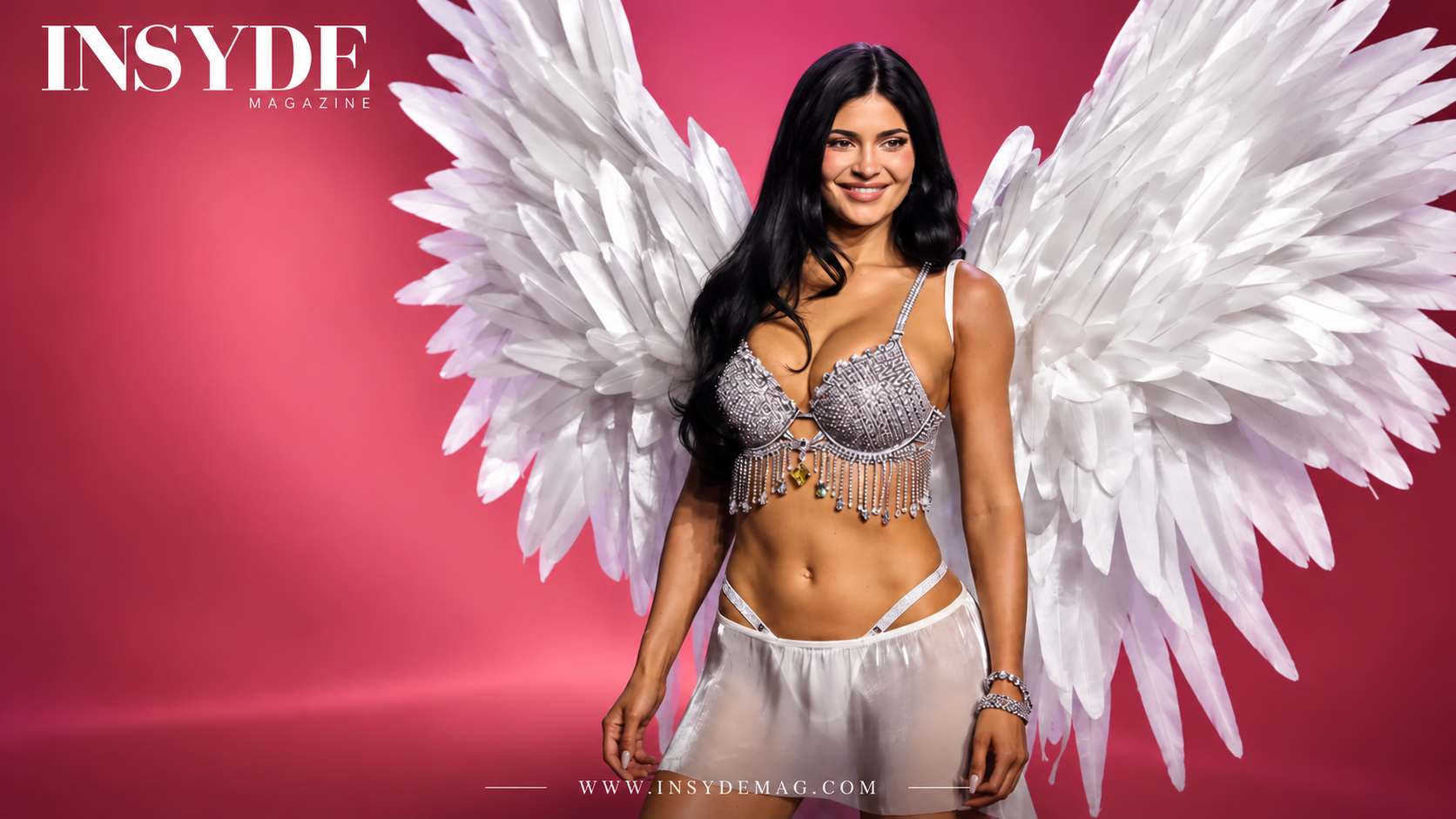
Jacob & Co. × Victoria’s Secret: Where Diamonds, Desire and Fashion Spectacle Collide
INSYDE Magazine | Fashion, Luxury & Culture
More than 4,400 diamonds, a 75.54-carat yellow diamond and over 1,000 hours of craftsmanship. As Victoria’s Secret revives its most extravagant runway tradition with Jacob & Co., the Fantasy Bra reveals how luxury transforms exceptional materials into global spectacle.
On 18 October 2026, Victoria’s Secret brought one of fashion’s most recognisable spectacles back to the runway. At its Los Angeles fashion show, Kylie Jenner made her Victoria’s Secret runway debut wearing the brand’s latest Fantasy Bra—a creation developed in collaboration with New York-based high-jewellery house Jacob & Co. and assigned a reported value of US$50 million.
The number is extraordinary. So is the object behind it.
Set in 18-karat white and yellow gold, the creation features more than 4,400 natural diamonds, anchored by a 75.54-carat radiant-cut Fancy Vivid yellow diamond. Fifteen artisans spent more than 1,000 hours bringing the piece to life, assembling approximately 3,218 individually designed components into a structure intended to move with the body.
According to Jacob & Co.’s official product description and reporting by Forbes, the design combines elaborate gemstone setting with engineering techniques more commonly associated with intricate mechanical objects than conventional lingerie.
It is a creation designed to be seen, photographed and remembered. Yet the most interesting story is not simply how much it is worth. It is how two brands have turned the intersection of jewellery, fashion and celebrity into an object capable of commanding global attention.
A DIAMOND AT THE CENTRE OF THE FANTASY
The Fantasy Bra’s visual impact begins with its centrepiece: a 75.54-carat natural Fancy Vivid yellow diamond, graded VS2 by the Gemological Institute of America, or GIA, according to Jacob & Co.’s published specifications.
The radiant cut combines the rectangular outline of an emerald-style cut with faceting designed to produce considerable brilliance. In a stone of this colour and scale, the effect is particularly striking. Rather than serving as a small accent, the yellow diamond becomes the focal point around which the entire composition is organised.
Two round brilliant white diamonds, together weighing 11.85 carats, flank the centre stone. Beyond them, the design incorporates 91 large natural white diamonds, with individual stones ranging from 5.01 to 18.59 carats. Jacob & Co. identifies these stones as E–F in colour and VVS2–VS1 in clarity. The remaining diamond work fills the structure with additional brilliance and detail.
The house’s published specifications list a combined diamond weight of approximately 1,373.39 carats. The stones are set in 18-karat white and yellow gold, with multiple diamond shapes and setting techniques used throughout the design.
These details matter because exceptional jewellery is not defined by carat weight alone. Colour, clarity, cut, proportions, setting and the relationship between individual stones all influence the final effect. The challenge is to make thousands of elements read as one coherent design rather than a collection of unrelated gemstones.
In the Fantasy Bra, the yellow centre stone establishes the visual hierarchy. The surrounding white diamonds intensify its contrast, while the gold framework gives the composition its structure.
The result is less a conventional garment embellished with precious stones than a piece of high jewellery conceived around the form of lingerie.
Source: Jacob & Co. — The Angel Fantasy Bra.
3,218 COMPONENTS. MORE THAN 1,000 HOURS OF CRAFTSMANSHIP.
The most revealing aspect of the Fantasy Bra may be the work that cannot be understood from a photograph.
Jacob & Co. describes the creation as a structure comprising approximately 3,218 individually designed components. Fifteen artisans spent more than 1,000 hours assembling and setting the piece by hand, combining traditional jewellery-making methods with computer-aided design.
The process began with an initial sketch, followed by a full-scale model made from chipboard. The team then developed a detailed digital model to refine the proportions, map the individual components and plan the construction.
Each gold component was cast using the lost-wax method, a traditional process in which a wax model is encased in investment material and heated until the wax melts away, leaving a mould for molten metal. The resulting pieces were cleaned, refined and pre-polished before being assembled and set with diamonds.
The engineering challenge was substantial. A centre stone weighing more than 75 carats requires a supporting structure capable of handling its mass. At the same time, the design could not behave like a rigid jewellery plate. It needed to follow the contours of the body and allow movement.
The team therefore used different setting approaches for different parts of the piece. Prong settings expose more of a diamond to light, while bezel settings secure stones in areas subject to greater movement. Pavé settings fill the spaces between larger stones, creating a more continuous field of brilliance. Articulated sections allow parts of the gold structure to move in relation to one another.
These are not merely decorative decisions. Every setting, connection and supporting element must balance the security of the gemstones with the overall appearance and wearability of the piece.
The challenge becomes even more significant when the object is intended for a live runway presentation. It must photograph beautifully, withstand movement and sit correctly on the wearer, all while preserving the visual integrity of the design.
As Forbes reported on 19 October 2026, the construction combined computer-aided design with traditional hand-finishing and assembly.
The craftsmanship is what separates this object from a simple exercise in extravagance. The diamonds establish its visual impact; the engineering makes the design possible.
WHEN PRECIOUS METAL BEHAVES LIKE FABRIC
The Fantasy Bra draws inspiration from Jacob & Co.’s Rare Touch jewellery collection, which explores how precious metal can be shaped into articulated structures that move with the body.
That idea is pushed further here. Instead of creating a conventional necklace, bracelet or rigid ornament, the house has developed a piece made entirely from precious metal and gemstones that is intended to function as lingerie.
The distinction is important. Jewellery is usually designed to sit on the body, while clothing is designed to follow it. The Fantasy Bra must do both.
Its gold framework has to support a substantial quantity of diamonds without becoming visually cumbersome. Its cups must follow the contours of the wearer. Its articulated elements must permit movement, while the settings must keep the stones secure.
The design also had to be fitted to Jenner’s measurements, with adjustments made to ensure that the structure sat correctly on her body.
In the official behind-the-scenes feature, Jacob Arabo, founder of Jacob & Co., emphasised that value alone was not enough. The creative priorities, he explained, were the diamonds, the light and the movement. Victoria’s Secret chief creative officer Adam Selman similarly stressed the importance of designing for the person wearing the piece.
Their comments point to the central design tension: the Fantasy Bra must be spectacular without becoming a static display object.
The finished creation weighs just under four pounds, according to Vogue. That is a remarkable weight for something intended to be worn on a moving body, and it underlines the unusual demands of the project.
For Jacob & Co., the collaboration offers an opportunity to apply its high-jewellery expertise to a format where the technical challenges are immediately visible. For Victoria’s Secret, it transforms a familiar piece of lingerie into a showpiece built around exceptional materials and specialist craftsmanship.
Sources: Victoria’s Secret — The Making of the Fantasy Bra and Vogue.
THE RETURN OF A RUNWAY ICON
The 2026 creation is also a revival of a tradition that has been part of Victoria’s Secret’s visual identity for three decades.
The first Fantasy Bra appeared in 1996, when Claudia Schiffer wore the original design in a magazine advertisement. Over the following years, the concept became a signature expression of the brand’s extravagant runway aesthetic, with each edition built around precious stones, elaborate craftsmanship and a high-profile wearer.
The tradition reached a new level of visibility in 2000, when Gisele Bündchen wore the Red Hot Fantasy Bra, valued at US$15 million. Other editions followed, each adding to the mythology surrounding the garment.
The last Fantasy Bra before the current revival was worn by Elsa Hosk in 2018. That edition, created with Atelier Swarovski, was valued at approximately US$1 million.
The return in 2026 therefore marks an eight-year gap between editions. It also arrives at a time when fashion shows are increasingly understood as entertainment properties as much as presentations of clothing.
The Victoria’s Secret Fashion Show on 18 October 2026 returned to Los Angeles, with a seasonal concept spanning spring, summer, autumn and two winter segments, alongside a dedicated PINK presentation. The production brought together runway fashion, celebrity appearances and live musical performances.
Within that wider production, the Fantasy Bra served as a focal point: a single creation with a long history, a recognisable name and a headline-making valuation.
Its return is not simply a nostalgic gesture. It reintroduces an established brand signature in a format suited to contemporary fashion coverage, where a single image can become the defining visual of an entire event.
The Fantasy Bra gives the show a clear centre of gravity. It is an object audiences can identify immediately, even if they know little about the rest of the collection.
Source: Vogue — The history and return of the Fantasy Bra.
WHY KYLIE JENNER WAS THE RIGHT CHOICE
The selection of Kylie Jenner was central to the story.
Jenner’s public profile extends across entertainment, fashion, beauty and social media. As a beauty entrepreneur with a substantial international audience, she reaches consumers who may not ordinarily follow fine-jewellery craftsmanship or the history of lingerie runway shows.
Her appearance therefore connected two different kinds of visibility: the specialist world of high jewellery and the broader culture of celebrity-led fashion.
In its coverage of the show, Vogue reported that Selman described Jenner as a “cultural powerhouse”, emphasising her influence beyond any single industry. The choice was consistent with the show’s positioning as entertainment as well as fashion.
That distinction matters in an era when the reach of a runway moment is not limited to the people in the room. Photographs, short-form video, backstage content, interviews and social commentary extend the life of a show long after the final model leaves the catwalk.
A recognisable celebrity can help translate a highly specialised object into a story with wider appeal. Audiences may initially encounter the Fantasy Bra because of Jenner, then become curious about the diamonds, the designer, the construction or the reported price.
The wearer is therefore more than a model displaying a garment. She becomes the link between the craftsmanship and the culture surrounding it.
This does not mean celebrity alone creates luxury. The object still needs a compelling design, credible craftsmanship and a story that rewards attention. But celebrity can give those qualities a much larger stage.
For Victoria’s Secret, Jenner’s debut placed the Fantasy Bra at the intersection of fashion, beauty and entertainment. For Jacob & Co., it offered a high-profile presentation of its work to an audience beyond traditional jewellery collectors.
The collaboration demonstrates how luxury objects can travel across cultural categories without losing their material identity.
Source: Vogue — Kylie Jenner’s Fantasy Bra debut.
WHAT DOES A US$50 MILLION FANTASY BRA ACTUALLY MEAN?
The reported valuation is the headline figure, but it deserves careful interpretation.
Jacob & Co. describes the 2026 Fantasy Bra as the most valuable edition ever created, and fashion reporting has placed its value at US$50 million. That figure should be understood as the reported valuation of an extraordinary, bespoke creation—not as evidence of a completed sale or a guaranteed resale price.
There is no publicly disclosed transaction establishing that a buyer has paid US$50 million for the piece. Nor does the reported figure, by itself, reveal how the valuation was calculated.
The cost of exceptional diamonds is one part of the story. The central yellow diamond, the additional white diamonds, the precious metal, the specialised labour and the complexity of the construction all contribute to the creation’s material and technical significance.
But a one-of-a-kind object associated with major brands also occupies a different category from a conventional retail product. Its identity is shaped by the circumstances of its creation, its place in fashion history and its role within a major public event.
That makes its valuation difficult to compare directly with the price of a commercially available piece of jewellery.
The Fantasy Bra is not simply a product with a price tag. It is a bespoke showpiece designed to embody the ambitions of two brands. Its value is communicated through the combination of gemstones, craftsmanship, exclusivity and cultural visibility.
That does not mean its reported valuation should be treated as a measure of its financial return. Without a public breakdown of the valuation methodology, a disclosed sale or independently verified resale evidence, it would be misleading to claim that the piece could necessarily be sold for the same amount.
The US$50 million figure is an extraordinary headline. The more useful question is what that headline enables the brands to communicate.
THE BUSINESS OF LUXURY SPECTACLE
For Victoria’s Secret, the Fantasy Bra is a concentrated expression of the brand’s visual identity. It brings glamour, excess and craftsmanship together in a single object that can anchor a fashion show and generate coverage well beyond the runway.
For Jacob & Co., the collaboration showcases the house’s ability to work with exceptional gemstones and complex structures while introducing its jewellery-making expertise to a wider fashion and entertainment audience.
The partnership creates value through a combination of complementary strengths. Victoria’s Secret provides the runway, the audience and a recognisable fashion tradition. Jacob & Co. provides the gemstones, the technical expertise and the high-jewellery proposition. Jenner’s appearance adds a celebrity narrative that can travel across multiple media platforms.
Together, these elements create a story that is larger than any one component.
This is the commercial logic of luxury spectacle: an object can serve as a product of craftsmanship and a communications asset at the same time. Its role is not necessarily to generate direct sales in the way a conventional retail collection would. It can also reinforce brand identity, attract attention, stimulate conversation and give audiences a memorable reason to engage with a show.
The Fantasy Bra is especially suited to that purpose because its headline figure is instantly understandable. A US$50 million valuation communicates extravagance in a single line. The diamond count and production hours then give the story additional substance.
But attention should not be confused with measurable commercial success. Neither brand has publicly disclosed figures that would allow an independent calculation of the collaboration’s return on investment, its effect on product sales or the precise value of the media coverage it generated.
The defensible conclusion is narrower, but still significant: the Fantasy Bra provides both brands with an unusually distinctive expression of their identities, supported by a story that connects craftsmanship, celebrity and fashion history.
In luxury marketing, not every creation needs to function as a conventional product. Some are designed to demonstrate what a brand can do when commercial constraints give way to creative ambition.
The Fantasy Bra belongs to that category.
WHEN EXCESS BECOMES AN ART FORM
Luxury has always maintained a relationship with excess. Exceptional materials, meticulous workmanship and limited availability distinguish many of its most prestigious creations from ordinary consumer goods.
Yet excess alone is rarely enough to make an object compelling. An extraordinary quantity of diamonds can establish a sense of scale, but scale does not automatically produce design. The more interesting challenge is how those materials are organised, how the object functions and what it communicates.
The Fantasy Bra brings those questions together.
Its gemstones create the immediate visual drama. Its articulated construction gives the design a technical dimension. Its connection to Victoria’s Secret’s runway history supplies context, while Jenner’s debut brings the piece into contemporary celebrity culture.
Each layer strengthens the others. Without the craftsmanship, the object would risk becoming a price-led spectacle. Without the runway, its technical achievement might reach a more specialised audience. Without the celebrity moment, its cultural reach could be more limited.
The result is a creation that operates across several worlds at once: jewellery, fashion, entertainment and brand storytelling.
That is what makes the Fantasy Bra relevant beyond its extraordinary valuation. It illustrates how luxury houses and fashion brands can use a single object to communicate both material excellence and cultural ambition.
THE FINAL WORD
The $50 million Fantasy Bra is not merely a story about diamonds, lingerie or a celebrity runway debut. It is a study in how luxury turns craftsmanship into spectacle.
Jacob & Co. brought its expertise in exceptional gemstones and intricate jewellery construction. Victoria’s Secret revived a defining element of its runway history. Kylie Jenner gave the creation a high-profile introduction to a global audience.
The result is a piece built from thousands of precious components, shaped to move with the body and presented as the centrepiece of a major fashion event.
Its reported valuation may be what first captures attention. But the more enduring story lies in the ambition behind it: the effort to make precious materials behave like fabric, to turn a familiar garment into high jewellery and to create an object that can carry the identities of two brands at once.
In luxury, price can make a headline. Craftsmanship gives that headline substance. Culture gives it reach.
And with the return of the Fantasy Bra, Victoria’s Secret and Jacob & Co. have brought all three onto the runway.
INSYDE Magazine is a luxury, fashion, culture and entertainment publication exploring the people, brands and ideas shaping the world of modern luxury. From exceptional craftsmanship and high jewellery to influential personalities and emerging cultural movements, INSYDE offers a distinctive perspective on the stories defining what comes next.
INSYDE — No. 1 Luxury Magazine in Bengaluru.