
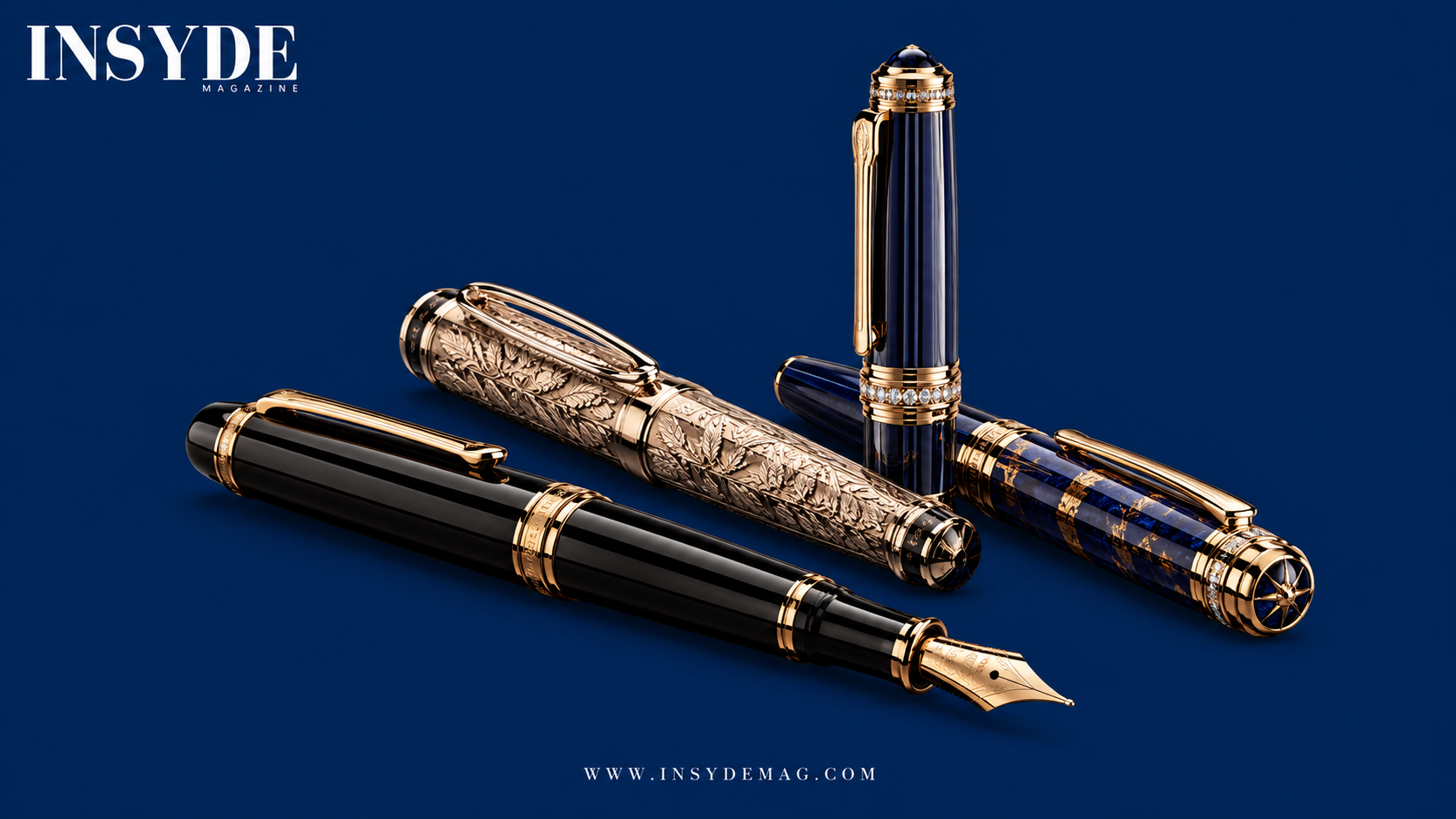
Five luxury pen houses where heritage, artistry and precision turn an everyday object into a statement of taste.
A signature can close a billion-dollar deal. It can authenticate a masterpiece, formalize an acquisition or mark the beginning of a legacy. Yet the object behind that signature is often overlooked.
In an age when messages disappear into screens and contracts are completed with a click, the luxury pen occupies a different kind of space. It is tactile, personal and deliberately old-fashioned. It asks you to slow down.
For the discerning collector, a pen can be far more than a writing instrument. It can represent a century of craftsmanship, a rare artistic tradition or a fascination with the smallest details. And at the highest end of the market, the difference between an ordinary pen and an extraordinary one can be measured in hours of handwork, intricate finishing and the scarcity of a particular edition.
The appeal is not simply about spending more. It is about knowing what you are paying for.
A BILLION-DOLLAR MARKET, BUILT ON THE DETAILS
The luxury pen industry is larger than its niche reputation might suggest. According to Grand View Research’s August 2026 market report, the global luxury-pen market was valued at an estimated US$3.6 billion in 2025. The firm projects it will reach US$3.7 billion in 2026 and US$5 billion by 2033, representing a forecast compound annual growth rate of 4.4% between 2026 and 2033.
The report estimates that fountain pens accounted for 41.5% of market revenue in 2025, making them the largest product segment. The mid-luxury category represented 45.2%, while offline retail accounted for 72.4% of sales. Europe held the largest regional share, at 32.6%.
These figures are commercial research estimates, not audited industry-wide sales disclosures. They nevertheless point to an important distinction: luxury writing instruments are not sustained by ultra-expensive collector pieces alone. The market also depends on everyday premium products, personalization, gifting and the experience of examining an instrument before buying it.
The most interesting end of the market, however, is where a pen becomes something closer to an object of art.
01. MONTBLANC — THE POWER OF AN ICON
Few writing-instrument names have achieved the cultural recognition of Montblanc.
The German luxury house introduced its Meisterstück in 1924. Over the following century, its distinctive silhouette and enduring design helped turn it into one of the most recognizable names in fine writing. The collection marked its centenary in 2024.
Montblanc’s strength is the balance between familiarity and aspiration. Its writing instruments are associated with professional achievement, milestone gifting and the rituals of business, but the brand’s collectible editions offer a different proposition.
The Great Characters collection draws inspiration from influential figures and cultural icons. Its Homage to The Great Gatsby Limited Edition 1925 fountain pen, for example, is listed at US$5,300 on Montblanc’s US website. The edition connects the writing instrument to the visual language of the Jazz Age and F. Scott Fitzgerald’s celebrated novel.
That price is for a specific limited edition, not a representative price for all Montblanc pens. The brand’s wider collection spans considerably different price points.
What makes Montblanc compelling is its ability to turn a recognisable design into a personal object. For one owner, it may be a daily writing companion. For another, a particular edition may represent a favourite author, an important achievement or a carefully chosen collectible.
The luxury proposition: An enduring design icon with a bridge between professional life, cultural references and collecting.
02. NAMIKI — THE ART OF JAPANESE LACQUER
Some luxury objects announce their value immediately. Others reward a closer look.
Namiki belongs firmly in the second category.
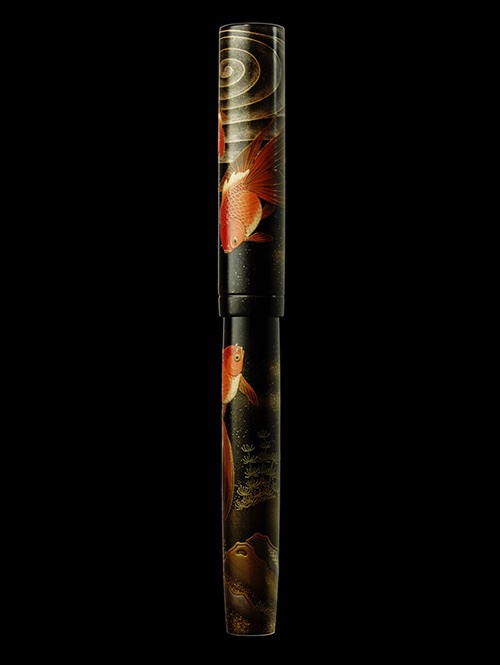
The Japanese brand’s history of maki-e fountain pens dates to 1925. Maki-e is a traditional decorative technique that involves building intricate designs through layers of lacquer and the application of materials such as metallic powders. The process demands specialist knowledge, patience and careful execution.
According to Namiki’s official history, the company explored lacquer as a durable and beautiful material for fountain-pen bodies before developing decorated designs that brought Japanese artistic traditions to writing instruments.
The result is a different expression of luxury. Rather than relying solely on a familiar logo or precious-metal finish, Namiki places the decorative work at the centre of the object. Nature, mythology and traditional Japanese motifs can become elaborate compositions across a pen’s surface.
The craftsmanship is not incidental decoration. It is the reason the object exists in that particular form.
For collectors, this creates a more intimate relationship with ownership. The attraction may lie in the visual complexity of a design, the skill required to produce it or the connection to a tradition passed between generations of artisans.
Namiki also challenges the assumption that luxury must always be loud. A pen can be extraordinary without relying on conspicuous branding. Its value can be found in the work that only becomes apparent when someone takes the time to look.
The luxury proposition: Traditional Japanese artistry, intricate lacquerwork and craftsmanship that transforms a writing instrument into a miniature canvas.
03. S.T. DUPONT — FRENCH REFINEMENT IN EVERY DETAIL
S.T. Dupont approaches luxury through precision, finish and the relationship between an object and its owner.
The French house’s Classique pen has an origin story that captures this philosophy. According to S.T. Dupont’s official account, Jacqueline Kennedy Onassis requested a writing instrument to match her S.T. Dupont lighter. The company, which had not previously manufactured pens, took on the challenge and adapted the lighter’s design language to create its first writing instrument.
The resulting Classique design drew on the lighter’s metalwork and vertical guilloché detailing. It was an exercise in translating the character of one luxury object into another.
That attention to detail remains central to the appeal of the house’s writing instruments. Surface patterns, lacquer, polished metal and the proportions of the body all contribute to the experience. The pen is not merely a vessel for ink; it is an object designed to feel considered in the hand and distinctive on a desk.
There is a certain intimacy to this kind of luxury. A writing instrument is handled repeatedly, often during moments that matter: a personal letter, a formal agreement, a handwritten note or a significant gift. The quality of its design becomes part of the ritual.
S.T. Dupont’s appeal is therefore less about size or spectacle than about refinement. The details are the point.
The luxury proposition: French design heritage, refined metalwork and an understated approach to personal luxury.
04. CARAN D’ACHE — SWISS PRECISION AT ITS MOST EXTRAVAGANT
Caran d’Ache brings Switzerland’s tradition of precision and technical design into the world of writing instruments.
Founded in Geneva in 1915, the company produces its writing and drawing instruments in Switzerland. Its range extends from accessible premium stationery to limited editions that explore elaborate materials, intricate finishing and ambitious design concepts.
One example is the 1010 Timekeeper Fountain Pen Limited Edition. On its US website, Caran d’Ache lists the model at US$14,325.
The design draws inspiration from the world of fine watchmaking, including the visual language of watch dials and crowns. The company highlights techniques including guilloché, engraving, manual polishing, lacquering and PVD treatment.
This is where the relationship between watches and pens becomes particularly interesting. Both objects combine engineering with personal taste. Both can be judged on their practical performance, yet their most collectible versions are often appreciated for the design decisions and technical work that go into them.
The price of the 1010 Timekeeper is a useful illustration of how far a luxury writing instrument can extend beyond everyday utility. It is not a typical Caran d’Ache price, nor should it be taken as representative of the brand’s broader collection. It is a specific limited edition at the upper end of its range.
At this level, the appeal lies in the convergence of design, specialist finishing and scarcity.
The luxury proposition: Swiss manufacturing and technical precision, expressed through highly elaborate limited editions.
05. MONTEGRAPPA — ITALIAN CHARACTER, COLLECTOR APPEAL
Montegrappa offers a more expressive interpretation of luxury writing.
Its history began in 1912, when a group of industrialists established Italy’s first nib factory in Bassano Veneto, now Bassano del Grappa. The company subsequently developed its own fountain pens and built a reputation around Italian manufacturing and design.
The house’s official history describes a tradition shaped by the artisanal culture of the Veneto region. That heritage continues to inform its identity, alongside an appetite for distinctive designs and themed collections.
Montegrappa is particularly interesting for collectors who want an object to communicate something about their interests. Its writing instruments have explored subjects from cultural figures and literature to entertainment and history. This can make the choice of pen feel more personal than simply selecting a familiar luxury name.
A collector might be drawn to a particular edition because of its visual language, the story behind it or the subject it commemorates. Another buyer may prefer a more restrained design from the brand’s wider range.
That breadth is important. Luxury collecting is not a single aesthetic, and a high price does not automatically make an object desirable. For many enthusiasts, the strongest connection comes from finding a design that feels individual.
Montegrappa’s character-driven approach gives it a distinct place among established writing houses: it treats the pen as a canvas for identity as well as a tool for writing.
The luxury proposition: Italian heritage, expressive design and collectible instruments that appeal to personal interests.
WHAT ACTUALLY MAKES A LUXURY PEN EXPENSIVE?
The price of a luxury pen is rarely explained by a single material or manufacturing decision. Several factors can combine to create a substantial premium.
Craftsmanship and finishing. Specialist nib work, engraving, lacquer application, polishing and assembly can require considerable skill. Techniques such as Namiki’s maki-e are particularly labour-intensive because the decorative surface is built through a series of carefully controlled processes.
Materials and construction. Precious metals, specialist finishes and complex components can affect manufacturing costs. Their influence varies by model, and a premium material alone does not establish a pen’s overall quality.
Design and heritage. Established houses carry histories, recognisable design languages and reputations built over decades. For some buyers, that continuity is part of the appeal.
Limited production. A restricted edition can attract interest when it combines a distinctive concept, desirable execution and genuine collector demand. However, limited availability does not guarantee that a pen will appreciate in value.
Personalisation and meaning. Engraving, bespoke details and the circumstances in which a pen is purchased can make it deeply personal. A writing instrument given to mark a career milestone may be valued for reasons that have little to do with its resale price.
It is also worth separating luxury from investment. Some pens become sought-after collectibles, but future value is uncertain. Condition, authenticity, provenance, rarity and market demand all matter. A buyer should not assume that an expensive pen will generate a financial return.
WHY THE PEN STILL MATTERS IN A DIGITAL WORLD
The continued appeal of fine writing instruments is not simply a nostalgic rejection of technology. It is a reminder that convenience and experience are not always the same thing.
Digital tools are faster for most routine communication. A luxury pen offers something different: the physical sensation of writing, the rhythm of forming words by hand and the pleasure of using an object made with care.
That distinction is relevant to the wider luxury market. Consumers can buy functional objects at almost every price point. The products that inspire deeper attachment often offer something beyond basic utility: a story, a craft tradition, an individual aesthetic or a connection to a meaningful moment.
Fine writing instruments sit comfortably within that world. They can be used every day, displayed as part of a collection or kept for occasions when the act of writing deserves attention.
They also occupy an unusual position between personal luxury and gifting. A pen can be chosen for its design, presented to mark an achievement or retained as a reminder of a relationship. Unlike a digital signature, the physical object can remain long after the moment has passed.
THE FINAL WORD
Montblanc represents the power of an icon. Namiki turns traditional Japanese craftsmanship into a form of wearable-scale art. S.T. Dupont brings French refinement to the smallest details. Caran d’Ache explores the possibilities of Swiss precision, while Montegrappa gives collectors a more expressive design language.
These five houses demonstrate that luxury writing is not defined by one price bracket or a single idea of status. Their collections span different budgets, and not every instrument is intended for the wealthiest buyer.
What connects them is the belief that an everyday object can become something worth keeping.
The finest luxury pens do more than put ink on paper. They bring together design, craft, heritage and personal meaning in a form that can be held in the hand.
In a world that rarely asks us to slow down, perhaps that is the ultimate luxury: not simply owning something expensive, but owning something worth taking the time to appreciate.
INSYDE MAGAZINE– NO.1 LUXURY MAGAZINE IN BENGALURU