
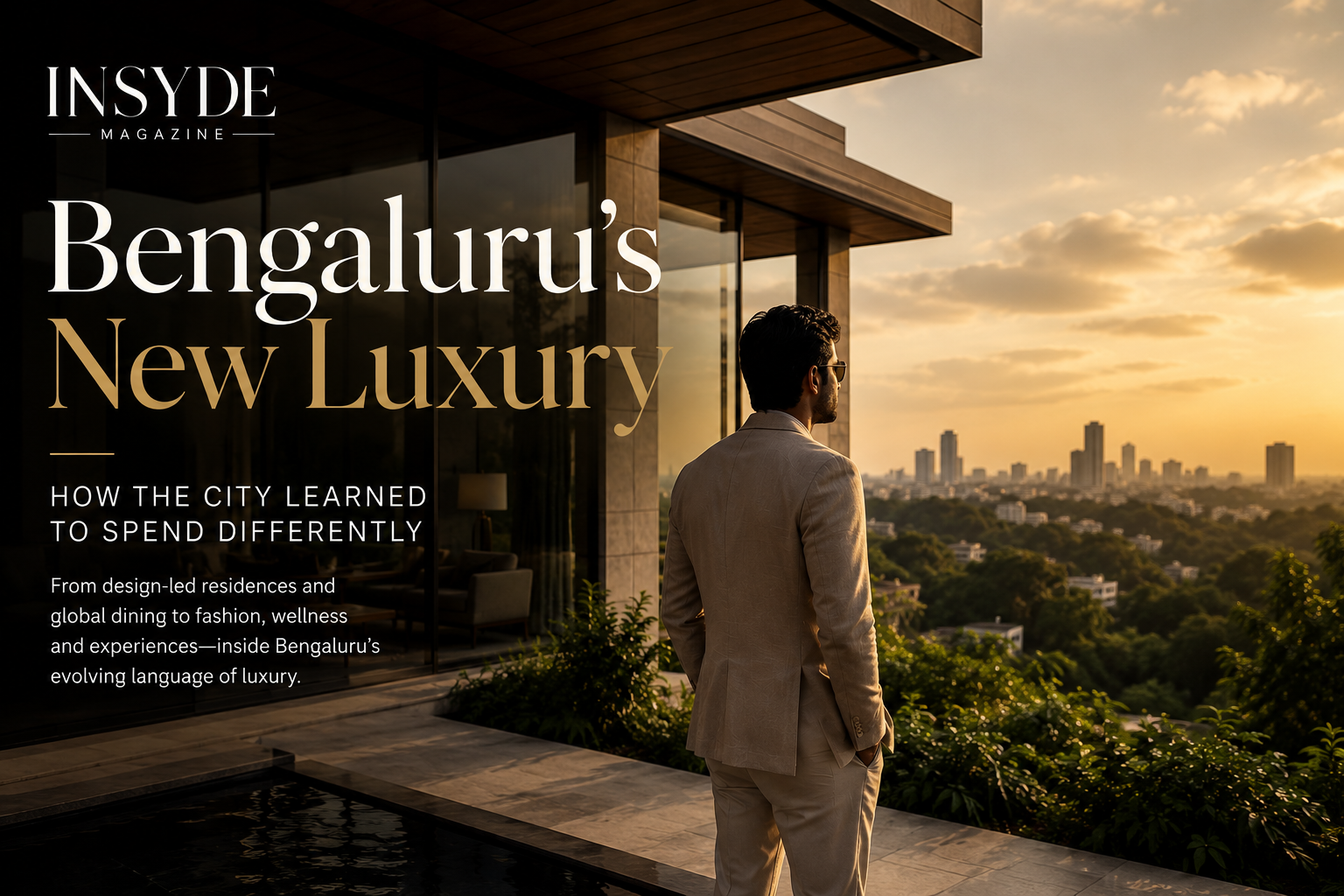
The city’s relationship with luxury is changing. Beyond logos and excess, Bengaluru is building a more considered culture of premium living—shaped by design, privacy, experience and a new generation of affluent consumers.
There was a time when Bengaluru’s idea of success was relatively straightforward.
A good career. A successful company. A home in a desirable neighbourhood. Perhaps a luxury car parked outside it.
But the city has become wealthier, more global and considerably more sophisticated—and its relationship with luxury is evolving with it.
Today, luxury in Bengaluru is increasingly less about simply owning something expensive and more about how one lives.
A beautifully designed residence. A restaurant where the experience matters as much as the plate. A private club. A watch chosen for its craftsmanship rather than its recognisability. A fashion label that feels personal rather than obvious.
It is a subtle shift, but an important one.
Bengaluru is developing its own language of luxury.
From Technology Wealth to Lifestyle Wealth
For years, Bengaluru’s economic identity was dominated by technology.
The city became synonymous with startups, software, multinational corporations and a generation of entrepreneurs who accumulated wealth differently from the traditional industrial and business families of older Indian metros.
That wealth is now influencing the city’s consumption patterns.
Bengaluru’s luxury market is no longer restricted to a small group of established families. Startup founders, CXOs, entrepreneurs, global Indians and high-net-worth professionals are becoming an increasingly visible part of the premium consumer landscape.
The transformation is particularly clear in real estate.
In FY2025, Bengaluru’s market for homes priced at ₹10 crore and above crossed ₹1,000 crore in annual sales for the first time. According to data from India Sotheby’s International Realty and CRE Matrix, 78 such homes were sold during the year, compared with 51 the previous year, while 42% of the city’s ₹10 crore-plus sales over the preceding four years occurred in FY2025 alone.
The numbers are significant. But what matters more is what they reveal about the consumer behind them.
The purchase of a luxury home is increasingly being framed around more than an address or an investment. Space, privacy, design, amenities and quality of life are becoming part of the proposition.
Bengaluru is, in other words, becoming a city where wealth increasingly seeks quality of life.
The New Luxury Is More Private
Luxury has traditionally relied on visibility.
The logo. The statement piece. The grand entrance.
But contemporary luxury is moving in another direction.
For an increasingly sophisticated consumer, exclusivity can mean something much quieter: an address with limited access, architecture that does not need to announce itself, personalised service, rare materials, thoughtful interiors or simply the freedom to enjoy something without an audience.
This shift is particularly visible in Bengaluru’s premium residential market.
The city’s high-end housing segment has seen strong price appreciation, while newer developments are increasingly competing through specifications, amenities, sustainability and future-ready design. In H1 2025, under-construction premium homes in Bengaluru recorded capital-value growth of roughly 32–35% year-on-year, according to Fortune India’s reporting on market data.
The implication is clear.
Luxury is becoming less about bigger and more about better.
A City Learning to Buy Experiences
The same shift extends beyond property.
Luxury hospitality, fine dining, premium retail, wellness and entertainment are increasingly competing for the same consumer: someone willing to pay more when the experience feels distinctive.
This matters because modern luxury is rarely confined to a product.
A luxury restaurant is selling atmosphere, service, design and memory alongside food.
A premium fashion boutique is selling curation and personal attention alongside clothing.
A high-end residence is selling privacy, architecture, convenience and community alongside square footage.
And a luxury hotel is selling a temporary version of a lifestyle.
The wider Indian luxury market is moving in the same direction. Industry research has identified experiential categories—including fine dining, travel, hospitality and wellness—as increasingly important to affluent consumers, while luxury brands continue expanding their physical presence across India’s major cities.
Bengaluru is particularly well placed for this evolution.
It has the wealth, international exposure and young professional population to support it—and a consumer base increasingly comfortable moving between global and Indian ideas of luxury.
The Bengaluru Consumer Doesn’t Need Everything to Look Expensive
Perhaps the most interesting part of Bengaluru’s luxury story is that it does not necessarily resemble the traditional image of Indian affluence.
Mumbai has its unmistakable glamour.
Delhi has its grander, more visibly opulent side.
Bengaluru has historically been more understated.
The city’s relationship with fashion reflects this personality. A consumer might move between a technology office, a contemporary restaurant, an art space and a luxury retail environment in the same week.
That creates a consumer who is not necessarily looking for one fixed definition of status.
Instead, there is a growing appetite for curated luxury.
A well-made garment.
A beautifully designed home.
A rare watch.
A destination dinner.
A thoughtfully planned weekend.
A piece of art.
A car that reflects taste rather than simply price.
The common thread is discernment.
And discernment is increasingly becoming one of luxury’s most valuable currencies.
Bengaluru’s Luxury Map Is Expanding
The geography of premium Bengaluru is changing too.
Central Bengaluru remains synonymous with some of the city’s most established luxury addresses, while newer premium developments are expanding the map into emerging and well-connected micro-markets.
That expansion is visible in the residential market. Bengaluru’s ₹10 crore-plus housing demand is no longer confined to a handful of traditional luxury neighbourhoods; the FY2025 data highlighted markets including Hebbal, Domlur, Sudhamnagar and Bommanahalli, with Hebbal accounting for 22% of luxury sales value among the high-end markets tracked in the report.
This creates an interesting tension.
Bengaluru’s old luxury is rooted in location, heritage and scarcity.
Its new luxury is increasingly built around design, technology, convenience and experience.
The future will likely be defined by the meeting point between the two.
The Business of Becoming Luxury
For brands, this shift matters.
A growing luxury consumer base creates opportunities well beyond residential real estate. Fashion, jewellery, watches, automobiles, hospitality, restaurants, wellness, interiors and premium entertainment all compete for a consumer whose expectations are becoming more sophisticated.
India’s luxury retail market is already expanding rapidly. Luxury and bridge-to-luxury brands accounted for a significant increase in retail leasing activity in 2025, reflecting an aggressive push by brands to capture India’s growing affluent consumer base.
Bengaluru is part of that story—and increasingly, it is becoming an important market within it.
The city’s retail environment is also evolving. In 2024, Bengaluru led retail space absorption among India’s top eight cities, while the wider retail landscape increasingly shifted towards destinations combining shopping, dining and entertainment.
That convergence is important.
The future of luxury may not be a store, a restaurant, a hotel or a residence in isolation.
It may be the ecosystem around them.
A neighbourhood where fashion, food, art, hospitality and design exist within the same cultural orbit.
A place where consumers do not simply purchase products—they participate in a lifestyle.
What Comes Next
The most interesting question is no longer whether Bengaluru will become a luxury city.
It already is.
The more important question is what kind of luxury city it will become.
Bengaluru has the economic foundation, entrepreneurial wealth and increasingly sophisticated consumer base to become one of India’s defining premium markets.
But its opportunity lies in doing luxury differently.
Not louder.
Not necessarily bigger.
Better.
More personal. More experiential. More design-conscious. More connected to the way people actually want to live.
For a city built on innovation, perhaps that is the most natural evolution of all.
Bengaluru’s new luxury is not simply about having more.
It is about having better—and knowing why it matters.
— INSYDE Editorial