Category: Lifestyle

How India’s creative and contemporary generation lives, from design and interiors to food, travel, hospitality and everyday experiences.

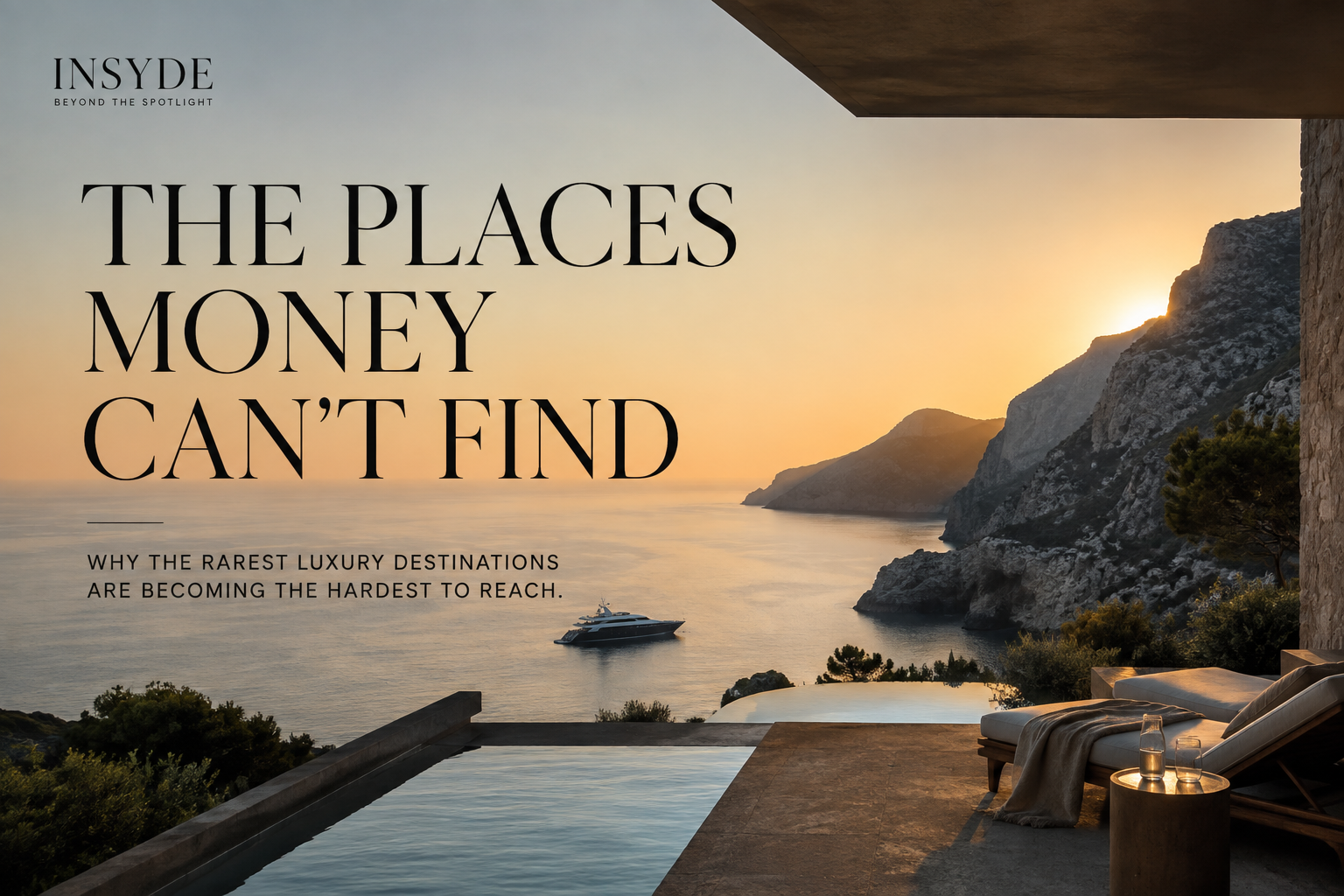
  • The Places Money Can’t Find

    The Places Money Can’t Find

    Why the rarest luxury destinations are becoming the hardest to reach.

    There was a time when luxury travel was about knowing where to go.

    Then it became about knowing where to stay.

    The right hotel. The right suite. The right table. The right beach.

    But for the traveller who has already experienced the familiar vocabulary of luxury, the more interesting question is beginning to emerge:

    Where can you go that still feels discovered?

    Not necessarily unknown.

    Not necessarily untouched.

    But difficult to reach, difficult to replicate and impossible to experience in quite the same way twice.

    That distinction is becoming increasingly important.

    Because when almost any destination can be researched, photographed, reviewed and booked within minutes, exclusivity can no longer depend entirely on a room number or a five-star rating.

    The new language of luxury travel is increasingly about access, privacy, time and discovery.

    And sometimes, the greatest luxury is simply being somewhere that doesn’t feel designed for everyone.

    When Luxury Becomes Too Accessible

    The luxury travel industry has become exceptionally good at creating beautiful places.

    There are extraordinary resorts on private islands, architectural villas overlooking the sea, mountain retreats surrounded by wilderness and hotels where every detail has been considered.

    And there is nothing wrong with any of it.

    But familiarity changes perception.

    Once a destination becomes part of the established luxury circuit, its exclusivity begins to evolve.

    The property may remain exceptional.

    The service may remain impeccable.

    The view may still be extraordinary.

    But the feeling of discovery becomes harder to preserve.

    For the sophisticated traveller, that can create a different desire.

    Not necessarily for something more expensive.

    For something less obvious.

    The New Luxury Is Distance

    Distance has become a luxury of its own.

    Not because travelling farther is inherently better, but because distance creates natural scarcity.

    A remote island cannot accommodate everyone.

    A private estate cannot simply add another thousand rooms.

    An expedition vessel cannot reproduce the infrastructure of a major resort.

    A destination requiring a yacht, private aircraft, helicopter or long overland journey naturally limits who can reach it.

    That limitation changes the experience.

    The journey itself becomes part of the privilege.

    The destination is no longer simply where you arrive.

    It is what you had to leave behind to get there.

    Privacy Is the New Amenity

    A private pool is beautiful.

    A private beach is better.

    But privacy itself may be becoming the more valuable amenity.

    For people whose lives involve constant communication, visibility and tightly managed schedules, the ability to disappear for several days without interruption can be worth more than another spectacular suite.

    No lobby.

    No crowds.

    No unnecessary meetings.

    No expectation to be anywhere.

    Just time.

    This is one reason private villas, secluded estates, yacht-based journeys and remote retreats have become such compelling forms of luxury.

    They don’t simply offer comfort.

    They create distance from everything else.

    Beyond the Suite

    The luxury industry spent years refining the hotel room.

    Better beds.

    Better bathrooms.

    Better views.

    Larger terraces.

    Private pools.

    Personal service.

    But the next evolution of luxury travel may be less concerned with what happens inside the room.

    The more interesting question is:

    What can the destination allow you to experience?

    A private cultural visit before the crowds arrive.

    A remote dive site reached by boat.

    Dinner prepared in a place where no restaurant exists.

    A conservation experience guided by specialists.

    A private estate normally closed to the public.

    A journey planned around a particular interest rather than a standard itinerary.

    These experiences are valuable because they are not simply amenities.

    They are access.

    And access is becoming one of the most sophisticated currencies in modern luxury.

    When the Journey Becomes the Experience

    The traditional idea of travel separates the journey from the destination.

    You fly there.

    Then the holiday begins.

    Luxury increasingly removes that boundary.

    A private aircraft can make the departure itself part of the experience.

    A yacht can turn the route into the destination.

    An expedition vessel can make the journey through remote waters the reason for travelling.

    A helicopter can transform a difficult landscape into an accessible one.

    The affluent traveller is therefore increasingly choosing not simply a destination, but a sequence of moments that could not easily be reproduced.

    The journey becomes part of the story.

    And the story becomes part of the luxury.

    The End of the Checklist

    There is another change taking place quietly.

    Luxury travel is moving away from the checklist.

    The old formula was familiar:

    See the landmark.

    Visit the famous restaurant.

    Stay at the iconic hotel.

    Take the photograph.

    Move to the next destination.

    But for someone who has travelled extensively, another itinerary can begin to feel strangely repetitive.

    The more interesting journey may have no checklist at all.

    It might revolve around a particular passion.

    Architecture.

    Wine.

    Art.

    Marine life.

    History.

    Photography.

    Cuisine.

    Wellness.

    Wildlife.

    Or simply the desire to spend a week somewhere extraordinarily quiet.

    This is where personalisation becomes more important than extravagance.

    The best itinerary may be the one that could not have been designed for anyone else.

    The Rise of Private Discovery

    There is a difference between exclusivity and discovery.

    Exclusivity says:

    Not everyone can enter.

    Discovery says:

    Not everyone knows to look.

    The second is more powerful.

    A private guide who has spent decades studying a region.

    A conservationist who can take you somewhere visitors rarely see.

    A local family opening a place that has never been part of mainstream tourism.

    A chef preparing a meal around ingredients sourced from a particular landscape.

    An architect introducing you to buildings unavailable through conventional tours.

    These experiences don’t necessarily require extraordinary spectacle.

    Their value comes from knowledge and access.

    And knowledge is one of the few luxuries that cannot simply be purchased by the hour.

    The Luxury of Knowing Someone

    At the highest level of travel, the concierge is no longer simply arranging a reservation.

    They are connecting you to a world.

    The difference is enormous.

    A reservation can be made online.

    A relationship cannot.

    The most sophisticated travel experiences often depend on people who know the region intimately — who understand which door to knock on, who to call, when to arrive and, just as importantly, when not to.

    That invisible network can transform an ordinary destination into an extraordinary one.

    The traveller may never know how difficult the arrangement was.

    They simply experience the result.

    Again, the finest luxury often works quietly.

    The Destination Without the Audience

    There is something increasingly attractive about experiencing a beautiful place without immediately turning it into content.

    No photograph required.

    No location tag.

    No audience.

    No obligation to document the moment.

    Just the experience itself.

    That may sound almost old-fashioned in a world where travel is constantly photographed and shared.

    But perhaps that is precisely why it feels luxurious.

    When every extraordinary moment can become public within seconds, keeping one private can become its own form of exclusivity.

    Not everything beautiful needs to be witnessed.

    Some experiences become more valuable precisely because they belong only to the people who were there.

    Beyond the Familiar

    This does not mean the world’s great luxury destinations are becoming irrelevant.

    Paris will remain Paris.

    The Mediterranean will remain the Mediterranean.

    The world’s great cities, hotels and resorts will continue to attract sophisticated travellers.

    But the definition of luxury is expanding.

    The experienced traveller may stay at the celebrated hotel.

    And then leave it.

    They may charter a yacht instead of spending the entire week at the resort.

    They may fly somewhere remote for three days.

    They may spend part of the journey in a private villa and part of it in an expedition camp.

    The point is not to reject conventional luxury.

    It is to move beyond it.

    The New Status Symbol Is the Story

    Luxury has always had a relationship with status.

    But status is changing.

    A recognisable hotel once communicated that you had arrived.

    A recognisable destination communicated taste.

    A recognisable experience communicated access.

    Today, the most interesting status may be more personal.

    It is the story you can tell because you were there.

    Not:

    “I stayed at the most expensive resort.”

    But:

    “We were taken somewhere almost nobody visits.”

    Not:

    “We went to the famous restaurant.”

    But:

    “We had dinner somewhere that doesn’t normally serve the public.”

    Not:

    “We visited the destination.”

    But:

    “We saw a side of it that most people never encounter.”

    The difference is subtle.

    But it represents a profound change in how sophisticated luxury is experienced.

    When Money Stops Being Enough

    There is a misconception that enough money can buy anything.

    In travel, that isn’t always true.

    Money can buy a private aircraft.

    It can buy a suite.

    It can charter a yacht.

    It can secure extraordinary service.

    But it cannot automatically create authenticity.

    It cannot manufacture a genuine relationship with a place.

    It cannot reproduce a moment that happened only because the circumstances aligned.

    And it cannot guarantee discovery.

    Some experiences depend on weather.

    Some on season.

    Some on local relationships.

    Some on conservation restrictions.

    Some on simply being in the right place at the right moment.

    That uncertainty is part of what makes them valuable.

    The rarest luxury is not always what money can buy.

    Sometimes it is what money can only help you reach.

    What the Next Luxury Traveller Wants

    The next generation of luxury travel is likely to be increasingly personal.

    Less concerned with showing where you have been.

    More interested in how deeply you experienced it.

    Less focused on excess.

    More focused on access.

    Less interested in a standard itinerary.

    More interested in something designed around an individual.

    The priorities become remarkably simple:

    Privacy.

    Time.

    Access.

    Discovery.

    Personalisation.

    Meaning.

    And perhaps most importantly:

    the feeling that the experience could not have been copied and given to someone else.

    The Places Money Can’t Find

    Perhaps that is where luxury travel is heading.

    Not necessarily toward the most expensive destination.

    Not toward the biggest suite.

    Not toward the most photographed beach.

    But toward places where luxury becomes almost invisible.

    A remote coastline.

    A private estate.

    A quiet island.

    A journey without an itinerary.

    A table prepared somewhere it shouldn’t be.

    A landscape seen before anyone else arrives.

    A place that doesn’t need a name everyone recognises.

    Because when almost anywhere can be discovered online, reviewed instantly and booked with a few clicks, the rarest destinations are no longer necessarily the ones nobody knows about.

    They are the ones that cannot be reduced to a booking.

    The ones that require a relationship.

    A journey.

    A little patience.

    A certain amount of luck.

    And the willingness to go further.

    Perhaps that is the real evolution of luxury travel.

    The world is not running out of beautiful places.

    It is simply becoming harder to experience them privately, personally and unexpectedly.

    And for the traveller who has already seen much of what the world has to offer, that may be the ultimate luxury.

    Not going somewhere everyone dreams of visiting.

    Going somewhere that still feels like you discovered it yourself.

    INSYDE — Beyond the Spotlight.
  • The Luxury of Disappearing

    The Luxury of Disappearing

    Why the world’s most private escapes are moving further offshore.

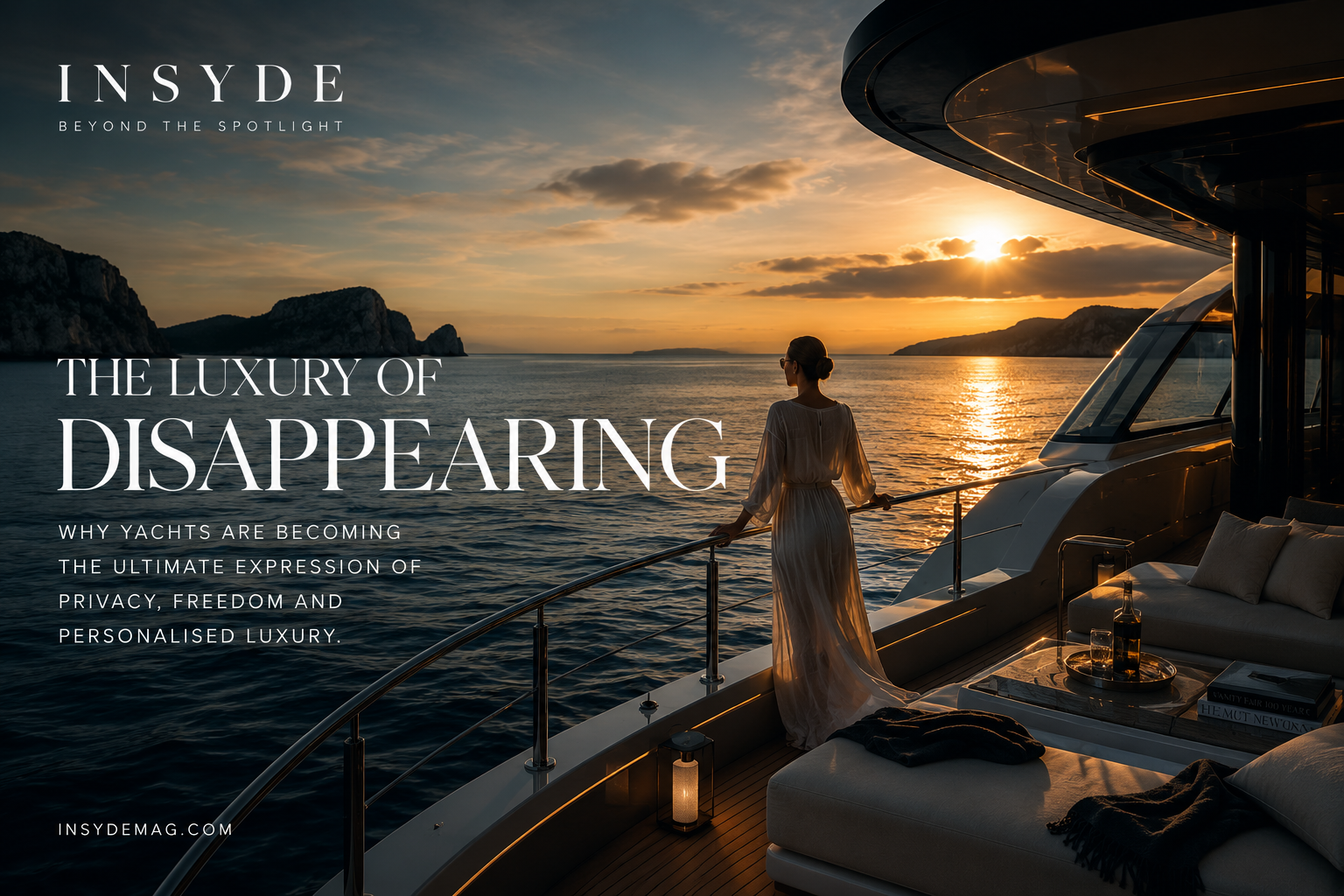
    There is a particular moment when a yacht leaves the harbour.

    The shoreline begins to disappear.

    The marina becomes smaller.

    The noise fades.

    And eventually, there is almost nothing left but open water.

    No lobby.

    No check-in desk.

    No crowded beach.

    No neighbouring suite.

    No one asking where you are going next.

    Just the horizon.

    For most people, that sounds like an extraordinary holiday.

    For someone who has access to almost everything, it represents something considerably rarer:

    privacy.

    That may be the most interesting thing happening in modern yachting.

    The superyacht has long been associated with excess — spectacular interiors, enormous decks, swimming pools, tenders, toys and seemingly limitless space.

    But the meaning of the yacht is changing.

    At the highest end of luxury, the conversation is becoming less about having more and more about having control over time, space and access.

    The yacht is no longer simply a symbol of wealth.

    It is becoming something more personal.

    A private world.

    One that happens to move.

    When Everything Is Available

    Luxury has traditionally been about access.

    A better hotel.

    A better table.

    A better seat.

    A better destination.

    A private car waiting outside.

    A flight that leaves when you want it to.

    But wealth changes the meaning of access.

    When almost everything is available, access itself becomes less rare.

    The more valuable commodities become time, privacy and control.

    That shift is increasingly visible across the luxury world. Knight Frank’s 2026 Wealth Report describes a broader movement toward more intentional, experience-led luxury, while its reporting on superyachts highlights continued demand among wealthy individuals for mobility and multi-location lifestyles.

    The yacht fits naturally into that world.

    It doesn’t simply take you somewhere.

    It allows you to decide where your world exists.

    The Yacht Isn’t the Luxury

    This is the distinction that matters.

    The yacht itself is not necessarily the luxury.

    The luxury is what it makes possible.

    You decide where to wake up.

    You decide who joins you.

    You decide when you leave.

    You decide where dinner happens.

    You decide how long you stay.

    You decide when the world disappears.

    A hotel can give you an extraordinary room.

    A private villa can give you privacy.

    A private jet can give you speed.

    But a yacht can combine all three while giving you something neither a hotel nor a jet can completely provide:

    the ability to take your private world with you.

    That is a fundamentally different proposition.

    The vessel becomes the architecture of freedom.

    The New Currency Is Privacy

    There was a time when luxury was most powerful when it was visible.

    The car needed to be recognisable.

    The watch needed to be distinctive.

    The hotel needed to be famous.

    The destination needed to be photographed.

    But the more visible the world becomes, the more valuable invisibility can become.

    For people whose lives are already highly exposed — through business, wealth, public profile or simply constant digital connectivity — privacy can become more valuable than spectacle.

    That is helping reshape luxury travel.

    Burgess reported in July 2026 that yacht-charter demand had risen sharply, with privacy, flexibility, personalised itineraries and experiential travel among the factors driving demand.

    The implication is subtle but important.

    The ultimate luxury may no longer be being seen in the right place.

    It may be being somewhere nobody else can reach.

    From Status Symbol to Private World

    A yacht has always carried symbolism.

    It says something about its owner.

    But symbolism is only the beginning.

    At the highest level, the yacht becomes something closer to a private residence.

    A dining room becomes a restaurant without another table in sight.

    A bedroom becomes a hotel suite with the horizon as its view.

    A pool becomes a private beach.

    A cinema becomes a room for a handful of people rather than hundreds.

    A deck becomes an office, a dining room, a gym, a lounge or simply somewhere to sit in silence.

    Modern yacht design is increasingly moving in this direction. Recent 2026 launches and deliveries show owners placing greater emphasis on natural materials, residential interiors, outdoor living, integrated wellness and spaces designed around individual lifestyles.

    The yacht is becoming less like a trophy.

    It is becoming a private ecosystem.

    A Home Without an Address

    There is something deeply appealing about a home that refuses to stay in one place.

    A traditional luxury residence is defined by its location.

    A yacht is defined by its ability to leave.

    One week, it can be anchored off the Mediterranean.

    Another, it can be crossing an ocean.

    And for owners interested in exploration, the destination doesn’t have to be the familiar circuit of luxury marinas.

    Explorer yachts are increasingly being designed around longer-range cruising, autonomy and access to remote destinations. Current yacht projects show owners prioritising expedition capability alongside comfort, wellness and highly personalised interiors.

    This represents a subtle change in the meaning of luxury.

    Luxury once meant reaching the world’s best-known places.

    Increasingly, it can mean reaching somewhere almost nobody else has.

    The Yacht Built Around You

    There is no single definition of the perfect yacht.

    That is precisely the point.

    One owner might want a floating family residence.

    Another might want an extraordinary platform for entertaining.

    Another may want a wellness retreat.

    Another may want a serious expedition vessel.

    Another may care about art.

    Another may care about diving, sailing, fishing or exploration.

    The yacht can be designed around the owner’s life rather than forcing the owner to adapt to the vessel.

    That is perhaps the purest expression of modern luxury.

    The product changes around you.

    Recent custom-yacht projects demonstrate just how far this philosophy can go, with owners influencing layouts, accommodation, beach clubs, technical spaces and operational capabilities throughout the construction process.

    The best luxury no longer asks:

    Which option do you want?

    It asks:

    What do you want to create?

    The Invisible Luxury of Service

    There is another reason exceptional yachts feel different.

    The people behind them.

    The captain.

    The chef.

    The engineers.

    The hospitality team.

    The specialists.

    The people who understand how the owner likes to live.

    The yacht appears effortless because an enormous amount of expertise exists behind the scenes.

    The guest sees the sunset.

    Someone else has already handled everything else.

    That is one of the great paradoxes of luxury.

    The more sophisticated the service, the less visible the machinery behind it.

    The experience should never feel like an operation.

    It should feel natural.

    Almost inevitable.

    When the Yacht Becomes Architecture

    The most compelling yachts increasingly deserve to be discussed alongside contemporary homes.

    Materials matter.

    Light matters.

    Proportion matters.

    Silence matters.

    The relationship between indoor and outdoor space matters.

    Natural materials, restrained palettes and residential interiors are becoming increasingly prominent across contemporary yacht design, replacing some of the decorative excess historically associated with superyachts.

    That doesn’t mean luxury has become less impressive.

    It has simply become more considered.

    A marble staircase can be beautiful.

    But so can a quiet room lined in natural wood with nothing competing for attention.

    The new question is not:

    How much can you put inside the yacht?

    It is:

    How does the space make you feel?

    Wellness at Sea

    Luxury is increasingly being measured by how you feel rather than simply what you possess.

    That idea is now moving deeper into yacht design.

    Wellness is no longer an afterthought.

    Recent 2026 yacht deliveries show dedicated spas, hydrotherapy, fitness areas, outdoor exercise spaces and wellness facilities being integrated into the architecture from the beginning rather than added as secondary amenities.

    The possibilities are becoming more sophisticated:

    A spa at sea level.

    A gym opening directly onto the water.

    A cold plunge after a morning swim.

    A private treatment room.

    A quiet space for meditation.

    A kitchen designed around a particular nutritional philosophy.

    Or simply enough room to slow down.

    The direction is revealing.

    Luxury is moving from stimulation to restoration.

    From entertainment to wellbeing.

    From having more to feeling better.

    The Quiet Yacht

    Perhaps the most interesting luxury trend of all is one that is almost invisible.

    Silence.

    Modern propulsion systems and engineering are giving designers more opportunities to reduce noise and vibration, while hybrid technologies are being incorporated into increasingly sophisticated vessels.

    But the goal isn’t simply to add more technology.

    It is to make technology disappear.

    The climate should be comfortable without demanding attention.

    The connectivity should work without dominating the interior.

    The lighting should feel natural.

    The propulsion should feel effortless.

    Automation should remove friction rather than announce itself.

    The ideal experience is one where you stop thinking about the machinery entirely.

    You simply experience the calm.

    And that may be one of the defining characteristics of modern luxury:

    the sophistication of what you don’t notice.

    Bigger Is Not Always Better

    The traditional yacht arms race is easy to understand.

    More length.

    More decks.

    More rooms.

    More toys.

    More spectacle.

    And there will always be owners who want exactly that.

    But another idea is emerging.

    The most desirable yacht may not necessarily be the largest one in the harbour.

    It may be the one that travels further.

    The one that feels more private.

    The one designed around a particular family.

    The one capable of reaching places others cannot.

    The one whose interior feels like a home rather than a showroom.

    The one that reflects its owner’s interests so precisely that another person’s version would make no sense.

    The next generation of yacht luxury may be measured less by scale and more by specificity.

    The Explorer Mentality

    This is why explorer yachts are so fascinating.

    They represent a different philosophy of wealth.

    Not:

    How impressive is the object?

    But:

    What can the object allow me to experience?

    Remote islands.

    Longer voyages.

    Less familiar coastlines.

    Polar waters.

    Places beyond the conventional luxury circuit.

    Explorer yachts are gaining attention because they offer something that established luxury destinations increasingly struggle to provide:

    discovery.

    And discovery is difficult to commoditise.

    A five-star hotel can be replicated.

    A private beach can be booked.

    A famous restaurant can become crowded.

    But reaching somewhere almost nobody else has experienced is a different kind of privilege.

    The Yacht as Freedom

    This may ultimately be why people choose yachts.

    Not because they need another luxury asset.

    Not because the world needs another floating palace.

    But because ownership — or even the most private forms of charter — creates a type of freedom that is difficult to reproduce elsewhere.

    Freedom from schedules.

    Freedom from crowded spaces.

    Freedom from other people’s itineraries.

    Freedom to stay longer.

    Freedom to leave earlier.

    Freedom to change your mind.

    And for someone who has spent years building a life around decisions, that last one may be particularly valuable.

    The ability to decide differently.

    What Comes Next

    The future of yachting will not simply be about making vessels larger.

    It will be about making them more personal, more capable and more intelligently designed.

    The direction is already visible:

    exploration

    wellness

    privacy

    personalisation

    quiet technology

    alternative propulsion

    natural materials

    long-range capability

    and deeper connections with the sea itself.

    Recent 2026 yacht developments point toward exactly this combination, with owner-led design, wellness, explorer capability and lower-impact propulsion becoming increasingly important parts of the conversation.

    The yacht of the future may therefore be less interested in proving how much its owner can afford.

    It may be more interested in proving how completely it can serve the owner’s way of living.

    That is a very different kind of luxury.

    The Luxury of Disappearing

    Perhaps the greatest misconception about the yacht is that it is a symbol of wealth.

    At the highest level, wealth doesn’t need another symbol.

    It needs somewhere to go.

    Somewhere private.

    Somewhere quiet.

    Somewhere the calendar can disappear and the horizon can take over.

    Because when almost everything in the world is available, the rarest luxury is no longer simply access.

    It is escape.

    The yacht offers something a hotel cannot.

    Something a private jet cannot.

    Something even the most extraordinary residence cannot completely provide.

    The ability to take your world with you — and leave the rest behind.

    Perhaps that is what the modern yacht has really become.

    Not a vessel for showing the world what you own.

    But a private world of your own.

    And perhaps, in an age where almost everything can be seen, shared and documented, the greatest luxury is not being seen at all.

    It is disappearing — on your own terms.

    INSYDE — Beyond the Spotlight.
  • THE CREDIT CARDS ONLY THE RICH HAVE ACCESS TO

    THE CREDIT CARDS ONLY THE RICH HAVE ACCESS TO

    Inside the invitation-only cards, private-bank relationships and ultra-premium financial products where the real luxury isn’t spending power — it’s access.

    There are credit cards designed to earn cashback.

    There are cards designed to collect airline miles.

    And then there are cards that belong to an entirely different financial ecosystem.

    Some are invitation-only. Some are available exclusively to private-banking clients. Others require significant income or an established relationship with a financial institution. Their benefits can extend far beyond rewards: dedicated relationship managers, private concierge services, luxury travel, priority airport experiences, members-only facilities and access to experiences that aren’t available through an ordinary application.

    At this level, the card is no longer simply a way to pay.

    It becomes an extension of the relationship between a financial institution and its wealthiest clients.

    And that relationship is where the real luxury begins.


    THE CARD IS ONLY THE BEGINNING

    The premium-card market has spent decades competing on numbers.

    More points.

    More miles.

    More airport lounges.

    Higher limits.

    Bigger sign-up bonuses.

    But the very top end of the market operates differently.

    A wealthy client doesn’t necessarily need another 2% in rewards.

    What becomes valuable is time.

    Someone to arrange the difficult reservation.

    Someone to coordinate an itinerary.

    Someone to resolve a problem while travelling.

    Someone who already knows the client and understands what they need.

    This is why the world’s most exclusive cards increasingly resemble private lifestyle platforms attached to financial relationships.

    The card is simply the object you can see.

    The infrastructure behind it is the part you can’t.


    01 — AMERICAN EXPRESS CENTURION

    THE BLACK CARD

    Few payment cards have achieved the cultural recognition of the American Express Centurion.

    Better known as the Black Card, Centurion helped transform the payment card from a financial tool into a luxury symbol.

    But the mythology surrounding it can sometimes obscure the actual product.

    In India, American Express’s current publicly available Centurion terms list a ₹7 lakh joining fee and an annual membership fee of ₹2.75 lakh, before applicable GST and other taxes. The published terms were updated on 11 August 2025. (American Express)

    That is an extraordinary price for a card.

    But the fee isn’t really the interesting part.

    The Centurion sits inside American Express’s wider premium travel, dining and lifestyle ecosystem. In the United States, eligible Centurion members have access to Fine Hotels + Resorts, which currently covers more than 1,900 luxury properties worldwide, with benefits including daily breakfast for two, a property credit, potential room upgrades and guaranteed 4 p.m. checkout, subject to programme terms. (American Express)

    The larger idea is that the card is designed around experience rather than simply expenditure.

    And there is an important distinction for Indian readers.

    American Express’s Indian Centurion terms are current, but the company’s Indian charge-card application process has also been undergoing technology-related changes. The product should therefore not be presented as a conventional open-application card available to anyone willing to pay the fee.

    That ambiguity is part of what has always surrounded Centurion.

    The card became famous partly because access itself became part of the product.

    THE INSYDE VIEW

    The Centurion’s most valuable feature may not be what sits inside the wallet.

    It may be the world built around it.


    02 — DBS INSIGNIA VISA INFINITE

    THE CARD YOU DON’T SIMPLY APPLY FOR

    Singapore’s DBS Insignia takes exclusivity a step further.

    DBS states explicitly that the Insignia Visa Infinite is available by invitation only and directs interested clients to their DBS Private Banking or relationship manager. (DBS Bank)

    The published proposition is striking.

    DBS advertises up to S$1 million in credit, a dedicated 24/7 concierge team known as Insignia Service Ambassadors, VIP airport-lounge access, fast-track immigration at selected Asian airports and complimentary stays at selected luxury hotels and resorts. (DBS Bank)

    The card also offers dining privileges through The Culinaire’s List and a published annual reward of 100,000 bonus miles for each annual-fee-paying year, subject to the applicable terms. (DBS Bank)

    But the defining word is not million.

    It is invitation.

    The card is embedded within a private-banking relationship rather than positioned as a mass-market premium product.

    That distinction changes the psychology completely.

    A conventional card asks a prospective customer to prove eligibility.

    An invitation-only card begins from a different premise:

    the institution has already decided that you belong in the room.

    THE INSYDE VIEW

    At this level, the question isn’t only:

    How much can you spend?

    It becomes:

    What can your relationship unlock?


    03 — FAB ROYALE WORLD LEGEND EXCLUSIVE

    THE NEW LANGUAGE OF FINANCIAL LUXURY

    The ultra-premium card market is still evolving, particularly in the Middle East.

    On 10 September 2026, First Abu Dhabi Bank and Mastercard launched the FAB Royale World Legend Exclusive, described by Mastercard as the UAE’s first World Legend Exclusive Mastercard credit card.

    It is explicitly invitation-only and intended for a select circle of FAB clients. (Mastercard)

    The proposition is less about a single spectacular perk and more about an entire service architecture.

    Cardholders receive dedicated relationship management through Royale Lifestyle Concierge, access to Mastercard’s Premium Lifestyle Program and international meet-and-greet services across 60 destinations. The programme also includes access to selected global economic forums in partnership with Bloomberg. (Mastercard)

    Then there is the Mastercard Collection, which brings priority restaurant reservations, premium tickets and fast-track airport services into the proposition. (Mastercard)

    This is revealing.

    The traditional premium-card model was essentially:

    Spend → earn → redeem.

    The new ultra-premium model increasingly looks like:

    Relationship → access → experience.

    The card isn’t necessarily trying to make spending more rewarding.

    It is trying to make living more frictionless.

    THE INSYDE VIEW

    For today’s wealthy consumer, convenience can be its own form of luxury.


    04 — COUTTS SILK

    WHEN THE CARD COMES AFTER THE BANKER

    British private bank Coutts offers another interpretation of exclusivity.

    Its Silk Credit Card and Silk Charge Card are available to Coutts private clients aged 18 and over. Both currently carry no annual card fee, while the cards form part of the wider Coutts private-banking relationship. (Coutts)

    That detail is more important than it initially appears.

    Because it demonstrates that exclusivity doesn’t necessarily have to come with an enormous card fee.

    Sometimes, the exclusivity exists before the card is issued.

    Coutts says its Silk cards provide access to more than 1,100 executive airport lounges across more than 300 airports through LoungeKey, alongside rewards, experiences and event invitations. (Coutts)

    The card also offers no non-sterling transaction fees when spending in foreign currencies, according to Coutts. (Coutts)

    But the most revealing part is the relationship itself.

    Coutts describes its cards as bringing “the power of your private bank to your pocket.” (Coutts)

    That is perhaps the cleanest explanation of the entire ultra-premium-card category.

    The card isn’t the relationship.

    The card is the physical expression of it.

    THE INSYDE VIEW

    Sometimes the most exclusive thing in your wallet isn’t the card.

    It’s the banker behind it.


    05 — EMIRATES NBD DARNA VISA INFINITE PRIVILEGE

    WHEN A CREDIT CARD BECOMES A LIFESTYLE MEMBERSHIP

    Not every elite-facing card is invitation-only.

    The Emirates NBD Darna Visa Infinite Privilege demonstrates another model: high financial thresholds combined with a tightly integrated lifestyle ecosystem.

    Emirates NBD currently lists a minimum monthly salary requirement of AED 50,000 and an annual fee of AED 2,625 for the Darna Visa Infinite Privilege card. (Emirates NBD)

    That makes it fundamentally different from an invitation-only product such as DBS Insignia or FAB Royale.

    But its proposition is equally revealing.

    Cardholders receive Darna Invite Only membership, which connects the financial product to benefits across Aldar’s lifestyle ecosystem. The broader offering includes travel, dining, golf, hotel and entertainment privileges, alongside premium airport access. (Emirates NBD)

    The important shift is from card benefit to ecosystem.

    The consumer isn’t simply being rewarded for using the card.

    The card is connecting financial activity to an entire network of experiences.

    That is where banking begins to resemble luxury hospitality.

    THE INSYDE VIEW

    The next generation of premium cards may not simply reward wealth.

    They may increasingly organise the world around it.


    WHAT MAKES A CARD “ELITE”?

    There is no universal financial category called an elite credit card.

    That distinction matters.

    A product can be exclusive for very different reasons.

    Centurion is associated with extraordinary fees and a highly selective premium ecosystem.

    DBS Insignia is explicitly invitation-only.

    FAB Royale World Legend Exclusive is invitation-only and tied to a select client base.

    Coutts Silk is restricted to Coutts private clients.

    Darna Visa Infinite Privilege uses a substantial published income threshold and a premium lifestyle ecosystem.

    They are not interchangeable.

    They operate in different markets, have different eligibility structures and offer different benefits.

    What connects them is their position at the upper end of premium financial services.

    And, increasingly, their emphasis on what exists beyond the transaction.


    THE DEATH OF THE CREDIT-CARD FLEX

    For years, premium-card culture was about visible numbers.

    A higher limit.

    More miles.

    More points.

    More airport lounges.

    But luxury itself has been changing.

    The new luxury consumer increasingly values things that are difficult to quantify:

    Time.

    Privacy.

    Convenience.

    Personalisation.

    Access.

    That is why concierge services matter.

    A concierge doesn’t make a restaurant more expensive.

    It makes the reservation easier.

    A relationship manager doesn’t necessarily make an asset more valuable.

    They make the financial relationship more personal.

    An airport fast-track service doesn’t change the flight.

    It changes the experience of getting there.

    The underlying product is therefore not simply money.

    It is friction reduction.

    And for people who have already accumulated significant wealth, removing friction can be more meaningful than accumulating another reward.


    WHEN MONEY STOPS BEING THE STORY

    This is where luxury banking begins to intersect with the broader luxury industry.

    Traditional luxury has historically been built around objects.

    A watch.

    A car.

    A handbag.

    A piece of jewellery.

    But contemporary luxury increasingly includes things that cannot simply be placed in a shopping bag.

    A private table.

    A sold-out event.

    A last-minute suite.

    A trusted introduction.

    A relationship.

    An experience that isn’t available to everyone.

    The ultra-premium card sits directly inside that transition.

    It is a physical object representing something increasingly intangible.

    Access.


    THE PRIVILEGE YOU CAN’T SEE

    There is a peculiar irony to elite financial products.

    The most visible part is the card.

    The most valuable part may be invisible.

    Someone receives a call from a dedicated relationship manager.

    Someone’s travel problem is solved without navigating a customer-service queue.

    Someone gains access to a restaurant, event or experience through a private programme.

    Someone has a financial institution coordinating around their needs rather than simply processing their transactions.

    None of that necessarily looks extravagant from the outside.

    And perhaps that is the point.

    Luxury has always evolved as its most obvious symbols become more accessible.

    The next expression tends to become quieter.

    More personal.

    More difficult to replicate.


    THE NEW STATUS SYMBOL IS ACCESS

    The premium card of the future may therefore look very different from the premium card of the past.

    It doesn’t necessarily need to be heavier.

    It doesn’t necessarily need to be black.

    It doesn’t necessarily need a higher credit limit.

    What matters is the ecosystem surrounding it.

    A card can be reproduced.

    A points programme can be matched.

    A metal finish can be copied.

    But a deeply integrated relationship between a client, a private bank, concierge teams, luxury brands and global experiences is much harder to replicate.

    That is where the real value lies.

    Not in the object.

    But in the network behind the object.


    THE CARD YOU NEVER SEE

    Perhaps that is the most fascinating part of the ultra-premium card.

    You can see the card.

    You can’t see the relationship behind it.

    You can see the metal.

    You can’t see the concierge.

    You can see the payment.

    You can’t see the access.

    And increasingly, that is where the definition of luxury is moving.

    Away from what you own.

    Toward what becomes possible because of who you are and who you bank with.

    The black card was once the ultimate symbol.

    Today, the black card is simply the beginning of a much larger conversation about wealth, privacy, access and personalised service.


    INSYDE TAKE

    The world’s most exclusive cards are not necessarily the ones with the highest fees or the most extravagant designs.

    Their significance lies in what happens around the card.

    A private-banking relationship.

    A dedicated concierge.

    An invitation.

    A network.

    A level of service designed around an individual rather than a demographic.

    That is the real evolution of luxury finance.

    Because when purchasing power is already high, the next luxury isn’t necessarily being able to buy more.

    It is being able to move through the world with less friction.

    And perhaps the ultimate privilege isn’t a card that lets you spend without thinking.

    It’s a relationship that makes the extraordinary feel effortless.


    INSYDE
    Luxury, Through a Different Lens.
    Beyond the Spotlight.

  • INDIA’S MOST EXCLUSIVE SCHOOLS

    INDIA’S MOST EXCLUSIVE SCHOOLS

    Where education, privilege and access come with a very serious price tag.

    There is a version of luxury that never makes it onto a showroom floor.

    It begins much earlier.

    Before the watch. Before the supercar. Before the penthouse. Before the private jet.

    For some of India’s wealthiest families, one of the most consequential luxury purchases is an education — and at the very top of the market, the numbers can be extraordinary.

    For the 2026–27 academic year, the American Embassy School in New Delhi lists tuition of US$39,490 for Grades 9–12. At the school’s September 2026 exchange rate of ₹95.50 to the US dollar, that is approximately ₹37.7 lakh a year, before certain additional charges. Woodstock School’s highest published 2026–27 boarding fee is around ₹30.86 lakh, while UWC Mahindra College lists annual fees of approximately ₹28.75 lakh for Indian students.

    But the most interesting part isn’t the number.

    Because these schools aren’t simply selling classrooms.

    They are selling an environment.

    A particular kind of education. A particular peer group. A particular relationship with the world.

    And sometimes, access to a community that can stretch far beyond the school gates.

    That raises a more interesting question than how expensive is school?

    What, exactly, are families paying for?

    THE NEW LUXURY IS EDUCATION

    Luxury has traditionally been easy to recognise.

    A rare watch.

    A couture gown.

    A Ferrari.

    A house overlooking the sea.

    But some of the most valuable forms of luxury are becoming less visible.

    Time. Privacy. Access. Experience. Community.

    Education sits quietly inside that shift.

    At the upper end of India’s school market, the premium isn’t necessarily about extravagant architecture or spectacular classrooms. It can come from international curricula, residential life, specialised facilities, global university preparation, extensive extracurricular programmes and carefully built communities.

    In other words, the product isn’t only the education.

    It’s the ecosystem around it.

    That distinction matters.

    Because comparing a ₹30-lakh residential school with a ₹37-lakh international day school as though they sell the same thing would be like comparing a private jet with a first-class airline ticket simply because both cross the same distance.

    The price tells you something.

    The structure tells you much more

    01 — AMERICAN EMBASSY SCHOOL, NEW DELHI

    THE INTERNATIONAL ENCLAVE

    In the heart of New Delhi’s diplomatic district, the American Embassy School operates within an unusually international ecosystem.

    The non-profit school serves students from Pre-K through Grade 12 and describes its community as representing more than 70 countries.

    Then there is the price.

    For 2026–27:

    US$39,490

    Grades 9–12

    Using AES’s own September 2026 exchange rate of ₹95.50 per US dollar, that translates to approximately:

    ₹37.7 LAKH A YEAR

    The school also lists an US$800 application fee and a US$16,500 one-time registration fee for students entering PK4 through Grade 12. Lunch, transportation and certain support services are additional.

    That makes the headline tuition figure only part of the financial picture.

    But there is another detail that makes AES particularly interesting.

    Money isn’t the only gate.

    The school’s admissions framework is built around its international community and eligibility requirements. That means simply being able to afford the tuition does not automatically make a family eligible for admission.

    The distinction is important.

    This is not merely an expensive Indian private school.

    It is an international educational ecosystem operating inside India.

    And that is a different kind of exclusivity.

    02 — WOODSTOCK SCHOOL, MUSSOORIE

    THE HIMALAYAN CLASSIC

    If AES represents international education inside a diplomatic capital, Woodstock offers something altogether different.

    Altitude.

    History.

    Boarding.

    The Himalayas.

    Woodstock’s 2026–27 boarding fees rise to approximately ₹30.86 lakh for Classes 11–12. The school’s own fee structure confirms that its annual school fee covers tuition, textbooks, boarding and lodging, basic laundry, internet and email facilities, class field trips and most social activities. Separate establishment and refundable security charges apply.

    And that changes the meaning of the number.

    A residential school isn’t simply a place where a student attends classes.

    The campus becomes home.

    Meals happen there.

    Friendships happen there.

    Sport happens there.

    Performances happen there.

    Weekends happen there.

    The education continues long after the last bell.

    That makes Woodstock’s proposition less about buying premium tuition and more about buying an entire way of living and learning.

    And there is another important nuance.

    Woodstock provides financial aid, meaning its published fee cannot be treated as the amount every student necessarily pays.

    The price of the institution and the price paid by an individual family are not always the same thing.

    03 — UWC MAHINDRA COLLEGE, PUNE

    THE ₹28.75-LAKH GLOBAL EXPERIMENT

    UWC Mahindra College is perhaps the most revealing example of why the phrase “rich kids’ school” doesn’t quite work.

    The college offers a two-year IB Diploma programme for students aged 16–18. Its current published annual fee is approximately:

    ₹28.75 LAKH FOR INDIAN STUDENTS

    That covers tuition, boarding and meals.

    On paper, that places it firmly inside India’s ultra-premium education market.

    But then comes the contradiction.

    UWC Mahindra says a majority of its students attend on full or partial scholarship and explicitly states that financial need should not be a barrier to admission. Its scholarships are need-based rather than simply rewards for academic performance.

    That makes the institution particularly interesting from a luxury perspective.

    Because it demonstrates that:

    A high price does not necessarily mean a high-income student body.

    The published price describes the value of the programme.

    It does not describe the financial circumstances of every person inside it.

    And UWC’s model makes the community itself part of the proposition: students arrive not simply to study for the IB Diploma, but to live within an international network.

    The luxury here is less about the invoice.

    It’s about the world the student enters.

    04 — GOOD SHEPHERD INTERNATIONAL SCHOOL, OOTY

    WHEN SCHOOL BECOMES A WORLD

    In the Nilgiris, Good Shepherd International School takes the residential model seriously.

    The school describes itself as 100% residential, with its term fee covering academics, boarding, meals, co-curricular programmes and round-the-clock care.

    For 2026–27, the school lists:

    ₹18.20 lakh for Grades 9–10 IGCSE/MYP

    ₹16.65 lakh for Grades 9–10 ICSE

    and, at the upper end,

    ₹20.30 LAKH A YEAR

    for Grades 11–12 IBDP and IBCP.

    There are additional costs.

    For certain new entrants, GSIS lists a ₹3 lakh establishment fee, a ₹3 lakh refundable caution deposit, a ₹30,000 registration fee and an advance payment toward miscellaneous expenses.

    For IBCP students, the school also has career-related study partnerships, including programmes connected with Savannah College of Art and Design and Arizona State University.

    Again, the important point isn’t simply that the school is expensive.

    It’s what the fee is trying to encompass.

    Academic education.

    Residential life.

    Sport.

    Arts.

    Technology.

    University preparation.

    And an environment designed to make the campus itself part of the student’s everyday world.

    05 — KODAIKANAL INTERNATIONAL SCHOOL

    THE OTHER HILL-STATION ICON

    Kodaikanal International School has a different kind of luxury proposition.

    It is not trying to imitate a metropolitan international school.

    Its appeal is tied to place, history, residential education and an international outlook.

    KIS currently publishes a dedicated 2026–27 fee schedule and reviews its fee structure annually. The school also offers financial aid to qualified students and says its maximum award can reach 95% of the annual fee, subject to its criteria and available resources.

    That is worth emphasising because it complicates the popular image of an “elite school”.

    A school can sit at the premium end of the market while still deliberately allocating financial support to students who could not otherwise afford it.

    And that is one of the recurring themes across this world:

    Exclusivity isn’t always the same thing as wealth.

    Sometimes it is the curriculum.

    Sometimes it is geography.

    Sometimes it is the admissions process.

    Sometimes it is scarcity.

    And sometimes it is simply the ability to enter an environment that very few people experience.

    THE SCHOOL EVERYONE EXPECTS TO SEE

    DHIRUBHAI AMBANI INTERNATIONAL SCHOOL

    No serious conversation about elite education in India can ignore Dhirubhai Ambani International School.

    But it is important not to force it into a ranking it doesn’t support.

    DAIS is not among the highest-fee schools in this comparison based simply on published annual tuition.

    Its significance lies elsewhere.

    Selectivity.

    DAIS currently admits students into Class VIII for IGCSE and Class XI for the IB Diploma. For the 2027–28 admissions cycle, applicants must satisfy the school’s eligibility requirements and go through an aptitude-testing and selection process. The school requires academic records and a personal statement, while applicants may also submit academic, co-curricular and sporting achievements.

    The lesson is bigger than DAIS.

    The most exclusive schools aren’t necessarily the ones with the highest fees.

    Exclusivity can be created by scarcity of seats.

    By admissions standards.

    By the kind of student community a school builds.

    By reputation.

    By history.

    And, sometimes, by the sheer number of families who want access to the same institution.

    THE PRICE OF GETTING IN

    This is where the headline numbers start to become misleading.

    A school’s annual fee is not necessarily its first-year cost.

    At AES, the 2026–27 high-school tuition is US$39,490, while the school separately lists its one-time registration fee of US$16,500 for PK4–12.

    At The Doon School, for example, the 2026–27 IB fee for Indian residents is ₹16.54 lakh a year, alongside a ₹5 lakh non-refundable admission fee and ₹7 lakh refundable security deposit.

    Doon is therefore an important reminder that annual tuition and the financial commitment required to enter a school are two different numbers.

    The school also admits boys into Class VII and VIII only, and says it looks for strong academic ability alongside character and talent in areas including sport, music, culture and leadership.

    That is the recurring pattern across elite education.

    The cheque gets you into the financial conversation.

    It doesn’t necessarily get you through the door.

    SO WHAT ARE FAMILIES REALLY BUYING?

    The obvious answer is:

    Education.

    But that doesn’t tell the whole story.

    At a school like UWC Mahindra, the proposition includes a two-year residential IB experience and an international student community.

    At Woodstock, it includes boarding and an entire campus life in the Himalayas.

    At AES, it includes an international school environment inside New Delhi’s diplomatic district.

    At GSIS, residential life, academics and extensive co-curricular programming are bundled into the school experience.

    And at selective institutions such as DAIS and Doon, admissions themselves create a degree of scarcity.

    So perhaps the better question is not:

    “Is this school better?”

    There is no honest universal answer to that.

    The more revealing question is:

    “What kind of world does this school create?”

    THE REAL LUXURY MAY BE THE PEOPLE

    This is where education begins to resemble the wider luxury industry.

    A private members’ club isn’t really selling a room.

    A luxury hotel isn’t simply selling a bed.

    A private jet isn’t merely selling transportation.

    And an elite school isn’t simply selling lessons.

    It is creating a community.

    Students live together.

    Eat together.

    Compete together.

    Create together.

    Travel together.

    And eventually leave with a network of people who have shared formative years.

    That does not guarantee success.

    It does not guarantee admission to a top university.

    And it certainly does not mean an expensive education automatically produces a better human being.

    But it does mean that the social environment is part of the product.

    For affluent families, that can be one of the most consequential parts of the purchase.

    THE NEW STATUS SYMBOL ISN’T ALWAYS SOMETHING YOU CAN WEAR

    Luxury has spent decades teaching us to recognise status through objects.

    A logo.

    A watch.

    A car.

    A handbag.

    But the next generation of luxury is increasingly about things that don’t photograph quite as easily.

    Access.

    Privacy.

    Time.

    Experience.

    Belonging.

    Elite education sits directly inside that evolution.

    The most expensive thing about a school may not be its architecture.

    It may be who gets to spend their formative years there.

    BUT DOES EXPENSIVE MEAN EXCLUSIVE?

    Not automatically.

    This is where the conversation needs some nuance.

    UWC Mahindra says a majority of its students receive full or partial scholarships.

    Kodaikanal International School says financial aid can cover up to 95% of annual fees for qualifying students, subject to its criteria.

    Woodstock also operates financial aid.

    So calling these simply “schools for rich children” would be lazy journalism.

    The better description is:

    They operate at the premium end of India’s education market, but their models of access differ dramatically.

    Some are highly international.

    Some are residential.

    Some are selective.

    Some combine several of those characteristics.

    And some actively use financial aid to broaden access.

    That complexity is precisely what makes the luxury-school economy interesting.

    INDIA’S EDUCATION LUXURY MARKET

    India’s wealthy families have never had a shortage of expensive schools.

    What is changing is the kind of world they expect those schools to provide.

    The globalisation of Indian wealth has changed the reference point.

    International curricula matter.

    Global university pathways matter.

    Residential experiences matter.

    Wellness, sport, technology, arts and cultural exposure matter.

    And increasingly, so does the quality of the community around the child.

    The school is no longer simply where a student spends six hours a day.

    For a residential institution, it can become the student’s entire world for months at a time.

    That is a very different definition of education.

    THE BILLION-RUPEE QUESTION

    Perhaps the strangest thing about India’s most expensive schools is that the fee itself isn’t the most interesting number.

    The more interesting numbers are:

    How many students are admitted?

    How many applicants compete for those places?

    How many receive aid?

    How international is the community?

    How much of the fee is tuition versus boarding and other services?

    And what happens to the student after they leave?

    Because if luxury is ultimately about access, then the value of an elite school may not be contained inside the classroom at all.

    It may live in the people.

    The places.

    The experiences.

    The confidence.

    The worldview.

    The relationships.

    The doors that open later.

    THE MOST EXPENSIVE THING MAY BE THE WORLD AROUND THE CHILD

    The luxury industry has spent decades selling objects that tell people where you have arrived.

    Elite education sells something different.

    It begins by asking where you want to go.

    A school in the Himalayas.

    A global campus in Pune.

    An international community in New Delhi.

    A residential world in Ooty.

    A highly selective institution in Mumbai.

    Different models.

    Different philosophies.

    Different price tags.

    But one common idea:

    education can be more than a qualification.

    It can be an environment designed to shape how a young person sees the world.

    And that may be the most sophisticated luxury of all.

    INSYDE TAKE

    The most expensive schools in India are not simply expensive because their fees are high.

    They are fascinating because they reveal how the meaning of luxury is changing.

    Luxury used to be about ownership.

    Now it is increasingly about access.

    The right campus.

    The right community.

    The right education.

    The right experiences.

    The right people.

    But there is an important line between privilege and promise.

    A ₹30-lakh education cannot guarantee a brilliant future.

    A prestigious school cannot manufacture talent.

    And money cannot purchase every form of opportunity.

    What it can sometimes buy is something subtler:

    an environment in which opportunity is unusually concentrated.

    And perhaps that is why India’s elite schools have become such an interesting part of the country’s luxury story.

    Because the ultimate luxury may no longer be the thing sitting in the driveway.

    It may be the world a child grows up inside.

    INSYDE
    Luxury, Through a Different Lens.
    Beyond the Spotlight.

  • THE WORLD’S MOST EXPENSIVE HOBBIES

    THE WORLD’S MOST EXPENSIVE HOBBIES

    When passion stops being a pastime — and becomes a private universe.

    By INSYDE | LUXURY

    For most people, a hobby begins when the working day ends.

    A few hours on the golf course. A weekend drive. A bottle opened for a special occasion. A watch admired through a glass counter.

    Then there is another kind of hobby.

    The kind that requires a captain.

    Or a stable.

    Or a climate-controlled cellar.

    Or a specialist who has spent decades learning how to restore an engine that hasn’t been produced in years.

    At the highest levels of wealth, hobbies can become something much larger than leisure. They become collections, communities, rituals, businesses — sometimes entire worlds.

    A yacht becomes a racing programme.

    A love of horses becomes a bloodline.

    A car becomes a piece of history.

    A painting becomes part of a cultural archive.

    A vineyard becomes a legacy.

    The interesting question isn’t simply how much these pursuits cost.

    It is why people become obsessed with them in the first place.

    Because when money stops being the primary limitation, something else becomes valuable:

    passion.


    01 — YACHTING

    WHEN A BOAT BECOMES A WORLD

    There are boats.

    And then there are yachts that require a captain, a crew, engineers, designers, shipyards and an itinerary that can stretch months ahead.

    The distinction isn’t simply size.

    It’s what happens around the object.

    At the top end, a yacht can become an ecosystem of its own — bespoke interiors, tenders, watercraft, hospitality, navigation and a permanent team keeping the entire experience moving.

    And then there is the ocean.

    The Mediterranean in summer.

    The Caribbean in winter.

    A secluded cove that never appears on a conventional holiday itinerary.

    A dinner served somewhere accessible only by water.

    In 2025, the superyacht market rebounded strongly. Knight Frank reported a 70% year-on-year increase in total sales value, while sales of yachts over 70 metres rose 60%. The average asking price of a yacht sold during the year reached approximately US$16.6 million. (Global)

    But the most interesting part of yachting isn’t necessarily ownership.

    It’s what ownership enables.

    Racing.

    Exploration.

    Entertaining.

    Privacy.

    Time away from the itinerary of everyone else.

    For those who race, the romance becomes competition. Engineering matters. Crew matters. Strategy matters. Small decisions can determine what happens once the sails go up.

    Suddenly, the ultimate luxury isn’t simply sitting on the deck.

    It’s having something to race.


    02 — HORSES & POLO

    THE LUXURY OF BLOODLINES

    Few luxury pursuits have a more complicated relationship with time than horses.

    You can order a watch.

    Commission a car.

    Build a yacht.

    But a bloodline cannot be rushed.

    At the highest levels of equestrian culture, horses exist within a world of breeding, training, competition, land and expertise.

    Polo adds another dimension.

    The sport becomes a social environment as much as an athletic one — clubs, tournaments, travelling teams, private estates and a network of people who understand the culture from inside.

    The aesthetic is undeniably seductive.

    Leather.

    Boots.

    Grass.

    Horsehair.

    But beneath the imagery is something far more enduring:

    patience.

    A great horse cannot simply be manufactured.

    Neither can its lineage.

    And that makes equestrian luxury fundamentally different from buying something off a shelf.

    The object is alive.

    It requires care.

    It requires knowledge.

    It demands time.

    Perhaps that is why horses occupy such a distinctive place in the world of serious wealth: they offer something increasingly difficult to purchase in an instant.

    Continuity.


    03 — CLASSIC CARS

    WHEN COLLECTING BECOMES OBSESSION

    The obvious luxury-car purchase is the newest supercar.

    The more interesting one may be a Ferrari built decades ago.

    Because serious car collecting isn’t necessarily about horsepower.

    It’s about provenance.

    The right chassis.

    The right specification.

    The right history.

    The right previous owner.

    The right story.

    Knight Frank’s 2026 Luxury Investment Index notes that classic cars remain an important collecting category, with renewed interest in vehicles from the late 1980s through the early 2000s. A 1995 Ferrari F50 sold for US$9.2 million at Monterey Car Week, while a 1956 Mercedes-Benz 300 SL Gullwing reached US$5 million in Paris. (Global)

    But the numbers are almost secondary.

    Imagine finding a car that has spent decades in the hands of collectors.

    Then finding the specialist capable of restoring it correctly.

    Then discovering that one original component — something almost invisible — is worth more than an entire modern car.

    That is when collecting becomes obsession.

    The collector isn’t simply buying transportation.

    They’re preserving a moment that cannot be recreated.

    The newest car represents the future.

    The right classic represents a past that will never happen again.

    And increasingly, rarity is becoming part of the attraction. Knight Frank reports that buyers in the luxury collectibles market are becoming more disciplined, favouring rarity and value as the market becomes more selective. (Global)


    04 — ART & RARE COLLECTING

    WHEN YOUR HOBBY BECOMES A CULTURAL LEGACY

    Perhaps nothing reveals a collector’s personality quite like art.

    Because unlike a car or a watch, art has no practical purpose.

    You don’t need it.

    You choose it.

    And that makes the choice strangely intimate.

    What do you hang on your wall?

    Which artist do you believe in?

    Which period matters to you?

    What do you want future generations to see?

    The serious collector increasingly looks beyond the obvious trophy.

    Knight Frank’s 2026 research describes a broader evolution in luxury collecting, with greater emphasis on personal meaning, knowledge, rarity and taste. Its research frames collecting as something increasingly connected to personal growth and identity rather than simply conspicuous consumption. (Global)

    The market itself remains selective.

    Major auction-house fine-art sales rose 11% in 2025, according to Knight Frank, while Impressionist sales increased 80.4%. The US$10 million-plus segment also grew 19.4%. Gustav Klimt’s Portrait of Elisabeth Lederer sold for US$236.4 million. (Global)

    But serious collecting isn’t simply about spending more.

    It’s about knowing why something matters.

    That’s the difference between accumulating and collecting.

    One fills a room.

    The other builds a point of view.

    And perhaps the ultimate collector isn’t the person with the most objects.

    It’s the person with the most interesting reasons for owning them.


    05 — WINE & VINEYARDS

    THE LUXURY OF OWNING TIME

    There are few luxury pursuits more romantic than wine.

    A cellar beneath an old house.

    Rows of bottles resting in darkness.

    Labels that have survived decades.

    A vineyard stretching across a landscape.

    A harvest that happens once a year.

    And perhaps that’s what makes wine different.

    It refuses to be rushed.

    You can buy the vineyard.

    You can buy the cellar.

    You can buy the bottle.

    But you cannot buy the years that created it.

    The financial reality, however, is considerably less romantic than the fantasy.

    Knight Frank’s 2026 Luxury Investment Index reports that the Liv-ex Fine Wine 100 declined 2.5% during 2025, with total losses of almost 25% from its 2022 peak. The research also notes that quality and value are increasingly shaping demand. (Global)

    Which is precisely why wine is more interesting as a luxury pursuit than as a simplistic investment story.

    The attraction can be somewhere else.

    Terroir.

    History.

    Craft.

    Hospitality.

    The pleasure of opening something that has been waiting years for that particular evening.

    A great wine doesn’t simply tell you what it costs.

    It tells you how long you’ve been willing to wait.


    WHEN A HOBBY BECOMES A WORLD

    A yacht.

    A stable.

    A Ferrari.

    A painting.

    A vineyard.

    From the outside, they can look like extravagant possessions.

    Look closer, however, and something else appears.

    Time.

    Knowledge.

    Craftsmanship.

    Patience.

    Obsession.

    That is what separates a luxury hobby from an expensive purchase.

    The object is only the entrance.

    Behind it is an entire ecosystem of people, expertise, history and culture.

    A serious collector doesn’t simply own a car.

    They learn its history.

    They find its specialists.

    They understand its provenance.

    A serious wine enthusiast doesn’t simply own bottles.

    They learn the regions, producers and vintages.

    A serious art collector doesn’t simply buy paintings.

    They develop a point of view.

    And perhaps that is why collecting remains so powerful in an increasingly digital world.

    Some things cannot be endlessly replicated.

    A historic Ferrari cannot be produced again.

    A vineyard cannot be moved.

    An original painting cannot become an edition of one hundred million.

    A bloodline cannot be accelerated.

    Scarcity still has a pulse.


    THE REAL LUXURY

    There is an interesting contradiction at the heart of extreme wealth.

    The more money someone has, the less interesting money itself can become.

    What becomes interesting is what money allows them to pursue.

    Not necessarily more.

    Something deeper.

    A craft.

    A collection.

    A competition.

    A landscape.

    A piece of history.

    A world that requires years to understand.

    Knight Frank’s 2026 research describes luxury consumption as evolving beyond conspicuous consumption toward more personal forms of indulgence, with experience, personal growth and taste playing a greater role. (Global)

    That changes the meaning of an expensive hobby.

    The luxury isn’t simply that you can afford it.

    It’s that you can devote yourself to it.


    THE INSYDE TAKE

    Perhaps the ultimate luxury isn’t owning something everyone else wants.

    It’s discovering something you genuinely care about — and having the freedom to pursue it without practical limits.

    The yacht becomes a passion.

    The horse becomes a bloodline.

    The car becomes history.

    The painting becomes a cultural legacy.

    The vineyard becomes time itself.

    At that level, the price tag is almost beside the point.

    Because the real indulgence isn’t simply being able to afford the hobby.

    It’s having the freedom to turn a fascination into a world.

    And perhaps that is what the world’s most expensive hobbies ultimately reveal.

    When money removes the obvious limits, the rarest luxury isn’t necessarily another possession.

    It is having something worth becoming obsessed with.


    THE WORLD’S MOST EXPENSIVE HOBBIES

    When passion stops being a pastime — and becomes a private universe.

    INSYDE | LUXURY


    SOURCES

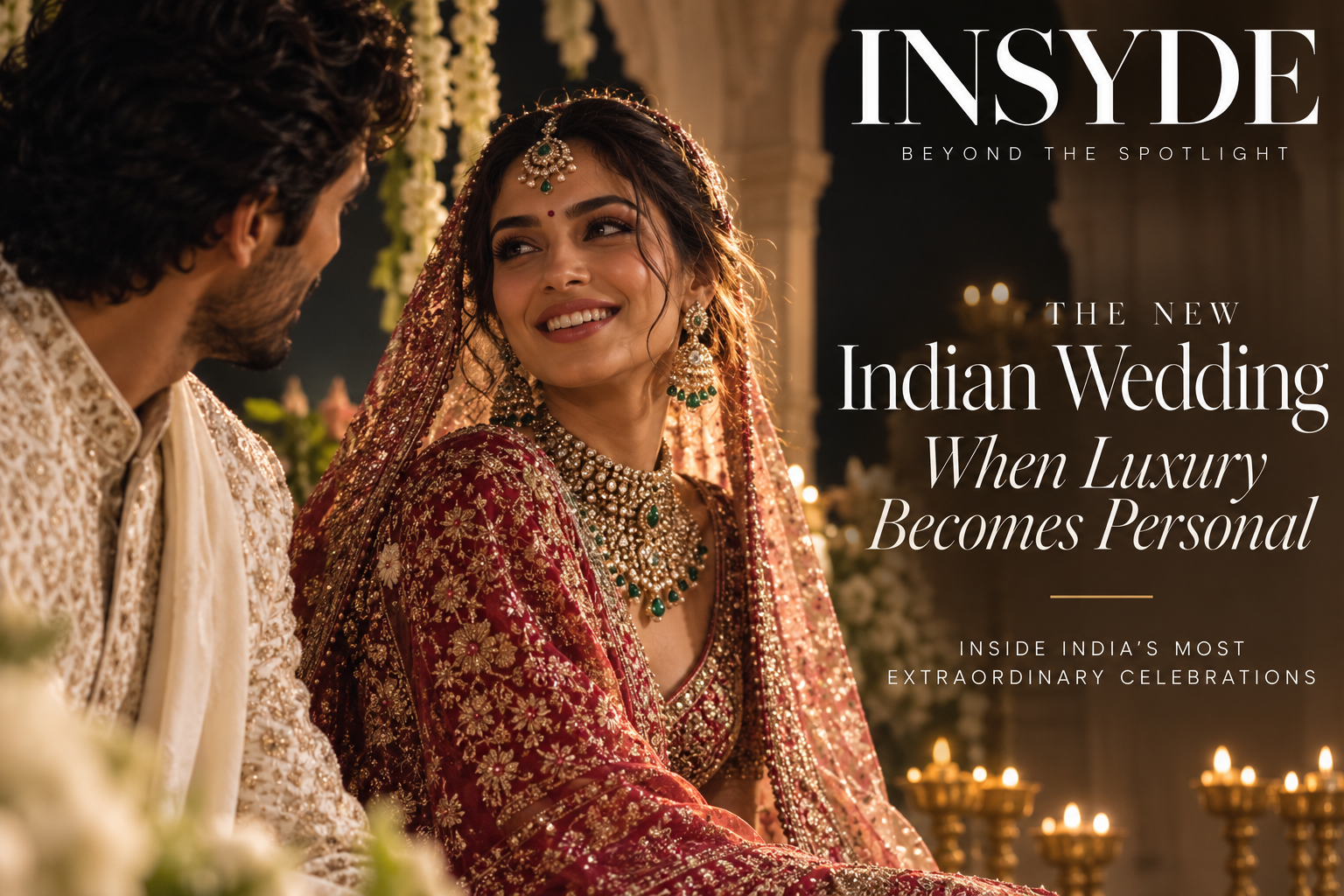
  • The New Indian Wedding: When Luxury Becomes Personal

    The New Indian Wedding: When Luxury Becomes Personal

    India has never been short of spectacular weddings. But a new generation is changing what makes a celebration truly luxurious — moving beyond scale and spectacle towards personalisation, experience, craftsmanship and the art of making people feel part of something extraordinary.

    A luxury Indian wedding is no longer simply a celebration.

    For a few days, it can become an entire world.

    A palace becomes a private residence. A garden becomes a dining room. A designer creates clothing that exists for one person. A chef builds a menu around a family’s memories. An artist transforms a space overnight. Guests arrive not simply for a ceremony, but for an experience designed to stay with them long after the final event.

    India has always known how to celebrate.

    What is changing is what the celebration is trying to say.

    For generations, wedding luxury was often measured through scale: larger venues, longer guest lists, bigger décor and increasingly elaborate entertainment.

    Those things still have their place.

    But the most interesting luxury weddings are beginning to ask a different question:

    Does this wedding feel like us?

    That question is changing the Indian wedding — and turning it into one of the country’s most fascinating expressions of modern luxury.

    From Grand to Personal

    The idea that luxury has to mean more is beginning to feel outdated.

    More flowers.

    More guests.

    More entertainment.

    More spectacle.

    More everything.

    But a wedding can be extraordinarily expensive and still feel strangely impersonal.

    The new luxury is increasingly found in the details that could not have been copied from another celebration.

    A menu built around a couple’s favourite dishes.

    A wedding wardrobe designed around a personal story.

    A handwritten note waiting in every guest’s room.

    A piece of jewellery incorporating a family heirloom.

    A song that means something to the couple rather than simply being popular.

    A ceremony designed around heritage without becoming theatrical.

    Recent industry reporting reflects this shift, with Indian wedding professionals describing personalisation, experience and emotional relevance as increasingly important to younger couples. (Eventfaqs)

    The difference is subtle, but important.

    Luxury is becoming less about how much is added and more about how much thought goes into what is chosen.

    The Destination Becomes Part of the Story

    The venue used to be the backdrop.

    Now, increasingly, it is part of the experience.

    A destination wedding can turn a single ceremony into several days of shared life.

    Guests arrive early.

    They stay together.

    They eat together.

    They explore the destination.

    They attend smaller celebrations.

    They have time to actually talk.

    That helps explain the continuing appeal of India’s palaces, heritage properties, resorts and quieter destinations. Recent reporting suggests that couples are increasingly looking beyond conventional wedding destinations for locations that offer privacy, atmosphere and a more distinctive experience. (The Economic Times)

    The venue is no longer simply where the wedding happens.

    The venue becomes part of the story.

    A palace communicates history.

    A coastal property creates a different rhythm.

    A private villa creates intimacy.

    A heritage estate creates a connection to place.

    A quieter destination can give a celebration something increasingly valuable: space.

    And the location can influence everything that follows — from the wardrobe and flowers to the food, photography and guest experience.

    The Wedding Becomes a Multi-Day World

    The modern luxury wedding is increasingly less like a single event and more like an editorial unfolding over several days.

    Welcome dinner.

    Mehendi.

    Haldi.

    Sangeet.

    Cocktail evening.

    Wedding ceremony.

    Reception.

    After-party.

    But the interesting change isn’t simply the number of events.

    It is how differently each event can feel.

    A daytime ceremony might be quiet and architectural.

    An evening celebration might become theatrical.

    A private dinner might feel intimate and almost residential.

    A final brunch might be deliberately relaxed.

    Each moment becomes its own chapter.

    The result is less of a wedding programme and more of a curated journey.

    That distinction matters.

    Luxury is increasingly being measured by the quality of the experience between the major moments, not simply by what happens on the main stage. Business Standard recently reported that Indian couples are increasingly trimming guest lists while investing more in destinations and multi-day experiences that allow families and friends to stay, explore and create memories together. (Business Standard)

    When Fashion Shapes the Entire Wedding

    Few things reveal the changing Indian wedding better than fashion.

    The wedding wardrobe has always been important.

    But today, couture can influence the entire visual language of the celebration.

    A bridal lehenga can inspire the colour palette.

    A groom’s sherwani can influence the décor.

    Jewellery can influence the lighting.

    Textiles can influence table settings.

    The invitation can become an extension of the couture.

    Fashion moves beyond the wardrobe.

    It becomes architecture.

    This is particularly interesting in India because the country already possesses an extraordinary vocabulary of textile and craft traditions.

    Embroidery.

    Weaving.

    Zardozi.

    Hand-painted textiles.

    Metalwork.

    Jewellery.

    Regional techniques passed between generations.

    The modern luxury wedding can give those traditions a new stage.

    The objective doesn’t have to be recreating the past.

    It can be reinterpretation.

    A traditional technique can become contemporary.

    A historic motif can become graphic.

    An old textile can be paired with modern tailoring.

    Heritage can become something that moves forward rather than something preserved behind glass.

    Craftsmanship Becomes Part of the Celebration

    The most memorable luxury is often the kind that takes time.

    A hand-embroidered garment.

    A custom piece of jewellery.

    A hand-painted invitation.

    A specially commissioned installation.

    A table setting created by craftspeople.

    A menu developed around regional ingredients.

    These things have something in common.

    They cannot be produced instantly.

    And that makes them valuable in a culture increasingly dominated by speed.

    The Indian wedding has always been a major platform for craftsmanship.

    But the opportunity now is to move beyond simply using craft as decoration.

    Craft can become the story itself.

    Imagine a wedding where guests are introduced to the artisans who created the textiles.

    Where the menu explains the origins of ingredients.

    Where the jewellery tells the story of a family.

    Where the architecture of the venue becomes part of the celebration.

    Suddenly, luxury becomes educational as well as beautiful.

    The Guest Is No Longer Just a Guest

    This may be one of the biggest changes in modern luxury weddings.

    The guest experience has become part of the design.

    A wedding can have the most beautiful stage in the country and still fail if the people attending it feel forgotten.

    Luxury hospitality works differently.

    Guests know where they are staying.

    They know what is happening.

    They have thoughtful welcome experiences.

    They receive things that feel selected rather than generic.

    They are given time to enjoy the destination.

    They are introduced to the culture of the place.

    They are not simply spectators.

    They become participants.

    That is why hospitality is becoming one of the most important dimensions of luxury weddings.

    The question isn’t only:

    How impressive can the wedding look?

    It is:

    How does everyone feel while they are there?

    That is a much harder question to answer.

    And perhaps a much more meaningful one.

    Food Becomes Storytelling

    Indian weddings have always taken food seriously.

    The modern luxury wedding is taking it further.

    Private dining.

    Regional menus.

    Chef collaborations.

    Curated tasting experiences.

    Family recipes.

    Local ingredients.

    Fine-dining techniques.

    Food can become another way of telling the couple’s story.

    A dish from the bride’s childhood.

    A recipe from the groom’s family.

    A regional ingredient from a place that matters to them.

    A menu inspired by their first trip together.

    The most luxurious meal may not be the one with the greatest number of dishes.

    It may be the one where every dish has a reason for being there.

    From Spectacle to Storytelling

    This doesn’t mean Indian weddings are becoming minimal.

    That would be too simple.

    Grand celebrations are not disappearing.

    Instead, grandeur is becoming more intentional.

    A spectacular performance can still be extraordinary.

    A dramatic floral installation can still be beautiful.

    Fireworks can still create a moment.

    A palace can still be magnificent.

    The difference is that spectacle increasingly works best when it belongs to a larger story.

    The question becomes:

    Why this?

    Why this location?

    Why this music?

    Why this designer?

    Why this colour?

    Why this performance?

    Why this particular piece of jewellery?

    When every element has an answer, extravagance begins to feel like curation rather than excess.

    India’s Heritage Meets a Global Outlook

    Indian weddings have always been deeply rooted in tradition.

    But today’s couples are also growing up in a global cultural environment.

    They travel.

    They study abroad.

    They consume international fashion.

    They follow global design.

    They discover restaurants, hotels and artists from around the world.

    That creates an interesting tension.

    The modern Indian wedding doesn’t necessarily have to choose between Indian and international.

    It can be both.

    A traditional ceremony can take place inside contemporary architecture.

    Indian textiles can be styled with modern silhouettes.

    A regional menu can be presented with contemporary fine-dining techniques.

    A palace wedding can have a distinctly modern visual identity.

    A destination wedding abroad can still remain deeply Indian.

    The future of Indian wedding luxury may therefore be less about choosing between heritage and modernity.

    It may be about making the two belong together.

    The Ultimate Luxury May Be Privacy

    There is another shift worth watching.

    For years, luxury weddings were designed to be seen.

    The bigger the spectacle, the more photographs.

    The more famous the guests, the more attention.

    The more elaborate the production, the more social media content.

    But for some of today’s most high-profile celebrations, the direction is changing.

    Privacy itself is becoming desirable.

    Smaller guest lists.

    Private properties.

    Controlled access.

    Discreet photography.

    Personalised hospitality.

    Carefully managed guest information.

    In July 2026, industry coverage of several high-profile Indian weddings highlighted privacy, intimate guest lists and personalised hospitality as increasingly important markers of luxury. (Eventfaqs)

    This doesn’t necessarily mean spending less.

    In fact, a smaller celebration can allow couples to spend considerably more on the people and details that matter.

    The wedding stops being a performance for everyone.

    It becomes an experience for the people who are actually there.

    And perhaps that is a more sophisticated form of luxury.

    The ability to decide who gets to see it.

    Technology Has a Place — But It Isn’t the Luxury

    Technology is now woven into almost every part of wedding planning and production.

    Digital invitations.

    Online RSVPs.

    Virtual venue tours.

    AI-assisted planning.

    Drone photography.

    Live streaming.

    Immersive installations.

    Technology can make a wedding more efficient and, sometimes, more spectacular.

    But technology itself isn’t necessarily what makes the experience luxurious.

    The best use of technology is often the use you barely notice.

    It removes friction.

    It makes the experience smoother.

    It helps personalise the celebration.

    The luxury remains human.

    A thoughtful welcome.

    A beautifully prepared room.

    A meal that arrives at exactly the right moment.

    A piece of clothing made specifically for you.

    A conversation that lasts longer than expected.

    Technology can support those moments.

    It cannot replace them.

    The Wedding as a Luxury Ecosystem

    Perhaps this is why weddings are becoming so important to the wider luxury industry.

    A single celebration can bring together fashion, jewellery, hospitality, travel, automobiles, beauty, food, art, architecture and entertainment.

    A wedding doesn’t exist inside one luxury category.

    It connects them all.

    A bride may work with a couture house, a jewellery designer, a beauty team and a photographer.

    The family may book a heritage property, private transport, a chef and a production company.

    Guests may travel internationally, stay at luxury hotels and shop for new wardrobes.

    The wedding becomes an ecosystem of luxury.

    But the commercial value is only one part of the story.

    The more interesting question is cultural:

    Why has the Indian wedding become such a powerful expression of aspiration?

    Because it combines almost everything India values about celebration — family, identity, tradition, craftsmanship, food, fashion, hospitality and storytelling — into one extraordinary moment.

    What Will the Next Indian Luxury Wedding Look Like?

    It may still be enormous.

    Or it may have 80 guests.

    It may take place in a palace.

    Or on a private beach.

    It may involve couture from Paris.

    Or a young Indian designer nobody outside the fashion world has discovered yet.

    It may feature a famous performer.

    Or simply a musician who means something to the family.

    There is no single formula.

    And that is precisely the point.

    The future of luxury weddings is not one aesthetic.

    It is personalisation at scale.

    The ability to create an experience that feels extraordinarily considered, even when the production itself is enormous.

    That requires more than money.

    It requires taste.

    It requires restraint.

    It requires storytelling.

    And above all, it requires knowing what matters.

    The Most Luxurious Wedding May Be the Most Personal One

    India doesn’t need to make its weddings less spectacular.

    It simply has the opportunity to make them more meaningful.

    The most memorable celebration may not be the one with the largest guest list or the tallest floral installation.

    It may be the one where every detail feels connected.

    The clothes.

    The jewellery.

    The food.

    The architecture.

    The music.

    The destination.

    The people.

    The memories.

    The things that could only have belonged to that particular couple.

    Because the ultimate luxury may not be having the wedding everyone remembers.

    It may be creating the wedding that could belong to no one else.

    And perhaps that is where the new Indian wedding begins.

    INSYDE — Inside modern luxury.

  • THE £20,000 POUR

    THE £20,000 POUR

    Inside the rare bottles, private collections and new drinking culture redefining luxury in 2026.

    A drink can cost more than a luxury watch.

    A bottle can be rarer than a piece of jewellery.

    A whisky can be made for one person.

    And a cognac can arrive with its own temperature-controlled cellar.

    In September 2026, LOUIS XIII unveiled Black Pearl: Tribute to Le Grollet, a new expression limited to just 398 decanters worldwide. The reported price is £21,000 per decanter, with the experience built around a temperature-controlled ritual inspired by the historic Le Grollet cellar in Cognac.

    At first glance, the obvious question is:

    Why?

    Why spend £21,000 on something that eventually disappears?

    But that question misses what luxury alcohol has become.

    Because at the highest end, the wealthy consumer isn’t simply buying what’s inside the bottle anymore.

    They’re buying rarity.

    Provenance.

    Craftsmanship.

    Access.

    Knowledge.

    And increasingly, the story surrounding the pour.

    At the same time, a younger generation is entering the category with an entirely different set of expectations. Gen Z isn’t simply abandoning alcohol. The latest IWSR research shows participation among legal-drinking-age Gen Z consumers has stabilised at 74% across 15 key markets, while drinking occasions and quantities are becoming more selective. In India’s high-income urban population, participation among Gen Z adults over 21 reached 80% in 2026, up from 60% three years earlier.

    The result is a strange contradiction.

    The luxury consumer is going deeper.

    The younger consumer is becoming more selective.

    And somewhere between the private cellar and the late-night cocktail bar, the definition of luxury is changing.

    Welcome to the new luxury pour.


    THE EXPENSIVE BOTTLE ISN’T ENOUGH ANYMORE

    For decades, luxury alcohol had a relatively simple formula.

    Make it old.

    Make it rare.

    Put a famous name on it.

    Put it inside an extraordinary bottle.

    Charge more.

    The higher the price, the stronger the signal.

    But 2026 is making that formula increasingly complicated.

    IWSR’s latest research argues that premiumisation is undergoing a reset. Since 2022, global beverage-alcohol price-per-litre growth has consistently lagged overall inflation, while consumers have become more selective about trading up. The question is increasingly whether an expensive product delivers something meaningful in return.

    That distinction matters.

    Because there is a difference between:

    expensive

    and

    luxurious.

    A bottle can be expensive because it carries a high price.

    Luxury needs a reason.

    Maybe the spirit comes from an unusually rare cask.

    Maybe only a few hundred bottles exist.

    Maybe the liquid took decades to mature.

    Maybe the bottle itself is an extraordinary piece of craftsmanship.

    Maybe the buyer gets access to something most consumers will never see.

    Or perhaps the bottle tells a story that cannot simply be reproduced.

    The price becomes a consequence of the story.

    Not the story itself.


    WHEN A BOTTLE BECOMES A COLLECTION

    There is a moment when alcohol stops behaving like a consumable and starts behaving like an object.

    Collectors understand this instinctively.

    A rare bottle can become an object of design, a piece of history, a conversation piece, a gift, a family possession — or simply something kept because finding another one would be almost impossible.

    The most interesting examples aren’t necessarily the bottles with the biggest numbers printed on their price tags.

    They are the ones where scarcity has meaning.

    LOUIS XIII’s Black Pearl is a particularly striking example.

    Its 398-decanter production is only part of the proposition. The expression draws on an exceptional eau-de-vie selected from the house’s historic collection and connected to Le Grollet, while the tasting ritual is designed to evolve as the cognac warms from cellar temperature toward ambient temperature.

    The bottle is therefore only one part of the object.

    The cellar.

    The temperature.

    The ritual.

    The provenance.

    The liquid.

    The story.

    All become part of the experience.

    And that is the point.

    Luxury alcohol is increasingly being designed as an experience rather than simply packaged as a product.


    THE RICHEST BOTTLE MAY BE THE ONE THAT IS YOURS

    Perhaps the most fascinating development in luxury spirits isn’t the rare bottle.

    It’s the personal bottle.

    India is already experimenting with this idea.

    Diageo India’s India Rare Spirits programme offers a personalised cask experience in which consumers can explore a library of aged malts, select a cask and create an expression tailored to individual tastes and occasions. The resulting bottles can carry personalised labels and commissioned artwork for milestones including weddings, corporate celebrations and anniversaries.

    The distinction is subtle but important.

    A limited edition says:

    Only a few people can own this.

    A bespoke expression says:

    This was made for you.

    Luxury has always understood the power of personalisation.

    Fashion does it.

    Cars do it.

    Jewellery does it.

    Watches do it.

    Now spirits are moving deeper into the same territory.

    The bottle becomes less like a product and more like a portrait of its owner.


    INDIA IS TRADING UP

    India is becoming one of the world’s most interesting growth stories in beverage alcohol.

    IWSR says India’s total beverage-alcohol volumes grew at a 3% CAGR between 2019 and 2024, including a 6% increase in 2024, with another 4% increase projected for 2025. Over 2024–2034, IWSR forecasts approximately 3% annual volume growth. Imported spirits have been gaining particularly quickly, growing at a 16% CAGR between 2019 and 2024.

    But the more interesting story isn’t simply that Indians are buying more alcohol.

    It is what they expect from it.

    The country’s premium alcohol landscape is expanding across single malts, Scotch, tequila, wine, craft spirits and increasingly personalised experiences. Indian producers and international houses are competing for consumers who have more choice, more information and greater exposure to global drinking culture.

    This is the beginning of a broader cultural shift.

    The Indian luxury consumer is no longer necessarily asking:

    “Is this imported?”

    Increasingly, the more interesting question is:

    “Is this interesting?”

    That is a significant change.


    THE INDIAN LUXURY CONSUMER IS GETTING MORE SELECTIVE

    India’s opportunity isn’t simply about having more wealthy consumers.

    It is about having consumers with more choices.

    More brands.

    More categories.

    More international exposure.

    More travel.

    More sophisticated bars.

    More information.

    More ways to discover something new.

    And more reasons to question whether a premium price actually means premium value.

    IWSR describes India as a major growth engine for beverage alcohol, but also emphasises the country’s complexity: state-level regulation, taxation, distribution structures and a consumer base that remains highly value-conscious.

    That creates an unusual environment for luxury.

    A global brand cannot simply arrive with a beautiful bottle and assume the story is finished.

    It has to earn its place.

    Through the liquid.

    Through the experience.

    Through the culture surrounding it.


    THE BAR IS NO LONGER JUST A BAR

    There was a time when a bar’s job was simple.

    Serve the drink.

    Today, some of the most interesting luxury drinking experiences are built around everything before the drink reaches the glass.

    The room.

    The bartender.

    The music.

    The food.

    The glassware.

    The story.

    The people.

    The location.

    The ritual.

    India’s on-premise market is becoming increasingly important to this equation.

    NIQ’s 2026 India research found that nearly seven in ten Indian consumers visit restaurants, cafés or bars at least once a quarter, while its research highlights the role of the on-premise environment in creating occasions, justifying premium choices and building brand preference. Bartenders and venue staff can also exert an outsized influence over consumer choice.

    The bar becomes a showroom.

    But not a showroom for bottles.

    A showroom for taste.

    The bartender becomes a curator.

    The menu becomes an editorial.

    The experience becomes part of the product.

    And suddenly, ordering a drink isn’t simply consumption.

    It becomes participation.


    THE NEW LUXURY CLUB

    At the highest end, this becomes even more exclusive.

    Luxury alcohol increasingly intersects with:

    private clubs

    members’ spaces

    collector communities

    private tastings

    hotel experiences

    chef collaborations

    distillery visits

    invitation-only events

    This shift can already be seen in the way spirits companies are building destinations around their brands.

    Diageo India’s The Good Craft Co. Flavour Market in Ponda, Goa, for example, is being developed as an ecosystem combining an experience centre, distillery tour, rare-spirits vault, craft bar, tasting room, chef and mixologist collaborations, workshops and a bespoke craft-spirit retail destination.

    The luxury alcohol ecosystem is therefore moving from:

    Bottle → Consumer

    towards:

    Brand → Experience → Community → Consumer

    Luxury is becoming social again.

    But selectively social.


    THEN GEN Z WALKED IN

    And just when the luxury industry thought it understood the next drinker, Gen Z complicated everything.

    The old narrative suggested Gen Z was simply going to abandon alcohol.

    The data is more nuanced.

    IWSR’s July 2026 research found that 74% of legal-drinking-age Gen Z consumers across 15 key markets participated in beverage alcohol, up from 66% three years earlier. In India’s high-income urban population, participation among Gen Z adults over 21 reached 80% in 2026, compared with 60% three years earlier.

    But participation doesn’t mean indiscriminate consumption.

    IWSR’s research also shows that younger drinkers are becoming more selective. Across its 15-market study, the average number of beverage-alcohol categories consumed per occasion by Gen Z fell from 2.8 to 1.8 over two years. The change was particularly visible among Gen Z consumers in India and several other markets.

    That’s where the story gets interesting.

    Gen Z isn’t necessarily saying:

    “I don’t want alcohol.”

    It is increasingly asking:

    “Why this drink?”

    “Why this place?”

    “Why this occasion?”

    And perhaps most importantly:

    “Is it worth it?”


    GEN Z DOESN’T WANT YOUR FATHER’S WHISKY

    Previous generations often understood premium alcohol through a familiar vocabulary:

    Age statement.

    Heritage.

    Status.

    Prestige.

    Scarcity.

    Gen Z is adding another word:

    Discovery.

    IWSR’s research shows younger legal-drinking-age consumers remain engaged with alcohol while becoming more selective about category choice and occasion.

    That changes how luxury works.

    A younger consumer may not automatically care that a brand has existed for centuries.

    But they may care that:

    a bartender recommended it,

    a chef built a menu around it,

    a designer collaborated on it,

    the distillery has an unusual story,

    the ingredients come from somewhere unexpected,

    or only a small community knows about it.

    The new luxury consumer doesn’t necessarily want to inherit taste.

    They want to discover it.


    THE COCKTAIL GENERATION

    There is another clue hiding in the changing drinking culture.

    Cocktails transform alcohol into something more than a bottle.

    A cocktail can be:

    a flavour experience,

    a piece of design,

    a performance,

    a social object,

    a signature of a particular venue,

    or the centre of an entire evening.

    The bottle becomes the raw material.

    The experience becomes the luxury.

    And this helps explain why sophisticated bars matter so much to younger consumers.

    They aren’t simply places to drink.

    They are places to discover culture.


    DRINK LESS. CHOOSE BETTER.

    There is another paradox here.

    The future of luxury alcohol may not involve drinking more.

    It may involve drinking less, but with greater intention.

    IWSR’s 2026 research found that the average number of drinks consumed per occasion across its key markets fell to 3.9, from 4.4 in 2024 and 2025. The organisation describes moderation as increasingly structural rather than simply cyclical, with lifestyle and health becoming more important influences.

    This does not mean premium alcohol disappears.

    Quite the opposite.

    IWSR’s latest premiumisation research suggests that consumers in developing markets such as India continue to trade up, but increasingly want genuine justification for the higher price. Across 16 major developing markets, IWSR forecasts premium-plus servings to expand by 13% between 2025 and 2035.

    That creates an unusual luxury equation.

    The consumer may have access to hundreds of bottles.

    But chooses one.

    One exceptional whisky.

    One extraordinary cognac.

    One beautifully made cocktail.

    One bottle opened for an important evening.

    Luxury becomes less about abundance.

    And more about selection.


    THE EXPERIENCE IS THE LUXURY

    This may be the biggest transformation taking place.

    The liquid still matters.

    But what happens around it increasingly matters too.

    The right restaurant.

    The right table.

    The right glass.

    The right bartender.

    The right person sitting across from you.

    The right story.

    The right moment.

    IWSR’s research into the on-trade describes a shift toward more “edited” occasions, with consumers drinking fewer serves and fewer categories while seeking meaningful experiences and better justification for what they spend.

    This is a profound shift.

    Because luxury has always been about controlling the experience.

    A luxury hotel doesn’t sell a bed.

    A private jet doesn’t sell a seat.

    A luxury watch doesn’t simply sell time.

    And a £20,000 cognac isn’t simply selling liquid.

    It is selling a moment that very few people can reproduce.


    THE NEW STATUS SYMBOL IS TASTE

    Perhaps this is where luxury alcohol becomes most interesting.

    For a long time, status was largely about ownership.

    The car.

    The watch.

    The bottle.

    The address.

    But as luxury becomes increasingly visible through social media, simply recognising a logo becomes less impressive.

    Knowing why something matters becomes more valuable.

    Knowing the producer.

    Knowing the vintage.

    Knowing the cask.

    Knowing the difference between two expressions.

    Knowing which bar has the rare bottle.

    Knowing which release is genuinely scarce.

    Knowing when a “limited edition” is actually meaningful.

    Knowing when to order something — and when not to.

    That is taste as cultural capital.

    And cultural capital is difficult to counterfeit.


    INDIA’S NEW DRINKING ELITE

    This is where the Indian story becomes especially compelling.

    India is developing not simply a larger alcohol market, but a more diverse luxury ecosystem around it.

    International spirits houses are expanding premium portfolios.

    Indian producers are moving into higher-value categories.

    Bars are becoming more sophisticated.

    Collectors are becoming more informed.

    And younger affluent consumers are increasingly participating in the category.

    IWSR’s 2026 data found beverage-alcohol participation among high-income urban Indians at 77%, while participation among Gen Z adults over 21 in the same demographic reached 80%, up from 60% three years earlier.

    And Indian brands are increasingly using scarcity, craftsmanship and storytelling to position themselves at the luxury end.

    Take Godawan 173.

    Released in 2025 as a collector’s edition, the expression was limited to 173 bottles, each priced at ₹5 lakh. Its name referenced the reported recovery of the Great Indian Bustard population from 100 to 173, while the whisky used a three-stage maturation journey involving ex-bourbon, Oloroso and PX sherry, and Asha liqueur casks. Each bottle was inspired by Jaipur Blue Pottery.

    The point isn’t that every affluent drinker will buy a ₹5 lakh bottle.

    They won’t.

    The point is that Indian spirits are increasingly learning how to construct luxury narratives of their own.

    And that changes the conversation.


    THE BATTLE FOR THE TOP SHELF

    This is why India’s luxury alcohol landscape is becoming increasingly interesting.

    International houses bring:

    heritage

    global recognition

    distribution

    iconic names

    deep reserves

    Indian producers bring:

    local knowledge

    climate

    experimentation

    craft

    cultural identity

    speed

    And consumers are standing in the middle with more choices than ever.

    The question is no longer simply whether Indian consumers will buy luxury alcohol.

    They already are.

    The bigger question is:

    Who will define what luxury drinking in India looks like next?

    Will European heritage continue to dominate?

    Will Indian spirits become global luxury objects?

    Will tequila and agave reshape the premium conversation?

    Will private clubs become more important to affluent nightlife?

    Will the cocktail become more important than the bottle?

    Will moderation redefine indulgence?

    Or will the next great luxury-drinks brand come from somewhere nobody is looking yet?


    WHAT ACTUALLY MAKES A DRINK LUXURIOUS?

    Perhaps the answer isn’t age.

    It isn’t price.

    It isn’t even rarity.

    Not by itself.

    Luxury emerges when several things collide:

    Scarcity.

    Craftsmanship.

    Provenance.

    Authenticity.

    Personalisation.

    Experience.

    Access.

    Knowledge.

    And increasingly:

    meaning.

    That’s why a £21,000 cognac can exist alongside a personalised Indian cask, a ₹5 lakh collector’s whisky, a perfectly executed cocktail and even a sophisticated alcohol-free serve.

    They occupy completely different price points.

    But they can participate in the same cultural conversation.

    Because luxury is no longer simply about what something costs.

    It’s about why someone cares.


    THE £20,000 POUR

    The £20,000 bottle is therefore not really the story.

    It’s the doorway.

    Behind it is a much larger transformation.

    The wealthy are becoming more selective.

    Collectors are becoming more sophisticated.

    Brands are moving from bottles to experiences.

    Indian spirits are building narratives of their own.

    Bars are becoming cultural spaces.

    And Gen Z is entering the conversation with a completely different understanding of indulgence.

    The future of luxury alcohol may not belong to the brand with the oldest distillery.

    Or the highest price.

    Or the biggest bottle.

    It may belong to whoever can create something people genuinely want to remember.

    Because when money stops being the obstacle, meaning becomes the luxury.

    And perhaps the most luxurious drink isn’t the one that costs £20,000.

    It’s the one you know exactly why you wanted.


    INSYDE TAKE

    Luxury alcohol is entering a strange new era.

    The bottle still matters.

    The heritage still matters.

    The craftsmanship absolutely matters.

    But the hierarchy is changing.

    Price gets attention.

    Scarcity creates desire.

    Craft earns respect.

    Experience creates memory.

    And taste creates status.

    For the wealthy, the next great luxury may not be another trophy bottle.

    For Gen Z, it may not always be alcohol at all.

    And for India, the most interesting possibility is that the next definition of luxury drinking won’t simply be imported.

    It could be made here.

    INSYDE

    Luxury, Through a Different Lens.

    Beyond the Spotlight.

  • WHY GEN Z WANTS LOVE — JUST NOT THE DRAMA

    WHY GEN Z WANTS LOVE — JUST NOT THE DRAMA

    They still believe in romance. They just want it to feel different.

    By INSYDE

    There was a time when dating seemed to have a script.

    You met someone.
    You liked them.
    You dated.
    You fell in love.
    Eventually, you decided where it was going.

    Today, the script has been replaced by a vocabulary.

    Talking stages. Situationships. Soft launches. Ghosting. Breadcrumbing. Orbiting.

    There are now so many ways to describe not knowing what a relationship is that romance can sometimes feel like it needs its own user manual.

    And somewhere in all that ambiguity, a familiar idea has taken hold:

    Gen Z doesn’t want commitment.

    It sounds convincing.

    It is also too easy.

    Because the latest research tells a much more interesting story.

    Gen Z hasn’t abandoned love.

    They haven’t stopped believing in long-term relationships.

    They haven’t collectively decided that marriage is obsolete.

    What appears to be changing is the kind of relationship they are willing to commit to — and the price they are willing to pay for it.

    A 2026 Match Group study conducted with researchers from the Kinsey Institute found that 80% of Gen Z believe they will find true love, while only 55% say they currently feel prepared for a romantic relationship.

    That gap might be the real story.

    They believe in love.

    They just aren’t necessarily willing to rush into it.


    THE GENERATION THAT STILL BELIEVES IN LOVE

    If Gen Z has supposedly given up on romance, the numbers have a strange way of disagreeing.

    Research from Match Group shows that Gen Z remains highly optimistic about finding meaningful relationships, with 80% saying they believe they will find true love.

    The latest Singles in America study, released in September 2026 by Match in partnership with the Kinsey Institute, surveyed roughly 5,000 U.S. singles and found that singles are becoming more deliberate about the relationships they pursue, placing greater emphasis on compatibility, trust and emotional steadiness.

    So perhaps Gen Z isn’t rejecting commitment.

    Perhaps they’re rejecting commitment for the sake of commitment.

    There is a difference.

    You can want a partner without wanting to rush into a relationship.

    You can want commitment without believing marriage has to happen on a particular timeline.

    You can want intimacy without wanting your relationship turned into content.

    You can want someone deeply without wanting to disappear inside the relationship.

    And for a generation raised around more choice, more information and more visibility than almost any before it, those distinctions matter.


    THE NEW CHECKLIST

    Romance used to be sold largely through chemistry.

    The spark.

    The butterflies.

    The irresistible person who walks into a room and changes everything.

    Those things still matter.

    But they’re no longer the entire conversation.

    The 2026 Singles in America research points toward a stronger emphasis on compatibility, trust and emotional steadiness.

    The question isn’t only:

    “Do I like you?”

    It increasingly becomes:

    “Can I build something with you?”

    Can we communicate?

    Can I trust you?

    Are you emotionally available?

    Do our values work together?

    Do I feel safe being myself around you?

    Will this relationship bring peace into my life, or another source of chaos?

    Those aren’t particularly cinematic questions.

    But they might be some of the most important ones.


    PEACE IS BECOMING SEXY

    Popular culture spent decades teaching us that great love should be dramatic.

    The jealousy.

    The obsession.

    The grand gesture.

    The emotional rollercoaster.

    The person who makes you lose your mind.

    But there is a growing cultural counterpoint to that fantasy:

    peace.

    Indian coverage of emerging Gen Z dating behaviours in 2026 has highlighted a preference for kindness, consistency, reliability and emotional safety over the intense highs associated with conventional romantic drama.

    The terminology may change tomorrow — the internet is very good at inventing new names for old human experiences — but the underlying idea is worth paying attention to.

    Maybe intensity isn’t the ultimate goal anymore.

    Maybe being able to breathe around someone is.

    Because eventually the question changes from:

    “Do you make my heart race?”

    to:

    “Do I feel good when I’m with you?”

    And after enough bad dates, mixed signals and emotional gymnastics, that can become its own kind of attraction.


    THE TALKING STAGE THAT NEVER ENDS

    Few phrases capture modern dating better than:

    “We’re talking.”

    It can mean almost anything.

    Three dates.

    Three months of texting.

    Daily memes but no plans.

    Emotional intimacy without a relationship.

    A connection that everyone understands except the two people actually involved.

    And sometimes, ambiguity is fun.

    Until it isn’t.

    YPulse reported in September 2026 that 70% of 18–24-year-olds surveyed agreed that dating is more difficult now than it was in the past. Its research points to swipe fatigue, ghosting and conversations that never progress as part of the frustration.

    The irony is hard to miss.

    Technology was supposed to make meeting people easier.

    Instead, having almost unlimited access to potential matches can make deciding what to do with one person strangely difficult.


    TOO MANY OPTIONS, NOT ENOUGH CONNECTION

    Dating apps solved one enormous problem:

    access.

    You no longer needed to meet someone through school, work, friends or family.

    Your potential dating pool could suddenly extend across a city — sometimes much further.

    But access isn’t intimacy.

    A hundred matches don’t guarantee one meaningful conversation.

    And an endless supply of profiles can make people feel less like potential partners and more like options in an infinite catalogue.

    The dating industry knows this.

    In 2026, platforms are increasingly experimenting with AI, more intentional matching, curated events and real-world experiences designed to move users beyond endless swiping.

    The industry invented the swipe.

    Now it is trying to get people off the swipe.

    That says something.

    Perhaps Gen Z doesn’t hate dating.

    Perhaps they are simply tired of dating as a product.


    THE RELATIONSHIP DOESN’T HAVE TO BE A PERFORMANCE

    There is another complication that previous generations didn’t have to navigate at quite this scale:

    everyone is watching.

    The first photo.

    The soft launch.

    The hard launch.

    The anniversary carousel.

    The holiday dump.

    The breakup post.

    Even a private relationship can start to feel public when your social feeds are full of everyone else’s carefully edited versions of love.

    And that creates a strange contradiction.

    We have never had more ways to publicly demonstrate intimacy.

    Yet privacy can feel increasingly intimate itself.

    A conversation that doesn’t become a screenshot.

    A photograph that doesn’t need to be uploaded.

    A relationship that exists without an audience.

    A person who matters to you even if nobody else knows.

    Maybe the new luxury isn’t being seen together.

    Maybe it’s having something that belongs only to you.


    LOVE HAS BECOME AN ECONOMIC QUESTION

    Romance doesn’t exist outside reality.

    There is rent.

    There is career uncertainty.

    There is the cost of living.

    There is the pressure to become financially independent.

    There is the question of where you’re going to live and what kind of life you’re trying to build.

    And for young adults, those pressures can influence how they think about long-term relationships.

    This doesn’t mean money determines whether someone falls in love.

    It means commitment can carry a larger practical question:

    Can we actually build a life together?

    For Gen Z, becoming a partner may increasingly feel like something that requires emotional and personal readiness — not simply romantic desire.

    That’s consistent with the 2026 Match Group/Kinsey research: 80% of Gen Z say they believe they’ll find true love, but only 55% currently feel prepared for a romantic relationship.

    That’s the contradiction.

    Optimistic about love.

    Cautious about readiness.

    And perhaps those two things can exist at the same time.


    INDIA HAS ITS OWN VERSION OF THE STORY

    Most conversations about Gen Z dating rely heavily on American research.

    India deserves its own lens.

    Here, romance doesn’t exist in isolation from family.

    Dating can eventually become marriage.

    Marriage can become a family decision.

    And personal choice can coexist with parental expectations.

    Yet even that old structure is changing.

    A September 2026 Indian Express report describes a growing “co-piloted” model in which adult children and parents jointly manage matrimonial profiles and participate in the search for potential partners.

    It isn’t quite the old arranged-marriage model.

    It isn’t completely independent dating either.

    It’s something in between.

    The young person still wants agency.

    The family still wants involvement.

    And both sides are negotiating where the boundary sits.

    That may actually be one of the most interesting things happening in Indian relationships right now:

    tradition isn’t necessarily disappearing.

    It’s being renegotiated.


    SMALLER GESTURES, BIGGER MEANING

    Indian dating culture is also developing its own language of affection.

    Bumble’s India research found that 92% of surveyed Indian singles said small behaviours such as sharing memes, playlists and inside jokes have become ways of expressing affection. The same research found that 62% of women surveyed in India placed greater value on stability amid uncertainty, including emotional consistency, reliability and clear goals in a partner.

    The research was conducted among Bumble members, so it should not be treated as a representative survey of all Indian Gen Z.

    But the cultural signal is interesting.

    Romance doesn’t always arrive as roses anymore.

    Sometimes it arrives as:

    “This reminded me of you.”

    A playlist.

    A stupid meme.

    A coffee ordered exactly the way you like it.

    Someone remembering the tiny detail you mentioned three weeks ago.

    Grand gestures are visible.

    Small gestures are personal.

    And perhaps personal is what matters more now.


    THE DEATH OF THE OLD DATING GAMES?

    For decades, romantic advice often celebrated strategic behaviour.

    Don’t reply too quickly.

    Don’t seem too interested.

    Make them chase you.

    Play hard to get.

    Keep them guessing.

    Modern dating culture is increasingly suspicious of those games.

    Indian reporting in 2026 has highlighted behaviours such as “dial-toning” — maintaining a connection through likes, story views or occasional messages without actually pursuing the relationship.

    The vocabulary is new.

    The behaviour isn’t.

    People have always been uncertain.

    The difference is that smartphones now give uncertainty a thousand ways to remain alive.

    A story view.

    A like.

    An emoji.

    A late-night “hey.”

    Someone can remain emotionally present without ever actually showing up.

    And that may be one reason clarity has become so attractive.

    Tell me what you want.

    Tell me where I stand.

    Tell me if you’re actually here.


    AND THEN AI ENTERED THE DATING LIFE

    Of course it did.

    By 2026, artificial intelligence is no longer just something people use at work.

    It’s entering conversations about dating too.

    Match Group’s 2026 research indicates that Gen Z is substantially more likely than older generations to use AI in dating-related contexts, including help with communication and matching.

    That raises a strange question.

    If AI can suggest the perfect opening line, improve your dating profile and help identify potential matches…

    what happens to spontaneity?

    Maybe not much.

    Because technology can optimise the beginning of a relationship.

    It can’t manufacture what happens after the screen goes dark.

    It can’t create trust.

    It can’t sit across the table from someone and understand why neither of you wants dinner to end.

    It can’t replace the silence that doesn’t feel awkward.

    It can’t make a person choose you.

    And perhaps that is the most reassuring part.

    The more technology enters dating, the more valuable genuinely human connection may become.


    SO, DOES GEN Z WANT COMMITMENT?

    Maybe the better question is:

    What does Gen Z think commitment should feel like?

    The evidence doesn’t suggest a generation running away from love.

    It suggests a generation becoming more selective about how it gets there.

    They still want connection.

    They still believe in lasting love.

    Many still expect marriage.

    But they’re also questioning the old timeline.

    They’re questioning relationships built on obligation.

    They’re questioning emotional unavailability disguised as mystery.

    They’re questioning the idea that jealousy equals passion.

    They’re questioning whether a relationship has to be public to be real.

    And they’re questioning whether being with someone should require losing the person they were before the relationship began.

    That isn’t necessarily the rejection of commitment.

    It may be an attempt to make commitment more meaningful.


    LOVE WITHOUT LOSING YOURSELF

    Perhaps the biggest difference isn’t that Gen Z wants less love.

    It’s that they have grown up watching what happens when relationships become identities.

    They’ve watched people stay together because leaving would look embarrassing.

    They’ve seen couples perform happiness online.

    They’ve seen relationships become content.

    They’ve watched friends navigate ghosting, cheating, situationships and emotional unavailability in public.

    They’ve also watched people leave.

    Start again.

    Stay single.

    Choose themselves.

    Wait.

    Refuse to settle.

    And that changes the definition of commitment.

    Commitment doesn’t necessarily have to mean:

    “I will stay no matter what.”

    Perhaps increasingly it means:

    “I will choose you honestly, and you will choose me honestly.”

    That’s a more complicated promise.

    But maybe it’s also a more conscious one.


    THE NEW ROMANTIC IDEAL

    So maybe Gen Z doesn’t hate commitment.

    Maybe they hate bad commitment.

    They don’t necessarily want fewer feelings.

    They want fewer games.

    They don’t necessarily want fewer relationships.

    They want fewer relationships that leave them constantly questioning where they stand.

    They don’t necessarily want to avoid vulnerability.

    They want vulnerability to be met with vulnerability.

    They don’t necessarily want less romance.

    They may simply want romance without the performance.

    And after growing up in a world where almost everything can be liked, shared, filtered, ranked and optimised, there is something quietly radical about wanting one thing that cannot be reduced to an algorithm:

    a person you can trust.

    No swipe required.


    THE INSYDE TAKE

    The easiest story about Gen Z and love is that they are afraid of commitment.

    The more interesting story is that they may simply be raising the standard for it.

    They want the freedom to choose.

    The emotional safety to stay.

    The independence to leave.

    The intimacy to be known.

    And the space to remain themselves.

    Love isn’t disappearing.

    The old script is.

    And perhaps that’s why the question for this generation isn’t simply:

    “Will you commit?”

    It’s:

    “What exactly are we committing to?”

    Because in a world of infinite options, constant visibility and increasingly intelligent technology, choosing one person may become more meaningful precisely because you don’t have to.

    Maybe Gen Z doesn’t want less love.

    Maybe they just want love without the drama.

  • Why the New Billionaire Wants His Own Jet

    Why the New Billionaire Wants His Own Jet

    As AI, technology and new fortunes create a younger class of ultra-wealthy travellers, the private jet is evolving from a symbol of status into something more useful: a private office, sanctuary and shortcut through time.

    There was a time when the private jet was the ultimate symbol of arrival.

    The aircraft itself was the statement.

    The size.

    The speed.

    The name painted on the tail.

    The ability to leave the car and step directly onto an aircraft while everyone else waited inside the terminal.

    But private aviation is becoming more interesting than that.

    A new generation of wealthy travellers is changing what the private jet is actually for.

    The question is no longer simply:

    Can you afford to fly privately?

    It is becoming:

    What could you do with the time you get back?

    That distinction matters.

    Because for a billionaire, founder or entrepreneur whose life moves between continents, time isn’t simply something that passes.

    It is something that can be controlled.

    And increasingly, the private jet is becoming one of the ultimate tools for doing exactly that.

    A Different Kind of Jet Set

    The image of the private-jet owner has traditionally been associated with established wealth.

    Oil.

    Finance.

    Entertainment.

    Real estate.

    Old industrial fortunes.

    The aircraft was often the physical expression of a fortune that had already been built.

    But a different kind of wealth is now entering private aviation.

    AI founders.

    Technology entrepreneurs.

    Investors.

    Executives.

    People whose fortunes have been created remarkably quickly.

    Reuters reported in July 2026 that wealth generated by AI startups and SpaceX was helping drive a new wave of private-jet demand, with private-jet owner flights rising 13.4% in early 2026 and shared-ownership flights increasing 11.8%. The report also noted a growing number of younger, newly wealthy customers entering the market.

    The Financial Times has reported a similar shift, with private-aviation companies seeing younger customers arrive as wealth from AI and cryptocurrency expands. Some operators have reported their average customer age falling significantly as newly wealthy technology entrepreneurs enter the market.

    The significance isn’t simply that younger people are buying jets.

    It is that they are bringing a different idea of luxury with them.

    The Most Valuable Luxury Is Time

    Imagine two people travelling from San Francisco to London.

    One spends hours getting to the airport.

    Then comes security.

    Then the terminal.

    Then boarding.

    Then the flight.

    Then immigration.

    Then baggage.

    Then another journey into the city.

    The other arrives at a private terminal, boards an aircraft designed around their schedule and lands closer to the moment their actual journey begins.

    The difference isn’t simply comfort.

    It is time.

    And time becomes increasingly valuable as the rest of life becomes more complicated.

    For an entrepreneur, those hours might become a meeting.

    For an executive, they might become uninterrupted work.

    For a founder, they might become sleep.

    For a family, they might simply become time together.

    The private jet doesn’t create more hours in the day.

    It removes some of the friction between them.

    That may be the most powerful luxury it offers.

    The Jet as a Private Office

    The traditional office has already changed.

    People work from homes.

    Hotels.

    Cafés.

    Cars.

    Lounges.

    And now, increasingly, aircraft.

    Modern business jets are designed around this reality.

    Gulfstream’s G700, for example, can be configured with up to five living areas and accommodate up to 19 passengers, with sleeping arrangements for as many as 13. Its cabin is designed around different modes of work, rest and living rather than a conventional seating arrangement.

    A private jet can contain a dining area.

    A meeting table.

    A lounge.

    A bedroom.

    A shower.

    A workspace.

    A place to disconnect.

    The aircraft becomes less like a vehicle and more like a private interior in motion.

    That is a very different proposition from simply flying first class.

    When the Cabin Becomes Architecture

    Luxury has always been connected to architecture.

    The house.

    The hotel.

    The restaurant.

    The yacht.

    The private club.

    But the private jet introduces a peculiar challenge.

    How do you create a beautiful interior inside something travelling hundreds of kilometres per hour through the atmosphere?

    Every decision matters.

    The weight of the materials.

    The lighting.

    The proportions.

    The storage.

    The acoustics.

    The seating.

    The movement between spaces.

    The relationship between the windows and the interior.

    It is architecture under pressure.

    And the best private-jet interiors don’t necessarily look extravagant.

    They look considered.

    That is an important distinction.

    The End of the Loud Billionaire Jet

    For decades, the visual language of extreme wealth was obvious.

    Glossy wood.

    Gold.

    Oversized seats.

    Crystal.

    Champagne.

    Anything that made the price visible.

    That world still exists.

    But another aesthetic is emerging.

    Quieter.

    More restrained.

    More personal.

    The Financial Times has reported that newer technology-driven luxury consumers are increasingly interested in efficiency, health, exclusivity and personalisation rather than traditional displays of wealth. In private aviation, that shift is appearing through more functional cabins, wellness-oriented services and less ostentatious design.

    This is the same cultural shift being seen across luxury more broadly.

    The buyer who has spent enough time around expensive things doesn’t necessarily want the object to look expensive.

    They want it to feel right.

    That could mean natural materials.

    Soft lighting.

    A quieter cabin.

    A better bed.

    Faster connectivity.

    A healthier meal.

    Or simply a space where nobody else can interrupt them.

    Luxury is becoming less about showing the price.

    It is becoming more about controlling the experience.

    The Aircraft Becomes Personal

    A private jet doesn’t have to look like anyone else’s.

    That is one of its greatest luxuries.

    A business founder might want a serious meeting environment.

    A family might want a cabin designed around children.

    A frequent long-haul traveller might prioritise a bedroom.

    Another owner might want a wellness-focused environment.

    Someone else might want a dining room capable of hosting guests.

    The aircraft can become an extension of its owner.

    And that is where private aviation begins to resemble other forms of bespoke luxury.

    A bespoke suit is made around one person.

    A custom home is designed around one family.

    A commissioned automobile is built around one collector.

    A private jet can be designed around one life.

    Ownership Is No Longer the Only Luxury

    There is another change happening beneath the surface.

    Not everyone who wants private aviation necessarily wants to own an entire aircraft.

    The market has expanded into different forms of access.

    Charter.

    Jet cards.

    Fractional ownership.

    Shared aircraft.

    Full ownership.

    Each model answers a different question.

    How often do you fly?

    Where do you travel?

    How much control do you need?

    How much responsibility do you want?

    That matters because modern luxury is increasingly moving away from a simple equation:

    ownership = status

    Instead, it is becoming:

    access = freedom

    You don’t necessarily need to own every luxury you use.

    You need the ability to access it when it matters.

    That is a much more contemporary idea of wealth.

    India’s Private Aviation Moment

    This transformation is not limited to Silicon Valley, London or the Gulf.

    India is entering its own private-aviation moment.

    A 2025 industry prospectus filed with SEBI estimated India’s private-jet market at approximately $274 million in FY2024, up from $187 million in FY2019. The report attributed the growth to rising numbers of high-net-worth individuals, expanding business activity, demand for faster travel and growing interest in personalised transportation.

    The significance goes beyond the number.

    India is producing a new generation of founders, entrepreneurs, investors and business families whose professional lives are increasingly international.

    Mumbai to Dubai.

    Bengaluru to Singapore.

    Delhi to London.

    Hyderabad to New York.

    When business becomes global, time spent travelling becomes a business consideration.

    And that makes private aviation more than an indulgence.

    It becomes infrastructure for a certain kind of life.

    The Private Jet as a Second Home

    The yacht has already shown us what happens when luxury transportation becomes architecture.

    A superyacht can be a home.

    An office.

    A hotel.

    A restaurant.

    A private club.

    The private jet is beginning to move in a similar direction.

    The difference is speed.

    The yacht gives you a place that moves slowly.

    The jet gives you a place that moves quickly.

    But both are ultimately selling the same idea:

    control over your environment.

    The cabin becomes your room.

    The route becomes your decision.

    The schedule becomes yours.

    And for a few hours, the world outside becomes irrelevant.

    The Architecture of Privacy

    Privacy has become one of the most valuable commodities in modern luxury.

    Not because people necessarily want to disappear forever.

    Because they increasingly want the ability to decide when they are visible.

    The private jet creates an unusually controlled environment.

    No crowded terminal.

    No shared cabin.

    No stranger sitting beside you.

    No public conversation.

    No need to perform for anyone.

    The door closes.

    The cabin becomes private.

    The world continues outside.

    That makes the aircraft more than a transportation device.

    It becomes a private room that happens to be moving through the sky.

    And that is an extraordinarily powerful form of luxury.

    The New Billionaire Doesn’t Necessarily Want More

    This may be the most interesting part of the story.

    The new billionaire isn’t necessarily looking for more objects.

    They may already have the house.

    The car.

    The watch.

    The yacht.

    The investments.

    The art.

    The businesses.

    What becomes valuable after accumulation is something harder to buy.

    Freedom.

    Freedom to leave when you want.

    Freedom to work where you want.

    Freedom to sleep during a journey.

    Freedom to change plans.

    Freedom to choose who enters your environment.

    Freedom to protect your time.

    The private jet becomes a physical expression of that freedom.

    Luxury Without the Logo

    Perhaps the future of private aviation will look less like a billionaire’s showroom and more like a beautifully designed home.

    There may be fewer obvious symbols.

    More natural materials.

    Better technology.

    More thoughtful spaces.

    Greater emphasis on health and comfort.

    More personalised interiors.

    Less interest in proving how much something cost.

    That is not the disappearance of luxury.

    It is its evolution.

    Because once you can afford almost anything, the difficult question becomes:

    What is actually worth having?

    And the answer is rarely “more.”

    It is usually something more specific.

    Better.

    Quieter.

    More personal.

    More useful.

    More meaningful.

    What the Private Jet Is Really Selling

    A private jet sells many things.

    Speed.

    Comfort.

    Privacy.

    Convenience.

    Exclusivity.

    But beneath all of them is something much simpler.

    Control.

    Control over where you leave from.

    Control over when you leave.

    Control over who travels with you.

    Control over the environment.

    Control over the hours between one destination and another.

    And that is why the private jet has survived as one of the ultimate symbols of luxury.

    Not because flying privately is inherently glamorous.

    But because time, once you have enough money, becomes one of the few things you still cannot buy more of.

    You can only waste less of it.

    The New Altitude of Luxury

    The luxury industry has spent decades teaching us to look at objects.

    The watch.

    The car.

    The house.

    The yacht.

    But the next generation of luxury is increasingly about something less tangible.

    Time.

    Privacy.

    Freedom.

    Access.

    Experience.

    The private jet brings all five together.

    It doesn’t simply take you somewhere faster.

    It changes your relationship with the journey itself.

    And perhaps that is the real reason the new billionaire wants a private jet.

    Not to fly above everyone else.

    But to reclaim something far more valuable.

    The ability to decide what happens with their time.

    At 40,000 feet, that may be the most luxurious thing of all.

    INSYDE — Inside modern luxury.

  • THE $4 BILLION BEAUTY OBSESSION

    THE $4 BILLION BEAUTY OBSESSION

    India is falling for luxury beauty. But as global houses chase the country’s next generation of consumers, the real question is whether they know what India actually wants.

    India can now discover a Dior lipstick almost as quickly as Paris.

    A new foundation can appear on an Indian beauty feed within hours of its global launch. A celebrity can turn a shade into a sell-out before the product has even reached every store. A consumer in Bengaluru can compare formulas, finishes and undertones with someone in London without ever leaving her phone.

    Luxury beauty has never been this accessible in India.

    But access is no longer the interesting part.

    The more seductive question is whether luxury beauty actually understands the person buying it.

    Because India’s beauty consumer is changing faster than the industry built to serve them.

    And somewhere between the luxury counter, the Instagram Reel, the quick-commerce delivery and the bathroom mirror, a new beauty market is taking shape.


    INDIA IS NO LONGER WAITING FOR LUXURY

    For years, India’s luxury beauty story was fundamentally about availability.

    Could you find the brand?

    Could you find the right shade?

    Could you buy it without travelling abroad?

    Could you get the latest global launch before the next one arrived?

    Those questions are becoming less important.

    India’s luxury beauty market was already around $800 million in 2023, according to Reuters’ reporting on research from Kearney and LUXASIA, and the Kearney-LUXASIA study projects the market to reach $4 billion by 2035.

    But there is an important distinction.

    That $4 billion figure refers to luxury beauty as a whole, not makeup alone.

    Within the category, color cosmetics represented 28% of luxury beauty in 2023 and are projected to reach 32% by 2028, with color cosmetics forecast to grow at a 24% CAGR between 2023 and 2028.

    That makes makeup particularly interesting.

    Because India isn’t simply buying more beauty.

    It is becoming more deliberate about what beauty means.

    And makeup sits directly at the intersection of beauty, fashion, identity and desire.


    THE BEAUTY OF BEING SEEN

    Luxury used to tell consumers what was desirable.

    Today, consumers increasingly tell brands what matters.

    The shift is particularly visible among younger Indian shoppers.

    According to Ipsos’ Luxury Reimagined research, 70% of new e-luxury shoppers in India are under 35, while 76% of Indian Gen Z consumers are open to trying new brands, even in luxury.

    That is a very different consumer from the traditional luxury buyer.

    For younger shoppers, luxury makeup is not necessarily about possessing a status symbol.

    It can be about identity.

    A lipstick can complete an outfit.

    A fragrance can become associated with a relationship.

    A blush can define the look of an entire generation on Instagram.

    A compact can become an object of desire before anyone has even used it.

    Beauty is no longer sitting neatly inside the beauty category.

    It is crossing into fashion, entertainment, culture and self-expression.

    And that is exactly why India is becoming such an important luxury market.


    BUT INDIA IS NOT ONE SHADE

    Here is where the fantasy of a single global luxury consumer begins to fall apart.

    India is not one complexion.

    Not one undertone.

    Not one climate.

    Not one beauty ritual.

    Not even one definition of what a beautiful finish looks like.

    A foundation developed around one market’s expectations can behave differently in India’s humidity. A complexion range created without enough brown, neutral or warm undertones can leave consumers searching for a match that simply isn’t there.

    The Kearney-LUXASIA research identifies India’s geographical and ethnic diversity as a significant consideration for beauty brands, recommending region- and city-specific strategies and greater adaptation to India’s complexions, climate and consumer preferences.

    That is the difference between selling in India and designing for India.

    The first requires distribution.

    The second requires understanding.

    And luxury has always claimed that understanding the customer is part of the experience.


    THE INDIAN FACE HAS BECOME A GLOBAL IMAGE

    There is another shift happening quietly.

    Indian beauty is no longer simply consuming global aesthetics.

    It is increasingly influencing them.

    Indian celebrities, creators, makeup artists and fashion personalities are appearing inside global campaigns and conversations. Indian weddings generate enormous beauty demand. Indian skin tones are becoming more visible in global beauty imagery. And social platforms have removed much of the distance between an international launch and an Indian consumer.

    But representation is only the beginning.

    There is a temptation for global brands to treat localisation as casting.

    Put an Indian model in the campaign.

    Launch the same product.

    Change the creative.

    Call it local.

    Consumers are becoming sophisticated enough to see through that.

    Representation can make a brand visible in India. Relevance makes it stay.


    THE STRANGEST NUMBER IN INDIAN LUXURY BEAUTY

    Perhaps the most revealing statistic isn’t the size of the opportunity.

    It is who currently owns it.

    Kearney-LUXASIA estimates that international brands account for roughly 93% of India’s luxury beauty market, leaving local brands with approximately 7%. The same research contrasts this with mature Asian markets such as Japan and South Korea, where local brands can represent a significantly larger share of luxury beauty.

    That raises a much more interesting question than How big can India’s luxury beauty market become?

    Why hasn’t India built more global luxury beauty brands of its own?

    India has centuries of beauty rituals.

    Ayurveda.

    Fragrance.

    Natural ingredients.

    Jewellery.

    Colour.

    Craft.

    Ceremony.

    And an extraordinary cultural relationship with appearance.

    Yet when consumers think of luxury makeup, the most recognisable names are still largely European or American.

    That isn’t necessarily a failure.

    It could be the biggest opportunity sitting inside the market.


    THE NEXT LUXURY BEAUTY HOUSE COULD COME FROM INDIA

    Imagine an Indian beauty house that doesn’t attempt to make itself look European.

    A brand that understands Indian skin without turning “Indian skin” into a marketing gimmick.

    A house built around India’s relationship with colour.

    Its climates.

    Its rituals.

    Its weddings.

    Its nightlife.

    Its cinema.

    Its jewellery.

    Its architecture.

    Its contradictions.

    A brand that could sell a product in Mumbai and Paris without having to explain why it came from India.

    That would be a different kind of luxury.

    Not Indian luxury for Indians.

    Indian luxury for the world.

    And that distinction matters.

    Because the greatest luxury brands don’t simply sell products from their home countries.

    They export a worldview.


    THE METRO IS NO LONGER THE WHOLE STORY

    The next consumer isn’t necessarily standing in a luxury mall in Mumbai.

    India’s beauty growth is spreading outward.

    The Nykaa Beauty Trends Report 2024 found that approximately 55% of sales from the top nine prestige beauty brands on Nykaa came from non-metro markets.

    That changes the geography of luxury.

    The consumer in Jaipur doesn’t necessarily need to become a consumer in Mumbai.

    The consumer in Chandigarh doesn’t need to behave like someone in Delhi.

    The consumer in Kochi doesn’t need to have the same beauty routine as someone in Bengaluru.

    Digital access is allowing these markets to develop their own relationship with beauty.

    And luxury brands will have to learn how to listen to them individually.


    THE COUNTER IS DEAD. LONG LIVE THE COUNTER.

    Not literally.

    But the role of the luxury beauty counter is changing.

    For decades, the counter was where discovery happened.

    Today discovery can happen anywhere.

    Instagram.

    YouTube.

    TikTok.

    A creator’s GRWM.

    A celebrity interview.

    A beauty community.

    A search bar.

    A friend sending a screenshot.

    The physical store now has to offer something digital cannot.

    Confidence.

    The ability to touch the product.

    Test the shade.

    Understand the texture.

    Ask someone who actually knows the difference.

    Experience the fragrance.

    Feel the weight of the packaging.

    And perhaps most importantly, feel that the brand has made an effort to understand you.

    Kearney-LUXASIA estimates that approximately 70% of India’s luxury beauty market remains offline, with online accounting for around 30%. E-commerce, however, is projected to be one of the category’s fastest-growing channels.

    The future therefore isn’t online versus offline.

    It is online into offline and back again.

    A Reel creates desire.

    A store creates confidence.

    A purchase creates data.

    The next Reel creates another desire.

    Luxury beauty is becoming an ecosystem.


    AND THEN INDIA MADE LUXURY FAST

    There is something almost contradictory about luxury beauty in India right now.

    Luxury traditionally asks you to wait.

    India increasingly expects everything immediately.

    Quick commerce has trained consumers to think in minutes rather than days. Premium beauty is increasingly participating in that ecosystem.

    That doesn’t necessarily make luxury less luxurious.

    It may actually reveal something important about what modern luxury means.

    Luxury used to mean having more.

    Now it increasingly means having control.

    Control over your time.

    Your access.

    Your experience.

    Your choices.

    If a consumer discovers a product at 10:00 a.m. and wants it at 10:30, the ability to fulfil that desire can itself become part of the luxury proposition.

    The contradiction is beautiful:

    The future of luxury beauty may be both slower and faster.

    Slower in the experience.

    Faster in the access.


    WHAT BRANDS STILL GET WRONG

    The biggest mistake would be to look at India’s growth numbers and assume the job is done.

    It isn’t.

    A bigger market does not automatically create a stronger luxury proposition.

    The brands that want to win here will have to think beyond campaigns.

    They will need better shade architecture.

    Better climate understanding.

    Better inventory planning.

    Better replenishment.

    Better beauty advisors.

    Better city-specific strategies.

    Better digital discovery.

    And perhaps most importantly, better cultural intelligence.

    The Kearney-LUXASIA report identifies product, marketing, and partnership/distribution as three central pillars for brands seeking to unlock India’s luxury beauty opportunity.

    But beneath all three is the same requirement:

    Listen before you localise.


    INDIA DOESN’T NEED ANOTHER LUXURY LOGO

    This is perhaps the most exciting part of the story.

    India’s luxury beauty opportunity isn’t interesting because another European beauty house is opening another counter.

    It is interesting because the entire relationship between luxury and the Indian consumer is being rewritten.

    The consumer is younger.

    The access is wider.

    The discovery is digital.

    The cities are multiplying.

    The appetite is growing.

    And the definition of luxury itself is becoming more personal.

    The question is no longer:

    Will Indians buy luxury beauty?

    They already are.

    The question is:

    What will they demand from it next?

    Perhaps better representation.

    Perhaps better products.

    Perhaps more meaningful experiences.

    Perhaps brands that understand the difference between adapting to India and simply entering India.

    And perhaps, eventually, an Indian beauty house capable of making the rest of the world look East for its next idea.

    Because India’s luxury beauty story is no longer about catching up with Paris, Milan, London or New York.

    It may be about giving the world something those cities don’t have.

    A different way of seeing beauty.

    A different way of experiencing luxury.

    A different face of desire.

    And that face is increasingly Indian.


    INSYDE TAKE

    The first phase of India’s luxury beauty boom was about access.

    The second is about relevance.

    The third could be about creation.

    Global beauty houses are arriving because the opportunity is impossible to ignore. But the real winners won’t be defined by how quickly they can put a luxury logo in front of an Indian consumer.

    They will be defined by how deeply they understand the person behind the purchase.

    And somewhere in that gap between global luxury and Indian identity, there is room for an entirely new beauty story.

    The next great luxury beauty house might not be discovering India.

    It might be coming from it.

    Beyond the Spotlight.