
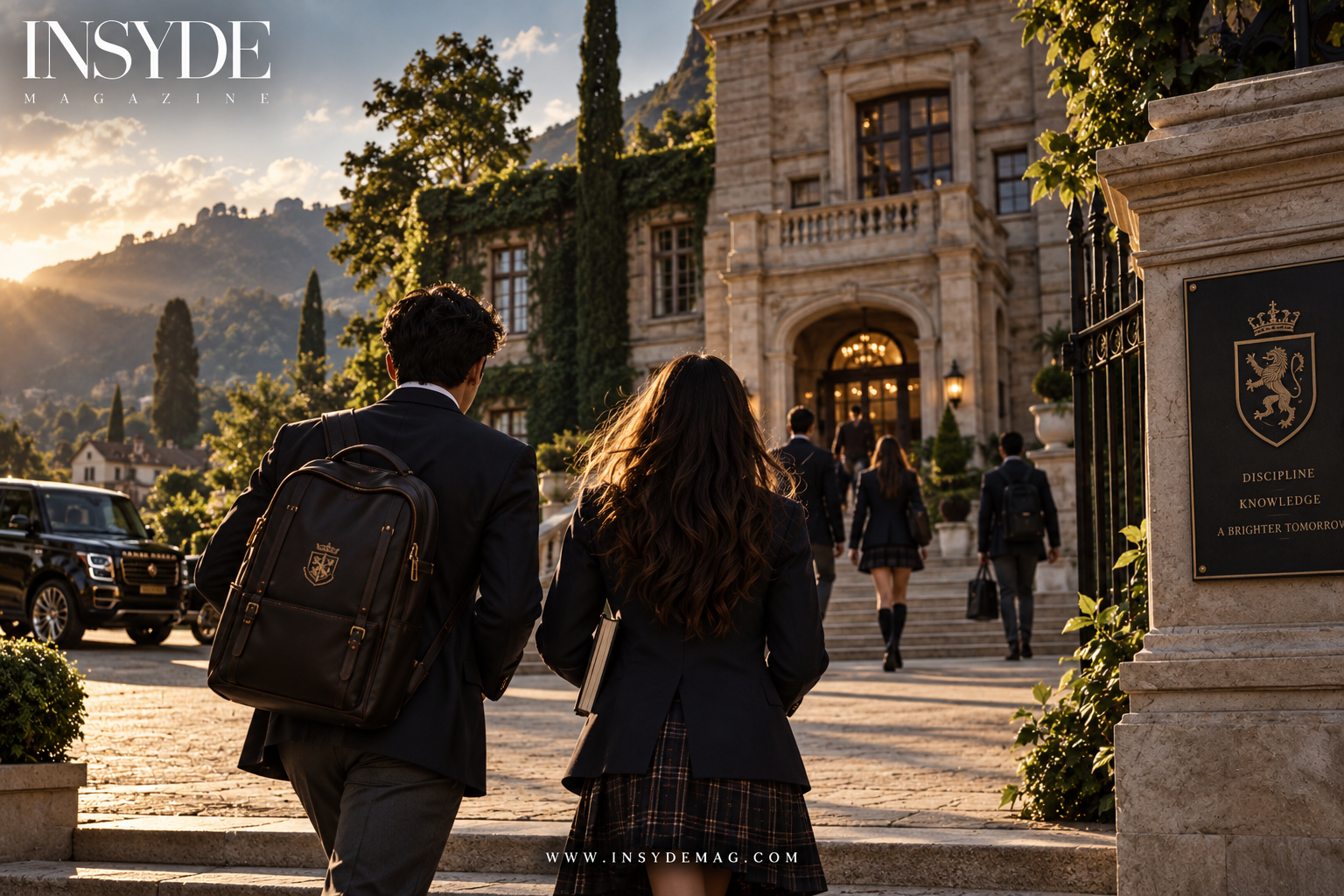
Where education, privilege and access come with a very serious price tag.
There is a version of luxury that never makes it onto a showroom floor.
It begins much earlier.
Before the watch. Before the supercar. Before the penthouse. Before the private jet.
For some of India’s wealthiest families, one of the most consequential luxury purchases is an education — and at the very top of the market, the numbers can be extraordinary.
For the 2026–27 academic year, the American Embassy School in New Delhi lists tuition of US$39,490 for Grades 9–12. At the school’s September 2026 exchange rate of ₹95.50 to the US dollar, that is approximately ₹37.7 lakh a year, before certain additional charges. Woodstock School’s highest published 2026–27 boarding fee is around ₹30.86 lakh, while UWC Mahindra College lists annual fees of approximately ₹28.75 lakh for Indian students.
But the most interesting part isn’t the number.
Because these schools aren’t simply selling classrooms.
They are selling an environment.
A particular kind of education. A particular peer group. A particular relationship with the world.
And sometimes, access to a community that can stretch far beyond the school gates.
That raises a more interesting question than how expensive is school?
What, exactly, are families paying for?
THE NEW LUXURY IS EDUCATION
Luxury has traditionally been easy to recognise.
A rare watch.
A couture gown.
A Ferrari.
A house overlooking the sea.
But some of the most valuable forms of luxury are becoming less visible.
Time. Privacy. Access. Experience. Community.
Education sits quietly inside that shift.
At the upper end of India’s school market, the premium isn’t necessarily about extravagant architecture or spectacular classrooms. It can come from international curricula, residential life, specialised facilities, global university preparation, extensive extracurricular programmes and carefully built communities.
In other words, the product isn’t only the education.
It’s the ecosystem around it.
That distinction matters.
Because comparing a ₹30-lakh residential school with a ₹37-lakh international day school as though they sell the same thing would be like comparing a private jet with a first-class airline ticket simply because both cross the same distance.
The price tells you something.
The structure tells you much more
01 — AMERICAN EMBASSY SCHOOL, NEW DELHI
THE INTERNATIONAL ENCLAVE
In the heart of New Delhi’s diplomatic district, the American Embassy School operates within an unusually international ecosystem.
The non-profit school serves students from Pre-K through Grade 12 and describes its community as representing more than 70 countries.
Then there is the price.
For 2026–27:
US$39,490
Grades 9–12
Using AES’s own September 2026 exchange rate of ₹95.50 per US dollar, that translates to approximately:
₹37.7 LAKH A YEAR
The school also lists an US$800 application fee and a US$16,500 one-time registration fee for students entering PK4 through Grade 12. Lunch, transportation and certain support services are additional.
That makes the headline tuition figure only part of the financial picture.
But there is another detail that makes AES particularly interesting.
Money isn’t the only gate.
The school’s admissions framework is built around its international community and eligibility requirements. That means simply being able to afford the tuition does not automatically make a family eligible for admission.
The distinction is important.
This is not merely an expensive Indian private school.
It is an international educational ecosystem operating inside India.
And that is a different kind of exclusivity.
02 — WOODSTOCK SCHOOL, MUSSOORIE
THE HIMALAYAN CLASSIC
If AES represents international education inside a diplomatic capital, Woodstock offers something altogether different.
Altitude.
History.
Boarding.
The Himalayas.
Woodstock’s 2026–27 boarding fees rise to approximately ₹30.86 lakh for Classes 11–12. The school’s own fee structure confirms that its annual school fee covers tuition, textbooks, boarding and lodging, basic laundry, internet and email facilities, class field trips and most social activities. Separate establishment and refundable security charges apply.
And that changes the meaning of the number.
A residential school isn’t simply a place where a student attends classes.
The campus becomes home.
Meals happen there.
Friendships happen there.
Sport happens there.
Performances happen there.
Weekends happen there.
The education continues long after the last bell.
That makes Woodstock’s proposition less about buying premium tuition and more about buying an entire way of living and learning.
And there is another important nuance.
Woodstock provides financial aid, meaning its published fee cannot be treated as the amount every student necessarily pays.
The price of the institution and the price paid by an individual family are not always the same thing.
03 — UWC MAHINDRA COLLEGE, PUNE
THE ₹28.75-LAKH GLOBAL EXPERIMENT
UWC Mahindra College is perhaps the most revealing example of why the phrase “rich kids’ school” doesn’t quite work.
The college offers a two-year IB Diploma programme for students aged 16–18. Its current published annual fee is approximately:
₹28.75 LAKH FOR INDIAN STUDENTS
That covers tuition, boarding and meals.
On paper, that places it firmly inside India’s ultra-premium education market.
But then comes the contradiction.
UWC Mahindra says a majority of its students attend on full or partial scholarship and explicitly states that financial need should not be a barrier to admission. Its scholarships are need-based rather than simply rewards for academic performance.
That makes the institution particularly interesting from a luxury perspective.
Because it demonstrates that:
A high price does not necessarily mean a high-income student body.
The published price describes the value of the programme.
It does not describe the financial circumstances of every person inside it.
And UWC’s model makes the community itself part of the proposition: students arrive not simply to study for the IB Diploma, but to live within an international network.
The luxury here is less about the invoice.
It’s about the world the student enters.
04 — GOOD SHEPHERD INTERNATIONAL SCHOOL, OOTY
WHEN SCHOOL BECOMES A WORLD
In the Nilgiris, Good Shepherd International School takes the residential model seriously.
The school describes itself as 100% residential, with its term fee covering academics, boarding, meals, co-curricular programmes and round-the-clock care.
For 2026–27, the school lists:
₹18.20 lakh for Grades 9–10 IGCSE/MYP
₹16.65 lakh for Grades 9–10 ICSE
and, at the upper end,
₹20.30 LAKH A YEAR
for Grades 11–12 IBDP and IBCP.
There are additional costs.
For certain new entrants, GSIS lists a ₹3 lakh establishment fee, a ₹3 lakh refundable caution deposit, a ₹30,000 registration fee and an advance payment toward miscellaneous expenses.
For IBCP students, the school also has career-related study partnerships, including programmes connected with Savannah College of Art and Design and Arizona State University.
Again, the important point isn’t simply that the school is expensive.
It’s what the fee is trying to encompass.
Academic education.
Residential life.
Sport.
Arts.
Technology.
University preparation.
And an environment designed to make the campus itself part of the student’s everyday world.
05 — KODAIKANAL INTERNATIONAL SCHOOL
THE OTHER HILL-STATION ICON
Kodaikanal International School has a different kind of luxury proposition.
It is not trying to imitate a metropolitan international school.
Its appeal is tied to place, history, residential education and an international outlook.
KIS currently publishes a dedicated 2026–27 fee schedule and reviews its fee structure annually. The school also offers financial aid to qualified students and says its maximum award can reach 95% of the annual fee, subject to its criteria and available resources.
That is worth emphasising because it complicates the popular image of an “elite school”.
A school can sit at the premium end of the market while still deliberately allocating financial support to students who could not otherwise afford it.
And that is one of the recurring themes across this world:
Exclusivity isn’t always the same thing as wealth.
Sometimes it is the curriculum.
Sometimes it is geography.
Sometimes it is the admissions process.
Sometimes it is scarcity.
And sometimes it is simply the ability to enter an environment that very few people experience.
THE SCHOOL EVERYONE EXPECTS TO SEE
DHIRUBHAI AMBANI INTERNATIONAL SCHOOL
No serious conversation about elite education in India can ignore Dhirubhai Ambani International School.
But it is important not to force it into a ranking it doesn’t support.
DAIS is not among the highest-fee schools in this comparison based simply on published annual tuition.
Its significance lies elsewhere.
Selectivity.
DAIS currently admits students into Class VIII for IGCSE and Class XI for the IB Diploma. For the 2027–28 admissions cycle, applicants must satisfy the school’s eligibility requirements and go through an aptitude-testing and selection process. The school requires academic records and a personal statement, while applicants may also submit academic, co-curricular and sporting achievements.
The lesson is bigger than DAIS.
The most exclusive schools aren’t necessarily the ones with the highest fees.
Exclusivity can be created by scarcity of seats.
By admissions standards.
By the kind of student community a school builds.
By reputation.
By history.
And, sometimes, by the sheer number of families who want access to the same institution.
THE PRICE OF GETTING IN
This is where the headline numbers start to become misleading.
A school’s annual fee is not necessarily its first-year cost.
At AES, the 2026–27 high-school tuition is US$39,490, while the school separately lists its one-time registration fee of US$16,500 for PK4–12.
At The Doon School, for example, the 2026–27 IB fee for Indian residents is ₹16.54 lakh a year, alongside a ₹5 lakh non-refundable admission fee and ₹7 lakh refundable security deposit.
Doon is therefore an important reminder that annual tuition and the financial commitment required to enter a school are two different numbers.
The school also admits boys into Class VII and VIII only, and says it looks for strong academic ability alongside character and talent in areas including sport, music, culture and leadership.
That is the recurring pattern across elite education.
The cheque gets you into the financial conversation.
It doesn’t necessarily get you through the door.
SO WHAT ARE FAMILIES REALLY BUYING?
The obvious answer is:
Education.
But that doesn’t tell the whole story.
At a school like UWC Mahindra, the proposition includes a two-year residential IB experience and an international student community.
At Woodstock, it includes boarding and an entire campus life in the Himalayas.
At AES, it includes an international school environment inside New Delhi’s diplomatic district.
At GSIS, residential life, academics and extensive co-curricular programming are bundled into the school experience.
And at selective institutions such as DAIS and Doon, admissions themselves create a degree of scarcity.
So perhaps the better question is not:
“Is this school better?”
There is no honest universal answer to that.
The more revealing question is:
“What kind of world does this school create?”
THE REAL LUXURY MAY BE THE PEOPLE
This is where education begins to resemble the wider luxury industry.
A private members’ club isn’t really selling a room.
A luxury hotel isn’t simply selling a bed.
A private jet isn’t merely selling transportation.
And an elite school isn’t simply selling lessons.
It is creating a community.
Students live together.
Eat together.
Compete together.
Create together.
Travel together.
And eventually leave with a network of people who have shared formative years.
That does not guarantee success.
It does not guarantee admission to a top university.
And it certainly does not mean an expensive education automatically produces a better human being.
But it does mean that the social environment is part of the product.
For affluent families, that can be one of the most consequential parts of the purchase.
THE NEW STATUS SYMBOL ISN’T ALWAYS SOMETHING YOU CAN WEAR
Luxury has spent decades teaching us to recognise status through objects.
A logo.
A watch.
A car.
A handbag.
But the next generation of luxury is increasingly about things that don’t photograph quite as easily.
Access.
Privacy.
Time.
Experience.
Belonging.
Elite education sits directly inside that evolution.
The most expensive thing about a school may not be its architecture.
It may be who gets to spend their formative years there.
BUT DOES EXPENSIVE MEAN EXCLUSIVE?
Not automatically.
This is where the conversation needs some nuance.
UWC Mahindra says a majority of its students receive full or partial scholarships.
Kodaikanal International School says financial aid can cover up to 95% of annual fees for qualifying students, subject to its criteria.
Woodstock also operates financial aid.
So calling these simply “schools for rich children” would be lazy journalism.
The better description is:
They operate at the premium end of India’s education market, but their models of access differ dramatically.
Some are highly international.
Some are residential.
Some are selective.
Some combine several of those characteristics.
And some actively use financial aid to broaden access.
That complexity is precisely what makes the luxury-school economy interesting.
INDIA’S EDUCATION LUXURY MARKET
India’s wealthy families have never had a shortage of expensive schools.
What is changing is the kind of world they expect those schools to provide.
The globalisation of Indian wealth has changed the reference point.
International curricula matter.
Global university pathways matter.
Residential experiences matter.
Wellness, sport, technology, arts and cultural exposure matter.
And increasingly, so does the quality of the community around the child.
The school is no longer simply where a student spends six hours a day.
For a residential institution, it can become the student’s entire world for months at a time.
That is a very different definition of education.
THE BILLION-RUPEE QUESTION
Perhaps the strangest thing about India’s most expensive schools is that the fee itself isn’t the most interesting number.
The more interesting numbers are:
How many students are admitted?
How many applicants compete for those places?
How many receive aid?
How international is the community?
How much of the fee is tuition versus boarding and other services?
And what happens to the student after they leave?
Because if luxury is ultimately about access, then the value of an elite school may not be contained inside the classroom at all.
It may live in the people.
The places.
The experiences.
The confidence.
The worldview.
The relationships.
The doors that open later.
THE MOST EXPENSIVE THING MAY BE THE WORLD AROUND THE CHILD
The luxury industry has spent decades selling objects that tell people where you have arrived.
Elite education sells something different.
It begins by asking where you want to go.
A school in the Himalayas.
A global campus in Pune.
An international community in New Delhi.
A residential world in Ooty.
A highly selective institution in Mumbai.
Different models.
Different philosophies.
Different price tags.
But one common idea:
education can be more than a qualification.
It can be an environment designed to shape how a young person sees the world.
And that may be the most sophisticated luxury of all.
INSYDE TAKE
The most expensive schools in India are not simply expensive because their fees are high.
They are fascinating because they reveal how the meaning of luxury is changing.
Luxury used to be about ownership.
Now it is increasingly about access.
The right campus.
The right community.
The right education.
The right experiences.
The right people.
But there is an important line between privilege and promise.
A ₹30-lakh education cannot guarantee a brilliant future.
A prestigious school cannot manufacture talent.
And money cannot purchase every form of opportunity.
What it can sometimes buy is something subtler:
an environment in which opportunity is unusually concentrated.
And perhaps that is why India’s elite schools have become such an interesting part of the country’s luxury story.
Because the ultimate luxury may no longer be the thing sitting in the driveway.
It may be the world a child grows up inside.
INSYDE
Luxury, Through a Different Lens.
Beyond the Spotlight.