
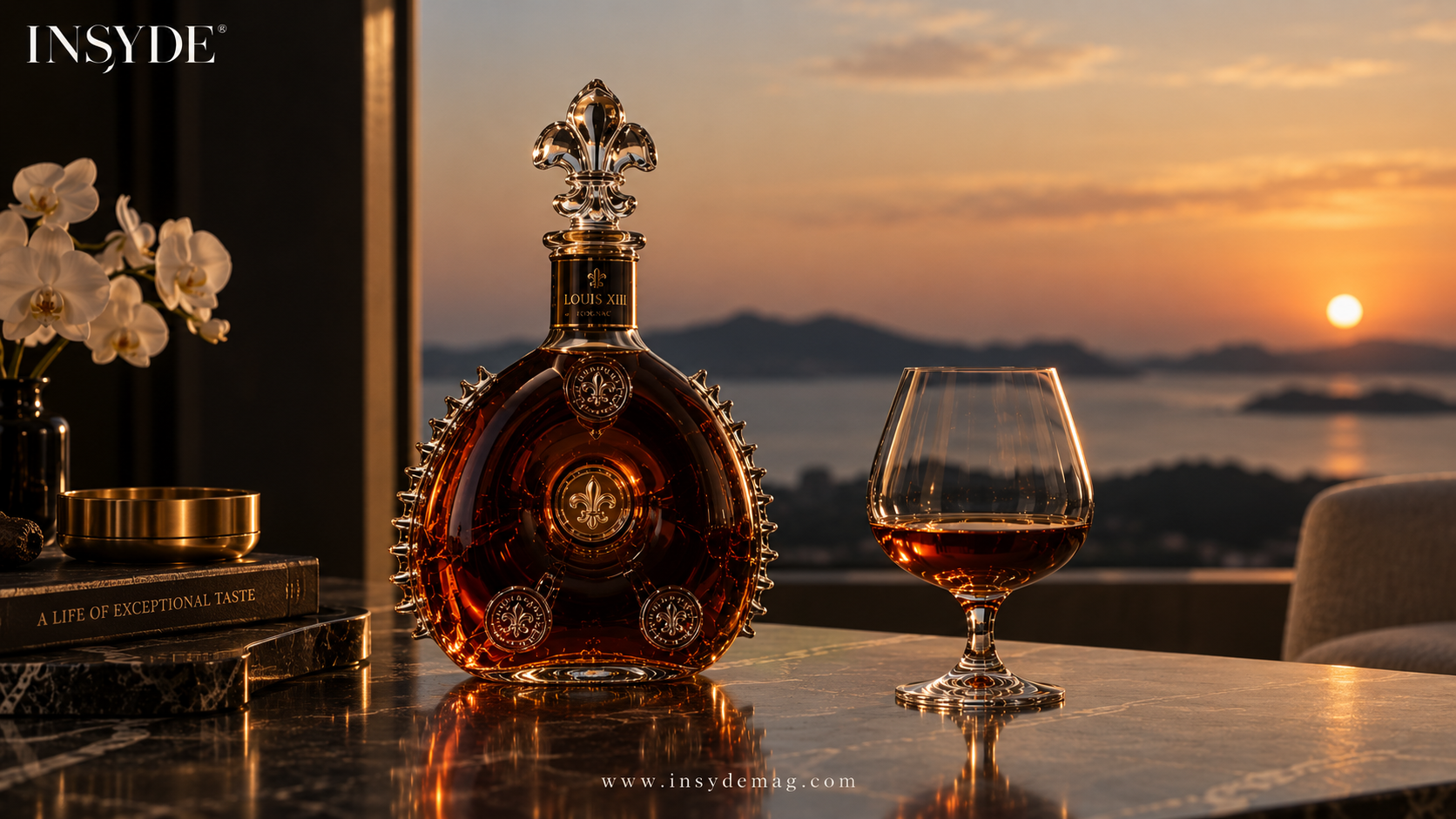
Inside the rare bottles, private collections and new drinking culture redefining luxury in 2026.
A drink can cost more than a luxury watch.
A bottle can be rarer than a piece of jewellery.
A whisky can be made for one person.
And a cognac can arrive with its own temperature-controlled cellar.
In September 2026, LOUIS XIII unveiled Black Pearl: Tribute to Le Grollet, a new expression limited to just 398 decanters worldwide. The reported price is £21,000 per decanter, with the experience built around a temperature-controlled ritual inspired by the historic Le Grollet cellar in Cognac.
At first glance, the obvious question is:
Why?
Why spend £21,000 on something that eventually disappears?
But that question misses what luxury alcohol has become.
Because at the highest end, the wealthy consumer isn’t simply buying what’s inside the bottle anymore.
They’re buying rarity.
Provenance.
Craftsmanship.
Access.
Knowledge.
And increasingly, the story surrounding the pour.
At the same time, a younger generation is entering the category with an entirely different set of expectations. Gen Z isn’t simply abandoning alcohol. The latest IWSR research shows participation among legal-drinking-age Gen Z consumers has stabilised at 74% across 15 key markets, while drinking occasions and quantities are becoming more selective. In India’s high-income urban population, participation among Gen Z adults over 21 reached 80% in 2026, up from 60% three years earlier.
The result is a strange contradiction.
The luxury consumer is going deeper.
The younger consumer is becoming more selective.
And somewhere between the private cellar and the late-night cocktail bar, the definition of luxury is changing.
Welcome to the new luxury pour.
THE EXPENSIVE BOTTLE ISN’T ENOUGH ANYMORE
For decades, luxury alcohol had a relatively simple formula.
Make it old.
Make it rare.
Put a famous name on it.
Put it inside an extraordinary bottle.
Charge more.
The higher the price, the stronger the signal.
But 2026 is making that formula increasingly complicated.
IWSR’s latest research argues that premiumisation is undergoing a reset. Since 2022, global beverage-alcohol price-per-litre growth has consistently lagged overall inflation, while consumers have become more selective about trading up. The question is increasingly whether an expensive product delivers something meaningful in return.
That distinction matters.
Because there is a difference between:
expensive
and
luxurious.
A bottle can be expensive because it carries a high price.
Luxury needs a reason.
Maybe the spirit comes from an unusually rare cask.
Maybe only a few hundred bottles exist.
Maybe the liquid took decades to mature.
Maybe the bottle itself is an extraordinary piece of craftsmanship.
Maybe the buyer gets access to something most consumers will never see.
Or perhaps the bottle tells a story that cannot simply be reproduced.
The price becomes a consequence of the story.
Not the story itself.
WHEN A BOTTLE BECOMES A COLLECTION
There is a moment when alcohol stops behaving like a consumable and starts behaving like an object.
Collectors understand this instinctively.
A rare bottle can become an object of design, a piece of history, a conversation piece, a gift, a family possession — or simply something kept because finding another one would be almost impossible.
The most interesting examples aren’t necessarily the bottles with the biggest numbers printed on their price tags.
They are the ones where scarcity has meaning.
LOUIS XIII’s Black Pearl is a particularly striking example.
Its 398-decanter production is only part of the proposition. The expression draws on an exceptional eau-de-vie selected from the house’s historic collection and connected to Le Grollet, while the tasting ritual is designed to evolve as the cognac warms from cellar temperature toward ambient temperature.
The bottle is therefore only one part of the object.
The cellar.
The temperature.
The ritual.
The provenance.
The liquid.
The story.
All become part of the experience.
And that is the point.
Luxury alcohol is increasingly being designed as an experience rather than simply packaged as a product.
THE RICHEST BOTTLE MAY BE THE ONE THAT IS YOURS
Perhaps the most fascinating development in luxury spirits isn’t the rare bottle.
It’s the personal bottle.
India is already experimenting with this idea.
Diageo India’s India Rare Spirits programme offers a personalised cask experience in which consumers can explore a library of aged malts, select a cask and create an expression tailored to individual tastes and occasions. The resulting bottles can carry personalised labels and commissioned artwork for milestones including weddings, corporate celebrations and anniversaries.
The distinction is subtle but important.
A limited edition says:
Only a few people can own this.
A bespoke expression says:
This was made for you.
Luxury has always understood the power of personalisation.
Fashion does it.
Cars do it.
Jewellery does it.
Watches do it.
Now spirits are moving deeper into the same territory.
The bottle becomes less like a product and more like a portrait of its owner.
INDIA IS TRADING UP
India is becoming one of the world’s most interesting growth stories in beverage alcohol.
IWSR says India’s total beverage-alcohol volumes grew at a 3% CAGR between 2019 and 2024, including a 6% increase in 2024, with another 4% increase projected for 2025. Over 2024–2034, IWSR forecasts approximately 3% annual volume growth. Imported spirits have been gaining particularly quickly, growing at a 16% CAGR between 2019 and 2024.
But the more interesting story isn’t simply that Indians are buying more alcohol.
It is what they expect from it.
The country’s premium alcohol landscape is expanding across single malts, Scotch, tequila, wine, craft spirits and increasingly personalised experiences. Indian producers and international houses are competing for consumers who have more choice, more information and greater exposure to global drinking culture.
This is the beginning of a broader cultural shift.
The Indian luxury consumer is no longer necessarily asking:
“Is this imported?”
Increasingly, the more interesting question is:
“Is this interesting?”
That is a significant change.
THE INDIAN LUXURY CONSUMER IS GETTING MORE SELECTIVE
India’s opportunity isn’t simply about having more wealthy consumers.
It is about having consumers with more choices.
More brands.
More categories.
More international exposure.
More travel.
More sophisticated bars.
More information.
More ways to discover something new.
And more reasons to question whether a premium price actually means premium value.
IWSR describes India as a major growth engine for beverage alcohol, but also emphasises the country’s complexity: state-level regulation, taxation, distribution structures and a consumer base that remains highly value-conscious.
That creates an unusual environment for luxury.
A global brand cannot simply arrive with a beautiful bottle and assume the story is finished.
It has to earn its place.
Through the liquid.
Through the experience.
Through the culture surrounding it.
THE BAR IS NO LONGER JUST A BAR
There was a time when a bar’s job was simple.
Serve the drink.
Today, some of the most interesting luxury drinking experiences are built around everything before the drink reaches the glass.
The room.
The bartender.
The music.
The food.
The glassware.
The story.
The people.
The location.
The ritual.
India’s on-premise market is becoming increasingly important to this equation.
NIQ’s 2026 India research found that nearly seven in ten Indian consumers visit restaurants, cafés or bars at least once a quarter, while its research highlights the role of the on-premise environment in creating occasions, justifying premium choices and building brand preference. Bartenders and venue staff can also exert an outsized influence over consumer choice.
The bar becomes a showroom.
But not a showroom for bottles.
A showroom for taste.
The bartender becomes a curator.
The menu becomes an editorial.
The experience becomes part of the product.
And suddenly, ordering a drink isn’t simply consumption.
It becomes participation.
THE NEW LUXURY CLUB
At the highest end, this becomes even more exclusive.
Luxury alcohol increasingly intersects with:
private clubs
members’ spaces
collector communities
private tastings
hotel experiences
chef collaborations
distillery visits
invitation-only events
This shift can already be seen in the way spirits companies are building destinations around their brands.
Diageo India’s The Good Craft Co. Flavour Market in Ponda, Goa, for example, is being developed as an ecosystem combining an experience centre, distillery tour, rare-spirits vault, craft bar, tasting room, chef and mixologist collaborations, workshops and a bespoke craft-spirit retail destination.
The luxury alcohol ecosystem is therefore moving from:
Bottle → Consumer
towards:
Brand → Experience → Community → Consumer
Luxury is becoming social again.
But selectively social.
THEN GEN Z WALKED IN
And just when the luxury industry thought it understood the next drinker, Gen Z complicated everything.
The old narrative suggested Gen Z was simply going to abandon alcohol.
The data is more nuanced.
IWSR’s July 2026 research found that 74% of legal-drinking-age Gen Z consumers across 15 key markets participated in beverage alcohol, up from 66% three years earlier. In India’s high-income urban population, participation among Gen Z adults over 21 reached 80% in 2026, compared with 60% three years earlier.
But participation doesn’t mean indiscriminate consumption.
IWSR’s research also shows that younger drinkers are becoming more selective. Across its 15-market study, the average number of beverage-alcohol categories consumed per occasion by Gen Z fell from 2.8 to 1.8 over two years. The change was particularly visible among Gen Z consumers in India and several other markets.
That’s where the story gets interesting.
Gen Z isn’t necessarily saying:
“I don’t want alcohol.”
It is increasingly asking:
“Why this drink?”
“Why this place?”
“Why this occasion?”
And perhaps most importantly:
“Is it worth it?”
GEN Z DOESN’T WANT YOUR FATHER’S WHISKY
Previous generations often understood premium alcohol through a familiar vocabulary:
Age statement.
Heritage.
Status.
Prestige.
Scarcity.
Gen Z is adding another word:
Discovery.
IWSR’s research shows younger legal-drinking-age consumers remain engaged with alcohol while becoming more selective about category choice and occasion.
That changes how luxury works.
A younger consumer may not automatically care that a brand has existed for centuries.
But they may care that:
a bartender recommended it,
a chef built a menu around it,
a designer collaborated on it,
the distillery has an unusual story,
the ingredients come from somewhere unexpected,
or only a small community knows about it.
The new luxury consumer doesn’t necessarily want to inherit taste.
They want to discover it.
THE COCKTAIL GENERATION
There is another clue hiding in the changing drinking culture.
Cocktails transform alcohol into something more than a bottle.
A cocktail can be:
a flavour experience,
a piece of design,
a performance,
a social object,
a signature of a particular venue,
or the centre of an entire evening.
The bottle becomes the raw material.
The experience becomes the luxury.
And this helps explain why sophisticated bars matter so much to younger consumers.
They aren’t simply places to drink.
They are places to discover culture.
DRINK LESS. CHOOSE BETTER.
There is another paradox here.
The future of luxury alcohol may not involve drinking more.
It may involve drinking less, but with greater intention.
IWSR’s 2026 research found that the average number of drinks consumed per occasion across its key markets fell to 3.9, from 4.4 in 2024 and 2025. The organisation describes moderation as increasingly structural rather than simply cyclical, with lifestyle and health becoming more important influences.
This does not mean premium alcohol disappears.
Quite the opposite.
IWSR’s latest premiumisation research suggests that consumers in developing markets such as India continue to trade up, but increasingly want genuine justification for the higher price. Across 16 major developing markets, IWSR forecasts premium-plus servings to expand by 13% between 2025 and 2035.
That creates an unusual luxury equation.
The consumer may have access to hundreds of bottles.
But chooses one.
One exceptional whisky.
One extraordinary cognac.
One beautifully made cocktail.
One bottle opened for an important evening.
Luxury becomes less about abundance.
And more about selection.
THE EXPERIENCE IS THE LUXURY
This may be the biggest transformation taking place.
The liquid still matters.
But what happens around it increasingly matters too.
The right restaurant.
The right table.
The right glass.
The right bartender.
The right person sitting across from you.
The right story.
The right moment.
IWSR’s research into the on-trade describes a shift toward more “edited” occasions, with consumers drinking fewer serves and fewer categories while seeking meaningful experiences and better justification for what they spend.
This is a profound shift.
Because luxury has always been about controlling the experience.
A luxury hotel doesn’t sell a bed.
A private jet doesn’t sell a seat.
A luxury watch doesn’t simply sell time.
And a £20,000 cognac isn’t simply selling liquid.
It is selling a moment that very few people can reproduce.
THE NEW STATUS SYMBOL IS TASTE
Perhaps this is where luxury alcohol becomes most interesting.
For a long time, status was largely about ownership.
The car.
The watch.
The bottle.
The address.
But as luxury becomes increasingly visible through social media, simply recognising a logo becomes less impressive.
Knowing why something matters becomes more valuable.
Knowing the producer.
Knowing the vintage.
Knowing the cask.
Knowing the difference between two expressions.
Knowing which bar has the rare bottle.
Knowing which release is genuinely scarce.
Knowing when a “limited edition” is actually meaningful.
Knowing when to order something — and when not to.
That is taste as cultural capital.
And cultural capital is difficult to counterfeit.
INDIA’S NEW DRINKING ELITE
This is where the Indian story becomes especially compelling.
India is developing not simply a larger alcohol market, but a more diverse luxury ecosystem around it.
International spirits houses are expanding premium portfolios.
Indian producers are moving into higher-value categories.
Bars are becoming more sophisticated.
Collectors are becoming more informed.
And younger affluent consumers are increasingly participating in the category.
IWSR’s 2026 data found beverage-alcohol participation among high-income urban Indians at 77%, while participation among Gen Z adults over 21 in the same demographic reached 80%, up from 60% three years earlier.
And Indian brands are increasingly using scarcity, craftsmanship and storytelling to position themselves at the luxury end.
Take Godawan 173.
Released in 2025 as a collector’s edition, the expression was limited to 173 bottles, each priced at ₹5 lakh. Its name referenced the reported recovery of the Great Indian Bustard population from 100 to 173, while the whisky used a three-stage maturation journey involving ex-bourbon, Oloroso and PX sherry, and Asha liqueur casks. Each bottle was inspired by Jaipur Blue Pottery.
The point isn’t that every affluent drinker will buy a ₹5 lakh bottle.
They won’t.
The point is that Indian spirits are increasingly learning how to construct luxury narratives of their own.
And that changes the conversation.
THE BATTLE FOR THE TOP SHELF
This is why India’s luxury alcohol landscape is becoming increasingly interesting.
International houses bring:
heritage
global recognition
distribution
iconic names
deep reserves
Indian producers bring:
local knowledge
climate
experimentation
craft
cultural identity
speed
And consumers are standing in the middle with more choices than ever.
The question is no longer simply whether Indian consumers will buy luxury alcohol.
They already are.
The bigger question is:
Who will define what luxury drinking in India looks like next?
Will European heritage continue to dominate?
Will Indian spirits become global luxury objects?
Will tequila and agave reshape the premium conversation?
Will private clubs become more important to affluent nightlife?
Will the cocktail become more important than the bottle?
Will moderation redefine indulgence?
Or will the next great luxury-drinks brand come from somewhere nobody is looking yet?
WHAT ACTUALLY MAKES A DRINK LUXURIOUS?
Perhaps the answer isn’t age.
It isn’t price.
It isn’t even rarity.
Not by itself.
Luxury emerges when several things collide:
Scarcity.
Craftsmanship.
Provenance.
Authenticity.
Personalisation.
Experience.
Access.
Knowledge.
And increasingly:
meaning.
That’s why a £21,000 cognac can exist alongside a personalised Indian cask, a ₹5 lakh collector’s whisky, a perfectly executed cocktail and even a sophisticated alcohol-free serve.
They occupy completely different price points.
But they can participate in the same cultural conversation.
Because luxury is no longer simply about what something costs.
It’s about why someone cares.
THE £20,000 POUR
The £20,000 bottle is therefore not really the story.
It’s the doorway.
Behind it is a much larger transformation.
The wealthy are becoming more selective.
Collectors are becoming more sophisticated.
Brands are moving from bottles to experiences.
Indian spirits are building narratives of their own.
Bars are becoming cultural spaces.
And Gen Z is entering the conversation with a completely different understanding of indulgence.
The future of luxury alcohol may not belong to the brand with the oldest distillery.
Or the highest price.
Or the biggest bottle.
It may belong to whoever can create something people genuinely want to remember.
Because when money stops being the obstacle, meaning becomes the luxury.
And perhaps the most luxurious drink isn’t the one that costs £20,000.
It’s the one you know exactly why you wanted.
INSYDE TAKE
Luxury alcohol is entering a strange new era.
The bottle still matters.
The heritage still matters.
The craftsmanship absolutely matters.
But the hierarchy is changing.
Price gets attention.
Scarcity creates desire.
Craft earns respect.
Experience creates memory.
And taste creates status.
For the wealthy, the next great luxury may not be another trophy bottle.
For Gen Z, it may not always be alcohol at all.
And for India, the most interesting possibility is that the next definition of luxury drinking won’t simply be imported.
It could be made here.
INSYDE
Luxury, Through a Different Lens.
Beyond the Spotlight.