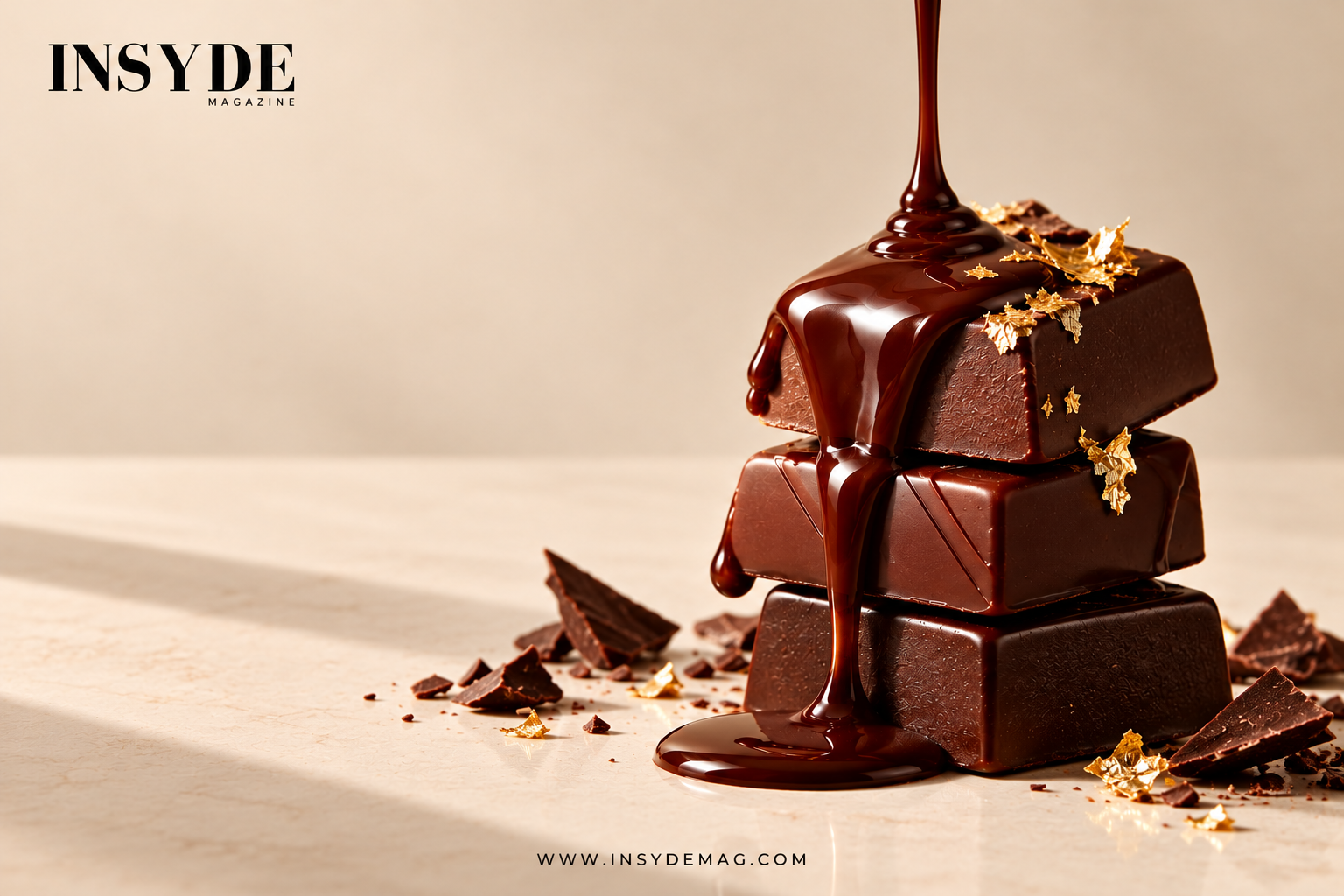
Inside the seductive world of luxury chocolate, where rare cacao, extraordinary craftsmanship and the pursuit of pleasure turn a familiar indulgence into something far more sophisticated.
INSYDE MAGAZINE | LUXURY
Chocolate has always understood the art of seduction. It melts slowly, lingers on the palate and transforms an ordinary moment into something worth savouring. But at the upper end of the market, chocolate is no longer simply a sweet indulgence. It is an expression of taste, craftsmanship, provenance and the increasingly sophisticated business of pleasure.
Behind an elegant box of bonbons or a carefully wrapped bar of dark chocolate lies a world of cacao varieties, agricultural heritage, technical precision and creative experimentation. Some makers draw on generations of European confectionery tradition. Others look towards distinctive growing regions, unusual flavour profiles or entirely different ways of experiencing chocolate.
Their products may differ in price, philosophy and presentation. What connects them is an ambition to make chocolate more than an everyday purchase: to turn it into an experience that invites attention, curiosity and desire.
Yet luxury is not simply a matter of charging more. A beautiful package cannot compensate for an unremarkable product, and an expensive ingredient does not automatically guarantee an exceptional result. The more interesting story lies in the relationship between the cacao, the maker and the experience that ultimately reaches the consumer.
This is where the art of temptation begins.
WHEN CHOCOLATE BECOMES LUXURY
For much of its commercial history, chocolate has been associated with comfort, celebration and accessible indulgence. Luxury chocolate operates through a more layered proposition.
Here, the conversation extends beyond sweetness to the origin of the cacao, the balance of flavours, the texture of a ganache, the precision of a chocolate shell and the decisions made long before a finished product reaches its packaging.
Presentation matters, but it is only one part of the equation. A beautifully designed box can create anticipation. It cannot, by itself, create exceptional chocolate.
The most compelling makers establish a recognisable point of view. Some pursue restraint and purity. Others explore intricate flavour combinations, celebrate particular cacao varieties or develop collections that encourage consumers to taste chocolate with the attention usually reserved for fine wine or specialty coffee.
This approach reflects a broader commercial opportunity. Grand View Research estimates that the global premium chocolate market was worth approximately US$32.9 billion in 2025 and projects it to reach US$34.1 billion in 2026, before growing to US$47.8 billion by 2033. These figures are market-research estimates rather than audited industry totals, but they indicate the scale of the premium segment and its projected growth.
The opportunity is not simply to sell a more expensive chocolate bar. It is to offer a more distinctive product, a stronger story and an experience consumers consider worth paying for.
In this market, luxury can mean rarity, technical expertise, heritage, sensory complexity or the pleasure of discovering something unfamiliar. The strongest brands understand that these qualities are most persuasive when they are supported by the product itself.
FIVE CHOCOLATE HOUSES, FIVE EXPRESSIONS OF LUXURY
There is no universally accepted ranking of the world’s most luxurious chocolate brands. The following five houses offer a more useful perspective: each illustrates a different way of building distinction in fine chocolate, from cacao provenance to French craftsmanship and Japanese product innovation.
01. TO’AK CHOCOLATE
Ecuador | The allure of rarity
What if the most interesting thing about chocolate were not the recipe, but the cacao itself?
Ecuadorian maker To’ak has built its identity around the heritage and distinctive character of cacao, particularly the Nacional variety. Its work draws attention to the relationship between the cacao tree, the growing environment, the people cultivating the crop and the final chocolate.
The brand’s story centres on Ecuador’s Piedra de Plata valley and the preservation of Nacional cacao. Rather than treating cacao as an interchangeable commodity, To’ak presents its origin and characteristics as essential parts of the finished product.
This philosophy extends into its approach to tasting. Its official catalogue includes a selection of 18 mini bars made from 100% cacao, weighing 54 grams in total and listed at US$60 on the brand’s website at the time of research. The seasonal selection allows consumers to explore differences in harvest and flavour without additional ingredients obscuring the cacao’s character.
That is a distinctive proposition in a category where chocolate is often judged by sweetness, percentage or packaging alone.
To’ak’s approach also raises a larger question about luxury: what happens when the ingredient becomes the main attraction? In this case, the answer lies in provenance, variation between harvests and the effort required to preserve particular cacao traditions.
Rarity, however, should not be confused with quality by default. The value of a rare variety ultimately depends on its flavour, production and the integrity of the story behind it.
INSYDE perspective: The most persuasive luxury is rarity with substance. When provenance connects to agricultural heritage and a genuinely distinctive tasting experience, the story becomes more than a marketing device.
Explore: To’ak Chocolate.
02. LA MAISON DU CHOCOLAT
France | The Parisian art of indulgence
Founded in Paris by Robert Linxe in 1977, La Maison du Chocolat helped establish a distinctive language for French luxury chocolate: refined, technically demanding and attentive to the character of each ingredient.
Its philosophy rests on a deceptively simple idea. Chocolate deserves to be treated as an art form, with the same attention to balance and execution found in other expressions of fine craftsmanship.
Consider the ganache. Its texture and flavour depend on the relationship between chocolate, cream and other ingredients, as well as the temperatures and techniques used during production. A subtle adjustment can change the result entirely. Achieving consistency while preserving the intended character of a recipe requires experience, precision and careful tasting.
La Maison du Chocolat places this craft at the centre of its identity. Its history and production philosophy emphasise the expertise of its chocolatiers, from developing fillings to coating and finishing individual pieces.
There is also a distinctly Parisian sensibility to its presentation. The visual language is elegant without requiring every creation to become an extravagant spectacle. The product remains central, while packaging and presentation frame the experience.
This is an important distinction in luxury. When every brand competes to appear more exclusive, restraint can become a form of confidence.
La Maison du Chocolat demonstrates that sophistication does not always require novelty. Sometimes it means taking a familiar pleasure and executing it with extraordinary care.
INSYDE perspective: True refinement is not about adding more. It is about understanding exactly what each detail contributes to the final experience.
Explore: La Maison du Chocolat.
03. AMEDEI
Italy | The beauty of the bean
Amedei approaches chocolate through the character of cacao and the qualities that make a particular variety distinctive.
One of its notable creations is Porcelana, a 70% dark chocolate made with Criollo cacao associated with Venezuela’s Zulia region, southwest of Lake Maracaibo. Amedei describes its Porcelana cacao as rare and highlights a flavour profile that includes notes of almond, toasted bread and bay leaf.
The details matter because fine chocolate is not defined by cocoa percentage alone. Two bars containing the same proportion of cacao can taste remarkably different, depending on the beans used, fermentation, roasting, conching and other production choices.
Amedei’s Porcelana offers an example of how a particular cacao variety can become central to a product’s identity. The origin, flavour profile and production philosophy give the chocolate a story that extends beyond its appearance.
The product also illustrates an important distinction between luxury positioning and luxury pricing. At the time of research, Amedei listed its 50-gram Porcelana bar at €10.30 on its official website. That is a premium price for a small bar, but the more meaningful point is the product’s emphasis on a specific cacao and its sensory characteristics.
Rarity deserves scrutiny, too. A rare ingredient is not automatically superior for every palate, and a prestigious origin cannot replace good processing. The ultimate test remains what the consumer experiences when the chocolate is tasted.
That distinction separates informed appreciation from luxury branding alone.
INSYDE perspective: Exceptional chocolate does not simply announce its quality. It gives the curious consumer something to discover.
Explore: Amedei Porcelana.
04. RICHART
France | Chocolate as a language of flavour
Not every luxury chocolate experience begins with a rare cacao variety or a centuries-old recipe. Sometimes, it begins with curiosity.
French chocolate house RICHART takes an approach inspired by the aromatic language of perfumery. Its collections are organised around seven aromatic families: balsamic, roasted, fruity, citrus, herbal, floral and spicy.
The concept changes the way chocolate is presented to the consumer. Rather than treating every piece as a variation on sweetness, the brand encourages exploration of aroma, flavour and the relationships between ingredients.
A fruity chocolate creates a different impression from a roasted or herbal one. Citrus can introduce brightness, while spices can add warmth and complexity. These combinations are not merely decorative descriptions; they give the consumer a framework for comparing and understanding different sensory experiences.
RICHART also pays attention to the form and presentation of its creations. Its Petits RICHART chocolates, introduced in 1988 according to the brand, are designed as small, carefully composed pieces in which appearance and aromatic character work together.
The appeal is closer to discovering a collection than simply buying a sweet treat. Each piece becomes part of a broader experience, inviting comparison and encouraging the consumer to slow down.
This approach reveals another dimension of luxury: not everything needs to be rare to be distinctive. A product can create value through the intelligence of its design and the way it encourages people to experience familiar ingredients differently.
INSYDE perspective: Sometimes the most seductive luxury is the one that makes you curious enough to take another bite.
Explore: RICHART.
05. ROYCE’
Japan | The art of texture
Luxury chocolate does not belong exclusively to Europe’s established confectionery traditions.
Founded in Sapporo, Hokkaido, in July 1983, ROYCE’ has developed a distinct identity through its attention to ingredient quality, originality, texture and presentation. Its Nama Chocolate, in particular, is associated with a soft, delicate texture that differs from the familiar snap of a conventional solid chocolate bar.
That contrast is central to the experience. Chocolate is often discussed through its cocoa percentage or origin, but texture can be just as influential. The way a piece yields, melts and releases flavour can shape the entire tasting experience.
ROYCE’ has built its philosophy around quality, originality and surprise, drawing on its Hokkaido roots while developing products for a wider international audience. Its approach demonstrates how a premium identity can emerge from a distinctive product experience rather than from European heritage or elaborate visual codes alone.
There is a practical dimension to this, too. Products with a softer texture and specific storage requirements demand attention to handling, freshness and distribution. Those considerations form part of the product’s character, not merely the logistics behind it.
ROYCE’ is also a relevant name for Indian readers. Its India website lists availability in cities including Bengaluru, Mumbai, New Delhi, Gurugram, Kolkata and Pune. Current stock and product ranges should still be checked with the retailer before planning a purchase.
Its story is a reminder that luxury does not need to look the same everywhere. A recognisable experience, executed consistently, can become a brand’s strongest signature.
INSYDE perspective: Luxury is not a single aesthetic. It is the ability to create something that feels unmistakably its own.
Explore: ROYCE’ India.
THE PRICE OF PLEASURE
The luxury chocolate conversation becomes more complicated when price enters the picture.
Rare cacao, specialist production, careful sourcing and labour-intensive finishing can all contribute to the cost of fine chocolate. But price is also influenced by brand positioning, packaging, distribution, taxes, retail location and the format in which a product is sold.
A tasting collection and a single-origin bar are not necessarily competing on the same terms. Nor can a limited-edition creation be compared fairly with a widely available product simply by looking at the price on the label.
The broader cacao market adds another layer to the conversation. Cocoa prices are influenced by supply and demand, weather, crop conditions, inventories and developments in producing countries. Those movements can affect manufacturers, but they do not translate directly into the retail price of every finished chocolate.
The relationship between raw cacao and luxury chocolate is especially complex because specialist makers may prioritise particular varieties, regions or sourcing relationships rather than purchasing ingredients solely on commodity-market terms.
For consumers, the more useful question is not simply whether a chocolate is expensive. It is what the price represents.
Is it the quality and provenance of the cacao? The skill required to produce the chocolate? A distinctive flavour experience? A thoughtfully designed gift? Or primarily the prestige attached to the name?
There is no single answer across the category. Amedei’s Porcelana and To’ak’s tasting selection, for instance, offer different experiences at different price points. Comparing them solely by cost would overlook what each product is designed to deliver.
The strongest luxury brands make that distinction clear. They give consumers a reason to understand the product beyond its price tag.
BEYOND THE BOX: WHAT MAKES LUXURY CHOCOLATE MATTER?
Luxury chocolate sits at the intersection of food, design, gifting and culture. Its appeal comes from more than sweetness: it can communicate affection, mark an occasion, signal discernment or provide a private moment of pleasure.
That is why presentation occupies such a prominent role. A carefully designed box can turn chocolate into a meaningful gift. A thoughtfully arranged collection can make opening the package part of the experience. But presentation is most convincing when it reflects the care invested in what is inside.
The same principle applies to heritage and provenance. An origin story can deepen appreciation when it is supported by credible information about the cacao, its production and the people involved. Without that substance, storytelling risks becoming decoration.
There is also a reason to ask harder questions about the supply chain. Cacao production is shaped by agricultural conditions, farmer livelihoods and environmental pressures. Claims about sustainability or ethical sourcing should therefore be judged on evidence rather than on elegant language alone.
For luxury brands, responsibility and quality need not be separate conversations. Traceable sourcing, long-term relationships with producers and credible efforts to protect distinctive cacao can contribute to the long-term value of a product. The important distinction is between commitments that can be substantiated and claims that simply sound appealing.
As the premium chocolate market evolves, its most interesting brands will be those that connect exceptional taste with meaningful provenance, skilled production and a credible account of how their products are made.
Luxury becomes more convincing when the story survives scrutiny.
THE INSYDE TAKE
The most luxurious chocolate is not necessarily the one with the highest price tag, the most elaborate packaging or the rarest-sounding name.
It is the one in which the details come together: the cacao has a reason to be celebrated, the maker understands the material, the flavour delivers on its promise and the experience feels considered from beginning to end.
To’ak makes the case for provenance and rarity. La Maison du Chocolat demonstrates the power of refinement. Amedei invites a closer look at cacao character. RICHART turns tasting into exploration. ROYCE’ shows how texture and product identity can create a different kind of indulgence.
Five distinct approaches, one shared idea: chocolate becomes more interesting when we look beyond the sweetness.
Perhaps that is the real art of temptation. Not simply making us want another piece, but giving us a reason to pay closer attention to the one already in front of us.
INSYDE MAGAZINE
Luxury, Through a Different Lens.
No.1 luxury Magazine in Bengaluru