
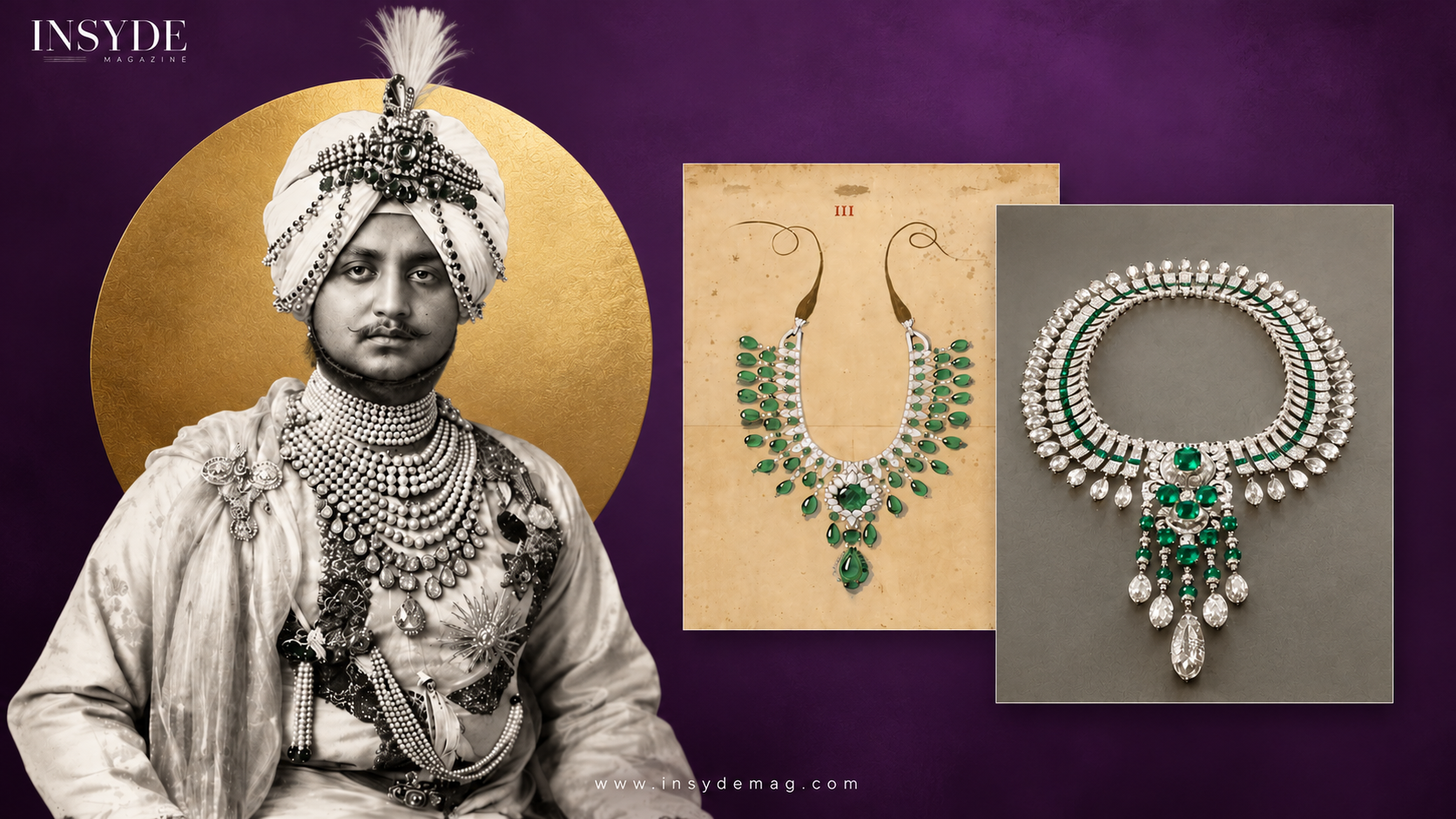
How Maharaja Bhupinder Singh of Patiala brought a treasure of gemstones to Paris—and inspired one of French high jewellery’s most extraordinary chapters.
By INSYDE
There are jewels that announce wealth.
And then there are jewels that become history.
On 2 August 1928, an Indian Maharaja arrived at one of Paris’s most prestigious jewellery houses carrying a treasure of diamonds, emeralds, rubies and pearls. He had not come to browse a boutique or select a finished necklace. He had brought his own gemstones, and he wanted them transformed into something extraordinary.
His name was Maharaja Bhupinder Singh of Patiala.
The jeweller was Boucheron.
What followed was an exceptional commission: 7,571 diamonds, 1,432 emeralds and 149 original jewellery designs, according to Boucheron’s historical account and contemporary coverage.
It was a meeting between Indian royal patronage and French high jewellery, between a ruler with an extraordinary collection of gemstones and a maison with the craftsmanship to give them new form.
Nearly a century later, those original designs would inspire a contemporary collection, bringing the story back into the spotlight.
The Maharaja’s jewels had become more than an expression of royal extravagance. They had entered the creative history of one of France’s most enduring jewellery houses.
And the most remarkable part?
The story was still being written long after the original commission.
BEFORE THE MAHARAJA, THERE WAS BOUCHERON
Founded in Paris in 1858 by Frédéric Boucheron, the maison established its reputation through fine craftsmanship, precious gemstones and an approach to jewellery that challenged convention.
In 1893, Frédéric Boucheron became the first of the great contemporary jewellers to open a boutique on Place Vendôme, the Parisian address that would become synonymous with high jewellery.
The location was a statement in itself. Place Vendôme represented a world where exceptional materials, technical mastery and individual commissions came together to serve an international clientele.
By the early twentieth century, Indian princely rulers were among the wealthy patrons commissioning jewellery from European maisons. Their collections contained gemstones inherited across generations, and their commissions could demand a level of customisation far beyond conventional retail.
But the relationship was not simply about Indian wealth purchasing European craftsmanship.
Indian royal jewellery had its own visual language and cultural significance. Precious stones, elaborate necklaces, ceremonial ornaments and turban jewels could communicate rank, authority and identity. Their forms were shaped by regional traditions, courtly customs and the preferences of individual rulers.
For European jewellers, commissions of this kind presented an opportunity to work with extraordinary materials while interpreting them through their own design traditions.
Boucheron’s encounter with Bhupinder Singh would become one of the most remarkable examples of that relationship.
ENTER THE MAHARAJA OF PATIALA
Bhupinder Singh was born in 1891 and became Maharaja of Patiala in 1900. The ruler of the princely state in present-day Punjab was known for his extravagant lifestyle, interest in sport and passion for luxury.
His world encompassed grand travel, automobiles, fine clothing and exceptional jewellery. He understood the public language of royal presentation: the way a carefully chosen object could communicate authority, taste and status.
Yet the significance of his relationship with Boucheron lies in something more specific than his reputation for extravagance.
He brought the maison a commission built around his own gemstones.
On 2 August 1928, the Maharaja arrived at Boucheron’s boutique at 26 Place Vendôme in Paris. Accounts of the visit describe an extensive royal entourage and guards carrying secure containers filled with precious stones.
The jewellery house was led by the legacy of its founder, Frédéric Boucheron. The commission was handled by his son, Louis Boucheron, who received the Maharaja’s treasure and undertook the task of translating it into jewellery designs.
The scene has all the ingredients of a cinematic encounter: a royal patron arriving in the heart of Paris with a private treasure, a historic jewellery house opening its doors, and gemstones whose potential would be realised through an extraordinary bespoke commission.
Inside were diamonds, emeralds, rubies, pearls and other precious stones.
The question was what Boucheron could make of them.
7,571 DIAMONDS. 1,432 EMERALDS. 149 DESIGNS.
The numbers remain extraordinary.
According to Boucheron’s historical account, the 1928 commission involved 7,571 diamonds and 1,432 emeralds, alongside other gemstones, which were selected for an exceptional collection of jewellery.
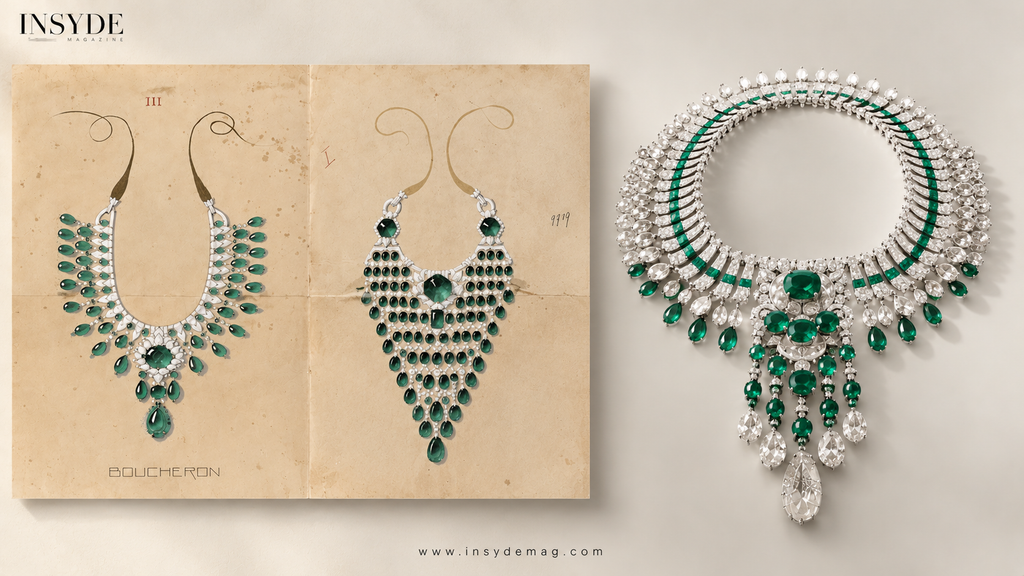
Louis Boucheron created 149 original designs for the commission.
The proposed creations included elaborate diamond-and-emerald collars, multi-strand pearl necklaces, gemstone-set belts and other pieces intended for the Maharaja and his family.
These were not ordinary retail purchases. The gemstones came from the Maharaja’s own collection, while Boucheron’s role was to interpret those materials through design and jewellery-making expertise.
That distinction matters.
In contemporary luxury, the value of a jewel is often communicated through its brand, rarity, materials or retail price. In this commission, the story began with a royal collection of gemstones and the decision to entrust them to a particular maison.
Boucheron had to do more than produce expensive objects. It had to create jewellery capable of carrying the Maharaja’s identity and the visual grandeur expected of a royal commission.
The designs brought together elements of Indian jewellery traditions and the design sensibilities of the period, including Art Deco influences. The resulting aesthetic was not simply a reproduction of European fashion or Indian court jewellery. It emerged from the meeting of the patron’s requirements, the gemstones themselves and Boucheron’s creative interpretation.
The scale of the commission was exceptional. Boucheron describes it as the largest order ever placed at Place Vendôme.
One royal commission had given the maison a remarkable chapter in its history.
WHEN WEALTH BECOMES A CREATIVE BRIEF
There is a difference between commissioning jewellery and giving a jeweller the freedom to create something extraordinary.
Bhupinder Singh’s commission began with an exceptional resource: his own collection of precious stones. Rather than selecting finished pieces from a display, he brought the materials and entrusted Boucheron with the task of transforming them.
The gemstones were not simply materials to be acquired. They were part of the creative brief.
Their colours, sizes and individual characteristics helped determine what could be made. The jeweller’s challenge was to bring them into a coherent collection while respecting their qualities and the intended forms of the jewellery.
The result was a collaboration between a royal patron and a jewellery house, each contributing something essential.
The Maharaja brought the treasure and the commission.
Boucheron brought the design expertise, craftsmanship and creative interpretation.
This is an enduring principle of high jewellery: exceptional creations often emerge when rare materials meet a clear vision and the technical ability to realise it.
In this case, the outcome was not simply one celebrated necklace, but a body of 149 original designs.
It was a reminder that the most interesting luxury commissions are not always defined by the amount spent. They are defined by what a patron and a creative house can make possible together.
THE ARCHIVE THAT KEPT THE STORY ALIVE
Time is not always kind to extraordinary objects.
Jewellery can be inherited, dismantled, reset, sold or dispersed across private collections. A piece that once defined a royal occasion may eventually become difficult to trace.
The Boucheron commission illustrates an important distinction: the history of a jewel is not necessarily the same as the history of its design.
Boucheron retained the original designs in its archives. These drawings recorded the creative response to the Maharaja’s commission and preserved a connection to the work undertaken in 1928.
The subsequent whereabouts of the entire original collection are not clearly established in the public record. It would therefore be inaccurate to claim that all 149 finished pieces remain together, or that the entire collection was definitively lost.
What survives is significant in its own right: the original designs and the documented history of the commission.
Those records eventually became a bridge between the royal patron of 1928 and a new generation of designers.
Nearly a century later, the archive would lead to another collection.
NEW MAHARAJAHS: A ROYAL VISION REIMAGINED
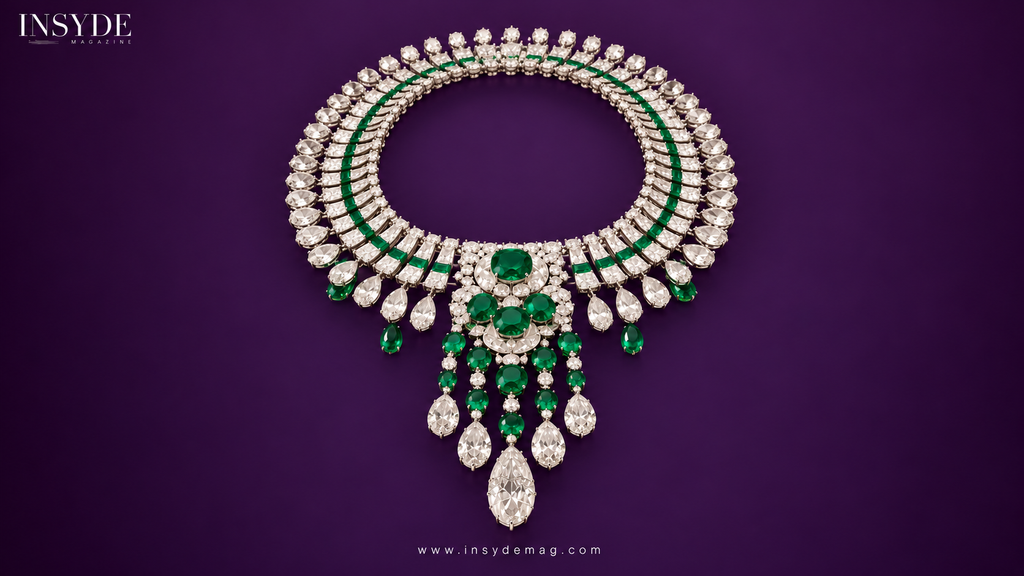
In January 2022, Boucheron unveiled Histoire de Style: New Maharajahs, a high-jewellery collection inspired by the historic Patiala commission.
Conceived by the maison’s creative director, Claire Choisne, the collection revisited the original designs and explored how their spirit could be translated into contemporary jewellery.
The objective was not to reproduce the past piece by piece.
Instead, Choisne used the archive as a starting point for a new creative interpretation. The collection retained references to Indian royal adornment while exploring contemporary proportions, materials and ways of wearing jewellery.
The resulting collection comprised 14 pieces across five sets.
Diamonds, emeralds, pearls, rock crystal, mother-of-pearl, platinum and white gold contributed to its visual language. The designs also drew on references associated with Indian adornment, including the lotus flower and the traditional sarpech, a jewelled ornament worn on a turban.
One of the collection’s defining creations was the New Maharajah necklace, featuring nine cushion-cut Colombian emeralds weighing nearly 40 carats in total. Its central motif could be detached and worn as a brooch, allowing the piece to be transformed rather than confined to a single form.
That transformability reflected a broader approach within the collection: jewellery was not treated solely as ceremonial display, but as something that could adapt to the wearer.
Choisne also made a striking aesthetic decision. Rather than recreating the original commission’s full visual intensity, the contemporary collection explored a palette of white and transparency, using materials such as rock crystal and diamonds to create a different sense of lightness.
The result was a conversation between historical inspiration and modern design.
The Maharaja’s commission supplied the creative foundation. Boucheron’s contemporary studio supplied a new interpretation.
The past was not simply reproduced. It was reimagined.
WHY BOUCHERON RETURNED TO THE MAHARAJA
Luxury houses frequently speak of heritage. But heritage becomes meaningful when it can do more than decorate a campaign.
It must give the present something to work with.
The Patiala commission offered Boucheron several layers of meaning: an extraordinary historical client, a remarkable collection of gemstones, a documented body of designs and a connection between Indian royal culture and French high jewellery.
The New Maharajahs collection brought these elements together again, demonstrating how an archive can inform contemporary creation.
A historic design is not automatically relevant to a modern audience. Its relevance emerges when a creative house finds something in it that can be reconsidered, adapted or challenged.
In Boucheron’s case, the original drawings offered more than a record of what had once been commissioned. They provided a foundation for new work.
That is the difference between heritage as nostalgia and heritage as a creative resource.
The 2022 collection did not need the original jewels to be presented as a complete surviving set. The designs themselves offered a way to reconnect with the commission and reinterpret its ideas for a new generation.
The Maharaja’s legacy continued through the creative possibilities his commission had left behind.
THE INDIAN CONNECTION TO FRENCH LUXURY
There is a tendency to tell the history of European luxury houses as a story of European creativity expanding outwards into the world.
The relationship between Boucheron and Bhupinder Singh offers another perspective.
The Maharaja was not simply a consumer of French luxury. He was a patron whose gemstones and commission helped shape a significant body of work within the maison’s history.
The original commission emerged from a specific encounter between Indian royal wealth, traditions of Indian adornment and the capabilities of a Parisian jewellery house.
Its later revival made that encounter relevant to a contemporary audience.
This does not mean that one commission alone transformed Boucheron into the maison it is today. Its history stretches back to 1858 and includes many clients, designers and creative chapters.
But the Patiala commission demonstrates that the history of a luxury house is often shaped by the people who commission its work as much as by the people who create it.
The relationship was not simply transactional. It became part of the maison’s cultural and creative heritage.
For Indian readers, that connection is especially compelling. It places an Indian royal at the centre of a major chapter in the history of a French jewellery house—not as a passing reference, but as the patron behind an exceptional commission whose designs later inspired a contemporary collection.
It is a reminder that the history of global luxury has never belonged to one country alone.
THE OTHER PATIALA JEWELLERY STORY
The Maharaja’s name is also associated with another celebrated creation: the Patiala Necklace by Cartier.
The two stories are connected by the same royal patron, but they are separate commissions.
Boucheron’s 1928 order involved 149 original jewellery designs using gemstones from Bhupinder Singh’s collection. Cartier’s Patiala Necklace was a different creation, renowned for its extraordinary diamonds and its central 234.65-carat yellow De Beers diamond.
The Cartier necklace later became the subject of a separate story involving the disappearance of much of the original piece and the eventual recovery and restoration of some components by Cartier using replacement stones.
That history should not be confused with the uncertain whereabouts of the complete Boucheron commission.
Both stories reveal the scale of Indian royal patronage during the period and the relationships between princely wealth and the leading jewellery houses of Europe.
But Boucheron’s story deserves to be understood on its own terms: a vast bespoke commission, 149 archival designs and a modern high-jewellery collection inspired by the original work.
WHAT THE MAHARAJA’S LEGACY REVEALS ABOUT LUXURY
Today, luxury is frequently discussed in terms of scarcity, status, price and brand recognition. These elements matter, but they do not fully explain why certain objects endure in cultural memory.
The Boucheron–Patiala story offers another perspective.
The original commission possessed scale and material extravagance. Yet its continuing significance comes from more than the number of gemstones involved.
It has a protagonist, a documented creative relationship, an archive and a contemporary reinterpretation.
It connects a specific historical moment to a modern collection, allowing the past to inform the present without requiring the original pieces to remain together.
That is the power of meaningful luxury heritage.
A jewel can be valuable because of its materials. It can be desirable because of its craftsmanship. But a documented story can give it another dimension: a place within a wider history of people, taste and creative exchange.
For Boucheron, the Maharaja’s commission remains a striking example of that principle.
The stones were extraordinary. The order was exceptional. But the legacy endured because the creative work was preserved—and because a later generation found something worth creating from it.
THE VERDICT
The Indian royal who rewrote Boucheron’s story did not build the maison, and he did not define its entire future.
What he did was leave behind an extraordinary chapter.
In 1928, Bhupinder Singh of Patiala brought his collection of precious stones to Paris and commissioned Boucheron to create 149 jewellery designs. The maison describes the order as the largest ever placed at Place Vendôme.
The original designs remained in the archives. In 2022, Claire Choisne returned to them with Histoire de Style: New Maharajahs, translating a historic royal commission into a contemporary high-jewellery collection.
The distance between those two moments is what makes the story remarkable.
A treasure arrived in Paris. A jewellery house gave it form. An archive preserved the creative record. And a new generation found inspiration in the designs.
Nearly a century later, the Maharaja’s story still has something to say about luxury—not simply as the possession of rare things, but as the meeting of material, imagination, patronage and memory.
Because the most enduring luxury stories are rarely about the price of an object alone.
They are about the people who make it possible, the ideas that shape it and the legacy it leaves behind.
One Indian Maharaja. One extraordinary commission. And a French jewellery house whose archives ensured the story would not end in 1928.
INSYDE — Culture, people and the stories shaping luxury.