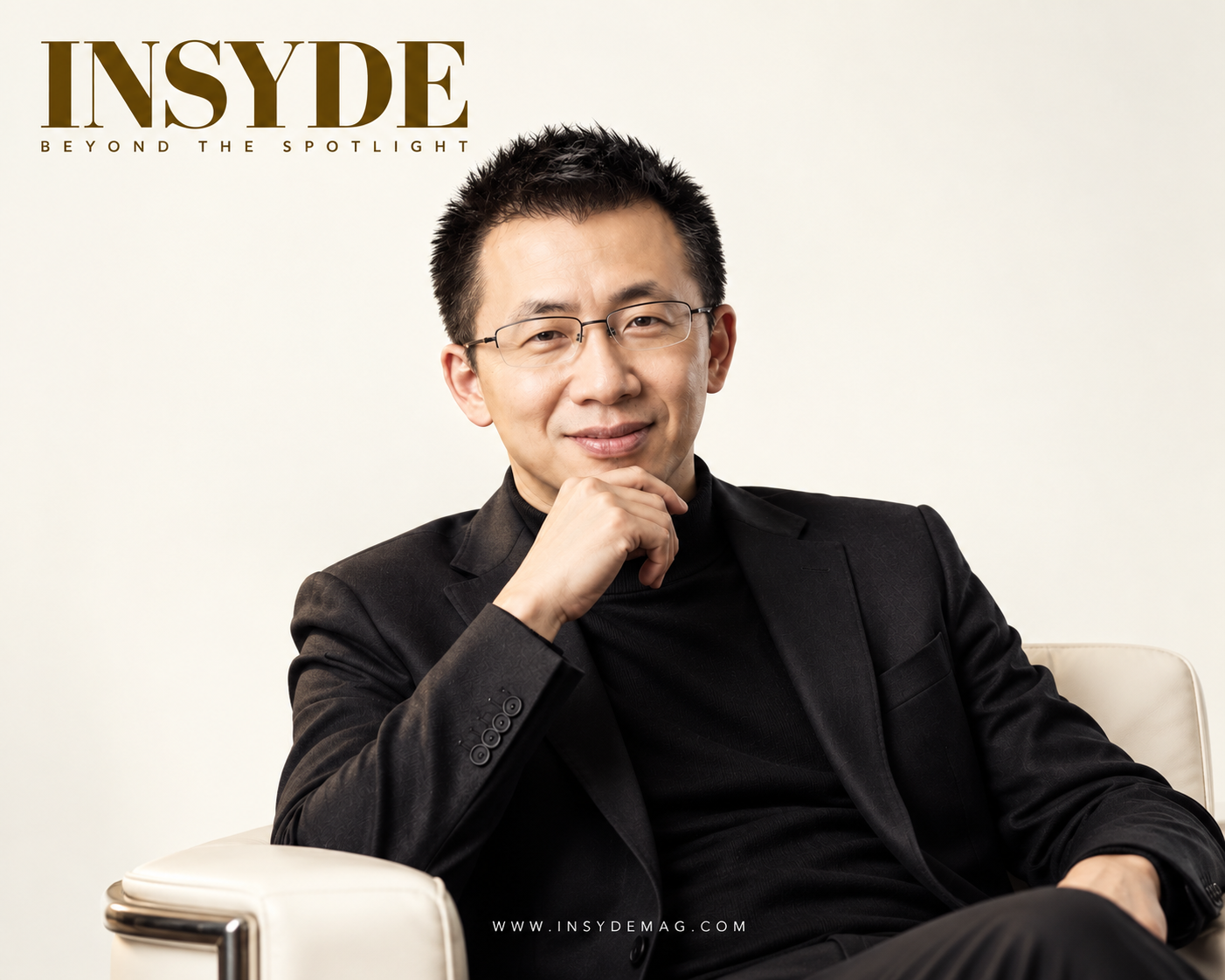
Zhang Yiming built TikTok. Now the quiet architect behind ByteDance sits at the top of Asia’s wealth hierarchy — as artificial intelligence begins writing the next chapter.
By INSYDE
There are billionaires who want you to know their name.
And then there is Zhang Yiming.
The 43-year-old co-founder of ByteDance has spent much of his career away from the spotlight, even as the company he helped create became one of the most influential forces in global digital culture.
Now, the world is looking at him.
According to the Bloomberg Billionaires Index, Zhang has overtaken Indian industrialist Gautam Adani to become Asia’s richest person, with an estimated fortune of approximately $105.5 billion. Adani was placed at around $104.8 billion in the same ranking. It is the first time Zhang has held the No. 1 position in Asia.
The numbers are extraordinary.
But the real story isn’t simply that Zhang has become richer than Adani.
It is what his fortune represents.
For generations, Asia’s great fortunes were built around ports, energy, steel, property, manufacturing and retail.
Zhang built his around attention.
And now, increasingly, artificial intelligence.
FROM A BEIJING APARTMENT TO THE TOP OF ASIA
In 2012, Zhang and his team started ByteDance from a four-bedroom apartment in Beijing.
The idea was deceptively simple: use algorithms to understand what people wanted to see and deliver it to them.
That thinking would eventually produce an empire of digital platforms, with TikTok becoming its most recognisable global phenomenon.
The genius wasn’t simply creating another social network.
It was changing the relationship between people and content.
You didn’t have to search.
You didn’t even have to know what you wanted.
The algorithm learned.
Every swipe became a signal. Every pause, replay and interaction became another piece of information.
The feed became personal.
And the personal became incredibly valuable.
Zhang’s fortune followed the rise of that system.
Bloomberg’s wealth tracking shows that his estimated fortune was around $13 billion in March 2019. It has since increased more than eightfold, with more than $12 billion added to the latest estimate this month after updated valuations of ByteDance holdings by investment firms including BlackRock, Fidelity Investments and T. Rowe Price.
$13 BILLION.
Then:
$105.5 BILLION.
The number alone tells you how violently the economics of technology can move.
THE BILLIONAIRE BEHIND THE SCREEN
What’s striking about Zhang isn’t only his wealth.
It’s his relative absence from the spectacle surrounding it.
He isn’t known for the constant public appearances, celebrity friendships or larger-than-life persona associated with some of the world’s most famous billionaires.
His greatest creation does the talking for him.
In 2021, Zhang stepped down as ByteDance’s CEO and later relinquished his chairman role, moving away from the company’s day-to-day leadership. At the time, he described himself as someone more interested in analysing markets, organisational principles and long-term possibilities than in being a conventional corporate operator.
There is an almost perfect irony to it.
The man behind one of the world’s most addictive attention machines has rarely seemed interested in becoming the centre of attention himself.
Zhang built the stage.
He didn’t need to stand on it.
TIKTOK CHANGED THE GAME
It is impossible to tell Zhang’s story without talking about TikTok.
The platform transformed short-form video from an internet format into a defining language of modern culture.
Music. Fashion. Beauty. Food. Comedy. Politics. Sport. Shopping.
Everything could become content.
And everything could travel.
TikTok didn’t simply distribute culture.
It accelerated it.
A song could become a global hit overnight. A fashion aesthetic could move from a niche community to millions of screens in hours. A creator sitting in a bedroom could suddenly reach an audience larger than a traditional television network.
Behind that cultural machine was an algorithmic infrastructure capable of processing enormous amounts of behavioural data.
That infrastructure helped make ByteDance one of the world’s most valuable private technology companies.
And it helped make Zhang one of the world’s wealthiest people.
But TikTok may ultimately turn out to have been only the beginning.
THE AI ERA
The next chapter of the ByteDance story is increasingly being written in artificial intelligence.
The company has expanded its AI ambitions through products including Doubao, its AI assistant, and Seedance, its AI video-generation technology. Its Seed research team also launched the Seed 2.0 model family in February 2026, positioning the technology for increasingly complex tasks including software development and scientific research.
Forbes reports that Doubao reached 345 million monthly active users in the first quarter of 2026, making it China’s most-used AI-powered app during that period according to QuestMobile data cited by Forbes.
Think about the evolution.
First, ByteDance built technology that understood what people wanted to watch.
Now it is building technology that can increasingly create what people want to watch.
That distinction could be enormous.
The company that mastered the recommendation engine is now competing in the race to build the creative engine.
FROM SOCIAL MEDIA TO SCIENCE
And ByteDance’s ambitions are moving beyond screens.
On September 16, Reuters reported that Anew Labs, ByteDance’s AI-driven drug-discovery business, raised $290 million in its first external funding round, giving the company a valuation of approximately $1.5 billion.
ByteDance retained a 56% stake following the funding. Anew Labs uses AI for areas including biomolecular structure prediction, antibody design and drug discovery.
It is a fascinating evolution.
The company associated globally with teenagers, creators, music and viral videos is now building businesses around some of the world’s most technically demanding fields.
Entertainment was the entry point.
AI is the expansion.
THE NEW ASIAN FORTUNE
Zhang’s rise also tells us something about the changing shape of wealth in Asia.
For decades, some of the continent’s most powerful fortunes were closely connected to physical assets.
Factories.
Ports.
Oil.
Steel.
Real estate.
Retail.
Infrastructure.
Those industries aren’t disappearing. In fact, many remain enormously powerful.
But technology has introduced another route to extraordinary wealth — one where the underlying asset can be an algorithm, a platform, a model, a network or millions of daily interactions.
Zhang’s rise above Adani therefore represents more than a change in a billionaire ranking.
It is a snapshot of a larger transition.
From physical infrastructure to digital infrastructure.
From owning things to owning platforms.
From selling products to controlling attention.
And now:
From algorithms that predict behaviour to AI that can generate new content, ideas and solutions.
THE NUMBER HAS A FOOTNOTE
There is, however, something important to remember when reading any billionaire ranking.
$105.5 billion isn’t money sitting in Zhang Yiming’s bank account.
It is an estimated net worth.
And because ByteDance is privately held, determining the value of Zhang’s stake is considerably more complicated than simply looking at a publicly traded company’s share price.
Bloomberg’s Billionaires Index currently estimates Zhang’s fortune at around $105.5 billion, using its methodology and a valuation of his ByteDance holdings. Forbes’ real-time tracker, however, currently places Zhang substantially lower, at approximately $84 billion.
The difference is largely a matter of methodology and how the value of a private company is assessed.
So the exact number should be treated as an estimate, not a bank balance.
But the larger trend is difficult to miss.
Zhang’s estimated fortune has risen dramatically.
ByteDance continues to command enormous investor interest.
And artificial intelligence is becoming an increasingly important part of the company’s future.
WHAT COMES NEXT?
The fascinating question isn’t whether Zhang will remain number one.
Billionaire rankings move.
Markets move.
Private valuations move.
Fortunes rise and fall.
The more interesting question is what happens to the empire behind the number.
Can ByteDance turn its enormous consumer reach into a lasting AI advantage?
Can its models compete in an increasingly crowded global AI market?
Can the company transform its expertise in recommendation algorithms and digital content into a new generation of AI products?
And perhaps most importantly:
Can the company that taught the internet what to watch teach AI what to create?
Nobody knows yet.
But the scale of the bet is becoming impossible to ignore.
THE QUIET BILLIONAIRE
Zhang Yiming’s rise is, in some ways, the perfect story for the internet age.
A man starts with an idea inside a Beijing apartment.
The idea becomes an algorithm.
The algorithm becomes an app.
The app becomes a global cultural phenomenon.
The company becomes a technology empire.
And the founder quietly becomes Asia’s richest man.
There is no grand industrial dynasty at the centre of this story.
No inherited fortune.
No centuries-old family name.
Just technology, scale, data, timing — and an extraordinary understanding of how people behave online.
TikTok made Zhang Yiming famous without making him a celebrity.
Now artificial intelligence may determine how far his empire can go.
For the moment, the title belongs to him.
Asia’s richest man.
Zhang Yiming.
And perhaps the most interesting part of his story is that the biggest chapter may still be unwritten.