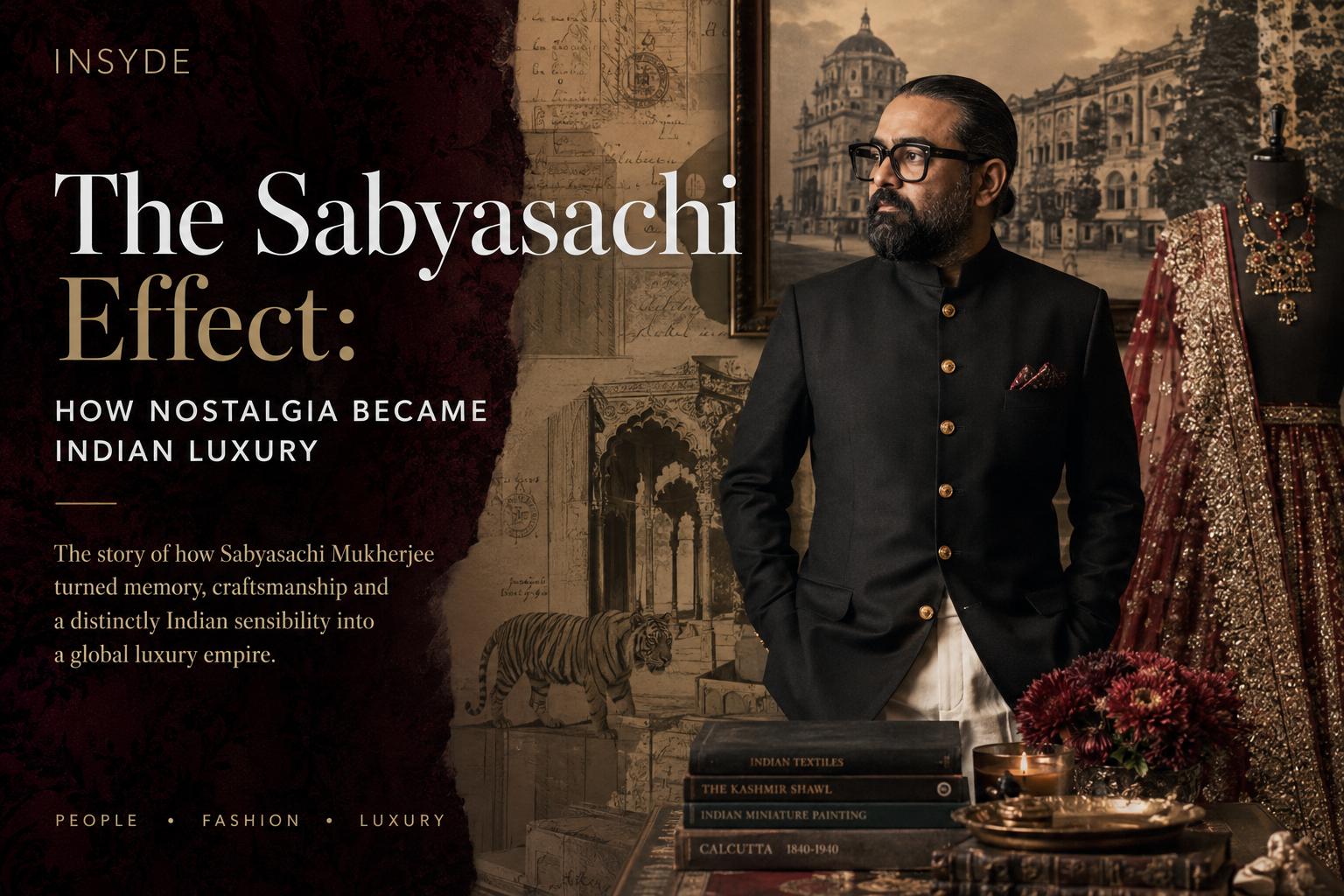
The story of Sabyasachi is not simply about a designer who made Indian fashion famous. It is about how memory, craft and a very particular idea of India became the foundation of a modern luxury business.
Walk into a Sabyasachi store and the first thing you notice may not be the clothes.
There are the clothes, of course. The jewellery. The handbags. The shoes. But around them is something else: old-world architecture, art, furniture, objects, colour, photographs and an atmosphere that feels deliberately removed from the speed of contemporary retail.
It doesn’t quite feel like a shop.
It feels like a memory.
That may be the most useful way to understand Sabyasachi Mukherjee.
Because the designer’s greatest achievement may not be that he made Indian fashion recognisable around the world. It may be that he made a particular version of India’s past feel desirable in the present.
That distinction is important.
Luxury has always sold more than products. It sells provenance, scarcity, craftsmanship, identity and belonging. Sabyasachi understood that early—and built a house around them.
The business of remembering
The Sabyasachi aesthetic is immediately recognisable.
Deep colours. Old photographs. Heavy embroidery. Vintage references. Jewellery that looks inherited rather than newly bought. Bengal. Tigers. Colonial-era architecture. Textiles that carry the evidence of the hand.
Even when the clothes are contemporary, they often seem to have arrived from somewhere else.
That is not accidental.
The brand’s own language repeatedly returns to heritage, indigenous craftsmanship and the idea of making the past relevant to the present. Its current collections continue to draw on Calcutta, Bengal, textiles, jewellery and archival references.
Sabyasachi has effectively made nostalgia into a design system.
And then he did something much harder:
he made that nostalgia expensive.
Before the empire, there were three tailors
The numbers make the early story almost sound implausible.
Sabyasachi graduated from NIFT in 1999 and launched his eponymous label soon afterwards. FDCI records that he won three major awards at graduation and, in early 2001, received the Femina British Council award that took him to London for an internship with Georgina von Etzdorf.
The designer’s own history gives the more personal version: he borrowed ₹20,000 from his family and began with a team of three.
The important part isn’t the ₹20,000.
It is what he decided to do with the opportunity.
At a time when Indian fashion was increasingly looking outward for validation, Sabyasachi’s instincts were unusually inward.
His early work was interested in India not as a costume, but as a source of references.
He wasn’t asking:
How can Indian fashion look international?
He was asking something closer to:
What if India itself became the reference?
The strange power of the hand
FDCI describes Sabyasachi’s design philosophy through the phrase “personalized imperfection of the human hand.” It is a useful phrase because it gets to the heart of his business.
In an industry obsessed with speed, scale and perfect replication, the hand offers the opposite.
It takes time.
It varies.
It leaves evidence.
And Sabyasachi built luxury around that evidence.
The house says it currently employs, directly or indirectly, more than 3,900 artisans, including master weavers, dyers and printers, and works with textile clusters across numerous Indian states.
That makes craftsmanship more than a decorative detail in the Sabyasachi story.
It is infrastructure.
A sari is not valuable simply because it is a sari. Its value can come from the material, the technique, the person who made it, the time it required and the story attached to it.
This is where Sabyasachi’s version of luxury becomes particularly Indian.
The house didn’t need to invent heritage.
It needed to reframe its value.
Then came the bride
If the Sabyasachi aesthetic gave Indian fashion a visual language, the bride gave it a mass cultural stage.
His bridal work became one of the defining parts of the house, and over time the “Sabyasachi bride” became a recognisable idea in itself: rich textiles, dramatic jewellery, detailed embroidery, saturated colour and a sense of ceremony that felt simultaneously contemporary and inherited.
Sabyasachi himself later described the house as having created a significant shift in the way people dressed in India, particularly around bridalwear.
That shift is worth looking at carefully.
The designer didn’t make Indian weddings less traditional.
In many ways, he made them more consciously traditional.
The bride wasn’t trying to escape heritage.
She was paying a premium to own it.
And that is a very different proposition from selling fashion.
Bollywood understood the picture
Sabyasachi’s relationship with cinema helped the aesthetic travel beyond the runway.
His work for Black earned him the National Award for Best Costume Design, and his later association with Bollywood and celebrity culture helped establish his clothes as part of a larger visual language.
This matters because celebrity dressing can do something a runway cannot.
It gives people a character to imagine themselves becoming.
The Sabyasachi bride wasn’t simply a consumer wearing a designer lehenga.
She could see herself in the same visual universe as actors, weddings, films and photographs that circulated far beyond fashion publications.
The clothes became aspirational because the world around the clothes became aspirational.
That distinction is one of the reasons the brand has travelled so well.
The store became part of the product
Sabyasachi eventually understood that the brand could not live only inside garments.
The Mumbai flagship was conceived as a “living museum,” bringing together fashion, jewellery, objects, art and interiors. The New York flagship followed in 2022, giving the house a permanent presence in one of the world’s most important luxury markets.
This is where Sabyasachi starts looking less like a designer and more like the founder of a luxury universe.
The product is the sari.
But the experience is the house.
The furniture, the architecture, the tiger, the packaging, the jewellery, the books, the visual merchandising—all of it reinforces the same idea.
You don’t just buy Sabyasachi.
You enter Sabyasachi.
That is a much more powerful business model.
From clothes to a house
The expansion has followed the logic of the universe.
Jewellery.
Accessories.
Fine jewellery.
Menswear.
Beauty.
Collaborations.
The brand has partnered with names including Christian Louboutin, H&M, Pottery Barn, Starbucks and Estée Lauder.
The Estée Lauder collaboration is particularly revealing.
In 2024, the two houses created a global collection of 10 lipsticks. The collaboration translated Sabyasachi’s visual vocabulary—textiles, gemstones, colour and the tiger motif—into beauty packaging and product.
That is what a mature luxury house does.
It doesn’t simply put its logo on another product.
It asks:
What does our world look like when it enters another category?
Sabyasachi had an answer.
It still looked like Sabyasachi.
The corporate reality behind the romance
There is, however, a less romantic part of the story.
Luxury houses need capital.
In 2021, Aditya Birla Fashion and Retail completed its acquisition of a 51% stake in Sabyasachi Calcutta LLP. ABFRL’s announcement put the transaction into the context of building its position in the fashion and luxury market.
This matters because the Sabyasachi story isn’t simply one of artistic success.
It is also a story about what happens when a distinctive creative identity becomes valuable enough to support institutional investment.
The challenge then changes.
It is no longer:
Can I build a brand?
It becomes:
Can this brand grow without losing the thing that made it desirable?
So far, the strategy has been unusually disciplined.
The house continues to build around a small number of recognisable codes rather than abandoning them every season.
Twenty-five years of looking backwards
The 25th-anniversary show in Mumbai in January 2025 made the philosophy almost impossible to miss.
The runway was designed as an imagined Calcutta, complete with weathered houses, vintage carpets, verandas, clotheslines and a fountain inspired by the Victoria Memorial. The show featured more than 150 looks, with Deepika Padukone and Christy Turlington among those walking.
It could have been a retrospective.
Instead, it became something more interesting.
A reminder that the past was still the brand’s most useful creative material.
The clothes themselves mixed Japanese cotton, pashmina, zardozi, gotta-patti, velvet, sequins, tailoring and references ranging from Frida Kahlo to Madonna. Vogue described the show as a homecoming to an identity that had been present since the beginning.
In other words, Sabyasachi wasn’t presenting heritage as a fixed museum exhibit.
He was treating it as a working archive.
That may be the secret.
The world is watching now
The international story has become increasingly visible.
Alia Bhatt’s 2024 Met Gala appearance in Sabyasachi marked another major global fashion moment for the house, while Shah Rukh Khan wore Sabyasachi at the 2025 Met Gala in a look built around the theme of Black dandyism, Indian tailoring and jewellery.
And now comes another significant step.
The Council of Fashion Designers of America lists Sabyasachi by Sabyasachi Mukherjee on the official September 2026 New York Fashion Week schedule, with the season running from September 10 to 15.
For a designer who began in Kolkata with three tailors, that return carries a certain irony.
New York is no longer the destination.
It is one of the places where the house now tells its story.
So what did Sabyasachi actually build?
Not just a fashion label.
Not just a bridal business.
Not even simply an Indian luxury brand.
He built a point of view.
And then he spent more than two decades convincing people that the point of view had value.
That is harder than designing a beautiful collection.
The genius of the Sabyasachi model is that the individual pieces rarely have to explain the entire brand. The house has already done that work.
A tiger means something.
A sari means something.
A vintage photograph means something.
A Bengal textile means something.
A piece of jewellery that looks as though it belonged to someone’s grandmother means something.
Together, they create a world.
And in luxury, worlds are what people pay to enter.
The Sabyasachi Effect
There is a temptation to describe Sabyasachi’s success as the story of Indian heritage going global.
That is true, but incomplete.
The more interesting story is what happened before the global part.
Heritage became aspiration.
A craft technique became a luxury technique.
The sari became a status object.
The wedding became a fashion platform.
The store became a cultural space.
The designer became a house.
And nostalgia became something that could be packaged, scaled and sold without entirely losing its emotional power.
That is the Sabyasachi effect.
He didn’t convince the world that India had a past.
Everyone already knew that.
He helped convince a new generation that India’s past could be the future of luxury.
And as Sabyasachi returns to New York in 2026, that idea is about to be tested on one of fashion’s biggest stages.
The question now isn’t whether the world will notice Sabyasachi.
It already has.
The more interesting question is:
How much of India’s luxury future will look like the world he built?
— INSYDE