Category: Craftsmanship

The makers, techniques and traditions behind exceptional Indian and global craftsmanship.

  • Jaya Misra: The Making of a  Modern Indian Fashion Language

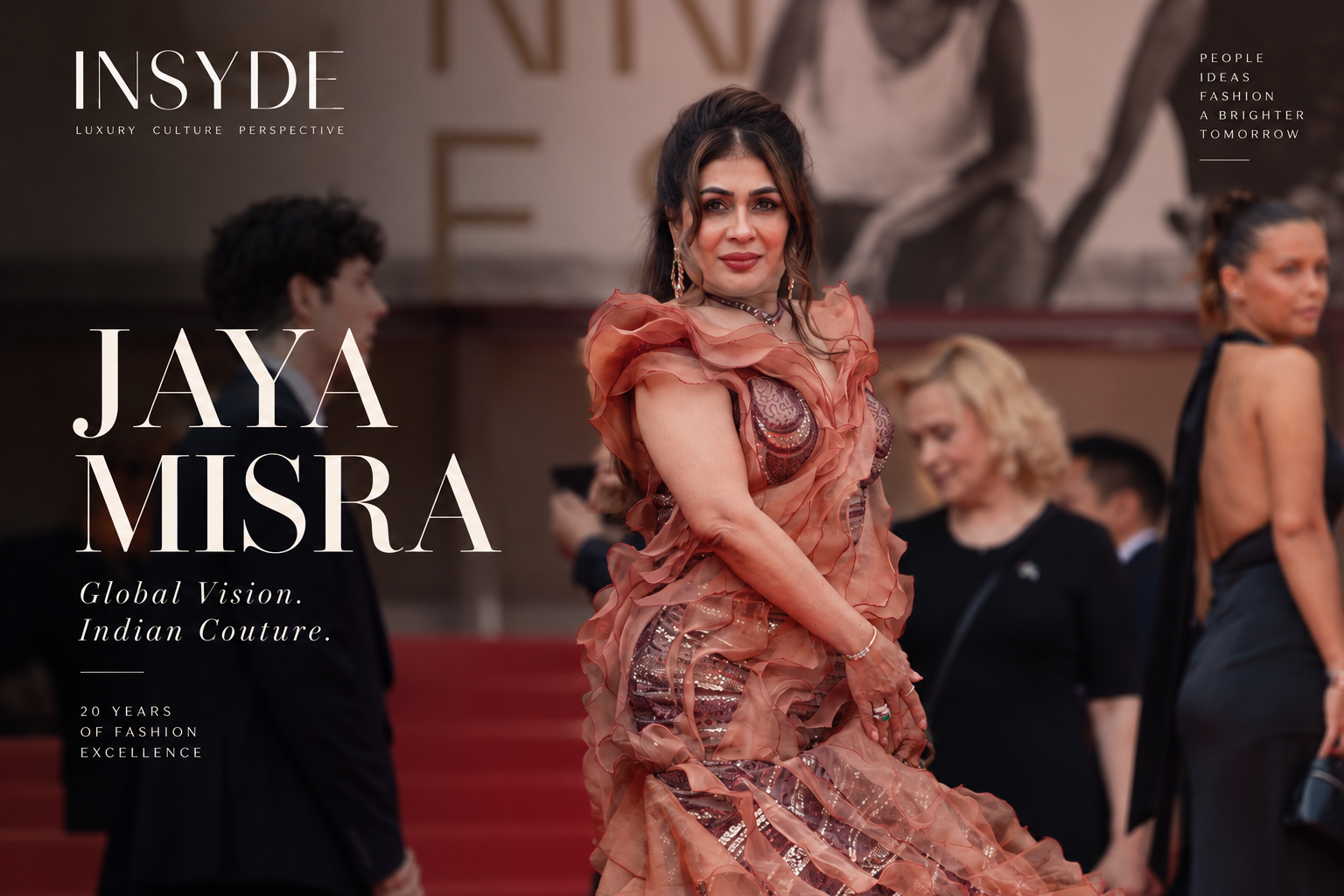
    Jaya Misra: The Making of a Modern Indian Fashion Language

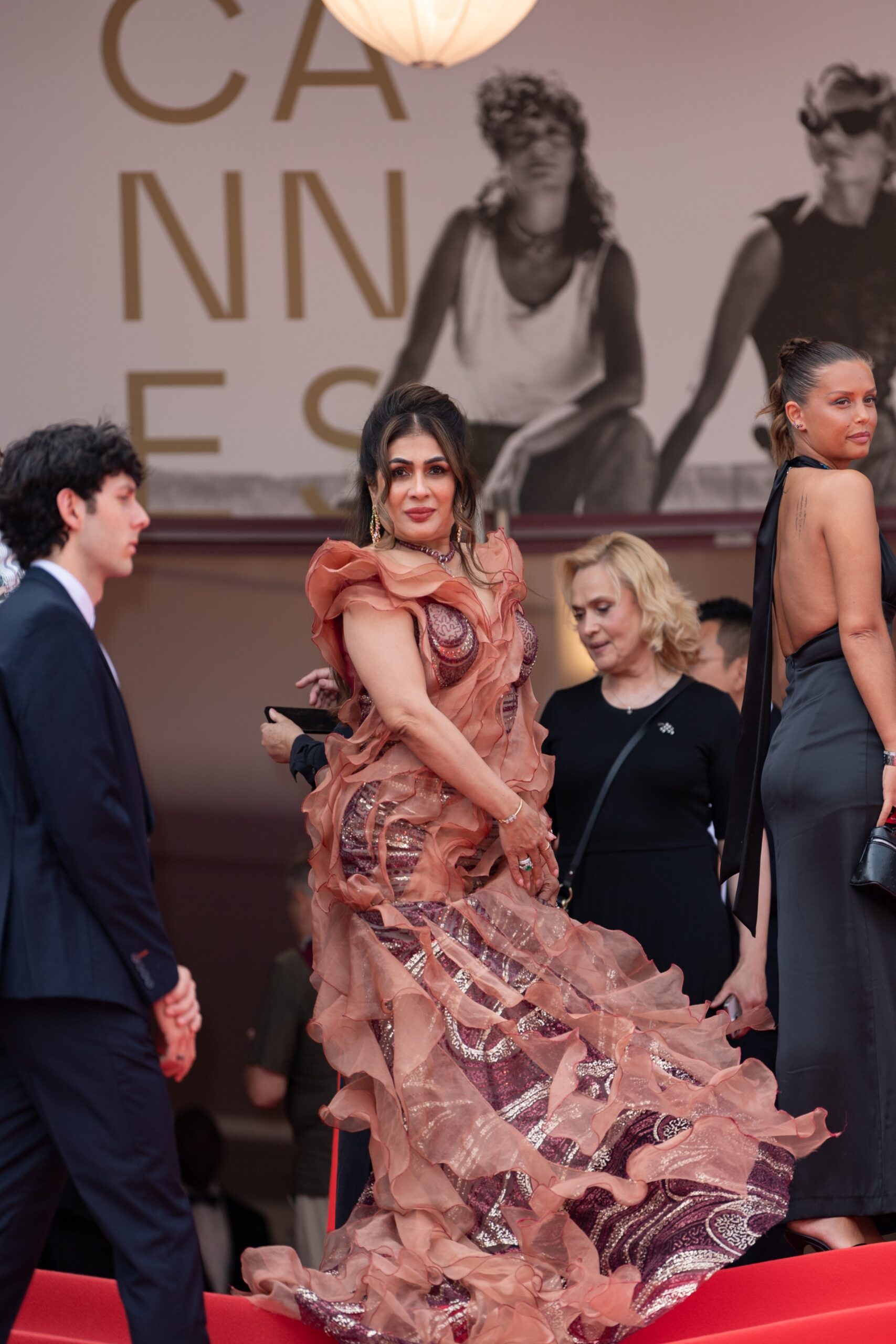
    Jaya Misra at the Cannes Film Festival,

    As Jaya Misra marks 20 years in fashion, the designer reflects on Indian identity, global ambition, craftsmanship, personal style and why the future of fashion may depend on knowing when to say less.

    Indian fashion is having a global moment.

    But the conversation around it is changing.

    For decades, international perceptions of Indian fashion were often reduced to a familiar vocabulary: elaborate embroidery, vivid colour, weddings, traditional silhouettes and the extraordinary work of its artisans.

    Those elements remain important. But they were never the whole story.

    India possesses one of the world’s richest design languages — shaped by textiles, regional craftsmanship, architecture, jewellery, history and generations of accumulated knowledge. Increasingly, Indian designers are taking those foundations into contemporary territory, creating work that can speak to an international audience without surrendering its identity.

    For Jaya Misra, that distinction is fundamental.

    “I have always believed that we do not need to become Western to be international. We can take something deeply Indian and give it a modern expression.”

    It is an idea that has accompanied her through two decades in fashion.

    In 2026, Jaya Misra India marks 20 years since its establishment. A graduate of NIFT, Jaya founded the house in 2006 and has since presented her work across national and international fashion platforms, with showcases spanning cities including Milan, New York, London, Dubai, Tokyo, Toronto and Vancouver. Her career has also included serving as an official designer for Femina Miss India and working across multiple international couture and fashion showcases.

    But after twenty years, the more interesting question is not simply where Indian fashion has travelled.

    It is what Indian fashion is becoming.

    Indian, Without Explanation

    For a long time, Indian fashion was introduced to the world through its most recognisable elements.

    Colour. Embroidery. Weddings. Ornamentation.

    Jaya believes that perception is becoming more nuanced.

    “Indian fashion is so much more than that,” she says, pointing to the country’s textiles, craftsmanship and techniques passed down through generations.

    The shift, she believes, is happening as designers begin presenting those traditions through a contemporary language that feels relevant around the world.

    There is still a tendency, she acknowledges, to measure luxury against Western standards. But that is gradually changing as Indian fashion becomes more confident in defining its own value.

    That distinction matters.

    Global relevance does not have to mean cultural translation.

    Indian fashion does not need to become Western in order to become international.

    Its challenge may instead be to become more confident about what is already uniquely its own — and to find new ways of expressing it.

    The goal is not simply to make Indian fashion visible.

    It is to make it understood on its own terms.
    When Heritage Is Allowed to Move

    Fashion has always had a complicated relationship with tradition.

    Preserve it too rigidly and it can become something admired rather than lived. Change it too completely and the knowledge behind it can disappear.

    For Jaya, evolution is part of preservation.

    “For me, preservation does not mean freezing something in time.”

    A traditional craft, she believes, needs room to move.

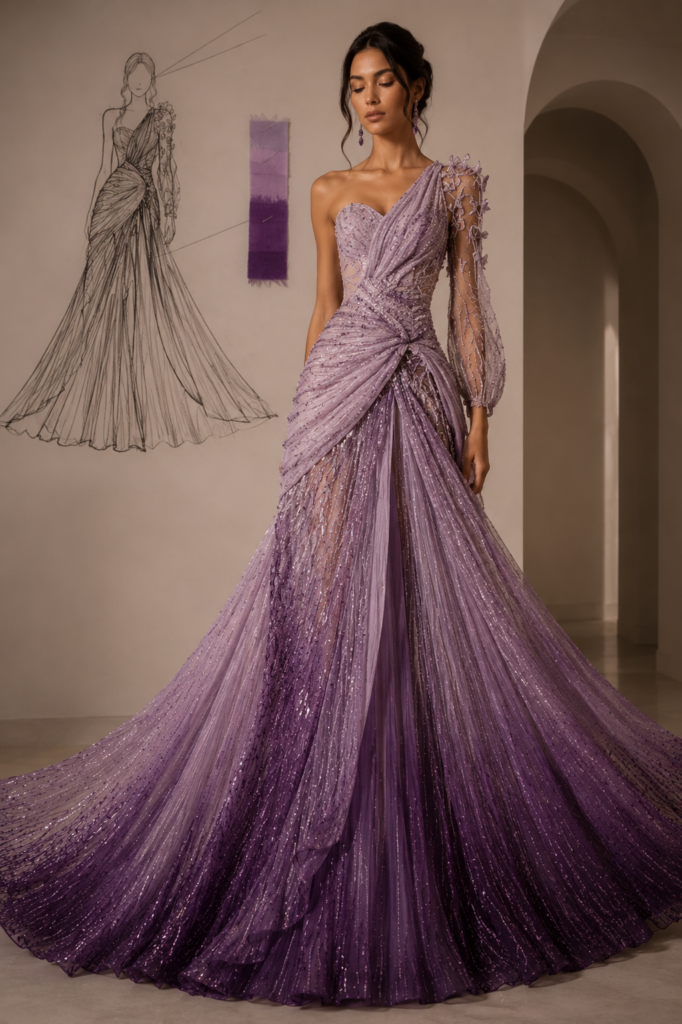
    A historic weave can become a contemporary jacket, corset or gown. An established technique can enter an unexpected silhouette without losing the heritage from which it came.

    The form can change.

    The essence should remain.

    But there is one boundary she considers essential: respect for the maker.

    “Evolution should never erase the artisan or the story behind the craft.”

    That places craftsmanship somewhere beyond decoration. The artisan is not simply part of a production process; the knowledge, patience and human skill behind the technique are part of the value of the final piece.

    For Indian fashion, keeping craft alive may therefore depend not on protecting it from change, but on giving it enough relevance to continue being worn, interpreted and desired.

    Tradition survives not only when it is preserved.

    Sometimes, it survives because it is allowed to evolve.

    The Luxury of Time

    Luxury has accumulated plenty of definitions.

    Price. Exclusivity. Rarity. Status.

    Jaya’s understanding is quieter.

    “For me, luxury is not defined by a price tag.”

    Instead, she associates it with time, craftsmanship, individuality and intention.

    That perspective feels particularly relevant in an industry increasingly shaped by immediacy.

    Fashion moves quickly. Trends appear and disappear almost overnight. Digital platforms encourage constant consumption, constant visibility and constant newness.

    Against that speed, something made slowly begins to feel almost radical.

    “Something handmade, created especially for you or marked by the subtle imperfections of the human hand has a unique soul.”

    But there is another form of luxury that cannot be measured through material value.

    Memory.

    “If a garment makes you feel powerful, beautiful or connected to a memory, its value goes far beyond its price,” she says.

    A couture garment can therefore become more than an object of consumption. It can become part of an experience, a milestone or a personal history.

    Perhaps that is why craftsmanship continues to matter.

    It gives an object something mass production struggles to replicate:

    a sense of having been made for a person rather than simply made for a market.

    The Problem With Seeing Everything

    Social media has changed fashion more radically than almost any runway could.

    A designer can now be discovered by someone thousands of kilometres away without passing through the traditional gatekeepers of the industry. Emerging talent can build an audience independently, while consumers have access to more fashion than ever before.

    Jaya sees that democratisation as a positive development.

    But accessibility has created its own contradiction.

    When everyone is looking at the same images, references can begin to converge.

    “The same silhouette, styling and trend can appear everywhere almost overnight.”

    The result is an industry with more access but, sometimes, less distinction.

    In that environment, personal style becomes less about knowing what is trending and more about knowing what feels authentic.

    “Personal style begins when you stop asking, ‘What is everyone wearing?’ and start asking, ‘What feels authentic to me?’”

    It is a question that extends beyond clothing.

    When algorithms can constantly tell us what to see, buy and desire, individuality requires a degree of resistance.

    Fashion can inspire you.

    It should not have to define you.

    Indian by Instinct

    Should an Indian designer have a responsibility to represent Indian culture?

    Jaya does not believe creativity should come with a compulsory assignment.

    An Indian designer should be free to create something minimal, futuristic, Western, traditional or experimental.

    “Creativity needs freedom.”

    Yet freedom from obligation does not mean freedom from influence.

    India’s textiles, embroideries, colours, architecture, jewellery, history and crafts inevitably form part of the visual memory of someone who grows up within that environment.

    “So even when I create something highly international, my Indian sensibility often comes through,” she says.

    “I do not have to force it; it is already an intrinsic part of who I am.”

    There is something significant in that idea.

    Identity does not always need to be announced to be present.

    For a designer working between Indian heritage and contemporary global silhouettes, being Indian does not necessarily mean reproducing recognisable symbols of India.

    Sometimes it is simply part of the way one sees.

    The Case for Editing

    Indian fashion has never struggled to make an entrance.

    Drama, colour, surface, craftsmanship and occasion are among its natural strengths. On a red carpet or international platform, that visual confidence can be extraordinarily powerful.

    But Jaya believes the next stage of India’s global fashion story may require a different skill.

    Editing.

    “Sometimes, we assume that showcasing craftsmanship means showing everything at once.”

    Her counterargument is particularly relevant to contemporary luxury: restraint can communicate just as much as abundance.

    “A single extraordinary detail can sometimes say more than twenty.”

    It is a deceptively simple observation in an industry where more is often mistaken for more luxurious.

    India already possesses extraordinary craftsmanship. The challenge now is not proving that it exists.

    The challenge is how it is presented.

    Jaya argues that Indian fashion needs stronger global business structures, presentation, communication and consistency.

    “Talent is not our challenge; we have an abundance of it.”

    That may be one of the most important questions facing Indian fashion today.

    The next chapter may be less about proving what India can create and more about deciding how that creativity is edited, positioned and communicated to the world.

    Jaya Misra at the House of Lords, London

    Dream First. Then Find the Woman.

    Every designer eventually confronts the tension between creativity and commercial reality.

    Focus too heavily on commerce and creative identity can disappear. Create only for yourself and the relationship with the person wearing the garment can become distant.

    Jaya sees the two as a dialogue.

    “I like to create a dream first. Then I ask myself: how can a real woman enter that dream?”

    The runway can remain dramatic and imaginative while its essence is translated into something that can exist beyond the show — a jacket, saree, dress or another silhouette.

    The idea begins as fantasy.

    The wearer gives it a life.

    That balance is particularly important in couture, where the distance between spectacle and reality can be enormous.

    The most successful design does not necessarily force the customer into the designer’s imagination.

    It gives the customer a way into it.

    A Generation in a Hurry

    Looking toward the future, Jaya is optimistic about the fearlessness of younger designers.

    Today’s generation has access to global references almost instantly. They experiment with gender, technology, sustainability, textiles, silhouettes and storytelling, while rediscovering Indian crafts through increasingly unconventional approaches.

    But that access also comes with pressure.

    Everything is expected to happen faster.

    Collections. Trends. Content. Recognition.

    “There can be enormous pressure to succeed before you have had the chance to discover who you are as a designer.”

    For Jaya, identity cannot be rushed.

    “A strong identity takes time.”

    After two decades in fashion, she says she is still learning, evolving and discovering new possibilities.

    That process, she believes, never really ends.

    Perhaps that is the most revealing lesson in her twenty years of fashion.

    Longevity is not simply about remaining relevant.

    It is about continuing to evolve without losing the thread that makes the work recognisably yours.

    Her advice to the next generation is therefore less about visibility than substance:

    “Do not be so eager to be seen that you forget to develop something worth remembering.”

    It is a thought that feels particularly relevant in an industry where visibility can arrive instantly and disappear just as quickly.

    Because ultimately, Jaya’s understanding of fashion is not about creating a moment.

    It is about creating a language.

    An identity.

    A body of work.

    Something that can travel across borders without losing its origin, evolve without abandoning its memory, and remain unmistakably its own.

    For Jaya Misra, Global Vision and Indian Couture are not opposing ideas.

    They are part of the same conversation.

    And after twenty years, that conversation is still evolving.


    JAYA MISRA INDIA

    Jaya Misra — Founder & Creative Director

    20 Years of Fashion Excellence · 2006–2026

    Design Signature: Modern Indian Couture · Heritage Textiles & Indian Craftsmanship · Contemporary Draping & Global Silhouettes · Luxury with Individuality · Tradition Reimagined for the Modern Woman

    Brand Philosophy: Global Vision. Indian Couture.

    INSYDE Exclusive
  • Insyde the Manish Malhotra Empire: How Bollywood Glamour Became Indian Luxury

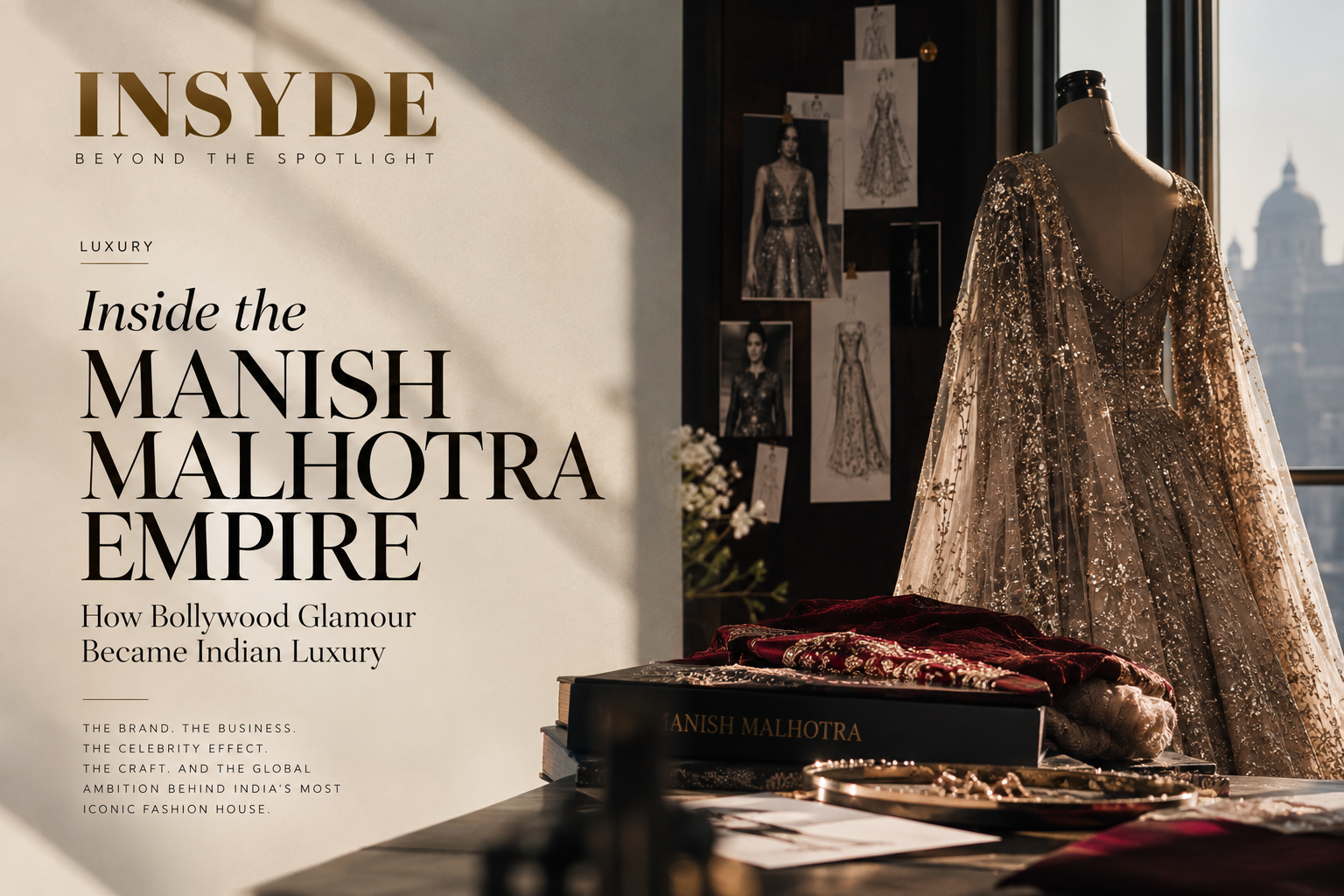
    Insyde the Manish Malhotra Empire: How Bollywood Glamour Became Indian Luxury

    What began with costumes for Bollywood became something much larger: a luxury house built around celebrity, craftsmanship, aspiration and the idea that Indian fashion can belong on the world’s biggest stages.

    Luxury has always been about more than what you wear.

    It is about what a name makes you feel.

    For some houses, that feeling has been built through centuries of European heritage. For others, it comes from a particular designer, a particular silhouette or a particular way of seeing the world.

    In India, few names have created that feeling as consistently as Manish Malhotra.

    For decades, his name has been attached to Bollywood glamour: sequins under studio lights, elaborate wedding lehengas, celebrities on red carpets and couture that seems designed for moments larger than everyday life.

    But there is another Manish Malhotra story hiding underneath the glamour.

    It is a business story.

    The story of how a costume designer became a fashion label, how a label became a luxury house, and how that house is now trying to move from being India’s most recognisable designer name to becoming a global Indian luxury brand.

    That distinction matters.

    Because designing beautiful clothes is one thing.

    Building a luxury house is something else entirely.

    The House Behind the Name

    The House of Manish Malhotra was founded in 2005, after the designer had already spent more than a decade transforming costume design in Indian cinema. Today, the House spans couture, bridal, menswear, ready-to-wear, high jewellery, beauty and film production.

    That expansion didn’t happen because fashion suddenly became a business opportunity.

    It happened because Malhotra had already built something extraordinarily valuable before the fashion house fully existed:

    recognition.

    People knew the name.

    They knew the aesthetic.

    They knew the celebrities.

    They knew the glamour.

    And they knew what it meant when a star stepped out in Manish Malhotra.

    That kind of cultural recognition cannot simply be bought.

    It has to be accumulated.

    Year after year.

    Film after film.

    Collection after collection.

    Wedding after wedding.

    The House was therefore not starting from zero.

    It was turning cultural influence into commercial architecture.

    Bollywood Was the Original Luxury Engine

    Before social media, before influencer marketing, before celebrity collaborations became standard fashion strategy, Bollywood was already doing something remarkably powerful.

    It was selling aspiration.

    Millions of people watched actors on screen and wanted pieces of that world: the clothes, the jewellery, the homes, the parties, the romance, the glamour.

    Malhotra understood this unusually well because he was working inside the machine creating those images.

    His costume designs didn’t simply dress characters.

    They helped define them.

    That gave him an advantage that a conventional fashion label could never easily replicate.

    He understood how clothes behave on camera.

    How colour works under lighting.

    How a silhouette changes the perception of a character.

    How one outfit can become associated with an entire film.

    And eventually, how a designer’s name can become part of the fantasy.

    That is one reason his move into fashion was so powerful.

    He wasn’t introducing a new name to Bollywood.

    He was taking a name Bollywood had already helped make famous and turning it into a brand.

    When Visibility Became Value

    Luxury traditionally depends on scarcity.

    But Malhotra built his brand through something that might appear contradictory:

    visibility.

    His clothes were everywhere.

    On movie stars.

    At weddings.

    At award ceremonies.

    In magazines.

    On runways.

    On social media.

    That visibility did not necessarily make the brand less luxurious.

    Instead, it created desire.

    The public could see the world.

    But only a small number of people could actually enter it.

    That is the basic psychology of aspiration.

    And Malhotra understood it long before the language of personal branding and influencer culture became part of fashion strategy.

    The celebrity was not simply wearing the product.

    The celebrity was helping create the product’s meaning.

    A Manish Malhotra lehenga became more than fabric and embroidery.

    It became a piece of the world associated with the people wearing it.

    The Power of the Indian Wedding

    There may be no better environment for luxury than an Indian wedding.

    Weddings are emotional.

    They are highly visual.

    They involve multiple generations.

    They bring together fashion, jewellery, beauty, photography, music and ceremony.

    And they often represent one of the largest discretionary fashion purchases a family will make.

    Malhotra’s aesthetic fits naturally into this world.

    His couture is dramatic enough for the occasion, detailed enough to reward close attention and recognisable enough to photograph beautifully.

    But there is something deeper happening here.

    A wedding outfit is not simply a fashion purchase.

    It becomes part of memory.

    The lehenga becomes the photograph.

    The photograph becomes the family archive.

    The garment becomes part of the story.

    For a luxury house, that emotional connection is enormously valuable.

    It means the brand isn’t simply selling clothing.

    It is participating in people’s most important moments.

    Craftsmanship as the Luxury Proposition

    There is another foundation underneath the glamour:

    craft.

    The House describes Indian craftsmanship as central to its identity, with embroidery, weaving and handcraft traditions continuously reinterpreted through a contemporary luxury vocabulary.

    This is important because Indian craftsmanship has historically occupied an unusual position in global fashion.

    The world has wanted the embroidery.

    It has wanted the textiles.

    It has wanted the handwork.

    But the names of the designers and houses presenting that craft have often mattered more than the names of the artisans producing it.

    The luxury conversation is beginning to change.

    Indian designers are increasingly presenting craftsmanship as part of an authored luxury proposition rather than simply as a source of decorative technique.

    Malhotra’s model is built around that idea.

    The embroidery isn’t background.

    It is part of the identity.

    The handwork isn’t simply an embellishment.

    It is part of the value.

    The Indian-ness isn’t something to hide.

    It is part of the luxury proposition.

    From Couture to an Ecosystem

    A fashion label can survive on clothing.

    A luxury house needs more.

    The Manish Malhotra universe has steadily expanded into categories that allow the customer to interact with the brand in different ways.

    Beauty arrived in 2018.

    High jewellery expanded from 2019 and formally launched as Manish Malhotra High Jewellery in 2023.

    Ready-to-wear launched in 2025.

    The House has also moved into film production through Stage5 Productions.

    This is not random diversification.

    It follows a familiar luxury-house logic.

    If the customer loves the aesthetic, give them more ways to live inside it.

    Couture creates the fantasy.

    Ready-to-wear makes it more accessible.

    Jewellery adds permanence.

    Beauty extends the identity to everyday life.

    Film creates another storytelling platform.

    The products change.

    The world remains recognisable.

    That is how a designer becomes a brand ecosystem.

    The Reliance Chapter

    Then came a significant change in the business story.

    In 2021, Reliance Brands acquired a 40% stake in Manish Malhotra’s brand company, MM Styles. The partnership was positioned around expanding the brand in India and internationally, including retail and digital growth.

    This matters because scale is one of the hardest problems facing Indian luxury.

    A designer can have extraordinary creative talent and enormous cultural influence.

    But global luxury requires infrastructure.

    Retail.

    Capital.

    Technology.

    Supply chains.

    International distribution.

    Marketing.

    And the ability to build a consistent customer experience across markets.

    Strategic corporate backing can provide some of that infrastructure.

    Malhotra himself has been open about the ambition.

    In a 2025 interview with The Week, he said he wanted the business to reach ₹1,000 crore, adding that he did not believe the company was very far from that goal. He also said the business had grown by 35% over the previous two years.

    That changes the way we should look at the House.

    This isn’t simply a designer protecting a creative legacy.

    It is a company trying to scale.

    The Global Customer

    The international opportunity is not theoretical.

    Malhotra opened his first international flagship in Dubai in 2004 — before opening his first Indian flagship in Mumbai in 2006. His relationship with Dubai has continued to deepen, including the opening of a large Dubai Mall boutique in 2023.

    And the potential customer isn’t necessarily Indian.

    In his 2025 interview with The Week, Malhotra described his Dubai clientele as including NRIs alongside Arab, Russian and Chinese customers.

    That is an important distinction.

    An Indian luxury brand becomes genuinely global when people who do not need to buy Indian fashion begin wanting it.

    The diaspora can be the bridge.

    But it cannot be the entire destination.

    The bigger ambition is to make Indian luxury desirable because it is Indian, not merely because Indians abroad want a connection to home.

    That is a much harder challenge.

    And a much bigger opportunity.

    Why Paris Matters

    In July 2026, the House reached one of the most important stages in its history.

    Manish Malhotra presented his Fall/Winter 2026 couture collection in Paris as a guest house on the official Haute Couture Week schedule, becoming the fourth Indian designer to appear on the official calendar.

    It would be easy to treat that as a glamorous milestone.

    But Paris means more than a runway.

    It is a signal.

    For years, Indian craftsmanship has quietly supported global luxury. Vogue noted in 2026 that Indian artisans have long produced embroidery, embellishment and handwoven textiles used by major international fashion houses. The growing presence of Indian designers on the Paris couture calendar represents a shift in who gets to tell that story.

    Malhotra’s arrival therefore carries a larger question:

    Can an Indian house move from supplying craftsmanship and inspiration to owning the global luxury narrative?

    That is the real significance of Paris.

    The House Has Something Europe Cannot Manufacture

    There is an interesting advantage to the Manish Malhotra proposition.

    European luxury houses have heritage.

    Malhotra has something different.

    He has cultural immediacy.

    He has Bollywood.

    He has Indian weddings.

    He has celebrity relationships.

    He has contemporary Indian glamour.

    He has access to an enormous cultural ecosystem that already understands the emotional language of his clothes.

    That is difficult for a new luxury brand to manufacture.

    You cannot launch a campaign and suddenly create thirty years of cultural memory.

    Malhotra already has it.

    The challenge is translating that memory for someone who didn’t grow up watching Bollywood.

    That is where the next stage of the brand becomes interesting.

    Can the glamour travel without losing its meaning?

    Can the craftsmanship feel contemporary rather than simply traditional?

    Can the name become aspirational in Paris, Dubai, London or New York for someone who has no personal connection to Hindi cinema?

    Those are the questions that will define the next chapter.

    The Risk of Being Too Much Manish Malhotra

    Every powerful designer brand eventually faces the same problem.

    The designer becomes the brand.

    That creates enormous recognition.

    But it can also create dependence.

    When people hear Manish Malhotra, they immediately know what kind of world they are entering.

    That is an asset.

    But a global luxury house has to become bigger than the person who created it.

    It needs institutional identity.

    It needs younger customers.

    It needs new categories.

    It needs designers, artisans and creative teams who can evolve the language without destroying it.

    The House’s expansion into ready-to-wear, beauty, jewellery and film suggests that this process is already underway.

    The question is whether the brand can evolve while remaining unmistakably Manish Malhotra.

    That is the difficult part of building a maison.

    You have to change without looking like you changed.

    The Indian Luxury Moment

    There is a broader story here too.

    India’s luxury market is entering a different phase.

    For a long time, Indian consumers who wanted global luxury looked outward.

    European fashion houses represented prestige.

    International logos represented status.

    Indian designers were often associated with weddings, occasionwear and celebrity culture.

    That hierarchy is becoming less simple.

    Indian designers are building stronger businesses.

    Indian craftsmanship is receiving greater attention.

    Indian consumers are becoming more confident in local luxury.

    And global audiences are increasingly interested in the culture and aesthetics emerging from India.

    Malhotra sits directly inside that transition.

    He represents an older India that discovered glamour through cinema.

    But he is also building for a newer India that wants to participate in global luxury on its own terms.

    That tension is part of what makes the House interesting.

    Beyond the Logo

    The most valuable thing Manish Malhotra has built may not be a logo.

    It is recognition.

    You can often identify the world before you identify the garment.

    The shimmer.

    The embroidery.

    The colour.

    The drama.

    The collision of contemporary silhouettes with Indian craft.

    That consistency is one of the foundations of luxury.

    A great house creates a visual language that customers recognise almost instinctively.

    Malhotra has been refining that language for decades.

    The business is simply giving it more places to exist.

    So, Can Manish Malhotra Become a Global Luxury House?

    The answer is more complicated than yes or no.

    The ingredients are already there.

    A recognisable creative identity.

    Decades of cultural relevance.

    A strong celebrity network.

    Deep relationships with Indian craftsmanship.

    A growing multi-category business.

    International retail.

    Corporate backing.

    And now, an official Paris couture presence.

    The harder part is what comes next.

    Global luxury cannot be built entirely on celebrity.

    It cannot depend only on Indian weddings.

    It cannot survive on nostalgia.

    And it cannot simply export the same product to every market.

    It has to evolve.

    It has to create desire beyond its original audience.

    It has to become culturally relevant without losing its origin.

    That is the real test.

    From Bollywood Glamour to Indian Luxury

    Manish Malhotra’s greatest achievement may not be that he became India’s most famous fashion designer.

    It may be that he understood how to turn attention into aspiration, aspiration into desire, and desire into a business.

    The movies gave him visibility.

    Celebrity gave him cultural power.

    Couture gave him authority.

    Craftsmanship gave him depth.

    Business partnerships gave him scale.

    And Paris has given the House a new stage.

    But the story isn’t finished.

    If the next decade goes the way Malhotra hopes, the question may eventually stop being:

    “Can an Indian designer build a global luxury house?”

    It may become:

    “Why did we ever assume Indian luxury had to look anywhere else for permission?”

    That is the opportunity sitting in front of Manish Malhotra.

    Not simply to take Indian glamour to the world.

    But to convince the world that Indian glamour was already luxury.

    The next chapter isn’t about becoming global.

    It is about deciding what Indian luxury looks like when the world is watching.

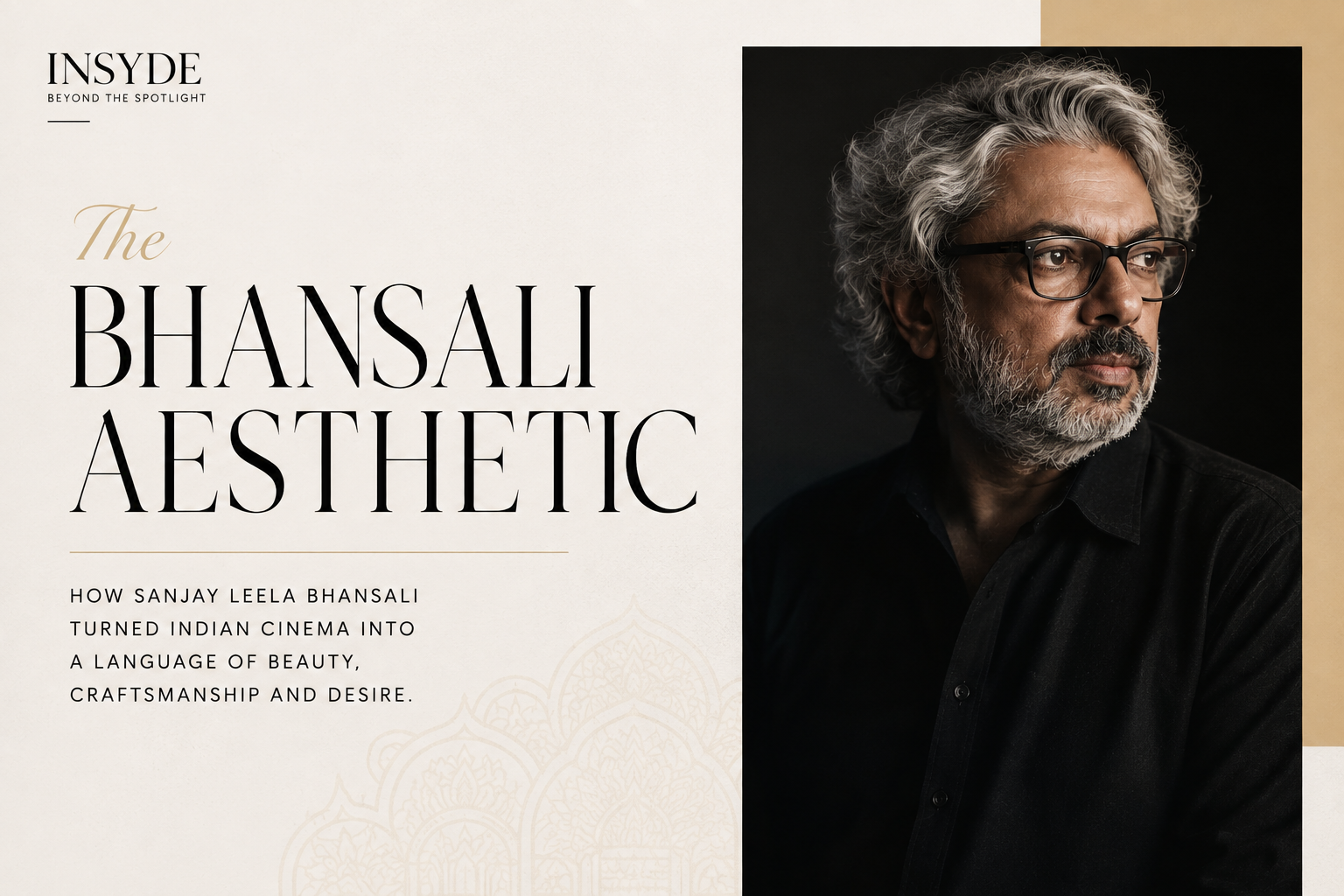
  • The Bhansali Aesthetic

    The Bhansali Aesthetic

    How Sanjay Leela Bhansali turned Indian cinema into a language of beauty, craftsmanship and desire.

    Some filmmakers tell stories.

    Sanjay Leela Bhansali builds worlds.

    Before a character speaks, there may already be a chandelier glowing above her, silk moving through the frame, jewellery catching the light, music rising somewhere beyond the room.

    In his cinema, beauty is rarely background.

    Beauty is part of the narrative.

    That is what makes Bhansali particularly interesting to INSYDE.

    His work sits at an intersection of cinema, fashion, architecture, music, craftsmanship and desire — a place where visual richness becomes storytelling and detail becomes identity.

    Over more than three decades, he has developed an aesthetic so recognisable that a frame can sometimes feel like a Bhansali frame before the audience consciously understands why.

    And perhaps that is the real achievement.

    He didn’t simply create films with a distinctive look. He created a visual language.

    When Cinema Becomes a World

    There is a difference between designing a beautiful frame and constructing an entire universe.

    Bhansali has consistently pursued the latter.

    His films are populated by elaborate interiors, dramatic architecture, intricate costumes, jewellery, carefully choreographed movement and compositions in which even the smallest visual element can feel deliberate.

    Those details do not exist independently.

    They speak to one another.

    Architecture establishes scale.

    Costume establishes character.

    Lighting establishes mood.

    Music establishes emotion.

    Movement establishes rhythm.

    Together, they create something closer to an immersive environment than a conventional film set.

    That precision has become part of the Bhansali method. On Heeramandi, Architectural Digest India documented his insistence on repeatedly adjusting elements of the set — from furniture and wall textures to seemingly minor decorative details — and quoted Bhansali explaining that architecture plays an important role in how he constructs a frame. (Architectural Digest)

    The point is not simply to make a set look expensive.

    The environment has to belong to the story.

    The Luxury of Detail

    Luxury has always depended on detail.

    The difference between something expensive and something exceptional is often invisible from a distance.

    A stitch.

    A setting.

    A finish.

    A proportion.

    A material chosen because of how it responds to light.

    Bhansali approaches cinema with a similar sensitivity.

    A costume isn’t simply clothing.

    A room isn’t simply a set.

    A chandelier isn’t simply decoration.

    A colour isn’t simply a colour.

    Everything contributes to the emotional architecture of the scene.

    The result is a cinema that can feel almost tactile.

    You sense the weight of the fabric.

    The warmth of the light.

    The scale of the room.

    The movement of jewellery.

    The silence before the music begins.

    The effect is extravagant, but the underlying principle is surprisingly disciplined:

    nothing is there without intention.

    Where the Obsession With Beauty Began

    The grandeur of Bhansali’s cinema has a deeply personal origin.

    He has spoken about growing up in a chawl in Mumbai and about the lack of space and visual beauty around him during his childhood. His mother, a dancer, performed in a small space, while Bhansali imagined larger, more ordered environments. He has connected those experiences directly to the expansive sets, central framing and visual symmetry that later became signatures of his filmmaking. (Indian Express)

    It is an important detail because it changes the way his aesthetic can be understood.

    The grandeur is not simply extravagance for its own sake.

    It is a response to limitation.

    Small spaces became expansive ones.

    Plain walls became elaborate environments.

    Disorder became symmetry.

    Limited movement became choreography.

    The absence of beauty became an obsession with creating it.

    And perhaps that is why his sets rarely feel merely expensive.

    They feel imagined.

    The Architecture of Desire

    Bhansali understands something that luxury brands have understood for generations:

    objects become more powerful when placed inside a world.

    A necklace is one thing.

    A necklace worn with a particular fabric, under a particular light, inside a particular room, accompanied by music and movement, becomes something else.

    The object acquires context.

    That is one of the reasons his cinema has such a strong relationship with fashion and jewellery.

    The visual elements do not sit around the characters.

    They help construct them.

    Jewellery as Storytelling

    There may be no better example than jewellery.

    In Bhansali’s worlds, jewellery rarely feels incidental.

    It can establish hierarchy.

    It can indicate wealth.

    It can communicate tradition.

    It can transform the silhouette of a character.

    And, importantly, it interacts with light.

    A necklace catching the light during a close-up is doing more than displaying craftsmanship.

    It is participating in the image.

    This is where Bhansali’s cinema naturally intersects with the language of luxury.

    The finest luxury objects are designed to reward attention.

    So are his frames.

    The closer you look, the more there is to discover.

    Fashion Without the Fashion Show

    Bhansali’s relationship with fashion is more sophisticated than simply dressing actors beautifully.

    His costumes establish an entire visual vocabulary.

    Silhouette, fabric, colour, ornamentation and movement work together.

    The clothes have to survive choreography.

    They have to respond to lighting.

    They have to communicate period and cultural context.

    And they have to remain emotionally connected to the character.

    That requires something closer to design than conventional styling.

    The result is fashion that belongs to the world of the film rather than being placed on top of it.

    The costume doesn’t interrupt the story. It becomes part of the story.

    The Women at the Centre

    Bhansali’s cinema has repeatedly placed women at the centre of its visual and emotional worlds.

    From Devdas and Black to Ram-Leela, Bajirao Mastani, Padmaavat, Gangubai Kathiawadi and Heeramandi, his women are rarely treated as background figures.

    Their clothes, jewellery, movement and environments often become extensions of their emotional and social position.

    The scale of the world around them can communicate power.

    A crowded room can become a stage.

    A palace can become a prison.

    A costume can become armour.

    A jewel can become status.

    A dance can become defiance.

    That visual treatment has become one of the recognisable elements of his cinema. Actors from Heeramandi have also described his approach to presenting women as central to his filmmaking language. (Indian Express)

    The important point is not simply that Bhansali makes beautiful images of women.

    It is that he uses beauty as part of the language through which their stories are told.

    Music Is Architecture

    There is another defining element of the Bhansali aesthetic: music.

    For Bhansali, music has long been central to the construction of his films rather than something added after the visual world is complete.

    A song can become a room.

    A room can become choreography.

    Choreography can become emotion.

    Emotion becomes narrative.

    This is why some of his most memorable sequences can communicate enormous amounts without conventional dialogue.

    The music carries the architecture of the scene.

    The performers move through it.

    The camera becomes part of the choreography.

    The result is closer to a fully composed theatrical experience than a conventional musical interlude.

    The Discipline Beneath the Spectacle

    The word “grand” is often used to describe Bhansali.

    It is accurate, but incomplete.

    What is more interesting is the discipline underneath it.

    He has spoken about his fascination with central framing and the desire to create order from the disorder he experienced growing up. (Indian Express)

    Architectural Digest India has similarly documented his attention to the smallest details of his sets, including furniture placement, textures, colours and architectural elements. (Architectural Digest)

    That reveals the secret beneath the spectacle.

    The image may be extravagant.

    The composition is controlled.

    That is why his frames can feel so immediately recognisable.

    Grandeur With a Purpose

    Bhansali’s films are often described using words such as lavish, opulent and larger-than-life.

    But spectacle alone would not explain their longevity.

    The real fascination lies in what the grandeur communicates.

    A palace can represent power.

    A crowded courtyard can represent society.

    A vast stage can make an individual appear small.

    An empty room can make an emotion feel enormous.

    A chandelier can suggest wealth, desire or decay.

    A costume can tell you where a character belongs before the dialogue does.

    The visual scale is therefore not simply decoration.

    It is emotional scale.

    India Through a More Cinematic Lens

    There is also something distinctly Indian about Bhansali’s understanding of grandeur.

    India has never treated beauty as purely architectural.

    It exists in textiles.

    Jewellery.

    Music.

    Dance.

    Wedding traditions.

    Craftsmanship.

    Palaces.

    Festivals.

    Theatre.

    Ceremony.

    Bhansali understands that instinctively.

    His cinema draws from a cultural memory in which colour, ornamentation, music and movement can coexist without apology.

    The result is not simply an expensive-looking version of Indian cinema.

    It is an attempt to transform elements of Indian visual culture into a cinematic language of their own.

    And that distinction matters.

    He doesn’t simply decorate Indian stories. He builds worlds around them.

    From Cinema to a Wider Cultural Language

    With Heeramandi: The Diamond Bazaar, Bhansali extended this visual vocabulary into streaming.

    The series brought together his familiar concerns — music, performance, elaborate environments, costumes, historical atmosphere and female characters — for a global streaming audience. Netflix describes the series as a story of love, power, betrayal and freedom centred on the courtesans of pre-independence Lahore. (Indian Express)

    The significance goes beyond the move from cinema to television.

    It demonstrated that the Bhansali aesthetic could exist as a broader cultural world.

    The sets became part of the conversation.

    The costumes became part of the conversation.

    The jewellery became part of the conversation.

    The music became part of the conversation.

    The visual identity became almost as recognisable as the title itself.

    That is a powerful position for any filmmaker to reach.

    The Influence of the Past

    Bhansali’s visual references are not limited to cinema.

    Architectural Digest India has documented how his reference library has drawn from places and objects he encountered growing up, as well as artists, photographers and musicians including S. H. Raza, V. S. Gaitonde, Raghu Rai and Kishori Amonkar. (Architectural Digest)

    That is revealing.

    His aesthetic isn’t built from one source.

    It is accumulated.

    Painting.

    Photography.

    Music.

    Architecture.

    Theatre.

    Textiles.

    Indian history.

    Street life.

    Memory.

    The resulting world may look fantastical, but its ingredients are deeply rooted in observation.

    When Excess Becomes Restraint

    There is an irony in Bhansali’s work.

    The images can be enormous.

    The sets can be enormous.

    The costumes can be elaborate.

    The music can be overwhelming.

    Yet the composition is often highly controlled.

    Symmetry.

    Central framing.

    Colour relationships.

    Movement.

    Light.

    Negative space.

    Everything is competing for attention, yet everything is carefully placed.

    That tension is part of what makes the aesthetic work.

    The spectacle is large. The intention is precise.

    A Filmmaker With a Signature

    The ultimate achievement for an auteur is recognisability.

    Not fame.

    Not scale.

    Not even box-office success.

    A signature.

    Something that makes an audience recognise the creator before seeing the name.

    Bhansali has achieved that.

    The grand interiors.

    The controlled colour.

    The elaborate costumes.

    The music.

    The choreography.

    The central compositions.

    The emotional intensity.

    The women framed against enormous spaces.

    The sense that every object has been placed with intention.

    Together, they form a vocabulary.

    And once a filmmaker develops a vocabulary of that strength, individual films become chapters inside a much larger artistic language.

    What Comes Next

    Bhansali’s next chapter is already taking shape.

    His much-anticipated Love & War, starring Ranbir Kapoor, Alia Bhatt and Vicky Kaushal, is nearing completion, with reports now pointing toward his next major project, a Madhubala biopic. (The Times of India)

    For a filmmaker whose aesthetic is already so established, the interesting question is not whether the next project will be visually ambitious.

    We know the answer.

    The more compelling question is:

    What will he do with that language next?

    Can grandeur evolve without becoming repetition?

    Can spectacle remain emotionally intimate?

    Can a recognisable aesthetic continue to surprise?

    Those are the questions that matter when an artist has spent decades refining a signature.

    The Bhansali Aesthetic

    Perhaps the easiest way to misunderstand Sanjay Leela Bhansali is to think his cinema is simply about luxury.

    It isn’t.

    Luxury is the surface.

    The deeper obsession is craft.

    The craft of composition.

    The craft of music.

    The craft of costume.

    The craft of movement.

    The craft of light.

    The craft of architecture.

    The craft of creating an environment that feels larger than reality.

    That is why his images remain so persistent.

    Long after a film’s plot has been discussed, individual frames remain.

    A room.

    A colour.

    A piece of jewellery.

    A costume.

    A song.

    A gesture beneath a chandelier.

    A character standing alone in an enormous space.

    These are not simply beautiful moments.

    They are fragments of a language.

    And perhaps that is Bhansali’s most enduring contribution to Indian cinema.

    He has shown that grandeur, when treated with enough discipline and imagination, can become more than spectacle.

    It can become storytelling.

    In a culture increasingly consumed through fleeting images, there is something almost radical about a filmmaker who still believes a frame deserves to be constructed, considered and remembered.

    That may be the real Bhansali aesthetic.

    Not simply the luxury of seeing more — but the discipline of making every detail matter.

    INSYDE — Beyond the Spotlight.

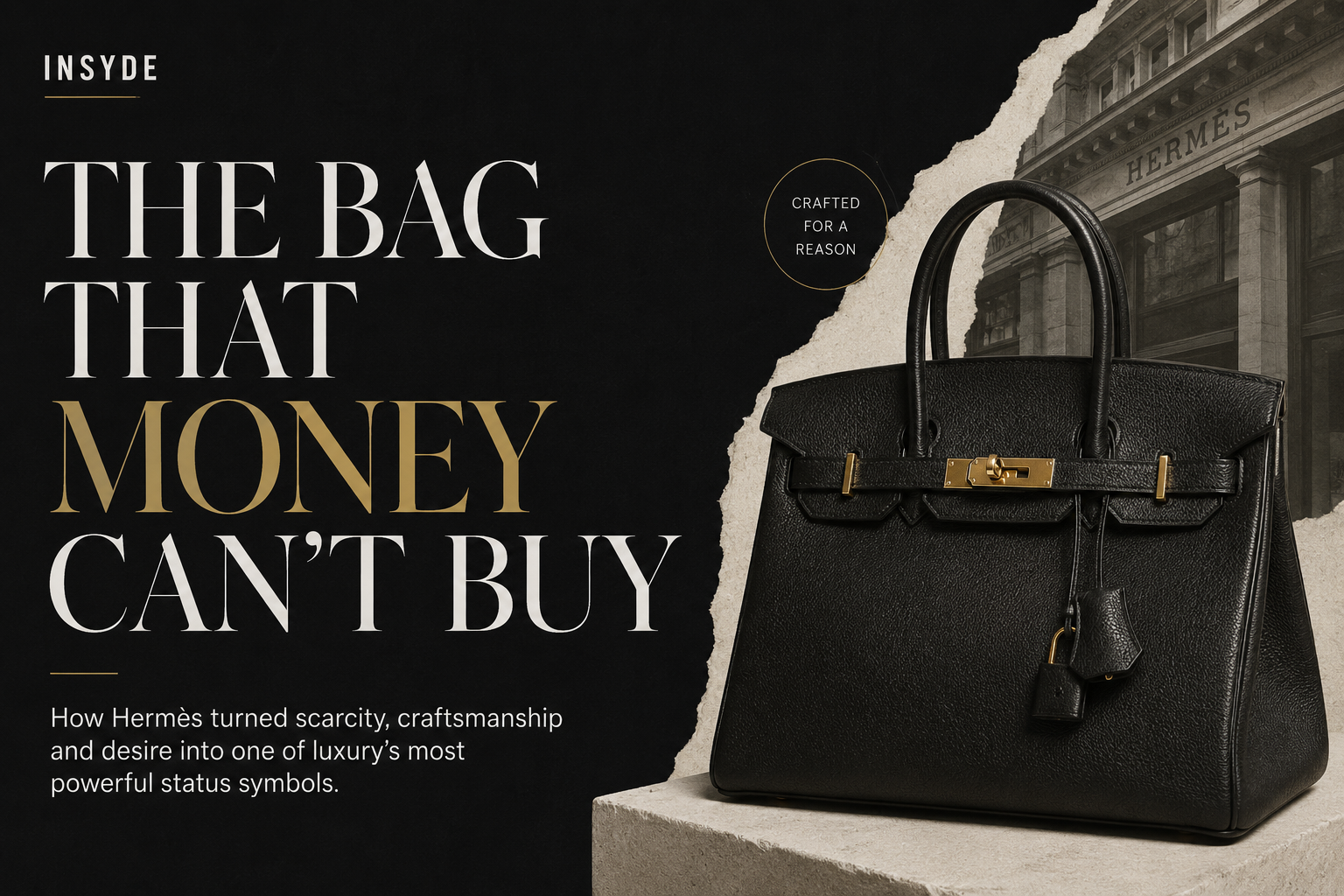
  • THE BAG THAT MONEY CAN’T BUY

    THE BAG THAT MONEY CAN’T BUY

    How Hermès turned scarcity, craftsmanship and desire into one of luxury’s most powerful status symbols.

    There are handbags that cost hundreds.

    There are handbags that cost thousands.

    And then there is the Hermès Birkin — a handbag so deeply embedded in the language of luxury that its price is no longer the most interesting thing about it.

    The real question is much simpler:

    What happens when having the money still doesn’t guarantee that you can have the thing you want?

    That is where Hermès becomes fascinating.

    Because luxury has traditionally followed a straightforward formula:

    More money. Better things.

    Hermès built something more complicated:

    More money gives you access to luxury. But it doesn’t necessarily give you access to everything.

    And that distinction transformed a handbag into something far bigger than a fashion accessory.

    The Birkin became a symbol of wealth, yes.

    But also of taste.

    Scarcity.

    Craftsmanship.

    Access.

    And, perhaps most importantly, desire.

    Because when something is difficult to obtain, the price is only the beginning of the story.


    THE BAG WAS NEVER DESIGNED TO BECOME A STATUS SYMBOL

    The origin of the Birkin is almost too ordinary for the mythology that eventually surrounded it.

    In 1984, British actress and singer Jane Birkin found herself seated next to Jean-Louis Dumas, then chairman and chief executive of Hermès, on a flight from Paris to London.

    Birkin explained that she couldn’t find a leather bag that worked for her as an everyday carryall.

    Dumas listened.

    The idea evolved into a new handbag.

    The Birkin was born.

    There was no grand plan to create one of the world’s most recognisable symbols of extreme wealth.

    It began with functionality.

    Make it practical.

    Make it beautiful.

    Make it exceptionally well.

    The mythology came later.

    And that may be one of the most important details in the entire story.

    Because Hermès didn’t begin by manufacturing status.

    It manufactured quality.

    Status followed.


    HERMÈS WAS BUILDING LUXURY LONG BEFORE THE BIRKIN

    To understand why the Birkin became so powerful, you have to go back much further.

    Hermès was founded in Paris in 1837 by Thierry Hermès, originally as a workshop producing harnesses and other equestrian equipment.

    Its early clientele included members of Europe’s wealthy and aristocratic society.

    As transportation changed, Hermès changed with it.

    The company moved into bags, luggage, silk, fashion, jewellery and other categories while maintaining a central commitment to craftsmanship.

    That history matters.

    Because the Birkin didn’t create Hermès’ luxury reputation.

    Hermès’ reputation created the environment in which the Birkin could become legendary.

    The bag arrived with decades of credibility already behind the name.


    THE REAL LUXURY IS IN THE MAKING

    A Birkin is not valuable simply because it carries the Hermès name.

    The construction itself is part of the story.

    Hermès leather goods are made by highly trained artisans, with the house emphasising manual craftsmanship and individual attention throughout the production process. The company says leather artisans undergo extensive training before becoming fully qualified.

    The leather is selected carefully.

    Pieces are cut and prepared.

    Edges are finished.

    Hardware is fitted.

    Stitching is performed by hand.

    And the artisan’s work becomes part of the character of the finished bag.

    This is important because modern luxury often creates the illusion of infinite choice.

    Hermès does something different.

    It reminds the customer that human time is finite.

    A skilled artisan can only make so many pieces.

    A particular material can only exist in a certain quantity.

    A particular finish requires a certain amount of attention.

    And suddenly, scarcity isn’t just a marketing strategy.

    It is built into the production process.


    THE DIFFERENCE BETWEEN EXPENSIVE AND EXCLUSIVE

    This is where the Birkin story becomes particularly interesting.

    An expensive product asks:

    Can you afford it?

    An exclusive product asks:

    Can you get it?

    Those are completely different questions.

    A wealthy customer can have the financial means to purchase a Birkin and still not be able to walk into a boutique and simply select any model, colour or leather they want.

    Availability varies.

    Relationships matter.

    Specific pieces are limited.

    And the exact bag someone wants may not be waiting behind the counter.

    That creates a psychological effect that money cannot completely eliminate:

    anticipation.

    You want it.

    You search for it.

    You wait.

    And the longer the desire survives, the more emotionally valuable the eventual acquisition can become.


    WHEN “NO” BECOMES PART OF THE LUXURY

    Modern commerce has been built around convenience.

    See it.

    Click it.

    Buy it.

    Tomorrow, it’s at your door.

    Luxury operates differently.

    At its highest level, friction can become part of the experience.

    The wait.

    The discovery.

    The relationship.

    The invitation.

    The moment when the right piece finally appears.

    That is a radical idea in a world obsessed with instant gratification.

    Hermès doesn’t need to make the Birkin feel like something everyone can have immediately.

    In fact, the opposite can make the product more desirable.

    The less ordinary the acquisition feels, the less ordinary the object can feel.

    The purchase becomes an event.


    THE BOUTIQUE ISN’T JUST A STORE

    This is another important distinction.

    For most consumer products, the store exists to facilitate the transaction.

    In luxury, the environment is part of the product.

    The boutique.

    The service.

    The packaging.

    The conversation.

    The anticipation.

    The feeling of discovering something rather than simply ordering it.

    These details matter because luxury is fundamentally emotional.

    A customer isn’t only purchasing leather and hardware.

    They’re purchasing an experience around the object.

    And Hermès has spent generations protecting that experience.


    THEN THE BIRKIN BECAME A CULTURAL SYMBOL

    The bag’s transformation accelerated as it became associated with celebrities, socialites, entrepreneurs and some of the world’s wealthiest consumers.

    Its shape became recognisable.

    Its hardware became recognisable.

    Its name became recognisable.

    The Birkin became something you could identify without seeing the logo.

    That is powerful branding.

    Hermès didn’t need to cover the bag in enormous symbols.

    The silhouette did much of the work.

    And this created an interesting form of status:

    the people who knew, knew.

    The bag could be visible without being loud.

    It could communicate wealth without announcing a price.

    It could sit quietly on an arm while carrying an enormous amount of cultural meaning.


    WHY THE BIRKIN DOESN’T NEED A GIANT LOGO

    Modern luxury has spent decades teaching consumers to recognise logos.

    Hermès took a different route.

    The Birkin’s identity comes from its proportions, construction, hardware, craftsmanship and association with the house.

    That makes the bag part of a more sophisticated form of luxury communication.

    A large logo says:

    Look at the brand.

    A recognisable object can say:

    If you know, you know.

    And that distinction has become increasingly relevant as luxury consumers become more interested in subtlety, provenance and craftsmanship.

    The most sophisticated status signal isn’t necessarily the loudest one.

    Sometimes it is the thing only a certain audience recognises.


    THEN THE SECONDARY MARKET CHANGED THE GAME

    The Birkin became even more fascinating when it entered the world of resale and collecting.

    Certain colours.

    Certain leathers.

    Certain sizes.

    Certain years.

    Exceptional condition.

    Rare examples.

    All can influence desirability in the secondary market.

    Some Birkins have sold for extraordinary sums at auction, particularly rare or historically significant examples.

    But there is an important distinction:

    A Birkin is not automatically an investment.

    The resale market is influenced by condition, provenance, rarity, demand and market conditions.

    The existence of a strong secondary market doesn’t guarantee appreciation.

    But it does demonstrate something important.

    The Birkin can exist simultaneously as:

    a handbag,

    a collectible,

    a status symbol,

    and a cultural asset.

    That is an extraordinary amount of meaning for an object originally designed to carry personal belongings.


    THE PSYCHOLOGY OF SCARCITY

    Why does scarcity work?

    Because humans don’t always value things according to their practical usefulness.

    When something is limited, difficult to obtain or perceived as disappearing, its psychological value can increase.

    Luxury brands have understood this for generations.

    But scarcity only works when the underlying product deserves desire.

    Make something rare without making it desirable and you have nothing.

    Hermès combined the two.

    Exceptional craftsmanship created the desire.

    Limited availability intensified it.

    And the result became a self-reinforcing cycle.

    Desire creates demand.

    Demand reinforces scarcity.

    Scarcity increases desirability.

    And the cycle continues.


    THE MOST POWERFUL WORD IN LUXURY

    No.

    No mass-market production.

    No constant discounting.

    No desperate promotions.

    No need to make every product available to everyone immediately.

    That ability to say no is one of the most powerful tools a luxury brand can possess.

    Because the moment a luxury product becomes permanently available at a discount, something changes.

    The consumer stops asking:

    “Can I get it?”

    and starts asking:

    “Should I buy it?”

    Hermès has spent decades making the first question more important.

    And that is incredibly powerful.


    WHEN THE BAG BECAME CULTURAL CURRENCY

    Eventually, owning a Birkin stopped being solely about owning an exceptional handbag.

    It became a form of cultural knowledge.

    You could recognise the bag.

    Understand the leather.

    Understand the construction.

    Understand why one version might attract more attention than another.

    Understand why rarity matters.

    That knowledge becomes part of the luxury experience.

    And suddenly, the Birkin communicates something beyond financial capability.

    It can communicate:

    I know this world.

    That’s cultural capital.

    And cultural capital is one of the most powerful currencies in luxury.


    HERMÈS DOESN’T NEED TO CHASE THE MOMENT

    Fashion is built around change.

    New season.

    New collection.

    New trend.

    New colour.

    New obsession.

    Luxury operates on a different clock.

    Hermès has the advantage of being able to build on heritage rather than constantly replacing it.

    The Birkin doesn’t need to become radically different every season.

    Its enduring appeal comes partly from consistency.

    The design can evolve.

    Materials can vary.

    Colours can change.

    But the underlying identity remains recognisable.

    That gives the brand something most fashion businesses desperately want:

    timelessness.


    THE BAG MONEY ALONE CAN’T GUARANTEE

    This is where the title becomes meaningful.

    The Bag That Money Can’t Buy.

    Of course money matters.

    A Birkin is a luxury purchase, and financial ability is an obvious part of accessing the category.

    But money isn’t the entire equation.

    There is availability.

    There is demand.

    There is craftsmanship.

    There is scarcity.

    There is knowledge.

    There is patience.

    There is the relationship with the house.

    And there is something even more important:

    desire.

    Because a luxury brand’s greatest achievement isn’t convincing you that you need its product.

    It’s convincing you that you want this particular product.

    Even when you could buy something else.


    WHEN THE WAIT BECOMES PART OF THE PRODUCT

    Think about the psychology.

    If something arrives tomorrow, you enjoy it tomorrow.

    If you’ve spent months wanting something, searching for it and imagining owning it, the moment you finally receive it carries something else:

    a story.

    The acquisition has emotional history.

    You remember the search.

    You remember the anticipation.

    You remember finally finding it.

    And that story becomes part of the object.

    This is one of luxury’s greatest tricks:

    the journey can become part of the value.


    THE BIRKIN ISN’T REALLY ABOUT THE BAG

    This is the point where the story becomes bigger than Hermès.

    The Birkin reveals something fundamental about modern luxury.

    People don’t simply buy objects.

    They buy:

    identity.

    belonging.

    recognition.

    craftsmanship.

    scarcity.

    emotion.

    And sometimes, they buy the feeling of possessing something that most people cannot simply obtain.

    That is why luxury cannot be measured purely by material cost.

    A handbag doesn’t become extraordinary because leather suddenly became priceless.

    It becomes extraordinary because people collectively decided that it means something.

    Hermès understood that better than most.


    WHAT HERMÈS REALLY SELLS

    It would be easy to say Hermès sells handbags.

    It doesn’t.

    Not entirely.

    Hermès sells craftsmanship.

    It sells heritage.

    It sells patience.

    It sells scarcity.

    It sells access.

    And, above everything else, it sells desire.

    The Birkin is simply one of the most successful containers for all of those ideas.

    And that’s why copying the shape isn’t enough.

    Another company can make a beautiful leather bag.

    Another company can use expensive hardware.

    Another company can create limited editions.

    But it cannot instantly manufacture decades of heritage.

    It cannot manufacture the artisans.

    It cannot manufacture the cultural mythology.

    And it cannot simply manufacture desire.

    That has to be earned.


    THE BAG THAT MONEY CAN’T BUY

    The Birkin became one of the world’s most powerful luxury symbols because Hermès understood a principle that many brands eventually forget:

    Luxury isn’t created by making something expensive.

    It’s created by making something desirable, distinctive and difficult to replace.

    The craftsmanship matters.

    The leather matters.

    The history matters.

    The scarcity matters.

    But the real magic happens when all of those things meet.

    Then a handbag becomes something else.

    A statement.

    A collectible.

    A cultural signal.

    A piece of personal identity.

    And perhaps that is the ultimate lesson of the Birkin.

    In a world where almost anything can be bought instantly, luxury has discovered a new form of power:

    making you wait for what you already have the money to buy.

    Because when money stops being the only barrier between you and the thing you want—

    desire becomes the real currency.

    And Hermès has spent generations becoming one of the world’s greatest masters of it.

    INSYDE — Beyond the Spotlight.

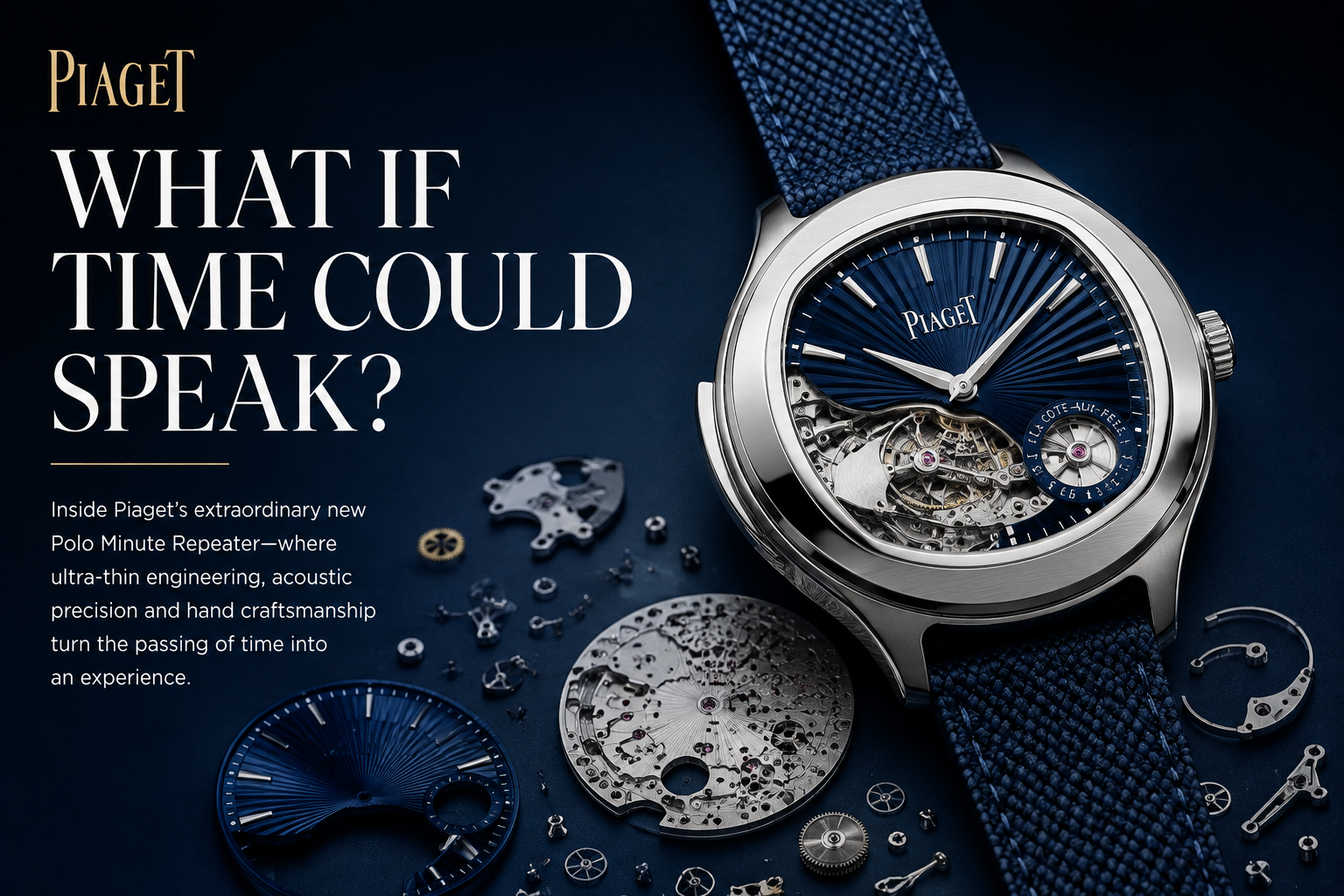
  • THE SOUND OF LUXURY

    THE SOUND OF LUXURY

    Inside Piaget’s extraordinary new Polo Minute Repeater — where ultra-thin engineering, acoustic precision and hand craftsmanship turn the passing of time into an experience.

    We live in a world where time has become almost impossible to ignore.

    It appears on our phones, our laptops, our cars, our walls and the screens we glance at without thinking.

    And yet, somewhere in Switzerland, Piaget has spent years perfecting a very different idea:

    What if you could hear it?

    The new Piaget Polo Minute Repeater doesn’t need to exist.

    That is exactly what makes it fascinating.

    It takes one of the most demanding complications in mechanical watchmaking and places it inside Piaget’s unmistakably modern Polo — a large 18-karat white-gold watch measuring 48mm across and just 9.30mm thick. Inside sits the self-winding Calibre 1290P, an ultra-thin movement developed, finished and assembled at Piaget’s Manufacture in La Côte-aux-Fées.

    This isn’t simply another complicated luxury watch.

    It is Piaget making an argument about what luxury can still mean when technology has already made everything easier.

    THE MOST UNNECESSARY COMPLICATION MAY BE THE MOST BEAUTIFUL

    A minute repeater is an almost wonderfully irrational piece of engineering.

    Activate it, and the mechanism chimes the time.

    Hours.

    Quarter hours.

    Minutes.

    That’s it.

    Your phone can tell you the same thing instantly.

    But a phone doesn’t need hundreds of mechanical components moving in sequence, carefully tuned hammers, resonating structures and years of accumulated watchmaking knowledge to do it.

    A minute repeater does.

    And that is where the fascination begins.

    Luxury has always been at its most interesting when it moves beyond necessity.

    A private jet isn’t necessary.

    A hand-finished grand complication isn’t necessary.

    A bespoke suit isn’t necessary.

    The point is not efficiency.

    The point is experience.

    The Polo Minute Repeater takes that idea to its most literal conclusion.

    It doesn’t simply show you the time.

    It gives time a voice.

    WHEN A WATCH BECOMES AN INSTRUMENT

    The real achievement isn’t merely making the mechanism chime.

    It is making it sound right.

    Piaget says the 1290P produces 64 decibels of acoustic intensity, with three harmonic partials and a damping factor of 2,600. The hours are struck at G sharp and the minutes at A sharp, both in the fifth octave. The activation slide sits at nine o’clock.

    For someone who doesn’t spend weekends discussing calibres, those specifications may sound unnecessarily technical.

    They are.

    But beautifully so.

    Because they are ultimately about something remarkably simple:

    sound.

    The movement and the case have to work together to create an acoustic experience.

    And suddenly, this isn’t just watchmaking anymore.

    It is a form of mechanical acoustics.

    The watch has to keep time.

    It has to fit inside an extraordinarily thin architecture.

    And then, when asked, it has to perform.

    PIAGET DIDN’T HIDE THE MAGIC

    This is perhaps the most INSYDE-worthy part of the watch.

    Piaget could have hidden the mechanism.

    Instead, it opened the door.

    The Polo Minute Repeater uses a partially openworked dial to reveal parts of the 1290P beneath it. At four o’clock, a smoked-blue sapphire ring sits over the inertia wheel — the dedicated regulator of the minute repeater — while a gold fillet travels across the dial and reveals sections of the mechanism.

    The effect is subtle.

    And that’s important.

    This isn’t skeletonisation for the sake of showing off every gear.

    The mechanism becomes part of the composition.

    The engineering becomes decoration.

    The decoration becomes engineering.

    You aren’t simply looking at the finished object. You’re being invited to understand why it is extraordinary.

    That is a very different kind of luxury.

    THE REAL COST ISN’T GOLD

    The case is made from 18-karat white gold.

    The strap is blue textured calfskin.

    The dial is gold, hand-guilloché and finished with a radiant sunray pattern, with an opaline outer track adding contrast.

    All of that sounds luxurious.

    But none of it is the most valuable material inside this watch.

    That would be time itself.

    Piaget says more than 150 hours went into developing the dial, followed by another 50 hours of hand finishing for each individual piece. The calibre’s bridges are hand-beveled, its mainplate carries guilloché decoration, and its minute-repeater hammers receive a mirror polish.

    Think about that.

    In an era where almost everything is optimised to be faster, Piaget is deliberately creating something that takes longer.

    Much longer.

    And that may be the real luxury story here.

    THE PIAGET PARADOX

    Piaget has been chasing thinness for generations.

    Georges-Édouard Piaget founded the Maison in the Swiss Jura in 1874, with a principle that would become central to its identity: “always do better than necessary.” Ultra-thin watchmaking eventually became one of the defining expressions of that philosophy.

    In 2013, Piaget introduced a minute repeater in the Polo Emperador case that the Maison presented as the world’s thinnest minute repeater at the time. The new Polo Minute Repeater carries that legacy into the contemporary Polo collection.

    And this is where Piaget’s philosophy becomes interesting.

    The goal isn’t simply:

    Can we make a complicated watch?

    The better question is:

    Can we make a complicated watch thinner, more wearable and more beautiful than it has any practical reason to be?

    The 1290P is just 4.8mm thick.

    The complete watch is 9.30mm thick.

    And yet inside that relatively restrained vertical space is an automatic minute-repeating mechanism with roughly 430 components, developed entirely at La Côte-aux-Fées.

    That contradiction is quintessentially Piaget.

    More complexity. Less thickness.

    WHY PUT IT IN A POLO?

    This is where the watch becomes more than a technical exercise.

    The minute repeater is one of traditional watchmaking’s most classical complications.

    The Polo is not.

    Since its arrival in 1979, the collection has represented a more contemporary side of Piaget — defined by its distinctive “shape-in-shape” architecture and its sport-chic identity.

    Putting the two together creates an interesting collision.

    Haute Horlogerie meets modern sports luxury.

    The result is not trying to look like a 19th-century pocket watch transferred onto a wrist.

    It is deliberately contemporary.

    Large.

    Architectural.

    Blue.

    Open.

    And technically serious.

    At 48mm, it is certainly not a watch designed to disappear beneath a shirt cuff.

    It wants to be noticed.

    But the thing worth noticing isn’t simply the size.

    It’s the contradiction:

    A sports watch carrying one of traditional watchmaking’s most demanding complications — while remaining only 9.3mm thick.

    FIVE WATCHES. NOT BECAUSE THEY HAD TO BE LIMITED.

    Only five numbered pieces of the Polo Minute Repeater are being crafted this year.

    But Piaget makes an interesting distinction.

    It isn’t presenting the watch as a conventional limited edition.

    The number is a consequence of the work required to make each piece.

    That difference matters.

    Luxury brands have become extremely good at creating scarcity.

    Five pieces can be a marketing strategy.

    But when five pieces are the natural result of hundreds of hours of specialist work, scarcity becomes something else.

    It becomes a by-product of craftsmanship.

    And perhaps that is a more convincing form of exclusivity.

    You aren’t being told that only five exist because five sounds exclusive.

    You’re being told that only five can realistically emerge from this level of human involvement.

    THEN PIAGET MAKES IT EVEN MORE EXTREME

    There is also a High Jewellery version.

    The bezel is set with baguette-cut blue sapphires, while the case combines baguette-cut and brilliant-cut diamonds. The dial is fully openworked, putting more than 70 hours of handcraft directly on display.

    It is almost excessive.

    And that’s the point.

    Piaget has never been particularly interested in choosing between watchmaking and jewellery.

    The Maison has historically operated comfortably in both worlds.

    Here, the two are fused into a single object:

    mechanical complexity beneath jewellery-level finishing, with sound as the final element.

    It doesn’t just ask to be seen.

    It asks to be heard.

    IN A WORLD OF SMARTWATCHES, PIAGET CHOSE SOUND

    There is an amusing irony to all of this.

    The smartwatch era has made watches smarter than ever.

    They track health.

    Messages.

    Calls.

    Maps.

    Markets.

    Flights.

    Sleep.

    The weather.

    The mechanical watch has responded by becoming something else entirely.

    An object of emotion.

    Craft.

    History.

    Identity.

    And now, with the Polo Minute Repeater, perhaps even theatre.

    Because the experience isn’t about information.

    You already know the time.

    The experience is the moment you activate the slide and the watch begins to speak.

    For a few seconds, you are not checking the time.

    You are experiencing it.

    That distinction is becoming increasingly important in luxury.

    THE REAL LUXURY IS TIME SPENT

    The most interesting thing about the Piaget Polo Minute Repeater isn’t the 48mm case.

    It isn’t the white gold.

    It isn’t even the complication.

    It is the philosophy behind the object.

    Someone decided that it was worth spending weeks finishing hundreds of components by hand so that a watch could perform something a phone can do instantly.

    Someone decided that the mechanism should be thin.

    Someone decided that parts of it should be visible.

    Someone decided that the sound itself had to be engineered.

    And someone decided that five watches a year was enough.

    None of those decisions were necessary.

    That is precisely why they matter.

    Modern luxury increasingly revolves around access — who can enter, who can own, who can experience, who can get there first.

    But there is another kind of exclusivity.

    The exclusivity of time.

    The time required to learn a craft.

    The time required to make something by hand.

    The time required to wait for something that cannot be rushed.

    And eventually, the time required to stop what you’re doing and simply listen.

    The Piaget Polo Minute Repeater doesn’t make time more useful.

    It makes it more memorable.

    And perhaps that is the point.

    In a world where technology has taught us to save every second, Piaget has created a watch that asks us to spend a few of them differently.

    Listening.
    INSYDE – Beyond the Spotlight

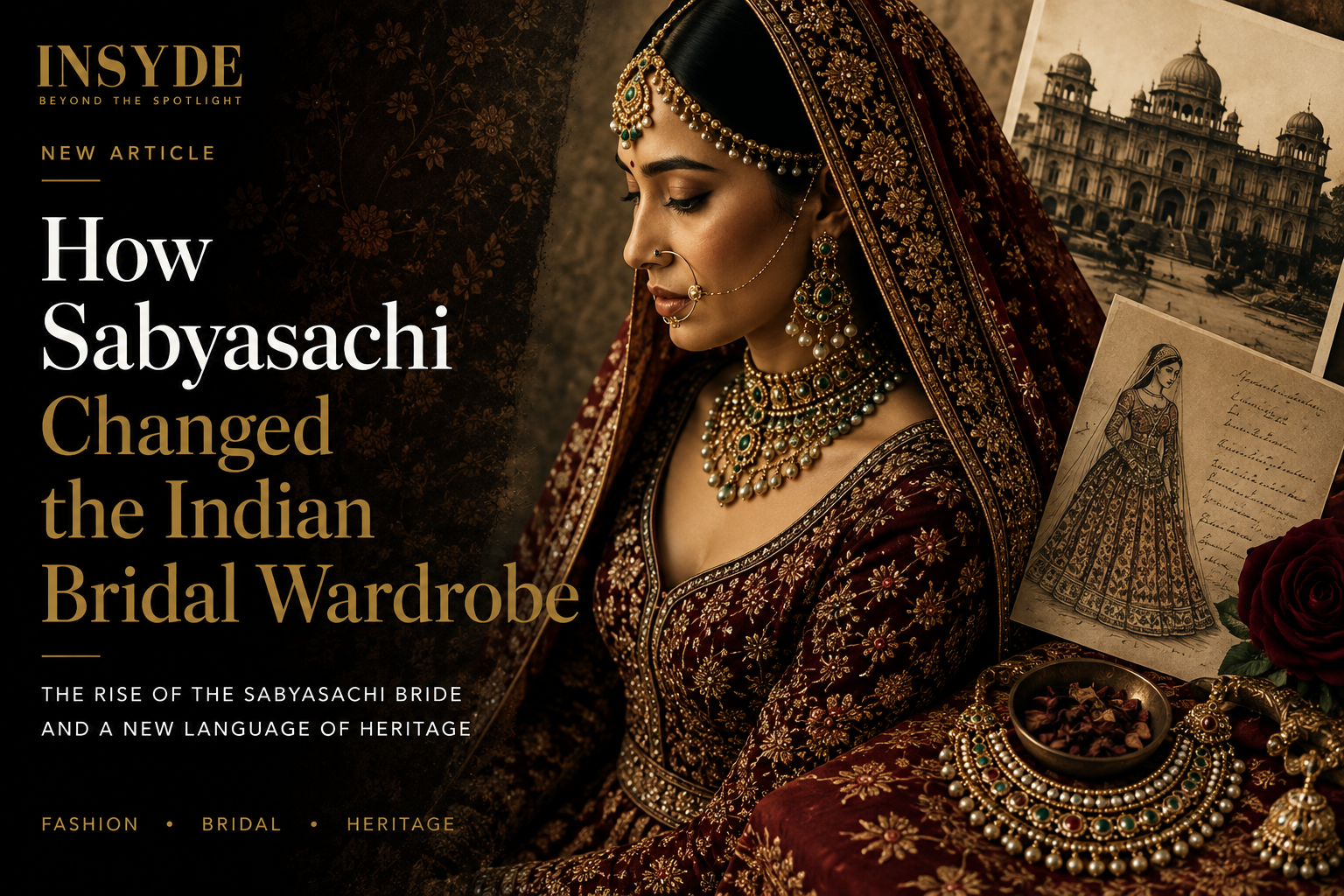
  • How Sabyasachi Changed the Indian Bridal Wardrobe

    How Sabyasachi Changed the Indian Bridal Wardrobe

    The Sabyasachi bride became more than a customer. She became a template—and eventually, one of the most recognisable visual identities in Indian fashion.

    There was a time when an Indian bride could be described by a checklist.

    A sari in one region. A lehenga in another. Gold jewellery. Red somewhere in the picture. Family traditions deciding much of the rest.

    Then the Indian wedding became something else.

    More photographed. More televised. More consumed online. More aspirational.

    And somewhere in that transformation, the bride acquired a new visual vocabulary.

    Deep colour.

    Hand embroidery.

    Old-world jewellery.

    Long-sleeved blouses.

    High-waisted lehengas.

    A certain kind of sepia-toned grandeur.

    The Sabyasachi bride had arrived.

    The designer did not invent Indian bridal fashion. Far from it. India had centuries of wedding traditions before Sabyasachi existed.

    What he did was more commercially powerful:

    He turned a collection of regional traditions, crafts and memories into a recognisable contemporary luxury aesthetic.

    The bride came after the world

    Sabyasachi’s bridal story did not begin with a wedding obsession.

    It came after years of looking outward.

    After graduating from NIFT Kolkata in 1999, the designer won the Femina British Council Most Outstanding Young Designer Award and travelled to London for an internship and research assignment at the Victoria & Albert Museum. His own account of the experience describes returning to India with a deeper understanding of India’s largely overlooked history of luxury.

    That perspective became important.

    Sabyasachi’s early collections were built around Indian craft and heritage, but they weren’t designed as historical costumes.

    They were contemporary clothes carrying old references.

    That distinction would eventually become the foundation of his bridal business.

    Chand Bibi changes the equation

    Sabyasachi launched his first bridal collection, Chand Bibi, at Lakmé Fashion Week.

    The designer describes the collection as a turning point: after spending years taking Indian fashion to international audiences, he wanted to bring what he considered the best of Indian craft and couture back into the great Indian wedding.

    The idea was deceptively simple.

    Don’t make the Indian bride choose between heritage and modernity.

    Give her both.

    The result was a bridal aesthetic that felt rooted in India’s past while still belonging to the contemporary luxury market.

    That distinction became crucial.

    Because the Sabyasachi bride didn’t look as though she had borrowed her grandmother’s wardrobe.

    She looked as though she had inherited it—and then had it remade for herself.

    Why the Sabyasachi look became so recognisable

    The Sabyasachi silhouette was never just about one garment.

    It was a combination of codes.

    The lehenga.

    The sari.

    The blouse.

    The jewellery.

    The hair.

    The colour palette.

    The embroidery.

    The setting.

    Even the photography.

    Over time, these elements became recognisable enough that the phrase “Sabyasachi bride” could describe an entire visual world.

    Vogue India has noted the designer’s influence on bridal dressing, including the high-waisted lehenga, long-sleeved blouse, conservative neckline and old-world embroidery associated with his aesthetic.

    The important word here is associated.

    A designer becomes influential when people begin recognising the design language even before they see the label.

    That is what happened.

    The colour of memory

    Sabyasachi’s bridal palette also helped distinguish him.

    Instead of relying exclusively on the predictable bright bridal red, his world expanded into deep maroons, greens, browns, pinks, muted golds and jewel tones.

    The colours felt less like a seasonal fashion palette and more like something discovered in an old photograph.

    That was part of the appeal. The bride wasn’t simply buying a beautiful outfit.

    She was buying an atmosphere.

    And atmosphere is powerful in luxury. Because clothes eventually leave the wedding.

    The photograph stays.

    The jewellery was never an afterthought

    Another reason the Sabyasachi bride became so complete was the relationship between clothing and jewellery.

    The house eventually built its own jewellery business, developing a language that combines Indian heritage with influences including North Calcutta and Byzantine art. Sabyasachi also introduced a branded mangalsutra, reinterpreting the traditional wedding necklace for a contemporary luxury audience.

    This mattered because the designer was no longer dressing only the body.

    He was shaping the entire frame.

    The blouse.

    The sari.

    The necklace.

    The earrings.

    The hair.

    The photographs.

    The wedding.

    Everything could belong to one visual universe.

    Luxury brands have long understood the power of this kind of total look.

    Sabyasachi applied it to the Indian wedding.

    Then celebrity weddings changed everything

    The Indian wedding was already important.

    Celebrity weddings made it culturally explosive.

    When a prominent bride chooses one designer across multiple wedding events, the designer is no longer simply supplying clothing.

    The designer is helping define the visual identity of the wedding itself.

    Vogue India has written about the emergence of this phenomenon in India, where celebrity couples increasingly wear the same designer across wedding events, giving the designer an opportunity to dictate the season’s bridal mood board.

    That is an extraordinary amount of cultural influence.

    One wedding can generate hundreds—or thousands—of photographs.

    Those photographs circulate through Instagram, newspapers, fashion magazines, wedding platforms and WhatsApp groups.

    The bride becomes the campaign.

    And the campaign becomes inspiration for the next bride.

    That is how an aesthetic spreads.

    The copy market is part of the story

    There is an uncomfortable compliment embedded in Sabyasachi’s success.

    His bridal designs became widely copied.

    The designer himself has spoken about the replication of his work and the enormous copy market surrounding it.

    From a business perspective, imitation is a problem.

    From a cultural perspective, it is evidence of influence.

    When a design vocabulary becomes so familiar that customers want versions of it at different price points, the designer has moved beyond fashion.

    The aesthetic has entered popular culture.

    You no longer need to buy the original to recognise the original.

    The bride became the brand

    This is where Sabyasachi’s bridal story becomes particularly interesting.

    Most fashion brands sell garments.

    Sabyasachi increasingly sold a version of the bride.

    She was romantic, but not delicate.

    Traditional, but not conservative.

    Luxurious, but not necessarily minimalist.

    Indian, without needing to explain herself.

    And importantly, she looked good in photographs.

    That last point cannot be underestimated.

    The modern Indian wedding is also a media event.

    The clothes have to work in person, under cameras, on Instagram, in videos, in family albums and in the imagination of everyone watching from outside.

    Sabyasachi’s clothes were built for that ecosystem.

    The wedding became a luxury platform

    The modern Indian wedding is increasingly an ecosystem of luxury industries.

    Fashion.

    Jewellery.

    Beauty.

    Hospitality.

    Décor.

    Photography.

    Travel.

    Food.

    Entertainment.

    Sabyasachi sits at the intersection of several of them.

    That is why his bridal business became larger than bridalwear.

    A bride buying a Sabyasachi lehenga enters a world that can include jewellery, accessories and eventually other expressions of the brand.

    The house itself has expanded into couture, ready-to-wear, jewellery, accessories and other categories.

    The wedding became an entry point.

    The house became the destination.

    But has the Sabyasachi bride changed?

    Yes.

    And this may be the most interesting part.

    The contemporary Indian bride is not necessarily looking for one rigid definition of tradition.

    Vogue India’s reporting on a newer generation of brides points toward a desire for balance: tradition and individuality, family and personal identity, the past and the present.

    That creates an interesting challenge for Sabyasachi.

    The aesthetic that once felt rebellious because it rejected generic modernity has itself become recognisable.

    The Sabyasachi bride is now a tradition.

    So what happens when the rebellion becomes the template?

    The answer may already be visible in the house’s recent work.

    At its 25th-anniversary show in Mumbai in 2025, Sabyasachi moved beyond a straightforward celebration of bridal codes. The collection mixed saris with trousers, sequins with tailoring, Japanese cotton with pashmina, and traditional craft with references ranging from Frida Kahlo to Madonna.

    The house was reminding its audience that Sabyasachi was never supposed to mean only weddings.

    The next Sabyasachi bride

    The future of the Sabyasachi bride may therefore be less about a specific lehenga.

    It may be about ownership of heritage.

    A sari worn again.

    A necklace passed down.

    A blouse separated from the lehenga and worn with something else.

    A wedding outfit treated as an heirloom rather than a one-night costume.

    That philosophy fits neatly with the house’s broader emphasis on craftsmanship, longevity and what it calls modern heirlooms.

    And it changes the meaning of luxury.

    The most luxurious garment isn’t necessarily the one that looks newest.

    It may be the one that still matters twenty years later.

    The Sabyasachi bride was never really about the bride

    That may be the secret.

    The designer didn’t simply change what Indian brides wore.

    He changed what a bridal outfit could mean.

    It could be memory.

    It could be status.

    It could be heritage.

    It could be fashion.

    It could be a family object.

    It could be a photograph.

    And it could be luxury.

    The Sabyasachi bride became powerful because she represented all of those things at once.

    The question now is whether the next generation will continue to want the same image—or whether it will take the Sabyasachi vocabulary and make it its own.

    Because fashion has a strange habit.

    First, someone creates the look.

    Then everyone wants the look.

    And finally, someone has to reinvent it.

    — INSYDE

  • The Rise of the Luxury Sneaker

    The Rise of the Luxury Sneaker

    How sneakers crossed from street culture into the world of luxury — and changed what status looks like along the way.

    There was a time when luxury had a dress code.

    A tailored jacket. A fine watch. Polished leather. A recognisable handbag. Objects whose value was understood almost immediately.

    Then came the sneaker.

    Casual. Familiar. Democratic. Designed for movement rather than ceremony.

    And somehow, it became one of fashion’s most powerful expressions of status.

    That transformation is more interesting than the sneaker’s price tag.

    Because the luxury sneaker did not become important simply because fashion houses decided to make expensive shoes. It became important because culture changed what people wanted luxury to mean.

    The sneaker brought together sport, music, youth culture, fashion and design. Luxury gave it craftsmanship, scarcity and prestige.

    The result was something neither world could have created alone.

    A new language of luxury.


    The Object That Wasn’t Supposed to Be Luxury

    The sneaker was never designed to communicate wealth.

    Its original purpose was practical: movement, comfort and performance.

    But practicality gave it something luxury could not manufacture.

    Cultural credibility.

    Sneakers were worn on basketball courts, running tracks, city streets and stages. They became intertwined with music, particularly hip-hop, and with the rise of streetwear.

    The sneaker began appearing everywhere culture was being created.

    And that changed its meaning.

    It was no longer simply footwear.

    A particular pair could communicate what music you listened to, which athletes you admired, what subculture you belonged to or how closely you followed fashion.

    The sneaker became an identity marker.

    Luxury eventually noticed.


    When the Street Met the Maison

    For decades, high fashion and street culture occupied very different territories.

    One represented heritage, craftsmanship and exclusivity.

    The other represented youth, rebellion and cultural immediacy.

    Then the boundary began to disappear.

    Luxury houses started incorporating sneakers into their collections, while streetwear gained increasing influence over the wider fashion industry.

    The meeting was inevitable.

    But it wasn’t simply luxury moving downward.

    It was luxury learning from the street.

    The sneaker offered fashion something extremely valuable: relevance.

    It was already connected to communities, music, sport and youth culture.

    Luxury could provide materials and craftsmanship.

    The street provided cultural energy.

    Together, they created a new category.


    The Collaboration Changed the Rules

    Few developments accelerated the sneaker’s transformation more than the collaboration.

    When a sneaker became the meeting point between an athlete, musician, artist, designer or fashion house, it became more than a product.

    It became a cultural event.

    Suddenly, the story surrounding the shoe could matter as much as the shoe itself.

    Who designed it?

    Who wore it?

    Why was it created?

    How many were produced?

    When was it released?

    And, perhaps most importantly:

    Could everyone get one?

    Scarcity introduced a new kind of desire.

    The sneaker began behaving less like ordinary footwear and more like a collectible.

    That was a significant moment.

    Because luxury has always understood that desire grows when access becomes selective.


    Scarcity Became a Status Symbol

    Luxury has never been purely about price.

    It is about access.

    The rare watch.

    The difficult-to-book restaurant.

    The limited edition automobile.

    The handbag that isn’t simply waiting on a shelf.

    Sneakers adopted the same psychology.

    Limited releases created urgency.

    Exclusive collaborations created communities.

    Rare editions developed their own markets.

    But there is an important distinction.

    Scarcity alone does not create value.

    There must be a reason to care.

    The most desirable sneakers usually combine rarity with cultural significance.

    They represent an athlete.

    A designer.

    A collaboration.

    A particular era.

    A moment that mattered.

    The shoe becomes valuable because it carries a story.


    When the Sneaker Became Collectible

    This is where sneaker culture began moving closer to traditional luxury collecting.

    Collectors stopped looking only at whether a shoe looked good.

    They began considering provenance.

    Condition.

    Originality.

    Production history.

    Collaboration.

    Cultural relevance.

    A rare sneaker can become interesting in much the same way as a vintage watch or classic automobile.

    Not because it is necessary.

    Precisely because it isn’t.

    The object exists beyond function.

    It becomes something to preserve, study and appreciate.

    That is one of luxury’s oldest ideas.

    And sneakers have adopted it remarkably well.


    The Luxury of Craft

    There is another reason luxury sneakers command attention: craftsmanship.

    Once high fashion began taking the category seriously, the sneaker became a canvas for experimentation.

    Leather.

    Suede.

    Technical textiles.

    Metal hardware.

    Specialised construction.

    Unexpected proportions.

    Complex soles.

    Hand-finishing.

    Details that might once have been invisible became part of the conversation.

    The sneaker could now be examined rather than simply worn.

    And that changed the perception of the object.

    It didn’t have to stop being comfortable to become luxurious.

    It could be both.

    Function and craftsmanship could coexist.

    That combination is central to modern luxury.


    The End of the Formal Luxury Uniform

    Perhaps the sneaker’s greatest cultural victory is that it helped make luxury less formal.

    The modern luxury wardrobe doesn’t necessarily require a polished leather shoe.

    A tailored trouser can meet a minimalist sneaker.

    A fine watch can sit above a relaxed silhouette.

    A luxury jacket can be paired with something deliberately casual.

    The contrast isn’t accidental.

    It is part of the language.

    Today’s sophisticated consumer often has less interest in proving that something is expensive.

    They are more interested in demonstrating that they know what works.

    That is a profound change.

    Luxury becomes less about dressing according to a rulebook and more about knowing when to break one.


    The New Status Symbol Doesn’t Always Shout

    For decades, luxury was designed to be recognised.

    Logos were visible.

    Signatures were obvious.

    The product announced itself.

    The sneaker introduced another possibility.

    Recognition could become selective.

    Someone who doesn’t follow fashion might see an ordinary pair of shoes.

    Someone who does might immediately recognise the silhouette, collaboration or material.

    That creates a subtle form of status.

    Not:

    “Everyone should know what I’m wearing.”

    But:

    “The people who understand it will know.”

    That distinction has become increasingly important in contemporary luxury.

    The audience for the signal has become smaller.

    The meaning of the signal has become deeper.


    From Logo to Language

    The most interesting luxury sneakers aren’t necessarily the loudest.

    They can be minimal.

    Almost anonymous.

    Their luxury might exist in the leather, construction, proportion or silhouette rather than a giant logo.

    That reflects a broader evolution in fashion.

    The conversation is moving from visibility to discernment.

    The question isn’t simply whether something looks expensive.

    It is whether it looks considered.

    A sneaker can now communicate taste without demanding attention.

    And that may be one of the reasons the category has become so powerful.

    It fits the psychology of a consumer who already knows what luxury looks like.

    They don’t need to announce it.


    The New Luxury Consumer

    The rise of the luxury sneaker also reflects a generational change.

    Younger consumers have never experienced fashion as a series of isolated categories.

    Music influences fashion.

    Sport influences fashion.

    Streetwear influences luxury.

    Luxury influences streetwear.

    Film, gaming, art and social media all participate in the same cultural conversation.

    For this audience, a sneaker does not need permission to belong in a luxury wardrobe.

    It already belongs.

    The old hierarchy has weakened.

    A rare sneaker can sit beside a mechanical watch.

    A vintage piece can sit beside a new luxury garment.

    A streetwear collaboration can become as culturally significant as a traditional fashion collection.

    Luxury is no longer a closed room.

    It has become a conversation.


    What Makes a Sneaker Luxury?

    The obvious answer is price.

    But price is only one ingredient.

    True luxury requires something more difficult to manufacture.

    Desire.

    A sneaker becomes luxurious when people want it for reasons beyond its practical purpose.

    Craftsmanship can create desire.

    Scarcity can create desire.

    Design can create desire.

    History can create desire.

    Cultural relevance can create desire.

    And the strongest products combine several of them.

    That is why a very expensive sneaker can feel completely unremarkable, while a much simpler pair can become iconic.

    Luxury is not the number on the receipt.

    It is the meaning attached to the object.


    The Sneaker and the Collector’s Mind

    The luxury world has always been fascinated by objects that don’t need to exist.

    Collectors buy watches even when their phones tell time more accurately.

    They collect automobiles they cannot drive every day.

    They acquire art they may rarely display.

    The value lies somewhere beyond utility.

    Sneakers now occupy that same territory.

    A collector can own dozens of pairs without needing another pair of shoes.

    The purchase is no longer about necessity.

    It is about appreciation.

    Memory.

    Identity.

    Curation.

    The collection becomes a portrait of the collector.

    And perhaps that is the final transformation of the sneaker:

    from something you wear to something that represents what you value.


    The Luxury Sneaker Is Here to Stay

    The sneaker’s rise tells us something larger about luxury.

    The definition of status has changed.

    For one generation, luxury meant formality.

    For another, it meant recognisable logos.

    Today, luxury increasingly means choice.

    Knowing what to buy.

    Knowing what not to buy.

    Understanding craftsmanship.

    Recognising cultural significance.

    Being able to move between worlds without looking as though you’re trying too hard.

    The sneaker fits perfectly into that new definition.

    It can be casual without being careless.

    Expensive without being obvious.

    Rare without being theatrical.

    Cultural without losing craftsmanship.

    That is an extraordinary amount of territory for one object to occupy.


    The Rise of the Luxury Sneaker

    The sneaker didn’t become luxurious simply because luxury fashion decided to put its name on it.

    Its transformation happened much earlier.

    Culture made it desirable.

    Sport made it iconic.

    Music gave it attitude.

    Streetwear gave it identity.

    Fashion gave it craftsmanship.

    Scarcity gave it collectability.

    And consumers gave it something even more powerful:

    meaning.

    That is why the luxury sneaker represents more than another category for fashion houses.

    It represents the changing definition of status itself.

    The old luxury question was:

    “How much does it cost?”

    The newer question is:

    “Why does it matter?”

    And perhaps that is the most modern luxury of all.

    To own something not because everyone wants it—

    but because you understand why you do.

    INSYDE — Beyond the Spotlight.

  • THE BILLIONAIRES BEHIND THE WORLD’S MOST LUXURIOUS HOTELS

    THE BILLIONAIRES BEHIND THE WORLD’S MOST LUXURIOUS HOTELS

    You know the hotel. You know the name. But do you know who actually owns the world behind it?

    Walk into one of the world’s great luxury hotels and you see the same things.

    Marble.

    Chandeliers.

    Immaculate suites.

    Private entrances.

    Restaurants where reservations can feel harder to secure than flights.

    Service so polished that almost everything appears effortless.

    But behind that effortless experience is a business most guests never think about.

    Who owns it?

    The answer is rarely as simple as the name above the entrance.

    A billionaire might own the hotel company.

    A family office might own the building.

    An investment fund might own the land.

    Another company might operate the property.

    And a global luxury group might own the brand and manage the experience.

    That complexity is not a technical footnote.

    It is the story.

    Because in 2026, some of the world’s most powerful fortunes are increasingly connected to the business of luxury hospitality.

    And the money involved is enormous.

    A $10 billion valuation for Four Seasons.

    A $3.2 billion enterprise-value acquisition of Belmond by LVMH.

    A $500 million new investment vehicle targeting Aman and Janu hotels, residences and mixed-use developments.

    A $230 million acquisition of Rosewood that helped turn it into a global luxury-hospitality group.

    These aren’t simply hotel deals.

    They are bets on the future of luxury itself.


    THE HOTEL YOU SEE IS ONLY THE FRONT END

    The first thing to understand about luxury hotels is that the brand and the building are not necessarily the same business.

    This is where the industry becomes fascinating.

    A hotel group can create the brand, design the service standards and manage the property without owning the real estate.

    A property company can own the building and hire a hotel company to operate it.

    An investment group can finance the development.

    And a billionaire can ultimately control the company sitting somewhere above all of them.

    So when someone says a billionaire “owns a hotel”, that can mean several different things.

    They may own:

    The hotel brand.

    The operating company.

    The property.

    The development company.

    Or simply a controlling stake in the company that controls the brand.

    At the top end of hospitality, understanding that distinction is essential.

    Because sometimes the most valuable thing in the building isn’t the building at all.

    It’s the name.


    AMAN: THE BILLIONAIRE WHO TURNED PRIVACY INTO AN EMPIRE

    Few names represent ultra-luxury quite like Aman.

    The brand began in 1988 with Amanpuri in Phuket and built its reputation around something that was almost the opposite of conventional luxury-hotel expansion:

    scarcity.

    Then came Vlad Doronin.

    The billionaire real-estate entrepreneur acquired Aman in 2014, after having been a long-time Aman guest himself. Since then, he has expanded the brand from secluded resorts into city hotels, residences, private clubs, interiors and new forms of travel.

    Aman has now grown into a global portfolio of hotels and resorts, while its ecosystem has expanded far beyond traditional hospitality.

    And then came the number that reveals where Aman is really heading.

    In July 2026, Doronin’s OKO Group announced a $500 million joint venture with Shinsegae Property to develop Aman and Janu hotels, branded residences and mixed-use properties.

    But the most striking part may be the residential business.

    Doronin told Bloomberg that Aman had sold close to $9 billion in branded residences over the previous four years, according to Forbes.

    Suddenly, Aman looks very different.

    It isn’t simply a company selling extraordinarily expensive hotel rooms.

    It is building a world where the same customer can stay at Aman, live at Aman, join Aman and eventually travel with Aman.

    The hotel becomes the entry point.

    The brand becomes the real asset.


    FOUR SEASONS: THE $10 BILLION BET

    If Aman represents scarcity, Four Seasons represents something else:

    global scale without abandoning luxury.

    Four Seasons is backed by Cascade Investment, associated with Bill Gates, alongside Kingdom Holding Company and founder Isadore Sharp.

    In 2021, Cascade agreed to acquire an additional 23.75% stake for $2.21 billion, taking its ownership to 71.25% and valuing Four Seasons at approximately $10 billion in enterprise value.

    That wasn’t a bet on one hotel.

    It was a bet on a global luxury machine.

    Four Seasons has continued expanding and says it has 135 hotels and resorts and 61 residential properties across 47 countries.

    And this is what makes the Four Seasons strategy so interesting.

    Aman tells the customer:

    You are entering a world very few people can access.

    Four Seasons tells the customer:

    You can expect an extraordinary standard wherever in the world you go.

    Two completely different interpretations of luxury.

    Both extraordinarily valuable.


    ROSEWOOD: THE $230 MILLION ACQUISITION

    Rosewood’s story demonstrates another way fortunes enter luxury.

    In 2011, Chow Tai Fook Enterprises, the Hong Kong company behind the Cheng family’s business empire, acquired Rosewood for roughly $230 million.

    The interesting part isn’t simply what they paid.

    It is what happened afterwards.

    Rosewood Hotel Group has expanded into a global hospitality platform, with 60 properties across 26 countries and territories and more than 30 additional properties in development.

    The group also operates other hospitality and lifestyle businesses.

    That makes Rosewood an important example of a larger trend:

    wealthy owners aren’t necessarily buying hotels to collect hotels.

    They’re buying brands that can be expanded across multiple categories.

    Hotels.

    Residences.

    Wellness.

    Private clubs.

    Experiences.

    And eventually, entire lifestyles.


    THE PENINSULA: WHEN LUXURY BECOMES A FAMILY LEGACY

    Then there is The Peninsula.

    Its story feels almost completely different.

    The Peninsula Hotels are part of Hongkong and Shanghai Hotels, a business with roots going back to 1866 and long associated with the Kadoorie family.

    Its chairman, Sir Michael Kadoorie, represents a very different model of luxury ownership: generational wealth.

    The Peninsula portfolio remains deliberately selective, with properties across major cities and destinations including Hong Kong, Shanghai, Tokyo, New York, London and Paris.

    This is not the story of a billionaire buying a trendy hospitality brand and rapidly multiplying its properties.

    It is something much older:

    generational ownership.

    That distinction matters.

    Because luxury isn’t always built through growth.

    Sometimes it is built through continuity.

    The Peninsula doesn’t need to be everywhere.

    Its power comes partly from the fact that it isn’t.


    OETKER: THE FAMILY BUSINESS BEHIND EUROPEAN HOTEL ROYALTY

    If there is one group that demonstrates the relationship between family wealth and luxury heritage, it is Oetker.

    Oetker Collection sits within the family-owned Oetker business, whose interests extend well beyond hotels.

    The group identifies Dr. Alfred Oetker and Ferdinand Oetker among its shareholders, while the wider family business spans multiple industries, including real estate and luxury hospitality.

    Its hotel portfolio includes names such as Le Bristol Paris and Hotel du Cap-Eden-Roc.

    And this is where luxury hospitality becomes different from almost every other industry.

    You can spend billions building a new hotel.

    But you cannot spend billions and instantly purchase a century of history.

    A historic address has something money alone cannot manufacture:

    memory.

    That is why heritage itself has become a luxury asset.

    You can construct a spectacular hotel in three years.

    You cannot manufacture decades of mythology.


    LVMH: WHEN THE LUXURY CONGLOMERATE ENTERS THE HOTEL BUSINESS

    Then there is the world’s ultimate luxury conglomerate.

    LVMH.

    The group already controlled brands across fashion, jewellery, watches, beauty and wine and spirits.

    Then it went deeper into hospitality.

    In 2018, LVMH agreed to acquire Belmond for $2.6 billion in equity value and $3.2 billion in enterprise value. The transaction was completed in 2019.

    Belmond brought with it hotels, restaurants, luxury trains and river cruises.

    That acquisition was important because it revealed a larger strategy.

    Luxury doesn’t have to mean selling a handbag.

    It can mean selling the entire journey surrounding the customer.

    A hotel.

    A train.

    A yacht.

    A destination.

    A restaurant.

    A fashion house.

    A piece of jewellery.

    Different products.

    One customer.

    One ecosystem.

    And in 2026, that strategy is becoming even more relevant as luxury groups push further into travel and experiential hospitality.


    THE BILLIONAIRE DOESN’T ALWAYS OWN THE HOTEL

    This is perhaps the most important part of the entire story.

    Imagine a luxury hotel carrying one of the world’s most famous names.

    The guest assumes the company behind that name owns everything.

    Not necessarily.

    The brand could belong to one company.

    The real estate could belong to another.

    The hotel operator could be a third.

    The financing could come from a fourth.

    And the ultimate investor could sit several layers above them.

    That structure is extremely common in modern hospitality.

    It allows hotel companies to expand without buying every building themselves.

    And it allows property investors to use powerful luxury brands to make their real estate more valuable.

    Which leads to perhaps the biggest transformation happening in luxury right now.


    THE REAL GOLDMINE: BRANDED RESIDENCES

    The hotel room is no longer necessarily the biggest prize.

    The residence might be.

    Luxury hotel brands are increasingly attaching their names to private residences.

    Why?

    Because selling a hotel room generates revenue from a stay.

    Selling a branded residence can create an enormous property transaction — while allowing the hotel company to earn branding, management and service fees without necessarily owning the entire building.

    Aman is one of the clearest examples.

    According to Forbes’ 2026 reporting, Aman has sold close to $9 billion in branded residences in four years, while Savills data cited in the same report indicated that buyers globally were willing to pay an average 33% premium for branded residences over comparable unbranded homes.

    That is a staggering proposition.

    Imagine buying an apartment.

    Now put a globally recognised luxury hotel brand on the front.

    Add hotel-level service.

    Concierge.

    Housekeeping.

    Wellness.

    Restaurants.

    Private clubs.

    Then charge a premium for the privilege.

    Suddenly the hotel brand is no longer just selling hospitality.

    It is selling real estate at a premium.


    WHY BILLIONAIRES WANT INTO HOSPITALITY

    So why would someone who already has billions want to own hotels?

    The obvious answer is money.

    But it isn’t the only answer.

    Luxury hospitality sits at an unusual intersection of industries.

    Real estate.

    Travel.

    Food.

    Fashion.

    Entertainment.

    Culture.

    Private wealth.

    A luxury hotel can become a meeting place for CEOs.

    A destination for celebrities.

    A home-away-from-home for billionaires.

    A platform for restaurants and chefs.

    A gateway into a city.

    A launchpad for branded residences.

    A private club.

    And a physical expression of a luxury brand.

    That makes the hotel much more powerful than a simple accommodation business.

    It becomes a social and commercial ecosystem.


    FROM ROOMS TO WORLDS

    This is where the luxury-hospitality business is ultimately heading.

    A hotel room was once the product.

    Then came the suite.

    Then the villa.

    Then the residence.

    Then the private club.

    Then the yacht.

    Then the private travel experience.

    The customer doesn’t necessarily want to buy one thing anymore.

    They want an entire world that feels consistent with their lifestyle.

    Aman understands this.

    Four Seasons understands this.

    LVMH understands this.

    Rosewood understands this.

    And the investors behind these companies understand something even more important:

    The luxury customer doesn’t stop being a luxury customer when they leave the hotel.

    So why should the brand stop selling to them?


    THE NEW LUXURY POWER PLAY

    This changes the economics of luxury.

    The most valuable hospitality brands aren’t necessarily the ones with the most rooms.

    They may be the ones that can convince customers to spend across the greatest number of categories.

    Stay at the hotel.

    Buy the residence.

    Join the club.

    Book the experience.

    Take the yacht.

    Return to another property.

    Bring the same brand into your lifestyle.

    That is a much bigger business than hotel occupancy.

    And it explains why billionaires, family fortunes and luxury conglomerates continue to look at hospitality as more than a place to park capital.

    They are buying access to a customer.


    SO, WHO REALLY OWNS LUXURY?

    There is no single answer.

    Vlad Doronin controls Aman.

    Cascade Investment is the controlling shareholder behind Four Seasons.

    The Cheng family’s Chow Tai Fook Enterprises controls Rosewood.

    The Kadoorie family sits behind The Peninsula’s long-running ownership structure.

    The Oetker family controls its luxury hospitality and wider family business.

    LVMH controls Belmond and has built a growing luxury-hospitality ecosystem around it.

    Different fortunes.

    Different generations.

    Different strategies.

    But they are all betting on the same fundamental idea:

    Luxury is becoming less about a product and more about an ecosystem.


    THE PEOPLE YOU NEVER SEE

    The guests are visible.

    The hotel is visible.

    The logo is visible.

    The billionaire behind the business usually isn’t.

    You won’t see them standing in the lobby.

    You probably won’t know which investment vehicle owns the building.

    You may never know which company controls the brand.

    And you certainly won’t see the spreadsheets behind the marble.

    But those decisions determine where the next hotel opens.

    Which neighbourhood becomes fashionable.

    Which destination receives billions in development.

    Which brands remain exclusive.

    Which become global.

    And which luxury experiences become available only to those who can afford them.

    That is the hidden side of hospitality.

    Not the room.

    Not the restaurant.

    Not the view.

    The ownership.

    Because the next time you walk into one of the world’s most luxurious hotels, look beyond the chandelier.

    Ask who owns the building.

    Who owns the brand.

    Who operates it.

    Who financed it.

    And who stands to benefit when the world’s wealthiest people decide they want to stay there.

    Because sometimes, the most interesting person in the hotel…

    is the one you never see.

    INSYDE — Beyond the Spotlight.

  • How Sabyasachi Built a Global Indian Luxury House | INSYDE

    How Sabyasachi Built a Global Indian Luxury House | INSYDE

    The Sabyasachi label began with three people and ₹20,000. Today, it spans couture, jewellery, retail, beauty, art and international markets. The real story is how a designer turned an aesthetic into an entire luxury ecosystem.

    A fashion label sells clothes.

    A luxury house sells something much harder to manufacture:

    a world.

    Sabyasachi has spent more than two decades building one.

    The clothes came first.

    Then came bridalwear.

    Then jewellery.

    Then accessories.

    Then stores that looked more like museums.

    Then international expansion.

    Then beauty.

    Then art.

    Then collaborations with global companies.

    At some point, calling Sabyasachi simply a fashion label stopped being enough.

    The more interesting question became:

    How did one designer turn a very specific idea of India into a global luxury business?

    The original ambition was never small

    The Sabyasachi story starts with an unusually clear ambition.

    After graduating from NIFT Kolkata in 1999, Sabyasachi rejected job offers from established designers and started his own label. His official history says he borrowed ₹20,000 from his family and began with a workforce of three.

    The ambition, according to the brand, was to create India’s biggest luxury house.

    That is important because it changes how we read everything that followed.

    The jewellery wasn’t a random extension.

    The stores weren’t simply retail expansion.

    The beauty collaboration wasn’t just another licensing opportunity.

    They were pieces of a larger plan.

    The goal was never only to design clothes.

    It was to build a house.

    The luxury proposition was craft

    The foundation of the business is not celebrity.

    It is craftsmanship.

    Sabyasachi’s official history describes work with weavers, block printers, embroiderers, dyers, goldsmiths, furniture artisans and other craftspeople across India. It currently says the house employs around 1,000 craftspeople and works regularly with more than 3,000 craftspeople and master weavers.

    That network gives the brand something modern luxury increasingly values:

    provenance.

    Where was it made?

    Who made it?

    How long did it take?

    What technique was used?

    What region does it come from?

    These questions turn an object into a story.

    And luxury has always been very good at selling stories.

    Sabyasachi’s innovation was to argue that India’s enormous craft tradition could be the foundation of a luxury proposition rather than simply a source of inspiration.

    The house explicitly describes the future of artisanal crafts and handwoven textiles as lying in luxury.

    That is not just a design philosophy.

    It is a business philosophy.

    The bridal business created the ecosystem

    Couture created prestige.

    Bridalwear created demand.

    Jewellery expanded the relationship.

    The wedding became the perfect environment for a luxury house because the customer often needs multiple categories at once.

    Clothing.

    Jewellery.

    Accessories.

    Beauty.

    Sometimes even décor and hospitality.

    Sabyasachi’s first bridal collection, Chand Bibi, marked a major turning point in the brand’s growth and helped establish what became known as the “Sabyasachi bride.”

    But the important business insight was broader.

    A bride doesn’t necessarily want a single product.

    She wants a world around the occasion.

    Sabyasachi was well positioned to provide it.

    Then jewellery became its own business

    The launch of Sabyasachi Jewellery was a significant step because jewellery is not simply another category of fashion.

    It changes the economics and lifespan of the relationship with the customer.

    A couture garment may be purchased for an occasion.

    Jewellery can become an heirloom.

    The house developed its jewellery language around Indian heritage, North Calcutta references and Byzantine influences. It also introduced a branded mangalsutra, presenting the traditional wedding necklace through a contemporary luxury lens.

    The jewellery business expanded internationally, including retail at Bergdorf Goodman and dedicated spaces in the brand’s New York and Mumbai stores.

    This was an important evolution.

    The customer no longer had to leave the Sabyasachi universe to complete the look.

    The house could increasingly provide the look itself.

    The store became the advertisement

    Then came retail.

    But Sabyasachi did not treat the store as somewhere to put clothes.

    The brand describes its retail spaces as “living museums.”

    The Mumbai flagship, opened in the city’s heritage district in 2023, expanded the idea dramatically. The brand describes the 25,862-square-foot space as its largest flagship, bringing together bridal and couture, ready-to-wear, jewellery, archival pieces and other elements of the Sabyasachi world.

    The New York flagship had already opened in 2022.

    The current official store network includes Kolkata, Mumbai, Delhi, Hyderabad, Bengaluru and New York.

    This is more than expansion.

    It is brand theatre.

    A luxury customer isn’t simply entering a shop.

    They are entering the story.

    And once the physical environment becomes distinctive enough, the store itself becomes marketing.

    People photograph it.

    Publications cover it.

    Visitors remember it.

    The building becomes part of the brand.

    New York wasn’t just another store

    The New York expansion carried a specific ambition.

    The brand described the goal as changing perceptions of Indian luxury—from “made in India” to “designed and made in India.”

    That distinction goes to the heart of Sabyasachi’s global strategy.

    The brand did not want India to be viewed simply as a production location.

    It wanted India to be understood as a source of design authority.

    That is a much bigger proposition.

    It changes the relationship between Indian luxury and the rest of the world.

    India is no longer merely where the artisan sits.

    India is where the luxury story begins.

    Collaboration without losing the identity

    Sabyasachi has also used collaborations as a way of extending the brand without abandoning its visual language.

    The house has worked with names including Christian Louboutin, H&M, Pottery Barn, Starbucks and Estée Lauder.

    The H&M collaboration is particularly interesting.

    It brought Sabyasachi into a mass global retail environment and included the retailer’s first sari. The collection was made available across approximately 50 countries, and the brand’s own history says the Indian online launch saw Myntra crash shortly after release, with the collection selling out rapidly.

    That kind of collaboration can easily dilute a luxury brand.

    Instead, it demonstrated something useful:

    recognition can travel across price points.

    People who could not access couture could still encounter the Sabyasachi universe.

    The brand remained aspirational.

    Then came beauty

    Beauty was a more significant move than it might initially appear.

    In its 25th year, Sabyasachi became the first Indian brand to collaborate with Estée Lauder on a global collection, launched across more than 20 countries.

    Why beauty?

    Because luxury houses don’t only sell what people wear.

    They sell codes.

    Colours.

    Textures.

    Packaging.

    Objects.

    Rituals.

    Beauty allowed Sabyasachi to take its visual identity into a category with a different price structure and a much wider global audience.

    The product changed.

    The world did not.

    That’s the real power of a luxury house.

    The corporate engine

    Behind the romance is another reality.

    Scaling a luxury business requires capital and infrastructure.

    In 2021, Aditya Birla Fashion and Retail acquired a 51% stake in Sabyasachi Calcutta LLP. ABFRL continues to include Sabyasachi within its designer-led ethnic portfolio.

    This relationship matters because it gives the house access to a larger corporate platform while the Sabyasachi identity remains the creative centre.

    And there is a larger lesson here.

    A designer can create desire.

    But a business has to deliver it.

    Supply chains.

    Retail.

    Inventory.

    International distribution.

    People.

    Technology.

    Capital.

    A global luxury house needs all of them.

    The glamour is the visible part.

    The infrastructure is the reason the glamour can exist at scale.

    The art foundation changes the definition again

    Another recent development pushes Sabyasachi beyond conventional fashion.

    The Sabyasachi Art Foundation opened its first gallery at Nilaya Anthology, with an inaugural exhibition by artist Atish Mukherjee. The brand describes the initiative as part of its commitment to cultural stewardship and to creating a permanent home where art can be nurtured and exhibited.

    This is strategically interesting.

    Because once a fashion brand begins collecting, exhibiting and supporting art, its cultural authority starts to change.

    It is no longer only making products.

    It is participating in cultural preservation.

    That is a much more ambitious position.

    Twenty-five years later, the house looks back

    The 25th-anniversary show in Mumbai in 2025 made the evolution visible.

    More than 150 looks revisited the Sabyasachi vocabulary while mixing traditional Indian craft with international references. Vogue described the show as a return to Calcutta and to the designer’s foundational aesthetic.

    The timing was significant.

    The house had spent years expanding outward.

    Now it was looking backward.

    But not nostalgically for nostalgia’s sake.

    The past had become an asset.

    The archive had become a resource.

    The signature had become a business advantage.

    And now the house is going back to New York

    The next chapter is already taking shape.

    The CFDA’s official preliminary September 2026 schedule lists Sabyasachi by Sabyasachi Mukherjee for New York Fashion Week on September 15, 2026.

    The return matters because the house is no longer arriving in New York as an ambitious young Indian label.

    It arrives with:

    A mature couture business.

    A global jewellery operation.

    International retail.

    A recognised visual identity.

    A craft ecosystem.

    Corporate backing.

    And a much larger understanding of what an Indian luxury house can be.

    The runway is almost the least interesting part.

    The interesting part is everything that had to be built before the runway could matter.

    So, what actually makes Sabyasachi a luxury house?

    It isn’t the price.

    It isn’t the celebrity list.

    It isn’t even the craftsmanship on its own.

    It is consistency.

    The same world appears across clothing.

    Jewellery.

    Stores.

    Beauty.

    Art.

    Packaging.

    Photography.

    Collaborations.

    The customer knows what Sabyasachi means before seeing the product.

    That is one of the hardest things to build in luxury.

    A recognisable world.

    The real Sabyasachi business

    There is a reason Sabyasachi has become such an interesting case study for Indian luxury.

    He didn’t build the business by abandoning India.

    He built it by making India itself part of the brand proposition.

    The craft is Indian.

    The references are Indian.

    The nostalgia is Indian.

    The jewellery is Indian.

    The wedding is Indian.

    But the ambition is global.

    That combination is what makes the house interesting.

    Because the real product isn’t a lehenga.

    It isn’t a necklace.

    It isn’t a store in New York.

    The product is the belief that all of these things belong together.

    That they can form one coherent world.

    And perhaps that is what separates a successful designer from a luxury house.

    A designer creates beautiful things.

    A luxury house creates meaning around those things.

    Sabyasachi has spent twenty-five years building that meaning.

    Now the question is no longer whether Indian luxury can travel.

    It already has.

    The question is how far the Sabyasachi idea of India can travel with it.

    — INSYDE

  • The Director Effect

    The Director Effect

    How cinema’s most successful filmmakers turned their names into a reason to buy the ticket.

    There was a time when the name above a film’s title usually belonged to the star.

    The actor was the attraction. The face was the campaign. The opening weekend belonged to the celebrity whose name appeared largest on the poster.

    The director was often the person behind the curtain.

    That relationship has changed.

    Today, a select group of filmmakers have developed something remarkably powerful: a name that carries its own promise.

    A Nolan film suggests one kind of experience. A Spielberg film another. A Cameron film another. In India, Rajamouli, Bhansali and, increasingly, Aditya Dhar have begun building similarly recognisable creative identities.

    The audience may not know every detail of the story.

    They may not even need to.

    The filmmaker’s name already tells them something about what they are about to experience.

    Scale.

    Craftsmanship.

    Aesthetic.

    Ambition.

    Emotion.

    Spectacle.

    That is when a director stops being simply the person who made the film.

    The director becomes part of the reason to see it.


    When the Name Becomes the Attraction

    The interesting shift isn’t that directors have become famous.

    Great directors have always been famous.

    The shift is that their names increasingly influence the audience’s decision to watch the film itself.

    Christopher Nolan offers perhaps the clearest contemporary example.

    The Odyssey arrived in 2026 with an extraordinary cast including Matt Damon, Tom Holland, Anne Hathaway, Lupita Nyong’o and Zendaya. Yet the conversation surrounding the film was never simply about its cast.

    It was about a Christopher Nolan film.

    The film opened to $264.1 million worldwide and went on to cross $1.4 billion globally, demonstrating the extraordinary theatrical power that can now surround a filmmaker’s name.

    The significance goes beyond the numbers.

    Nolan has reached a point where audiences can recognise the experience before they know the story.

    That is brand recognition.


    Christopher Nolan — The Event Maker

    Nolan’s greatest achievement may not be any individual film.

    It may be that he has transformed the act of going to the cinema into part of his identity as a filmmaker.

    IMAX.

    Large-format film.

    Practical effects.

    Immersive sound.

    Complex narratives.

    Scale.

    Mystery.

    His films arrive with a sense of occasion.

    His relationship with IMAX has become particularly important to that identity. The Odyssey generated an extraordinary opening for the format, reinforcing the idea that Nolan’s films are designed not merely to be watched but to be experienced theatrically.

    Nolan therefore sells something more than a story.

    He sells the experience of cinema itself.

    That is why audiences can become interested in a Nolan film before they know exactly what happens in it.

    The name tells them enough.


    Steven Spielberg — The Pioneer

    Long before directors were discussed as personal brands, Steven Spielberg had already established the model.

    Jaws didn’t simply become a hit.

    It helped define the modern blockbuster.

    Spielberg’s name eventually came to represent something unusually broad:

    Adventure.

    Emotion.

    Spectacle.

    Humanity.

    Family.

    History.

    Science fiction.

    The remarkable part is the range.

    A Spielberg film doesn’t have to belong to one genre to feel like a Spielberg film.

    That is one of the defining characteristics of a mature creative brand.

    The identity survives the category.

    His name became associated with a particular standard of mainstream cinematic storytelling, helping establish the idea that the filmmaker could become part of the commercial identity of a movie.

    Decades later, the name still carries that accumulated trust.

    And that is perhaps the purest form of brand equity:

    recognition built over time.


    James Cameron — The Spectacle

    If Spielberg helped build the modern blockbuster, James Cameron pushed the idea of spectacle into technological territory.

    Titanic, Avatar and Avatar: The Way of Water place Cameron in an extraordinarily rare commercial category.

    But the more interesting part isn’t simply their box-office performance.

    It is the way Cameron approaches technology.

    He doesn’t merely use new tools.

    He frequently pushes the industry to develop them.

    For Avatar, his production team developed new approaches to performance capture, virtual environments and 3D filmmaking to realise the world he had imagined.

    The technology became part of the storytelling.

    That has become part of the Cameron promise.

    When a Cameron film arrives, audiences expect something that stretches the boundaries of what cinema can physically display.

    The technology becomes part of the spectacle.

    And the director becomes the guarantee.


    India’s Director-Brand Era

    The phenomenon isn’t uniquely American.

    In fact, some of the most interesting examples are emerging from India.

    Indian cinema has always had powerful stars, but a new generation of filmmakers has demonstrated that a director’s name can carry an increasingly independent form of commercial and cultural value.

    The difference is subtle.

    The audience isn’t simply asking who is acting in the film.

    It is beginning to ask:

    Who is creating this world?


    S. S. Rajamouli — The Global Phenomenon

    S. S. Rajamouli may be the clearest contemporary example of an Indian filmmaker whose name has become associated with a global theatrical proposition.

    Baahubali established the scale.

    RRR expanded the international audience.

    His cinema carries a recognisable promise:

    Mythology.

    Emotion.

    Heroism.

    Music.

    Large-scale action.

    World-building.

    Spectacle.

    But Rajamouli’s influence has increasingly travelled beyond the traditional boundaries of Indian cinema.

    His international reception and the global ambitions surrounding his upcoming projects demonstrate how far that directorial identity has travelled.

    The important shift is that Rajamouli is no longer simply exporting individual films.

    He is exporting a cinematic language.

    Audiences increasingly understand what a Rajamouli experience promises before the opening frame.

    That is a powerful form of authorship.


    Sanjay Leela Bhansali — The Aesthetic

    If Rajamouli’s name promises spectacle, Sanjay Leela Bhansali’s promises something more intimate:

    a world.

    Mention Bhansali and an audience can almost imagine the frame before seeing it.

    Architecture.

    Jewellery.

    Textiles.

    Music.

    Choreography.

    Romance.

    Colour.

    Light.

    Grandeur.

    His films have developed such a distinctive visual vocabulary that the director’s name itself functions almost like an aesthetic category.

    That is a particularly sophisticated form of brand recognition.

    A luxury house can communicate through a silhouette.

    An architect can communicate through proportion.

    A watchmaker can communicate through a movement.

    Bhansali communicates through the frame.

    His films feel authored down to the smallest detail.

    The sets, costumes, musical sequences and compositions all belong to the same universe.

    And that consistency creates expectation.

    The audience knows what kind of world it is entering.

    The question isn’t whether it will be beautiful.

    The question is how Bhansali will make beauty feel this time.


    Aditya Dhar — The New Force

    Aditya Dhar represents a different stage of director-brand power.

    His career is considerably younger than those of Spielberg, Cameron, Nolan, Rajamouli or Bhansali, but that is precisely what makes his rise interesting.

    Uri: The Surgical Strike established his directorial identity through political tension, action and a grounded sense of scale.

    The Dhurandhar films expanded that identity dramatically.

    The commercial response has demonstrated that Dhar is increasingly associated with a particular cinematic proposition: political narratives, high-stakes action, technical ambition and large-scale world-building.

    That matters because a director does not necessarily need decades to build a recognisable identity anymore.

    In an environment where audiences are exposed to more content than ever, a distinctive creative voice can become recognisable remarkably quickly.

    Dhar represents the newer model of the director as a commercial force.

    His story is still being written.

    But the audience is beginning to recognise the promise.


    The Director as a Luxury Brand

    This is where cinema begins to resemble luxury.

    A luxury house doesn’t simply sell an object.

    It sells an expectation.

    You don’t choose a watch only because it tells time.

    You choose its history, craftsmanship, design language and reputation.

    You don’t choose a fashion house merely because it produces clothing.

    You choose its interpretation of clothing.

    The same principle increasingly applies to filmmakers.

    A Nolan film promises one kind of experience.

    A Cameron film another.

    A Rajamouli film another.

    A Bhansali film another.

    The audience is not simply purchasing a ticket.

    It is purchasing an expectation of authorship.

    That is the real shift.


    From Star Power to Auteur Power

    For decades, cinema was built around the star system.

    The actor was the brand.

    The actor’s face sold the poster.

    The actor’s name drove the opening.

    That power hasn’t disappeared.

    But audiences now have another way of choosing.

    Franchises have multiplied.

    Streaming has expanded the amount of content available.

    The number of films competing for attention has become enormous.

    In that environment, a recognisable creative voice becomes valuable.

    A filmmaker with a distinct identity provides something a new concept otherwise lacks:

    trust.

    The audience may not know the entire story.

    But they know the person telling it.

    And sometimes that is enough.


    The New Currency Is Expectation

    Perhaps the most valuable thing a filmmaker can build is not fame.

    It is expectation.

    When a director reaches that level, a new project becomes news before the trailer arrives.

    A new Nolan project becomes an event.

    A new Cameron project becomes an event.

    A new Rajamouli project becomes an event.

    A new Bhansali project becomes an event.

    The filmmaker’s previous work has already performed part of the marketing.

    The reputation precedes the film.

    That is exactly how powerful luxury brands operate.

    The name creates anticipation before the object is experienced.


    The Risk of Becoming a Brand

    There is, however, a paradox.

    A brand creates expectations.

    And expectations can become a prison.

    The more recognisable a filmmaker becomes, the more audiences expect the next film to resemble the last.

    Nolan must remain Nolan.

    Bhansali must remain Bhansali.

    Rajamouli must remain Rajamouli.

    But if a signature becomes too predictable, it can become formula.

    The strongest creative brands therefore face the same challenge as the strongest luxury houses:

    How do you remain recognisable without becoming predictable?

    The answer is evolution.

    Preserve the philosophy.

    Change the expression.

    A signature should be a foundation, not a cage.


    The Future Belongs to the Signature

    The future of theatrical cinema will not belong entirely to actors.

    Nor will it belong exclusively to franchises.

    Both will remain powerful.

    But as audiences become more selective about which films deserve their time, money and attention, authorship becomes increasingly valuable.

    A filmmaker with a recognisable voice offers something a generic production cannot.

    A reason to anticipate.

    A reason to care.

    A reason to believe the experience will be different.

    That may explain why the modern director is becoming something more than the person who makes the film.

    The director is becoming part of the reason the film exists in the audience’s imagination before it arrives.


    The Director Is the Brand

    The most interesting evolution in cinema may therefore be happening above the title.

    Not in the cast list.

    Not in the franchise logo.

    But in the name of the person who imagined the world.

    Spielberg built the modern blockbuster.

    Cameron turned technology into spectacle.

    Nolan turned theatrical cinema into an event.

    Rajamouli transformed scale into a global Indian cinematic language.

    Bhansali turned visual beauty into authorship.

    Dhar is demonstrating how quickly a contemporary filmmaker can build a commercial identity around a distinct worldview.

    Six directors.

    Six different forms of influence.

    But one underlying shift.

    The audience isn’t always asking:

    “What is this film about?”

    Increasingly, it is asking:

    “Who made it?”

    And when the answer itself is enough to make someone buy a ticket, the filmmaker has crossed an important line.

    They are no longer simply making the brand.

    They have become the brand.

    INSYDE — Beyond the Spotlight.