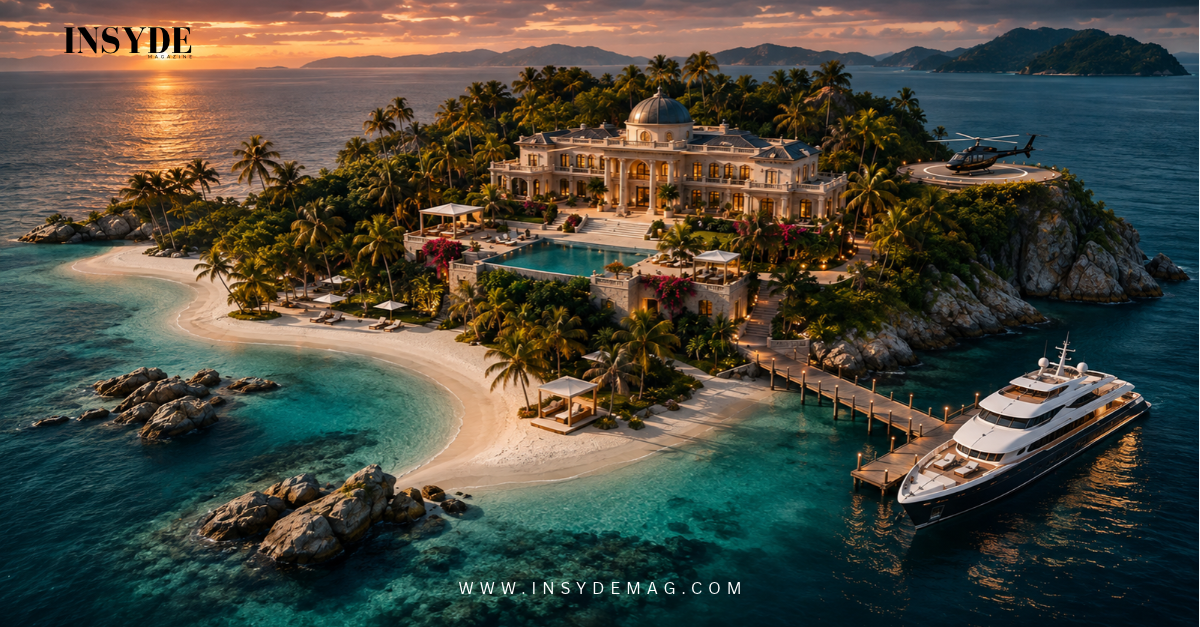
Beyond turquoise waters and secluded shores lies a world of extraordinary wealth, private ownership and the pursuit of absolute exclusivity. From billionaire retreats and multimillion-dollar estates to institutional investments in island destinations, private islands are becoming one of the most fascinating intersections of luxury real estate and global hospitality.
INSYDE MAGAZINE | PRIVATE ISLAND
There is a particular kind of luxury that cannot be found in a penthouse overlooking Manhattan, a private members’ club in London or even the presidential suite of the world’s most celebrated hotel. It is the luxury of an entire island — a private stretch of coastline, an uninterrupted horizon and the freedom to decide who enters your world.
For centuries, islands have represented power, escape and privilege. Today, they occupy an increasingly intriguing position within the global luxury economy. Some are extraordinary private residences belonging to wealthy individuals and families. Others have become sophisticated hospitality destinations, attracting international hotel groups, institutional investors and travellers willing to pay a premium for experiences that conventional luxury properties cannot easily replicate.
Yet beneath the romance of palm-lined beaches and secluded villas lies a far more complicated proposition. Acquiring an island involves navigating property rights, infrastructure, environmental regulations and substantial operating costs. Developing one into a commercially successful destination requires an entirely different level of capital and expertise.
The private island is no longer simply a symbol of having made it. In the right circumstances, it can be a real estate holding, a hospitality business and an exceptionally scarce destination.
The question is no longer just who can afford paradise. It is who can own it, develop it and make it last.
THE NEW CURRENCY OF EXCLUSIVITY
Luxury has always been associated with access. But as the world’s affluent consumers become increasingly experienced in high-end travel, the definition of exclusivity is evolving.
The traditional markers of luxury — five-star accommodation, first-class travel and prestigious destinations — are increasingly complemented by something considerably harder to obtain: privacy, personalisation and control over the experience.
The 2026 Virtuoso Luxe Report, based on insights from more than 2,400 travel advisers across over 50 countries, offers an indication of this changing landscape. Nearly half of the advisers surveyed anticipated a slight increase in luxury travel demand for 2026, while 18 per cent expected a significant increase. Furthermore, 55 per cent anticipated modest growth in spending per trip.
The report identifies beach resort stays, multigenerational travel, cultural immersion and expedition experiences among the leading luxury travel trends.
These findings point towards a consumer who increasingly values the quality and individuality of an experience rather than accommodation alone.
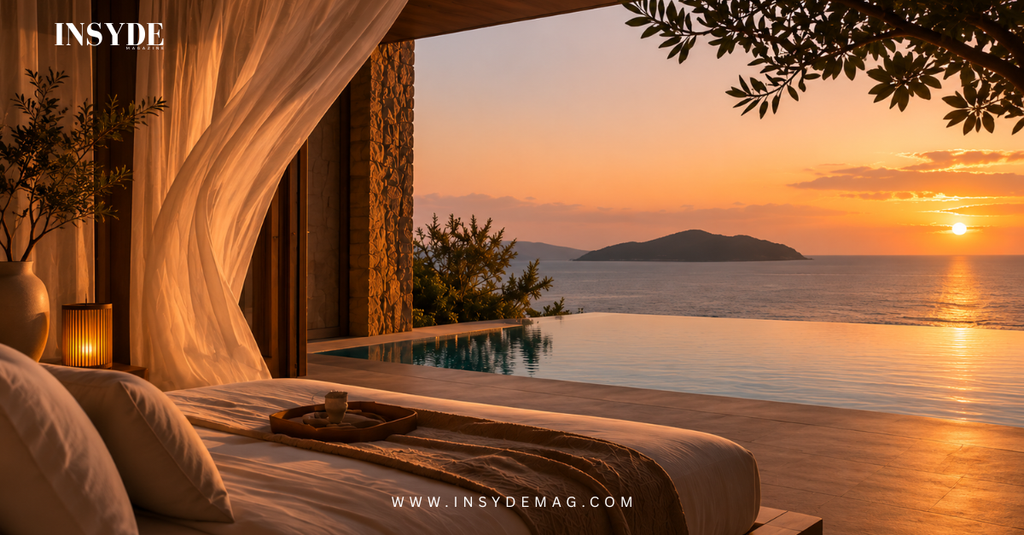
An exceptional hotel suite can offer comfort. A private villa can provide discretion. An entire island, however, presents a different proposition altogether: the ability to determine the surroundings, the company, the pace and, to a significant extent, the boundaries of the experience.
For ultra-high-net-worth individuals, families and discerning travellers, this is where the appeal of private island living becomes particularly compelling.
Privacy is not simply an amenity. It is part of the product.
THE PRICE OF PARADISE
Owning an island sounds like the ultimate expression of financial freedom. The reality is considerably more complex.
The international private island property market is fragmented, with opportunities varying significantly by geography, ownership structure, infrastructure and development potential. There is no sufficiently comprehensive, independently audited global database that establishes the total value or annual transaction volume of privately owned islands.
Nevertheless, property listings offer a glimpse into the extraordinary range of opportunities available.
Consider Little Norman’s Cay in the Bahamas. Marketed through Bahamas Sotheby’s International Realty at an asking price of US$75 million, the 35-acre private island features a substantial residential estate comprising 15 bedrooms and 16 bathrooms.
At the other end of the market, Sotheby’s International Realty’s Bahamas private-island listings have featured properties advertised for considerably lower amounts, including Swain’s Cay at US$1.5 million.
These figures are asking prices, not verified completed transactions. They also represent properties with very different levels of development, accessibility and infrastructure.
The difference between purchasing an undeveloped island and acquiring an established private estate can be substantial.
There is another distinction that prospective buyers must understand: ownership does not necessarily mean unrestricted freehold title. Depending on the jurisdiction, an acquisition may involve freehold property, leasehold interests, government concessions or other forms of land-use rights. Foreign ownership restrictions, planning permissions and environmental approvals can fundamentally change what is being acquired.
And then there is the cost of making the island functional.
Electricity generation, freshwater production, desalination, wastewater treatment, telecommunications, marine transportation, staff accommodation and emergency facilities are essential components of a developed island property.
The financial commitment extends beyond construction. Staffing, maintenance, insurance, security, logistics and environmental management create recurring expenditure that can be considerable, particularly in remote locations.
A relatively inexpensive undeveloped island may ultimately require a larger capital commitment than a more expensive property with established infrastructure.
The true price of paradise, therefore, is not determined by its coastline alone. It is determined by what it takes to sustain life and luxury there.
WHEN AN ISLAND BECOMES AN INVESTMENT
The growing intersection between luxury real estate and hospitality investment is perhaps the most interesting development in the modern island economy.
An island with established hotels, restaurants, transportation infrastructure, a marina and commercial operations is fundamentally different from an undeveloped private property. It represents an operating destination with multiple revenue streams and the potential for long-term value creation.
This is where institutional capital enters the picture.
According to JLL’s 2026 Global Hotel Investment Outlook, global hotel direct investment volumes in 2025 increased by 22 per cent compared with the 2023 trough. Hotels accounted for approximately eight per cent of global commercial real estate investment volumes in 2025, exceeding their long-term average share.
JLL also identifies luxury resorts and trophy hospitality assets as increasingly attractive investment targets, supported by investor appetite for exceptional properties and the availability of institutional capital.
The regional picture, however, is not uniform. While hotel transaction volumes increased across the Americas and Europe, Asia-Pacific experienced a 20 per cent decline in 2025. JLL nevertheless identifies improving conditions and renewed investment opportunities in the region for 2026.
These figures describe the broader hospitality investment market, not private island transactions specifically. Their relevance lies in the investment environment surrounding extraordinary destinations.
One of the clearest illustrations is Hamilton Island in Australia’s Whitsunday Islands.
THE HAMILTON ISLAND DEAL: WHEN PRIVATE PARADISE ATTRACTS INSTITUTIONAL CAPITAL
In December 2025, global alternative asset manager Blackstone announced an agreement to acquire Hamilton Island from the Oatley family through its real estate funds.
The scale of the destination makes the transaction particularly significant.
According to Blackstone’s official acquisition announcement, Hamilton Island spans more than 2,800 acres across two islands, approximately 70 per cent of which remains undeveloped.
Its existing infrastructure includes five hotels, more than 20 restaurants and bars, 20 retail outlets, an 18-hole championship golf course on neighbouring Dent Island, a marina and a commercial airport.
Located within the World Heritage-listed Great Barrier Reef region, the destination combines natural assets with an established hospitality and tourism operation.
The importance of the transaction extends beyond its geographical scale.
For an institutional investor such as Blackstone, an integrated island destination offers the possibility of combining real estate ownership interests, hospitality operations, destination management and long-term development opportunities within a single investment.
The transaction also demonstrates why an established island destination can attract a very different category of buyer from an individual purchasing a secluded residential island.
The latter may be seeking privacy and personal enjoyment. The former is evaluating operating performance, capital expenditure, tourism demand, infrastructure, development potential and long-term returns.
Hamilton Island is therefore an important case study in how exceptional island destinations can become institutional-scale hospitality assets.
It also illustrates an important distinction: the acquisition announced by Blackstone concerns an integrated resort destination and its associated interests, not necessarily unrestricted freehold ownership of every parcel of land across both islands.
THE INDIAN OCEAN: WHERE ISLAND LUXURY MEETS GLOBAL DEMAND
Few destinations embody the modern private island experience quite like the Maldives.
Its combination of secluded resorts, private villas, marine experiences and high-end hospitality has established the country as one of the world’s most recognisable luxury island destinations.
Yet beyond its international reputation lies an important economic story.
According to the Maldives Monetary Authority’s 2025 Annual Report, the country welcomed 2,246,516 international visitors in 2025, representing growth of approximately 9.8 per cent over the previous year.
Tourism receipts reached an estimated US$5.57 billion, compared with approximately US$4.79 billion in 2024.
The figures underline the economic importance of tourism to the Maldivian economy and the commercial potential of its hospitality sector.
However, the latest available 2026 figures reveal a more nuanced picture.
Data from the Maldives Monetary Authority’s tourism statistics database, covering January to September 2026, records approximately 1.572 million tourist arrivals, compared with 1.636 million over the corresponding period in 2025 — a decline of around 3.9 per cent.
Over the same period, the average occupancy rate was approximately 55.2 per cent, compared with 58.2 per cent a year earlier.
The figures suggest that the strong annual growth recorded in 2025 has not translated into uninterrupted growth throughout 2026.
For hospitality operators, this creates a more demanding commercial environment. Expanding accommodation capacity alone does not guarantee stronger performance. Pricing, occupancy, average length of stay, source markets and operational efficiency become increasingly important.
The Maldives offers an instructive example of this challenge. Its luxury positioning is globally established, but the next stage of growth will depend on how effectively the industry balances additional supply with sustainable demand.
For private island resorts, the lesson is particularly relevant: exclusivity may command a premium, but the economics behind delivering it must remain viable.
THE BUSINESS MODEL BEHIND AN EXCLUSIVE ISLAND
The commercial appeal of a private island can extend far beyond selling accommodation.
Depending on its ownership structure, location and operating model, an island destination can generate income through multiple channels.
Luxury accommodation remains central, but private dining, wellness programmes, yacht services, marine excursions, events, destination weddings, private aviation transfers and exclusive-use bookings can contribute to the wider hospitality proposition.
Some properties operate as privately owned estates, while others function as commercially managed resorts. There are also destinations that combine private residential ownership with hotel operations and shared amenities.
This diversity is important because the economics of each model are fundamentally different.
A private estate may prioritise personal enjoyment and long-term wealth preservation rather than operating profitability. A resort, by contrast, must generate sufficient revenue to support staff, maintenance, utilities, marketing, distribution and capital investment.
The distinction also affects how an island should be valued.
An established hospitality destination with operating infrastructure and an established customer base cannot be evaluated in the same way as undeveloped land. Its value may depend on operating income, future development potential, brand positioning, management capability and the legal rights attached to the property.
For investors, the opportunity is therefore not simply to acquire an island. It is to acquire or create a destination that can sustain its exclusivity commercially.
THE ENVIRONMENTAL COST OF PARADISE
There is an uncomfortable contradiction at the heart of private island luxury.
The natural environment that makes these destinations desirable is also one of their greatest long-term vulnerabilities.
Rising sea levels, coastal erosion, coral degradation, freshwater stress and extreme weather events present significant challenges for low-lying island economies.
The Asian Development Bank’s October 2026 Asia-Pacific Climate Report highlights the growing economic risks facing coastal communities and island nations across the region.
Across 30 ADB developing member countries with coastlines, more than 400 million people live within ten kilometres of the coast. The report estimates that, without adaptation, annual coastal flood damages across the region could rise from approximately US$27 billion today to US$172–199 billion by 2050.
The implications for small island economies are particularly serious.
For the Maldives, the report estimates that climate-related ocean damages could produce an equivalent permanent reduction in living standards of 3.8 per cent under a moderate-emissions scenario and 7.6 per cent under a high-emissions scenario by 2100.
These are economy-wide modelled estimates, not forecasts of individual property losses. Nevertheless, they illustrate the scale of the environmental and economic challenges facing vulnerable island destinations.
For private island owners and hospitality operators, environmental resilience is increasingly inseparable from long-term asset management.
Responsible development requires careful consideration of coastal protection, freshwater availability, energy systems, marine ecosystems, waste management and construction practices.
An island resort that damages the very environment on which its appeal depends risks undermining its own long-term commercial proposition.
Sustainability, in this context, is not simply an aesthetic or marketing consideration. It is a fundamental question of whether paradise can remain viable.
THE FUTURE OF PRIVATE ISLAND LUXURY
The future of private island ownership is unlikely to be defined by a single type of buyer or investment strategy.
Some will continue to acquire islands as secluded family estates, prioritising privacy, security and personal freedom. Others will approach them as hospitality opportunities, seeking to create destinations that combine exceptional accommodation with carefully curated experiences.
Institutional investors are also likely to remain interested in distinctive hospitality assets where location, infrastructure and operational potential offer compelling long-term propositions.
Yet the industry faces a more demanding set of considerations than the traditional image of billionaire island living might suggest.
Legal ownership structures, capital requirements, infrastructure limitations, tourism cycles and climate exposure all influence the attractiveness of an island investment.
The most successful destinations will likely be those that understand the relationship between exclusivity and operational discipline — properties capable of delivering exceptional experiences while protecting the natural assets that make them valuable.
Ultimately, the private island represents something more complex than a luxury purchase.
It is a rare intersection of geography, wealth, architecture, hospitality and power. For some, it is the ultimate expression of personal freedom. For others, it is a strategic investment in an extraordinary destination.
And perhaps that is what makes the private island affair so compelling.
Because in a world where almost everything can be accessed, booked or experienced, the ability to possess a place that feels entirely one’s own remains one of luxury’s most enduring ambitions.
Paradise may be priceless. But owning it is a business.
INSYDE MAGAZINE– No. 1 Luxury Magazine In Bangalore
Discover the people, culture, style and experiences shaping what comes next.