Author: insyde

  • FIRST CLASS FOR THE FILTHY RICH

    FIRST CLASS FOR THE FILTHY RICH

    Inside the world’s most extravagant First Class cabins of 2026, where private bedrooms, exceptional service and the pursuit of privacy are redefining the luxury of flying.

    INSYDE | Luxury & Experiences


    There is flying first class. And then there is having a private bedroom, an ensuite shower and a dedicated living room at 35,000 feet.

    For a select class of travellers, the journey is no longer simply about reaching a destination. It is about everything that happens between departure and arrival: the absence of queues, the comfort of a proper bed, the discretion of a personal service team and the freedom to disappear behind a closed door while the world continues moving beneath the aircraft.

    At the highest end of commercial aviation, airlines are selling something considerably more sophisticated than a larger seat. They are selling privacy, time, personal space and an experience designed to make the inconveniences of ordinary travel feel like someone else’s problem.

    Welcome to First Class for the filthy rich.

    In 2026, the world’s leading airlines are competing to make commercial flying feel increasingly personal. Some offer enclosed suites with full-size beds. Others build their proposition around exceptional gastronomy, carefully considered design or extraordinary airport experiences. At the most extravagant end of the market, an aircraft can even accommodate a three-room private residence.

    Yet behind the champagne, the designer amenities and the polished cabin interiors lies a serious business question.

    What does extreme luxury actually buy at 35,000 feet — and why would the world’s wealthiest travellers choose First Class when private aviation exists?

    The answer reveals an industry caught between two ambitions: making premium travel more accessible to affluent customers and making its most exclusive experiences increasingly difficult to replicate.

    THE NEW LUXURY IS DISAPPEARING

    For decades, First Class communicated status through the obvious things: better food, larger seats, more attentive service and a quieter cabin. Those advantages still matter. But the category is undergoing an identity shift.

    Business Class has become dramatically more sophisticated. Lie-flat beds, direct aisle access, enclosed suites and restaurant-inspired dining have transformed the experience on many long-haul routes. Features once associated with First Class are now available to a much broader group of premium travellers.

    That creates a difficult question for airlines: if Business Class already provides a private place to sleep, what justifies the additional expense of First Class?

    The answer increasingly lies in the distinction between having a comfortable seat and having an environment of one’s own.

    A separate bed. More space to move. A private shower. Personalised airport assistance. A dedicated lounge. Service that anticipates a request rather than waiting for one. The experience becomes less about accumulating amenities and more about removing friction from the journey.

    This is also where luxury becomes a question of psychology. Privacy has value because it gives the passenger control over the experience. Space has value because it allows the traveller to work, dine, sleep or simply do nothing without feeling confined by the routines of a commercial cabin.

    The most sophisticated First Class products understand that luxury is not always about being seen. Sometimes, it is about being left entirely alone.

    THE BUSINESS BEHIND THE BEAUTIFUL CABIN

    The investment in premium travel is not happening in isolation.

    In its June 2026 analysis, McKinsey & Company examined how premium cabins are becoming increasingly important to airline revenue and profitability. Its research found that business- and first-class cabins accounted for a growing share of passengers and an even faster-growing share of revenue across several major markets between 2019 and 2025.

    The commercial logic is straightforward. Airlines have limited cabin space, and premium seats can generate substantially more revenue per passenger than economy seats. The challenge is to price, design and sell those products in ways that justify the space and service they require.

    However, premiumisation does not guarantee profitability. A First Class cabin occupies valuable aircraft real estate, requires specialised service and must attract sufficient demand at the right fares. The economics vary by airline, route, aircraft and season.

    The wider industry faces additional pressure. The International Air Transport Association’s June 2026 outlook projected global airline net profit of US$23 billion for 2026, with a net margin of just 2%. The forecast reflected rising fuel costs and geopolitical disruption, demonstrating how narrow the industry’s overall financial cushion can be.

    These are industry-wide figures, not proof that any particular First Class product is profitable. But they help explain why airlines must make every premium investment count.

    The result is a fascinating contradiction: commercial aviation operates on tight margins, yet some of its most ambitious products devote extraordinary amounts of space to a handful of passengers.

    For the airlines that can make the numbers work, exclusivity is not simply a decorative feature. It is part of the business strategy.

    01. ETIHAD THE RESIDENCE — AN APARTMENT ABOVE THE CLOUDS

    For those who believe one room is never quite enough.

    Some luxury products require very little explanation. Their architecture makes the argument for them.

    Etihad Airways’ The Residence, available on selected Airbus A380 services, is one of the most unusual experiences in commercial aviation. Designed for up to two guests, it consists of three distinct spaces: a living room, a private bedroom and an ensuite shower room.

    This is not a conventional First Class suite with additional amenities. It is a multi-room environment built into a commercial aircraft.

    The living room provides a separate space to sit and spend time with a companion. The bedroom contains a double bed, while the ensuite shower adds a level of privacy that conventional First Class cabins cannot easily replicate.

    The ground experience extends the proposition. Etihad lists a dedicated service team, a private lounge suite in Abu Dhabi and chauffeur transfers among The Residence’s features.

    The appeal is the separation of activities. Passengers can sit, sleep and freshen up in different spaces rather than attempting to make one seat perform every function.

    That distinction matters on long journeys. A larger seat can improve comfort, but a separate bedroom changes the nature of the environment.

    The product is available on selected Etihad A380 routes, including services connecting Abu Dhabi with London, Paris, Singapore, Tokyo and Toronto. Exact availability depends on the flight and date, so the aircraft and cabin must be confirmed before booking.

    The Residence is not a private jet. It operates on a scheduled commercial aircraft, follows a published route and remains subject to airline operations. Yet it borrows some of private aviation’s most compelling ideas: individual space, personal attention and a journey designed around the passenger.

    There is also a powerful commercial question. A product occupying this much aircraft space must justify its existence through a highly differentiated experience and sufficient demand at the appropriate price.

    The INSYDE verdict: The Residence represents one of commercial aviation’s most ambitious attempts to turn a flight into a private living experience. Its defining luxury is not a single amenity, but the freedom to inhabit several separate spaces in the sky.

    Product reference: Etihad A380 and The Residence.

    02. AIR FRANCE LA PREMIÈRE — THE FRENCH ART OF EXCLUSIVITY

    Where gastronomy, design and discretion become part of the destination.

    Air France approaches First Class from a different direction. Rather than relying on spectacle alone, the airline places French design, gastronomy and personalised hospitality at the centre of its proposition.

    The strategy received a significant endorsement on 18 September 2026, when Air France won Skytrax’s World’s Best First Class Airline award for the first time.

    Its redesigned La Première cabin, introduced in 2025, is built around four suites on equipped Boeing 777-300ER aircraft. Each suite combines an armchair with a separate daybed that converts into a fully flat bed measuring two metres. Five windows form part of the design, while floor-to-ceiling curtains provide privacy. Two 32-inch 4K screens complete the entertainment setup.

    The experience begins on the ground, with dedicated airport assistance and an exclusive lounge environment at Paris-Charles de Gaulle. Air France also offers personalised handling and transfers to the aircraft on selected services and airports.

    Gastronomy is central to the identity. In October 2026, Air France announced that three-Michelin-starred chef Arnaud Lallement would create the La Première menus served on departure from Paris, adding another chapter to the airline’s relationship with French fine dining.

    The ambition is to make the meal part of a larger cultural experience. The passenger is not simply receiving better airline catering; the airline is presenting a particular interpretation of French hospitality.

    The new La Première cabin was introduced on the Paris–San Francisco route in August 2026, with daily service on selected Boeing 777-300ER aircraft. Air France has continued expanding the redesigned product across its network, although cabin availability remains aircraft-specific.

    Skytrax’s result is an important industry benchmark, not a universal declaration that every traveller will prefer Air France. Personal priorities, service preferences and the exact aircraft all influence the experience.

    Nevertheless, La Première offers a compelling example of luxury as a coherent system. The cabin, dining, airport experience and service reinforce the same identity rather than competing for attention.

    The INSYDE verdict: Air France makes a persuasive case for luxury through composition rather than excess. The sophistication lies in how the details work together.

    Product references: La Première’s 2026 San Francisco launch and Air France’s October 2026 gastronomy announcement.

    03. SINGAPORE AIRLINES SUITES — THE ART OF PERSONAL SPACE

    Precision, privacy and the luxury of having room to breathe.

    Singapore Airlines has built its premium reputation around attentive service, refined dining and carefully considered cabin design. Its A380 Suites remain one of the most distinctive examples of the private-room concept in commercial aviation.

    The defining feature is the separation between sitting and sleeping. Rather than relying entirely on a seat that converts into a bed, the Suites provide a dedicated seat and a separate bed within the private cabin environment.

    That arrangement changes how the space can be used. Passengers can dine while seated, prepare for sleep and settle into a bed without having to transform the entire cabin around a single piece of furniture.

    The experience is complemented by Singapore Airlines’ Book the Cook service, which allows eligible passengers to pre-select dishes, alongside premium dining, wines and carefully selected amenities.

    The distinction between luxury as spectacle and luxury as execution is important here. An impressive suite may attract attention, but the experience also depends on whether the bed is comfortable, the service is discreet and the cabin functions as well as it looks.

    Singapore Airlines’ performance in the 2026 awards illustrates the point. While Air France won Skytrax’s overall First Class airline award, Singapore Airlines won the award for the World’s Best First Class Airline Seat.

    Those are different categories, and the distinction matters. One recognises the broader airline experience; the other focuses on the cabin seat itself.

    The Suites are available only on the airline’s Airbus A380 aircraft. The aircraft and exact cabin should be checked against the individual itinerary, as not every Singapore Airlines flight offers the same First Class product.

    The INSYDE verdict: Singapore Airlines demonstrates that refinement is not the opposite of extravagance. It is extravagance disciplined by function, with privacy and comfort built into the architecture of the experience.

    Product reference: Singapore Airlines.

    04. EMIRATES FIRST CLASS — LUXURY AS SPECTACLE

    For those who prefer their indulgence with a little theatre.

    Emirates understands the visual power of luxury. Its First Class proposition is designed to be memorable, combining private suites with signature experiences that extend beyond the seat itself.

    On selected Airbus A380 services, passengers can enjoy private suites, access to the onboard Shower Spa and the aircraft’s lounge area. Selected Boeing 777 configurations offer fully enclosed First Class suites. Chauffeur-drive arrangements and premium airport lounges add further layers for eligible passengers and routes.

    The A380 Shower Spa remains one of commercial aviation’s most recognisable First Class features. The onboard lounge offers a different way to spend time in the air, giving passengers an alternative to remaining in their suites throughout the journey.

    These experiences have a theatrical quality. A shower at cruising altitude or a drink in an onboard lounge is not simply a functional benefit; it is a moment that makes the journey feel unusual.

    Yet spectacle should not be confused with universal superiority. Some travellers prefer minimalism and quiet. Others enjoy the sense of occasion that Emirates creates. Both are legitimate expressions of luxury.

    The important consideration is consistency between expectation and delivery. Emirates’ First Class products vary by aircraft type and configuration. The A380’s signature facilities are not available on every Emirates First Class flight, so the precise cabin should always be confirmed before booking.

    The INSYDE verdict: Emirates sells the pleasure of an extraordinary experience. Its strength is making luxury feel vivid, theatrical and unmistakably different from ordinary travel.

    Product reference: Emirates A380 First Class.

    05. LUFTHANSA ALLEGRIS — THE NEW EUROPEAN FIRST CLASS

    Tradition meets the enclosed suite.

    Lufthansa’s Allegris programme reflects a broader reinvention of premium airline cabins. Its First Class concept places greater emphasis on privacy, personal space and a more individualised environment.

    The wider programme matters because airlines cannot redesign their premium offering around one cabin in isolation. They must balance passenger expectations, aircraft economics, service delivery and the complexity of introducing new products across a fleet.

    For Lufthansa, the challenge is to make First Class feel genuinely distinct in a market where Business Class has already adopted many features once associated with the front of the aircraft.

    Enclosed suites can create a stronger sense of personal space, but the design is only part of the equation. A premium product must also deliver consistent service, comfortable bedding, good dining and a ground experience that justifies the fare.

    Allegris is being introduced progressively on selected aircraft and routes. The exact product is not available on every Lufthansa flight, so passengers should verify the aircraft and cabin for their itinerary.

    For Indian travellers, Lufthansa’s network connections through Germany make it a relevant option for journeys to Europe and beyond. However, a Lufthansa flight from Bengaluru, Mumbai or Delhi should not automatically be assumed to offer Allegris First Class. Route, aircraft and cabin availability must be checked individually.

    The INSYDE verdict: Allegris captures the challenge facing established European carriers: preserve the traditions of premium service while competing with a new generation of private, enclosed suites.

    Product reference: Lufthansa Allegris.

    06. JAPAN AIRLINES — QUIET LUXURY AT 35,000 FEET

    When restraint becomes the ultimate indulgence.

    Japan Airlines’ First Class on the Airbus A350-1000 offers a different expression of luxury.

    The cabin features spacious sofa-style seating, a convertible bed arrangement, a 43-inch 4K display and a private-room atmosphere. The design emphasises comfort and personal space without making theatrical amenities the centre of the experience.

    JAL’s published specifications list six First Class seats in a 1-1-1 configuration on the A350-1000. Its bed can be configured as a twin-size arrangement with a side chair or as a wider full-size bed.

    These details matter because cabin design is not simply about the largest possible seat. The relationship between sitting, sleeping, storage and movement determines whether a space works over a long flight.

    JAL also demonstrates that luxury is culturally specific. Some passengers want a cabin that announces its extravagance; others prefer an environment where the design, service and materials do the work quietly.

    The A350-1000 product should not be confused with every First Class cabin in the airline’s fleet. Travellers need to confirm the aircraft assigned to their flight.

    The INSYDE verdict: JAL makes a persuasive case for understated luxury. It shows that an experience can feel exceptional without relying on gold accents or spectacle.

    Product reference: JAL A350-1000 First Class.

    07. CATHAY PACIFIC — THE LUXURY BEFORE TAKE-OFF

    Because the journey begins long before the aircraft door closes.

    A premium flight cannot be judged by the seat alone. The airport experience can determine whether a passenger boards relaxed or exhausted. Lounge quality, check-in, transfers, boarding and connections all contribute to the overall impression.

    Cathay Pacific’s First Class proposition is particularly interesting because of its Hong Kong ground experience. The airline’s flagship lounge, The Wing, received Skytrax’s 2026 award for the World’s Best First Class Airline Lounge.

    That is a meaningful distinction. It recognises an element of luxury that cannot be evaluated by looking at an aircraft cabin in isolation.

    Hong Kong’s position as a major international hub also makes the ground experience important for travellers connecting between Asian and long-haul destinations.

    The awards should nevertheless be interpreted carefully. Cathay Pacific placed fifth in Skytrax’s 2026 overall First Class airline ranking, while The Wing won the separate lounge category. The lounge award does not, by itself, establish that Cathay has the world’s best First Class cabin.

    The broader lesson is that the best premium journeys are designed as a sequence. The quality of what happens before boarding can be as consequential to the passenger as the quality of the seat itself.

    The INSYDE verdict: Cathay Pacific demonstrates why luxury aviation should be assessed from airport arrival to final destination, rather than from the cabin alone.

    Award reference: Skytrax World’s Best First Class Airlines 2026.

    08. ANA THE SUITE — JAPANESE HOSPITALITY, REIMAGINED

    Privacy, technology and a more personal way to travel.

    All Nippon Airways, better known as ANA, offers another interpretation of the enclosed First Class cabin.

    Its The Suite product on selected Boeing 777-300ER aircraft features a privacy door, a fully flat seat and a 43-inch 4K monitor. ANA also offers other First Class products on different aircraft, which makes the distinction between the airline’s overall reputation and the actual cabin particularly important.

    The value of privacy is not simply the ability to close a door. It is what that privacy enables: resting, working, dining at one’s own pace and moving between activities without feeling exposed to the rest of the cabin.

    ANA’s wider service proposition includes dedicated airport assistance and premium lounge facilities. Its First Class offering reflects the airline’s emphasis on hospitality, attention to detail and comfort.

    In Skytrax’s 2026 awards, ANA placed eighth in the overall First Class airline category and fifth in the First Class seat category. Those results provide a useful point of reference, though the best experience for an individual passenger will still depend on route, aircraft and personal priorities.

    The Suite is not available on every ANA First Class flight. Passengers should confirm the aircraft and product for the exact itinerary.

    The INSYDE verdict: ANA reinforces the idea that the future of First Class is not simply about adding amenities. It is about creating a more complete personal environment around the traveller.

    Product reference: ANA First Class.

    THE PRIVATE-JET QUESTION

    There is an obvious question behind all this expenditure: if the objective is privacy, personalised service and a greater sense of control, why not simply fly private?

    Private aviation can offer advantages that scheduled commercial flights cannot fully replicate. Depending on the aircraft, operator and itinerary, passengers may be able to choose departure times, use private terminals, access more convenient airports and organise the journey around their own requirements.

    Commercial First Class offers a different proposition. The passenger buys a place within an established airline network, with the airline operating the aircraft across many customers. The experience can be extraordinarily luxurious without requiring the traveller to charter an entire aircraft.

    The economics are equally different.

    A private charter quote depends on the aircraft, route, flight duration, repositioning requirements, airport fees and other operating costs. A commercial First Class fare is priced per passenger and can vary significantly with demand, booking conditions, routing and availability.

    There is no universal passenger count or price at which private aviation automatically becomes the better choice. For an individual travelling on a major long-haul route, First Class may be more economical. For a group travelling together on a complex itinerary, a charter may offer advantages that go beyond the cabin itself.

    The comparison is not purely financial, either. Some travellers value the predictability of a major airline network. Others place greater importance on schedule flexibility, privacy or control over the journey.

    The useful question is not whether First Class can replace private aviation. It is which kind of luxury the traveller is buying.

    Commercial First Class sells a place within an exceptional shared experience. Private aviation offers greater control over the journey itself.

    The two overlap, but they are not interchangeable.

    THE BUSINESS OF EXCLUSIVITY

    The future of First Class depends on airlines finding a balance between extraordinary experiences and commercial discipline.

    According to IATA’s June 2026 outlook, global airlines were expected to generate US$1.165 trillion in revenue while retaining a net margin of only 2%. The forecast highlighted the pressure created by fuel costs, geopolitical disruption and rising operating expenses.

    These are industry-wide projections, not evidence that a specific First Class cabin is profitable or unprofitable. They do, however, reveal the financial environment in which premium products must operate.

    First Class cabins require significant space and specialised service. Airlines must decide which routes can sustain them, which aircraft deserve the newest products and how to ensure that the experience delivers enough value to justify the investment.

    The future is therefore unlikely to be defined by extravagance alone. It will depend on selective investment, stronger product differentiation and the ability to deliver a consistent experience across the entire journey.

    For passengers, this means that the most extraordinary cabins may be concentrated on particular aircraft and routes. A flagship suite may be available on one departure but absent from another operated by the same airline.

    That makes accurate product information part of the luxury experience itself. A passenger should know what is being purchased before paying a premium for it.

    Scarcity can strengthen a product’s appeal. Uncertainty about what will actually be delivered does not.

    SO, WHICH FIRST CLASS DESERVES THE FANTASY?

    There is no single answer, and a credible luxury editorial should resist pretending otherwise.

    Etihad’s The Residence stands apart for its three-room configuration. Air France La Première offers a carefully integrated expression of French design, gastronomy and ground service. Singapore Airlines Suites provides a benchmark for separating sitting and sleeping. Emirates turns onboard luxury into a spectacle. Lufthansa Allegris reflects the reinvention of the European premium cabin, while Japan Airlines and ANA demonstrate different approaches to privacy and restraint. Cathay Pacific reminds us that the airport experience belongs in any serious assessment.

    Skytrax’s 2026 results offer a useful reference point: Air France won the overall First Class airline award, Singapore Airlines won the First Class seat award, Lufthansa won for First Class onboard catering, and Cathay Pacific’s The Wing won the First Class lounge award.

    These distinctions are more revealing than a single list of winners. They show that luxury is a collection of experiences rather than one universally agreed hierarchy.

    The right choice depends on what matters most to the traveller: space, sleep, cuisine, privacy, design, service or the journey on the ground.

    For one passenger, the ultimate indulgence is a private bedroom in the sky. For another, it is a perfectly executed meal, a discreet crew and a cabin that makes a long journey feel almost effortless.

    For someone considering private aviation, the deciding factor may be whether control over the entire journey is worth more than the extraordinary comfort of a scheduled flight.

    THE FINAL WORD

    First Class was once the clearest expression of hierarchy inside commercial aviation. Today, its future depends on proving that it still offers something meaningfully different in a world where premium cabins have become increasingly sophisticated.

    The strongest products are not simply adding more features. They are building a sense of personal space around the passenger — from airport arrival to final transfer — and making the journey feel less like an interruption and more like an experience in its own right.

    That is the real luxury of flying First Class.

    Not the champagne alone. Not the bed, the screen or the shower. Not even the price.

    It is the rare feeling that, for a few hours, the world has been arranged around you.

    And at 35,000 feet, that may be the most expensive luxury of all.


    INSYDE — Luxury, Culture & Experiences
  • THE INDIAN ROYAL WHO REWROTE BOUCHERON’S STORY

    THE INDIAN ROYAL WHO REWROTE BOUCHERON’S STORY

    How Maharaja Bhupinder Singh of Patiala brought a treasure of gemstones to Paris—and inspired one of French high jewellery’s most extraordinary chapters.

    By INSYDE

    There are jewels that announce wealth.

    And then there are jewels that become history.

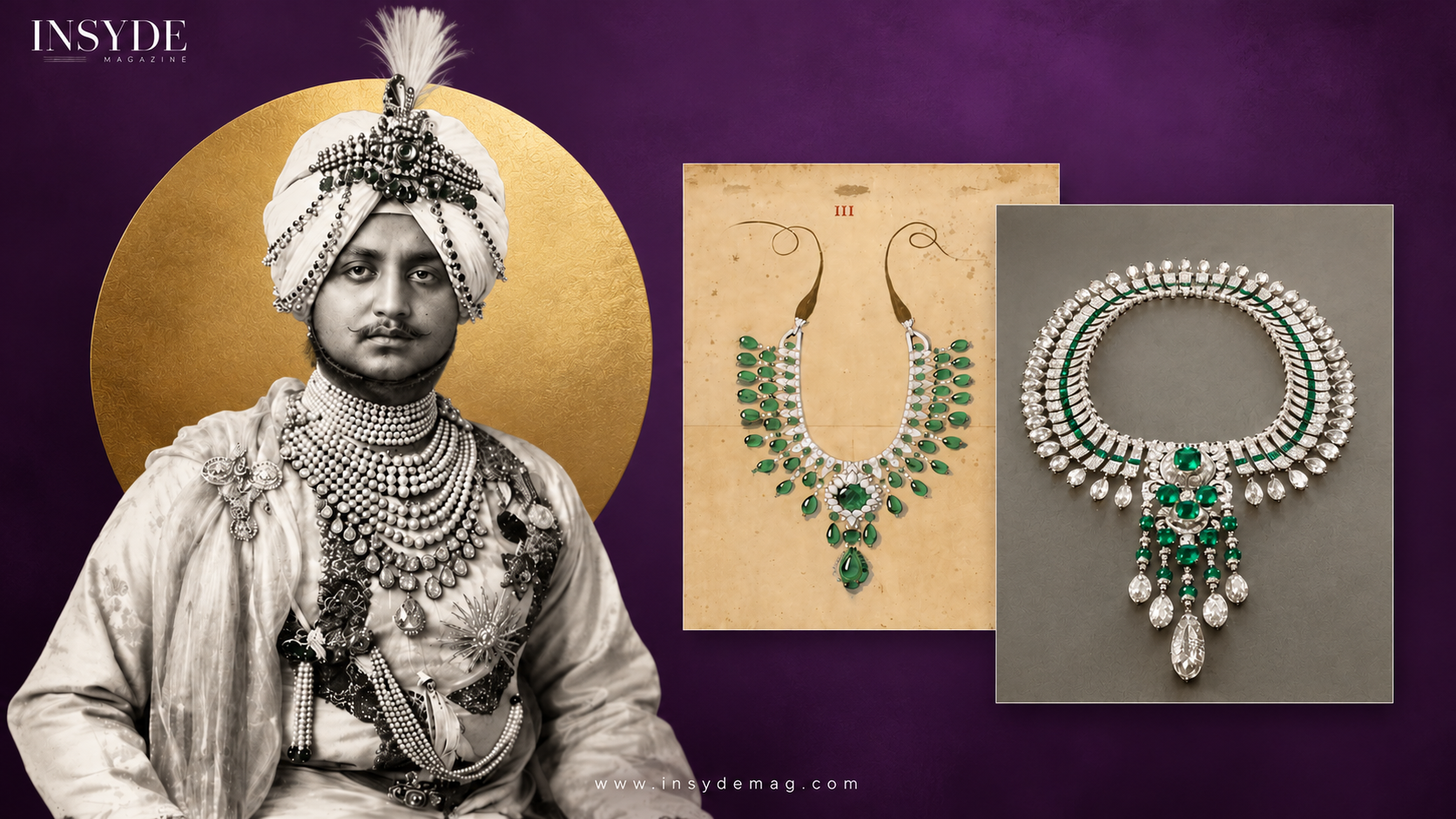
    On 2 August 1928, an Indian Maharaja arrived at one of Paris’s most prestigious jewellery houses carrying a treasure of diamonds, emeralds, rubies and pearls. He had not come to browse a boutique or select a finished necklace. He had brought his own gemstones, and he wanted them transformed into something extraordinary.

    His name was Maharaja Bhupinder Singh of Patiala.

    The jeweller was Boucheron.

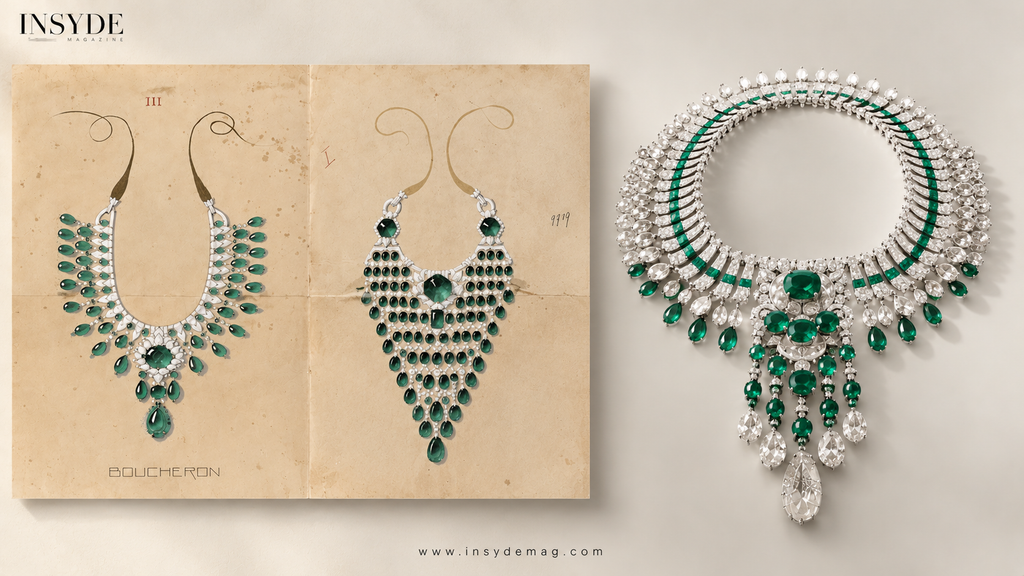
    What followed was an exceptional commission: 7,571 diamonds, 1,432 emeralds and 149 original jewellery designs, according to Boucheron’s historical account and contemporary coverage.

    It was a meeting between Indian royal patronage and French high jewellery, between a ruler with an extraordinary collection of gemstones and a maison with the craftsmanship to give them new form.

    Nearly a century later, those original designs would inspire a contemporary collection, bringing the story back into the spotlight.

    The Maharaja’s jewels had become more than an expression of royal extravagance. They had entered the creative history of one of France’s most enduring jewellery houses.

    And the most remarkable part?

    The story was still being written long after the original commission.

    BEFORE THE MAHARAJA, THERE WAS BOUCHERON

    Founded in Paris in 1858 by Frédéric Boucheron, the maison established its reputation through fine craftsmanship, precious gemstones and an approach to jewellery that challenged convention.

    In 1893, Frédéric Boucheron became the first of the great contemporary jewellers to open a boutique on Place Vendôme, the Parisian address that would become synonymous with high jewellery.

    The location was a statement in itself. Place Vendôme represented a world where exceptional materials, technical mastery and individual commissions came together to serve an international clientele.

    By the early twentieth century, Indian princely rulers were among the wealthy patrons commissioning jewellery from European maisons. Their collections contained gemstones inherited across generations, and their commissions could demand a level of customisation far beyond conventional retail.

    But the relationship was not simply about Indian wealth purchasing European craftsmanship.

    Indian royal jewellery had its own visual language and cultural significance. Precious stones, elaborate necklaces, ceremonial ornaments and turban jewels could communicate rank, authority and identity. Their forms were shaped by regional traditions, courtly customs and the preferences of individual rulers.

    For European jewellers, commissions of this kind presented an opportunity to work with extraordinary materials while interpreting them through their own design traditions.

    Boucheron’s encounter with Bhupinder Singh would become one of the most remarkable examples of that relationship.

    ENTER THE MAHARAJA OF PATIALA

    Bhupinder Singh was born in 1891 and became Maharaja of Patiala in 1900. The ruler of the princely state in present-day Punjab was known for his extravagant lifestyle, interest in sport and passion for luxury.

    His world encompassed grand travel, automobiles, fine clothing and exceptional jewellery. He understood the public language of royal presentation: the way a carefully chosen object could communicate authority, taste and status.

    Yet the significance of his relationship with Boucheron lies in something more specific than his reputation for extravagance.

    He brought the maison a commission built around his own gemstones.

    On 2 August 1928, the Maharaja arrived at Boucheron’s boutique at 26 Place Vendôme in Paris. Accounts of the visit describe an extensive royal entourage and guards carrying secure containers filled with precious stones.

    The jewellery house was led by the legacy of its founder, Frédéric Boucheron. The commission was handled by his son, Louis Boucheron, who received the Maharaja’s treasure and undertook the task of translating it into jewellery designs.

    The scene has all the ingredients of a cinematic encounter: a royal patron arriving in the heart of Paris with a private treasure, a historic jewellery house opening its doors, and gemstones whose potential would be realised through an extraordinary bespoke commission.

    Inside were diamonds, emeralds, rubies, pearls and other precious stones.

    The question was what Boucheron could make of them.

    7,571 DIAMONDS. 1,432 EMERALDS. 149 DESIGNS.

    The numbers remain extraordinary.

    According to Boucheron’s historical account, the 1928 commission involved 7,571 diamonds and 1,432 emeralds, alongside other gemstones, which were selected for an exceptional collection of jewellery.

    Louis Boucheron created 149 original designs for the commission.

    The proposed creations included elaborate diamond-and-emerald collars, multi-strand pearl necklaces, gemstone-set belts and other pieces intended for the Maharaja and his family.

    These were not ordinary retail purchases. The gemstones came from the Maharaja’s own collection, while Boucheron’s role was to interpret those materials through design and jewellery-making expertise.

    That distinction matters.

    In contemporary luxury, the value of a jewel is often communicated through its brand, rarity, materials or retail price. In this commission, the story began with a royal collection of gemstones and the decision to entrust them to a particular maison.

    Boucheron had to do more than produce expensive objects. It had to create jewellery capable of carrying the Maharaja’s identity and the visual grandeur expected of a royal commission.

    The designs brought together elements of Indian jewellery traditions and the design sensibilities of the period, including Art Deco influences. The resulting aesthetic was not simply a reproduction of European fashion or Indian court jewellery. It emerged from the meeting of the patron’s requirements, the gemstones themselves and Boucheron’s creative interpretation.

    The scale of the commission was exceptional. Boucheron describes it as the largest order ever placed at Place Vendôme.

    One royal commission had given the maison a remarkable chapter in its history.

    WHEN WEALTH BECOMES A CREATIVE BRIEF

    There is a difference between commissioning jewellery and giving a jeweller the freedom to create something extraordinary.

    Bhupinder Singh’s commission began with an exceptional resource: his own collection of precious stones. Rather than selecting finished pieces from a display, he brought the materials and entrusted Boucheron with the task of transforming them.

    The gemstones were not simply materials to be acquired. They were part of the creative brief.

    Their colours, sizes and individual characteristics helped determine what could be made. The jeweller’s challenge was to bring them into a coherent collection while respecting their qualities and the intended forms of the jewellery.

    The result was a collaboration between a royal patron and a jewellery house, each contributing something essential.

    The Maharaja brought the treasure and the commission.

    Boucheron brought the design expertise, craftsmanship and creative interpretation.

    This is an enduring principle of high jewellery: exceptional creations often emerge when rare materials meet a clear vision and the technical ability to realise it.

    In this case, the outcome was not simply one celebrated necklace, but a body of 149 original designs.

    It was a reminder that the most interesting luxury commissions are not always defined by the amount spent. They are defined by what a patron and a creative house can make possible together.

    THE ARCHIVE THAT KEPT THE STORY ALIVE

    Time is not always kind to extraordinary objects.

    Jewellery can be inherited, dismantled, reset, sold or dispersed across private collections. A piece that once defined a royal occasion may eventually become difficult to trace.

    The Boucheron commission illustrates an important distinction: the history of a jewel is not necessarily the same as the history of its design.

    Boucheron retained the original designs in its archives. These drawings recorded the creative response to the Maharaja’s commission and preserved a connection to the work undertaken in 1928.

    The subsequent whereabouts of the entire original collection are not clearly established in the public record. It would therefore be inaccurate to claim that all 149 finished pieces remain together, or that the entire collection was definitively lost.

    What survives is significant in its own right: the original designs and the documented history of the commission.

    Those records eventually became a bridge between the royal patron of 1928 and a new generation of designers.

    Nearly a century later, the archive would lead to another collection.

    NEW MAHARAJAHS: A ROYAL VISION REIMAGINED

    In January 2022, Boucheron unveiled Histoire de Style: New Maharajahs, a high-jewellery collection inspired by the historic Patiala commission.

    Conceived by the maison’s creative director, Claire Choisne, the collection revisited the original designs and explored how their spirit could be translated into contemporary jewellery.

    The objective was not to reproduce the past piece by piece.

    Instead, Choisne used the archive as a starting point for a new creative interpretation. The collection retained references to Indian royal adornment while exploring contemporary proportions, materials and ways of wearing jewellery.

    The resulting collection comprised 14 pieces across five sets.

    Diamonds, emeralds, pearls, rock crystal, mother-of-pearl, platinum and white gold contributed to its visual language. The designs also drew on references associated with Indian adornment, including the lotus flower and the traditional sarpech, a jewelled ornament worn on a turban.

    One of the collection’s defining creations was the New Maharajah necklace, featuring nine cushion-cut Colombian emeralds weighing nearly 40 carats in total. Its central motif could be detached and worn as a brooch, allowing the piece to be transformed rather than confined to a single form.

    That transformability reflected a broader approach within the collection: jewellery was not treated solely as ceremonial display, but as something that could adapt to the wearer.

    Choisne also made a striking aesthetic decision. Rather than recreating the original commission’s full visual intensity, the contemporary collection explored a palette of white and transparency, using materials such as rock crystal and diamonds to create a different sense of lightness.

    The result was a conversation between historical inspiration and modern design.

    The Maharaja’s commission supplied the creative foundation. Boucheron’s contemporary studio supplied a new interpretation.

    The past was not simply reproduced. It was reimagined.

    WHY BOUCHERON RETURNED TO THE MAHARAJA

    Luxury houses frequently speak of heritage. But heritage becomes meaningful when it can do more than decorate a campaign.

    It must give the present something to work with.

    The Patiala commission offered Boucheron several layers of meaning: an extraordinary historical client, a remarkable collection of gemstones, a documented body of designs and a connection between Indian royal culture and French high jewellery.

    The New Maharajahs collection brought these elements together again, demonstrating how an archive can inform contemporary creation.

    A historic design is not automatically relevant to a modern audience. Its relevance emerges when a creative house finds something in it that can be reconsidered, adapted or challenged.

    In Boucheron’s case, the original drawings offered more than a record of what had once been commissioned. They provided a foundation for new work.

    That is the difference between heritage as nostalgia and heritage as a creative resource.

    The 2022 collection did not need the original jewels to be presented as a complete surviving set. The designs themselves offered a way to reconnect with the commission and reinterpret its ideas for a new generation.

    The Maharaja’s legacy continued through the creative possibilities his commission had left behind.

    THE INDIAN CONNECTION TO FRENCH LUXURY

    There is a tendency to tell the history of European luxury houses as a story of European creativity expanding outwards into the world.

    The relationship between Boucheron and Bhupinder Singh offers another perspective.

    The Maharaja was not simply a consumer of French luxury. He was a patron whose gemstones and commission helped shape a significant body of work within the maison’s history.

    The original commission emerged from a specific encounter between Indian royal wealth, traditions of Indian adornment and the capabilities of a Parisian jewellery house.

    Its later revival made that encounter relevant to a contemporary audience.

    This does not mean that one commission alone transformed Boucheron into the maison it is today. Its history stretches back to 1858 and includes many clients, designers and creative chapters.

    But the Patiala commission demonstrates that the history of a luxury house is often shaped by the people who commission its work as much as by the people who create it.

    The relationship was not simply transactional. It became part of the maison’s cultural and creative heritage.

    For Indian readers, that connection is especially compelling. It places an Indian royal at the centre of a major chapter in the history of a French jewellery house—not as a passing reference, but as the patron behind an exceptional commission whose designs later inspired a contemporary collection.

    It is a reminder that the history of global luxury has never belonged to one country alone.

    THE OTHER PATIALA JEWELLERY STORY

    The Maharaja’s name is also associated with another celebrated creation: the Patiala Necklace by Cartier.

    The two stories are connected by the same royal patron, but they are separate commissions.

    Boucheron’s 1928 order involved 149 original jewellery designs using gemstones from Bhupinder Singh’s collection. Cartier’s Patiala Necklace was a different creation, renowned for its extraordinary diamonds and its central 234.65-carat yellow De Beers diamond.

    The Cartier necklace later became the subject of a separate story involving the disappearance of much of the original piece and the eventual recovery and restoration of some components by Cartier using replacement stones.

    That history should not be confused with the uncertain whereabouts of the complete Boucheron commission.

    Both stories reveal the scale of Indian royal patronage during the period and the relationships between princely wealth and the leading jewellery houses of Europe.

    But Boucheron’s story deserves to be understood on its own terms: a vast bespoke commission, 149 archival designs and a modern high-jewellery collection inspired by the original work.

    WHAT THE MAHARAJA’S LEGACY REVEALS ABOUT LUXURY

    Today, luxury is frequently discussed in terms of scarcity, status, price and brand recognition. These elements matter, but they do not fully explain why certain objects endure in cultural memory.

    The Boucheron–Patiala story offers another perspective.

    The original commission possessed scale and material extravagance. Yet its continuing significance comes from more than the number of gemstones involved.

    It has a protagonist, a documented creative relationship, an archive and a contemporary reinterpretation.

    It connects a specific historical moment to a modern collection, allowing the past to inform the present without requiring the original pieces to remain together.

    That is the power of meaningful luxury heritage.

    A jewel can be valuable because of its materials. It can be desirable because of its craftsmanship. But a documented story can give it another dimension: a place within a wider history of people, taste and creative exchange.

    For Boucheron, the Maharaja’s commission remains a striking example of that principle.

    The stones were extraordinary. The order was exceptional. But the legacy endured because the creative work was preserved—and because a later generation found something worth creating from it.

    THE VERDICT

    The Indian royal who rewrote Boucheron’s story did not build the maison, and he did not define its entire future.

    What he did was leave behind an extraordinary chapter.

    In 1928, Bhupinder Singh of Patiala brought his collection of precious stones to Paris and commissioned Boucheron to create 149 jewellery designs. The maison describes the order as the largest ever placed at Place Vendôme.

    The original designs remained in the archives. In 2022, Claire Choisne returned to them with Histoire de Style: New Maharajahs, translating a historic royal commission into a contemporary high-jewellery collection.

    The distance between those two moments is what makes the story remarkable.

    A treasure arrived in Paris. A jewellery house gave it form. An archive preserved the creative record. And a new generation found inspiration in the designs.

    Nearly a century later, the Maharaja’s story still has something to say about luxury—not simply as the possession of rare things, but as the meeting of material, imagination, patronage and memory.

    Because the most enduring luxury stories are rarely about the price of an object alone.

    They are about the people who make it possible, the ideas that shape it and the legacy it leaves behind.

    One Indian Maharaja. One extraordinary commission. And a French jewellery house whose archives ensured the story would not end in 1928.

    INSYDE — Culture, people and the stories shaping luxury.

  • JAMES BOND x OMEGA: GOOD, EVIL & VERY EXPENSIVE

    JAMES BOND x OMEGA: GOOD, EVIL & VERY EXPENSIVE

    Inside OMEGA’s new Seamaster collection, where 007 meets SPECTRE — and luxury turns a battle of identities into a collector’s game.

    By INSYDE

    There are watches that tell time.

    And then there are watches that tell a story about the person wearing them.

    For more than three decades, OMEGA has understood the difference.

    James Bond first wore an OMEGA in GoldenEye in 1995. Since then, the Seamaster has become one of the most recognisable objects in the 007 universe — moving through the Pierce Brosnan and Daniel Craig eras and becoming part of the character’s visual language. OMEGA’s relationship with Bond has now lasted more than 30 years. OMEGA Press Room

    But in October 2026, OMEGA changed the formula.

    For the first time, SPECTRE has entered the picture.

    The new Seamaster Diver 300M James Bond and SPECTRE Collection, released October 5, brings six watches into the same universe: three carrying the James Bond identity and three carrying the SPECTRE identity. OMEGA Press Room

    And suddenly, this isn’t simply another Bond watch.

    It’s a choice.

    Good or evil.

    Blue or black.

    Bond or SPECTRE.

    And, depending on how far you want to take the fantasy, $8,600 or $89,800.


    THE BOND WATCH HAS BECOME SOMETHING BIGGER

    OMEGA’s Bond relationship is one of luxury’s most successful examples of entertainment becoming brand identity.

    The Seamaster wasn’t invented for James Bond. The Diver 300M dates back to 1993, two years before it appeared on Pierce Brosnan’s wrist in GoldenEye. But cinema transformed the watch from a professional dive instrument into something much more culturally charged. OMEGA Press Room

    Over time, the watch became part of Bond’s uniform.

    The tuxedo.

    The Aston Martin.

    The gadgets.

    The Seamaster.

    That distinction matters because OMEGA isn’t borrowing Bond’s cultural relevance for a single campaign. It has spent three decades building a relationship in which the watch itself has become part of the mythology.

    And now the brand is expanding that mythology from one character to two.


    ENTER: SPECTRE

    The cleverness of the 2026 collection is its simplicity.

    Bond and SPECTRE share the same technical foundation, but represent opposing personalities.

    OMEGA describes Bond through duty, discipline and loyalty. SPECTRE represents independence, self-interest and operating beyond the same constraints. The brand’s own concept is built around this duality — the idea that different instincts can exist within the same person. OMEGA Press Room

    That gives the watches something more interesting than a franchise logo.

    It gives them personality.

    The Bond watch is blue.

    The SPECTRE watch is black.

    One feels familiar.

    The other feels forbidden.

    And that is precisely where luxury starts to become psychological.


    THE WATCH FOR 007

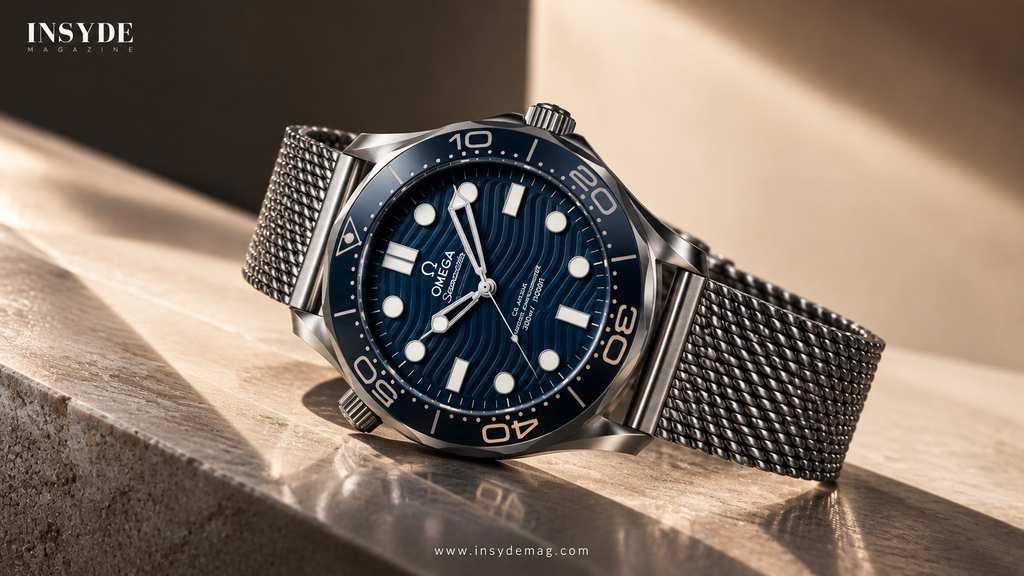
    The standard James Bond edition, reference 210.30.42.20.03.004, measures 42mm and is crafted in stainless steel.

    It features a Grade 5 titanium bezel ring and a blue aluminium dial with the laser-engraved wave pattern associated with the Seamaster Diver 300M. The watch comes on a brushed mesh bracelet. OMEGA Press Room

    Turn it over and the Bond mythology becomes more discreet.

    The movement’s rotor carries a gun-barrel decoration — an unmistakable reference to 007 without turning the dial into a piece of obvious merchandise. OMEGA Press Room

    That restraint is important.

    Because the modern luxury consumer doesn’t necessarily want to announce:

    “I am wearing the James Bond watch.”

    They may prefer something subtler:

    “If you know, you know.”


    THE WATCH FOR THE DARK SIDE

    Then comes the SPECTRE edition.

    Reference 210.30.42.20.01.023 keeps the same 42mm stainless-steel architecture but changes the mood completely.

    The bezel becomes black ceramic.

    The dial takes on a blackened, grained finish.

    The bracelet remains brushed mesh.

    The result is darker, quieter and more severe. OMEGA Press Room

    And beneath the sapphire caseback sits perhaps the best detail of all: a rotor shaped around SPECTRE’s octopus insignia. Monochrome Watches

    It is the kind of detail that rewards attention.

    The Bond watch wants to be recognised.

    The SPECTRE watch almost feels like it wants to be discovered.


    TWO WATCHES. ONE QUESTION.

    Whose side are you on?

    OMEGA has effectively turned product selection into identity selection.

    Bond or SPECTRE.

    Classic or dark.

    Duty or independence.

    The appeal isn’t purely technical.

    It’s emotional.

    And that is increasingly important in luxury.

    A watch at this level is no longer competing solely on accuracy, materials or movement architecture. It is competing for meaning.

    Why this watch?

    Why this brand?

    Why this particular story?

    The answer can be as important as the specification sheet.


    THE TECHNICAL CREDENTIALS STILL MATTER

    For all the cinematic theatre, OMEGA hasn’t turned the Seamaster into a costume accessory.

    The new watches are powered by the OMEGA Co-Axial Master Chronometer Calibre 8806, an automatic movement certified as a Master Chronometer by the Swiss Federal Institute of Metrology (METAS).

    The movement provides approximately 55 hours of power reserve, while the Seamaster Diver 300M retains 300 metres of water resistance. The watches measure 42mm in diameter and approximately 14.23mm thick. Monochrome Watches

    This is important to the credibility of the collection.

    The Bond connection creates the desire.

    The watchmaking has to justify the object.


    THEN OMEGA MAKES IT VERY EXPENSIVE

    The standard stainless-steel Bond and SPECTRE watches are priced at $8,600 each in the United States, with both models positioned as non-limited editions. Hodinkee

    But OMEGA has also created something considerably more exclusive.

    Two limited-edition sets sit at the top of the collection:

    One for James Bond.

    One for SPECTRE.

    Each is limited to 77 numbered sets.

    Each costs $89,800 in the United States. Hodinkee

    And neither watch within those sets is sold separately.

    That changes the proposition completely.


    THE $89,800 SIDE OF THE STORY

    Each limited set combines a stainless-steel watch with a platinum-gold model.

    The platinum-gold versions feature polished ceramic bezels, platinum diving scales and 18K white-gold dials with character-specific designs.

    The Bond version carries a blue gradient and gun-barrel motif.

    The SPECTRE version goes dark grey, with an octopus design.

    Both use 18K Moonshine™ Gold for the rotor emblem. OMEGA Press Room

    But OMEGA hasn’t stopped at the watches.

    The presentation box includes an additional NATO strap and changing tool, cufflinks, a cord bracelet, loupe, leather travel pouch, card holder and certificate of authenticity.

    Even the accessories are divided by allegiance.

    Bond receives a blue travel pouch and 007 details.

    SPECTRE receives black treatment and its own insignia. OMEGA Press Room

    This is no longer simply watchmaking.

    It’s world-building.


    WHY 77 MATTERS

    Seventy-seven.

    A number that immediately speaks to 007.

    OMEGA hasn’t positioned the limited editions as merely “rare.” It has created a numerical connection to the franchise itself.

    And that’s how collectible luxury works at its most effective.

    Scarcity creates urgency.

    Story creates emotion.

    Craft creates credibility.

    When those three meet, a product can move beyond being something you wear and become something you collect.

    At $89,800, that is clearly the territory OMEGA is entering.


    FROM WATCH TO COLLECTIBLE

    There is a larger shift happening across luxury.

    The strongest products increasingly aren’t just objects.

    They are objects with cultural context.

    A handbag can carry a fashion-house history.

    A sneaker can represent a cultural movement.

    A watch can carry an entire cinematic mythology.

    OMEGA’s Bond relationship gives it something that most watch brands cannot manufacture overnight: recognition built over decades.

    And the new SPECTRE chapter adds another dimension.

    For 30 years, OMEGA told the story from Bond’s side.

    Now it is deliberately giving the other side equal space.

    That isn’t just product design.

    It’s narrative strategy.


    BOND DOESN’T NEED A NEW FILM

    This may be the most interesting part of the timing.

    The new collection arrives without a new James Bond film driving the launch.

    Instead, OMEGA has been expanding the 007 universe beyond cinema.

    In May 2026, the brand introduced the Seamaster Diver 300M Chronograph 007 First Light, a watch created in collaboration with IO Interactive and Amazon MGM Studios for the 007 First Light video game. The game presents a new story around a 26-year-old James Bond, giving the franchise a new interactive entry point. OMEGA Press Room

    That is significant.

    OMEGA isn’t simply waiting for the next movie.

    It is keeping 007 culturally active through different forms of entertainment.

    And now, rather than simply following Bond into another film, the brand has expanded the universe to include his most recognisable enemy.


    THE TIMING COULD HARDLY BE MORE INTERESTING

    The broader Swiss watch industry is operating in a complicated environment.

    According to the Federation of the Swiss Watch Industry, Swiss watch exports totalled CHF 12.8 billion in the first half of 2026, down 0.7% year-on-year. The industry has been dealing with currency pressure, tariffs, geopolitical uncertainty and weaker conditions in some major markets. FHS

    But the picture isn’t simply negative.

    The same data shows that India’s Swiss watch imports grew 31.5% in the first half of 2026, making India one of the industry’s strongest growth markets and moving it into fifth place among Swiss watch export destinations. FHS

    That matters for a publication like INSYDE.

    Luxury watch culture is no longer something Indian consumers merely observe from a distance.

    India is becoming a more important market for Swiss watchmakers, and younger affluent consumers are increasingly engaging with watches as part of fashion, lifestyle and personal identity.

    For OMEGA, a globally recognised cultural property like James Bond gives the mechanical watch an immediate point of entry.


    THE WATCH INDUSTRY’S REAL BATTLE IS EMOTIONAL

    The mechanical watch has an unusual problem.

    It isn’t necessary.

    Your phone tells the time more accurately.

    Your smartwatch tells you much more.

    And yet mechanical watches remain objects of desire.

    Why?

    Because luxury has never really been about necessity.

    It’s about meaning.

    A mechanical watch can represent craftsmanship, heritage, achievement, taste or personal milestones.

    James Bond adds another layer:

    fantasy.

    The fantasy of competence.

    The fantasy of elegance under pressure.

    The fantasy of walking into a room and already knowing what to do.

    That is something a smartwatch cannot manufacture.


    WHY THIS MATTERS TO A YOUNGER LUXURY AUDIENCE

    For younger consumers, luxury increasingly works through cultural literacy.

    Knowing the obvious logo isn’t enough.

    Understanding the reference can be the real flex.

    That’s why the SPECTRE watch is particularly interesting.

    Someone unfamiliar with the franchise may simply see a black luxury dive watch.

    Someone who knows the mythology sees something else.

    They see the octopus.

    They understand the reference.

    They know why the watch exists.

    The product becomes a conversation between people who recognise the same cultural code.

    That is powerful territory for luxury.


    THE DANGER OF MAKING A “BOND WATCH”

    There is, however, a fine line.

    Too much Bond and a luxury watch can become merchandise.

    Too little Bond and the collaboration becomes meaningless.

    OMEGA’s new collection largely avoids that trap by retaining the identity of the Seamaster Diver 300M.

    The Bond and SPECTRE references are layered into the design rather than overwhelming it.

    That distinction is important.

    You’re not buying a movie prop.

    You’re buying an OMEGA Seamaster with a particularly rich story attached to it.

    And that gives the collection relevance beyond the franchise’s most dedicated fans.


    THE SPECTRE WATCH MAY BE THE MORE INTERESTING ONE

    The Bond model is the obvious choice.

    But the SPECTRE model is where things become more intriguing.

    It is darker.

    More discreet.

    Less immediately conventional.

    And perhaps more aligned with the current luxury consumer’s fascination with understatement.

    The watch doesn’t need to scream villain.

    The black ceramic bezel and grained dial already create the mood.

    The octopus waits on the other side.

    That is exactly how insider luxury works.

    The detail is there for the person who knows.


    IS $89,800 REALLY ABOUT THE WATCH?

    Not entirely.

    And that’s okay.

    At this level, you’re buying a combination of:

    Watchmaking.

    Materials.

    Scarcity.

    Provenance.

    Story.

    Collectibility.

    The 77-piece limitation, platinum-gold construction and dual-watch presentation deliberately move the product into collector territory.

    Whether that makes the price “worth it” is subjective.

    But it does make the strategy understandable.

    OMEGA isn’t asking the buyer to pay $89,800 simply to tell time.

    It’s asking them to own a highly limited physical piece of the 007 universe.

    That’s a very different proposition.


    OMEGA HAS TURNED LUXURY INTO A CHOICE

    And perhaps that is why this collection works.

    The brand hasn’t simply added another Bond logo to another Seamaster.

    It has created a confrontation.

    James Bond vs. SPECTRE.

    Blue vs. black.

    Hero vs. villain.

    Duty vs. freedom.

    And underneath all of it is the same mechanical foundation.

    That is smart luxury storytelling.

    Because the consumer doesn’t just choose a watch.

    They choose the version of the story they want to wear.


    THE VERDICT

    Is this OMEGA’s most technically revolutionary Bond watch?

    No.

    And that isn’t really the point.

    The movement is proven.

    The Seamaster platform is established.

    The design language is familiar.

    The innovation is happening somewhere else.

    In the story.

    OMEGA has taken one of luxury’s most recognisable entertainment partnerships and expanded it into a two-sided universe.

    It has made the hero share the spotlight.

    It has given the villain equal wrist space.

    And it has turned the collector into the final decision-maker.

    For $8,600, you can choose your side.

    For $89,800, you can collect both worlds within a limited set.

    And for everyone else, you can simply enjoy watching one of luxury’s most enduring partnerships become a little more dangerous.


    GOOD. EVIL. AND VERY EXPENSIVE.

    James Bond has always had a watch.

    Now, for the first time, his enemy has one too.

    OMEGA’s new collection is therefore more than another chapter in the brand’s Bond relationship.

    It is a statement about where luxury is going.

    The watch no longer has to sell itself purely through mechanics.

    It can sell through memory, identity, entertainment and culture.

    That is increasingly how modern luxury wins attention.

    And perhaps the smartest detail is that OMEGA doesn’t tell you which side is better.

    It simply asks:

    Which side are you on?

    Because after 30 years of making James Bond synonymous with OMEGA, the Swiss watchmaker has found a new way to keep the fantasy alive.

    Give the villain a watch.

    And let the collector decide who wins.


    INSYDE’S TAKE

    OMEGA has made a watch launch feel like a choice of identity.

    That’s what makes the 2026 Bond and SPECTRE collection more interesting than another franchise collaboration.

    The watches aren’t revolutionary because they don’t need to be.

    The Seamaster already has the credibility.

    Bond already has the mythology.

    SPECTRE already has the intrigue.

    OMEGA has simply brought the two together — and turned the space between them into luxury.

    Good. Evil. Very expensive.

    And, for once, the dark side has a very good case.


    EDITORIAL FACT BOX

    Collection: OMEGA Seamaster Diver 300M James Bond & SPECTRE
    Launch: October 5, 2026
    Total watches: Six
    Standard editions: Two stainless-steel models
    Case size: 42mm
    Movement: OMEGA Co-Axial Master Chronometer Calibre 8806
    Power reserve: 55 hours
    Water resistance: 300 metres
    Standard U.S. price: $8,600 each
    Limited sets: Two — one James Bond, one SPECTRE
    Limited quantity: 77 numbered sets of each
    Limited-set U.S. price: $89,800
    Availability: OMEGA boutiques and OMEGA’s online store OMEGA Press Room

    INSYDE INDUSTRY NOTE

    The Swiss watch market remains resilient but uneven in 2026. First-half Swiss watch exports fell 0.7% to CHF 12.8 billion, while India grew 31.5%, making it one of the strongest-performing markets. At the same time, Swatch Group reported strong sales acceleration in May and June, continuing into July, across price segments and regions. The evidence therefore does not support framing OMEGA’s Bond strategy as a response to a simple sales crisis. A stronger interpretation is that the brand is using a highly recognizable cultural property to deepen emotional relevance and maintain momentum in a competitive luxury-watch environment. FHS.


  • hybe’s WEVERSE CON FESTIVAL IS COMING TO INDIA

    hybe’s WEVERSE CON FESTIVAL IS COMING TO INDIA

    HYBE is bringing its flagship global music festival to New Delhi for the first time outside Korea, bringing K-pop, Indian music, fandom and immersive experiences together.

    For the first time since its launch, Weverse Con Festival is leaving Korea.

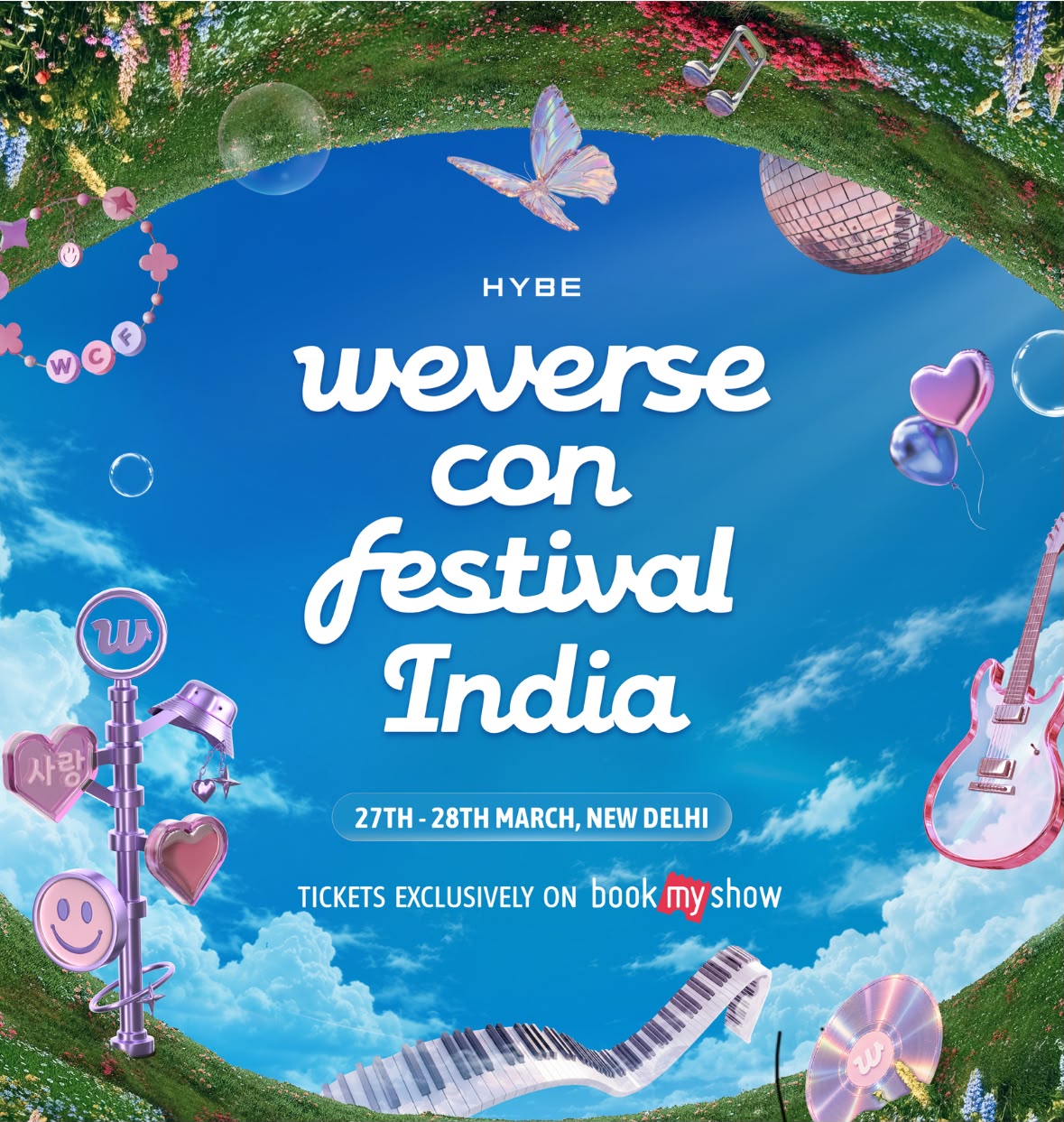
    HYBE has announced that its flagship global music festival will take place in New Delhi on March 27–28, 2027, marking the festival’s first edition outside Korea. The two-day event will bring together Indian and global artists, live performances, special collaboration stages and a broader programme built around fan culture and immersive experiences. Press Release-Weverse Con Festi…

    But the arrival of Weverse Con Festival in India is about more than bringing another international music event to the country.

    The festival is being designed as a meeting point between artists and their communities, combining live music with interactive fan engagement, brand activations and cultural experiences. In other words, the stage is only one part of the experience. Press Release-Weverse Con Festi…

    A NEW HOME FOR WEVERSE CON

    Since its launch, Weverse Con Festival has been associated with HYBE’s global music ecosystem. Its move to New Delhi marks the first time the festival will be presented outside Korea.

    The India edition will run across two days, bringing together artists from India’s diverse music scene and influential K-pop artists. Special collaboration stages will also form part of the programme, creating opportunities for Indian and global artists to share the same platform. Press Release-Weverse Con Festi…

    For HYBE, the format is intended to extend beyond conventional live performance.

    The company describes the festival as an experience inspired by the fan communities fostered through Weverse, bringing music, interactive engagement, brand activations and cultural experiences together in a single physical setting. Press Release-Weverse Con Festi…

    That emphasis on the fan is central to what makes the India edition significant.

    WHEN FANDOM MOVES OFF THE SCREEN

    Weverse has grown as a platform built around the relationship between artists and fans, providing content, communication and services designed around fan activity. The festival takes that relationship into the physical world. Press Release-Weverse Con Festi…

    For the audience, that means the experience is not limited to watching an artist perform.

    HYBE says fans will be able to engage with artists and fellow fans throughout the festival, while the event itself will bring together performances, interactive experiences and cultural programming. Press Release-Weverse Con Festi…

    It reflects a broader philosophy within HYBE’s entertainment ecosystem, which combines artists, content, platforms and services around the fan experience. Press Release-Weverse Con Festi…

    The result is a festival conceived as an environment rather than simply a concert schedule.

    HYBE’S INDIA MOMENT

    The decision to bring Weverse Con Festival to India also sits within HYBE’s broader strategy for the country.

    HYBE CEO Jason Jaesang Lee described the India edition as a new chapter in the company’s “multi-home, multi-genre” strategy, while identifying India as a key market in HYBE’s global growth plans. The company says its aim is to combine its global capabilities with India’s creativity and develop experiences that resonate with local audiences. Press Release-Weverse Con Festi…

    That ambition extends beyond the festival.

    HYBE INDIA, the company’s strategic global office in India, has been conducting nationwide auditions to discover and develop local talent, produce content and expand intellectual property. The office is also focused on developing locally resonant and globally scalable content while fostering cultural exchange. Press Release-Weverse Con Festi…

    Seen in that context, Weverse Con Festival is part of a larger effort to connect HYBE’s global entertainment ecosystem with India’s creative landscape.

    INDIA MEETS THE GLOBAL STAGE

    The India edition will place Indian and global music cultures alongside one another.

    The festival will feature K-pop artists as well as artists from India’s diverse music scene, with collaboration stages intended to create new connections between artists and cultures. Press Release-Weverse Con Festi…

    That element gives the New Delhi edition its own identity.

    Rather than simply reproducing the Korean festival in another market, the announcement frames the India edition around the meeting of global and Indian music cultures. It is an approach that fits directly into HYBE’s stated ambition of combining global capabilities with local creativity. Press Release-Weverse Con Festi…

    THE EXPERIENCE AROUND THE MUSIC

    Weverse Con Festival India is being co-produced and promoted by BookMyShow Live, the live entertainment division of BookMyShow.

    BookMyShow Live will bring its production expertise and audience reach to the festival, with tickets set to be available exclusively through BookMyShow. Press Release-Weverse Con Festi…

    The event will also feature a group of commercial and brand partners. Kia India, Mastercard, Project B and Samsung are listed as presenting partners, while NONGSHIM joins as an Associate Partner. Mastercard will serve as the festival’s banking partner, with cardholders receiving exclusive access to pre-sale tickets. Press Release-Weverse Con Festi…

    Together, these elements contribute to the wider environment that HYBE is building around the festival — one where music, fandom, brands and cultural experiences meet.

    THE FIRST EDITION OUTSIDE KOREA

    For Weverse Con Festival, India represents a first.

    For HYBE, it represents another step in its stated expansion and cultural ambitions in the country.

    And for fans, it brings the Weverse Con experience into a new physical setting — one built around live music, artist interaction, fandom and cultural exchange.

    On March 27–28, 2027, New Delhi will host the first Weverse Con Festival outside Korea.

    It is not simply a festival arriving in a new country.

    It is Weverse Con entering a new chapter — in India.

  • TOO RARE TO OWN

    TOO RARE TO OWN

    The world’s rarest automobiles — and the fortunes, histories and secrets behind them.

    There is expensive.

    And then there is unattainable.

    At the highest level of the automotive world, price is no longer the only measure of luxury. The truly exceptional automobile is valued for something much harder to acquire: provenance, scarcity, originality, craftsmanship and history.

    A car can be worth millions because it is fast.

    A very different kind of car can be worth tens of millions because it is irreplaceable.

    That distinction is becoming increasingly important as the collector-car market enters a new era.

    In 2025, RM Sotheby’s generated more than $1 billion in sales, with 135 automobiles selling for more than $1 million and 75 auction records set across marques and models. Nearly half of its buyers were participating for the first time.

    The momentum has continued into 2026, with major European sales producing extraordinary results.

    Yet the most valuable cars in the world cannot always be ranked neatly on a spreadsheet.

    Some have sold at public auction for documented sums.

    Others have changed hands privately, where the transaction price is reported rather than publicly verified.

    And then there are modern coachbuilt automobiles whose prices are widely estimated by the market but never officially disclosed by the manufacturer or client.

    So this isn’t simply a list of the five cars with the biggest numbers attached to them.

    It is a look at five automobiles that represent the different forms of wealth at the top of the collector-car world:

    scarcity, provenance, mythology, craftsmanship and exclusivity.

    Because when a car becomes rare enough, the question changes.

    It is no longer:

    “What does it cost?”

    It becomes:

    “Can anyone else ever own one?”


    When history exists in only two examples, scarcity becomes part of the car itself.  
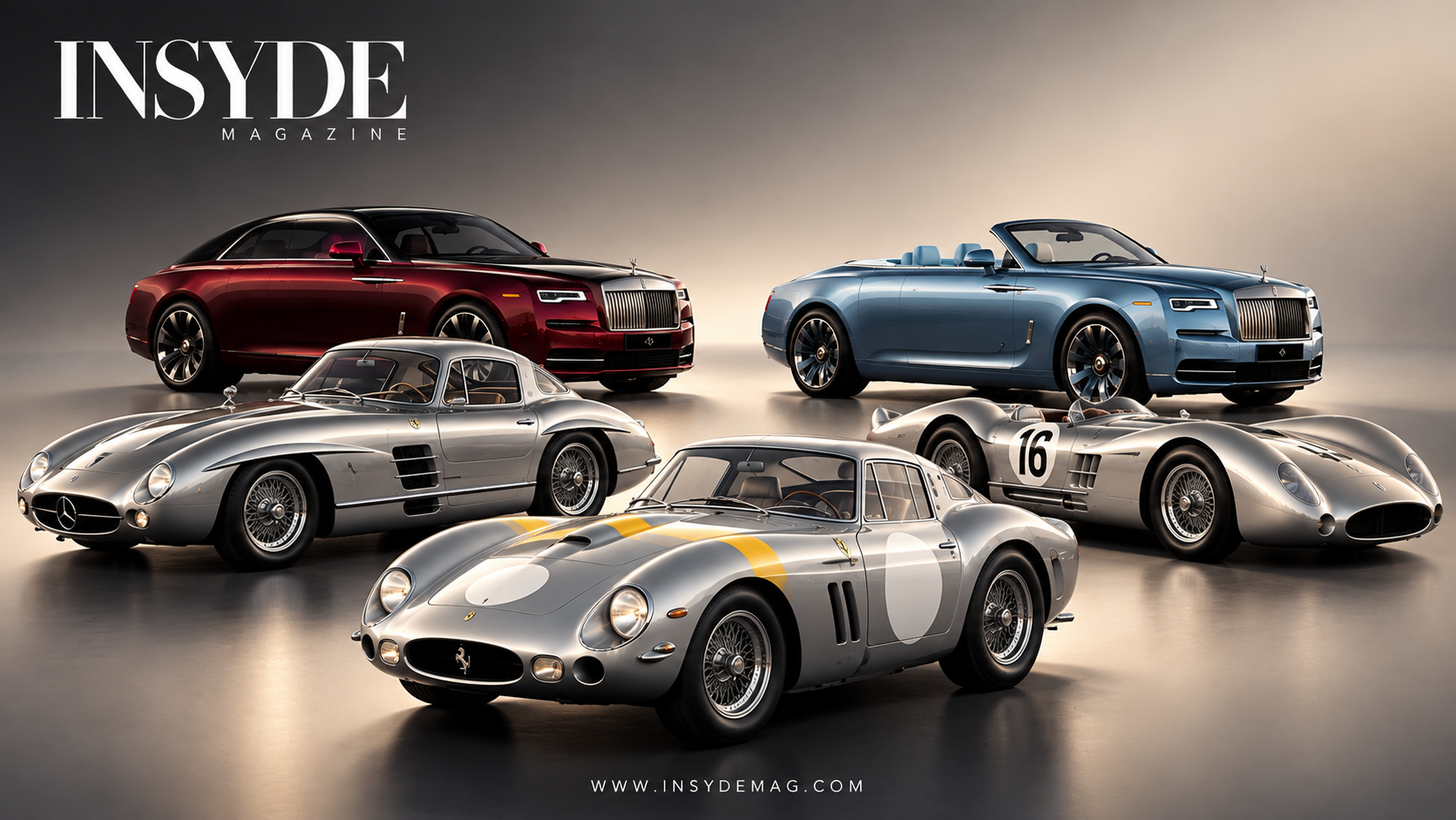
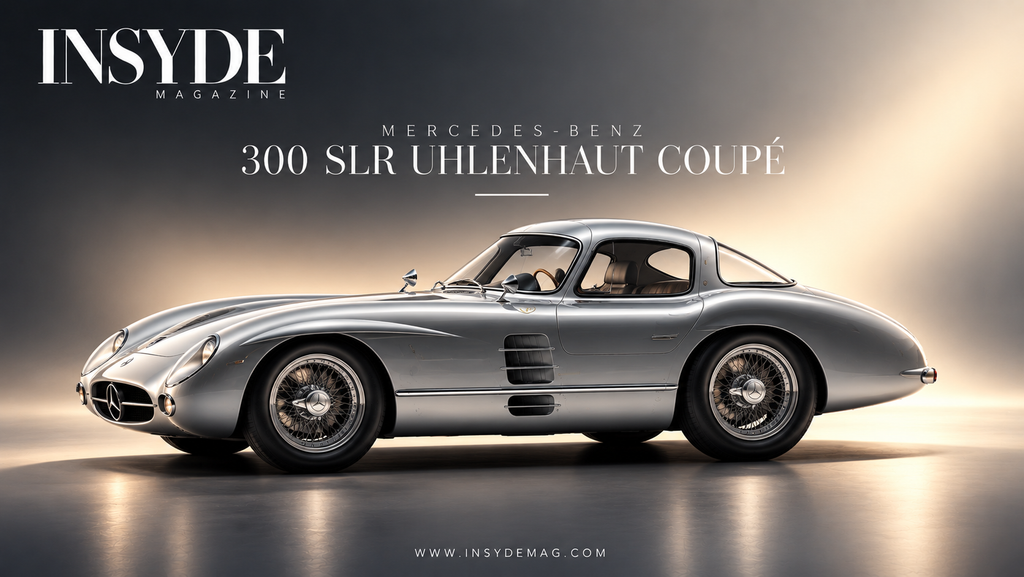
Mercedes-Benz confirms that only two 300 SLR Uhlenhaut Coupés were built, with one sold for €135 million in 2022.

    01

    MERCEDES-BENZ 300 SLR UHLENHAUT COUPÉ

    €135 MILLION

    THE CAR THAT REDEFINED EXPENSIVE

    There are very few automobiles that can genuinely be called irreplaceable.

    The Mercedes-Benz 300 SLR Uhlenhaut Coupé is one of them.

    On 5 May 2022, Mercedes-Benz sold one of the two Uhlenhaut Coupés ever built for €135 million at an exclusive auction at the Mercedes-Benz Museum in Stuttgart.

    It remains the defining transaction in the modern collector-car market.

    The car is named after Rudolf Uhlenhaut, the legendary Mercedes-Benz engineer responsible for its design. Developed from the engineering of Mercedes-Benz’s extraordinary 300 SLR racing programme, the Coupé represents one of the most ambitious expressions of post-war automotive engineering.

    Only two were built.

    One remains with Mercedes-Benz.

    The other passed into private ownership.

    And that private collector has never been publicly identified.

    That anonymity feels strangely appropriate.

    The Uhlenhaut Coupé isn’t simply an expensive Mercedes-Benz.

    It is an artifact from a very specific moment in automotive history — one that cannot be reproduced.

    WHY IT COMMANDS THE MONEY

    The formula is almost impossible to recreate:

    Two examples.

    Factory provenance.

    Historic engineering.

    Motorsport DNA.

    Exceptional originality.

    A legendary engineer.

    There are faster cars.

    There are newer cars.

    There are more technologically advanced cars.

    But there will never be another original Uhlenhaut Coupé.

    That is the difference between a very expensive automobile and an irreplaceable one.

    WHO OWNS IT?

    A private collector.

    Mercedes-Benz has not publicly identified the buyer.

    THE INSYDE TAKE

    The ultimate collector car isn’t necessarily the fastest. It is the one history refuses to repeat.


    Born for Grand Prix racing. Decades later, it became one of the most valuable racing cars ever sold.
The W 196 R Stromlinienwagen sold for €51.155 million at RM Sotheby's in 2025, making it the second-highest public auction result for a car at that time. RM Sotheby's

    02

    MERCEDES-BENZ W 196 R STROMLINIENWAGEN

    €51.155 MILLION

    THE SILVER ARROW WITH TWO LEGENDS IN ITS HISTORY

    If the Uhlenhaut Coupé represents engineering mythology, the W 196 R represents something even more romantic:

    motorsport history.

    In February 2025, RM Sotheby’s sold a 1954 Mercedes-Benz W 196 R Stromlinienwagen for €51.155 million.

    The transaction became the second-highest public auction result ever recorded for an automobile at that time and the most valuable Grand Prix car ever sold at auction.

    But the number is only half the story.

    The particular chassis — 00009/54 — was driven by two of the greatest names in racing history.

    Juan Manuel Fangio drove the car to victory at the 1955 Buenos Aires Grand Prix.

    Later that year, Stirling Moss drove the same chassis at Monza, where it recorded the fastest lap.

    This is what makes provenance so powerful.

    The car isn’t valuable merely because Mercedes-Benz built it.

    It is valuable because history happened inside it.

    Only four complete examples of the W 196 R with the factory Streamliner bodywork are known.

    The car was donated by Mercedes-Benz to the Indianapolis Motor Speedway Museum in 1965 and remained under the museum’s care for decades before being offered at auction.

    WHO OWNS IT?

    The new owner’s identity has not been publicly disclosed.

    And that matters.

    At this level, some collectors are buying history without any desire to become part of the public story themselves.

    WHY IT MATTERS

    A specialist can rebuild an engine.

    A craftsman can recreate bodywork.

    A manufacturer can reproduce a design.

    But nobody can recreate Fangio winning Buenos Aires in 1955.

    That moment belongs exclusively to this chassis.

    THE INSYDE TAKE

    The rarest luxury isn’t what can be made. It’s what can never happen again.


    Some cars become valuable because of what they are. Others because of what they survived.
Chassis 4153 GT was reported to have changed hands privately for around $70 million in 2018. Its racing history included fourth overall at the 1963 Le Mans 24 Hours and victory in the 1964 Tour de France Automobile.

    03

    FERRARI 250 GTO — CHASSIS 4153 GT

    REPORTED AT APPROXIMATELY $70 MILLION

    THE FERRARI THAT BECAME A FINANCIAL PHENOMENON

    Few names in the collector-car world carry the same gravitational pull as 250 GTO.

    Ferrari produced only 36 examples between 1962 and 1964.

    The car was created for competition, and its racing record became an essential part of the mythology surrounding the model.

    One particular example, chassis 4153 GT, became one of the most valuable automobiles ever reported to have changed hands privately.

    In 2018, the 1963 Ferrari 250 GTO was reported to have been sold for approximately $70 million to American businessman and collector David MacNeil, founder and CEO of WeatherTech.

    There is, however, a crucial distinction.

    This was a private transaction, not a public auction.

    The reported $70 million figure therefore does not have the same level of public verification as the €135 million Uhlenhaut auction result.

    For a professional publication, that distinction should remain explicit.

    WHO OWNS IT?

    David MacNeil.

    The WeatherTech founder is a prominent automotive collector, and chassis 4153 GT remains associated with his collection.

    WHY THIS GTO?

    Because its provenance is exceptional.

    Chassis 4153 GT competed at the 1963 24 Hours of Le Mans, where it finished fourth overall.

    In 1964, it won the Tour de France Automobile with Lucien Bianchi and Georges Berger.

    It is also known for retaining significant original components and for its unusually strong competition history.

    This is why the 250 GTO is so difficult to value using ordinary automotive logic.

    A modern hypercar can be faster.

    It can produce more power.

    It can use technologies that Ferrari engineers in the 1960s could never have imagined.

    But it cannot become 4153 GT.

    The identity is fixed.

    The history is fixed.

    The number is fixed.

    THE 250 GTO EFFECT

    The model demonstrates one of the collector market’s most important principles:

    historical significance can become more valuable than performance.

    The 250 GTO is no longer competing with other Ferraris.

    At its highest level, it is competing with fine art, rare watches and other irreplaceable cultural objects.

    THE INSYDE TAKE

    The ultimate Ferrari isn’t the one with the biggest numbers. It’s the one whose story can never be replicated.


    When a car becomes a commission, the boundary between automobile and artwork begins to disappear.
Rolls-Royce says La Rose Noire was the first of four unique Droptail commissions. Its parquetry uses 1,603 individual pieces of Black Sycamore veneer, while the exterior paint process required 150 iterations.

    04

    ROLLS-ROYCE LA ROSE NOIRE DROPTAIL

    WIDELY REPORTED AROUND $30 MILLION

    WHEN A CAR BECOMES ART

    At this point, the definition of a luxury automobile begins to blur.

    The Rolls-Royce La Rose Noire Droptail isn’t merely a highly exclusive Rolls-Royce.

    It is a commissioned work of automotive art.

    La Rose Noire was the first of four unique Droptail commissions.

    Its inspiration was the Black Baccara rose — a flower that held particular meaning for the commissioning family.

    The result is one of the most elaborate modern expressions of coachbuilding ever produced by Rolls-Royce.

    Inside the car are 1,603 individual pieces of black sycamore veneer, each hand-finished and positioned to create an abstract interpretation of falling rose petals.

    The development of the intricate parquetry took almost two years.

    The exterior paint process went through 150 iterations before the final finish was approved.

    There is even a removable Audemars Piguet timepiece integrated into the dashboard.

    This is not simply bespoke automotive manufacturing.

    It is closer to commissioning a piece of contemporary art.

    WHO OWNS IT?

    The commissioning family.

    Rolls-Royce has not publicly identified the clients by name.

    WHAT IS IT WORTH?

    The figure most frequently associated with La Rose Noire is approximately $30 million.

    But INSYDE would not describe that as a confirmed sale price.

    Rolls-Royce has not publicly disclosed the transaction value.

    The figure should therefore be treated as a reported or estimated market value.

    That distinction matters.

    THE NEW BESPOKE

    Traditional luxury says:

    “Choose something few people can afford.”

    Modern coachbuilding says:

    “Create something nobody else can own.”

    That is a fundamentally different proposition.

    La Rose Noire was not designed for a demographic.

    It was designed around a client.

    And that is where ultra-luxury is heading.

    THE INSYDE TAKE

    The ultimate luxury is not owning something expensive. It’s knowing nobody else can order the same thing.


    Three cars. Three patrons. Three entirely different expressions of the same idea of luxury.
Rolls-Royce confirms that three Boat Tails were completed, each unique to its commissioning client. The third was never publicly exhibited at its owner's request.

    05

    ROLLS-ROYCE BOAT TAIL

    WIDELY REPORTED AROUND $28 MILLION

    THE CAR THAT TURNED COACHBUILDING INTO A LIFESTYLE

    Before Droptail, there was Boat Tail.

    Only three examples were completed — and Rolls-Royce says there will only ever be three.

    Each was created for a different commissioning client.

    Each is unique.

    And each tells a different story.

    The design draws inspiration from the sweeping forms of classic racing yachts and historic Rolls-Royce Boat Tail automobiles.

    Its rear deck opens to reveal an elaborate Hosting Suite, turning the automobile into an environment for entertaining as much as driving.

    One Boat Tail was commissioned by a patron whose family business grew from the pearling industry.

    Another was created around a different client’s personal history.

    The third was never publicly exhibited at the owner’s request.

    That detail says something profound about the modern definition of luxury.

    For some people, exclusivity isn’t about being photographed with an object.

    It is about making sure very few people ever see it.

    WHO OWNS THEM?

    Three separate private commissioning clients.

    Rolls-Royce has not officially disclosed their identities.

    There have been numerous celebrity ownership claims surrounding Boat Tail online.

    Those claims should not be presented as fact unless independently confirmed by Rolls-Royce or the owners themselves.

    For INSYDE, privacy is part of the story.

    WHAT IS IT WORTH?

    Boat Tail is widely reported at approximately $28 million.

    Again, this should be treated as an estimated/reported value, rather than a publicly confirmed transaction price.

    WHY BOAT TAIL MATTERS

    Boat Tail demonstrates the transformation of the automobile from product into personal expression.

    It isn’t about selecting options.

    It is about creating an object around a client’s identity, heritage and taste.

    In that sense, Rolls-Royce Coachbuild is increasingly operating closer to haute couture than conventional automotive manufacturing.

    THE INSYDE TAKE

    The new status symbol isn’t the car everyone wants. It’s the car nobody else can commission.


    THE FIVE DIFFERENT TYPES OF RARITY

    These five automobiles are valuable for different reasons.

    And that distinction is important.

    THE UHLENHAUT COUPÉ

    Rarity through absolute scarcity.

    Two examples.

    THE W 196 R

    Rarity through provenance.

    Fangio. Moss. Grand Prix history.

    THE 250 GTO

    Rarity through mythology.

    A fixed production run of 36 cars combined with an extraordinary racing legacy.

    LA ROSE NOIRE

    Rarity through craftsmanship.

    A bespoke object designed around one client.

    BOAT TAIL

    Rarity through exclusivity.

    Three cars. Three clients. Three completely individual creations.

    This is why the phrase “most expensive car” can be misleading.

    Price is only one part of the equation.


    THE NEW CURRENCY OF AUTOMOTIVE LUXURY

    The collector-car market is increasingly behaving like the market for fine art, watches and jewellery.

    The object itself matters.

    But the story surrounding the object can matter even more.

    01 — SCARCITY

    At the top of the market, production numbers become part of the product.

    Two Uhlenhaut Coupés.

    Four complete W 196 R Streamliners.

    Thirty-six 250 GTOs.

    Four Droptail commissions.

    Three Boat Tails.

    Every additional example could dilute the mythology.

    Scarcity therefore isn’t simply a consequence of production.

    It becomes a form of value.


    02 — PROVENANCE

    A car’s history can become more valuable than its machinery.

    Fangio’s name isn’t attached to the W 196 R because Mercedes-Benz created a special edition bearing his name.

    He actually drove it.

    That difference is everything.

    The collector is not buying a specification.

    They are buying a connection to a moment that already happened.


    03 — CRAFTSMANSHIP

    Rolls-Royce has taken bespoke production into territory traditionally associated with haute couture, jewellery and fine art.

    1,603 individually positioned pieces of veneer.

    150 paint iterations.

    A bespoke timepiece.

    A handcrafted Hosting Suite.

    The value isn’t simply in the materials.

    It is in the human time required to create them.


    04 — PRIVACY

    Perhaps the most fascinating luxury of all.

    The higher the value becomes, the less transparent ownership can be.

    The Uhlenhaut buyer is anonymous.

    The W 196 R buyer is undisclosed.

    Rolls-Royce’s coachbuilt patrons remain private.

    The Ferrari 250 GTO transaction happened away from a public auction.

    In a culture increasingly obsessed with displaying wealth, the ultra-high-end collector market often moves in the opposite direction.

    The ultimate flex may be not showing the object at all.


    WHAT THE 2026 COLLECTOR-CAR MARKET IS TELLING US

    The collector-car market is not simply surviving.

    It is becoming more sophisticated.

    RM Sotheby’s reported more than $1 billion in sales during 2025, its strongest year to date.

    The company sold 135 cars for more than $1 million, achieved a 92% sell-through rate across its live auctions and attracted buyers from 54 countries.

    Perhaps most revealingly, 47% of buyers were participating for the first time.

    That suggests the collector-car world is attracting a new generation of wealth.

    And those buyers are not necessarily looking for the same things their predecessors wanted.

    The market is becoming increasingly segmented.

    At one end are historically significant automobiles whose value is driven by provenance, competition history and originality.

    At the other are modern hypercars and coachbuilt commissions, where exclusivity, craftsmanship and personalisation dominate.

    The two categories may look completely different.

    But economically, they share the same fundamental principle:

    limited supply + exceptional desirability + wealthy demand.

    The 2026 auction calendar has reinforced that appetite.

    RM Sotheby’s Monaco sale in April 2026 generated approximately €87.97 million, becoming the auction house’s highest-grossing multi-car auction ever held in Europe.

    A 1961 Ferrari 250 GT SWB California Spider alone achieved €16.655 million, setting a new auction record for the model.

    The significance isn’t simply the size of the numbers.

    It is what buyers are rewarding.

    History.

    Condition.

    Provenance.

    Rarity.

    And increasingly, exceptional specification.


    THE CLASSIC CAR IS BECOMING A CULTURAL ASSET

    The collector-car market has moved far beyond the idea of wealthy people buying old cars.

    The very best automobiles are increasingly being treated as cultural assets.

    They appear at concours events.

    They are displayed in private museums.

    They are loaned to exhibitions.

    They become part of family collections.

    Some are driven in historic competition.

    Others spend years hidden inside climate-controlled garages.

    And a handful become almost mythical objects that rarely appear in public.

    This creates a fascinating paradox.

    The more valuable the car becomes, the less likely it may be to function like a conventional car.

    It becomes an asset.

    A historical document.

    A work of design.

    A piece of mechanical art.

    Sometimes, all four.


    WHY MONEY ALONE ISN’T ENOUGH

    There is a misconception that the world’s wealthiest collectors simply buy whatever they want.

    At this level, that isn’t necessarily true.

    Money can open the door.

    It cannot manufacture provenance.

    It cannot create an original racing history.

    It cannot make Ferrari build another 250 GTO.

    It cannot make Mercedes-Benz produce another original Uhlenhaut Coupé.

    And it cannot persuade Rolls-Royce to make a second La Rose Noire for someone else.

    This is the paradox of ultra-luxury.

    The more money enters the market, the more valuable genuine scarcity becomes.

    If everyone can buy it, it stops being extraordinary.

    If only one person can own it, desire becomes almost limitless.


    THE INSYDE FIVE

    01 — MERCEDES-BENZ 300 SLR UHLENHAUT COUPÉ

    €135 million
    Confirmed 2022 auction result
    Two built
    Private collector — identity undisclosed

    02 — MERCEDES-BENZ W 196 R STROMLINIENWAGEN

    €51.155 million
    Confirmed 2025 auction result
    One of four complete Streamliner examples
    Buyer undisclosed

    03 — FERRARI 250 GTO — 4153 GT

    Approximately $70 million
    Reported 2018 private transaction
    One of 36 Ferrari 250 GTOs
    David MacNeil

    04 — ROLLS-ROYCE LA ROSE NOIRE DROPTAIL

    Approximately $30 million — reported/estimated
    One of four Droptail commissions
    Private commissioning family

    05 — ROLLS-ROYCE BOAT TAIL

    Approximately $28 million — reported/estimated
    Three ever made
    Private commissioning clients


    FINAL WORD

    The world’s rarest cars don’t ask:

    “How much can you afford?”

    They ask:

    “How badly do you want something nobody else can have?”

    At the highest level of luxury, price is merely the beginning.

    The real value lies somewhere deeper:

    In the story.

    In the craftsmanship.

    In the provenance.

    In the scarcity.

    And in the knowledge that, somewhere in the world, there is an automobile that cannot simply be ordered, reproduced or replaced.

    Because the rarest luxury isn’t necessarily the most expensive thing.

    It is the thing that money cannot make again.

    INSYDE

    The leading voice of luxury.

  • THE GEN Z LUXURY PARADOX

    THE GEN Z LUXURY PARADOX

    They want luxury. They just don’t want to want it the way previous generations did.

    Luxury has always been built on desire.

    Not simply the desire to own something expensive, but the desire to believe that something is worth wanting.

    For decades, the formula was relatively clear: heritage, craftsmanship, scarcity, a famous name and a price high enough to create distance.

    Then came Gen Z.

    They grew up with luxury everywhere.

    The campaign appears on Instagram before the collection reaches a boutique. A celebrity can make a new bag culturally relevant overnight. The history of a watch can be researched in minutes. A vintage piece can be found online. A resale price can be checked before the original box is even opened.

    Luxury has never been more visible.

    And that may be precisely why being desirable has become harder.

    Because the question this generation asks is not simply:

    “How much does it cost?”

    It is:

    “Why is it worth it?”

    That question may become one of the defining forces of luxury’s next decade.


    THE GENERATION LUXURY CAN’T IGNORE

    The numbers make one thing clear: Gen Z is not standing outside luxury looking in.

    It is already becoming one of the industry’s most important consumer groups.

    In India, Ipsos reports that 70% of new e-luxury shoppers are under 35, while 76% of Indian Gen Z consumers are open to trying new brands, including luxury brands. Ipsos also describes younger Indian luxury consumers as more value-conscious yet indulgent, with purchases increasingly expected to feel personal and “story-worthy.” Ipsos

    That changes the conversation.

    Gen Z isn’t asking whether luxury belongs in its world.

    It is deciding what kind of luxury deserves a place in it.

    Globally, the trajectory is equally significant. BCG’s True-Luxury research estimates that Gen Z represented around 12% of total luxury spending in 2024, with that share projected to reach 25% by 2030. BCG Web Assets

    McKinsey goes further: Gen Z spending is growing roughly twice as fast as that of previous generations and is expected to surpass Baby Boomer spending by 2029, helped by the long-term transfer of wealth from older generations to younger ones. McKinsey & Company

    The implication is difficult for luxury brands to ignore.

    The next generation isn’t approaching the luxury market. It is becoming the luxury market.


    THEY DON’T HATE EXPENSIVE THINGS

    There is an easy story about Gen Z that the luxury industry should probably stop telling itself.

    That young consumers are rejecting expensive products.

    The reality is considerably more complicated.

    Gen Z can be highly value-conscious and highly indulgent at the same time.

    They can buy secondhand and still dream about a new watch.

    They can care about sustainability and still desire exceptional craftsmanship.

    They can search for a more affordable alternative and still spend heavily on something that feels deeply personal.

    That isn’t necessarily contradiction.

    It is selectivity.

    McKinsey’s State of Fashion 2026 research found that Gen Z and Millennials place greater emphasis on luxury as a marker of identity and status than older cohorts, while being less likely to connect luxury primarily with wealth. McKinsey & Company

    That distinction matters.

    The older luxury equation could be:

    I can afford this, therefore it says something about me.

    The emerging equation is closer to:

    This says something about me, therefore I’m willing to pay for it.

    The object hasn’t necessarily become less valuable.

    The reason for buying it has changed.


    THE LOGO IS NO LONGER THE WHOLE STORY

    For much of modern luxury, the logo did enormous cultural work.

    It told people what you owned.

    It told people where it came from.

    It could communicate wealth without requiring conversation.

    But Gen Z grew up surrounded by logos.

    Luxury became part of the visual background of the internet.

    That changes its power.

    McKinsey’s research shows that younger consumers increasingly associate luxury with personal status and identity, while also placing strong emphasis on quality, craftsmanship, uniqueness and exclusivity. The same research finds that Gen Z and Millennials cite exclusivity as a driver of increased luxury spending 11 percentage points above the average. McKinsey & Company

    But exclusivity itself is changing.

    The product doesn’t necessarily need to be impossible to buy.

    It needs to feel meaningful enough to choose.

    A young consumer may care less about whether everyone recognises an object and more about whether they understand why it matters.

    The movement inside a watch.

    The atelier behind a garment.

    The provenance of a stone.

    The technique behind a piece of furniture.

    The designer nobody has discovered yet.

    The archival handbag that requires knowledge to identify.

    Suddenly, knowledge becomes a form of luxury.


    EXCLUSIVITY DIDN’T DIE. IT GOT SMARTER.

    Gen Z did not kill exclusivity.

    In many ways, it made exclusivity more interesting.

    For the traditional luxury model, exclusivity often meant:

    Not everyone can buy this.

    For the new consumer, it can also mean:

    Not everyone knows about this.

    That is a significant shift.

    An invitation-only event.

    An emerging designer.

    A limited archival release.

    A watch with an unusual complication.

    A small atelier.

    A piece discovered before it becomes culturally obvious.

    A restaurant known more through relationships than advertising.

    Luxury becomes less about simply being expensive and more about being specific.

    And specificity is difficult to mass-produce.


    WHY VINTAGE MATTERS

    Perhaps nowhere is this transformation more visible than in resale.

    At first glance, secondhand luxury appears contradictory.

    Luxury traditionally sells the dream of the new.

    Resale sells something that has already lived a life.

    But for younger consumers, that history can increase desirability.

    BCG and Vestiaire Collective’s 2025 research found that secondhand fashion and luxury were growing about three times faster than the firsthand market, with the global resale market estimated at $210–$220 billion at the time and projected to reach as much as $360 billion by 2030. BCG Global

    Gen Z is particularly important.

    BCG found that secondhand pieces can account for up to 32% of Gen Z wardrobes, rising to 45% for handbags and 36% for clothing among the surveyed population. Affordability was the leading motivation at 74%, but discovery, experimentation and personal style also mattered. Around 80% of Gen Z respondents said they had bought or discovered a new brand through secondhand, compared with 66% overall. BCG Global

    That changes the meaning of resale.

    It isn’t simply a cheaper entrance into luxury.

    It can be a discovery engine.

    It creates access to archives.

    It encourages experimentation.

    It gives consumers a way to develop taste outside the current-season marketing cycle.

    The luxury consumer no longer has to ask:

    “What is the brand selling me this season?”

    They can ask:

    “What has this brand made that I want to find?”

    That is a much more powerful position for the consumer.


    THE SECONDHAND PARADOX

    There is another reason resale matters.

    It can actually make luxury more exclusive, not less.

    A current-season handbag may be everywhere.

    An obscure piece from fifteen years ago may be almost impossible to find.

    The second object could carry less obvious status and more cultural capital.

    And that distinction matters in an era when luxury brands are wrestling with overexposure.

    The industry itself is adapting.

    Deloitte’s 2026 Global Powers of Luxury research found that 68.3% of surveyed luxury companies offer repair or refurbishment, 53.8% operate certified pre-owned or trade-in programmes, and 44.5% partner with resale platforms. Deloitte United Kingdom

    Luxury is beginning to understand something important:

    A product’s life does not have to end when the first owner stops wearing it.

    Its story can continue.

    And that may become increasingly valuable to a generation that thinks about products in terms of longevity, identity and discovery.


    INDIA MAKES THE PARADOX EVEN MORE INTERESTING

    India may be one of the most revealing markets in which to watch this transformation.

    The Indian luxury consumer is not simply importing a European definition of luxury.

    Global brands now meet a consumer shaped simultaneously by Indian culture, global fashion, social media, digital commerce, traditional craftsmanship and a rapidly expanding luxury ecosystem.

    Ipsos identifies India’s younger luxury consumers as particularly open to new brands, while highlighting the growing importance of cultural fit and unique experiences alongside traditional status signals. Ipsos

    And there is another important point.

    India’s Gen Z is not a small niche waiting for luxury to arrive.

    Ipsos identifies Gen Z as India’s largest generational cohort and reports that it contributes 43% of overall consumer spending. Ipsos

    That gives India a unique position.

    The next generation of Indian luxury consumers can want a Swiss watch and Indian jewellery.

    A global fashion house and an independent Indian designer.

    A European supercar and a locally created luxury experience.

    Heritage and experimentation.

    Global and deeply Indian.

    The boundaries are becoming less rigid.


    THE INDIAN GEN Z CONSUMER DOESN’T WANT TO BE SOLD A DREAM

    Not in the traditional sense.

    They have already seen the dream.

    They have watched the campaigns.

    They have followed the celebrities.

    They know the boutiques.

    They know the language.

    What they increasingly want is a reason to believe.

    Show me the craftsmanship.

    Show me the story.

    Show me what makes it different.

    Show me why the price makes sense.

    Show me something I haven’t already seen everywhere.

    That is a much harder brief for a luxury brand.

    But it may also be a better one.

    Because it forces luxury back toward the thing that made it powerful in the first place:

    meaning.


    THE CELEBRITY ISN’T ENOUGH ANYMORE

    Celebrity still matters.

    Of course it does.

    A major campaign can create enormous attention overnight.

    But attention and desire are not the same thing.

    Gen Z lives inside an economy of constant cultural visibility.

    Actors, musicians, athletes, creators, designers and influencers are all competing for attention at the same time.

    A famous face can introduce a product.

    It cannot automatically make the product meaningful.

    The more interesting luxury campaigns increasingly understand this.

    The person becomes a doorway into a larger story about identity, culture or creativity.

    The product has to survive after the celebrity leaves the frame.

    Because the next generation doesn’t simply want to know:

    “Who is wearing it?”

    It increasingly wants to know:

    “Why should I care?”


    THE BIGGEST PROBLEM FOR LUXURY ISN’T GEN Z

    It may be overexposure.

    Luxury spent decades expanding.

    More stores.

    More categories.

    More products.

    More consumers.

    More collaborations.

    More visibility.

    That expansion created enormous commercial opportunity.

    But it also created a contradiction.

    The more visible luxury becomes, the harder it can be to make it feel genuinely rare.

    McKinsey’s recent luxury research has highlighted the pressure created by rising prices and the weakening of exclusivity and desirability when brands become overexposed. McKinsey & Company

    The answer isn’t necessarily to make everything more expensive.

    It may be to make fewer things more meaningful.

    That distinction is crucial.

    Because Gen Z isn’t necessarily asking luxury to become cheaper.

    It may be asking luxury to become better at proving its value.


    LUXURY’S STRANGEST NEW COMPETITOR

    The biggest competitor to a luxury product may not be another luxury product.

    It may be an alternative.

    A vintage piece.

    A young designer.

    A secondhand watch.

    A niche fragrance.

    A beautifully made Indian brand.

    A product discovered through social media.

    Something that costs less but feels culturally more interesting.

    Ipsos’ finding that 76% of Indian Gen Z consumers are open to trying new brands, including luxury, is therefore more than a positive statistic for emerging labels. It is a warning to established houses. Ipsos

    Heritage is valuable.

    But heritage is not immunity.

    A famous name can earn the first look.

    It cannot assume it gets the next purchase.


    BUT GEN Z STILL WANTS THE DREAM

    And this is where the paradox becomes interesting.

    For all the conversation around resale, value, sustainability and authenticity, Gen Z has not stopped dreaming.

    It still wants the extraordinary.

    The watch.

    The car.

    The handbag.

    The jewellery.

    The couture.

    The hotel.

    The journey.

    The impossible object.

    What is changing is the relationship between the consumer and the dream.

    Luxury is becoming more personal.

    And the industry is beginning to respond.

    Deloitte’s 2026 research identifies customer experience and loyalty as the strongest growth opportunity cited by luxury executives, while its findings show luxury companies investing more heavily in repair, pre-owned programmes, resale partnerships, technology and relationship-driven experiences. Deloitte United Kingdom

    The message from the industry is increasingly clear:

    The relationship matters.


    THE NEW LUXURY EQUATION

    Perhaps the old equation looked like this:

    PRICE + HERITAGE + SCARCITY = DESIRE

    The emerging equation is closer to:

    CRAFT + IDENTITY + CULTURE + EXPERIENCE + DISCOVERY = DESIRE

    Price hasn’t disappeared.

    Scarcity hasn’t disappeared.

    Heritage certainly hasn’t disappeared.

    But they no longer work alone.

    A luxury brand now has to give the consumer something to believe in.

    Something to discover.

    Something to identify with.

    Something worth talking about.

    Something worth keeping.

    And increasingly, something worth passing on.


    SO, DOES GEN Z LOVE LUXURY?

    Yes.

    Just not necessarily luxury for luxury’s sake.

    They want the object when the object means something.

    They want the brand when the brand has a point of view.

    They want exclusivity when exclusivity feels earned.

    They want heritage when heritage is alive rather than simply repeated.

    They want craftsmanship when craftsmanship can be felt.

    They want experiences that cannot be reduced to a product page.

    And they are willing to look somewhere else when luxury stops giving them a reason to care.

    That isn’t the death of luxury.

    It may actually be luxury becoming more interesting.


    THE FUTURE OF LUXURY ISN’T ABOUT BEING RICHER

    It is about being more discerning.

    The next generation of luxury consumers will not necessarily be the people with the biggest wardrobes.

    They may be the people who know exactly why one thing deserves a place in theirs.

    That changes the role of the luxury brand.

    It is no longer enough to say:

    “This is expensive.”

    The better question is:

    “Is this worth wanting?”

    And that question will shape everything from fashion and watches to beauty, cars, jewellery, hospitality and design.

    Gen Z hasn’t killed luxury.

    It has made luxury work harder.

    Harder to impress.

    Harder to convince.

    Harder to imitate.

    Harder to make culturally relevant.

    But perhaps also harder to forget.


    INSYDE TAKE

    Luxury has spent decades teaching consumers what to desire.

    Gen Z is becoming the generation that asks why.

    That doesn’t make them the enemy of luxury.

    It makes them one of its most important tests.

    The brands that win the next era won’t necessarily be the loudest, oldest or most visible.

    They will be the ones capable of making a young consumer stop scrolling, look closer and think:

    I understand why this matters.

    And perhaps that is the most valuable luxury of all.

    Not being told what is desirable.

    Discovering it for yourself.


    INSYDE MAGAZINE
    Luxury, Through a Different Lens.
    Beyond the Spotlight.

  • THE LUXURY BRANDS THE RICH DON’T TELL YOU ABOUT

    THE LUXURY BRANDS THE RICH DON’T TELL YOU ABOUT

    Beyond Gucci, Hermès and Chanel: the discreet names shaping the world of insider luxury.

    By INSYDE


    Everyone knows the names.

    Gucci. Louis Vuitton. Chanel. Hermès. Dior. Prada.

    Their logos are everywhere — on red carpets, in airports, on social media, in music videos and across the wardrobes of celebrities.

    But there is another side to luxury.

    A quieter one.

    One where the logo matters less, the history matters more and recognising the name can sometimes be less important than understanding why the name matters.

    This is the world of Kiton, Delvaux, Moynat, Charvet and Stefano Ricci.

    They aren’t secret brands in the literal sense. Serious fashion collectors, luxury insiders, menswear enthusiasts and wealthy clients know them well. But compared with the global visibility of the industry’s biggest houses, these names occupy a more specialised corner of luxury.

    And that difference is precisely what makes them fascinating.

    Because once you’ve seen every logo, visited every flagship and bought every obvious symbol of status, a different question begins to emerge:

    What comes next?


    WHEN LUXURY STOPS SHOUTING

    For years, luxury was built around recognition.

    The monogram was the message.

    A handbag could tell a story before its owner said a word. A belt buckle could announce a price bracket. A watch could communicate status across a room.

    But the luxury conversation has become more complicated.

    Today’s most sophisticated luxury consumer doesn’t necessarily want less luxury.

    They may simply want more meaning behind it.

    Craftsmanship.

    Provenance.

    Fabric.

    Construction.

    Heritage.

    Personalisation.

    Scarcity.

    And perhaps most importantly — knowledge.

    There is a difference between recognising luxury and understanding luxury.

    Almost everyone recognises a Louis Vuitton monogram.

    Far fewer people can explain why a hand-built Neapolitan jacket from Kiton commands its price.

    Everyone knows Hermès.

    Far fewer have encountered Delvaux’s nearly two-century-old leather-goods history.

    And while many people have heard of bespoke tailoring, considerably fewer know why a house like Charvet has maintained such an unusual position at Paris’s Place Vendôme for almost two centuries.

    This is where the deeper luxury market becomes interesting.


    01

    KITON

    When the suit becomes a craft.

    Naples has always had a particular relationship with tailoring.

    It is relaxed rather than rigid. Soft rather than architectural. Personal rather than formulaic.

    Kiton was founded in 1968 by Ciro Paone in Arzano, near Naples, with a mission centred on handcrafted clothing and Neapolitan sartorial tradition. The house still describes its philosophy through the fundamental tools of tailoring: needle, thread and scissors.

    That philosophy remains visible in Kiton’s current 2026–27 offering.

    The house’s Fall/Winter 2026–27 collection includes highly priced cashmere tailoring, with a medium-grey checked pure-cashmere jacket listed at €10,930 on its current website. Kiton also continues to operate a School of Haute Couture aimed at passing tailoring knowledge to future generations.

    Its fabric programme is equally central to the proposition, with the house highlighting fibres including vicuña, cashmere, silk and fine micron wool, alongside its emphasis on limited production and artisanal processing.

    But the real attraction isn’t simply the price.

    It is the construction.

    A Kiton jacket isn’t intended to scream that it cost thousands.

    Its appeal is supposed to be discovered through the way it sits, moves and feels.

    That is an entirely different approach to status.

    The garment doesn’t introduce itself.

    You have to know what you’re looking at.

    And perhaps that is the point.

    Kiton has continued to expand globally — including a new Hangzhou boutique announced in September 2026 — while maintaining the craftsmanship narrative that made its name.

    In a world obsessed with speed, Kiton is selling something increasingly rare:

    time.


    02

    DELVAUX

    The handbag you don’t need everyone to recognise.

    If you’re talking about luxury handbags, the usual conversation begins with Hermès, Chanel and Louis Vuitton.

    But go deeper and you’ll eventually encounter Delvaux.

    Founded in Brussels in 1829, Delvaux describes itself as the world’s oldest fine leather-goods house. The maison’s archives contain more than 3,000 designs catalogued since 1908, and the house has served as an official purveyor to the Belgian Royal Court since 1883.

    That’s not a recent luxury story.

    That’s nearly two centuries of one.

    Today, Delvaux continues to build around its distinctive leather-goods universe, with collections including the Brillant, Tempête, Pin, Léonce, Cool and Lingot families. The brand also operates more than 50 boutiques globally.

    The important distinction is visibility.

    A Delvaux bag doesn’t necessarily announce its price from across a room.

    Its identity is more subtle.

    The person carrying it may know exactly what it is.

    The person standing beside them may not.

    And that creates an intriguing kind of luxury.

    Recognition becomes optional.

    The object can exist as something personal rather than performative.

    Delvaux’s continued investment in craftsmanship and its historical archives gives it another advantage: it isn’t trying to manufacture heritage after the fact.

    It has almost two centuries of it.


    03

    MOYNAT

    Before the handbag, there was the trunk.

    There was a time when luxury was not primarily about handbags.

    It was about travel.

    Trunks were status objects. They carried wardrobes, possessions and entire lifestyles across oceans and continents.

    Moynat entered that world in 1849, founded by Pauline Moynat as a specialist trunk-making house. In 1873, Moynat introduced its English Trunk, incorporating waterproofing technology using gutta-percha-coated canvas.

    That history still informs the house today.

    Moynat continues to make leather goods, travel pieces and contemporary trunks while maintaining techniques such as leather marquetry, hand-painted personalisation and specialised trunk construction. The house says a Gabrielle handbag can require around 20 hours of work in the atelier.

    Its leather marquetry is particularly remarkable.

    Individual pieces of leather are cut and assembled by hand so precisely that the finished composition can appear to be one continuous piece.

    And Moynat isn’t simply living in its archive.

    In 2026, the maison continued its collaboration with artist Kasing Lung, launching a second capsule collection in selected boutiques from February 6. The project brought Lung’s characters onto Moynat’s signature M Canvas.

    The house currently has a presence in 12 countries with 28 boutiques, according to Moynat, while continuing to offer personalised and special-order services.

    That combination is what makes Moynat interesting in 2026:

    heritage without becoming a museum.

    The past is being used as material for the future.


    04

    CHARVET

    The shirtmaker that luxury’s biggest names eventually came looking for.

    There is something almost cinematic about Charvet.

    A historic Parisian shirtmaker.

    A Place Vendôme address.

    Bespoke shirts.

    Thousands of fabrics.

    And a reputation built largely without shouting about itself.

    Founded in 1838, Charvet has operated from 28 Place Vendôme and has long been associated with bespoke craftsmanship and highly personalised service. A 2026 Vanity Fair profile described it as a rare bastion of discreet luxury, noting its resistance to mass expansion and conventional luxury marketing.

    But 2026 brought a major twist to the Charvet story.

    Chanel acquired the house.

    The acquisition ended 188 years of independent ownership and gave Chanel control of Charvet’s Place Vendôme headquarters and store. The deal followed collaboration between Charvet and Chanel creative director Matthieu Blazy and was presented as part of Chanel’s effort to deepen its connection with menswear and specialist craftsmanship.

    Yet the fascinating part is what isn’t supposed to change.

    Charvet’s identity is built around discretion, craftsmanship and personalised service — the exact qualities that made it interesting in the first place.

    The acquisition therefore raises a much larger question:

    What happens when the world’s biggest luxury houses start acquiring the small houses that already understand exclusivity?

    Because the future of luxury may not simply belong to the biggest brands.

    It may belong to the brands that know how to make luxury feel personal again.


    05

    STEFANO RICCI

    Where luxury becomes almost impossibly specific.

    Florence has always understood luxury.

    Art.

    Architecture.

    Leather.

    Tailoring.

    Stefano Ricci emerged from that tradition in 1972, building an Italian menswear house focused on tailoring, exceptional materials and an unmistakably Florentine identity.

    Today, the brand’s current collections demonstrate just how far into the high end that proposition goes.

    Its current menswear offering includes a cashmere two-button deconstructed suit at $10,650, an Alpha Yarn cashmere suit at $13,350, and an Alpha Yarn cashmere-and-mink blouson at $44,750 on its US website.

    Its Fall/Winter 2026 collection also includes pieces such as vicuña, silk and crocodile leather outerwear listed at £17,850, alongside an Alpha Yarn cashmere-and-mink blouson at £27,900.

    These numbers are eye-catching.

    But price alone isn’t the story.

    Stefano Ricci positions its menswear around luxurious fabrics and 100% Made in Italy craftsmanship, spanning formal tailoring, leisurewear and specialist materials.

    The brand’s Alpha Yarn collection, for example, is built around particularly fine cashmere, while its tailoring includes high-grade wool and cashmere constructions.

    This is luxury operating at a level where the difference between two seemingly similar jackets can become a conversation about fibre, weave, construction, finishing and provenance.

    The consumer isn’t simply buying the jacket.

    They’re buying the knowledge embedded inside it.


    THE REAL LUXURY FLEX IS KNOWING WHY

    This is where the conversation around these brands becomes more interesting than a simple list of expensive names.

    Because wealth and luxury are not the same thing.

    You can buy an expensive product without understanding it.

    And you can understand a remarkable product without needing everyone else to recognise it.

    That distinction is increasingly important in a luxury market saturated with visibility.

    The biggest brands have enormous cultural power.

    But cultural power comes with familiarity.

    The more people recognise something, the less exclusive recognition itself becomes.

    That doesn’t make famous luxury brands less valuable.

    It simply creates another market around them.

    A market where the selling point is not:

    “Everyone knows this.”

    It is:

    “You know what this is.”


    FROM LOGO TO LITERACY

    For a younger generation discovering luxury through Instagram, TikTok, celebrities and street style, the first stage of luxury is often recognition.

    You learn the logos.

    Then the silhouettes.

    Then the iconic bags.

    Then the watches.

    But eventually, if your interest goes deeper, you start asking different questions.

    Who made it?

    Where?

    How?

    From what?

    How long did it take?

    Why is this fabric different?

    Why does this jacket cost more than another one that looks almost identical?

    Why does one handbag have a waiting list?

    Why would someone choose a brand that fewer people recognise?

    That is where luxury literacy begins.

    And it may be the most interesting form of status in fashion today.

    Not simply possessing the object.

    Understanding the object.


    THE NEW STATUS SYMBOL

    The luxury industry has spent decades teaching consumers to look.

    Look at the logo.

    Look at the bag.

    Look at the car.

    Look at the watch.

    Look at the celebrity wearing it.

    But the deeper luxury market asks you to look closer.

    At the stitching.

    The fabric.

    The leather.

    The construction.

    The history.

    The atelier.

    The person who made it.

    And that creates an entirely different form of desire.

    It is quieter.

    More intimate.

    More difficult to manufacture.

    And much harder to fake.

    Because you can’t create decades of heritage overnight.

    You can’t manufacture a tailoring tradition with a marketing campaign.

    You can’t invent 180 years of leather craftsmanship.

    And you can’t simply print a logo and call it savoir-faire.


    SO, ARE THESE REALLY “THE BRANDS ONLY THE RICH KNOW”?

    Not literally.

    That would be too easy — and not quite true.

    These houses are known to fashion editors, collectors, menswear specialists, luxury professionals and dedicated enthusiasts around the world.

    But compared with the global recognition of Gucci, Chanel, Louis Vuitton, Dior or Hermès, their visibility is much more specialised.

    And that is the real story.

    The luxury world has layers.

    There is the luxury everyone recognises.

    Then there is the luxury people who are deeply interested in the subject recognise.

    And beneath that sits a world where the product itself becomes the credential.

    That’s where these names become interesting.


    THE LUXURY AFTER LUXURY

    Perhaps the biggest misconception about wealth is that once someone has enough money, they simply buy more expensive versions of the same things.

    The reality of specialist luxury is more nuanced.

    At the highest end, scarcity can matter.

    Craft can matter.

    Personalisation can matter.

    Heritage can matter.

    And sometimes, anonymity itself can become desirable.

    That is why a person might choose a jacket that very few people can identify.

    A handbag without an obvious monogram.

    A shirt made specifically for them.

    A trunk built around a personal request.

    A suit constructed from an extraordinary fabric that only another menswear obsessive would recognise.

    The flex isn’t always:

    “Look what I can afford.”

    Sometimes it is:

    “I know what this is.”


    THE LAST WORD

    Luxury doesn’t disappear when the logo does.

    It becomes harder to read.

    And perhaps that’s what makes it fascinating.

    Kiton turns tailoring into an almost obsessive pursuit of craft.

    Delvaux turns nearly two centuries of leather history into objects that don’t need to announce themselves.

    Moynat transforms the heritage of the travelling trunk into contemporary leather, travel and art.

    Charvet has made the humble shirt an exercise in personalisation — and in 2026, even Chanel came looking for that expertise.

    Stefano Ricci pushes Italian menswear into a realm where extraordinary materials and craftsmanship can command extraordinary prices.

    None of these houses needs to be completely unknown.

    They simply need to remain less obvious.

    Because once you’ve seen every logo, the real luxury may be discovering what lies behind them.

    The deeper you go into luxury, the less it needs to prove.


    INSYDE

    Luxury isn’t just about what you own.

    It’s about what you know.


  • THE ART OF INTIMACY

    THE ART OF INTIMACY

    8 Luxury Lingerie Houses Defining Modern Intimacy in 2026

    From historic Italian ateliers to experimental London studios and fashion-first New York labels, luxury lingerie is becoming less about what is hidden beneath clothing and more about craftsmanship, identity, design and the art of dressing.

    For decades, lingerie occupied a strange position in fashion.

    It was essential, but rarely treated as the main event. It shaped the silhouette, supported the body and completed the wardrobe — yet remained deliberately hidden beneath it.

    That relationship is changing.

    In 2026, lingerie has become increasingly visible in fashion, increasingly sophisticated in construction and increasingly connected to the wider luxury conversation. Lace, corsetry, structured bras, bodysuits and lingerie-inspired silhouettes are moving between the bedroom, the wardrobe and the runway.

    At Paris Fashion Week in September 2026, Chloé’s Spring/Summer 2027 collection incorporated lingerie-inspired harnesses and metallic bust straps alongside lace, tailoring and romantic silhouettes. Dior’s Spring 2027 presentation also played with exposed bras and intimate-wear references. (AP News)

    The message is difficult to miss.

    Lingerie is no longer simply underneath fashion. It is becoming part of fashion’s language.

    And behind that shift is a luxury industry with serious commercial momentum.

    One 2026 industry estimate values the global luxury lingerie market at approximately US$16.2 billion, forecasting it to reach US$34.1 billion by 2035. Another research firm estimates the 2026 market at approximately US$15.1 billion. Because these reports use different definitions and methodologies, the individual figures should not be treated as a single definitive market size. What they consistently indicate, however, is a category growing at roughly high-single-digit rates. (Business Research Insights)

    The wider lingerie market is considerably larger. IMARC estimates the global lingerie market at US$95.2 billion in 2025, with Asia-Pacific accounting for more than 40% of the market, and projects the global market to reach US$154.1 billion by 2034. (IMARC Group)

    India is part of that story.

    The country’s premium lingerie market was estimated at US$1.9 billion in 2025, according to IMARC, with a projected value of US$4.3 billion by 2034 and a forecast CAGR of 9.5% between 2026 and 2034. The report points to rising disposable incomes, increasing fashion consciousness, e-commerce, DTC brands, premium materials, customization and changing consumer preferences as important growth drivers. (IMARC Group)

    For a new generation of luxury consumers, therefore, lingerie is becoming much more than a functional purchase.

    It is becoming a fashion decision.

    And these eight houses demonstrate the different ways luxury can be built around the body.


    01 — LA PERLA

    The Italian Legacy

    Few names carry the historical weight of luxury lingerie quite like La Perla.

    The story began in 1954, when Ada Masotti established a corsetry atelier in Bologna, a city with a long tradition of textile and silk production. Her early work treated corsetry as an Italian craft rather than simply an item of underwear. (La Perla Atelier)

    That distinction became important.

    Over the decades, La Perla helped push lingerie beyond functionality and toward fashion, introducing colour, silk, more relaxed silhouettes and increasingly sophisticated forms of presentation.

    By the 1990s, the house was explicitly exploring the relationship between lingerie and outerwear, styling intimate pieces alongside shoes, jewellery and jackets. La Perla’s own historical account describes this period as one in which the boundary between public and private began to blur. (La Perla Atelier)

    That evolution is particularly relevant today.

    Luxury lingerie is no longer defined simply by whether a garment is expensive. Its value is increasingly connected to heritage, construction, material and the cultural history behind it.

    La Perla represents one of the earliest versions of that equation.

    INSYDE VIEW:
    Luxury lingerie begins with craftsmanship — and La Perla helped make that craftsmanship visible.


    02 — AGENT PROVOCATEUR

    Luxury With an Attitude

    La Perla built luxury around Italian craftsmanship.

    Agent Provocateur built it around attitude.

    Founded in London’s Soho in 1994, the house deliberately challenged the restrained conventions surrounding lingerie. The brand describes its origins as a moment when it sought to subvert established ideas around intimate apparel through provocative design, colourful collections and irreverent storytelling. (Agent Provocateur)

    That philosophy remains central to the house.

    Agent Provocateur combines elaborate construction with exclusive fabrics, embellishment and distinctive motifs, while its boutiques and storytelling position lingerie somewhere between fashion, fantasy and performance. (Agent Provocateur)

    British Vogue’s 2026 lingerie guide continues to place the house firmly within the luxury end of the category, highlighting its corsetry, garters, balconette bras and elaborate lace designs. (British Vogue)

    The important part is not simply that Agent Provocateur is provocative.

    It is that the brand made provocation itself part of the luxury proposition.

    In a market where many brands compete on minimalism, comfort or technical innovation, Agent Provocateur continues to operate through personality.

    INSYDE VIEW:
    Some luxury brands sell discretion. Agent Provocateur sells presence.


    03 — BORDELLE

    When Lingerie Becomes Architecture

    Bordelle takes a very different approach.

    Founded in London in 2009, the brand developed an aesthetic built around structure, geometry and adjustable construction. Its signature pieces combine customized satin elastic, luxury fabrics and 24-karat-gold-plated hardware. (Bordelle)

    The result is instantly recognizable.

    Rather than simply decorating the body, Bordelle creates a framework around it.

    The brand’s designs are developed in London and handmade by teams in London and at its production facility in Cluj, Romania. It works with European suppliers for specialist materials including embroidered tulle, bespoke elastics and gold-plated hardware. (Bordelle)

    Bordelle also occupies an unusual position within retail.

    The brand says it is stocked alongside ready-to-wear labels at selected department stores, concept stores and specialist boutiques in more than 25 countries. (Bordelle)

    That matters because it reflects one of the biggest developments in contemporary lingerie:

    the category is increasingly being treated as fashion.

    A Bordelle piece doesn’t necessarily need to disappear beneath a dress.

    It can become the dress.

    It can become the silhouette.

    It can become the statement.

    INSYDE VIEW:
    Bordelle turns the architecture of the body into the architecture of the garment.


    04 — FLEUR DU MAL

    New York’s Fashion-First Revolution

    Luxury lingerie doesn’t have to come from a century-old European atelier.

    Fleur du Mal represents the new generation.

    Founded by Jennifer Zuccarini in 2012, the New York label was built around the idea that lingerie should operate as fashion rather than remain confined to the bedroom. The brand describes its philosophy through three ideas: fashion first, designed to be seen, and delicate with edge. (Fleur du Mal)

    That positioning is important.

    Fleur du Mal works across lingerie, bodysuits, slip dresses, ready-to-wear and lingerie-inspired pieces. Its materials include silk, organic cotton and Leavers lace, while its designs are deliberately intended to move between private and public dressing. (Fleur du Mal)

    British Vogue’s 2026 lingerie guide similarly highlights Fleur du Mal for its contemporary luxury bras and use of French Leavers lace. (British Vogue)

    The brand represents a broader shift in consumer behaviour.

    Today’s luxury customer does not necessarily divide a wardrobe into rigid categories.

    A bodysuit can be lingerie.

    A bodysuit can also be eveningwear.

    A slip can be sleepwear.

    A lace bra can sit beneath a tailored jacket.

    The boundaries are becoming deliberately blurred.

    INSYDE VIEW:
    The modern luxury wardrobe doesn’t always distinguish between what is worn underneath and what is meant to be seen.


    05 — CARINE GILSON

    Where Lingerie Meets Couture

    Some houses make lingerie.

    Carine Gilson makes couture lingerie.

    The designer’s story began in the 1990s after she discovered a Brussels atelier specializing in fine underslips. She subsequently established her own couture lingerie line, building the house around craftsmanship and handwork. (Carine Gilson)

    The atelier is the heart of the brand.

    Carine Gilson states that processes including cutting, pleating, bias work and the inlaying of Chantilly lace are performed by hand. The house deliberately manufactures limited quantities because of the specialist nature of the work. (Carine Gilson)

    This is where the word luxury becomes meaningful.

    Luxury is not simply a higher price.

    It can be the time required to produce something.

    The skill required to produce it.

    The rarity of the technique.

    The quality of the material.

    And the number of hands involved before a finished garment reaches its owner.

    Carine Gilson embodies that philosophy almost literally.

    The result is lingerie that sits closer to the world of couture than conventional intimate apparel.

    INSYDE VIEW:
    When the hand of the artisan becomes visible in the garment, lingerie enters the territory of couture.


    06 — I.D. SARRIERI

    The Couture Lingerie Proposition

    Romania has developed a distinctive place within Europe’s luxury lingerie landscape, and I.D. Sarrieri represents one of its most recognizable luxury propositions.

    Established at the beginning of the 21st century, the house built its identity around glamour, craftsmanship and a deliberate return to highly feminine design. (I.D. Sarrieri)

    Chantilly lace is central to its aesthetic, while collections incorporate details such as embroidery, crystals and elaborate bustier construction. (I.D. Sarrieri)

    But the most interesting aspect of I.D. Sarrieri is its approach to visibility.

    The house explicitly designs pieces intended to be seen — lace under a crisp white shirt, a chemise styled for evening or a corset-inspired bodice paired with tailoring. (I.D. Sarrieri)

    Its current collections also demonstrate the price architecture of the luxury category. Selected bustiers on the brand’s US site are listed at roughly US$400–US$1,000, illustrating how couture-inspired construction can move intimate apparel firmly into luxury-fashion pricing. (I.D. Sarrieri)

    The proposition is straightforward:

    Lingerie does not have to wait for the clothes to come off.

    It can be part of the clothes.

    INSYDE VIEW:
    The future of lingerie may not be about hiding it better — but styling it better.


    07 — FLEUR OF ENGLAND

    The Luxury of Materials

    Fleur of England represents a quieter interpretation of luxury.

    There is less emphasis on shock.

    More emphasis on touch.

    The British house uses French lace, silk and gold-plated hardware across its collections, with production carried out in Europe. Current pieces include French lace paired with silk satin and 24-karat-gold-plated hardware. (Fleur of England)

    The distinction is subtle but important.

    Two garments can both be called lace lingerie.

    They can still be completely different objects.

    The provenance of the lace, the weave, the softness, the finishing, the way it is cut and how it interacts with the body all affect the final garment.

    Fleur of England places those details at the centre of its proposition.

    It is luxury designed to be felt before it is noticed.

    INSYDE VIEW:
    Sometimes the most luxurious detail is the one you feel before you see it.


    08 — KIKI DE MONTPARNASSE

    When Intimacy Becomes Luxury

    Kiki de Montparnasse approaches luxury lingerie from a different direction altogether.

    Rather than treating lingerie purely as fashion, the brand has built a broader world around intimacy, sensuality and personal experience.

    Its proposition extends beyond lingerie into ready-to-wear, accessories and sexual wellness, turning the brand into a lifestyle universe rather than simply an intimate-apparel label.

    That matters because luxury is increasingly becoming experiential.

    A handbag can represent status.

    A watch can represent heritage.

    A private club can represent access.

    Lingerie can represent something more personal:

    the experience of oneself.

    That creates an unusual luxury proposition.

    Most luxury products are designed to be seen.

    Lingerie can be valuable precisely because it does not have to be.

    It can exist entirely for the person wearing it.

    In a culture where almost everything is photographed, posted and displayed, that privacy becomes increasingly interesting.

    INSYDE VIEW:
    The ultimate luxury may be the thing nobody else knows you’re wearing.


    THE NEW LUXURY OF INTIMACY

    Why the Category Is Growing

    The rise of luxury lingerie is part of a larger transformation in the luxury consumer.

    For years, luxury was heavily associated with visible symbols of wealth: handbags, watches, automobiles, jewellery and logos.

    That definition is expanding.

    Luxury today can mean craftsmanship.

    It can mean personalization.

    It can mean scarcity.

    It can mean sustainability.

    It can mean an exceptional experience.

    And sometimes, it can mean buying something beautiful that nobody else will ever see.

    That is particularly relevant to younger consumers.

    British Vogue’s 2026 lingerie coverage reflects a market that now spans functional underwear, everyday essentials, sustainable labels and luxury houses — demonstrating how fragmented the modern lingerie landscape has become. (British Vogue)

    The premium customer is no longer necessarily buying lingerie for one reason.

    Comfort matters.

    Fit matters.

    Design matters.

    Materials matter.

    Identity matters.

    And increasingly, the distinction between lingerie and fashion matters less.


    THE BUSINESS OF THE PRIVATE WARDROBE

    The numbers suggest that this is not merely a fashion moment.

    It is a business opportunity.

    Global estimates for the luxury lingerie market vary by research methodology, but current 2026 studies consistently place the category in the mid-teens of billions of US dollars, with projected growth toward roughly US$27–34 billion by the early-to-mid 2030s. (Business Research Insights)

    The wider lingerie industry is substantially larger, with IMARC estimating the global market at US$95.2 billion in 2025 and projecting US$154.1 billion by 2034. Asia-Pacific represented more than 40% of the global market in 2025. (IMARC Group)

    That Asian concentration matters for brands looking beyond Europe and North America.

    India is particularly interesting.

    The country’s overall lingerie market was estimated at US$6.4 billion in 2026, according to IMARC, with a forecast of US$12 billion by 2034. The economy segment remains dominant, accounting for 69% of the market in 2025, but IMARC identifies premiumization as an important emerging trend as consumers increasingly seek better materials, branded products, comfort and design differentiation. (IMARC Group)

    That creates an important distinction.

    The future of Indian luxury lingerie is unlikely to be about replacing the mass market.

    It is about creating a premium layer above it.

    As India’s urban consumer becomes more exposed to international fashion, global luxury and DTC commerce, the intimate wardrobe is becoming another space in which consumers can express taste.

    For global lingerie houses, that makes India more than simply another emerging retail market.

    It is a developing luxury audience.


    WHAT ACTUALLY MAKES LINGERIE LUXURY?

    A high price does not automatically make a garment luxurious.

    The strongest luxury lingerie houses tend to build their proposition around several elements.

    MATERIAL

    Fine silk, specialist lace, embroidered tulle and high-quality technical fabrics can dramatically change the experience of a garment.

    CRAFTSMANSHIP

    Hand-cut lace, hand finishing, specialist construction and atelier production introduce skills and time that cannot easily be replicated through mass manufacturing.

    FIT

    Lingerie sits directly against the body.

    That makes precision particularly important.

    A beautiful garment that doesn’t fit properly is not a successful luxury product.

    DESIGN LANGUAGE

    The strongest houses are recognizable without necessarily relying on logos.

    La Perla has its Italian heritage.

    Agent Provocateur has provocation.

    Bordelle has architecture.

    Fleur du Mal has fashion crossover.

    Carine Gilson has couture craftsmanship.

    I.D. Sarrieri has glamour and elaborate lacework.

    The identity becomes part of the product.

    SCARCITY

    Limited production can make craftsmanship economically viable while also creating exclusivity.

    EXPERIENCE

    Packaging, boutiques, private appointments, fitting services and storytelling all contribute to the modern luxury proposition.

    CULTURAL RELEVANCE

    Perhaps the most important element is meaning.

    A garment can be expensive.

    But without a point of view, it is simply expensive underwear.


    FROM BEDROOM TO RUNWAY

    The most significant change may ultimately be cultural rather than commercial.

    Lingerie is escaping the private wardrobe.

    It is being layered beneath tailoring.

    Worn beneath sheer fabrics.

    Built into bodysuits.

    Transformed into corsetry.

    Reinterpreted through metallic structures.

    And increasingly incorporated directly into ready-to-wear.

    Chloé’s Spring/Summer 2027 collection is one recent example. Designer Chemena Kamali incorporated romantic harnesses and metallic bust straps into a collection that otherwise balanced lace, tailoring and substantial outerwear. (AP News)

    Dior’s Spring 2027 show similarly brought exposed bras and intimate-wear references into its runway vocabulary. (AP News)

    This is not necessarily the death of traditional lingerie.

    It is something more interesting.

    The category is expanding.

    The garment that was once hidden can now be styled.

    The garment that was once private can become fashion.

    And the garment that was once purely functional can become an object of design.


    THE NEXT ERA OF LUXURY LINGERIE

    The future of luxury lingerie will probably not belong to one aesthetic.

    There will be heritage houses protecting traditional techniques.

    Independent ateliers producing extremely limited quantities.

    Fashion-led labels turning intimate pieces into ready-to-wear.

    Experimental designers building new forms around the body.

    Digitally native brands creating communities around fit and identity.

    And established luxury houses continuing to borrow lingerie codes for the runway.

    The category is becoming more diverse because the meaning of luxury itself is becoming more diverse.

    For one consumer, luxury may mean an Italian silk corset.

    For another, it may be an architectural Bordelle harness.

    For another, a hand-finished Carine Gilson slip.

    For someone else, it may simply be a perfectly fitted garment made from exceptional fabric.

    There is no single definition.

    And perhaps that is exactly the point.


    THE INSYDE TAKE

    Luxury lingerie is entering a new era.

    The old definition was straightforward:

    Beautiful underwear for private moments.

    The new definition is considerably broader.

    It is craftsmanship against the skin.

    It is fashion that can be hidden or revealed.

    It is heritage, material, design and identity compressed into a garment that may occupy only a fraction of the wardrobe.

    And as luxury moves beyond visible status toward more personal forms of expression, lingerie has the potential to become one of fashion’s most intimate luxury categories.

    Because the most interesting luxury isn’t always the loudest.

    Sometimes it isn’t displayed.

    Sometimes it isn’t photographed.

    Sometimes nobody else even knows it exists.

    Sometimes luxury is simply knowing what you’re wearing.


    INSYDE EDITORIAL NOTE

    This editorial is intentionally not a ranking. The eight houses represent different interpretations of luxury lingerie — heritage, provocation, architecture, fashion crossover, couture craftsmanship, glamour, material excellence and intimacy.

    Research and market data reviewed: 1 October 2026.

  • WHY IS INDIA LOSING IN THE GLOBAL MUSIC RACE?

    WHY IS INDIA LOSING IN THE GLOBAL MUSIC RACE?

    India has one of the world’s largest music audiences, billions of streams and a rapidly growing generation of artists reaching listeners beyond its borders. Yet its recorded-music economy remains far behind the world’s leading markets. The question is no longer whether India can make music the world wants to hear. It is whether India can build the business to match it.

    Music has never been difficult to find in India.

    It is everywhere.

    It lives inside films, weddings, clubs, festivals, cars, headphones, Instagram Reels and late-night playlists. It crosses languages, generations and social classes. A song can travel from a bedroom studio in Chandigarh to a million phones in London, from Chennai to Toronto, or from Kerala to New York without ever needing a passport.

    India has no shortage of listeners.

    No shortage of artists.

    No shortage of songs.

    And increasingly, no shortage of global attention.

    Yet there is a strange contradiction at the centre of India’s music economy.

    India is one of the world’s great music-consuming nations. But it is not yet one of the world’s great music markets.

    The latest FICCI-EY data puts India’s music sector at approximately ₹59 billion in 2025, up 10% from the previous year. The sector is estimated at ₹64 billion for 2026 and projected to reach ₹75 billion by 2028. (EY)

    The global recorded-music industry, meanwhile, reached US$31.7 billion in 2025, growing 6.4% and marking its eleventh consecutive year of growth. Paid streaming alone generated more than half of global recorded-music revenue. (IFPI)

    India is growing.

    But the global race is moving too.

    And that raises the uncomfortable question:

    Why has India’s enormous cultural influence not yet translated into equivalent music-industry power?


    THE GREAT INDIAN MUSIC PARADOX

    The numbers are almost difficult to reconcile.

    According to the 2026 EY–Indian Music Industry study, 96% of Indian smartphone users listen to music, and 80% spend more than an hour a day doing so. Yet India had only around 14 million paid music subscriptions in 2025, compared with more than 200 million paid video subscriptions. (EY)

    That is the paradox.

    India has built a massive listening economy without yet building an equally large payment economy.

    And that distinction is crucial.

    Because music-market rankings are ultimately about revenue—not how many people love music, how many songs are played at weddings, or how many reels use an Indian track.

    The global recorded-music business rewards the markets that successfully turn listening into subscriptions, royalties, licensing, physical sales and other forms of monetisation.

    India has mastered the first half.

    The second is still being built.


    THE WORLD’S MUSIC BUSINESS HAS ALREADY MOVED ON

    The global music industry is no longer the business it was a decade ago.

    Streaming has transformed the economics of music.

    In 2025, global recorded-music revenue reached US$31.7 billion. Streaming revenue surpassed US$22 billion, while paid subscription streaming revenue grew 8.8% and accounted for 52.4% of global recorded-music revenue. There were approximately 837 million paid streaming subscription accounts worldwide. (IFPI)

    And the global market is becoming increasingly international.

    Language is no longer the barrier it once was.

    In 2025, Rosé and Bruno Mars’ “APT.” became the first song featuring non-English lyrics to top IFPI’s Global Single Chart. IFPI described the result as evidence of the increasingly global nature of recorded music and the growing ability of artists to cross language and market boundaries. (IFPI)

    That matters enormously for India.

    Because India possesses something few countries can match:

    dozens of musical cultures, hundreds of millions of potential listeners and a vast global diaspora.

    The question is why that advantage has not yet produced a music economy of comparable scale.

    A conceptual INSYDE Magazine visual representing the gap between India's vast music audience and the revenue generated by music consumption.

    1. INDIA HAS A MONETISATION PROBLEM

    This is perhaps the biggest weakness in the Indian music business.

    The EY–IMI study surveyed 15,373 smartphone users across India in March and April 2026.

    The findings are striking.

    While 86% of respondents had paid for video OTT services at some point, only 38% had ever paid for a music streaming service, including bundled services. (EY)

    The problem, therefore, isn’t that Indians refuse to pay for digital entertainment.

    They already do.

    They pay for films.

    They pay for sports.

    They pay for streaming television.

    They pay for premium experiences.

    But music has historically been treated differently.

    Why pay for a song when the song can be found somewhere else for free?

    That question has shaped the Indian music economy for years.

    EY identifies the availability of free alternatives and limited perceived differentiation between free and premium music services as major barriers to subscription growth. (EY)

    There is, however, an intriguing opportunity hidden inside the problem.

    61% of respondents said they would be willing to pay if free alternatives disappeared and the price was reasonable. (EY)

    So the issue may not be a lack of love for music.

    It may be a lack of perceived value.


    2. INDIA HAS BILLIONS OF STREAMS. BUT STREAMS ARE NOT THE SAME AS MONEY.

    This is where the conversation needs to move beyond vanity metrics.

    A billion streams sounds enormous.

    But a stream is not a universal unit of economic value.

    The revenue generated by listening depends on the market, the platform, subscription mix, advertising, rights arrangements and other commercial factors.

    That means a country can generate extraordinary volumes of listening while still producing a relatively modest music market by global revenue standards.

    India has essentially built a gigantic attention economy around music.

    The next challenge is building a much stronger value economy around it.

    The distinction is simple:

    Attention asks: How many people are listening?

    Value asks: How much economic activity does that listening create?

    India is exceptional at the first.

    It is still developing the second.


    3. INDIA’S FREE-MUSIC CULTURE IS BOTH ITS SUPERPOWER AND ITS PROBLEM

    The digital revolution made music incredibly accessible.

    YouTube.

    Short-form video.

    Ad-supported streaming.

    Social platforms.

    Film soundtracks.

    User-generated content.

    Music discovery has never been easier.

    But abundance changes consumer behaviour.

    When a listener can access an enormous amount of music without paying a conventional subscription, convincing that listener to upgrade becomes much harder.

    The industry therefore faces a delicate problem.

    Restrict free access too aggressively and platforms risk losing reach.

    Leave free access too generous and consumers may never develop the habit of paying.

    India’s streaming industry is still trying to find that balance.

    And this is why the next stage of growth will probably depend less on simply acquiring listeners and more on making premium music experiences feel worth paying for.

    Ad-free listening, offline access, better audio quality, personalisation, exclusive content, fan experiences and live-event integration are all becoming increasingly important to that proposition. (EY)


    4. INDIA DOESN’T HAVE ONE MUSIC INDUSTRY

    This may be one of India’s greatest cultural strengths.

    And one of its biggest commercial complications.

    India has:

    Hindi.

    Punjabi.

    Tamil.

    Telugu.

    Malayalam.

    Kannada.

    Bengali.

    Marathi.

    Haryanvi.

    Bhojpuri.

    And many more.

    For decades, Bollywood acted as the international shorthand for Indian popular music.

    But streaming is breaking that model apart.

    According to FICCI-EY analysis using IPRS data, Hindi accounted for 59% of music consumption in 2025, followed by Punjabi at 9%, Tamil at 7%, Telugu at 6%, Bhojpuri at 4%, Kannada at 3%, and several other regional languages. (EY)

    That fragmentation can look like a weakness when compared with countries exporting a more unified musical identity.

    But it may ultimately become India’s greatest competitive advantage.

    Because India doesn’t need to export one sound.

    It can export many.

    An INSYDE Magazine editorial visual representing the growing international reach of Indian artists and music across global audiences.

    5. THE MOST IMPORTANT CHANGE: INDIAN MUSIC IS LEAVING INDIA

    This is where the story becomes much more optimistic.

    Spotify’s 2026 India Loud & Clear report found that royalties generated by Indian artists on Spotify grew 29% in 2025.

    The number of artists generating more than ₹1 crore annually grew 21%, while the number generating more than ₹5 crore doubled compared with 2023. (Spotify)

    But the more interesting number is geographical.

    More than 40% of royalties earned by Indian artists on Spotify in 2025 came from listeners outside India. (Spotify)

    That changes the argument.

    Indian music isn’t simply popular at home.

    It is becoming an export.

    Spotify says listeners streamed Indian artists nearly 335 billion times in 2025, equivalent to more than 20 billion hours of music. Listeners also played an Indian artist they had never previously heard approximately 12.8 billion times during the year. (Spotify)

    The audience is crossing borders.

    And it isn’t happening only through Bollywood.


    FROM BOLLYWOOD MUSIC TO INDIAN MUSIC

    For generations, India’s global musical identity was heavily connected to cinema.

    A song became internationally recognised because a film became internationally recognised.

    But streaming has begun to separate the artist from the film.

    Spotify’s latest data shows that half of its Top 10 India tracks in 2025 came from I-Pop—music outside Bollywood film soundtracks. Eleven of the 15 most-exported Indian songs on Spotify’s 2025 Global Impact List came directly from artists rather than film soundtracks. (Spotify)

    That is a significant structural shift.

    The Indian music industry is slowly moving from:

    Bollywood music

    to:

    Indian music.

    The distinction matters.

    An independent artist can build an audience without waiting for a film.

    They can release internationally.

    They can collaborate across borders.

    They can tour.

    They can sell merchandise.

    They can work with brands.

    They can own and develop a catalogue.

    They can build a business around their identity.

    That is how a music market becomes bigger than the soundtrack business.

    Minimal INSYDE Magazine graphic exploring India's global musical talent and the infrastructure required to turn artists into sustainable international businesses.

    6. INDIA HAS TALENT. WHAT IT NEEDS IS INFRASTRUCTURE.

    India’s problem has never been a lack of talented musicians.

    The country produces extraordinary singers, rappers, composers, producers and songwriters.

    But a global music economy requires far more than artists.

    It requires:

    A&R.

    Artist management.

    Publishing.

    Music lawyers.

    International PR.

    Global distribution.

    Touring infrastructure.

    Sync licensing.

    Catalogue investment.

    Songwriting networks.

    Festival relationships.

    Merchandising.

    Data and rights management.

    India has many of these pieces.

    What it is still developing is the scale and integration of the system.

    A great song can come from Bengaluru, Mumbai, Chennai, Delhi or Chandigarh.

    But getting that song systematically into global markets requires an ecosystem around the artist.

    The world’s most powerful music industries have spent decades building that machinery.

    India is building it now.


    7. THE RIGHTS BUSINESS IS FINALLY BECOMING BIGGER

    There is another part of the music economy that rarely gets the attention it deserves.

    Rights.

    A song isn’t one asset.

    It can generate value through recordings, publishing, performance, synchronisation, digital platforms, broadcasts, live performances and licensing.

    Globally, music creator royalties collected through collective management organisations reached €12.59 billion in 2024, up 7.2%. Digital music collections reached more than €5 billion for the first time. (CISAC)

    India is moving rapidly toward a digital rights economy.

    CISAC’s 2025 Global Collections Report shows digital income accounted for 82.7% of creator-rights collections in India in 2024, while India’s digital collections grew dramatically over the previous decade from a low base. (CISAC)

    That is a sign of an industry becoming more sophisticated.

    The music business is no longer simply about releasing songs.

    It is about owning, managing, licensing and monetising intellectual property.

    And India is increasingly learning that language.


    8. THEN THERE IS THE LIVE MUSIC BOOM

    If streaming is one side of India’s music future, live entertainment could be the other.

    India’s organised live-events segment grew 44% in 2025, according to FICCI-EY. The growth was driven by ticketed concerts and other large-scale live experiences. (EY)

    This matters because the economics of a concert are fundamentally different from those of a stream.

    A concert creates revenue through:

    tickets.

    VIP experiences.

    sponsorships.

    merchandise.

    hospitality.

    brand partnerships.

    tourism.

    content.

    The artist therefore becomes more than a recording act.

    They become an experience brand.

    That shift is already visible in India’s growing concert economy and in the increasing ability of Indian artists to build audiences beyond their home cities.

    The next great Indian music company may therefore look less like a traditional record label and more like a combination of:

    label + management company + live-entertainment business + media company + brand studio.


    9. INDIA’S REGIONAL DIVERSITY COULD BECOME ITS GLOBAL ADVANTAGE

    For years, India’s linguistic fragmentation was often treated as a commercial obstacle.

    The global streaming era changes that calculation.

    Spotify’s 2026 data shows Indian music gaining traction across multiple languages and genres. Royalties for Indian artists rose across major language markets, while Spotify has expanded artist-development initiatives into regional-language ecosystems including Malayalam, following earlier programmes in Punjabi and Tamil. (Spotify)

    This matters because the world no longer needs to understand every lyric to discover a song.

    Algorithms can recommend it.

    Short-form video can amplify it.

    Fans can translate it.

    Diaspora communities can carry it.

    Collaborations can cross language barriers.

    And global audiences are increasingly comfortable consuming music they don’t completely understand.

    India doesn’t need to make its music less Indian to make it global.

    It may simply need to make it easier to discover.


    10. INDIA SHOULDN’T TRY TO BECOME THE NEXT AMERICA

    There is a temptation to compare India with the United States, South Korea or the UK and ask why India hasn’t replicated their music industries.

    But perhaps that is the wrong question.

    South Korea built a highly integrated cultural-export model around music, television, fashion, beauty and fandom.

    The United States benefited from the global reach of English and decades of music-industry infrastructure.

    India has a different starting point.

    It has something neither model possesses in quite the same combination:

    multiple languages, massive domestic scale, a global diaspora, a powerful film industry, enormous digital consumption and a deep regional music culture.

    India’s opportunity may therefore be to build the world’s most powerful multilingual music ecosystem rather than trying to create a second American or Korean model.

    Imagine the commercial possibilities:

    Punjabi music travelling through the diaspora.

    Tamil music reaching Southeast Asia.

    Hindi music expanding across the Middle East and beyond.

    Telugu and Malayalam music finding new international audiences.

    Independent Indian hip-hop crossing borders.

    Electronic producers collaborating globally.

    Classical and contemporary Indian sounds entering new markets.

    The future of Indian music may not have one sound.

    It may have thousands.


    THE NUMBERS SAY INDIA ISN’T DYING

    This is where the headline becomes deliberately provocative.

    India’s music market is not dying.

    In fact, the latest data says the opposite.

    The Indian music sector grew approximately 10% in 2025. Paid music subscriptions increased 37% to 14.4 million. Music labels also saw their other income streams grow, supported by events, branded content and talent management. (EY)

    Spotify reported a 29% increase in royalties generated by Indian artists in 2025. (Spotify)

    The global recorded-music industry itself grew 6.4% in 2025. (IFPI)

    So the more accurate diagnosis isn’t:

    India’s music industry is dying.

    It is:

    India’s music industry is under-monetised relative to the size of its audience and cultural influence.

    And that is a very different problem.


    THE REAL GAP IS BETWEEN ATTENTION AND VALUE

    This may ultimately be India’s biggest opportunity.

    The country has already solved the hardest part of entertainment:

    people care.

    They listen.

    They share.

    They discover.

    They dance.

    They sing.

    They attend concerts.

    They follow artists.

    They create trends around songs.

    They export culture through the diaspora.

    What remains is converting more of that attention into sustainable economic value.

    That means:

    more paid subscribers.

    stronger publishing.

    better rights management.

    larger international tours.

    more global collaborations.

    better artist development.

    stronger management companies.

    premium fan experiences.

    merchandise.

    sync licensing.

    catalogue ownership.

    international marketing.

    And, perhaps most importantly, a culture in which paying for music is understood as supporting the people who make it.


    THE RACE INDIA ACTUALLY NEEDS TO WIN

    The question isn’t whether India can produce another global hit.

    It already can.

    The question isn’t whether Indian artists can find international audiences.

    They already are.

    The question is whether India can build the infrastructure to make those successes repeatable, scalable and economically meaningful.

    That is the real global music race.

    Because a hit is not an industry.

    One artist is not an industry.

    One viral song is not an industry.

    A truly powerful music economy is the ecosystem that allows thousands of artists to build sustainable careers, while labels, publishers, platforms, promoters, managers and rights organisations capture and reinvest value throughout the system.

    India is moving in that direction.

    But it is still early.


    SO, WHY IS INDIA NOWHERE IN THE GLOBAL MUSIC RACE?

    Perhaps the premise needs one final adjustment.

    India isn’t nowhere.

    It is actually moving in several important directions at once.

    Its artists are travelling.

    Its regional languages are travelling.

    Its streaming economy is growing.

    Its concert economy is expanding.

    Its rights infrastructure is becoming more sophisticated.

    Its international audience is getting larger.

    Its independent music scene is becoming more important.

    And global platforms are increasingly investing in discovering Indian talent.

    The problem is that India’s cultural influence is still ahead of its commercial infrastructure.

    The country has built the audience before fully building the business.

    And now comes the difficult part.

    Turning:

    listeners into customers.

    songs into intellectual property.

    artists into global brands.

    fans into communities.

    concerts into experiences.

    regional sounds into international exports.

    And cultural influence into economic power.

    India doesn’t need another billion people to listen.

    It needs to make the people already listening worth more to the ecosystem—and make the ecosystem worth more to them.

    The next Indian music revolution may therefore not be about producing more music.

    It may be about finally learning how to build an industry around it.

    And when India figures that out, the global music map may have to be redrawn.

    Because the country with the audience has already arrived.

    Now it needs the music economy to match.


    SOURCES & METHODOLOGY

    This editorial uses the latest full-year market data available as of October 2026. Global recorded-music figures are from IFPI’s Global Music Report 2026, covering calendar year 2025. Indian music-industry figures are primarily from the 2026 FICCI-EY Stories, Scale and Impact: Unlocking India’s Media and Entertainment Economy report and the EY–Indian Music Industry How India Listens, Streams and Pays for Music study, which surveyed 15,373 smartphone users in March–April 2026. Spotify figures come from its India Loud & Clear report published in September 2026. Rights-market figures are from CISAC’s Global Collections Report 2025, covering 2024 collections. (Global Music Report)

    Important: “Music market” can mean different things. IFPI’s global ranking measures recorded-music revenue, while FICCI-EY measures India’s music-sector revenue and CISAC measures creator-rights collections. These datasets are complementary but are not directly interchangeable. This distinction is important when comparing India’s position with other countries.

  • THE COMEBACK OF ADANI

    THE COMEBACK OF ADANI

    How Gautam Adani returned to the top of India’s wealth rankings — and why the bigger story is the infrastructure empire being built for what comes next.

    BY INSYDE | BUSINESS & POWER


    There are different ways to become extraordinarily wealthy.

    You can build something people desperately want.

    You can create a brand people dream about owning.

    Or you can build the infrastructure that an entire economy depends on.

    Gautam Adani belongs largely to the third category.

    In September 2026, Forbes’ latest India’s 100 Richest list placed Adani at No. 1 with an estimated $112.7 billion fortune, marking his return to the top after three years at No. 2. Forbes said his wealth had increased by $20.7 billion over the previous year.

    The M3M Hurun India Rich List 2026 also placed Adani and his family first, valuing their wealth at approximately ₹9.23 lakh crore. Hurun’s wealth calculations, however, were a snapshot as of August 24, 2026, illustrating why billionaire rankings can produce different numbers at different points in time.

    That distinction matters.

    Because the most interesting part of the Adani story isn’t simply who occupies the first line of a rich list.

    It is what kind of empire can create wealth on this scale.

    Ports.

    Airports.

    Power.

    Renewables.

    Logistics.

    Infrastructure.

    And increasingly:

    Artificial intelligence.

    The Adani comeback is therefore about more than a number.

    It is about the changing architecture of Indian wealth.


    01 — THE RETURN

    The headline is irresistible:

    Adani is back on top.

    Forbes’ 2026 India rich list estimates Gautam Adani’s fortune at $112.7 billion, making him India’s richest person on that ranking. The publication says he has reclaimed the position after three years at No. 2.

    Hurun tells a similar story. Its 2026 list puts Adani and his family at approximately ₹9.23 lakh crore, ahead of Mukesh Ambani and family at ₹8.63 lakh crore.

    But billionaire rankings are snapshots, not permanent titles.

    Their numbers change with listed-company valuations, exchange rates, ownership stakes and the date on which wealth is measured. Forbes and Hurun themselves use different methodologies and valuation dates, which explains why their figures are not identical.

    The ranking is therefore the hook.

    The empire is the story.


    02 — BEFORE THE BILLIONS, THERE WAS TRADE

    The Adani Group did not begin as an airport empire.

    It began in 1988 as a commodities trading business.

    Over the following decades, Gautam Adani expanded into ports, logistics, energy, transmission, airports, renewables and other infrastructure businesses.

    That history explains something fundamental about the Adani model.

    The group has generally built around large physical systems rather than a single consumer-facing product.

    A luxury brand might sell a handbag.

    A technology company might sell software.

    Adani’s businesses operate closer to the foundations underneath those economies.

    They move goods.

    They move people.

    They generate electricity.

    They transmit power.

    They connect supply chains.

    And increasingly, they are positioning themselves around the infrastructure required for computing.

    The result is a very different kind of business empire.

    Less visible.

    More physical.

    And built around assets designed to operate at enormous scale.

    Container port and logistics infrastructure representing Adani's ports and infrastructure empire

    03 — THE EMPIRE BENEATH INDIA

    Look at the port business and the scale becomes clearer.

    Adani Ports and Special Economic Zone, or APSEZ, reported 500.8 million tonnes of cargo handled in FY26, an 11% increase from the previous year. The company reported a 27.1% share of India’s total port cargo and a 45.5% share of India’s container market.

    Mundra is particularly significant.

    The port handles nearly 35% of India’s container trade, according to APSEZ.

    This isn’t simply a story about owning a port.

    It is about occupying a critical position inside India’s relationship with global trade.

    Then there is aviation.

    Adani Airport Holdings reported 94.44 million passengers across its seven operational airports in FY2024–25, according to the company’s reporting.

    The network now stretches across major Indian aviation markets, while Navi Mumbai International Airport began international operations in July 2026, adding another significant asset to the group’s aviation portfolio.

    These aren’t abstract assets.

    They are places through which millions of people and enormous volumes of goods physically move.

    And that is the defining characteristic of the Adani empire:

    scale becomes tangible.


    04 — THE ₹1.53-LAKH-CRORE STATEMENT

    Perhaps the clearest indication of where the group is heading isn’t Adani’s personal net worth.

    It is how aggressively the businesses are investing.

    The Adani portfolio reported ₹1,52,967 crore in capital expenditure during FY26, describing it as the highest annual capex in its history. Its gross asset base reached ₹7,85,098 crore, while EBITDA reached an all-time high of ₹94,834 crore, up 5.6% year on year. The group said core infrastructure contributed 87% of EBITDA.

    The numbers reveal something important.

    Adani’s wealth story isn’t simply about assets becoming more valuable.

    It is also about continually building more assets.

    During FY26, the group reported commissioning major projects including 5.1 GW of renewable capacity, 3.37 GWh of battery-energy storage, the Ganga Expressway and Navi Mumbai International Airport.

    Infrastructure requires enormous amounts of capital.

    But it also requires something else:

    time.

    A port is not a five-year trend.

    An airport is not a seasonal fashion cycle.

    A transmission network is not a consumer fad.

    These are assets designed to operate for decades.

    Futuristic data centre infrastructure representing the growing role of AI in India's infrastructure economy

    05 — THEN CAME AI

    This is where the Adani story becomes considerably more interesting.

    In February 2026, the Adani Group announced a proposed $100 billion direct investment through 2035 to develop renewable-energy-powered, hyperscale, AI-ready data centres.

    The plan targets 5 GW of integrated data-centre capacity and is expected by the group to catalyse an additional $150 billion across areas including server manufacturing, advanced electrical infrastructure and sovereign cloud services — creating what Adani describes as a potential $250 billion AI infrastructure ecosystem in India.

    The significance isn’t simply the size of the headline number.

    It is the logic behind it.

    AI may look like a software revolution.

    But software needs hardware.

    Hardware needs data centres.

    Data centres need electricity.

    Electricity requires generation and transmission.

    And all of that requires land, construction, cooling, logistics, networks and capital.

    Suddenly, the traditional Adani portfolio — energy, infrastructure, logistics and utilities — has a direct relationship with one of the defining technological shifts of the decade.

    The group isn’t simply betting on AI applications.

    It is betting on the physical infrastructure underneath AI.


    06 — FROM PORTS TO COMPUTE

    This may ultimately be one of the most interesting evolutions in the Adani story.

    The first version of the empire was built around commodities.

    The next expanded into infrastructure and energy.

    The emerging version is positioning itself around the infrastructure required by a more digital economy.

    It is an evolution from moving physical goods to supporting the systems that move information and computation.

    In April 2026, Google broke ground on a gigawatt-scale AI hub in Visakhapatnam in partnership with AdaniConneX and Nxtra by Airtel, adding another major development to India’s emerging AI infrastructure ecosystem.

    Then, in June, Adani Enterprises and Jabil announced plans for a strategic alliance aimed at building a vertically integrated AI and data-centre infrastructure manufacturing platform in India, including high-density AI racks, servers, storage, networking systems, power-distribution equipment and thermal-management infrastructure.

    The glamour of AI tends to belong to the companies building models, applications and consumer products.

    But underneath the interface is an industrial ecosystem:

    Power.
    Cooling.
    Data centres.
    Servers.
    Transmission.
    Connectivity.
    Land.
    Construction.
    Logistics.

    That is the infrastructure opportunity Adani is pursuing.


    07 — TWO MODELS OF INDIAN SCALE

    For years, India’s billionaire story has been framed around a single question:

    Ambani or Adani?

    But the more revealing comparison isn’t personal.

    It is structural.

    Reliance under Mukesh Ambani has evolved from its traditional energy and petrochemicals base into a broader ecosystem spanning telecommunications, digital services, retail, financial services and energy.

    Adani’s centre of gravity is different.

    Its portfolio remains heavily concentrated around infrastructure, transport, logistics, energy, utilities and industrial development, while newer ambitions extend into areas such as AI infrastructure and advanced manufacturing.

    The distinction tells us something about India’s economic transformation.

    The country’s largest business empires are increasingly not built around one product.

    They are built around ecosystems.

    One can be closer to the consumer.

    Another can be closer to the infrastructure underneath the consumer economy.

    Both reflect the increasing scale and complexity of Indian capital.


    08 — THE COMEBACK HAS A HISTORY

    No serious account of Adani’s rise can ignore the scrutiny surrounding the group in recent years.

    In January 2023, Hindenburg Research published allegations concerning the Adani Group, including claims involving stock manipulation and financial wrongdoing. The Adani Group denied the allegations. The episode was followed by substantial market scrutiny and a sharp decline in the group’s listed-company valuations.

    The story has since moved through multiple regulatory and legal developments.

    Most recently, on September 28, 2026, India’s market regulator SEBI allowed Gautam Adani and four Adani Group companies to settle proceedings concerning alleged minimum-public-shareholding violations.

    Reuters reported that the settlement involved a payment of ₹1.482 crore ($154,403) without admission or denial of SEBI’s findings. Proceedings against the Adani entities were disposed of without penalties, while two individuals were separately fined ₹20 lakh each for incomplete or incorrect disclosures.

    For INSYDE, this isn’t a footnote.

    It is part of understanding what happens when a private business empire becomes large enough to attract sustained regulatory, market and public scrutiny.

    Scale creates opportunity.
    Scale also creates scrutiny.


    Indian city, airport, port and infrastructure landscape representing the new scale of Indian wealth

    09 — THE NEW INDIAN BILLIONAIRE

    There was a time when India’s wealth hierarchy was dominated by industrial categories that were relatively easy to define.

    Steel.

    Cement.

    Textiles.

    Pharmaceuticals.

    Petrochemicals.

    Today’s landscape is more complicated.

    Technology.

    Telecom.

    Digital platforms.

    Renewable energy.

    Infrastructure.

    Healthcare.

    Financial services.

    Data centres.

    AI.

    Logistics.

    The latest Hurun list puts that transformation into perspective: 1,810 individuals with wealth of at least ₹1,000 crore made its 2026 list, with their combined wealth reaching approximately ₹187.5 lakh crore, or $1.96 trillion. Hurun also counted a record 391 dollar billionaires.

    The modern billionaire is increasingly not simply a person with an enormous collection of assets.

    It is an individual whose ownership can span networks of businesses that interact with one another.

    A port connects to logistics.

    Logistics connects to manufacturing.

    Energy connects to data centres.

    Data centres connect to AI.

    Airports connect to retail, hospitality and urban development.

    The empire becomes the ecosystem.


    10 — THE LUXURY OF SCALE

    Luxury is usually presented through objects.

    A watch.

    A car.

    A yacht.

    A private jet.

    A penthouse.

    But there is another form of luxury that rarely appears in glossy advertising:

    scale.

    The ability to commit billions of dollars to an industry before its full potential becomes obvious.

    The ability to build assets that may take years to mature.

    The ability to think in decades rather than seasons.

    Infrastructure requires exactly that kind of patience.

    It is capital-intensive, operationally complex and dependent on long-term demand.

    That makes the Adani story relevant to INSYDE for a different reason.

    It expands the definition of what extreme wealth looks like.

    Sometimes luxury is owning the object everyone recognizes.

    Sometimes it is having the resources to build the system nobody notices until it stops working.


    11 — WHAT INDIA NEEDS NEXT

    The real test of an infrastructure empire is not how impressive its balance sheet looks today.

    It is whether the assets being built remain relevant tomorrow.

    India’s next phase of growth will require enormous amounts of:

    Energy.
    Transportation.
    Logistics.
    Urban infrastructure.
    Digital connectivity.
    Computing capacity.
    Manufacturing.

    Adani’s recent capital deployment reflects that ambition.

    During FY26, the group reported commissioning major assets across renewable energy, battery storage, airports, roads and other infrastructure platforms. Adani Green Energy separately reported adding more than 5 GW of renewable capacity in FY26, taking its operational renewable portfolio to 19.3 GW.

    The strategy is therefore not simply about becoming larger.

    It is about positioning the portfolio around the physical requirements of India’s next economic phase.

    Whether every investment ultimately delivers the returns projected is a question that only time and markets can answer.

    But the direction of capital is clear.


    12 — THE SECOND ACT

    The easiest way to describe this moment is as a comeback.

    And there is truth in that.

    Adani has returned to the top of Forbes’ 2026 Indian wealth ranking after three years at No. 2.

    But the second act is more interesting than the first.

    Because this isn’t simply about rebuilding what existed before.

    The group is simultaneously expanding its infrastructure portfolio while placing major new bets on renewable energy, energy storage, data centres and AI infrastructure.

    That makes the current moment less about reclaiming a title and more about what happens after the title is reclaimed.

    The next decade will determine whether the group’s enormous capital cycle translates into equally significant long-term value.

    For now, the direction is unmistakable.

    The empire is building.


    THE INSYDE TAKE

    The most interesting thing about Gautam Adani’s return to the top isn’t the number beside his name.

    It is what that number represents.

    A fortune built largely around the physical architecture of a rapidly changing economy.

    Ports.

    Airports.

    Power.

    Energy.

    Logistics.

    Renewables.

    And now, increasingly, artificial intelligence.

    Forbes and Hurun currently place Adani at the top of their respective 2026 Indian wealth rankings, while their figures differ because their methodologies and valuation dates differ.

    But beyond the ranking, the larger story is difficult to miss.

    India is building.

    It is building airports.

    Ports.

    Energy systems.

    Digital infrastructure.

    Manufacturing capacity.

    And increasingly, the physical foundations of artificial intelligence.

    The fortunes being created at the highest levels of Indian wealth are therefore becoming increasingly connected not simply to what India buys, but to what India will need next.

    That may be the real Adani comeback.

    Not simply returning to No. 1.

    But building for what comes after it.


    THE ADANI COMEBACK

    The billionaire is back at the top.
    The empire is building for what comes next.

    Ports. Power. Airports. AI.

    The new Indian wealth story may be less about what you own — and more about what you build.

    INSYDE