Author: insyde

  • WHERE THE ULTRA-RICH LIVE

    WHERE THE ULTRA-RICH LIVE

    Bengaluru’s 5 Most Exclusive Residential Addresses in 2026

    By INSYDE Magazine

    Bengaluru has spent decades building wealth. Now, that wealth is reshaping the city’s residential map.

    India’s technology capital has become one of the country’s most important luxury-property markets, driven by technology entrepreneurs, business families, senior executives, investors and a growing population of high-net-worth individuals.

    The numbers tell part of the story.

    In FY2026, Bengaluru recorded 128 residential transactions valued at ₹10 crore or more, worth a combined ₹1,957 crore. The number of ultra-luxury transactions increased 52% year-on-year, making Bengaluru the fastest-growing of the three southern markets tracked in the CRE Matrix–India Sotheby’s International Realty Southern India High-End Luxury Housing Report. (CRE Matrix)

    The broader market has remained equally active. Cushman & Wakefield recorded 12,442 residential launches in Bengaluru in Q3 2026, taking year-to-date launches to approximately 37,650 units. High-end and luxury housing continued to dominate new supply. Earlier in 2026, the segment accounted for 68% of launches in Q1, compared with 53% in the previous quarter. (Cushman & Wakefield)

    At the prime end of the market, the story becomes even more interesting.

    Knight Frank’s 2026 Prime International Residential Index found global prime residential prices rose 3.2% during 2025, while Bengaluru recorded 9.4% growth, placing the city among the strongest-performing prime residential markets tracked globally. (Global)

    But where does Bengaluru’s wealth actually live?

    Not necessarily in the newest skyscraper. And not always in the largest gated villa development.

    Some of the city’s most valuable residential real estate remains concentrated in established neighbourhoods where land is scarce, privacy is difficult to replicate and the address itself carries decades of prestige.

    After examining current 2026 pricing, luxury inventory, documented transactions, land scarcity and the character of wealth concentrated in each market, these are the five addresses that stand out.


    01

    LAVELLE ROAD & VITTAL MALLYA ROAD

    THE TROPHY ADDRESS

    If Bengaluru has a residential equivalent of a trophy asset, it is the Lavelle Road–Vittal Mallya Road corridor.

    This is the city’s most concentrated ultra-prime residential pocket: central, land-constrained and surrounded by some of Bengaluru’s most established commercial, cultural and hospitality destinations.

    Current 2026 data shows just how expensive the market has become.

    MagicBricks recorded an average apartment price of approximately ₹23,904 per sq ft on Lavelle Road in Q2 2026, with the locality’s quoted high reaching around ₹28,476 per sq ft. (MagicBricks)

    But averages only tell part of the story.

    At the trophy end of the market, a 25,824-sq-ft ancestral bungalow on Lavelle Road reportedly transacted at approximately ₹64,000 per sq ft, putting the transaction value at roughly ₹165.6 crore. This was a landed property transaction, not an apartment sale, and therefore should not be compared directly with apartment averages. It does, however, demonstrate the extraordinary value attached to scarce land in this micro-market. (Sadhwani Real Estate Holdings)

    Vittal Mallya Road operates at an equally rarefied level.

    The road is home to Kingfisher Towers, one of Bengaluru’s best-known ultra-luxury residential developments. A previously recorded 8,400-sq-ft apartment transaction at ₹50 crore translated to approximately ₹59,500 per sq ft. Another resale transaction was reported at approximately ₹42,090 per sq ft. (Sadhwani Real Estate Holdings)

    These transactions should not be mistaken for locality-wide averages. They are trophy benchmarks.

    And that distinction is important.

    At this level of the market, buyers are not simply paying for built-up area. They are paying for scarcity, centrality, privacy and provenance.

    Government guidance values underline the same land-scarcity story. For FY2026–27, Lavelle Road carries a residential guidance value of ₹15,000 per sq ft, the highest residential guidance value among the localities listed in the DeedSure index. Guidance value, however, is a registration benchmark — not the market price. (DeedSure)

    What makes it exclusive: trophy transactions, scarce central land, established luxury developments and an address that has become synonymous with Bengaluru’s uppermost residential market.


    02

    SADASHIVANAGAR

    WHERE LEGACY LIVES

    If Lavelle Road represents trophy real estate, Sadashivanagar represents legacy wealth.

    The neighbourhood’s character is fundamentally different from Bengaluru’s newer luxury corridors.

    Here, the ultimate asset is often not a high-rise apartment but land.

    Large plots, mature trees, established residences and limited opportunities for comparable development have created a market where privacy and location carry enormous value.

    MagicBricks recorded an average apartment price of approximately ₹24,063 per sq ft in Q2 2026, with the quoted locality range running from roughly ₹20,128 to ₹27,998 per sq ft. (MagicBricks)

    Another MagicBricks listing dataset puts the average rate around ₹24,062 per sq ft for the same period, reinforcing the locality’s position among Bengaluru’s most expensive established apartment markets. (MagicBricks)

    But again, apartment prices do not fully capture the economics of Sadashivanagar.

    The neighbourhood contains a significant stock of independent homes and large plots, meaning that the value of a property can be heavily influenced by the land beneath it.

    That is why comparing Sadashivanagar purely with apartment-heavy neighbourhoods can be misleading.

    It is a market where the address, the plot and the privacy are part of the product.

    The government’s FY2026–27 guidance value also places Sadashivanagar among Karnataka’s highest-value residential localities, at ₹12,000 per sq ft. (DeedSure)

    Luxury-market research continues to identify Sadashivanagar as one of Bengaluru’s traditional prime residential addresses, alongside the Lavelle Road and Vittal Mallya Road corridor. (GHAR.TV)

    What makes it exclusive: legacy housing stock, large land parcels, low-supply conditions, privacy and an established association with Bengaluru’s wealthiest residential circles.


    03

    CUNNINGHAM ROAD

    QUIET, CENTRAL, ULTRA-PRIME

    Cunningham Road is not necessarily Bengaluru’s loudest luxury address.

    That is part of its appeal.

    Located in central Bengaluru, close to the CBD and some of the city’s most established institutions and neighbourhoods, Cunningham Road occupies a particularly scarce segment of the residential market.

    MagicBricks recorded an average apartment price of approximately ₹18,530 per sq ft in Q2 2026, with the locality’s quoted high at approximately ₹22,821 per sq ft. (MagicBricks)

    But premium developments can command considerably more.

    Current 2026 luxury-market research places advertised rates on Cunningham Road at roughly ₹21,550–₹31,750 per sq ft, with some of the most exclusive central branded projects quoting approximately ₹33,000–₹35,000 per sq ft. (GHAR.TV)

    The difference between these numbers is not necessarily contradictory.

    MagicBricks is reporting a broader locality-level apartment market, while the higher figures relate to selected premium developments.

    That distinction is crucial when analysing Bengaluru’s luxury property market.

    Cunningham Road also benefits from one of the characteristics that matters most at the top end of real estate: limited supply in a central location.

    The wider Cushman & Wakefield market classification places Cunningham Road within Bengaluru’s high-end Central submarket alongside locations such as Lavelle Road, Palace Cross Road, Richmond Road and Sankey Road. (Cushman & Wakefield)

    This is not a neighbourhood built around spectacle.

    It is built around location.

    What makes it exclusive: centrality, limited high-quality residential supply, premium apartment developments and proximity to Bengaluru’s CBD.


    04

    RICHMOND TOWN

    OLD BENGALURU, NEW LUXURY

    Richmond Town represents another version of central Bengaluru luxury.

    Its appeal comes from its combination of heritage character, central location and increasingly expensive residential stock.

    MagicBricks recorded an average apartment price of approximately ₹18,079 per sq ft in Q2 2026, with a quoted locality high of around ₹21,419 per sq ft. (MagicBricks)

    Other datasets show an even higher premium at the project level.

    DOSL, using Karnataka RERA project data rather than property-portal listings, reports a median builder quote of ₹23,158 per sq ft across projects with published pricing in Richmond Town. Because this is a project-level median rather than a locality-wide transaction average, it should be interpreted separately from the MagicBricks figure. (DOSL)

    Housing.com, meanwhile, reports a 2026 locality average of approximately ₹21,269 per sq ft, with listed properties extending considerably higher depending on the asset. (Housing)

    The differences illustrate something fundamental about central Bengaluru.

    There is no single number that perfectly describes an entire neighbourhood.

    A newly built luxury apartment, a resale residence, an independent house and a redevelopment parcel can have radically different economics even when they share the same postcode.

    Richmond Town benefits from precisely that mix.

    It sits close to Bengaluru’s established commercial and hospitality districts while retaining the character of an older residential neighbourhood.

    For wealthy buyers who want centrality without the trophy-apartment identity of Vittal Mallya Road, that combination can be particularly attractive.

    What makes it exclusive: central location, established residential character, limited new supply and a growing premium for high-quality redevelopment.


    05

    INDIRANAGAR

    WHERE NEW WEALTH MEETS CULTURE

    Indiranagar tells a different story.

    If Sadashivanagar represents established wealth, Indiranagar represents the evolution of Bengaluru’s new affluent lifestyle.

    The neighbourhood has become one of the city’s most recognisable destinations for restaurants, nightlife, fashion, hospitality, design and premium retail.

    Its residential market reflects the same transformation.

    MagicBricks recorded an average apartment price of approximately ₹18,749 per sq ft in Q2 2026. But independent houses were considerably more expensive, averaging approximately ₹34,529 per sq ft, with the highest quoted house price reaching around ₹43,361 per sq ft. (MagicBricks)

    That difference is revealing.

    Indiranagar’s most valuable properties are not necessarily the apartments.

    In many cases, the underlying land is the real asset.

    The government’s FY2026–27 residential guidance value for Indiranagar is ₹11,000 per sq ft, placing it among Karnataka’s highest-value residential localities. Again, this is a statutory guidance benchmark rather than an open-market selling price. (DeedSure)

    Indiranagar also demonstrates how the meaning of luxury is changing in Bengaluru.

    For a newer generation of affluent residents, luxury can mean being close to the city’s best restaurants, social spaces, boutiques, cafés and entertainment — rather than being completely removed from urban life.

    That makes Indiranagar different from the quieter legacy neighbourhoods.

    Its luxury proposition is not only privacy.

    It is access.

    What makes it exclusive: premium landed property, strong lifestyle infrastructure, central connectivity and a deep connection to Bengaluru’s contemporary affluent culture.


    THE FIVE ADDRESSES, AT A GLANCE

    RankAddress2026 Market IndicatorLuxury Character
    01Lavelle Road & Vittal Mallya RoadLavelle Road apartments ~₹23,904/sq ft; trophy transactions substantially higherTrophy real estate
    02SadashivanagarApartments ~₹24,063/sq ftLegacy wealth & privacy
    03Cunningham RoadApartments ~₹18,530/sq ft; premium projects can exceed ₹30,000/sq ftCentral ultra-luxury
    04Richmond TownApartments ~₹18,079/sq ft; project-level quotes can exceed ₹23,000/sq ftHeritage central luxury
    05IndiranagarApartments ~₹18,749/sq ft; independent houses ~₹34,529/sq ftNew wealth & lifestyle

    Locality averages and premium-project figures are not directly interchangeable. They represent different market samples and methodologies.


    SO, WHERE DOES BENGALURU’S ULTRA-WEALTHY LIVE?

    The answer is not as simple as identifying the five neighbourhoods with the highest average price per square foot.

    Bengaluru’s luxury market is divided into several different forms of wealth.

    Lavelle Road and Vittal Mallya Road represent the city’s trophy residential core.

    Sadashivanagar represents legacy wealth and scarce landed property.

    Cunningham Road represents quiet, central ultra-luxury.

    Richmond Town combines heritage character with central-city premiumisation.

    Indiranagar represents the city’s newer affluent lifestyle economy.

    There is also an important reason why Koramangala does not appear in this final five despite being one of Bengaluru’s most important wealth neighbourhoods.

    Koramangala is unquestionably a major luxury market and a significant centre of technology-driven wealth. Its Q2 2026 average apartment price was approximately ₹15,738 per sq ft, while independent houses averaged around ₹32,767 per sq ft, with the highest quoted house level around ₹40,901 per sq ft. (MagicBricks)

    But when the ranking is constructed around the combination of current residential price intensity, ultra-prime scarcity and established luxury positioning, the central addresses above provide a stronger overall fit for this particular editorial.

    That does not mean Koramangala is less important to Bengaluru’s wealth story.

    It means expensive real estate and wealth concentration are two related — but different — measures.


    THE BIGGER STORY

    The most interesting part of Bengaluru’s luxury-property market isn’t a single ₹50 crore apartment or a ₹100 crore-plus bungalow.

    It is the structural change taking place underneath the market.

    The city is producing more high-value housing, more high-net-worth buyers and more sophisticated forms of residential luxury.

    The FY2026 data from CRE Matrix and India Sotheby’s International Realty is particularly revealing: Bengaluru recorded 128 homes sold at ₹10 crore or above, worth ₹1,957 crore, with unit sales up 52% from FY2025. (CRE Matrix)

    At the same time, new luxury supply is expanding beyond Bengaluru’s traditional centre.

    Cushman & Wakefield’s 2026 research shows strong launch activity in East and North Bengaluru, including Whitefield, Gunjur, Budigere Cross, Hoskote, Devanahalli and Hebbal. The latest Q3 data recorded 12,442 new residential launches, while year-to-date launches reached approximately 37,650 units. (Cushman & Wakefield)

    That creates two very different definitions of luxury.

    There is new luxury:

    Branded residences.
    Large-format apartments.
    Gated villas.
    Airport-corridor developments.
    Private amenities.
    New infrastructure.

    And then there is scarcity luxury:

    Old plots.
    Large gardens.
    Established streets.
    Low-density neighbourhoods.
    Trophy buildings.
    Addresses that cannot easily be recreated.

    The second category remains particularly powerful in central Bengaluru.

    Because once a neighbourhood reaches a certain level of scarcity, the value is no longer simply in what can be built there.

    It is in what cannot be built again.


    THE INSYDE TAKE

    Bengaluru’s wealth map is changing, but its most exclusive addresses continue to be shaped by an old principle of luxury real estate:

    scarcity creates status.

    Lavelle Road and Vittal Mallya Road have the trophy transactions.

    Sadashivanagar has the land and legacy.

    Cunningham Road has central scarcity.

    Richmond Town has heritage and location.

    Indiranagar has the lifestyle and the new affluent economy.

    Together, they reveal a city where old wealth and new wealth increasingly overlap — while the most valuable pieces of real estate remain remarkably difficult to reproduce.

    The future of Bengaluru luxury property may be being built in new corridors.

    But some of the city’s most coveted addresses are already decades old.

    And perhaps that is the ultimate luxury.

    Not owning the newest home in Bengaluru.

    Owning a piece of the city that cannot be made again.


    DATA & METHODOLOGY

    This editorial uses the latest publicly available 2026 data reviewed by INSYDE as of 28 September 2026. Locality-level figures primarily use Q2 2026 property-market data where Q3 locality data was not yet available in a comparable format. City-wide market analysis incorporates the latest available Q3 2026 Cushman & Wakefield data, FY2026 luxury transaction data from CRE Matrix and India Sotheby’s International Realty, and Knight Frank’s 2026 prime residential index. (Cushman & Wakefield)

    Price figures from property portals, RERA-based project databases, market reports and transaction records measure different things. Asking prices, builder quotes, registered transaction prices, locality averages and government guidance values should not be treated as interchangeable. Where trophy transactions are cited, they are presented as individual benchmarks rather than locality-wide averages.

    Government guidance values are statutory registration benchmarks and do not represent current market prices. (DeedSure)

    The five-address selection is an INSYDE editorial analysis, based on a combination of price intensity, ultra-prime inventory, documented transaction benchmarks, land scarcity, centrality and the character of wealth associated with each residential market. It is not an official government or industry ranking.

    SOURCES & MARKET DATA

    Primary market and industry research

    Locality pricing — 2026

    Karnataka property valuation

    Ultra-luxury Bengaluru market research

    Market data reviewed through: 28 September 2026.

    INSYDE Magazine
    People. Culture. Style. What’s Next.

  • THE RICHEST SPORT ON EARTH?

    THE RICHEST SPORT ON EARTH?

    Inside the NFL’s $300 Billion Empire

    The NFL has transformed American football into one of the most valuable entertainment businesses on the planet. But is it really the richest sport in the world?

    There are sports leagues.

    And then there is the NFL.

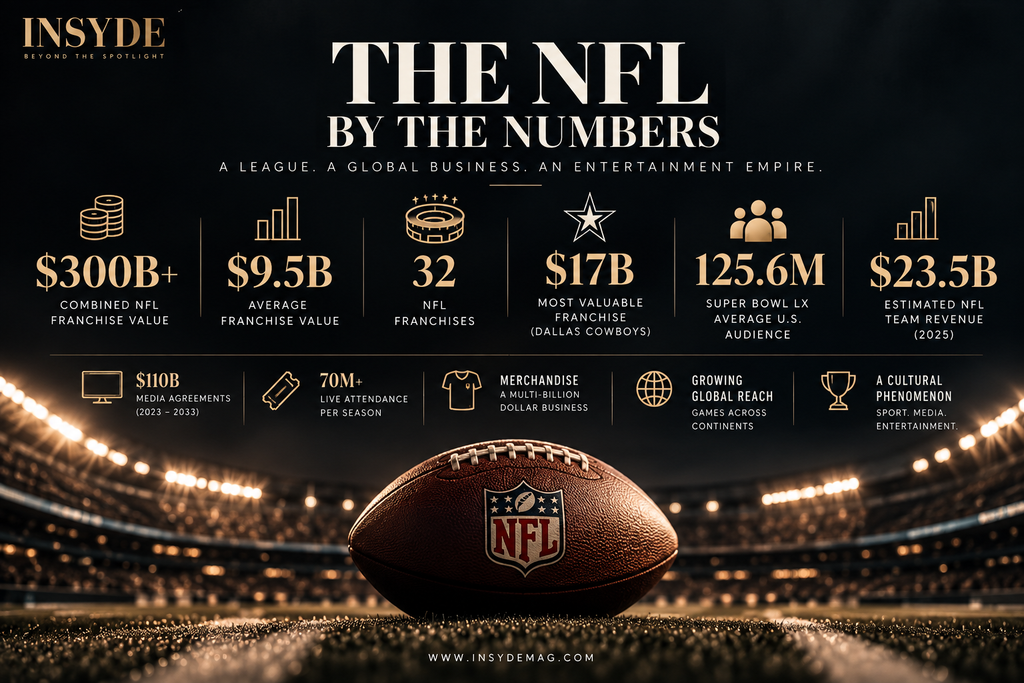
    With just 32 franchises, the National Football League has built a commercial machine that generates more than $23 billion in annual revenue, commands nearly $110 billion in long-term media rights agreements, and has pushed the average value of an NFL franchise to approximately $9.5 billion in 2026.

    The Dallas Cowboys alone are now valued at $17 billion.

    The league’s financial scale has become so extraordinary that the least valuable NFL franchise is now worth around $8 billion.

    But there is a catch.

    The NFL is not the world’s biggest sport by global audience. Football — or soccer — has a vastly broader international footprint, with the FIFA World Cup continuing to demonstrate its enormous global reach.

    So what exactly has the NFL built?

    The answer is perhaps more interesting than the question.

    The NFL has created one of the most powerful sports-business ecosystems in the world — a combination of media rights, advertising, sponsorship, franchise scarcity, stadium economics, merchandising, celebrity and live entertainment that has turned American football into a financial powerhouse.

    And the numbers tell the story.


    $300 BILLION AND COUNTING

    In September 2026, Forbes valued the average NFL franchise at approximately $9.5 billion, up 34% from the previous year.

    Collectively, the 32 franchises are therefore worth more than $300 billion.

    Every team in the league is now valued at at least $8 billion.

    That is an extraordinary change from just a few years ago.

    The Dallas Cowboys sit at the top of the market with a valuation of $17 billion, according to Forbes. The Los Angeles Rams follow at $13.5 billion, the New York Giants at $12 billion, the New England Patriots at $10.6 billion and the San Francisco 49ers at $10.5 billion.

    The Cowboys have held the position as the NFL’s most valuable franchise for 20 consecutive years.

    The striking part isn’t simply that the Cowboys are worth $17 billion.

    It is how quickly the entire league has moved upward.

    The Seattle Seahawks, for example, were sold in 2026 at a reported $9.6 billion valuation — a price that would have represented an extraordinary franchise value only a few years ago.

    Today, it places the club around the middle of the NFL’s valuation hierarchy.

    This is what happens when a scarce asset class meets rapidly growing media economics.


    THE NFL DOESN’T NEED 100 TEAMS

    There are only 32 NFL franchises.

    That scarcity is fundamental to the economics.

    An investor cannot simply create another NFL franchise and begin competing with the existing clubs.

    Ownership opportunities are exceptionally rare, while the number of ultra-high-net-worth individuals and investment groups capable of participating in major sports ownership has expanded.

    At the same time, NFL media rights have continued to grow.

    The result is a remarkably powerful equation:

    limited supply + growing demand + predictable media revenue = rising franchise valuations.

    S&P Global’s 2026 analysis points to several forces behind the rise in NFL valuations, including expanding television rights, the influx of private equity and higher revenue multiples.

    The value of an NFL franchise is therefore not determined simply by how well its team performs on the field.

    The business surrounding the team can be just as important.


    THE $23 BILLION MACHINE

    The NFL’s scale becomes even clearer when looking at revenue.

    NFL teams generated an estimated $23.5 billion in revenue in 2025, according to recent industry reporting, while total NFL revenue surpassed $23 billion.

    That places the NFL substantially ahead of several other major individual sports leagues on commonly reported revenue measures.

    The NBA’s teams generated an estimated $12.25 billion during the 2024–25 season.

    The Premier League’s clubs generated approximately £6.8 billion during 2024–25, equivalent to roughly $9 billion depending on exchange rates.

    These comparisons need some caution because leagues report their finances differently and operate under different structures.

    But the broad picture is clear:

    The NFL is an extraordinary revenue-generating machine.

    And much of that machine is powered by something increasingly valuable in modern media:

    live attention.


    THE $14.5 BILLION DISTRIBUTION

    One of the NFL’s most important structural advantages is its centralized revenue model.

    In 2025, NFL teams received approximately $14.5 billion in shared league revenue, according to S&P Global.

    That works out to more than $450 million per team before considering many locally generated revenue streams.

    The shared revenue pool includes national media rights, sponsorships, licensing and other leaguewide commercial income.

    This structure creates an unusually strong financial floor for individual franchises.

    The NFL isn’t simply a collection of 32 independent businesses.

    It functions as a connected commercial ecosystem.

    The league sells its most valuable national inventory collectively.

    The teams share substantial portions of that income.

    And the result is greater financial stability across the franchise base.


    TELEVISION IS THE REAL MVP

    The NFL’s greatest commercial asset may not be the stadium.

    It may not even be the Super Bowl.

    It is the league’s control over premium live media.

    The NFL’s current media agreements with CBS, NBC, FOX, ESPN/ABC and Amazon run through the 2033 season and are worth nearly $110 billion over 11 years, according to S&P Global.

    The agreements cover television and digital distribution, including major regular-season packages and Super Bowl rights.

    The significance goes beyond the size of the cheque.

    Live sport is one of the few forms of entertainment that people still have a powerful reason to watch immediately.

    A film can wait.

    A series can wait.

    A YouTube video can wait.

    A game cannot.

    The outcome exists only once.

    That makes live sport incredibly valuable to broadcasters and advertisers.

    And the NFL has an enormous amount of it.


    83 OF AMERICA’S TOP 100

    The league’s dominance of U.S. television illustrates the strength of the model.

    NFL games accounted for 83 of the 100 most-watched television broadcasts in the United States during 2025, according to recent industry reporting.

    The NFL also averaged approximately 18.7 million viewers per game during the 2025 season, according to S&P Global, making it one of the most powerful recurring television properties in the United States.

    That concentration of attention is commercially rare.

    And advertisers know it.


    THE SUPER BOWL EFFECT

    Then there is the Super Bowl.

    Super Bowl LX, played in February 2026, averaged 125.6 million viewers across NBC, Peacock, Telemundo, NBC Sports Digital and NFL+, according to Nielsen figures reported by NBC Sports.

    The broadcast peaked at 137.8 million viewers, setting a U.S. television viewership record for a single moment of programming.

    Those numbers explain why the Super Bowl exists in a category of its own.

    It is simultaneously a championship game, television spectacle, advertising platform, celebrity event and entertainment property.

    For brands, it is not simply a media buy.

    It is access to one of the largest concentrated audiences available in American entertainment.

    The Super Bowl has therefore become something larger than the game itself.

    It is a cultural event built around a sporting event.


    THE PRICE OF 30 SECONDS

    The economics of Super Bowl advertising make that point even clearer.

    A 30-second commercial during the 2026 Super Bowl cost advertisers roughly $8 million on average, with some placements reaching higher levels.

    But the real cost of participating in the Super Bowl ecosystem can be substantially greater.

    Brands don’t just purchase airtime.

    They produce campaigns.

    Hire celebrities.

    Create social content.

    Launch teasers.

    Build activations.

    Extend the campaign across digital platforms.

    And then compete for attention around the advertisement itself.

    The commercial becomes part of the entertainment.

    That is one of the NFL’s greatest commercial advantages.

    It doesn’t simply sell advertising space.

    It sells participation in a cultural moment.


    THE COWBOYS: A BUSINESS BEYOND FOOTBALL

    Nothing illustrates the NFL’s economics better than the Dallas Cowboys.

    Forbes estimates the Cowboys generated nearly $1.28 billion in revenue during the 2025 season and approximately $677 million in operating income.

    Their franchise valuation reached $17 billion in 2026.

    The Cowboys are therefore not simply monetizing football games.

    Their business encompasses sponsorships, premium seating, merchandise, media exposure, stadium activity, hospitality and the enormous commercial value of the Cowboys brand.

    AT&T Stadium itself functions as an entertainment destination.

    The franchise has effectively turned team ownership into a large-scale entertainment and commercial platform.

    And that model increasingly defines modern sports ownership.


    THE STADIUM HAS BECOME A LUXURY PRODUCT

    The modern sports stadium is no longer simply a place to watch a game.

    Premium suites.

    Private clubs.

    Corporate hospitality.

    Restaurants.

    Luxury seating.

    Concerts.

    Naming rights.

    Merchandise.

    Non-sporting events.

    The stadium has become a destination where sport meets hospitality, entertainment and business.

    This matters because the highest-value fan isn’t necessarily the person buying the cheapest seat.

    The premium customer may be paying thousands for access, privacy, hospitality and networking.

    The experience becomes the product.

    And that is increasingly where sports begins to overlap with luxury.


    THE ATHLETE IS A BUSINESS, TOO

    The commercial ecosystem doesn’t end with the franchise.

    Players themselves have become brands.

    The modern NFL star can generate value through:

    Endorsements.

    Merchandise.

    Social media.

    Fashion.

    Collectibles.

    Media appearances.

    Personal businesses.

    The NFL Players Association reported more than $1.9 billion in retail sales of officially licensed player merchandise during the March 2025–February 2026 period.

    A jersey isn’t simply merchandise.

    It is identity.

    Fans don’t only consume the sport.

    They participate in it through the athletes and teams they choose to represent.

    That creates another layer of commercial value.


    THE SALARY CAP AND THE ECONOMIC ENGINE

    The players are also directly connected to the league’s financial growth.

    The NFL’s salary cap reached approximately $301.2 million per team in 2026, crossing the $300 million threshold for the first time.

    That is a dramatic increase from the approximately $208.2 million cap in 2022.

    The growth reflects the increasing size of the league’s revenue pool.

    More media money means more league revenue.

    More league revenue means a larger pool available under the league’s labor agreement.

    The result is a cycle in which media growth, player compensation and franchise economics are closely connected.


    BUT IS THE NFL REALLY THE BIGGEST SPORT ON EARTH?

    This is where the story gets complicated.

    If “biggest” means financial power as an individual sports league, the NFL has a compelling claim.

    If “biggest” means global audience and worldwide cultural reach, the answer is different.

    Football — soccer — is played and followed across far more countries and markets.

    The 2026 FIFA World Cup once again demonstrated that reach.

    FIFA reported record-breaking audiences across multiple countries during the tournament’s opening stages and described the World Cup as the world’s biggest and most-watched global sporting event.

    That distinction is crucial.

    The NFL is one centralized league with 32 franchises.

    Global football is a massive ecosystem made up of domestic leagues, continental competitions, national teams and international tournaments.

    Comparing the two directly is therefore imperfect.

    But the contrast is revealing.

    Soccer has the world’s broader global footprint.

    The NFL has one of the world’s most powerful individual league businesses.

    Those are not the same achievement.


    THE GLOBAL EXPANSION

    The NFL understands the difference.

    And it is increasingly looking outside the United States.

    The league is scheduled to play a record nine international games during the 2026 season, expanding its presence across markets including the United Kingdom, Germany, Brazil, Spain, Ireland, Australia and other international destinations.

    All 32 NFL teams are also involved in the league’s Global Markets Program, which gives franchises commercial rights in selected international markets.

    The strategy is straightforward:

    The NFL already has enormous commercial power in the United States.

    Now it wants more of the world’s attention.

    That means international games.

    Streaming.

    Merchandise.

    Sponsorships.

    Local partnerships.

    Player marketing.

    And eventually, deeper grassroots development.

    The opportunity is enormous.

    So is the challenge.


    THE GLOBAL GAP

    American football does not yet have the worldwide cultural penetration of soccer.

    In many countries, football is not simply another sport.

    It is part of everyday culture.

    The NFL therefore faces a different problem from many global sports organizations.

    It does not need to prove that its business works.

    It needs to prove that its business model can travel.

    That is a much harder question.

    The United States provides the NFL with an enormous and highly monetized domestic market.

    The rest of the world offers something different:

    scale.

    If the NFL can convert even a fraction of international curiosity into long-term fandom, merchandise sales, media audiences and commercial partnerships, the league’s economic ceiling could move significantly higher.


    WHY THE NFL BUSINESS MODEL WORKS

    The league’s extraordinary economics come down to several structural advantages.

    SCARCITY

    Only 32 franchises exist.

    MEDIA POWER

    The league controls some of the most valuable live sports content in the world.

    CENTRALIZED REVENUE

    Large portions of national commercial revenue are shared among franchises.

    LIVE ATTENTION

    The outcome of a game cannot be replicated after the fact.

    ADVERTISING

    The Super Bowl provides one of the world’s most concentrated advertising audiences.

    BRAND VALUE

    NFL franchises have become powerful entertainment brands in their own right.

    PREMIUM HOSPITALITY

    Luxury suites, clubs and premium experiences create additional high-value revenue.

    GLOBAL EXPANSION

    The league still has significant international markets to develop.

    Put together, these factors create something unusually powerful:

    a scarce asset with recurring media demand and growing global commercial potential.


    THE NEXT BILLION-DOLLAR QUESTION

    The NFL’s next phase is not simply about increasing ticket sales.

    It is about increasing the value of attention.

    Streaming will become increasingly important.

    International markets will become increasingly important.

    Sports betting and fantasy will remain part of the broader engagement ecosystem.

    Premium hospitality will continue to evolve.

    Digital content will extend the life of games beyond the broadcast.

    And future media negotiations could become even more valuable.

    The league’s current media agreements already approach $110 billion over 11 years.

    Several agreements contain opt-out provisions that could allow the NFL to renegotiate before the contracts fully expire. S&P Global reports that most of the current agreements can be opted out of after the 2029 season.

    That creates another potential inflection point.

    The next major NFL media cycle could become one of the most closely watched transactions in global sports entertainment.


    SO, IS THE NFL THE RICHEST SPORT IN THE WORLD?

    There is no single answer because the question itself mixes different measurements.

    BY INDIVIDUAL LEAGUE REVENUE

    The NFL is the clear financial heavyweight among major individual sports leagues on commonly reported figures, with team revenue estimated at $23.5 billion in 2025 and total league revenue above $23 billion.

    BY FRANCHISE VALUE

    The NFL is extraordinary.

    Its 32 franchises have an average value of approximately $9.5 billion, while the league’s combined franchise value exceeds $300 billion.

    BY GLOBAL SPORTING REACH

    Soccer remains the larger worldwide phenomenon.

    The FIFA World Cup continues to generate enormous audiences across continents and FIFA describes it as the world’s biggest and most-watched global sporting event.

    BY SINGLE-EVENT COMMERCIAL POWER

    The Super Bowl occupies an unusually powerful position.

    Its 125.6 million average U.S. viewers in 2026 demonstrate the scale of the event, while its advertising market turns the championship into a major commercial spectacle.

    So the most defensible conclusion is not that the NFL is simply “the biggest sport on Earth.”

    It is this:

    The NFL is arguably the world’s most powerful individual sports-league business.

    And that distinction matters.


    THE REAL PRODUCT IS ATTENTION

    Football is what happens on the field.

    The real business happens everywhere else.

    In television studios.

    Inside advertising agencies.

    In luxury suites.

    At sponsorship meetings.

    Across streaming platforms.

    Inside stadiums.

    On social media.

    In merchandise stores.

    And increasingly, in markets outside the United States.

    The NFL has created an ecosystem where broadcasters pay billions for access to games, advertisers pay millions for access to viewers, investors pay billions for access to franchises, fans pay for access to experiences, and brands pay for access to the cultural conversation.

    Everyone is buying the same thing.

    Attention.

    The NFL has simply become exceptionally good at converting that attention into economic value.


    THE FINAL WHISTLE

    The NFL may not be the world’s most globally popular sport.

    That distinction belongs to a much broader football ecosystem.

    But measuring the NFL only by audience would miss the extraordinary business it has created.

    Thirty-two franchises.

    More than $23 billion in annual revenue.

    More than $300 billion in combined franchise value.

    A $17 billion flagship franchise.

    Nearly $110 billion in current media agreements.

    A Super Bowl attracting 125.6 million viewers in the United States.

    And a league now aggressively expanding into international markets.

    The NFL is no longer simply selling football.

    It is selling media.

    It is selling access.

    It is selling identity.

    It is selling entertainment.

    It is selling scarcity.

    And above all, it is selling attention.

    The game lasts a few hours.

    The business never stops.


    INSYDE VERDICT

    The NFL isn’t necessarily the biggest sport on Earth.

    But it may be the clearest example of how sport can be transformed into a global-scale entertainment and financial business.

    And as franchise valuations climb, media rights expand and the league pushes further beyond America, the most interesting question may no longer be whether the NFL is the richest sports league.

    It may be:

    How much is the NFL still worth if the rest of the world starts watching?

  • THE FILMS INDIA CAN’T AFFORD TO FAIL

    THE FILMS INDIA CAN’T AFFORD TO FAIL

    Inside the films pushing Indian cinema into a new era of scale, technology and global ambition

    By INSYDE Editorial Desk
    Data & Research: INSYDE Editorial Desk | Ormax Media
    Research updated: 29 September 2026

    Indian cinema has entered a different kind of arms race.

    The biggest films are no longer competing only on star power, opening-day collections or the number of languages in which they release. They are competing on scale — the size of their worlds, the sophistication of their visual effects, the reach of their international campaigns and, increasingly, the amount of capital required to put them on screen.

    A new generation of Indian productions is now being mounted at extraordinary financial scale.

    Ramayana has been associated with a ₹4,000-crore project figure. Varanasi has been reported at approximately ₹1,300–1,400 crore. Raaka has been reported at more than ₹1,000 crore, while Kalki 2898 AD: Part 2 and Fauzi are being discussed in the ₹600–700-crore range.

    But there is an important distinction.

    These numbers are not directly comparable production budgets.

    Some are industry estimates. Some include marketing and release expenditure. Ramayana’s ₹4,000-crore figure covers two films rather than one. Several producers have not publicly disclosed audited production costs.

    So the more useful question is not simply which movie costs the most?

    It is:

    Why is Indian cinema willing to spend at this scale — and what does that tell us about the future of the business?


    THE FIVE MEGA-PRODUCTIONS TO WATCH

    FilmReported / Estimated ScaleCurrent StatusExpected Release
    Ramayana: Part 1 & Part 2~₹4,000 Cr*Part 1 completed / global rollout underwayPart 1: 6 Nov 2026; Part 2: 2027
    Varanasi~₹1,300–1,400 Cr**In production7 Apr 2027
    Raaka₹1,000 Cr+**In production2027
    Kalki 2898 AD: Part 2~₹700 Cr***Regular shoot begins Oct 2026TBA
    Fauzi~₹600–700 Cr**In production / postponedTBA

    * The ₹4,000-crore figure covers both Ramayana films, including release and promotional costs, according to Yash. (India Today)

    ** Reported industry estimate; not an audited producer-disclosed budget. (NDTV)

    *** Reported estimate rather than an officially confirmed production budget. (DPIFF)


    01 — RAMAYANA

    The ₹4,000-Crore Global Project

    Few Indian films have generated as much conversation about scale as Ramayana.

    Directed by Nitesh Tiwari and led by Ranbir Kapoor as Rama, Sai Pallavi as Sita and Yash as Ravana, the two-part epic is being developed as an international-scale cinematic adaptation of one of India’s most enduring stories.

    The headline number, however, needs context.

    The much-discussed ₹4,000 crore is not the production cost of Part One alone. In August 2026, Yash, who is also a co-producer, clarified that the figure covers both films along with release and promotional expenditure. (India Today)

    That makes Ramayana less useful as a conventional single-film budget comparison and more interesting as a large-scale entertainment project.

    Part One is scheduled to release internationally on 6 November 2026, ahead of the Diwali weekend, with the second instalment planned for 2027. (India Today)

    The production also has an unusually international creative infrastructure. Its official promotional material identifies DNEG as the VFX partner, with the film being designed for IMAX presentation and featuring music by Hans Zimmer and A.R. Rahman. (YouTube)

    THE BUSINESS OF MYTHOLOGY

    The commercial proposition behind Ramayana is bigger than a familiar story.

    It is the attempt to turn Indian mythology into globally marketable cinematic intellectual property.

    The source material already possesses enormous cultural recognition. The investment is therefore being directed toward translating that recognition into a modern theatrical spectacle — one that can travel beyond India’s linguistic and geographical markets.

    That requires world-building, visual effects, international distribution, marketing and premium theatrical presentation.

    In other words, the investment is not simply in actors.

    It is in building an entertainment property at global scale.


    02 — VARANASI

    Rajamouli’s Global Gamble

    S. S. Rajamouli has spent the past decade demonstrating that the commercial ceiling of Indian cinema can be much higher than its traditional regional boundaries.

    Varanasi may be his most ambitious experiment yet.

    Starring Mahesh Babu, Priyanka Chopra Jonas and Prithviraj Sukumaran, the action-adventure is being mounted on a reported budget of approximately ₹1,300–1,400 crore. Different reports have cited figures in this range, and the exact audited production cost has not been publicly established. (Bollywood Hungama)

    The film has an officially announced theatrical release date of 7 April 2027. (India Today)

    Its production ambitions extend well beyond conventional Indian locations. Reporting around the film has highlighted international locations including Africa and Antarctica, while the project is being designed around large-scale action and IMAX presentation. (NDTV)

    THE PAN-INDIA MODEL HAS EVOLVED

    The first generation of pan-India cinema was largely about taking a successful regional film into other Indian markets.

    The next generation is being designed differently.

    The film itself is being conceived for multiple markets from the beginning.

    That means:

    Indian theatrical markets
    International Indian audiences
    Premium formats
    Overseas distribution
    Streaming
    Global publicity

    Varanasi therefore represents a bigger commercial experiment than simply making an expensive Telugu film.

    It asks whether an Indian director can build a blockbuster whose production language and commercial ambition are genuinely global.


    03 — RAAKA

    Allu Arjun’s ₹1,000-Crore Franchise Bet

    Raaka may offer the clearest example of Indian cinema moving toward the franchise economy.

    Directed by Atlee and starring Allu Arjun, the project has been reported by India Today as being mounted at more than ₹1,000 crore and planned as a two-part franchise. (India Today)

    The reported narrative spans two worlds and timelines, including a Puranic/Vedic-era setting and a contemporary world.

    That structure is significant.

    Instead of investing heavily in one contained story, the production is reportedly building a larger mythology capable of supporting multiple films.

    And the project is still evolving. As of September 2026, Allu Arjun has acknowledged that production is taking time, while current reporting places the film in the 2027 release window without a firmly announced date. (Hindustan Times)

    The film has also recently attracted attention for its use of large-scale motion-capture technology, underlining how much of the production’s ambition lies beyond conventional live-action filmmaking. (The Indian Express)

    FROM MOVIE TO UNIVERSE

    The economics of a franchise are fundamentally different from those of a standalone film.

    A successful movie can create:

    Characters → audience loyalty → sequels → merchandise → streaming value → music → licensing → future theatrical events

    That is the model global entertainment companies have spent decades developing.

    Indian cinema is increasingly moving in the same direction.

    And Raaka is particularly interesting because its reported budget is being paired with a multi-part structure and multiple cinematic worlds.

    The investment is therefore not only in making one movie.

    It is in creating something that could potentially become an entertainment universe.


    04 — KALKI 2898 AD: PART 2

    When the Franchise Becomes the Product

    Kalki 2898 AD demonstrated that Indian cinema could combine mythology, science fiction and large-scale visual effects into a commercially ambitious theatrical property.

    Now, the sequel is preparing to expand that universe.

    Industry estimates have placed Kalki 2898 AD: Part 2 at around ₹700 crore, although the figure has not been officially confirmed by the producers. (DPIFF)

    Director Nag Ashwin has now confirmed that regular filming is scheduled to begin in October 2026, with the team hoping to complete the shoot by the middle of 2027 before moving into post-production. He has also indicated that the film could arrive in 2028, although no final release date has been announced. (The Times of India)

    Prabhas, Amitabh Bachchan and Kamal Haasan remain central to the project.

    But the most valuable asset may not be the cast.

    It is the Kalki world itself.

    The first film established the mythology, characters, visual language and futuristic environment. The sequel therefore doesn’t have to spend its entire narrative introducing audiences to a new universe.

    It can expand it.

    THE VALUE OF EXISTING IP

    This is one of the most important economic shifts in contemporary Indian cinema.

    A successful franchise can reduce one of the most difficult problems facing expensive films:

    building audience familiarity from zero.

    The audience already knows the world.

    That gives the sequel a foundation on which to build bigger action, deeper mythology and more ambitious visual effects.

    But it also raises the stakes.

    A ₹700-crore film cannot simply look expensive.

    It has to feel like an event.


    05 — FAUZI

    The ₹600–700-Crore Historical Bet

    Not every mega-budget Indian film is built around mythology or futuristic worlds.

    Fauzi is taking the historical route.

    Directed by Hanu Raghavapudi and starring Prabhas, the period action drama is set against the backdrop of pre-Independence India and has been reported at an estimated ₹600–700 crore. (@theweek)

    The film was originally scheduled for 3 December 2026, but producer Y. Ravi Shankar confirmed in September that the release has been postponed. A new date has not yet been announced, with the film now expected to move into 2027. (India Today)

    The delay itself illustrates the economics of large-scale filmmaking.

    Period films require extensive physical reconstruction:

    Sets.
    Costumes.
    Vehicles.
    Crowds.
    Weapons.
    Locations.
    Action choreography.
    Visual effects.

    And when the production is designed as a pan-India theatrical event, the post-production burden grows further.

    SCALE AS IMMERSION

    The objective of a historical epic is not simply to show the past.

    It is to reconstruct it convincingly enough for an audience to enter it.

    That makes production design and post-production central to the business.

    And Fauzi demonstrates an important reality of mega-budget cinema:

    sometimes the most expensive part of a film is not what the camera captures — but everything required to make the world outside the camera believable.


    THE ₹1,000-CRORE QUESTION

    The real story behind these films isn’t simply that Indian cinema is spending more.

    It is that the market underneath those investments is changing.

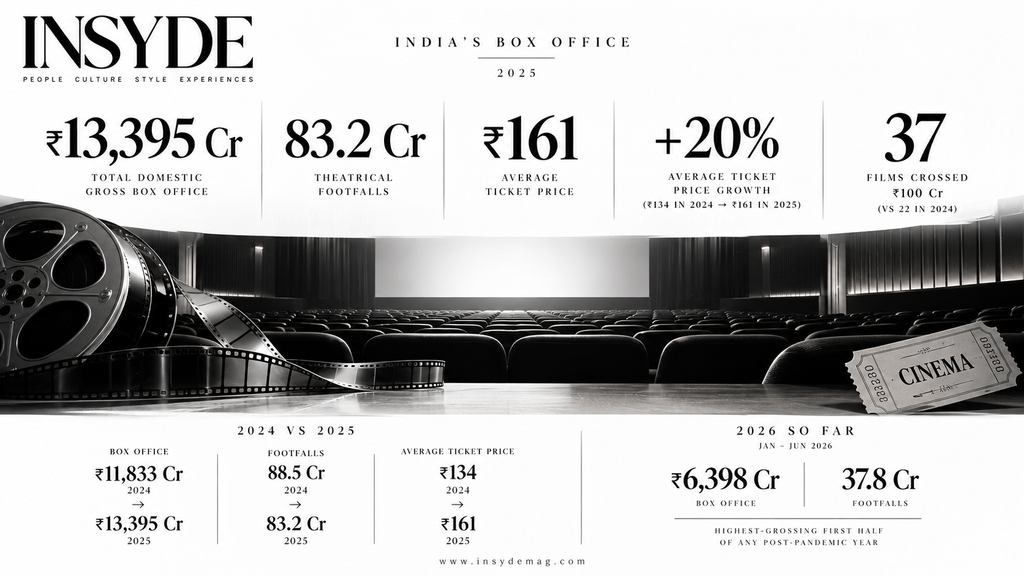
    India’s domestic box office reached a record ₹13,395 crore in 2025, making it the first year to cross the ₹13,000-crore mark. But the same year also saw theatrical footfalls decline 6% to 83.2 crore, while average ticket price rose 20%, from ₹134 to ₹161. (Ormax Media Pvt. Ltd.)

    That combination is revealing.

    The theatrical market is generating more money without requiring proportionally more admissions.

    In other words, premiumisation matters.

    Higher ticket prices, premium formats and event-driven releases are becoming increasingly important to the economics of theatrical cinema.

    And 2026 has continued that momentum.

    By the end of August, Indian domestic box office collections for films released during the year had reached ₹9,868 crore, 18% higher than the corresponding period in 2025. August alone generated ₹1,768 crore, making it the strongest month of 2026 so far and the third-highest-grossing month ever recorded in India’s domestic market. (Ormax Media Pvt. Ltd.)

    The market is therefore providing a stronger foundation for large theatrical events.

    But a stronger market does not make a ₹1,000-crore production automatically safe.


    THE NEW BLOCKBUSTER ECONOMY

    A film’s production budget and its box-office gross are not the same thing.

    This distinction becomes critical at the top end of the market.

    A major Indian film can generate revenue from multiple sources:

    Theatrical rights
    Overseas distribution
    Streaming rights
    Satellite rights
    Music rights
    Brand partnerships
    Merchandising and licensing

    At the same time, costs can extend far beyond principal photography:

    Production
    Star remuneration
    Sets and locations
    Visual effects
    Post-production
    Marketing
    Distribution and release

    This is why a ₹700-crore budget does not mean a film simply needs to collect ₹700 crore at the box office to recover its investment.

    Theatrical gross is distributed across the exhibition and distribution ecosystem, while non-theatrical rights can contribute substantially to the overall financial model.

    For mega-budget cinema, the question is therefore not:

    “How much did the movie collect?”

    It is:

    “How much value did the entire property generate across its life cycle?”

    That is a much more sophisticated way of looking at the modern Indian film business.


    WHY INDIAN CINEMA IS GOING BIGGER

    01 — PAN-INDIA IS NOW AN ECONOMIC STRATEGY

    The success of films travelling across language markets has fundamentally changed the way major productions are conceived.

    A large-scale film can now be designed for Hindi, Telugu, Tamil, Kannada and Malayalam audiences from the outset, rather than being created for one market and expanded later.

    The addressable audience becomes larger.

    So does the investment required to reach it.


    02 — THE GLOBAL INDIAN AUDIENCE MATTERS

    Indian cinema’s commercial opportunity is no longer restricted to India.

    Large diaspora markets across North America, the Gulf, the UK, Australia and elsewhere provide additional theatrical and streaming audiences.

    For a production carrying hundreds of crores in costs, international distribution can therefore become part of the core business strategy rather than an afterthought.

    Ramayana is perhaps the clearest current example of this approach, with its makers explicitly framing the project around a global audience and global release and promotional economics. (India Today)


    03 — VFX IS NO LONGER A FINISHING TOUCH

    Visual effects have moved from being a supporting element to becoming a fundamental part of Indian blockbuster production.

    In films such as Ramayana, Varanasi and Kalki, entire environments, creatures, action sequences and worlds depend on digital production.

    That requires:

    Longer post-production schedules.
    Specialised international teams.
    Advanced motion capture.
    Virtual environments.
    Digital set extensions.
    High-end compositing.

    The technology makes bigger films possible.

    It also makes them considerably more expensive.


    04 — THE STAR HAS BECOME A GLOBAL ASSET

    Ranbir Kapoor.

    Yash.

    Mahesh Babu.

    Allu Arjun.

    Prabhas.

    These names represent more than casting.

    For a mega-budget production, a major star can influence:

    Opening demand.
    Language-market penetration.
    Overseas awareness.
    Brand partnerships.
    Distribution leverage.

    The Indian superstar is increasingly becoming part of the film’s international commercial architecture.


    05 — CINEMA NEEDS TO FEEL LIKE AN EVENT

    Streaming has made entertainment more accessible than ever.

    That creates a difficult question for theatrical cinema:

    Why should audiences leave home?

    The answer increasingly appears to be spectacle.

    IMAX.

    Premium screens.

    Large-format sound.

    Massive action sequences.

    Mythology.

    Science fiction.

    Historical worlds.

    International locations.

    Major stars.

    The modern blockbuster is being designed to offer something that a phone, laptop or ordinary television cannot easily replicate.

    An experience.


    THE RISK OF SCALE

    There is another side to the mega-budget revolution.

    Scale increases both opportunity and exposure.

    A ₹200-crore film and a ₹1,000-crore project do not carry the same financial risk.

    The larger the investment, the more sensitive the production becomes to:

    • release timing
    • production delays
    • visual-effects delivery
    • marketing efficiency
    • distribution
    • audience demand
    • premium-screen availability
    • international performance

    A delay can increase costs.

    A crowded release calendar can affect screen availability.

    A production overrun can materially change the financial equation.

    And if audiences decide that a spectacle is not worth the price of admission, the size of the investment can become its greatest vulnerability.

    This is why India’s mega-budget era should not simply be described as Indian cinema becoming richer.

    It is more accurately understood as the industry moving toward higher-stakes entertainment assets.


    THE NEW POWER MAP OF INDIAN CINEMA

    There is another story hiding inside these five productions.

    A significant share of India’s current mega-budget pipeline is connected to the Telugu film industry and its wider production ecosystem.

    Varanasi.
    Raaka.
    Kalki 2898 AD: Part 2.
    Fauzi.

    This reflects a broader transformation in Indian cinema.

    Over the past decade, Telugu filmmaking has developed a commercially powerful model combining:

    large-scale spectacle + star power + multilingual distribution + visual effects + international ambition.

    Rajamouli’s Baahubali and RRR were important milestones in that evolution.

    The current generation is taking the model further.

    At the same time, Ramayana demonstrates that the Hindi industry is also moving toward the same global-scale production philosophy.

    The old Bollywood-versus-South framework is becoming increasingly inadequate at the highest end of the market.

    The next generation of Indian blockbusters may be better understood as Indian entertainment properties, rather than films belonging neatly to one regional industry.


    THE FINAL FRAME

    India’s next generation of blockbuster films is not simply getting more expensive.

    It is becoming more global, more technological and more franchise-driven.

    Ramayana is attempting to transform mythology into a global cinematic property.

    Varanasi is pushing Rajamouli’s spectacle into an increasingly international production model.

    Raaka is being built around the economics of multiple worlds and a potential franchise.

    Kalki 2898 AD: Part 2 is expanding an established science-fiction universe.

    Fauzi is investing hundreds of crores in historical spectacle and theatrical immersion.

    Together, these films represent something larger than a list of expensive productions.

    They represent a fundamental question for the next phase of Indian cinema:

    CAN INDIA BUILD BLOCKBUSTERS AT GLOBAL SCALE — AND BUILD A BUSINESS THAT CAN SUSTAIN THE COST?

    The answer will not be found in budget announcements alone.

    It will be measured across theatrical admissions, ticket prices, premium formats, overseas markets, streaming rights, distribution deals and the long-term value of the intellectual properties these films create.

    Because the next era of Indian cinema may not be defined by who can make the most expensive film.

    It may be defined by who can turn extraordinary production scale into an extraordinary entertainment business.

    And that is where the real ₹1,000-crore story begins.


    EDITORIAL RESEARCH NOTE

    Budget figures in this feature are presented as reported or estimated figures, not as uniformly audited production budgets. The figures are particularly difficult to compare because they can include different combinations of production, visual effects, marketing, release and multi-film expenditure.

    The ₹4,000-crore Ramayana figure specifically covers both parts of the project along with release and promotional expenditure, as clarified by co-producer Yash. (India Today)

    Varanasi‘s reported budget ranges around ₹1,300–1,400 crore, while Raaka has been reported at ₹1,000 crore-plus. Kalki 2898 AD: Part 2 has been widely estimated at around ₹700 crore, and Fauzi at approximately ₹600–700 crore. These latter figures remain estimates rather than producer-confirmed audited budgets. (NDTV)

    Toxic has deliberately not been included in this upcoming-film list because it released theatrically on 26 August 2026. (India Today)

    Primary market-data source: Ormax Media, The Ormax Box Office Report 2025 and The India Box Office Report: August 2026. (Ormax Media Pvt. Ltd.)

    INSYDE | PEOPLE · CULTURE · STYLE · EXPERIENCES

  • The Places Money Can’t Find

    The Places Money Can’t Find

    Why the rarest luxury destinations are becoming the hardest to reach.

    There was a time when luxury travel was about knowing where to go.

    Then it became about knowing where to stay.

    The right hotel. The right suite. The right table. The right beach.

    But for the traveller who has already experienced the familiar vocabulary of luxury, the more interesting question is beginning to emerge:

    Where can you go that still feels discovered?

    Not necessarily unknown.

    Not necessarily untouched.

    But difficult to reach, difficult to replicate and impossible to experience in quite the same way twice.

    That distinction is becoming increasingly important.

    Because when almost any destination can be researched, photographed, reviewed and booked within minutes, exclusivity can no longer depend entirely on a room number or a five-star rating.

    The new language of luxury travel is increasingly about access, privacy, time and discovery.

    And sometimes, the greatest luxury is simply being somewhere that doesn’t feel designed for everyone.

    When Luxury Becomes Too Accessible

    The luxury travel industry has become exceptionally good at creating beautiful places.

    There are extraordinary resorts on private islands, architectural villas overlooking the sea, mountain retreats surrounded by wilderness and hotels where every detail has been considered.

    And there is nothing wrong with any of it.

    But familiarity changes perception.

    Once a destination becomes part of the established luxury circuit, its exclusivity begins to evolve.

    The property may remain exceptional.

    The service may remain impeccable.

    The view may still be extraordinary.

    But the feeling of discovery becomes harder to preserve.

    For the sophisticated traveller, that can create a different desire.

    Not necessarily for something more expensive.

    For something less obvious.

    The New Luxury Is Distance

    Distance has become a luxury of its own.

    Not because travelling farther is inherently better, but because distance creates natural scarcity.

    A remote island cannot accommodate everyone.

    A private estate cannot simply add another thousand rooms.

    An expedition vessel cannot reproduce the infrastructure of a major resort.

    A destination requiring a yacht, private aircraft, helicopter or long overland journey naturally limits who can reach it.

    That limitation changes the experience.

    The journey itself becomes part of the privilege.

    The destination is no longer simply where you arrive.

    It is what you had to leave behind to get there.

    Privacy Is the New Amenity

    A private pool is beautiful.

    A private beach is better.

    But privacy itself may be becoming the more valuable amenity.

    For people whose lives involve constant communication, visibility and tightly managed schedules, the ability to disappear for several days without interruption can be worth more than another spectacular suite.

    No lobby.

    No crowds.

    No unnecessary meetings.

    No expectation to be anywhere.

    Just time.

    This is one reason private villas, secluded estates, yacht-based journeys and remote retreats have become such compelling forms of luxury.

    They don’t simply offer comfort.

    They create distance from everything else.

    Beyond the Suite

    The luxury industry spent years refining the hotel room.

    Better beds.

    Better bathrooms.

    Better views.

    Larger terraces.

    Private pools.

    Personal service.

    But the next evolution of luxury travel may be less concerned with what happens inside the room.

    The more interesting question is:

    What can the destination allow you to experience?

    A private cultural visit before the crowds arrive.

    A remote dive site reached by boat.

    Dinner prepared in a place where no restaurant exists.

    A conservation experience guided by specialists.

    A private estate normally closed to the public.

    A journey planned around a particular interest rather than a standard itinerary.

    These experiences are valuable because they are not simply amenities.

    They are access.

    And access is becoming one of the most sophisticated currencies in modern luxury.

    When the Journey Becomes the Experience

    The traditional idea of travel separates the journey from the destination.

    You fly there.

    Then the holiday begins.

    Luxury increasingly removes that boundary.

    A private aircraft can make the departure itself part of the experience.

    A yacht can turn the route into the destination.

    An expedition vessel can make the journey through remote waters the reason for travelling.

    A helicopter can transform a difficult landscape into an accessible one.

    The affluent traveller is therefore increasingly choosing not simply a destination, but a sequence of moments that could not easily be reproduced.

    The journey becomes part of the story.

    And the story becomes part of the luxury.

    The End of the Checklist

    There is another change taking place quietly.

    Luxury travel is moving away from the checklist.

    The old formula was familiar:

    See the landmark.

    Visit the famous restaurant.

    Stay at the iconic hotel.

    Take the photograph.

    Move to the next destination.

    But for someone who has travelled extensively, another itinerary can begin to feel strangely repetitive.

    The more interesting journey may have no checklist at all.

    It might revolve around a particular passion.

    Architecture.

    Wine.

    Art.

    Marine life.

    History.

    Photography.

    Cuisine.

    Wellness.

    Wildlife.

    Or simply the desire to spend a week somewhere extraordinarily quiet.

    This is where personalisation becomes more important than extravagance.

    The best itinerary may be the one that could not have been designed for anyone else.

    The Rise of Private Discovery

    There is a difference between exclusivity and discovery.

    Exclusivity says:

    Not everyone can enter.

    Discovery says:

    Not everyone knows to look.

    The second is more powerful.

    A private guide who has spent decades studying a region.

    A conservationist who can take you somewhere visitors rarely see.

    A local family opening a place that has never been part of mainstream tourism.

    A chef preparing a meal around ingredients sourced from a particular landscape.

    An architect introducing you to buildings unavailable through conventional tours.

    These experiences don’t necessarily require extraordinary spectacle.

    Their value comes from knowledge and access.

    And knowledge is one of the few luxuries that cannot simply be purchased by the hour.

    The Luxury of Knowing Someone

    At the highest level of travel, the concierge is no longer simply arranging a reservation.

    They are connecting you to a world.

    The difference is enormous.

    A reservation can be made online.

    A relationship cannot.

    The most sophisticated travel experiences often depend on people who know the region intimately — who understand which door to knock on, who to call, when to arrive and, just as importantly, when not to.

    That invisible network can transform an ordinary destination into an extraordinary one.

    The traveller may never know how difficult the arrangement was.

    They simply experience the result.

    Again, the finest luxury often works quietly.

    The Destination Without the Audience

    There is something increasingly attractive about experiencing a beautiful place without immediately turning it into content.

    No photograph required.

    No location tag.

    No audience.

    No obligation to document the moment.

    Just the experience itself.

    That may sound almost old-fashioned in a world where travel is constantly photographed and shared.

    But perhaps that is precisely why it feels luxurious.

    When every extraordinary moment can become public within seconds, keeping one private can become its own form of exclusivity.

    Not everything beautiful needs to be witnessed.

    Some experiences become more valuable precisely because they belong only to the people who were there.

    Beyond the Familiar

    This does not mean the world’s great luxury destinations are becoming irrelevant.

    Paris will remain Paris.

    The Mediterranean will remain the Mediterranean.

    The world’s great cities, hotels and resorts will continue to attract sophisticated travellers.

    But the definition of luxury is expanding.

    The experienced traveller may stay at the celebrated hotel.

    And then leave it.

    They may charter a yacht instead of spending the entire week at the resort.

    They may fly somewhere remote for three days.

    They may spend part of the journey in a private villa and part of it in an expedition camp.

    The point is not to reject conventional luxury.

    It is to move beyond it.

    The New Status Symbol Is the Story

    Luxury has always had a relationship with status.

    But status is changing.

    A recognisable hotel once communicated that you had arrived.

    A recognisable destination communicated taste.

    A recognisable experience communicated access.

    Today, the most interesting status may be more personal.

    It is the story you can tell because you were there.

    Not:

    “I stayed at the most expensive resort.”

    But:

    “We were taken somewhere almost nobody visits.”

    Not:

    “We went to the famous restaurant.”

    But:

    “We had dinner somewhere that doesn’t normally serve the public.”

    Not:

    “We visited the destination.”

    But:

    “We saw a side of it that most people never encounter.”

    The difference is subtle.

    But it represents a profound change in how sophisticated luxury is experienced.

    When Money Stops Being Enough

    There is a misconception that enough money can buy anything.

    In travel, that isn’t always true.

    Money can buy a private aircraft.

    It can buy a suite.

    It can charter a yacht.

    It can secure extraordinary service.

    But it cannot automatically create authenticity.

    It cannot manufacture a genuine relationship with a place.

    It cannot reproduce a moment that happened only because the circumstances aligned.

    And it cannot guarantee discovery.

    Some experiences depend on weather.

    Some on season.

    Some on local relationships.

    Some on conservation restrictions.

    Some on simply being in the right place at the right moment.

    That uncertainty is part of what makes them valuable.

    The rarest luxury is not always what money can buy.

    Sometimes it is what money can only help you reach.

    What the Next Luxury Traveller Wants

    The next generation of luxury travel is likely to be increasingly personal.

    Less concerned with showing where you have been.

    More interested in how deeply you experienced it.

    Less focused on excess.

    More focused on access.

    Less interested in a standard itinerary.

    More interested in something designed around an individual.

    The priorities become remarkably simple:

    Privacy.

    Time.

    Access.

    Discovery.

    Personalisation.

    Meaning.

    And perhaps most importantly:

    the feeling that the experience could not have been copied and given to someone else.

    The Places Money Can’t Find

    Perhaps that is where luxury travel is heading.

    Not necessarily toward the most expensive destination.

    Not toward the biggest suite.

    Not toward the most photographed beach.

    But toward places where luxury becomes almost invisible.

    A remote coastline.

    A private estate.

    A quiet island.

    A journey without an itinerary.

    A table prepared somewhere it shouldn’t be.

    A landscape seen before anyone else arrives.

    A place that doesn’t need a name everyone recognises.

    Because when almost anywhere can be discovered online, reviewed instantly and booked with a few clicks, the rarest destinations are no longer necessarily the ones nobody knows about.

    They are the ones that cannot be reduced to a booking.

    The ones that require a relationship.

    A journey.

    A little patience.

    A certain amount of luck.

    And the willingness to go further.

    Perhaps that is the real evolution of luxury travel.

    The world is not running out of beautiful places.

    It is simply becoming harder to experience them privately, personally and unexpectedly.

    And for the traveller who has already seen much of what the world has to offer, that may be the ultimate luxury.

    Not going somewhere everyone dreams of visiting.

    Going somewhere that still feels like you discovered it yourself.

    INSYDE — Beyond the Spotlight.

  • INDIA’S 5 BIGGEST FILM INDUSTRIES

    INDIA’S 5 BIGGEST FILM INDUSTRIES

    The ₹13,395 Crore Business of Indian Cinema

    India’s film economy is no longer a one-industry story. Hindi cinema has reclaimed the top spot at record scale, while Telugu, Tamil, Malayalam and Kannada cinema continue to build powerful theatrical markets of their own.

    For decades, the global shorthand for Indian cinema was simple: Bollywood.

    But the economics of the country’s theatrical market tell a far more complex story.

    India is home to several large film industries, each with its own stars, studios, audiences, distribution networks and cultural identity. Hindi cinema remains the country’s largest theatrical language market, but Telugu and Tamil cinema operate at enormous commercial scale, Malayalam cinema has established itself as a major force, and Kannada cinema delivered one of the market’s sharpest recoveries in 2025.

    The numbers underline just how large the business has become.

    In 2025, India’s domestic theatrical box office reached ₹13,395 crore — the highest annual gross in the history of the Indian market and the first time the country crossed the ₹13,000 crore mark. The previous record was ₹12,226 crore in 2023.

    But the headline number comes with an important qualification.

    India recorded 83.2 crore theatrical footfalls in 2025, down 6% from 2024, while the average ticket price rose 20%, from ₹134 to ₹161. The record box office was therefore driven not simply by larger audiences, but also by audiences paying more for cinema.

    And within that record market, five Indian language industries stood out.

    THE FIVE BIGGEST

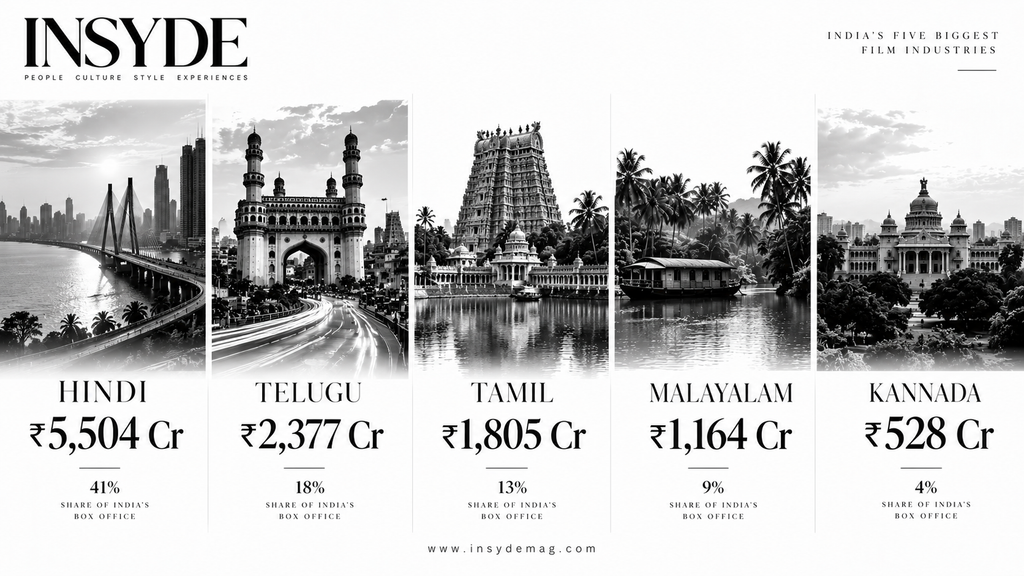
    RankIndustry2025 Gross Box OfficeShare of India
    01Hindi₹5,504 Cr41%
    02Telugu₹2,377 Cr18%
    03Tamil₹1,805 Cr13%
    04Malayalam₹1,164 Cr9%
    05Kannada₹528 Cr4%

    Source: Ormax Media, The Ormax Box Office Report 2025. Figures represent domestic gross box office and are rounded.

    Together, these five language markets generated approximately ₹11,378 crore, or about 85% of India’s total 2025 theatrical box office.

    But the real story isn’t simply who collected the most.

    It is how each industry is evolving.


    01 — HINDI CINEMA

    ₹5,504 CRORE

    The giant returns to record territory.

    Hindi cinema remained India’s largest theatrical market in 2025 — and reached a new high.

    The Hindi-language market generated ₹5,504 crore in domestic gross box office, making 2025 its best year ever. Hindi accounted for approximately 41% of India’s total theatrical market.

    But the more revealing statistic lies beneath the headline.

    93% of Hindi cinema’s 2025 box office came from original Hindi-language films.

    That represents a significant change from 2024, when dubbed South Indian films accounted for approximately 31% of Hindi cinema’s collections. In 2025, that dependence fell to just 7%.

    The market was therefore not merely growing; its composition was changing.

    At the centre of that resurgence was Dhurandhar, which generated approximately ₹950 crore in India and became the highest-grossing Hindi-language film in Ormax’s 2025 data, surpassing Stree 2 at ₹698 crore.

    Chhaava was another major contributor, while Saiyaara became one of the year’s other major Hindi successes.

    Across the entire Indian market, only three films crossed the ₹500 crore mark in 2025: Dhurandhar, Kantara: A Legend – Chapter 1 and Chhaava.

    Hindi cinema’s 2025 performance therefore represented more than a single blockbuster year.

    It demonstrated the continued commercial power of original Hindi-language theatrical content.

    THE NUMBER TO KNOW

    ₹5,504 Cr — Hindi cinema’s 2025 domestic gross.

    WHAT IT TELLS US

    Hindi cinema remains the single largest theatrical language market in India, but its 2025 resurgence was increasingly powered by original Hindi films rather than dubbed South Indian releases.


    02 — TELUGU CINEMA

    ₹2,377 CRORE

    A ₹2,000-crore market with staying power.

    Telugu cinema finished 2025 as India’s second-largest language market, with ₹2,377 crore in domestic gross box office.

    The significance of Telugu cinema lies not only in the size of the number, but in its consistency.

    The industry has remained above the ₹2,000 crore mark for multiple consecutive years, establishing a scale that few other regional markets have matched.

    The Telugu market has also become an important part of India’s wider pan-Indian theatrical ecosystem.

    Films originating in Telugu increasingly travel beyond Andhra Pradesh and Telangana, while stars, directors and production houses have become recognisable across India.

    That cross-market ambition has been one of the defining characteristics of the modern Telugu film business.

    Yet the industry’s commercial strength does not mean every year produces a new record.

    In 2025, Telugu cinema’s overall box office remained broadly stable compared with the previous year. That stability itself is notable: the industry maintained a ₹2,000-crore-plus market even without depending on one year’s singular mega-blockbuster to redefine its scale.

    The first half of 2026 reinforced Telugu cinema’s importance. During January 2026, Telugu releases accounted for 39% of that month’s box office alongside Hindi releases, with the Sankranthi period alone producing more than ₹500 crore from five major Telugu releases.

    THE NUMBER TO KNOW

    ₹2,377 Cr — Telugu cinema’s 2025 domestic gross.

    WHAT IT TELLS US

    Telugu cinema has evolved from a strong regional industry into one of India’s most commercially significant theatrical ecosystems, with the ability to generate large-scale business both within its home markets and beyond them.


    03 — TAMIL CINEMA

    ₹1,805 CRORE

    A heavyweight in a quieter year.

    Tamil cinema generated ₹1,805 crore in domestic gross box office in 2025, placing it third among India’s major language markets.

    The number is substantial, but 2025 was not a peak year for the industry.

    Tamil cinema’s share of India’s annual box office was approximately 13%, and its theatrical performance was softer than in some recent record years.

    That is an important distinction when looking at industry rankings.

    A market can remain enormous while experiencing a weaker cycle of releases.

    Tamil cinema has one of India’s deepest filmmaking ecosystems, with a large domestic audience, an established star system, major production houses and a long history of films travelling internationally.

    The industry’s influence also extends far beyond the size of its annual domestic gross.

    However, theatrical markets are ultimately measured by what audiences spend at the box office — and 2025 demonstrated how much annual rankings can be affected by the presence or absence of a handful of event films.

    The 2026 numbers show that volatility continuing. In the first half of 2026, Tamil cinema’s share of India’s box office fell from 17% in H1 2025 to 12% in H1 2026.

    That should not be interpreted as a permanent change in the industry’s position. It is a snapshot of a particular release cycle.

    THE NUMBER TO KNOW

    ₹1,805 Cr — Tamil cinema’s 2025 domestic gross.

    WHAT IT TELLS US

    Tamil cinema remains one of India’s largest film markets, but its annual box-office performance can move considerably depending on the strength and timing of major releases.


    04 — MALAYALAM CINEMA

    ₹1,164 CRORE

    From regional strength to national relevance.

    If one Indian film industry has dramatically changed its commercial profile in recent years, it is Malayalam cinema.

    In 2025, Malayalam films generated ₹1,164 crore in domestic gross box office, keeping the industry above the ₹1,000-crore threshold for a second consecutive year.

    That achievement is particularly notable because Malayalam cinema had already undergone a dramatic expansion in 2024.

    In 2024, its box office more than doubled and crossed ₹1,000 crore for the first time, rising from ₹572 crore in 2023 to ₹1,165 crore.

    Maintaining almost exactly that level in 2025 makes the development more significant.

    It suggests that the ₹1,000-crore year was not simply an isolated spike.

    Malayalam cinema has increasingly demonstrated that commercially successful films do not necessarily require the scale traditionally associated with the largest Indian industries.

    Its ecosystem has been built around a combination of strong storytelling, distinctive filmmakers, established actors, genre experimentation and an audience willing to support a wide variety of films.

    That model has also helped Malayalam films travel.

    Streaming has expanded their national visibility, while successful theatrical titles increasingly attract audiences outside Kerala through dubbed versions and cross-language releases.

    The commercial result is a market that now sits comfortably among India’s five largest theatrical language industries.

    THE NUMBER TO KNOW

    ₹1,164 Cr — Malayalam cinema’s 2025 domestic gross.

    WHAT IT TELLS US

    Malayalam cinema’s rise is not simply about one successful year. Its ability to sustain a ₹1,000-crore-plus theatrical market has made it one of the most significant developments in India’s modern film economy.


    05 — KANNADA CINEMA

    ₹528 CRORE

    The comeback market.

    Kannada cinema enters the top five with ₹528 crore in 2025 domestic gross box office.

    But the number that makes the industry stand out is not ₹528 crore.

    It is 73%.

    Kannada cinema recorded approximately 73% growth over 2024, making it the only one of the four major South Indian language markets highlighted by Ormax to show significant growth in 2025.

    The recovery was driven heavily by Kantara: A Legend – Chapter 1, which became one of the year’s biggest Indian films.

    The film was one of only three releases to cross ₹500 crore across India in 2025, alongside Dhurandhar and Chhaava.

    That puts Kannada cinema’s year into perspective.

    Its overall market remains considerably smaller than Hindi, Telugu, Tamil or Malayalam cinema. But its 2025 performance demonstrated the ability of a major Kannada-language event film to operate at national scale.

    The challenge now is sustainability.

    A single blockbuster can dramatically change an industry’s annual numbers. Building a deeper pipeline of commercially successful films is what ultimately determines whether a recovery becomes a lasting expansion.

    For Kannada cinema, 2025 was therefore both a commercial achievement and a reminder of the power of event filmmaking.

    THE NUMBER TO KNOW

    ₹528 Cr — Kannada cinema’s 2025 domestic gross.

    WHAT IT TELLS US

    Kannada cinema’s 2025 performance showed how quickly a smaller theatrical market can expand when a major homegrown film becomes a national event.


    THE ₹13,395-CRORE QUESTION

    What is really driving India’s box office?

    The most interesting part of India’s record 2025 box office is that audience volume did not grow alongside revenue.

    India recorded 83.2 crore theatrical footfalls, a 6% decline from 2024.

    At the same time, the average ticket price increased by 20%, from ₹134 to ₹161.

    This tells us something important about the modern theatrical business.

    The industry’s growth is increasingly influenced by:

    Higher ticket prices.

    Premium formats.

    Event films.

    Large-scale releases.

    Audience concentration around films perceived as theatrical experiences.

    The market is not simply selling more tickets.

    It is extracting more value from the audiences who do go.

    That distinction will matter enormously as the Indian theatrical industry competes with streaming platforms for consumers’ time and entertainment spending.


    THE BLOCKBUSTER ECONOMY

    Another major change appeared in the number of films crossing the ₹100-crore threshold.

    In 2025, 37 films crossed ₹100 crore at the Indian box office, compared with 22 films in 2024.

    At the very top of the market, six films crossed ₹300 crore, while three crossed ₹500 crore.

    That tells us two things simultaneously.

    First, India’s theatrical market has developed a much larger pool of films capable of generating significant revenue.

    Second, the blockbuster remains enormously important.

    This became even more visible in the first half of 2026.

    From January to June 2026, the Indian box office generated ₹6,398 crore, approximately 10% higher than the same period in 2025. Footfalls also increased by 5%, reaching 37.8 crore.

    But box-office concentration increased.

    Six films crossed ₹200 crore in the first half of 2026, while the top 15 films accounted for 58% of total box office, compared with 49% during the comparable 2025 period. Dhurandhar: The Revenge alone contributed nearly 20% of the first-half total.

    The message is clear:

    India’s theatrical market can be broad, but its biggest numbers are still increasingly concentrated around event films.


    THE LANGUAGE SHIFT

    Perhaps the most important change in Indian cinema is not occurring inside any individual industry.

    It is happening between them.

    The old model treated Hindi cinema and regional cinema as separate commercial worlds.

    That distinction is increasingly difficult to maintain.

    Actors cross industries.

    Directors work across languages.

    Films release simultaneously in multiple markets.

    Stories are dubbed and remade.

    Audiences move between languages.

    And theatrical success can now travel far beyond the market in which a film was originally produced.

    At the same time, the 2025 numbers show that this does not mean every industry is growing at the same rate.

    Hindi cinema’s share reached 41% of India’s 2025 box office, while the combined share of Telugu, Tamil, Malayalam and Kannada cinema fell from 48% in 2024 to 44% in 2025.

    That change was driven in part by Hindi cinema’s strong recovery and the increased contribution of international films.

    It is therefore better understood as a shift in annual market share, rather than evidence that India’s regional industries are becoming commercially irrelevant.

    In fact, the opposite may be happening.

    India is becoming a market in which multiple film industries can achieve national-scale success.


    2026: THE MARKET IS STILL MOVING

    The story did not stop with 2025.

    The first six months of 2026 generated ₹6,398 crore, the strongest first half of any post-pandemic year. Footfalls rose 5% year-on-year, reversing a three-year period of decline and stagnation.

    Hindi cinema strengthened its position, accounting for 44% of the first-half 2026 box office, compared with 39% in the corresponding period of 2025. Tamil cinema’s share moved in the opposite direction, falling from 17% to 12%.

    And the market continued to produce exceptionally strong monthly results.

    By August 2026, the Indian box office had already recorded its strongest month of the year, with ₹1,768 crore in gross collections during August.

    The annual picture will ultimately depend on the performance of the remaining 2026 releases, but the mid-year data confirms one thing:

    India’s theatrical economy is still expanding — and the balance between its major language markets continues to shift.


    THE NEW POWER MAP OF INDIAN CINEMA

    The idea of Indian cinema as simply “Bollywood” no longer captures the economics of the market.

    Hindi cinema is still the largest.

    Telugu cinema has established a ₹2,000-crore-plus theatrical scale.

    Tamil cinema remains one of India’s deepest and most established film ecosystems.

    Malayalam cinema has transformed itself into a ₹1,000-crore-plus market.

    Kannada cinema has shown how quickly a regional industry can rebound when a film becomes a national cultural event.

    And beyond these five, industries such as Marathi, Gujarati, Bengali and others continue to contribute to India’s increasingly diverse theatrical economy.

    The result is a film market that is becoming simultaneously larger, more multilingual and more interconnected.

    For audiences, that means more films crossing traditional language boundaries.

    For studios, it means the potential audience for a successful film is no longer limited to the language in which it was produced.

    For stars, it means regional fame can increasingly become national recognition.

    And for the business itself, it means the next blockbuster could come from almost anywhere.


    THE FINAL FRAME

    India’s film industry did not become a ₹13,395-crore business because one industry suddenly conquered the others.

    It happened because several powerful film ecosystems are operating simultaneously — sometimes competing, sometimes collaborating and increasingly sharing audiences.

    The five largest language markets accounted for roughly 85% of India’s 2025 theatrical gross, but their individual stories could hardly be more different.

    One returned to record territory.

    One maintained a ₹2,000-crore-plus scale.

    One navigated a softer release cycle.

    One consolidated a remarkable breakthrough.

    And one delivered a dramatic comeback.

    That may be the most important story in Indian cinema today.

    The future of Indian film is not necessarily about one industry replacing another.

    It is about more industries becoming big enough to matter.

    And in a market this large, the next major cinematic phenomenon could come from Mumbai, Hyderabad, Chennai, Kochi, Bengaluru — or somewhere audiences haven’t started looking yet.

    **India’s box office is no longer one story. It is an ecosystem.**

    By INSYDE Editorial Desk
    Research & Data: Ormax Media
    Additional 2026 market data: Ormax Media — Jan–Jun 2026

  • THE BUILDERS

    THE BUILDERS

    5 Entrepreneurs Who Helped Build Modern India

    India was not built by one industry. It was built by people willing to imagine a different one.

    Long before India became one of the world’s largest startup ecosystems, before Bengaluru became synonymous with technology, before smartphones became essential infrastructure and before biotechnology became one of the country’s most promising frontiers, there were entrepreneurs building companies in a very different India.

    They operated in an economy defined by scarcity, regulation and limited access to capital.

    Yet they built.

    They built factories, software companies, computers, telecommunications networks and biotechnology laboratories. More importantly, they built institutions that changed what Indian businesses could aspire to become.

    Today, India has more than 200,000 startups recognised by the government, millions of jobs created by the startup ecosystem and a technology sector projected to cross $315 billion in FY2026.

    The country is no longer simply asking whether something can be built in India.

    It is asking whether it can be built in India and for the world.

    That shift did not happen overnight.

    It was shaped by generations of entrepreneurs who expanded the boundaries of Indian business — sometimes through industrial scale, sometimes through technology, sometimes through connectivity, and sometimes through scientific ambition.

    There is no definitive list of the people who “built India.” The country is far too large, and its economic transformation far too complex, for that.

    But these five entrepreneurs offer five compelling lenses through which to understand the making of modern Indian enterprise.

    Dhirubhai Ambani.
    N. R. Narayana Murthy.
    Sunil Bharti Mittal.
    Kiran Mazumdar-Shaw.
    Shiv Nadar.

    Five entrepreneurs.

    Five industries.

    Five different ideas of what India could become.


    01

    THE BUILDER OF SCALE

    Dhirubhai Ambani

    Reliance Industries

    There is a particular word that follows Dhirubhai Ambani through the history of Indian business:

    Scale.

    In 1957, after returning to India, Dhirubhai began a yarn-trading business in Mumbai. Two decades later, Reliance Textile Industries went public.

    The 1977 IPO became a defining moment. The issue was oversubscribed seven times, and Reliance credits it with helping usher in what became known as the “equity cult” in India.

    But the significance of Dhirubhai’s story goes beyond the size of Reliance.

    He understood something that would become central to modern Indian capitalism: scale could itself be a competitive advantage.

    Reliance moved from textiles into petrochemicals and progressively deeper into the industrial value chain. The objective was not simply to operate a successful business in one category, but to build an integrated industrial enterprise capable of competing at a much larger level.

    That ambition eventually became part of the foundation on which Reliance expanded into energy, retail, telecommunications and digital services.

    The transformation is striking when viewed against the India in which Dhirubhai began.

    Capital was scarce.

    Markets were less developed.

    Indian companies were rarely discussed in the same global terms as their Western counterparts.

    Dhirubhai’s answer was not to think smaller because the environment was difficult.

    It was to think bigger.

    His public-market strategy also brought a new generation of individual investors into the story of corporate growth. Reliance’s 1977 public issue became an important moment in the widening participation of ordinary Indian investors in equity markets.

    That legacy is complicated, as the history of any enormous business empire inevitably is.

    But there is little ambiguity about the ambition.

    Dhirubhai helped establish a model of Indian entrepreneurship built around scale, vertical integration, capital and mass participation.

    The company that emerged from that philosophy would eventually become one of the world’s largest diversified business groups.

    THE IDEA

    India could build companies at industrial scale — and Indian capital could participate in that growth.


    02

    THE EXPORTER OF INDIAN TALENT

    N. R. Narayana Murthy

    Infosys

    In 1981, seven engineers founded Infosys in Pune with initial capital of just US$250.

    Four decades later, the company reported FY2026 revenue of roughly US$20.3 billion on a trailing basis, with more than 328,000 employees.

    The distance between those two numbers tells part of the story.

    The more important story is what happened in between.

    Infosys emerged during a period when India’s greatest economic asset was increasingly recognised not as raw material or manufacturing capacity, but as human capital.

    Engineers.

    Programmers.

    Mathematicians.

    Problem-solvers.

    Infosys helped turn that talent into a global business model.

    The company pioneered the Global Delivery Model, allowing technology work to be delivered across borders and time zones. In 1999, Infosys became the first Indian IT company to be listed on NASDAQ.

    Suddenly, the world was not simply outsourcing work to India.

    It was increasingly recognising India as a source of sophisticated technology talent.

    That distinction matters.

    The growth of India’s IT services industry would go on to create an enormous ecosystem of engineers, entrepreneurs, technology professionals and new companies.

    Bengaluru became one of the most important centres of that transformation.

    Infosys was not responsible for India’s entire technology revolution. No single company was.

    But it became one of the institutions through which the world began to see Indian technology capability differently.

    Its employee stock-option programme also became an important part of the early Indian technology story, creating a pathway through which professional employees could participate directly in the value created by a rapidly growing company.

    The broader result was a change in perception.

    Indian talent was no longer simply a cost advantage.

    It could become a global competitive advantage.

    THE IDEA

    India’s most valuable export did not always need to be a physical product. Sometimes it was knowledge.


    03

    THE CONNECTOR

    Sunil Bharti Mittal

    Bharti Airtel

    There was a time when a mobile phone in India was a luxury.

    Today, telecommunications is infrastructure.

    As of March 2026, India had more than 1.26 billion wireless subscribers, more than 1.06 billion broadband subscribers and more than 1.09 billion internet subscribers.

    That transformation was not created by one company.

    But Sunil Bharti Mittal and Bharti Airtel became major participants in it.

    Mittal began Bharti Enterprises in 1976, initially building businesses including bicycle components. Telecommunications became the defining chapter.

    Airtel launched its Delhi mobile service in 1995.

    The idea was deceptively simple:

    Make telecommunications a mass-market business.

    The implications were enormous.

    As mobile connectivity spread, the telephone evolved into something much larger.

    It became a gateway to banking, commerce, entertainment, education, navigation, work and social life.

    By 2026, Bharti Airtel had crossed the 650 million customer milestone globally, making it the world’s second-largest telecom operator by customer base, according to Bharti.

    The number is almost difficult to visualise.

    But the real significance is not the number itself.

    It is what that number represents.

    Connectivity became democratised at extraordinary scale.

    The Indian consumer moved from waiting for access to a fixed telephone line to carrying a connected computer in their pocket.

    And that infrastructure became one of the foundations of India’s digital economy.

    Mittal’s story therefore belongs in this conversation not simply because he built a large telecommunications company.

    It belongs here because he helped participate in a transformation in which connectivity stopped being a privilege and became part of everyday life.

    THE IDEA

    Sometimes the most powerful businesses don’t sell a product. They build the infrastructure through which an entire economy operates.


    04

    THE SCIENTIST

    Kiran Mazumdar-Shaw

    Biocon

    In 1978, Kiran Mazumdar-Shaw began Biocon in Bengaluru with three employees in a rented shed.

    The company started by manufacturing and exporting enzymes.

    It was an unlikely beginning for what would become one of India’s best-known biotechnology enterprises.

    But the importance of Biocon lies precisely in that leap.

    India’s economic transformation is often told through the stories of manufacturing, information technology and telecommunications.

    Biotechnology offers another chapter.

    It is the story of a country attempting to turn scientific capability into globally relevant businesses.

    Biocon’s early history was built around enzymes. Its ambitions expanded into research, biopharmaceuticals, biosimilars and healthcare.

    In FY2026, Biocon reported consolidated total income of approximately ₹17,270 crore, with operating revenue of around ₹16,927 crore, demonstrating the scale of the institution that grew from that original Bengaluru operation.

    But financial scale only tells part of the story.

    Mazumdar-Shaw was building in a field where the barriers were fundamentally different from those faced by consumer or software businesses.

    Biotechnology demands scientific infrastructure.

    Research.

    Regulatory expertise.

    Patient capital.

    Global partnerships.

    And an ability to remain committed to a problem for years rather than quarters.

    That makes Biocon an important part of India’s larger entrepreneurial story.

    The company did not simply demonstrate that an Indian company could manufacture biological products.

    It demonstrated that Indian scientific capability could become the foundation of a global business.

    And the sector is becoming increasingly important.

    India’s bioeconomy reached approximately $195.3 billion in 2025, according to the India BioEconomy Report 2026.

    The industry Mazumdar-Shaw entered in 1978 is no longer a niche experiment.

    It is becoming a major part of India’s future economic architecture.

    THE IDEA

    India’s next great industries can be built in laboratories as well as factories.


    05

    THE TECHNOLOGY PIONEER

    Shiv Nadar

    HCL

    Before India became known as the world’s technology-services powerhouse, it was already trying to build computers.

    In 1976, Shiv Nadar and his co-founders established HCL.

    The company began as one of India’s early technology ventures and moved into computer hardware at a time when the country’s computing ecosystem was still in its infancy.

    HCL’s history includes a series of technological firsts, including the development of indigenous computing systems and early work in areas such as Unix-based computing and relational database technology.

    The larger significance is easy to miss from today’s perspective.

    India now has hundreds of millions of people working and studying around digital technologies.

    In the 1970s, the country was still building much of the technological capability needed to participate in the coming information age.

    Nadar’s bet was that India should not simply consume technology.

    India should build it.

    HCL began with hardware and eventually evolved into a global technology enterprise spanning engineering, software and services.

    That evolution mirrors India’s own technological journey.

    Hardware.

    Computing.

    Software.

    IT services.

    Engineering.

    Digital transformation.

    Artificial intelligence.

    The industry kept changing.

    HCL kept changing with it.

    Nadar’s story also illustrates an important characteristic of India’s technology sector: it was not created entirely by the companies that later became household names.

    It was built by an earlier generation that took risks when the market was smaller, the technology was expensive and the outcome was far from certain.

    Today, HCLTech describes itself as a global technology company with more than 220,000 professionals operating across 60 countries.

    But its origins were much smaller.

    A handful of entrepreneurs.

    A Delhi startup.

    A belief in the microprocessor.

    And a conviction that India could participate in the information age on its own terms.

    THE IDEA

    Before India could become a technology superpower, someone had to believe India could build technology.


    THE FIVE BUILDERS

    Dhirubhai Ambani built around scale.

    Narayana Murthy helped turn Indian talent into a global technology export.

    Sunil Bharti Mittal helped make connectivity mass infrastructure.

    Kiran Mazumdar-Shaw demonstrated the potential of Indian biotechnology and scientific entrepreneurship.

    Shiv Nadar helped establish an early foundation for Indian computing and technology.

    Their businesses were different.

    Their generations were different.

    Their strategies were different.

    But each expanded the boundaries of what Indian enterprise could attempt.

    And that may be the most interesting way to understand their legacy.

    Not through their net worth.

    Not through a ranking.

    Not through the size of their personal fortunes.

    But through the possibilities their companies created for the people who came after them.


    FROM BUILDING COMPANIES TO BUILDING POSSIBILITIES

    The India these entrepreneurs entered was not the India we know today.

    The economy was smaller.

    Capital was harder to access.

    Technology was expensive.

    Global markets were further away.

    The infrastructure required to build a world-class company was often missing.

    Yet businesses were built anyway.

    Then those businesses created talent.

    Talent created new businesses.

    Those businesses created capital.

    Capital created more ambition.

    And ambition created an ecosystem.

    That compounding effect is perhaps the most important part of the story.

    Today’s India has more than 2.07 lakh startups recognised by DPIIT, with nearly 2.8 million jobs attributed to the startup ecosystem.

    The country’s technology industry is projected to cross $315 billion in FY2026.

    Its telecommunications infrastructure now reaches more than a billion internet subscribers.

    Its bioeconomy has crossed $195 billion.

    These numbers belong to today’s India.

    But the foundations were laid over decades.


    THE NEXT BUILDERS

    The question facing the next generation is therefore different.

    The first generation had to ask:

    Can India build?

    The next generation asks:

    Can India lead?

    That distinction is already visible.

    Artificial intelligence.

    Semiconductors.

    Space technology.

    Electric mobility.

    Biotechnology.

    Defence technology.

    Climate technology.

    Consumer brands.

    Financial technology.

    Deep-tech.

    India’s entrepreneurial story is moving into industries where the opportunity is not simply to build large companies, but to build globally consequential ones.

    The builders of the previous era created institutions.

    The builders of the next era will inherit those institutions — along with a vastly larger market, deeper pools of talent, greater access to capital and a generation of consumers who are increasingly connected to the world.

    That does not make the next chapter inevitable.

    Building anything consequential remains difficult.

    Markets change.

    Technology changes.

    Capital disappears.

    Competition intensifies.

    And institutions must continually reinvent themselves.

    But the ambition has changed.

    India is no longer only a market waiting to be served.

    It is increasingly a place from which products, technologies, companies and ideas can emerge for the rest of the world.


    THE REAL LEGACY

    Perhaps the phrase “builders of India” is too large for any five names.

    It is.

    A country of 1.4 billion people cannot be reduced to five entrepreneurs.

    India was built by farmers and engineers, workers and scientists, entrepreneurs and educators, designers and factory workers, investors and consumers, public institutions and private enterprise.

    The five people in this story represent only a handful of those forces.

    But their stories reveal something important.

    Countries change when their citizens begin to believe that the future can be built rather than simply inherited.

    Dhirubhai Ambani showed what scale could look like.

    Narayana Murthy showed what Indian talent could export.

    Sunil Bharti Mittal showed what connectivity could unlock.

    Kiran Mazumdar-Shaw showed what science could become.

    Shiv Nadar showed that India could build technology rather than merely consume it.

    Their greatest legacy may therefore not be the companies they left behind.

    It may be the entrepreneurs who looked at those companies and thought:

    Why not us?


    THE BUILDERS

    Five entrepreneurs.

    Five industries.

    One evolving India.

    And the story is nowhere near finished.

  • The New Heirloom: The Luxury of Legacy

    The New Heirloom: The Luxury of Legacy

    Why exceptional jewellery is becoming one of luxury’s most personal forms of wealth.

    There is a difference between owning something valuable and owning something that matters.

    The distinction becomes clearer at the highest levels of luxury.

    When access is no longer the challenge, another question begins to matter: what is actually worth keeping?

    A remarkable piece of jewellery can answer that question rather elegantly.

    It does not need to occupy a room.

    It does not need a chauffeur.

    It does not need a marina or a private hangar.

    It can sit quietly in a private collection, emerge for one evening, and carry more meaning than an object ten times its size.

    That is the peculiar power of exceptional jewellery.

    It is wealth made intimate.

    Not necessarily wealth designed to be seen by everyone, but wealth expressed through rarity, provenance, craftsmanship and personal significance.

    And increasingly, that is where luxury is heading.

    When Price Stops Being the Point

    For a certain kind of buyer, price is an important consideration.

    For the truly affluent, it is often a secondary one.

    The question is no longer whether something is expensive enough to justify its place in a collection.

    It is whether it is exceptional enough to deserve one.

    That distinction changes the entire conversation.

    A rare Colombian emerald.

    An extraordinary Burmese ruby with compelling provenance.

    A historic diamond.

    A one-of-one commission.

    A piece created by an exceptional atelier.

    A jewel whose craftsmanship reveals itself only when examined closely.

    These are not interchangeable luxury goods.

    They are objects with characteristics that cannot simply be reproduced by increasing a budget.

    That is where jewellery becomes particularly interesting.

    Money can secure access. It cannot manufacture rarity.

    The Value of Knowing What You Are Looking At

    There is a sophistication to jewellery that rewards knowledge.

    Two stones can appear similar to an untrained eye and possess radically different histories, qualities and desirability.

    Two pieces can carry similar materials and have completely different levels of craftsmanship.

    The difference may be in the cut.

    The setting.

    The proportions.

    The origin.

    The stone selection.

    The construction.

    The hand behind it.

    Or simply the judgement of the person who commissioned it.

    This is why the most sophisticated jewellery culture is not necessarily loud.

    It is informed.

    A collector does not need a room to recognise a remarkable stone.

    Sometimes a glance across a dinner table is enough.

    That is a very different kind of status.

    Recognition becomes selective.

    Jewellery Is Wealth You Can Wear

    A residence remains at its address.

    A yacht remains at sea.

    A private aircraft moves according to a flight plan.

    Jewellery has a different kind of freedom.

    It travels with its owner.

    A necklace can move between continents.

    A ring can pass from a boardroom to a private dinner.

    A pair of earrings can become part of an evening’s entire visual language.

    The object is not simply stored wealth.

    It becomes portable identity.

    And because it is worn directly against the body, jewellery occupies an unusually intimate position within a luxury collection.

    You don’t simply own it.

    You live with it.

    The Quiet Power of Exceptional Craftsmanship

    At the top end of jewellery, craftsmanship is rarely there for spectacle.

    It is there for perfection.

    The setting has to hold the stone without overpowering it.

    The proportions have to feel inevitable.

    The metal has to respond to light correctly.

    The construction has to survive years of wear without losing its character.

    The smallest detail can determine whether a piece feels merely expensive or genuinely exceptional.

    This is where the great ateliers distinguish themselves.

    The finished piece may appear effortless.

    That is precisely the point.

    Exceptional craftsmanship hides its own difficulty.

    The more refined the object, the less it needs to explain itself.

    The Stone Is Only the Beginning

    A remarkable gemstone carries its own identity.

    Its colour.

    Its character.

    Its origin.

    Its rarity.

    Its history.

    Its imperfections can sometimes become part of what makes it desirable.

    The sophisticated collector therefore isn’t necessarily searching for the largest stone.

    They may be searching for the stone that cannot easily be replaced.

    That distinction matters.

    Size can be measured.

    Rarity has to be understood.

    And in the highest echelons of collecting, uniqueness tends to outlast spectacle.

    India’s Jewellery Legacy Is an Extraordinary Advantage

    India enters this conversation with something many emerging luxury markets would struggle to create from scratch:

    centuries of jewellery culture.

    Kundan.

    Jadau.

    Polki.

    Meenakari.

    Temple jewellery.

    Goldsmithing traditions.

    Gem-setting techniques.

    Regional craftsmanship passed between generations.

    These aren’t simply decorative traditions.

    They are sophisticated systems of making.

    The opportunity for contemporary Indian luxury is therefore not to reproduce the European model of jewellery.

    It is to take India’s enormous craft heritage and give it a new vocabulary.

    The most compelling future Indian jewellery may not look traditionally Indian at first glance.

    It may be architectural.

    Minimal.

    Sculptural.

    Unexpected.

    But the intelligence of the craft can remain underneath.

    That is where heritage becomes contemporary.

    The Indian Jewel of Tomorrow

    Imagine a contemporary necklace constructed using a centuries-old technique.

    A sculptural ring inspired by Indian architecture.

    A modern interpretation of Jadau without ceremonial excess.

    A rare gemstone framed with the restraint of contemporary design.

    A private commission that combines an inherited stone with a completely new setting.

    That is far more interesting than simply placing an Indian motif on a luxury product.

    The real opportunity is reinvention without losing provenance.

    If Indian jewellery houses can achieve that balance, the result could become globally significant.

    Not because it is Indian.

    But because it is exceptional.

    When Jewellery Becomes a Private Language

    There is a particular pleasure in owning something that does not need to announce itself.

    A necklace without a visible logo.

    A ring whose significance is understood only by a handful of collectors.

    A stone selected because of its provenance rather than its recognisability.

    A private commission that exists nowhere else.

    This is where jewellery enters the territory of discreet luxury.

    The object does not ask for attention.

    It rewards attention.

    And that distinction is increasingly important.

    The old luxury language often said:

    Look at what I own.

    The newer language can say:

    Look closely.

    The Heirloom Is Changing

    Historically, an heirloom was something that survived long enough to be inherited.

    Today, the most thoughtful collectors can design for inheritance from the beginning.

    A piece commissioned for a milestone.

    A gemstone selected with a future daughter or son in mind.

    An existing family jewel redesigned without losing its original stone.

    A new piece created specifically to become part of a family’s visual history.

    The object becomes more than an acquisition.

    It becomes a decision about the future.

    And that may be one of the most sophisticated reasons to buy exceptional jewellery.

    You are not necessarily buying for yourself alone.

    You are deciding what deserves to survive you.

    From Jewellery to Family Archive

    This is where jewellery becomes almost impossible to price.

    A necklace can carry the memory of a wedding.

    A ring can carry the history of a marriage.

    A stone can be reset across generations.

    A brooch can return decades later at another family celebration.

    The financial value may remain measurable.

    The emotional value does not.

    And over time, the two can become inseparable.

    A remarkable jewel is therefore capable of becoming something unusual:

    a physical archive of a family.

    That is a form of wealth no balance sheet can properly capture.

    The Collector’s Eye

    Serious collecting is rarely about accumulation for its own sake.

    The most interesting private collections tend to have a point of view.

    They may focus on exceptional stones.

    A particular period.

    A house.

    A designer.

    A technique.

    A geographical tradition.

    Or simply pieces that tell compelling stories.

    The collector begins to develop an eye.

    They notice things.

    The quality of a setting.

    The way a stone is cut.

    The originality of a design.

    The difference between an important piece and merely an expensive one.

    At that point, buying becomes less about consumption and more about curation.

    And curation is one of the defining characteristics of sophisticated luxury.

    When a Jewel Becomes Art

    There is a moment when jewellery stops functioning as an accessory.

    It becomes an artwork.

    A one-of-one commission.

    An extraordinary stone.

    An experimental setting.

    A collaboration between an artist and a master jeweller.

    A piece whose proportions are so deliberate that it could belong in a gallery as naturally as it belongs on the body.

    At that level, the question is no longer whether the piece matches an outfit.

    It is whether the object itself deserves to exist.

    That is a much higher standard.

    And it is where jewellery enters the world of collecting.

    The Investment Question Is Almost the Wrong Question

    Luxury jewellery is frequently discussed as an investment.

    That conversation has its place.

    Certain exceptional pieces can command significant prices in the secondary market, particularly when rarity, provenance, craftsmanship and collector demand converge.

    But reducing exceptional jewellery to financial performance misses its more enduring value.

    The serious collector isn’t necessarily asking whether a jewel will outperform an investment portfolio.

    They are asking whether it possesses lasting desirability.

    Will the stone still be remarkable?

    Will the craftsmanship still be respected?

    Will the design still feel relevant?

    Will the provenance still matter?

    Will someone want it decades from now?

    That is a different definition of value.

    Financial value can fluctuate. Cultural value can compound.

    The New Luxury Is Personal

    The next generation of high jewellery is unlikely to be defined simply by larger stones or heavier pieces.

    It will be defined by individuality.

    Private commissions.

    Unusual gemstones.

    Exceptional provenance.

    Artist collaborations.

    Heritage techniques.

    Contemporary Indian craftsmanship.

    One-of-one designs.

    And pieces that could never have been created for anyone else.

    This is where luxury becomes most interesting.

    The object is no longer simply selected.

    It is authored.

    The collector becomes part of the creative process.

    The final piece carries something of both sides: the skill of the maker and the identity of the person who commissioned it.

    That is difficult to mass-produce.

    And therefore, increasingly valuable.

    Beyond the Logo

    The future of jewellery may belong to pieces that do not immediately reveal their price, their house or even their significance.

    A rare stone.

    An exceptional setting.

    A technique recognised by a specialist.

    A piece with a story known only to the owner and a small circle of people who understand its importance.

    This is not the disappearance of the luxury brand.

    It is the evolution of luxury beyond the brand.

    The logo tells you who made something.

    The craftsmanship tells you why it matters.

    The provenance tells you where it has been.

    But the story tells you why it should be kept.

    The Things We Choose to Keep

    Perhaps that is why jewellery has survived every change in fashion.

    Trends disappear.

    Designers change.

    Houses rise and fall.

    But a remarkable jewel can remain.

    It can cross generations.

    It can carry a story long after its original owner is gone.

    It can be worn again decades later and somehow feel completely right.

    Because the most valuable thing about jewellery has never been simply what it is made from.

    It is what it remembers.

    And perhaps that is the ultimate luxury.

    Not owning the largest stone.

    Not wearing the most recognisable name.

    Not proving how much something cost.

    But possessing something rare enough, beautiful enough and meaningful enough to become part of someone else’s future.

    The finest jewellery doesn’t simply belong to a person.

    For a while, a person becomes part of its story.

    INSYDE — Beyond the Spotlight.

  • GUCCI goes MADE IN CHINA?

    GUCCI goes MADE IN CHINA?

    Inside the sneaker challenging what “Made in Italy” means in modern luxury.

    By INSYDE

    There are few phrases in fashion more powerful than Made in Italy.

    Two words can evoke Florence workshops, generations of artisans, hand-finished leather and the kind of craftsmanship luxury houses have spent decades turning into mythology.

    So when a Gucci sneaker arrives with “Made in China” printed on its product information, it creates an uncomfortable question.

    Not because China cannot manufacture luxury products.

    But because, for a brand like Gucci, where something is made has always been part of the story.

    Gucci has now introduced specific sneaker models manufactured in China, including the Drip, the first sneaker designed under Demna’s creative direction at Gucci. The product is officially listed by Gucci as “Made in China.” A second slip-on sneaker from the same Primavera collection also carries the designation.

    The internet can reduce that story to three words:

    Gucci. Made in China.

    The reality is considerably more interesting.

    Because this isn’t really a story about China replacing Italy.

    It is a story about what luxury means when the world that makes it becomes increasingly global.


    THE SNEAKER THAT STARTED THE CONVERSATION

    The Drip is not designed to look like a traditional Italian luxury sneaker.

    Gucci describes it as a streamlined silhouette that combines the visual language of a basketball shoe with the ease of a loafer. It is available across materials and colourways including nylon, suede and GG canvas. Gucci identifies it as Demna’s first sneaker for the house.

    Its positioning is also distinctly contemporary.

    This is not a product attempting to recreate the romance of an old Gucci atelier.

    It is a product designed for a fashion landscape where sneakers can carry the cultural weight once reserved for handbags, watches and couture.

    And then comes the detail that changes the conversation:

    Made in China.

    The sneaker is still sold through Gucci.

    It still carries the Gucci name.

    It still sits within Gucci’s luxury ecosystem.

    And depending on the market and version, it carries a price approaching the €800–$1,000 range.

    That is where the question becomes unavoidable.

    If the product is luxury, what exactly makes it luxury?


    NO, GUCCI ISN’T MOVING TO CHINA

    Before the headlines get ahead of the facts, there is an important distinction to make.

    Gucci has not announced a broad relocation of its manufacturing from Italy to China.

    According to Gucci’s statement reported by Reuters, Italy remains at the heart of its manufacturing model and identity, and the company has no broader plan to move production outside Italy. Gucci said the Chinese manufacturer was selected for the technical expertise and capabilities needed for the particular sneaker.

    Gucci’s wider manufacturing structure tells the same story.

    The house says that most Gucci products are made in Italy, while different categories are manufactured in other specialist markets. Gucci states that its watches are mainly produced in Switzerland, fragrances in France and the UK, cosmetics in the EU and some eyewear in Japan.

    Its responsible supply-chain documentation states that 95% of Gucci’s manufacturers are based in Italy.

    So the accurate story is not:

    Gucci is abandoning Italy.

    It is:

    Gucci has chosen China for the manufacturing of specific sneakers.

    That distinction matters.


    WHY CHINA?

    For years, “Made in China” was often used in luxury conversations as shorthand for mass production.

    That perception is increasingly outdated.

    China has become one of the world’s major manufacturing centres, including in footwear, technical materials and highly specialised production.

    And Gucci’s public explanation for the Drip is not that China was chosen simply because it is cheaper.

    The company has specifically pointed to the manufacturer’s technical know-how and capabilities as the reason for the decision.

    That doesn’t mean cost is irrelevant to the economics of global luxury.

    Gucci’s parent company Kering reported that Gucci’s first-half 2026 revenue declined 5% on a comparable basis to €2.757 billion, while the group also reported sequential improvement during the period. Mainland China remained a challenging market, although trends were improving.

    The broader luxury industry is navigating a more demanding consumer environment, with brands looking for new ways to create relevance, excitement and value.

    But there is not enough public evidence to say that Gucci selected China specifically to reduce manufacturing costs.

    And that is precisely why the story is more interesting without that assumption.


    THE MYTH OF “MADE IN ITALY”

    Luxury has always understood the power of geography.

    Paris.

    Milan.

    Florence.

    Geneva.

    Tokyo.

    Certain places have become synonymous with particular forms of expertise.

    For Gucci, Italy isn’t simply a manufacturing location.

    It is part of the brand’s cultural identity.

    But modern luxury supply chains are rarely as simple as a single country.

    A product can involve materials, components, specialist techniques and manufacturing processes spanning several countries before it reaches a customer.

    European Union rules on non-preferential origin recognise this complexity, generally determining origin for goods involving multiple countries through the concept of last substantial transformation, subject to the applicable rules.

    That doesn’t make “Made in Italy” meaningless.

    Quite the opposite.

    It demonstrates why provenance is a sophisticated concept rather than simply a postcode.

    The real question is no longer only:

    Where was it made?

    It is:

    What expertise was required to make it?


    FROM COUNTRY OF ORIGIN TO COUNTRY OF EXPERTISE

    This may be where luxury is heading.

    A watch can be Swiss.

    An eyewear collection can involve Japanese manufacturing.

    A fragrance can be produced in France.

    A sneaker can be manufactured in China.

    And the same global luxury house can still maintain a distinctly European identity.

    Gucci’s own manufacturing footprint already reflects this reality.

    The old luxury equation was relatively simple:

    Italy = craftsmanship.

    The new equation is considerably more complicated:

    Design + expertise + materials + technology + craftsmanship + scarcity + brand identity + cultural relevance.

    Geography remains part of that equation.

    But it is no longer necessarily the entire equation.


    THE PRICE OF THE NAME

    Then there is the uncomfortable part.

    What exactly is the customer paying for?

    A sneaker doesn’t cost hundreds of dollars because of the rubber sole alone.

    The price incorporates an entire ecosystem:

    Design.

    Creative direction.

    Materials.

    Manufacturing.

    Distribution.

    Brand heritage.

    Marketing.

    Retail experience.

    Cultural relevance.

    And, inevitably, the name printed on the box.

    That last element is enormous.

    Luxury has always sold objects, but it has also sold meaning.

    A Gucci handbag is not simply leather.

    A Rolex is not simply steel.

    A Ferrari is not simply an engine.

    The object becomes valuable partly because of the story surrounding it.

    Which brings us back to the label.

    If a Gucci sneaker is manufactured in China but designed under Demna, developed within Gucci’s creative and commercial system, sold through Gucci boutiques and presented as a Gucci product, does its country of manufacture change its luxury status?

    There is no universal answer.

    For some consumers, provenance will remain fundamental.

    For others, design and cultural relevance may matter more.

    And that tension is exactly what makes this moment worth watching.


    DEMNA AND THE NEW GUCCI

    The timing makes the story even more significant.

    The Drip isn’t simply another Gucci sneaker.

    It is part of the beginning of Demna’s Gucci era.

    The designer’s arrival represents a new creative chapter for one of fashion’s most recognisable houses, and the Drip is one of the first products through which that direction becomes visible. Gucci itself identifies it as Demna’s first sneaker for the brand.

    Its design feels deliberately contemporary.

    Less about preserving an image of luxury.

    More about asking what luxury can look like now.

    That distinction matters.

    The modern luxury consumer doesn’t necessarily want a product that looks expensive.

    They want something that means something.

    Something recognisable without being obvious.

    Something culturally relevant.

    Something that can move between fashion, street culture, social media and everyday life.

    The Drip belongs to that world.

    Its manufacturing origin simply adds another layer to the conversation.


    WHEN THE LABEL BECOMES THE STORY

    There is a strange irony here.

    Luxury brands spend enormous amounts of money creating narratives around their products.

    With the Drip, the manufacturing label has become part of the narrative itself.

    That can be complicated.

    Reuters reported that some luxury-industry analysts see potential tension between China-made products and Gucci’s long-standing association with Italian craftsmanship. Those are industry interpretations, however, rather than evidence that the product has already damaged Gucci’s positioning or consumer demand.

    The eventual answer will come from consumers.

    Not headlines.

    Not social-media arguments.

    Not assumptions about where a product should be made.

    But whether customers believe the object delivers enough design, quality, desirability and cultural value to justify its price.

    Because luxury has always been, at its core, an agreement between a brand and its customer.

    The brand says:

    This is special.

    The customer decides whether to believe it.


    THE NEW LUXURY MAP

    Perhaps the most important consequence of Gucci’s China-made sneaker isn’t what it says about China.

    It is what it says about Italy.

    And, more broadly, about the future of luxury.

    For decades, country of origin functioned almost like a guarantee.

    Made in Italy.

    Made in Switzerland.

    Made in France.

    The location itself communicated expertise.

    But as technology improves and manufacturing capabilities become increasingly distributed around the world, luxury houses have more choices than ever.

    The next generation of luxury may therefore be less interested in a single manufacturing postcode and more interested in why a particular place was chosen.

    Where is the best leather?

    Where is the strongest technical expertise?

    Where is the most appropriate craftsmanship?

    Where can a particular construction be executed at the required standard?

    Where does the product make the most sense?

    Those questions are far more complicated than simply asking whether something was made in Italy or China.

    And they may become increasingly important as luxury brands rethink how they manufacture, price and position products.


    SO, DOES “MADE IN CHINA” CHANGE GUCCI?

    It changes the conversation.

    It doesn’t erase Gucci’s Italian manufacturing heritage.

    It doesn’t mean Gucci has moved its entire production operation to China.

    It doesn’t make the sneaker counterfeit.

    And it doesn’t, by itself, tell us whether the product is better or worse.

    What it does do is challenge one of luxury’s oldest assumptions:

    that geography and value are inseparable.

    Gucci continues to have the overwhelming majority of its manufacturers in Italy, while also using specialist manufacturing capabilities across different countries and, now, China for specific sneaker models.

    That may be less dramatic than the internet’s version of the story.

    But it is far more revealing.

    Because the future of luxury may not be about choosing between Italy and China.

    It may be about understanding that modern luxury can be simultaneously local in identity and global in production.

    The atelier still matters.

    The designer still matters.

    The material still matters.

    The craftsmanship still matters.

    But so does technology. So does cultural relevance. So does the ability to manufacture something precisely for the way people want to live now.

    The Gucci Drip has simply made that evolution visible.

    And perhaps that is the real story behind the label.

    Luxury isn’t losing its borders.

    It’s learning how to exist beyond them.


    INSYDE

    The world of luxury is changing. We’re watching what comes next.

    Sources: Gucci product listings and FAQ; Gucci Responsible Supply Chain documentation; Kering H1 2026 results; Reuters reporting, September 2026; European Commission rules on non-preferential origin.

    Inside the sneaker challenging what “Made in Italy” means in modern luxury.

    By INSYDE

    There are few phrases in fashion more powerful than Made in Italy.

    Two words can evoke Florence workshops, generations of artisans, hand-finished leather and the kind of craftsmanship luxury houses have spent decades turning into mythology.

    So when a Gucci sneaker arrives with “Made in China” printed on its product information, it creates an uncomfortable question.

    Not because China cannot manufacture luxury products.

    But because, for a brand like Gucci, where something is made has always been part of the story.

    Gucci has now introduced specific sneaker models manufactured in China, including the Drip, the first sneaker designed under Demna’s creative direction at Gucci. The product is officially listed by Gucci as “Made in China.” A second slip-on sneaker from the same Primavera collection also carries the designation.

    The internet can reduce that story to three words:

    Gucci. Made in China.

    The reality is considerably more interesting.

    Because this isn’t really a story about China replacing Italy.

    It is a story about what luxury means when the world that makes it becomes increasingly global.


    THE SNEAKER THAT STARTED THE CONVERSATION

    The Drip is not designed to look like a traditional Italian luxury sneaker.

    Gucci describes it as a streamlined silhouette that combines the visual language of a basketball shoe with the ease of a loafer. It is available across materials and colourways including nylon, suede and GG canvas. Gucci identifies it as Demna’s first sneaker for the house.

    Its positioning is also distinctly contemporary.

    This is not a product attempting to recreate the romance of an old Gucci atelier.

    It is a product designed for a fashion landscape where sneakers can carry the cultural weight once reserved for handbags, watches and couture.

    And then comes the detail that changes the conversation:

    Made in China.

    The sneaker is still sold through Gucci.

    It still carries the Gucci name.

    It still sits within Gucci’s luxury ecosystem.

    And depending on the market and version, it carries a price approaching the €800–$1,000 range.

    That is where the question becomes unavoidable.

    If the product is luxury, what exactly makes it luxury?


    NO, GUCCI ISN’T MOVING TO CHINA

    Before the headlines get ahead of the facts, there is an important distinction to make.

    Gucci has not announced a broad relocation of its manufacturing from Italy to China.

    According to Gucci’s statement reported by Reuters, Italy remains at the heart of its manufacturing model and identity, and the company has no broader plan to move production outside Italy. Gucci said the Chinese manufacturer was selected for the technical expertise and capabilities needed for the particular sneaker.

    Gucci’s wider manufacturing structure tells the same story.

    The house says that most Gucci products are made in Italy, while different categories are manufactured in other specialist markets. Gucci states that its watches are mainly produced in Switzerland, fragrances in France and the UK, cosmetics in the EU and some eyewear in Japan.

    Its responsible supply-chain documentation states that 95% of Gucci’s manufacturers are based in Italy.

    So the accurate story is not:

    Gucci is abandoning Italy.

    It is:

    Gucci has chosen China for the manufacturing of specific sneakers.

    That distinction matters.


    WHY CHINA?

    For years, “Made in China” was often used in luxury conversations as shorthand for mass production.

    That perception is increasingly outdated.

    China has become one of the world’s major manufacturing centres, including in footwear, technical materials and highly specialised production.

    And Gucci’s public explanation for the Drip is not that China was chosen simply because it is cheaper.

    The company has specifically pointed to the manufacturer’s technical know-how and capabilities as the reason for the decision.

    That doesn’t mean cost is irrelevant to the economics of global luxury.

    Gucci’s parent company Kering reported that Gucci’s first-half 2026 revenue declined 5% on a comparable basis to €2.757 billion, while the group also reported sequential improvement during the period. Mainland China remained a challenging market, although trends were improving.

    The broader luxury industry is navigating a more demanding consumer environment, with brands looking for new ways to create relevance, excitement and value.

    But there is not enough public evidence to say that Gucci selected China specifically to reduce manufacturing costs.

    And that is precisely why the story is more interesting without that assumption.


    THE MYTH OF “MADE IN ITALY”

    Luxury has always understood the power of geography.

    Paris.

    Milan.

    Florence.

    Geneva.

    Tokyo.

    Certain places have become synonymous with particular forms of expertise.

    For Gucci, Italy isn’t simply a manufacturing location.

    It is part of the brand’s cultural identity.

    But modern luxury supply chains are rarely as simple as a single country.

    A product can involve materials, components, specialist techniques and manufacturing processes spanning several countries before it reaches a customer.

    European Union rules on non-preferential origin recognise this complexity, generally determining origin for goods involving multiple countries through the concept of last substantial transformation, subject to the applicable rules.

    That doesn’t make “Made in Italy” meaningless.

    Quite the opposite.

    It demonstrates why provenance is a sophisticated concept rather than simply a postcode.

    The real question is no longer only:

    Where was it made?

    It is:

    What expertise was required to make it?


    FROM COUNTRY OF ORIGIN TO COUNTRY OF EXPERTISE

    This may be where luxury is heading.

    A watch can be Swiss.

    An eyewear collection can involve Japanese manufacturing.

    A fragrance can be produced in France.

    A sneaker can be manufactured in China.

    And the same global luxury house can still maintain a distinctly European identity.

    Gucci’s own manufacturing footprint already reflects this reality.

    The old luxury equation was relatively simple:

    Italy = craftsmanship.

    The new equation is considerably more complicated:

    Design + expertise + materials + technology + craftsmanship + scarcity + brand identity + cultural relevance.

    Geography remains part of that equation.

    But it is no longer necessarily the entire equation.


    THE PRICE OF THE NAME

    Then there is the uncomfortable part.

    What exactly is the customer paying for?

    A sneaker doesn’t cost hundreds of dollars because of the rubber sole alone.

    The price incorporates an entire ecosystem:

    Design.

    Creative direction.

    Materials.

    Manufacturing.

    Distribution.

    Brand heritage.

    Marketing.

    Retail experience.

    Cultural relevance.

    And, inevitably, the name printed on the box.

    That last element is enormous.

    Luxury has always sold objects, but it has also sold meaning.

    A Gucci handbag is not simply leather.

    A Rolex is not simply steel.

    A Ferrari is not simply an engine.

    The object becomes valuable partly because of the story surrounding it.

    Which brings us back to the label.

    If a Gucci sneaker is manufactured in China but designed under Demna, developed within Gucci’s creative and commercial system, sold through Gucci boutiques and presented as a Gucci product, does its country of manufacture change its luxury status?

    There is no universal answer.

    For some consumers, provenance will remain fundamental.

    For others, design and cultural relevance may matter more.

    And that tension is exactly what makes this moment worth watching.


    DEMNA AND THE NEW GUCCI

    The timing makes the story even more significant.

    The Drip isn’t simply another Gucci sneaker.

    It is part of the beginning of Demna’s Gucci era.

    The designer’s arrival represents a new creative chapter for one of fashion’s most recognisable houses, and the Drip is one of the first products through which that direction becomes visible. Gucci itself identifies it as Demna’s first sneaker for the brand.

    Its design feels deliberately contemporary.

    Less about preserving an image of luxury.

    More about asking what luxury can look like now.

    That distinction matters.

    The modern luxury consumer doesn’t necessarily want a product that looks expensive.

    They want something that means something.

    Something recognisable without being obvious.

    Something culturally relevant.

    Something that can move between fashion, street culture, social media and everyday life.

    The Drip belongs to that world.

    Its manufacturing origin simply adds another layer to the conversation.


    WHEN THE LABEL BECOMES THE STORY

    There is a strange irony here.

    Luxury brands spend enormous amounts of money creating narratives around their products.

    With the Drip, the manufacturing label has become part of the narrative itself.

    That can be complicated.

    Reuters reported that some luxury-industry analysts see potential tension between China-made products and Gucci’s long-standing association with Italian craftsmanship. Those are industry interpretations, however, rather than evidence that the product has already damaged Gucci’s positioning or consumer demand.

    The eventual answer will come from consumers.

    Not headlines.

    Not social-media arguments.

    Not assumptions about where a product should be made.

    But whether customers believe the object delivers enough design, quality, desirability and cultural value to justify its price.

    Because luxury has always been, at its core, an agreement between a brand and its customer.

    The brand says:

    This is special.

    The customer decides whether to believe it.


    THE NEW LUXURY MAP

    Perhaps the most important consequence of Gucci’s China-made sneaker isn’t what it says about China.

    It is what it says about Italy.

    And, more broadly, about the future of luxury.

    For decades, country of origin functioned almost like a guarantee.

    Made in Italy.

    Made in Switzerland.

    Made in France.

    The location itself communicated expertise.

    But as technology improves and manufacturing capabilities become increasingly distributed around the world, luxury houses have more choices than ever.

    The next generation of luxury may therefore be less interested in a single manufacturing postcode and more interested in why a particular place was chosen.

    Where is the best leather?

    Where is the strongest technical expertise?

    Where is the most appropriate craftsmanship?

    Where can a particular construction be executed at the required standard?

    Where does the product make the most sense?

    Those questions are far more complicated than simply asking whether something was made in Italy or China.

    And they may become increasingly important as luxury brands rethink how they manufacture, price and position products.


    SO, DOES “MADE IN CHINA” CHANGE GUCCI?

    It changes the conversation.

    It doesn’t erase Gucci’s Italian manufacturing heritage.

    It doesn’t mean Gucci has moved its entire production operation to China.

    It doesn’t make the sneaker counterfeit.

    And it doesn’t, by itself, tell us whether the product is better or worse.

    What it does do is challenge one of luxury’s oldest assumptions:

    that geography and value are inseparable.

    Gucci continues to have the overwhelming majority of its manufacturers in Italy, while also using specialist manufacturing capabilities across different countries and, now, China for specific sneaker models.

    That may be less dramatic than the internet’s version of the story.

    But it is far more revealing.

    Because the future of luxury may not be about choosing between Italy and China.

    It may be about understanding that modern luxury can be simultaneously local in identity and global in production.

    The atelier still matters.

    The designer still matters.

    The material still matters.

    The craftsmanship still matters.

    But so does technology. So does cultural relevance. So does the ability to manufacture something precisely for the way people want to live now.

    The Gucci Drip has simply made that evolution visible.

    And perhaps that is the real story behind the label.

    Luxury isn’t losing its borders.

    It’s learning how to exist beyond them.


    INSYDE

    The world of luxury is changing. We’re watching what comes next.

    Sources

    European Commission — Non-Preferential Rules of Origin

    Gucci — Men’s Drip Sneaker

    Gucci — Where Gucci Products Are Made

    Gucci Responsible Supply Chain

    Reuters — Gucci’s New “Made in China” Sneaker Models

    Kering — 2026 First-Half Results

  • london fasion week 2026

    london fasion week 2026

    How London Fashion Week rebuilt its creative energy — and why British fashion suddenly feels relevant again.

    By INSYDE Magazine
    Fashion | Culture | Luxury

    London has never needed to be the most polished fashion capital in the world.

    Its influence has always come from something harder to manufacture: the collision of fashion with music, art, youth culture, tailoring, subculture and the city’s appetite for reinvention.

    That has made London Fashion Week difficult to define — but also difficult to ignore.

    The September 2026 season offered a particularly convincing reminder of why.

    McQueen returned to the official London Fashion Week schedule for the first time since 2001. Christopher Kane presented his first collection for Mulberry. Burberry continued to occupy its place at the centre of British luxury. Marks & Spencer made its London Fashion Week debut. And a new generation of designers continued to push the boundaries of what a fashion week can be.

    The numbers suggested that the international fashion industry was paying attention again.

    According to the British Fashion Council, accredited buyer attendance increased 19% year-on-year, while accredited international buyer attendance rose 41%. Across five days, London hosted 47 catwalk shows, 23 presentations, 10 digital activations and 53 evening events. (British Fashion Council)

    But the more interesting story isn’t simply that London had a successful fashion week.

    It is why London suddenly feels important again.


    photo credit @britishfashioncoun

    THE CITY THAT REFUSED TO BECOME PARIS

    London’s fashion identity has never been built around perfection.

    It was built around contradiction.

    Punk beside tailoring.
    Aristocratic tradition beside underground culture.
    Luxury houses beside independent studios.
    Craftsmanship beside experimentation.

    That tension has always been part of the city’s creative power.

    The British Fashion Council describes London Fashion Week as a creative laboratory — a platform where ideas are developed, emerging talent is supported, collaborations are created and global influence is redefined. (British Fashion Council)

    That description feels particularly relevant now.

    Because London’s strength isn’t simply that it produces clothes.

    It produces possibilities.

    And at a moment when fashion is searching for new creative identities, new consumers and new ways to make people care, possibility is becoming increasingly valuable.


    THEN McQUEEN CAME HOME

    Some fashion moments carry more weight than a collection.

    McQueen’s return to London was one of them.

    The house returned to the official LFW schedule for the first time since 2001 under creative director Seán McGirr, bringing one of Britain’s most internationally recognised fashion names back to the city that remains central to its history and identity. (British Fashion Council)

    For McGirr, London isn’t simply a location.

    It is part of the creative vocabulary.

    His relationship with the city stretches back to his arrival from Ireland at 17 and his education at Central Saint Martins. Speaking ahead of the show, he described London as a place of freedom, energy and playful contradiction — a place where people mix things in ways that aren’t necessarily supposed to work. (Vogue)

    That idea is important to McQueen.

    The house was founded on the tension between beauty and discomfort, tailoring and rebellion, craftsmanship and provocation.

    Returning to London therefore raises a larger question:

    Can a global luxury house preserve the disruptive spirit that made it important in the first place?

    The answer cannot simply be found in archival references.

    History only remains valuable when someone finds a way to make it feel alive.


    THE NEW MULBERRY

    If McQueen represented a return to its roots, Mulberry represented something different:

    reinvention through a new creative voice.

    Christopher Kane presented his first collection for Mulberry during London Fashion Week, marking a new chapter for both the designer and the British leather house.

    The collection, titled “City Town Country,” established a deliberately modern visual language while drawing directly from Mulberry’s existing codes. Kane reworked elements of the iconic Bayswater bag’s flap and closure across clothing and accessories, turning a recognisable house detail into a broader design vocabulary. (Vogue)

    It was an intelligent approach to heritage.

    Because heritage doesn’t necessarily have to be protected behind glass.

    It can be reinterpreted.

    That distinction matters enormously in modern luxury.

    The danger of heritage is nostalgia.

    The opportunity is to treat heritage as raw material.

    Mulberry’s next chapter will therefore be judged not simply by how well it remembers its past, but by whether that past can create desire in the present.


    BURBERRY’S BRITISH QUESTION

    Burberry has a different problem.

    It doesn’t need to convince the world that it exists.

    It needs to convince the world that it still matters.

    That is a much harder challenge.

    As one of Britain’s most recognisable luxury houses, Burberry carries an enormous amount of cultural history: the trench coat, the check, British weather, British tailoring and a visual language that has travelled far beyond Britain itself.

    The question for a modern Burberry is therefore not whether it should be British.

    It is:

    What does Britishness look like now?

    That question continues to shape Daniel Lee’s work.

    For Spring/Summer 2027, the collection drew on the work of British textile designer Celia Birtwell, incorporating florals, stripes, gingham and other familiar British references. Rapper Central Cee’s appearance on the runway added another contemporary cultural layer. (Vogue)

    The result speaks to one of luxury’s biggest challenges.

    A global house cannot simply sell its heritage.

    It has to continually reinterpret it for the next generation.

    Britishness cannot remain a costume.

    It has to remain a living culture.


    WHEN FASHION WEEK BECAME MORE THAN A RUNWAY

    Perhaps the most important change in London wasn’t visible in a single collection.

    It was visible in the structure of the week itself.

    The September programme included catwalk shows, presentations, digital activations, immersive experiences, exhibitions, retail collaborations and cultural events. The BFC also expanded Fashion Britain into a nationwide programme of more than 1,000 events across the UK. (British Fashion Council)

    That tells us something about fashion’s changing business model.

    The runway is no longer the entire product.

    The experience around the runway is becoming part of the product.

    H&M worked with photographer and filmmaker Nick Knight and SHOWstudio to rethink the traditional fashion-show format. eBay returned with its Endless Runway, bringing resale and circular fashion into the official conversation. Selfridges created an in-store edit of London Fashion Week designers. (British Fashion Council)

    Fashion houses are increasingly asking consumers to do more than look.

    They want them to enter the world of the brand.

    Watch the show.

    Visit the store.

    Attend the event.

    Share the experience.

    Buy the product.

    Discover the designer.

    Become part of the culture.

    In an industry where traditional advertising is increasingly easy to ignore, experience has become one of luxury’s most powerful forms of communication.


    THE M&S QUESTION

    Then there was Marks & Spencer.

    The retailer made its London Fashion Week debut with its first dedicated catwalk show during its centenary year, using a see-now-buy-now model that connected the runway directly to customers. (British Fashion Council)

    On the surface, the pairing seems unusual.

    London Fashion Week is traditionally associated with designer houses, independent labels and luxury fashion.

    M&S operates at an entirely different scale.

    But that difference is precisely why its presence matters.

    Fashion week is becoming less like a closed industry meeting and more like a cultural platform.

    Luxury houses want attention.

    Retailers want credibility.

    Designers want customers.

    Consumers want immediacy.

    Social platforms want spectacle.

    The old fashion calendar was designed primarily around the needs of the industry.

    The new one increasingly has to work for the audience.


    LONDON’S NEXT GENERATION

    Yet London’s most valuable asset may still be the designers whose names haven’t become household names.

    The September schedule brought established houses together with BFC NEWGEN and Fashion East talent, reinforcing London’s role as an ecosystem rather than simply a collection of major brands. (British Fashion Council)

    Francesca Lake, Gui Rosa and Petra Fagerström made their LFW debuts through BFC NEWGEN, while Fashion East returned to the official schedule with GOYAGOMA, Jacek Gleba and Mé Mé. Indian label LOVE BIRDS also joined the official schedule for the first time. (British Fashion Council)

    This is where London’s fashion system becomes particularly interesting.

    A fashion capital doesn’t remain relevant by protecting the designers it already knows.

    It remains relevant by continually creating the designers the world hasn’t met yet.

    That is London’s real competitive advantage.

    Not one house.

    Not one creative director.

    Not one season.

    The possibility of the next one.


    THE INDIAN CONNECTION

    For INSYDE, the appearance of Indian label LOVE BIRDS on the official London Fashion Week schedule deserves particular attention.

    It is another indication of how increasingly interconnected fashion’s creative ecosystem has become.

    Indian designers no longer have to be discussed solely through the lens of traditional Indian fashion.

    The more interesting question is how Indian creative voices participate in the broader international fashion conversation.

    London provides a particularly relevant environment for that conversation because its fashion culture has historically absorbed influences from across the world.

    The presence of LOVE BIRDS within the official schedule places an Indian label inside that ecosystem — alongside established British houses, emerging designers and international creative talent. (British Fashion Council)

    For Indian fashion, the opportunity is larger than simply being seen abroad.

    It is about becoming part of the global fashion vocabulary without losing the identity that made the work worth noticing in the first place.

    That distinction will matter increasingly as Indian luxury becomes more internationally ambitious.


    THE BUSINESS OF BEING CREATIVE

    There is another reason this season matters.

    Creativity alone is no longer enough.

    Fashion businesses need to demonstrate that creative relevance can translate into commercial momentum.

    The British Fashion Council’s post-season figures provide one indication of that renewed engagement: international accredited buyer attendance increased 41% year-on-year, while overall accredited buyer attendance rose 19%. (British Fashion Council)

    That does not mean every British fashion business is suddenly thriving.

    It doesn’t.

    But it does demonstrate that London remains capable of attracting the international buyers and industry attention necessary to turn creative ideas into global opportunities.

    That distinction is crucial.

    For years, London could rely on being exciting.

    The next phase requires it to be exciting and commercially sustainable.

    Creative credibility without business infrastructure eventually becomes fragile.

    Commercial success without creative identity becomes forgettable.

    London needs both.


    THE NEW LONDON MODEL

    Perhaps that is what made September 2026 feel different.

    It wasn’t one comeback.

    It was several different parts of the ecosystem moving simultaneously.

    McQueen brought a major British house home.

    Christopher Kane opened a new chapter at Mulberry.

    Burberry continued translating British identity for a global audience.

    Marks & Spencer challenged the traditional boundaries of fashion week.

    Emerging designers supplied the experimentation that keeps London’s fashion culture moving forward.

    And around all of them, London Fashion Week itself continued to expand beyond the runway into retail, technology, entertainment, resale and cultural programming.

    That combination is difficult to manufacture.

    Because London’s fashion identity has always been built on the tension between heritage and experimentation.


    LONDON DOESN’T WANT TO BE PARIS

    And perhaps that is the point.

    London’s fashion future doesn’t depend on becoming more like another fashion capital.

    Its value lies in being unmistakably itself.

    A city where a heritage luxury house can stand beside an unknown designer.

    Where tailoring can exist alongside street culture.

    Where a global fashion brand can share a calendar with a mass retailer.

    Where a runway can become a film, an exhibition, a livestream, a party or a cultural event.

    Where the next important designer might still be working in a studio nobody knows about.

    That unpredictability isn’t a weakness.

    It is London’s competitive advantage.


    THE REAL COMEBACK

    Calling London Fashion Week “back” is tempting.

    The numbers certainly give the phrase substance. International buyer attendance increased 41%, major British houses returned to the official schedule, and emerging designers continued to receive a significant platform. (British Fashion Council)

    But a comeback isn’t really about one successful week.

    It is about what happens afterwards.

    Can the new creative energy translate into stronger businesses?

    Can emerging designers scale without losing what made them interesting?

    Can established houses continue to reinvent themselves without becoming trapped by their own histories?

    Can London maintain the cultural unpredictability that made it important in the first place?

    Those are the questions that matter now.

    Because fashion capitals aren’t defined simply by how many shows they host.

    They’re defined by what the world wants to see next.

    And after September 2026, London has given the industry a reason to look again.


    INSYDE TAKE

    London’s greatest luxury has never been perfection.

    It is possibility.

    The city remains at its most powerful when fashion, music, art, commerce and subculture collide — when established names return without becoming museums, and emerging designers are given enough space to challenge what already exists.

    Milan has its language of Italian craftsmanship.

    Paris has its institutional mythology.

    London has something harder to manufacture:

    the feeling that something could happen here that hasn’t happened anywhere else yet.

    And in an industry increasingly searching for its next idea, that may be London’s most valuable asset of all.

    INSYDE MAGAZINE
    Luxury, Through a Different Lens.
    Beyond the Spotlight.

  • The Luxury of Disappearing

    The Luxury of Disappearing

    Why the world’s most private escapes are moving further offshore.

    There is a particular moment when a yacht leaves the harbour.

    The shoreline begins to disappear.

    The marina becomes smaller.

    The noise fades.

    And eventually, there is almost nothing left but open water.

    No lobby.

    No check-in desk.

    No crowded beach.

    No neighbouring suite.

    No one asking where you are going next.

    Just the horizon.

    For most people, that sounds like an extraordinary holiday.

    For someone who has access to almost everything, it represents something considerably rarer:

    privacy.

    That may be the most interesting thing happening in modern yachting.

    The superyacht has long been associated with excess — spectacular interiors, enormous decks, swimming pools, tenders, toys and seemingly limitless space.

    But the meaning of the yacht is changing.

    At the highest end of luxury, the conversation is becoming less about having more and more about having control over time, space and access.

    The yacht is no longer simply a symbol of wealth.

    It is becoming something more personal.

    A private world.

    One that happens to move.

    When Everything Is Available

    Luxury has traditionally been about access.

    A better hotel.

    A better table.

    A better seat.

    A better destination.

    A private car waiting outside.

    A flight that leaves when you want it to.

    But wealth changes the meaning of access.

    When almost everything is available, access itself becomes less rare.

    The more valuable commodities become time, privacy and control.

    That shift is increasingly visible across the luxury world. Knight Frank’s 2026 Wealth Report describes a broader movement toward more intentional, experience-led luxury, while its reporting on superyachts highlights continued demand among wealthy individuals for mobility and multi-location lifestyles.

    The yacht fits naturally into that world.

    It doesn’t simply take you somewhere.

    It allows you to decide where your world exists.

    The Yacht Isn’t the Luxury

    This is the distinction that matters.

    The yacht itself is not necessarily the luxury.

    The luxury is what it makes possible.

    You decide where to wake up.

    You decide who joins you.

    You decide when you leave.

    You decide where dinner happens.

    You decide how long you stay.

    You decide when the world disappears.

    A hotel can give you an extraordinary room.

    A private villa can give you privacy.

    A private jet can give you speed.

    But a yacht can combine all three while giving you something neither a hotel nor a jet can completely provide:

    the ability to take your private world with you.

    That is a fundamentally different proposition.

    The vessel becomes the architecture of freedom.

    The New Currency Is Privacy

    There was a time when luxury was most powerful when it was visible.

    The car needed to be recognisable.

    The watch needed to be distinctive.

    The hotel needed to be famous.

    The destination needed to be photographed.

    But the more visible the world becomes, the more valuable invisibility can become.

    For people whose lives are already highly exposed — through business, wealth, public profile or simply constant digital connectivity — privacy can become more valuable than spectacle.

    That is helping reshape luxury travel.

    Burgess reported in July 2026 that yacht-charter demand had risen sharply, with privacy, flexibility, personalised itineraries and experiential travel among the factors driving demand.

    The implication is subtle but important.

    The ultimate luxury may no longer be being seen in the right place.

    It may be being somewhere nobody else can reach.

    From Status Symbol to Private World

    A yacht has always carried symbolism.

    It says something about its owner.

    But symbolism is only the beginning.

    At the highest level, the yacht becomes something closer to a private residence.

    A dining room becomes a restaurant without another table in sight.

    A bedroom becomes a hotel suite with the horizon as its view.

    A pool becomes a private beach.

    A cinema becomes a room for a handful of people rather than hundreds.

    A deck becomes an office, a dining room, a gym, a lounge or simply somewhere to sit in silence.

    Modern yacht design is increasingly moving in this direction. Recent 2026 launches and deliveries show owners placing greater emphasis on natural materials, residential interiors, outdoor living, integrated wellness and spaces designed around individual lifestyles.

    The yacht is becoming less like a trophy.

    It is becoming a private ecosystem.

    A Home Without an Address

    There is something deeply appealing about a home that refuses to stay in one place.

    A traditional luxury residence is defined by its location.

    A yacht is defined by its ability to leave.

    One week, it can be anchored off the Mediterranean.

    Another, it can be crossing an ocean.

    And for owners interested in exploration, the destination doesn’t have to be the familiar circuit of luxury marinas.

    Explorer yachts are increasingly being designed around longer-range cruising, autonomy and access to remote destinations. Current yacht projects show owners prioritising expedition capability alongside comfort, wellness and highly personalised interiors.

    This represents a subtle change in the meaning of luxury.

    Luxury once meant reaching the world’s best-known places.

    Increasingly, it can mean reaching somewhere almost nobody else has.

    The Yacht Built Around You

    There is no single definition of the perfect yacht.

    That is precisely the point.

    One owner might want a floating family residence.

    Another might want an extraordinary platform for entertaining.

    Another may want a wellness retreat.

    Another may want a serious expedition vessel.

    Another may care about art.

    Another may care about diving, sailing, fishing or exploration.

    The yacht can be designed around the owner’s life rather than forcing the owner to adapt to the vessel.

    That is perhaps the purest expression of modern luxury.

    The product changes around you.

    Recent custom-yacht projects demonstrate just how far this philosophy can go, with owners influencing layouts, accommodation, beach clubs, technical spaces and operational capabilities throughout the construction process.

    The best luxury no longer asks:

    Which option do you want?

    It asks:

    What do you want to create?

    The Invisible Luxury of Service

    There is another reason exceptional yachts feel different.

    The people behind them.

    The captain.

    The chef.

    The engineers.

    The hospitality team.

    The specialists.

    The people who understand how the owner likes to live.

    The yacht appears effortless because an enormous amount of expertise exists behind the scenes.

    The guest sees the sunset.

    Someone else has already handled everything else.

    That is one of the great paradoxes of luxury.

    The more sophisticated the service, the less visible the machinery behind it.

    The experience should never feel like an operation.

    It should feel natural.

    Almost inevitable.

    When the Yacht Becomes Architecture

    The most compelling yachts increasingly deserve to be discussed alongside contemporary homes.

    Materials matter.

    Light matters.

    Proportion matters.

    Silence matters.

    The relationship between indoor and outdoor space matters.

    Natural materials, restrained palettes and residential interiors are becoming increasingly prominent across contemporary yacht design, replacing some of the decorative excess historically associated with superyachts.

    That doesn’t mean luxury has become less impressive.

    It has simply become more considered.

    A marble staircase can be beautiful.

    But so can a quiet room lined in natural wood with nothing competing for attention.

    The new question is not:

    How much can you put inside the yacht?

    It is:

    How does the space make you feel?

    Wellness at Sea

    Luxury is increasingly being measured by how you feel rather than simply what you possess.

    That idea is now moving deeper into yacht design.

    Wellness is no longer an afterthought.

    Recent 2026 yacht deliveries show dedicated spas, hydrotherapy, fitness areas, outdoor exercise spaces and wellness facilities being integrated into the architecture from the beginning rather than added as secondary amenities.

    The possibilities are becoming more sophisticated:

    A spa at sea level.

    A gym opening directly onto the water.

    A cold plunge after a morning swim.

    A private treatment room.

    A quiet space for meditation.

    A kitchen designed around a particular nutritional philosophy.

    Or simply enough room to slow down.

    The direction is revealing.

    Luxury is moving from stimulation to restoration.

    From entertainment to wellbeing.

    From having more to feeling better.

    The Quiet Yacht

    Perhaps the most interesting luxury trend of all is one that is almost invisible.

    Silence.

    Modern propulsion systems and engineering are giving designers more opportunities to reduce noise and vibration, while hybrid technologies are being incorporated into increasingly sophisticated vessels.

    But the goal isn’t simply to add more technology.

    It is to make technology disappear.

    The climate should be comfortable without demanding attention.

    The connectivity should work without dominating the interior.

    The lighting should feel natural.

    The propulsion should feel effortless.

    Automation should remove friction rather than announce itself.

    The ideal experience is one where you stop thinking about the machinery entirely.

    You simply experience the calm.

    And that may be one of the defining characteristics of modern luxury:

    the sophistication of what you don’t notice.

    Bigger Is Not Always Better

    The traditional yacht arms race is easy to understand.

    More length.

    More decks.

    More rooms.

    More toys.

    More spectacle.

    And there will always be owners who want exactly that.

    But another idea is emerging.

    The most desirable yacht may not necessarily be the largest one in the harbour.

    It may be the one that travels further.

    The one that feels more private.

    The one designed around a particular family.

    The one capable of reaching places others cannot.

    The one whose interior feels like a home rather than a showroom.

    The one that reflects its owner’s interests so precisely that another person’s version would make no sense.

    The next generation of yacht luxury may be measured less by scale and more by specificity.

    The Explorer Mentality

    This is why explorer yachts are so fascinating.

    They represent a different philosophy of wealth.

    Not:

    How impressive is the object?

    But:

    What can the object allow me to experience?

    Remote islands.

    Longer voyages.

    Less familiar coastlines.

    Polar waters.

    Places beyond the conventional luxury circuit.

    Explorer yachts are gaining attention because they offer something that established luxury destinations increasingly struggle to provide:

    discovery.

    And discovery is difficult to commoditise.

    A five-star hotel can be replicated.

    A private beach can be booked.

    A famous restaurant can become crowded.

    But reaching somewhere almost nobody else has experienced is a different kind of privilege.

    The Yacht as Freedom

    This may ultimately be why people choose yachts.

    Not because they need another luxury asset.

    Not because the world needs another floating palace.

    But because ownership — or even the most private forms of charter — creates a type of freedom that is difficult to reproduce elsewhere.

    Freedom from schedules.

    Freedom from crowded spaces.

    Freedom from other people’s itineraries.

    Freedom to stay longer.

    Freedom to leave earlier.

    Freedom to change your mind.

    And for someone who has spent years building a life around decisions, that last one may be particularly valuable.

    The ability to decide differently.

    What Comes Next

    The future of yachting will not simply be about making vessels larger.

    It will be about making them more personal, more capable and more intelligently designed.

    The direction is already visible:

    exploration

    wellness

    privacy

    personalisation

    quiet technology

    alternative propulsion

    natural materials

    long-range capability

    and deeper connections with the sea itself.

    Recent 2026 yacht developments point toward exactly this combination, with owner-led design, wellness, explorer capability and lower-impact propulsion becoming increasingly important parts of the conversation.

    The yacht of the future may therefore be less interested in proving how much its owner can afford.

    It may be more interested in proving how completely it can serve the owner’s way of living.

    That is a very different kind of luxury.

    The Luxury of Disappearing

    Perhaps the greatest misconception about the yacht is that it is a symbol of wealth.

    At the highest level, wealth doesn’t need another symbol.

    It needs somewhere to go.

    Somewhere private.

    Somewhere quiet.

    Somewhere the calendar can disappear and the horizon can take over.

    Because when almost everything in the world is available, the rarest luxury is no longer simply access.

    It is escape.

    The yacht offers something a hotel cannot.

    Something a private jet cannot.

    Something even the most extraordinary residence cannot completely provide.

    The ability to take your world with you — and leave the rest behind.

    Perhaps that is what the modern yacht has really become.

    Not a vessel for showing the world what you own.

    But a private world of your own.

    And perhaps, in an age where almost everything can be seen, shared and documented, the greatest luxury is not being seen at all.

    It is disappearing — on your own terms.

    INSYDE — Beyond the Spotlight.