
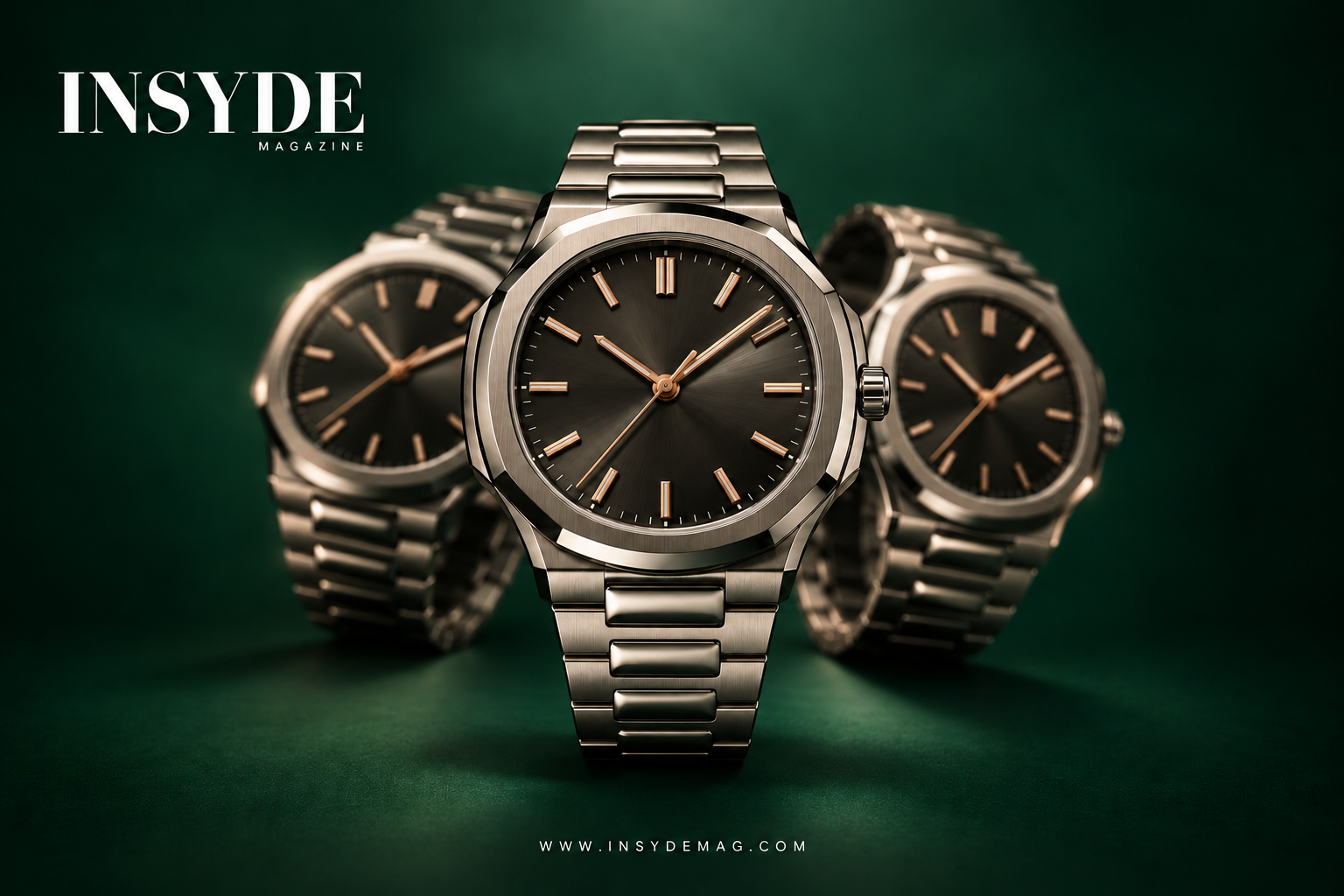
Inside the craftsmanship, heritage and global prestige that transformed Swiss watchmaking into one of the world’s most influential luxury industries.
A watch can tell the time. A luxury watch can tell a story about the person wearing it, the hands that made it and the history behind its name.
For centuries, Switzerland has cultivated a reputation for precision, craftsmanship and technical excellence. Today, its watchmakers occupy an extraordinary position in the global luxury market, producing timepieces that can cost hundreds, thousands or even millions of Swiss francs.
But what makes a Swiss watch a luxury object? Is it the movement inside the case, the materials on the wrist, the name printed on the dial—or the reputation of an entire country?
The answer lies in the intersection of engineering, heritage, commercial strategy and human desire.
THE MAKING OF A WATCHMAKING NATION
Switzerland’s position in watchmaking was not inevitable. It emerged through centuries of specialised craftsmanship, economic development and the concentration of expertise in a relatively small geographical area.
Geneva became an important centre of watchmaking during the sixteenth century, when Protestant refugees, including skilled artisans, brought their knowledge to the city. Goldsmiths and other craftsmen gradually directed their expertise towards watches and clocks, helping establish a tradition that would eventually extend across the country.
Over time, watchmaking developed throughout the Jura region and neighbouring areas. Workshops specialised in individual components and processes, creating networks of suppliers, engineers, finishers and assemblers. This concentration of skills helped Swiss manufacturers develop technical expertise that could be refined and passed between generations.
Geneva’s contribution to fine watchmaking remains particularly significant. Established in 1886, the Poinçon de Genève, or Geneva Seal, became a mark associated with demanding standards of craftsmanship and finishing.
Yet Switzerland’s success was not built on tradition alone. The industry also adapted to industrialisation, changing consumer tastes and technological disruption.
During the quartz crisis of the 1970s and 1980s, affordable electronic watches—particularly from Japanese manufacturers—challenged the economics of traditional mechanical watchmaking. Swiss manufacturers faced intense competition, restructuring and the possibility that centuries of expertise might lose their commercial relevance.
The industry’s recovery demonstrated a crucial principle: heritage is valuable only when it remains relevant. Swiss watchmakers had to combine their traditional strengths with new production methods, contemporary design and more clearly defined brand identities.
That ability to evolve helped transform Swiss watchmaking from a manufacturing specialism into a globally recognised luxury category.
For further reading: Switzerland’s official overview of its watchmaking industry.
PRECISION, ENGINEERING AND THE HUMAN HAND
At the heart of traditional Swiss watchmaking lies a remarkable engineering challenge: creating a compact mechanism capable of measuring time reliably through the coordinated movement of tiny components.
A mechanical watch typically draws energy from a mainspring. A gear train transmits that energy, while an escapement and regulating system control its release. In an automatic watch, a rotor uses the movement of the wearer’s wrist to wind the mainspring.
The principle is deceptively simple. The execution can be extraordinarily complex.
Components must be manufactured to precise tolerances, assembled correctly and adjusted to work together. Depending on the movement, a watch may incorporate additional mechanisms for chronographs, calendars, multiple time zones or tourbillons.
At the upper end of watchmaking, the distinction often lies in the details: carefully finished bridges, polished edges, decorated surfaces, precise adjustments and the integration of complicated mechanisms into a reliable instrument.
These elements require technical knowledge, specialised equipment and, in many cases, highly trained human skill.
However, an important distinction should be made. Not every Swiss watch is handmade, and not every luxury watch contains a complicated mechanical movement. Modern watchmaking combines automated manufacturing with skilled assembly and finishing in different proportions.
The presence of a mechanical movement alone does not establish superior quality. Design, materials, reliability, finishing and execution all matter.
Nor is mechanical watchmaking necessarily the most accurate way to tell time. Quartz watches can offer excellent accuracy at substantially lower prices.
The appeal of a fine mechanical watch is different. It is the achievement of engineering a miniature mechanical system, the beauty of its construction and the opportunity to wear an object whose operation can be appreciated long after its original purchase.
In an increasingly digital world, that physical connection to engineering has become part of its attraction.
WHAT DOES “SWISS MADE” ACTUALLY MEAN?
Few country-of-origin designations carry the same recognition in watchmaking as the words Swiss Made. But their significance extends beyond marketing.
Switzerland regulates the use of the designation through specific legal requirements. Under the rules strengthened in 2017, a qualifying watch must meet requirements covering Swiss technical development, its movement, casing-up, final inspection and manufacturing costs.
At least 60 per cent of the manufacturing costs of the complete watch must be incurred in Switzerland. The movement must also satisfy separate Swiss-origin requirements, including assembly and inspection in Switzerland, qualifying manufacturing costs and a minimum Swiss share of component value.
These rules are designed to protect the credibility of the designation and ensure that a substantial part of the watch’s qualifying development and manufacture takes place in Switzerland.
The distinction is important because modern manufacturing is international. Materials, components and specialist services may come from different countries, even when a watch is developed and manufactured under Swiss rules.
But Swiss Made should not be mistaken for a universal luxury certification.
Swiss Made establishes a regulated standard of origin. It does not guarantee that every qualifying watch is expensive, exceptionally finished or superior to every watch made elsewhere.
A relatively affordable Swiss watch can satisfy the legal requirements. A watch manufactured in another country can also demonstrate outstanding craftsmanship and technical sophistication.
The designation gives consumers meaningful information about provenance. Its commercial power, however, comes from the reputation Switzerland has built around that provenance over generations.
Official reference: Swiss Ordinance on the Use of “Switzerland” or “Swiss” for Watches.
WHY SOME WATCHES COST SO MUCH
The price of a luxury watch is rarely explained by its manufacturing cost alone.
Materials, movement development, specialist labour, finishing, testing, quality control and after-sales service all contribute to the economics of a timepiece. Precious metals, complex mechanisms and labour-intensive finishing can add substantial costs.
But the final retail price also reflects factors that are less tangible.
A watchmaker may spend decades establishing a reputation for reliability, distinctive design or technical achievement. A brand’s history, visual identity and relationship with collectors can influence how consumers perceive its products. Retail networks, distribution strategies and the cost of maintaining a luxury business also contribute to the price.
Brand equity—the commercial value associated with a name and its reputation—can therefore become a significant part of what a buyer pays for.
Consider two watches that perform the same basic function. One may be designed primarily as a reliable everyday timepiece. The other may combine a distinctive movement, exceptional finishing, precious materials, decades of brand heritage and a highly recognisable design.
Both tell the time. Their prices may be dramatically different because their products, production methods, positioning and perceived value are different.
Scarcity can add another dimension. Restricted production and strong demand may make certain watches difficult to obtain. But scarcity alone does not establish superior craftsmanship, and limited availability does not guarantee that a watch will appreciate in value.
A luxury watch is not automatically a good investment. Its resale price depends on the specific model, condition, provenance, market demand and other factors that can change over time.
The strongest luxury brands combine tangible product quality with an identity that consumers recognise and value. The physical watch matters, but so does the meaning attached to it.
FROM ROLEX TO PATEK PHILIPPE: THE MANY FACES OF SWISS LUXURY
Swiss watchmaking is not a single, uniform category. Its leading houses demonstrate different ways of building prestige.
Rolex has established a powerful international identity through recognisable designs, technical development and consistency across its collections. Its watches often function as both personal accessories and widely understood status symbols.
Patek Philippe places particular emphasis on traditional watchmaking, complex movements, heritage and long-term continuity. Its positioning appeals to collectors who value technical artistry and the idea of a timepiece being passed between generations.
Audemars Piguet illustrates the power of design in defining luxury. The Royal Oak, introduced in 1972, helped establish the luxury sports watch as a major category, combining a distinctive case and integrated bracelet with high-end watchmaking.
Omega has built its identity around technical heritage, precision, professional timing and cultural associations, including space exploration and its longstanding connection with the James Bond film franchise.
These brands are not interchangeable. Their products differ in design, technical character, price, production and availability.
Their shared lesson is that Swiss origin provides a foundation, but individual brands must give consumers a reason to desire their particular watches.
A country can establish a reputation for quality. A brand must turn that reputation into a distinctive identity.
THE PSYCHOLOGY OF OWNING A LUXURY WATCH
Why spend thousands—or, in certain cases, hundreds of thousands—on a watch when a much less expensive device can display the time?
The answer depends on the buyer.
For some, the attraction is technical: the movement, the finishing, the materials or the challenge of understanding how a complex mechanism works. For others, the appeal is aesthetic, rooted in the proportions of a case, the design of a dial or the way a watch complements personal style.
There is also an emotional dimension. A watch may mark a graduation, a wedding, a professional milestone or a personal achievement. Over time, it can become associated with memories and relationships that extend beyond its original purpose.
Luxury watches also occupy a social space. Certain designs communicate status, taste or familiarity with a particular cultural world. Other watches appeal to collectors precisely because their craftsmanship is less immediately visible to a casual observer.
Heritage can deepen that relationship. A well-maintained watch may be passed from one generation to another, acquiring meaning through the people who own and wear it.
This is one reason a traditional watch can remain desirable in an age of smartwatches and connected devices. Its value is not limited to the information displayed on its dial. It can be an expression of personal taste, an appreciation of craftsmanship or an object associated with a significant moment in life.
None of this means that a luxury watch makes its owner more successful, or that a higher price guarantees greater satisfaction.
Instead, luxury watchmaking succeeds because it brings together technical achievement and the meanings consumers attach to the objects they choose to own.
THE MARKET IN 2026: PRESTIGE MEETS REALITY
Switzerland’s watchmaking reputation remains formidable, but the industry’s recent performance shows why prestige should not be confused with immunity to economic pressure.
According to the Federation of the Swiss Watch Industry (FH), Swiss watch exports totalled approximately CHF 25.6 billion in 2025, a decline of 1.7 per cent from 2024. The number of watches exported also fell, declining 4.8 per cent to approximately 14.6 million units.
The federation cited difficult market conditions, uncertainty surrounding US trade policy, continued weakness in mainland China and Hong Kong, and elevated gold prices and Swiss-franc strength as factors affecting the industry.
The pressure continued into the first half of 2026. Swiss watch exports reached CHF 12.8 billion, down 0.7 per cent year on year, according to the federation’s half-year report published on 21 July 2026.
Yet the results were not uniform across markets. Swiss watch exports to India grew 31.5 per cent during the first half of 2026, moving India into fifth place among destination markets in the federation’s reported ranking. This is a notable development for a country where luxury consumption and interest in premium products offer watchmakers opportunities for future growth.
The latest monthly report available as of 18 October adds another layer to the picture. In August 2026, Swiss watch exports increased 9.1 per cent year on year, according to the federation’s monthly statistics. However, August had one more working day than the same month in 2025, and export performance varied substantially between markets. Shipments to the United States, for example, declined 19.4 per cent.
These figures require careful interpretation. Export values represent shipments declared by exporting companies; they are not the same as final consumer retail sales. Monthly comparisons can also be affected by working days, exchange rates, trade policy and the timing of shipments.
Nevertheless, the data makes one point clear: Swiss watchmaking remains a major international industry, but its performance depends on changing economic conditions and consumer demand.
The market does not reward reputation indefinitely without question. Brands must continue to justify their prices, maintain their desirability and adapt to the expectations of new generations of buyers.
For India, the recent export growth offers a compelling reason to pay closer attention to Swiss watchmaking—not simply as a symbol of European luxury, but as part of a global industry responding to changing patterns of demand.
DOES SWISS MADE STILL MATTER?
In an age of smartwatches, connected devices and advanced manufacturing across the world, the Swiss watch industry faces a question that goes beyond precision: what makes a traditional timepiece worth wanting?
The answer cannot be found in accuracy alone. Nor can it be reduced to the words printed on a dial.
Swiss watchmaking remains compelling because it brings together several forms of value: technical expertise, manufacturing traditions, regulated provenance, recognisable design and the cultural meaning attached to established brands.
These elements reinforce one another. Craftsmanship gives heritage substance. Heritage helps build trust. A strong brand transforms that trust into desire. Consumer demand, in turn, helps sustain the specialist skills on which the industry depends.
But Swiss origin is not the whole story. Outstanding watchmaking exists beyond Switzerland, and Swiss manufacturers themselves span a wide range of prices, technologies and ambitions. A discerning buyer must still evaluate the individual watch, its quality, its design and the value it offers.
Ultimately, the enduring strength of Swiss watchmaking lies in its ability to make time tangible—not merely as a measurement, but as an expression of human skill, engineering, design and memory.
A watch may be purchased for its craftsmanship, worn as a personal statement or treasured as an heirloom. Its significance depends on the person who owns it.
And perhaps that is the most revealing distinction between a watch that simply tells time and one that becomes a luxury object: the latter carries a story that extends far beyond the movement inside its case.
Because in luxury, the object matters. But so does everything that gives it meaning.
INSYDE — The world of luxury, culture and the people shaping what comes next.
No.1 Luxury Magazine In Bengaluru