
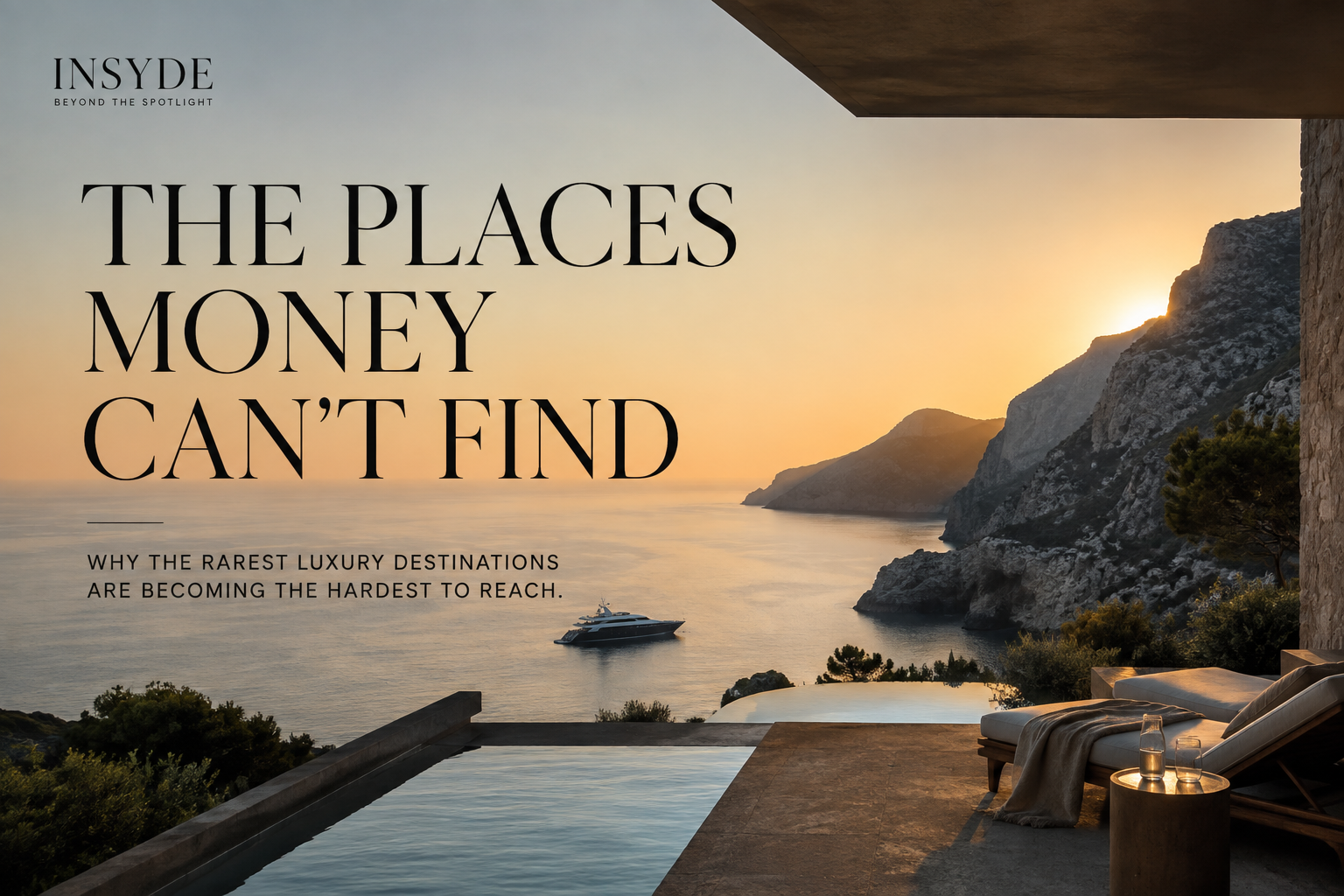
Why the rarest luxury destinations are becoming the hardest to reach.
There was a time when luxury travel was about knowing where to go.
Then it became about knowing where to stay.
The right hotel. The right suite. The right table. The right beach.
But for the traveller who has already experienced the familiar vocabulary of luxury, the more interesting question is beginning to emerge:
Where can you go that still feels discovered?
Not necessarily unknown.
Not necessarily untouched.
But difficult to reach, difficult to replicate and impossible to experience in quite the same way twice.
That distinction is becoming increasingly important.
Because when almost any destination can be researched, photographed, reviewed and booked within minutes, exclusivity can no longer depend entirely on a room number or a five-star rating.
The new language of luxury travel is increasingly about access, privacy, time and discovery.
And sometimes, the greatest luxury is simply being somewhere that doesn’t feel designed for everyone.
When Luxury Becomes Too Accessible
The luxury travel industry has become exceptionally good at creating beautiful places.
There are extraordinary resorts on private islands, architectural villas overlooking the sea, mountain retreats surrounded by wilderness and hotels where every detail has been considered.
And there is nothing wrong with any of it.
But familiarity changes perception.
Once a destination becomes part of the established luxury circuit, its exclusivity begins to evolve.
The property may remain exceptional.
The service may remain impeccable.
The view may still be extraordinary.
But the feeling of discovery becomes harder to preserve.
For the sophisticated traveller, that can create a different desire.
Not necessarily for something more expensive.
For something less obvious.
The New Luxury Is Distance
Distance has become a luxury of its own.
Not because travelling farther is inherently better, but because distance creates natural scarcity.
A remote island cannot accommodate everyone.
A private estate cannot simply add another thousand rooms.
An expedition vessel cannot reproduce the infrastructure of a major resort.
A destination requiring a yacht, private aircraft, helicopter or long overland journey naturally limits who can reach it.
That limitation changes the experience.
The journey itself becomes part of the privilege.
The destination is no longer simply where you arrive.
It is what you had to leave behind to get there.
Privacy Is the New Amenity
A private pool is beautiful.
A private beach is better.
But privacy itself may be becoming the more valuable amenity.
For people whose lives involve constant communication, visibility and tightly managed schedules, the ability to disappear for several days without interruption can be worth more than another spectacular suite.
No lobby.
No crowds.
No unnecessary meetings.
No expectation to be anywhere.
Just time.
This is one reason private villas, secluded estates, yacht-based journeys and remote retreats have become such compelling forms of luxury.
They don’t simply offer comfort.
They create distance from everything else.
Beyond the Suite
The luxury industry spent years refining the hotel room.
Better beds.
Better bathrooms.
Better views.
Larger terraces.
Private pools.
Personal service.
But the next evolution of luxury travel may be less concerned with what happens inside the room.
The more interesting question is:
What can the destination allow you to experience?
A private cultural visit before the crowds arrive.
A remote dive site reached by boat.
Dinner prepared in a place where no restaurant exists.
A conservation experience guided by specialists.
A private estate normally closed to the public.
A journey planned around a particular interest rather than a standard itinerary.
These experiences are valuable because they are not simply amenities.
They are access.
And access is becoming one of the most sophisticated currencies in modern luxury.
When the Journey Becomes the Experience
The traditional idea of travel separates the journey from the destination.
You fly there.
Then the holiday begins.
Luxury increasingly removes that boundary.
A private aircraft can make the departure itself part of the experience.
A yacht can turn the route into the destination.
An expedition vessel can make the journey through remote waters the reason for travelling.
A helicopter can transform a difficult landscape into an accessible one.
The affluent traveller is therefore increasingly choosing not simply a destination, but a sequence of moments that could not easily be reproduced.
The journey becomes part of the story.
And the story becomes part of the luxury.
The End of the Checklist
There is another change taking place quietly.
Luxury travel is moving away from the checklist.
The old formula was familiar:
See the landmark.
Visit the famous restaurant.
Stay at the iconic hotel.
Take the photograph.
Move to the next destination.
But for someone who has travelled extensively, another itinerary can begin to feel strangely repetitive.
The more interesting journey may have no checklist at all.
It might revolve around a particular passion.
Architecture.
Wine.
Art.
Marine life.
History.
Photography.
Cuisine.
Wellness.
Wildlife.
Or simply the desire to spend a week somewhere extraordinarily quiet.
This is where personalisation becomes more important than extravagance.
The best itinerary may be the one that could not have been designed for anyone else.
The Rise of Private Discovery
There is a difference between exclusivity and discovery.
Exclusivity says:
Not everyone can enter.
Discovery says:
Not everyone knows to look.
The second is more powerful.
A private guide who has spent decades studying a region.
A conservationist who can take you somewhere visitors rarely see.
A local family opening a place that has never been part of mainstream tourism.
A chef preparing a meal around ingredients sourced from a particular landscape.
An architect introducing you to buildings unavailable through conventional tours.
These experiences don’t necessarily require extraordinary spectacle.
Their value comes from knowledge and access.
And knowledge is one of the few luxuries that cannot simply be purchased by the hour.
The Luxury of Knowing Someone
At the highest level of travel, the concierge is no longer simply arranging a reservation.
They are connecting you to a world.
The difference is enormous.
A reservation can be made online.
A relationship cannot.
The most sophisticated travel experiences often depend on people who know the region intimately — who understand which door to knock on, who to call, when to arrive and, just as importantly, when not to.
That invisible network can transform an ordinary destination into an extraordinary one.
The traveller may never know how difficult the arrangement was.
They simply experience the result.
Again, the finest luxury often works quietly.
The Destination Without the Audience
There is something increasingly attractive about experiencing a beautiful place without immediately turning it into content.
No photograph required.
No location tag.
No audience.
No obligation to document the moment.
Just the experience itself.
That may sound almost old-fashioned in a world where travel is constantly photographed and shared.
But perhaps that is precisely why it feels luxurious.
When every extraordinary moment can become public within seconds, keeping one private can become its own form of exclusivity.
Not everything beautiful needs to be witnessed.
Some experiences become more valuable precisely because they belong only to the people who were there.
Beyond the Familiar
This does not mean the world’s great luxury destinations are becoming irrelevant.
Paris will remain Paris.
The Mediterranean will remain the Mediterranean.
The world’s great cities, hotels and resorts will continue to attract sophisticated travellers.
But the definition of luxury is expanding.
The experienced traveller may stay at the celebrated hotel.
And then leave it.
They may charter a yacht instead of spending the entire week at the resort.
They may fly somewhere remote for three days.
They may spend part of the journey in a private villa and part of it in an expedition camp.
The point is not to reject conventional luxury.
It is to move beyond it.
The New Status Symbol Is the Story
Luxury has always had a relationship with status.
But status is changing.
A recognisable hotel once communicated that you had arrived.
A recognisable destination communicated taste.
A recognisable experience communicated access.
Today, the most interesting status may be more personal.
It is the story you can tell because you were there.
Not:
“I stayed at the most expensive resort.”
But:
“We were taken somewhere almost nobody visits.”
Not:
“We went to the famous restaurant.”
But:
“We had dinner somewhere that doesn’t normally serve the public.”
Not:
“We visited the destination.”
But:
“We saw a side of it that most people never encounter.”
The difference is subtle.
But it represents a profound change in how sophisticated luxury is experienced.
When Money Stops Being Enough
There is a misconception that enough money can buy anything.
In travel, that isn’t always true.
Money can buy a private aircraft.
It can buy a suite.
It can charter a yacht.
It can secure extraordinary service.
But it cannot automatically create authenticity.
It cannot manufacture a genuine relationship with a place.
It cannot reproduce a moment that happened only because the circumstances aligned.
And it cannot guarantee discovery.
Some experiences depend on weather.
Some on season.
Some on local relationships.
Some on conservation restrictions.
Some on simply being in the right place at the right moment.
That uncertainty is part of what makes them valuable.
The rarest luxury is not always what money can buy.
Sometimes it is what money can only help you reach.
What the Next Luxury Traveller Wants
The next generation of luxury travel is likely to be increasingly personal.
Less concerned with showing where you have been.
More interested in how deeply you experienced it.
Less focused on excess.
More focused on access.
Less interested in a standard itinerary.
More interested in something designed around an individual.
The priorities become remarkably simple:
Privacy.
Time.
Access.
Discovery.
Personalisation.
Meaning.
And perhaps most importantly:
the feeling that the experience could not have been copied and given to someone else.
The Places Money Can’t Find
Perhaps that is where luxury travel is heading.
Not necessarily toward the most expensive destination.
Not toward the biggest suite.
Not toward the most photographed beach.
But toward places where luxury becomes almost invisible.
A remote coastline.
A private estate.
A quiet island.
A journey without an itinerary.
A table prepared somewhere it shouldn’t be.
A landscape seen before anyone else arrives.
A place that doesn’t need a name everyone recognises.
Because when almost anywhere can be discovered online, reviewed instantly and booked with a few clicks, the rarest destinations are no longer necessarily the ones nobody knows about.
They are the ones that cannot be reduced to a booking.
The ones that require a relationship.
A journey.
A little patience.
A certain amount of luck.
And the willingness to go further.
Perhaps that is the real evolution of luxury travel.
The world is not running out of beautiful places.
It is simply becoming harder to experience them privately, personally and unexpectedly.
And for the traveller who has already seen much of what the world has to offer, that may be the ultimate luxury.
Not going somewhere everyone dreams of visiting.
Going somewhere that still feels like you discovered it yourself.
INSYDE — Beyond the Spotlight.