Category: Luxury Homes

Extraordinary homes, interiors and spaces where architecture, design and luxury meet.

  • INVITATION ONLY: WHERE MONEY ISN’T ENOUGH

    INVITATION ONLY: WHERE MONEY ISN’T ENOUGH

    Inside the private luxury stays where an invitation, a relationship or a membership can matter more than the room rate.

    Luxury has always had a price.

    A suite overlooking the Mediterranean.
    A private villa in the Caribbean.
    A penthouse above Manhattan.
    A room with a view that most people will only ever see on Instagram.

    For most luxury hotels, the equation is beautifully simple:

    You want the room. You can afford the room. You book the room.

    But there is another level of hospitality where that equation breaks down.

    There are properties where the room doesn’t have a public nightly rate.

    Places where you cannot simply open a booking platform, enter your dates and hand over a credit card.

    Places where the first question isn’t:

    “How much does it cost?”

    It is:

    “Who invited you?”

    Welcome to the world of invitation-only luxury hospitality.

    Here, money can certainly be useful.

    But it isn’t always enough.


    THE NEW LUXURY IS ACCESS

    Luxury is entering an interesting phase.

    After years of expansion, visibility and increasingly accessible luxury experiences, the industry is becoming more selective about what creates genuine desirability.

    Deloitte’s Global Powers of Luxury 2026 describes the sector as entering a period defined by “stabilization, selectivity and significance.” Its survey of 420 senior luxury executives across ten countries found that customer experience and loyalty were among the strongest growth opportunities, cited by 28.6% of respondents. The report also identified luxury travel as the category with the highest growth potential, cited by 36.2% of executives. Deloitte

    That matters because luxury hospitality is no longer competing purely on the size of the suite.

    It is competing on how difficult the experience is to replicate.

    Privacy.

    Personalisation.

    Cultural access.

    Relationships.

    Community.

    And increasingly, belonging.

    Knight Frank’s 2026 research captures the shift in another way: private members’ clubs are moving beyond cities into countryside and lifestyle destinations, combining hospitality, wellness and community. The firm’s research also found that access to sought-after clubs can influence residential demand, showing that membership itself can become an asset rather than merely an amenity. Global

    The hotel, in other words, is becoming more than a place to sleep.

    For the most exclusive properties, it can become a private world.
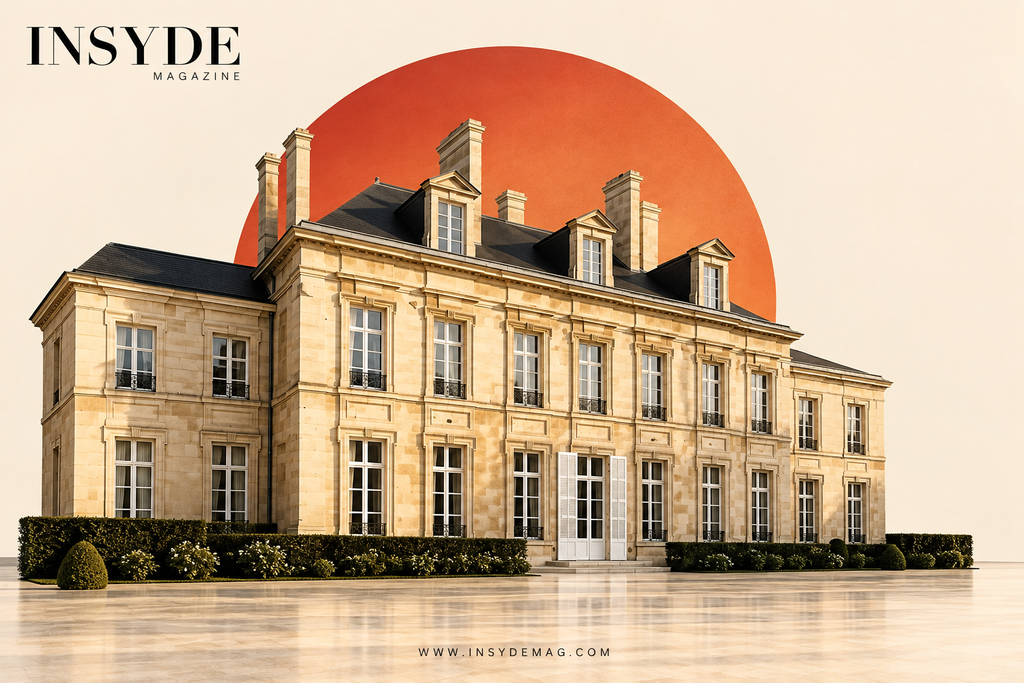

    01 — HÔTEL DU MARC

    THE HOUSE YOU CAN’T SIMPLY BOOK

    Reims, France

    There are luxury hotels where the question is how much you are willing to spend.

    Hôtel du Marc asks something more complicated:

    Are you invited?

    The six-room residence in Reims belongs to Veuve Clicquot and operates differently from a conventional luxury hotel. Rather than releasing rooms to the public through ordinary booking channels, it functions as a private hospitality space for guests invited by the Champagne house.

    Its invitation-only character remains relevant in 2026. Emirates Skywards’ 2026 exclusive Moët Hennessy experience, for example, included an overnight stay at Hôtel du Marc and described it as an invitation-only private residence. Eoghan Corry’s TRAVEL Extra

    That is an important distinction.

    Hôtel du Marc isn’t simply selling a luxurious night in Champagne.

    It gives selected guests access to the world behind one of the world’s most recognisable Champagne houses.

    The residence has six bedrooms, each individually conceived around Veuve Clicquot’s international history, making the property feel less like a conventional hotel and more like an extension of the maison itself. Robb Report India

    The guest therefore isn’t merely staying at a luxury property.

    They are being brought inside the brand.

    And that changes the value of the experience.

    The bottle on a restaurant table becomes a house.

    The house becomes a story.

    And the consumer becomes a guest.
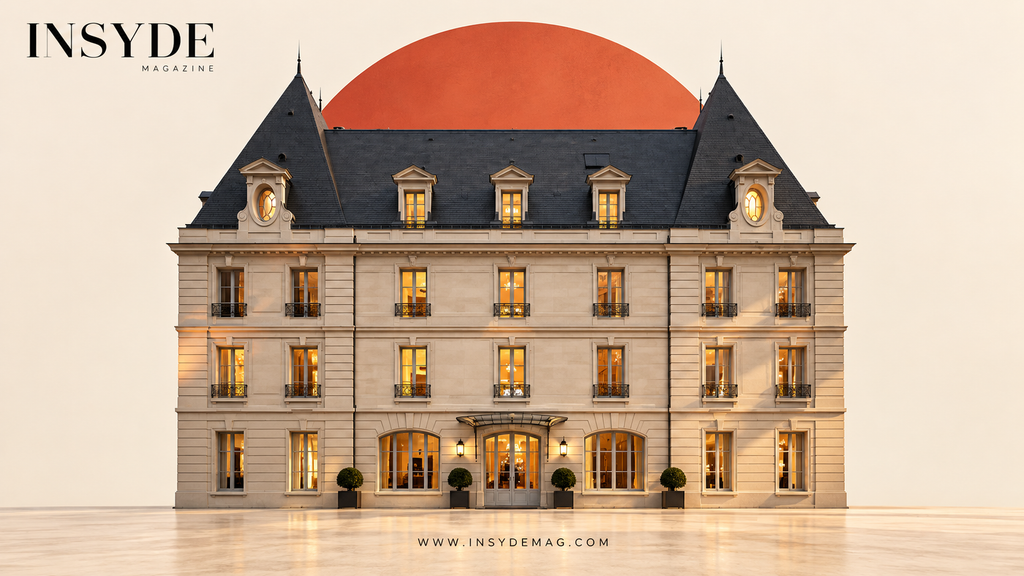

    02 — CHÂTEAU DE SARAN

    WHEN THE GUEST LIST BECOMES PART OF THE LUXURY

    Champagne, France

    Some luxury properties sell rooms.

    Château de Saran sells something far harder to purchase:

    access to a world.

    The historic château is part of the Moët & Chandon estate and is presented by LVMH as one of the maison’s distinctive properties. LVMH

    It is not a conventional hotel competing for weekend bookings.

    It operates as a private hospitality setting for carefully selected guests and experiences.

    The evidence is not merely historical.

    In September 2025, LVMH documented a private event at Château de Saran in which ZENITH and Moët Hennessy Private hosted a select circle of clients for an evening centred on craftsmanship and savoir-faire. LVMH

    That tells us something important about the role of the château.

    The property is part of the luxury ecosystem.

    It isn’t simply accommodation.

    It is a stage on which several worlds meet:

    Champagne.

    Watchmaking.

    Craftsmanship.

    Heritage.

    Private clients.

    And access.

    The modern luxury consumer can buy a bottle of Moët & Chandon.

    They cannot simply buy their way onto every guest list surrounding the house.

    That distinction is precisely what makes Château de Saran interesting.

    Because when hospitality becomes invitation-led, the guest list itself becomes part of the experience.
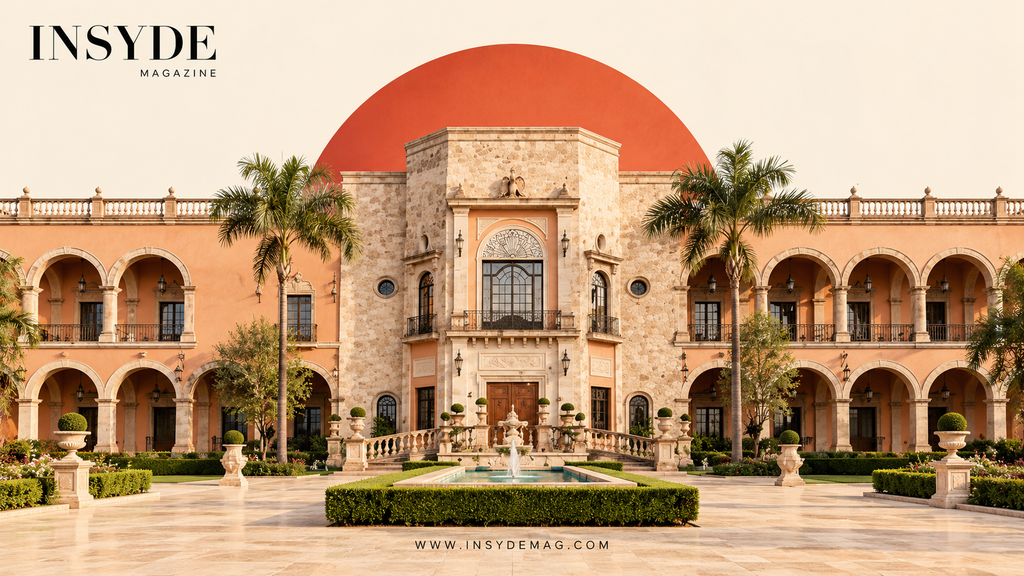

    03 — LA CASONA AT HACIENDA PATRÓN

    THE HOTEL THAT DOESN’T SELL THE ROOM

    Jalisco, Mexico

    Deep inside the world of Patrón tequila is one of the strangest luxury hospitality concepts in the industry.

    La Casona at Hacienda Patrón.

    It looks like a beautiful Mexican hacienda.

    It has elegant guest rooms, dining spaces, a café and a bar.

    But it does not operate like an ordinary hotel.

    Travel + Leisure’s August 2026 review described La Casona as an exclusive, invite-only property, with stays complimentary and paid for by Patrón. Travel + Leisure

    That changes everything.

    There is no traditional transaction in which a traveller simply chooses a room, checks the rate and makes a reservation.

    Instead, the stay is part of a relationship with the brand.

    The people invited can include VIPs, business partners and hospitality professionals.

    The experience becomes a form of brand immersion.

    Guests don’t simply learn about Patrón from a bottle or a cocktail menu.

    They enter the environment behind it.

    They see the estate.

    They experience the hospitality.

    They encounter the craftsmanship and culture surrounding the brand.

    The stay becomes part of the story.

    And this may be one of the most interesting directions in luxury hospitality:

    the hotel is no longer the product.

    The experience around the product is.


    04 — THE CARNEGIE CLUB AT SKIBO CASTLE

    YOU DON’T JUST STAY. YOU BELONG.

    Dornoch, Scotland

    Then there is Skibo.

    A Scottish castle.

    An 8,000-acre estate.

    An 18-hole championship golf course.

    Castle bedrooms.

    Estate lodges.

    Spa and country pursuits.

    And a private members’ club at the centre of it all.

    The Carnegie Club describes Skibo Castle as one of the world’s prestigious private clubs, with membership giving members access to what it calls a residential club experience in the Highlands. Carnegie Club

    The accommodation includes 21 castle rooms and 13 estate lodges, according to the club. Carnegie Club

    But the defining feature isn’t the room inventory.

    It is the membership.

    As of October 2026, the Carnegie Club states that it is fully subscribed and is accepting new applications for its waiting list. Carnegie Club

    That single detail tells us almost everything about the model.

    Skibo isn’t trying to behave like a luxury resort with unlimited availability.

    Its value comes partly from continuity.

    Members return.

    Members bring guests.

    Relationships develop.

    The same people can encounter one another again and again.

    And the club itself says that its appeal isn’t simply the golf, food, facilities or landscape. It identifies the people — its membership and staff — as central to what makes Skibo special. Carnegie Club

    That is a profound shift in the meaning of hospitality.

    The luxury isn’t simply:

    “I stayed in a castle.”

    It becomes:

    “I belong to the world that stays there.”
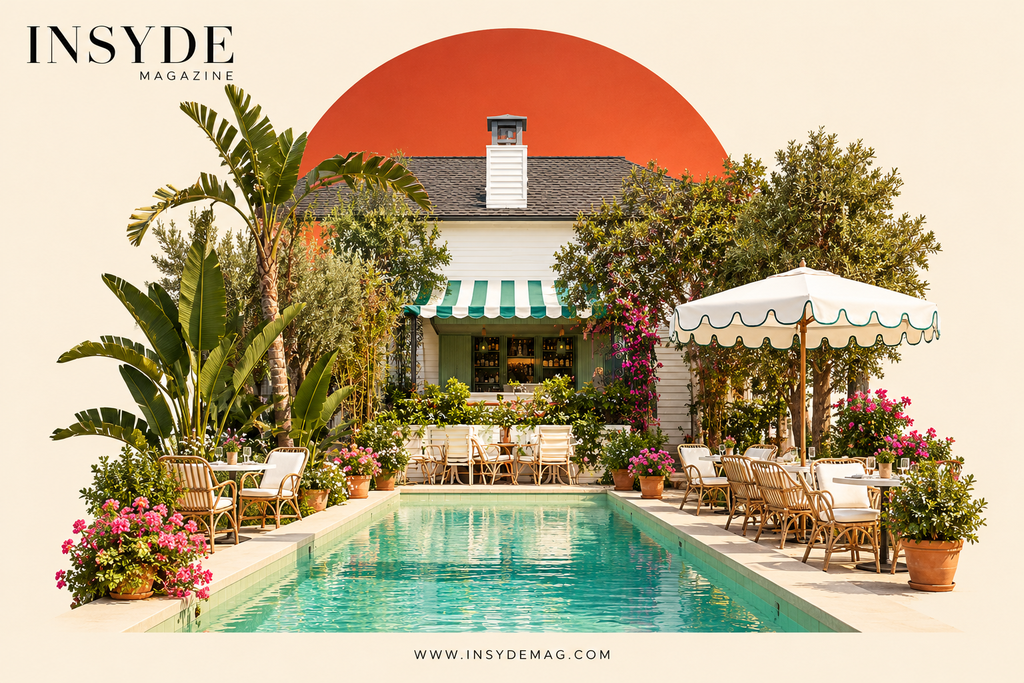

    05 — SAN VICENTE BUNGALOWS

    HOLLYWOOD’S PRIVATE DOOR

    West Hollywood, California

    Los Angeles has no shortage of luxury hotels.

    But San Vicente Bungalows operates according to a different philosophy.

    It is a private members’ club with accommodation — and privacy is not an additional amenity.

    It is the foundation of the experience.

    Membership requires nomination by an existing member, and nomination does not guarantee acceptance. The club’s rules and membership structure are designed around controlled access and a private community. Time Out Worldwide

    The club is also famously strict about photography and privacy.

    That makes sense in a city where visibility is currency.

    At San Vicente, the appeal is almost the opposite.

    Not being seen.

    The club has expanded beyond its original West Hollywood location, but the underlying proposition remains the same: curated membership, controlled access and a social environment where privacy is part of the luxury. JK HOTEL GROUP

    And in September 2026, the access model became even tighter.

    Robb Report India reported that, from 1 September 2026, the West Hollywood club stopped accepting reservations from non-member guests, closing an avenue that had previously allowed outsiders to stay. Robb Report India

    That is a significant development.

    Because it turns the hotel room into something secondary.

    The real product is the club.

    The room simply lets members stay inside that world a little longer.


    THE ROOM ISN’T THE PRODUCT ANYMORE

    Look at these five properties and the pattern becomes difficult to ignore.

    They aren’t all hotels.

    They aren’t all invitation-only in exactly the same way.

    And they don’t all operate under the same commercial model.

    But they share one defining characteristic:

    ordinary hotel booking is not the route to the experience.

    At Hôtel du Marc, access comes through the Champagne house.

    At Château de Saran, the property functions as part of Moët & Chandon’s private hospitality ecosystem.

    At La Casona, the stay is invitation-led and complimentary.

    At Skibo, membership is the gateway.

    At San Vicente, membership and nomination govern access.

    The common currency is therefore not simply money.

    It is relationship.


    WHEN MONEY STOPS BEING ENOUGH

    Luxury has traditionally been very good at creating price barriers.

    Want the better suite?

    Pay more.

    Want the private villa?

    Pay more.

    Want the yacht?

    Pay more.

    Want the rare watch?

    Pay more.

    But invitation-only hospitality introduces a different kind of scarcity.

    You cannot simply pay more to guarantee entry.

    The scarcity is controlled access.

    That is a more complicated and, in some ways, more powerful form of luxury.

    Because the question changes from:

    “Can I afford it?”

    to:

    “Do I have access to it?”

    And access is harder to manufacture.


    THE VALUE OF A CLOSED DOOR

    There is a reason luxury has always been fascinated with closed doors.

    A closed door creates curiosity.

    Curiosity creates desire.

    And desire creates value.

    In an age when almost everything can be photographed, reviewed, geotagged and uploaded within seconds, privacy itself is becoming increasingly valuable.

    WATG’s 2026 hospitality research identifies the expansion of luxury towards ultra-high-net-worth travellers as one of the defining forces shaping the sector, while noting that today’s ultra-wealthy are increasingly deliberate about protecting privacy and that status is being measured through experience and purpose rather than simply scale and spectacle. WATG

    That is precisely where invitation-only hospitality fits.

    It doesn’t need to shout.

    It doesn’t need the biggest lobby.

    It doesn’t need hundreds of rooms.

    It needs something far more difficult:

    a reason to keep the door closed.


    THE NEW LUXURY EQUATION

    The old luxury equation was simple:

    PRICE + SCARCITY = DESIRE

    The new equation is more complicated:

    ACCESS + PRIVACY + PERSONALISATION + BELONGING = DESIRE

    Deloitte’s 2026 research supports this broader shift. Luxury executives increasingly identify customer experience, loyalty and relationship-driven value as critical growth areas, while the industry moves toward more curated experiences and deeper emotional connections with clients. Deloitte

    Deloitte’s separate 2026 luxury-marketing research describes this movement in terms of predictive intimacy, participatory scarcity, privacy and hospitality as a frontier for luxury brands. Deloitte

    That is exactly what these properties demonstrate in physical form.

    They don’t simply restrict access for the sake of being difficult.

    The restriction itself becomes part of the value proposition.


    THE RISE OF THE PRIVATE WORLD

    The hotel industry is also moving closer to the private-club model.

    Knight Frank’s 2026 research describes a new generation of private members’ clubs moving into countryside destinations, combining hospitality, wellness and community. It notes that private clubs are increasingly influencing demand for homes and lifestyle destinations around them. Global

    And Knight Frank has identified another emerging model: membership-led hospitality designed specifically for affluent travellers seeking small-scale properties that feel location-specific, difficult to access and intellectually engaging rather than interchangeable five-star resorts. Global

    This is important.

    Because the future of luxury hospitality may not be about building the world’s biggest hotel.

    It may be about building the world’s most compelling private environment.

    A place where the guest doesn’t feel like a customer.

    They feel like an insider.


    WHY THIS MATTERS TO LUXURY BRANDS

    The most fascinating thing about Hôtel du Marc, Château de Saran and La Casona isn’t the fact that they’re difficult to book.

    It’s why they exist.

    A luxury brand traditionally communicates through:

    campaigns,

    boutiques,

    products,

    runways,

    events,

    advertising.

    But hospitality offers something different.

    Time.

    Attention.

    Immersion.

    A guest can spend an entire day inside the brand’s world.

    They can meet its people.

    Understand its craftsmanship.

    Eat its food.

    See where its products come from.

    Experience its history.

    And leave with something advertising cannot easily create:

    a memory.

    That is why luxury brands are increasingly treating hospitality and service as strategic extensions of their brand universes rather than simply as amenities.

    The hotel becomes a physical expression of the brand.

    The guest becomes part of the story.


    THE LUXURY OF NOT BEING EVERYWHERE

    Luxury has spent decades expanding.

    More markets.

    More stores.

    More products.

    More collaborations.

    More consumers.

    More visibility.

    That expansion created extraordinary growth.

    But it created a paradox.

    When luxury becomes too visible, visibility itself becomes less luxurious.

    The answer isn’t necessarily to become inaccessible everywhere.

    It is to create certain experiences that remain genuinely difficult to access.

    A private residence.

    A members’ club.

    A guesthouse hidden inside a distillery.

    A castle with a waiting list.

    A hotel room behind a private social club.

    These places create something the internet cannot easily reproduce:

    a feeling that you have entered somewhere not everyone can enter.


    PRIVACY IS BECOMING A STATUS SYMBOL

    There was a time when luxury meant being seen.

    The car had to be recognisable.

    The hotel had to be spectacular.

    The restaurant had to be impossible to get into.

    The logo had to be visible.

    But today’s luxury environment is more complicated.

    For an increasingly connected and photographed generation of wealthy consumers, privacy itself can become a form of status.

    No photographs.

    No crowds.

    No public booking calendar.

    No anonymous tourists.

    No obligation to perform the experience online.

    Just a room.

    A table.

    A conversation.

    A landscape.

    And the knowledge that the people around you are there for the same reason:

    they were invited.


    THE STRANGEST THING ABOUT EXCLUSIVITY

    There is one beautiful contradiction at the centre of all this.

    The harder these places are to access, the more people want to know about them.

    That is why invitation-only hospitality is so powerful as a cultural idea.

    Most of us may never sleep at Hôtel du Marc.

    Most of us will never receive an invitation to Château de Saran.

    Most of us will never become Carnegie Club members.

    Most of us will never walk through San Vicente Bungalows as members.

    And yet we want to know what is behind the door.

    That curiosity is precisely what exclusivity is designed to create.

    Desire begins where access ends.


    THE FUTURE ISN’T BIGGER. IT’S MORE PRIVATE.

    The next era of luxury hospitality may be less interested in scale and more interested in intimacy.

    Smaller properties.

    Fewer rooms.

    More personalised service.

    Private memberships.

    Curated communities.

    Brand residences.

    Wellness.

    Culture.

    Craftsmanship.

    And experiences that cannot simply be purchased by anyone who happens to have enough money.

    The most interesting new luxury hospitality concepts are increasingly selling something beyond accommodation:

    belonging.

    And belonging is different from booking.

    A booking ends at checkout.

    A relationship can last for years.


    SO, WHAT IS THE MOST EXPENSIVE THING HERE?

    It isn’t the room.

    It isn’t the château.

    It isn’t the Scottish estate.

    It isn’t the private club.

    It isn’t even the service.

    It is the invitation.

    Because a room has a price.

    An invitation has a relationship behind it.

    You cannot add it to a shopping cart.

    You cannot guarantee it with a larger credit limit.

    You cannot simply pay for express delivery.

    Someone has to want you there.

    And that makes the invitation itself a luxury object.


    THE LUXURY OF BEING CHOSEN

    Perhaps this is where luxury hospitality is heading.

    Away from the simple idea of:

    “I can afford to stay here.”

    And toward something more elusive:

    “They wanted me here.”

    The distinction is subtle.

    But it changes everything.

    Because the ultimate privilege isn’t always having access to everything.

    Sometimes it is having access to something most people cannot buy.

    A private house in Champagne.

    A château behind a luxury maison.

    A guesthouse inside a tequila estate.

    A Scottish castle reserved for a private club.

    A Hollywood sanctuary where privacy is part of the price of belonging.

    These places aren’t necessarily the world’s most expensive hotels.

    They are something more interesting.

    They are controlled worlds.

    And in an age when almost everything is available to everyone, controlled access may be one of luxury’s most powerful remaining currencies.


    INSYDE TAKE

    Luxury used to ask:

    How much can you spend?

    Then it asked:

    How rare is what you own?

    Now, increasingly, it is asking something else:

    Who has access?

    The answer isn’t always money.

    Sometimes it’s a relationship.

    Sometimes it’s membership.

    Sometimes it’s an introduction.

    Sometimes it’s an invitation.

    And perhaps that is the most seductive evolution of luxury hospitality.

    Because anyone can build an expensive room.

    Anyone can create a spectacular view.

    Anyone can put a five-star rating beside a hotel name.

    But creating a world that not everyone can enter is something else entirely.

    The ultimate luxury may no longer be the suite with the highest price.

    It may be the room with no price at all.

    Because when the booking button disappears, one question remains:

    Who invited you?


    INSYDE MAGAZINE
    Luxury, Through a Different Lens.
    Leading Voice Of Luxury
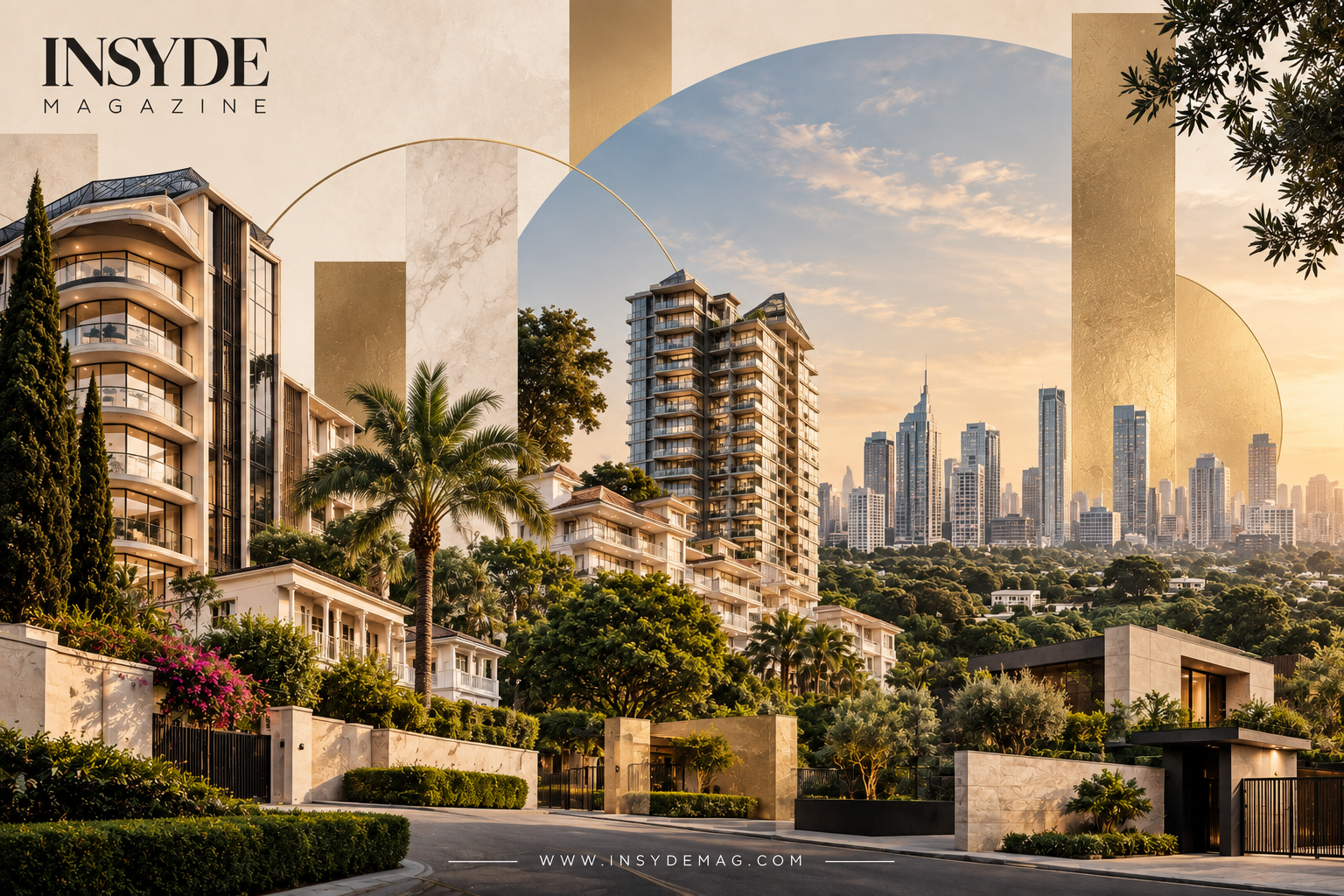
  • WHERE THE ULTRA-RICH LIVE

    WHERE THE ULTRA-RICH LIVE

    Bengaluru’s 5 Most Exclusive Residential Addresses in 2026

    By INSYDE Magazine

    Bengaluru has spent decades building wealth. Now, that wealth is reshaping the city’s residential map.

    India’s technology capital has become one of the country’s most important luxury-property markets, driven by technology entrepreneurs, business families, senior executives, investors and a growing population of high-net-worth individuals.

    The numbers tell part of the story.

    In FY2026, Bengaluru recorded 128 residential transactions valued at ₹10 crore or more, worth a combined ₹1,957 crore. The number of ultra-luxury transactions increased 52% year-on-year, making Bengaluru the fastest-growing of the three southern markets tracked in the CRE Matrix–India Sotheby’s International Realty Southern India High-End Luxury Housing Report. (CRE Matrix)

    The broader market has remained equally active. Cushman & Wakefield recorded 12,442 residential launches in Bengaluru in Q3 2026, taking year-to-date launches to approximately 37,650 units. High-end and luxury housing continued to dominate new supply. Earlier in 2026, the segment accounted for 68% of launches in Q1, compared with 53% in the previous quarter. (Cushman & Wakefield)

    At the prime end of the market, the story becomes even more interesting.

    Knight Frank’s 2026 Prime International Residential Index found global prime residential prices rose 3.2% during 2025, while Bengaluru recorded 9.4% growth, placing the city among the strongest-performing prime residential markets tracked globally. (Global)

    But where does Bengaluru’s wealth actually live?

    Not necessarily in the newest skyscraper. And not always in the largest gated villa development.

    Some of the city’s most valuable residential real estate remains concentrated in established neighbourhoods where land is scarce, privacy is difficult to replicate and the address itself carries decades of prestige.

    After examining current 2026 pricing, luxury inventory, documented transactions, land scarcity and the character of wealth concentrated in each market, these are the five addresses that stand out.


    01

    LAVELLE ROAD & VITTAL MALLYA ROAD

    THE TROPHY ADDRESS

    If Bengaluru has a residential equivalent of a trophy asset, it is the Lavelle Road–Vittal Mallya Road corridor.

    This is the city’s most concentrated ultra-prime residential pocket: central, land-constrained and surrounded by some of Bengaluru’s most established commercial, cultural and hospitality destinations.

    Current 2026 data shows just how expensive the market has become.

    MagicBricks recorded an average apartment price of approximately ₹23,904 per sq ft on Lavelle Road in Q2 2026, with the locality’s quoted high reaching around ₹28,476 per sq ft. (MagicBricks)

    But averages only tell part of the story.

    At the trophy end of the market, a 25,824-sq-ft ancestral bungalow on Lavelle Road reportedly transacted at approximately ₹64,000 per sq ft, putting the transaction value at roughly ₹165.6 crore. This was a landed property transaction, not an apartment sale, and therefore should not be compared directly with apartment averages. It does, however, demonstrate the extraordinary value attached to scarce land in this micro-market. (Sadhwani Real Estate Holdings)

    Vittal Mallya Road operates at an equally rarefied level.

    The road is home to Kingfisher Towers, one of Bengaluru’s best-known ultra-luxury residential developments. A previously recorded 8,400-sq-ft apartment transaction at ₹50 crore translated to approximately ₹59,500 per sq ft. Another resale transaction was reported at approximately ₹42,090 per sq ft. (Sadhwani Real Estate Holdings)

    These transactions should not be mistaken for locality-wide averages. They are trophy benchmarks.

    And that distinction is important.

    At this level of the market, buyers are not simply paying for built-up area. They are paying for scarcity, centrality, privacy and provenance.

    Government guidance values underline the same land-scarcity story. For FY2026–27, Lavelle Road carries a residential guidance value of ₹15,000 per sq ft, the highest residential guidance value among the localities listed in the DeedSure index. Guidance value, however, is a registration benchmark — not the market price. (DeedSure)

    What makes it exclusive: trophy transactions, scarce central land, established luxury developments and an address that has become synonymous with Bengaluru’s uppermost residential market.


    02

    SADASHIVANAGAR

    WHERE LEGACY LIVES

    If Lavelle Road represents trophy real estate, Sadashivanagar represents legacy wealth.

    The neighbourhood’s character is fundamentally different from Bengaluru’s newer luxury corridors.

    Here, the ultimate asset is often not a high-rise apartment but land.

    Large plots, mature trees, established residences and limited opportunities for comparable development have created a market where privacy and location carry enormous value.

    MagicBricks recorded an average apartment price of approximately ₹24,063 per sq ft in Q2 2026, with the quoted locality range running from roughly ₹20,128 to ₹27,998 per sq ft. (MagicBricks)

    Another MagicBricks listing dataset puts the average rate around ₹24,062 per sq ft for the same period, reinforcing the locality’s position among Bengaluru’s most expensive established apartment markets. (MagicBricks)

    But again, apartment prices do not fully capture the economics of Sadashivanagar.

    The neighbourhood contains a significant stock of independent homes and large plots, meaning that the value of a property can be heavily influenced by the land beneath it.

    That is why comparing Sadashivanagar purely with apartment-heavy neighbourhoods can be misleading.

    It is a market where the address, the plot and the privacy are part of the product.

    The government’s FY2026–27 guidance value also places Sadashivanagar among Karnataka’s highest-value residential localities, at ₹12,000 per sq ft. (DeedSure)

    Luxury-market research continues to identify Sadashivanagar as one of Bengaluru’s traditional prime residential addresses, alongside the Lavelle Road and Vittal Mallya Road corridor. (GHAR.TV)

    What makes it exclusive: legacy housing stock, large land parcels, low-supply conditions, privacy and an established association with Bengaluru’s wealthiest residential circles.


    03

    CUNNINGHAM ROAD

    QUIET, CENTRAL, ULTRA-PRIME

    Cunningham Road is not necessarily Bengaluru’s loudest luxury address.

    That is part of its appeal.

    Located in central Bengaluru, close to the CBD and some of the city’s most established institutions and neighbourhoods, Cunningham Road occupies a particularly scarce segment of the residential market.

    MagicBricks recorded an average apartment price of approximately ₹18,530 per sq ft in Q2 2026, with the locality’s quoted high at approximately ₹22,821 per sq ft. (MagicBricks)

    But premium developments can command considerably more.

    Current 2026 luxury-market research places advertised rates on Cunningham Road at roughly ₹21,550–₹31,750 per sq ft, with some of the most exclusive central branded projects quoting approximately ₹33,000–₹35,000 per sq ft. (GHAR.TV)

    The difference between these numbers is not necessarily contradictory.

    MagicBricks is reporting a broader locality-level apartment market, while the higher figures relate to selected premium developments.

    That distinction is crucial when analysing Bengaluru’s luxury property market.

    Cunningham Road also benefits from one of the characteristics that matters most at the top end of real estate: limited supply in a central location.

    The wider Cushman & Wakefield market classification places Cunningham Road within Bengaluru’s high-end Central submarket alongside locations such as Lavelle Road, Palace Cross Road, Richmond Road and Sankey Road. (Cushman & Wakefield)

    This is not a neighbourhood built around spectacle.

    It is built around location.

    What makes it exclusive: centrality, limited high-quality residential supply, premium apartment developments and proximity to Bengaluru’s CBD.


    04

    RICHMOND TOWN

    OLD BENGALURU, NEW LUXURY

    Richmond Town represents another version of central Bengaluru luxury.

    Its appeal comes from its combination of heritage character, central location and increasingly expensive residential stock.

    MagicBricks recorded an average apartment price of approximately ₹18,079 per sq ft in Q2 2026, with a quoted locality high of around ₹21,419 per sq ft. (MagicBricks)

    Other datasets show an even higher premium at the project level.

    DOSL, using Karnataka RERA project data rather than property-portal listings, reports a median builder quote of ₹23,158 per sq ft across projects with published pricing in Richmond Town. Because this is a project-level median rather than a locality-wide transaction average, it should be interpreted separately from the MagicBricks figure. (DOSL)

    Housing.com, meanwhile, reports a 2026 locality average of approximately ₹21,269 per sq ft, with listed properties extending considerably higher depending on the asset. (Housing)

    The differences illustrate something fundamental about central Bengaluru.

    There is no single number that perfectly describes an entire neighbourhood.

    A newly built luxury apartment, a resale residence, an independent house and a redevelopment parcel can have radically different economics even when they share the same postcode.

    Richmond Town benefits from precisely that mix.

    It sits close to Bengaluru’s established commercial and hospitality districts while retaining the character of an older residential neighbourhood.

    For wealthy buyers who want centrality without the trophy-apartment identity of Vittal Mallya Road, that combination can be particularly attractive.

    What makes it exclusive: central location, established residential character, limited new supply and a growing premium for high-quality redevelopment.


    05

    INDIRANAGAR

    WHERE NEW WEALTH MEETS CULTURE

    Indiranagar tells a different story.

    If Sadashivanagar represents established wealth, Indiranagar represents the evolution of Bengaluru’s new affluent lifestyle.

    The neighbourhood has become one of the city’s most recognisable destinations for restaurants, nightlife, fashion, hospitality, design and premium retail.

    Its residential market reflects the same transformation.

    MagicBricks recorded an average apartment price of approximately ₹18,749 per sq ft in Q2 2026. But independent houses were considerably more expensive, averaging approximately ₹34,529 per sq ft, with the highest quoted house price reaching around ₹43,361 per sq ft. (MagicBricks)

    That difference is revealing.

    Indiranagar’s most valuable properties are not necessarily the apartments.

    In many cases, the underlying land is the real asset.

    The government’s FY2026–27 residential guidance value for Indiranagar is ₹11,000 per sq ft, placing it among Karnataka’s highest-value residential localities. Again, this is a statutory guidance benchmark rather than an open-market selling price. (DeedSure)

    Indiranagar also demonstrates how the meaning of luxury is changing in Bengaluru.

    For a newer generation of affluent residents, luxury can mean being close to the city’s best restaurants, social spaces, boutiques, cafés and entertainment — rather than being completely removed from urban life.

    That makes Indiranagar different from the quieter legacy neighbourhoods.

    Its luxury proposition is not only privacy.

    It is access.

    What makes it exclusive: premium landed property, strong lifestyle infrastructure, central connectivity and a deep connection to Bengaluru’s contemporary affluent culture.


    THE FIVE ADDRESSES, AT A GLANCE

    RankAddress2026 Market IndicatorLuxury Character
    01Lavelle Road & Vittal Mallya RoadLavelle Road apartments ~₹23,904/sq ft; trophy transactions substantially higherTrophy real estate
    02SadashivanagarApartments ~₹24,063/sq ftLegacy wealth & privacy
    03Cunningham RoadApartments ~₹18,530/sq ft; premium projects can exceed ₹30,000/sq ftCentral ultra-luxury
    04Richmond TownApartments ~₹18,079/sq ft; project-level quotes can exceed ₹23,000/sq ftHeritage central luxury
    05IndiranagarApartments ~₹18,749/sq ft; independent houses ~₹34,529/sq ftNew wealth & lifestyle

    Locality averages and premium-project figures are not directly interchangeable. They represent different market samples and methodologies.


    SO, WHERE DOES BENGALURU’S ULTRA-WEALTHY LIVE?

    The answer is not as simple as identifying the five neighbourhoods with the highest average price per square foot.

    Bengaluru’s luxury market is divided into several different forms of wealth.

    Lavelle Road and Vittal Mallya Road represent the city’s trophy residential core.

    Sadashivanagar represents legacy wealth and scarce landed property.

    Cunningham Road represents quiet, central ultra-luxury.

    Richmond Town combines heritage character with central-city premiumisation.

    Indiranagar represents the city’s newer affluent lifestyle economy.

    There is also an important reason why Koramangala does not appear in this final five despite being one of Bengaluru’s most important wealth neighbourhoods.

    Koramangala is unquestionably a major luxury market and a significant centre of technology-driven wealth. Its Q2 2026 average apartment price was approximately ₹15,738 per sq ft, while independent houses averaged around ₹32,767 per sq ft, with the highest quoted house level around ₹40,901 per sq ft. (MagicBricks)

    But when the ranking is constructed around the combination of current residential price intensity, ultra-prime scarcity and established luxury positioning, the central addresses above provide a stronger overall fit for this particular editorial.

    That does not mean Koramangala is less important to Bengaluru’s wealth story.

    It means expensive real estate and wealth concentration are two related — but different — measures.


    THE BIGGER STORY

    The most interesting part of Bengaluru’s luxury-property market isn’t a single ₹50 crore apartment or a ₹100 crore-plus bungalow.

    It is the structural change taking place underneath the market.

    The city is producing more high-value housing, more high-net-worth buyers and more sophisticated forms of residential luxury.

    The FY2026 data from CRE Matrix and India Sotheby’s International Realty is particularly revealing: Bengaluru recorded 128 homes sold at ₹10 crore or above, worth ₹1,957 crore, with unit sales up 52% from FY2025. (CRE Matrix)

    At the same time, new luxury supply is expanding beyond Bengaluru’s traditional centre.

    Cushman & Wakefield’s 2026 research shows strong launch activity in East and North Bengaluru, including Whitefield, Gunjur, Budigere Cross, Hoskote, Devanahalli and Hebbal. The latest Q3 data recorded 12,442 new residential launches, while year-to-date launches reached approximately 37,650 units. (Cushman & Wakefield)

    That creates two very different definitions of luxury.

    There is new luxury:

    Branded residences.
    Large-format apartments.
    Gated villas.
    Airport-corridor developments.
    Private amenities.
    New infrastructure.

    And then there is scarcity luxury:

    Old plots.
    Large gardens.
    Established streets.
    Low-density neighbourhoods.
    Trophy buildings.
    Addresses that cannot easily be recreated.

    The second category remains particularly powerful in central Bengaluru.

    Because once a neighbourhood reaches a certain level of scarcity, the value is no longer simply in what can be built there.

    It is in what cannot be built again.


    THE INSYDE TAKE

    Bengaluru’s wealth map is changing, but its most exclusive addresses continue to be shaped by an old principle of luxury real estate:

    scarcity creates status.

    Lavelle Road and Vittal Mallya Road have the trophy transactions.

    Sadashivanagar has the land and legacy.

    Cunningham Road has central scarcity.

    Richmond Town has heritage and location.

    Indiranagar has the lifestyle and the new affluent economy.

    Together, they reveal a city where old wealth and new wealth increasingly overlap — while the most valuable pieces of real estate remain remarkably difficult to reproduce.

    The future of Bengaluru luxury property may be being built in new corridors.

    But some of the city’s most coveted addresses are already decades old.

    And perhaps that is the ultimate luxury.

    Not owning the newest home in Bengaluru.

    Owning a piece of the city that cannot be made again.


    DATA & METHODOLOGY

    This editorial uses the latest publicly available 2026 data reviewed by INSYDE as of 28 September 2026. Locality-level figures primarily use Q2 2026 property-market data where Q3 locality data was not yet available in a comparable format. City-wide market analysis incorporates the latest available Q3 2026 Cushman & Wakefield data, FY2026 luxury transaction data from CRE Matrix and India Sotheby’s International Realty, and Knight Frank’s 2026 prime residential index. (Cushman & Wakefield)

    Price figures from property portals, RERA-based project databases, market reports and transaction records measure different things. Asking prices, builder quotes, registered transaction prices, locality averages and government guidance values should not be treated as interchangeable. Where trophy transactions are cited, they are presented as individual benchmarks rather than locality-wide averages.

    Government guidance values are statutory registration benchmarks and do not represent current market prices. (DeedSure)

    The five-address selection is an INSYDE editorial analysis, based on a combination of price intensity, ultra-prime inventory, documented transaction benchmarks, land scarcity, centrality and the character of wealth associated with each residential market. It is not an official government or industry ranking.

    SOURCES & MARKET DATA

    Primary market and industry research

    Locality pricing — 2026

    Karnataka property valuation

    Ultra-luxury Bengaluru market research

    Market data reviewed through: 28 September 2026.

    INSYDE Magazine
    People. Culture. Style. What’s Next.

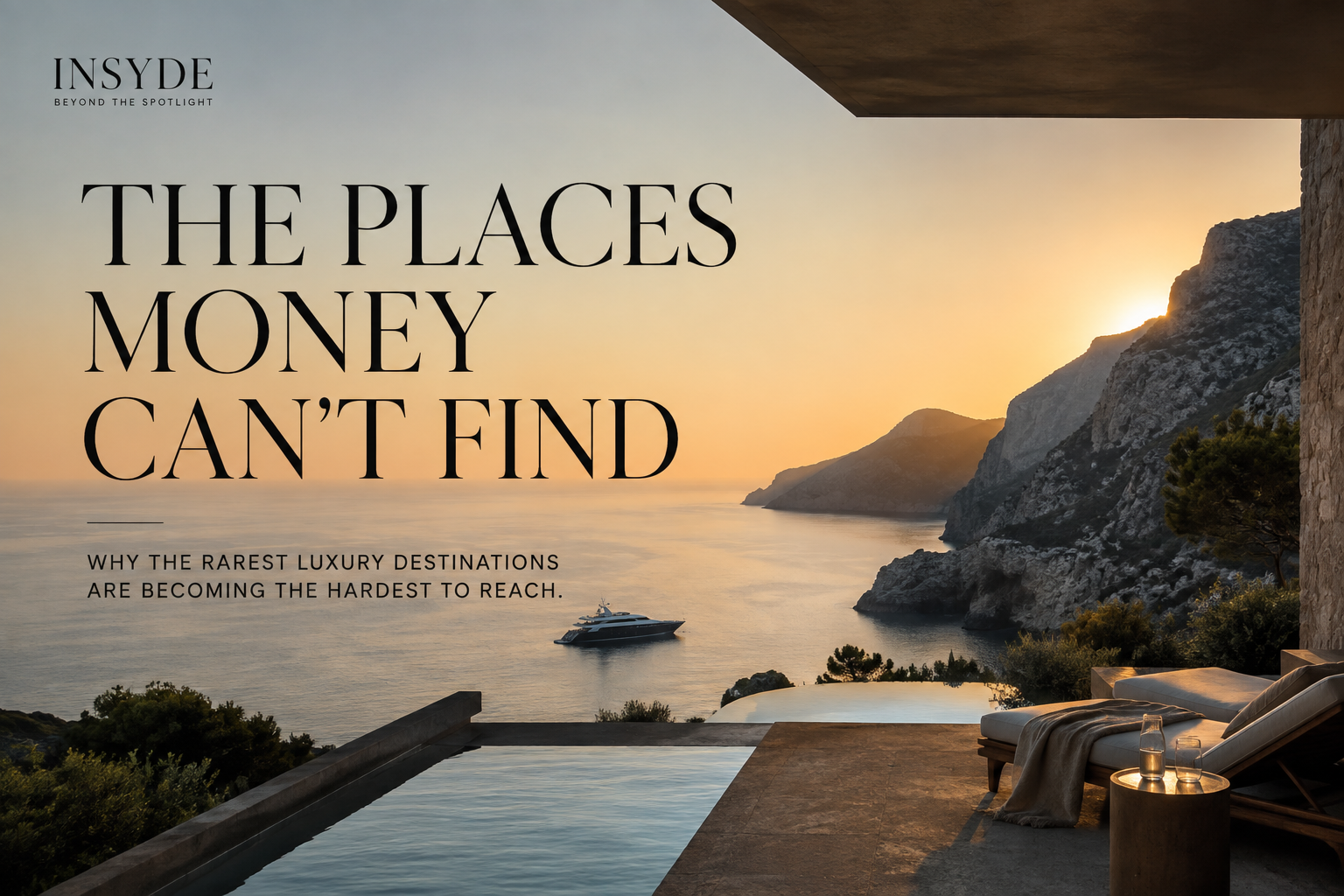
  • The Places Money Can’t Find

    The Places Money Can’t Find

    Why the rarest luxury destinations are becoming the hardest to reach.

    There was a time when luxury travel was about knowing where to go.

    Then it became about knowing where to stay.

    The right hotel. The right suite. The right table. The right beach.

    But for the traveller who has already experienced the familiar vocabulary of luxury, the more interesting question is beginning to emerge:

    Where can you go that still feels discovered?

    Not necessarily unknown.

    Not necessarily untouched.

    But difficult to reach, difficult to replicate and impossible to experience in quite the same way twice.

    That distinction is becoming increasingly important.

    Because when almost any destination can be researched, photographed, reviewed and booked within minutes, exclusivity can no longer depend entirely on a room number or a five-star rating.

    The new language of luxury travel is increasingly about access, privacy, time and discovery.

    And sometimes, the greatest luxury is simply being somewhere that doesn’t feel designed for everyone.

    When Luxury Becomes Too Accessible

    The luxury travel industry has become exceptionally good at creating beautiful places.

    There are extraordinary resorts on private islands, architectural villas overlooking the sea, mountain retreats surrounded by wilderness and hotels where every detail has been considered.

    And there is nothing wrong with any of it.

    But familiarity changes perception.

    Once a destination becomes part of the established luxury circuit, its exclusivity begins to evolve.

    The property may remain exceptional.

    The service may remain impeccable.

    The view may still be extraordinary.

    But the feeling of discovery becomes harder to preserve.

    For the sophisticated traveller, that can create a different desire.

    Not necessarily for something more expensive.

    For something less obvious.

    The New Luxury Is Distance

    Distance has become a luxury of its own.

    Not because travelling farther is inherently better, but because distance creates natural scarcity.

    A remote island cannot accommodate everyone.

    A private estate cannot simply add another thousand rooms.

    An expedition vessel cannot reproduce the infrastructure of a major resort.

    A destination requiring a yacht, private aircraft, helicopter or long overland journey naturally limits who can reach it.

    That limitation changes the experience.

    The journey itself becomes part of the privilege.

    The destination is no longer simply where you arrive.

    It is what you had to leave behind to get there.

    Privacy Is the New Amenity

    A private pool is beautiful.

    A private beach is better.

    But privacy itself may be becoming the more valuable amenity.

    For people whose lives involve constant communication, visibility and tightly managed schedules, the ability to disappear for several days without interruption can be worth more than another spectacular suite.

    No lobby.

    No crowds.

    No unnecessary meetings.

    No expectation to be anywhere.

    Just time.

    This is one reason private villas, secluded estates, yacht-based journeys and remote retreats have become such compelling forms of luxury.

    They don’t simply offer comfort.

    They create distance from everything else.

    Beyond the Suite

    The luxury industry spent years refining the hotel room.

    Better beds.

    Better bathrooms.

    Better views.

    Larger terraces.

    Private pools.

    Personal service.

    But the next evolution of luxury travel may be less concerned with what happens inside the room.

    The more interesting question is:

    What can the destination allow you to experience?

    A private cultural visit before the crowds arrive.

    A remote dive site reached by boat.

    Dinner prepared in a place where no restaurant exists.

    A conservation experience guided by specialists.

    A private estate normally closed to the public.

    A journey planned around a particular interest rather than a standard itinerary.

    These experiences are valuable because they are not simply amenities.

    They are access.

    And access is becoming one of the most sophisticated currencies in modern luxury.

    When the Journey Becomes the Experience

    The traditional idea of travel separates the journey from the destination.

    You fly there.

    Then the holiday begins.

    Luxury increasingly removes that boundary.

    A private aircraft can make the departure itself part of the experience.

    A yacht can turn the route into the destination.

    An expedition vessel can make the journey through remote waters the reason for travelling.

    A helicopter can transform a difficult landscape into an accessible one.

    The affluent traveller is therefore increasingly choosing not simply a destination, but a sequence of moments that could not easily be reproduced.

    The journey becomes part of the story.

    And the story becomes part of the luxury.

    The End of the Checklist

    There is another change taking place quietly.

    Luxury travel is moving away from the checklist.

    The old formula was familiar:

    See the landmark.

    Visit the famous restaurant.

    Stay at the iconic hotel.

    Take the photograph.

    Move to the next destination.

    But for someone who has travelled extensively, another itinerary can begin to feel strangely repetitive.

    The more interesting journey may have no checklist at all.

    It might revolve around a particular passion.

    Architecture.

    Wine.

    Art.

    Marine life.

    History.

    Photography.

    Cuisine.

    Wellness.

    Wildlife.

    Or simply the desire to spend a week somewhere extraordinarily quiet.

    This is where personalisation becomes more important than extravagance.

    The best itinerary may be the one that could not have been designed for anyone else.

    The Rise of Private Discovery

    There is a difference between exclusivity and discovery.

    Exclusivity says:

    Not everyone can enter.

    Discovery says:

    Not everyone knows to look.

    The second is more powerful.

    A private guide who has spent decades studying a region.

    A conservationist who can take you somewhere visitors rarely see.

    A local family opening a place that has never been part of mainstream tourism.

    A chef preparing a meal around ingredients sourced from a particular landscape.

    An architect introducing you to buildings unavailable through conventional tours.

    These experiences don’t necessarily require extraordinary spectacle.

    Their value comes from knowledge and access.

    And knowledge is one of the few luxuries that cannot simply be purchased by the hour.

    The Luxury of Knowing Someone

    At the highest level of travel, the concierge is no longer simply arranging a reservation.

    They are connecting you to a world.

    The difference is enormous.

    A reservation can be made online.

    A relationship cannot.

    The most sophisticated travel experiences often depend on people who know the region intimately — who understand which door to knock on, who to call, when to arrive and, just as importantly, when not to.

    That invisible network can transform an ordinary destination into an extraordinary one.

    The traveller may never know how difficult the arrangement was.

    They simply experience the result.

    Again, the finest luxury often works quietly.

    The Destination Without the Audience

    There is something increasingly attractive about experiencing a beautiful place without immediately turning it into content.

    No photograph required.

    No location tag.

    No audience.

    No obligation to document the moment.

    Just the experience itself.

    That may sound almost old-fashioned in a world where travel is constantly photographed and shared.

    But perhaps that is precisely why it feels luxurious.

    When every extraordinary moment can become public within seconds, keeping one private can become its own form of exclusivity.

    Not everything beautiful needs to be witnessed.

    Some experiences become more valuable precisely because they belong only to the people who were there.

    Beyond the Familiar

    This does not mean the world’s great luxury destinations are becoming irrelevant.

    Paris will remain Paris.

    The Mediterranean will remain the Mediterranean.

    The world’s great cities, hotels and resorts will continue to attract sophisticated travellers.

    But the definition of luxury is expanding.

    The experienced traveller may stay at the celebrated hotel.

    And then leave it.

    They may charter a yacht instead of spending the entire week at the resort.

    They may fly somewhere remote for three days.

    They may spend part of the journey in a private villa and part of it in an expedition camp.

    The point is not to reject conventional luxury.

    It is to move beyond it.

    The New Status Symbol Is the Story

    Luxury has always had a relationship with status.

    But status is changing.

    A recognisable hotel once communicated that you had arrived.

    A recognisable destination communicated taste.

    A recognisable experience communicated access.

    Today, the most interesting status may be more personal.

    It is the story you can tell because you were there.

    Not:

    “I stayed at the most expensive resort.”

    But:

    “We were taken somewhere almost nobody visits.”

    Not:

    “We went to the famous restaurant.”

    But:

    “We had dinner somewhere that doesn’t normally serve the public.”

    Not:

    “We visited the destination.”

    But:

    “We saw a side of it that most people never encounter.”

    The difference is subtle.

    But it represents a profound change in how sophisticated luxury is experienced.

    When Money Stops Being Enough

    There is a misconception that enough money can buy anything.

    In travel, that isn’t always true.

    Money can buy a private aircraft.

    It can buy a suite.

    It can charter a yacht.

    It can secure extraordinary service.

    But it cannot automatically create authenticity.

    It cannot manufacture a genuine relationship with a place.

    It cannot reproduce a moment that happened only because the circumstances aligned.

    And it cannot guarantee discovery.

    Some experiences depend on weather.

    Some on season.

    Some on local relationships.

    Some on conservation restrictions.

    Some on simply being in the right place at the right moment.

    That uncertainty is part of what makes them valuable.

    The rarest luxury is not always what money can buy.

    Sometimes it is what money can only help you reach.

    What the Next Luxury Traveller Wants

    The next generation of luxury travel is likely to be increasingly personal.

    Less concerned with showing where you have been.

    More interested in how deeply you experienced it.

    Less focused on excess.

    More focused on access.

    Less interested in a standard itinerary.

    More interested in something designed around an individual.

    The priorities become remarkably simple:

    Privacy.

    Time.

    Access.

    Discovery.

    Personalisation.

    Meaning.

    And perhaps most importantly:

    the feeling that the experience could not have been copied and given to someone else.

    The Places Money Can’t Find

    Perhaps that is where luxury travel is heading.

    Not necessarily toward the most expensive destination.

    Not toward the biggest suite.

    Not toward the most photographed beach.

    But toward places where luxury becomes almost invisible.

    A remote coastline.

    A private estate.

    A quiet island.

    A journey without an itinerary.

    A table prepared somewhere it shouldn’t be.

    A landscape seen before anyone else arrives.

    A place that doesn’t need a name everyone recognises.

    Because when almost anywhere can be discovered online, reviewed instantly and booked with a few clicks, the rarest destinations are no longer necessarily the ones nobody knows about.

    They are the ones that cannot be reduced to a booking.

    The ones that require a relationship.

    A journey.

    A little patience.

    A certain amount of luck.

    And the willingness to go further.

    Perhaps that is the real evolution of luxury travel.

    The world is not running out of beautiful places.

    It is simply becoming harder to experience them privately, personally and unexpectedly.

    And for the traveller who has already seen much of what the world has to offer, that may be the ultimate luxury.

    Not going somewhere everyone dreams of visiting.

    Going somewhere that still feels like you discovered it yourself.

    INSYDE — Beyond the Spotlight.

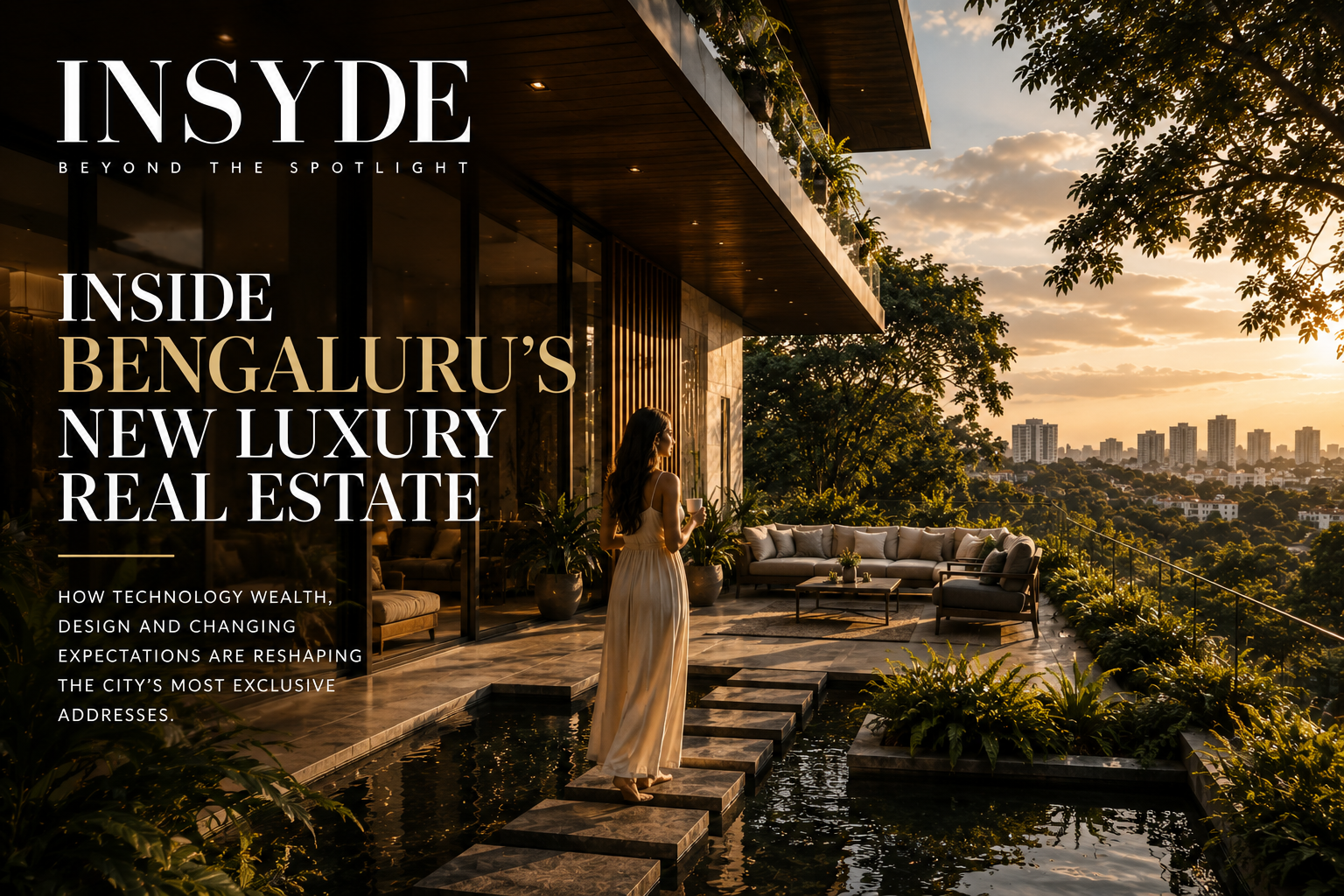
  • Inside Bengaluru’s New Luxury Real Estate

    Inside Bengaluru’s New Luxury Real Estate

    Technology wealth, changing consumer expectations and a new appetite for design are reshaping Bengaluru’s high-end housing market. At the top end, a home is no longer simply a property—it is becoming an expression of how the city wants to live.

    Bengaluru has always understood the language of growth.

    For decades, the city built its reputation on technology, entrepreneurship and the companies that transformed India’s relationship with the global economy. But as that wealth has matured, another transformation is becoming increasingly visible.

    The city is beginning to spend its wealth differently.

    Nowhere is that more apparent than in luxury real estate.

    Bengaluru’s most expensive homes are no longer being defined simply by their size or their address. Increasingly, buyers are paying for privacy, architecture, wellness, technology, service and the experience of living well.

    The numbers suggest that this is no longer a niche phenomenon.

    It is becoming a market of its own.

    When ₹10 Crore Became a Market

    In FY2025, Bengaluru’s residential market for homes priced at ₹10 crore and above crossed ₹1,000 crore in annual sales for the first time. Seventy-eight homes in the segment were sold that year, compared with 51 in the previous financial year.

    The momentum continued into FY2026.

    Data from CRE Matrix and India Sotheby’s International Realty recorded 128 Bengaluru homes priced at ₹10 crore and above sold during FY2026, representing ₹1,957 crore in transaction value. Unit sales increased 52% year on year, making Bengaluru the fastest-growing southern market covered in their report.

    The significance of those numbers is not simply that more expensive homes are being sold.

    It is that Bengaluru now has a sufficiently deep pool of affluent buyers for ultra-premium residential property to behave like a distinct consumer market.

    The ₹10 crore threshold is no longer merely a marker of exceptional wealth.

    It is becoming part of the city’s expanding luxury economy.

    The New Bengaluru Buyer

    Bengaluru’s luxury consumer is different from the traditional image of the Indian high-net-worth buyer.

    The city’s wealth has been shaped heavily by technology, entrepreneurship, global businesses and the startup ecosystem. Its affluent population includes founders, CXOs, senior technology executives, entrepreneurs, HNIs and globally mobile Indians.

    That background influences what they expect from a home.

    The FY2025 luxury housing data identified startup founders, CXOs, HNIs and global Indians among the key buyers in the ₹10 crore-plus segment.

    For this consumer, luxury is increasingly about what the price enables.

    More privacy.

    More space.

    Better design.

    Better security.

    Better amenities.

    Better access.

    And, perhaps most importantly, a home that feels aligned with the life they have built.

    That distinction matters.

    Because when buyers begin choosing residences based on experience rather than square footage alone, real estate starts behaving like luxury.

    When a Home Becomes an Experience

    The traditional luxury residence was often defined by scale.

    The larger the home, the greater the sense of status.

    That equation is changing.

    Today’s premium developments increasingly compete through what surrounds the residence: architecture, landscape, wellness facilities, private amenities, smart-home technology, hospitality-style services and carefully designed communal spaces.

    The home is becoming an ecosystem.

    This reflects a broader transformation in luxury consumption. Across India, affluent consumers are increasingly placing value on experiences, personalisation, hospitality and environments rather than visible symbols of wealth.

    Bengaluru is particularly suited to this evolution.

    A city accustomed to paying a premium for technology, convenience and efficiency is beginning to apply the same logic to where it lives.

    The Rise of the Design-Led Residence

    At the upper end of the market, architecture is no longer background.

    It is part of the product.

    Natural materials. Generous proportions. Landscape design. Light. Privacy. Technology. Wellness.

    These details are increasingly becoming part of the value proposition.

    Knight Frank’s H1 2026 research recorded a 9% year-on-year increase in Bengaluru’s average weighted residential price, reaching ₹9,354 per square foot. The research also found continued momentum in premium housing, with the ₹2–5 crore segment recording a 50% year-on-year increase in new launches.

    The figures point to a broader premiumisation of the market.

    But at the very top end, the competition is less about simply adding square footage.

    It is about creating differentiation.

    A luxury residence needs to feel considered.

    Bengaluru’s Luxury Map Is Moving

    Luxury has traditionally been associated with Bengaluru’s established central neighbourhoods.

    But the geography of premium living is expanding.

    Hebbal has emerged as one of the city’s strongest luxury markets. In FY2025, it accounted for 22% of Bengaluru’s ₹10 crore-plus luxury apartment sales value, while markets including Domlur, Sudhamnagar and Bommanahalli also featured among emerging high-end locations.

    North Bengaluru is particularly significant.

    Knight Frank identified North Bengaluru as the city’s fastest-growing residential corridor in H1 2026, with launches increasing 10% and sales rising 11% year on year. Infrastructure development, expanding commercial activity, employment growth and airport connectivity are helping reshape the area’s residential appeal.

    This matters beyond property.

    When the geography of wealth changes, the geography of the city changes with it.

    Restaurants follow affluent neighbourhoods.

    Retail follows.

    Hospitality follows.

    Wellness, design and premium services follow.

    Real estate is therefore not simply responding to Bengaluru’s growth.

    It is helping create the next version of the city.

    The Space Equation

    One of the clearest indicators of changing expectations is the demand for larger residences.

    In FY2025, luxury apartments in the 5,000–7,000 square-foot range attracted particularly strong buyer interest.

    But space itself is becoming more nuanced.

    The value of a large residence increasingly lies in what that space allows.

    A private office.

    A library.

    A home gym.

    A guest suite.

    A larger kitchen designed for entertaining.

    A terrace that functions as an outdoor room.

    A private garden.

    A space for art.

    The modern luxury residence is beginning to resemble a private hospitality environment—one designed around the rituals of its occupants.

    That is a very different proposition from simply buying a bigger apartment.

    The Business of Premiumisation

    For developers and luxury brands, this shift has significant implications.

    A growing affluent consumer base creates opportunities well beyond residential property. Architecture, interiors, furniture, fashion, jewellery, automobiles, hospitality, wellness and premium entertainment increasingly occupy the same ecosystem.

    India’s luxury retail market is expanding alongside this affluent consumer base, while brands are increasing their presence in major metropolitan markets and experimenting with more experience-led physical spaces.

    Bengaluru is becoming an important part of that story.

    The city’s luxury real estate market can therefore be understood as more than a property segment.

    It is a gateway into a broader premium economy.

    A high-value residence can create demand for interior design.

    A new luxury neighbourhood can create demand for restaurants and hospitality.

    A concentration of affluent households can attract international brands.

    And a sophisticated consumer base can raise expectations across the entire market.

    The luxury home becomes the starting point rather than the end product.

    The Limits of Luxury

    There is another side to Bengaluru’s premiumisation.

    Prices are rising, but buyers are also becoming more selective.

    Knight Frank reported that Bengaluru’s residential sales moderated sequentially in H1 2026, even as year-on-year demand remained positive. The report also identified affordability pressures and elevated property prices as factors influencing buyer and developer behaviour.

    For the luxury segment, that selectivity may ultimately be healthy.

    When buyers have more choices and higher expectations, developers cannot rely solely on a prestigious address or a large floor plan.

    They have to create a reason for the premium.

    That means better architecture.

    Better service.

    Better design.

    Better experiences.

    Luxury, after all, only works when the buyer believes there is something genuinely rare about what is being offered.

    What Bengaluru Is Building

    The most interesting part of Bengaluru’s luxury real estate story is not the price of its homes.

    It is what those homes represent.

    For a technology entrepreneur, a residence can be a private retreat from an intensely connected professional life.

    For a global Indian, it can be a return to Bengaluru with expectations shaped by international cities.

    For a young founder or CXO, it can be both an asset and an expression of identity.

    For developers, it represents an opportunity to move beyond conventional residential construction and create complete lifestyle environments.

    And for Bengaluru itself, it signals something larger:

    A city that once built its identity around creating wealth is becoming increasingly comfortable with living it.

    The Next Address

    Bengaluru’s luxury real estate market is entering a more sophisticated phase.

    The first chapter was about accumulation.

    The next is about curation.

    As affluent buyers become more discerning, the winning residences will not necessarily be the largest or the most conspicuous.

    They will be the ones that understand what luxury increasingly means:

    Privacy without isolation. Technology without intrusion. Architecture without excess. Comfort without compromise.

    Bengaluru’s luxury real estate story is ultimately not about houses.

    It is about what the city’s wealth wants its future to look like.

    And increasingly, that future has an address.

    — INSYDE Editorial

    Sources: CRE Matrix & India Sotheby’s International Realty; Knight Frank India; Fortune India; Business Standard.