
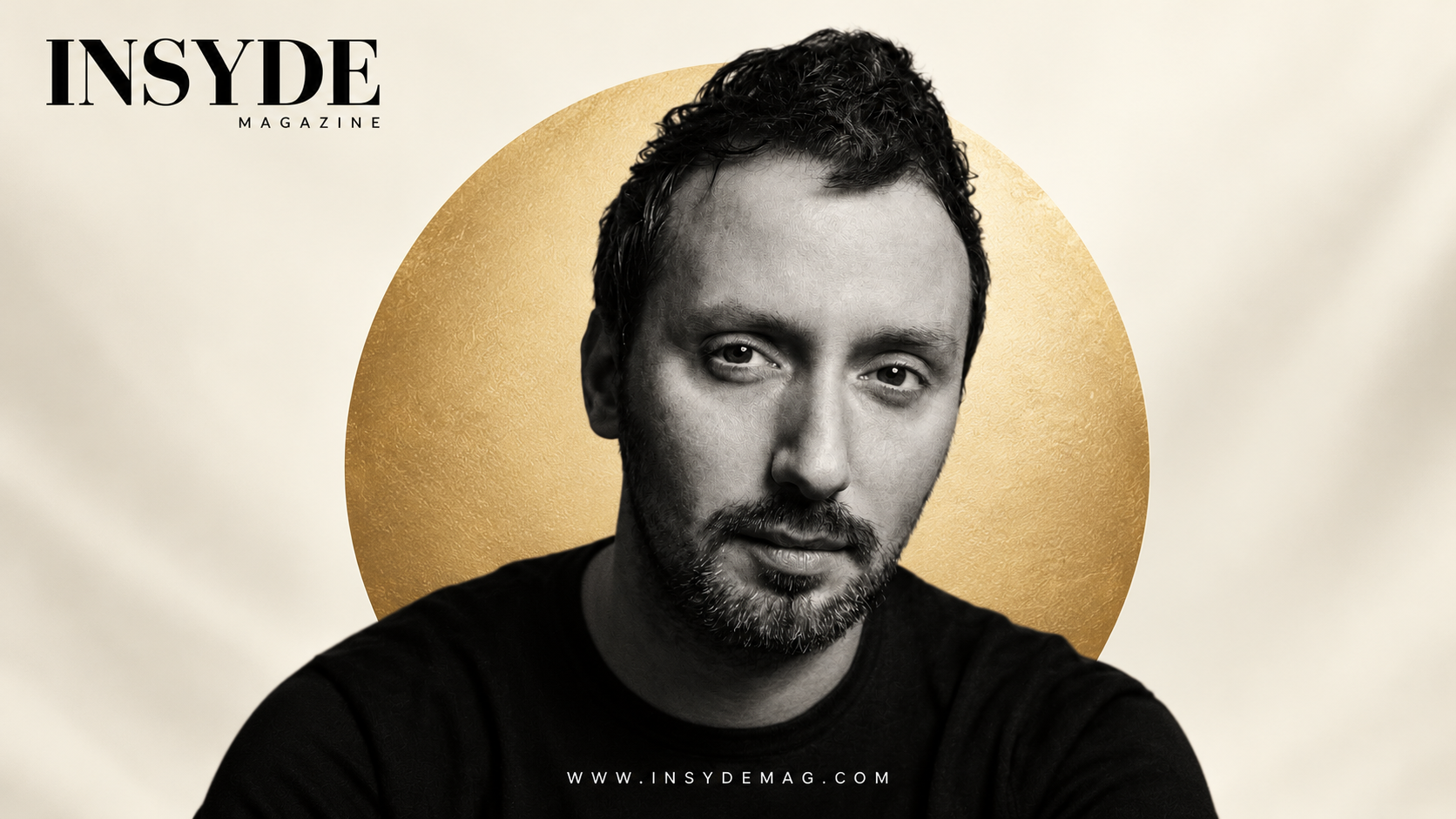
Inside the end of his decade at Saint Laurent, the financial pressures reshaping luxury fashion, and the unanswered questions surrounding one of the industry’s most consequential creative departures.
By INSYDE Magazine | Luxury & Fashion
There is something almost cinematic about leaving Saint Laurent in gold.
For Anthony Vaccarello, the final chapter at the French fashion house arrived in a blaze of metallic glamour. Gold dresses, sculptural trench coats and shimmering stilettos transformed the runway into a vision of opulence, staged beneath the Eiffel Tower and recalling the grandeur of Saint Laurent’s own history.
It was a fitting image for a designer whose decade at the house had been defined by controlled sensuality, sharp silhouettes and a distinctly nocturnal vision of luxury.
Then came the announcement.
On 9 October 2026, Kering officially confirmed that Vaccarello was leaving Saint Laurent after ten years as creative director. The group praised his contribution to strengthening the house’s identity and cultural influence, while confirming that new creative leadership would be announced soon. The statement did not disclose a specific reason for his departure.
Read Kering’s official announcement.
The timing is significant. Vaccarello is not leaving an obscure label struggling to establish an identity. He is departing one of fashion’s most recognisable houses after helping take its annual sales beyond €3 billion in 2023.
Yet the years that followed brought a commercial slowdown, against the backdrop of a wider luxury-market correction and a restructuring at Saint Laurent’s parent company.
So what does his exit actually tell us?
Is this the natural conclusion of a decade-long creative partnership? A response to the changing economics of luxury? Or a sign that even a successful creative vision must eventually adapt to a new set of commercial expectations?
The public record does not establish one definitive explanation. But Vaccarello’s legacy, Saint Laurent’s financial trajectory and Kering’s broader strategic reset offer a revealing picture of the pressures facing luxury fashion today.
A DECADE OF DESIRE
When Vaccarello took over Saint Laurent in 2016, succeeding Hedi Slimane, he inherited a house whose recent identity had been shaped by a powerful, highly distinctive creative vision. His challenge was to establish his own language without diluting the attitude that made Saint Laurent instantly recognisable.
He approached the task through consistency rather than reinvention for its own sake.
Black became a near-constant. Shoulders were sharpened. Legs were elongated. Leather, sheer fabrics, short hemlines and precise tailoring created a wardrobe that moved between eroticism and authority. The result was sensual without being soft, glamorous without being traditionally romantic.
His Saint Laurent woman did not need to announce her presence. The clothes did it for her.
But reducing Vaccarello’s tenure to provocative dresses would overlook the scale of his achievement. He built a coherent visual world across runway collections, campaigns, celebrity dressing and monumental Parisian shows. The Eiffel Tower became a recurring backdrop, transforming the city itself into part of the brand’s imagery.
Saint Laurent was selling more than clothing. It was selling an atmosphere: Paris after dark, unapologetic sexuality, rock-and-roll attitude and a particular form of modern power.
He also helped extend the house’s cultural reach beyond fashion through Saint Laurent Productions, launched in 2023. Its involvement in cinema, including Emilia Pérez, brought the brand into a broader cultural conversation and demonstrated how a fashion house could use film as an extension of its identity.
Explore Vogue’s coverage of Vaccarello’s departure and creative legacy.
Commercially, the results were substantial. According to Reuters, Saint Laurent generated well over €3 billion in annual sales in 2023. Vaccarello had helped establish a strong identity at a scale that few creative directors achieve.
That is what makes his departure consequential. He was not simply designing the next collection. He had become central to how the house presented itself to the world.
THE NUMBERS BEHIND THE EXIT
Luxury is built on desire. But desire must eventually translate into sales.
Saint Laurent’s financial trajectory provides essential context for understanding why this transition matters. The brand reached more than €3 billion in annual sales in 2023 before losing momentum as the luxury sector faced weaker demand and brands reassessed their growth strategies.
Reuters reported that Saint Laurent’s gross revenue declined by 9% in 2024 and a further 6% in 2025. Performance had largely stabilised during 2026, according to the same report, although full-year 2026 results were not yet available as of 11 October.
Saint Laurent: the recent financial picture
| Period | Reported performance |
|---|---|
| 2023 | Annual sales exceeded €3 billion |
| 2024 | Gross revenue declined 9% |
| 2025 | Gross revenue declined a further 6% |
| 2026 | Performance described as largely stabilised; full-year results pending |
Source: Reuters, 9 October 2026. Figures refer to reported annual sales and gross-revenue movements; the 2026 assessment is qualitative, not a full-year result.
The numbers matter, but they require careful interpretation.
The decline does not prove that Vaccarello’s designs caused the slowdown, nor does it establish that falling sales triggered his departure. Luxury brands have faced a more challenging environment as consumers have become selective, price increases have tested perceptions of value, and demand has weakened across parts of the market.
Saint Laurent’s parent company, Kering, has also been under pressure. The group reported 2025 revenue of approximately €14.7 billion, reflecting the wider challenges facing its portfolio of luxury houses.
Read Kering’s official announcement and corporate information and Reuters’ reporting on the departure and financial context.
This is the broader context in which Vaccarello’s exit should be understood. Kering is working to restore growth and improve performance across a portfolio that includes Saint Laurent, Gucci, Bottega Veneta and Balenciaga.
The strategic question is no longer simply whether a collection generates attention. It is whether a house can translate creative distinction into sustainable demand, profitable growth and stronger customer relationships.
That is a much harder equation to solve.
WHEN THE RUNWAY MEETS THE BALANCE SHEET
A spectacular runway show can dominate fashion coverage. A celebrity appearance can put a collection in front of millions. A campaign can make a handbag instantly desirable.
But none of those moments, on its own, guarantees sustained growth.
Luxury houses also depend on products that customers return to: daywear that works beyond special occasions, leather goods that justify their prices, menswear with a clear identity, and collections that encourage repeat purchases without making the brand feel overexposed.
Reuters, citing Barclays analysts, identified women’s daywear, menswear and high-end leather goods, alongside less-penetrated markets in China and Asia, as potential areas of focus for Saint Laurent’s next creative chapter.
These are potential growth opportunities identified by analysts, not a confirmed brief issued by Kering.
Read Reuters’ full report on Saint Laurent’s leadership change.
This points to a strategic challenge rather than a simple aesthetic verdict.
Vaccarello’s vision was disciplined and commercially powerful. Yet the next phase of growth may require Saint Laurent to broaden the ways customers engage with the brand while protecting the desirability that made it successful.
Expand too aggressively and the house risks diluting the sense of scarcity and attitude that gives its products their appeal. Rely too heavily on a narrow visual signature and it may struggle to create enough new reasons for customers to return.
The strongest luxury houses make commercial expansion feel like a natural extension of their creative identity. For Saint Laurent, that is the challenge ahead.
WAS IT A CONTROVERSIAL EXIT?
The word controversy travels quickly in fashion. A departure becomes a rumour. A rumour becomes a supposed falling-out. A final collection is reinterpreted as a coded message.
But the evidence available publicly is more limited than the speculation might suggest.
Kering confirmed Vaccarello’s departure and praised his contribution to the house. It did not publicly identify a dispute, misconduct allegation or specific personal conflict as the reason. Reuters reported that a successor would be announced soon, but did not establish a definitive explanation for the decision.
There is, therefore, no verified basis for presenting this as a personal scandal or claiming that Vaccarello was fired over a particular disagreement.
That does not make the departure unimportant. A creative-director transition after ten years can be significant without being scandalous. It can reflect strategic priorities, changing commercial expectations, personal decisions or the natural conclusion of a long creative partnership. Without evidence, assigning one of these explanations to Vaccarello would be speculation.
The more substantive story is the environment in which the exit occurred.
Kering has been reshaping creative leadership across its portfolio as it attempts to reverse a prolonged downturn. Saint Laurent’s transition belongs to a larger conversation about how luxury groups balance creative autonomy with commercial accountability.
The question is not whether a designer can create a memorable collection. It is how long a creative leader remains the right person for a house as its business enters a different phase.
In an industry where creative directors increasingly become the public face of a brand, the distinction between the designer’s identity and the house’s identity can become complicated. When the designer leaves, the business must prove that the desirability they helped create belongs to the brand itself—not exclusively to the person behind it.
THE GOLDEN FINALE
Vaccarello’s final runway provided an arresting image for the end of his tenure.
Gold dresses, gold outerwear and gold stilettos appeared beneath monumental chandeliers in a presentation that referenced the Salon Impérial at Paris’s Hôtel Inter-Continental, associated with Yves Saint Laurent’s historic couture presentations.
It was a visual return to the house’s mythology: grandeur, theatricality and the idea of fashion as a carefully controlled spectacle.
The collection has inevitably invited interpretation. Was the gold a farewell? A statement of triumph? A deliberate message about the designer’s relationship with the house?
There is no confirmed evidence that it was intended as a coded message about his departure. Treating the collection as proof of a hidden conflict would confuse fashion criticism with reporting.
Its significance is more compelling when considered on its own terms. Vaccarello spent a decade making Saint Laurent’s codes feel contemporary without making them unrecognisable. His final collection concentrated those codes—sensuality, Parisian grandeur, sharp tailoring and theatrical glamour—into a single visual statement.
Gold was more than decoration. It was a fitting language for a house that has long sold aspiration through clothing and imagery.
But a spectacular finale cannot answer the question that follows every creative-director departure: what happens when the person who defined the look is no longer there?
WHO COMES NEXT?
At the time of writing, Kering has confirmed that new creative leadership will be announced, but no successor has been officially named.
Industry speculation has included Chemena Kamali, currently creative director at Chloé and previously associated with Saint Laurent’s design team. That possibility remains unconfirmed and should not be mistaken for an appointment.
Reuters’ report on the departure and successor speculation.
Whoever takes the role will inherit a house with considerable advantages: a recognisable identity, global visibility, a strong cultural presence and a decade of consistent creative direction. They will also inherit a commercial challenge.
The next chapter must preserve what makes Saint Laurent distinctive while giving the business fresh momentum. Developing daywear and menswear, strengthening leather goods and pursuing opportunities in Asian markets are among the areas analysts have identified as potential avenues for growth.
The creative challenge will be delicate. Too much continuity could make the next era feel derivative. Too sharp a break could alienate customers who associate Saint Laurent with Vaccarello’s particular combination of sensuality and control.
The successor will not simply be asked to design a successful collection. They will be asked to define what Saint Laurent looks and feels like next—and to make that vision commercially compelling.
THE NEXT CHAPTER OF LUXURY
Vaccarello’s departure arrives at a moment when luxury fashion is reconsidering the relationship between creative identity and financial performance.
For years, the industry benefited from powerful brand equity, global expansion and customers willing to pay increasingly high prices for desirable products. The current environment demands more. Brands must give customers compelling reasons to buy, justify their prices and build identities that can withstand changes in consumer behaviour.
Saint Laurent’s recent revenue decline is part of that context, but it should not be mistaken for a verdict on one designer. Vaccarello helped take the house beyond €3 billion in annual sales and established a visual language that reached well beyond the runway. The subsequent slowdown occurred amid broader industry pressure, while the precise reason for his departure remains undisclosed.
The next phase will reveal whether Saint Laurent can turn that legacy into renewed growth without diluting the qualities that made it desirable.
That is the real story behind the exit: not a proven scandal or a confirmed boardroom battle, but a consequential change at the intersection of fashion, business and cultural influence.
Anthony Vaccarello leaves behind a decade of sharp silhouettes, exposed skin, precise tailoring and cinematic spectacle. Saint Laurent now faces a different kind of design challenge—one that cannot be solved on a runway alone.
It must decide what comes after desire.
And in luxury, the answer is rarely as simple as changing the name on the invitation.
INSYDE Magazine — Where luxury, culture and influence meet.
SOURCES & FURTHER READING
- Kering — Official announcement of Anthony Vaccarello’s departure, 9 October 2026
- Reuters — Saint Laurent ends Vaccarello’s decade-long tenure amid wider Kering revamp, 9 October 2026
- Reuters via Investing.com — Financial performance, industry context and successor speculation, 9 October 2026
- Vogue — Anthony Vaccarello Bows Out at Saint Laurent, 9 October 2026
Editorial note: This article reflects publicly available information as of 11 October 2026. Saint Laurent had not publicly disclosed a specific reason for Vaccarello’s departure, and no successor had been officially announced at the time of writing.